Archive
01/28/2015 – Ephemeris – Wednesday is bright planet and comet day on Ephemeris
Ephemeris for Wednesday, January 28th. The sun will rise at 8:06. It’ll be up for 9 hours and 39 minutes, setting at 5:45. The moon, 2 days past first quarter, will set at 3:37 tomorrow morning.
Lets take a look at the bright planets and a pretty bright comet for this week. Venus is in the west-southwest by 6:30 p.m. It will set at 7:41. Mercury is now too close to the direction of the sun to be seen. Mars appears above and left of Venus in the southwest, and is in the constellation of Aquarius. The Red Planet will set tonight at 8:42 p.m. Jupiter, 9 days from being in opposition from the sun, and opposite the sun in the sky, when it will be rising at sunset and setting at sunrise will rise tonight in the east at 6:27 p.m. It’s near the sickle-shaped head of Leo the lion. Early risers will be able to spot Saturn which will rise in the east-southeast at 3:32 a.m. Comet Lovejoy, visible in binoculars, is near the short end of the constellation of Triangulum.
Times are for the Traverse City/Interlochen area of Michigan. They may be different for your location.
Addendum
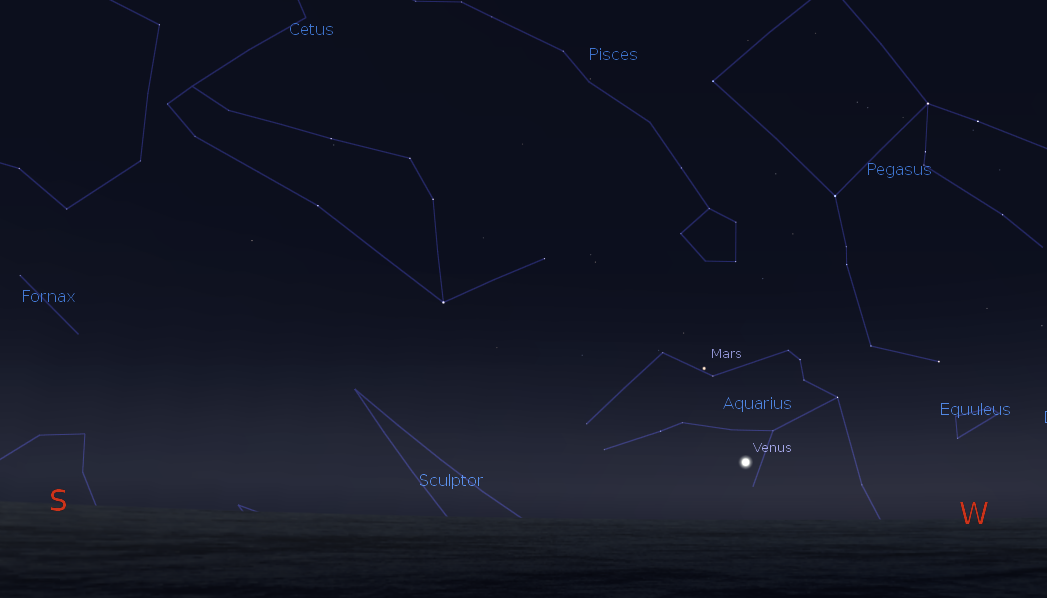
Venus and Mars with the setting autumn constellations at 7 p.m. January 28, 2015. Created using Stellarium.
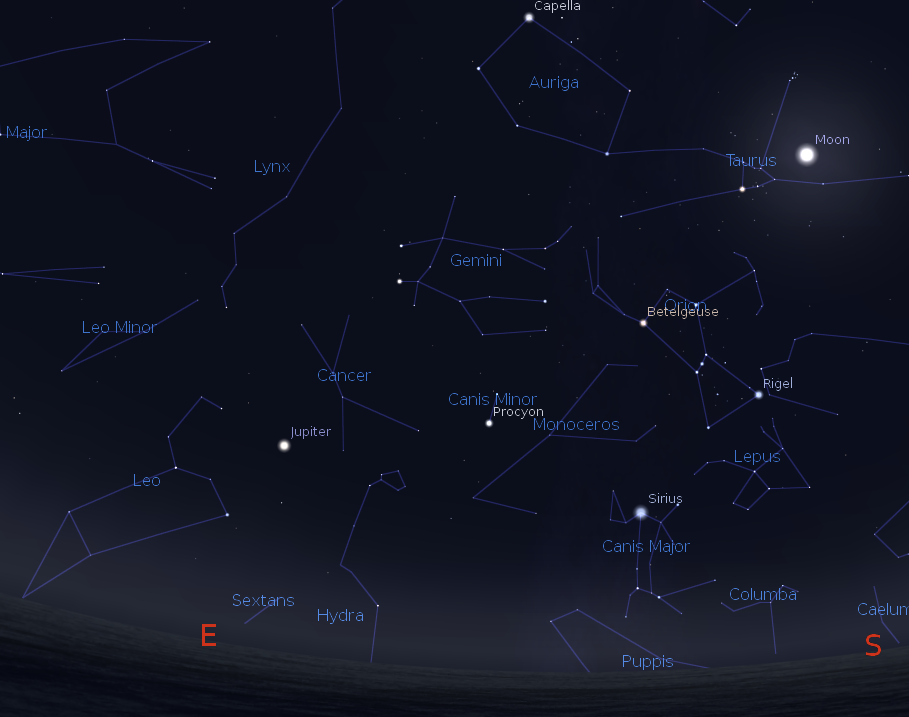
Jupiter, the Moon and the constellations of winter at 9 p.m. January 28, 2015. Created using Stellarium.
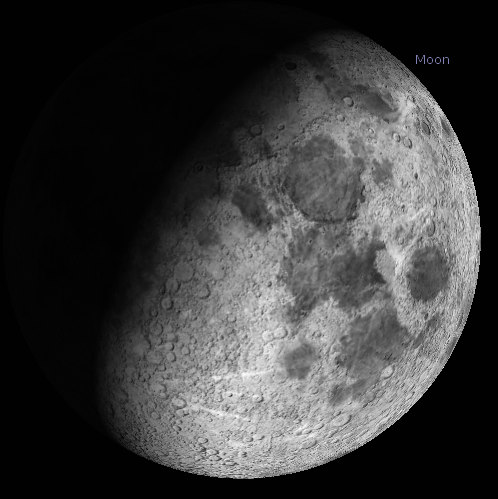
What the moon might look like in binoculars at 9 p.m. January 28, 2015. Created using Stellarium.
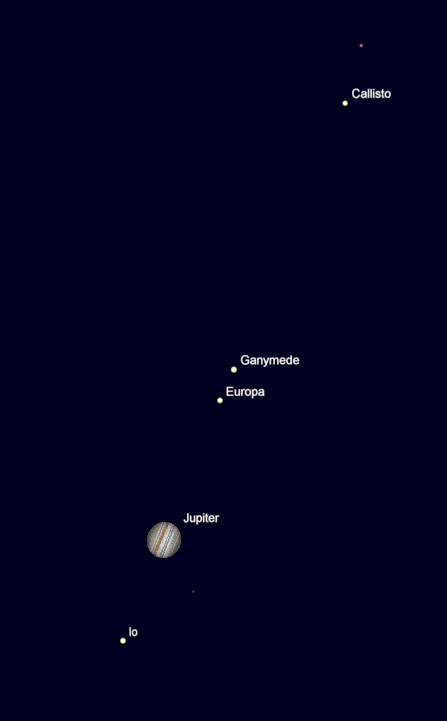
What Jupiter and its moons might appear like in a telescope at 9 p.m., January 28, 2015. Created using Cartes du Ceil (Sky Charts).
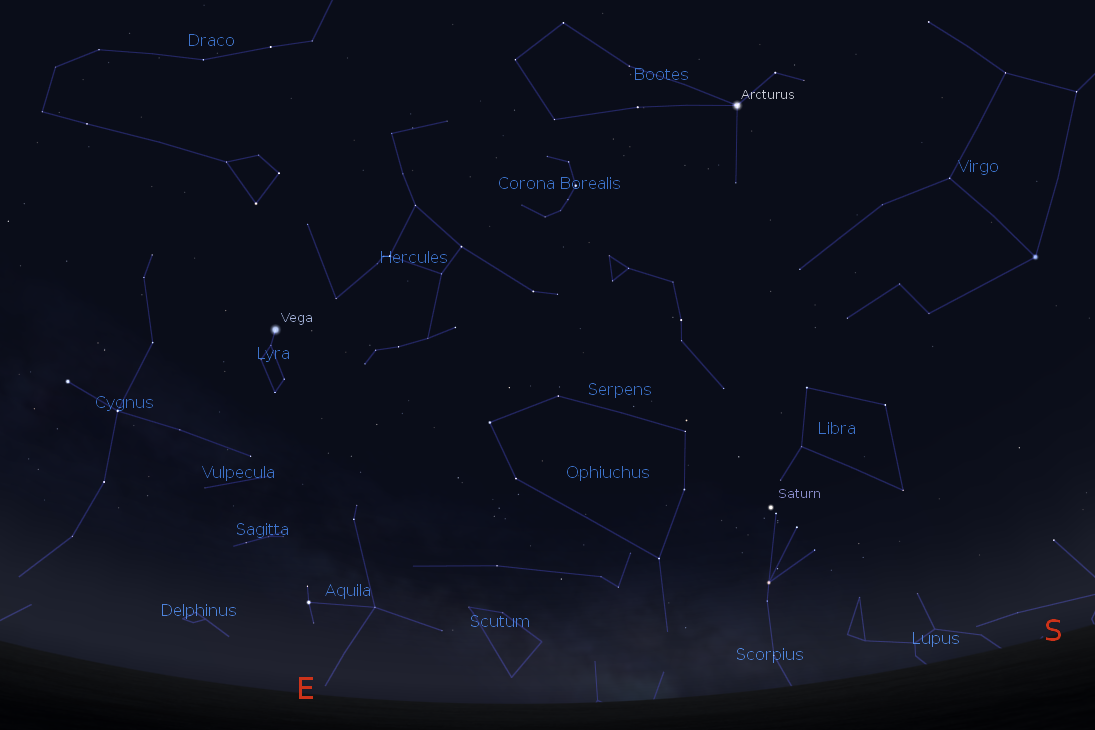
Saturn and a preview of the summer constellations at 6:30 a.m. January 29, 2015. Created using Stellarium.
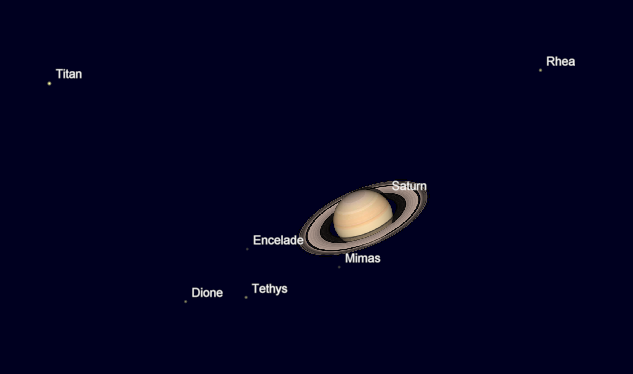
What Saturn and its moons might appear like in a telescope at 6:30 a.m., January 29, 2015. Small telescopes will show only the moon Titan. Created using Cartes du Ceil (Sky Charts).
Comet Lovejoy
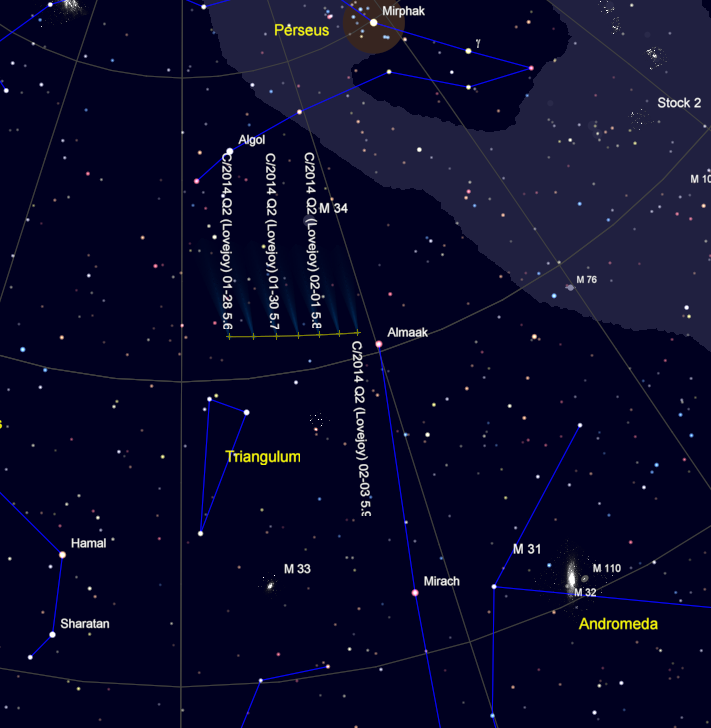
The track of Comet Lovejoy for the next week (from 1/28/2015 to 2/03/2015 at 9 p.m.) Created using Cartes du Ceil (Sky Charts).
There are some fuzzy objects in this part of the sky. However only M31, the Great Andromeda Galaxy, is bright enough to be mistaken for the comet. Next Tuesday and Wednesday the comet will appear close to Almaak (γ Andromedae), a 2nd magnitude star. Note: six of the seven Big Dipper stars are 2nd magnitude.
01/26/2015 – Ephemeris – First quarter Moon, a telescopic asteroid misses the Earth tonight and a Jupiter shadow recap
Note: Ephemeris program generally features objects in the sky that are visible to the naked eye or binoculars. However in the blog, with the ability to expand in both content and illustrations I can add information for telescopic observers and expand postings.
Ephemeris for Monday, January 26th. The sun will rise at 8:08. It’ll be up for 9 hours and 34 minutes, setting at 5:42. The moon, at first quarter today, will set at 1:30 tomorrow morning.
The Moon will be perfectly half illuminated by the sun at 11:48 p.m. The gray patches that appear on the Moon’s surface were called by early telescopic astronomers: seas; because they thought they were bodies of water. The Moon is pretty much bone dry, except for some eternally shadowed craters at the poles, which still aren’t wet because the water is frozen. Anyway the seas or maria on the moon are indeed low spots. The seas, from the top center of the moon down to the lower right are Serenity, Tranquility, Nectar and Fertility. To the upper right all by itself is the Sea of Crises. From Serenity to Fertility some can imagine an upside down rabbit, with ears of unequal sizes. In a few more days we’ll see the face of the man in the Moon.
Times are for the Traverse City/Interlochen area of Michigan. They may be different for your location.
Addenda
First Quarter Moon
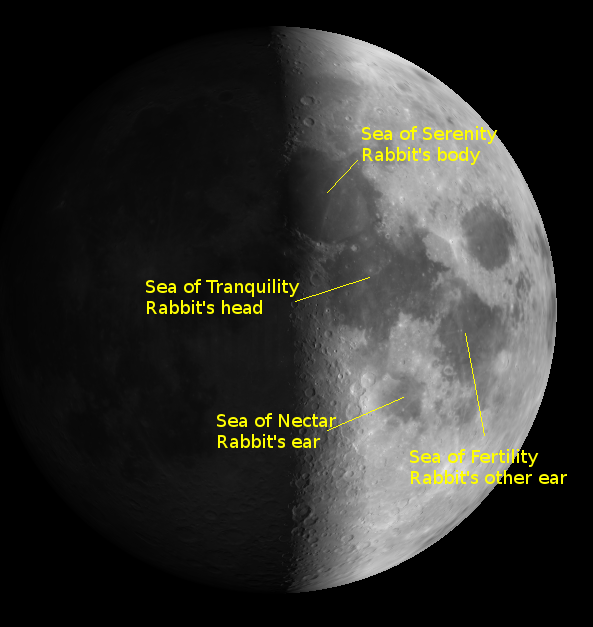
Rabbit in the first quarter Moon. Created using Virtual Moon Atlas.
Tonight Asteroid 2004 BL86 will pass three times the Moon’s distance from the Earth
This evening a rather large asteroid for a Near Earth Object or NEO will pass three-quarters of a million miles from the Earth. The asteroid has the designation 2004 BL86. The cool thing is that this asteroid is half a kilometer or so meters across, that’s 5 soccer or football fields in diameter. Radar from this close passage should nail down the size and shape. Between Goldstone Tracking Station and Arecibo Observatory in Puerto Rico the asteroid should be mapped down to 2 to 4 meters. It would be definitely not cool if this asteroid ever hit the Earth. It will be 9th magnitude, and so will be visible in small telescopes, and it will cross the east or left side of the Beehive star cluster also designated M44 starting about midnight tonight.
If you want to observe the event and don’t have the equipment head on over to www.slooh.com. This is the site for Slooh (pronounced “slew”) Community Observatory which has observatories in the Canary Islands and Chile, and partners with others. Besides these events, members can schedule time and use the telescopes via the internet. Check the above link for more information.
The chart below is from NASA/JPL’s Near Earth Object Program: Updated Charts for Asteroid 2004 BL86 Earth Flyby on Jan 26, 2015
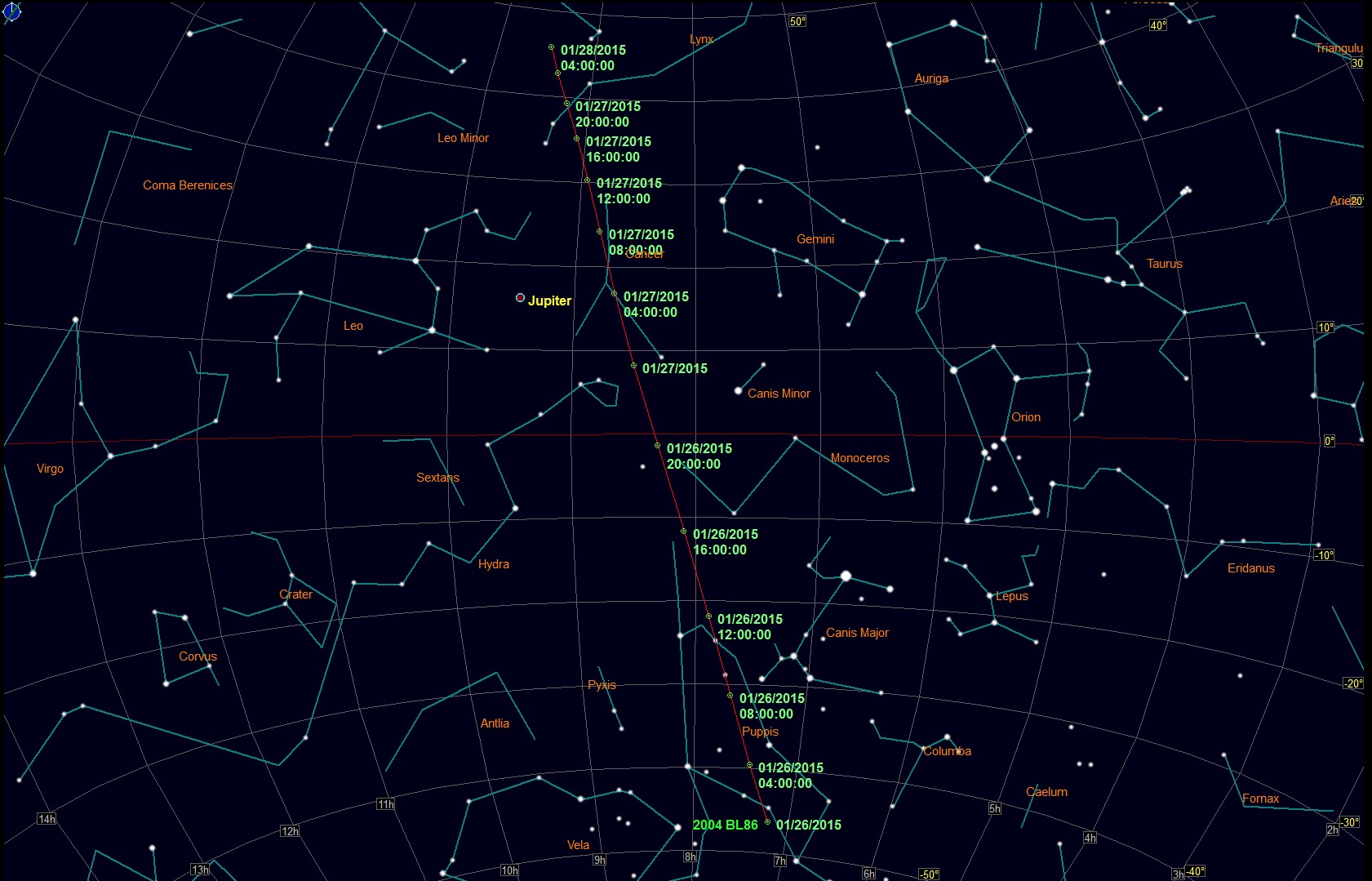
The track of asteroid 2004 BL86 as viewed from the Earth, plotted on a star chart with an equatorial coordinate grid. The asteroid location is shown at four-hour intervals from January 26 to 28. The indicated times are Universal Time; subtract 5 hours for Eastern Standard Time (EST), 6 hours for CST, and 8 hours for PST. On January 26, the asteroid will pass within 11 degrees of Jupiter, now shining brightly in the east in the evening sky. Image and caption credit: NASA/JPL-Caltech. JPL orbit solution #43, with star chart graphics produced using C2A. Click to enlarge.
Below is a chart from Universe Today. Here’s a link to their web page.
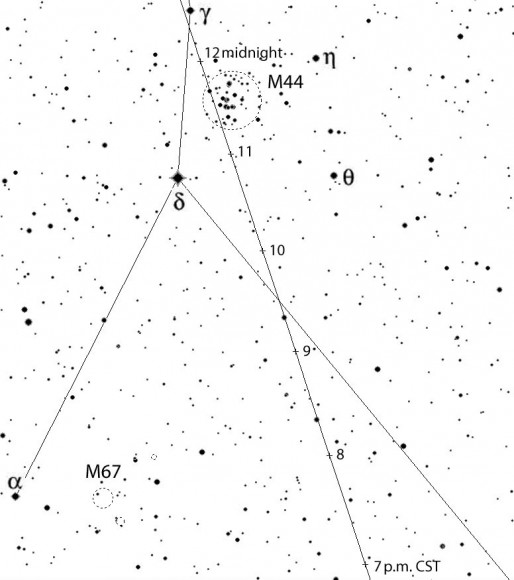
A Black on white chart of asteroid 2004 BL86 crossing to the right of M44. Note that the actual path depends on your location since the chart is based on the center of the Earth. The closer to your horizon the greatest deviation from the path shown. Time Ticks are for CST. Add one hour to them for EST. The Midnight tick mark is 0 h UT or GMT the 27th. Credit Universe Today and created with Chris Marriott’s SkyMap software.
Sky and Telescope has charts that have BL86’s track plotted about 15 minutes ahead of the track above. It is a newer chart, so the asteroid’s position may have been updated. The Sky and Telescope narrative and charts are here.
Results from Jupiter’s early Saturday satellite shadow play
The video live feed from the Griffith Planetarium in Los Angeles was a bust. It suffered from what astronomers call bad seeing. I mean really horrible seeing. Astronomers ascribe at least two qualities to the sky, other than brightness due to the moon or light pollution. That is transparency and seeing. Seeing is the steadiness of the sky. What Jupiter looked like was looking at a small disk at the bottom of a swimming pool while the kids are still playing in it. At first I ascribed it to Jupiter being low in the LA sky, being 3 hours west of here. But it didn’t get better as the night progressed. I could occasionally make out Callisto’s shadow, just because I knew where it’s supposed to be. But that’s it.
However my friend from the Detroit area, Scott Anttila, blessed at least for a while with clearer and calmer skies got some wonderful pictures of the first part of the multiple shadow event.
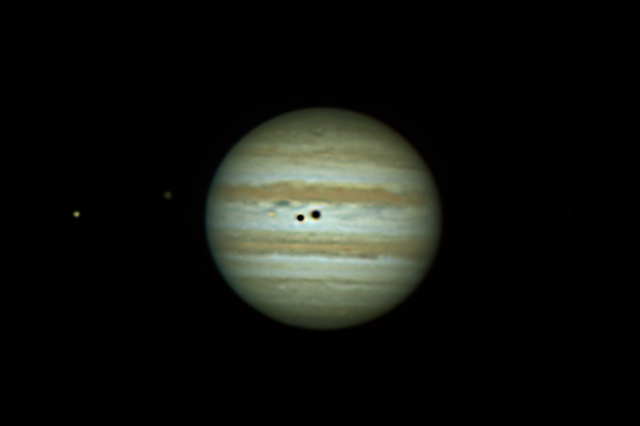
Left to right the shadows of Io and Callisto crossing the face of Jupiter at 12:52 a.m. January 24, 2015. Credit Scott Anttila.
Note that Callisto has a larger shadow than Io. That’s mainly due to it’s greater distance from Jupiter that makes its shadow larger and fuzzier than the closer Io.
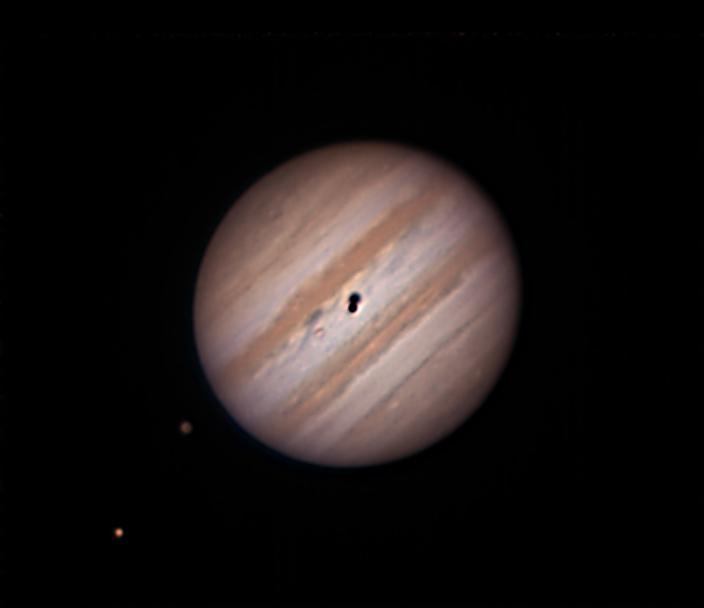
In this picture Io’s shadow has just caught up with Callisto’s shadow. Credit: Scott Anttila.
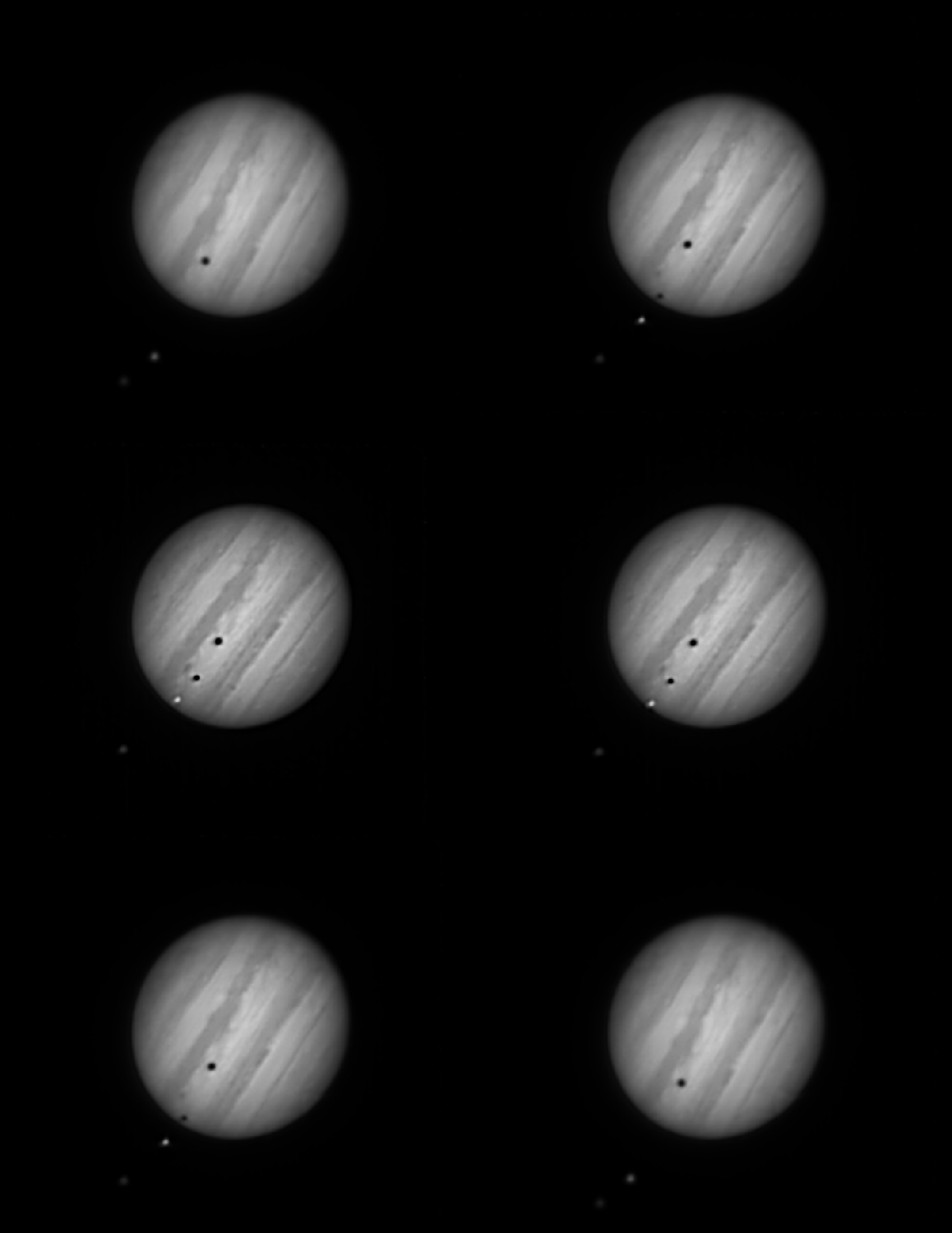
Rocking animation of the early stages of the shadow show on Jupiter. Callisto’s shadow already on the planet while Io’s shadow is just entering. Also Io’s transit is starting, following its shadow on the planet. Credit: Scott Anttila
01/21/2015 – Ephemeris – Our weekly look at the bright planets and a comet
Ephemeris for Wednesday, January 21st. The sun will rise at 8:12. It’ll be up for 9 hours and 23 minutes, setting at 5:35. The moon, 1 day past new, will set at 7:29 this evening.
Lets take a look at the bright planets and a pretty bright comet for this week. Venus and Mercury are close low in the southwest by 6:30 p.m.. Mercury is about 8 moon widths at about 4 o’clock angle from the brighter Venus. Tonight the Noon will be above and between them. Mercury will set at 6:59, while Venus will set at 7:22 p.m. Mars appear above and left of Venus in the southwest, and is in the constellation of Aquarius. The Red Planet will set tonight at 8:41 p.m. Jupiter will rise in the east at 6:59 p.m. It’s near the sickle-shaped head of Leo the lion. Early risers will be able to spot Saturn which will rise in the east-southeast at 3:57 a.m. Comet Lovejoy, visible in binoculars, is a bit more than the width of a fist to the right of the Pleiades.
Times are for the Traverse City/Interlochen area of Michigan. They may be different for your location.
Addendum
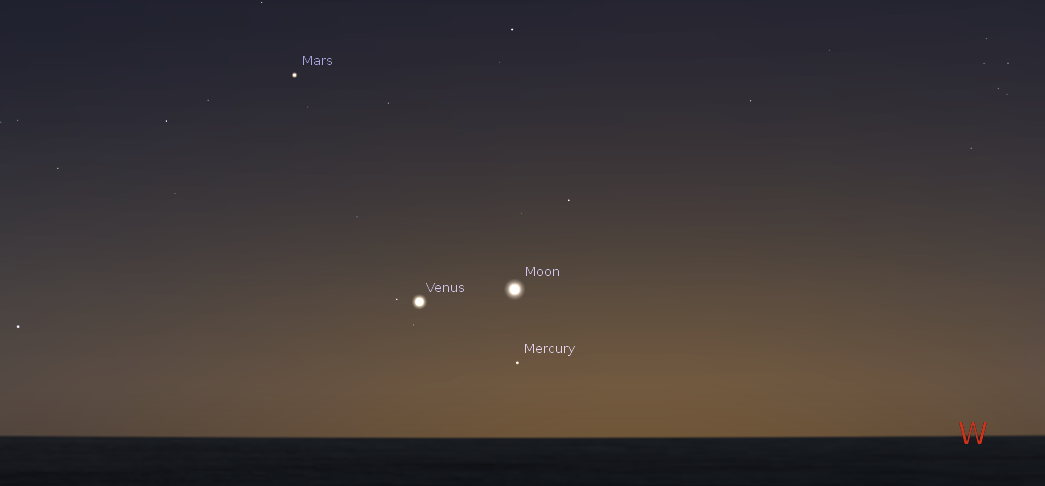
Venus, Mercury and the crescent Moon, which will be a lot dimmer than seen here, with Mars at 6:30 p.m. January 21, 2015. Created using Stellarium.
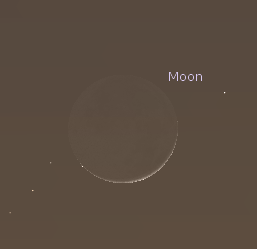
One day old Moon at 6:30 p.m., January 21, 2015. Created using Stellarium.
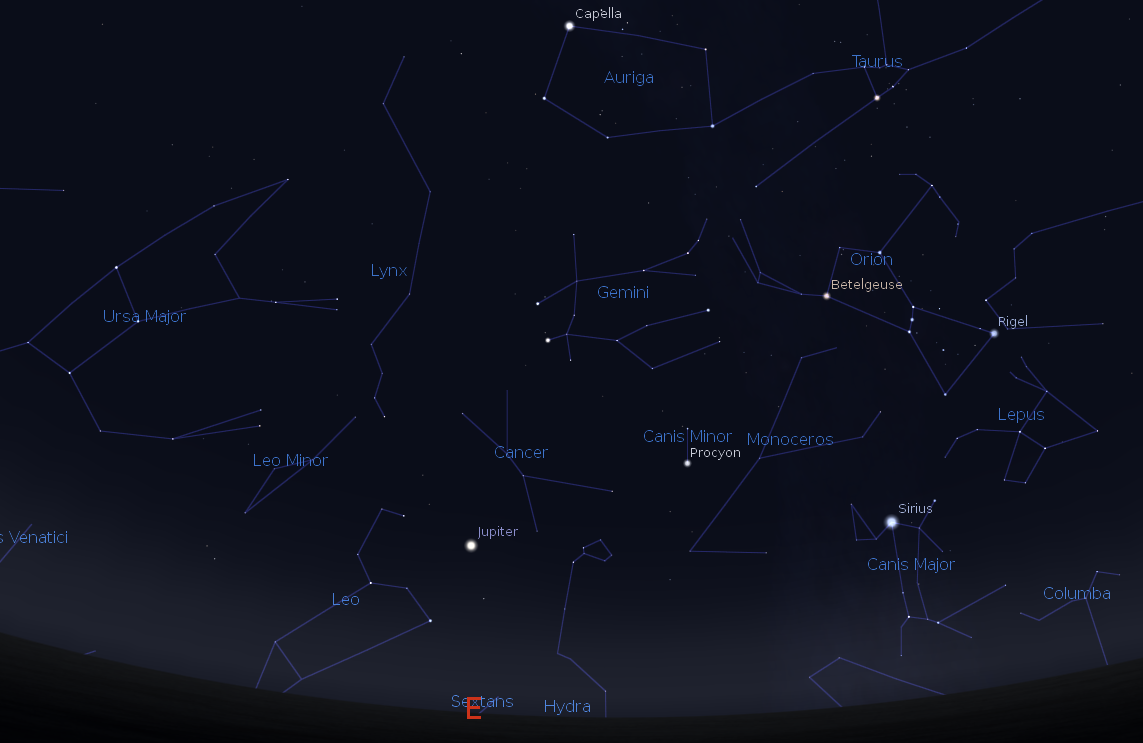
Jupiter and the winter constellations at 9 p.m., January 21, 2015. Created using Stellarium.
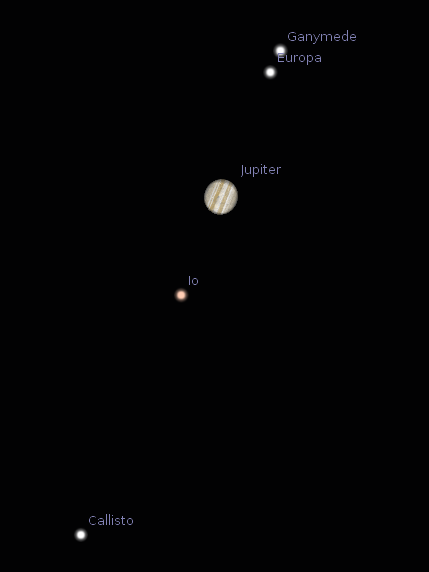
Jupiter and 4 Galilean moons through a telescope. The moon’s aren’t really that bright compared to Jupiter. The time for this observation will be 9 p.m. January 21, 2015. Created using Stellarium.
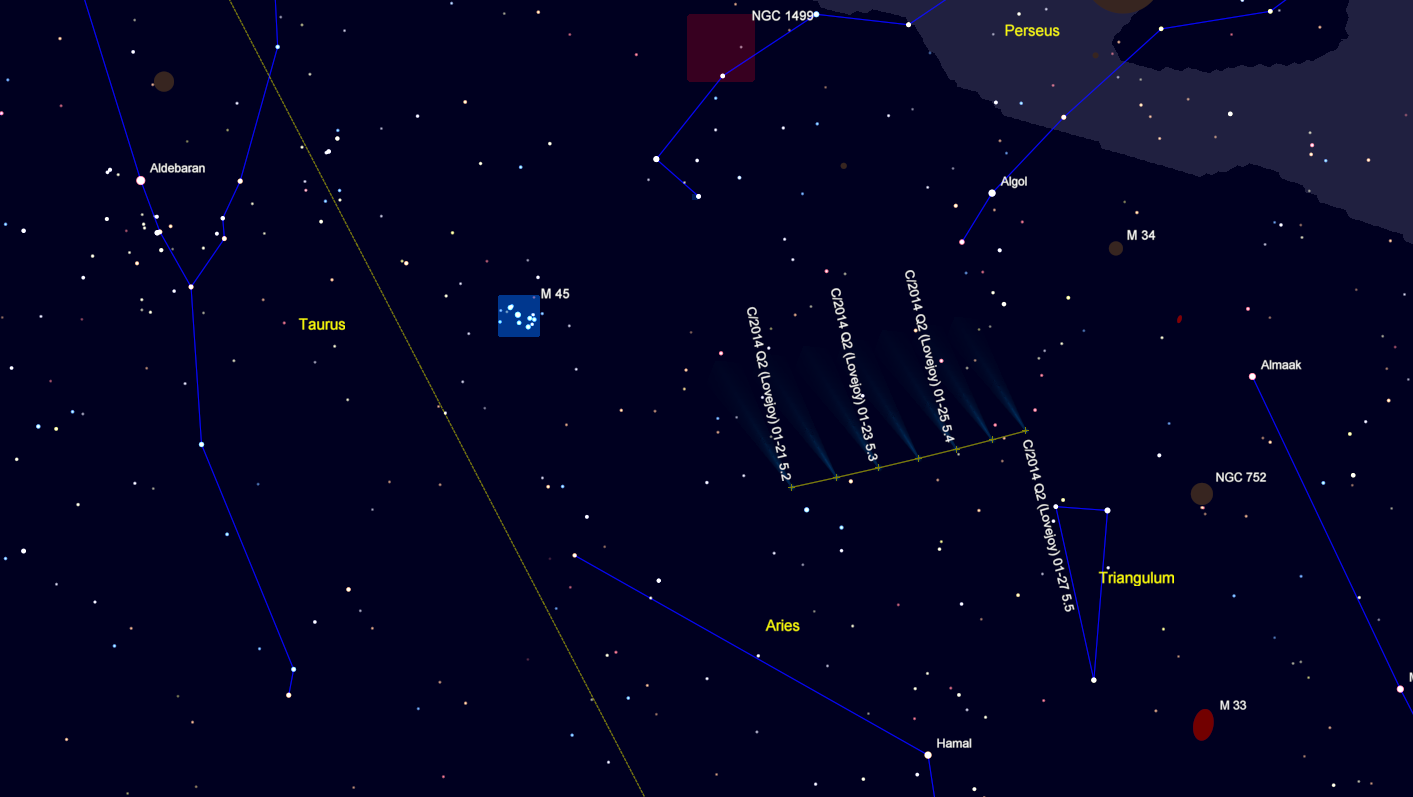
The track of Comet Lovejoy for the next week (from 1/21/2015 to 1/27/2015 at 9 p.m.) Created using Cartes du Ceil (Sky Charts).
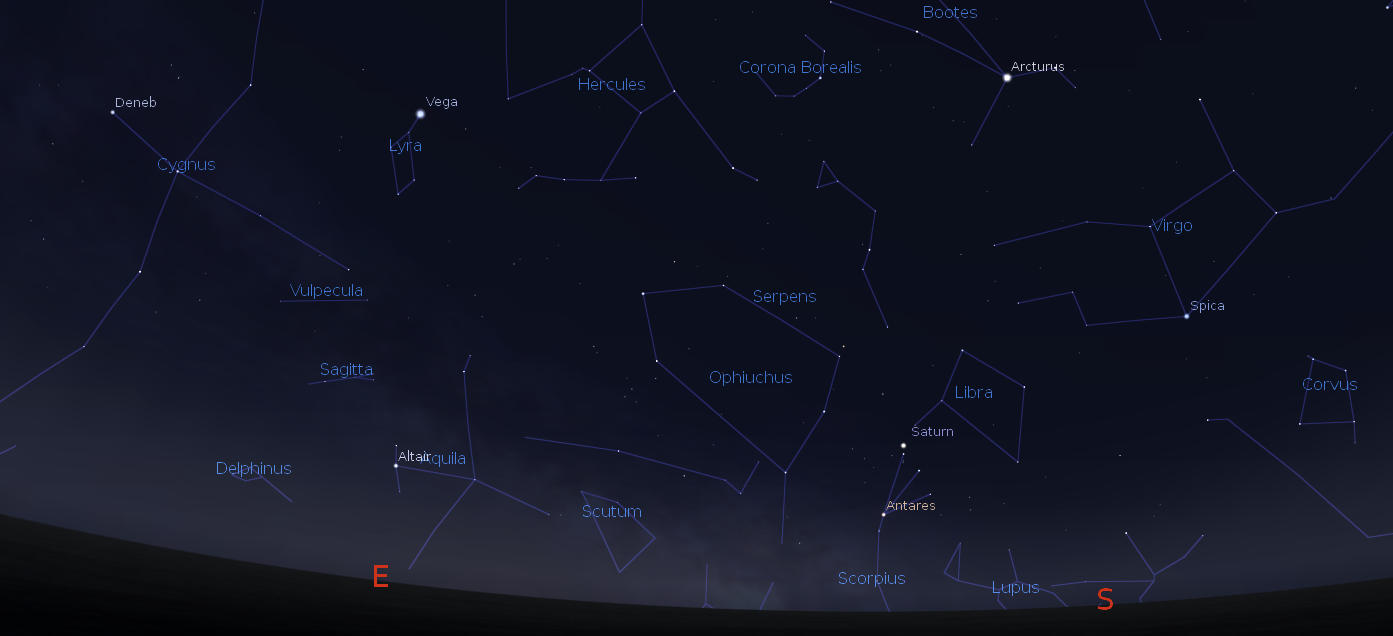
What we need in the depths of winter, a preview of the summer stars, 5 months hence, but at 7 a.m. January 22, 2015. Saturn is visible in Scorpius. Created using Stellarium.
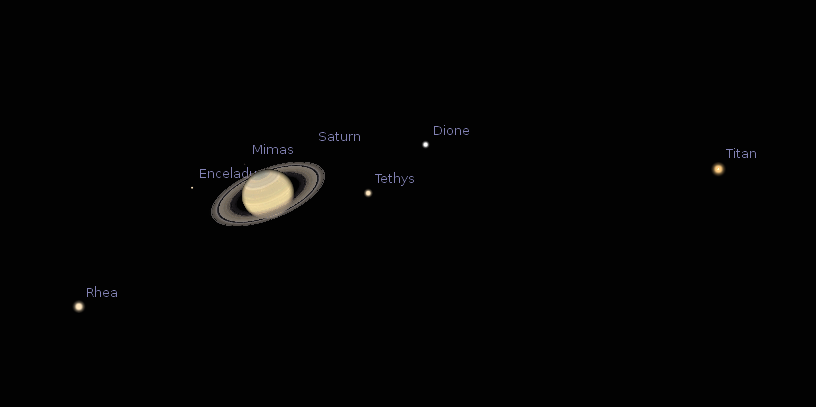
Saturn and its moons at 7 a.m., January 22, 2015. Actually only Titan would be visible in small telescopes. Created using Stellarium.
01/14/2015 – Ephemeris – Five bright planets and Comet Lovejoy are visible now
Ephemeris for Wednesday, January 14th. The sun will rise at 8:17. It’ll be up for 9 hours and 9 minutes, setting at 5:26. The moon, 1 day past last quarter, will rise at 3:05 tomorrow morning.
Lets take a look at the bright planets and a pretty bright comet for this week. Venus and Mercury are side by side low in the southwest by 6 p.m. Mercury is about 2 and a half moon widths to the right of the much brighter Venus. Mercury will set at 7:02, while Venus will set at 7:03 p.m. Mars is low in the southwest at 7 p.m. and is in the constellation of Aquarius. The Red Planet will set tonight at 8:39 p.m. Jupiter will rise in the east at 7:31 p.m. It’s near the sickle shaped head of Leo the lion. Early risers will be able to spot Saturn which will rise in the east-southeast at 4:21 a.m. Comet Lovejoy, visible in binoculars, makes an equilateral triangle with the V shaped head of Taurus and the Pleiades, to the right of both.
Times are for the Traverse City/Interlochen area of Michigan. They may be different for your location.
Addendum
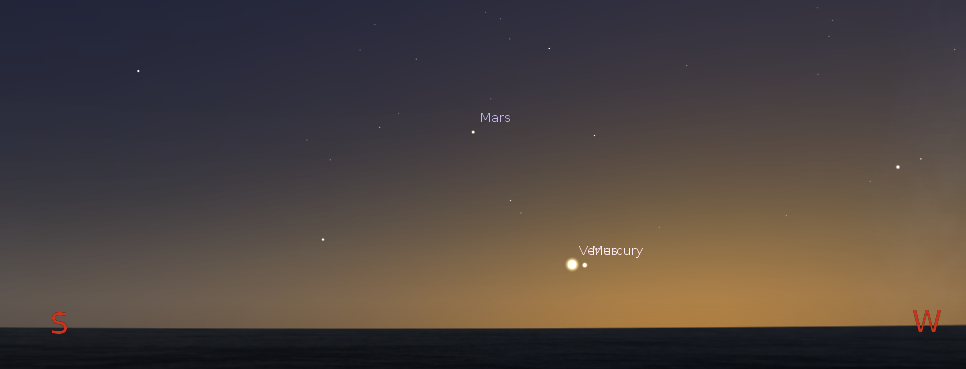
Venus, Mercury and Mars at 6:15 p.m. on January 14, 2015. Note that Mercury is getting dimmer, and Venus is overtaking Mars which is a bit more than a month away. Created using Stellarium.
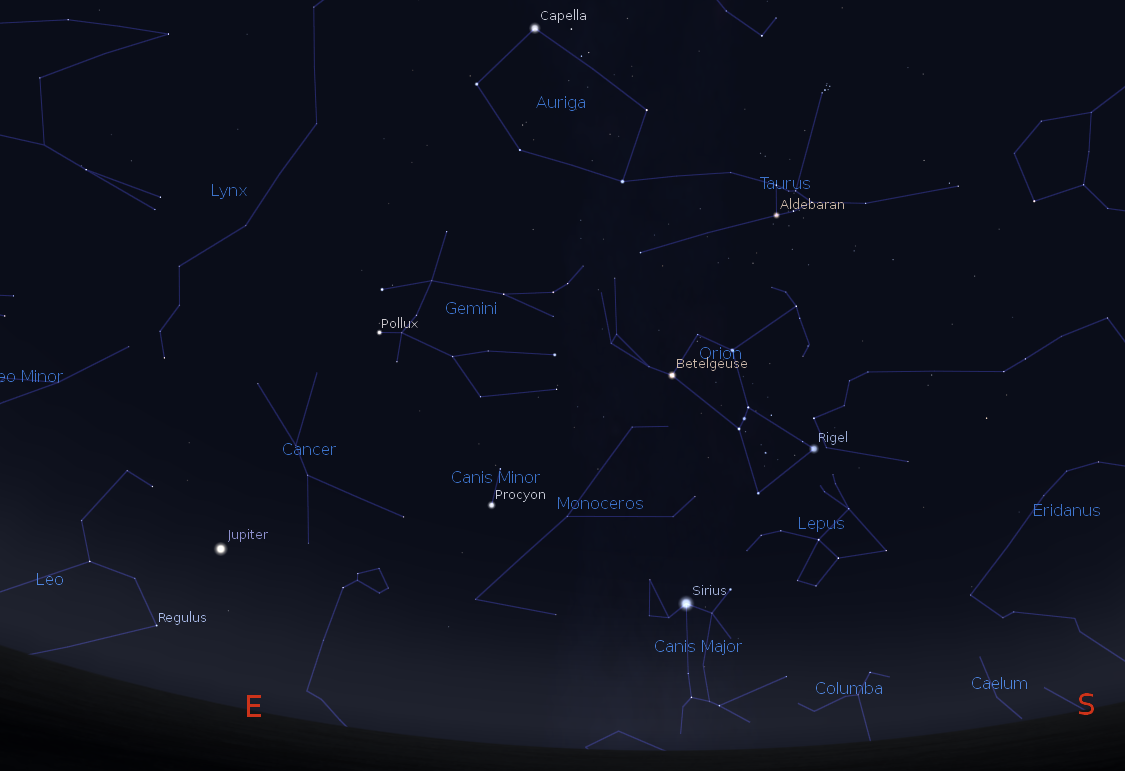
Jupiter and the winter constellations at 9 p.m. on January 14, 2015. Comet Lovejoy is not shown. Created using Stellarium.
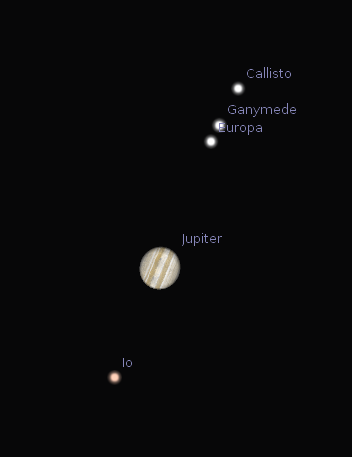
Jupiter and it’s Galilean satellites as seen in a telescope at 9 p.m. on January 14, 2015. Created using Stellarium.
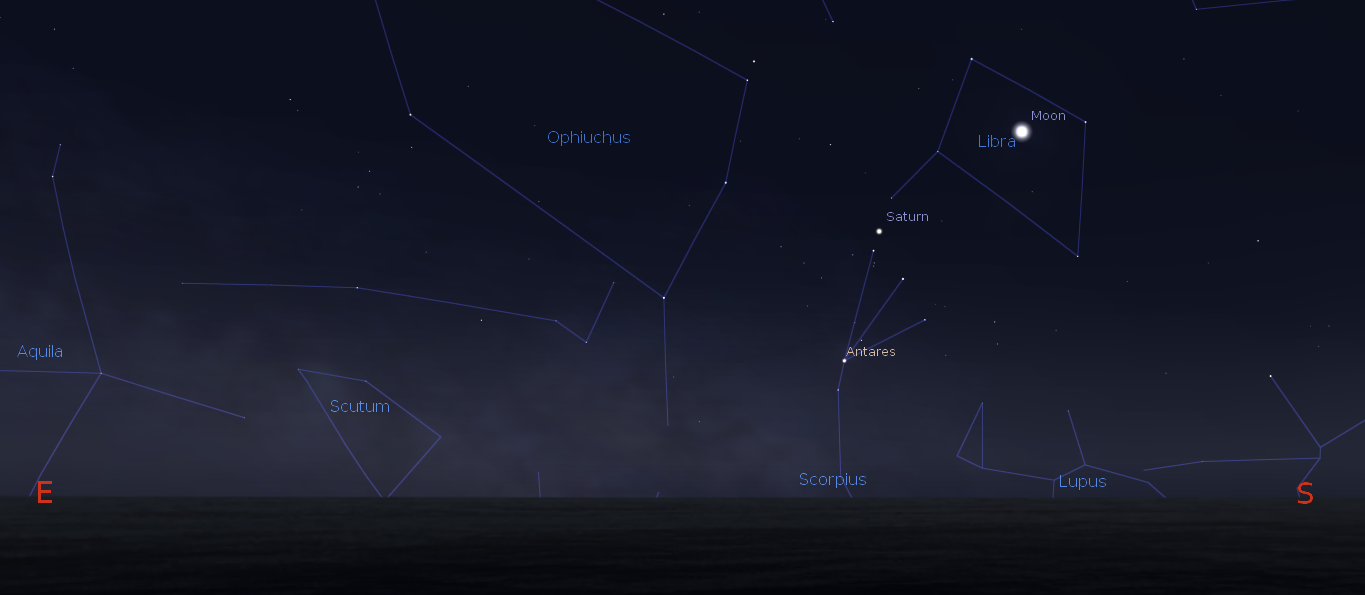
Saturn and the Moon at 7 a.m., January 15, 2015. Created using Stellarium.
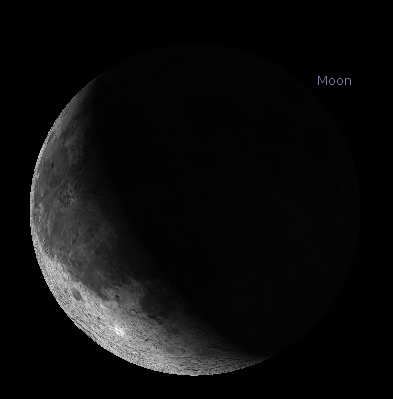
The Moon as it would be seen in binoculars at 7 a.m., January 15, 2015. Created using Stellarium.
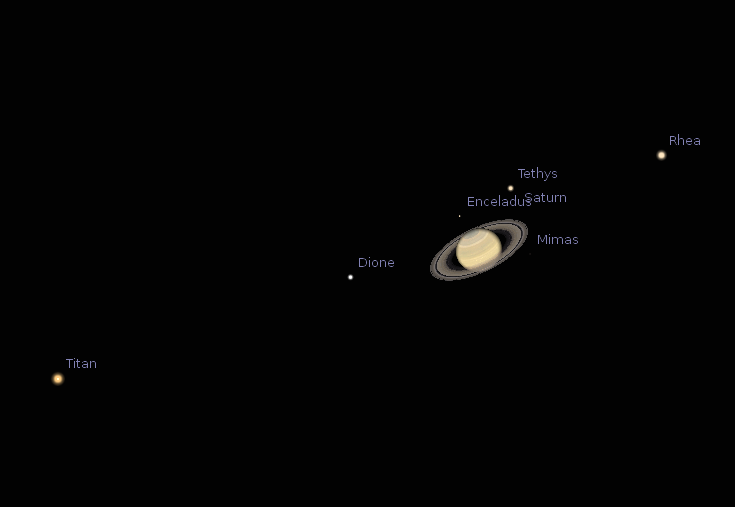
Saturn as seen with a telescope at 7 a.m., January 15, 2015. Titan is visible in most small telescopes. Created using Stellarium.
Comet Lovejoy
We finally had a clear night. Comet Lovejoy was not visible to me to the naked eye last night. But I thing an observer far from city lights and perfectly dark adapted might be able to spot it. It was a great sight in 10X50 binoculars. it was a bright featureless round blob of light. I couldn’t spot a tail, which I expected. My friend Scott Anttila, an excellent astrophotographer unfortunately has moved down to the Detroit area and is hindered by the lights down there. However he was able to get this image of the comet sans tail. But the green color of the come shows wonderfully. Unfortunately our eyes don’t register color at low light levels.
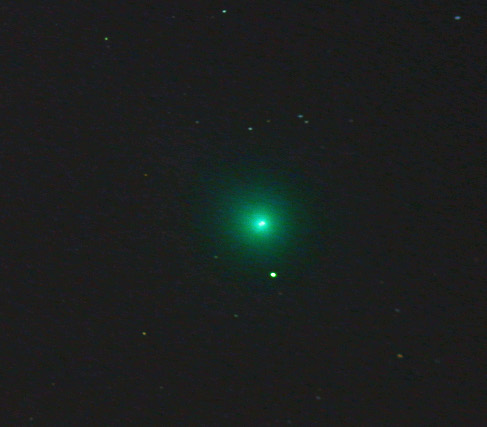
Scott Anttila’s photo of Comet Lovejoy from the light polluted skies of the Detroit area.
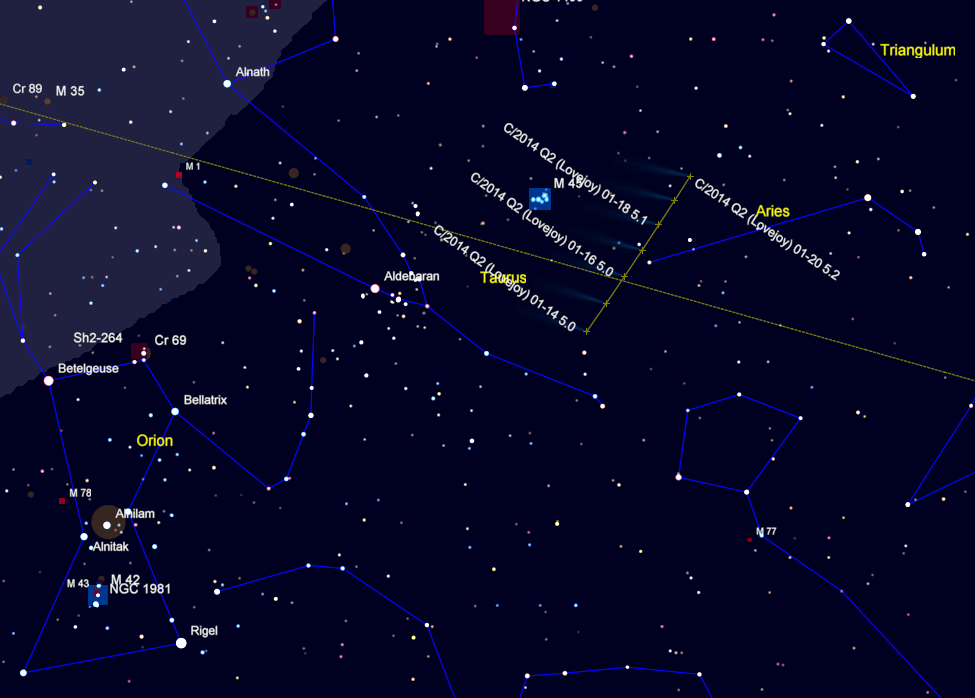
The track of Comet Lovejoy for the next week (from 1/14/2015 to 1/20/2015 at 9 p.m.) Created using Cartes du Ceil (Sky Charts).
01/07/2015 – Ephemeris – Lets take our first looks at the bright planets and a pretty bright comet
Ephemeris for Wednesday, January 7th. The sun will rise at 8:19. It’ll be up for 8 hours and 59 minutes, setting at 5:18. The moon, 3 days past full, will rise at 8:10 this evening.
Lets take our first look at the bright planets for 2015. Mercury is visible below right of Venus by about 2 moon widths low in the southwest shortly after sunset. On Saturday Mercury will be its closest to Venus. Mercury will set at 6:38, while Venus will set at 6:44 p.m. They will be visible low in the southwestern twilight by 6 p.m. Mars is low in the southwest at 7 p.m. and is in the constellation of Capricornus and will cross the boundary into Aquarius tomorrow. The Red Planet will set tonight at 8:37 p.m. Jupiter will rise in the east at 8:02 p.m. It’s near the sickle-shaped head of Leo the lion. Early risers will be able to spot Saturn which will rise in the east-southeast at 4:46 a.m. On the 18th it will cross the border from Libra to Scorpius.
Times are for the Traverse City/Interlochen area of Michigan. They may be different for your location.
Addendum
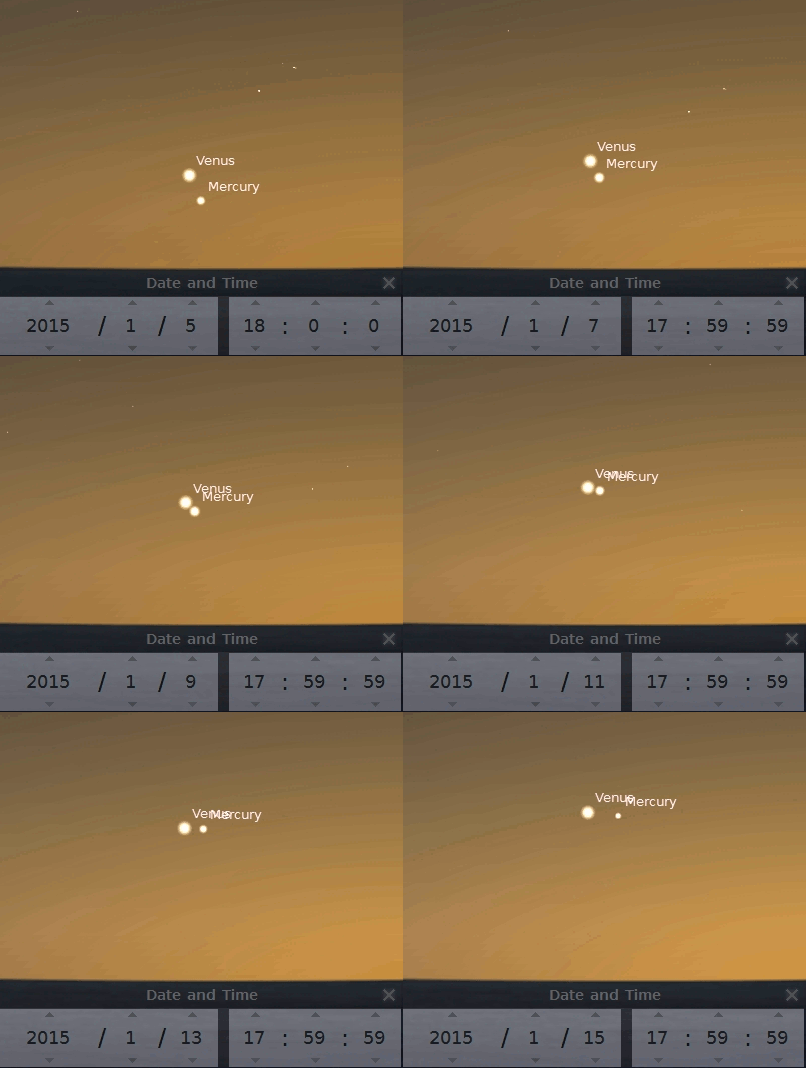
Animation of the Quasi-conjunction of Venus and Mercury. Time span 1/05/2015 to 1/15/2015 at 7 p.m. Created by Bob Moler using Stellarium and GIMP.
Note that Mercury gets dimmer as the days go by. This is because its phase moves from gibbous to half illuminated on the 14th at its greatest elongation from the Sun.
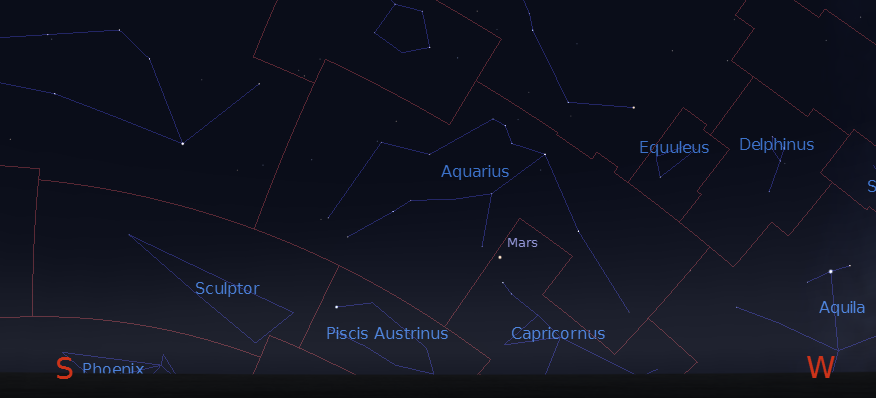
Mars and the setting constellations, with constellation boundaries in red. at 7 p.m. on January 7, 2015. Created using Stellarium.
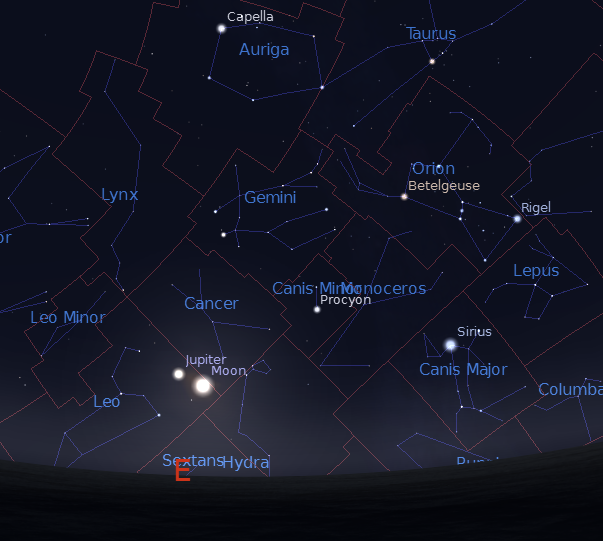
Jupiter, the Moon and the winter constellations at 10 p.m. on January 7, 2015. Created using Stellarium.
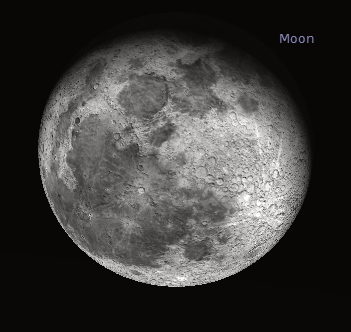
The Moon as seen through binoculars at 10 p.m. on January 7, 2015. Created using Stellarium.
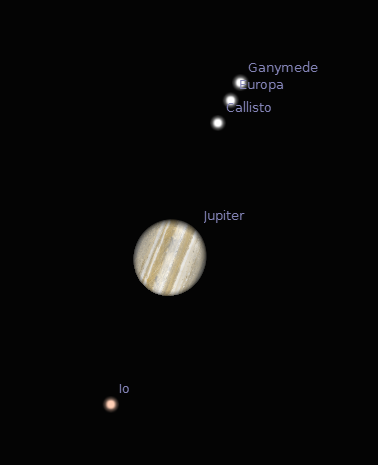
Jupiter and its satellites as seen through a telescope at 10 p.m. on January 7, 2015. Created using Stellarium.
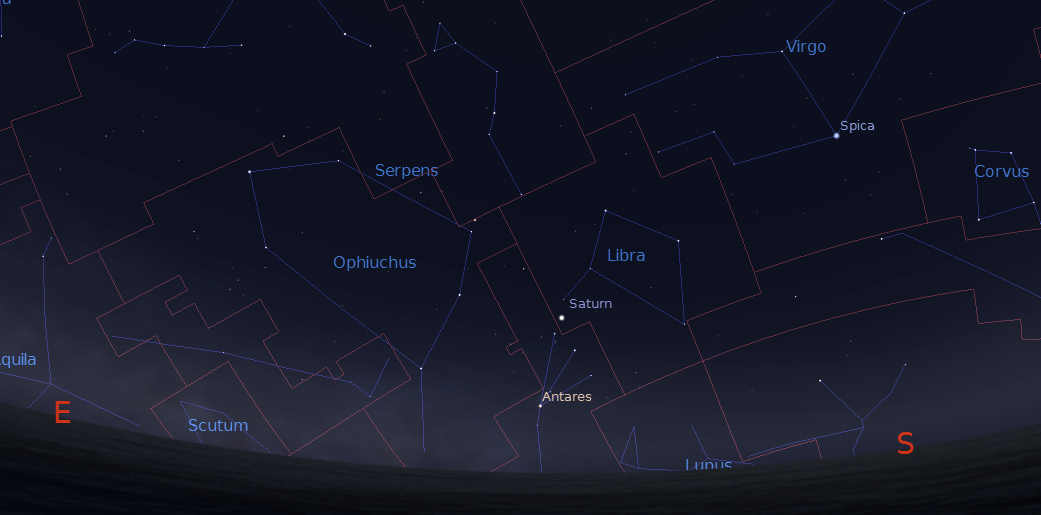
Saturn and the spring constellations at 7 p.m. on January 8, 2015. Created using Stellarium.
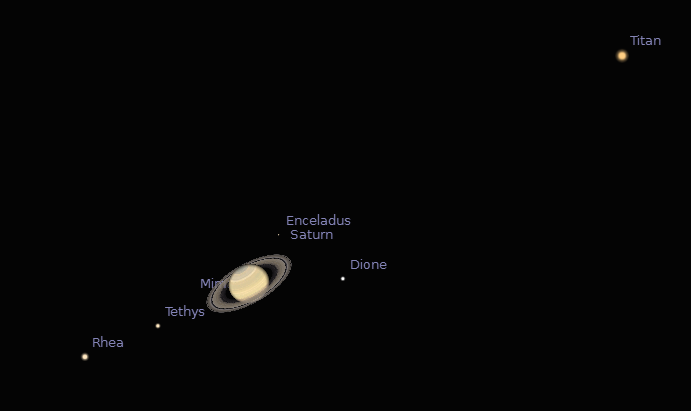
Saturn and satellites through a telescope at 7 a.m. January 8, 2015. Note that the moons other than Titan will be difficult to spot. Created using Stellarium.
Comet C/2014 Q2 (Lovejoy)
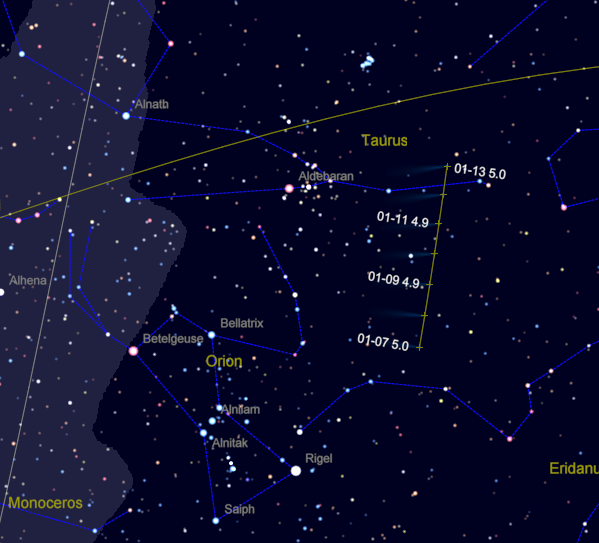
Comet Lovejoy track for January 7 to January 13, 2015. Despite the magnitudes being less than 6, binoculars will, most likely, be needed to spot it. Every other day is marked with month-day and magnitude of the comet.
12/31/2014 – Ephemeris – A New Year’s look at the bright planets and a comet
Ephemeris for New Years Eve, Wednesday, December 31st. The sun will rise at 8:19. It’ll be up for 8 hours and 52 minutes, setting at 5:11. The moon, 3 days past first quarter, will set at 4:42 tomorrow morning.
Lets take a last look at the bright planets for 2014. Mercury joins Venus low in the southwest. It will be below and right of Venus and will set at 6:07 p.m. Venus is low in the southwest shortly after sunset. It now sets at 6:26 p.m., an hour and 15 minutes after the sun. It will be seen low in the southwestern twilight by 5:55 p.m. Mars is low in the southwest at 7 p.m. and is in the constellation of Capricornus. The Red Planet will set tonight at 8:36 p.m. Jupiter will rise in the east at 8:33 p.m. It’s near the sickle-shaped head of Leo. Jupiter is now moving slowly westward. This is an effect that happens because the Earth is passing Jupiter, a motion shared by all the planets that baffled the ancients who thought the Earth to be motionless. Early risers will be able to spot Saturn which will rise in the east-southeast at 5:10 a.m.
Times are for the Traverse City/Interlochen area of Michigan. They may be different for your location.
Addendum
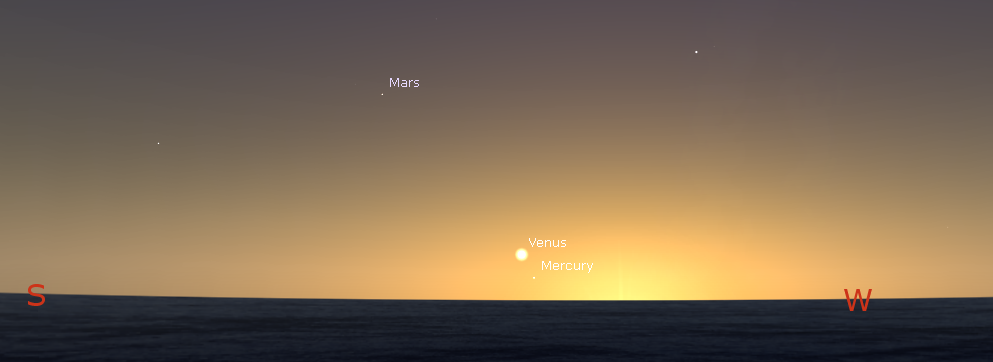
Mercury, Venus and Mars are seen in the southwestern sky shortly after sunset. In this case 5:45 p.m. December 31, 2014, only 34 minutes after sunset. Created using Stellarium.
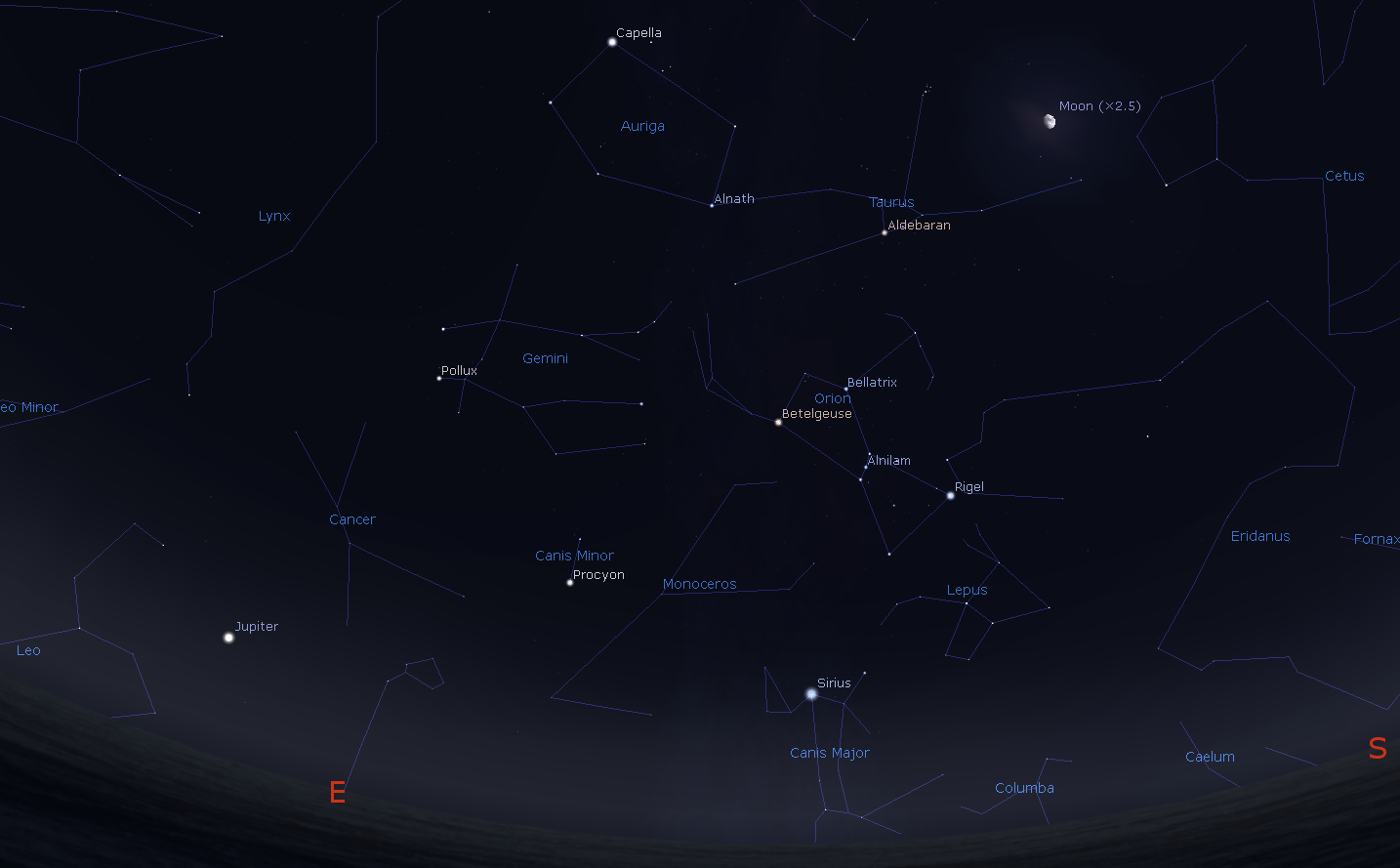
Jupiter, the Moon and the winter constellations at 9:30 p.m. December 31, 2014. Created using Stellarium.
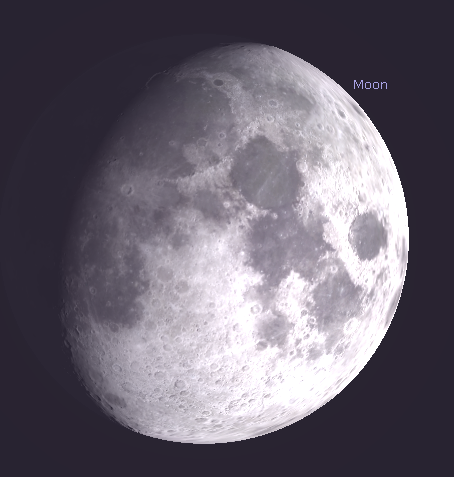
The Moon as it will appear in binoculars at 9:30 p.m. December 31, 2014. Created using Stellarium.
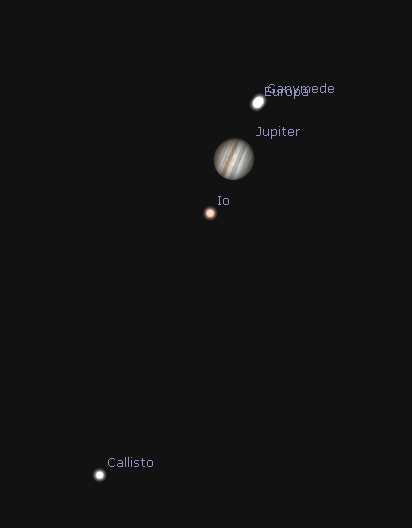
Jupiter seen through a telescope at 9:30 p.m. December 31, 2014. Note that Ganymede and Europa will appear very close to each other. Created using Stellarium.
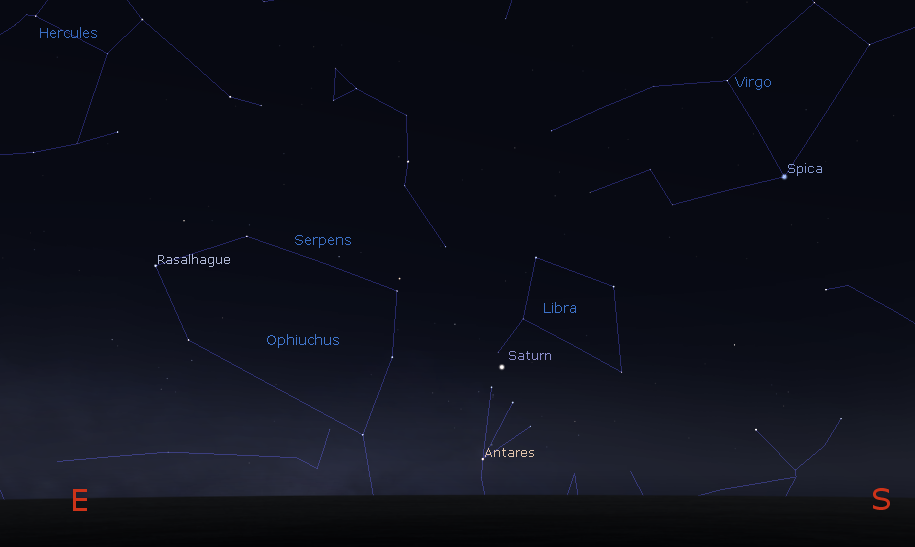
Saturn and the late spring and early summer constellations at 7 a.m. New Year’s Day 2015. Created using Stellarium.
Comet Lovejoy
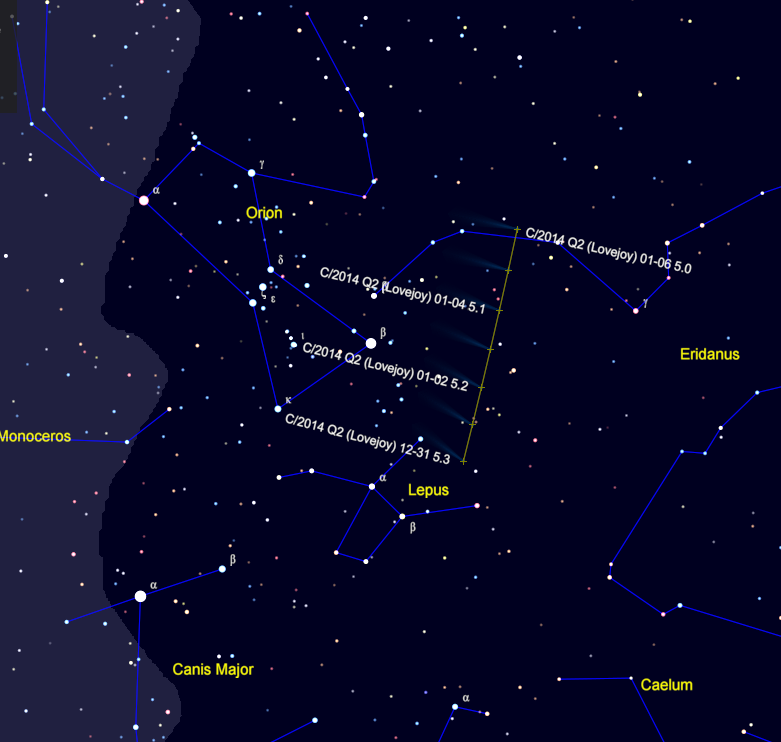
Comet Lovejoy (C/2014 Q2) plotted for 9 p.m. from 12/31/2014 to 1/06/2015. Created using Cartes du Ceil (Sky Charts).
12/24/2014 – Ephemeris – Twas the night before Christmas and only the planets and a comet were stirring
Ephemeris for Christmas Eve, Wednesday, December 24th. The sun will rise at 8:17. It’ll be up for 8 hours and 49 minutes, setting at 5:06. The moon, 3 days past new, will set at 8:37 this evening.
Twas the night before Christmas and only the planets were stirring. Venus is low in the southwest shortly after sunset. It now sets at 6:09 p.m., 63 minutes after the sun. It will be tough to spot at all. New Year’s Eve might be a good time to start to see it. Mars, low in the southwest at 7 p.m. has the Moon just to the right of it tonight. Mars will set tonight at 8:34 p.m. Jupiter, which will be our Christmas Star this year will rise in the east at 8:59 p.m. It’s near the sickle shaped head of Leo. Jupiter is now moving slowly westward. This is an effect that happens because the Earth is passing Jupiter, a motion shared by all the planets that baffled the ancients who thought the Earth to be motionless. Saturn will rise in the east-southeast at 5:34 a.m.
Times are for the Traverse City/Interlochen area of Michigan. They may be different for your location.
Addenda
The Planets tonight
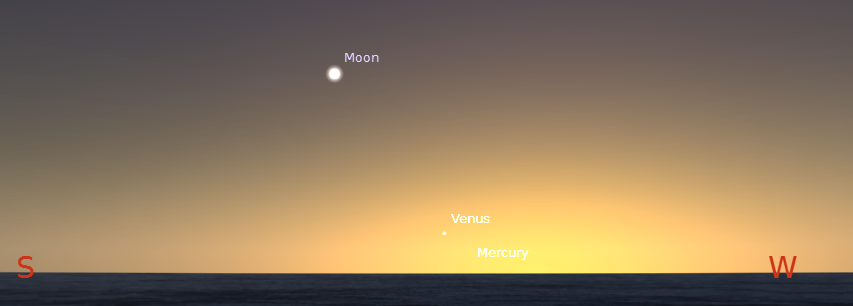
Venus low on the horizon, and the Moon, at 5 30 p.m. on December 24, 2014. Created using Stellarium.
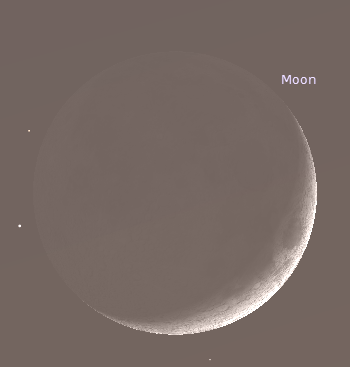
The crescent Moon through binoculars, at 5 30 p.m. on December 24, 2014. Created using Stellarium.
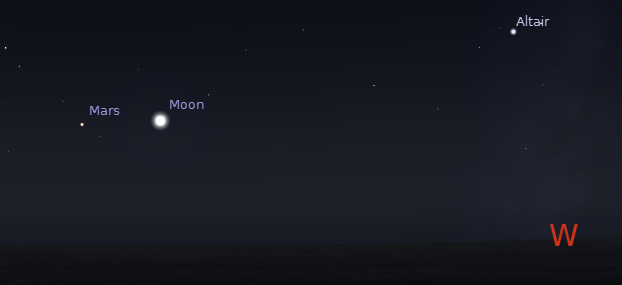
Mars and the Moon at 7:30 p.m. on December 24, 2014. Created using Stellarium.
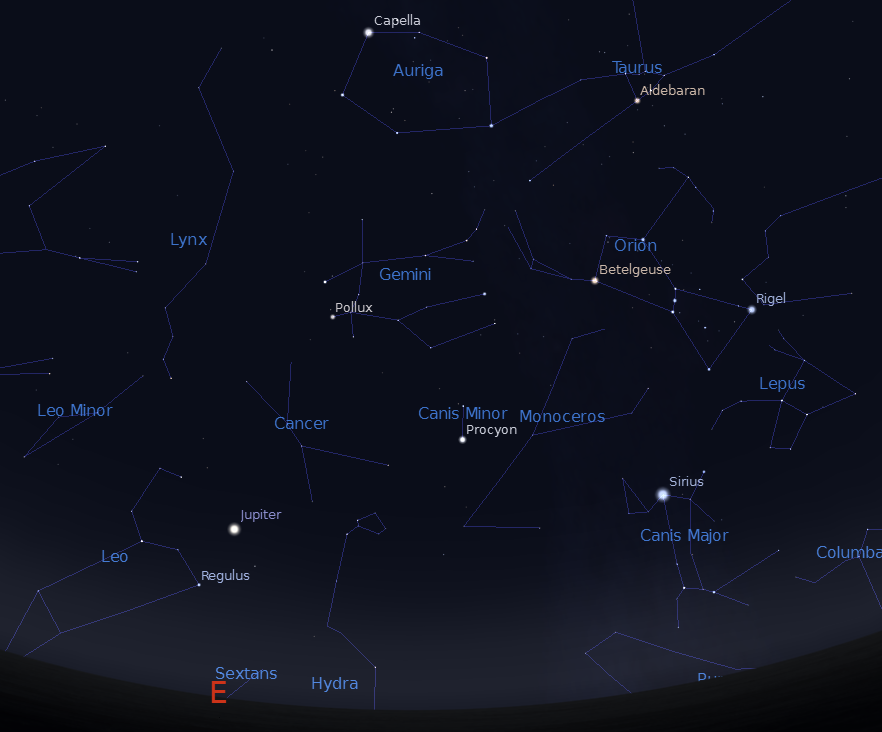
Jupiter and the winter constellations at 11 p.m. on December 24, 2014. Created using Stellarium.
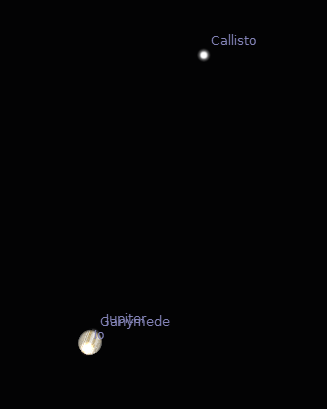
Jupiter with three hidden satellites, with only Callisto showing at 11 p.m. on December 24, 2014. See blow by blow of the satellite disappearances below. Created using Stellarium.
Jovian satellite events of the night of December 24-25, 2014
Ganymede starts eclipse (enters Jupiter’s shadow) 6:20 p.m.
Europa starts eclipse 8:27p.m.
Io’s shadow starts crossing Jupiter 9:32 p.m.
Ganymede leaves Jupiter’s shadow 10:00 p.m.
Ganymede starts being occulted by Jupiter 10:11 p.m.
Io’s transit across the face of Jupiter starts 10:29 p.m.
Io’s shadow leaves the face of Jupiter 11:50 p.m.
Io’s transit of Jupiter ends 12:46 a.m.
Europa’s occultation by Jupiter ends 1:10 a.m.
Ganymede’s occultation by Jupiter ends 1:50 a.m.
Note that Europa’s occultation by Jupiter starts before its eclipse ends, so unlike the more distant Ganymede there isn’t an interval of visibility between the two.
Jovian satellite event timings provided by Project Pluto www.projectpluto.com
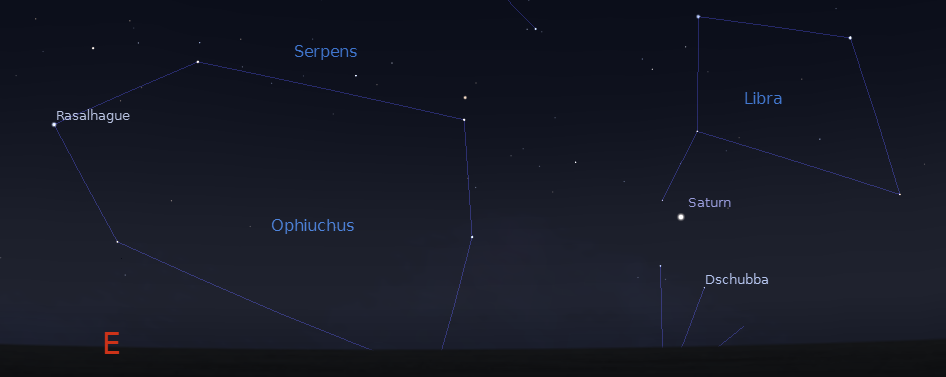
Saturn low in the east-southeast among the constellations of late spring and early summer at 6:30 a.m. on Christmas morning 2014 . Created using Stellarium.
Comet C/2014 Q2 (Lovejoy)
Normally my Ephemeris program deals with celestial objects that are visible to the naked eye. While Comet Lovejoy will, for a few weeks become brighter than 6th magnitude the normal limit for the unaided human eye, a comet is a diffuse object and always looks dimmer than a star of the same magnitude. This comet was discovered August 17, 2014 by Australian amateur astronomer Terry Lovejoy. He has discovered 5 comets. His most famous find was C/2011 W3 (Lovejoy) that buzzed the Sun and survived becoming a magnificent comet for southern hemisphere observers.
Recently Comet Lovejoy became brighter than expected. The data for the charts below are from Minor Planet Center and do not include new brightness estimates that include the outburst. They have the comet reaching magnitude 4.9. The aerith.net website gives the maximum brightness next month of 4. (Magnitudes are like golf scores the lower the magnitude the brighter the object). Each magnitude step is a brightness difference of about 2 and a half times. To check on the comet go to http://www.aerith.net/comet/weekly/current.html. Currently Comet Lovejoy is the brightest comet now visible and is the first comet on the list. Clicking on the comet ‘s name will give you the comet’s page. The last chart on the page is a chart tracking the comet’s brightness from reports vs. prediction. That chart predicts a magnitude of 4 just after the first of the year.
Photographs of the comet show a gaseous coma (head) and a very faint ion tail, which may not be visible visually in binoculars and telescopes. Right now the comet is highest around midnight.
The finder charts below designate the comet by month-day and the predicted magnitude
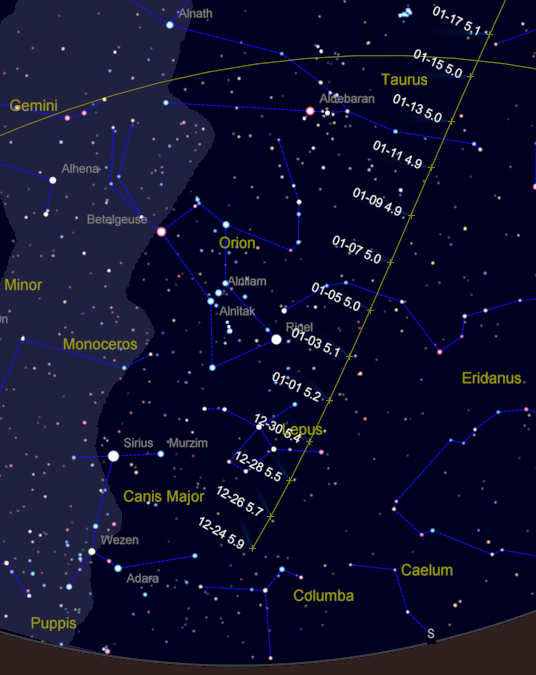
Comet C/2014 Q2 (Lovejoy) at 11 p.m. at 2 day intervals from tonight 12/24/2014 to 1/17/2015. Created using Cartes du Ceil (Sky Charts).
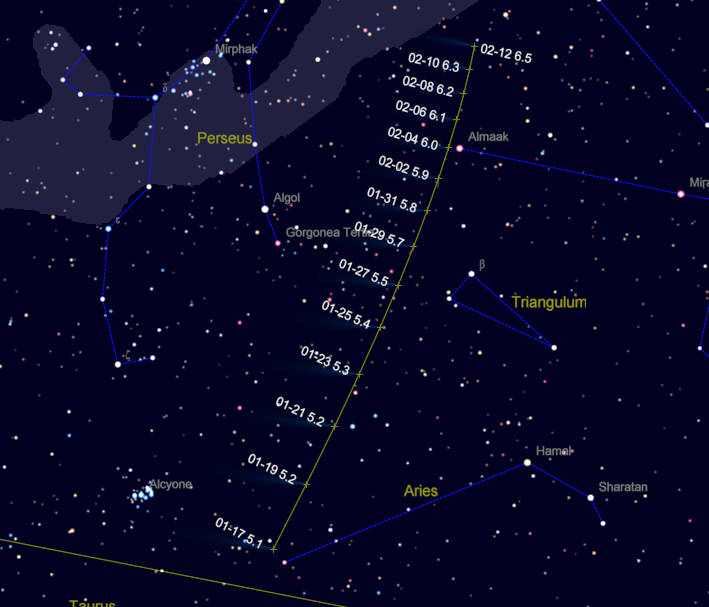
Comet C/2014 Q2 (Lovejoy) at 8 p.m. at 2 day intervals from tonight 1/17/2015 to 2/12/2015. Created using Cartes du Ceil (Sky Charts).
On December 28th Comet Lovejoy will appear to pass the globular cluster M79.
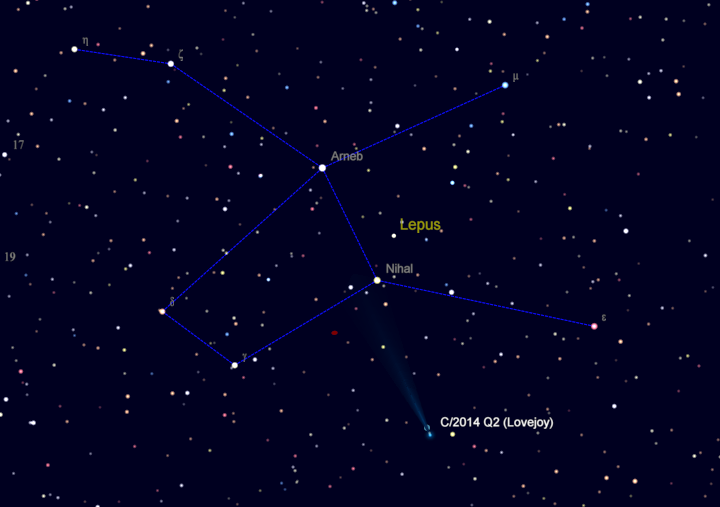
Comet Lovejoy and M79 a distant globular star cluster, in the constellation of Lepus the hare, will appear together at 11 p.m. December 28th, 2014. Note the that M79 is the unlabeled blue dot in the tail of the comet, next to the head. Created using Cartes du Ceil (Sky Charts).
12/17/2014 – Ephemeris – Your weekly look at the bright planets
Ephemeris for Wednesday, December 17th. The sun will rise at 8:13. It’ll be up for 8 hours and 49 minutes, setting at 5:03. The moon, 3 days past last quarter, will rise at 4:19 tomorrow morning.
Venus is slowly moving from around the sun into the evening sky. It now sets at 5:55 p.m., 52 minutes after the sun. It will be tough to spot at all New Year’s Eve might be a good time to start to see it. Mars is still low in the southwest at 7 p.m. It’s now moving through the constellation of Capricornus and will set tonight at 8:32 p.m. Jupiter, which will be our Christmas Star this year will rise in the east at 9:32 p.m. It’s near the sickle-shaped head of Leo. Jupiter has just started to turn from eastward or direct motion to retrograde, or westward motion among the stars. This is an effect that happens because the Earth is passing Jupiter, a motion shared by all the planets that baffled the ancients who thought the Earth to be motionless. Saturn will rise in the east-southeast at 5:58 a.m.
Times are for the Traverse City/Interlochen area of Michigan. They may be different for your location.
Addendum
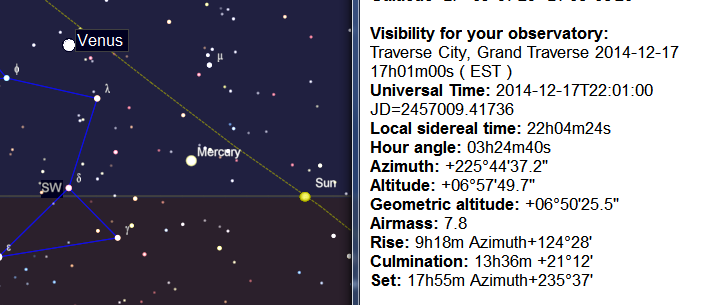
Venus at Sunset. Only 7 degrees above the horizon. Created using Cartes du Ceil (Sky Charts).
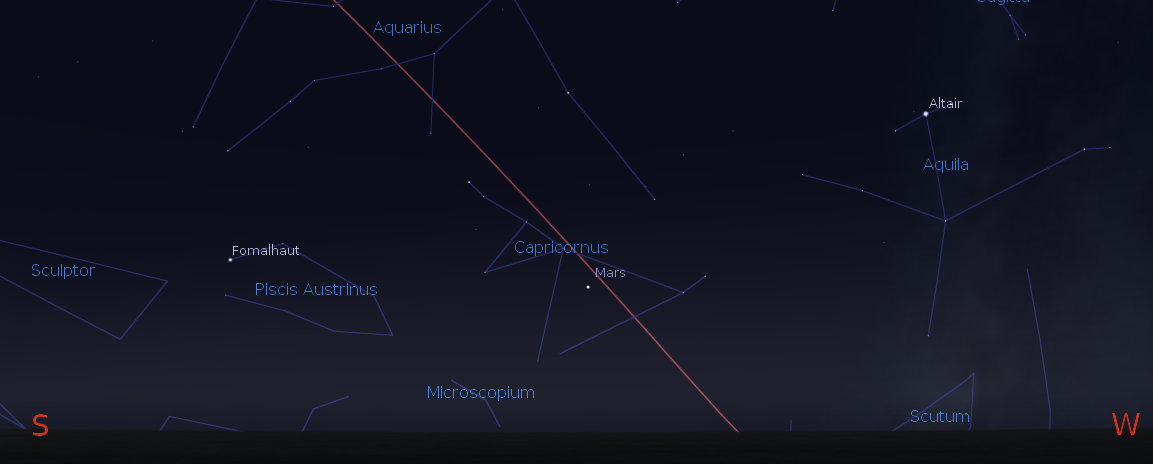
Mars and the constellations plus the ecliptic (red line) at 7 p.m. on December 17, 2014. Created using Stellarium.
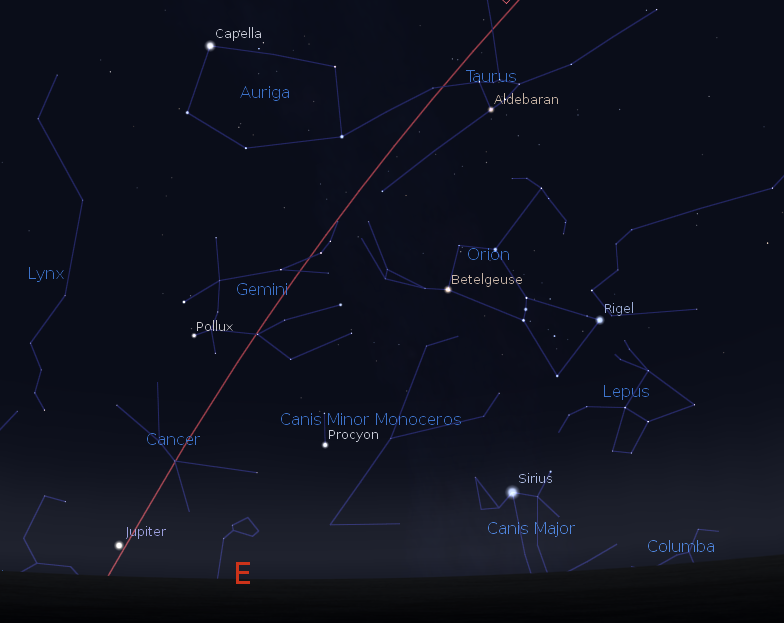
Jupiter and the winter constellations at 11 p.m. on December 17, 2014. Created using Stellarium.
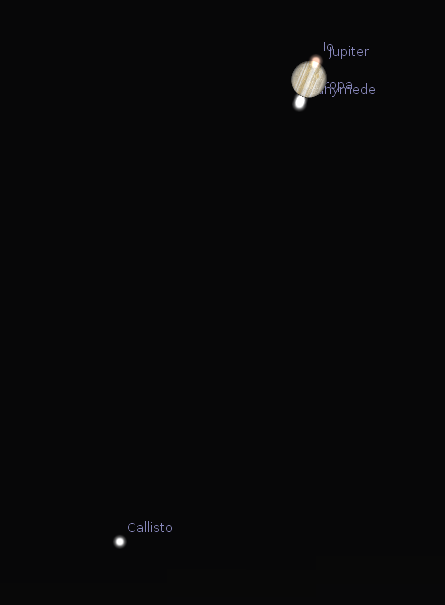
Jupiter and moons in a telescope. The moons Io, Europa and Ganymede all will be moving away from Jupiter over the evening and morning. Image as of 11 p.m. December 17, 2014. Created using Stellarium.
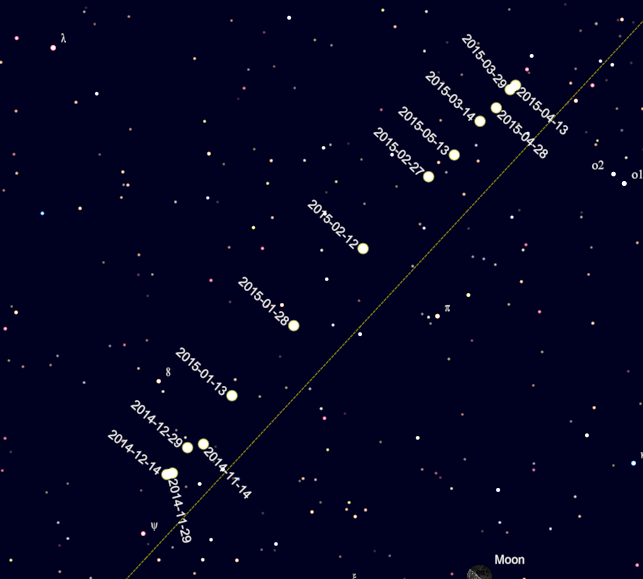
Jupiter’s Retrograde motion. Created using Cartes du Ceil (Sky Charts).
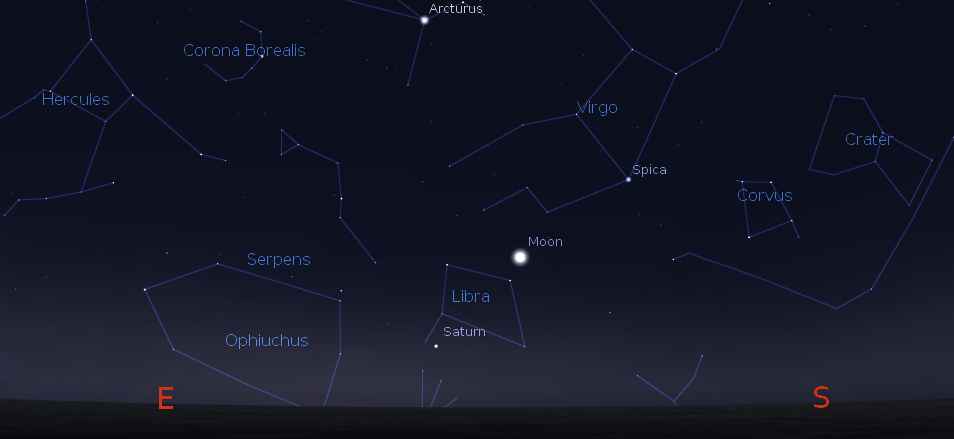
Saturn and the Moon at 7 a.m. on December 18, 2014. Created using Stellarium.
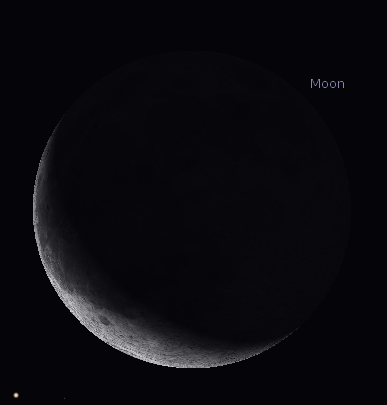
The Moon as it would appear in binoculars on December 18, 2014. Created using Stellarium.
12/10/2014 – Ephemeris – Two holdout planets in the evening sky
Ephemeris for Wednesday, December 10th. The sun will rise at 8:08. It’ll be up for 8 hours and 53 minutes, setting at 5:02. The moon, half way from full to last quarter, will rise at 9:23 this evening.
In reviewing which planets are visible tonight, it looks like we’re still down to two. Venus, Saturn and Mercury are still hanging near the direction of the Sun. It will be a little while before we see them again. However we can see Mars, which will be low in the southwest at 7 p.m. It will set at 8:30 p.m. Mars’ setting time will slowly advance 5 minutes between now and the end of the year. Normal setting times for stars and planets decrease by 4 minutes a night or about a half hour a week. Mars is moving northeastward in the sky and is counteracting that. Jupiter will rise at 10 p.m. in the east-northeast. The best views in a telescope may have to wait for at least an hour after that. Jupiter is a wonderful sight in a telescope.
Times are for the Traverse City/Interlochen area of Michigan. They may be different for your location.
Addendum
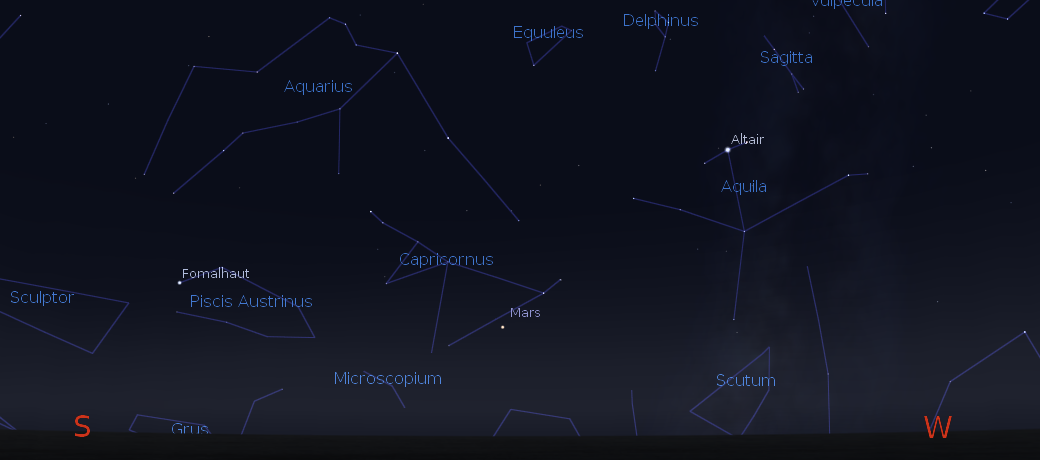
Mars low in the southwest at 7 p.m. December 10, 2014. Created using Stellarium.
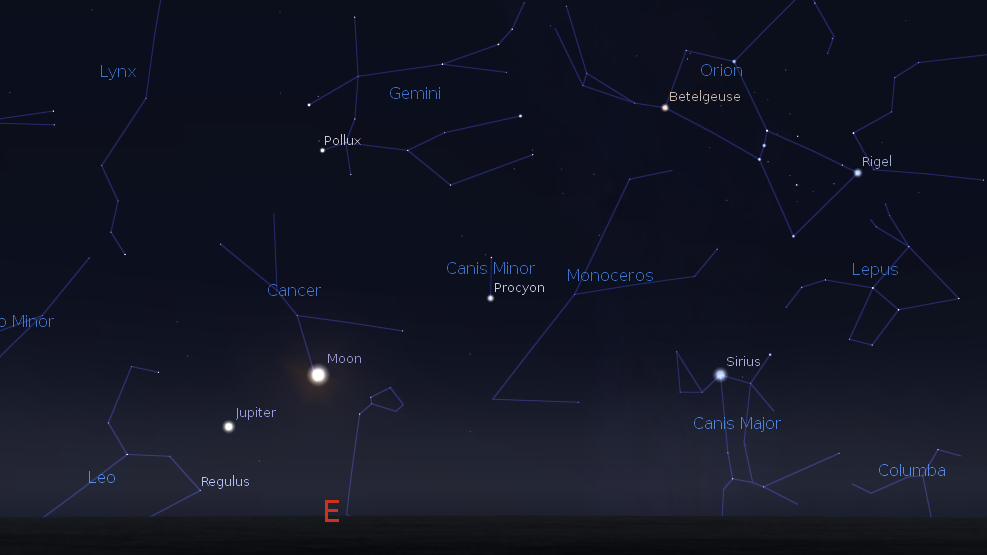
Jupiter and the Moon low in the east at 11 p.m. December 10, 2014. On the evening of the 11th the Moon will appear below Jupiter. Created using Stellarium.
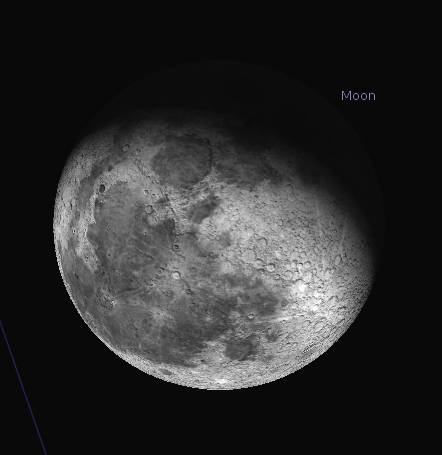
The moon as it would appear in binoculars at 11p.m. December 10, 2014. Created using Stellarium.
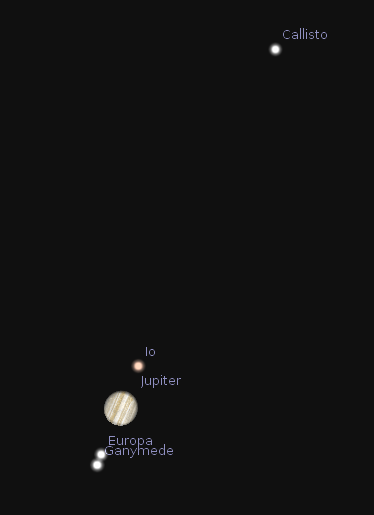
Jupiter and its moon as seen in a telescope. at 11 p.m. December 10, 2014. Note that Europa and Ganymede appear very close. They will move closer until 5 a.m. when they will appear at their closest. Created using Stellarium.
12/03/2014 – Ephemeris – Bright planets: One early and one late
Ephemeris for Wednesday, December 3rd. The sun will rise at 8:01. It’ll be up for 9 hours and 1 minute, setting at 5:03. The moon, 3 days before full, will set at 5:48 tomorrow morning.
In reviewing which planets are visible tonight, it looks like we’re still down to two. Venus, Saturn and Mercury are hanging around near the direction of the Sun. It will be a little while before we see them again. However we can see Mars, which will be low in the southwest at 7 p.m. It will set at 8:29 p.m. Mars’ setting time will slowly advance only 6 minutes between now and the end of the year. Jupiter will rise at 10:28 p.m. in the east-northeast. The best telescopic views will have to wait a couple of hours after that. So if you’re more of an early bird rather than a night owl it might be better to view Jupiter with a telescope in the morning. Jupiter has those four bright moons that change position daily, and sometimes while you watch.
Times are for the Traverse City/Interlochen area of Michigan. They may be different for your location.
Addendum
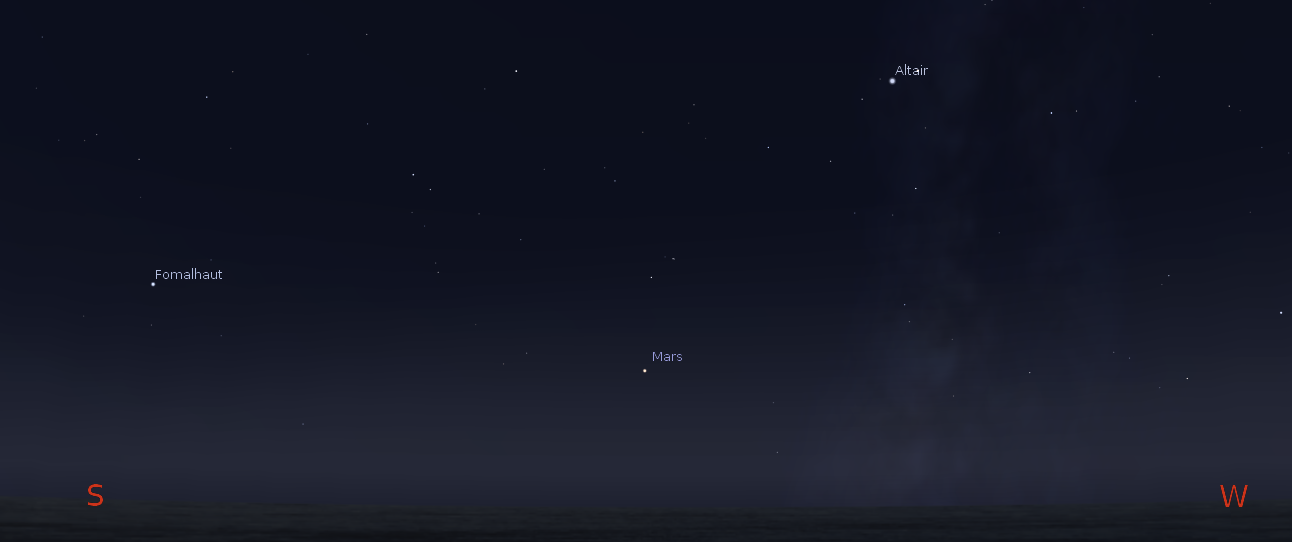
Mars in the southwest at 7 p.m. December 3, 2014. Created using Stellarium.
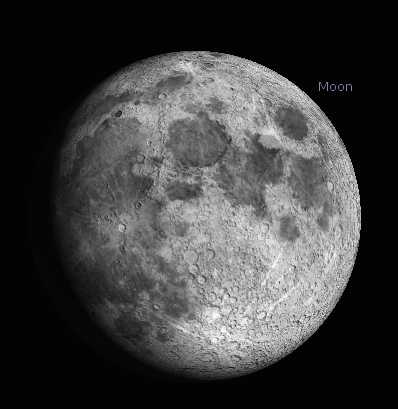
A binocular view of what the moon will look like at 7 p.m. December 3, 2014. Created using Stellarium.
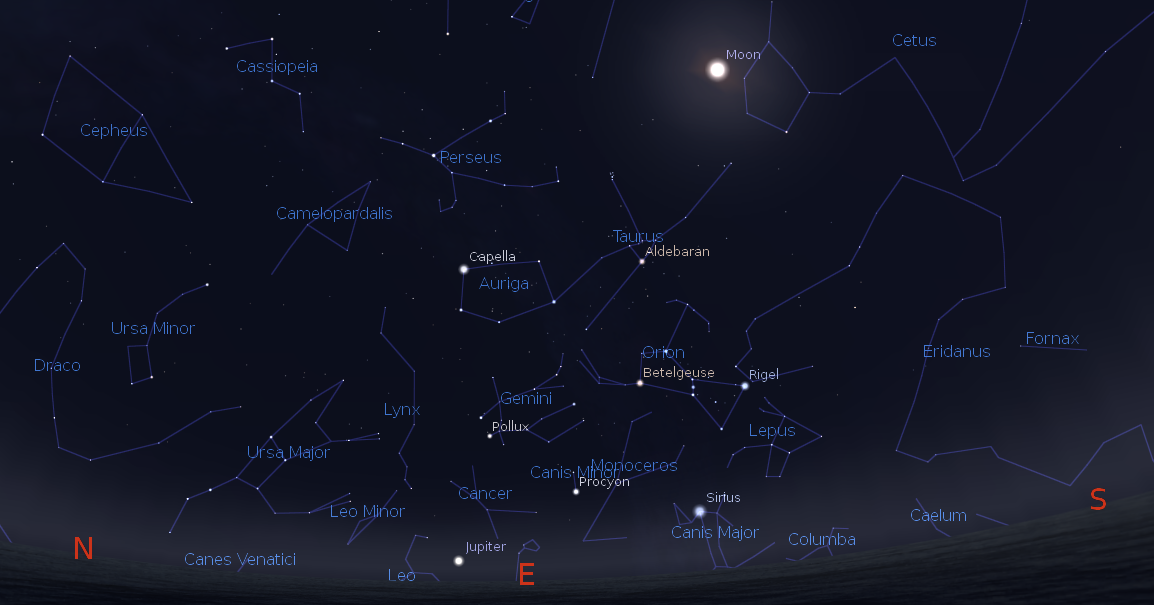
Jupiter rising with the winter constellations at 11 p.m., December 3, 2014. We’re actually looking at the eastern half of the sky. Created using Stellarium.
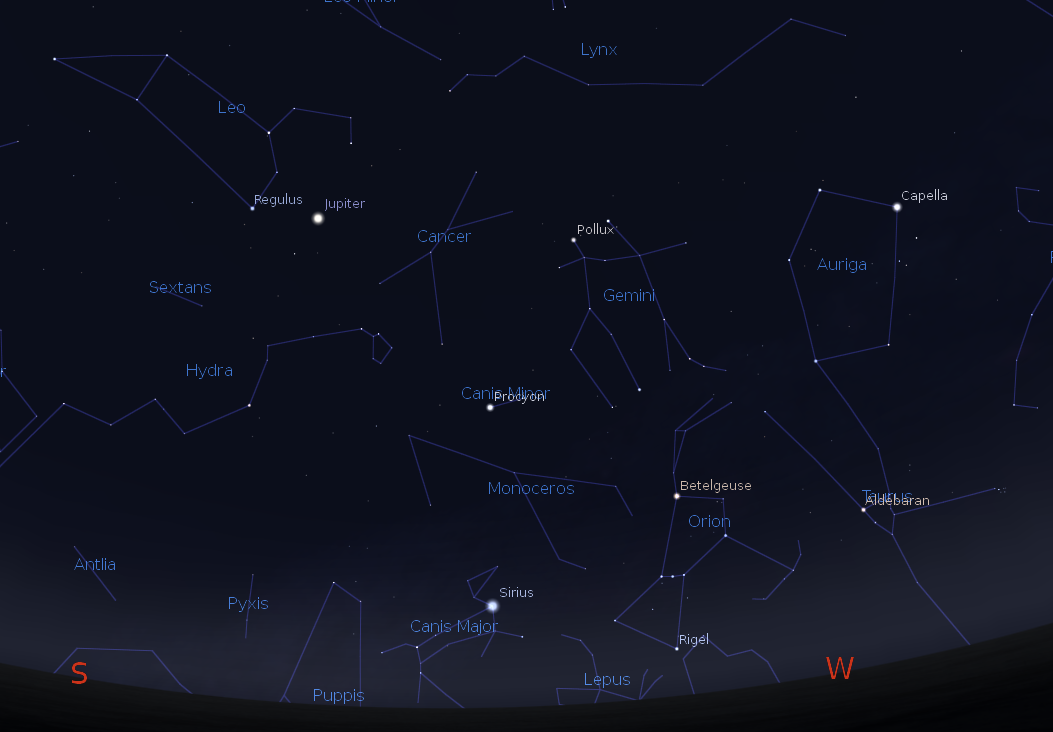
At 6 a.m. December 4, 2014 Jupiter and the winter constellations will swing into the southwest while out of the view the spring and early summer stars take over the eastern sky. Created using Stellarium.
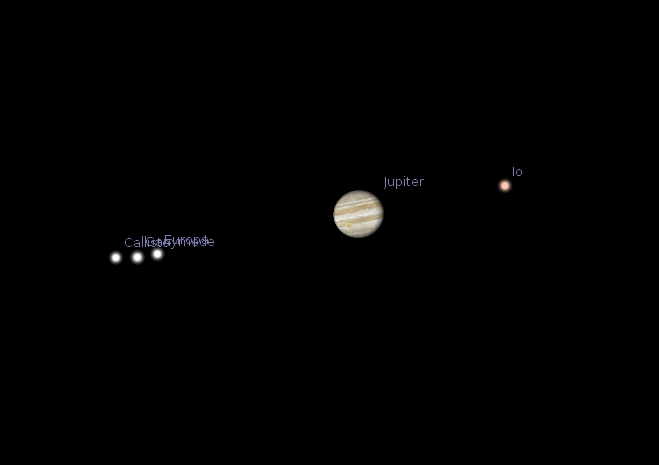
Telescopic view of Jupiter at 6 a.m. December 4, 2014. The moons on the left in order from left to right are Callisto, Ganymede and Europa. In the next hour the moons will appear to get even closer together, especially Ganymede and Callisto. Created using Stellarium.

