Archive
03/14/2012 – Ephemeris – Where are the bright planets this week?
Wednesday, March 14th. The sun will rise at 7:55. It’ll be up for 11 hours and 52 minutes, setting at 7:47. The moon, at last quarter today, will rise at 3:35 tomorrow morning.
Let’s see what’s happening with the bright planets for this week. Mercury will make a brief appearance in the west after sunset. It will set at 8:54. Venus and Jupiter are brilliant in the western sky after sunset. Jupiter will be just below left of Venus, the brighter planet. Jupiter will set first at 11:40 p.m. followed by Venus at 11:53. Mars is up in the east in the evening with its unmistakable bright reddish color. It’s in the constellation Leo the lion now. It is 63.5 million miles and moving away. Mars will pass due south at 1:04 a.m. and will be setting in the west near sunrise. Saturn will rise at 10:31 p.m. just to the left of the bright star Spica in the east southeast.
* Times are for the Traverse City/Interlochen area of Michigan. They may be different for your location.
Addendum
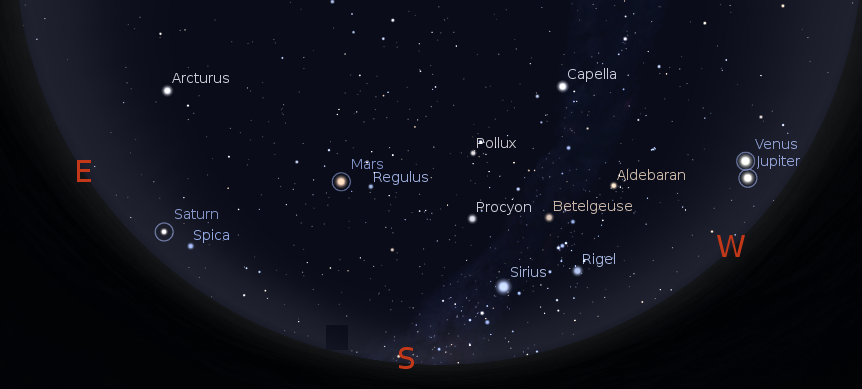
The planets at 11 p.m. March 14, 2012. Created using Stellarium.
03/07/2012 – Ephemeris – Where are the bright planets this week?
Ephemeris for Wednesday, March 7th. The sun will rise at 7:08. It’ll be up for 11 hours and 30 minutes, setting at 6:38. The moon, 1 day before full, will set at 6:47 tomorrow morning.
Let’s see what’s happening with the bright planets for this week. Mercury will make a brief appearance in the west after sunset. It will set at 8:15. Venus is brilliant in the western sky after sunset and will set at 10:39 in the west. Jupiter the second brightest planet after Venus is located just above it. They are approaching each other. Jupiter will set at 10:57 p.m.. Mars is up by sunset in the east and is in the constellation Leo the lion. It is 62.6 million miles away . It’s now as bright as most first magnitude stars. Mars will pass due south at 12:37 a.m. and will be setting in the west at sunrise. Saturn will rise at 10:00 p.m. just to the left of the bright star Spica in the east southeast. The moon will appear near it on Saturday evening.
* Times are for the Traverse City/Interlochen area of Michigan. They may be different for your location.
Addendum
Below is Mars a photo by Scott Anttila.
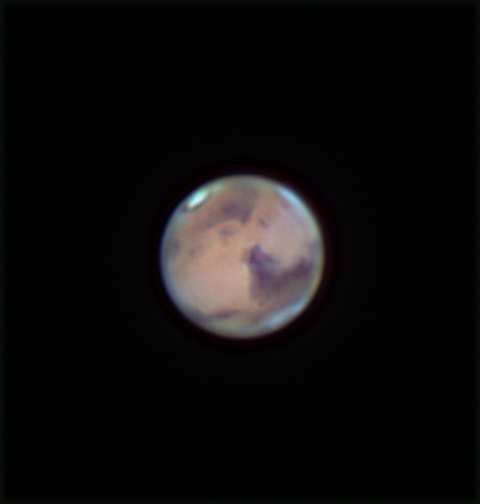
Mars on the morning of March 5, 2012 by Scott Anttila
Scott’s description: “Near 100% illumination, Syrtis Major, the Horse Tail, small polar cap, clouds all around the equatorial area. It is a quick and dirty processing of the Image. There might be more detail that can be teased out when I have more time.”
Syrtis Major is the large dark area. The name means Great Swamp. i am unfamiliar with the Horse Tail. I’m guessing that it’s the linear dark feature on the lower left of the image. If so the proper name is Sinus Sabaeus. Sinus is “Bay”. Ther are no bays or swamps on bone dry Mars or for that matter seas on the moon. The names were established before the nature of these features were known.
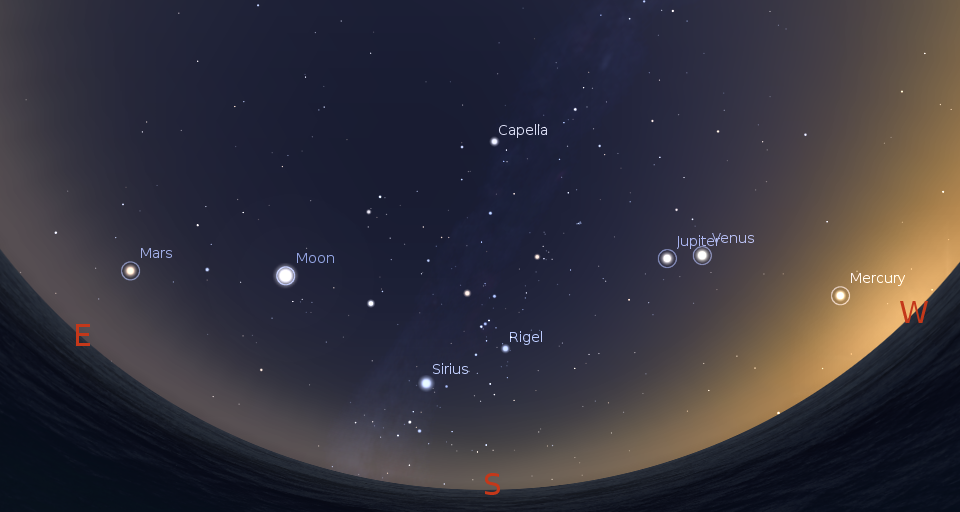
The sky after sunset showing all the evening planets. Created using Stellarium.
This is from Monday, but still pretty close to tonight’s view.
03/06/2012 – Ephemeris – Comparing Mercury with the moon
Ephemeris for Tuesday, March 6th. The sun will rise at 7:10. It’ll be up for 11 hours and 27 minutes, setting at 6:37. The moon, 2 days before full, will set at 6:18 tomorrow morning.
The planet Mercury, which is visible shortly after sunset, is the smallest planet and the one closest to the sun. Its diameter of about 3,030 miles is 50 percent larger than the moon. At first glance Mercury looks like the moon. However to the spacecraft now orbiting Mercury, it appears as a much different place. Mercury is very dense with a large iron core. The moon in contrast is a lightweight. There are no dark lava plains called seas on Mercury, as there are on the near face of the moon. The largest impact basin on Mercury is the Caloris basin, some 650 miles in diameter. At the antipodal point from the Caloris Basin, there is a patch of jumbled terrain actually called Weird Terrain where the impact forces were focused.
* Times are for the Traverse City/Interlochen area of Michigan. They may be different for your location.
03/05/2012 – Ephemeris – Mars closest and Mercury at greatest elongation from the sun
Ephemeris for Monday, March 5th. The sun will rise at 7:12. It’ll be up for 11 hours and 24 minutes, setting at 6:36. The moon, 3 days before full, will set at 5:48 tomorrow morning.
The planet Mars is at its closest to the earth of this time around today. The distance is 62.6 million miles. All planets have elliptical orbits. The Earth varies its distance from the sun by 3 million miles. Mars has a remarkably elliptical orbit which varies its distance from the sun by nearly 30 million miles. It is now at its farthest from the sun. Another small planet is making its appearance in the evening sky now. That’s Mercury seen low in the west after sunset, much closer to the horizon than bright Venus and Jupiter. Mercury is at its greatest apparent distance or elongation from the sun. Mercury will set at 8:14 p.m. It is hard to spot in twilight, so binoculars will help. Like Mars Mercury’s orbit is also very elliptical.
* Times are for the Traverse City/Interlochen area of Michigan. They may be different for your location.
Addendum
The southern sky with the planets at 7:15 p.m. Created using Stellarium.
The sky after sunset showing all the evening planets. Created using Stellarium.
Click on the image to enlarge.
12/29/11 – Ephemeris – Astronomical highlights from 2011
Thursday, December 29th. The sun will rise at 8:18. It’ll be up for 8 hours and 51 minutes, setting at 5:10. The moon, 3 days before first quarter, will set at 11:00 this evening.
Let’s look at the best astronomical events of 2011. To my mind Comet Lovejoy’s survival near the sun is one. The announcements from the Kepler satellite keep coming in. Over 2000 planets in other solar systems suspected including a planet 2.4 times the size of the earth in its star’s habitable zone, two planets of another star about the size of the earth and a planet with two suns. A fourth moon of Pluto was discovered, worrying scientists operating the New Horizons spacecraft that will reach Pluto in 3 and a half years that there may be a debris field around the dwarf planet. This year the MESSENGER satellite gained orbit of the innermost planet Mercury, and the Dawn spacecraft began orbiting the asteroid Vesta. Those are just a sample.
* Times, as always are for the Traverse City/Interlochen area of Michigan.
09/14/11 – Ephemeris – The bright planets visible this week
Wednesday, September 14th. The sun will rise at 7:19. It’ll be up for 12 hours and 35 minutes, setting at 7:55. The moon, 2 days past full, will rise at 8:29 this evening.
It’s Wednesday and time again to take a look at the whereabouts of the bright planets. The planet Venus is rather close to the sun in the evening setting 23 minutes after the sun and not really visible. The ringed planet Saturn is not really visible in the west in evening twilight. It will set 45 minutes after the sun. Jupiter is now the prominent planet of the evening sky after it rises at 9:41 p.m. in the east northeast and is seen against the stars of the constellation Aries now. It will be accompanied by its 4 brightest moons. Mars will rise at 2:31 a.m also in the east northeast and is now between the constellation Gemini and Cancer. Mercury is briefly visible now from about half an hour after its rising in the east at 6:17 until about 7 a.m.
* Times are for the Traverse City/Interlochen area of Michigan. They may be different for your location.
09/07/11 – Ephemeris – The bright planets visible this week
Wednesday, September 7th. The sun will rise at 7:11. It’ll be up for 12 hours and 56 minutes, setting at 8:08. The moon, 3 days past first quarter, will set at 3:23 tomorrow morning.
It’s Wednesday and time again to take a look at the whereabouts of the bright planets. The ringed planet Saturn will be barely visible in the west southwest in evening twilight. It’s near the bright star Spica to its left. Spica has a blue tinge, while Saturn is yellowish. It will set at 9:25 p.m. Because we are seeing Saturn in evening twilight now its image is being deteriorated by the earth’s atmosphere being low in the sky. Jupiter will rise at 10:10 p.m. in the east northeast and is seen against the stars of the constellation Aries now. Mars will rise at 2:36 a.m also in the east northeast and is now passing through the constellation Gemini the twins. Mercury is briefly visible now from about half an hour after its rising in the east at 5:43 until about 20 minutes before sunrise.
* Times are for the Traverse City/Interlochen area of Michigan. They may be different for your location.
09/05/11 – Ephemeris – Mercury is visible in the morning
Labor Day, Monday, September 5th. The sun will rise at 7:09. It’ll be up for 13 hours and 2 minutes, setting at 8:12. The moon, 1 day past first quarter, will set at 1:13 tomorrow morning.
The planet Mercury is now very low in the eastern sky before sunrise. This tiny planet was at its greatest apparent distance from the sun yesterday. Astronomers call it greatest elongation and its separation from the sun was an 18 degree angle. Mercury will be very close to the east northeast horizon in the 6:30 a.m. twilight. Once found, you can probably follow it for the next 20 minutes or so. Mercury will be visible for the next week of so. The cool thing is that it will become brighter. It’s illuminated by the sun, and as it moves away from us around the sun its phase or illuminated portion from our vantage point becomes larger. Currently Mercury is being studied up close by the MESSENGER spacecraft now orbiting it.
* Times are for the Traverse City/Interlochen area of Michigan. They may be different for your location.
Addendum
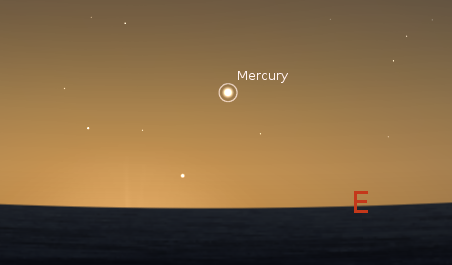
Mercury in the morning in early September 2011. Chrat created using Stellarium.
08/16/11 – Ephemeris – Solar conjunctions today of Mercury and Venus
Tuesday, August 16th. The sun rises at 6:45. It’ll be up for 14 hours and 0 minutes, setting at 8:46. The moon, 3 days past full, will rise at 9:38 this evening.
Today we have an interesting coincidence. Both Venus and Mercury will be in conjunction with the sun. Astrologers may make a big deal out of it but this time astronomers won’t. A conjunction means that two solar system bodies are just north and south of each other. At 8:07 this morning Venus will be just north of the sun in superior conjunction. That is it is beyond the sun. And at 9:03 this evening Mercury will be somewhat south of the sun in inferior conjunction. Thai is it is between the earth and the sun. Mercury will be going into our morning sky, while Venus will begin to appear in the evening sky later this fall. But the coolest thing of all will be Venus’ next inferior conjunction June 6th, 2012. It will cross the face of the sun in a rare transit.
* Times are for the Traverse City/Interlochen area of Michigan. They may be different for your location.
05/13/11 – Ephemeris – Astronomical meaning of the morning planet lineup
Friday, May 13th. Today the sun will be up for 14 hours and 43 minutes, setting at 9:01. The moon, 3 days past first quarter, will set at 4:09 tomorrow morning. Tomorrow the sun will rise at 6:16
The planet grouping that’s now breaking up in the morning twilight might be taken as having meaning by astrologers. To astronomers it’s just a nice line up of planets, that is along our line of sight. Let’s look at their distances from the earth. Mercury is actually closest of the four now at 86 million miles, The rest are farther than the sun. Venus is next farthest at 139 million miles. Next comes Mars at 214 million miles away. Finally there’s Jupiter at 541 million miles out. So these planets are grouped by accident of their directions from the earth. They are not really close together. As far as influence goes, the moon, Jupiter and Venus gave the greatest gravitational effect of the earth, but that’s miniscule compared to the sun.
* Times are for the Traverse City/Interlochen area of Michigan. They may be different for your location.
Addendum
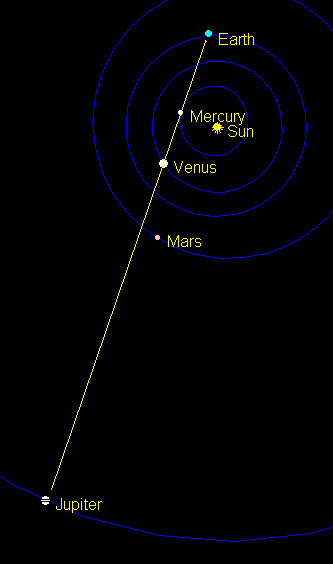
Line of sight of the planets in the Planet Jam for May 13th.
Here’s the animation of the morning planets this month.
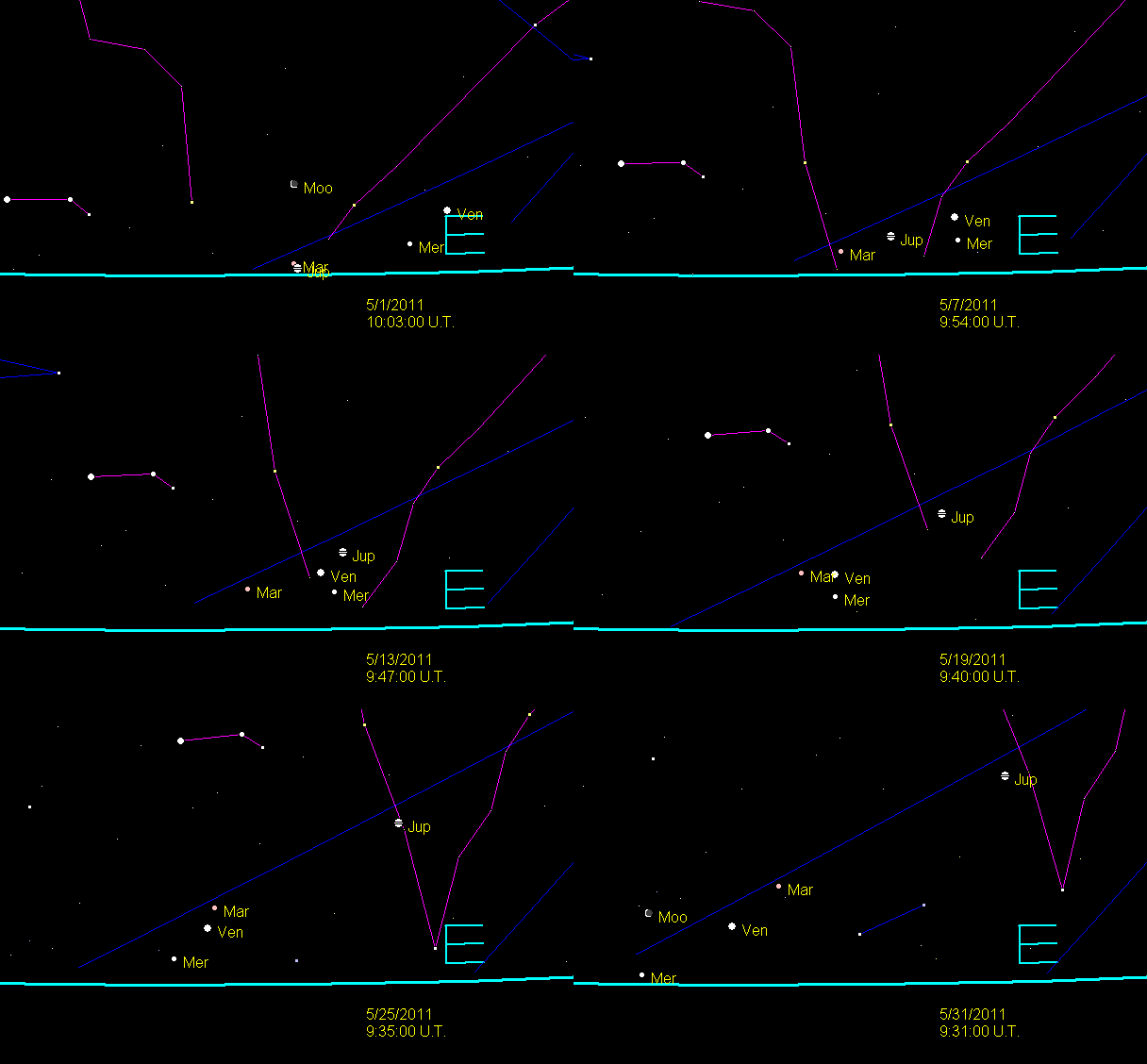
Planet Jam May 2011 animation

