Archive
11/28/2012 – Ephemeris – Where are the bright planets this week?
Ephemeris for Wednesday, November 28th. The sun will rise at 7:56. It’ll be up for 9 hours and 8 minutes, setting at 5:04. The moon, at full today, will rise at 5:18 this evening.
Let’s check out the planets for this week. First there will be a penumbral eclipse of the moon this morning which we will not be able see. Penumbral eclipses are not very noticeable. At 6:15 p.m. Mars can be seen low in the southwest. Mars will set at 7:07. The planetary action will have already picked up on the other side of the sky. Jupiter, will rise at 5:16 p.m. in the east northeast. It is located in the constellation of Taurus. Tonight it will appear right above the moon. It will transit or pass due south at 12:49 a.m. Jupiter will reach opposition from the sun this Saturday December 1st, and will officially be part of the evening sky. Saturn will be the next planet to rise at 5:15 a.m. in the east southeast. Venus will rise at 5:23 and is almost directly below Saturn. Mercury will rise at 6:13 and will be seen below and left of Venus.
Times are for the Traverse City/Interlochen area of Michigan. They may be different for your location.
Addendum
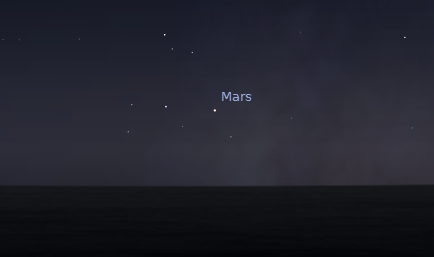
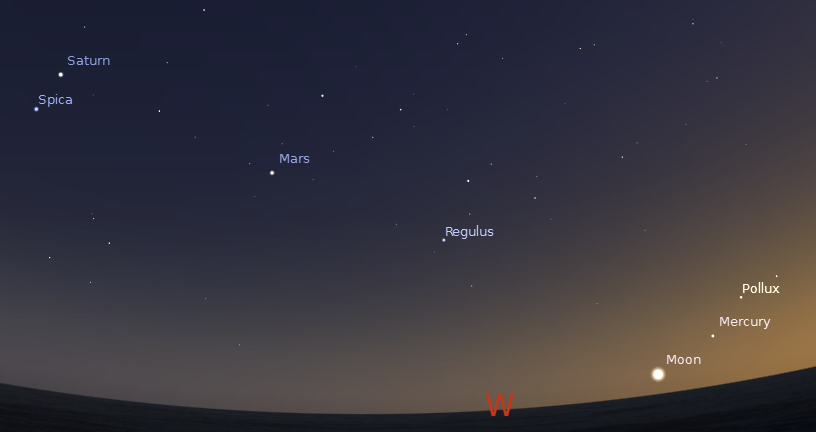
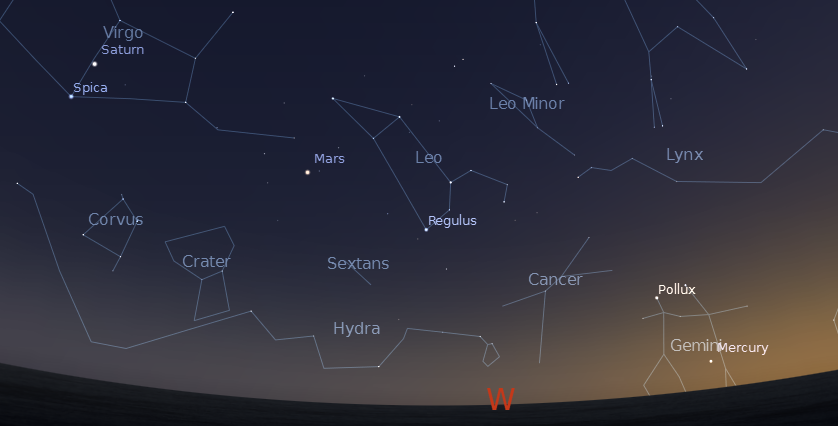
Mars low in the southwest at 6:15 p.m. on November 28, 2012. Created using Stellarium.
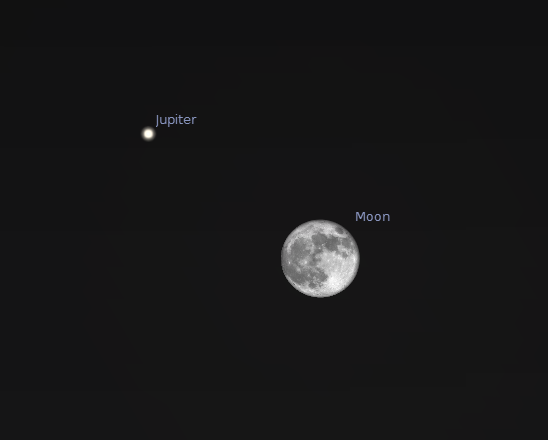
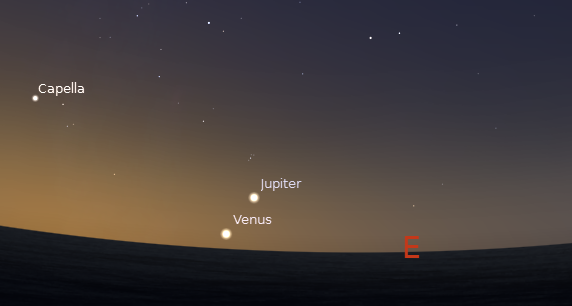
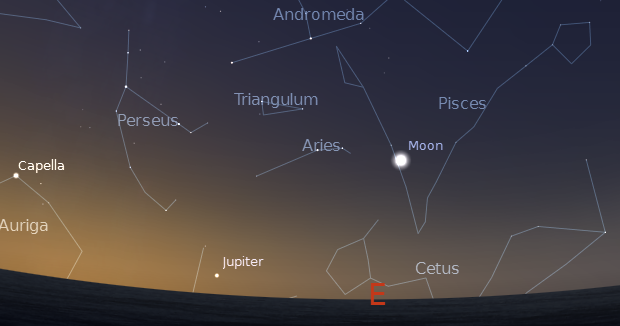
Jupiter and the Moon at 6:15 p.m. low in the east northeast on November 28, 2012. Created using Stellarium.
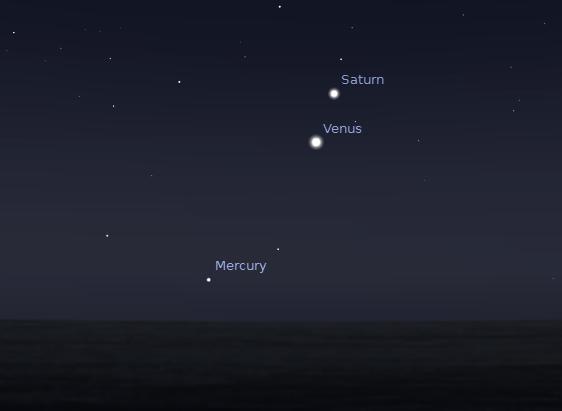
Saturn, Venus and Mercury low in the east southeast at 6:30 a.m. November 29, 2012. Created using Stellarium.
07/06/2012 – Ephemeris – Sun and planet viewing tonight
Ephemeris for Friday, July 6th. Today the sun will be up for 15 hours and 25 minutes, setting at 9:29. The moon, 3 days past full, will rise at 11:06 this evening. Tomorrow the sun will rise at 6:05.
This evening the Grand Traverse Astronomical Society will hold its monthly meeting at the Northwestern Michigan College’s Rogers Observatory at 8 p.m. This meeting will be devoted to viewing the sun through the society’s new solar telescope. After that starting at 9 p.m. Will be a star party. For both events, the public is welcome. The tiny planet Mars and the ringed planet Saturn will be visible as will a number of binary stars and brighter wonders of the heavens as the skies darken. Mercury is now receded toward the sun so is not visible. For the rest of the abbreviated planet report this week: A note for early risers that Jupiter and Venus make a fine sight low in the east northeast in the morning after 5 a.m.
Times are for the Traverse City/Interlochen area of Michigan. They may be different for your location.
06/28/2012 – Ephemeris – Mercury near greatest elongation from the sun
Ephemeris for Thursday, June 28th. Today the sun will be up for 15 hours and 31 minutes, setting at 9:31. The moon, 2 days past first quarter, will set at 2:16 tomorrow morning. Tomorrow the sun will rise at 6:00.
Saturday will be the greatest eastern elongation of Mercury from the sun. It’s a whopping 26 degrees angle east from the sun. Mercury has a markedly elliptical orbit. And when we have a spring eastern elongation, its around 18 degrees from the sun. The best western elongations for us are in the autumn when again the elongation angle is 18 degrees. I won’t go into the why of all this here. But we’re getting an extra good view of this tiny planet. The best time to look for Mercury starts about 10:15 p.m. and ends about 10:45 when Mercury is too close to the horizon. The stars Pollux and Castor of Gemini will appear just to the right of Mercury, and will provide a check that you really have found it.
Times are for the Traverse City/Interlochen area of Michigan. They may be different for your location.
Addendum
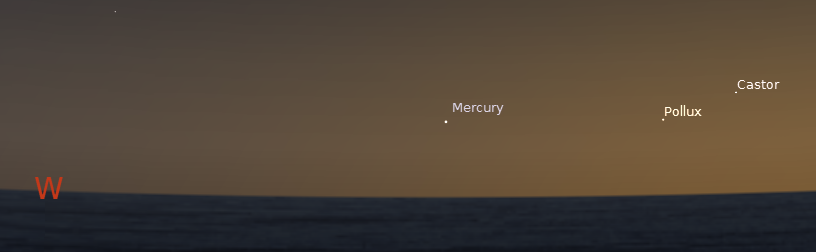
Mercury with the bright stars Pollux and Castor at 10:30 p.m. June 28, 2012. Created using Stellarium.
06/27/12012 – Ephemeris – Where are the bright planets this week?
Wednesday, June 27th. Today the sun will be up for 15 hours and 32 minutes, setting at 9:31. The moon, 1 day past first quarter, will set at 1:40 tomorrow morning. Tomorrow the sun will rise at 5:59.
Let’s see what’s happening with the bright planets for this week. Mercury is in the evening sky but very low in the west northwest about 45 minutes after sunset. It will set at 11:04 p.m. Mars, with its unmistakable bright reddish color, is in the west southwest in the evening entering the constellation of Virgo the virgin. Mars will be setting in the west at 1:15 a.m. Saturn will be in the south southwest above the bright star Spica now. It will set at 2:21 a.m. Jupiter, now a morning planet will rise at 3:53 a.m. in the east northeast. Venus, is now seen below Jupiter after it rises at 4:23 a.m. [They are striking in telescopes with Venus as a large thin crescent, and Jupiter with its cloud bands and satellites.]
Times are for the Traverse City/Interlochen area of Michigan. They may be different for your location. Bracketed text was omitted from the audio program due to time constraints.
Addendum
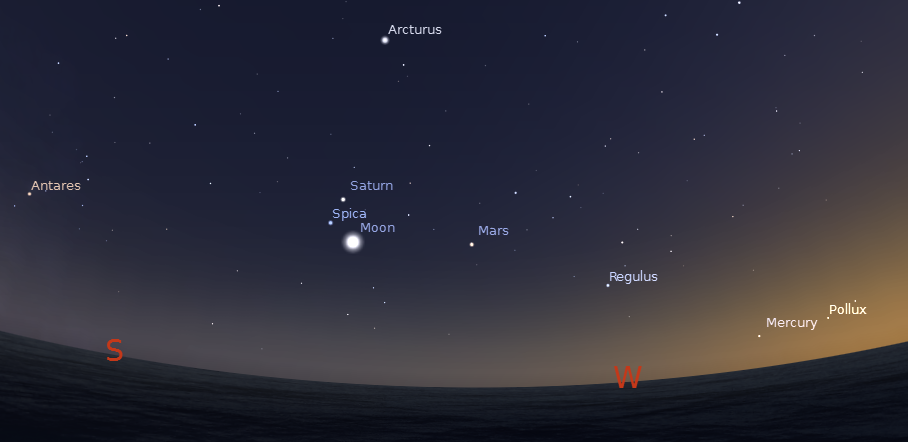
Mercury, Mars and Saturn at 10:30 p.m. on June 27, 2012. Created using Stellarium.
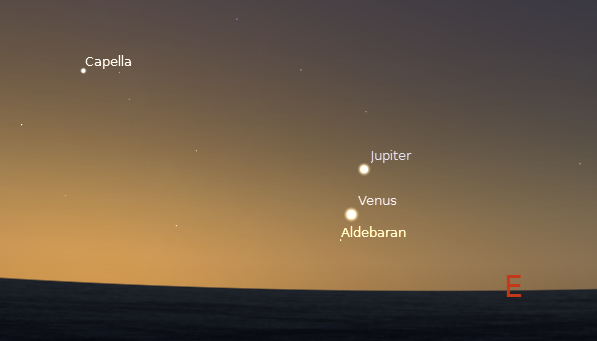
The eastern sky with Jupiter and Venus. at 5:15 a.m. June 28, 2012. Created using Stellarium.
06/25/2012 – Venus and Jupiter in the morning and Mercury in th evening
Ephemeris for Monday, June 25th. Today the sun will be up for 15 hours and 33 minutes, setting at 9:31. The moon, 1 day before first quarter, will set at 12:41 tomorrow morning. Tomorrow the sun will rise at 5:59.
You’ve got to be an early riser for this, say about quarter after 5. Venus and Jupiter will appear close together low in the east northeast in the growing twilight. It’s reminiscent of their evening show. However their paths will not cross. The brighter Venus appears below and to the left of the dimmer Jupiter. They will be their closest around July 3rd. Then Jupiter will outpace Venus. In the evening sky the dim planet Mercury is making an appearance. Start looking to the west northwest about 10:15 for this elusive planet. Here binoculars will help. The bright stars Pollux and Castor are to its right and nearly in a horizontal line to it. Mercury, though is brighter than they are so you should spot Mercury first.
Times are for the Traverse City/Interlochen area of Michigan. They may be different for your location.
Addendum
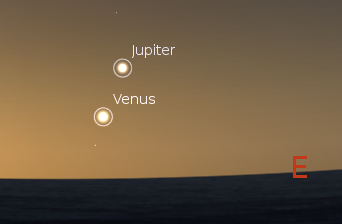
Jupiter and Venus in the Morning June 25th 2012. Created using Stellarium.
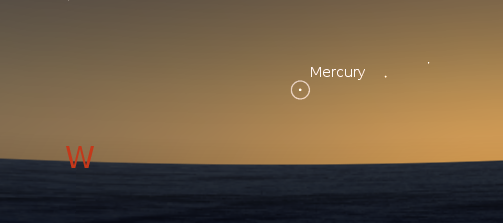
Mercury with the stars Pollux and Castor to its right at 10:15 p.m. June 25th, 2012 Created using Stellarium.
06/21/2012 – Ephemeris – Where are the bright planets this week?
Ephemeris for Thursday, June 21st. Today the sun will be up for 15 hours and 33 minutes, setting at 9:31. The moon, 2 days past new, will set at 10:48 this evening. Tomorrow the sun will rise at 5:57.
Let’s see what’s happening with the bright planets for this week, one day late. Mercury is in the evening sky but very low in the west northwest about 45 minutes after sunset. It will set at 11:09 p.m. Mars is in the west southwest in the evening between the constellations Leo the lion and Virgo with its unmistakable bright reddish color. Mars will be setting in the west at 1:33 a.m. Saturn will be in the south southwest above the bright star Spica now. It will set at 2:45 a.m. Jupiter, now a morning planet will rise at 4:10 a.m. in the east northeast. Venus, is now in the morning sky will rise at 4:45 a.m. In the east northeast. It’s making its debut as the morning star.
Times are for the Traverse City/Interlochen area of Michigan. They may be different for your location.
Addendum
Looking at the fading twilit sky at 10:30 p.m. on June 21, 2012. Created using Stellarium.
This is just an hour after sunset. The moon is really a very thin crescent, and is much dimmer than is shown here. Click to expand. When expanded the images above and below will appear at the same scale.
The eastern sky at 05:00 a.m. on June 22, 2012. Created using Stellarium.
This shows the sky an hour before sunrise tomorrow. In actuality Venus is much brighter than Jupiter.
06/13/2012 – Ephemeris – Where are the bright planets this week?
Ephemeris for Wednesday, June 13th. Today the sun will be up for 15 hours and 32 minutes, setting at 9:28. The moon, 2 days past last quarter, will rise at 2:47 tomorrow morning. Tomorrow the sun will rise at 5:56.
Let’s see what’s happening with the bright planets for this week. Mars is in the southwest in the evening between the constellations Leo the lion and Virgo with its unmistakable bright reddish color, though its fading as it retreats from us. Mars will be setting in the west at 1:58 a.m. Saturn will be in the south above the bright star Spica now. It’s due south at 9:41 p.m. and will set at 3:17 a.m. Jupiter, now a morning planet will rise at 4:39 a.m. in the east northeast. Venus, now in the morning sky is very close to the rising sun, will itself rise at 5:18 a.m. I’m not sure it’s all that visible yet. Mercury is in the evening sky but too close to the sun to be seen, we should be able to spot it the last week of this month.
Times are for the Traverse City/Interlochen area of Michigan. They may be different for your location.
Addendum
Centered on the southwestern sky at 10:30 p.m. on June 13, 2012. Created using Stellarium.
The planets Saturn, Mars and Mercury. Click to enlarge.
The morning sky in the east at 5 a.m. on June 14, 2012. Created using Stellarium.
Jupiter rising a bit right of East at 5 a.m. Venus will rise at 5:18 on the 14th. We should see them both next week. Click to enlarge.
06/06/2012 – Ephemeris – Where are the bright planets this week?
Ephemeris for Wednesday, June 6th. Today the sun will be up for 15 hours and 26 minutes, setting at 9:24. The moon, 2 days past full, will rise at 11:31 this evening. Tomorrow the sun will rise at 5:57.
Let’s see what’s happening with the bright planets for this week. Venus is now in the morning sky and very close to the sun, will be seen again in a few weeks. Mars is in the southwest in the evening in the constellation of Leo the lion with its unmistakable bright reddish color, though its fading as it retreats from us. It’s heading eastward toward Virgo. Mars will be setting in the west at 2:20 a.m. Saturn will be in the south above the bright star Spica now. It’s due south at 10:09 p.m. and will set at 3:45 a.m. Jupiter, now a morning planet will rise at 5:01 a.m. in the east northeast. Mercury is in the evening sky but too close to the sun to be seen, we should be able to spot it the last week of this month.
Times are for the Traverse City/Interlochen area of Michigan. They may be different for your location.
Addendum
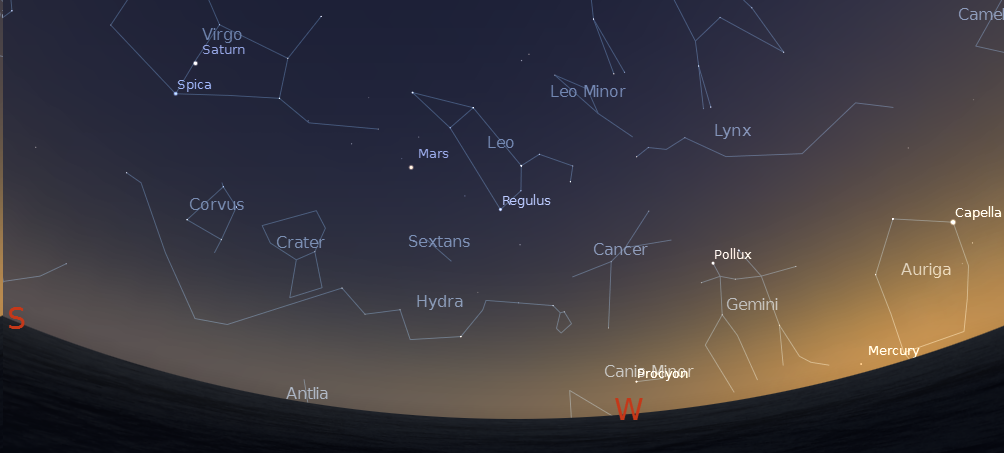
The planets at 10:15 in the evening. Check out Mercury near the horizon. Created using Stellarium.
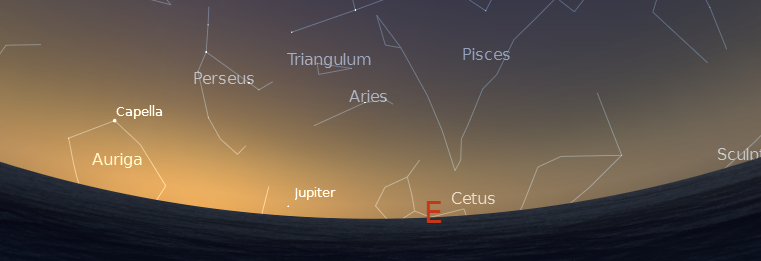
5:15 a.m. at 6/7/2012. Morning sky and Jupiter. Created using Stellarium.
05/25/2012 – Ephemeris – Of conjunctions, superior and inferior
Ephemeris for Friday, May 25th. Today the sun will be up for 15 hours and 10 minutes, setting at 9:14. The moon, 3 days before first quarter, will set at 12:45 tomorrow morning. Tomorrow the sun will rise at 6:03.
The planet Mercury will pass the behind the sun this weekend, in what is called superior conjunction. It is called that because Mercury is beyond or superior to the sun. Venus and Mercury can have both superior and inferior conjunctions because they are inferior planets, not a statement of their quality, but simply because they reside in orbits between the earth and the sun. A conjunction occurs when two solar system bodies pass each other from our point of view. Anyway Mercury will slowly move into our evening sky and by July first might be glimpsed in evening twilight. Mercury can be seen near its greatest elongations or separations from the sun on spring evenings and autumn mornings. July will push it a bit.
Times are for the Traverse City/Interlochen area of Michigan. They may be different for your location.
03/21/2012 – Ephemeris – Where are the bright planets this week?
Ephemeris for Wednesday, March 21st. The sun will rise at 7:42. It’ll be up for 12 hours and 13 minutes, setting at 7:56. The moon, 1 day before new, will rise at 7:18 tomorrow morning.
Let’s see what’s happening with the bright planets for this week. Mercury will pass between the earth and the sun, and will enter the morning sky this afternoon, so is invisible. Venus and Jupiter are separating in the western sky after sunset. Jupiter is below of Venus, the brighter planet. Jupiter will set at 11:20 p.m. followed by Venus at 12:05 a.m. Mars is up in the southeast in the evening with its unmistakable bright reddish color. It’s in the constellation Leo the lion now. It is 65.2 million miles and moving away. Mars will pass due south at 12:23 a.m. and will be setting in the west at 7:15 a.m. Saturn will rise at 10:01 p.m. just to the left of the bright star Spica in the east southeast. We have 4 bright planets visible in the evening.
* Times are for the Traverse City/Interlochen area of Michigan. They may be different for your location.
Addendum
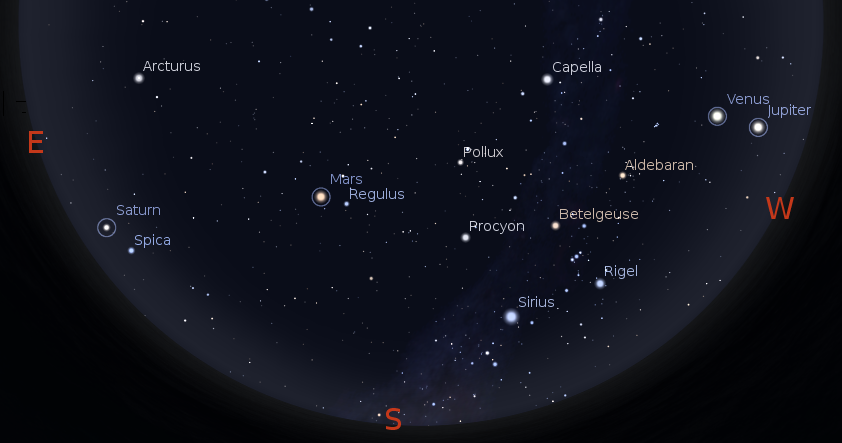
The planets visible at 10:30 p.m. March 21, 2012. Created using Stellarium.
Scott Anttila was photographing the red planet instead of drinking green beer on Srt. Patrick’s day night. Here is the result.

Mars on March 17, 2012 at 10:15 p.m. edt. Photo by Scott Anttila.
This I generally consider the bland side of Mars. However the white blotch near the center appears to be clouds over the largest mountain in the solar system Olympus Mons. I’m willing to bet the three white blotches to the right of it are clouds over the three Tharsis volcanoes, from top to bottom: Ascraeus Mons, Pavonis Mons and Arsia Mons.

