Archive
08/01/2012 – Ephemeris – Where are the bright planets this week?
Ephemeris for Wednesday, August 1st. The sun rises at 6:29. It’ll be up for 14 hours and 37 minutes, setting at 9:07. The moon, at full today, will rise at 8:33 this evening.
Let’s see what’s happening with the bright planets for this week. Mars Saturn and the star Spica make a bright triangle in the west southwest after sunset. Mars is on the right and Saturn is the topmost of the three. They are located in the constellation Virgo the virgin. Mars will be setting in the west at 11:38 p.m. Saturn will set at 12:05 a.m. At mid-month Mars will pass between Saturn and Spica. The morning sky features the two brightest planets: Jupiter, which will rise at 1:59 in the east northeast and Venus, which will rise at 3:13 also in the east northeast. The bright star Aldebaran in Taurus the bull will appear just to the right of Jupiter tomorrow morning, but Venus will have dropped farther below Jupiter, as it stays by the sun.
Times are for the Traverse City/Interlochen area of Michigan. They may be different for your location.
Addendum
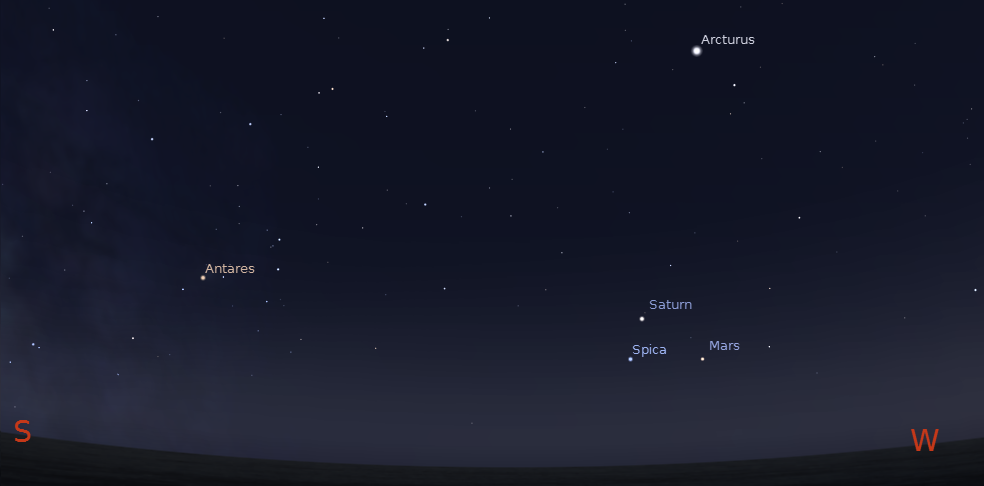
Looking southwest at 10:30 p.m. on August 1, 2012. Created using Stellarium. Click on the image to enlarge.
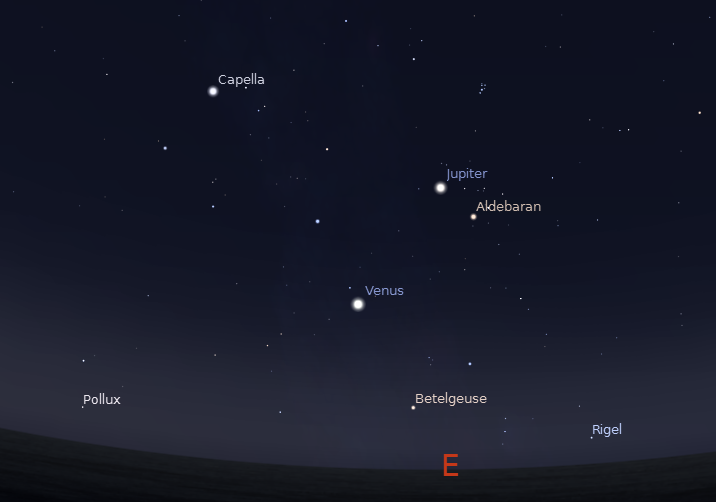
Looking east at 5 a.m. August 2, 2012. That’s Orion rising below Jupiter and Venus. Created using Stellarium. Click on the image to enlarge.
07/17/2012 – Ephemeris – Scorpius and Orion
Ephemeris for Tuesday, July 17th. Today the sun will be up for 15 hours and 9 minutes, setting at 9:22. The moon, 2 days before new, will rise at 5:50 tomorrow morning. Tomorrow the sun will rise at 6:14.
Crawling just above the southern horizon at 11 p.m. is the zodiacal constellation of Scorpius the scorpion. His heart is the red giant star Antares. Its facing the west or right with a short arc of three stars as its head. His body and tail drop to the left and scrape the horizon before curving up to the critter’s poisonous stinger of two stars. One story of the scorpion concerns Orion the hunter the great winter constellation. In that story Orion was supposedly killed by the sting of a scorpion. Therefore Orion and Scorpius are never seen in the sky at the same time. That is certainly true around here and for the Greeks, whose legend it is. However if one travels far enough south that is no longer true.
Times are for the Traverse City/Interlochen area of Michigan. They may be different for your location.
Addendum
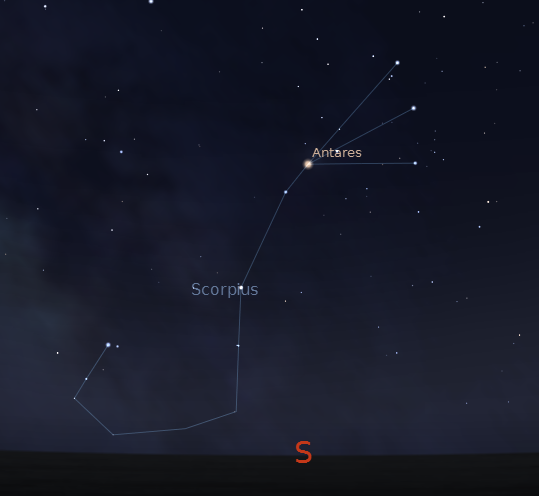
The constellation Scorpius at 10:30 p.m. on July 17, 2012. Created using Stellarium.
06/08/2012 – Ephemeris – The constellation of Hercules
Ephemeris for Friday, June 8th. Today the sun will be up for 15 hours and 28 minutes, setting at 9:26. The moon, 3 days before last quarter, will rise at 12:38 tomorrow morning. Tomorrow the sun will rise at 5:57.
High in the east is the dim and reasonably large constellation of Hercules. Here is the greatest of the Greek heroes, dim and upside down even, while the comparative nobody Orion gets a great constellation to his name in the winter. Anyway, Hercules can be spotted by the distinctive keystone shape of stars that mark the old boy’s kilt. Stars connected to the four corners show his body and limbs. Check a constellation book for where all the stars lead to. On the west side of the keystone can be spotted with binoculars a fuzzy star. Investigations with larger and larger telescopes will reveal a huge assembly of stars called a globular star cluster. There’s perhaps a million stars there. The finest in the northern heavens.
Times are for the Traverse City/Interlochen area of Michigan. They may be different for your location.
Addendum
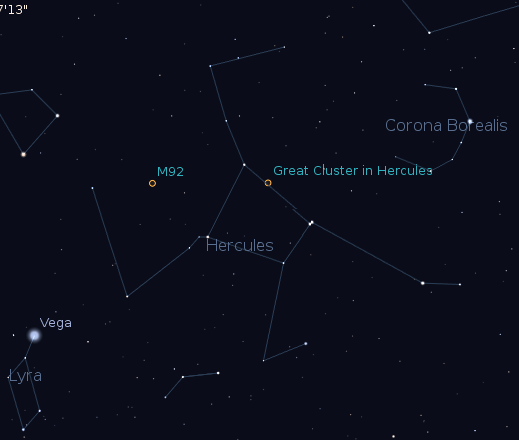
The constellation Hercules and his neighbors. Created with Stellarium.
M92 is also a globular star cluster but more distant. The Great Globular Cluster in Hercules is also designated M13.
02/16/2012 – Ephemeris – The constellation of Lepus the hare
Ephemeris for Thursday, February 16th. The sun will rise at 7:41. It’ll be up for 10 hours and 29 minutes, setting at 6:11. The moon, 2 days past last quarter, will rise at 4:39 tomorrow morning.
Orion, the central winter constellation is seen in the south at 9 p.m. He is a hunter, but is preoccupied in defending himself from the charge of Taurus the bull to the upper right. At Orion’s feet, and unnoticed by him is the small constellation of Lepus the hare. It’s very hard to see a whole rabbit in its eight dim stars: however, I do see a rabbit’s head, ears and shoulders. A misshapen box is the head and face of this critter facing to the left. His ears extend upwards from the upper right star of the box, and the bend forward a bit. Two stars to the right of the box and a bit farther apart show the front part of the body. The free computer program Stellarium shows a different orientation to the hare. You might check it out at Stellarium.org.
* Times are for the Traverse City/Interlochen area of Michigan. They may be different for your location.
Addendum
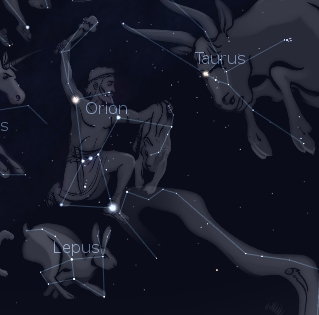
Lepus and a preoccupied Orion. Image from Stellarium.
02/13/2012 – Ephemeris – Orion and Scorpius
Ephemeris for Monday, February 13th. The sun will rise at 7:46. It’ll be up for 10 hours and 21 minutes, setting at 6:07. The moon, 1 day before last quarter, will rise at 1:34 tomorrow morning.
The most prominent constellation of the winter sky is Orion, and is most astronomer’s favorite. It seems odd that such a minor personage of Greek myth would have such a prominent constellation named for him. He is even mentioned twice in the book of Job, though in the the original Hebrew the word for Orion means fool. And that pretty much sums Orion’s life up. A luckless fool. One of several contradictory stories of his death has Orion dying of a Scorpion sting. And when placing Orion in the heavens the gods made sure that Orion and Scorpius are never in the sky at the same time. This however doesn’t work in the southern hemisphere. Orion can be found in the south at 9 p.m. an upright rectangle of bright stars framing the three stars as his belt.
* Times are for the Traverse City/Interlochen area of Michigan. They may be different for your location.
Addendum
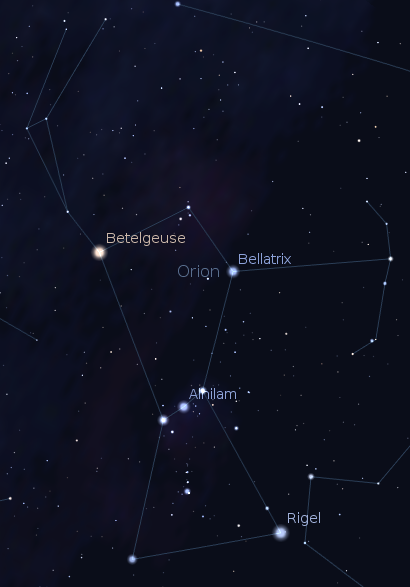
Orion upright and due south. Created using Stellarium.
01/27/2012 – Ephemeris – The constellation Canis Major
Ephemeris for Friday, January 27th. The sun will rise at 8:07. It’ll be up for 9 hours and 36 minutes, setting at 5:43. The moon, 3 days before first quarter, will set at 10:49 this evening.
What kind of a hunter would the constellation Orion be without his trusty hunting dogs. The larger of the dogs is Canis Major which can be found if you extend Orion’s belt stars down to the left. There in the south southeast will appear the brightest night time star Sirius the Dog Star. It is in the heart of the dog, which appears to be begging. Well it’s tilted funny. Other than that it’s a pretty good representation of a dog as a stick figure. The name Sirius doesn’t mean Dog Star, but means Dazzling One due to its great brightness. It outshines all other night stars, only to be out shown by the planets Venus, Jupiter and occasionally Mars. Binoculars will show a nice little star cluster a short ways below Sirius known as M41.
* Times, as always are for the Traverse City/Interlochen area of Michigan.
Addendum
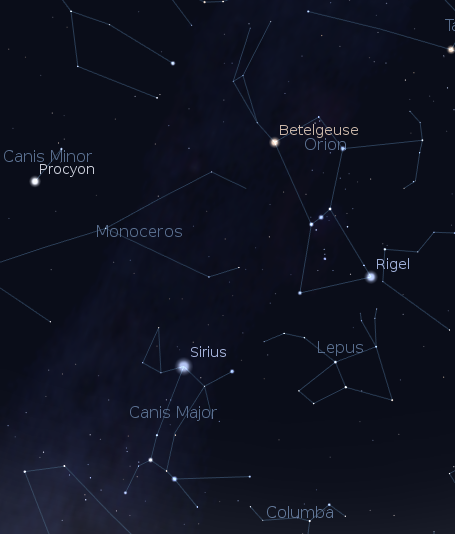
Orion and his Hunting Dogs. Created using Stellarium.
01/24/2012 – Ephemeris – The face of the constellation Taurus – The Hyades
Ephemeris for Tuesday, January 24th. The sun will rise at 8:09. It’ll be up for 9 hours and 29 minutes, setting at 5:39. The moon, 1 day past new, will set at 7:36 this evening.
To the upper right of the constellation Orion in the south in the evening is a letter V of stars with a bright orange star at one tip. This is the face of Taurus the bull. In some constellation depictions the bull is charging Orion who is turned to face him. The V of stars isn’t very bright and are outshone by the Pleiades star cluster to the right in Taurus’ shoulder. In Greek mythology the V of stars are the Hyades, half sisters of the Pleiades. It is a star cluster like the Pleiades and very important, because it is the closest star cluster to us at 153 light years distant. It helped determine the scale of the universe. The bright star at the tip is Aldebaran the follower (of the Pleiades). It is not part of the Hyades and is less than half way to it at 65 light years.
* Times, as always are for the Traverse City/Interlochen area of Michigan.
Addendum
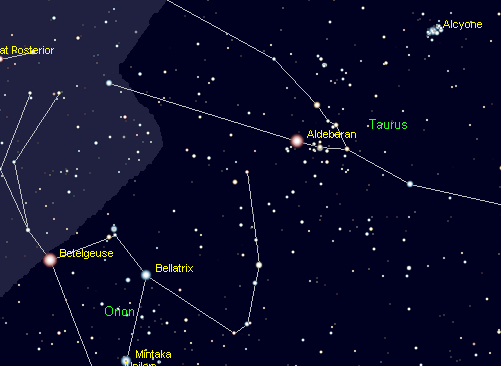
The Hyades, Orion and the Pleiades. Created using Cartes du Ciel
01/23/2012 -Ephemeris – The constellation Gemini the twins
Ephemeris for Monday, January 23rd. The sun will rise at 8:10. It’ll be up for 9 hours and 27 minutes, setting at 5:38. The moon is new today, and won’t be visible.
The constellation of Gemini the twins appears high in the southeast. It appears to the upper left of Orion and the stars that portray his club raised high. Gemini’s two brightest stars are the namesakes of the twins. Castor above and Pollux below. From them there are two lines of stars that form the silhouette of the lads heading to the lower right. In Greek mythology these twins each had a different father, not unheard of in medical history, with Pollux being fathered by the god Zeus and thus immortal. Castor was not. But the brothers were inseparable, so when Castor was killed in the search for the golden fleece Pollux begged his father to let him die too and join his brother. His wish was granted and his devotion was so great that they were placed in the sky where we see them today.
* Times, as always are for the Traverse City/Interlochen area of Michigan.
Addendum
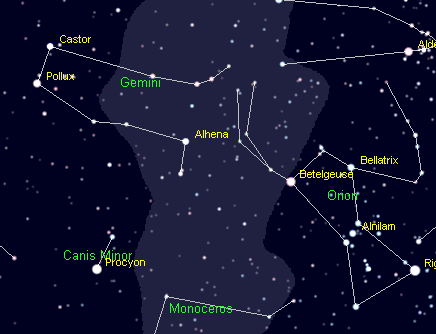
Gemini and Orion. Created using Cartes du Ciel
12/23/11 – Ephemeris – This year’s Christmas stars
Friday, December 23rd. The sun will rise at 8:17. It’ll be up for 8 hours and 48 minutes, setting at 5:06. The moon, 1 day before new, will rise at 8:04 tomorrow morning.
We have two bright planets and the brightest nighttime star out to be our Christmas stars this year. The planet Venus appears in the southwest in the evening and in seen higher and higher each evening, leading the sun in its slow climb as we move through winter into spring. Jupiter holds forth high in the south, the brightest star-like object once Venus sets. The brightest of all the night-time stars is Sirius, whose name means “Dazzling One” rising higher in the southeast, whiter than any planet with a tinge of blue, especially when seen in binoculars or a telescope.. It is accompanied by the rest of the bright stars of winter, including those of the great constellation Orion the hunter, whose three stars of his belt point down and to the left at Sirius.
* Times, as always are for the Traverse City/Interlochen area of Michigan.
11/18/11 – Ephemeris – Pleiades, Hyades and Orion
Friday, November 18th. The sun will rise at 7:42. It’ll be up for 9 hours and 29 minutes, setting at 5:12. The moon, at last quarter today, will rise at 12:48 tomorrow morning.
The Pleiades or Seven Sisters star cluster is now quite high in the east at 9 p.m. To the Greeks they were the daughters of the god Atlas. Their half sisters, the Hyades is seen below them as the letter V shape of stars that form the face of Taurus the bull, with the bright orange star Aldebaran at one corner. Both are being chased by the giant hunter Orion, now mostly risen in the east. His three belt stars in a row are now oriented vertically. The reddish star Betelgeuse is to their upper left, while blue-white Rigel to the lower right. Rigel may suffer some by being very close to the horizon at the time, but it will come into its own as it rises higher. [Here is our preview of the glories of the winter sky. There is more to come as the night wears on.]
* Times, as always are for the Traverse City/Interlochen area of Michigan. Bracketed passage was omitted from the audio program due to time constraints.
Addendum
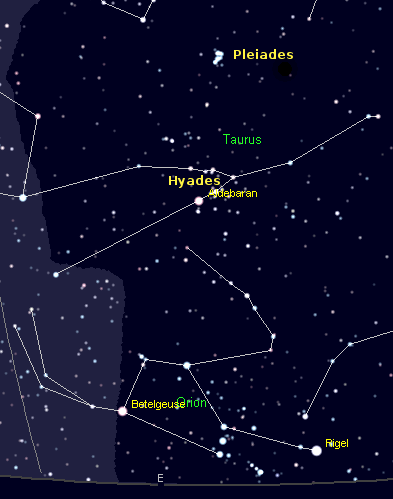
The eastern sky at 9 p.m.
 Bob Moler's Ephemeris Blog