Archive
04/01/2013 – Ephemeris – Orion the Fool
Ephemeris for April Fools Day, Monday, April 1st. The sun will rise at 7:22. It’ll be up for 12 hours and 47 minutes, setting at 8:10. The moon, 2 days before last quarter, will rise at 2:25 tomorrow morning.
Orion is one of the two constellations mentioned in the Bible, that have been deciphered. These are mentioned in the Book of Job. In the King James translation of the Bible the star Arcturus is mentioned. Modern scholars have changed that to the Bear, that is the Great Bear, Ursa Major, of which the Big Dipper is a part. The star cluster Pleiades, our Seven Sisters are also mentioned. There is no agreement of what Mazzeroth and the Mansions of the South are. The translation of Orion from the original Hebrew fits the day today. It’s Kesil, which means fool. Considering the mythology of Orion, a very minor character of Greek mythology, he was indeed, if not a fool, very unlucky in love.
Times are for the Traverse City/Interlochen area of Michigan. They may be different for your location.
Addendum
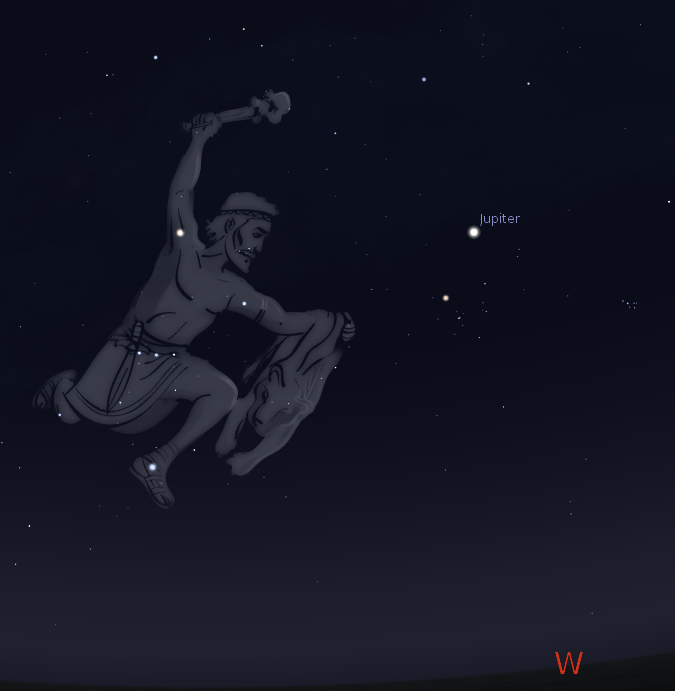
Orion the fool at 10 p.m. on April 3, 2013. Created using Stellarium. Note the Pleiades at the extreme right edge of the picture
01/18/2013 – Ephemeris – Aldebaran, Taurus’ angry read eye
Ephemeris for Friday, January 18th. The sun will rise at 8:13. It’ll be up for 9 hours and 18 minutes, setting at 5:32. The moon, at first quarter today, will set at 1:42 tomorrow morning.
The bright orange star Aldebaran is the most westerly bright star of winter Aldebaran appears at the upper left tip of a letter V group of stars that is the face of the bull, his angry red eye. Aldebaran isn’t actually part of the group, called the Hyades star cluster. Aldebaran is 65 light years away, less than half the distance of the Hyades. The name Aldebaran means “The Follower” because it follows the Pleiades across the skies. The Pleiades is the brightest star cluster in Taurus, also known as the Seven Sisters. Aldebaran has an orange hue because its surface is cooler than the sun’s. However Aldebaran is 44 times larger in diameter, and shines 500 times brighter than the sun. It’s the type of star that’s in the red giant phase of life.
Times are for the Traverse City/Interlochen area of Michigan. They may be different for your location.
Addendum
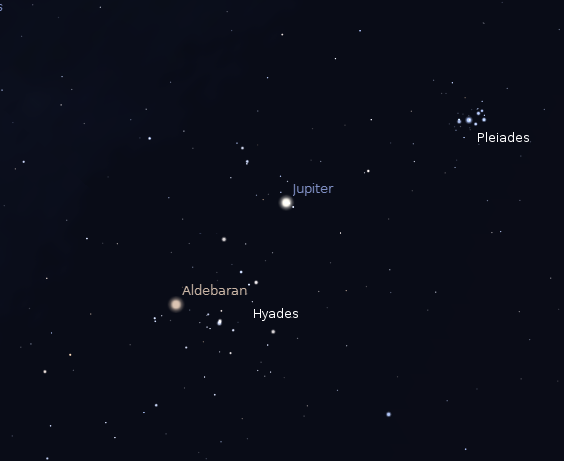
Aldebaran,Jupiter, the Hyades, and the Pleiades on January 18 2913. Created using Stellarium.
12/11/2012 – Ephemeris – The Pleiades and Hyades star clusters
Ephemeris for Tuesday, December 11th. The sun will rise at 8:09. It’ll be up for 8 hours and 52 minutes, setting at 5:02. The moon, 2 days before new, will rise at 7:13 tomorrow morning.
At 8 to 9 p.m. The constellation of Taurus the bull rises higher in the east to southeast. Taurus contains two bright clusters of stars. The most famous of these is the Pleiades, also known as the Seven Sisters. The other is a letter V shape that is the face of Taurus, the Hyades. In the Greek mythology they are half-sisters of each other, all fathered by the Titan Atlas. They are apparently fleeing from the giant Orion rising in the east. The Pleiades are the younger of the two star clusters, and there has been some problem in estimating their distance. They could be from 390 to 460 light years away. The distance to Hyades is much better known at 153 light years. It was the star cluster upon which greater distances could be measured.
Times are for the Traverse City/Interlochen area of Michigan. They may be different for your location.
Addendum
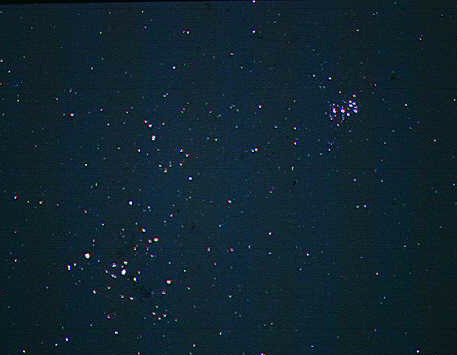
The Hyades (lower left) and the Pleiades (upper right). My photograph from many years ago.
10/16/2012 – Ephemeris – Autumn wonders for binoculars or small telescope: The Pleiades
Ephemeris for Tuesday, October 16th. The sun will rise at 7:59. It’ll be up for 10 hours and 55 minutes, setting at 6:55. The moon, 1 day past new, will set at 7:33 this evening.
The most magnificent star cluster of the autumn sky is the Pleiades or Seven Sisters. At 10 p.m. It will appear as a close group of stars of a nebulous fuzz, depending your eyesight or sky conditions low in the east. It is the perfect binocular object, showing under good conditions a hundred more than the 7 brightest stars. Some mistake it for the Little Dipper because the stars do make a nearly handle less dipper. I tend to call it the Tiny Dipper. The stars in the Pleiades are less than half the age of the stars in the Double Cluster I talked about yesterday. The stars in the is cluster are about 100 million years old. Compared to the sun, these guys aren’t out of diapers yet. I’ll have lots more to to talk about the Pleiades as autumn wears on.
Times are for the Traverse City/Interlochen area of Michigan. They may be different for your location.
Addendum
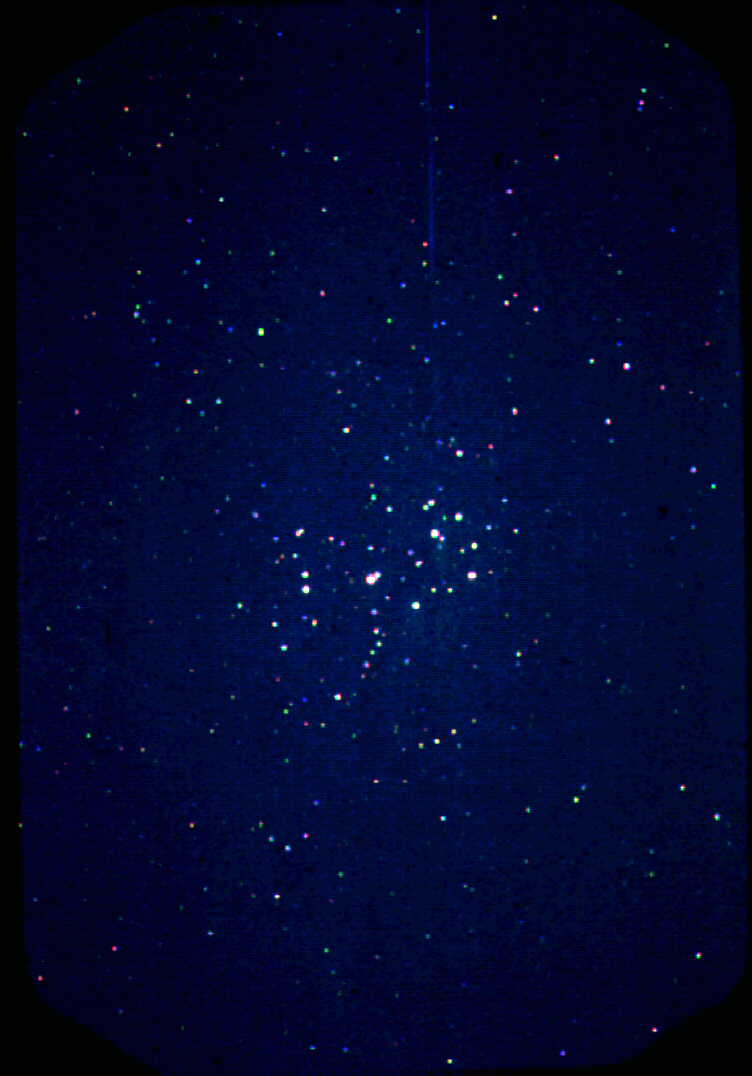
The Pleiades, about what you’d see in binoculars.
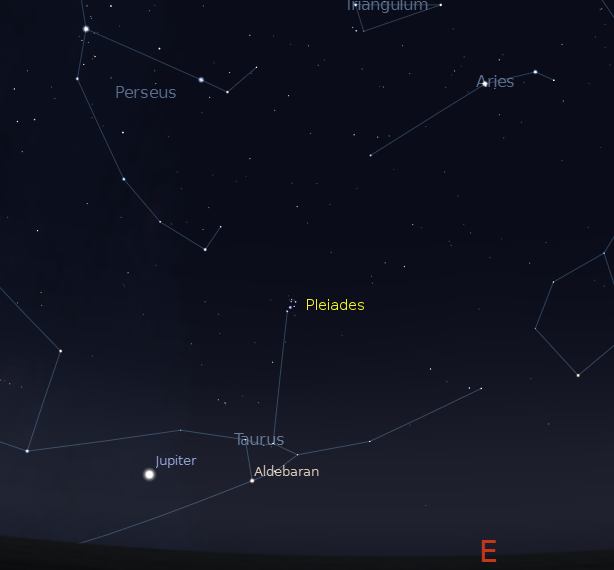
Pleiades and Jupiter at 10 p.m. October 16, 2012. Created using Stellarium.
07/11/2012 – Ephemeris – Where are the bright planets this week?
Ephemeris for Wednesday, July 11th. Today the sun will be up for 15 hours and 18 minutes, setting at 9:27. The moon, 1 day past last quarter, will rise at 1:18 tomorrow morning. Tomorrow the sun will rise at 6:09.
Let’s see what’s happening with the bright planets for this week. Mars, with its unmistakable bright reddish color, is in the west southwest in the evening in the constellation of Virgo the virgin. Mars will be setting in the west at 12:34 a.m. It is approaching Saturn and Spica just to its left. Saturn will be in the southwest above the bright star Spica now. It will set at 1:26 a.m. Jupiter, now a morning planet will rise at 3:08 a.m. in the east northeast. Venus, is now seen just below Jupiter after it rises at 3:45 a.m. Tomorrow morning, Venus will appear next to the bright star Aldebaran. The planets are striking in telescopes with Venus as a large thin crescent, and Jupiter with its cloud bands and satellites.
Times are for the Traverse City/Interlochen area of Michigan. They may be different for your location.
Addendum
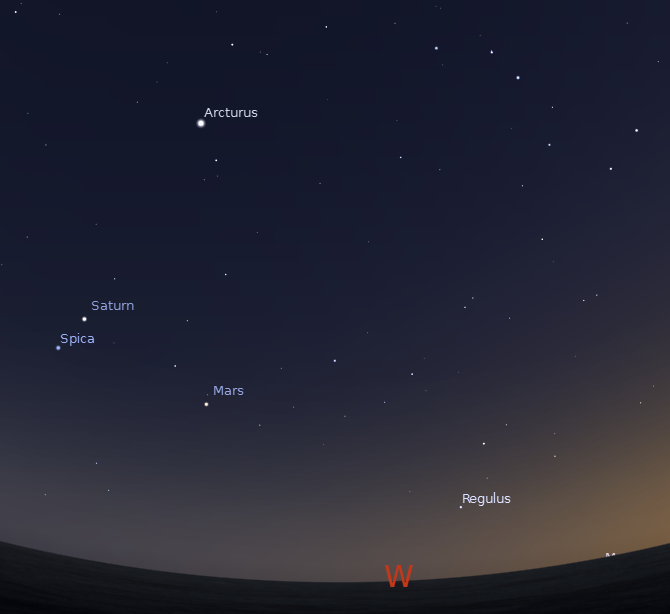
Looking westward at 10:30 p.m. on July 11, 2012. Created using Stellarium.
Click on image to enlarge.
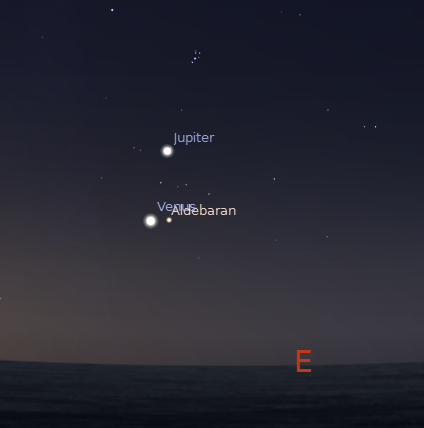
Looking eastward at 5 a.m. on July 12, 2012. Created using Stellarium.
Note Aldebaran near Venus. Aldebaran is the brightest star in the winter constellation Taurus the bull. Note the Pleiades star cluster above Jupiter. Well worth a look with binoculars.
04/23/2012 – Ephemeris – The moon will appear near the Pleiades tonight
Ephemeris for Monday, April 23rd. The sun rises at 6:44. It’ll be up for 13 hours and 53 minutes, setting at 8:37. The moon, 2 days past new, will set at 11:13 this evening.
This evening the thin crescent moon will appear near the Pleiades, or Seven Sisters. They will appear just to the right of the thin sliver of the moon. If you look closely at the moon the entire Moon will be visible. That’s because the nearly full Earth is shining on it. The phase of the earth in the moon’s sky is exactly the opposite of the moon’s phase in the earth’s sky. The effect is called earth shine and was first explained by Leonardo DaVinci. For future astronauts spending a two week night on the moon’s near side, the full earth in its skies will be much brighter than the full moon looks in our skies. The earth covers 16 times the sky as the moon and is more than twice as reflective as the moon. The moon will continue to move eastward and will be near Venus tomorrow.
Times are for the Traverse City/Interlochen area of Michigan. They may be different for your location.
Addendum
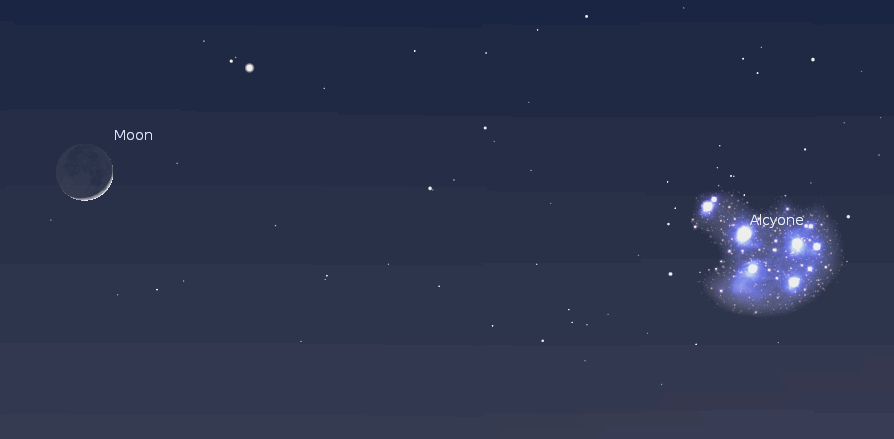
The moon and the Pleiades on April 23rd at 10 p.m. Created using Stellarium.
Note that Stellarium shows a photograph for the Pleiades. The blue reflection nebula is not visible to the eye, and the stars of the Pleiades aren’t that bright in comparison to the moon.
04/03/2012 – Ephemeris – Venus passes the Pleiades part 2.
Ephemeris for Tuesday, April 3rd. The sun will rise at 7:18. It’ll be up for 12 hours and 54 minutes, setting at 8:13. The moon, 3 days before full, will set at 5:43 tomorrow morning.
The brilliant planet Venus is passing by the Pleiades star cluster. It will be a great sight in the west in the evening. Binoculars will help in picking out the Pleiads, as the individual stars of the Pleiades are called. The celestial sphere is the ultimate reference frame for objects in the heavens. It used to be the stars, but the stars move, the sun moves and the earth moves. Now the standard for an unmoving frame of reference is distance quasars, the nearly stellar in size active cores of distant galaxies. While they’re moving too, they are so far away we cannot detect any motion on the celestial sphere. Our earth centered frame of reference rotates within that at once in 26 thousand years as the earth’s axis precesses due to the gravitational pull of the moon.
* Times are for the Traverse City/Interlochen area of Michigan. They may be different for your location.
Addendum
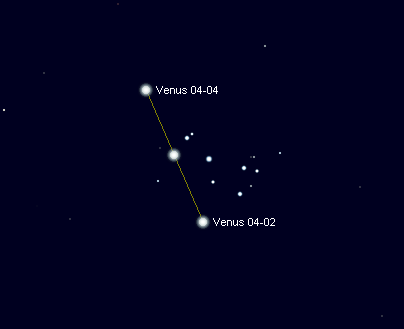
Venus passing the Pleiades April 2 - 4, 2012. Created using Cartes du Ciel.
Click here for a Space.com write up on how quasars are being used as a reference for the GPS system.
04/02/2012 – Ephemeris – Venus will pass the Pleiades tonight
Ephemeris for Monday, April 2nd. The sun will rise at 7:20. It’ll be up for 12 hours and 51 minutes, setting at 8:11. The moon, 3 days past first quarter, will set at 5:14 tomorrow morning.
This evening Venus starts a pass by the Pleiades star cluster. The Pleiades is also known as the Seven Sisters and soon it will disappear in the twilight glow. The next time it will be seen in the evening is in next October. Venus will head back toward the sun, which it will pass directly in front of on June 5th. The sun will pass the Pleiades in mid May, so Venus will never quite make it back to the Pleiades this go around anyway. Though Venus is beginning to head back to the sun, it is still moving eastward against the stars, though a little slower than the sun. Right now Venus is mostly heading toward us. Around the 16th of May Venus will finally stop its eastward motion with respect with the stars and will head westward.
* Times are for the Traverse City/Interlochen area of Michigan. They may be different for your location.
Addendum
Venus passing the Pleiades April 2 - 4, 2012. Created using Cartes du Ciel.
In the real sky Venus is a heck of a lot brighter than you see here. And with binoculars, you’ll see a lot more stars in the Pleiades.
02/28/2012 – Ephemeris – The moon will pass south of the Pleiades tonight
Ephemeris for Tuesday, February 28th. The sun will rise at 7:22. It’ll be up for 11 hours and 5 minutes, setting at 6:28. The moon, 1 day before first quarter, will set at 1:34 tomorrow morning.
The fat crescent moon will appear below the Pleiades star cluster tonight. The Pleiades is also known as the Seven Sisters. With the moon as bright as it is the stars of the Pleiades may not be easily spotted, so a pair of binoculars might be needed. The Pleiades will appear nearly 8 moon diameters above the moon, so they might escape the moon’s glare somewhat. The moon will pass the Pleiades every 28 and a fraction days. Sometimes it passes south of the cluster, and sometimes north of it, and occasionally it passes in front of the stars of the cluster. The moon’s orbit of the earth wobbles or precesses once every 18.6 years. It’s why eclipses occur at different times of the year, and generally earlier one year to the next.
* Times are for the Traverse City/Interlochen area of Michigan. They may be different for your location.
Addendum
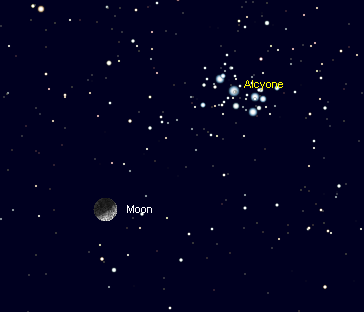
The moon south of the Pleiades at 10:19 p.m. February 28, 2012 from Michigan . Chart created using Cartes du Ciel (Sky Charts)
01/24/2012 – Ephemeris – The face of the constellation Taurus – The Hyades
Ephemeris for Tuesday, January 24th. The sun will rise at 8:09. It’ll be up for 9 hours and 29 minutes, setting at 5:39. The moon, 1 day past new, will set at 7:36 this evening.
To the upper right of the constellation Orion in the south in the evening is a letter V of stars with a bright orange star at one tip. This is the face of Taurus the bull. In some constellation depictions the bull is charging Orion who is turned to face him. The V of stars isn’t very bright and are outshone by the Pleiades star cluster to the right in Taurus’ shoulder. In Greek mythology the V of stars are the Hyades, half sisters of the Pleiades. It is a star cluster like the Pleiades and very important, because it is the closest star cluster to us at 153 light years distant. It helped determine the scale of the universe. The bright star at the tip is Aldebaran the follower (of the Pleiades). It is not part of the Hyades and is less than half way to it at 65 light years.
* Times, as always are for the Traverse City/Interlochen area of Michigan.
Addendum
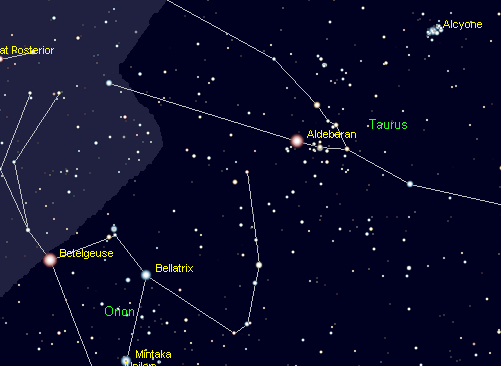
The Hyades, Orion and the Pleiades. Created using Cartes du Ciel
 Bob Moler's Ephemeris Blog