Archive
Ephemeris: 06/12/2025 – Another look at the star Spica
This is Ephemeris for Thursday, June 12th. Today the Sun will be up for 15 hours and 32 minutes, setting at 9:29, and it will rise tomorrow at 5:56. The Moon, 1 day past full, will rise at 11:20 this evening.
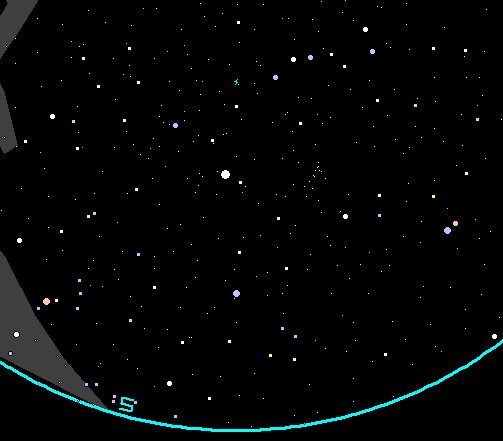
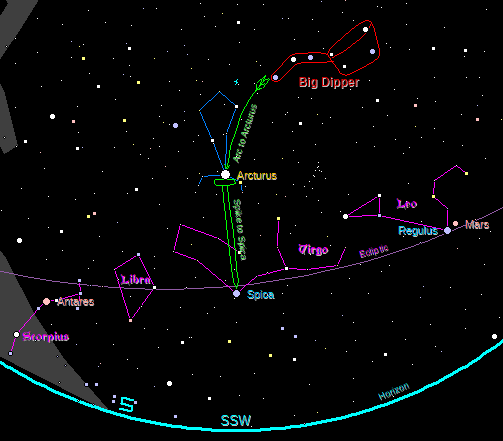
In the south-southwest at 11 PM is the bright star Spica in Virgo the virgin. Arcturus, high in the south, is much brighter than Spica and has an orange tint to Spica’s bluish hue. In fact, Spica is the 15th brightest and the bluest of the 21 first magnitude stars. That means that it has a really hot surface temperature. Spica is actually two stars in a tight 4-day orbit of each other. They are both reasonably matched in mass and brightness. I found that out once photographing a lunar eclipse near Spica, The star came out very blue. The twin stars of Spica are 250 light years away. I’m glad the stars are young now. They will have a very interesting future as they age and interact in the next few million years.
The astronomical event times given in this blog are for the Traverse City/Interlochen area of Michigan (Lat 44.7° N, Long 85.7° W; EDT, UT – 4 hours) unless stated otherwise. Times will be different for other locations.
Addendum

Ephemeris: 05/15/2025 – Finding Virgo the virgin in the spring sky
This is Ephemeris for Thursday, May 15th. Today the Sun will be up for 14 hours and 50 minutes, setting at 9:04, and it will rise tomorrow at 6:13. The Moon, 3 days past full, will rise at 12:36 tomorrow morning.
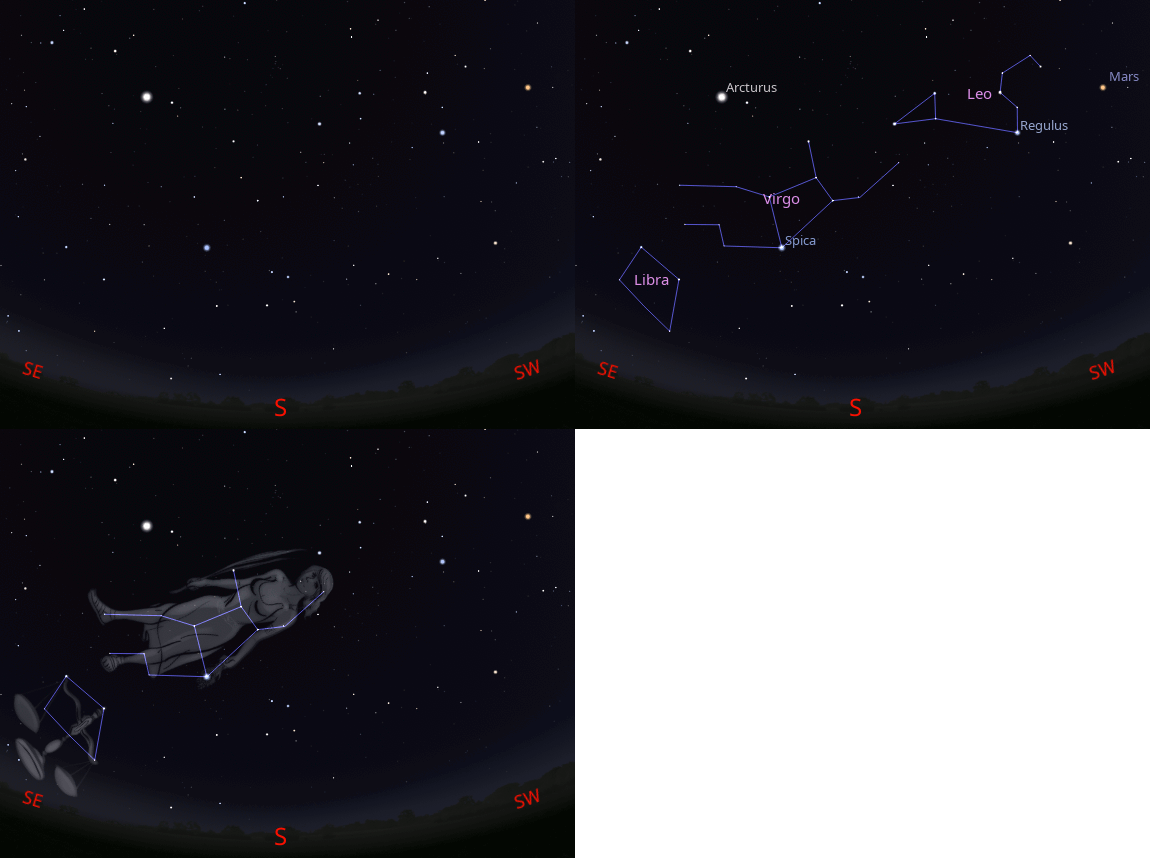
Located below the bright star Arcturus, high in the southeast, and below and left of Leo the lion, which is high in the south, lies the constellation of Virgo the virgin with its bright star Spica. Other than Spica, Virgo contains only dim stars. It’s quite large, extending to the upper right, and to the left of Spica. Virgo represents several goddesses. The Greek harvest goddess Persephone, whose Roman name is Ceres, which is the root of our word cereal, is one. The bright star Spica is the ear of wheat that she’s holding in her hand. Some see her standing at an odd angle, I see her reclining. Virgo also represents Astraea the goddess of Justice, with her scales, the constellation Libra, at her feet low in the southeast.
The astronomical event times given in this blog are for the Traverse City/Interlochen area of Michigan (Lat 44.7° N, Long 85.7° W; EDT, UT – 4 hours) unless stated otherwise. Times will be different for other locations.
Addendum
Ephemeris: 04/21/2025 – Follow the spike to Spica
This is Ephemeris for Monday, April 21st. Today the Sun will be up for 13 hours and 47 minutes, setting at 8:35, and it will rise tomorrow at 6:46. The Moon, 1 day past last quarter, will rise at 4:25 tomorrow morning.
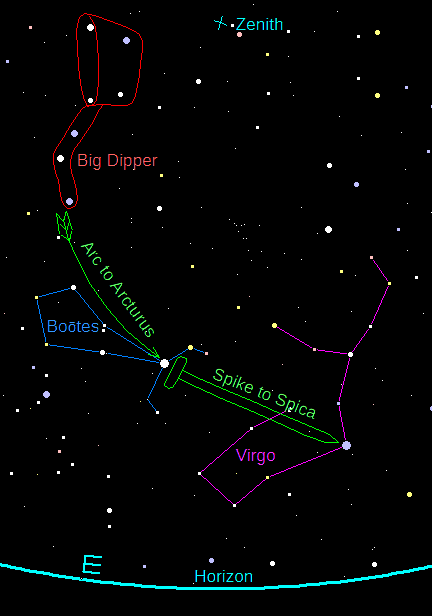
In the south-southeast at 10:30 p.m. is the bright star Spica, which can be found from all the way back overhead to the Big Dipper. Follow the arc of the handle of the Big Dipper to the bright star Arcturus below it in the east-southeast. Then straighten the curve of the arc to a straight spike which points to Spica, the brightest star in Virgo the virgin. Arcturus is much brighter than Spica and has an orange tint to Spica’s bluish hue. In fact, Spica is the bluest of the 21 first magnitude stars. That means that it has a really hot surface temperature. Actually, Spica is really two blue-white stars orbiting each other in 4 days. Spica is 250 light years away. It also was an important star to the ancient Greeks. One temple was built and aligned to its setting point. The astronomical event times given are for the Traverse City/Interlochen area of Michigan (EDT, UT – 4 hours). Times will be different for other locations.
The astronomical event times given are for the Traverse City/Interlochen area of Michigan (EDT, UT – 4 hours). Times will be different for other locations.
Addendum
Ephemeris: 04/17/2025 – Finding the celestial crow
This is Ephemeris for Thursday, April 17th. Today the Sun will be up for 13 hours and 36 minutes, setting at 8:30, and it will rise tomorrow at 6:52. The Moon, 3 days before last quarter, will rise at 1:48 tomorrow morning.
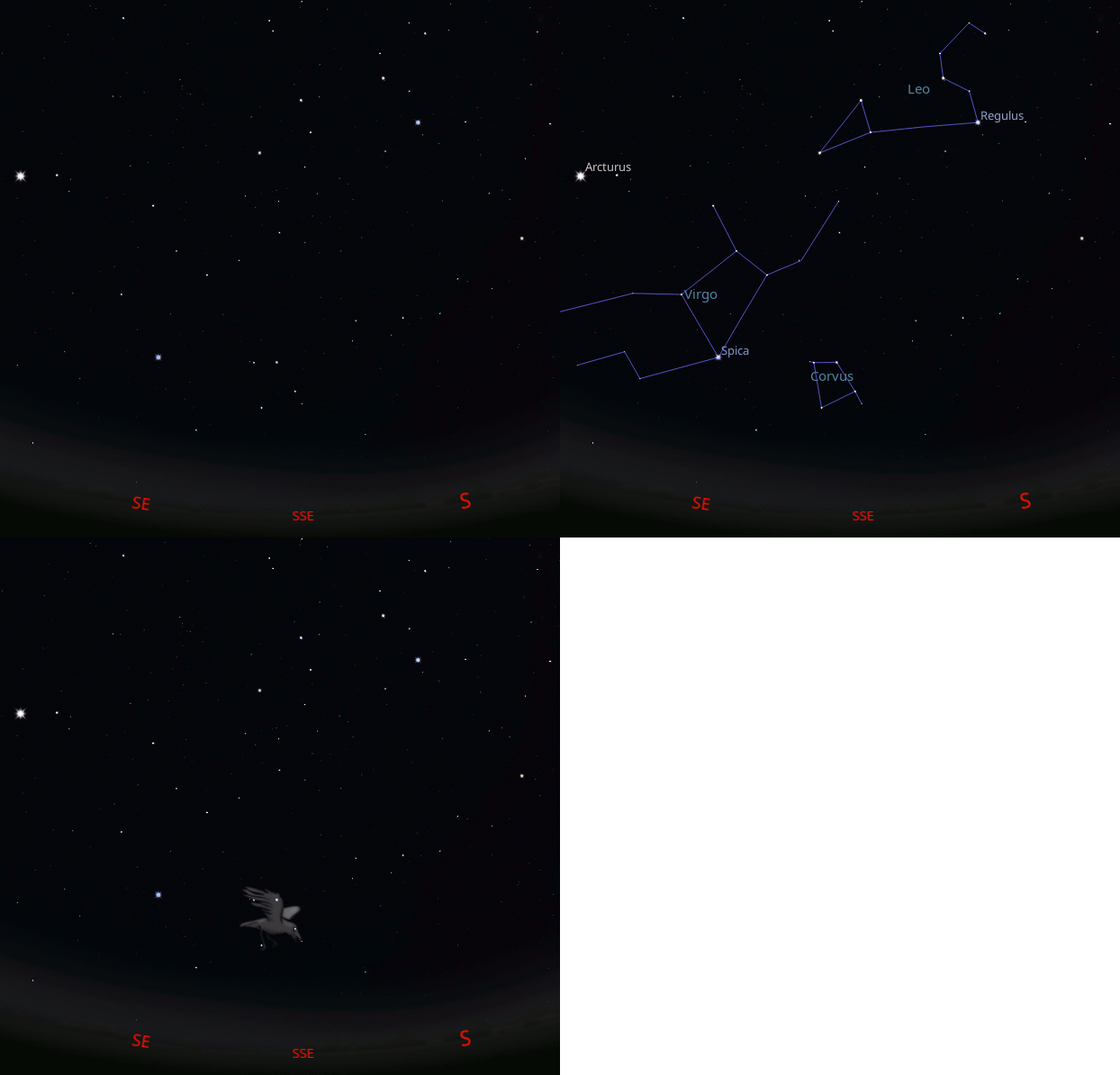
The small constellation of Corvus the crow is located low in the south-southeast at 10:30 this evening. It’s made of 6 dim stars, but the pattern is a distinctive but distorted box with two stars at the upper left marking that corner, and another two marking the lower right corner. I usually don’t notice the extra star at these corners. To me the box stands out enough. It’s pretty much alone below Virgo and its bright star Spica, left an above it. I don’t see a crow here, but the box is distinctive in that no two sides are parallel. In the US we call the shape a trapezium. The British call it a trapezoid. Anyway it is a very interesting shape, at least to me.
The astronomical event times given are for the Traverse City/Interlochen area of Michigan (EDT, UT – 4 hours). Times will be different for other locations.
Addendum
Ephemeris: 05/30/2024 – Virgo and what’s hidden within
This is Bob Moler with Ephemeris for Thursday, May 30th. Today the Sun will be up for 15 hours and 18 minutes, setting at 9:20, and it will rise tomorrow at 6:00. The Moon, at last quarter today, will rise at 2:52 tomorrow morning.
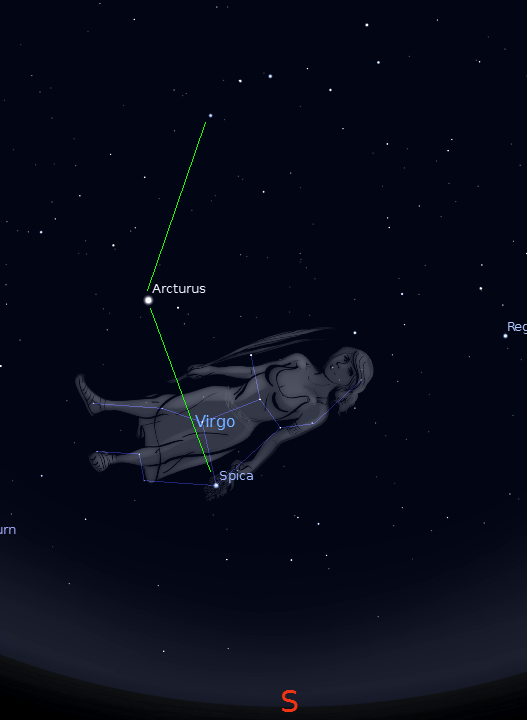
One of the large constellations we see in the south at 11 p.m. can be found using the Big Dipper overhead, follow the arc of the handle to the bright star Arcturus, then straighten the arc to a spike to reach Spica, a bright blue-white star in the south. Spica is the brightest star in the constellation Virgo, the virgin. She represents the goddess of the harvest, Virgo is holding a sheaf of wheat in depictions of her, and Spica is placed at the head of the sheaf. In the space between Spica and Leo the lion to her upper right is, a great cluster of thousands of galaxies just below naked eye visibility. The Virgo Cluster. Inside that cluster is galaxy M87, in whose center lies a black hole with the mass of 6.5 billion suns. The center of the cluster is at about 54 million light years away. The first black hole imaged by the Earth spanning Event Horizon Telescope.
The astronomical event times given are for the Traverse City/Interlochen area of Michigan (EDT, UT–4 hours). They may be different for your location.
Addendum
Ephemeris: 05/28/2024 – Finding Spica and Virgo
This is Ephemeris for Tuesday, May 28th. Today the Sun will be up for 15 hours and 15 minutes, setting at 9:18, and it will rise tomorrow at 6:01. The Moon, 2 days before last quarter, will rise at 2:06 tomorrow morning.
The Big Dipper, near the zenith at 10:30 pm points to several stars and constellations. It’s handle points to two bright stars. First we follow the arc of the handle to the bright orange star Arcturus, the 4th brightest nighttime star. The reason I say nighttime is that the Sun is a star also, but by definition is not out at night. The arc to Arcturus is a way to find Arcturus and a clue to its name. Arcturus, high in the south-southeast, lies at the base point of the kite shaped constellation of Boötes the herdsman. From Arcturus, straighten out the arc to a spike and one soon arrives at Spica a blue-white star in Virgo the virgin, now in the south. Spica is also sometimes pronounced ‘Speeka’.
The astronomical event times given are for the Traverse City/Interlochen area of Michigan (EDT, UT–4 hours). They may be different for your location.
Addendum
Ephemeris: 05/27/2024 The evening sky is transitioning into summer
This is Bob Moler with Ephemeris for Memorial Day, Monday, May 27th. Today the Sun will be up for 15 hours and 14 minutes, setting at 9:17, and it will rise tomorrow at 6:02. The Moon, 3 days before last quarter, will rise at 1:36 tomorrow morning.
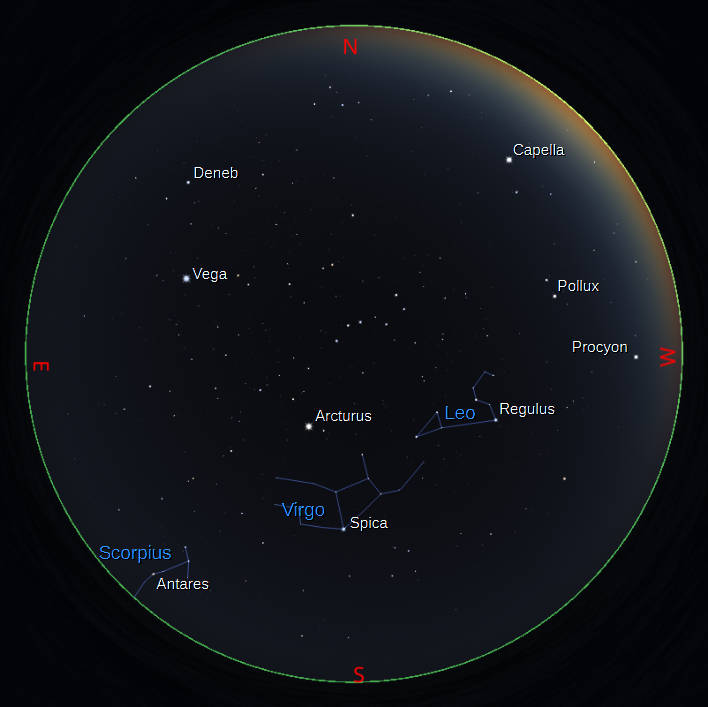
The sky tonight at 10:30 is beginning to show the transition from spring to summer. Antares in Scorpius is very low in the southeast, rising and chasing away Orion who has disappeared in the West. According to Greek mythology, at least in one story, Orion was killed by the sting of a giant scorpion and so neither he nor Scorpius the scorpion can be in the sky at the same time. The bright star Spica in Virgo the virgin is due South at that time, with Leo the lion in the southwest. Very high in the southeast is the star Arcturus. The Big Dipper is overhead. And in the east-northeast high up this is the bright star Vega, one of the stars of the summer triangle. The second star of the triangle Deneb is lower in the northeast. The third star has yet to rise.
The astronomical event times given are for the Traverse City/Interlochen area of Michigan (EDT, UT–4 hours). They may be different for your location.
Addendum
05/18/2023 – Ephemeris – Spica, the bluest first magnitude star
This is Bob Moler with Ephemeris for Thursday, May 18th. Today the Sun will be up for 14 hours and 55 minutes, setting at 9:07, and it will rise tomorrow at 6:10. The Moon, 1 day before new, will rise at 5:56 tomorrow morning.
In the south at 11 p.m. is the bright star Spica, which can be found from all the way back overhead to the Big Dipper. Follow the arc of the handle of the Big Dipper to the bright star Arcturus high in the southeast. Then straighten the curve of the arc to a straight spike which points to Spica, the brightest star in Virgo the virgin. Arcturus is much brighter than Spica and has an orange tint to Spica’s bluish hue. In fact, Spica is the bluest of the 21 first magnitude stars. That means that it has a really hot surface temperature. Actually, Spica is really two blue stars orbiting each other in 4 days. Spica is 250 light years away. It also was an important star to the ancient Greeks. One temple was built, and aligned to its setting point.
The astronomical event times given are for the Traverse City/Interlochen area of Michigan (EDT, UT –4 hours). They may be different for your location.
Addendum
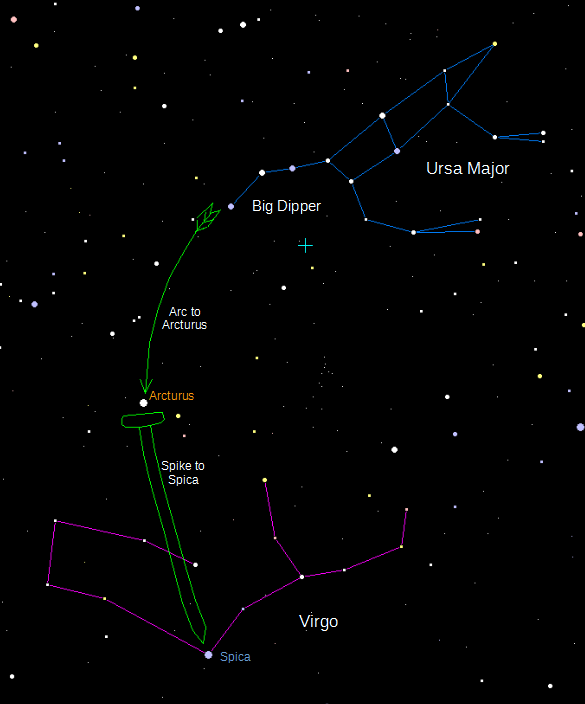
Finding Virgo from the Big Dipper at 10:30 pm, May 18th. There are no planetary interlopers this year. The small + sign marks the zenith, and the image faces south. Created using my LookingUp app, with captions added using LibreOffice Draw.
05/12/2023 – Ephemeris – Finding Virgo the virgin in the evening sky
This is Ephemeris for Friday, May 12th. Today the Sun will be up for 14 hours and 42 minutes, setting at 9:00, and it will rise tomorrow at 6:17. The Moon, at last quarter today, will rise at 3:44 tomorrow morning.
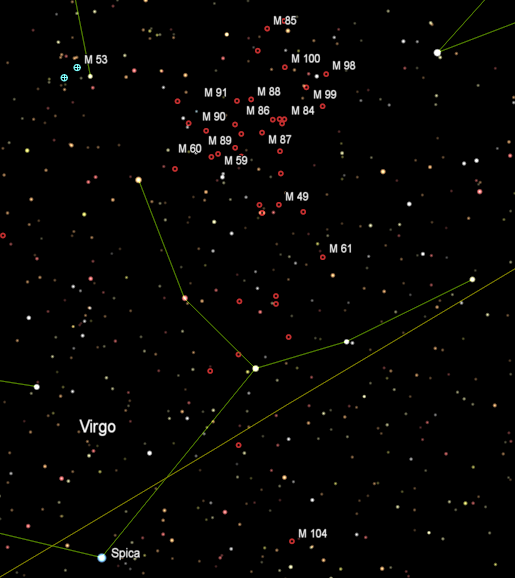
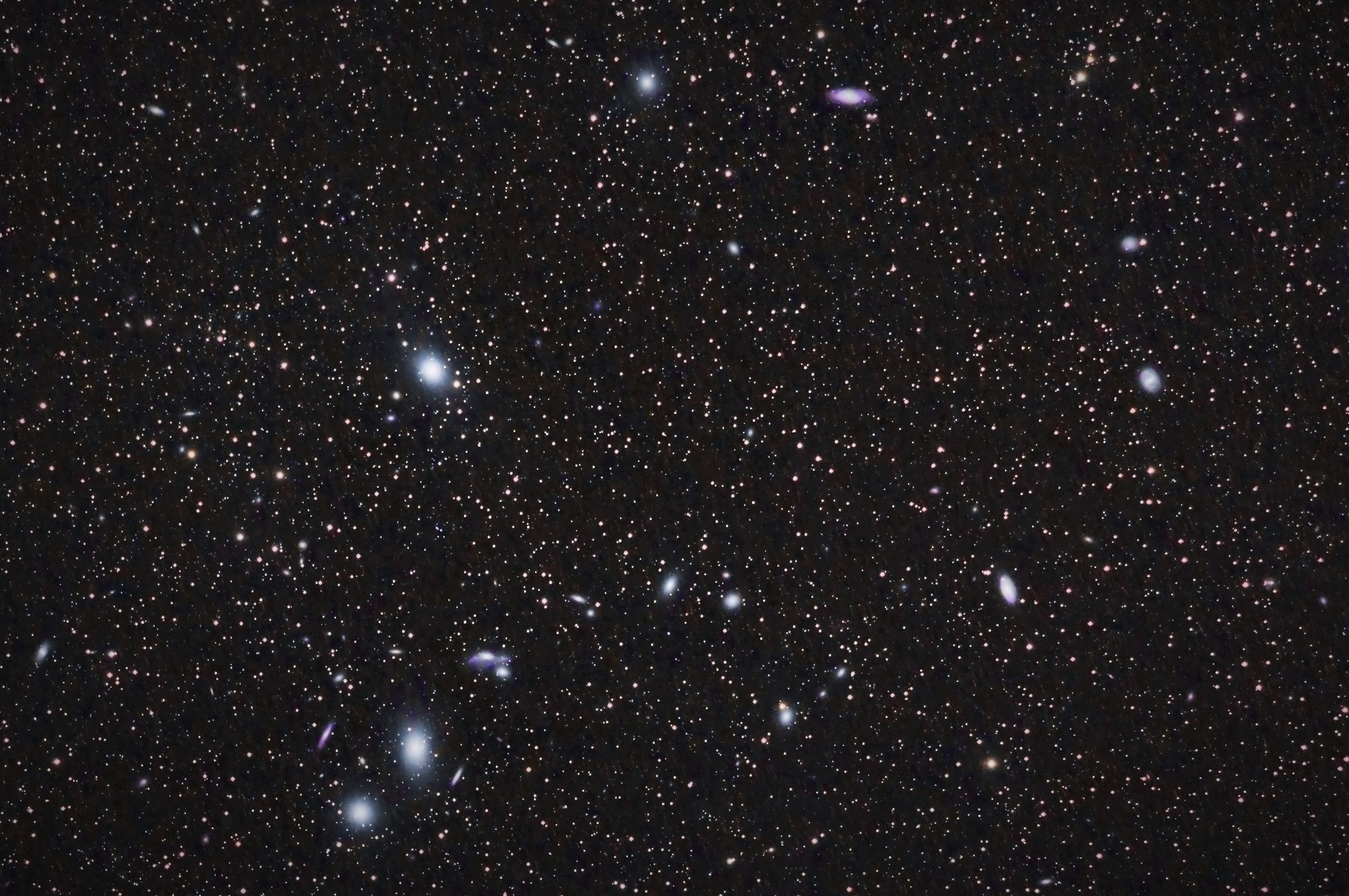
One of the large constellations we see in the south at 11 p.m. can be found using the Big Dipper overhead, follow the arc of the handle to the bright star Arcturus, then straighten the arc to a spike to reach Spica, a bright blue-white star in the south. Spica is the brightest star in the constellation Virgo, the virgin. She represents the goddess of the harvest, Virgo is holding a sheaf of wheat in depictions of her, and Spica is placed at the head of the sheaf. In the space between Spica and Leo the lion to her upper right is, a great cluster of thousands of galaxies just below naked eye visibility. The Virgo Cluster. Inside that cluster is galaxy M87, in whose center lies a black hole with the mass of 6.5 billion suns. The center of the cluster is at about 54 million light years away.
The astronomical event times given are for the Traverse City/Interlochen area of Michigan (EDT, UT –4 hours). They may be different for your location.
Addendum
Finding Virgo from the Big Dipper at 11 pm, May 12. There are no planetary interlopers this year. The small + sign marks the zenith, and the image faces south. Created using my LookingUp app, with captions added using LibreOffice Draw.
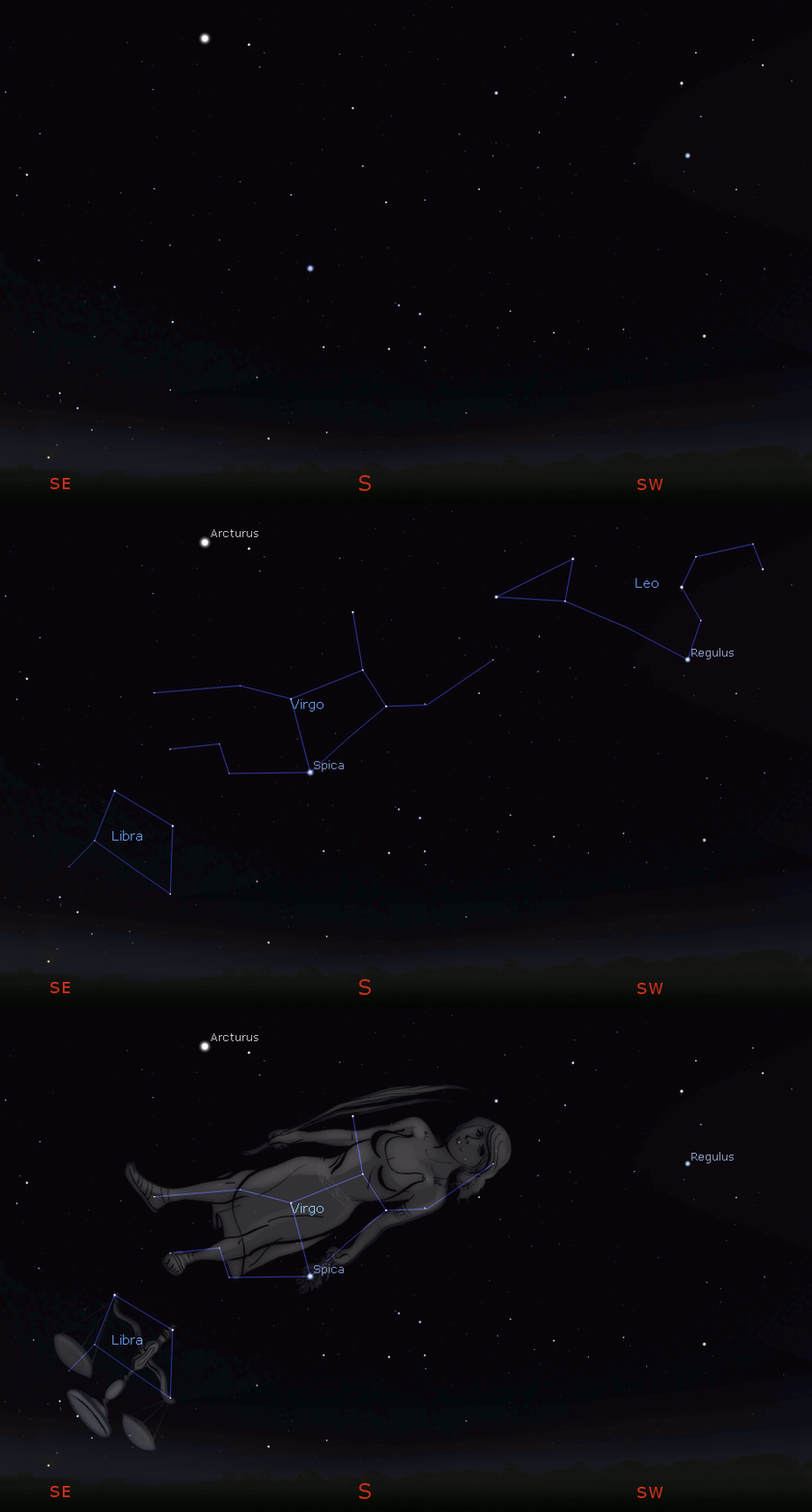
Virgo finder animation with Leo added as an aid for 11 p.m. tonight. Created using Stellarium and GIMP.
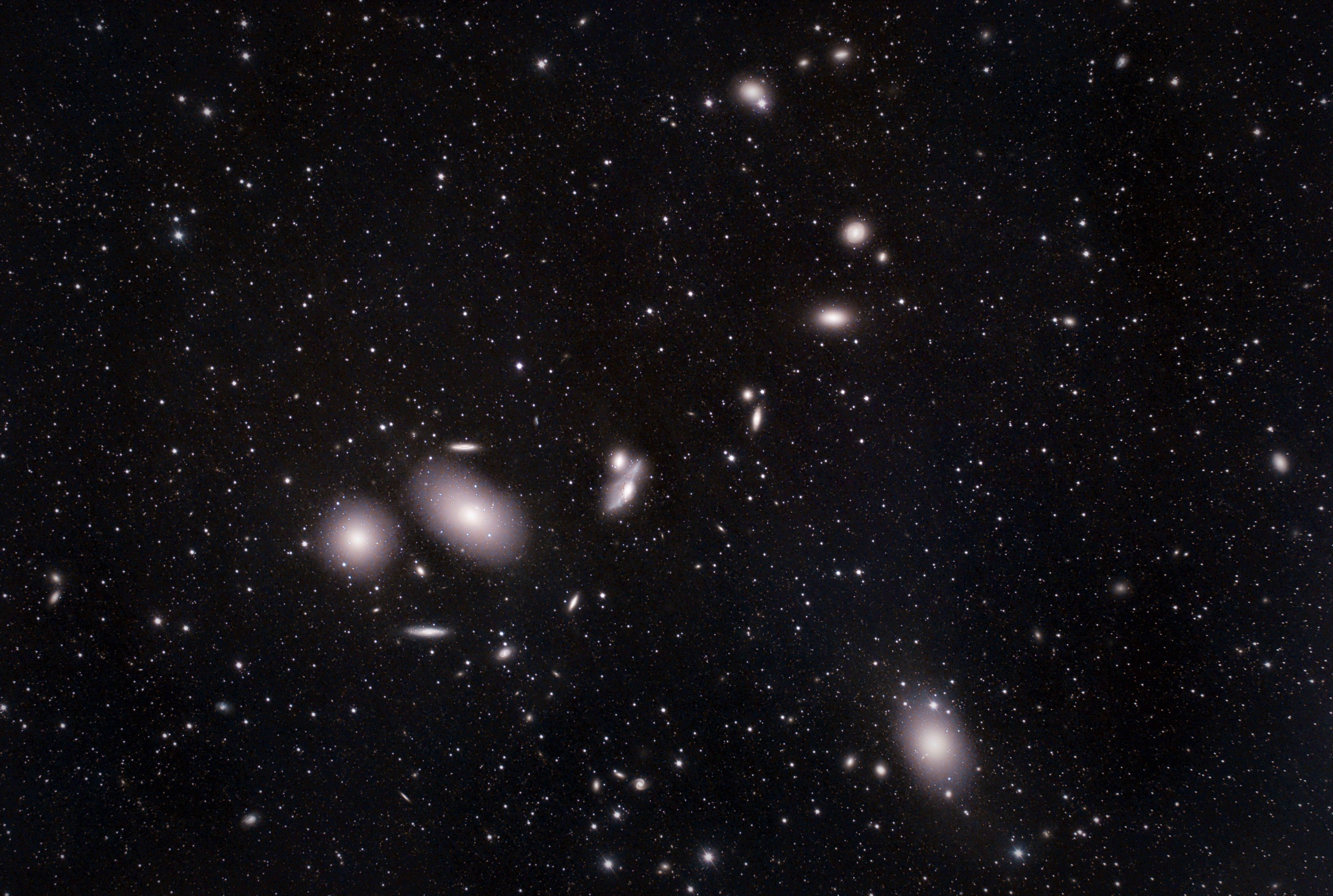
Markarian’s Chain, a small part of the Virgo Cluster of galaxies. Click or tap on the image to enlarge it. Credit: Daniel Dall’Olmo.
05/03/2021 – Ephemeris – The constellation of Virgo
This is Ephemeris for Monday, May 3rd. Today the Sun will be up for 14 hours and 21 minutes, setting at 8:50, and it will rise tomorrow at 6:28. The Moon, at last quarter today, will rise at 3:52 tomorrow morning.
Tonight in the sky: to the southeast is the bright star Spica. Another way to find the star is to find the Big Dipper high overhead and follow the arc of the handle to the bright star Arcturus, and straighten the arc to a spike to meet Spica. It is in the constellation and member of the zodiac: Virgo the virgin. Virgo is a large constellation of a reclining woman holding a stalk of wheat. The bright star in the center of the constellation, Spica, is the head of that spike of wheat; and as such it ruled over the harvest in two of Virgo’s guises as the goddesses Persephone and Ceres. Ceres is now a dwarf planet and the root of the word cereal. Virgo is also identified as Astraea the goddess of justice. The constellation of Libra, the scales of justice, lies at her feet.
The astronomical event times given are for the Traverse City/Interlochen area of Michigan. They may be different for your location.
Addendum
 Bob Moler's Ephemeris Blog