Archive
08/31/11 – Ephemeris – The bright planets for this week
Wednesday, August 31st. The sun will rise at 7:03. It’ll be up for 13 hours and 17 minutes, setting at 8:21. The moon, 3 days past new, will set at 9:19 this evening.
It’s Wednesday and time again to take a look at the whereabouts of the bright planets. The ringed planet Saturn will be visible in the west southwest in evening twilight. It’s near the bright star Spica to its left. Spica has a blue tinge, while Saturn is yellowish. It will set at 9:50 p.m. Saturn is a wonderful sight is a telescope with its rings. We are seeing Saturn in evening twilight now. Its image is being deteriorated by the earth’s atmosphere being low in the sky. Jupiter will rise at 10:37 p.m. in the east northeast and is seen against the stars of the constellation Aries now. Mars will rise at 2:42 a.m also in the east northeast and is now passing through the constellation Gemini the twins. Venus, now in the evening sky, is too close to the sun to be seen.
* Times are for the Traverse City/Interlochen area of Michigan. They may be different for your location.
08/30/11 – Ephemeris – The bright star Altair
Tuesday, August 30th. The sun will rise at 7:02. It’ll be up for 13 hours and 20 minutes, setting at 8:23. The moon, 2 days past new, will set at 8:48 this evening.
The Summer Triangle of bright stars is visible overhead and to the south.. Vega is highest, nearly overhead, while Deneb is high in the northeast. The southernmost star of the Summer Triangle is Altair. Altair is the closest of the three stars at a distance of 16.8 light years away. One light year is nearly 6 trillion miles. Altair is 10 times the brightness of the sun. If seen at Altair’s distance, the sun would only be as bright as one of the two stars that flank it. What is rather different about Altair is it’s rapid rotation. While its almost twice the sun’s diameter, it rotates once in only 6 ½ to 10 hours, and would show a decidedly squashed appearance if seen close up. Our sun’s a slow poke, taking nearly a month to rotate just once.
* Times are for the Traverse City/Interlochen area of Michigan. They may be different for your location.
08/29/11 – Ephemeris – The twinkly red star Antares
Monday, August 29th. The sun will rise at 7:01. It’ll be up for 13 hours and 23 minutes, setting at 8:24. The moon, 1 day past new, will set at 8:19 this evening.
As it gets dark this evening a bright reddish star will appear low in the south. It will appear to twinkle mightily. It is not the planet Mars, which is now in the morning sky, but its rival the star Antares in Scorpius the scorpion. The star’s name, Antares, notes the rivalry. “Ant” means anti, while “Ares” is the Greek name for the Roman god Mars. Antares literally means “Rival of Mars”. Antares appears red due to its cool surface temperature of 3,600 Kelvin, much cooler than the sun’s 6,000 Kelvin, while Mars is red due to rust. As Antares starts to set later in the evening its light will mass through more of earth’s turbulent atmosphere making it sparkle like a multicolored sparkler. Antares spectacular twinkling has sparked more than a few calls about a strange light in the sky.
* Times are for the Traverse City/Interlochen area of Michigan. They may be different for your location
08/26/11 – Ephemeris – Observing events this weekend
Friday, August 26th. The sun rises at 6:57. It’ll be up for 13 hours and 32 minutes, setting at 8:30. The moon, 2 days before new, will rise at 5:10 tomorrow morning.
We have a couple of events this weekend to view the heavens hosted by the Grand Traverse Astronomical Society. Starting at 9 p.m. tonight the Northwestern Michigan College’s Rogers Observatory will be open for viewing of the wonders of the summer Milky Way. Then Saturday night starting around 9 if it is clear the society will be at the Open Space or near the beach west of there for an asteroid Vesta viewing night. We’ll be hunting for a dark spot probably as far as we can get from lights. We’ll have a banner visible from the Grand View Parkway to the area we’ll be in. We’ll be viewing this asteroid which is currently being orbited by the Dawn spacecraft. It will look like a star in our telescopes, but one of our members has a piece of Vesta which he will exhibit.
* Times are for the Traverse City/Interlochen area of Michigan. They may be different for your location.
08/25/11 – Ephemeris – The Great Rift
Thursday, August 25th. The sun rises at 6:56. It’ll be up for 13 hours and 35 minutes, setting at 8:31. The moon, 3 days before new, will rise at 3:57 tomorrow morning.
High overhead the Milky Way is seen passing through the Summer Triangle of three bright stars. Here we find the Milky Way split into two sections. The split starts in the constellation of Cygnus the Swan or Northern Cross very high in the east. The western part of the Milky Way ends southwest of the Aquila the eagle. This dark dividing feature is called the Great Rift. Despite the lack of stars seen there, it doesn’t mean that there are fewer stars there than in the brighter patches of the Milky Way. The rift is a great dark cloud that obscures the light of the stars behind it. Sometimes binoculars can be used to find the edges of the clouds of the rift, as stars numbers drop off suddenly. This is especially easy in Aquila.
* Times are for the Traverse City/Interlochen area of Michigan. They may be different for your location.
Addendum
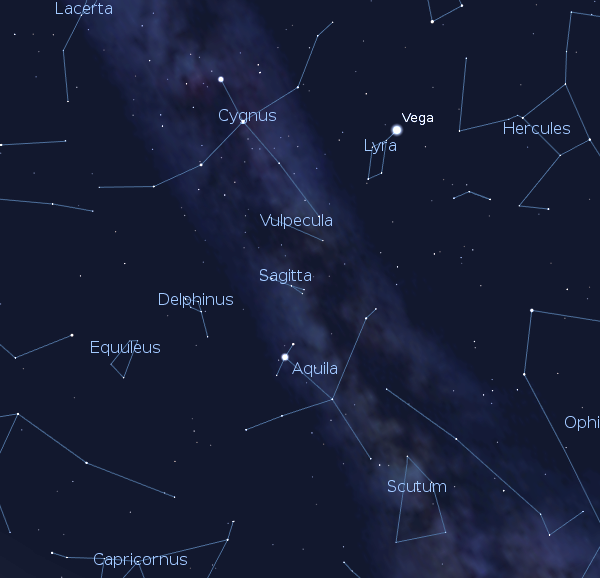
The Great Rift in the Milky Way. Created using Stellarium.
08/24/11 – Ephemeris – The bright planets visible this week
Wednesday, August 24th. The sun rises at 6:55. It’ll be up for 13 hours and 38 minutes, setting at 8:33. The moon, 3 days past last quarter, will rise at 2:47 tomorrow morning.
It’s Wednesday and time again to take a look at the whereabouts of the bright planets. The ringed planet Saturn will be visible in the west southwest in evening twilight. It’s near the bright star Spica to its left. Spica has a blue tinge, while Saturn is yellowish. It will set at 10:17 p.m. Saturn is a wonderful sight is a telescope with its rings. We are seeing Saturn in evening twilight now. Its image is being deteriorated by the earth’s atmosphere being low in the sky. Jupiter will rise at 11:04 p.m. in the east northeast and is seen against the stars of the constellation Aries now. Mars will rise at 2:48 a.m also in the east northeast and is now passing through the constellation Gemini the twins. Venus, now in the evening sky, is too close to the sun to be seen.
* Times are for the Traverse City/Interlochen area of Michigan. They may be different for your location.
08/23/11 – Ephemeris – The wonders found in the constellation Scutum
Tuesday, August 23rd. The sun rises at 6:54. It’ll be up for 13 hours and 41 minutes, setting at 8:35. The moon, 2 days past last quarter, will rise at 1:45 tomorrow morning.
The teapot pattern of stars that is the constellation of Sagittarius lies at the southern end of the Milky Way this evening. It appears that the Milky Way is steam rising from the spout. The area above Sagittarius in the brightest part of the Milky Way is the dim constellation of Scutum the shield. Don’t bother looking for the stars that make up the constellation; what’s important is the star clouds of the Milky Way. Scan this area with binoculars or small telescope for star clusters and nebulae or clouds of gas. In binoculars both clusters and nebulae will appear fuzzy, but a small telescope will tell most of them apart. Even if you’ve never been able to find anything in your telescope, put on the lowest power eyepiece you have and scan back and forth for these wonders.
* Times are for the Traverse City/Interlochen area of Michigan. They may be different for your location.
Addendum
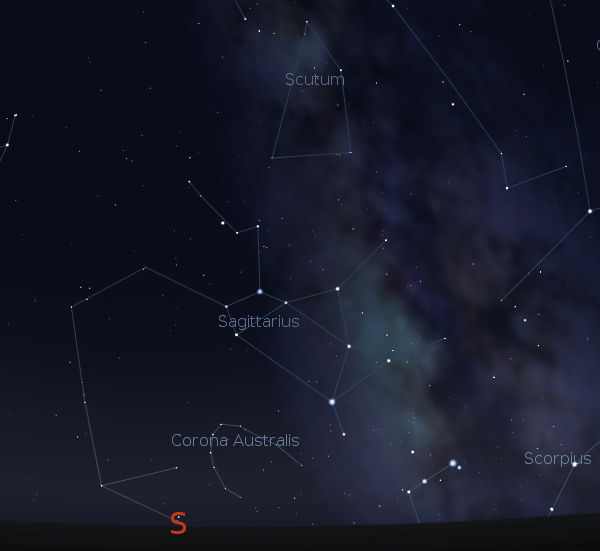
The constellations Sagittarius and Scutum. Created using Stellarium.
08/22/11 – Ephemeris – The constellation Sagittarius
Monday, August 22nd. The sun rises at 6:52. It’ll be up for 13 hours and 44 minutes, setting at 8:36. The moon, 1 day past last quarter, will rise at 12:50 tomorrow morning.
The Milky Way runs from north to south through the heavens at 11 p.m. You’ll notice that the Milky Way is brighter and broader just above the horizon in the south. In that glow in the south is a star pattern that looks like a stout little teapot, with a the Milky way like steam rising from the spout, which faces the west. This pattern of stars is the major part of the constellation called Sagittarius. According to Greek mythology Sagittarius is a centaur with a bow and arrow poised to shoot Scorpius the scorpion to the right. This centaur is called Chiron, the most learned of the breed, centaurs usually being a rowdy bunch. The center of the pinwheel of our galaxy lies hidden beyond the stars above the spout of the teapot.
* Times are for the Traverse City/Interlochen area of Michigan. They may be different for your location.
Addendum
The constellations Sagittarius and Scutum. Created using Stellarium.
08/19/11 – Ephemeris – Lots of viewing opportunities this weekend
Friday, August 19th. The sun rises at 6:49. It’ll be up for 13 hours and 52 minutes, setting at 8:41. The moon, 2 days before last quarter, will rise at 10:53 this evening.
This will be a big weekend of observing the heavens if it’s clear. First the Grand Traverse Astronomical Society will be part of Friday Night Live on Front Street in Traverse City. Starting at 9 p.m. Northwestern Michigan College’s Rogers Observatory will be open for viewing of the skies. Saturday night starting around 9 the society will be at the Open Space for an asteroid Vesta viewing night. This will be repeated on the 27th. We’ll probably be as far as we can get from lights in the area of the old power planet to view this asteroid which is currently being orbited by the dawn spacecraft. It will look like a star in our telescopes, but one of our members has a piece of Vesta which he will exhibit also at the Open Space.
* Times are for the Traverse City/Interlochen area of Michigan. They may be different for your location.
08/18/11 – Ephemeris – The constellation of Scorpius the scorpion
Thursday, August 18th. The sun rises at 6:48. It’ll be up for 13 hours and 55 minutes, setting at 8:43. The moon, 3 days before last quarter, will rise at 10:25 this evening.
There’s a large constellation located low in the south as it starts to get dark about 10 tonight It’s Scorpius the scorpion. Its brightest star is Antares in its heart, a red giant star, that I get calls about from time to time as being a UFO. From Antares to the right is a star then a vertical arc of three stars that is its head. The Scorpion’s tail is a line of stars running down to the left of Antares swooping to the horizon before coming back up and ending in a pair of stars that portray his poisonous stinger. Scorpius looks huge lying on the southern horizon. But if you go south Scorpius will be higher in the sky, and will look smaller. Being close to the horizon from here, Scorpius shares with the rising and setting sun and moon the illusion of increased size.
* Times are for the Traverse City/Interlochen area of Michigan. They may be different for your location.
Addendum
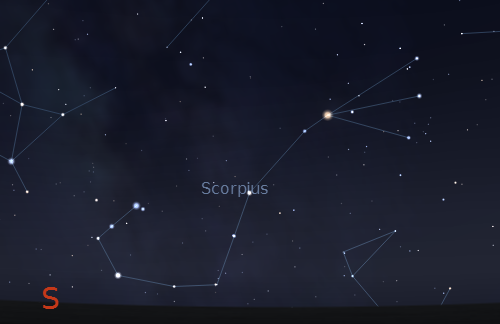
Scorpius at 10 p.m. tonight from near 45 degrees north. Created using Stellarium.
 Bob Moler's Ephemeris Blog