Archive
06/14/2013 – Ephemeris – Earliest sun rise of the year
Ephemeris for Flag Day, Friday, June 14th. Today the sun will be up for 15 hours and 32 minutes, setting at 9:29. The moon, 2 days before first quarter, will set at 12:51 tomorrow morning. Tomorrow the sun will rise at 5:56.
The sundial makes a poor clock. It will give the approximate time, but even if you could make the lines on its face accurate for one day, it could be off a week later. The reason I mention this is because tomorrow morning is the earliest sunrise. We’ll be still 6 days from the longest day, when the daylight hours are at their maximum. The latest sunset will be on the 26th, 5 days after the summer solstice. The disparity is even greater in the winter. Sundials can be corrected by a table of how much the sun is fast or slow, called the equation of time. It is caused by both earth’s slightly eccentric orbit of the sun, and the tilt of the earth’s axis. It seems when you study things closely they are not as simple as they appear.
Times are for the Traverse City/Interlochen area of Michigan. They may be different for your location.
06/13/2013 – Ephemeris – The moon tonight and the crater Theophilus
Ephemeris for Thursday, June 13th. Today the sun will be up for 15 hours and 31 minutes, setting at 9:28. The moon, 3 days before first quarter, will set at 12:23 tomorrow morning. Tomorrow the sun will rise at 5:56.
The 5 day old crescent moon reveals to a small telescope, a trio of large craters on the edge of the moon’s terminator or sunrise line. The best of these is on top Theophilus, a perfectly circular 61 mile diameter crater with a prominent central peak. It’s a little late for it tonight but sometimes when the terminator is crossing the crater, the floor is dark and the central peak catches the morning sunlight. The other two craters won’t be completely in sunlight tonight. Theophilus is a couple of hundred miles south of the Apollo 11 landing site in the Sea of Tranquility, That sea will be completely in sunlight tomorrow night. The moon is a great celestial object to view with any telescope.
Times are for the Traverse City/Interlochen area of Michigan. They may be different for your location.
Addendum
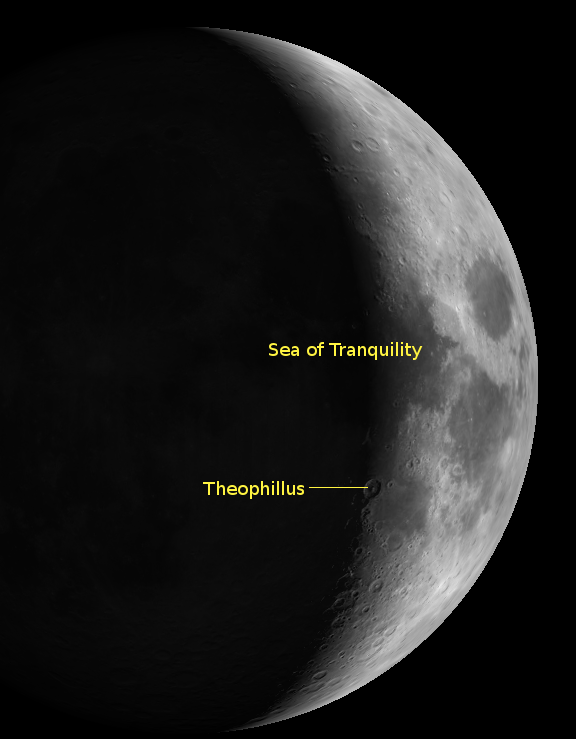
The moon at 10 p.m. on June 13, 2013. In our skies the moon will be rotated some 30-40 degrees clockwise. Created using Virtual Moon Atlas.
Note: Due to some familial concerns yesterday, this post is a bit late.
06/12/2012 – Ephemeris – Three planets still in the evening sky
Ephemeris for Wednesday, June 12th. Today the sun will be up for 15 hours and 31 minutes, setting at 9:28. The moon, half way from new to first quarter, will set at 11:55 this evening. Tomorrow the sun will rise at 5:56.
The early evening will be taken up with Venus and faint Mercury low in the west northwest at about 10:15 p.m. The crescent moon is nearby to the left. Mercury is above and left of Venus by about 5 degrees, about half the width of your fist at arm’s length. Mercury is at its greatest separation or elongation from the sun today of 24 degrees angle. Venus will set at 10:59, and Mercury will set at 11:14 p.m. Holding forth in the south will be Saturn this evening, the brightest star-like object in the constellation Virgo appearing yellowish to the left of the extremely blue-white star Spica. Saturn is a wonderful sight in a telescope of 20 power or more. Saturn will pass due south at 10:33 p.m., and will set at 3:51 tomorrow morning.
Times are for the Traverse City/Interlochen area of Michigan. They may be different for your location.
Addendum
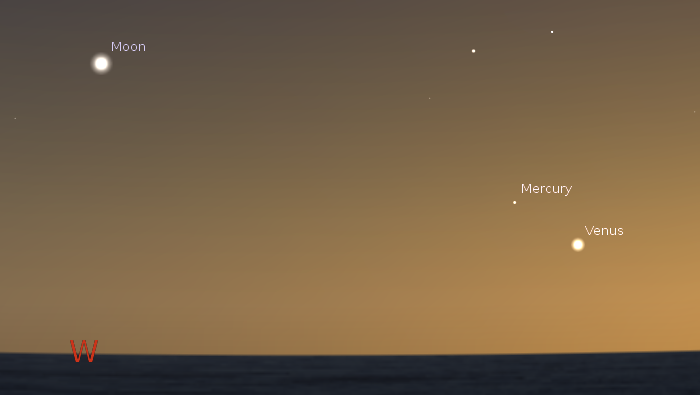
Mercury, Venus and the moon at 10:15 p.m. on June 12, 2013. Created using Stellarium. Note that the moon at this phase (thin crescent) doesn’t show at this scale, so the moon’s position is shown as full.
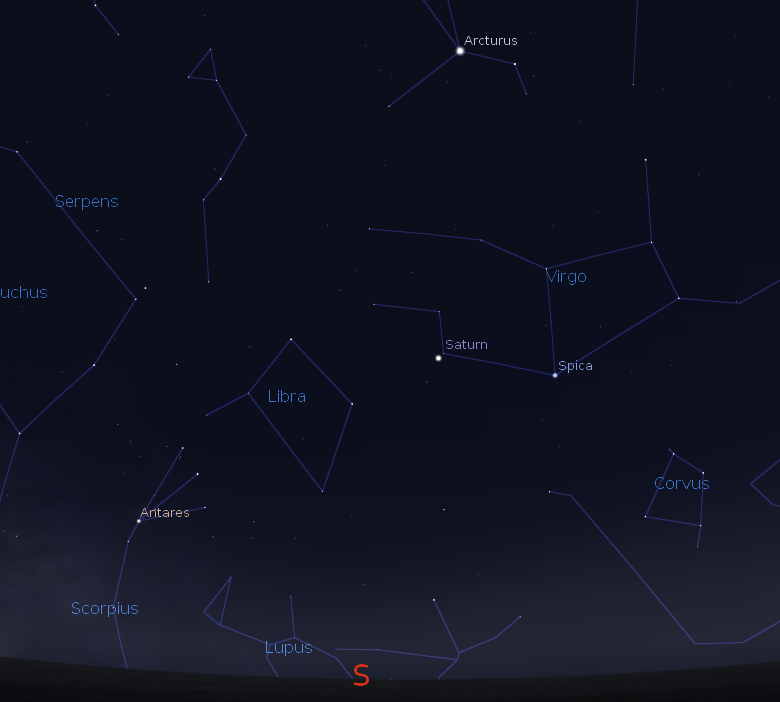
Saturn and constellations at 11 p.m. on June 12, 2013. Note Scorpius rising to the left. Created using Stellarium.
06/11/2013 – Ephemeris – The Milky Way rising
Ephemeris for Tuesday, June 11th. Today the sun will be up for 15 hours and 30 minutes, setting at 9:27. The moon, 3 days past new, will set at 11:24 this evening. Tomorrow the sun will rise at 5:56.
Last Saturday night at the Sleeping Bear Dunes star party, at the end of the official star party after 11 we were looking to the east. The only blemish to the dark skies was the light pollution dome of Traverse City to the east. Rising out of that yellowish haze and barely visible was the Milky Way. In the spring skies the Milky way almost rings the horizon. The only portion visible is low in the north, too close to the horizon to be really visible. Now that spring is almost over , we are transitioning at the end of twilight to the summer stars and the brilliant Milky Way of summer is rising in the east. By August it will run across the sky from northeast to the south, revealing in the south the bulge of the galactic center.
Times are for the Traverse City/Interlochen area of Michigan. They may be different for your location.
Addendum
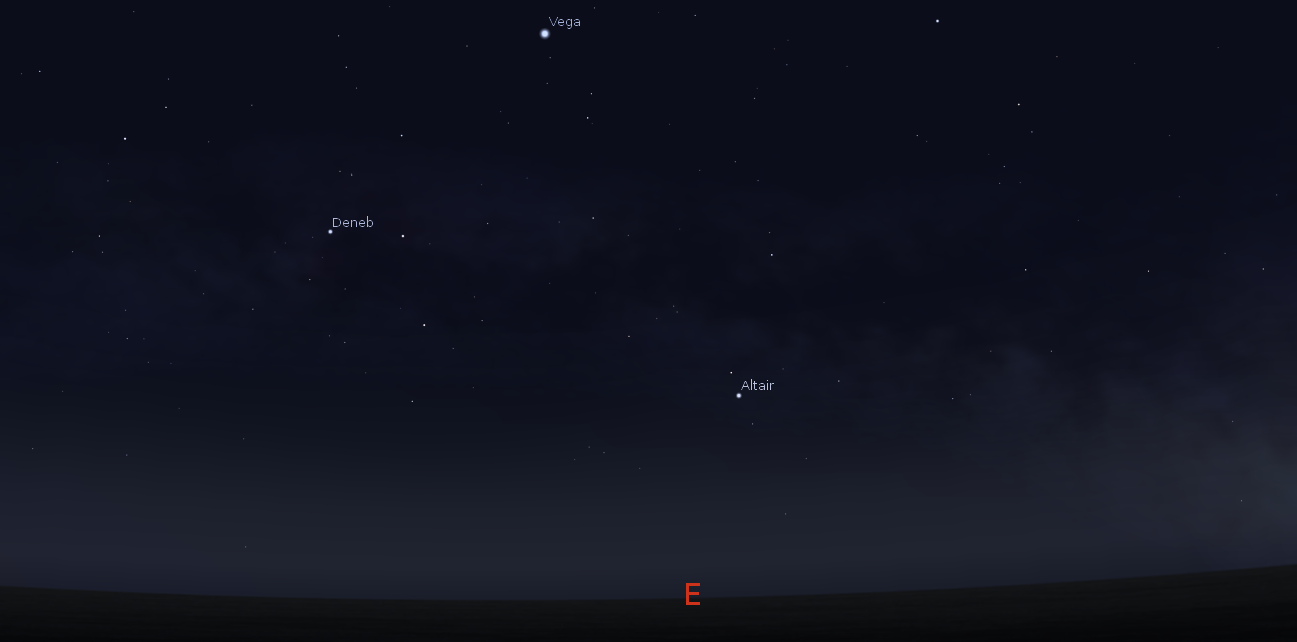
The Milky Way Rising at 11:15 p.m. on June 11, 2013. Created using Stellarium.
The three named stars are those of the Summer Triangle.
06/10/2013 – Ephemeris – Mercury and Venus in the west
Ephemeris for Monday, June 10th. Today the sun will be up for 15 hours and 29 minutes, setting at 9:27. The moon, 2 days past new, will set at 10:49 this evening. Tomorrow the sun will rise at 5:56.
Tonight the moon will join Mercury and Venus low in the west northwest at around 10:15. Venus will be the easiest to spot. Mercury will be above Venus and to the left. Binoculars may help you spot it. The crescent moon will be to the left and a bit below Venus. If you’ve been watching these planets for the past two weeks you’ve probably noticed that Mercury is getting fainter. That’s because its phase is becoming less full as moves around the sun toward us. It’s phase is now a bit more than half illuminated. Wednesday it will be half illuminated as it reaches its greatest elongation from the sun, a whopping 24 degree angle from the sun. That’s pretty good for us observing from the northern hemisphere.
Times are for the Traverse City/Interlochen area of Michigan. They may be different for your location.
Addendum
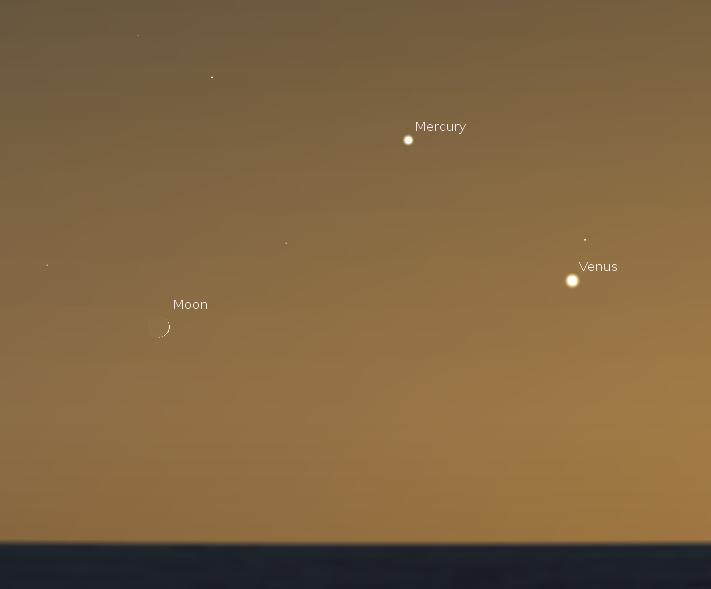
Mercury, Venus and the crescent moon in the west northwest at 10:15 p.m. on June 19, 2013. Created using Stellarium.
06/07/2013 – Ephemeris – Learn about telescopes and observe the heavens this weekend.
Ephemeris for Friday, June 7th. Today the sun will be up for 15 hours and 27 minutes, setting at 9:25. The moon, 1 day before new, will rise at 6:06 tomorrow morning. Tomorrow the sun will rise at 5:57.
This will be a busy weekend for anyone wanting to view the heavens. First the Grand Traverse Astronomical Society will hold its monthly meeting at 8 p.m. tonight at the Rogers Observatory. It will be a program about how to use telescopes. The session will be conducted by Rod Cortright of the Northern Michigan Astronomy Club. This will be followed by a star party at 9 p.m. where the featured attractions will be the planets Mercury, Venus and Saturn if its clear. Tomorrow night, that’s Saturday night there will be a star party at Sleeping Bear Dunes Pierce Stocking Drive, Stop number 3 starting at 9 p.m. Please park at Picnic Mountain, just before stop 3. The Dunes star party will take place if it’s clear or partly cloudy.
Times are for the Traverse City/Interlochen area of Michigan. They may be different for your location.
06/06/2013 – Ephemeris – Star colors
Ephemeris for Thursday, June 6th. Today the sun will be up for 15 hours and 26 minutes, setting at 9:24. The moon, 2 days before new, will rise at 5:22 tomorrow morning. Tomorrow the sun will rise at 5:57.
Star and planets colors are quite subtle. This is partly due to the fact that we are color blind at very low light levels. Only the brightest stars show color at all. Telescopes however aid our color perception because it makes the stars brighter. The planet Saturn, now in the south at night has a distinct yellowish hue, caused by the color of its atmosphere. The star Spica to its right is the bluest of the bright first magnitude stars, and shows as a bright arc light. Arcturus, above both Saturn and Spica has a yellow to orange hue. Antares low in the southeast has a definite reddish hue. In a telescope it also looks like a sparkler due to our turbulent atmosphere. Red stars are the coolest stars (temperature wise) while blue-white stars are the hottest.
Times are for the Traverse City/Interlochen area of Michigan. They may be different for your location.
Addendum
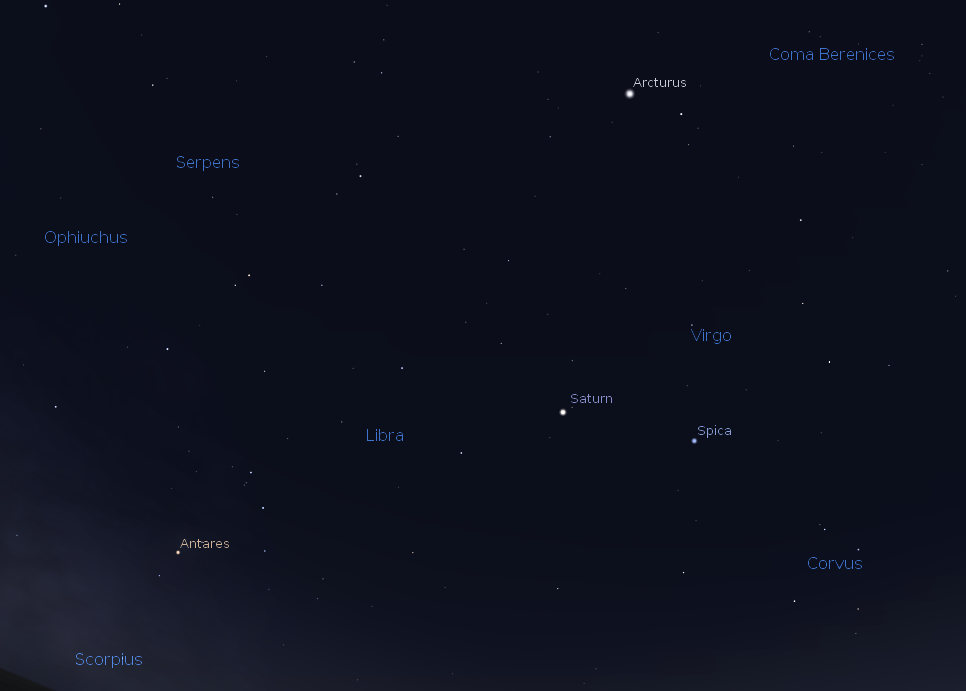
Stellarium does a pretty good job of showing the subtle colors of stars, which is also reflected in the color of the star labels. Click on the image to enlarge.
06/05/2013 – Ephemeris – Then there were two… planets that is, in the west
Ephemeris for Wednesday, June 5th. Today the sun will be up for 15 hours and 25 minutes, setting at 9:23. The moon, 3 days before new, will rise at 4:43 tomorrow morning. Tomorrow the sun will rise at 5:58.
The early evening will be taken up with Venus and Mercury low in the west northwest at about 10:15 p.m. Mercury is above and left of Venus by about 5 degrees, about half the width of your fist at arms length. Jupiter is out of it now, setting at 10:07. We’ll see it next in late July in the morning sky. Venus will set at 10:49, and Mercury will set at 11:16 p.m. Holding forth in the south will be Saturn this evening, the brightest star-like object in the constellation Virgo appearing yellowish to the left of the extremely blue-white star Spica. Saturn will pass due south at 11:01 p.m., and will set at 4:19 tomorrow morning. I’ll talk about star and planet colors on tomorrow’s program.
Times are for the Traverse City/Interlochen area of Michigan. They may be different for your location.
Addendum
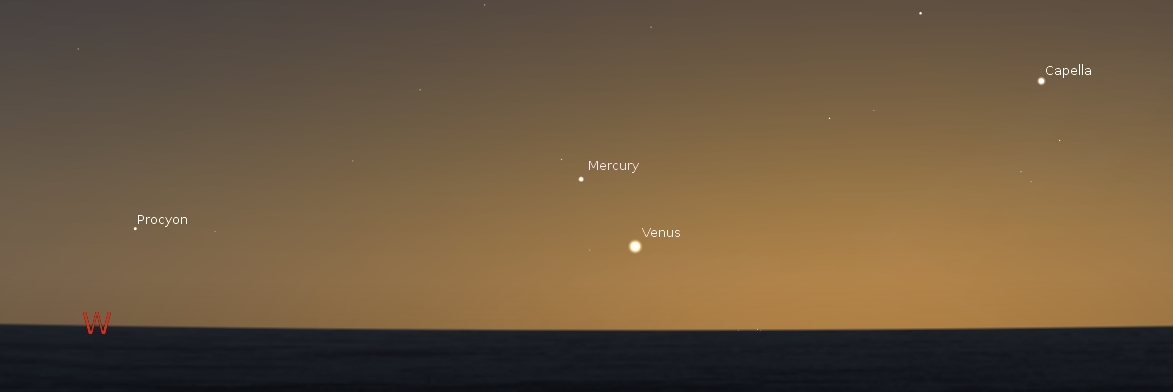
Mercury and Venus seen in the west northwest after sunset. Here it’s 10:15 p.m. on June 5, 2013. Created using Stellarium.
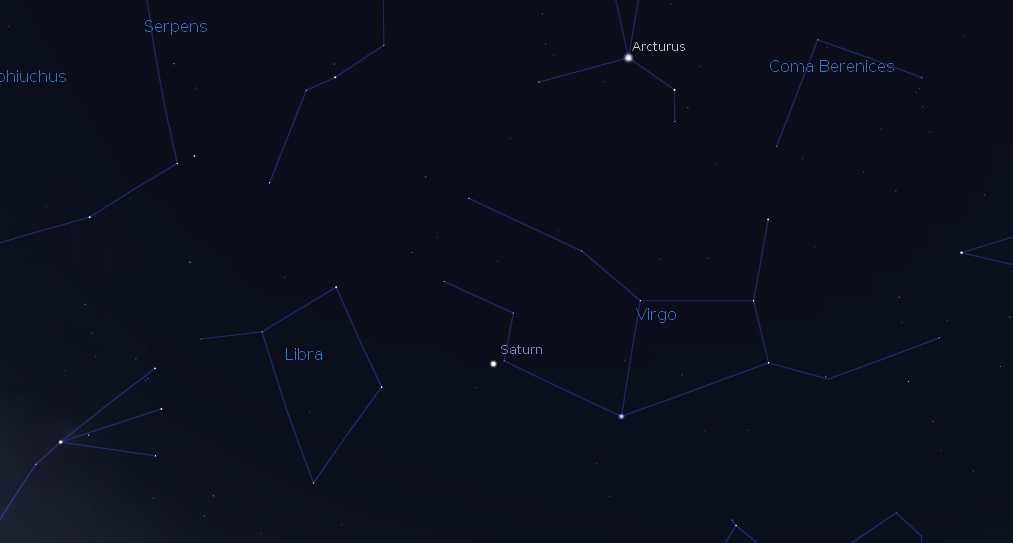
Looking south at Saturn and surrounding constellations at 11 p.m. on June 5, 2013. Created using Stellarium.
06/04/2013 – Ephemeris – A cluster of not stars but galaxies
Ephemeris for Tuesday, June 4th. Today the sun will be up for 15 hours and 24 minutes, setting at 9:23. The moon, half way from last quarter to new, will rise at 4:08 tomorrow morning. Tomorrow the sun will rise at 5:58.
The constellation Virgo which contains the bright star Spica and for this and the last two years the planet Saturn is in a sparse region of the sky as far as stars go. We are almost directly looking out the side of our Milky Way Galaxy. That milky band has been banished to the northern horizon. But while the stars may be few, we are also looking out past a gulf of 50 million light years to a great cluster of galaxies we call the Virgo Cluster. The galaxies here count into the thousands and overflow Virgo itself into adjacent constellations. I found that an 8 inch diameter telescope can easily pick up the brightest of them. In its heart is a giant elliptical galaxy M87 which has a black hole of 6.6 billion sun masses.
Times are for the Traverse City/Interlochen area of Michigan. They may be different for your location.
Addendum
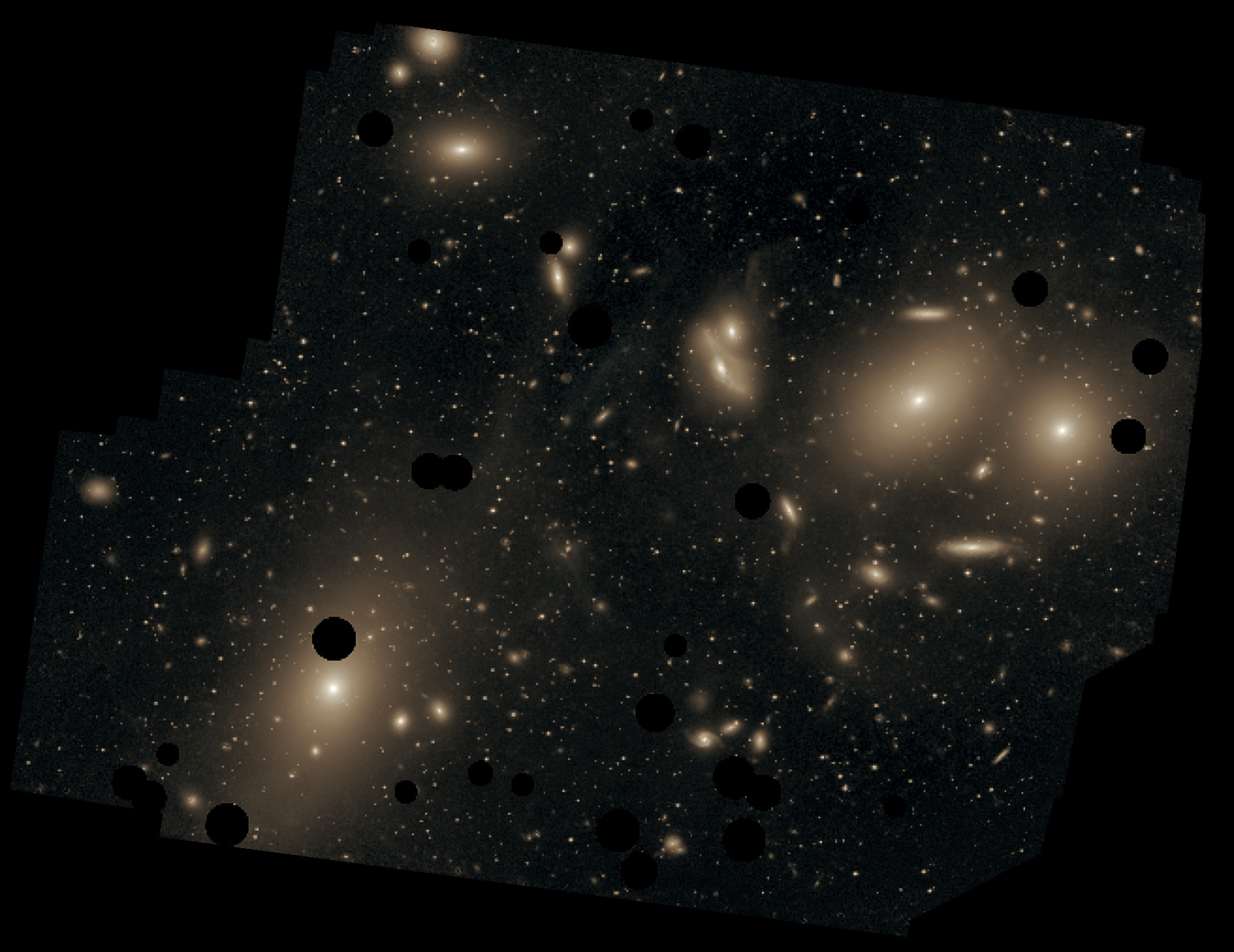
This deep image of the Virgo Cluster obtained by Chris Mihos and his colleagues using the Burrell Schmidt telescope shows the diffuse light between the galaxies belonging to the cluster. North is up, east to the left. The dark spots indicate where bright foreground stars were removed from the image. Messier 87 is the largest galaxy in the picture (lower left).
06/03/2013 – Ariadne’s crown is our Corona Borealis
Ephemeris for Monday, June 3rd. Today the sun will be up for 15 hours and 23 minutes, setting at 9:22. The moon, 3 days past last quarter, will rise at 3:36 tomorrow morning. Tomorrow the sun will rise at 5:58.
Here we go, starting Ephemeris’ 39th trip around the sun with the constellation of Corona Borealis, the Northern Crown. In the east at 11 this evening it can be seen as small nearly circular constellation. It is just below and left of Boötes, the kite shaped constellation off the handle of the Big Dipper. According to Greek myth the crown was given by the god Dionysus to the princess Ariadne, daughter of King Minos of Crete. The crown is more like a tiara with the bright star Gemma also known as Alphecca at the front. While stars suggest that the crown is diamond studded, the meaning of Gemma, a blossom suggests to me that Corona Borealis is a floral crown. It is known in many lands as many different things.
Times are for the Traverse City/Interlochen area of Michigan. They may be different for your location.
Addendum

Corona Borealis with Boötes. Created with Stellarium.
 Bob Moler's Ephemeris Blog