Archive
08/16/2013 – Ephemeris – Another weekend under the stars
Ephemeris for Friday, August 16th. The sun rises at 6:46. It’ll be up for 13 hours and 59 minutes, setting at 8:45. The moon, 2 days past first quarter, will set at 2:44 tomorrow morning.
The Grand Traverse Astronomical Society will have a busy weekend, though not as busy as last weekend where we had four events on four nights. It starts this evening with Friday Night Live, viewing the sun if it’s clear. The society sets up in front of Orvis Streamside, just west of the State Theater. After the event closes we’ll stay after to view the moon and possibly Venus and Saturn. Saturday evening from 9 to 11 p.m. The crew will be out at Northwestern Michigan College’s Rogers Observatory on Birmley Road, south of Traverse City for a Star Party, again with the moon, Venus and Saturn. Some of the brighter objects beyond the solar system, we call them deep sky objects, will be viewed if it’s clear.
Times are for the Traverse City/Interlochen area of Michigan. They may be different for your location.
Addendum

On Front Street after Friday Night Live.
08/15/2013 – Ephemeris – Plato and Copernicus (the craters)
Ephemeris for Thursday, August 15th. The sun rises at 6:45. It’ll be up for 14 hours and 2 minutes, setting at 8:47. The moon, 1 day past first quarter, will set at 1:43 tomorrow morning.
The moon now is slightly gibbous. The term gibbous comes from Latin meaning having a hump or humpbacked. In binoculars or a small telescope look to the upper left where the great Sea of Showers or Mare Imbrium is being revealed by the advance of sunrise. The flat walled plain, actually a crater called Plato is off the top of Imbrium. It is circular and 61 miles in diameter. It looks oval to us because of the curvature of the moon. Below or south at the other edge of Imbrium, just coming into sunlight is the marvelous crater Copernicus with it’s triple central peaks. It’s 56 miles in diameter. In a good enough telescope one can see that the crater walls appear terraced. Copernicus is 2 miles deep.
Times are for the Traverse City/Interlochen area of Michigan. They may be different for your location.
Addendum
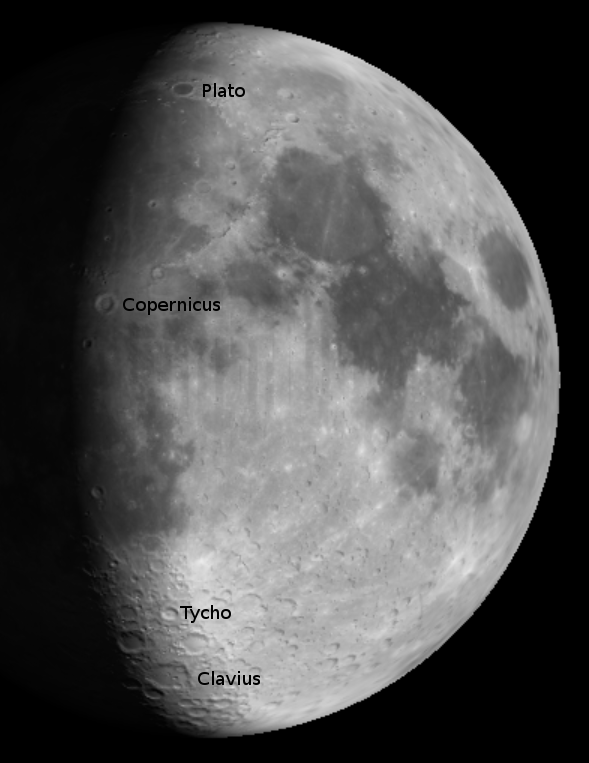
The moon a day after first quarter on August 15, 2013. Created using Virtual Moon Atlas.
The image also includs the craters Tycho and Clavius craters in the southern highlands.
08/14/2013 – Ephemeris – Where are the bright planets this week?
Ephemeris for Wednesday, August 14th. The sun rises at 6:44. It’ll be up for 14 hours and 4 minutes, setting at 8:49. The moon, at first quarter today, will set at 12:49 tomorrow morning.
Lets check out the planets visible now. Venus is now brilliant low in the western sky in evening twilight, It will set at 10:11 p.m. Holding forth in the west southwest will be Saturn this evening, the brightest star-like object in the constellation Virgo appearing yellowish to the left and above the extremely blue-white star Spica. It will set at 11:43 p.m. In the morning sky before twilight starts Jupiter will rise at 3:12, with Mars rising nearly an hour later at 4:01. At about 5 a.m. Jupiter will be the brightest star-like object in the east northeast, with Mars barely visible below and left by about the width of your fist held at arm’s length. Mercury is now to close to the sun to be seen, heading around the far side of the sun.
Times are for the Traverse City/Interlochen area of Michigan. They may be different for your location.
Addendum
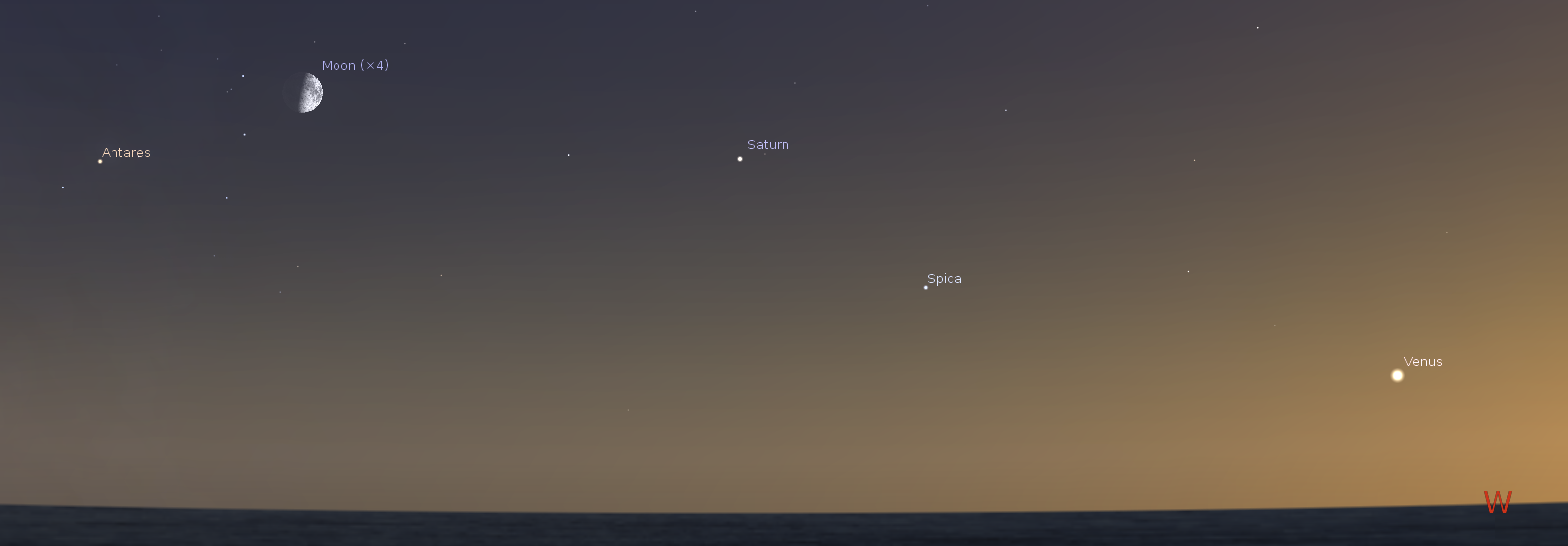
Venus, Saturn and the Moon at 10:30 p.m. on August 14, 2013. Note that the Moon is 4 times its normal size. Created using Stellarium. Click on the image to enlarge.
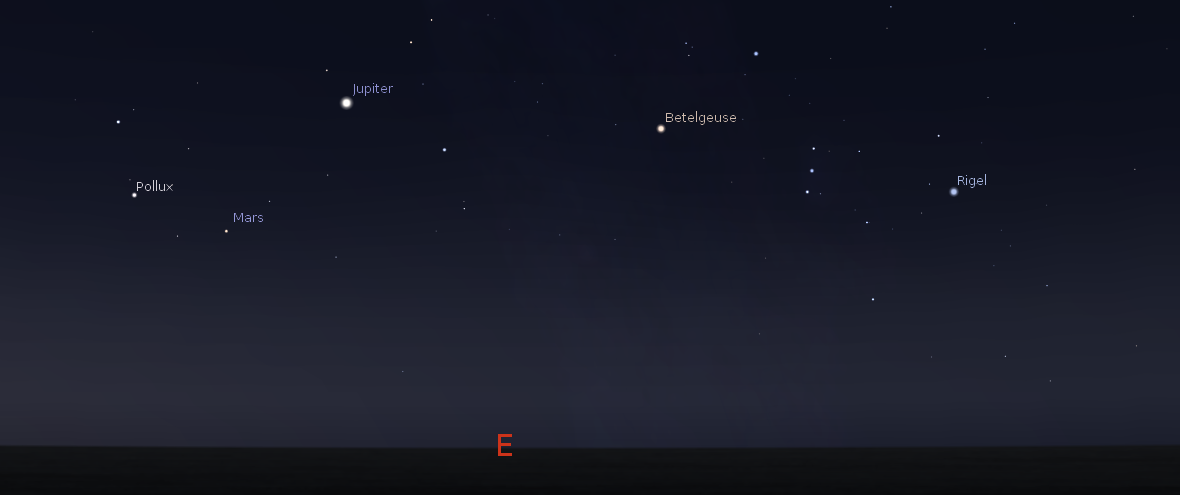
Jupiter and Mars with Orion and other morning stars at 5:30 a.m. August 15, 2013. Created using Stellarium. Click on the image to enlarge.
08/13/2013 – Ephemeris – Highs and lows on the moon
Ephemeris for Tuesday, August 13th. The sun rises at 6:43. It’ll be up for 14 hours and 7 minutes, setting at 8:50. The moon, 1 day before first quarter, will set at 12:04 tomorrow morning.
The moon passed Saturn a couple of hours ago while they were below the horizon. By this evening the moon will be to the left of Saturn. In each 24 hour period the moon moves about 24 times its diameter against the stars, or its own width in an hour. Looking at the moon tonight with binoculars or a telescope, the Sea of Serenity or Mare Serenitatis dominates the moon’s upper right quadrant. To me its shaped like a scallop shell. On the bottom part of the moon are the lunar highlands, bright and saturated with craters large and small. The highlands are really high, while the sea’s like Serenity are low. Should the moon have an atmosphere and water, the seas would be real, not just lava filled plains.
Times are for the Traverse City/Interlochen area of Michigan. They may be different for your location.
Addendum
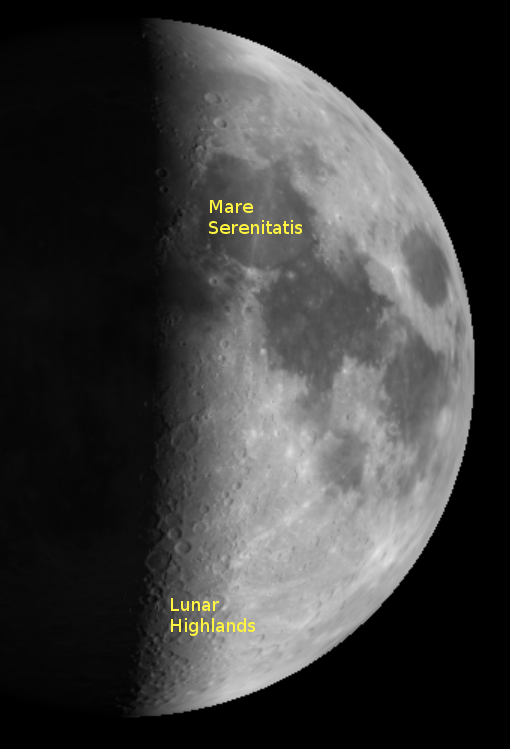
The Moon 1 day before first quarter. Created usinf Virtual Moon Atlas.
08/12/2013 – Ephemeris – The perseid meteors are not done yet
Ephemeris for Monday, August 12th. The sun rises at 6:41. It’ll be up for 14 hours and 10 minutes, setting at 8:52. The moon, 2 days before first quarter, will set at 11:26 this evening.
The Perseid meteor shower is still active. Their peak will be this afternoon. So starting at moon set at 11:26 or so it will be dark enough to see them. Meteor showers are caused when the earth crosses the path of a periodic comet and runs into the debris liberated by the comet’s past visits near the sun. Comet Swift-Tuttle is the comet responsible for the Perseids. It has an orbit of the sun of 130 years. Every time the comet comes close to the sun, it liberates a cloud of small gravel that’s too massive to be swept into the comet’s tail, however it is affected by the pressure of sunlight. These make the prediction of the time of the meteor shower interesting, or that a particular cloud may miss the earth this time to hit it some other passage.
Addendum
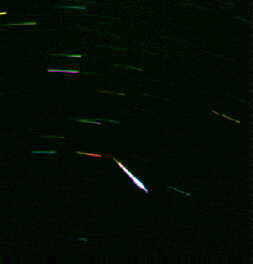
My best Perseid photo. From the 70’s.
08/09/2013 – Ephemeris – A weekend full of local astronomical events
Ephemeris for Friday, August 9th. The sun rises at 6:38. It’ll be up for 14 hours and 18 minutes, setting at 8:56. The moon, 3 days past new, will set at 9:55 this evening.
This weekend is packed with events by the Grand Traverse Astronomical Society starting tonight with Friday Night Live on Front Street in Traverse City. We’ll start by looking at the sun if it’s clear, and at Saturn as night falls. Tomorrow night its a Star Party and meteor watch at Thoreson Farm at Sleeping Bear Dunes National Lakeshore see the map at http://www.gtastro.org for location. Sunday night it’s Meteors and S’mores at Leelanau State Park. The Perseid meteor shower will reach its peak between 2 and 4 Monday afternoon, but we’re already seeing its meteors, which seem to come from the northeastern sky. The moon really won’t interfere until Monday night before midnight, so this is an excellent year for the Perseid meteor shower.
Times are for the Traverse City/Interlochen area of Michigan. They may be different for your location.
Addendum
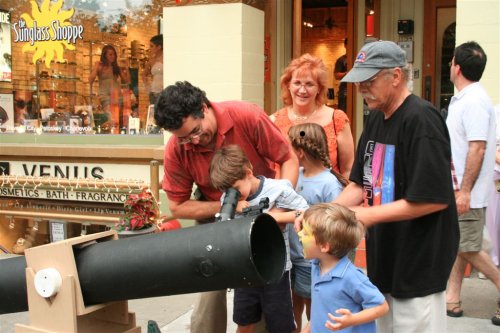
Friday Nite Live
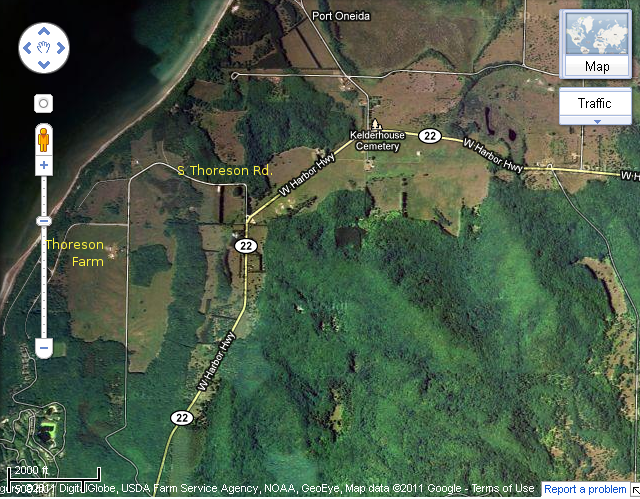
Map to Thoreson Farm, northeast of Glen Arbor.
08/08/2013 – Ephemeris – The wonders located in Scutum the shield
Ephemeris for Thursday, August 8th. The sun rises at 6:37. It’ll be up for 14 hours and 20 minutes, setting at 8:58. The moon, 2 days past new, will set at 9:28 this evening.
The teapot pattern of stars that is the constellation of Sagittarius lies at the southern end of the Milky Way this evening. It appears that the Milky Way is steam rising from the spout. The area above Sagittarius in the brightest part of the Milky Way is the dim constellation of Scutum the shield. Don’t bother looking for the stars that make up the constellation; what’s important is the star clouds of the Milky Way. Scan this area with binoculars or small telescope for star clusters and nebulae or clouds of gas. In binoculars both clusters and nebulae will appear fuzzy, but a small telescope will tell most of them apart. Even if you’ve never been able to find anything in your telescope, put on the lowest power eyepiece you have and scan back and forth for these wonders.
Times are for the Traverse City/Interlochen area of Michigan. They may be different for your location.
Addendum
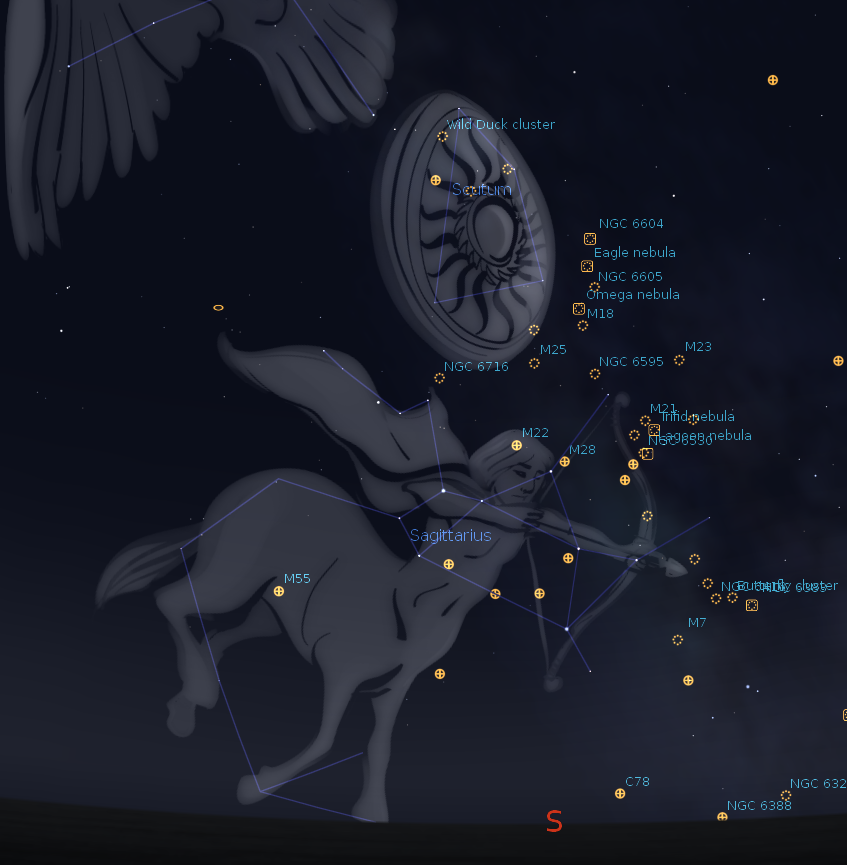
Binocular and telescope deep sky objects in Scutum and Sagittarius. Created using Stellarium.
The symbols mean:
Circle with embedded cross – Globular star cluster (Very old compact star cluster)
Open dotted circle – Open or galactic star cluster (Young loose star cluster)
Square – Nebula (Here emission nebulae. In many cases with associated open clusters)
Ellipse – Galaxy
08/07/2013 – Ephemeris – Where are the bright planets this week?
Ephemeris for Wednesday, August 7th. The sun rises at 6:36. It’ll be up for 14 hours and 23 minutes, setting at 8:59. The moon, 1 day past new, will set at 9:00 this evening.
Lets check out the planets visible now. Venus is now brilliant low in the western sky in evening twilight, It will set at 10:23 p.m. Holding forth in the southwest will be Saturn this evening, the brightest star-like object in the constellation Virgo appearing yellowish to the left of the extremely blue-white star Spica. It will set at 12:14 tomorrow morning. In the morning sky before sunrise Jupiter will rise at 3:33, with Mars rising shortly after at 4:06, which will appear below and left of Jupiter by four and a half degrees or half the width of your fist held at arm’s length. Mercury will rise at 5:12 a.m. tomorrow. It will nearly two widths of your fist below and left of Jupiter. For sharp-eyed observers we have 5 planets visible now.
Times are for the Traverse City/Interlochen area of Michigan. They may be different for your location.
Addendum
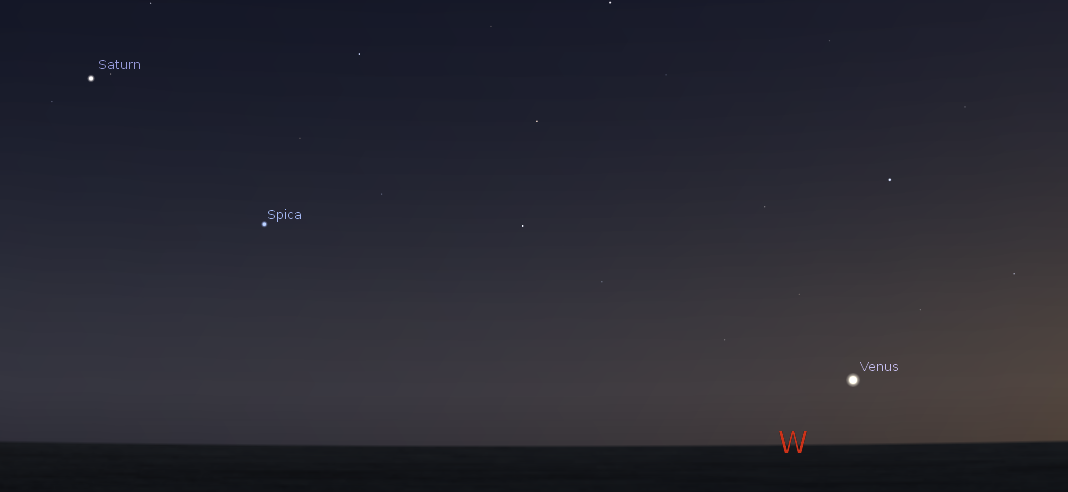
Venus and Saturn at 10 p.m. on August 7, 2013. Created using Stellarium.
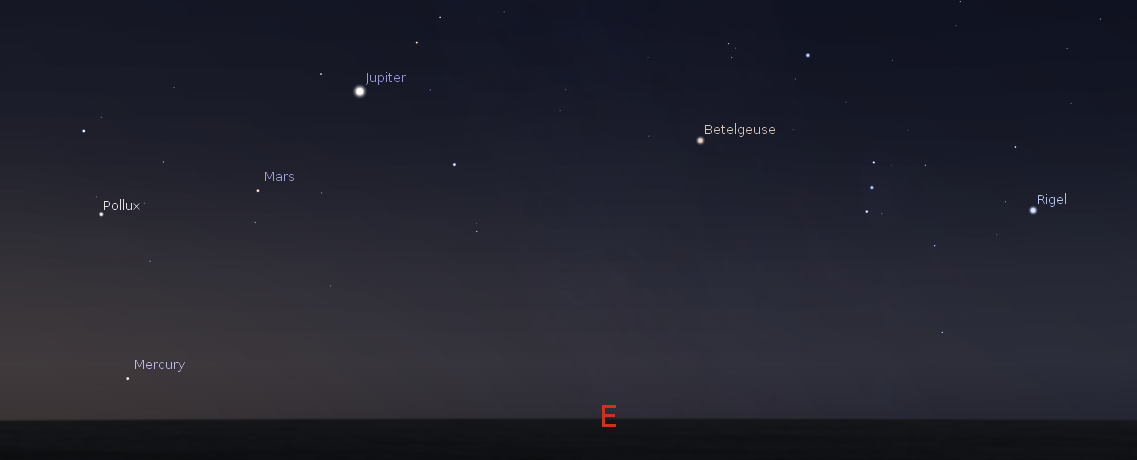
Morning planets and stars at 5:30 a.m. on August 8, 2013. Created using Stellarium.
08/06/2013 – Ephemeris – The constellation of Sagittarius: centaur or teapot?
Ephemeris for Tuesday, August 6th. The sun rises at 6:34. It’ll be up for 14 hours and 26 minutes, setting at 9:00. The moon is new today, and won’t be visible.
The Milky Way runs from north to south through the heavens at 11 p.m. You’ll notice that the Milky Way is brighter and broader just above the horizon in the south. In that glow in the south is a star pattern that looks like a stout little teapot, with a bright stream of the Milky Way rising from the spout, which faces the west. This pattern of stars is the major part of the constellation called Sagittarius. According to Greek mythology Sagittarius is a centaur with a bow and arrow poised to shoot Scorpius the scorpion to the right. This centaur is named Chiron, the most learned of the breed, centaurs usually being a rowdy bunch. The center of the pin wheel of our galaxy lies hidden beyond the stars near the spout of the teapot.
Times are for the Traverse City/Interlochen area of Michigan. They may be different for your location.
Addendum
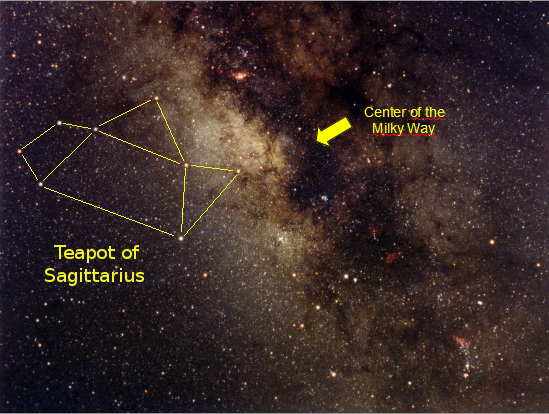
Location of the center of the Milky Way behind gas and dust clouds and the Teapot of Sagittarius.
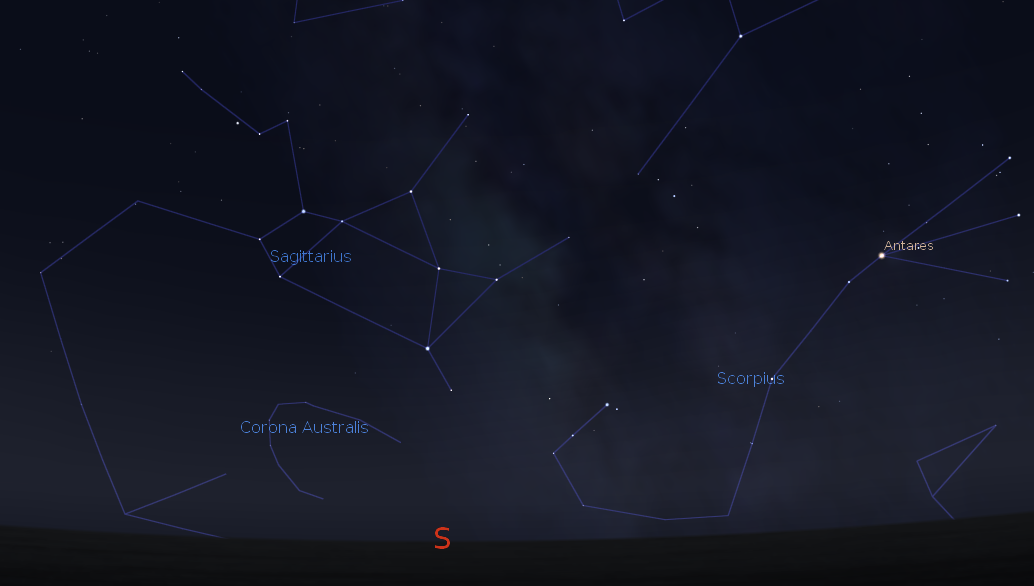
Sagittarius and Scorpius at 11 p.m. on August 6, 2013. Created using Stellarium.
08/05/2013 – Ephemeris – The celestial swan
Ephemeris for Monday, August 5th. The sun rises at 6:33. It’ll be up for 14 hours and 28 minutes, setting at 9:02. The moon, 1 day before new, will rise at 6:28 tomorrow morning.
High in the east as it gets dark flies the constellation of Cygnus the swan. This constellation is also known as the Northern Cross. The cross is seen lying on its side with the bright star Deneb, member of the Summer Triangle, at the head of the cross to the left. The rest of the cross is delineated in the stars to the right. As a swan, Deneb is the tail, the stars of the crosspiece of the cross are the leading edges of wings as Cygnus flies south through the Milky Way. There are faint stars that also define the trailing wing edges. It is a very good portrayal of a flying swan, like the mute swans we see on the wing around here. In Cygnus we are looking in the direction that the sun is traveling as it orbits the center of the Milky Way galaxy.
Times are for the Traverse City/Interlochen area of Michigan. They may be different for your location.
Addendum
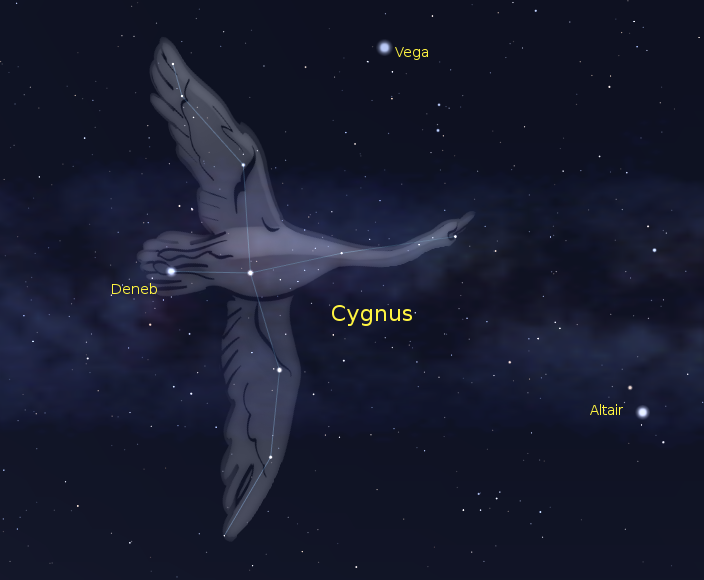
Cygnus The Swan Created using Stellarium.
 Bob Moler's Ephemeris Blog