Archive
06/30/2014 – Ephemeris – The celestial snake handler
Ephemeris for Monday, June 30th. Today the sun will be up for 15 hours and 30 minutes, setting at 9:31. The moon, 3 days past new, will set at 11:14 this evening. Tomorrow the sun will rise at 6:01. | The red star Antares shines in the south at 11 p.m. In the constellation of Scorpius. In the area of sky above and a little to the left lies a large constellation of faint stars called Ophiuchus, the serpent bearer. The constellation shape is like a large bell, which reminds me of the head, shoulders and arms of a fellow that’s holding the snake-like a weight lifter pulling up a heavy bar bell. The serpent he’s holding is Serpens, the only two-part constellation in the heavens. The head rises to Ophiuchus’ right and the tail extends up to the left. In legend Ophiuchus was a great physician, educated by the god Apollo, and the centaur Chiron, also found in the stars as Sagittarius, now rising below and left of him.
Times are for the Traverse City/Interlochen area of Michigan. They may be different for your location.
Addendum
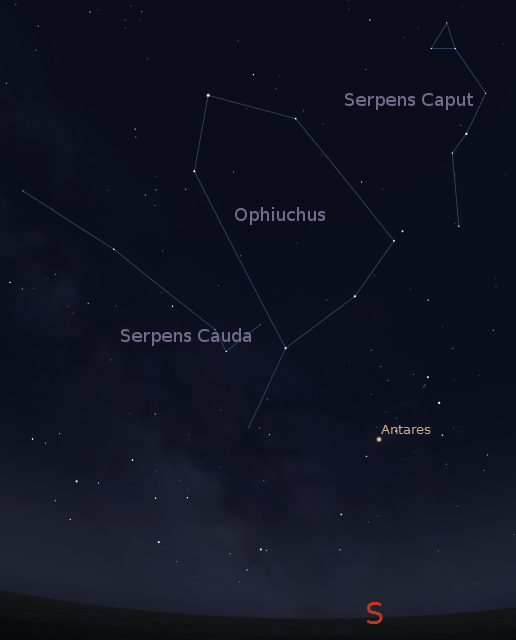
Ophiuchus and Serpens at 11 p.m.. Created using Stellarium.
06/27/2014 – Ephemeris – Scorpius invades Libra
Ephemeris for Friday, June 27th. Today the sun will be up for 15 hours and 32 minutes, setting at 9:31. The moon is new today, and won’t be visible. Tomorrow the sun will rise at 5:59.
One of the constellations of the Zodiac or circle of animals isn’t either animal or human. It is Libra the Scales or balance. It lies low in the southern sky at 11 p.m., just to the right of the rising Scorpius the scorpion. Libra, it seems, is an afterthought, a simple diamond shape of four stars. This year with Saturn inside. Its two brightest stars Zubeneschamali and Zubenelgenubi translate to the north and south claw respectively, of Scorpius to the left of it. The Arabs, at least, seemed to view this as part of Scorpius. The balance was perhaps to signify the equality of day and night, at the time the sun was in this part of the sky at the start of autumn, over 2000 years ago. Nowadays the sun is one constellation west, in Virgo at the start of autumn.
Times are for the Traverse City/Interlochen area of Michigan. They may be different for your location.
Addendum
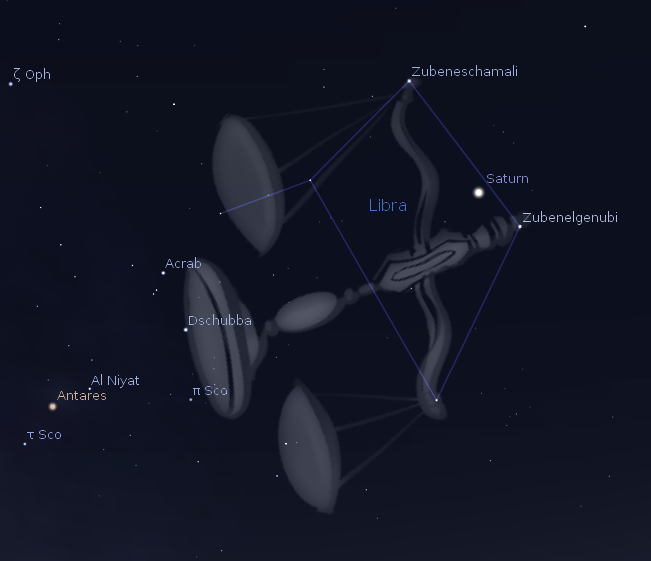
Libra with Saturn this year (2014). Created using Stellarium. Note: the named stars to the left belong to Scorpius.
06/26/2014 – Ephemeris – Draco the dragon is twisted around the pole of the sky
Ephemeris for Thursday, June 26th. Today the sun will be up for 15 hours and 32 minutes, setting at 9:31, the latest sunset. The moon, 1 day before new, will rise at 6:32 tomorrow morning. Tomorrow the sun will rise at 5:59.
High in the northern sky at 11 p.m. lies the twisted constellation, that of Draco the dragon. This dragon is more like the snakelike Chinese dragon than the dinosaur like dragon of European legend. I find it better to start at the tail of Draco, to trace him out in the stars. Draco’s tail starts between the bowl of the Big Dipper and the Little Dipper. The Dragon is seen in a line of stars that extends parallel to the handle of the Big Dipper before curving around the bowl of the Little Dipper then bends back toward the south. The head of Draco is an odd box of stars near the bright star Vega, high in the east. Though not made up of very bright stars, Draco has an easy shape to trace.
Times are for the Traverse City/Interlochen area of Michigan. They may be different for your location.
Addendum
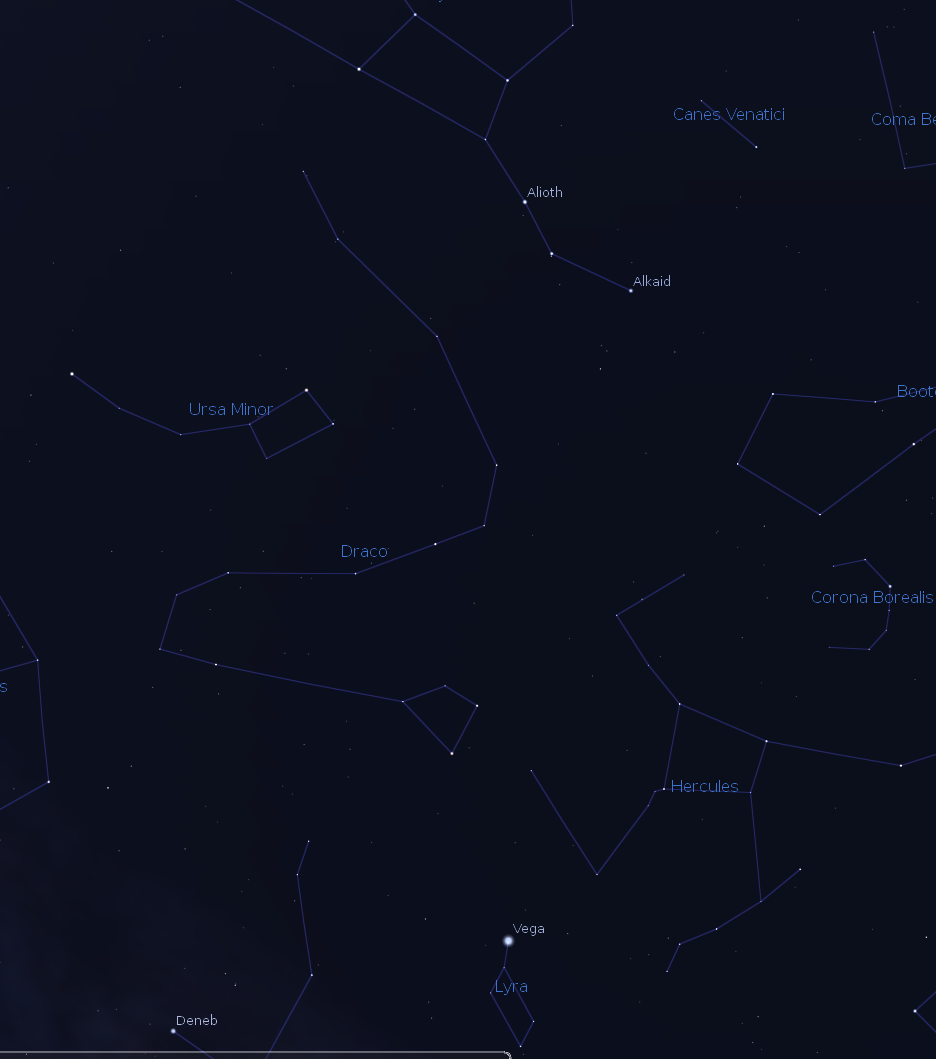
Draco via Stellarium in approximately the same orientation as the Jamieson atlas below. You’s have to face southeast and bend over backward to see this orientation in the sky.
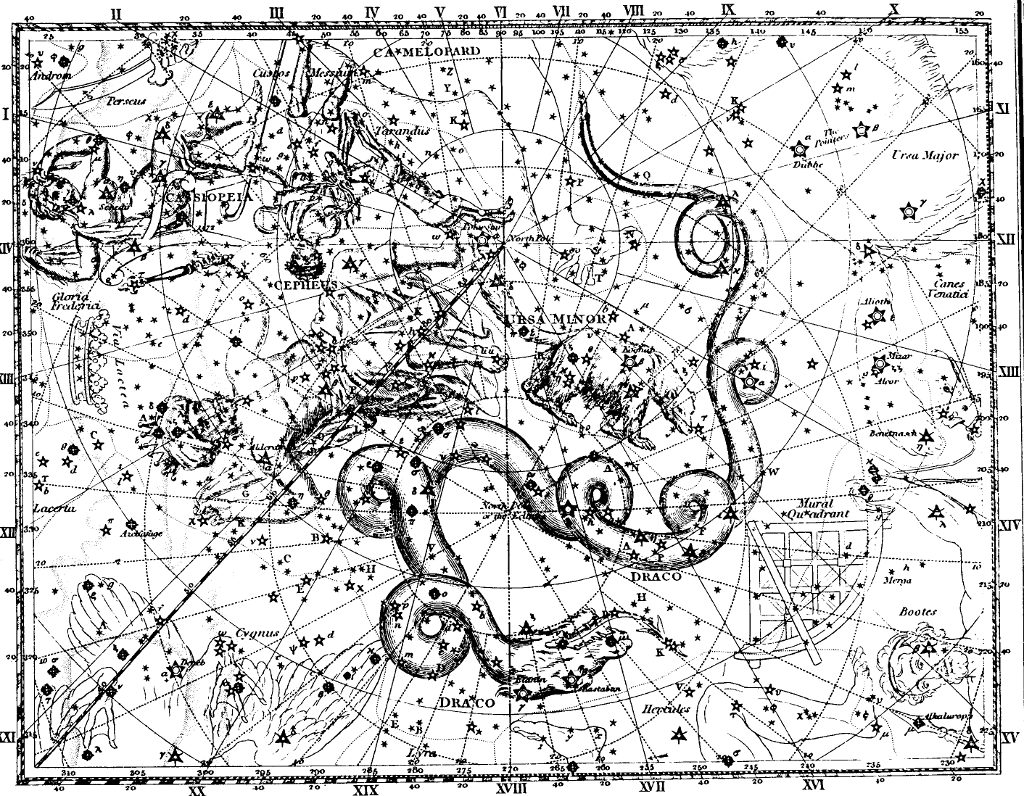
Draco the Dragon as drawn in Alexander Jamieson’s 1820 Celestial Atlas as printer in Men, Monsters and the Modern Universe by George Lovi and Wil Tirion, 1989, Willmann-Bell, Richmond, VA
06/25/2014 – Ephemeris – Wednesday is bright planet day here on Ephemeris
Ephemeris for Wednesday, June 25th. Today the sun will be up for 15 hours and 33 minutes, setting at 9:31. The moon, 2 days before new, will rise at 5:41 tomorrow morning. Tomorrow the sun will rise at 5:58.
It’s Wednesday and once again time to locate the bright planets for this week. Brilliant Jupiter will be in the west-northwestern sky in Gemini as darkness falls tonight. It’s getting lower each night and will set at 10:51 p.m. Reddish Mars is in Virgo in the southwest as darkness falls. It’s 88 million miles (142 million km) away now, and will set at 2:01 a.m. Saturn will be low in the south as darkness falls. It’s in the faint constellation of Libra the scales this year. It will pass due south at 10:28 p.m. It will set at 3:30 a.m. Saturn’s in perfect position for viewing with a small or large telescope to see those fabulous rings. Brilliant Venus will rise in the east at 4:07 a.m. in morning twilight.
Times are for the Traverse City/Interlochen area of Michigan. They may be different for your location.
Addendum
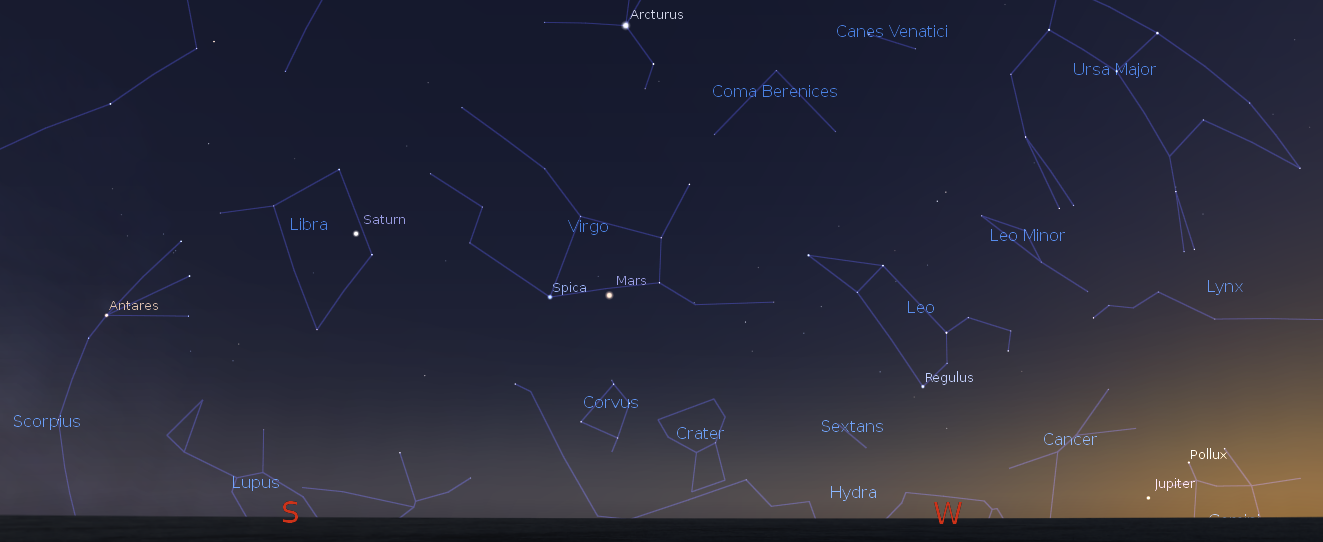
The Evening Planets and constellations at 10:30 p.m. June 25, 2014. Created using Stellarium.
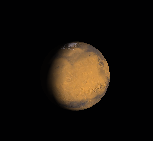
Mars through a powerful telescope at 10:30 p.m. June 25, 2014. Created using Stellarium.
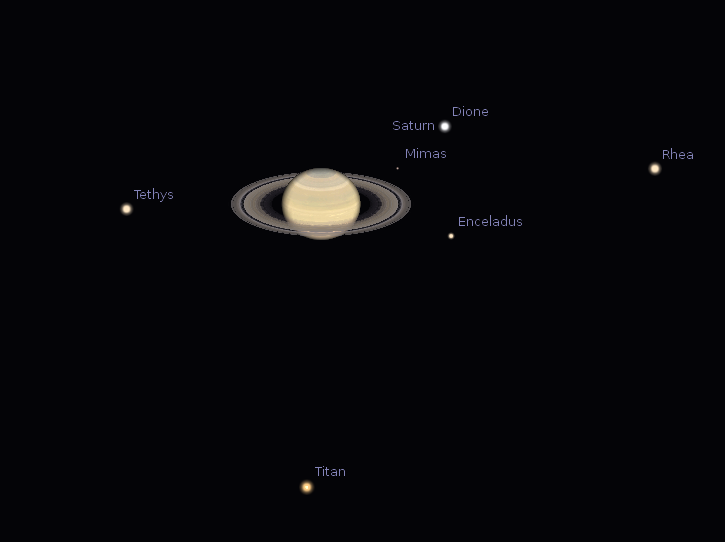
Saturn with its moons on June 25, 2014. Created using Stellarium.
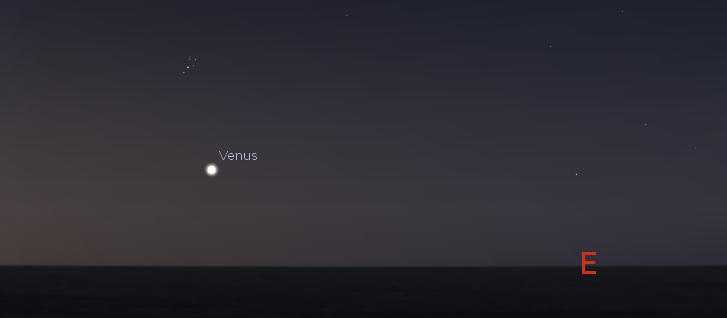
Venus and a glimpse of the Pleiades at 4:45 a.m. on June 26, 2014. Created using Stellarium.
Telescopic Venus on June 26, 2014. Created using Stellarium.
06/24/2014 – Ephemeris – The bright star Vega is high in the east
Ephemeris for Tuesday, June 24th. Today the sun will be up for 15 hours and 33 minutes, setting at 9:31. The moon, 3 days before new, will rise at 4:53 tomorrow morning. Tomorrow the sun will rise at 5:58.
The bright star high in the east is Vega, one of the stars of the Summer Triangle an informal constellation called an asterism. Vega belongs to the official constellation Lyra the harp, which includes a narrow parallelogram of stars to its south. Vega is regarded by astronomers as a standard calibration star. Though a first magnitude star, its actual magnitude is 0.03. It is a type A0 pure white star, and is 27 light years away. Astronomers however got a shock in 1983 when calibrating the Infrared Astronomy Satellite (IRAS) on it: Vega showed an excess of Infrared radiation that means the star is orbited by a disk of dust, perhaps the beginnings of a planetary system. Due to the slow wobble of the earth’s axis Vega will be our pole star in 14 thousand years.
Times are for the Traverse City/Interlochen area of Michigan. They may be different for your location.
Addendum
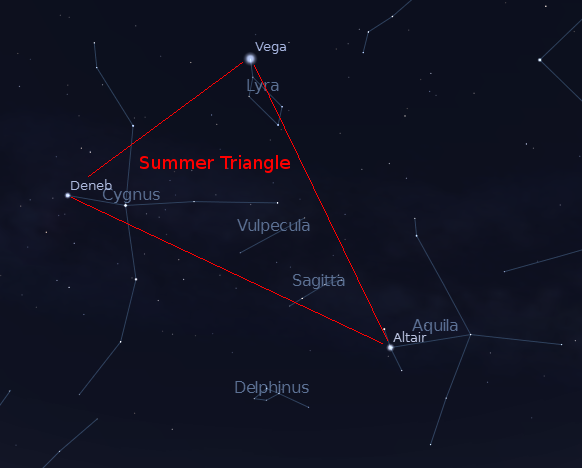
The Summer Triangle. Created using Stellarium and The Gimp.
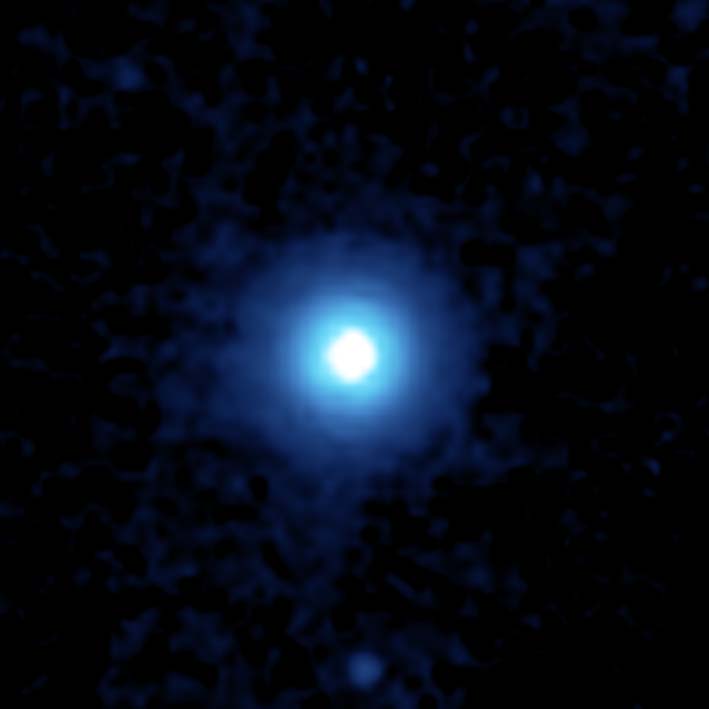
Vega in the mid-infrared from the Spitzer Space Telescope. Credit: NASA/JPL-Caltech/University of Arizona
06/23/2014 – Ephemeris – It’s summer, so where is the Summer Triangle?
Ephemeris for Monday, June 23rd. Today the sun will be up for 15 hours and 33 minutes, setting at 9:31. The moon, half way from last quarter to new, will rise at 4:09 tomorrow morning. Tomorrow the sun will rise at 5:58.
Now that it’s summer it’s time to look for the Summer Triangle in the sky. It’s seen rising in the east as it gets dark. Highest of the three bright stars is Vega in the constellation Lyra the harp, whose body is seen in a narrow parallelogram nearby. The second star of the triangle is Deneb lower and left of Vega, It appears dimmer than Vega because it is by far the most distant of the three. The third star of the Summer Triangle is seen farther below and a right of Vega. It is Altair in Aquila the eagle, and the closest. Altair is 16.5 light years away, Vega is 27 light years while Deneb actually one of the brighter stars known, is a whopping 2600 light years away, give or take. It’s distance is not well-known. (24 08:54 Venus 1.3°N of Moon)
Times are for the Traverse City/Interlochen area of Michigan. They may be different for your location.
Addendum
The Summer Triangle. Created using Stellarium and The Gimp.
06/20/2014 – Ephemeris – Summer is almost here!
Ephemeris for Friday, June 20th. Today the sun will be up for 15 hours and 33 minutes, setting at 9:31. The moon, 1 day past last quarter, will rise at 2:21 tomorrow morning. Tomorrow the sun will rise at 5:57.
Summer will begin at 6:52 tomorrow morning. Great I can’t wait. Summer is my favorite season, and it is especially welcome after the long and cold winter, and a not especially warm spring. In the summer I move my operations to a table under a tree in the back yard, with a laptop and my radio tuned to IPR, of course. There I conduct my research, take online teleconferences and courses and do my writing. The summer solstice for us in the northern hemisphere is when the sun reaches its farthest north in the sky. Around the Interlochen/Traverse City area that’s about 68.5 degrees above the southern horizon at solar noon, which is about 1:43 p.m. and staying up 15 hours and 33 minutes.
Times are for the Traverse City/Interlochen area of Michigan. They may be different for your location.
Addendum

The earth centered on Michigan at 6:52 a.m. EDT, June 21, 2014 the moment of the summer solstice. Created using Celestia.

My summer office
06/19/2014 – Ephemeris – The constellation Hercules
Ephemeris for Thursday, June 19th. Today the sun will be up for 15 hours and 33 minutes, setting at 9:30. The moon, at last quarter today, will rise at 1:50 tomorrow morning. Tomorrow the sun will rise at 5:57.
Orion, the hard luck Greek hunter gets a splashy constellation in the winter sky, but the greatest hero of all, Hercules, gets a dim group of stars on the border between the spring and summer stars. At 11 p.m. Hercules is high in the southeast. It is located above and right of the bright star, Vega in the east. Hercules’ central feature is a keystone shaped box of stars, called the Keystone, which represents the old boy’s shorts. From each top corner extend lines of stars that are his legs, from the bottom stars, the rest of his torso and arms extend. So in one final indignity he’s upside down in our sky. Some see him crouched down, club upraised holding the Hydra about to throttle it. [For those with a telescope it contains the beautiful globular star cluster M13.]
Times are for the Traverse City/Interlochen area of Michigan. They may be different for your location.
Addendum
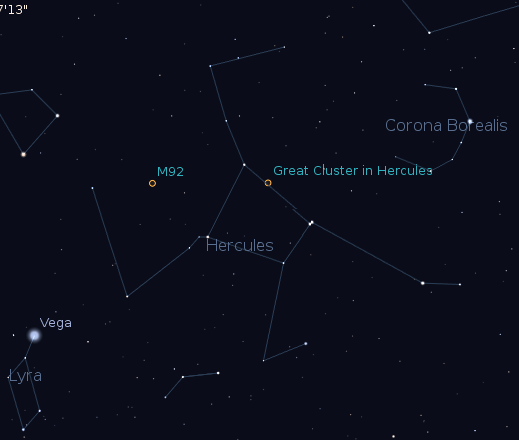
The constellation Hercules and his neighbors. Created with Stellarium.
On Tuesday I mentioned that for the Anishinabek people around the Great Lakes, Corona Borealis is a Sweat Lodge. Incidentally the Pleiades, only seen in the sky at the same time as Corona Borealis on autumn evenings on opposite ends of the sky, are the seven stones of the Sweat Lodge ceremony. The stars of Hercules represents one poor fellow, who couldn’t stand the heat of the sweat lodge and is splayed on the snow near by.
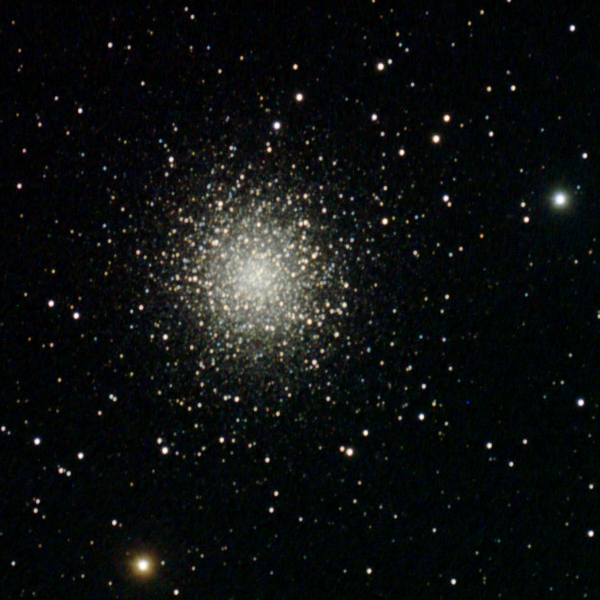
M13, the Great Globular Star Cluster in Hercules. Credit: Scott Anttila
06/18/2014 – Ephemeris – The bright planets for this week
Ephemeris for Wednesday, June 18th. Today the sun will be up for 15 hours and 33 minutes, setting at 9:30. The moon, 1 day before last quarter, will rise at 1:18 tomorrow morning. Tomorrow the sun will rise at 5:56.
It’s Wednesday and once again time to locate the bright planets for this week. Brilliant Jupiter will be in the west-northwestern sky in Gemini as darkness falls tonight. It’s getting lower each night and will set at 11:13 p.m. tonight. Reddish Mars is in Virgo in the southwest as darkness falls. It’s 83 million miles (135 million km) away now, and will set at 2:25 a.m. Saturn will be low in the south-southeast as darkness falls. It’s in the faint constellation of Libra the scales this year. It will pass due south at 10:57 p.m. It will set at 3:59 a.m. Saturn’s in perfect position for viewing with a small or large telescope. Brilliant Venus will rise in the east at 4:10 a.m. in morning twilight.
Times are for the Traverse City/Interlochen area of Michigan. They may be different for your location.
Addendum
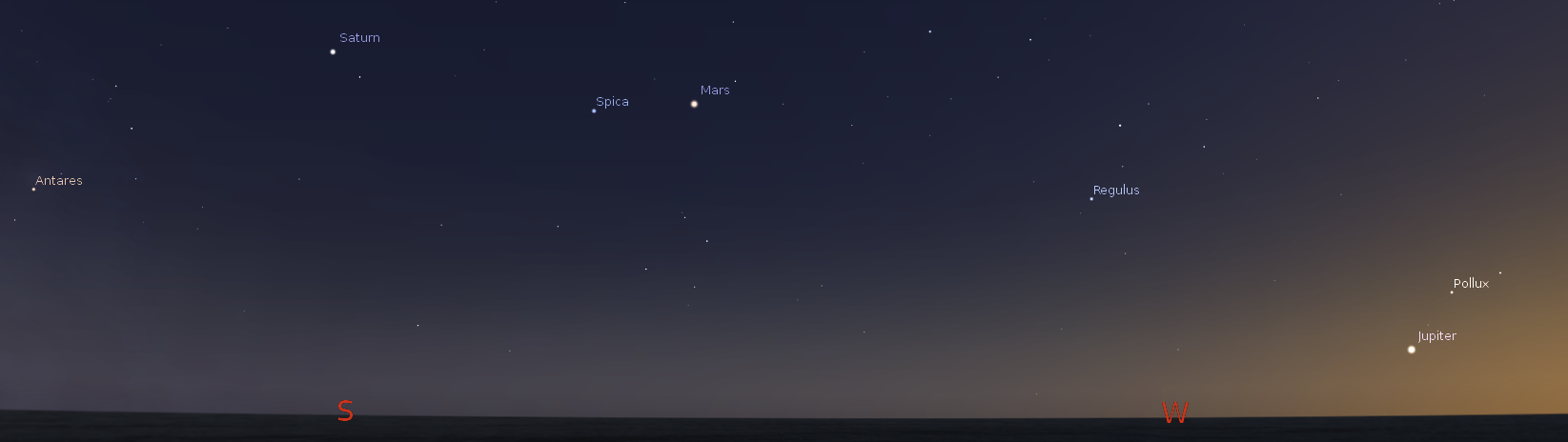
The bright evening planets and stars at 10:30 p.m., June 18, 2014. Created using Stellarium.
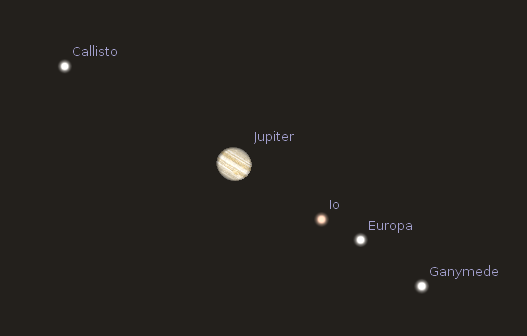
Jupiter and moons in a telescope on June 18, 2014. Due to the low altitude of Jupiter not all the moons may be visible and Jupiter will suffer color fringes due to atmospheric dispersion. Created using Stellarium.
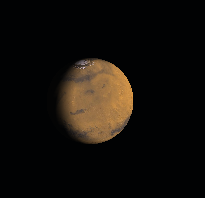
Mars through a telescope on June 18, 2018. Note that Mars is not fully illuminated, and appears as a gibbous disc. This effect will increase for another month. Created using Stellarium.
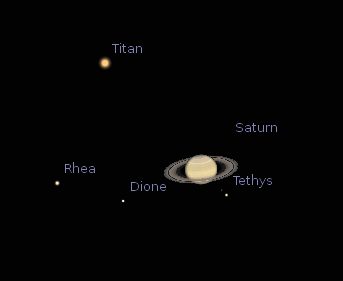
Saturn and its moons through a telescope on June 18, 2018. Titan is easy to spot, the other moons will be more difficult. Created using Stellarium.
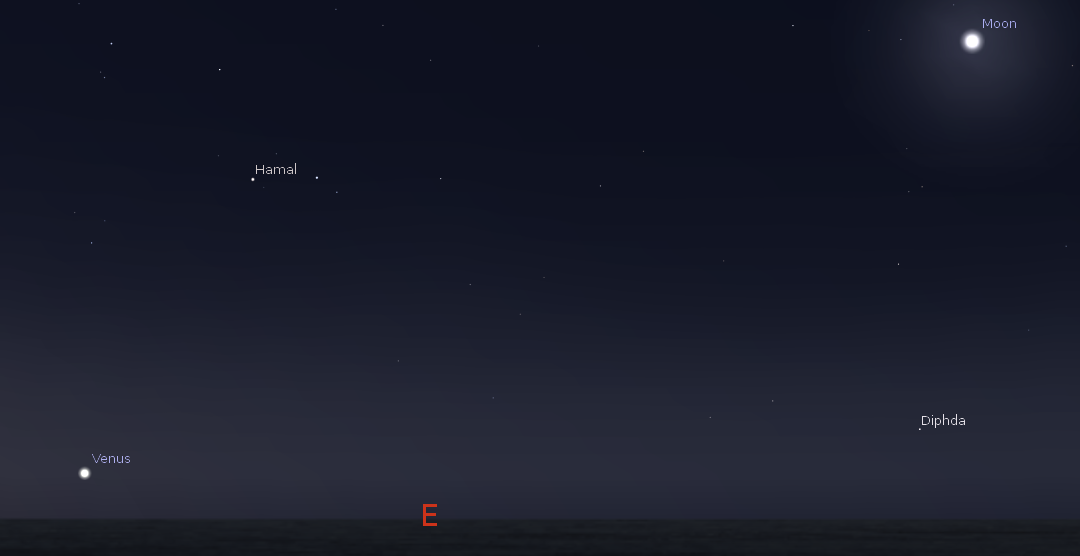
Venus and the Moon at 4:30 a.m. on June 19, 2014. Created using Stellarium.
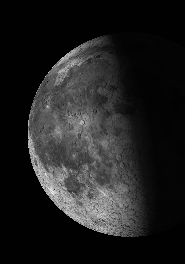
The Moon as seen in binoculars on June 19, 2014. Created using Stellarium.

Venus as seen in a telescope on June 19, 2014. Created using Stellarium.
06/17/2014 – Ephemeris – The constellation Corona Borealis, the Northern Crown
Ephemeris for Tuesday, June 17th. Today the sun will be up for 15 hours and 33 minutes, setting at 9:30. The moon, 2 days before last quarter, will rise at 12:46 tomorrow morning. Tomorrow the sun will rise at 5:56.
High in the south at 11 p.m. can be found a small but easily spotted constellation of Corona Borealis, the Northern Crown. It is located just east or left of the kite shaped constellation of Boötes, with its bright star Arcturus at the base. The Northern Crown is a semicircle of stars, like a tiara, with a brighter star Gemma at the bottom. Despite the obvious allusion of stars to diamonds and the sound of the star’s name, this is not a gem studded crown. Gemma means blossom, so Corona Borealis may represent a floral crown. According to Greek mythology it belonged to Princess Ariadne, daughter of King Minos of Crete. She was abandoned by Theseus, whom she helped out of the Labyrinth of the Minotaur.
Times are for the Traverse City/Interlochen area of Michigan. They may be different for your location.
Addendum

Corona Borealis with Boötes. Created with Stellarium.
For the Anishinabek peoples around the Great Lakes, Corona Borealis is a Sweat Lodge.
 Bob Moler's Ephemeris Blog