Archive
01/17/2018 – Ephemeris – Our weekly look at the bright planets
Ephemeris for Wednesday, January 17th. The Sun will rise at 8:15. It’ll be up for 9 hours and 15 minutes, setting at 5:31. The Moon, 1 day past new, will set at 6:17 this evening.
Let’s take our weekly look at the bright planets. All of the bright naked eye planets save one are in the morning sky now, but Venus sets 2 minutes after the Sun. At 7 this morning Jupiter is in the south-southeast and is a lot brighter than Mars, below and left of it. Saturn is just rising in the southeast. Jupiter will rise at 3:07 tomorrow with Mars following at 3:35. And Saturn will rise at 6:39. Saturn’s rise times will increase by 3 to 4 minutes each morning. It will be in a lot better position to spot in the coming weeks. The morning sky you’ll see at 7 a.m. will be the same stars as in the late spring sky with the summer triangle just rising. Scorpius is rising with the red star Antares below left of Mars, and Orion as I mentioned yesterday has fled over the western horizon.
The times given are for the Traverse City/Interlochen area of Michigan. They may be different for your location.
Addendum
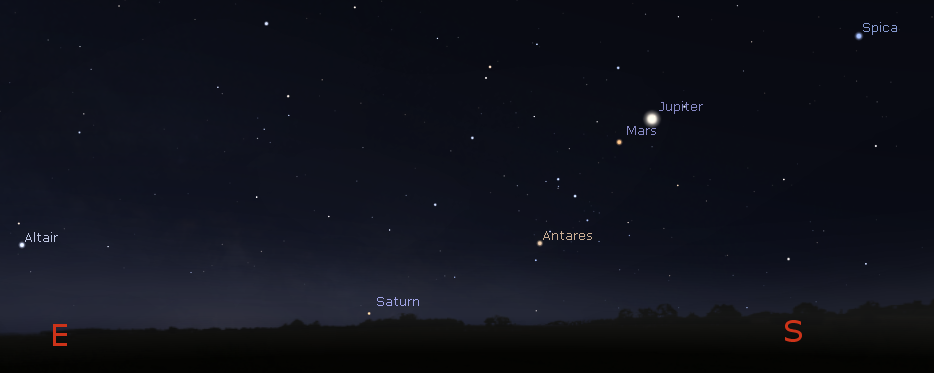
Jupiter and Mars are easily visible, but Saturn is low and problematic at 7 in the morning. Created using Stellarium.
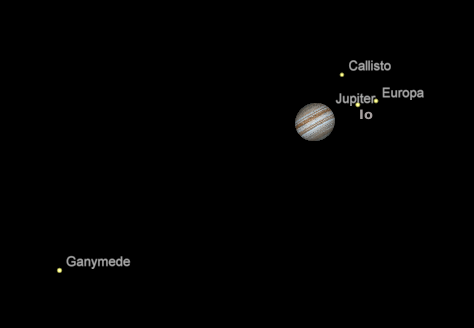
Jupiter and its moons at 7 a.m. this morning January 17, 2018. Io and Europa will be eclipsed and occulted by Jupiter after this time.
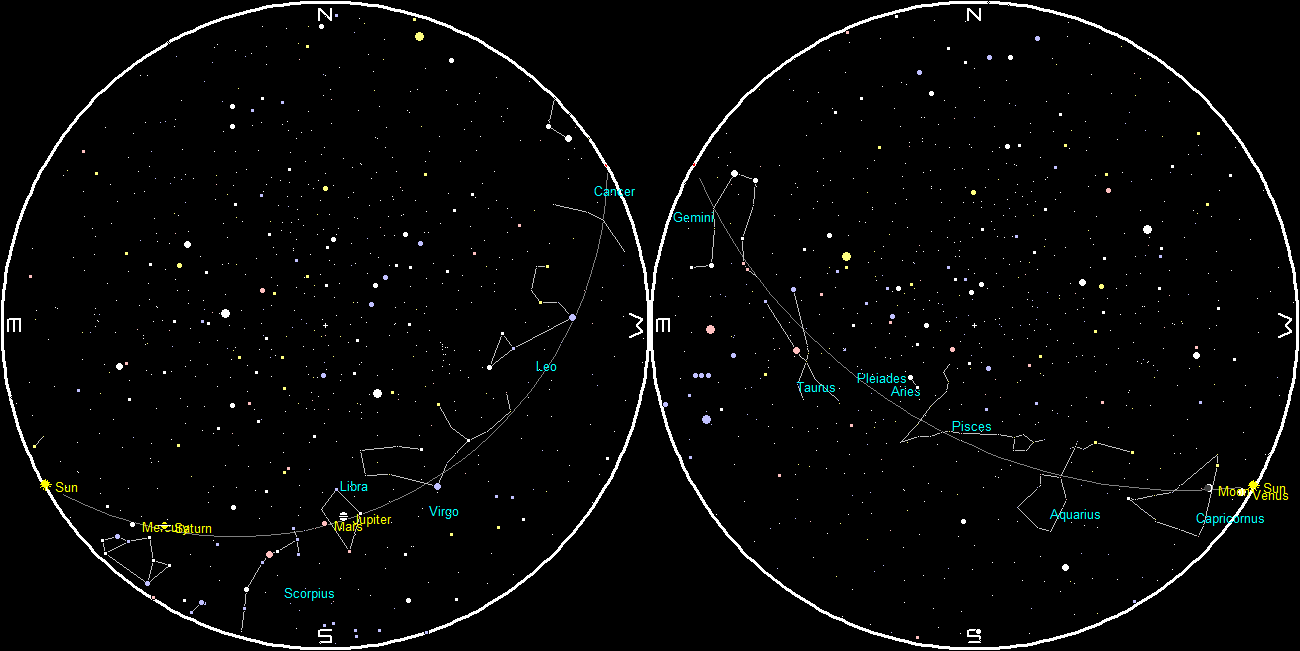
Planets at sunset and sunrise of a single night starting with sunset on the right on January 17, 2018. The night ends on the left with sunrise on the 18th. Click on the image to enlarge. Created using my LookingUp program.
01/16/2018 – Ephemeris – More thoughts about Orion and the Wintermaker
Ephemeris for Tuesday, January 16th. The Sun will rise at 8:15. It’ll be up for 9 hours and 13 minutes, setting at 5:29. The Moon is new today, and won’t be visible.
We come back to the central constellation of the winter sky Orion the hunter, now in the southeast at 9 p.m. with his three stars of his belt in a straight line, with his upper shoulder stars above and knees below. In one Greek story he was killed by the sting of a scorpion so the gods made sure the rising of the constellation Scorpius would chase him out of the sky to the west. To the Greeks he was a hapless hero. Orion is mentioned in the Bible in the book of Job. The name for Orion in Hebrew is Kesil, meaning “Fool”. To the native peoples around the Great Lakes, the stars here are those of the Wintermaker, who stretches his arms from Aldebaran in Taurus to Procyon in Canis Minor. When he is in the evening sky it is indeed winter.
The times given are for the Traverse City/Interlochen area of Michigan. They may be different for your location.
Addendum
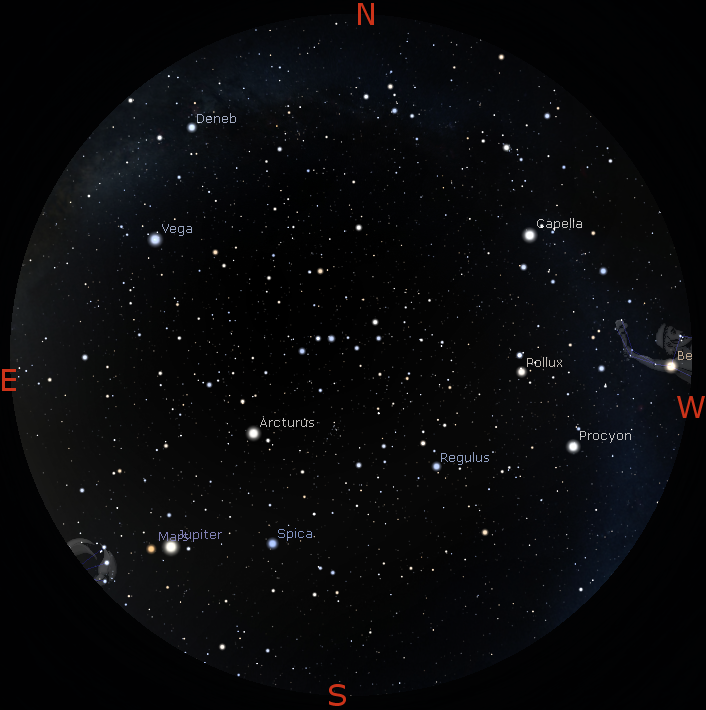
When the scorpion (Scorpius) crawls over the southeastern horizon, Orion takes a powder to the west. This is about 5 a.m. in mid January. Created using Stellarium.
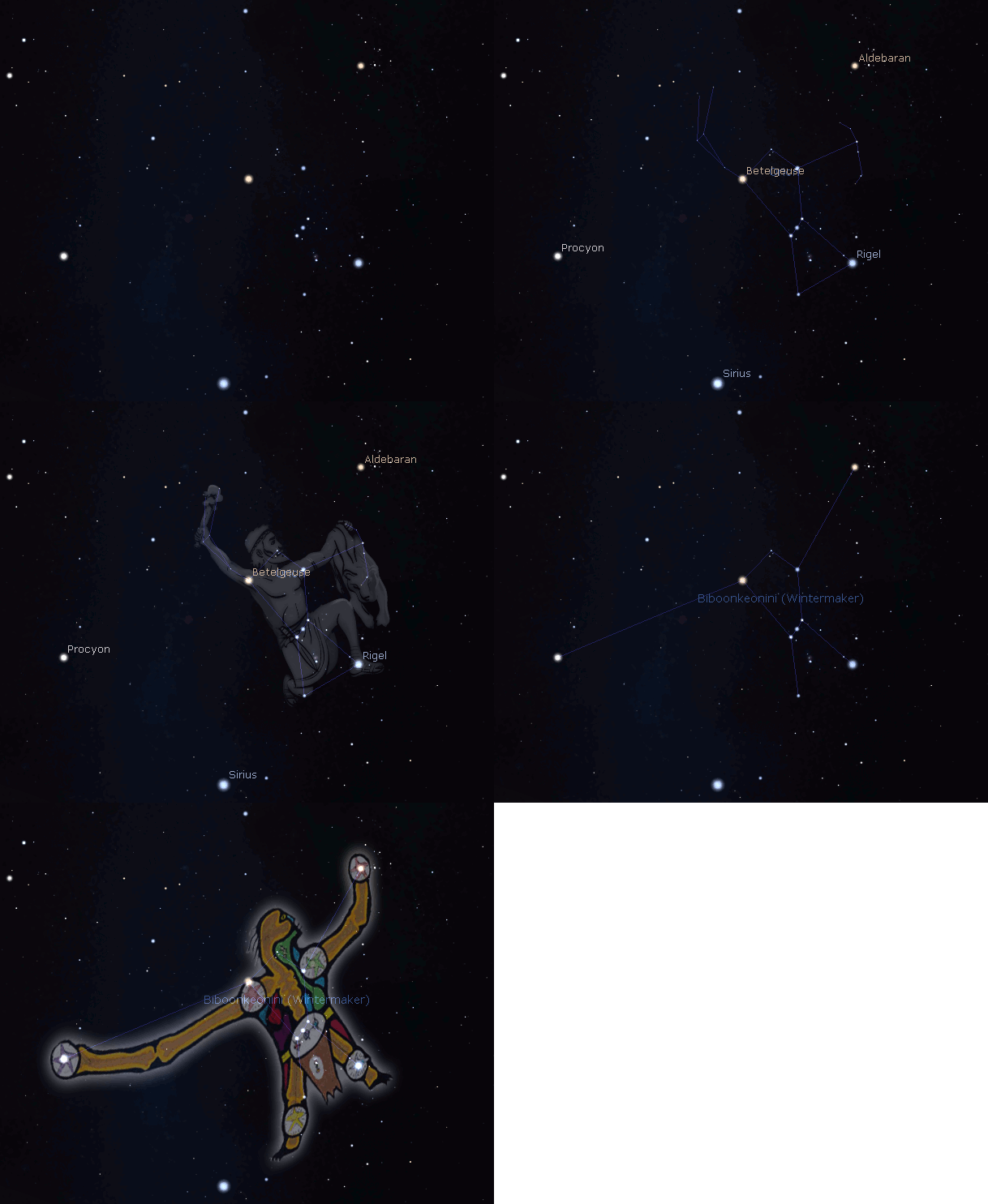
Orion-Wintermaker finder animation for 9 p.m., January 16. Created using Stellarium and GIMP.
01/15/2018 – Ephemeris – A river in the sky
Ephemeris for Martin Luther King Day, Monday, January 15th. The Sun will rise at 8:16. It’ll be up for 9 hours and 11 minutes, setting at 5:28. The Moon, 1 day before new, will rise at 7:49 tomorrow morning.
There is a long and sinuous constellation that’s part of the winter sky. It is Eridanus, which depicts a river. The river starts near the lower right corner of Orion, near the bright star Rigel and flows to the right then down near the southern horizon, then it meanders below the horizon. One has to travel to the far southern United States or even farther south to see the southern terminus of the river, the bright star Achernar. Writers over the ages have seen here the Nile and the earth circling river Ocean of the flat earth days. One of its stars is close to us and famous. It’s Omicron 2 Eridani a triple star system and the fictional home to Mr. Spock and other Vulcans of the Star Trek franchise. No real planet has been found there. Yet.
The times given are for the Traverse City/Interlochen area of Michigan. They may be different for your location.
Addendum
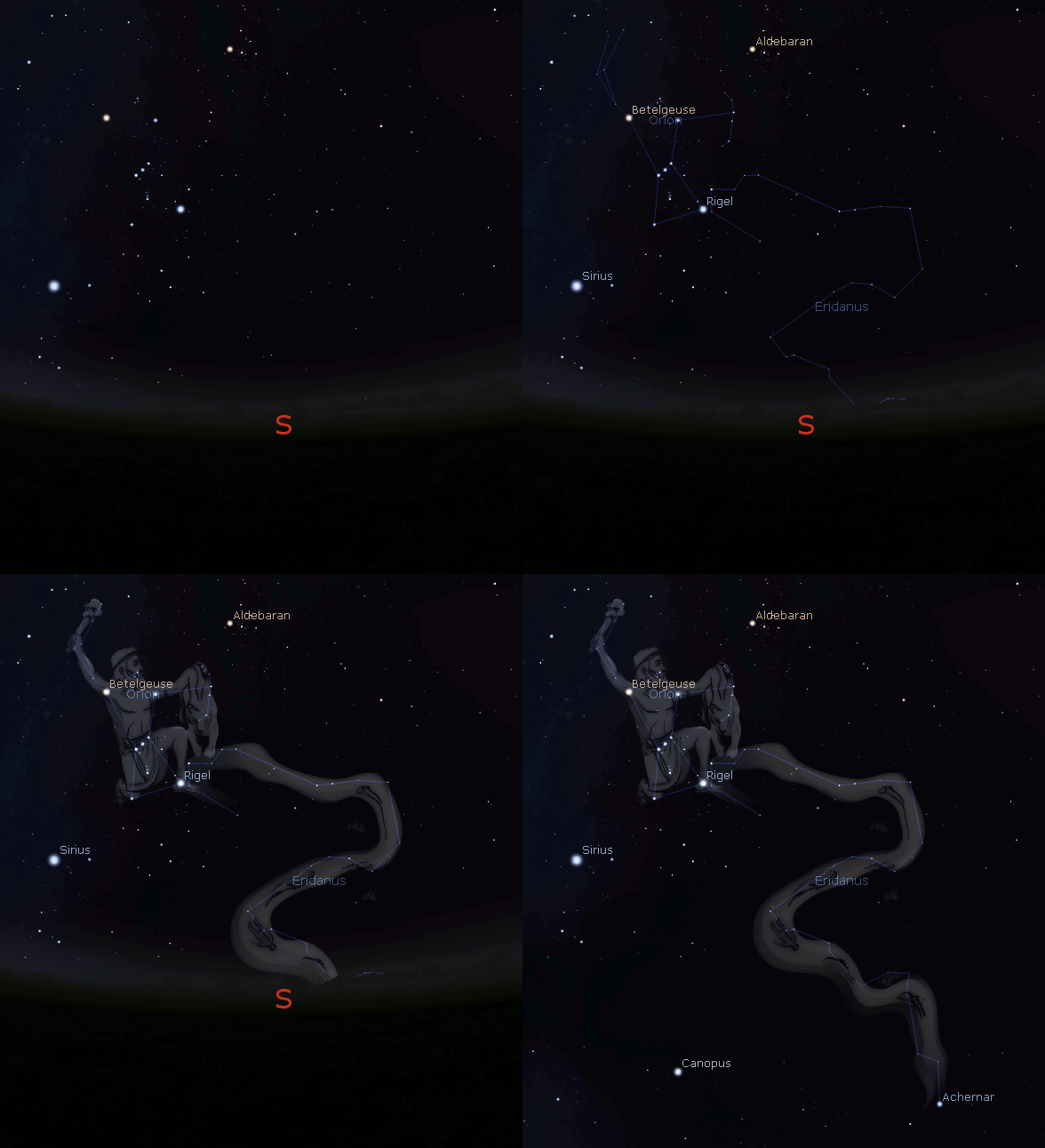
An animation of the constellation Eridanus which is a river that flows from Rigel in Orion to the star Achernar below our southern horizon at latitude 45 degrees north. Create using Stellarium and GIMP.
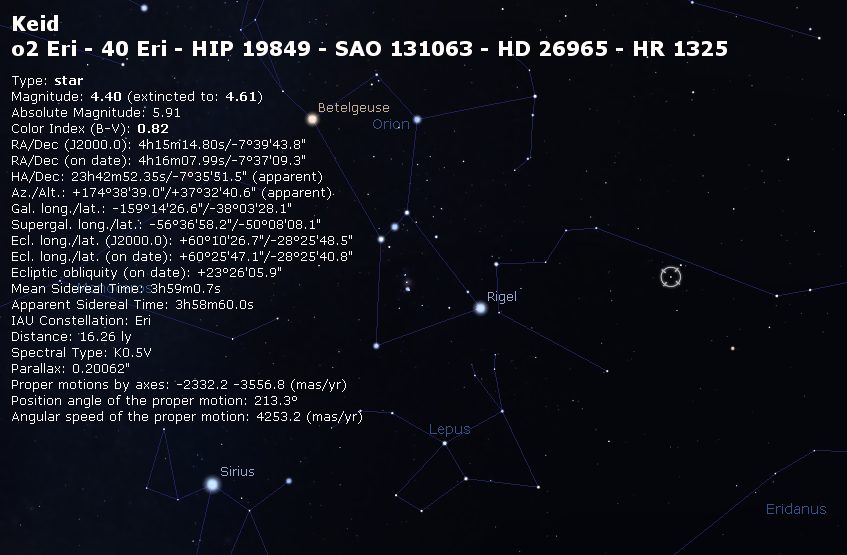
Keid, Omicron 2 Eridani, fictional home of Mr. Spock. Created using Stellarium.
01/12/2018 – Ephemeris – A look at Gemini the very unusual twins
Ephemeris for Friday, January 12th. The Sun will rise at 8:18. It’ll be up for 9 hours and 6 minutes, setting at 5:24. The Moon, half way from last quarter to new, will rise at 5:16 tomorrow morning.
The constellation Gemini, the Twins is visible half way up the sky in the east at 9 p.m. The namesake stars of the two lads will be on the upper left edge of the constellation, nearly vertically aligned. Castor is above, while Pollux, a slightly brighter star is below it. Lines of stars from Castor and Pollux to the right delineate the lads. In Greek mythology Castor and Pollux were twins, and half brothers, Castor was fathered by a mere mortal, while Pollux was fathered by Zeus in the famous Leda and the swan affair. The brothers, however were inseparable, and when Castor was killed during the quest for the Golden Fleece, Pollux pleaded with Zeus to let him die also. Zeus granted his wish, so they both appear in the sky together forever.
The times given are for the Traverse City/Interlochen area of Michigan. They may be different for your location.
Addendum
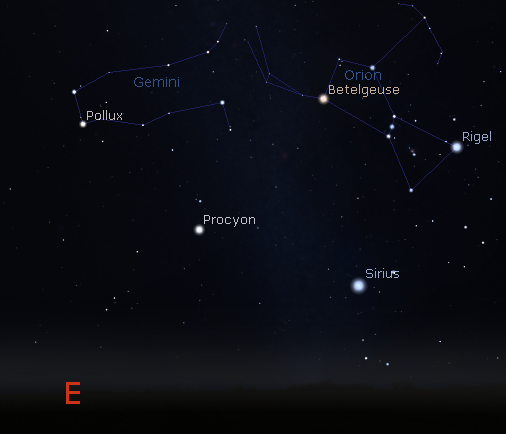
Gemini as it should appear at 9 p.m., January 12, 2018. Created using Stellarium.
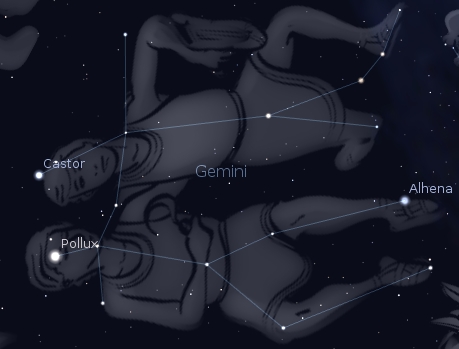
Gemini with Castor and Pollux. A closeup with a different way to link the stars with constellation art. Created with Stellarium.
01/11/2018 – Ephemeris – This morning the Moon passes Jupiter and Mars
Jan 11. This is Bob Moler with Ephemeris for Thursday, January 11th. The Sun will rise at 8:18. It’ll be up for 9 hours and 5 minutes, setting at 5:23. The Moon, 3 days past last quarter, will rise at 4:19 tomorrow morning.
This morning the thin crescent Moon will be poised over Jupiter and Mars in the east southeast at 7 a.m. It will make a pretty sight for the eye and camera. I follow many amateur astronomers on Twitter with clearer skies than ours who take many great pictures of planetary conjunctions, the Moon and other wonders of the heavens.
There is space mission orbiting Jupiter right now. It doesn’t make great discoveries that shake up the astronomical world enough to make the national news. The Juno mission skims close and then away from Jupiter in order to ferret out its internal structure. It does contain a camera for the public that reveals the spectacular cloud formations of Jupiter’s polar cloudscapes.
The times given are for the Traverse City/Interlochen area of Michigan. They may be different for your location.
Addendum
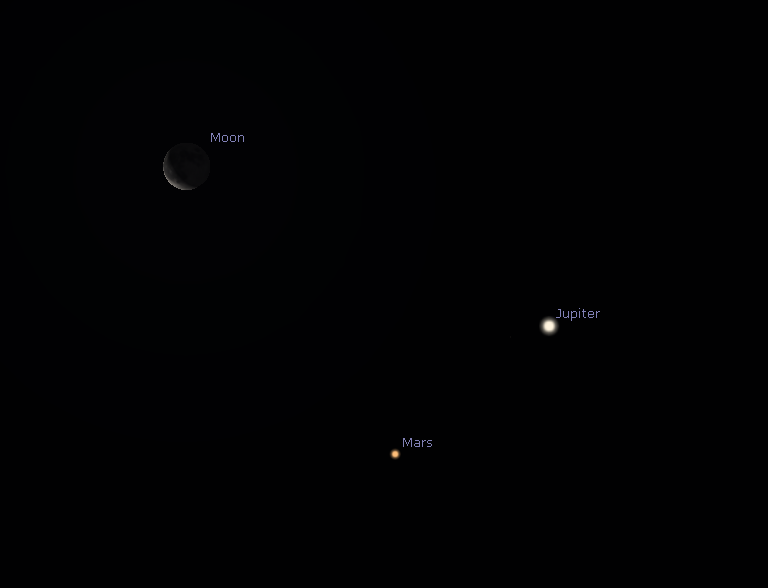
The Moon with Jupiter and Mars this morning January 11, 2018 at 7 a.m. Created using Stellarium.
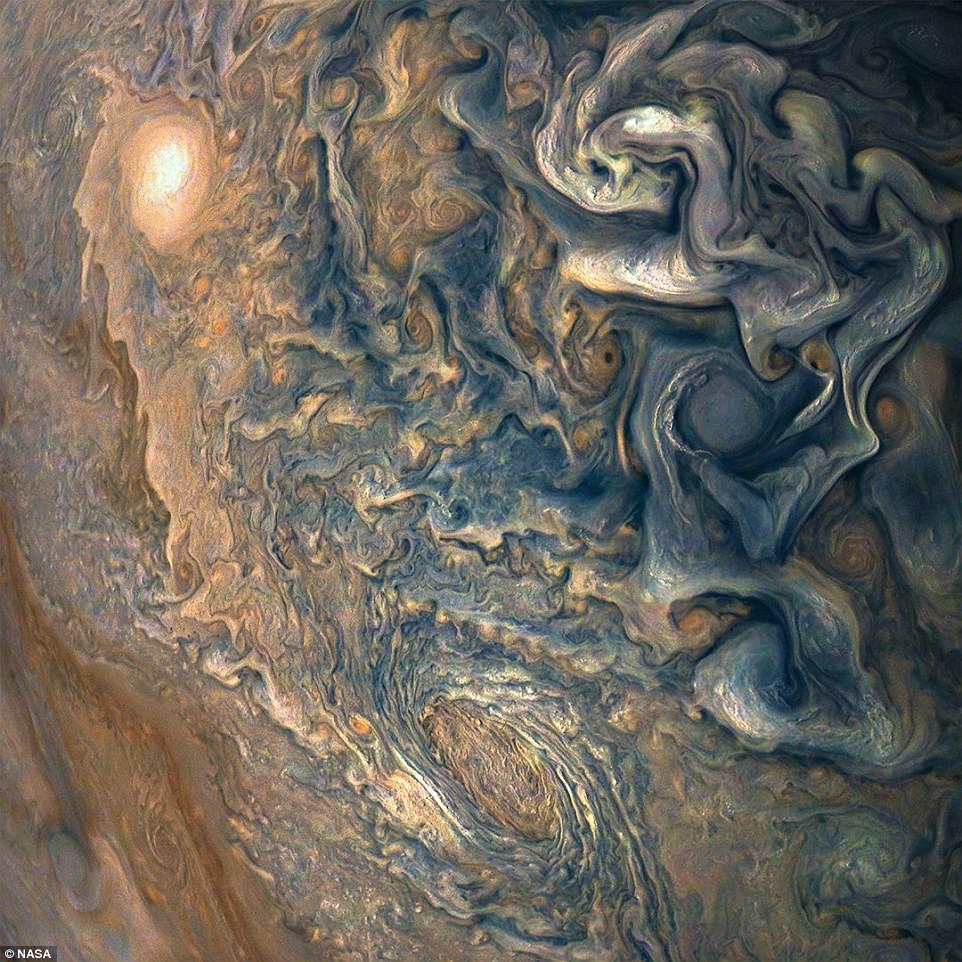
Some of Jupiter’s clouds photographed by NASA’s Juno spacecraft.
Ride along with Juno on its 6th close encounter (perijove 6) with Jupiter. Jove is another Roman name for Jupiter, by Jove!
Jupiter: Juno Perijove 06 from Seán Doran on Vimeo.
01/10/2018 – Ephemeris – One lone, but invisible, bright planet in the evening, the rest in the morning
Ephemeris for Wednesday, January 10th. The Sun will rise at 8:18. It’ll be up for 9 hours and 3 minutes, setting at 5:22. The Moon, 2 days past last quarter, will rise at 3:20 tomorrow morning.
Let’s take our weekly look at the bright planets. While Uranus and Neptune are evening planets, they require binoculars or a telescope to spot. All of the bright naked eye planets save one are in the morning sky now, but Venus is too close to the Sun to be seen. So is Saturn, but that’s in the morning sky along with Mercury. At 7 this morning Jupiter is in the east-southeast and is a lot brighter than Mars, just below and left of it. Jupiter will rise at 3:29 tomorrow with Mars following at 3:40. If you want to take a crack at Mercury, it will rise this morning at 6:52 And Saturn will rise at 7:07 this morning. Saturn’s rise times will increase by 3 to 4 minutes each morning. The morning sky you’ll see at 7 a.m. will be the same stars as in the late spring sky with the summer triangle just rising.
The times given are for the Traverse City/Interlochen area of Michigan. They may be different for your location.
Addendum
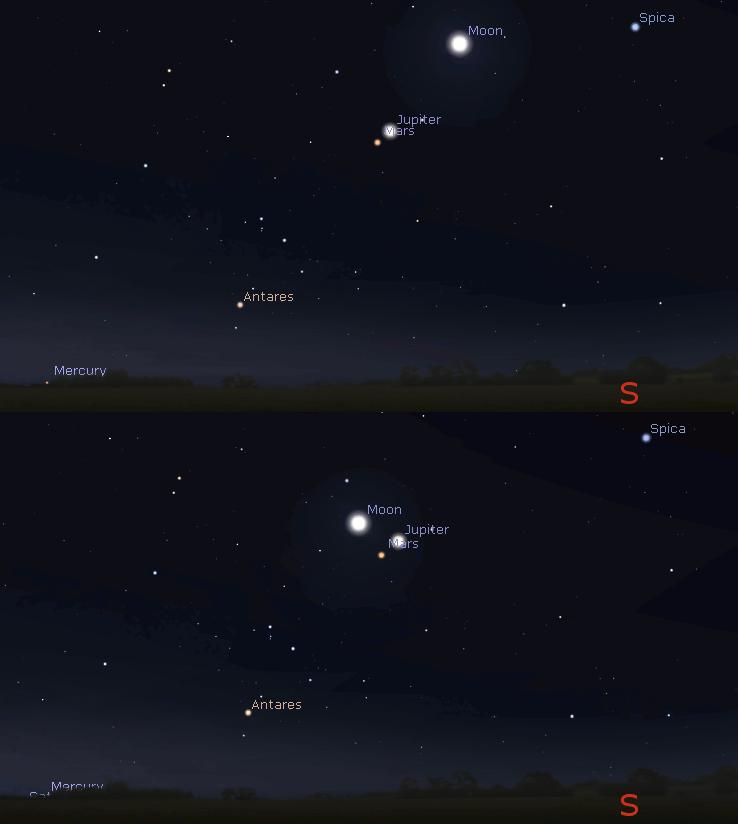
Morning planets with an animation of the Moon’s motion on the morning of the 10th & 11th. Created using Stellarium and GIMP. I’ll be covering the Moon’s apparent proximity to the planets tomorrow. Click on image to enlarge.
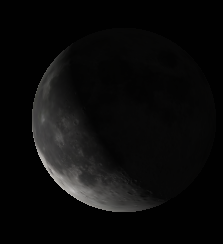
The fat waning crescent Moon as it might be seen in binoculars at 7 a.m. January 10, 2017. Created using Stellarium.
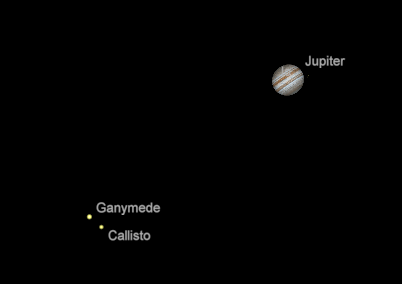
Jupiter with only two of its moons visible at 7 a.m. January 10, 2018. Io and Europa will be visible before 5:27 a.m. before ducking into Jupiter’s shadow. Created using Cartes du Ciel.
Satellite Event           Date      UT     EST
Europa Eclipse start:   10 Jan 2018 10:27  5:27 a.m.
Io Eclipse start:       10 Jan 2018 10:28  5:28 a.m.
Io Occultation end:     10 Jan 2018 13:42  Daylight
Europa Occultation end: 10 Jan 2018 14:56  Daylight
Satellite events are from the Pluto Project: https://www.projectpluto.com/jevent.htm
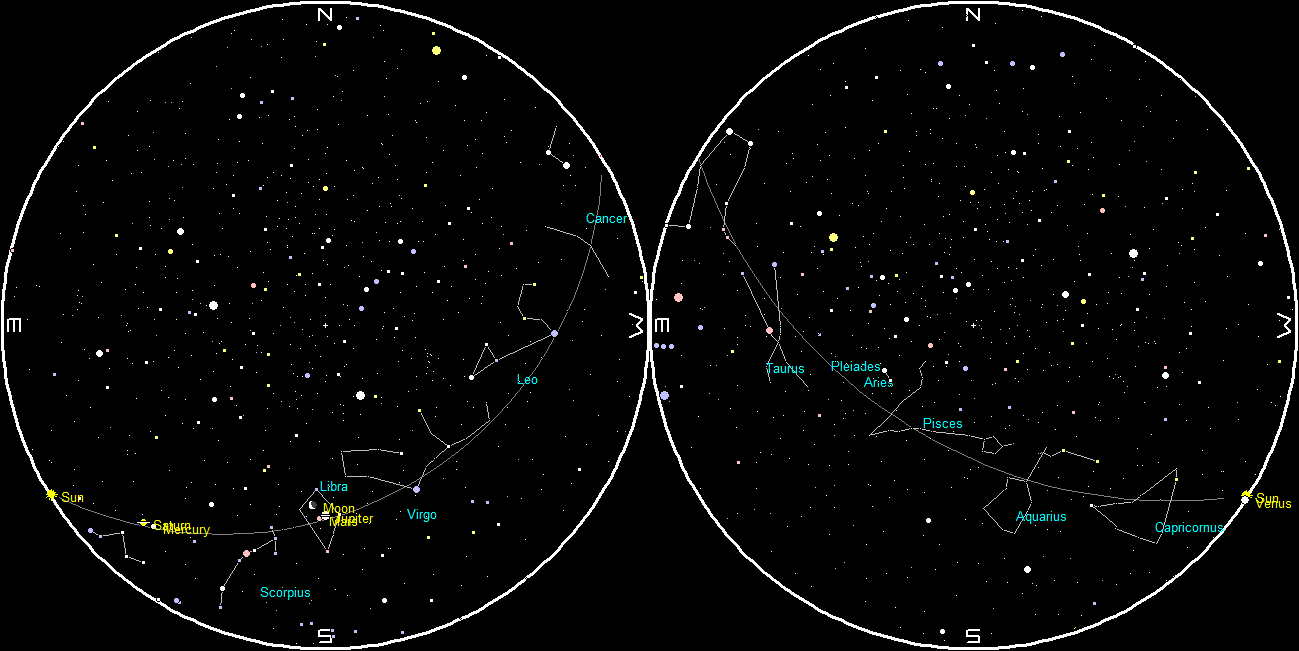
Planets at sunset and sunrise of a single night starting with sunset on the right on January 10, 2017. The night ends on the left with sunrise on the 11th. Click on the image to enlarge. Created using my LookingUp program.
01/08/2018 – Ephemeris – The Pleiades in Greek myth
Ephemeris for Monday, January 8th. The Sun will rise at 8:19. It’ll be up for 9 hours and 1 minute, setting at 5:20. The Moon, at last quarter today, will rise at 1:17 tomorrow morning.
The large and bright constellation of Orion is now in the southeast at 9 p.m. It is seen as an upright rectangle of bright stars, with a belt of three stars in the center. Orion is a minor character in Greek mythology. Orion was the son of Neptune, and was a hunter. He had an ill-fated romance with Merope, whose father King Oenopion, had him blinded. After having his sight restored, Orion became a companion of Diana goddess of the hunt and they wanted to marry. Apollo, Diana’s brother disapproved of Orion also and was able to trick Diana into accidentally killing Orion with an arrow. The heart-broken Diana then placed Orion in the sky with his hunting dogs, were we see him to this day.
The times given are for the Traverse City/Interlochen area of Michigan. They may be different for your location.
Addendum
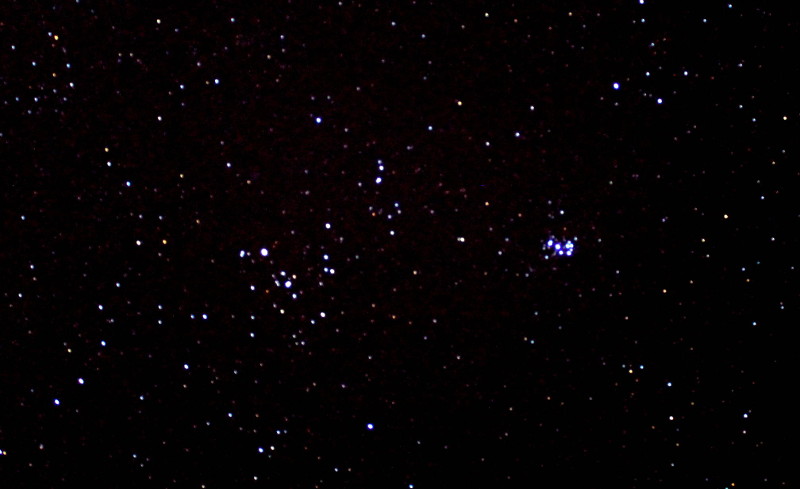
The Pleiades (right) and the Hyades (left) in this photograph I took January 4, 2016.
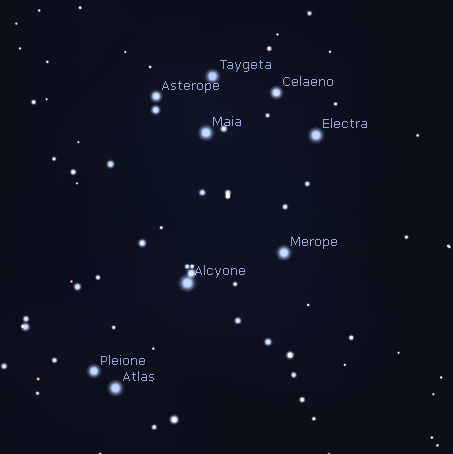
The named stars of the Pleiades. This is also showing more stars than can be seen with the naked eye. This is the number of stars that can be seen in binoculars, which is the best way to observe them. Most telescopes are offer too much magnification to fit all the stars in. A thirty power wide-angle eyepiece can just fit all the stars in. Created using Stellarium.
01/05/2018 – Ephemeris – Telescope Clinic tonight (Has been canceled due to weather)
Ephemeris for Friday, January 5th. The Sun will rise at 8:19. It’ll be up for 8 hours and 56 minutes, setting at 5:16. The Moon, 3 days before last quarter, will rise at 9:56 this evening.
If you’ve received a telescope for Christmas and are having trouble setting it up, or have an unused one in a closet, basement or attic, bring them to Northwestern Michigan College’s Rogers Observatory tonight at 8 p.m. The Grand Traverse Astronomical Society will be holding their annual telescope clinic to help you understand and use your telescope. The clinic will extend through the period that will be set aside for a star party if it’s clear, to test the telescopes and show the owners how to use them. Like anything telescopes take some time to learn how to use them and find celestial objects. It took me 15 minutes to find Saturn with a telescope the first time I tried, and I knew where it was in the sky. The observatory is south of Traverse City on Birmley Road.
The times given are for the Traverse City/Interlochen area of Michigan. They may be different for your location.
Addendum
Link to my December 26 post on telescope basics to start you off: https://bobmoler.wordpress.com/2017/12/26/
Can’t make it tonight? Members are generally available at star parties at the observatory when time permits to help folks who bring their telescopes out. See http://www.gtastro.org for our current schedule of events for 2018.
Updated 7:02 p.m.
01/04/2018 – Ephemeris – Mars will pass Jupiter in the morning sky this weekend
Ephemeris for Thursday, January 4th. The Sun will rise at 8:20. It’ll be up for 8 hours and 55 minutes, setting at 5:15. The Moon, 3 days past full, will rise at 8:44 this evening.
We have, weather permitting, been watching Mars and Jupiter getting closer together day by day in the morning sky. Their paths will cross Saturday evening as Mars slips under Jupiter. However at that time they will be below our horizon. So Saturday morning the 6th Mars will be just to the lower right of the brighter Jupiter by a bit less than he diameter of the Moon and Sunday morning the 7th Mars will be left and below Jupiter by about the same amount. After that they will continue to separate. Jupiter will stay in the constellation of Libra and enter the evening sky in early May. The Earth will catch up to Mars at the end of July. Then it will be closer to the Earth than any time since 2003. It will come as close as 35.8 million miles (57.9 million km) from the Earth.
The times given are for the Traverse City/Interlochen area of Michigan. They may be different for your location.
Addendum
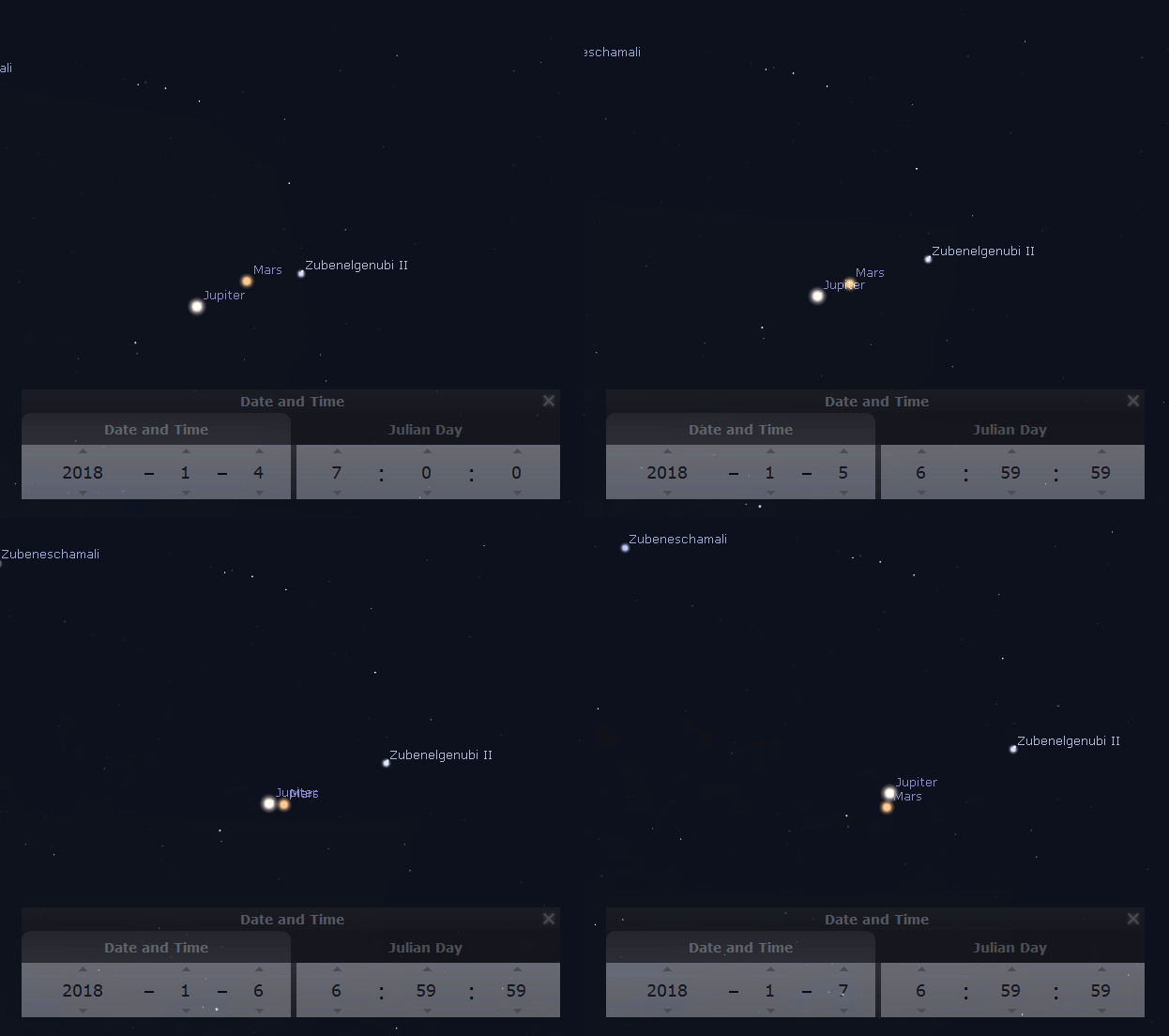
An animation of the Mars-Jupiter conjunction from January 4th thru 7th at 7 a.m.. The two named stars seen Zubenelgenubi and Zubeneschamali, stars in the constellation Libra, meaning south claw and north claw respectively. Claws of Scorpius, the constellation rising to the east. Created using Stellarium and GIMP.
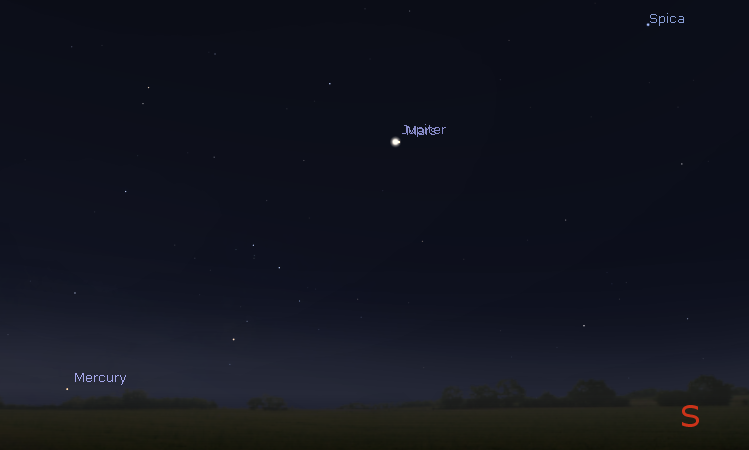
Morning planets at 7 a.m. January 6th, 2018. Mars and Jupiter labels are superimposed. Created with Stellarium.
01/03/2018 – Ephemeris – The year starts out with all the bright planets in the morning sky
Ephemeris for Wednesday, January 3rd. The Sun will rise at 8:20. It’ll be up for 8 hours and 54 minutes, setting at 5:14. The Moon, 2 days past full, will rise at 7:30 this evening.
Let’s take our weekly look at the bright planets. While Uranus and Neptune are evening planets, they require binoculars or a telescope to spot. All of the bright naked eye planets are in the morning sky now, However Saturn and Venus, the brightest, are too close to the Sun to be seen. At 7 this morning Mars is in the south-southeast while Jupiter is a lot brighter and below and left of it. Mars will rise tomorrow morning at 3:45. It’s approaching Jupiter which will rise 6 minutes later at 3:51. They will cross paths this weekend, I’ll have more on that tomorrow. Mercury will be a challenge to spot, rising in the east-southeast around 6:38 a.m. now. At 7 a.m. It will require a low horizon, binoculars and luck to find. In its next evening appearance in March it will be placed much higher in the sky for the same twilight conditions.
The times given are for the Traverse City/Interlochen area of Michigan. They may be different for your location.
Addendum
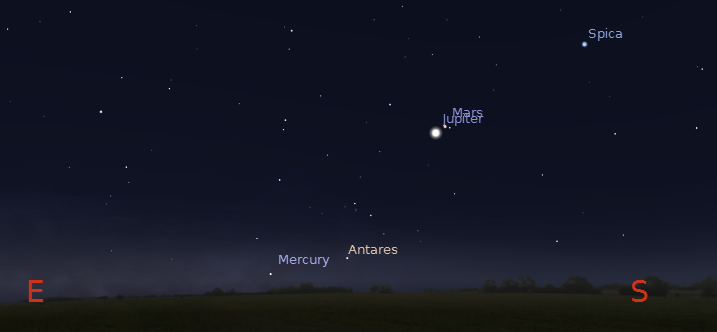
Three morning planets are visible at 7 this morning. Created using Stellarium.
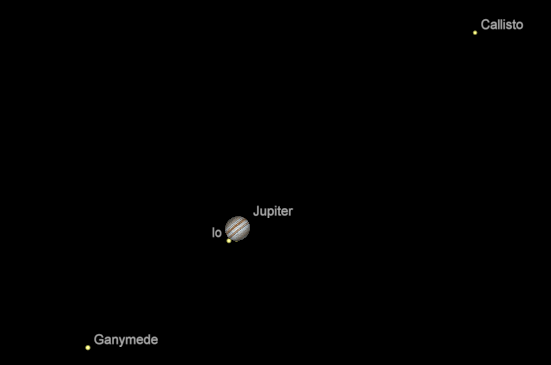
Jupiter and three of its four Galilean moons as they might be seen in a telescope at 7 a.m. this morning, January 3, 2018. Created using Cartes du Ciel (Sky Charts).
Event                      UT        EST
Europa Eclipse starts:    7:51
Io Eclipse starts:        8:35
Io Occultation ends:     11:45    6:45 a.m.
Europa Occultation ends: 12:12    7:12 a.m.
Only the last two events will be visible in the Grand Traverse area. Occultations now have the moon enter Jupiter’s shadow to the west, then unseen pass behind the planet to emerge at the east edge of the planet.
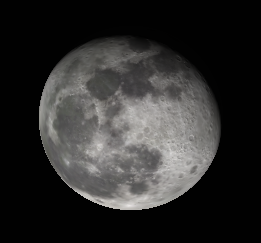
The only bright solar system object visible in the evening is the waning gibbous Moon. Binoculars will reveal several large craters. this evening January 3, 2018. Created using Stellarium.
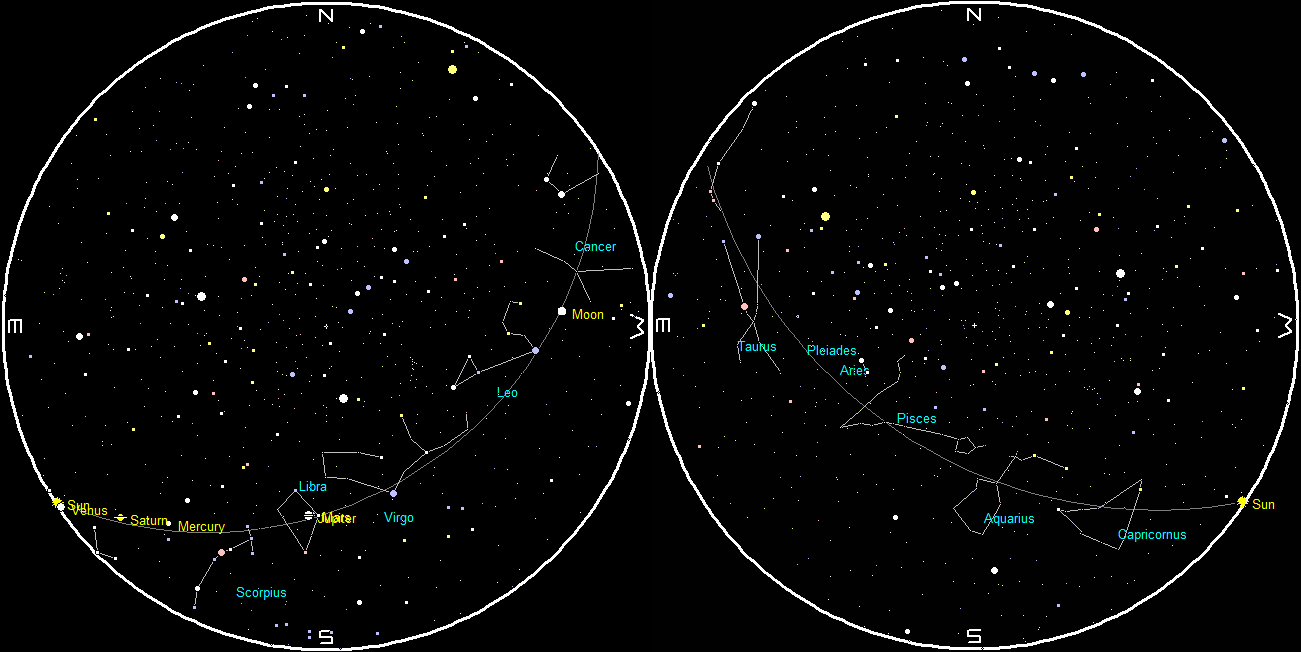
Planets at sunset and sunrise of a single night starting with sunset on the right on January 3, 2017. The night ends on the left with sunrise on the 4th. Click on the image to enlarge. Created using my LookingUp program.
 Bob Moler's Ephemeris Blog