Archive
04/16/2018 – Ephemeris – The Virgo cluster of galaxies
Ephemeris for Monday, April 16th. The Sun rises at 6:56. It’ll be up for 13 hours and 32 minutes, setting at 8:29. The Moon, 1 day past new, will set at 9:16 this evening.
The stars around the constellation Leo and Virgo below and left of it feature relatively few stars, compared to those around Orion and the other winter constellations. That isn’t just a lot of blank sky, but beyond what can be seen with the naked eye in the region of southwestern Virgo, just to the lower left of the tail star Denebola of Leo is a vast cluster of galaxies that outnumber the stars of the same brightness in that direction. It is the Virgo Galaxy Cluster. Astronomers shorten the name to the Virgo Cluster. Two centuries ago the comet hunter Charles Messier swept this region with his small telescope and found many fuzzy bodies that could be confused with comets. He didn’t know what they were, but they sure weren’t comets, because they didn’t move against the stars.
The times given are for the Traverse City/Interlochen area of Michigan. They may be different for your location.
Addendum
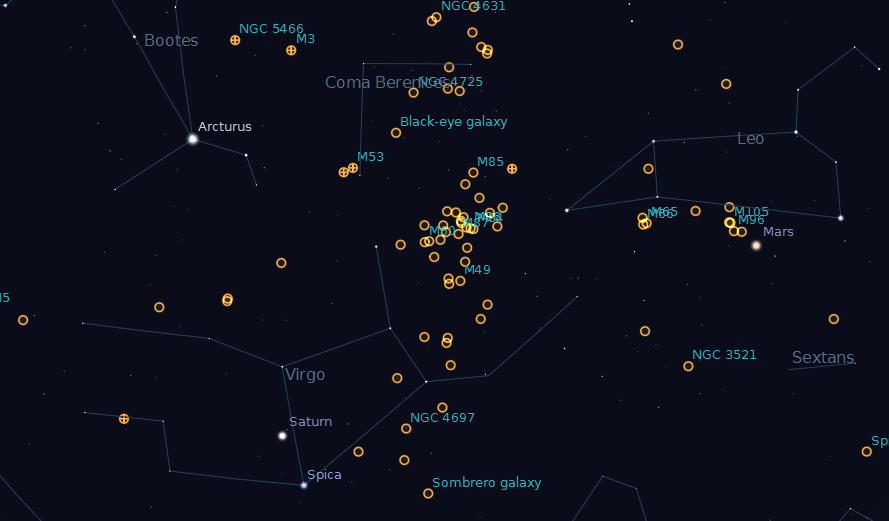
Brighter members of the Virgo Cluster. Created using Stellarium. Open circles are galaxies, circles with crosses are globular star clusters, outlying members of our Milky Way galaxy. This image is from a few years ago – Saturn, above Spica, has moved on.
04/13/2018 – Ephemeris – Regulus, in Leo the lion, the “Little King” star.
Ephemeris for Friday, April 13th. The Sun will rise at 7:01. It’ll be up for 13 hours and 23 minutes, setting at 8:25. The Moon, 2 days before new, will rise at 6:42 tomorrow morning.
The brightest star in the constellation Leo, which is high in the south these evenings is Regulus, whose name means “Little King”. It is appropriate due to its position in the heart of the king of beasts Leo the lion. Regulus is dead last in brightness of the 21 first magnitude stars, the brightest night-time stars. Even so, it is much brighter than the Sun. It is 79 light years away. The Sun would require a telescope to be spotted at that distance. Regulus appears to be a quadruple star system. The bright star itself is really two stars with a bright star orbited by a much dimmer star every 40 days. There are two dimmer stars much further out that share Regulus’ motion through space. There are an infinite variety of star system arrangements in the galaxy and beyond.
The times given are for the Traverse City/Interlochen area of Michigan. They may be different for your location.
Addendum
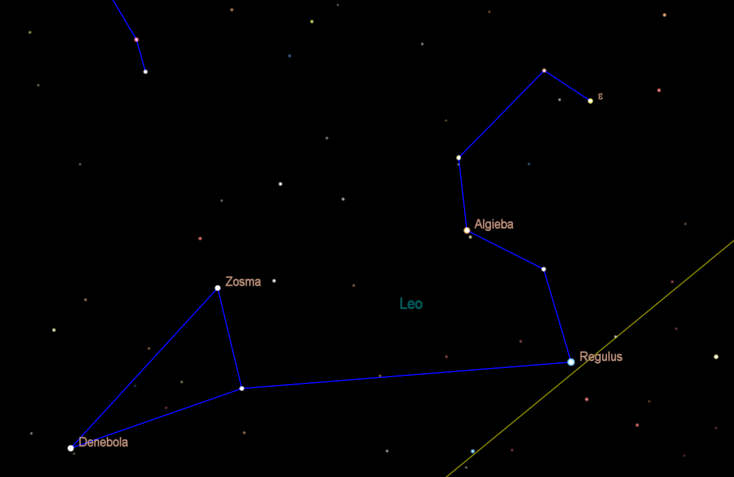
The naked eye stars of Leo, including Regulus at 10 p.m. April 13, 2018. Note that Algieba is a binary star that can be seen in small telescopes. The yellow line that passes Regulus is the ecliptic the apparent path of the Sun. The Moon and planets also hang out near that line. Created using Cartes du Ciel (Sky Charts).
Note: The original scheduled topic for today was the announcement of a star party at the Sleeping Bear Dunes National Lakeshore tomorrow, April 14th. It seems the weather gods have a different plan. There’s a winter storm watch from late Friday night (tonight) to noon Sunday with 3-6 inches of slushy snow.
04/12/2018 – Ephemeris – Where did the Milky Way go in the spring?
Ephemeris for Thursday, April 12th. The Sun will rise at 7:03. It’ll be up for 13 hours and 20 minutes, setting at 8:24. The Moon, 3 days before new, will rise at 6:14 tomorrow morning.
The Bright stars of winter are sliding into the western twilight in the evening. Taking their place in the south and east are the much more sparse stars of spring. The Milky Way passes through the winter and summer skies as well as the northern autumn sky. In the spring it runs below our southern horizon. Way back 200 years ago William Herschel realized that the stars around us lie in a flattened disk, that it was deeper in the direction of the milky glow than 90 degrees from it. It wasn’t until a bit less than 100 years ago that astronomers realized that there was anything outside this disk of stars. Today we call the fuzzy objects we find out there galaxies after the Greek word for Milky Way. They were seen in the 18th and 19th centuries, but were not recognized as such.
The times given are for the Traverse City/Interlochen area of Michigan. They may be different for your location.
Addendum

The shape of the universe (Milky Way) as measured by William Herschel by counting stars in the eyepiece fields of his telescope pointed in various directions. The large indent on the right is caused by the Great Rift, clouds of gas and dust the block the light of the stars behind it, not the lack of stars in that direction. The Great Rift is easily seen in the summer sky running through the Milky Way.
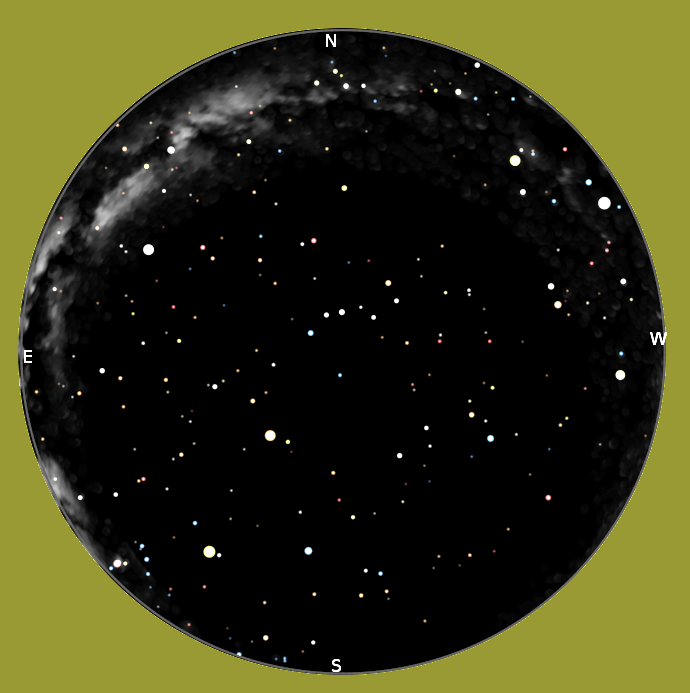
The dome of the spring sky showing the Milky Way visible mostly on the northeastern sky. In spring, we are looking out the thin side of the Milky Way. Created using Cartes du Ciel (Sky Charts).
Some Spring Galaxies
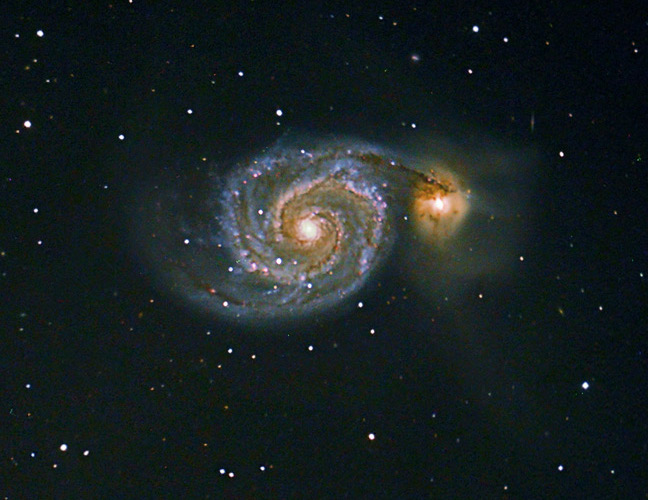
The Whirlpool Galaxy, M51 in Canes Venatici. Credit Scott Anttila.
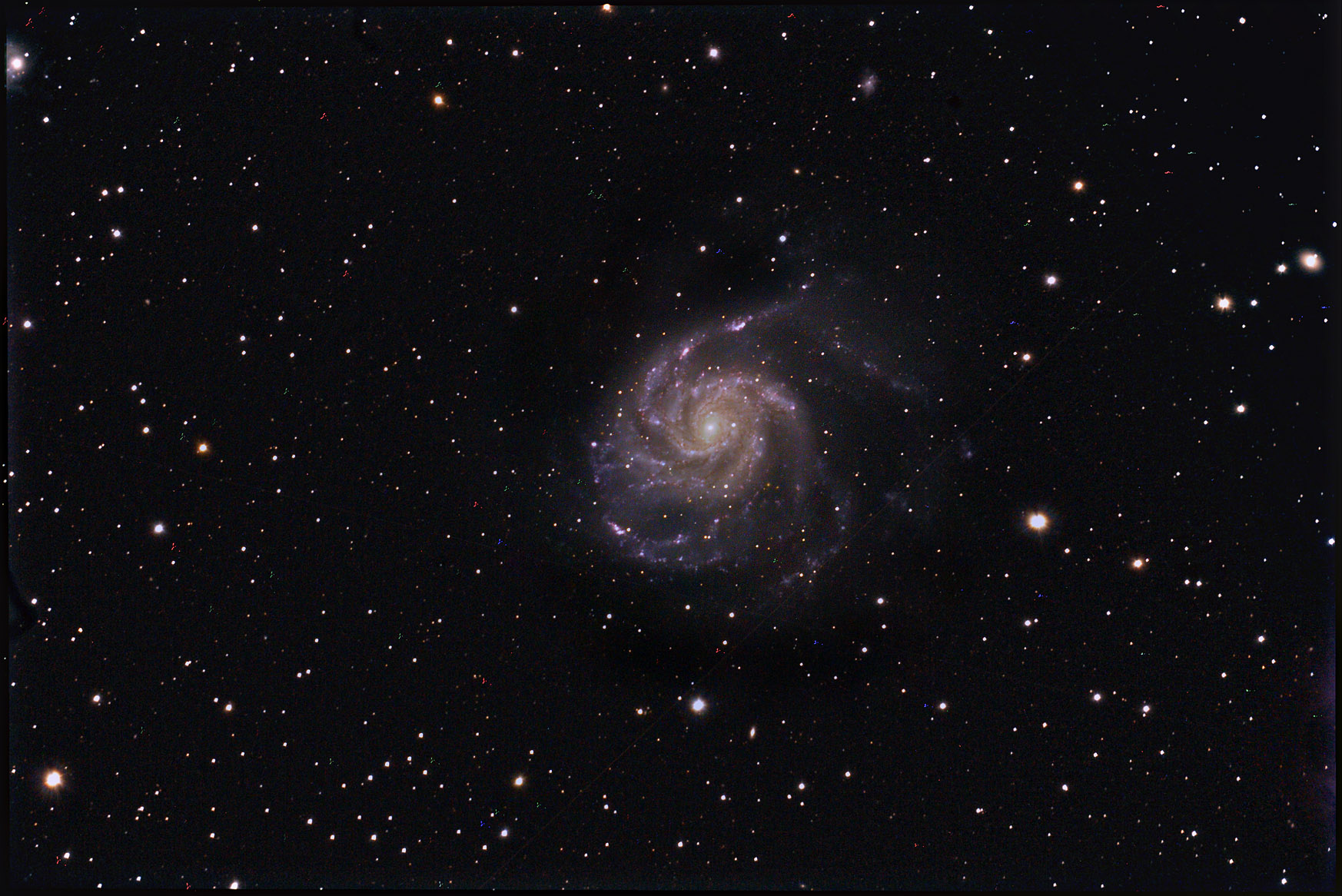
The Pinwheel Galaxy, M101 near the star Mizar in the handle of the Big Dipper. Credit Scott Anttila.
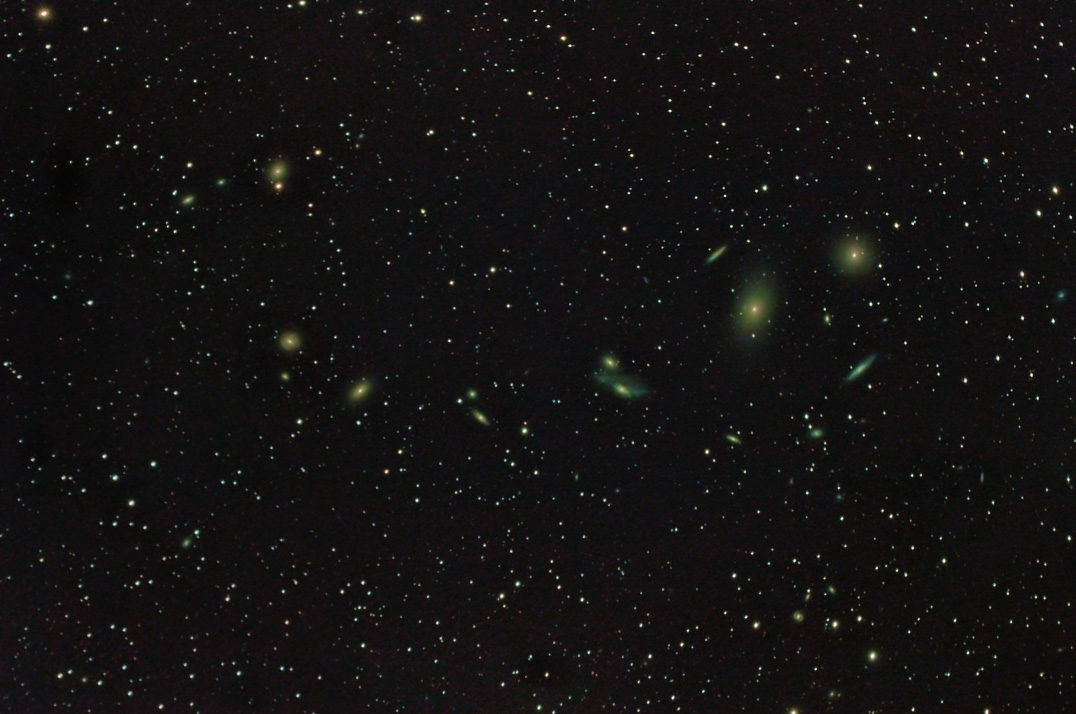
Markarian Chain of galaxies in Virgo. Credit Scott Anttila.
04/11/2018 – Ephemeris – Looking at the bright planets for this week
Ephemeris for Wednesday, April 11th. The Sun will rise at 7:05. It’ll be up for 13 hours and 17 minutes, setting at 8:22. The Moon, 3 days past last quarter, will rise at 5:45 tomorrow morning.
It’s Wednesday again and time to look for the bright planets. One bright planet is in the evening sky, the brightest, Venus. It will be visible low in the Western twilight from about 8:40 p.m. until it sets at 10:20. Venus is blindingly bright in binoculars or a small telescope. Jupiter will rise late this evening at 10:45 p.m. That doesn’t make it an evening planet. It has to rise before sunset to be an evening planet. Saturn will rise at 2:32 a.m., while Mars will rise at 3 a.m. At 6 tomorrow morning these three planets will be strung across the southern sky. Bright Jupiter will be in the southwest, dimmer Mars and Saturn will be in the south-southeast, with Mars below-left of Saturn.
The times given are for the Traverse City/Interlochen area of Michigan. They may be different for your location.
Addendum
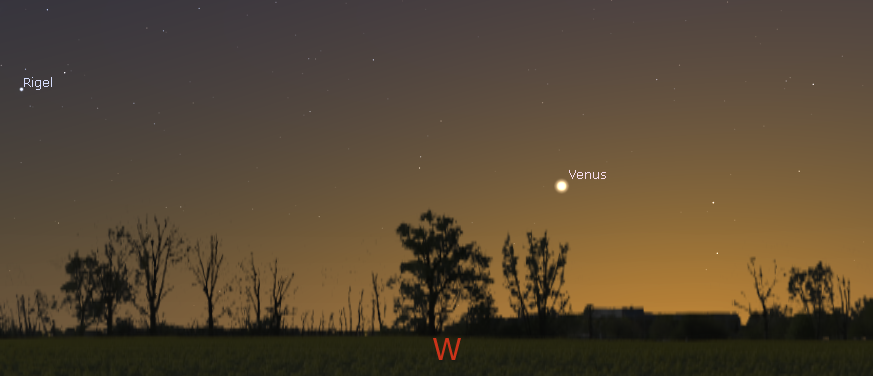
Venus in evening twilight at 9 p.m, tonight April 11, 2018. Click on the image to enlarge. Created using Stellarium.
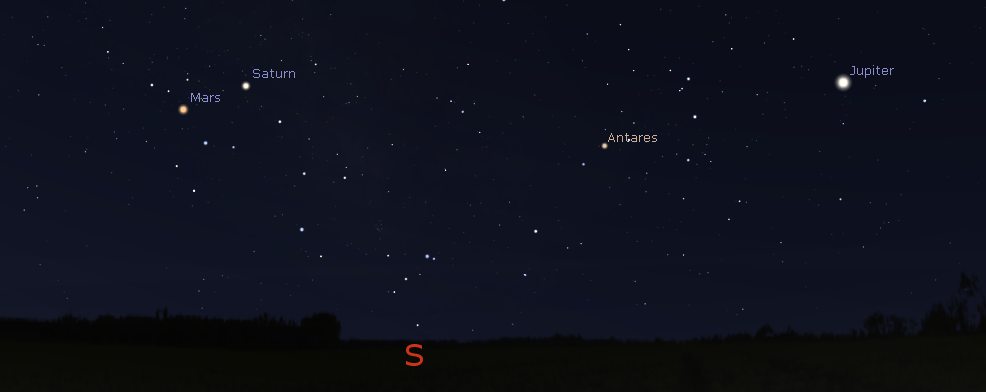
The morning planets at 6 a.m. April 12, 2018. Click on the image to enlarge. Created using Stellarium.
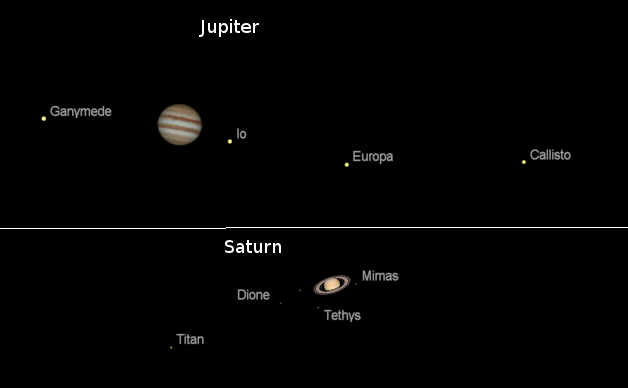
The morning planets Jupiter and Saturn as seen by a telescope using the same magnification for both at 6 a.m. April 12, 2018. a.m. Created using Cartes du Ciel (Sky Charts).
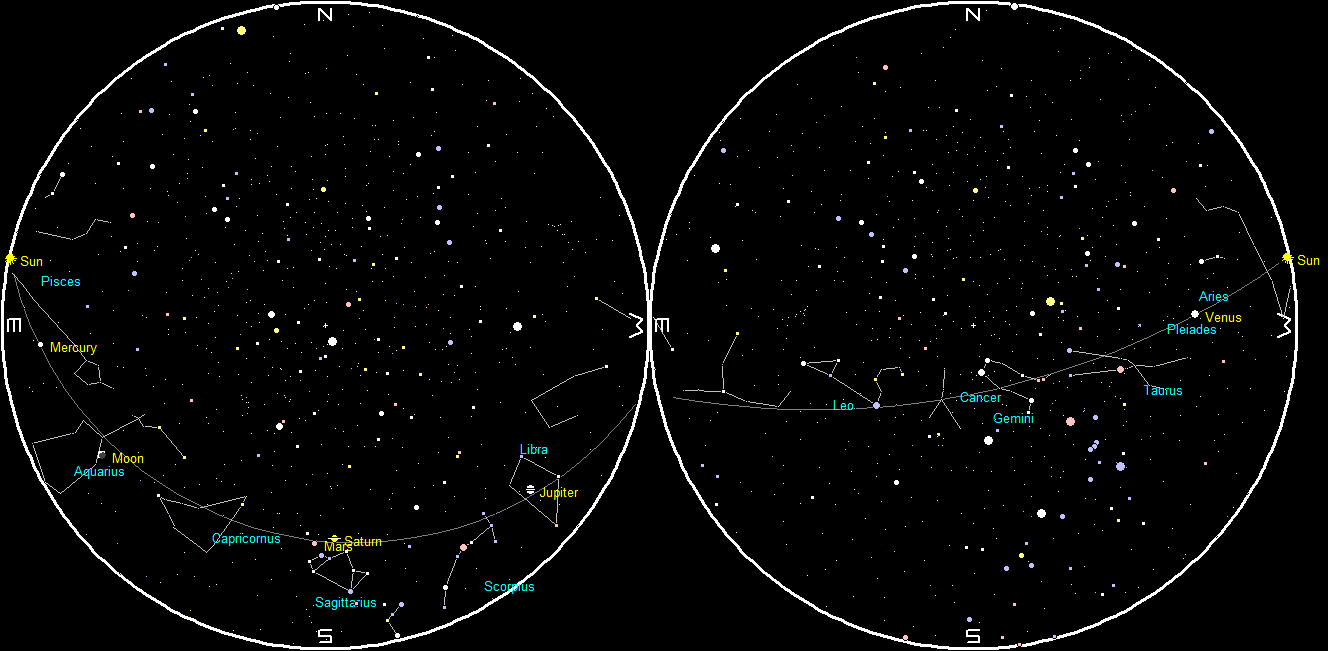
Planets and the Moon at sunset and sunrise of a single night starting with sunset on the right on April 11, 2018. The night ends on the left with sunrise on the 12th. Click on the image to enlarge. Created using my LookingUp program.
04/10/2018 – Ephemeris – How Boötes and the Great Bear got into the sky
Ephemeris for Tuesday, April 10th. The Sun will rise at 7:07. It’ll be up for 13 hours and 14 minutes, setting at 8:21. The Moon, 2 days past last quarter, will rise at 5:14 tomorrow morning.
Appearing mid way up the sky in the east at 10 p.m. is the kite shaped constellation of Boötes the herdsman. The bright star Arcturus is at the bottom-right of the kite, pointed to by the arc of the handle of the Big Dipper, above it. In one Greek myth Boötes represents a young hunter named Arcas, son of Callisto, a beautiful young lady who had the misfortune of being loved by Zeus the chief of the Greek gods. Zeus’ wife Hera, found out about the affair, and since she couldn’t punish Zeus, turned the poor woman into an ugly bear. Arcas, unaware of the events surrounding his mother’s disappearance in his youth was about to kill the bear when Zeus intervened and placed them both in the sky to save her. To this day Boötes continues to chase the great bear Ursa Major around the pole of the sky each night.
The times given are for the Traverse City/Interlochen area of Michigan. They may be different for your location.
Addendum

Arcas about to slay the bear by the 17th century artist Baur. Source: University of Virginia Electronic Text Center
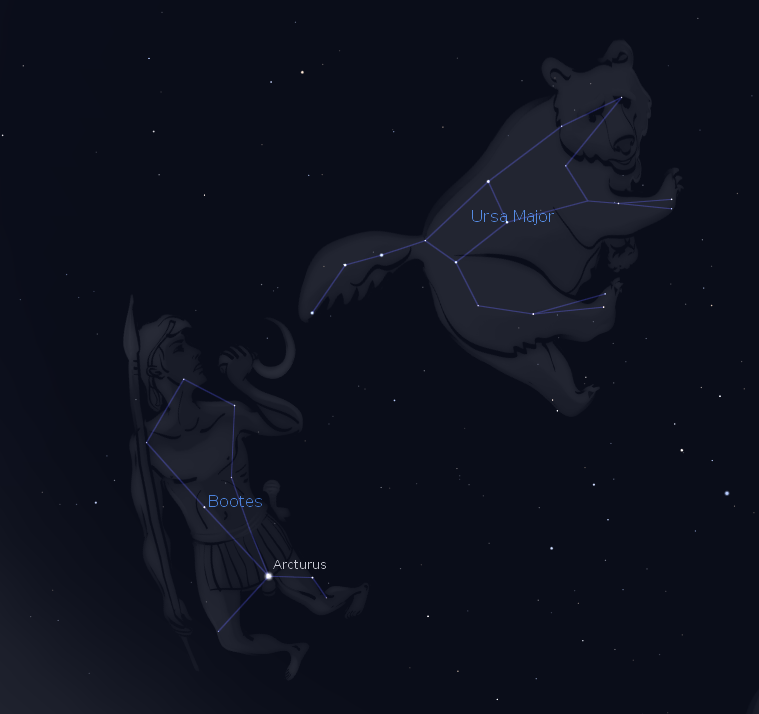
Bootes and Ursa Major aka Arcas chasing Callisto around the pole of the sky. Created using Stellarium.
04/09/2018 – Ephemeris – Follow the arc to Arcturus
Ephemeris for Monday, April 9th. The Sun will rise at 7:09. It’ll be up for 13 hours and 11 minutes, setting at 8:20. The Moon, 1 day past last quarter, will rise at 4:40 tomorrow morning.
The fourth brightest night-time star is now up in the east. It is Arcturus, a bright star with an orange hue. It can be found otherwise by finding the Big Dipper and tracing out and extending the curve of the handle and remembering the line “Follow the arc of the handle to Arcturus”. To remember the name of the star and how to find it. Arcturus is about 37 light years from us and is moving quite rapidly across the sky, compared to most stars, though one would not notice it to the naked eye in one’s lifetime. Arcturus is slightly more massive than our Sun, and about 7 billion years old, and is entering its red giant stage of life after using all the hydrogen fuel in its core. Our Sun, being slightly less massive will survive on hydrogen a bit longer.
The times given are for the Traverse City/Interlochen area of Michigan. They may be different for your location.
Addendum
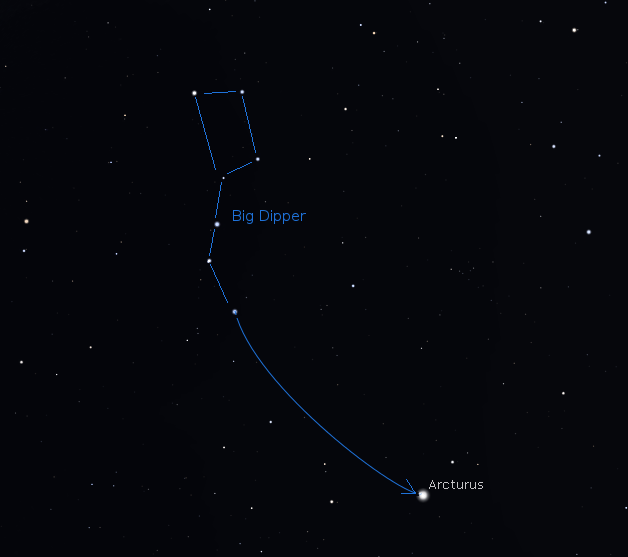
Look high in the east on a spring evening to follow the arc of the Big Dipper’s handle to Arcturus. Created using Stellarium ans GIMP.
04/06/2018 – Ephemeris – Marking the passage of 13 hours of daylight
Ephemeris for Friday, April 6th. The Sun will rise at 7:14. It’ll be up for 13 hours and 2 minutes, setting at 8:16. The Moon, 2 days before last quarter, will rise at 2:33 tomorrow morning.
Tomorrow morning early, the crescent Moon will pass Saturn and Mars. These planets will be below the Moon in the dark early morning hours. The dark night hours will be increasingly more inaccessible as summer approaches. Today we’ve broached 13 hours of daylight. By the summer solstice on June 21st the Sun will be out just a bit over 15 and a half hours. Meaning that the Sun will be down for only eight and a half hours, with only three and a half hours of really dark sky, Moon permitting, between the end of evening astronomical twilight and the beginning of morning astronomical twilight. Twilight is really long around the summer solstice because the Sun sets at a shallow angle.
The times given are for the Traverse City/Interlochen area of Michigan. They may be different for your location.
Addendum
Definitions
End or start of Civil Twilight: Sun is 6° below the horizon
Brighter planets become visible
End or start of Nautical Twilight: Sun is 12° below the horizon
Brighter deep sky objects can be found for public star parties
End or start of astronomical twilight: Sun is 18° below the horizon
On moonless nights, the twilight glow is gone and the sky is dark
04/05/2018 – Ephemeris – Hydra, a constellation for all of spring
Ephemeris for Thursday, April 5th. The Sun will rise at 7:16. It’ll be up for 12 hours and 59 minutes, setting at 8:15. The Moon, 3 days before last quarter, will rise at 1:41 tomorrow morning.
In the southern evening sky can be found the constellation of Hydra the water snake. Unlike the monster of the same name this Hydra has but one head, which is its most distinctive part. At 10 p.m. look to the south. The head of Hydra is located below a line from Gemini and Leo. It is directly below Cancer the crab, and left of the star Procyon. Hydra’s head is a small distinctive group of 6 stars that make a loop and the snake’s slightly drooping head. At that time the sinuous body of Hydra sinks below the horizon in the southeast. As it gets later in the evening the rest of Hydra will wend its way to eventually end beneath Libra the scales. This can also be seen in the next few months as Hydra slithers across the southern horizon.
The times given are for the Traverse City/Interlochen area of Michigan. They may be different for your location.
Addendum
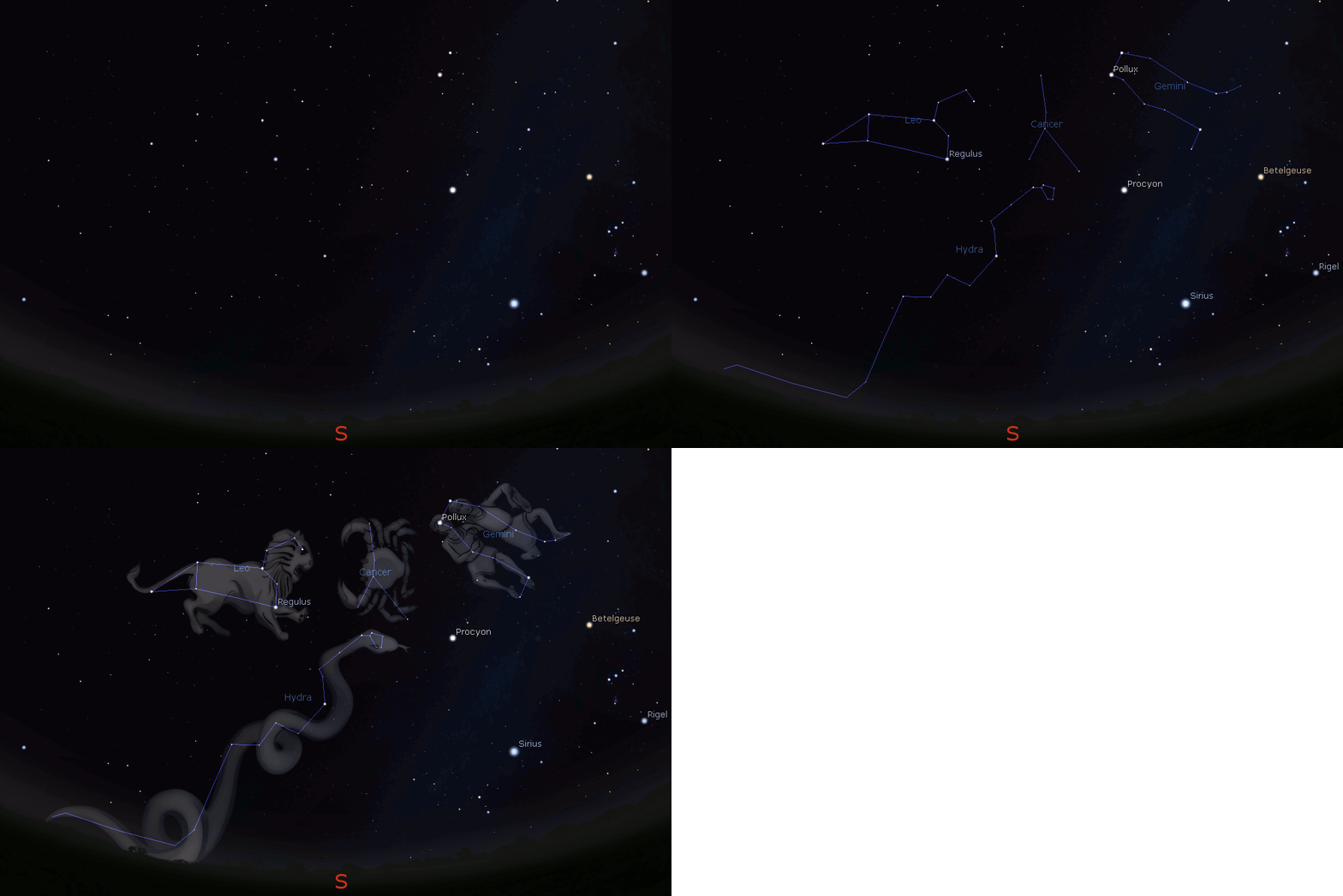
Hydra the water snake finder animation for 10 p.m. April 5th.. Hydra is the longest of all the constellations. Click on image to enlarge. Created using Stellarium and GIMP.
04/04/2018 – Ephemeris – Wednesday is bright planet day on Ephemeris
Wednesday, April 4th. The Sun will rise at 7:18. It’ll be up for 12 hours and 56 minutes, setting at 8:14. The Moon, half way from full to last quarter, will rise at 12:44 tomorrow morning.
Let’s take our weekly look at the bright planets. We’re down to 4 the naked eye planets are visible now. One is in the evening sky. Venus will be visible low in the Western twilight from about 8:40 p.m. until it sets at 10:01. Mercury is in the morning sky, but too close to the Sun to be seen by anybody. Jupiter will rise late this evening at 11:16 p.m. That doesn’t make it an evening planet. It has to rise before sunset to be an evening planet. Saturn will rise at 2:59 a.m., while Mars will rise 14 minutes later at 3:13 a.m. At 6 tomorrow morning these three planets will be strung across the southern sky. Bright Jupiter will be in the southwest, dimmer Mars and Saturn will be in the south-southeast, with Mars below Saturn.
The times given are for the Traverse City/Interlochen area of Michigan. They may be different for your location.
Addendum
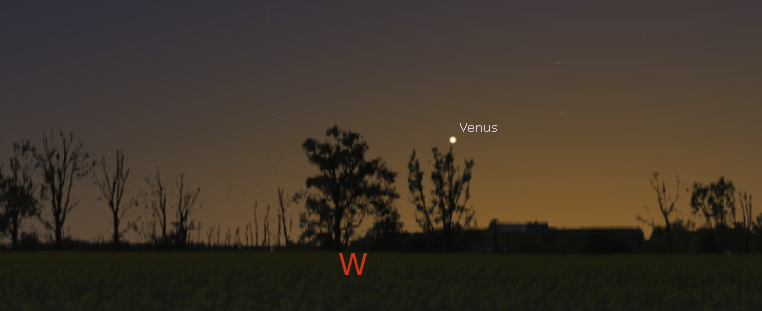
Venus in evening twilight at 9 p.m, tonight April 4, 2018. Click on the image to enlarge. Created using Stellarium.
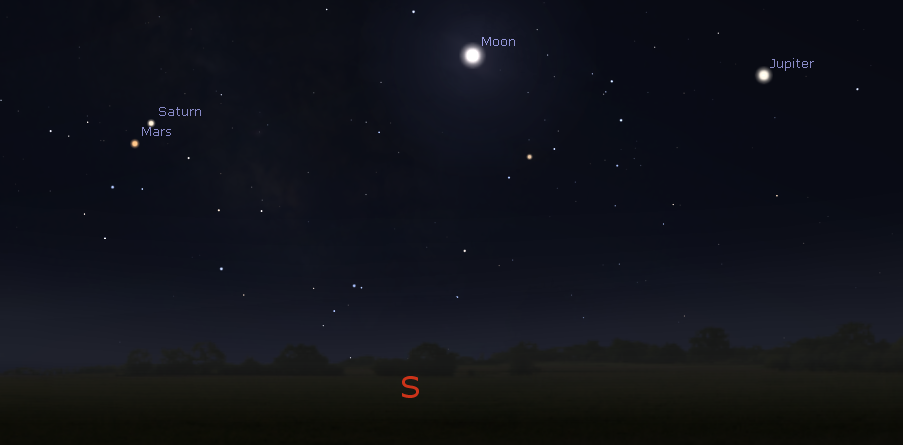
The morning planets and the Moon at 6 a.m. April 5, 2018. Click on the image to enlarge. Created using Stellarium.
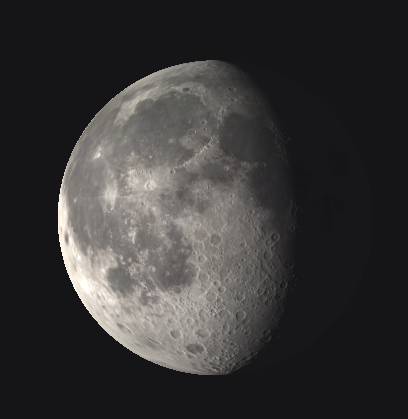
The waning gibbous Moon at 6 a.m. April 5, 2018 as it might be seen in binoculars.
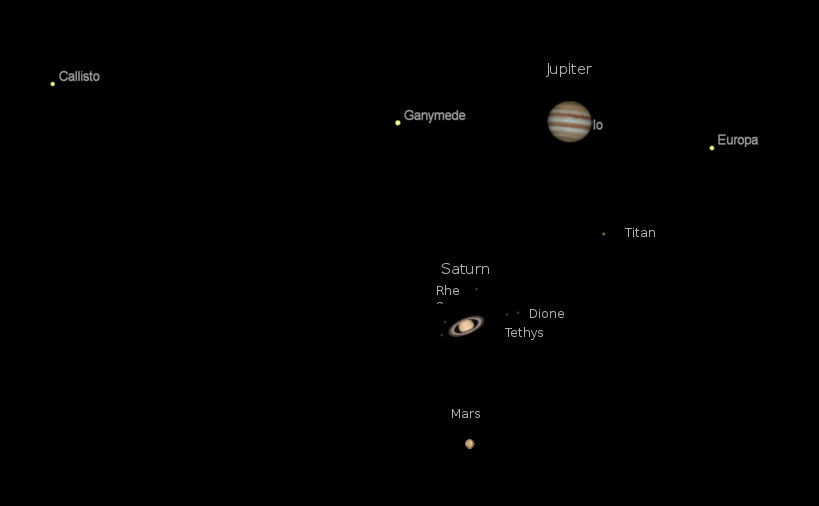
The morning planets as seen by a telescope using the same magnification for all at 6 a.m. April 5, 2018. a.m. Jupiter’s moon Io is in the planet’s shadow. See the table below from Project Pluto. Created using Cartes du Ciel (Sky Charts).
Moon Event             Date     Universal Time   Local time
Io : Eclipse start     5 Apr 2018  9:04 UT        5:04 EDT
Io : Occultation end   5 Apr 2018 11:57 UT        7:57 EDT (unseen)
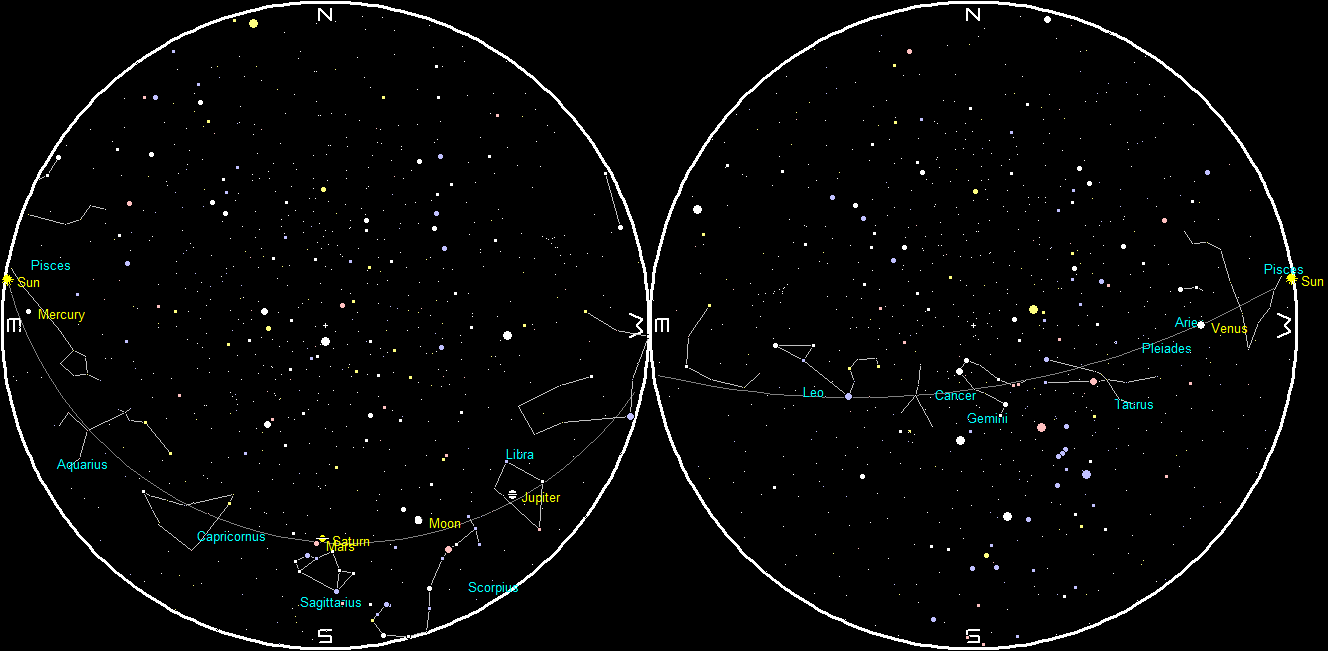
Planets and the Moon at sunset and sunrise of a single night starting with sunset on the right on April 4, 2018. The night ends on the left with sunrise on the 5th. Click on the image to enlarge. Created using my LookingUp program.
04/03/2018 – Ephemeris – How to spot Zodiacal Light
Ephemeris for Tuesday, April 3rd. The Sun will rise at 7:19. It’ll be up for 12 hours and 53 minutes, setting at 8:12. The Moon, 3 days past full, will rise at 11:44 this evening.
Zodiacal light is a faint but towering glow that can be seen after the end of astronomical twilight on a moonless night. It is seen in the west in the evening in late winter and early spring and in the east in the morning in late summer and early autumn. The axis of the glow is the ecliptic, the plane of the Earth’s orbit, indeed that of all the planets, along which lie the constellations of the zodiac. Right now the end of twilight is about 10 p.m. and advancing at a rate of a minute or two each night. The cause of zodiacal light is dust, micron sized dust from comets and asteroids. Most of these lie in the plane of the solar system, which is why zodiacal light is centered on the ecliptic and the constellations of the zodiac and increases in brightness and width toward the Sun. Spotting Zodiacal Light takes dark adapted eyes, time and patience.
The times given are for the Traverse City/Interlochen area of Michigan. They may be different for your location.
Addendum
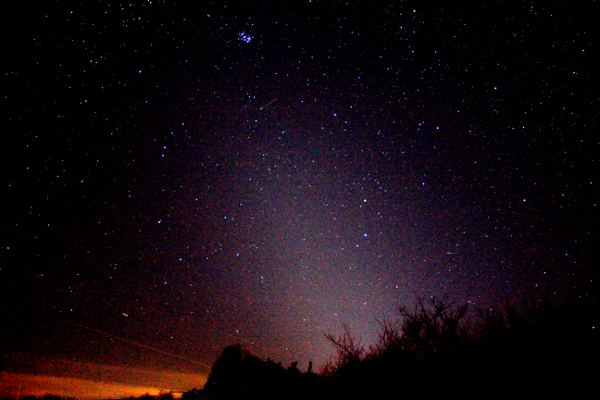
Much enhanced Zodiacal Light from the my back yard at 9:31 p.m. March 16, 2018, 5 minutes after the official end of astronomical twilight. Canon EOS Rebel T5 18mm f.l., f/3.5, 6 sec. ISO 12,800 . The clouds on the left appear to be illuminated by the lights of the towns of Beulah and Frankfort 20+ miles away. Note the Pleiades at the top of the image.
 Bob Moler's Ephemeris Blog