Archive
09/16/2022 – Ephemeris – Alberio: a double star that showcases star colors
This is Ephemeris for Friday, September 16th. Today the Sun will be up for 12 hours and 28 minutes, setting at 7:51, and it will rise tomorrow at 7:24. The Moon, 1 day before last quarter, will rise at 11:03 this evening.
Alberio is the name given to the star that is in the head of the constellation of Cygnus the swan, which is high in the east these evenings. It is also at the foot of the asterism or informal constellation of the Northern Cross. To the naked eye Albireo looks like a single star, however even in small telescopes its true nature is revealed. It’s a double star whose individual star colors are strikingly different Its brightest star is yellow, and the dimmer star is blue. While star colors are subtle, these two, due to their apparent closeness, make an obvious color contrast. Unlike what your interior decorator says: In stars, blue is hot, yellow, orange and red are cool. The two stars are too far apart to be considered a binary star system, but appear to move together in space. It is what is called an optical double, though they’re both around 430 light years away.
The astronomical event times given are for the Traverse City/Interlochen area of Michigan (EDT, UT – 4 hours). They may be different for your location.
Addendum
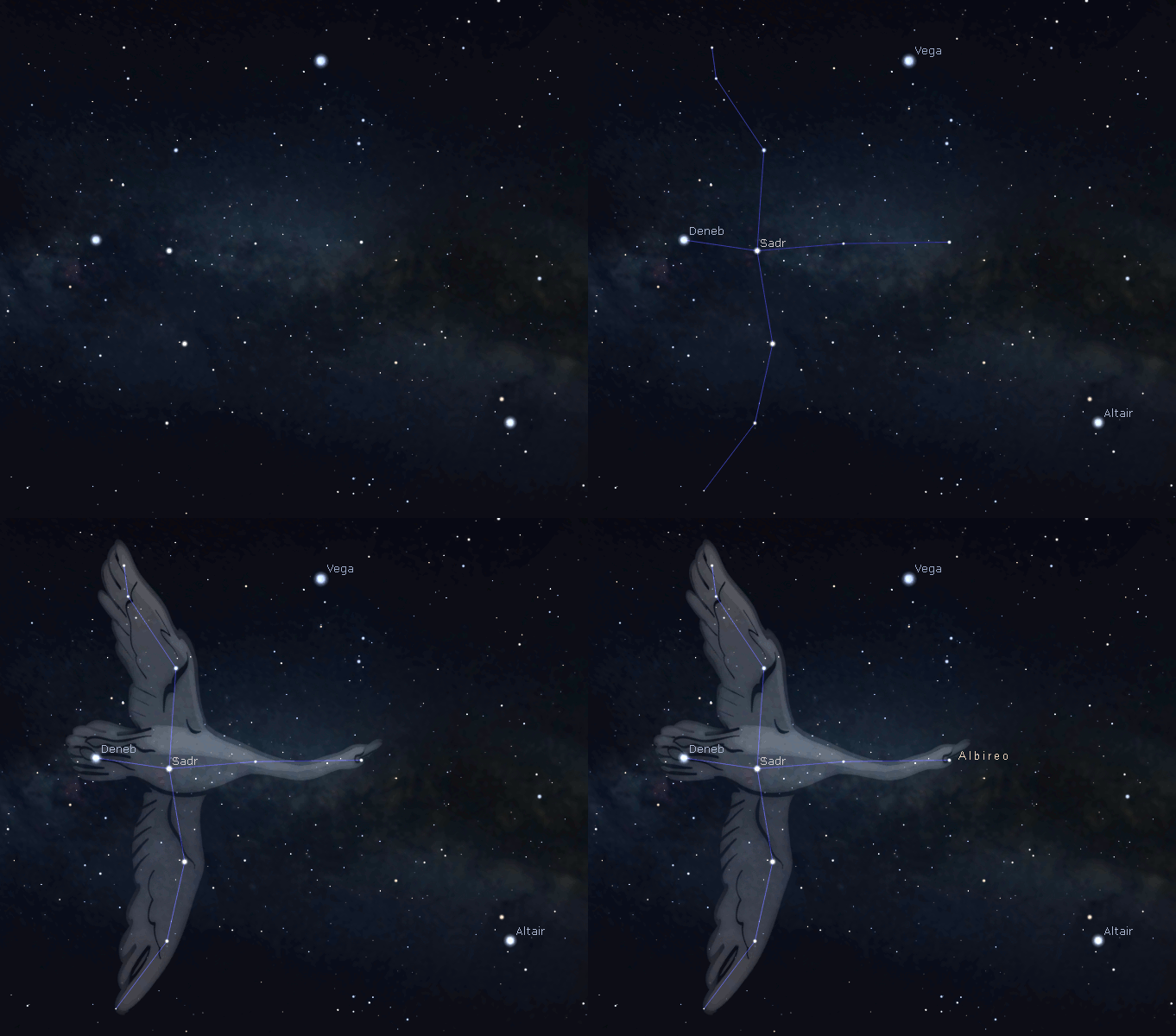
Animated Albireo finder chart. Albireo is located in the head of Cygnus the swan, or at the base of the Northern Cross. Tagged stars are, beside Albireo, the stars of the Summer Triangle: Deneb, Vega and Altair plus the star at the junction of the upright and crosspiece of the cross, Sadr. Created using Stellarium.
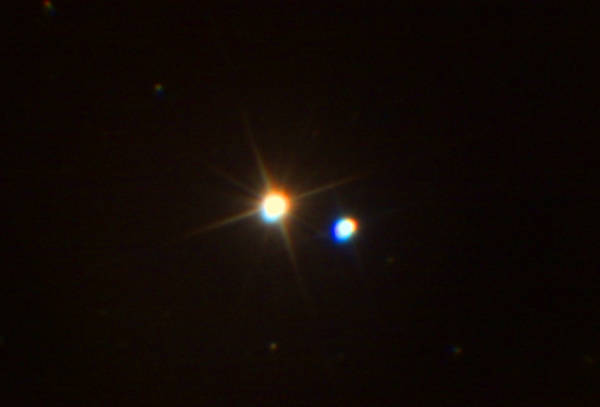
Albireo, captured at high magnification by the staff of the Smithsonian Institution. Informally, at star parties, I call it the U of M Star because it displays the University of Michigan’s Maize and Blue colors.
A note about star colors
The color of a star is dependent on its surface temperature. The term surface is a misnomer, because stars do not have a surface, at least not a solid one, being gaseous in nature. The only exception I can think is a neutron star, which is packed with neutrons. We consider the Sun’s photosphere synonymous with “surface”. The photosphere of the Sun is where the energy transport from the core changes from convection to radiation. The color of the Sun is a measure of the temperature of the photosphere. The color sequence from the coolest to the hottest is: red, orange, yellow, white and blue. The light emitted by a star is not a pure color, but a distribution of colors, whose peak shifts along that range. There is much more to tell, but that’s beyond the scope of this post.
09/15/2022 – Ephemeris – Finding Cassiopeia this time of year
This is Ephemeris for Thursday, September 15th. Today the Sun will be up for 12 hours and 31 minutes, setting at 7:53, and it will rise tomorrow at 7:22. The Moon, 2 days before last quarter, will rise at 10:30 this evening.
In the northeastern sky is a letter W shaped constellation of Cassiopeia, the queen of Greek myth. I can’t say Cassiopeia is rising in the northeast, because it never sets for us in northern Michigan. This time of year it skirts above the northern horizon during the daytime. One of Cassiopeia’s claims to historical astronomical fame is that it’s the location of Tycho’s Star, a supernova discovered in 1572 by Danish astronomer Tycho Brahe, the last of the great astronomers prior to the invention of the telescope. Tycho was able to prove that the temporary phenomenon was actually a star in the heavens, disproving the Greek notion that the heavens were changeless and perfect. The Chinese had already known that, calling them Guest Stars.
The astronomical event times given are for the Traverse City/Interlochen area of Michigan (EDT, UT – 4 hours). They may be different for your location.
Addendum
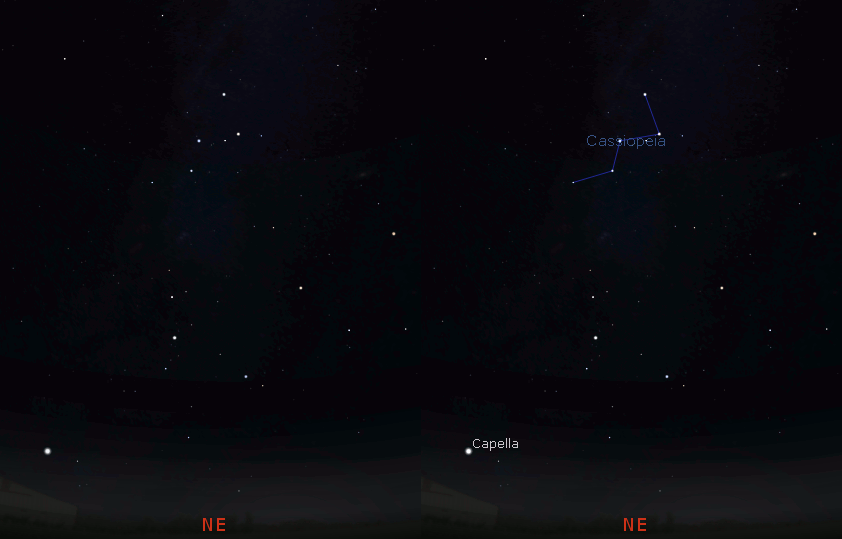
Cassiopeia finder animation for 10 pm tonight, September 15th. One cannot miss the distinctive W. Created using Stellarium.
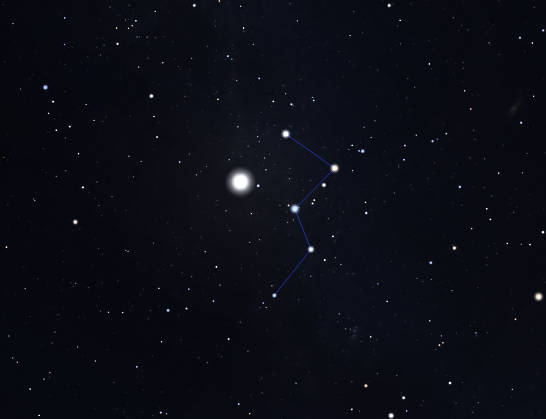
Tycho’s Supernova 1574A, as simulated in Stellarium for mid-November 1572.
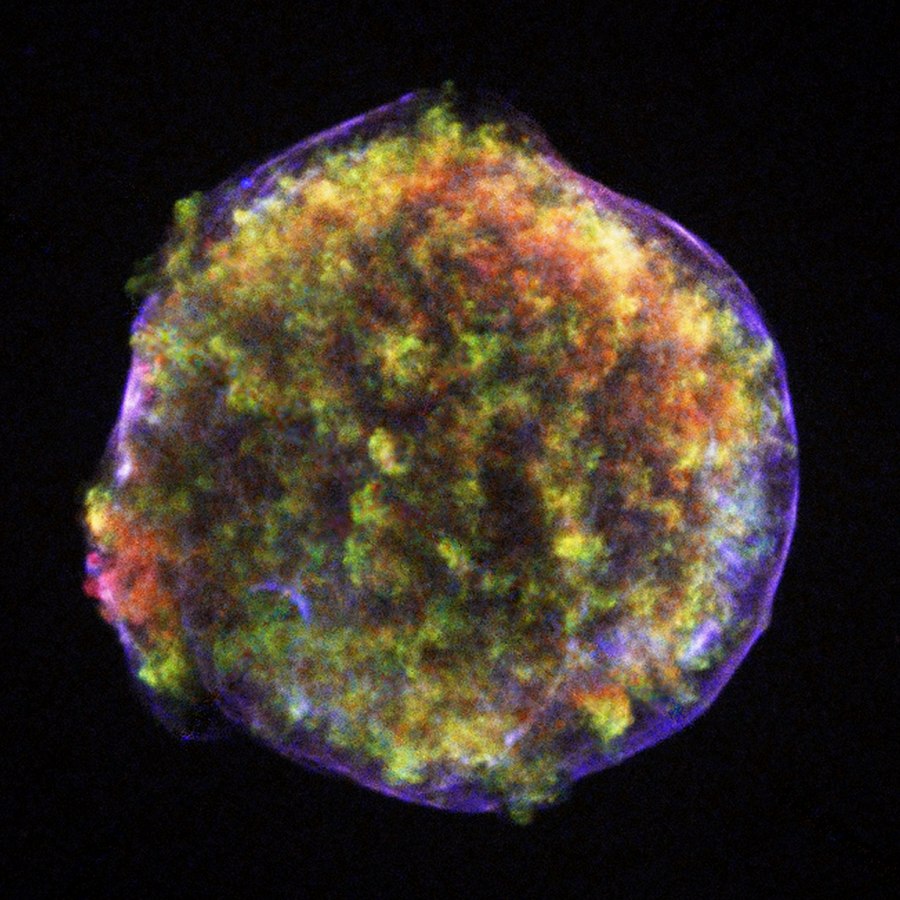
Tycho’s Supernova remnant, seen in x-rays by the orbiting Chandra X-ray Observatory. Credit: NASA / Chandra
09/14/2022 – Ephemeris – Let’s search for the naked-eye planets for this week
This is Ephemeris for Wednesday, September 14th. Today the Sun will be up for 12 hours and 34 minutes, setting at 7:55, and it will rise tomorrow at 7:21. The Moon, 3 days before last quarter, will rise at 10:02 this evening.
Let’s search for the naked-eye planets for this week. Two of the naked-eye planets are in the evening sky. Mercury sets too close to the Sun to be seen in the evening. But as it gets darker, Saturn can be seen in the southeast. Jupiter, still officially a morning planet, rises in the east around 8:23 pm. It is seen against the stars of Pisces now, moving slowly retrograde or westward. At 6:30 am tomorrow the three morning planets will be spread out from brilliant Venus on the horizon in the east-northeast, if you can see it at all, to Mars high in the south-southeast below the Moon and next to the bright reddish star Aldebaran to Jupiter in the west-southwest. Mars is among the stars seen rising on late autumn and early winter evenings.
The astronomical event times given are for the Traverse City/Interlochen area of Michigan (EDT, UT – 4 hours). They may be different for your location.
Addendum
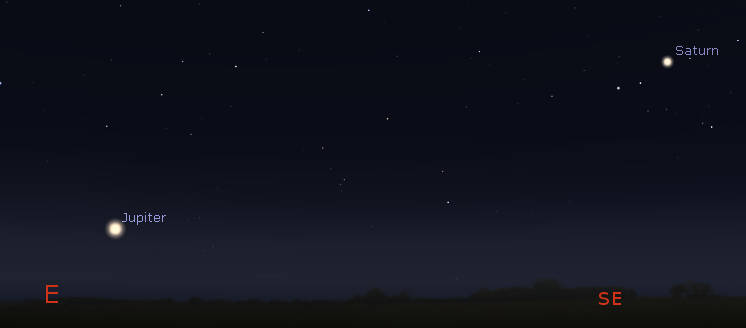
Jupiter and Saturn at 9 pm tonight, September 14, 2022. Created using Stellarium.
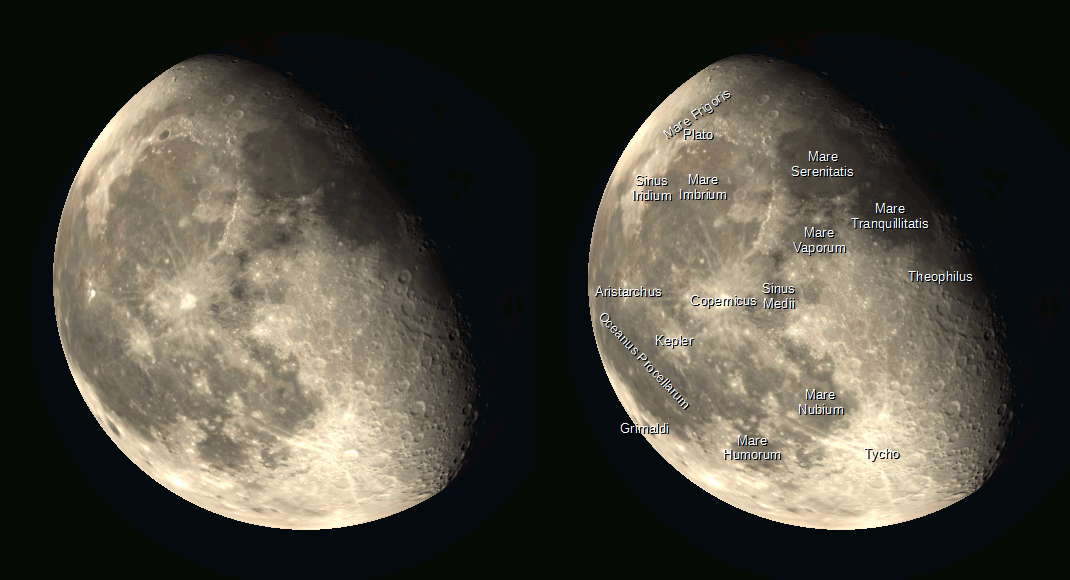
The waning gibbous moon as seen in binoculars or low power telescope at 10:30 tonight, September 14, 2022. Labels are centered on their feature. Created using Stellarium, labels using LibreOffice Draw, and GIMP for animation.
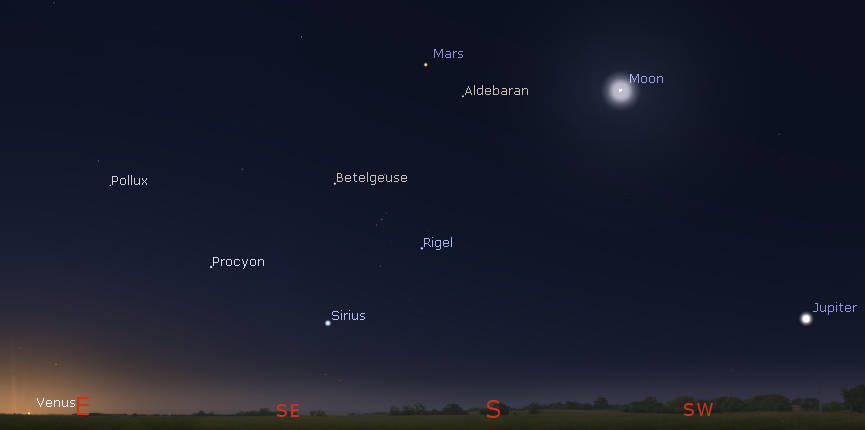
The morning planets with the Moon and the bright winter stars at 6:30 am tomorrow, September 15, 2022. Click on the image to enlarge it. Click on the image to enlarge it. Created using Stellarium.
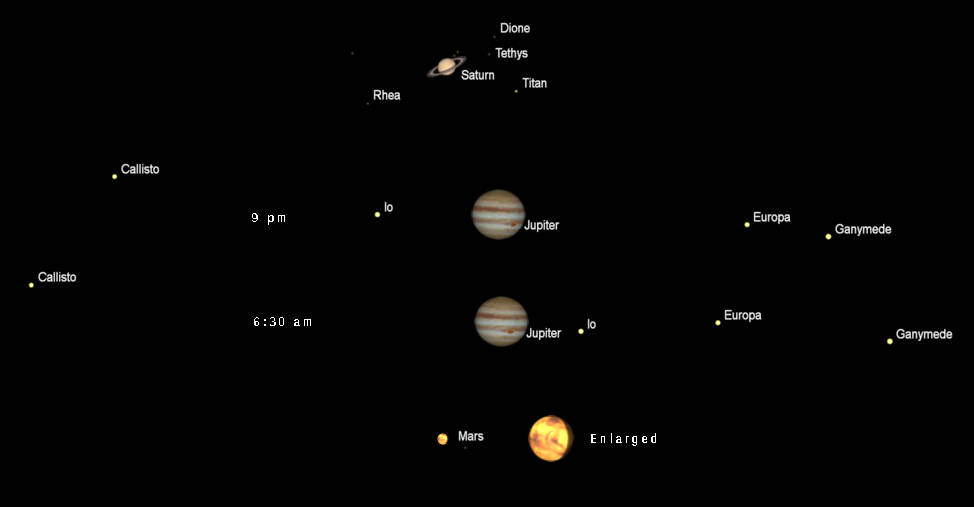
Telescopic views of Saturn Jupiter and Mars (north up) as they would be seen in a small telescope, with the same magnification. The times vary for each planet. Saturn is shown at 9 pm. Jupiter is shown twice, at 9 pm and 6:30 am, since its moons, especially Io and Europa, move rapidly. Mars is shown at 6:30 am. I do not show planets less than 10 seconds of arc in diameter, so Venus isn’t shown. Apparent diameters: Saturn 18.47″, its rings 43.02″; Jupiter 49.66″. Mars 10.70″, 86.0% illuminated; Venus (not shown) 9.89″, 98.5% illuminated. The ” symbol means seconds of arc (1/3600th of a degree.) Click on the image to enlarge it. Created using Cartes du Ciel (Sky Charts) and GIMP.
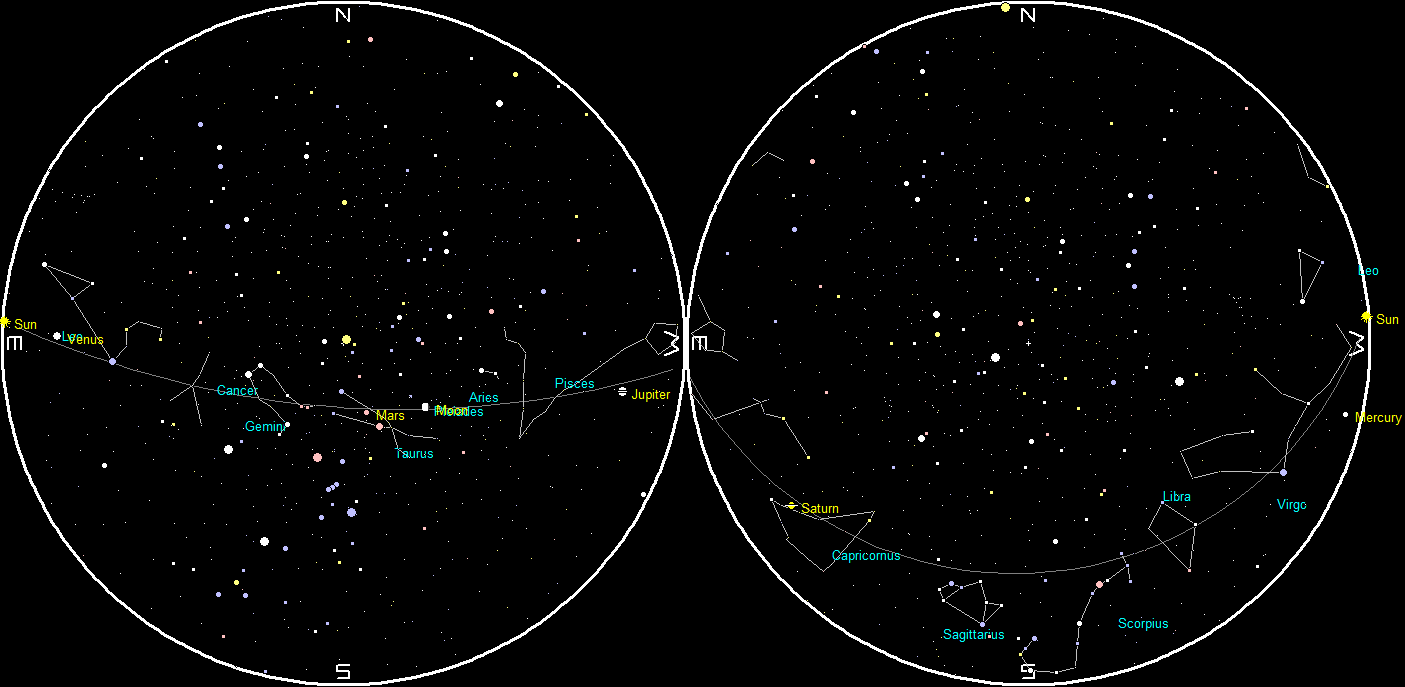
The naked-eye planets and the Moon at sunset and sunrise on a single night, starting with sunset on the right on September 14, 2022. The night ends on the left with sunrise on the 15th. Click on the image to enlarge it. Created using my LookingUp program, and GIMP.
09/13/2022 – Ephemeris – SpaceX Crew-5 flight to the ISS will be commanded by first Native American female astronaut
This is Ephemeris for Tuesday, September 13th. Today the Sun will be up for 12 hours and 37 minutes, setting at 7:57, and it will rise tomorrow at 7:20. The Moon, 3 days past full, will rise at 9:38 this evening.
On or around October 3rd a SpaceX Crew Dragon capsule will be launched to the International Space Station with an international crew of four with the first female Native American astronaut Nicole Mann as commander, pilot Josh Cassada, both NASA astronauts, Japanese astronaut Koichi Wakata, and Russian cosmonaut Anna Kikina. Nicole Mann, a member of the Round Valley Indian Tribes of northern California, is also the first female commander of a Commercial Crew spacecraft. She was originally assigned to the Boeing CST-100 Starliner, but was transferred to the SpaceX Dragon due to the prolonged problems with the former vehicle. Crew 5 will be a part of Expeditions 67 and 68 on the International Space Station.
The astronomical event times given are for the Traverse City/Interlochen area of Michigan (EDT, UT – 4 hours). They may be different for your location.
Addendum
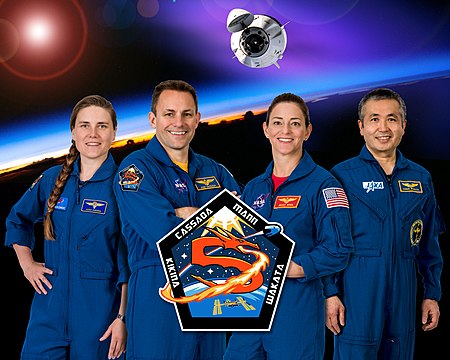
SpaceX Crew-5 Official Crew Portrait – Left to right: Anna Kikina, Josh Cassada, Nicole Mann and Koichi Wakata.
09/12/2022 – Ephemeris – The Dart Mission hits its asteroid in two weeks
This is Bob Moler with Ephemeris for Monday, September 12th. Today the Sun will be up for 12 hours and 40 minutes, setting at 7:59, and it will rise tomorrow at 7:19. The Moon, 2 days past full, will rise at 9:16 this evening.
Two weeks from today, a small satellite will smash into a small asteroid ion an attempt to change its orbit. The spacecraft and the name of the NASA mission is DART (Double Asteroid Redirection Test). At 7:14 pm Monday, September 26th, the DART spacecraft will crash into a tiny 525-foot diameter asteroid that’s orbiting a larger asteroid. The target is Dimorphos that is orbiting Didymos. Dimorphos is orbiting Didymos at the slow pace of four tenths of a mile an hour, taking 11.9 hours to orbit it once. The DART spacecraft hit should change that a bit. A cube sat, launched by DART, should witness the event. Radio telescopes using radar should see any effect on the velocity of Dimorphos, to see if it worked.
The astronomical event times given are for the Traverse City/Interlochen area of Michigan (EDT, UT – 4 hours). They may be different for your location.
Addendum
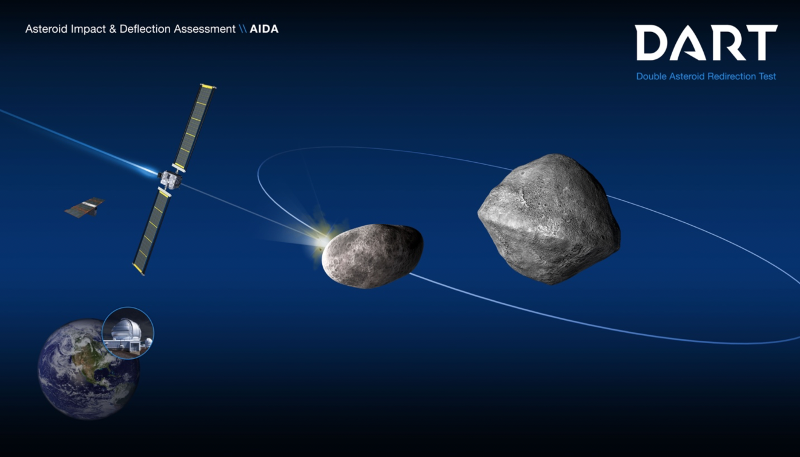
Schematic of the DART mission shows the impact on the moonlet of asteroid (65803) Didymos. Post-impact observations from Earth-based optical telescopes and planetary radar would, in turn, measure the change in the moonlet’s orbit about the parent body. The DART spacecraft is not to scale with the asteroids. Click on the image to enlarge it. Credits: NASA/Johns Hopkins Applied Physics Lab.
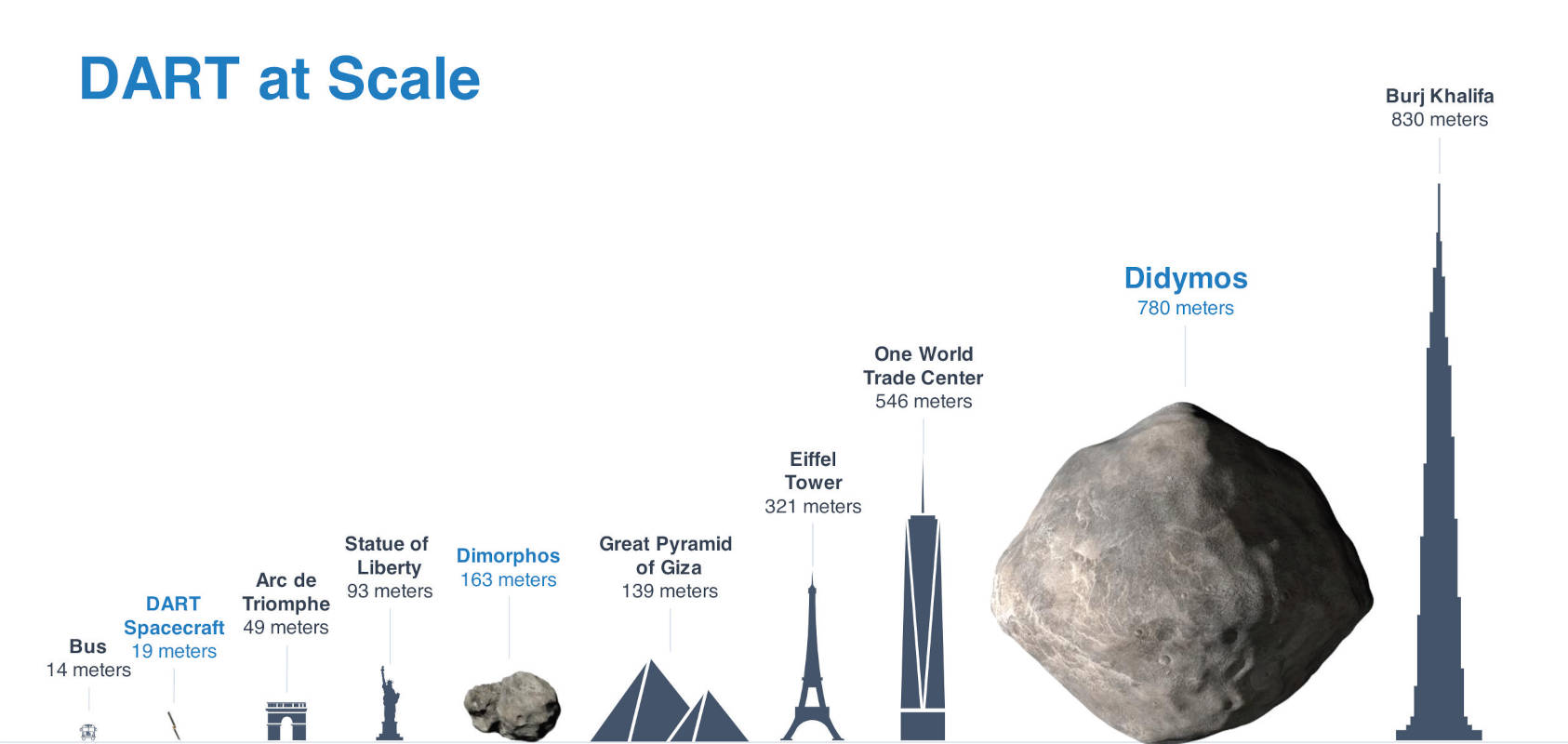
Dart and asteroids to scale with terrestrial landmarks. Click on the image to enlarge it. Credit: NASA/JHUAPL
09/09/2022 – Ephemeris – Observe the Harvest Moon at the Sleeping Bear Dunes Saturday night (weather permitting)
Update 9/10/2022, 6 pm: The weather does not permit it! We’ll have another, again weather permitting, on September 24th. This time with dark skies and a look at the summer Milky Way, two days after the end of summer. (It still counts).
This is Ephemeris for Friday, September 9th. Today the Sun will be up for 12 hours and 49 minutes, setting at 8:04, and it will rise tomorrow at 7:15. The Moon, 1 day before full, will set at 7:14 tomorrow morning.
Tomorrow night, September 10th, there will be, weather permitting, a star party at Sleeping Bear Dunes National Lakeshore, this will take place at the Dune Climb. Actually, it will be mostly a Moon and planet party. The event will be made possible by the rangers of the park and the Grand Traverse Astronomical Society. The society’s and member’s telescopes will take over the parking lot closest to the Dunes. The event starts at 8 p.m., near sunset, while it’s still light out and the location can be found. The Moon will join the party, rising at 8:41 pm. Oh, and it’s a supermoon. There will be a short talk about Harvest Moon lore and why it was important. See if you can find the Man in the Moon and the Chinese rabbit pounding medicine.
The astronomical event times given are for the Traverse City/Interlochen area of Michigan (EDT, UT – 4 hours). They may be different for your location.
Addendum
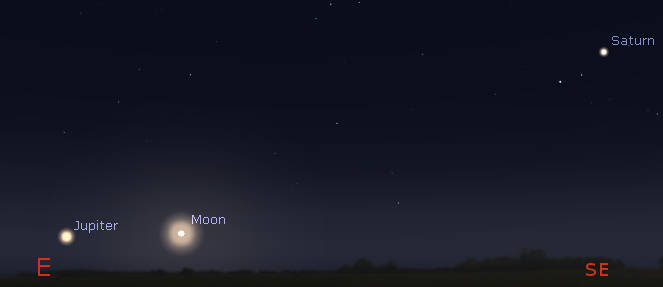
The Harvest Moon with Jupiter and Saturn at 9 pm, September 10, 2022. Created using Stellarium.
09/08/2022 – Ephemeris – We are going to have an early Harvest Moon this year
This is Bob Moler with Ephemeris for Thursday, September 8th. Today the Sun will be up for 12 hours and 53 minutes, setting at 8:06, and it will rise tomorrow at 7:14. The Moon, 2 days before full, will set at 5:54 tomorrow morning.
We are going to have an early Harvest Moon this year, on the early morning of Saturday the 10th, this Saturday coming up. The Harvest Moon is the closest full moon to the autumnal equinox, which is on the 22nd. The earliest a Harvest Moon can fall is on the 8th of September. The reason that the Harvest Moon is so famous is that at sunset the Moon’s path, in the sky, is shallow to the horizon. So it rises much less than its average 50 minutes later each night. This effectively lengthens the amount of useful twilight, allowing more time to harvest the crops. It compensated for the rapid retreat of the daylight hours this time of year. It’s not so important now, but back before electric lights it definitely was.
The astronomical event times given are for the Traverse City/Interlochen area of Michigan (EDT, UT – 4 hours). They may be different for your location.
Addendum
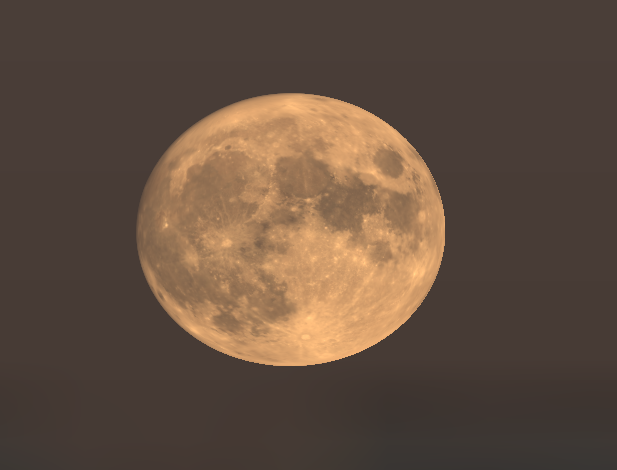
The Harvest Moon rising as seen in Stellarium. The planetarium program Stellarium, which I use a lot, also colors the rising and setting Moon and Sun. It also reproduces the effect of atmospheric refraction, which makes objects close to the horizon look higher than they are. Thus, extended objects close to the horizon appear squashed a bit vertically.
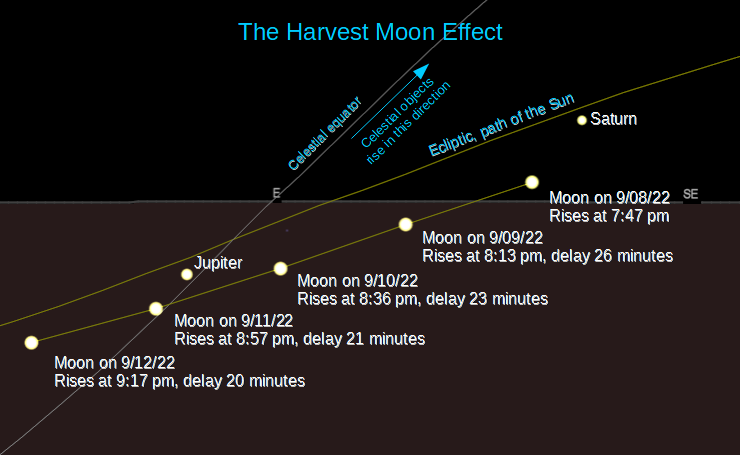
The Harvest Moon effect is a phenomenon where the Moon’s nightly advance in rising times become much shorter than the average 50 minutes. This has the effect of extending the bright part of twilight for up to a week near the Harvest Moon. Complicating effects this year are the fact that the Harvest Moon is a supermoon, being a bit brighter than normal, and also moving faster than normal, negating the harvest moon effect somewhat. The Moon’s perigee was on the 7th, so the Moon is slowing down*, which shows in the delay numbers. Also helping to shorten the delay is that the path of the Moon is a bit shallower than the ecliptic. The Moon is south of the ecliptic, heading northward to its ascending node.
The Moon moves fastest in its orbit at perigee, and its slowest at apogee, at its farthest from the Earth.
09/07/2022 – Ephemeris – Let’s search for the naked-eye planets for this week
This is Ephemeris for Wednesday, September 7th. Today the Sun will be up for 12 hours and 56 minutes, setting at 8:08, and it will rise tomorrow at 7:13. The Moon, 3 days before full, will set at 4:33 tomorrow morning.
Let’s search for the naked-eye planets for this week. Two of the naked-eye planets are in the evening sky. Mercury sets too close to the Sun to be seen in the evening. But as it gets darker, Saturn can be seen low in the southeast. Jupiter rises in the east around 8:52 pm. It is seen against the stars of Pisces now, moving slowly retrograde or westward. At 6:30 am tomorrow the three remaining morning planets will be spread out from brilliant Venus very low in the east-northeast to Mars high in the south-southeast above the bright reddish star Aldebaran to Jupiter in the west-southwest. Mars is among the stars seen rising on late autumn and winter evenings. Venus is actually all the way to the spring constellation of Leo the lion.
The astronomical event times given are for the Traverse City/Interlochen area of Michigan (EDT, UT – 4 hours). They may be different for your location.
Addendum
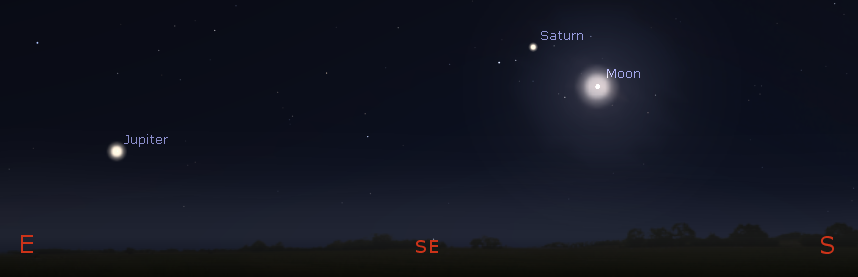
Evening planets and the Moon tonight at 10 pm, September 7, 2022. Click on the image to enlarge it. Created using Stellarium.
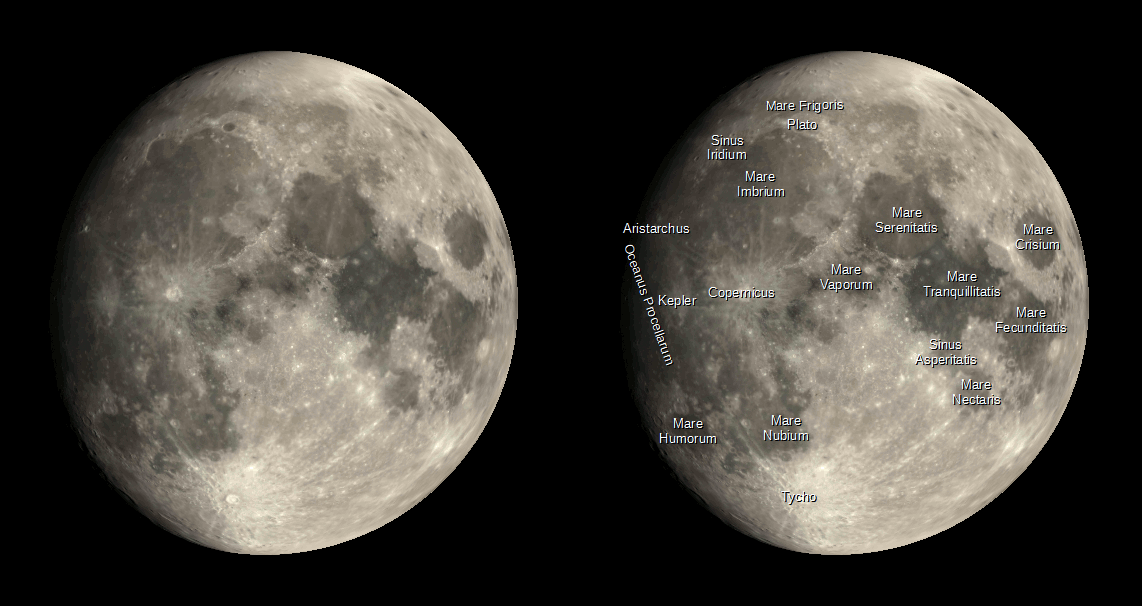
The Moon tonight as it might be seen in binoculars or low power telescopes. Labels of prominent features are alternately shown with the unlabeled chart. Created using Stellarium, LibreOffice Draw and GIMP.
Translations of some feature names
Mare Crisium – Sea of Crises
Mare Fecunditatis – Sea of Fertility
Mare Frigoris – Sea of Cold
Mare Humorum – Sea of Moisture
Mare Imbrium – Sea of Showers
Mare Nectaris – Sea of Nectar
Mare Nubium – Sea of Clouds
Mare Serenitatis – Sea of Serenity
Mare Tranquillitatis – Sea of Tranquility
Mare Vaporum – Sea of Vapors
Montes Apenninus – Apennines Mountains
Oceanus Procellarum – Ocean of Storms
Sinus Asperitatis – Golfe des Asperites
Sinus Iridium – Bay of Rainbows
Sinus Medii – Bay of the Center
Note that Mare is pronounced Mar-é
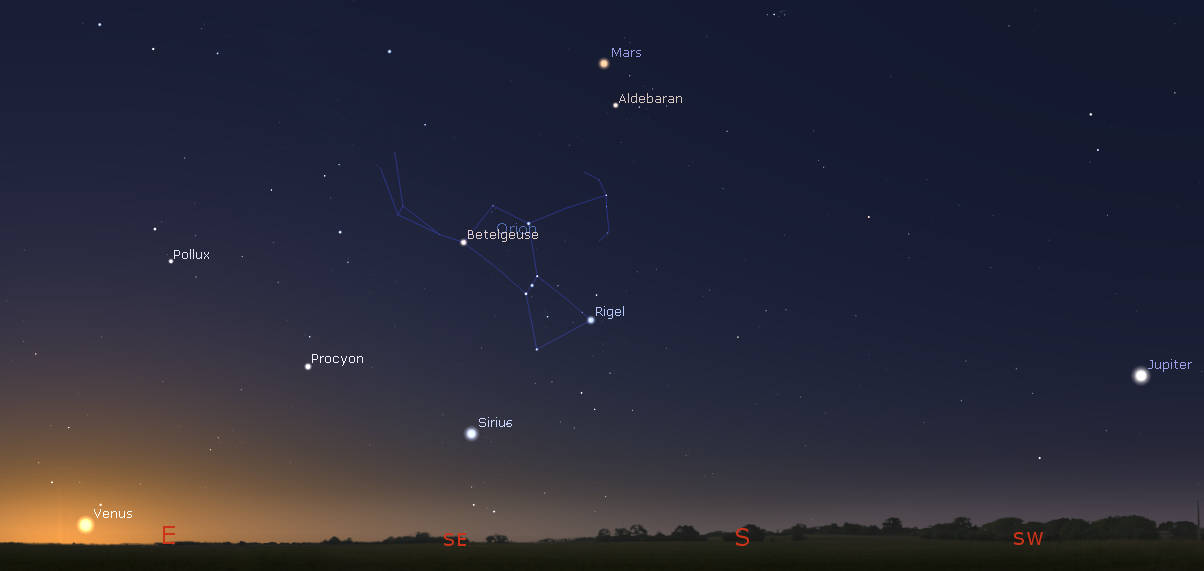
Morning planets with the bright winter stars at 6:30 am tomorrow, September 8, 2022. Click on the image to enlarge it. Created using Stellarium.
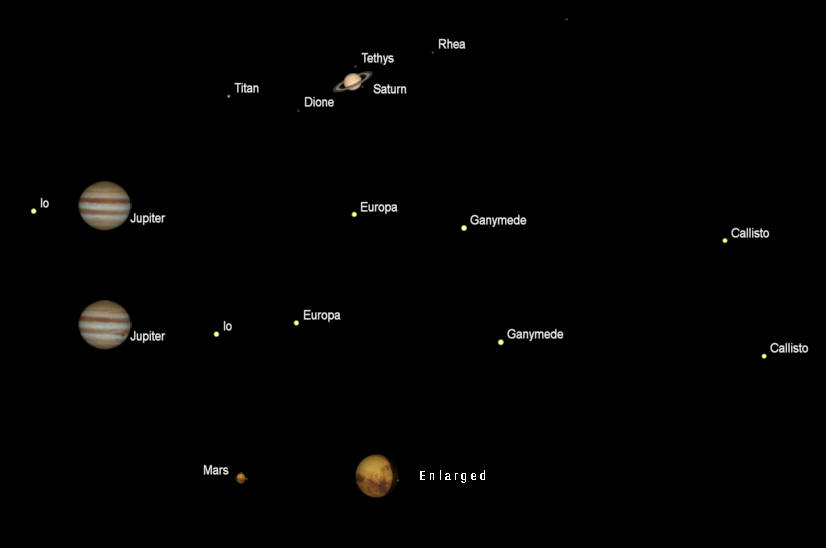
Telescopic views of Saturn Jupiter and Mars (north up) as they would be seen in a small telescope, with the same magnification. The times vary for each planet. Jupiter is shown twice, at 10 pm and 6:30 am, since its moons, especially Io and Europa, move rapidly. I do not show planets less than 10 seconds of arc in diameter, so Venus doesn’t show up yet. Coincidentally, Mars has reached that threshold. Apparent diameters: Saturn 18.58″, its rings 43.23″; Jupiter 49.27″. Mars 10.23″, 85.5% illuminated; Venus (not shown) 9.97″, 97.9% illuminated. The ” symbol means seconds of arc (1/3600th of a degree.) Click on the image to enlarge it. Created using Cartes du Ciel (Sky Charts).
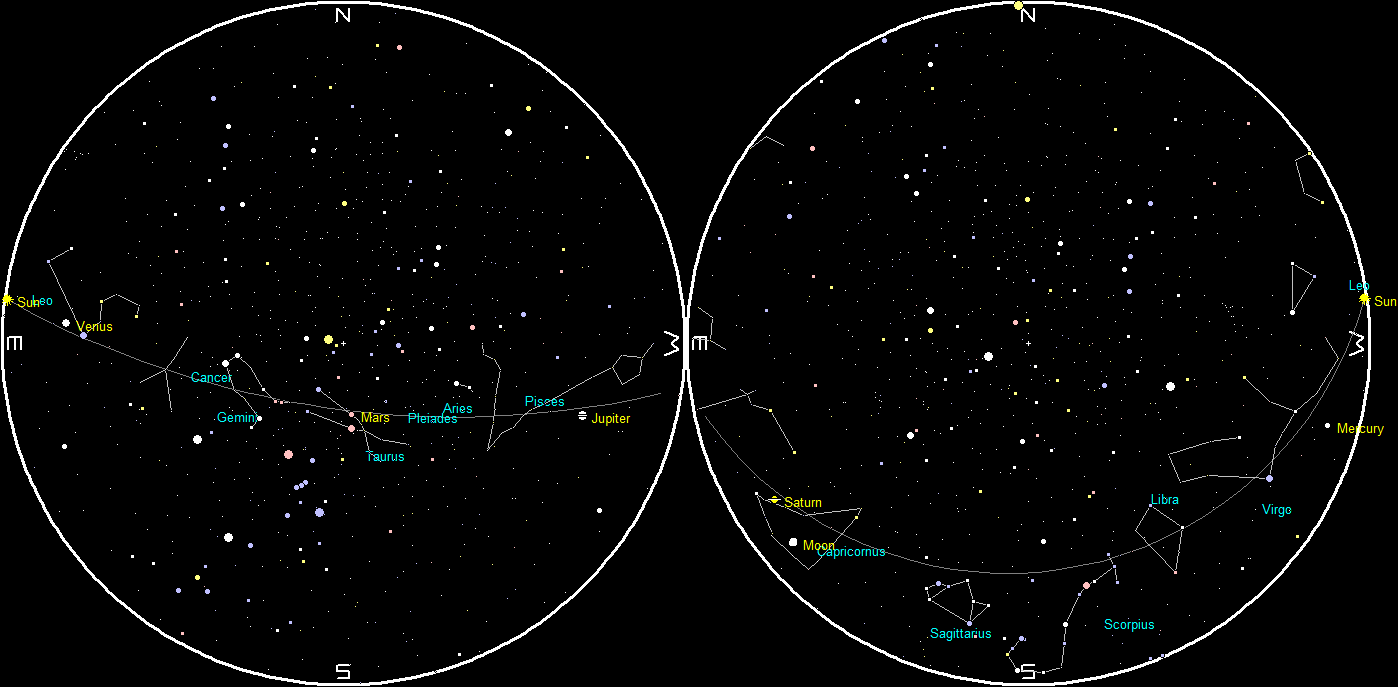
The naked-eye planets and the Moon at sunset and sunrise on a single night, starting with sunset on the right on September 7, 2022. The night ends on the left with sunrise on the 8th. Click on the image to enlarge it. Created using my LookingUp program.
09/06/2022 – Ephemeris – Ongoing NASA Missions
This is Ephemeris for Tuesday, September 6th. Today the Sun will be up for 12 hours and 59 minutes, setting at 8:10, and it will rise tomorrow at 7:12. The Moon, 3 days past first quarter, will set at 3:11 tomorrow morning.
The Artemis I launch has been postponed until later this month. The next try will come no sooner than the 25th, or next month. Another launch that is delayed is the Psyche mission to the asteroid Psyche that was supposed to be launched last month on a Falcon Heavy rocket. The problem this time isn’t the rocket, but the satellite. There is a delay with delivery and testing of the software for the satellite. The launch this year would have used a Mars flyby for a gravitational assist to shorten the flight time. A launch next year would not have that advantage and would increase the flight time. On the 26th of this month the DART satellite will impact the tiny asteroid Dimorphos, that’s orbiting a larger asteroid Didymos, to test that method of planetary defense.
The astronomical event times given are for the Traverse City/Interlochen area of Michigan (EDT, UT – 4 hours). They may be different for your location.
Addendum
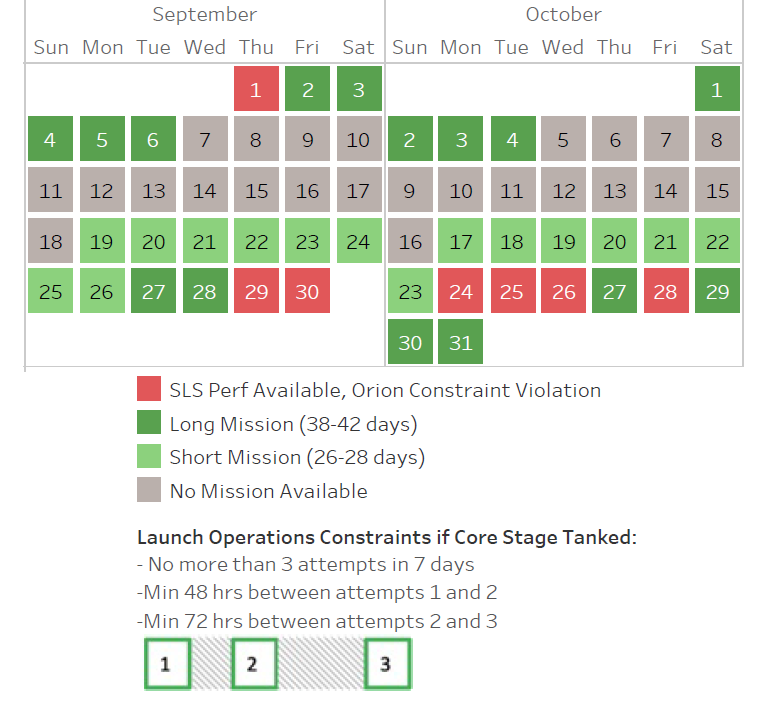
Artemis I availability dates for September and October 2022. As I understand it, launches on red dates would cause the Orion capsule to be in the Earth’s shadow for longer than 90 minutes. Gray dates would have the Orion Capsule land at night. Credit NASA. A cut & paste from Artemis I Mission Availability 2022-2023 (EST/EDT) pdf.
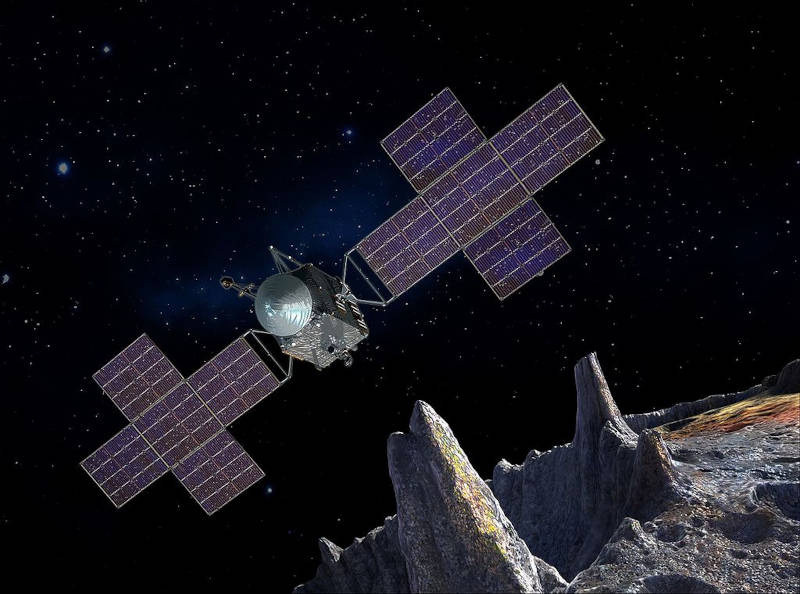
An artist’s rendition of the Psyche spacecraft at the metal-rich asteroid Psyche. Credit: NASA.
Schematic of the DART mission shows the impact on the moonlet of asteroid (65803) Didymos. Post-impact observations from Earth-based optical telescopes and planetary radar would, in turn, measure the change in the moonlet’s orbit about the parent body.
Credits: NASA/Johns Hopkins Applied Physics Lab.
09/05/2022 – Ephemeris – It’s Labor Day, the unofficial end of summer
This is Ephemeris for Labor Day, Monday, September 5th. Today the Sun will be up for 13 hours and 2 minutes, setting at 8:12, and it will rise tomorrow at 7:11. The Moon, 2 days past first quarter, will set at 1:55 tomorrow morning.
Even though we have 17 more days officially, of summer, according to the actual seasons, today seems like it, the end of summer. Summer seems to be defined or confined to between the time that the kids get out of school, to Labor Day. Schools in many locales have been back for almost two weeks now. As far as the summer sky goes, the summer Milky Way will stick around until October, until we lose the Teapot of Sagittarius over the southwestern horizon. The Summer Triangle of bright summer stars, won’t leave the sky until December, as they move ever westward. However, in the east the autumn stars are even now rising, pushing the Milky Way to the west. The predawn sky is already featuring the winter stars.
The astronomical event times given are for the Traverse City/Interlochen area of Michigan (EDT, UT – 4 hours). They may be different for your location.
Addendum
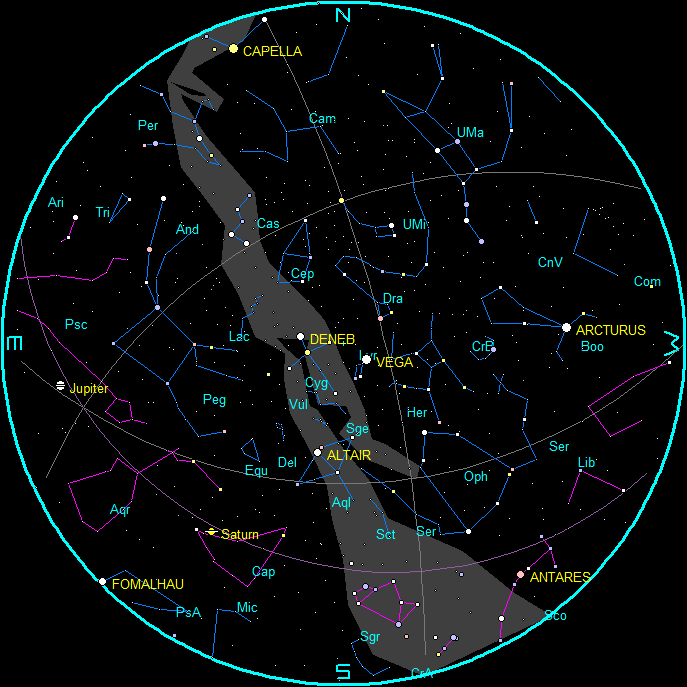
The constellations of Labor Day Evening, September 5, 2022, at 10 pm, around 2 hours after sunset. Note that the Summer Triangle Stars of Vega, Altair and Deneb are overhead. Click on the chart to enlarge it. Credit: my App LookingUp. I only allowed 8 character star names, so Fomalhaut shows up as Fomalhau.
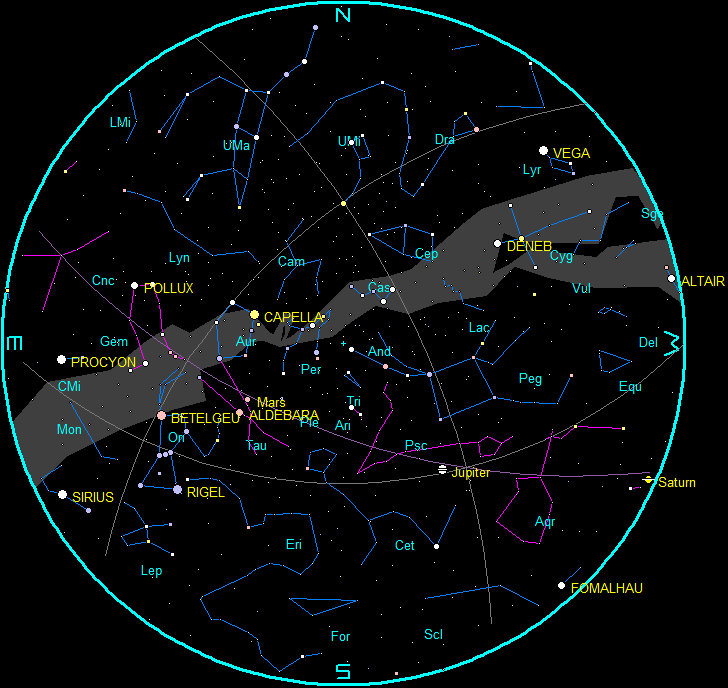
The constellations of the day after Labor Day morning, September 6, 2022, at 5 am, around 2 hours before sunrise. Note that the Summer Triangle Stars are setting in the northwest. All the brightest winter stars are now up, and constellations, except for the southern half of Canis Major, of which Sirius is a part. This is equivalent to an evening in mid-December, except the planets Mars, Jupiter and Saturn will have moved a bit. Click on the chart to enlarge it. Again, some of the star names have been truncated: Fomalhaut, Aldebaran, and Betelgeuse. Credit: my App LookingUp.
For a list of constellation names to go with the abbreviations, click here.
 Bob Moler's Ephemeris Blog