
Archive

Archive for October, 2022

10/17/022 – Ephemeris – Andromeda, damsel in distress

October 17, 2022 Comments off

This is Ephemeris for Monday, October 17th. Today the Sun will be up for 10 hours and 53 minutes, setting at 6:54, and it will rise tomorrow at 8:02. The Moon, at last quarter today, will rise at 12:18 tomorrow morning

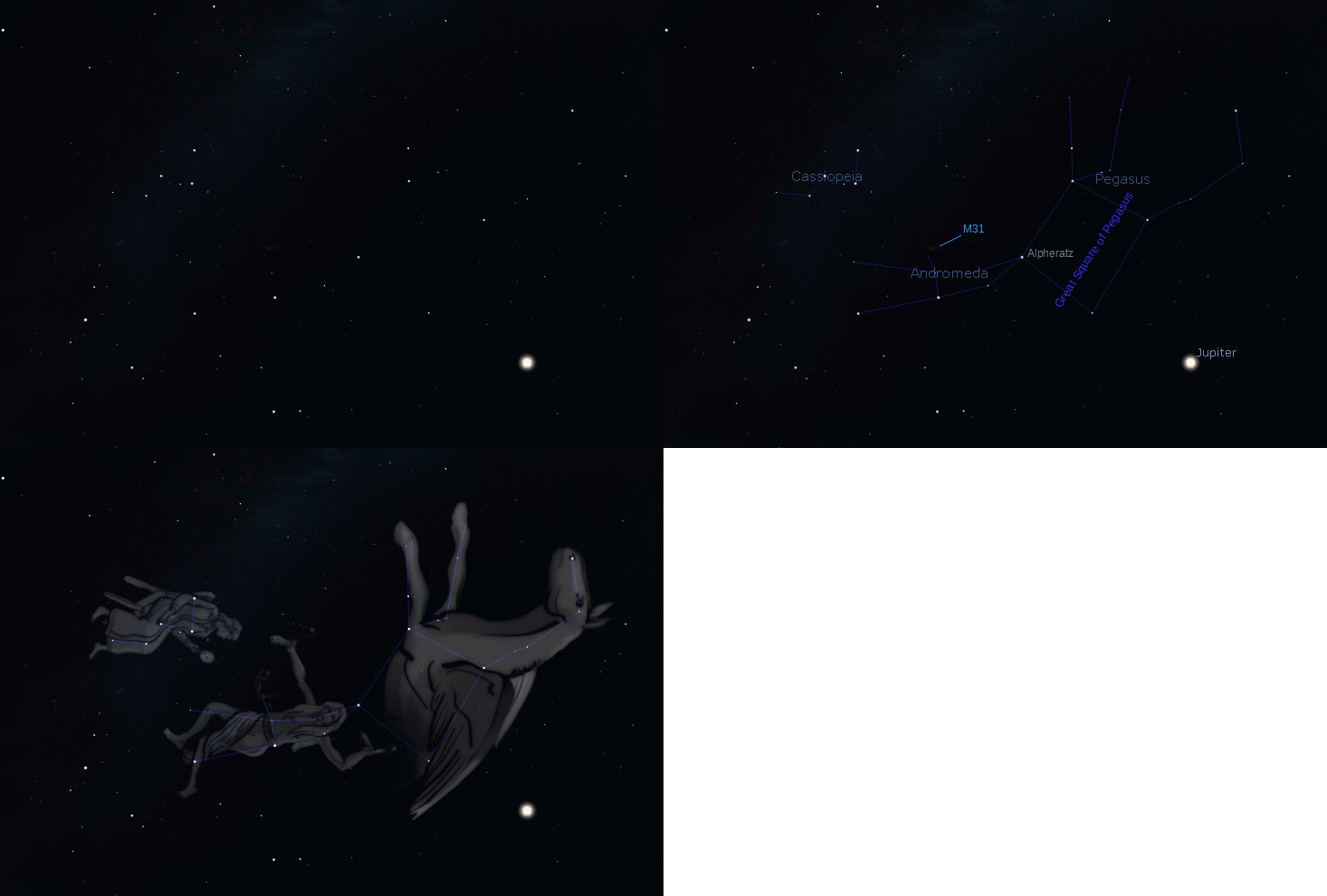
In the east at 9 this evening can be found a large square of stars, the Great Square of Pegasus the upside down flying horse. The square is standing on one corner. What looks like its hind legs stretching to the left from the left corner star is another constellation, Andromeda the chained princess. She is seen in the sky as two nearly horizontal but diverging curved strings of stars that curve upward. She was doomed due to her mother, Queen Cassiopeia’s boasting, which angered the god Poseidon. She was rescued by the hero Perseus, a nearby constellation, riding his steed Pegasus. Andromeda’s claim to scientific fame is the large galaxy seen as a faint fuzzy spot with the naked-eye just above the upper line of stars. The Great Andromeda Galaxy is two and a half million light years away.

The astronomical event times given are for the Traverse City/Interlochen area of Michigan (EDT, UT – 4 hours). They may be different for your location.

Addendum

Andromeda finder animation

Andromeda finder animation looking east at 9 pm tonight, October 17, 2022. The left corner star of the Great Square of Pegasus is called Alpheratz, and actually belongs to Andromeda. The faint fuzzy spot labeled M31 is the Great Andromeda Galaxy, the Milky Way’s large neighbor. I’ll talk more about it tomorrow. Click on the image to enlarge it. Created using Stellarium and GIMP.

I’ve related Andromeda’s story in my post The Great Star Story of Autumn.

10/14/2022 – Ephemeris – The loneliest star in the sky isn’t so lonely this year, and more

October 14, 2022 Comments off

This is Ephemeris for Friday, October 14th. Today the Sun will be up for 11 hours and 2 minutes, setting at 6:59, and it will rise tomorrow at 7:58. The Moon, 3 days before last quarter, will rise at 9:37 this evening.

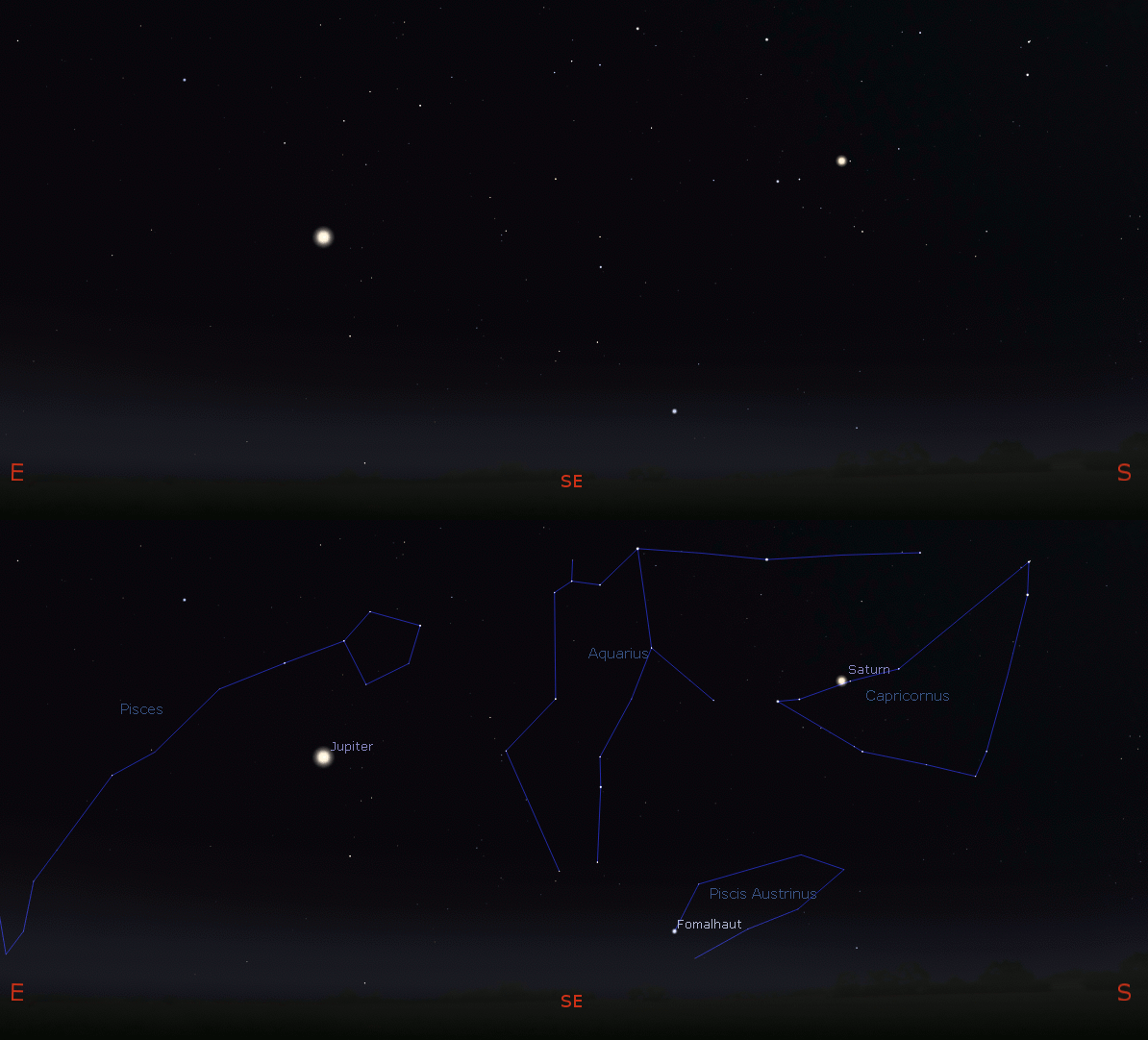
There’s a bright star that appears for only seven and a half hours on autumn evenings. It’s appearance, low in the south-southeast at 9 p.m., is a clear indication of the autumn season. The star’s name is Fomalhaut, which means fish’s mouth. That’s fitting because it’s in the constellation of Piscis Austrinus, the southern fish. At our latitude it’s kind of the fish that got away, because Fomalhaut appears to be quite alone low in the sky. The other stars of its constellation are dim, and being low in the sky makes them even dimmer. However, this year Fomalhaut has visitors. Above and left of it is the brilliant planet Jupiter. And above and right of it is the bright planet Saturn. Both planets, while not very close to Fomalhaut, will keep it company this year.

The astronomical event times given are for the Traverse City/Interlochen area of Michigan (EDT, UT – 4 hours). They may be different for your location.

Addenda

Fomalhaut and friends animation

Fomalhaut and friends (Jupiter and Saturn) finder animation for 9 pm tonight, Friday, October 14, 2022. Click on the image to enlarge it. Created using Stellarium and GIMP.

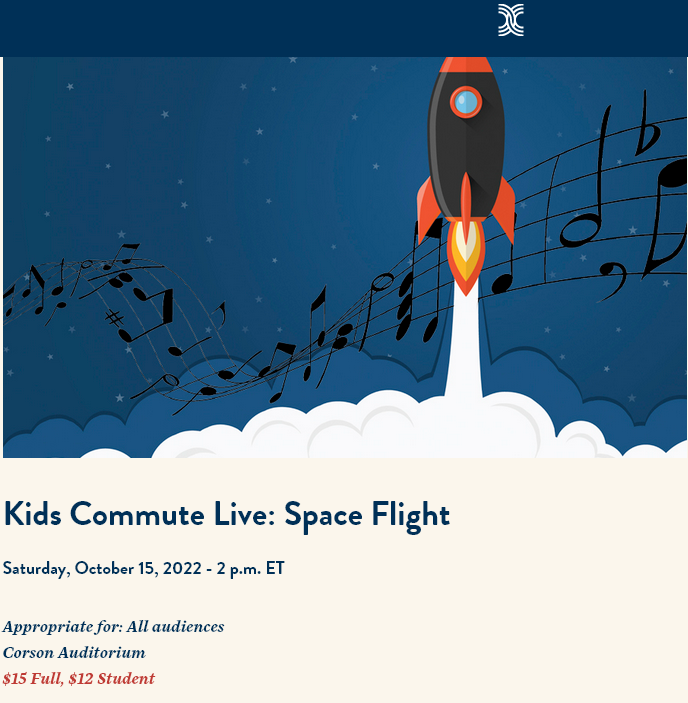
Also at Corson Auditorium on the Interlochen Center for the Arts Campus…

Join Interlochen Public Radio for Kids Commute Live! This family-friendly matinee is brought to you by the Interlochen Arts Academy Wind Symphony and features Interlochen theatre and singer-songwriter students, TCAPS middle school musicians, and special guests from NASA, the Coast Guard, and the International Dark Sky Park. Conductor Matthew Schlomer and Kids Commute host Kate Botello will lead this multi-sensory experience centered on the theme “Space Flight.”
The program will include Gustav Holst’s “Jupiter,” Michael Mogenson’s “Aerial Fantasy,” John Williams’ “Fantasy of Flight,” and more!
Come early for pre-concert activities for kids of all ages, including drone demonstrations and paper airplane contests. Space-themed food will be available for purchase.
I will be there from 12 to 1 pm, having the kids help me make COMETS! I’ll also be part of the program. 

For more information and tickets: https://www.interlochen.org/events/kids-commute-live-space-flight-2022-10-15


10/13/2022 – Ephemeris – CAPSTONE satellite stabilized again

October 13, 2022 Comments off

This is Ephemeris for Thursday, October 13th. Today the Sun will be up for 11 hours and 5 minutes, setting at 7:01, and it will rise tomorrow at 7:57. The Moon, half way from full to last quarter, will rise at 8:59 this evening.

The CubeSat named CAPSTONE, was launched June 28th to prove out the near rectilinear halo orbit of the Moon that the Lunar Gateway Space Station and Orion Capsule will be located in on missions to the south pole of the Moon. CubeSats are built on a 10 by 10 centimeter or 4 by 4 inch cube. They are relatively inexpensive. CAPSTONE is a 12 unit CubeSat arranged 4 by 3 cubes with a solar panel/antenna attached to one side. Back on September 8th it made a course correction which caused it to tumble. It took almost a month, until last Friday to regain control of the satellite and stop the tumbling. Apparently a stuck propellant valve was the problem. CAPSTONE should enter this halo orbit of the Moon on November 13th.

The astronomical event times given are for the Traverse City/Interlochen area of Michigan (EDT, UT – 4 hours). They may be different for your location.

Addendum

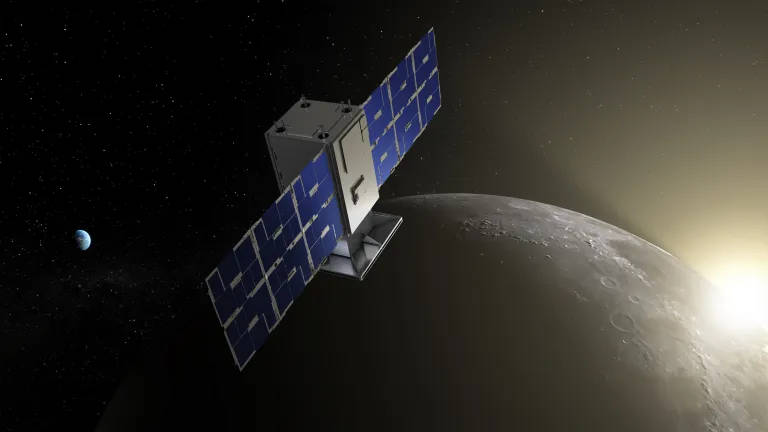
CAPSTONE spacecraft

Artist’s impression of the CAPSTONE spacecraft at perilune, the closest point in its orbit, over the north pole of the Moon.

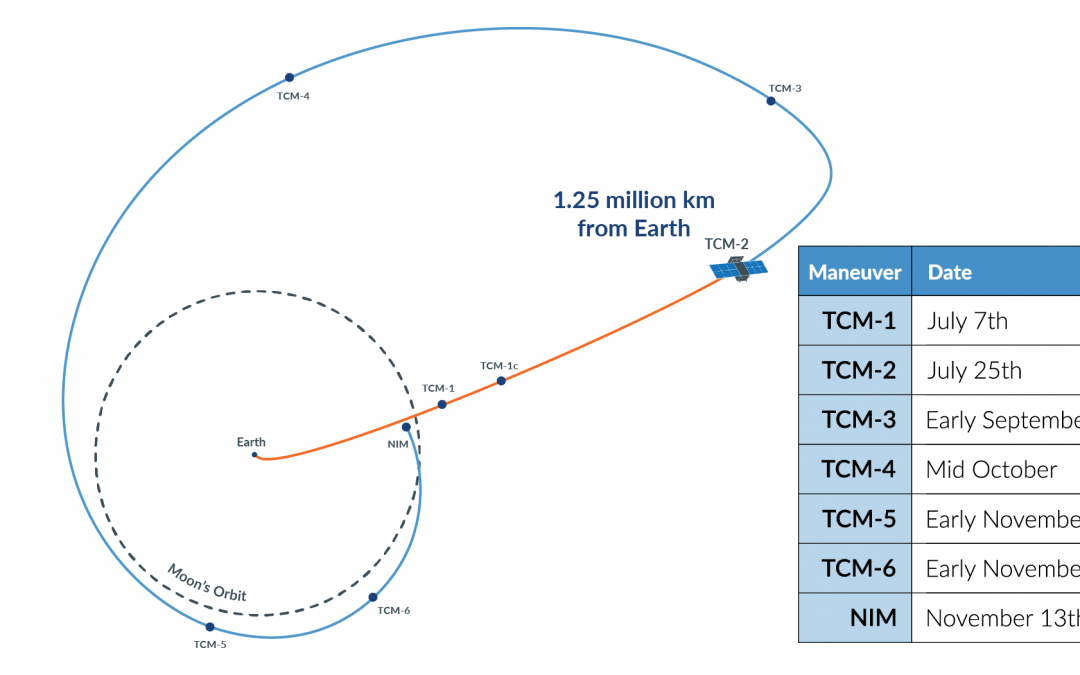
CAPSTONE orbit to the Moon

CAPSTONE low-energy trajectory to the Moon. TCM are trajectory Correction Maneuvers (Thruster firings). Click on the image to enlarge it. Credit: Advanced Space, builder of the CAPSTONE CubeSat.

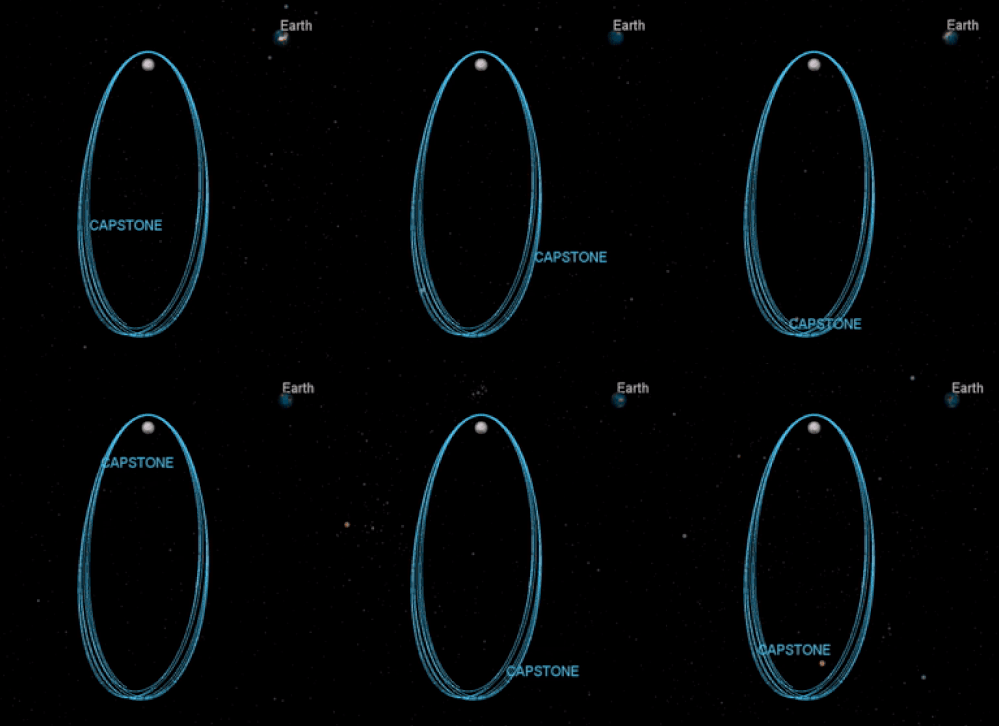
NASA CAPSTONE pathfinder for gateway orbit

NASA CAPSTONE pathfinder for gateway orbit to prove out the near rectilinear halo orbit for the Lunar Gateway.

10/12/2022 – Ephemeris – Let’s search for the naked-eye planets for this week

October 12, 2022 Comments off

This is Bob Moler with Ephemeris for Wednesday, October 12th. Today the Sun will be up for 11 hours and 8 minutes, setting at 7:03, and it will rise tomorrow at 7:55. The Moon, 3 days past full, will rise at 8:28 this evening.

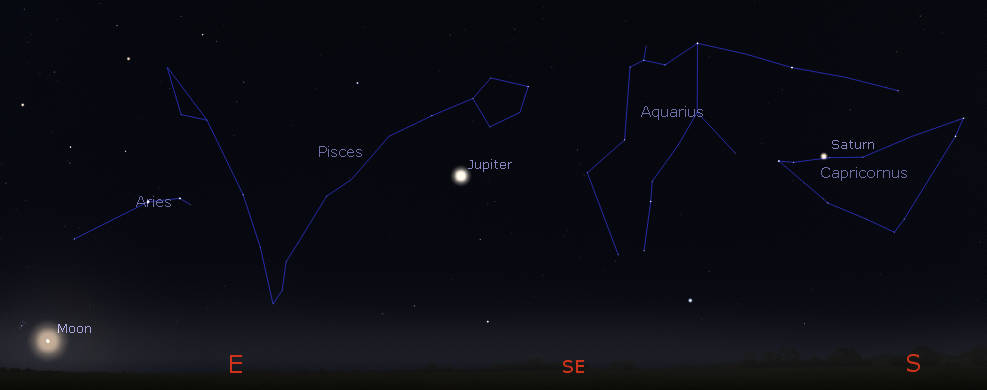
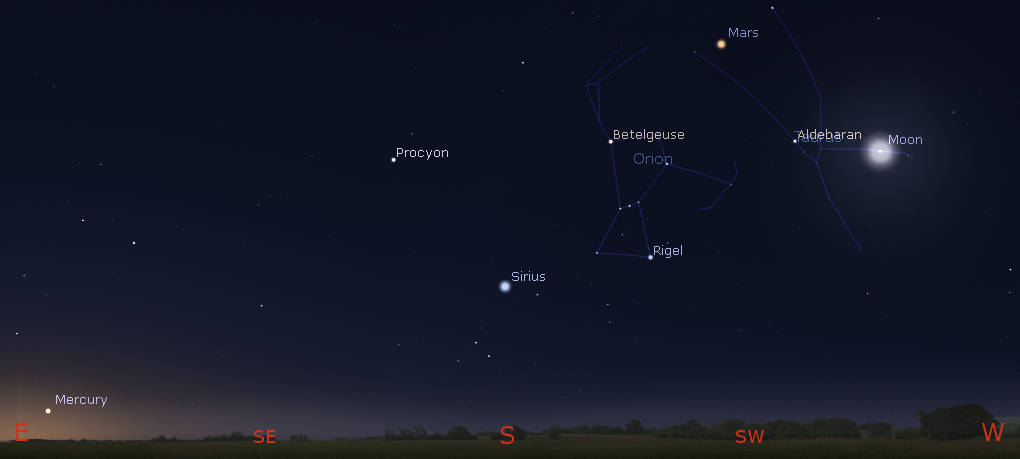
Let’s search for the naked-eye planets for this week. Jupiter and Saturn will be visible this evening, in the east-southeast and south-southeast respectively, as soon after sunset as it will be dark enough to see them, which would be by 7:45 pm. Jupiter is seen against the stars of Pisces the fish, while Saturn is spotted in the eastern end of Capricornus the sea goat. The red planet Mars, though a morning planet, will rise tonight at 10:04 pm in the northeast. It’s located between the long horns of Taurus the bull. By seven tomorrow morning, the red planet Mars will be high in the southwestern sky, above the winter constellation of Orion. Tiny Mercury can be spotted at that hour very low in the east and by 7:30 for the next week or so.

The astronomical event times given are for the Traverse City/Interlochen area of Michigan (EDT, UT – 4 hours). They may be different for your location.

Addendum

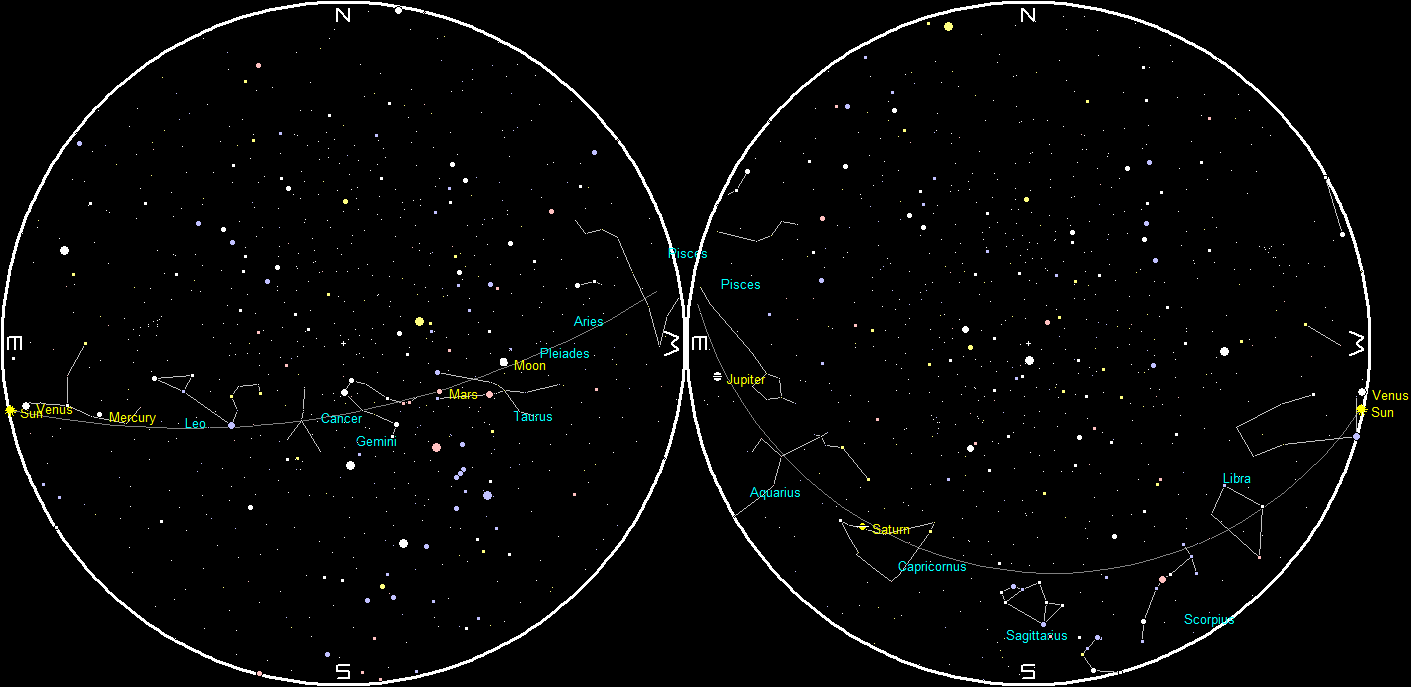
Evening planets and the Moon at 9 pm

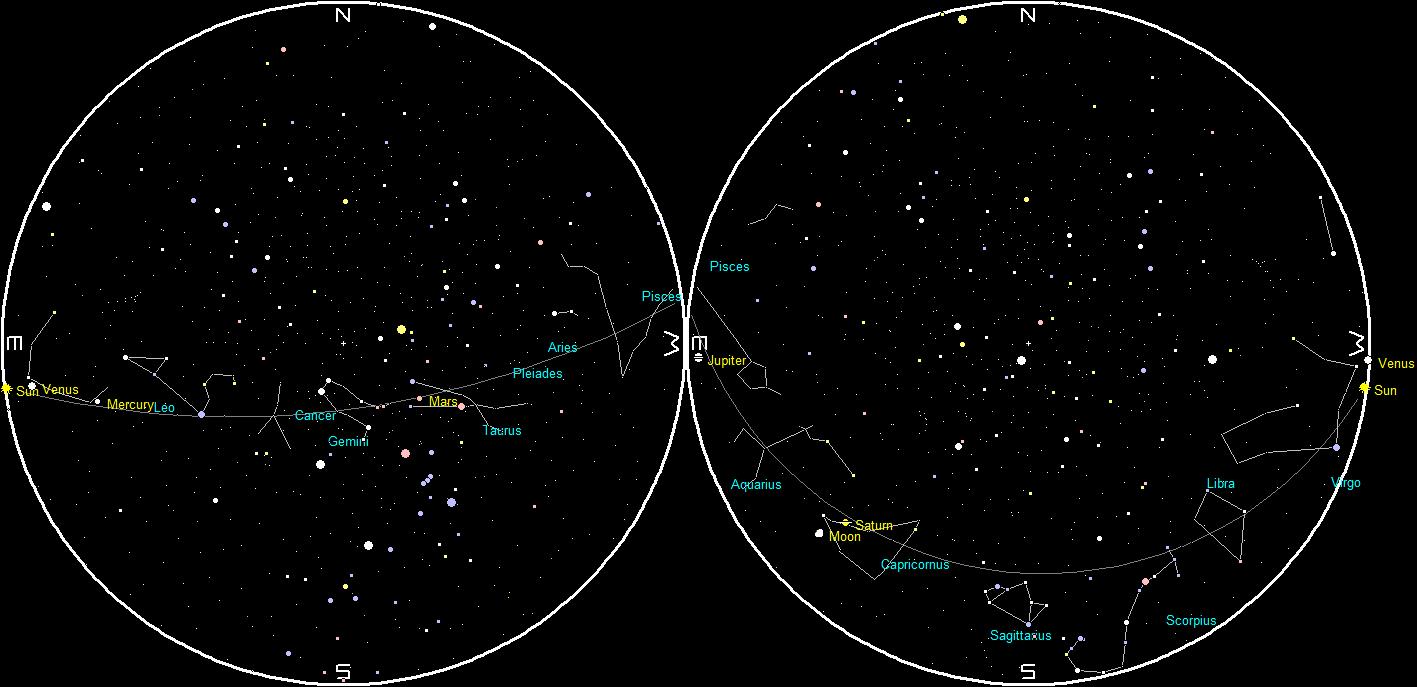
Evening planets and the Moon at 9 pm tonight, October 12, 2022, with the line figures of the zodiacal constellations in their part of the sky. Click on the image to enlarge it. Created using Stellarium.

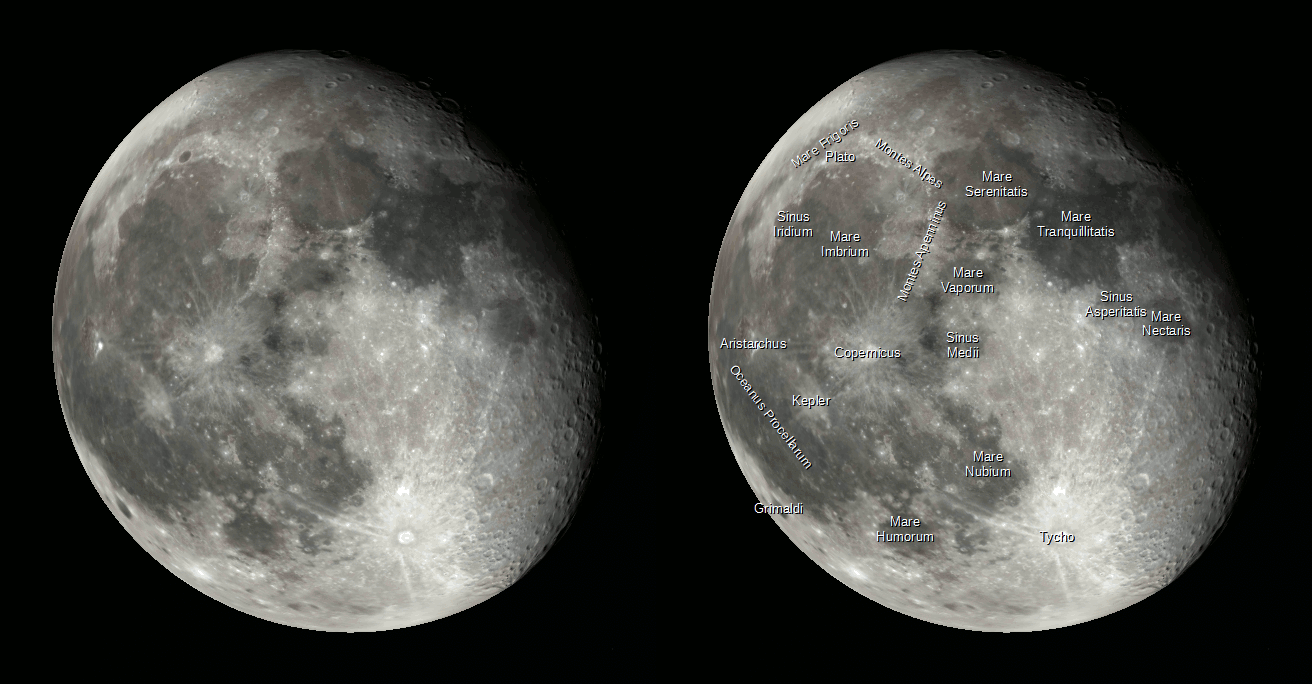
Annotated waning Gibbous Moon Animation for tonight, October 12, 2022, as it might look like in binoculars or a small telescope. Created using Stellarium, LibreOffice Draw and GIMP.

Translations of some lunar feature names according to Virtual Moon Atlas

Mare Frigoris – Sea of Cold
Mare Humorum – Sea of Moisture
Mare Imbrium – Sea of Showers
Mare Nubium – Sea of Clouds
Mare Serenitatis – Sea of Serenity
Mare Tranquillitatis – Sea of Tranquility
Mare Vaporum – Sea of Vapors
Montes Alpes – Alps Mountains
Montes Apenninus – Apennines Mountains
Oceanus Procellarum – Ocean of Storms
Sinus Asperitatis – Golfe des Asperites
Sinus Iridium – Bay of Rainbows
Sinus Medii – Central Bay

Craters are generally named after astronomers, people of science, or explorers

Note that Mare is pronounced Mar-é

Morning planets Mars, Mercury and Moon

Morning planets Mars, Mercury and the Moon at 7 am tomorrow morning, October 13, 2022. Click on the image to enlarge it. Created using Stellarium.

Telescopic views of Saturn, Jupiter and Mars

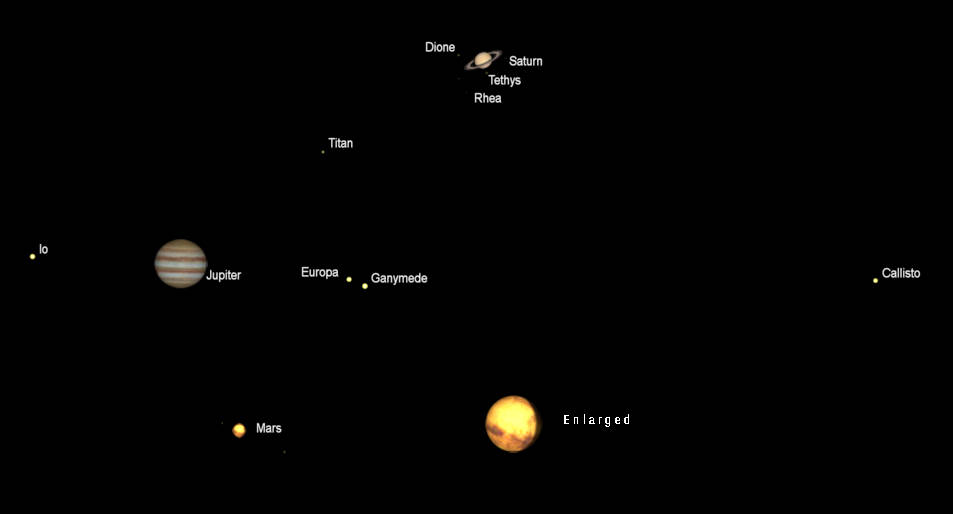
Telescopic views of Saturn Jupiter and Mars (north up) as they would be seen in a small telescope, with the same magnification. The image of Mars doesn’t show it, but the white north polar cap will appear at the top or north limb of Mars. Saturn and Jupiter are shown at 9 pm, Mars at 6 am. I do not show planets less than 10 seconds of arc in diameter, so Mercury is not shown. Apparent diameters: Saturn 17.81″, its rings 41.48″; Jupiter 49.34″. Mars 13.13″. Mars’ distance is 66.5 million miles (107.1 million kilometers). Mercury, which isn’t shown, is 6.17″ in diameter and 71.1% illuminated. The ” symbol means seconds of arc (1/3600th of a degree.) Click on the image to enlarge it. Created using Cartes du Ciel (Sky Charts).

Planets and the Moon on a single night

The naked-eye planets and the Moon at sunset and sunrise on a single night, starting with sunset on the right on October 12, 2022. The night ends on the left with sunrise on the 13th. Click on the image to enlarge it. Created using my LookingUp program and GIMP.

10/11/2022 – Ephemeris – Ada Lovelace Day

October 11, 2022 Comments off

This is Bob Moler with Ephemeris for Ada Lovelace Day, Tuesday, October 11th. Today the Sun will be up for 11 hours and 11 minutes, setting at 7:05, and it will rise tomorrow at 7:54. The Moon, 2 days past full, will rise at 8:02 this evening.

Ada Lovelace (1815-1852), or more properly Augusta Ada King, Countess of Lovelace, was the daughter of Lord Byron and worked for Charles Babbage, a brilliant mechanical engineer and mathematician in the early 19th century. She is considered the first computer programmer. She devised a way to use the same punch cards that were used on the Jacquard loom to store and run her programs, even though Babbage was unable to complete his mechanical computer the Analytical Engine in the mid 1800s. This day is set aside to celebrate the accomplishments of all the women of Science, Technology, Engineering and Math, (STEM). The computer language, Ada, was named after her, and was created for the US Department of Defense.

The astronomical event times given are for the Traverse City/Interlochen area of Michigan (EDT, UT – 4 hours). They may be different for your location.

Addendum

Portrait of Ada Lovelace by Margaret Sarah Carpenter, 1836

Portrait of Ada Lovelace by Margaret Sarah Carpenter, 1836

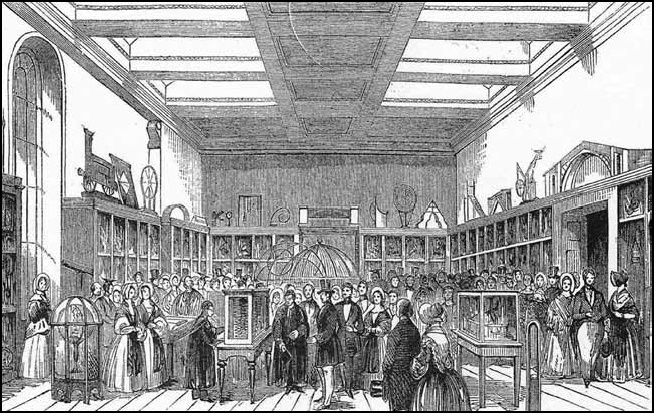
Part of the Analytical Engine

Part of Charles Babbage’s Analytical Engine on display, in 1843, left of centre in this engraving of the King George III Museum in King’s College, London. Unknown engraver.

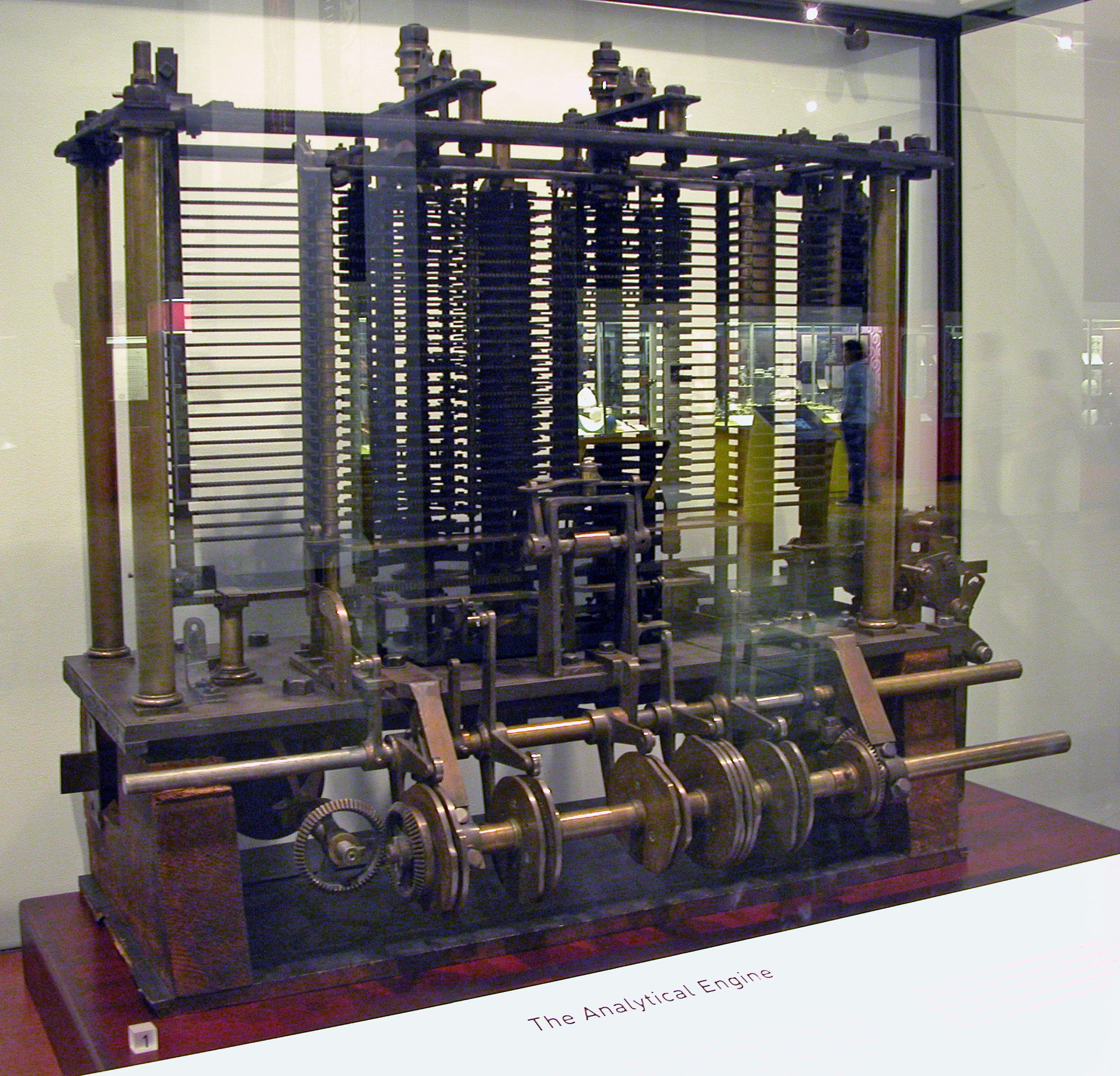
AnalyticalMachine

Trial model of a part of the Analytical Engine, built by Charles Babbage, as displayed at the Science Museum (London). By Bruno Barral (ByB), CC BY-SA 2.5.

10/10/2022 – Ephemeris – Indigenous Peoples Day

October 10, 2022 Comments off

This is Ephemeris for Indigenous Peoples Day, Monday, October 10th. Today the Sun will be up for 11 hours and 14 minutes, setting at 7:06, and it will rise tomorrow at 7:53. The Moon, 1 day past full, will rise at 7:39 this evening.

Today the United States celebrates Columbus Day, a Monday near the date Christopher Columbus landed on a Caribbean island, and found people who got there at least 15 thousand years earlier. Due to superior technology, and nothing else really, the Europeans conquered the peoples of the continents they called the Americas, deeming the indigenous peoples, incorrectly, as savages. My astronomical journey started with learning the constellations and stories from the ancient Greeks. About twelve years ago I began to investigate the constellations and stories of the Anishinaabe peoples, whose ancestral lands we live on, which turn out to be as rich and meaningful as those I learned in my youth from the Old World.

The astronomical event times given are for the Traverse City/Interlochen area of Michigan (EDT, UT – 4 hours). They may be different for your location.

Addendum

Proclamation by Governor Whitmer:

October 10, 2022: Indigenous Peoples’ Day

WHEREAS, the idea of Indigenous Peoples’ Day was first proposed in 1977 by a delegation of Native Nations to the United Nations-sponsored International Conference on Discrimination Against Indigenous Populations in the Americas; and,

WHEREAS, in 1990, representatives from 120 Indigenous Nations at the First Continental Conference on 500 Years of Indian Resistance unanimously passed a resolution to transform Columbus Day into an opportunity to reveal historic truths about pre-existing Indigenous cultures and Peoples that have survived a colonization process, most often violent, and continue to exist and thrive in present day America; and,

WHEREAS, the United States endorsed the United Declaration on the Rights of Indigenous Peoples on December 16, 2010, and Article 15 of that declaration states:

  • Indigenous Peoples have the right to the dignity and diversity of their cultures, traditions, histories, and aspirations, which shall be appropriately reflected in education and public information.
  • States should take effective measures, in consultation and cooperation with the Indigenous Peoples concerned, to combat prejudice and eliminate discrimination and to promote tolerance, understanding, and good relations among Indigenous Peoples and all other segments of society; and,

WHEREAS, the state of Michigan recognizes the presence of the three major tribal groups in our state today, the Chippewa (Ojibwe), Ottawa (Odawa), and Potawatomi (Bodéwadmik), who have lived upon this land since time immemorial, and values the progress our society has accomplished through Native American thought, culture, and contributions; and,

WHEREAS, many communities and municipalities in the land we now call Michigan have passed resolutions to officially recognize Indigenous Peoples’ Day on the second Monday in October; and,

WHEREAS, the resolution states that Indigenous Peoples’ Day shall be used to reflect upon the ongoing struggles of Indigenous Peoples on this land and to celebrate the thriving cultures and values that the Odawa, Ojibwe, Bodéwadmik, and other Indigenous Peoples contribute to society; and,

WHEREAS, on this second Monday of October, we should honor the historic, cultural, and contemporary significance of Indigenous Peoples and their ancestral lands that also became known as the Americas and celebrate their contributions to communities throughout the land we now call Michigan, the United States, and all over the world;

NOW, THEREFORE, I, Gretchen Whitmer, governor of Michigan, do hereby proclaim October 10, 2022, as Indigenous Peoples’ Day in Michigan to uplift our country’s Indigenous roots, history, and contributions.

Anishinaabe North America is Turtle Island

The Anishinaabe, of which the Ojibwe, Odawa, and Potawatomi are a part, see North America as Turtle Island

10/07/2022 – Ephemeris – Learn about the Sun tonight and view the Moon on Saturday

October 7, 2022 Comments off

This is Bob Moler with Ephemeris for Friday, October 7th. Today the Sun will be up for 11 hours and 24 minutes, setting at 7:12, and it will rise tomorrow at 7:49. The Moon, 2 days before full, will set at 6:08 tomorrow morning.

Tonight at 8 pm, the Grand Traverse Astronomical Society will have an in-person meeting at Northwestern Michigan College’s Rogers Observatory. The meeting will also be available via Zoom. The program will be presented by Mary Gribbin who has been observing the sun through her special solar telescope. She’ll describe the features visible with a solar telescope. If it’s clear, there will be a star party following the meeting. The observatory is located south of Traverse City off Birmley Road, between Garfield and Keystone roads. A Zoom link is available at gtastro.org. There will be a Moon and star party at the Sleeping Bear Dunes, Dune Climb tomorrow starting at 8 pm. That may be our last of the year out there. 2023 promises to have a full slate of star parties out there.

The astronomical event times given are for the Traverse City/Interlochen area of Michigan (EDT, UT – 4 hours). They may be different for your location.

Addendum

Excerpt from the Sleeping Bear Dunes National Lakeshore calendar posting:

“These events will be cancelled if the sky is not visible due to weather conditions. The decision to cancel is usually made either three hours in advance or by 4:30 p.m. the day prior to the event. Please call park rangers at 231-326-4700, ext. 5005, for a voicemail message with the decision. For the early morning and late evening astronomy events, bring a flashlight for the walk to and from the event. Park rangers and GTAS staff will wear red glow bracelets at the events. For more information about the Grand Traverse Astronomical Society, go to http://www.gtastro.org/.“


10/06/2022 – Ephemeris – Artemis I rescheduled

October 6, 2022 Comments off

This is Ephemeris for Thursday, October 6th. Today the Sun will be up for 11 hours and 27 minutes, setting at 7:14, and it will rise tomorrow at 7:48. The Moon, 3 days before full, will set at 4:52 tomorrow morning.

Artemis 1 was going to launch on September 27th, But Hurricane Ian had other plans, so the rocket was trundled back to the Vertical Assembly Building. There, a battery or components of the auto destruct mechanism had to be swapped out before they attempted to launch again. All rockets launched from the US are required to be equipped with a destruct package to blow up the rocket if it veers off course, to not endanger lives on the ground. There are other tweaks, including charging or replacing batteries in all the CubeSats that are on board. The next possible launch period runs from November 12th to the 27th, with four blackout dates within that period. The weather should be better, being the tail end of hurricane season.

The astronomical event times given are for the Traverse City/Interlochen area of Michigan (EDT, UT – 4 hours). They may be different for your location.

Addendum

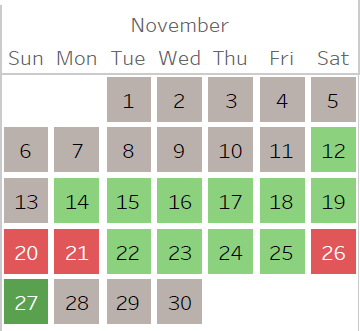
Artemis I November launch calendar

Artemis I November launch calendar. Dates in green are possible launch dates. I’m not sure, but red dates are also forbidden because the Orion Capsule will experience more than 90 minutes in shadow at a time. It’s powered by solar panels. Light green dates allow a long mission of 1 1/2 orbits of the Moon in the distant retrograde orbit (DRO). The dark green dates can only have 1/2 a DRO. Source: NASA.

10/05/2022 – Ephemeris – Let’s search for the naked-eye planets for this week

October 5, 2022 Comments off

This is Ephemeris for Wednesday, October 5th. Today the Sun will be up for 11 hours and 30 minutes, setting at 7:15, and it will rise tomorrow at 7:46. The Moon, 3 days past first quarter, will set at 3:33 tomorrow morning.

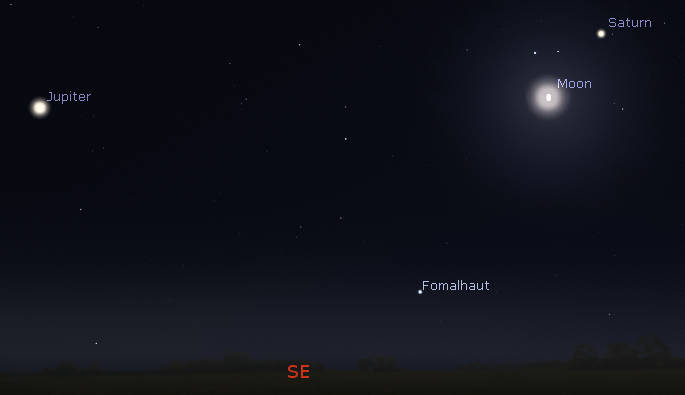
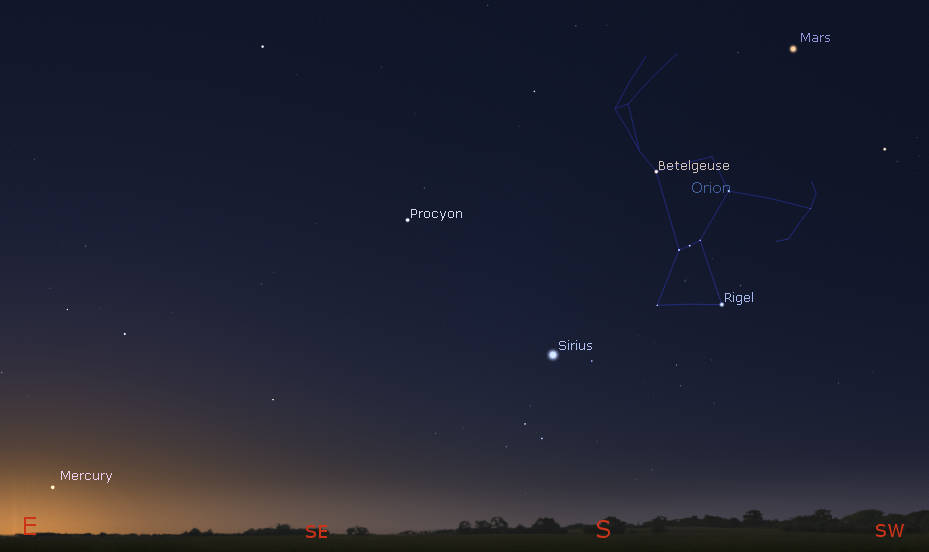
Let’s search for the naked-eye planets for this week. The waxing gibbous Moon will be visible near Saturn tonight, with the ringed planet right and above our Moon. Super bright Jupiter is to the far right of the Moon at 9 pm in the east southeast, the brightest star-like object in the sky. Jupiter is seen against the stars of Pisces the fish, while Saturn is spotted in the eastern end of Capricornus the sea goat. I don’t think the stars will be visible with the bright Moon. One star in their direction may be visible and low on the horizon and in line tonight with Saturn and the Moon. It’s Fomalhaut, normally the loneliest star in the sky. Before seven tomorrow morning, the red planet Mars will be high in the south, above the winter constellation of Orion. At that hour, Mercury can also be spotted low in the east.cc

The astronomical event times given are for the Traverse City/Interlochen area of Michigan (EDT, UT – 4 hours). They may be different for your location.

Addendum

Evening planets and the Moon tonight

Evening planets and the Moon tonight, October 5, 2022, at 9 pm. Click on the image to enlarge it. Created using Stellarium.

Annotated Gibbous Moon Animation for tonight

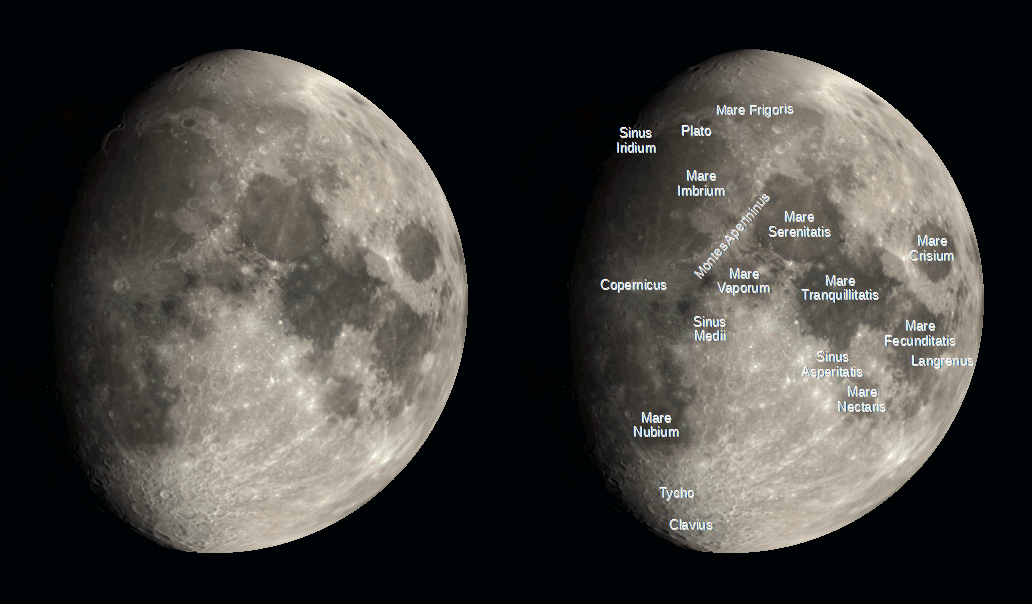
Annotated Gibbous Moon Animation for tonight, October 5, 2022, as it might in binoculars or a small telescope. Created using Stellarium, LibreOffice Draw and GIMP.

Translations of some lunar feature names according to Virtual Moon Atlas

Mare Crisium – Sea of Crises
Mare Fecunditatis – Sea of Fertility
Mare Frigoris – Sea of Cold
Mare Imbrium – Sea of Showers
Mare Nectaris – Sea of Nectar
Mare Nubium – Sea of Clouds
Mare Serenitatis – Sea of Serenity
Mare Tranquillitatis – Sea of Tranquility
Mare Vaporum – Sea of Vapors
Montes Apenninus – Apennines Mountains
Sinus Asperitatis – Golfe des Asperites
Sinus Iridium – Bay of Rainbows
Sinus Medii – Bay of the Center

Craters are generally named after astronomers, people of science, or explorers

Note that Mare is pronounced Mar-é

Morning planets Mars and Mercury at 7 am tomorrow

Morning planets, Mars and Mercury with the winter stars and Orion at 7 am tomorrow morning, October 6, 2022. Click on the image to enlarge it. Created using Stellarium.

Telescopic views of Saturn Jupiter and Mars

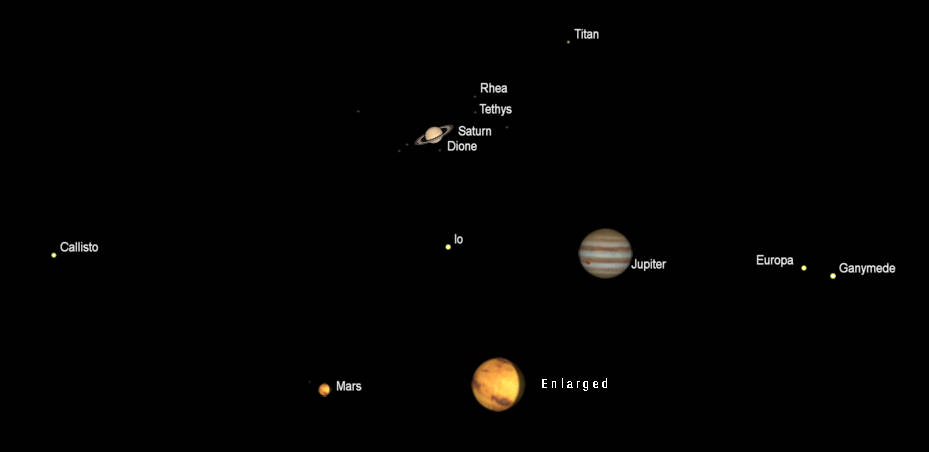
Telescopic views of Saturn Jupiter and Mars (north up) as they would be seen in a small telescope, with the same magnification. The image doesn’t show it, but the white north polar cap will appear at the top or north limb of Mars. Saturn and Jupiter are shown at 9 pm, Mars at 6 am. I do not show planets less than 10 seconds of arc in diameter. Apparent diameters: Saturn 18.00″, its rings 41.91″; Jupiter 49.69″. Mars 12.44″. Mars’ distance is 69.7 million miles (112.2 million kilometers). Mercury, which isn’t shown, is 7.51″ in diameter and 40.8% illuminated. The ” symbol means seconds of arc (1/3600th of a degree.) Click on the image to enlarge it. Created using Cartes du Ciel (Sky Charts).

Planets and the Moon on a single night

The naked-eye planets and the Moon at sunset and sunrise on a single night, starting with sunset on the right on October 5, 2022. The night ends on the left with sunrise on the 6th. Click on the image to enlarge it. Created using my LookingUp program and GIMP.

10/04/2022 – Ephemeris – DART does its job, now we wait and watch.

October 4, 2022 Comments off

This is Ephemeris for Tuesday, October 4th. Today the Sun will be up for 11 hours and 33 minutes, setting at 7:17, and it will rise tomorrow at 7:45. The Moon, 2 days past first quarter, will set at 2:14 tomorrow morning.

Last week Monday night NASA’s DART spacecraft successfully smashed into the tiny asteroid Dimorphos, which was slowly orbiting an asteroid named Didymos five times its size, and nearly a half mile in size. Dimorphos is too small and too close to Didymos to be seen in optical telescopes. Even the DART spacecraft’s telescope could only spot it in the last hour before the collision. Astronomers have found that they can see asteroid shapes and moonlets by radar. One technique was to send out radar pulses out from the Arecibo Observatory in Puerto Rico and receive them back with the Green Bank Telescope in West Virginia. Now that Arecibo has been destroyed, astronomers transmit from Goldstone, California.

The astronomical event times given are for the Traverse City/Interlochen area of Michigan (EDT, UT – 4 hours). They may be different for your location.

Addendum

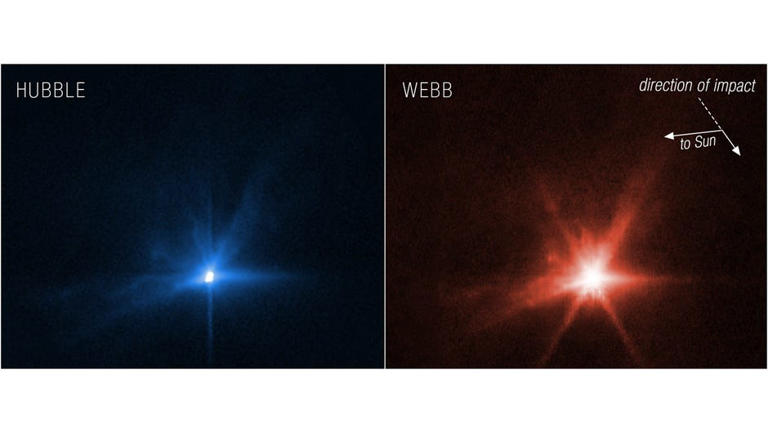
Dimorphos collision from Hubble and JWST

Dimorphos collision from as seen from Hubble and JWST. The colors aren’t true. Credit: NASA, ESA, CSA, Jian-Yang Li, Cristina Thomas, Ian Wong, Joseph DePasquale, Alyssa Pagan. From CNET web site.