Archive
Ephemeris: 05/16/2025 – Two bright stars, alike but different
This is Bob Moler with Ephemeris for Friday, May 16th. Today the Sun will be up for 14 hours and 52 minutes, setting at 9:05, and it will rise tomorrow at 6:12. The Moon, halfway from full to last quarter, will rise at 1:21 tomorrow morning.
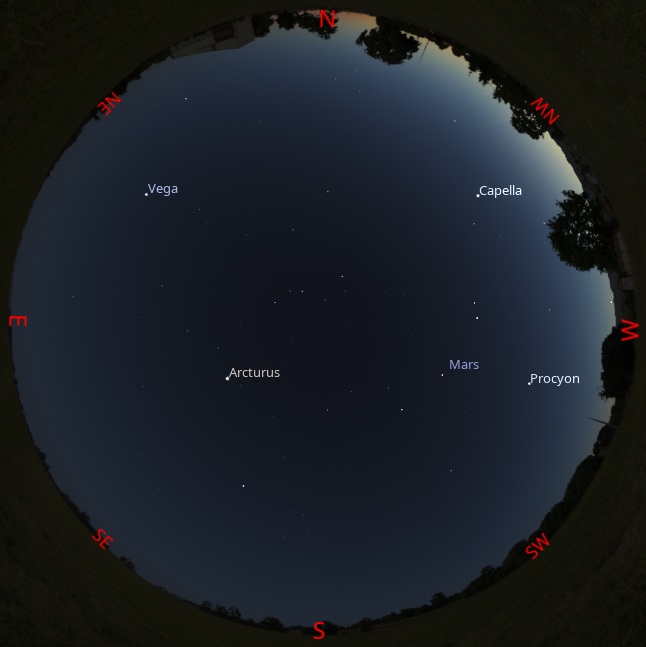
Two stars which I’ve been known to confuse in the twilit sky in late spring and late summer are Arcturus and Vega. These stars have about the same brightness and in some lists of stars swap places between the 4th and 5th brightest stars in the sky. Arcturus is an orangish star, now high in the southern sky in the evening, while Vega is a pure white star which to my eyes tends towards a little tinge of blue. Vega is high in the south, actually almost overhead, in the late summer. Now, in mid to late Spring Vega is rather low in the northeastern sky. Arcturus is a cool star on the outside which has depleted the hydrogen in its core and is a red giant star, while the younger and more massive Vega, still turning hydrogen into helium.
The astronomical event times given in this blog are for the Traverse City/Interlochen area of Michigan (Lat 44.7° N, Long 85.7° W; EDT, UT – 4 hours) unless stated otherwise. Times will be different for other locations.
Addendum
Ephemeris: 05/15/2025 – Finding Virgo the virgin in the spring sky
This is Ephemeris for Thursday, May 15th. Today the Sun will be up for 14 hours and 50 minutes, setting at 9:04, and it will rise tomorrow at 6:13. The Moon, 3 days past full, will rise at 12:36 tomorrow morning.
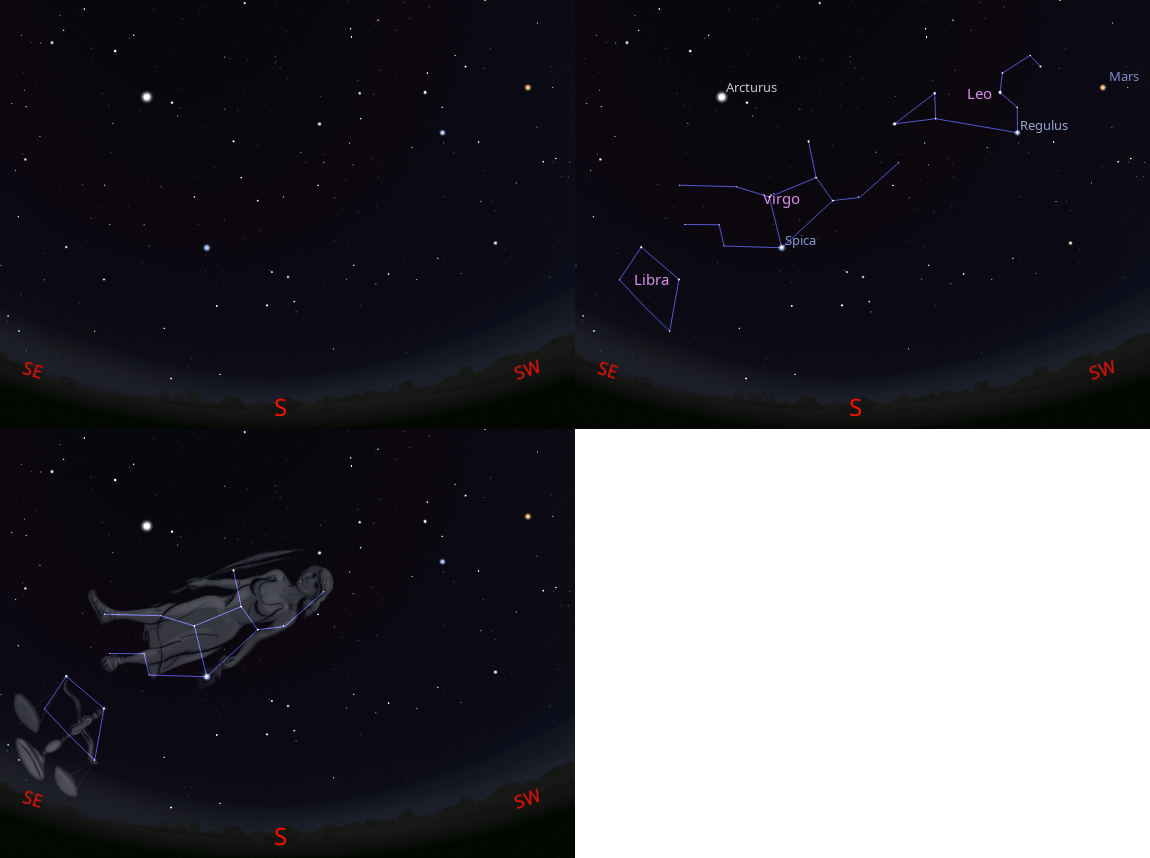
Located below the bright star Arcturus, high in the southeast, and below and left of Leo the lion, which is high in the south, lies the constellation of Virgo the virgin with its bright star Spica. Other than Spica, Virgo contains only dim stars. It’s quite large, extending to the upper right, and to the left of Spica. Virgo represents several goddesses. The Greek harvest goddess Persephone, whose Roman name is Ceres, which is the root of our word cereal, is one. The bright star Spica is the ear of wheat that she’s holding in her hand. Some see her standing at an odd angle, I see her reclining. Virgo also represents Astraea the goddess of Justice, with her scales, the constellation Libra, at her feet low in the southeast.
The astronomical event times given in this blog are for the Traverse City/Interlochen area of Michigan (Lat 44.7° N, Long 85.7° W; EDT, UT – 4 hours) unless stated otherwise. Times will be different for other locations.
Addendum
Ephemeris: 05/14/2025 – Looking for the naked-eye planets
This is Bob Moler with Ephemeris for Wednesday, May 14th. Today the Sun will be up for 14 hours and 48 minutes, setting at 9:03, and it will rise tomorrow at 6:14. The Moon, 2 days past full, will rise at 11:41 this evening.
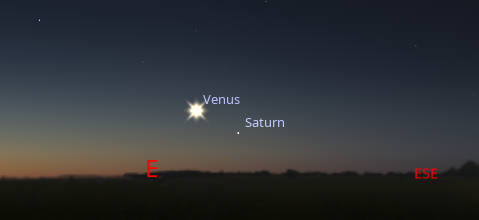
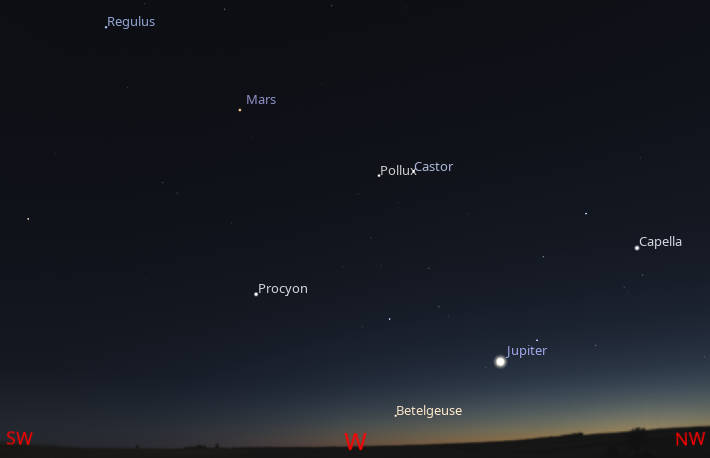
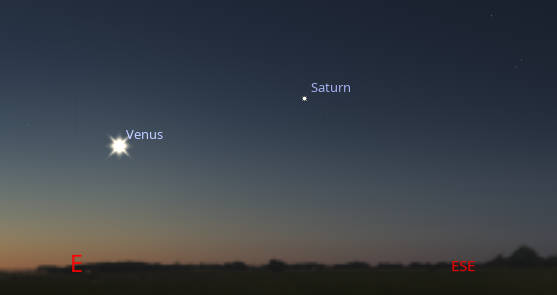
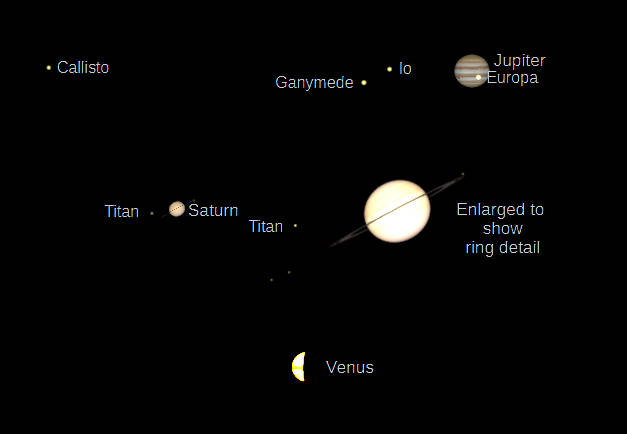
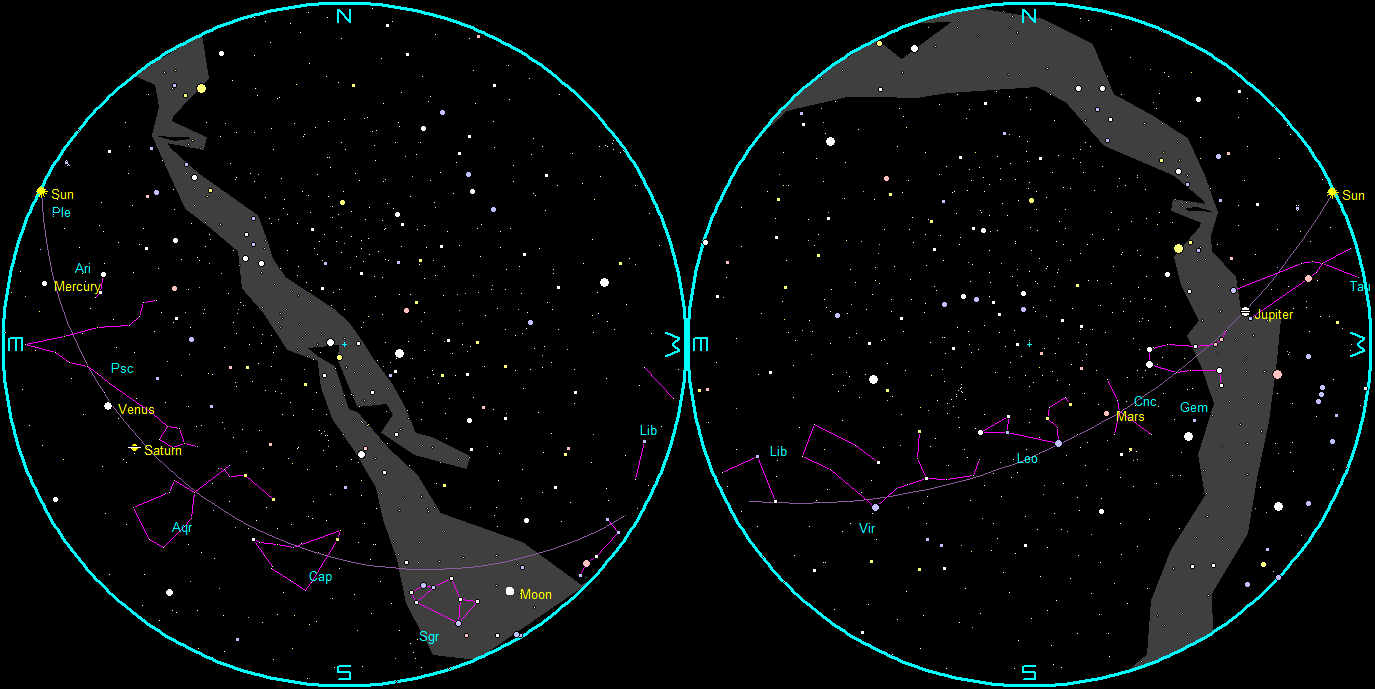
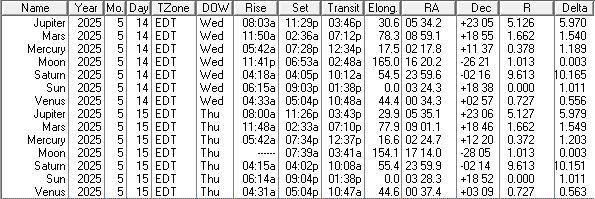
Let’s take our weekly look at the whereabouts of the naked-eye planets. At 10 PM this evening two of the five naked eye planets will be out. Jupiter, is now the brightest evening planet, our substitute evening star if you will. It will be in the low in the west-northwestern sky. The rapidly fading Mars, with its distinctive reddish hue, is in the west-southwest, less than a binocular field’s width east of the Beehive Star Cluster in Cancer the Crab. By 5 AM Venus will be seen very low in the east, as the Morning Star. It will require a low eastern horizon. It should be visible until close to 6 AM. Saturn is visible to the right and a bit above Venus. It will disappear much sooner than the much brighter Venus.
The astronomical event times given in this blog are for the Traverse City/Interlochen area of Michigan (Lat 44.7° N, Long 85.7° W; EDT, UT – 4 hours) unless stated otherwise. Event times will be different for other locations.
Addendum
Ephemeris: 05/13/2025 – Arcturus, extragalactic visitor?
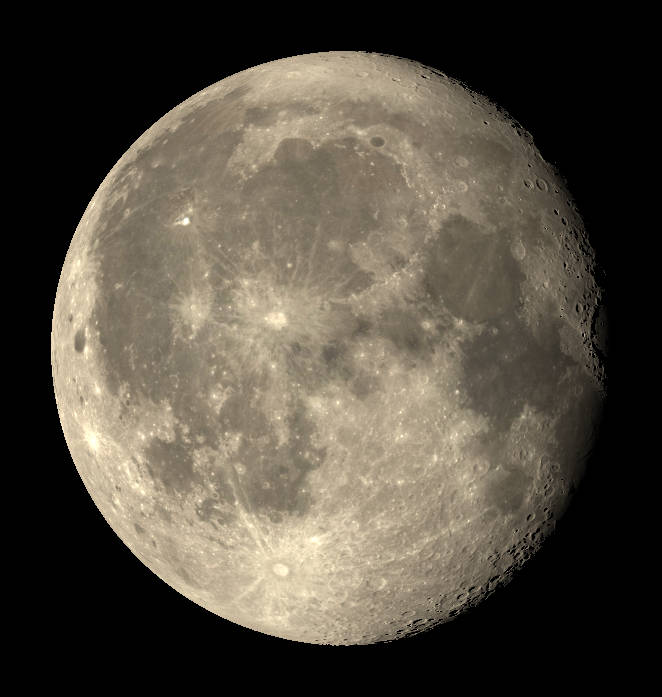
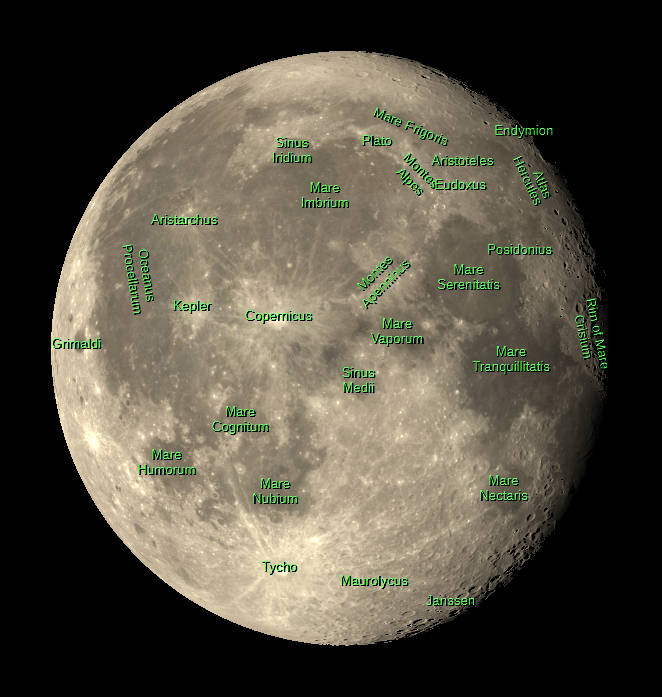
This is Ephemeris for Tuesday, May 13th. Today the Sun will be up for 14 hours and 45 minutes, setting at 9:02, and it will rise tomorrow at 6:15. The Moon, 1 day past full, will rise at 10:39 this evening.
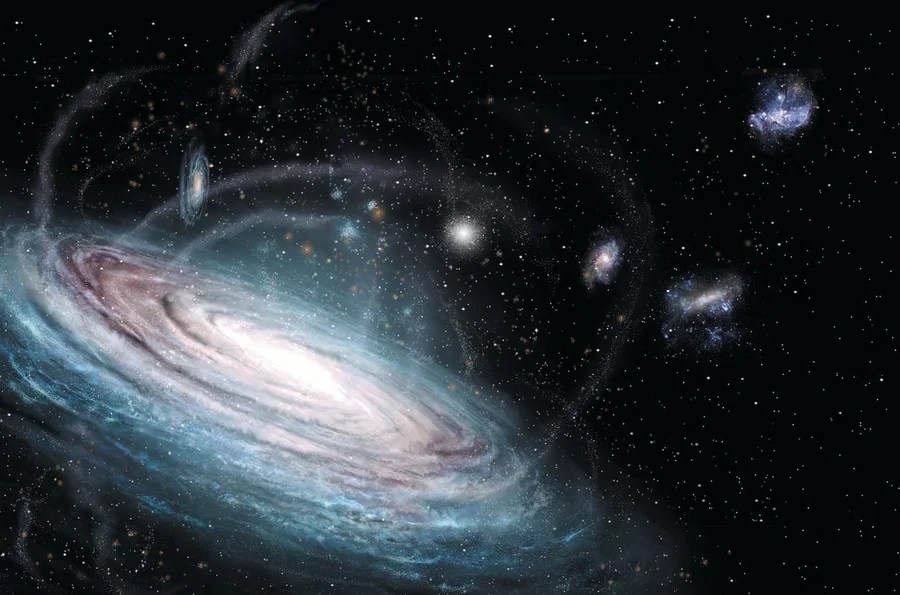
The bright orange star high in the southeast at 10 PM is Arcturus. Remember: Follow the arc of the handle of the Big Dipper to find Arcturus. It is an interesting star in many respects. Arcturus is somewhat more massive than the Sun and a bit older. It is starting its red giant phase having run out of hydrogen in its core and starting to use helium as its heat source, transmuting it into carbon and other elements. It has a very high velocity with respect to the Sun of about 100 kilometers per second. Arcturus is thought to be, by some astronomers, part of the remnants of a dwarf galaxy that collided with the Milky Way, and has now been assimilated. So Arcturus isn’t from around here.
-The astronomical event times given in this blog are for the Traverse City/Interlochen area of Michigan (Lat 44.7° N, Long 85.7° W; EDT, UT – 4 hours) unless stated otherwise. Times will be different for other locations.
Addendum
Ephemeris: 05/12/2025 – Artificial Intelligence, promise and caution

This is Ephemeris for Monday, May 12th. Today the Sun will be up for 14 hours and 43 minutes, setting at 9:01, and it will rise tomorrow at 6:16. The Moon, at full today, will rise at 9:34 this evening.
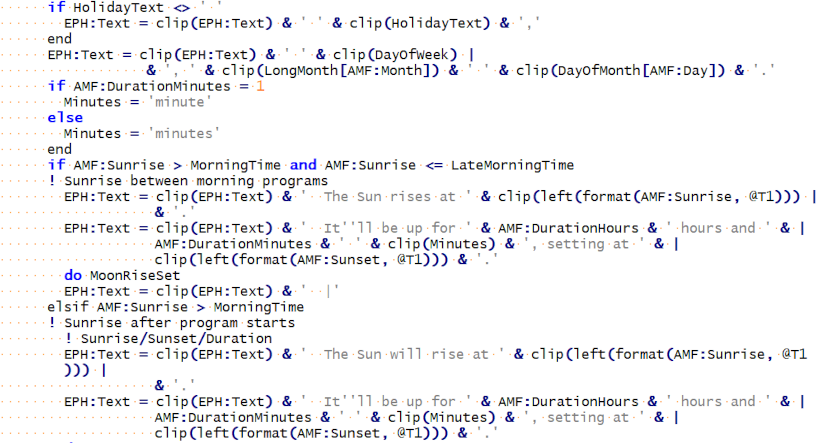
The text for the part of this program up to now was generated by a computer. It’s not AI. It’s generated by a program I wrote from data I created by another program that I also wrote, which is why it’s nearly the same every day. AI or artificial intelligence systems are trained rather than programmed. They learn their information more like how organic creatures learn, than computers do. And in talking to an AI one gets the feeling that there is almost a person there. It’s not like talking to the automated answering system of most businesses, where whatever the system is running, does not have a large vocabulary or under really understand anything. AI is powerful… and scary. AI can lie, they call it hallucinate, and can cheat. There’s great potential… and great danger.
The astronomical event times given in this blog are for the Traverse City/Interlochen area of Michigan (Lat 44.7° N, Long 85.7° W; EDT, UT – 4 hours) unless stated otherwise. Times will be different for other locations.
Addendum
Ephemeris: 05/09/2025 – AI and me
This is Ephemeris for Friday, May 9th. Today the Sun will be up for 14 hours and 36 minutes, setting at 8:57, and it will rise tomorrow at 6:20. The Moon, 3 days before full, will set at 5:08 tomorrow morning.
Continuing my look at Artificial Intelligence or AI. AI appears to be just about everywhere nowadays: on computers, software applications, and even on smartphones. The brains of AI are somewhere out on the Internet not on your phone or computer. I’ve gotten into it just recently. The first time was just this last February when I wanted a picture of a groundhog seeing its shadow for Groundhog’s day from my blog, which illustrated my day after Groundhog’s Day program here on Ephemeris. I use AI for research. Besides giving a synopsis of what it finds on the Internet. The one I use also gives a link to the original data, which has more information. I don’t rely on the synopsis it presents. And I would never have an AI write an Ephemeris episode. You could probably tell by its much better grammar.
The astronomical event times given in this blog are for the Traverse City/Interlochen area of Michigan (Lat 44.7° N, Long 85.7° W; EDT, UT – 4 hours) unless stated otherwise. Times will be different for other locations.
Addendum

Ephemeris: 05/08/2025 – AI, a different way to compute
This is Bob Moler with Ephemeris for Thursday, May 8th. Today the Sun will be up for 14 hours and 33 minutes, setting at 8:56, and it will rise tomorrow at 6:21. The Moon, halfway from first quarter to full, will set at 4:51 tomorrow morning.
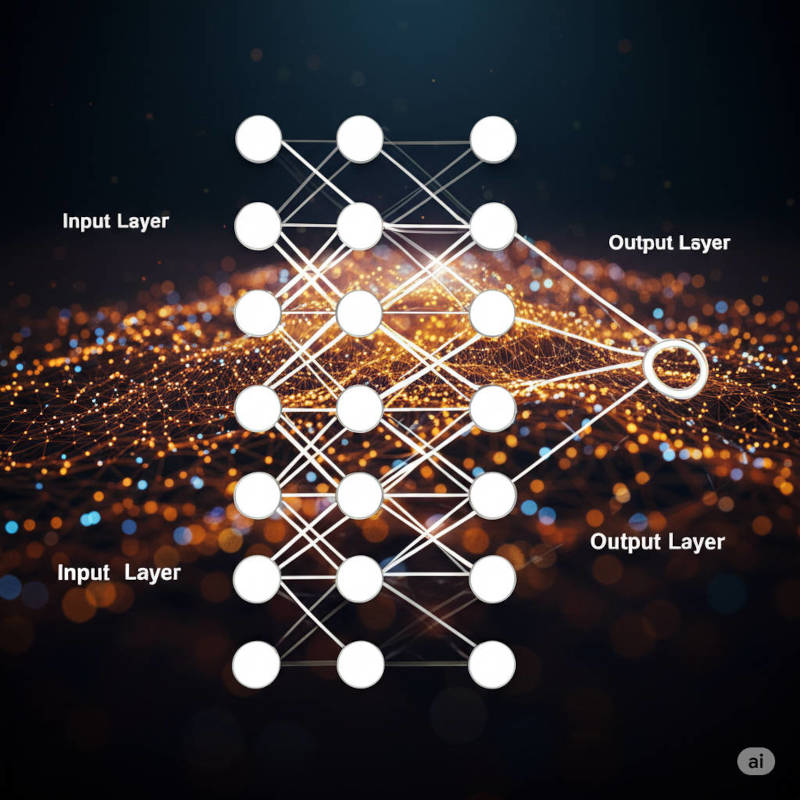
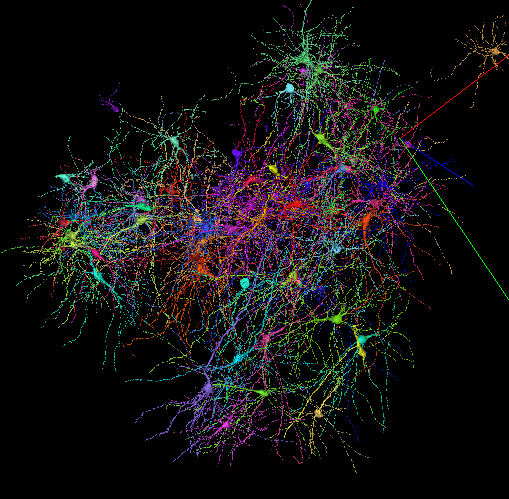
This week we’re investigating artificial intelligence or AI. My software experience in my career with computers is that of financial software for banks including ATMs and various other machines that have to do with banking, so AI or anything scientific was completely out of my realm. So I’m kind of looking at this like is an interested layman with some knowledge of computers. AI uses neural networks which is something that most computers don’t have. It can be simulated digitally, although I understand that they have chips that actually are neural network components. Neural networks are how the human brain functions with neurons and synapses. How they’ve gotten it to work, I have no idea.
The astronomical event times given in this blog are for the Traverse City/Interlochen area of Michigan (Lat 44.7° N, Long 85.7° W; EDT, UT – 4 hours) unless stated otherwise. Times will be different for other locations.
Addendum
Ephemeris: 05/07/2025 – Taking our weekly look at the whereabouts of the naked-eye planets
This is Ephemeris for Wednesday, May 7th. Today the Sun will be up for 14 hours and 31 minutes, setting at 8:55, and it will rise tomorrow at 6:22. The Moon, 3 days past first quarter, will set at 4:36 tomorrow morning.
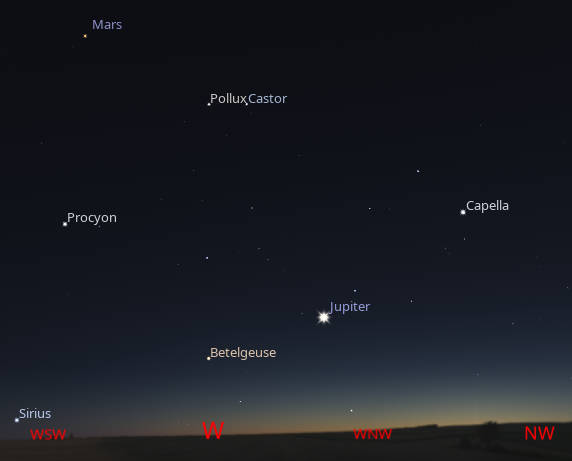
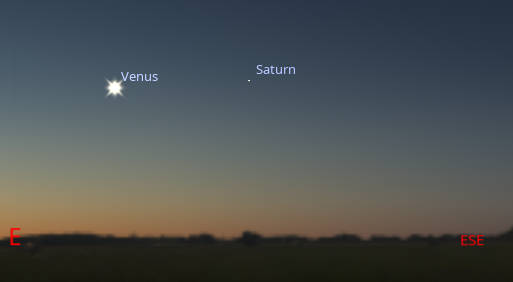
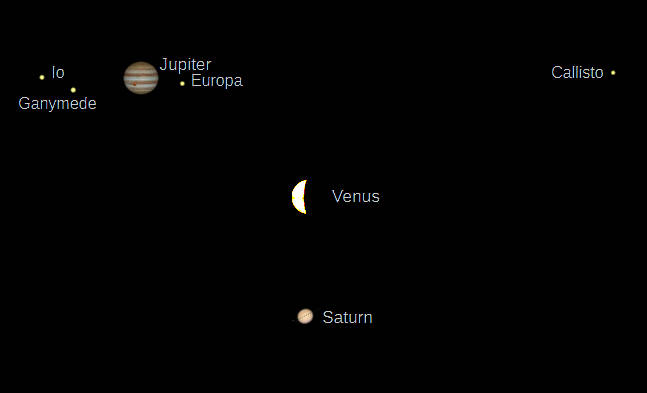
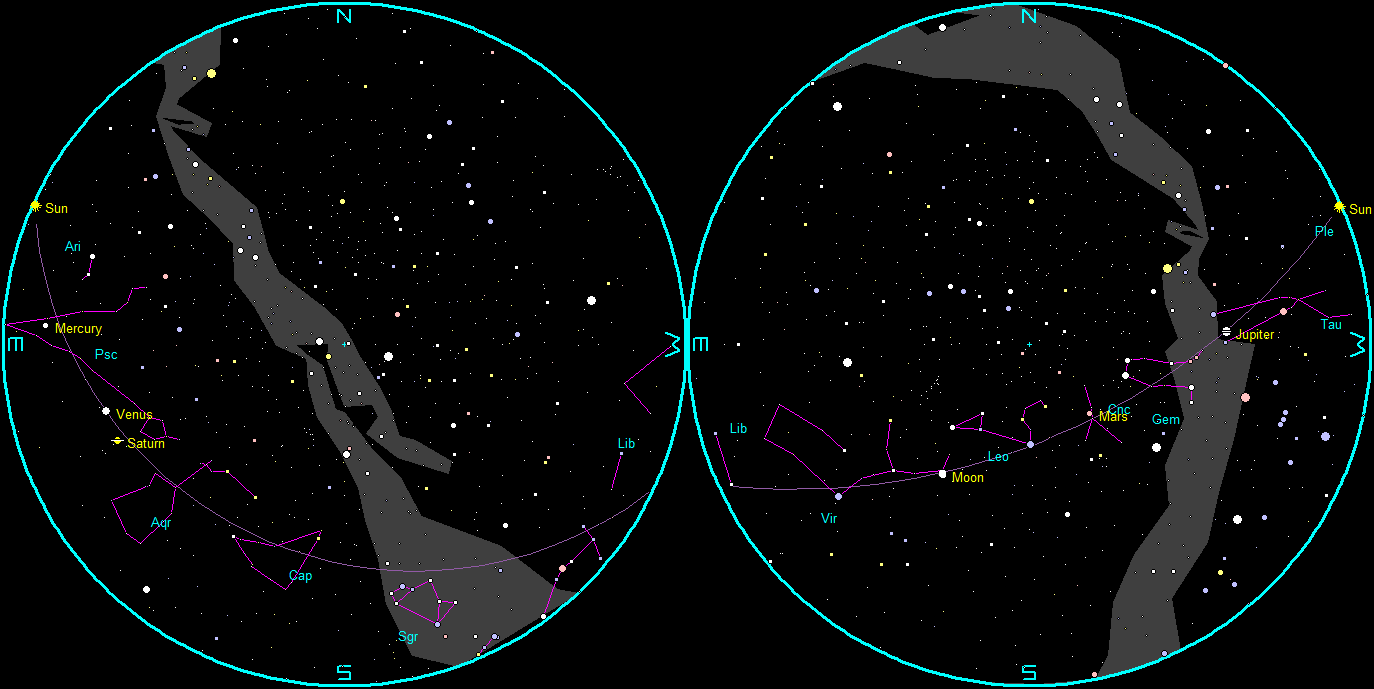
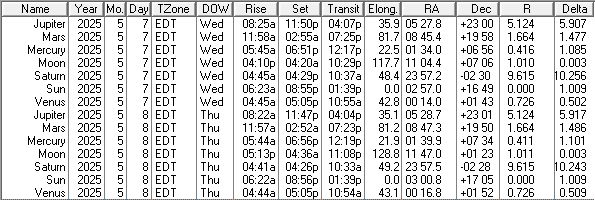
Let’s take our weekly look at the whereabouts of the naked-eye planets. At 10 PM this evening two of the five naked eye planets will be out. Jupiter, is now the brightest evening planet, our substitute evening star if you will. It will be in the low in the west-northwestern sky. The rapidly fading Mars, with its distinctive reddish hue, is in the west-southwest, moving away from the stars Castor and Pollux in Gemini to the lower right of it. By 5:30 AM Venus will be seen very low in the east, as the Morning Star. It will require a low eastern horizon. It should be visible until a bit after 6:30. Saturn is visible close and to its right and a bit above. It will disappear much sooner than Venus.
The astronomical event times given in this blog are for the Traverse City/Interlochen area of Michigan (Lat 44.7° N, Long 85.7° W; EDT, UT – 4 hours) unless stated otherwise. Times will be different for other locations.
Addendum
Ephemeris: 05/05/2025 – Speculating about AI while the Moon is too bright

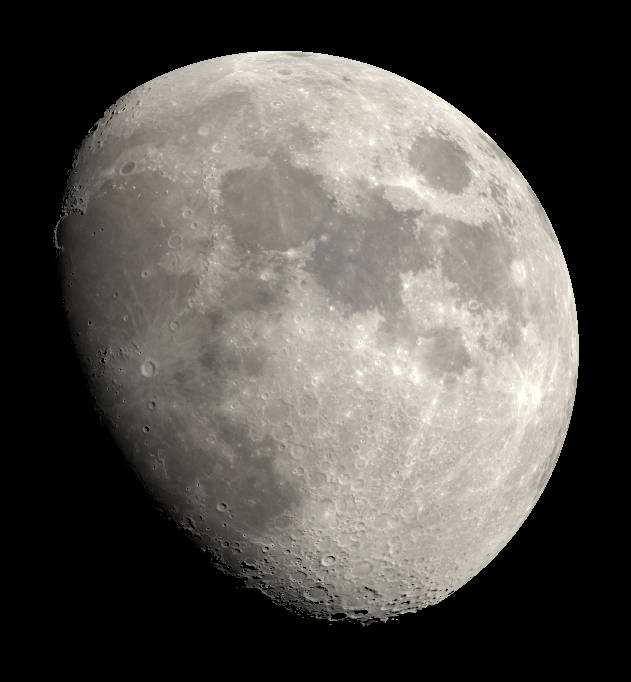
This is Ephemeris for Tuesday, May 6th. Today the Sun will be up for 14 hours and 28 minutes, setting at 8:54, and it will rise tomorrow at 6:23. The Moon, 2 days past first quarter, will set at 4:20 tomorrow morning.
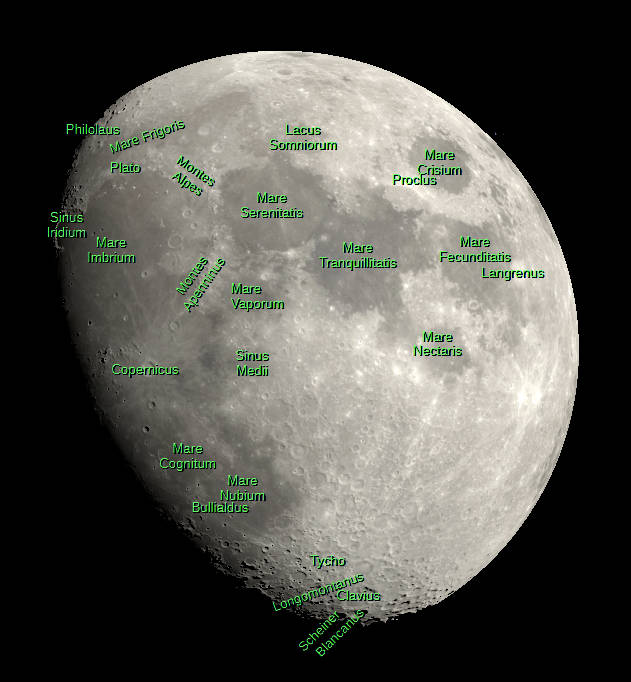
With the Artemis moon program in doubt, NASA’s budget being cut, and scientific programs being eliminated, I’m going to wait until the dust settles a bit before I talk more about it. In the meantime I’d like to digress a bit with a little bit of expertise I’ve gotten from my working life as a systems engineer and computer programmer. I have no expertise in what’s hot now in computers, which is artificial intelligence or AI, but I do have some thoughts about it which I will talk about later on this week and next while the constellations are pretty much wiped out by the Moon’s bright light. AI came upon the scene rather suddenly*, after years of quiet development. All of a sudden just about every smartphone and computer app seems to have an AI component.
The astronomical event times given in this blog are for the Traverse City/Interlochen area of Michigan (Lat 44.7° N, Long 85.7° W; EDT, UT – 4 hours) unless stated otherwise. Times will be different for other locations.
*I’m a bit old, and moving slowly, but the clock seems to tick faster. Just about anything seems to happen faster.
Ephemeris: 05/05/2025 – A brief early morning meteor shower
This is Bob Moler with Ephemeris for Cinco de Mayo, Monday, May 5th. Today the Sun will be up for 14 hours and 26 minutes, setting at 8:53, and it will rise tomorrow at 6:25. The Moon, 1 day past first quarter, will set at 4:03 tomorrow morning.
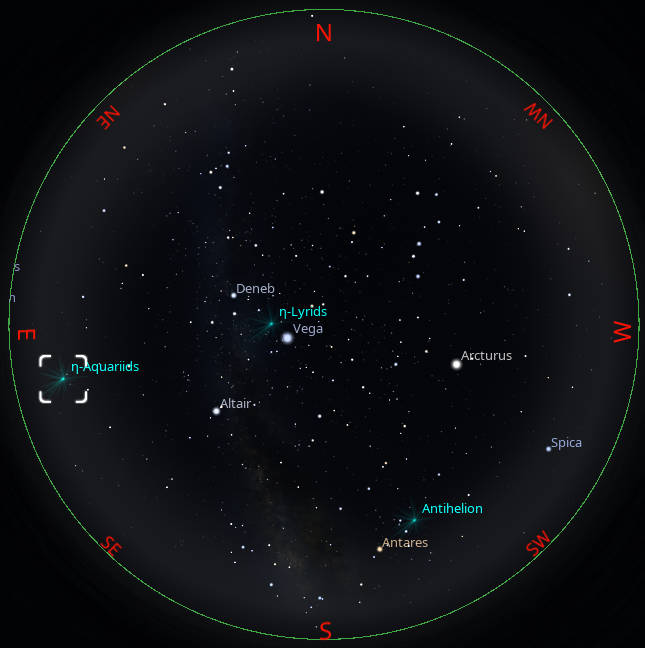
The Earth is now passing through a stream of bits of rock that were shed from Halley’s Comet on its many previous passes through the inner solar system. The Earth gets to pass through this stream twice a year, Once in late October as the stream passes the Earth’s orbit heading in, and in early May as the stream is departing. The peak of this meteor shower, the Eta Aquariids, is this afternoon. Since the meteoroids are coming from nearer the direction of the Sun, there is only a short period when these meteors are visible. Actually less than an hour between moonset at 4:03 AM and nearly 5 AM around here as twilight begins to interfere with the display. The meteors will seem to come from low in the east-southeast, but they will be seen all over the sky.
The astronomical event times given in this blog are for the Traverse City/Interlochen area of Michigan (Lat 44.7° N, Long 85.7° W; EDT, UT – 4 hours) unless stated otherwise. Times will be different for other locations.
Addendum
 Bob Moler's Ephemeris Blog