Archive
Ephemeris: 11/17/2026 – The Leonid meteor shower peaks after moonset tonight
This is Ephemeris for Tuesday, November 17th. Today the Sun will be up for 9 hours and 30 minutes, setting at 5:12, and it will rise tomorrow at 7:43. The Moon, at first quarter today, will set at 12:39 tomorrow morning.
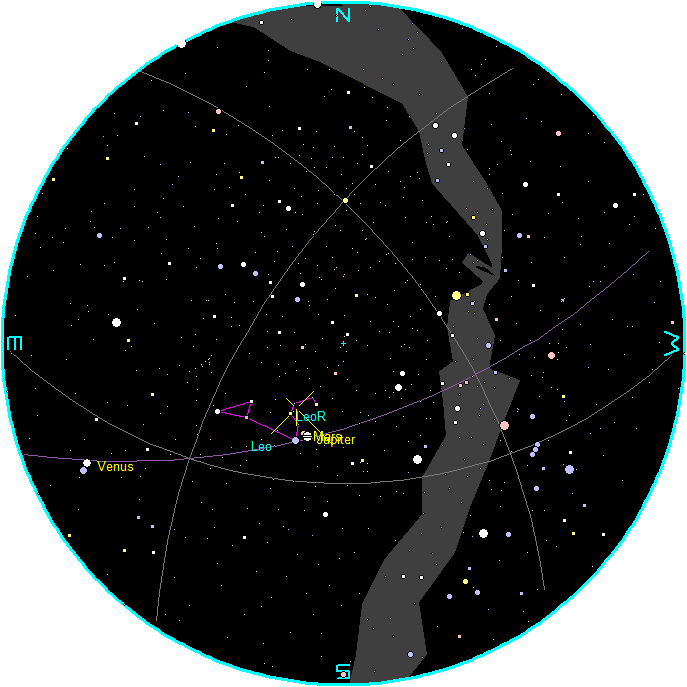
Tonight, after the Moon sets we’ll see the peak of the Leonid meteor shower. It is called the Leonids because the meteors appear to come from the head of Leo the lion, which will rise about midnight. This meteor shower is mediocre most years. However, every 33 or so years it can be spectacular with thousands of meteors per hour appearing in the sky for a short time. The meteoroid particles that produce the shower come from the comet 55P/Tempel-Tuttle which comes into the vicinity of the Sun in the inner solar system approximately every 33 years. The next peak year is predicted to be 2031, though it is expected to be not as active as recent peak years. But the Leonids are always surprising.
The astronomical event times given in this blog are for the Traverse City/Interlochen area of Michigan (Lat 44.7° N, Long 85.7° W; EST, UT – 5 hours) unless stated otherwise. Times will be different for other locations.
Addendum
Ephemeris: 11/16/2026 – Did our alphabet begin with Taurus?
This is Ephemeris for Monday, November 16th. Today the Sun will be up for 9 hours and 32 minutes, setting at 5:13, and it will rise tomorrow at 7:42. The Moon, 1 day before first quarter, will set at 11:33 this evening.
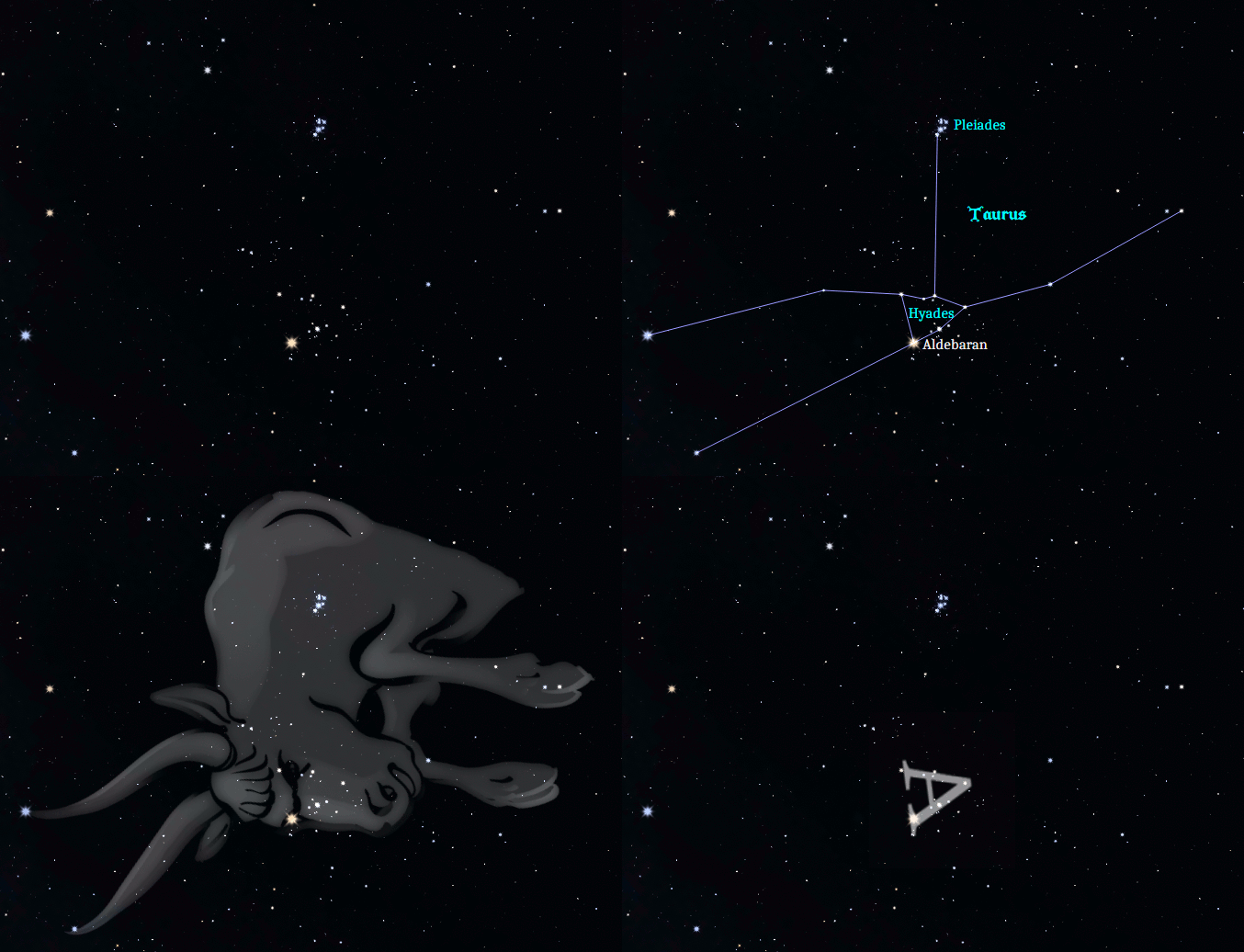
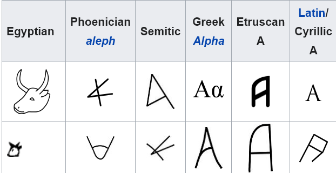
When we look at the face of Taurus the bull, the Hyades star cluster, we tend to think of the letter V. But maybe that’s the wrong letter. It could be an A. Back when our alphabet was beginning to be formed by the Phoenicians in the second millennium BCE, the constellation Taurus was the first constellation of Spring, not Aries, or Pisces as it truly is today. The early Egyptian prototype of the letter A in hieroglyphics was the head of an ox. Was that Taurus? The Phoenician letter A is tilted on its side, like the Hyades, but looks like our modern A with an extended horizontal line through it. The Greeks adapted their alphabet from the Phoenician one. And the Greek capital letter alpha is the same as our capital A.
The astronomical event times given in this blog are for the Traverse City/Interlochen area of Michigan (Lat 44.7° N, Long 85.7° W; EST, UT – 5 hours) unless stated otherwise. Times will be different for other locations.
Addendum
Ephemeris: 11/13/2026 – The Hyades cluster is moving away from us
This is Ephemeris for Friday, November 13th. Today the Sun will be up for 9 hours and 39 minutes, setting at 5:16, and it will rise tomorrow at 7:38. The Moon, halfway from new to first quarter, will set at 8:17 this evening.
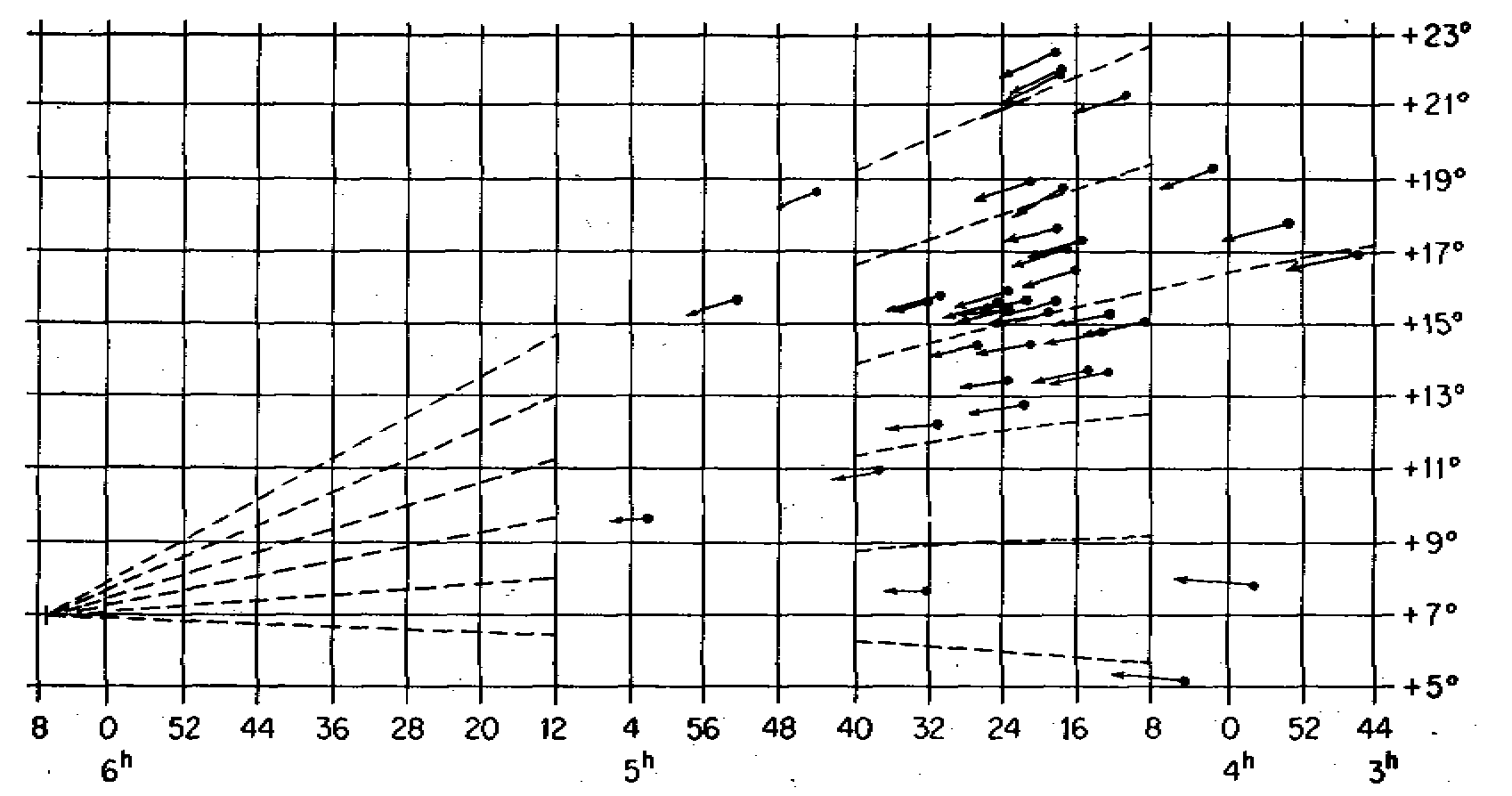
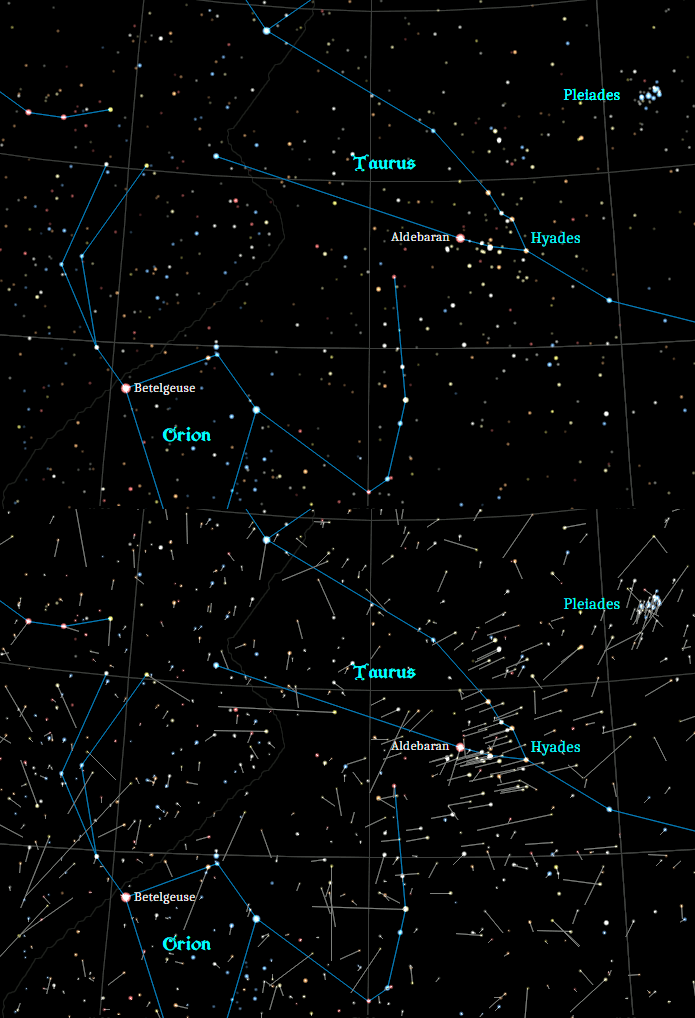
The Hyades star cluster, which is the face of Taurus the bull, and seen below the Pleiades in the east these evenings, is moving away from us. It is moving away towards a location that’s north of the constellation Orion, which will rise later this evening. The cluster itself is moving away from us and to the east, while its individual stars are slowly dispersing. The movement of a star across the sky is called proper motion, and it is very tiny. It takes a long time interval between observations to detect this motion. The Hyades cluster is also being pulled apart by the tidal forces caused by the rest of the Galaxy itself and stars can be seen that share the same general motion of the Hyades are scattered over vast stretches of the sky, far from the cluster itself.
The astronomical event times given in this blog are for the Traverse City/Interlochen area of Michigan (Lat 44.7° N, Long 85.7° W; EST, UT – 5 hours) unless stated otherwise. Times will be different for other locations.
Addendum
Ephemeris: 11/12/2026 – We’re having a low yield, but very interesting meteor shower now
This is Ephemeris for Thursday, November 12th. Today the Sun will be up for 9 hours and 41 minutes, setting at 5:17, and it will rise tomorrow at 7:37. The Moon, 3 days past new, will set at 7:18 this evening.
This evening we’ll see the peak of the North Taurid* meteor shower. The expected peak numbers will be only 5 an hour. However, they are slow and quite bright. Moonlight doesn’t seem to bother them. Their source is Encke’s Comet one of the first periodic comets discovered, and it has the shortest orbit around the sun of only 3.3 years, which explains their slowness. They will appear to come from near the Pleiades. The particles causing the meteors, technically meteoroids, must be fairly large to be that bright. It is thought, by some, that the Tunguska meteorite that hit the Earth June 30th, 1908 may have been part of a related meteor stream. The meteoroid stream crosses the Earth’s orbit in 2 spots: tonight and around the end of June coming from out from the direction of the sun. The Tunguska meteorite hit in the morning during daylight.
The astronomical event times given in this blog are for the Traverse City/Interlochen area of Michigan (Lat 44.7° N, Long 85.7° W; EST, UT – 5 hours) unless stated otherwise. Times will be different for other locations.
* On the radio program, I misspoke, stating the South Taurid meteor shower. Both were shed by Encke’s Comet, and reach peak a week apart. The Southern Taurids reached peak on the 4th\, but is still active
Addendum
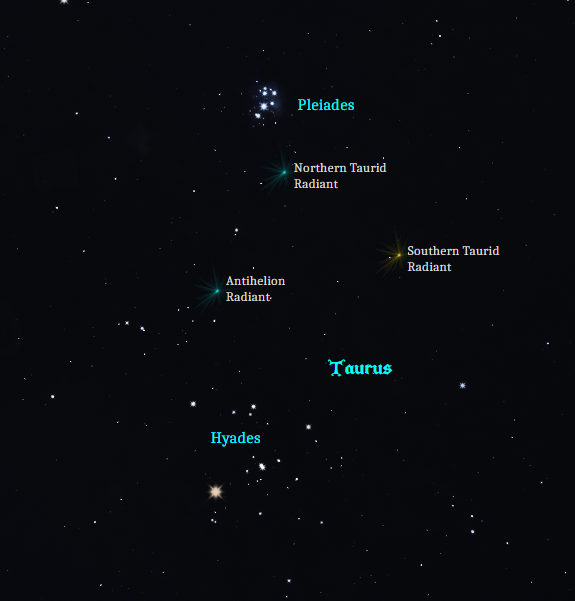
For a good write-up on Antihelion meteors I suggest checking out What Is the Antihelion Source Meteor Shower? from SpaceWeekly.com.
Ephemeris: 11/11/2026 – Taking our weekly look at the whereabouts of the naked-eye planets
This is Ephemeris for Veteran’s Day, Wednesday, November 11th. Today the Sun will be up for 9 hours and 44 minutes, setting at 5:18, and it will rise tomorrow at 7:35. The Moon, 2 days past new, will set at 6:26 this evening.
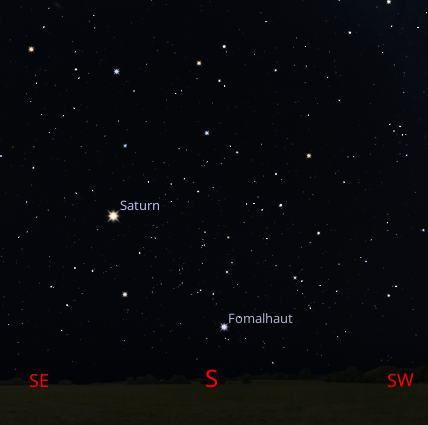
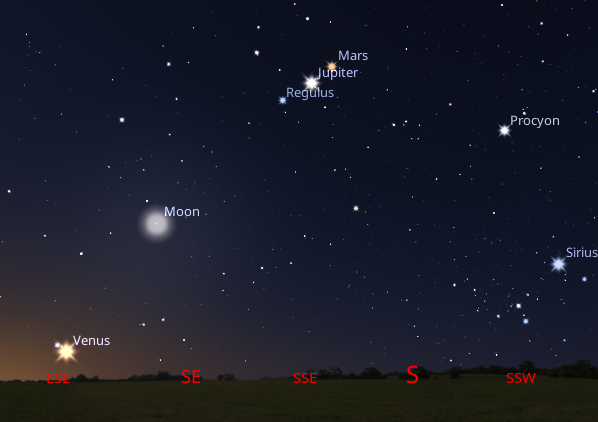
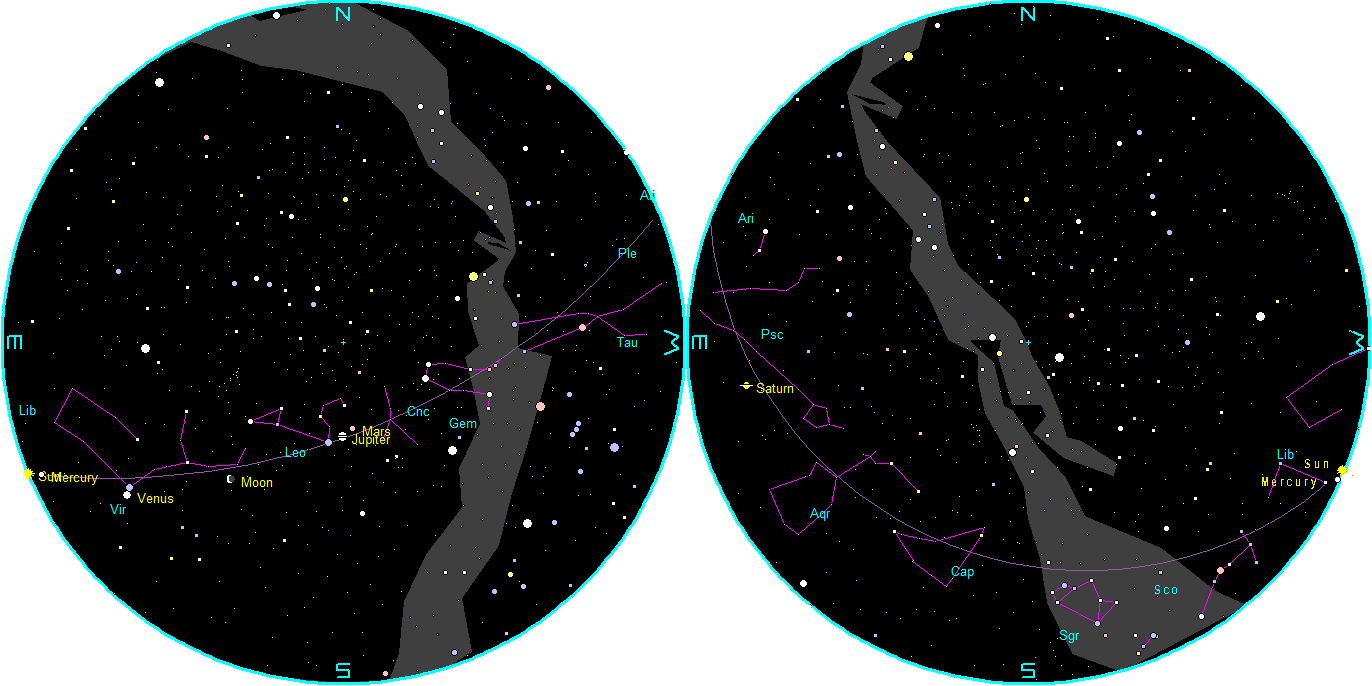
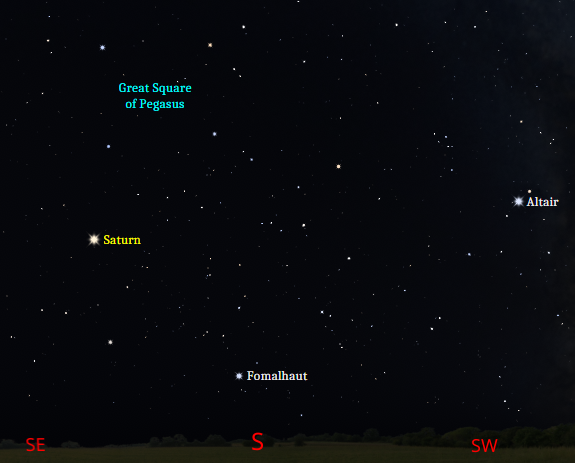
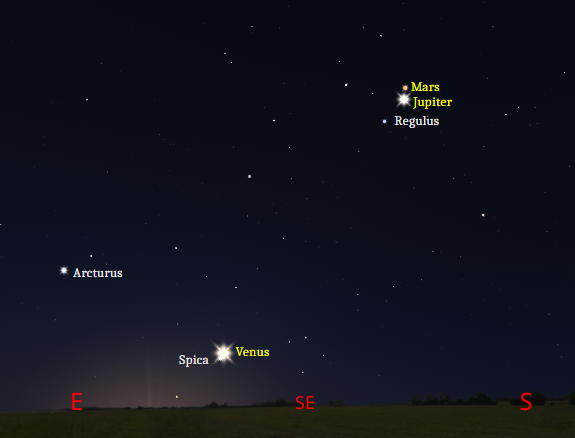
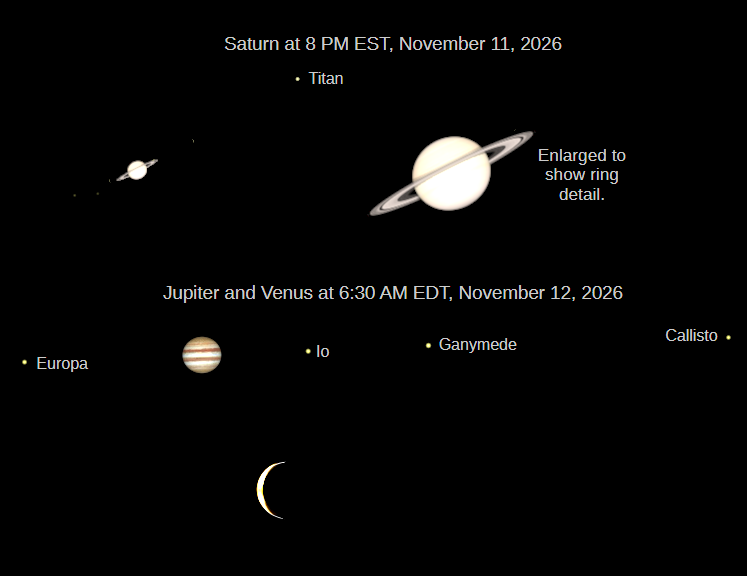
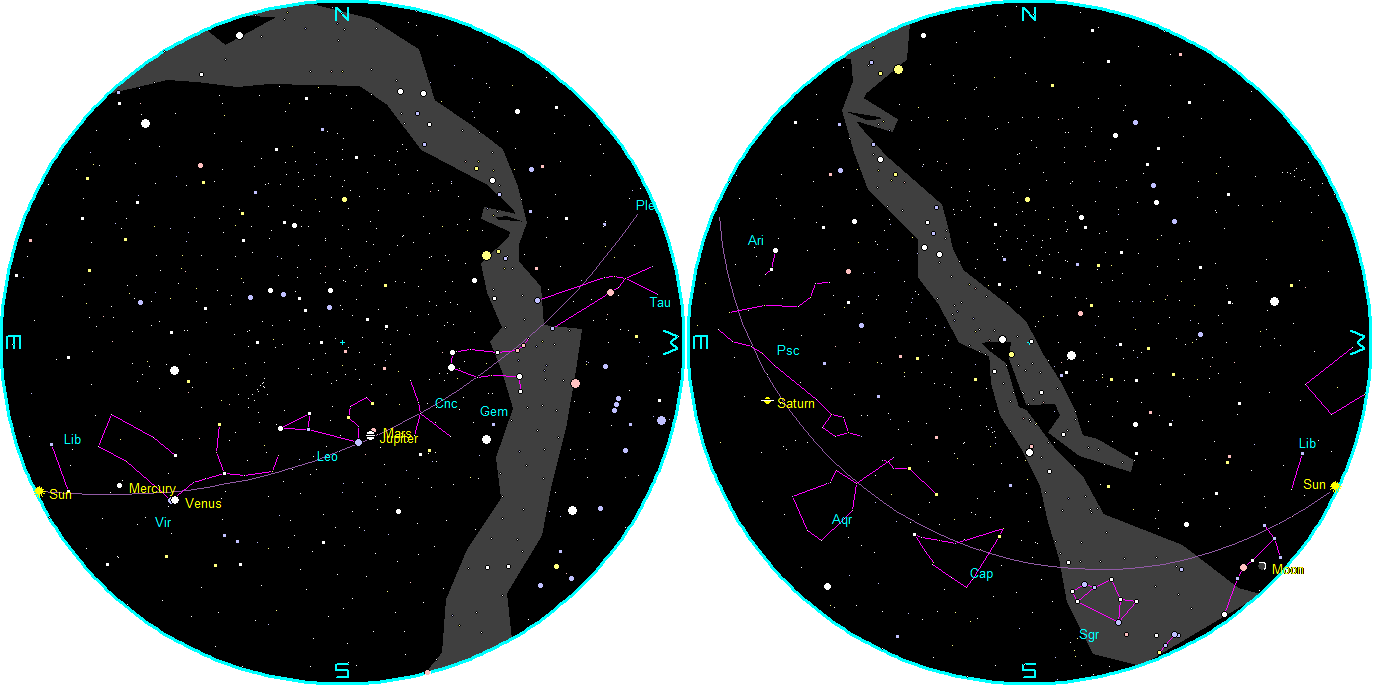
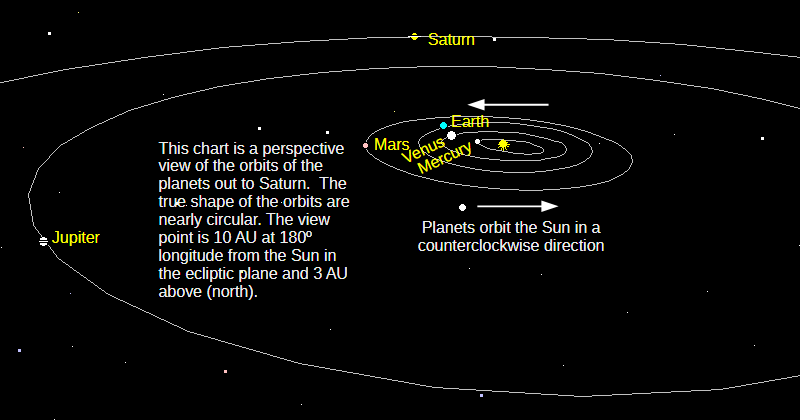
Let’s take our weekly look at the whereabouts of the naked-eye planets. Three of the naked-eye planets are visible in the night sky. Tonight, Saturn will be in the east-southeastern sky as it gets dar k. It is the brightest starlike object low in that direction, and as it gets darker, will be seen below a large square of stars, the Great Square of Pegasus. Venus will be seen in the morning sky, rising at 5:18 AM. By 6 AM it will be low in the east southeast. Jupiter and Mars will be in the southeastern sky, above and right of it, with the dimmer and red Mars just above Jupiter. Mars will pass closest to Jupiter on Sunday morning. The bright star, that may look blue-white is below and left of Jupiter. That’s Regulus in Leo, the lion.
The astronomical event times given in this blog are for the Traverse City/Interlochen area of Michigan (Lat 44.7° N, Long 85.7° W; EST, UT – 5 hours) unless stated otherwise. Times will be different for other locations.
Addendum
Ephemeris: 11/10/2026 – Finding Taurus the bull
This is Ephemeris for Tuesday, November 10th. Today the Sun will be up for 9 hours and 46 minutes, setting at 5:19, and it will rise tomorrow at 7:34. The Moon, 1 day past new, will set at 5:42 this evening.
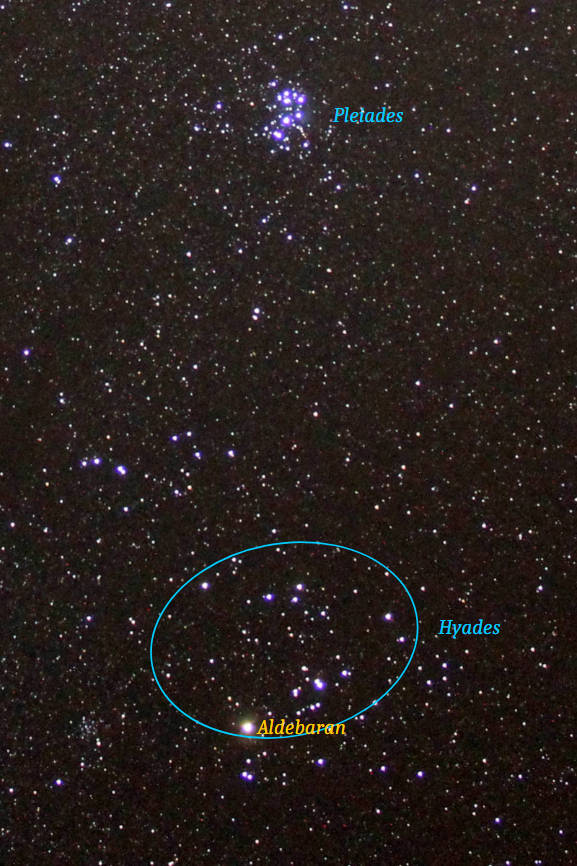
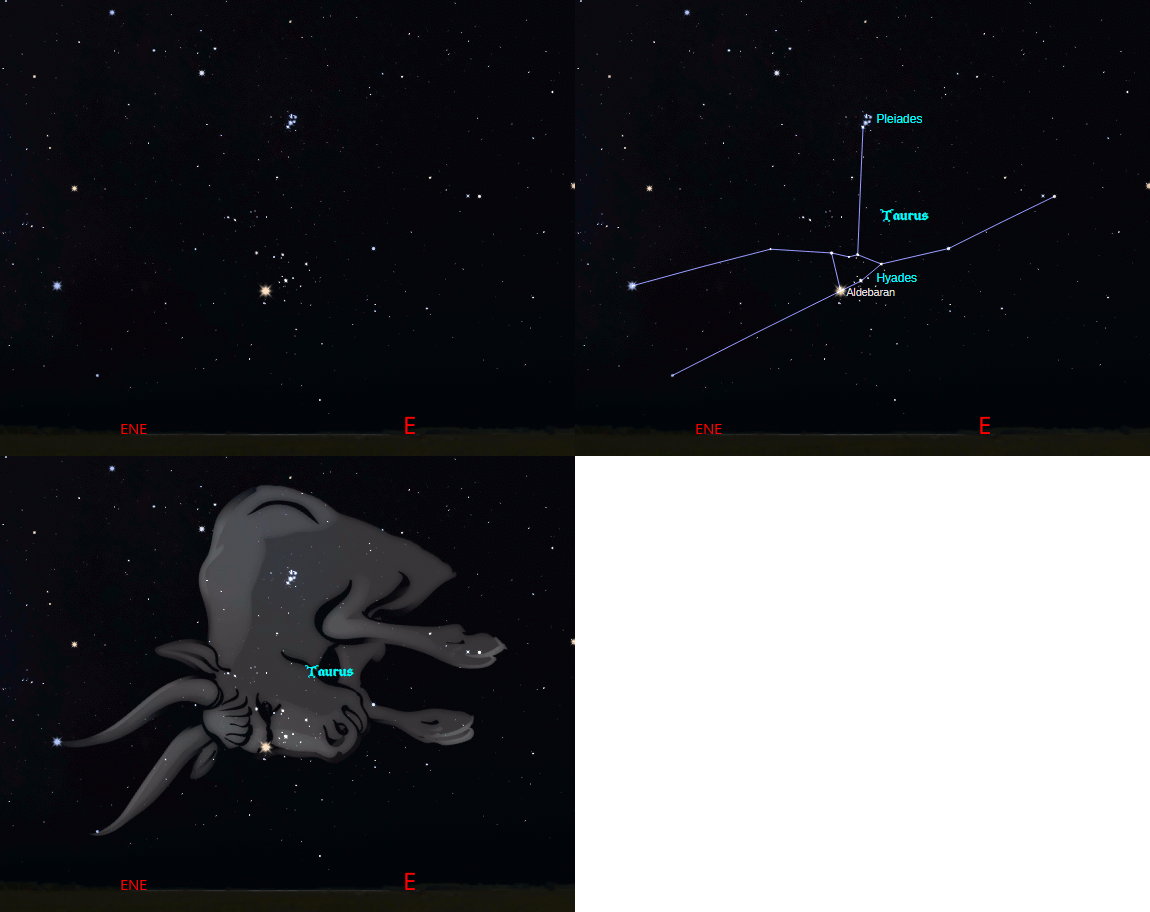
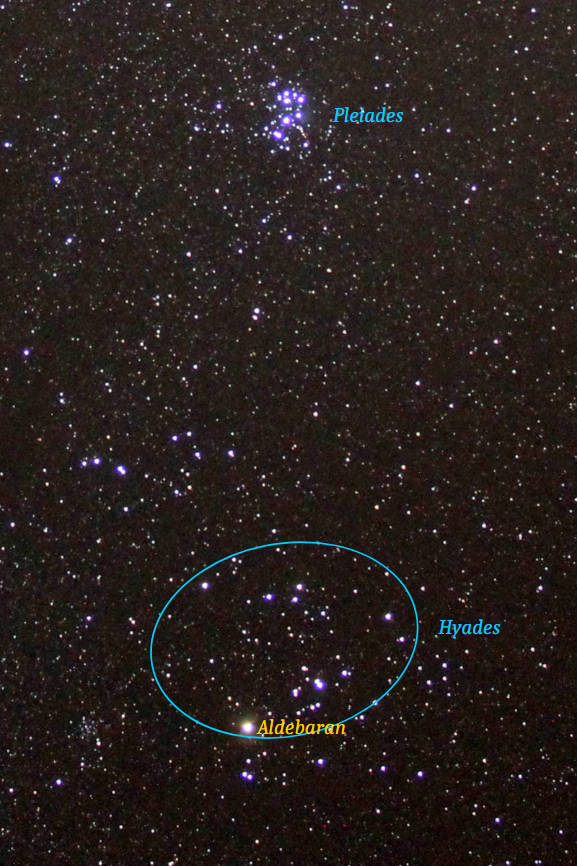
The tight little star group of the Pleiades is seen in the eastern sky these evenings. Below it is a much looser cluster of stars called the Hyades, which are arranged like a letter V of the stars. These represent the face of the constellation Taurus the bull, one of the constellations of the Zodiac. At the lower left end of the V of stars is a bright orange star called Aldebaran which represents Taurus’ angry bloodshot eye, because he’s charging to the east at the constellation Orion which will rise later in the evening. Aldebaran is an interesting star. It is a red giant star, although it’s more on the orange side compared to Betlegeuse in Orion. Aldebaran itself does not belong to the star cluster. It’s less than half the distance of the Hyades.
The astronomical event times given in this blog are for the Traverse City/Interlochen area of Michigan (Lat 44.7° N, Long 85.7° W; EST, UT – 5 hours) unless stated otherwise. Times will be different for other locations.
Addendum
Ephemeris: 11/09/2026 – The star cluster Hyades, half sisters of the Pleiades
This is Bob Moler with Ephemeris for Monday, November 9th. Today the Sun will be up for 9 hours and 49 minutes, setting at 5:21, and it will rise tomorrow at 7:33. The Moon is new today, and won’t be visible.
At 8 o’clock this evening the constellation of Taurus the bull is low in the eastern sky. His face is a letter V of stars or as a letter A, is the star cluster called the Hyades. In Greek myth the stars are the half sisters of the Pleiades, which are right above them. The Hyades star cluster played a special part in determinating distances beyond the closest stars. They don’t look as splashy as the Pleiades which are younger and still have their hot blue white stars. However, the Hyades are much closer, a third as far as the Pleiades. In fact they’re close enough to be measured by trigonometry using Earth’s orbit as the base of a triangle, before satellites. Which was critical in measuring distances beyond the solar system. The Hyades was the only star cluster close enough to be measured that way.
The astronomical event times given in this blog are for the Traverse City/Interlochen area of Michigan (Lat 44.7° N, Long 85.7° W; EST, UT – 5 hours) unless stated otherwise. Times will be different for other locations.
Addendum
Ephemeris: 11/06/2026 – How some Native Americans saw the Pleiades
This is Ephemeris for Friday, November 6th. Today the Sun will be up for 9 hours and 57 minutes, setting at 5:24, and it will rise tomorrow at 7:29. The Moon, 3 days before new, will rise at 5:51 tomorrow morning.
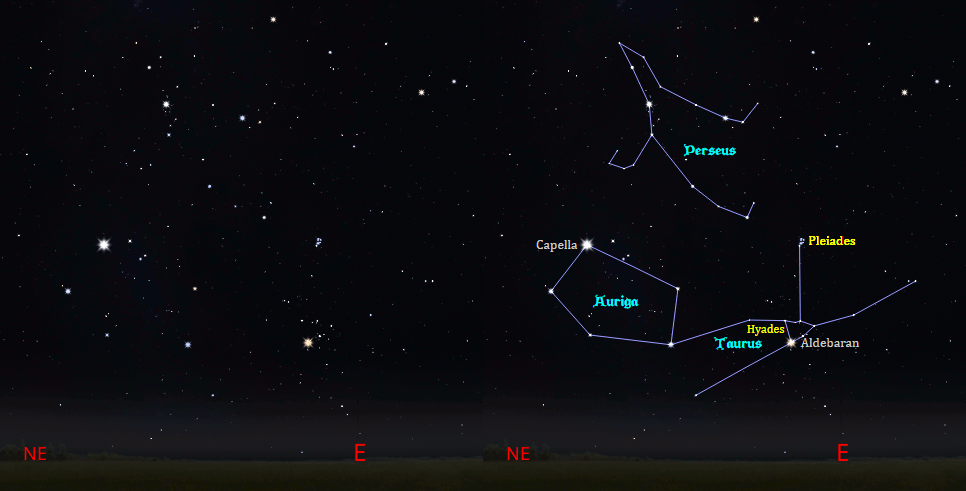
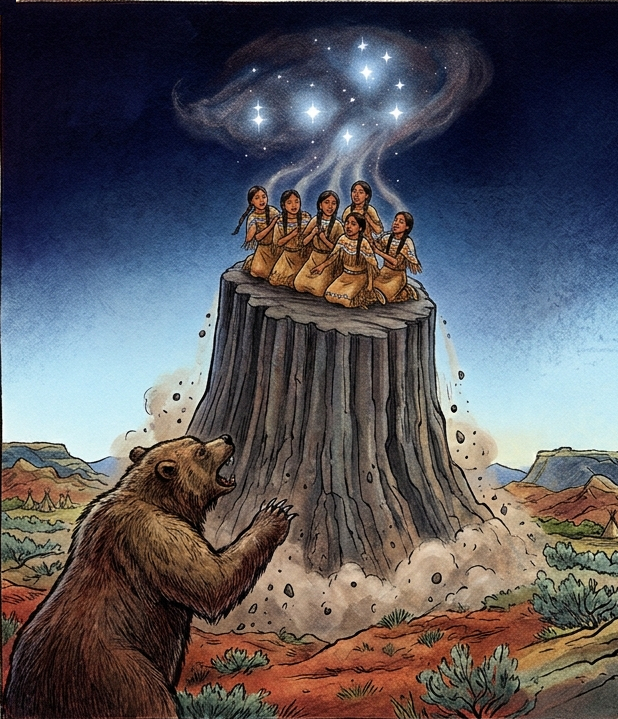
Let’s look at how some native cultures saw the Pleiades, the star cluster that is seen in the eastern sky these evenings. To the Anishinaabe native peoples around here, the Pleiades is the “Hole in the Sky”. As the Hole in the Sky it iss that passage between the Earth and the sky. It was through this that the Sky Mother broght humanity to the Earth. It is also the passage through which the souls of the dead enter the sky to journey along the Milky Way to the hereafter. The Pleiades also represents the stones that are heated for the Sweat Lodge ceremony. To the Kiowa, the Pleiades were seven maidens chased to the top of Devils Tower, Wyoming by a giant bear. They were drawn up into the sky, where they remain as the Pleiades.
The astronomical event times given in this blog are for the Traverse City/Interlochen area of Michigan (Lat 44.7° N, Long 85.7° W; EST, UT – 5 hours) unless stated otherwise. Times will be different for other locations.
Addendum
Ephemeris: 11/05/2026 – Why is the Pleiades called the Seven Sisters when only 6 stars can be seen?
This is Ephemeris for Thursday, November 5th. Today the Sun will be up for 9 hours and 59 minutes, setting at 5:25, and it will rise tomorrow at 7:27. The Moon, half way from last quarter to new, will rise at 4:42 tomorrow morning.
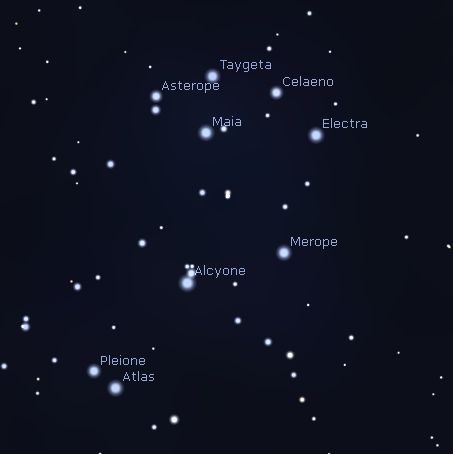
Many cultures around the world have looked at the Pleiades star cluster that’s off in the eastern sky these autumn nights as having seven stars and many as seven sisters or 7 maidens. However, the most people can see with their naked eye is 6 stars. There’s several theories about this. There are 9 named stars in the Pleiades the seven sisters themselves plus Atlas and Pleione the parents. Atlas and Pleione are the one or two stars seen at bottom as one looks at the Pleiades in the autumn sky, the end of the handle the tiny dipper. Normally only one can be seen. That’s Atlas. Pleione is a little bit off to the left of Atlas. It is thought that Pleione was farther away from Atlas in the distant past, or possibly brighter so it could be seen as a separate star.
The astronomical event times given in this blog are for the Traverse City/Interlochen area of Michigan (Lat 44.7° N, Long 85.7° W; EST, UT – 5 hours) unless stated otherwise. Times will be different for other locations.
Addendum
Ephemeris: 11/04/2026 – Taking our weekly look at the whereabouts of the naked-eye planets
This is Ephemeris for Wednesday, November 4th. Today the Sun will be up for 10 hours and 2 minutes, setting at 5:27, and it will rise tomorrow at 7:26. The Moon, 3 days past last quarter, will rise at 3:32 tomorrow morning.
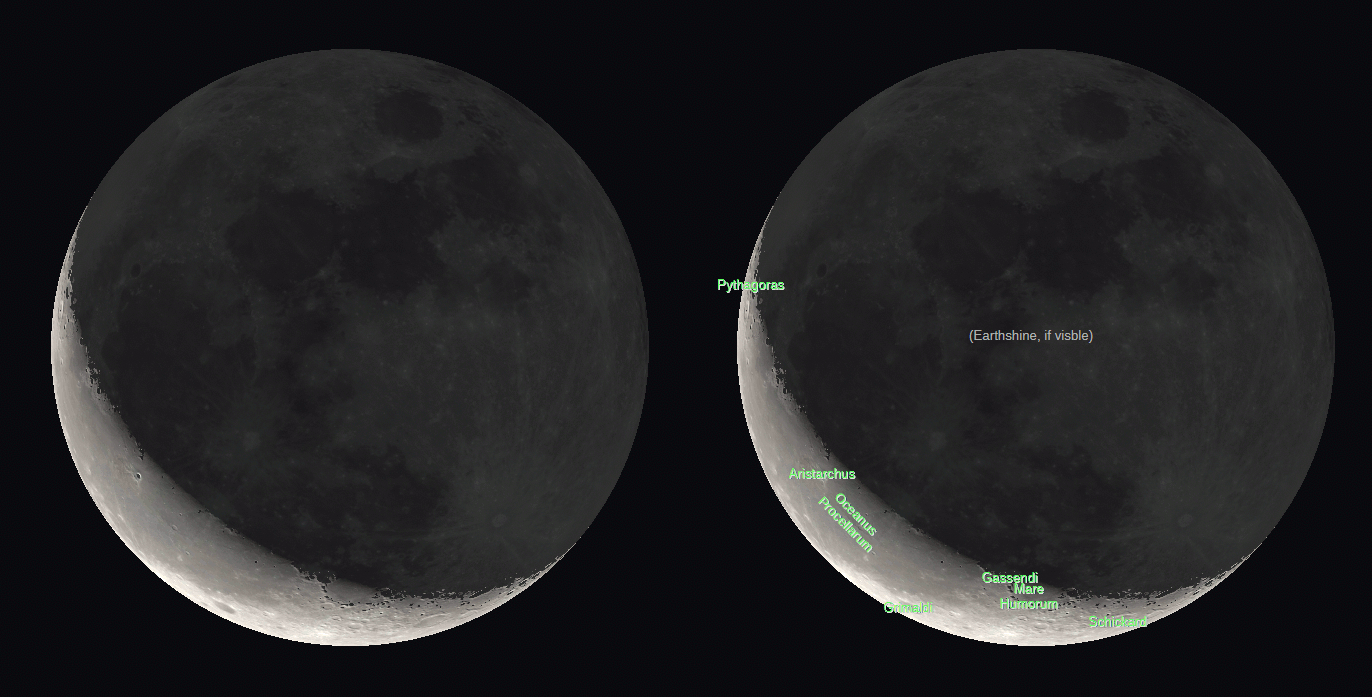
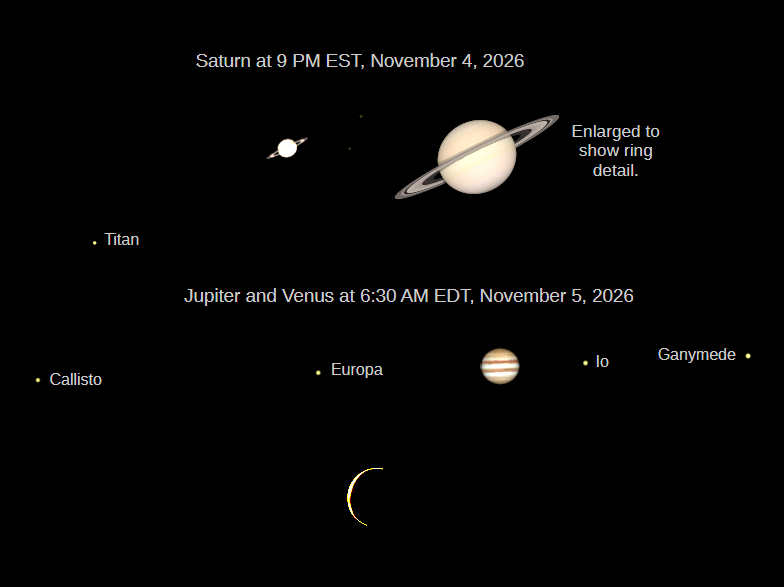
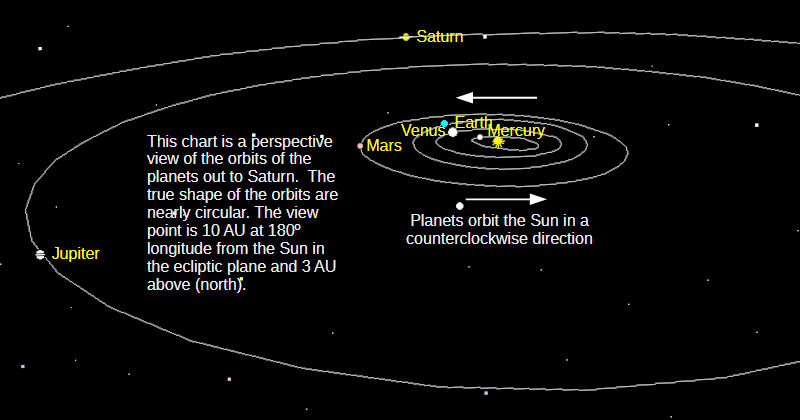
Let’s take our weekly look at the whereabouts of the naked-eye planets. Three of the naked-eye planets are visible in the night sky. Mercury moves throuigh inferior conjunction with the Sun today. Tonight, Saturn will be in the east-southeastern sky as it gets dark. It is the brightest starlike object low in that direction. Venus passed between the Earth and the Sun in inferior conjunction 12 days ago, and might be seen in the morning sky for sharp-eyed observers by 6:30 AM low in the east southeast. Jupiter and Mars will be in the southern sky by then with the waning crescent moon about halfway between them and Venus. Red Mars will be above and to the right of Jupiter and slowly closing. Mars will pass just above Jupiter on the 15th.
The astronomical event times given in this blog are for the Traverse City/Interlochen area of Michigan (Lat 44.7° N, Long 85.7° W; EST, UT – 5 hours) unless stated otherwise. Times will be different for other locations.
Addendum