Archive
06/16/2023 – Ephemeris – Twilight is longer near the summer solstice
This is Ephemeris for Friday, June 16th. Today the Sun will be up for 15 hours and 33 minutes, setting at 9:30, and it will rise tomorrow at 5:56. The Moon, 2 days before new, will rise at 5:04 tomorrow morning.
Not only does the Sun set later this time of year, but twilight lasts longer too. As of tonight the end of astronomical twilight, when the last vestiges of twilight are gone is, for the Traverse City/Interlochen area, 12:01 am, That’s two and a half hours of evening twilight. I feel that for most purposes that the end of nautical twilight, when navigators on ships could no longer see the horizon for their sextant readings, is dark enough to view most stars, and brighter objects beyond the solar system, what we call deep sky objects. That happens at 10:56 pm, or about an hour and a half after sunset. Twilight of both kinds are a third shorter around the equinoxes. These times are dependent on our latitude, and the Sun’s declination which is equivalent to latitude.
The astronomical event times given are for the Traverse City/Interlochen area of Michigan (EDT, UT –4 hours). They may be different for your location.
Addendum
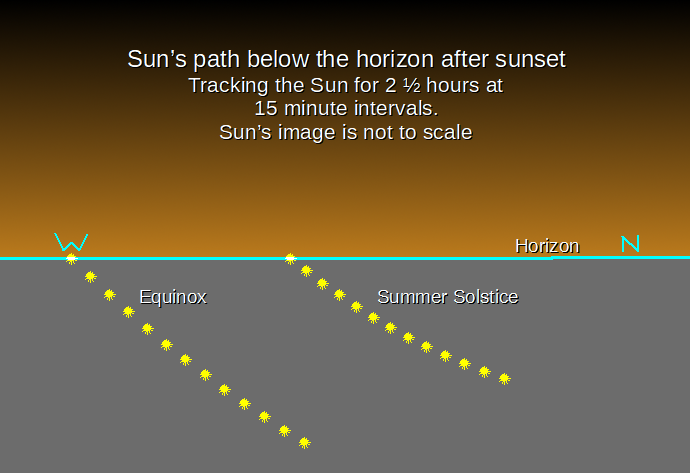
Check out my September 27, 2018 post about the different twilight periods.
06/15/2023 – Ephemeris – Today we have the earliest sunrise of the year
This is Ephemeris for Thursday, June 15th. Today the Sun will be up for 15 hours and 33 minutes, setting at 9:30, and it will rise tomorrow at 5:56. The Moon, 3 days before new, will rise at 4:28 tomorrow morning.
Today is the day of the earliest sunrise, though the time will stay within the same minute for a few days. In six days the Sun will reach it’s farthest north in our sky. And be above the horizon for fifteen hours and thirty four minutes. That’s the summer solstice for those living in the north hemisphere. It’s also known as the longest day. The retired computer programmer in me likes to take things literally, so no, June 21st, the summer solstice is not the longest day. It’s 24 hours long, like any other day, however it has the longest daylight hours. Daylight hours being defined as the time interval from sunrise to sunset, which, in Interlochen and Traverse City, is 15 hours 34 minutes. Five or six days later, we’ll have the latest sunset.
The astronomical event times given are for the Traverse City/Interlochen area of Michigan (EDT, UT –4 hours). They may be different for your location.
Addendum
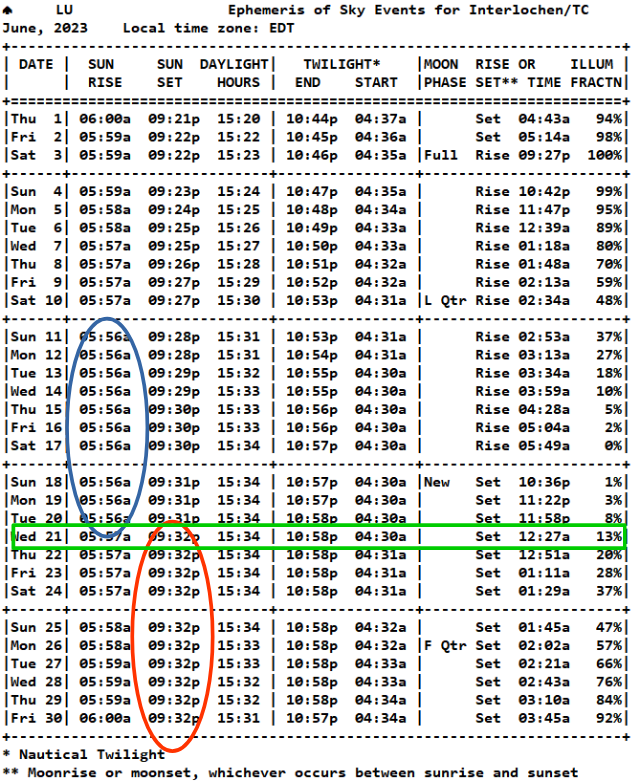
If the Earth had no axial tilt and had a circular orbit of the Sun, The earliest sunrise and latest sunset would occur on the summer solstice. But since that is not the case the Earth’s axial tilt and elliptical orbit cause the the earliest sunrise and latest sunset to differ from each other and the summer solstice.
04/24/2023 – Ephemeris – The reason for the Moon’s phases
This is Bob Moler with Ephemeris for Monday, April 24th. Today the Sun will be up for 13 hours and 55 minutes, setting at 8:38, and it will rise tomorrow at 6:42. The Moon, 3 days before first quarter, will set at 2:02 tomorrow morning.
The Moon’s changing appearance over the month may seem to be mysterious at first glance. Maybe because one may think that the objects in the sky are somehow different from the familiar objects we see around us on the Earth. In ancient times, especially the Greeks, thought that everything in the heavens was perfect and spotless. They explained the definite markings we see as the man-in-the-moon as a reflection of the Earth by a spotless Moon. The Moon’s phases are simply light and shadow on a ball in the sunlight. Sometime, when the Moon appears in the daytime, take a small ball, like a golf ball and hold it up to the Moon, while the ball is also in sunlight, and the small ball will exhibit the same phase as the Moon.
The astronomical event times given are for the Traverse City/Interlochen area of Michigan (EST, UT –4 hours). They may be different for your location.
Addendum
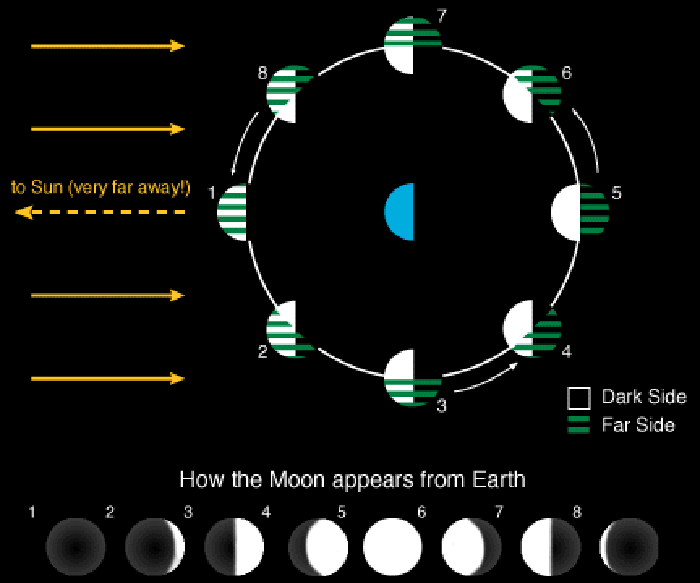
This is the best diagram of the Moon’s phases and how the it appears from the Earth. Credit http://planetfacts.org/phases-of-the-moon/ which I recommend.
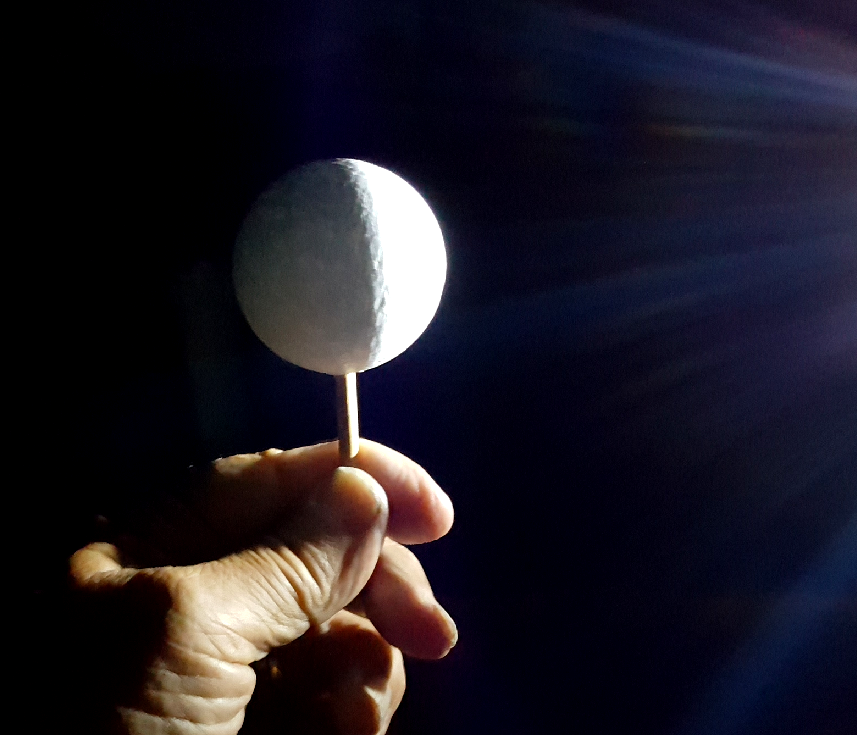
A demonstration of the Moon’s crescent phase with the styrofoam moon ball we use for Project Astro held up to a light off frame to the right. The line between the bright (day) and dark (night) side of the ball, moon or planet is called the terminator. The night side of the ball is illuminated a bit by the translucency of the ball, and the reflection off my hand. Note the roughness of the ball is visible only at the terminator, where the shadows are longest. I photographed this outside at night to minimize the ball’s nighttime illumination.
04/18/2023 – Ephemeris – Orion rotates 90 degrees from rising to setting
This is Bob Moler with Ephemeris for Tuesday, April 18th. Today the Sun will be up for 13 hours and 37 minutes, setting at 8:31, and it will rise tomorrow at 6:52. The Moon, 2 days before new, will rise at 6:43 tomorrow morning.
As the constellation of Orion the hunter, that dominated our winter skies, moves into the west in the evening, it will have rotated 90 degrees from its rising orientation. As we saw it rising last November, its three belt stars were nearly vertically aligned. Now, as Orion nears the western horizon, those belt stars have rotated to be almost horizontal. The same is true of Gemini’s two brightest stars, Castor and Pollux. They are the two stars above red Mars, which is now halfway through Gemini on its eastward travels. Orion, a minor Greek hero, is most famous for how he died. I know of three versions, all different. The one that fits Orion’s current setting is that he was killed by the sting of a giant scorpion. So he must flee the sky before Scorpius the scorpion rises, which is around midnight tonight.
This amount of rotation between rising and setting is only true for latitudes near 45 degrees north or south, such as Northern Michigan, and objects near the celestial equator. The rotation for other latitudes would be 2 x (90 – latitude) for equatorial celestial objects. The name given for the term (90 – latitude) is colatitude. 90 degrees is the latitude of the Earth’s poles.
The astronomical event times given are for the Traverse City/Interlochen area of Michigan (EST, UT –4 hours). They may be different for your location.
Addendum
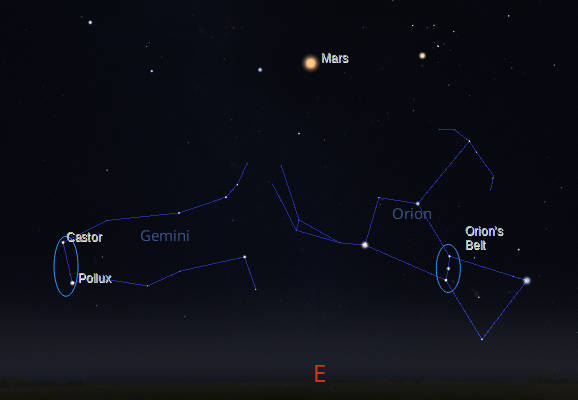
When Orion is rising, its belt stars are nearly vertically aligned. Castor and Pollux, too, appear nearly vertically aligned. This was for November 30, 2022, at 9 pm. Mars was near opposition then and quite close to the Earth, so it had shown quite brightly. Created using Stellarium and LibreOffice Draw.
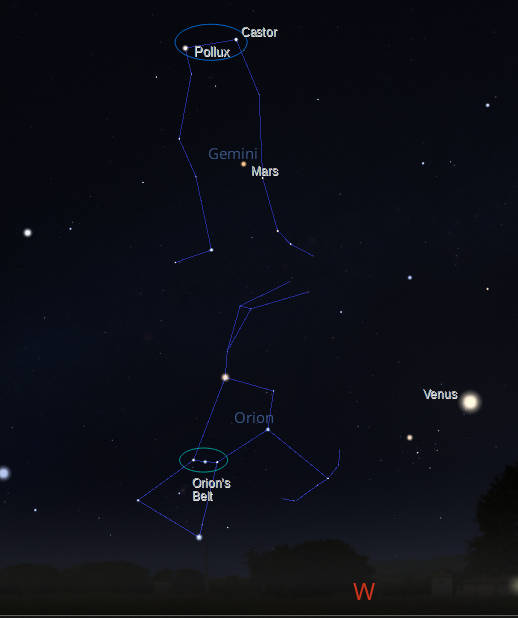
Orion’s belt stars show that the constellation has rotated about 90 degrees from their rising orientation. This is for 10 pm, April 18, 2023. Note that Venus is the Evening Star now, and Mars is much dimmer, as the Earth has moved ahead and away from it. Created using Stellarium and LibreOffice Draw, for the added labels.
03/21/2023 – Ephemeris Extra – Spring has sprung without me
Being in the hospital and now in inpatient rehab one loses a sense of time. So the vernal equinox snuck by me unnoticed. My view of the outside world is another part of the hospital, a part of the HVAC system, and a piece of sky.
Yesterday, the Sun passed over the Earth’s equator, heading northward. The Sun is gradually setting at the South Pole and rising at the North Pole. Folks like me who live in the Northern Hemisphere are experiencing longer daylight than those south of the equator, who are beginning autumn. The daylight hours will increase daily until June 21st, the summer solstice. In the Interlochen/Traverse City area, that will be 15 hours and 34 minutes.
The cause of the Earth’s seasons is not our varying distance from the Sun in our eliptical orbit of the Sun of 93 million plus or minus a million and a half miles.By the way, the Earth is currently moving away from the Sun. It will be farthest from the Sun around July 4th or 5th.
Our perception of the advance of spring, besides the gradully warming temperatures and increasing daylight hours, will be the height of the Sun’s path in the sky, and the position of the Sun’s rise and set points on the horizon. All these annual changes are angles having to do with one’s latitude (an angle), Earth’s position in orbit (an angle), and the tilt of the Earth’s axis to it’s orbit (more angles).
Bob
02/07/2023 – Ephemeris – A new view on the creation of our Moon
Feb 7. This is Bob Moler with Ephemeris for Tuesday, February 7th. Today the Sun will be up for 10 hours and 5 minutes, setting at 5:59, and it will rise tomorrow at 7:53. The Moon, 2 days past full, will rise at 7:58 this evening.
Is this how the Moon came to be? After the Apollo missions, NASA decided to look at the crust of the Moon which apparently is much like the Earth’s and came up to the conclusion that a Mars sized body they called Theia, after the mother of the twins Apollo and Artemis, crashed into the Earth at about a 45-degree angle, and caused a ring of debris around the Earth that would be maintained for a long time. In a newer simulation, the collision could actually create two blobs of material, a large one that became our Moon, in orbit, with about one percent of the Earth’s mass, and a smaller mass that fell back onto the Earth.
The astronomical event times given are for the Traverse City/Interlochen area of Michigan (EST, UT –5 hours). They may be different for your location.
Addendum
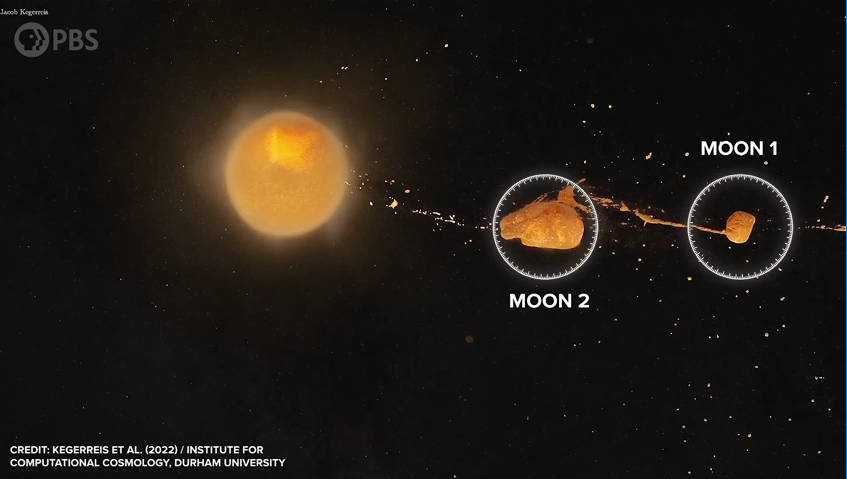
A new simulation on how the Moon formed. Credit: PBS.
12/09/2022 – Ephemeris – The earliest sunset of the year
This is Bob Moler with Ephemeris for Friday, December 9th. Today the Sun will be up for 8 hours and 53 minutes, setting at 5:02, and it will rise tomorrow at 8:09. The Moon, 2 days past full, will rise at 5:59 this evening.
We are at the period of time of the earliest sunset, in the middle of a 13-day stretch where the Sun sets within the same minute. We are still 12 days from the winter solstice, the day of the shortest daylight hours, on the 21st. The reason is twofold. The Sun is near its farthest position south of the equator, where the longitude lines are closer together, so it takes less time to cross them. 15 degrees in longitude equals one hour in Earth’s rotation. Add to that we are less than a month from Earth’s perihelion in its orbit of the Sun, that is at its closest, and is moving faster than average. The combined effects delay sunrise and sunset, from what they’d be if the Sun was on the equator and the Earth’s orbit was circular. We will have our latest sunrise on January 2nd.
The astronomical event times given are for the Traverse City/Interlochen area of Michigan (EST, UT –5 hours). They may be different for your location.
Addendum
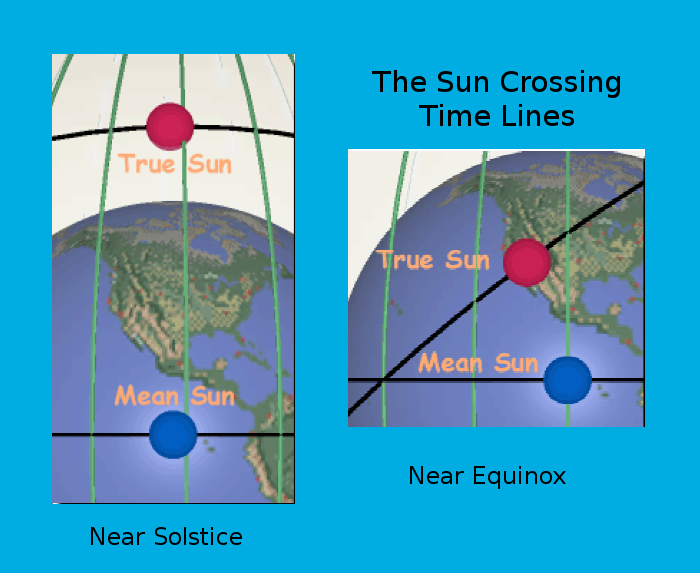
How the Sun’s declination affects how rapidly it appears to cross time lines (meridians)
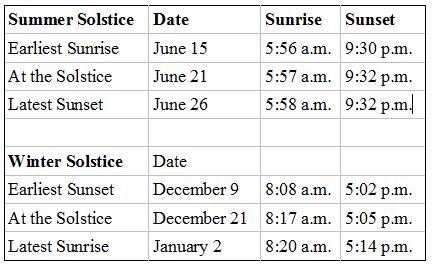
Table of Earliest and Latest Sunrises and Sunsets during the year for Interlochen/Traverse City area of Michigan.
In December the Earth is approaching perihelion, its closest to the Sun, so it moves faster than average. This makes the Sun to appear to move faster eastward against the stars in our sky. This tends to make our sunrises, apparent local noons and sunsets later than they would otherwise be. This makes sunset bottom out early and extends the date of the latest sunrise
For the June or summer solstice around here, the Earth is near aphelion, its farthest from the Sun where the Earth is at its slowest in its orbit. By reflection, the Sun appears to move its slowest against the stars in our sky. This effect works against the high latitude effect, making the effect smaller. Looking at the table above, the days between the earliest and latest times is shorter for the summer solstice than for the winter solstice.
10/31/2022 – Ephemeris – The perfect Halloween star
This is Bob Moler with Ephemeris for Halloween, Monday, October 31st. Today the Sun will be up for 10 hours and 13 minutes, setting at 6:32, and it will rise tomorrow at 8:20. The Moon, 1 day before first quarter, will set at 12:02 tomorrow morning.
Not all the ghosts and goblins out tonight will be children. One is out just about every night because it’s a star. Its name is Algol, from the Arabic for Ghoul Star or Demon Star. It’s normally the second-brightest star in the constellation Perseus the hero, visible in the northeast this evening. The star is located where artists have drawn the severed head of Medusa, whom he had slain. Medusa was so ugly that she turned all who gazed upon her to stone. Algol is her still glittering eye. The star got the name before astronomers discovered what was really wrong with it. They found out that it does a slow wink about every two days, 21 hours because Algol is two stars that eclipse each other. Her next evening wink will be dimmest at 10:25 p.m. November 19th.*
The astronomical event times given are for the Traverse City/Interlochen area of Michigan (EDT, UT – 4 hours). They may be different for your location.
Addendum
*For the broadcast, the source for the Algol minimum brightness time was the Stellarium app. For whichever date the sky is displayed for and Algol is clicked on, among the data for the star that is displayed is next minimum light. However, in double-checking the times with those posted in Sky & Telescope magazine after I recorded the program, it turns out to be 3 hours 46 minutes early, so minimum light would be at 1:36 am on November 17th. At the time given then, the eclipse would just be starting. The actual first eclipse minimum in the evening in November would be at 10:25 pm on the 19th. I hope it’s clear on the night of the 16/17th to see which prediction is right. In the past, S&T was accurate, or accurate enough.
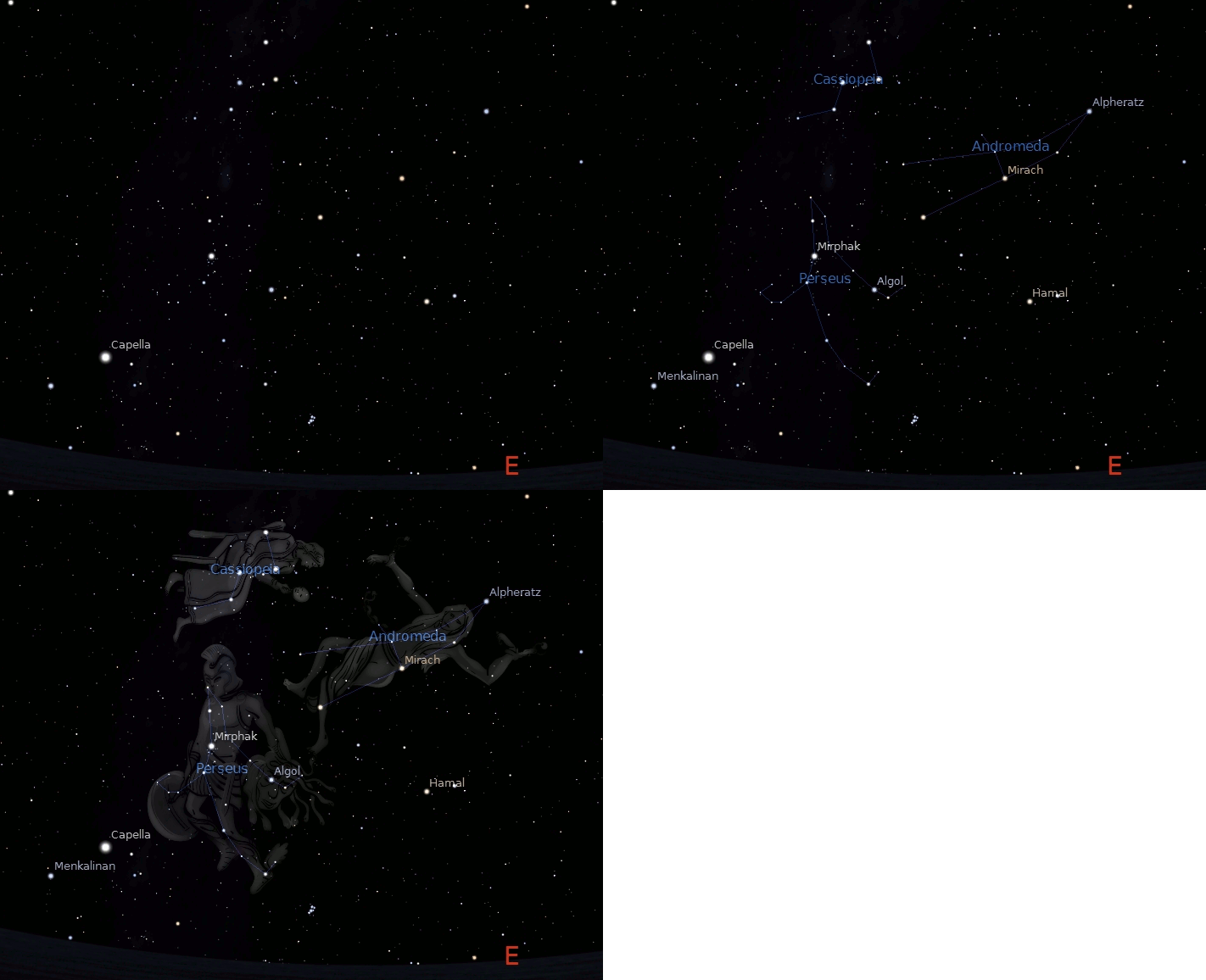
Perseus, Cassiopeia, Andromeda with Algol finder animation for Autumn evenings. Click on the image to enlarge it. Created using Stellarium and GIMP.
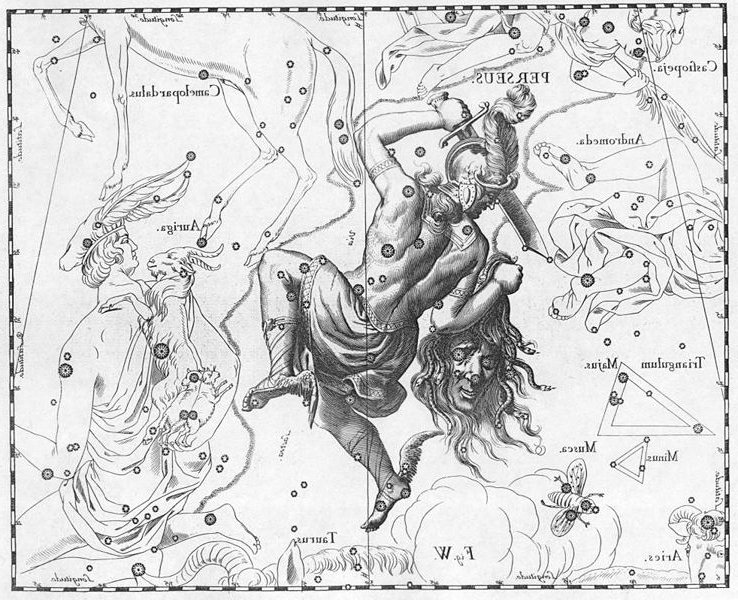
Perseus and the head of Medusa from the 1690 Uranographia by Johannes Hevelius. Note that the captions in the image are as seen in a mirror. Early star representations were painted on a globe, a celestial sphere, so the stars and constellations were shown as seen from the outside. A God’s eye view. Early printed star charts simply kept the convention. I reversed the image, so it is seen from inside the celestial sphere. An Earthly view to match the sky as we see it. The image was found with the article on Algol on Wikipedia.
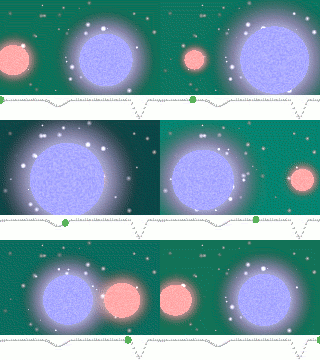
Animation of an eclipsing binary star like Algol. Credit: Wikimedia Commons h/t Earth and Sky
10/28/2022 – Ephemeris – Mars is turning around this weekend
This is Bob Moler with Ephemeris for Friday, October 28th. Today the Sun will be up for 10 hours and 21 minutes, setting at 6:37, and it will rise tomorrow at 8:16. The Moon, 3 days past new, will set at 8:39 this evening.
This Sunday the 30th, the planet Mars will cease its normal eastward motion in relation to the stars, and backtrack to the west for a while. The instant Mars stops its eastward motion, it is said to be stationary. The backtracking is called retrograde motion, which was hard for ancient astronomers to explain because they thought the Earth was not moving and in the center of the universe. And the planets moved in uniform circular motion. So said the Greeks, because they thought that things in the heavens were perfect, not like the imperfect things of the Earth. Mars was a hard case. Its motion was definitely not uniform or circular. To Copernicus, the retrograde motion meant that the Earth was a planet passing another planet in their race around the Sun.
The astronomical event times given are for the Traverse City/Interlochen area of Michigan (EDT, UT – 4 hours). They may be different for your location.
Addendum
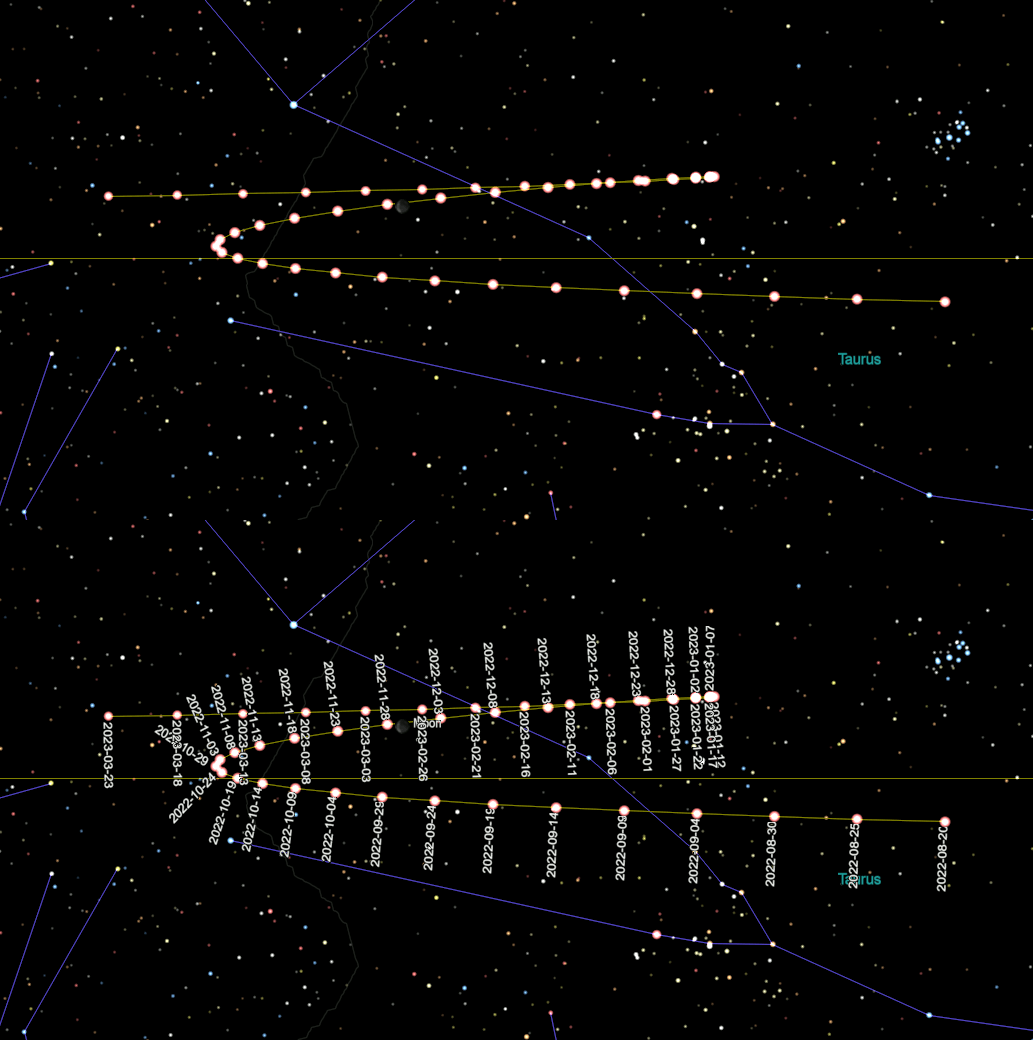
Mars retrograde path from October 29, 2022 to January 11, 2023 against the stars of Taurus the bull. It will be at opposition on December 7, and actually closest to the Earth on November 30 at 50.61 million miles or 81.45 million kilometers. In the upper right is the beautiful Pleiades star cluster, also known as the Seven Sisters. Below and right is the V shaped star cluster that represents the face of Taurus the bull, with the bright red star Aldebaran as the bull’s angry red eye. That V of stars is called the Hyades, who in mythology were the half sisters to the Pleiades. Click on the image to enlarge it. Created using Cartes du Ciel (Sky Charts) and GIMP.
10/25/2022 – Ephemeris – This eclipse season starts with a partial solar eclipse, but not for us
“But not for us” means not for Michigan in the United States. This is a script, as always, for a local radio program. Which also mentions the midterm election day, two weeks from now, which coincides with the total lunar eclipse that morning. I’ll have an Ephemeris Extra post before the lunar eclipse, which looks into the next few lunar and solar eclipses visible in Michigan and the United States.
This is Ephemeris for Tuesday, October 25th. Today the Sun will be up for 10 hours and 30 minutes, setting at 6:41, and it will rise tomorrow at 8:12. The Moon is new today, and won’t be visible.
The Moon will be visible in a negative way for some folks at this time. There is a partial solar eclipse in progress now for parts of Europe, Asia and Africa. So that thing blocking the northern part of the Sun for them will be the Moon. Being a partial eclipse means that an eclipse season has started, and we should have a lunar eclipse in about two weeks, when the Moon is full. There sure is, and it’s visible from here. In exactly two weeks, there will be. In the early morning hours of November 8th, Election Day, a total eclipse of the Moon. And if you’re standing outside the polling place waiting for the polls to open at 7 am, and it’s clear, and you have a view to the west, the partially eclipsed Moon will still be visible. That will be the ending partial phase of the eclipse.
The astronomical event times given are for the Traverse City/Interlochen area of Michigan (EDT, UT – 4 hours). They may be different for your location.
Addendum
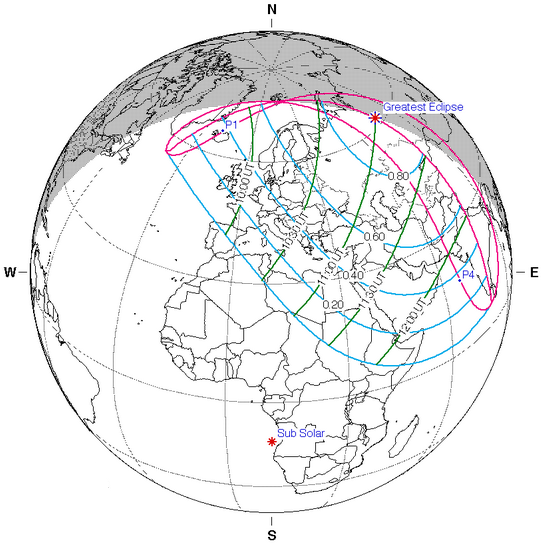
Map for the area on the Earth where the partial solar eclipse of October 25, 2022, will be visible. Credit: NASA/GSFC, Fred Espenak.
 Bob Moler's Ephemeris Blog