Archive
08/04/2016 – Ephemeris – Mars’ lookalike star
Ephemeris for Thursday, August 4th. The Sun rises at 6:32. It’ll be up for 14 hours and 30 minutes, setting at 9:03. The Moon, 2 days past new, will set at 10:01 this evening.
As it gets dark this evening a bright reddish star will appear low in the south. It will appear to twinkle mightily. It is not the planet Mars, which is brighter and to the right of it, but its rival the star Antares in Scorpius the scorpion. The star’s name, Antares, notes the rivalry. “Ant” means anti, while “Ares” is the Greek name for the Roman god Mars. Antares literally means “Rival of Mars”. Antares appears red due to its cool surface temperature of 3,600 Kelvin, much cooler than the sun’s 6,000 Kelvin, while Mars is red due to rust. Watch nightly as Mars slowly approaches Antares, and will pass it on the 24th. Being always low in the sky, Antares’ spectacular twinkling has sparked more than a few emails about a strange light in the sky.
Times are for the Traverse City/Interlochen area of Michigan. They may be different for your location.
Addendum
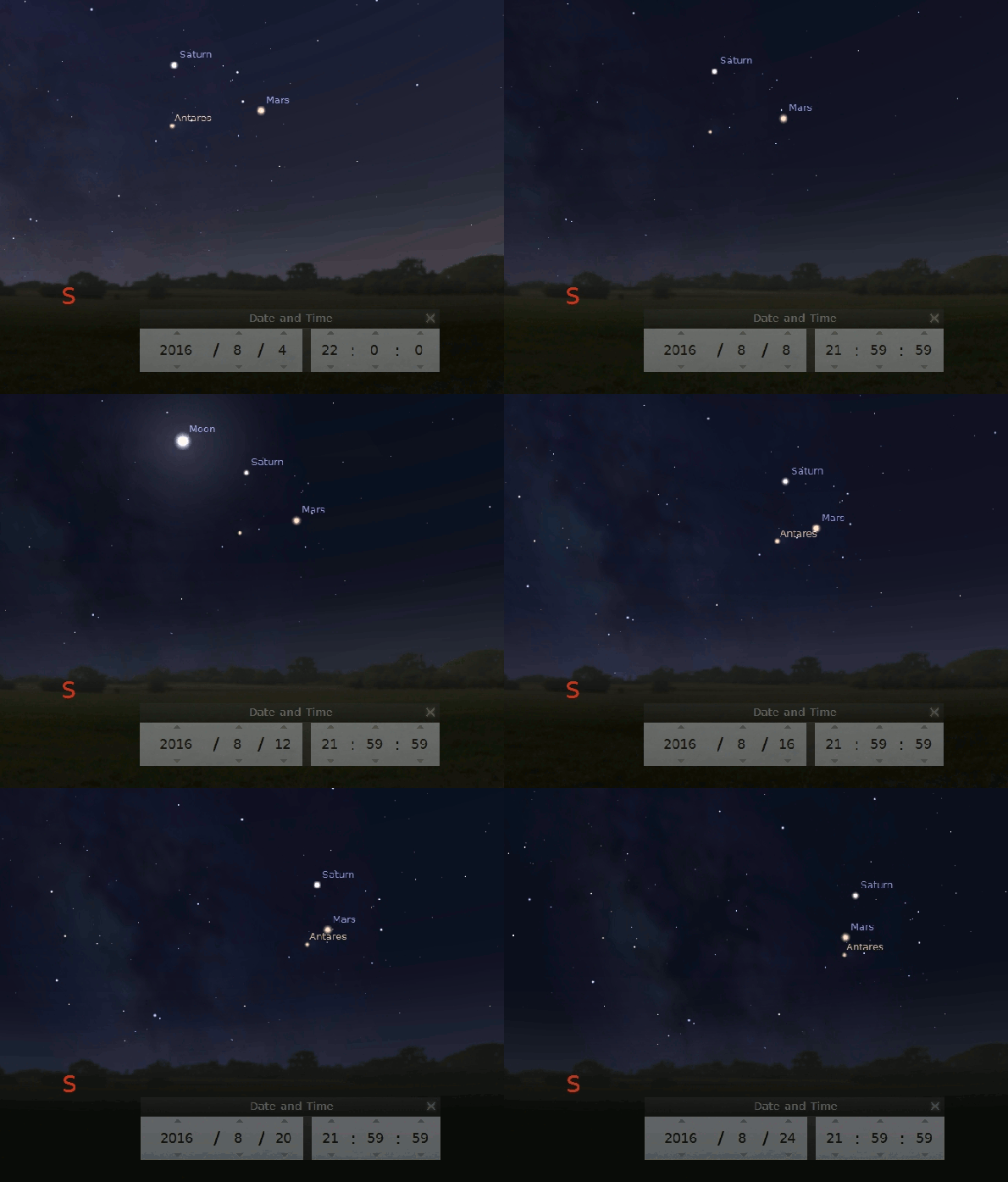
Animation of Mars approaching Antares from August 4 to the 24th, 2016 at 10 p.m. Created using Stellarium and GIMP.
02/23/2016 – Ephemeris – The king of the planets is planning to conquer the evening sky. Tonight its enlisting help from the Moon.
Ephemeris for Tuesday, February 23rd. The Sun will rise at 7:31. It’ll be up for 10 hours and 50 minutes, setting at 6:21. The Moon, 1 day past full, will rise at 7:32 this evening.
Rising with the Moon tonight will be the planet Jupiter which will appear to the left of the Moon as they rise, to the upper left of the Moon at 10 p.m. and above the Moon at midnight. NASA’s Juno spacecraft, launched in 2011, is planned to arrive at Jupiter on July 4th this year. No, it’s not a coincidence. It will orbit the planet for nearly two years. It’s the only solar-powered spacecraft that can operate as far from the Sun as Jupiter, which is 5 times farther from the Sun as the Earth, which gets one 5th squared or one twenty-fifth the intensity of sunlight. It has 3 huge solar panels making the spacecraft 66 feet wide. It’s mission is about Jupiter, its internal structure, atmosphere and magnetic and radiation fields.
Times are for the Traverse City/Interlochen area of Michigan. They may be different for your location.
Addendum
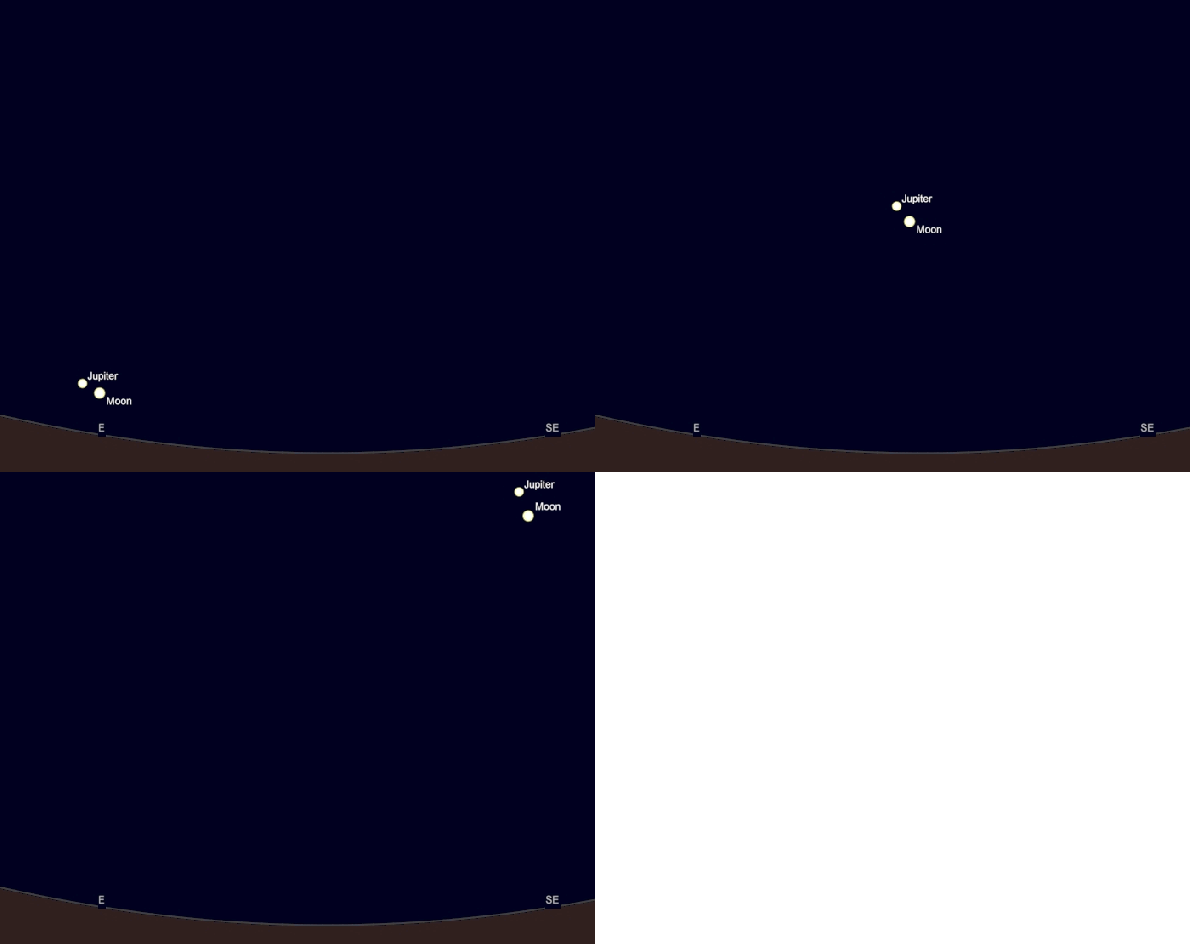
Jupiter and the Moon animation. Note their change in position relative to each other at 8 p.m., 10 p.m. and midnight. Created using Cartes du Ciel (Sky Chart) and GIMP.
.m.
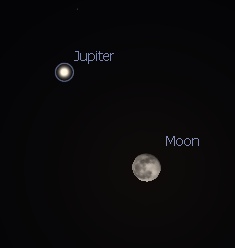
Closeup of Jupiter and the Moon at 10 p.m., February 23, 2016. The Moon is a whole lot brighter, and Jupiter dimmer than what’s shown here. Created using Stellarium.
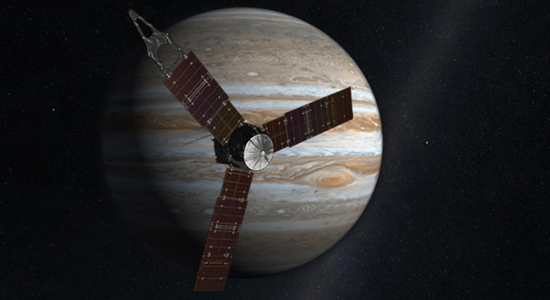
The Juno spacecraft. Credit: NASA.
01/14/2016 – Ephemeris – Mercury joins the rest of the bright morning planets
Ephemeris for Thursday, January 14th. The Sun will rise at 8:17. It’ll be up for 9 hours and 9 minutes, setting at 5:26. The Moon, 2 days before first quarter, will set at 11:08 this evening.
After 9:03 this morning all the bright planets, known from antiquity, will be in the morning sky. To be a morning planet one must be in the sky at sunrise. And even though Jupiter rises before midnight, it is still in the sky at sunrise. It will leave the morning sky and enter the evening sky February 6th when it moves in opposition with the Sun and rises at sunset. Mercury is joining the morning planets by passing inferior conjunction with the Sun this morning, however this is not a good time of year to spot it in the morning. In the later part of February, we may have a shot at spotting it. However folks in the southern hemisphere will have better luck at spotting it, because it too is in the southern part of the sky.
Times are for the Traverse City/Interlochen area of Michigan. They may be different for your location.
Addendum
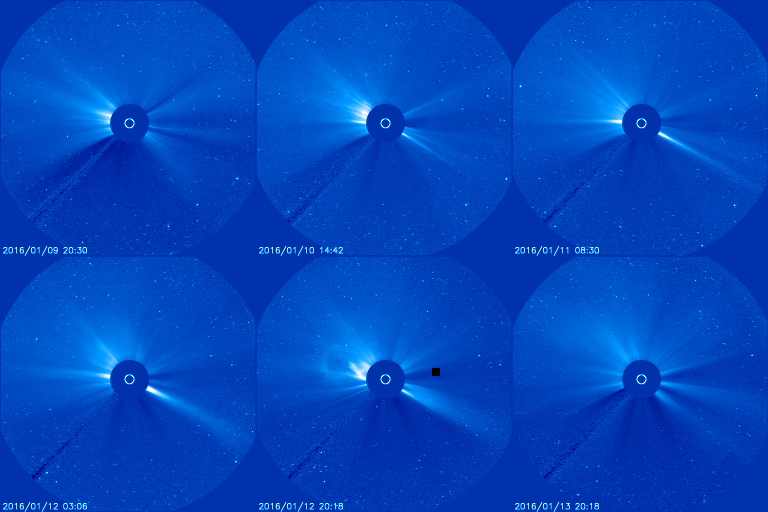
Solar and Heliospheric Observatory (SOHO) LASCO C3 coronograph animated GIF of a three day period 1/10 to 1/13/2016 image of the Sun. Mercury will enter the picture above center on the left on 1/11. Mercury is not very bright due to the fact that the Sun is illuminating it on the other side. We’re seeing mostly the unlit side. Credit ESA/NASA.
01/08/2016 – Ephemeris – A telescope clinic tonight and Venus and Saturn get cozy tomorrow morning
Ephemeris for Friday, January 8th. The Sun will rise at 8:19. It’ll be up for 9 hours even, setting at 5:19. The Moon, 1 day before new, will rise at 7:35 tomorrow morning.
If you’ve received a telescope for Christmas and are having trouble setting it up, or have an unused one in a closet somewhere, bring them to Northwestern Michigan College’s Rogers Observatory tonight at 8 p.m. The Grand Traverse Astronomical Society will be holding their annual telescope clinic to help you understand and use your telescope. The clinic will extend through the period that will be set aside for a star party if it’s clear. Tomorrow morning the planets Venus and Saturn will appear close together low on the southeastern horizon. They should be high enough to spot by 6 a.m. and will be visible in the brightening twilight til about quarter to eight a.m. Dimmer Saturn will be about 2/3rds of a Moon width to the right of Venus.
Times are for the Traverse City/Interlochen area of Michigan. They may be different for your location.
Addendum
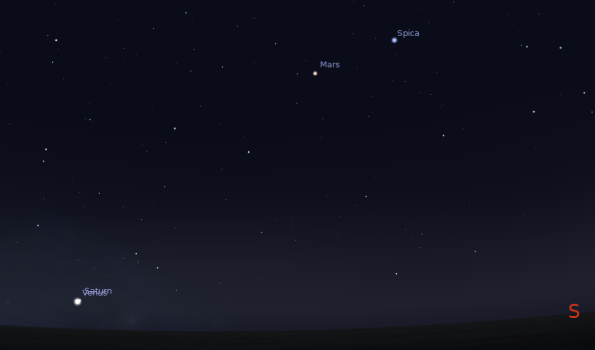
Mars with Venus and Saturn close together. at 6 a.m. January 9, 2016. Created using Stellarium.
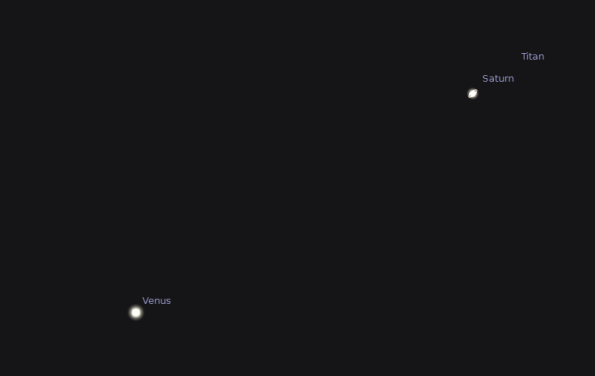
Low power telescope view of Venus and Saturn at 6 a.m. January 9, 2016. At this time the planets are about 20 minutes of arc apart, about 2/3rds the width of the Moon apart. Created using Stellarium.
The actual conjunction of these two planets will occur at 2:42 a.m. (7:42 Hrs UT). Folks in the UK and Europe will spot these two planets even closer together.
12/24/2015 – Ephemeris – Jupiter and Venus the “Star” of Bethlehem?
Ephemeris for Christmas Eve, Thursday, December 24th. The Sun will rise at 8:18. It’ll be up for 8 hours and 48 minutes, setting at 5:06. The Moon, 1 day before full, will set at 8:02 tomorrow morning.
Last year August and earlier this year in June we had a near repeat of two very close conjunctions of Jupiter and Venus that occurred in 3 and 2 BC. These two conjunctions spaced by a month more than the human gestation period and seen against the constellation of Leo the lion, symbol of Judah could have brought the Magi, who were Persian astrologer-priests to Jerusalem, capital of Judea. The events could have signified the them the birth of a king of Judea. It was the interpretation of the scriptures by the scribes that actually sent them to Bethlehem. This version of the Star of Bethlehem seems to be the one that’s being accepted more and more by those who believe the Star has a physical reality.
Times are for the Traverse City/Interlochen area of Michigan. They may be different for your location.
Addendum
Jupiter and Venus Conjunctions August 2014 and June 2015
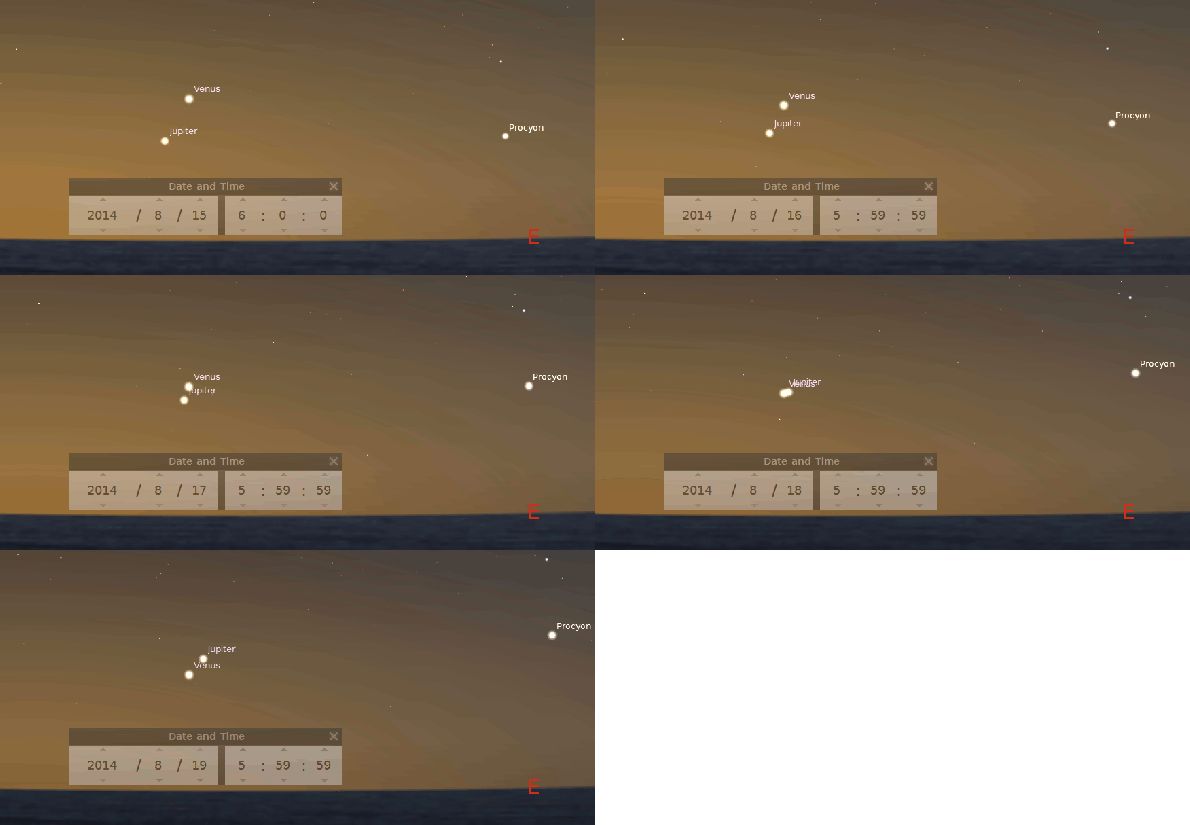
Watch Jupiter and Venus approach each other and separate. From August 15 to August 19, 2018. Created using Stellarium and GIMP.
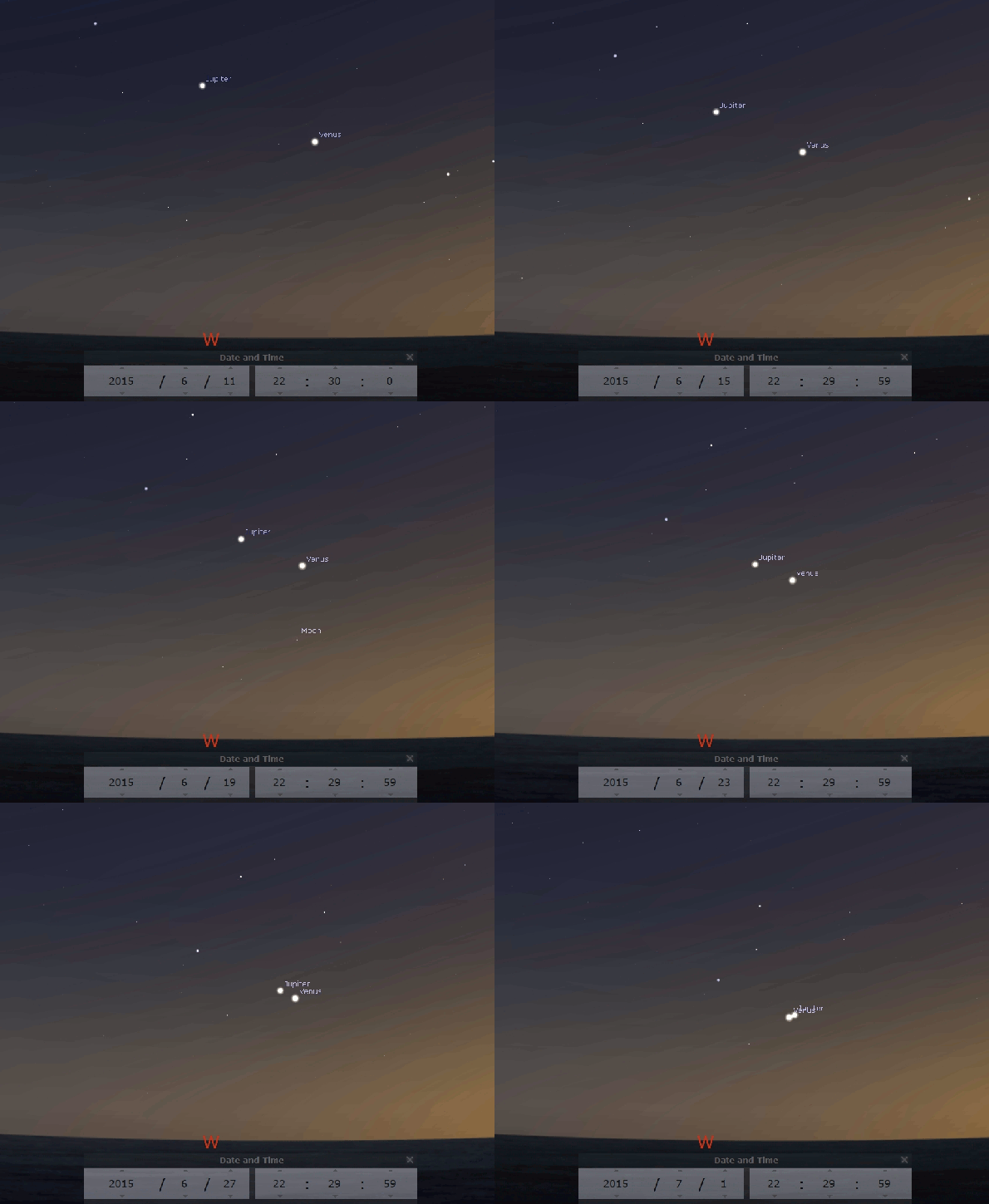
Jupiter-Venus approach animation June 11 to July 1, 2015 at 10:30 p.m. Created using Stellarium and GIMP. Click on image to enlarge.
Jupiter and Venus Conjunctions August 3 BC and June 2 BC
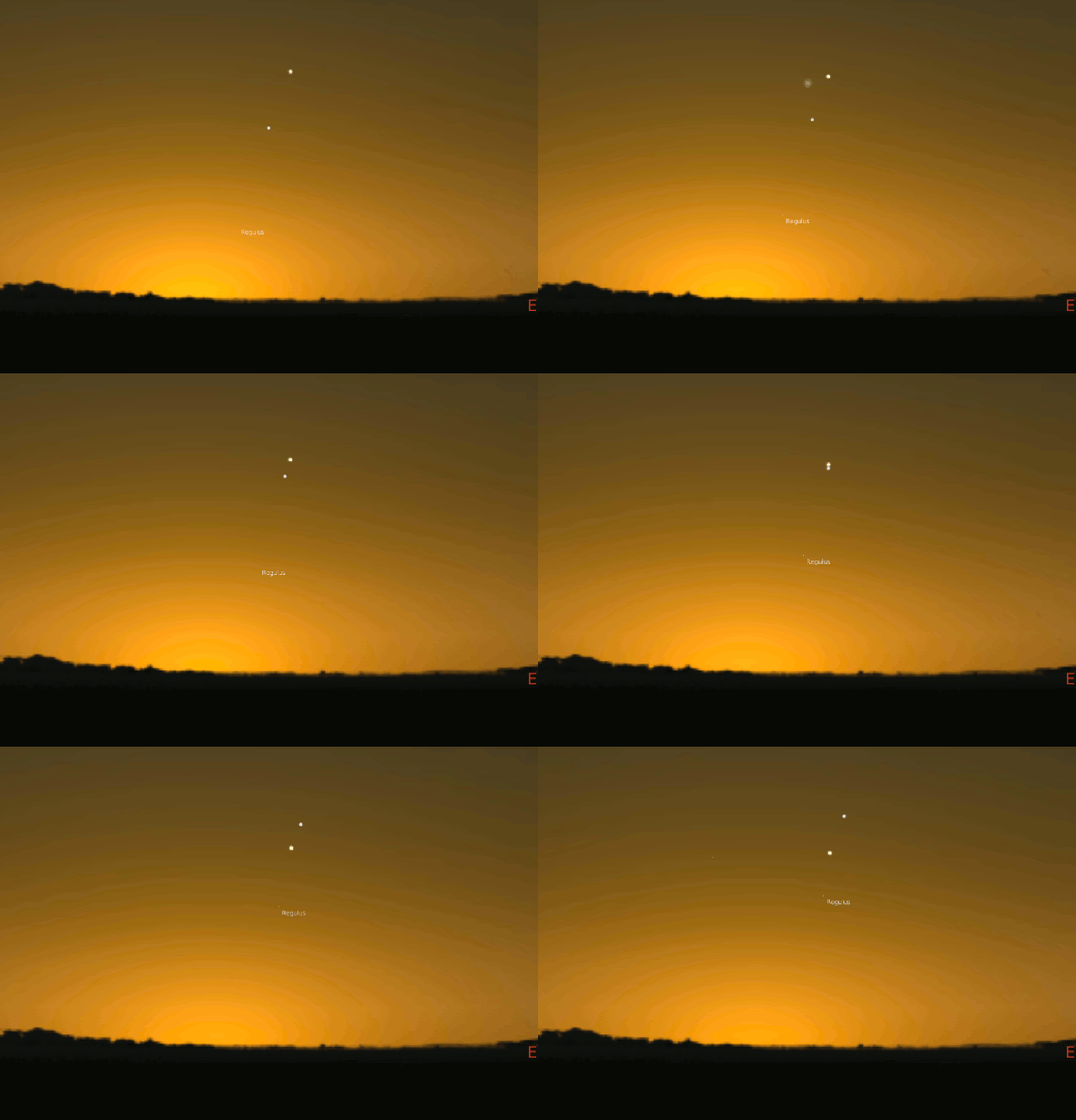
Animation of the Jupiter-Venus conjunction of August 3, 3 BC. in the morning twilight. Created using Stellarium.
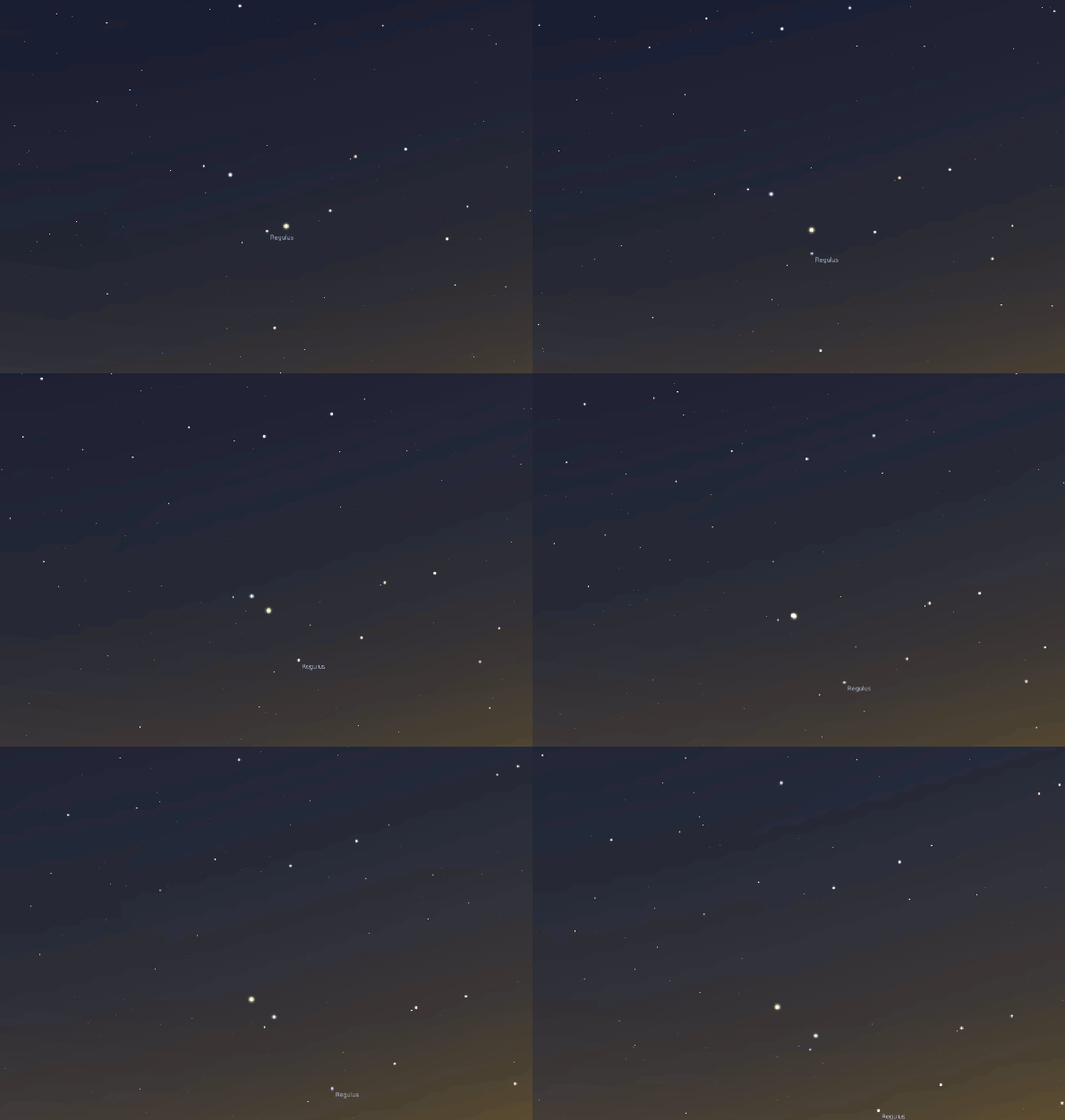
June of 2 BC just after sunset Jupiter and Venus again cross paths. Created using Stellarium.
11/05/2015 – Ephemeris – The Moon will be among the morning planets in the next two days
Ephemeris for Thursday, November 5th. The Sun will rise at 7:25. It’ll be up for 10 hours and 0 minutes, setting at 5:26. The Moon, 2 days past last quarter, will rise at 2:23 tomorrow morning.
Over the next two mornings the Moon will pass, first, the planet Jupiter and then on Saturday Mars and Venus. These will be readily visible at 6 a.m. and less so at 7 a.m. when twilight is brighter. This month and next we will have two times the Moon will actually pass in front of another bright celestial object. Both will occur in the morning. These events are called occultations. The first will be an occultation of the bright star Aldebaran, the bright star in Taurus the bull, which I sometimes call the bull’s angry bloodshot eye. That will occur on the morning of November 26th. The next will be really spectacular. On December 7th the crescent Moon will occult the planet Venus. I’ll keep you updated on both these events.
Times are for the Traverse City/Interlochen area of Michigan. They may be different for your location.
Addendum
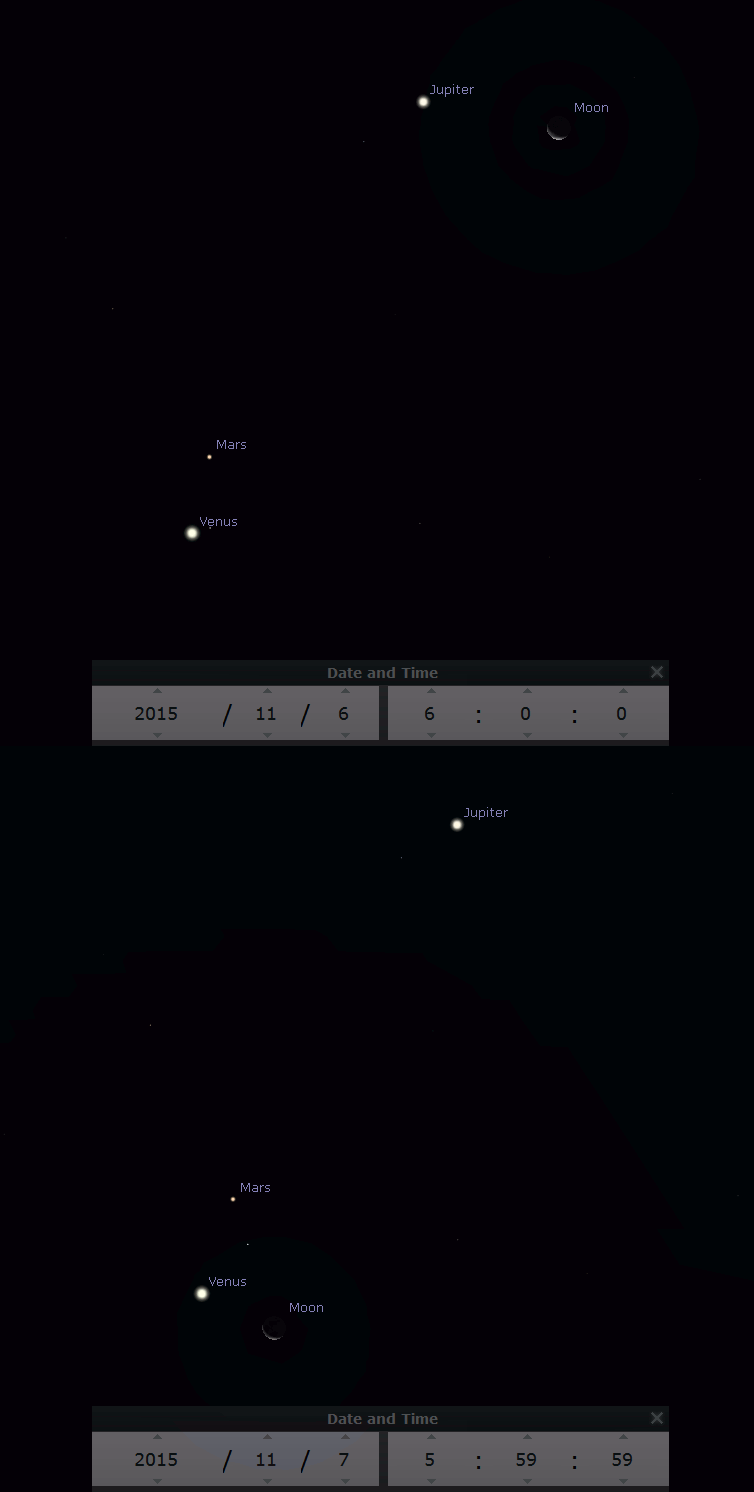
Animation of the Moon passing Jupiter tomorrow morning and Mars and Venus Saturday morning. Created using Stellarium and GIMP.
10/03/2015 – Ephemeris – Venus and Mars pass each other this morning
Ephemeris for Tuesday, November 3rd, election day for some localities. The Sun will rise at 7:23. It’ll be up for 10 hours and 5 minutes, setting at 5:29. The Moon, at last quarter today, will rise at 12:26 tomorrow morning.
This morning the planets Mars and Venus will cross paths. Mars, which is much dimmer, will appear about 2 Moon diameters above and left of Venus. In fact if you view them at 7 a.m., binoculars may be your only hope to spot the red planet. Mars is a small planet, half the size of the Earth or Venus. It also farther from the Sun than either Venus or the Earth. When Mars is at its closest to the Earth it is actually brighter than Jupiter, but Mars varies its distance from the Earth by a great range, from 240 million miles (386 million km) at its greatest distance to about 35 million miles (56 million km) at its nearest. At its farthest, Mars is only as bright as a Big Dipper star. Venus and Jupiter also vary their brightness but to a smaller degree than Mars.
Times are for the Traverse City/Interlochen area of Michigan. They may be different for your location.
Addendum
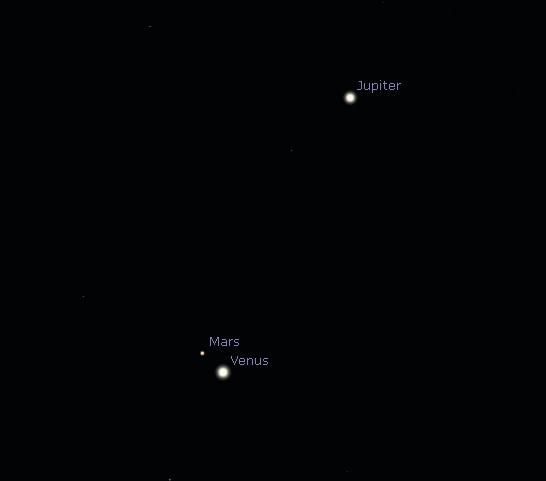
Venus in conjunction with Mars with Jupiter nearby in the southeast at 6 a.m. November 3, 2015. Created using Stellarium.
Venus is magnitude -3.95, distance is 113 million km, or 72 million miles away.
Mars is magnitude 1.88, distance is 326 million km or 203 million miles away.
Jupiter is magnitude -1.40, distance is 886 million km or 550 million miles away.
10/23/2015 – Ephemeris – Jupiter approaches Venus this weekend
Ephemeris for Friday, October 23rd. The Sun will rise at 8:08. It’ll be up for 10 hours and 36 minutes, setting at 6:45. The Moon, 3 days past first quarter, will set at 4:23 tomorrow morning.
Over the weekend the planets Venus and Jupiter will approach each other, until on Monday morning they will be a bit more than a degree apart, or twice the diameter of the Moon apart. Of course in reality Jupiter is far more distant than Venus. Jupiter is 563 million miles (906 million km) away, while Venus is only 63 million miles (101 million km) away, about a ninth of Jupiter’s distance. Also, on Monday Venus will be at its greatest western elongation from the Sun, that is its greatest angular separation from the Sun of 46 degrees. Venus, like Mercury, which went through its greatest western elongation last week have orbits of the Sun inside that of the Earth, so never stray far from it. Venus never rises or sets more than 3 hours from the Sun.
Times are for the Traverse City/Interlochen area of Michigan. They may be different for your location.
Addendum
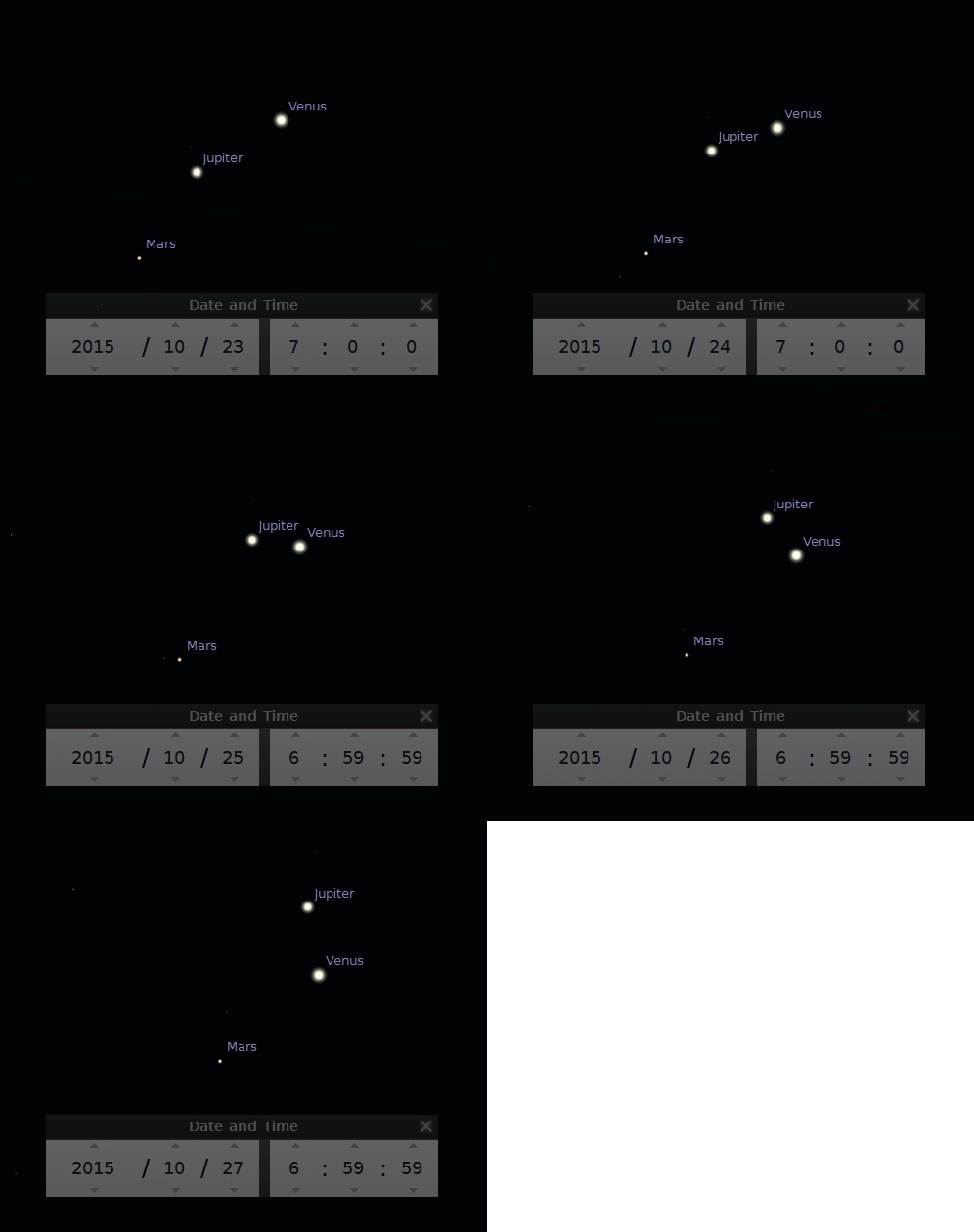
Jupiter passing Venus with Mars nearby in the east on the mornings of October 23, 24, 25, 26 and 27, 2015. Created using Stellarium and GIMP.
Check out my posts on the last two conjunctions of Jupiter and Venus in this series on August 18, 2014, and June 30, 2015. I discuss the possible connection to the Star of Bethlehem on my June 29th post.
09/18/2015 – Ephemeris – Saturn and the Moon together tonight and tomorrow a big day for the GTAS – It starts with the Leland Heritage Celebration
Ephemeris for Friday, September 18th. The Sun will rise at 7:24. It’ll be up for 12 hours and 23 minutes, setting at 7:48. The Moon, 3 days before first quarter, will set at 10:40 this evening.
Tonight the planet Saturn will appear left of and a bit below the crescent Moon. Saturn will be visible in the evening sky for 2 and a half more months with about a month where it’s high enough to see clearly in telescopes. There are two local astronomical events tomorrow. Tomorrow the Leland Heritage Celebration will take place from 11 a.m. to 4 p.m. at Fish Town in Leland. The Grand Traverse Astronomical Society will be there to show the Sun through member’s telescopes and give out NASA items for the kids. Then a few hours later the crew will be on Front Street in Traverse City for the International Observe the Moon Night starting at 7 p.m. Both events are weather dependent. Rain will affect the Leland event and clouds the evening one.
Times are for the Traverse City/Interlochen area of Michigan. They may be different for your location.
Addendum
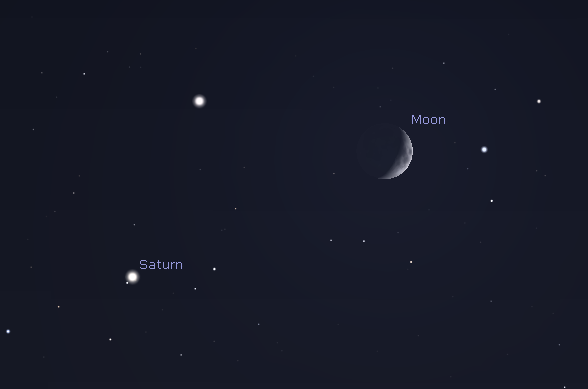
Saturn and the Moon at 9 p.m. September 18 from Northern Michigan. Created using Stellarium.
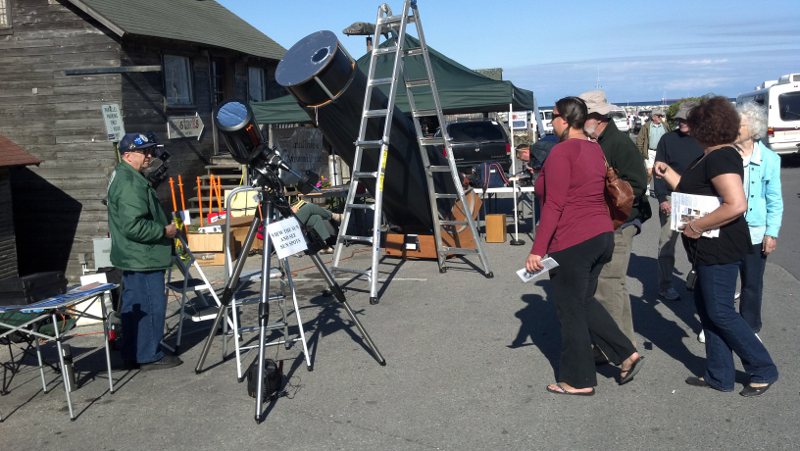
GTAS telescopes at Leland Heritage Celebration in 2011.
07/17/2015 – Ephemeris – The constellation of the harp now and Venus and the Moon tomorrow night.
Ephemeris for Friday, July 17th. Today the Sun will be up for 15 hours and 11 minutes, setting at 9:24. The Moon, 2 days past new, will set at 10:07 this evening, and tomorrow the Sun will rise at 6:14.
High in the east at 11 p.m. can be found a bright star just above a small, narrow, but very distinctive parallelogram of stars. They are the stars of the constellation Lyra the harp. The bright star is Vega, one of the twenty one brightest stars, called first magnitude stars. Vega is actually the 5th brightest night time star. The harp, according to Greek mythology, was invented by the god Hermes. The form of the harp in the sky, is as he had invented it: by stretching strings across a tortoise-shell. Hermes gave it to his half-brother Apollo, who in turn gave it to the great musician Orpheus.
Looking westward tomorrow night the planet Venus will appear about 2 moon widths above the crescent Moon.
Times are for the Traverse City/Interlochen area of Michigan. They may be different for your location.
Addendum
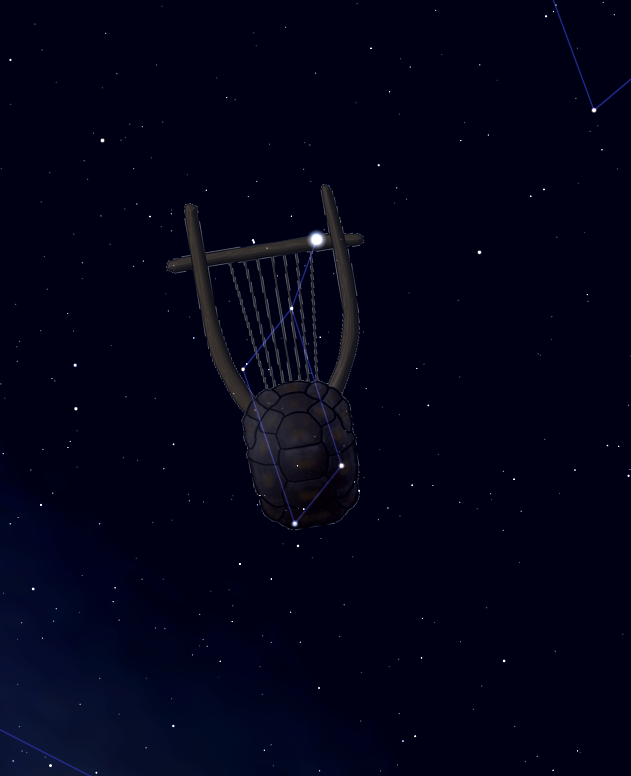
Lyra as a tortoise-shell harp. Created using Stellarium and free clip art.
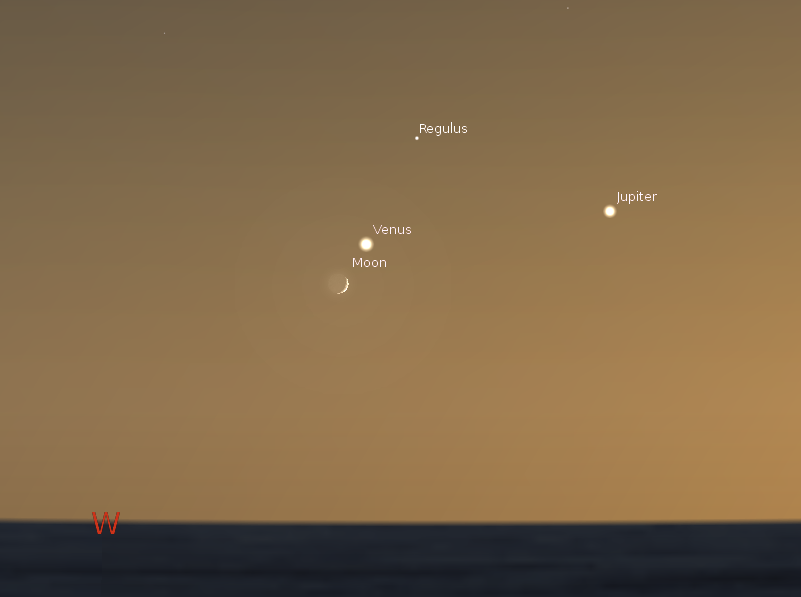
Venus appears above the thin crescent moon with Jupiter to the right at 10 p.m. Saturday July 18, 2015. Created using Stellarium.
 Bob Moler's Ephemeris Blog