Archive
08/26/2021 – Ephemeris – Two tiny summer constellations
This is Ephemeris for Thursday, August 26th. Today the Sun will be up for 13 hours and 31 minutes, setting at 8:29, and it will rise tomorrow at 6:59. The Moon, half-way from full to last quarter, will rise at 10:40 this evening. | Located below the eastern edge of the Summer Triangle of three of the brightest stars in the sky, which is nearly overhead in our sky at 10 p.m., is the tiny constellation of Delphinus the dolphin. Delphinus’ 6 stars, in a small parallelogram with a tail, really does look like a dolphin leaping out of the water. The parallelogram itself has the name Job’s Coffin. The origin of this asterism or informal constellation is unknown. Of the dolphin itself: the ancient Greeks appreciated this aquatic mammal as we do, and told stories of dolphins rescuing shipwrecked sailors. There’s another tiny constellation to the right of Delphinus, Sagitta the arrow a small thin group of 5 stars, which represents Cupid’s dart.
The astronomical event times given are for the Traverse City/Interlochen area of Michigan (EDT, UT – 4 hr). They may be different for your location.
Addendum

Delphinus and Sagitta finder animation. Created using Stellarium and GIMP.
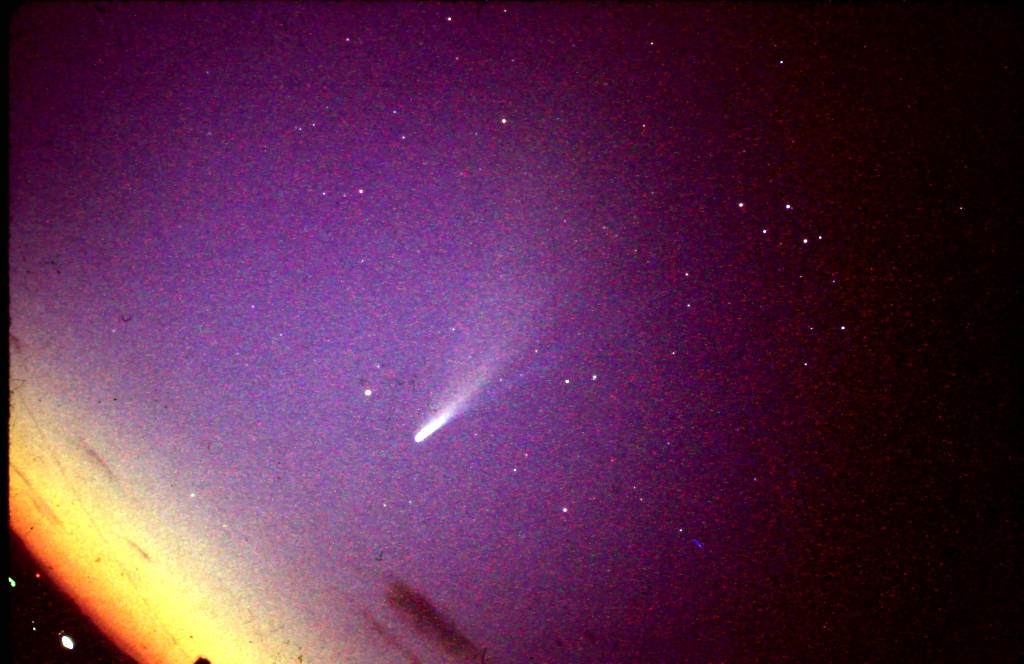
Comet West, C/1975 V1, as photographed by me at about 6 am, March 8, 1976. The wide, curved dust tail is most prominent, with the narrow blue ion tail streaming more directly away from the rising Sun. The small summer constellation of Delphinus the dolphin is to the upper right. The diamond shape of stars at the front of the dolphin’s body is an asterism called Job’s Coffin.
08/05/2021 – Ephemeris – Looking toward the center of the Milky Way in Sagittarius
This is Ephemeris for Thursday, August 5th. Today the Sun will be up for 14 hours and 29 minutes, setting at 9:02, and it will rise tomorrow at 6:35. The Moon, 3 days before new, will rise at 4:09 tomorrow morning.
Let’s look around the Teapot shape of stars that is the constellation of Sagittarius. A pair of binoculars or a telescope with a very low magnifying power is all that’s needed. The purpose here is not so much to make things bigger, but make them brighter. Right off the tip of the teapot’s spout is a large and bright patch of light. This is the farthest we can see, in visible light that is, toward the center of our galaxy, part of the central bulge. Astronomer Walter Baade discovered that fact in the mid 1940s. The center of the galaxy is 4 moon-widths or 2 degrees to the right of it, but obscured by a cloud of interstellar dust. It is called the Large Sagittarius Star Cloud or Baade’s Window. The glow there comes from 25 thousand light years away.
The astronomical event times given are for the Traverse City/Interlochen area of Michigan (EDT, UT – 4 hr). They may be different for your location.
Addendum
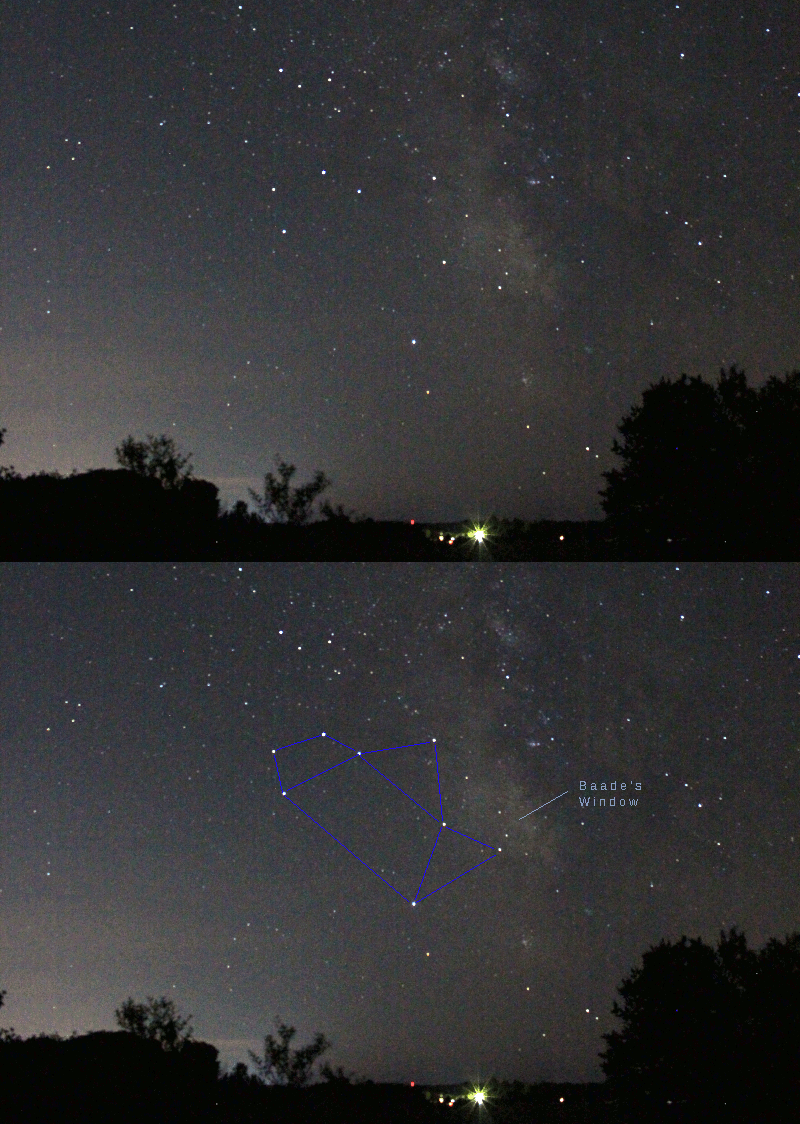
Baade’s Window, aka Large Sagittarius Star Cloud. A finder animation created from my photograph taken August 23, 2016, at 11:23 pm. Click on the image to enlarge it.
08/03/2021 – Ephemeris – Centaur or Teapot?
This is Ephemeris for Tuesday, August 3rd. Today the Sun will be up for 14 hours and 33 minutes, setting at 9:05, and it will rise tomorrow at 6:32. The Moon, 3 days past last quarter, will rise at 2:31 tomorrow morning.
In the south and low in the sky at 10:30 p.m. is one of my favorite asterisms the Teapot of the constellation Sagittarius. Sagittarius classically represents a centaur with a bow and arrow aimed at the heart of the constellation Scorpius to its west. I can find the bow and arrow here, but the half man, half horse figure of the centaur eludes me. However, the stout little teapot of the children’s song is quite obvious, with its base, lid on top, handle to the left and the spout to the right. To make things more realistic, the bright Milky Way seems to rise like steam from its spout. As the night goes on, the Teapot slides westward and appears to tilt, pouring its tea on the southwestern horizon. Its appearance in the south is an invitation to explore the milky band with binoculars.
The astronomical event times given are for the Traverse City/Interlochen area of Michigan (EDT, UT – 4 hr). They may be different for your location.
Addendum
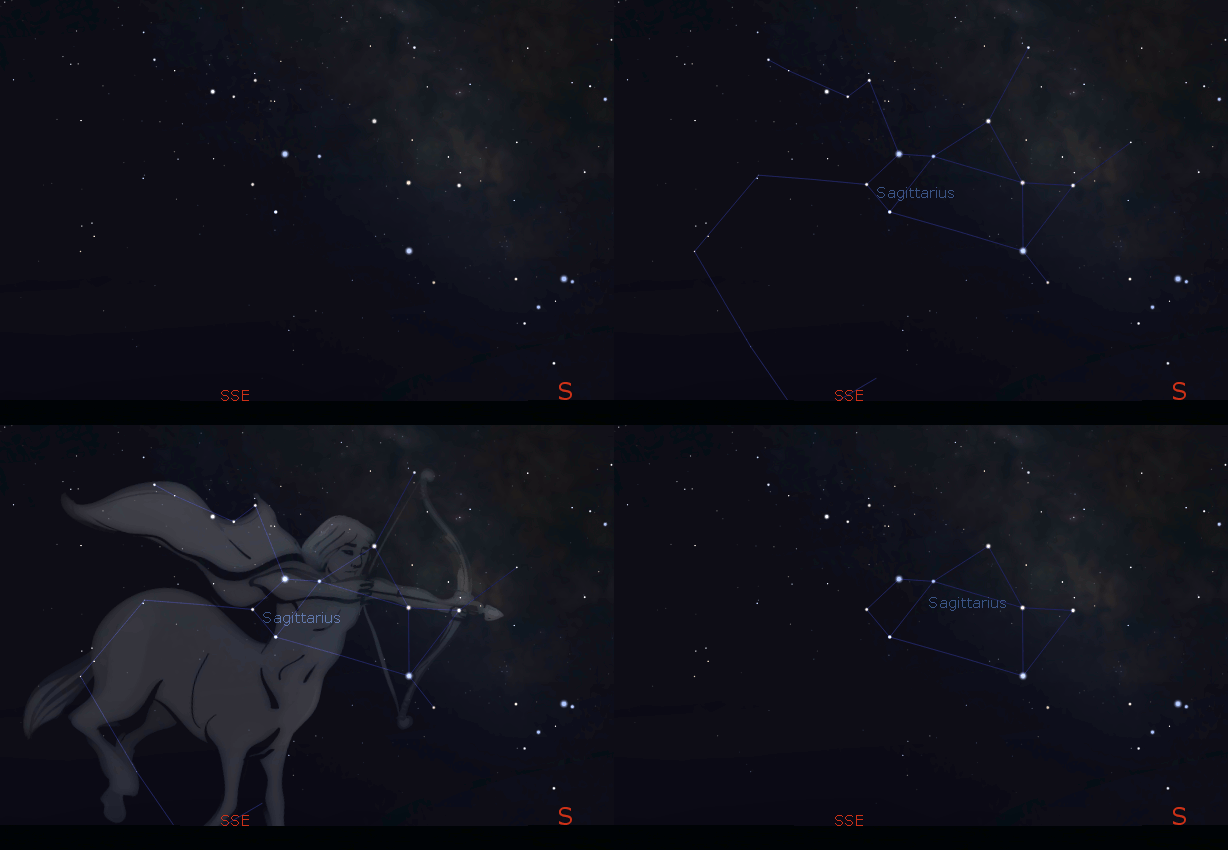
Sagittarius and the Teapot finder animation for tonight, August 3rd. Created using Stellarium.
07/27/2021 – Ephemeris – The celestial scorpion crawls over the southern horizon
This is Ephemeris for Tuesday, July 27th. Today the Sun will be up for 14 hours and 50 minutes, setting at 9:14, and it will rise tomorrow at 6:24. The Moon, halfway from full to last quarter, will rise at 11:37 this evening.
There’s a large constellation located low in the south around 10:30, 11 o’clock tonight. It’s Scorpius the scorpion. Its brightest star is Antares in its heart, a red giant star, that I used to get calls about from time to time as being a UFO. From Antares to the right is a star, then a vertical arc of three stars that is its head. The Scorpion’s tail is a line of stars running down to the left of Antares, swooping to the horizon before coming back up and ending in a pair of stars that portray his poisonous stinger. Scorpius looks huge lying on the southern horizon. But if you go south, Scorpius will be higher in the sky, and will look smaller. Being close to the horizon from here, Scorpius shares with the rising and setting sun and moon the illusion of increased size.
The astronomical event times given are for the Traverse City/Interlochen area of Michigan (EDT, UT – 4 hr). They may be different for your location.
Addendum
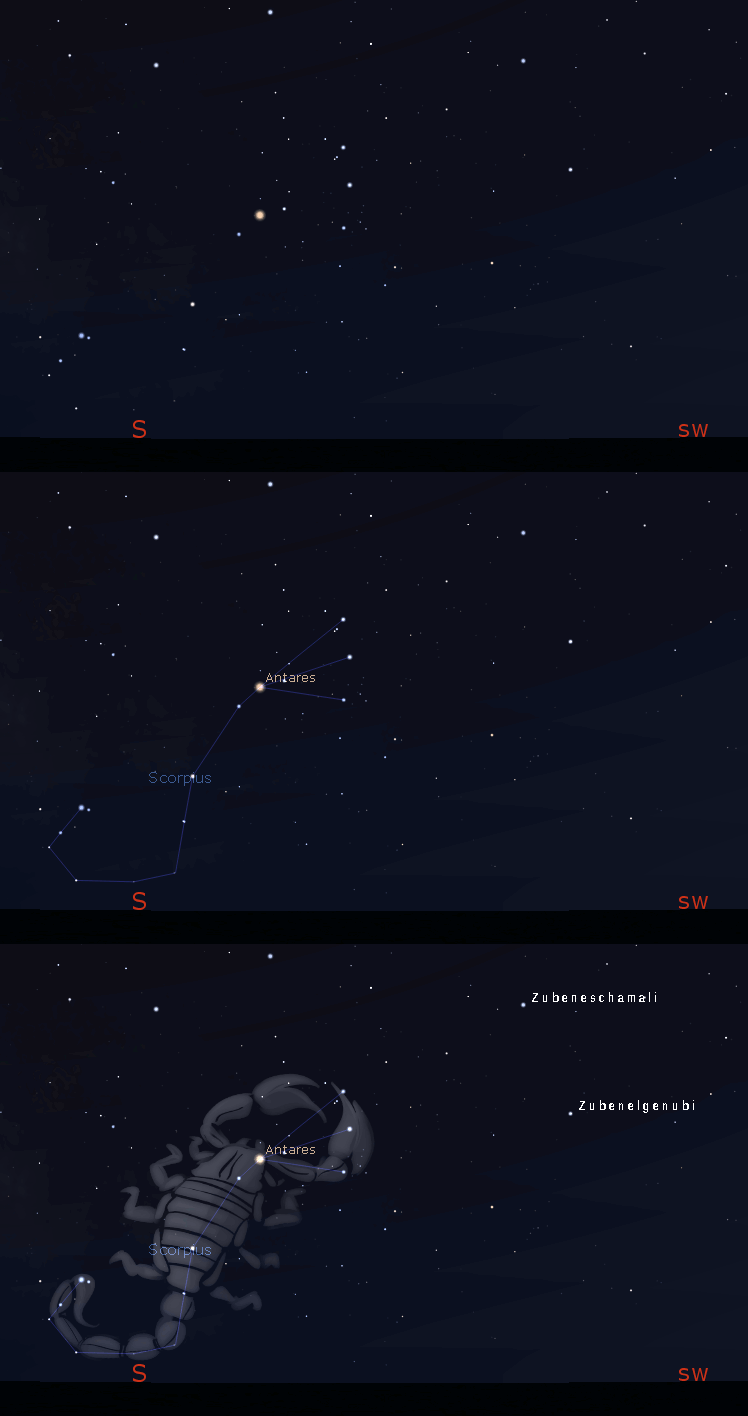
Scorpius animated finder for 10:30 pm July 27th. The Arabs saw a bigger scorpion with Antares in the upper part of its body, the arc of three stars near its head and its claws extending to Zubeneschamali (North Claw) and Zubenelgenubi (South Claw). The latter two stars belong to Libra the scales. Click on the image to enlarge it. Created using Stellarium and GIMP.
07/15/2021 – Ephemeris – What the Chinese saw in the face of the Moon
This is Bob Moler with Ephemeris for Thursday, July 15th. Today the Sun will be up for 15 hours and 13 minutes, setting at 9:25, and it will rise tomorrow at 6:12. The Moon, 2 days before first quarter, will set at 12:45 tomorrow morning.
Looking at the Moon tonight with the naked eye or binoculars, the dark patches called seas, which are really lava filled plains, make out the ears, head, and top part of the body of a rabbit that appears upside down. It’s the Chinese Jade Rabbit, Yutu. The seas involved, with their English names are: Serenity, the top of its body; Tranquility, its head; the more prominent ear is Fertility; while the other ear is a combination of the Bay of Roughness and Sea of Nectar. Yutu is the pet rabbit of the Moon goddess Chang’e, who flew to the Moon to escape her pursuers. The Chinese space agency has named all their moon landers Chang’e and their lunar rovers Yutu in their honor.
The astronomical event times given are for the Traverse City/Interlochen area of Michigan (EDT, UT – 4 hr). They may be different for your location.
Addendum
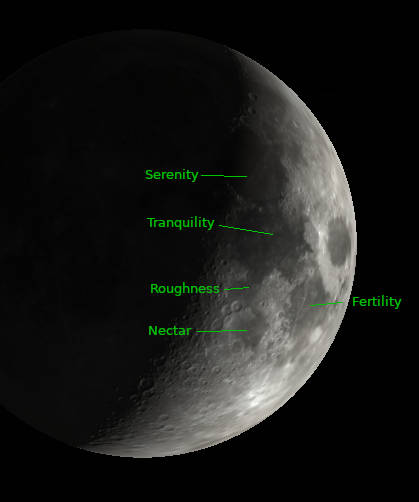
The Moon tonight with the Jade Rabbit delineated in the seas and one bay the dark lava covered plains of the Moon. Created using Stellarium.
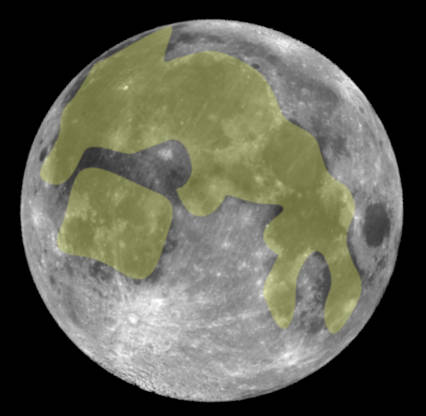
The Jade Rabbit seen on a full moon rotated close to what tonight’s Moon is. Actually, the ancient Chinese saw the rabbit pounding medicine.
07/12/2021 – Ephemeris – Two cultures look at the star pattern of Cygnus the swan
This is Ephemeris for Monday, July 12th. Today the Sun will be up for 15 hours and 18 minutes, setting at 9:27, and it will rise tomorrow at 6:09. The Moon, 3 days past new, will set at 11:33 this evening.
Last week I looked at the constellation of Cygnus the swan and the informal constellation or asterism made from most of its stars, the Northern Cross. Cygnus is the official International Astronomical Union constellation name. However, the indigenous Anishinaabe people of our area, and the northern Great Lakes, had another bird in mind when seeing these stars, which are now fairly high in the east in the evening: Ajijaak, (pronounced a-ji-jock) a Sand Hill crane. While the swan is flying, neck outstretched to the south through the Milky Way, the crane is flying northward with its long legs trailing behind. The bright star Deneb is at its head. I see more cranes than swans around here in recent years and hear their creaking-door-like calls, and can see a pair foraging, from time to time, in a field south of where I live.
The astronomical event times given are for the Traverse City/Interlochen area of Michigan (EDT, UT – 4 hr). They may be different for your location.
Addendum
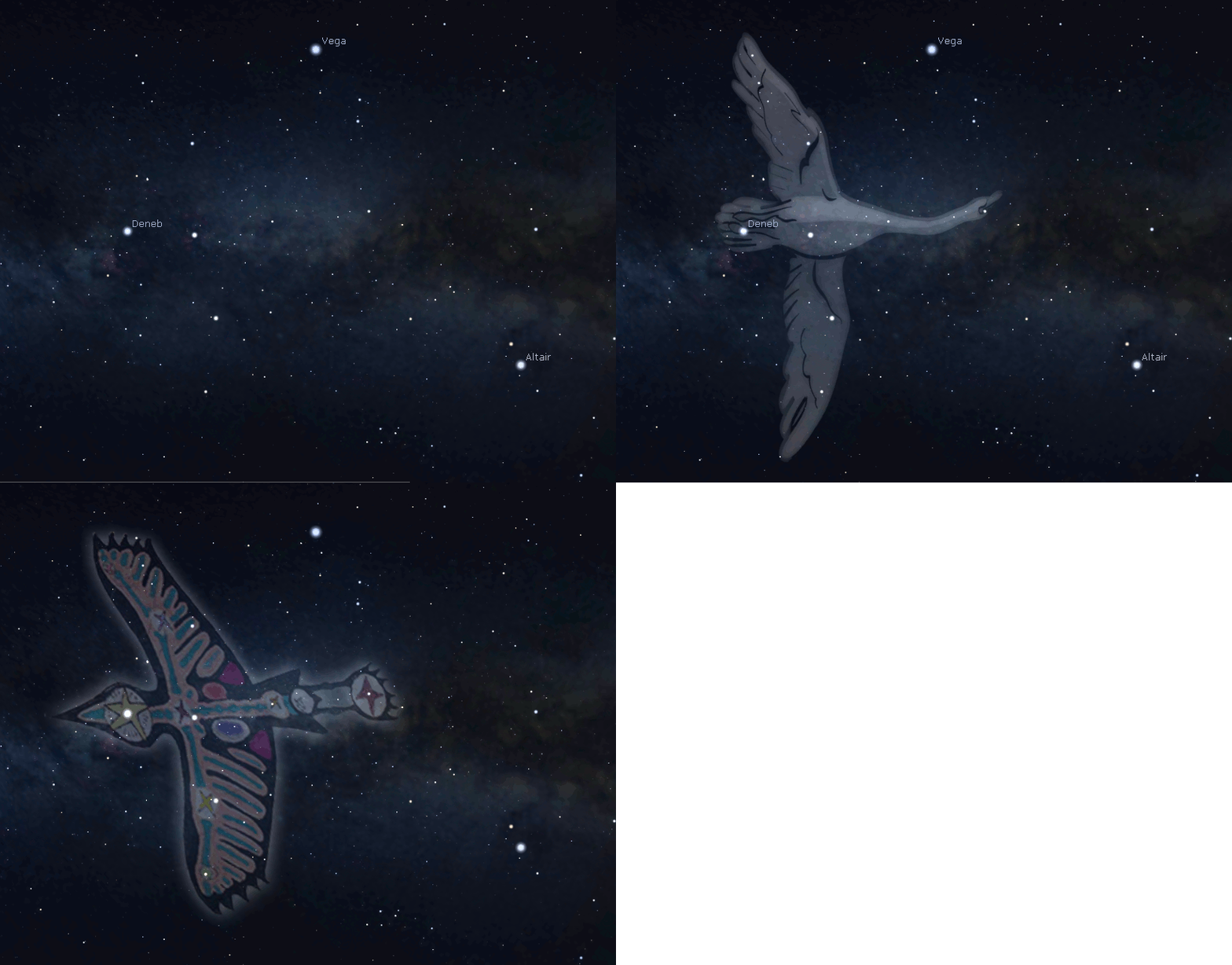
The IAU Cygnus the swan and the Anishinaabe Ajijaak the crane constellations demonstrated via an animated GIF image. Click on the image to enlarge it. Credit Stellarium (both star lore images are embedded in Stellarium). The Anishinaabe image is from Ojibwe Giizhig Anung Masinaaigan – Ojibwe Sky Star Map created by A. Lee, W. Wilson, and C. Gawboy.
07/09/2021 – Ephemeris – Finding the constellation of Aquila the eagle
This is Ephemeris for Friday, July 9th. Today the Sun will be up for 15 hours and 22 minutes, setting at 9:29, and it will rise tomorrow at 6:07. The Moon is new today, and won’t be visible.
Aquila the eagle is a constellation that lies in the Milky Way. It’s in the southeastern sky as it gets dark. Its brightest star, Altair, is one of the stars of the Summer Triangle, a group of three bright stars dominating the eastern sky in the evening now. Altair, in the head of the eagle, is flanked by two slightly dimmer stars, the shoulders of the eagle. The eagle is flying northeastward through the Milky Way. Its wings are seen in the wing tip stars. A curved group of stars to the lower right of Altair is its tail. Within Aquila, the Milky Way shows many dark clouds as part of the Great Rift that splits it here. The other summer bird is Cygnus the swan above and left of Aquila, flying in the opposite direction. It was said this was the eagle that attended the god Jupiter.
The astronomical event times given are for the Traverse City/Interlochen area of Michigan (EDT, UT-4). They may be different for your location.
Addendum
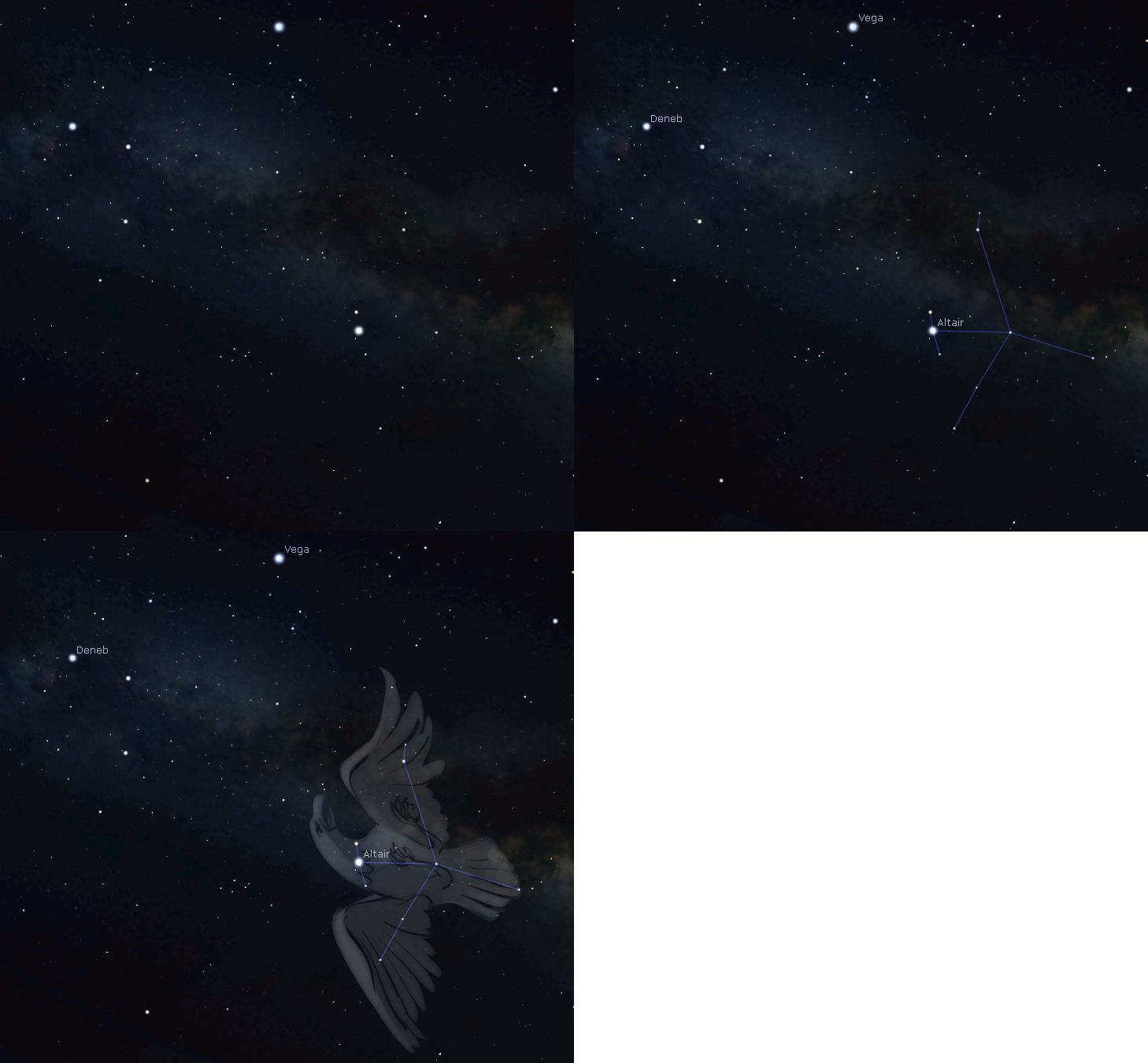
Animated Cygnus finder chart. Lyra the harp, Cygnus the swan, Delphinus the dolphin and Sagitta the arrow are also in the image. Can you find them? Click on the image to enlarge it. Created using Stellarium and GIMP.
07/08/2021 – Ephemeris – How to find the constellation of Cygnus the swan
This is Ephemeris for Thursday, July 8th. Today the Sun will be up for 15 hours and 23 minutes, setting at 9:29, and it will rise tomorrow at 6:06. The Moon, 1 day before new, will rise at 5:23 tomorrow morning.
Halfway up the sky in the east at 11 pm is the constellation of Cygnus the swan, flying south through the Milky Way. It is also called the Northern Cross. At the left, the tail of the swan or the head of the cross is the bright star Deneb, one of the stars of the Summer Triangle. The next star to the right is Sadr the intersection of the body and the wings of the swan seen in flight, or the intersection of the two pieces of the cross. There are two or three stars farther to the right that delineate the swan’s long neck or upright of the cross, that ends with the star Alberio, a beautiful double star in telescopes, in the beak of the swan or foot of the cross. The crosspiece of the cross extends to the stars on either side of the intersection star Sadr, while the swan’s wings extend for a couple more stars each side.
The astronomical event times given are for the Traverse City/Interlochen area of Michigan (EDT, UT-4). They may be different for your location.
Addendum
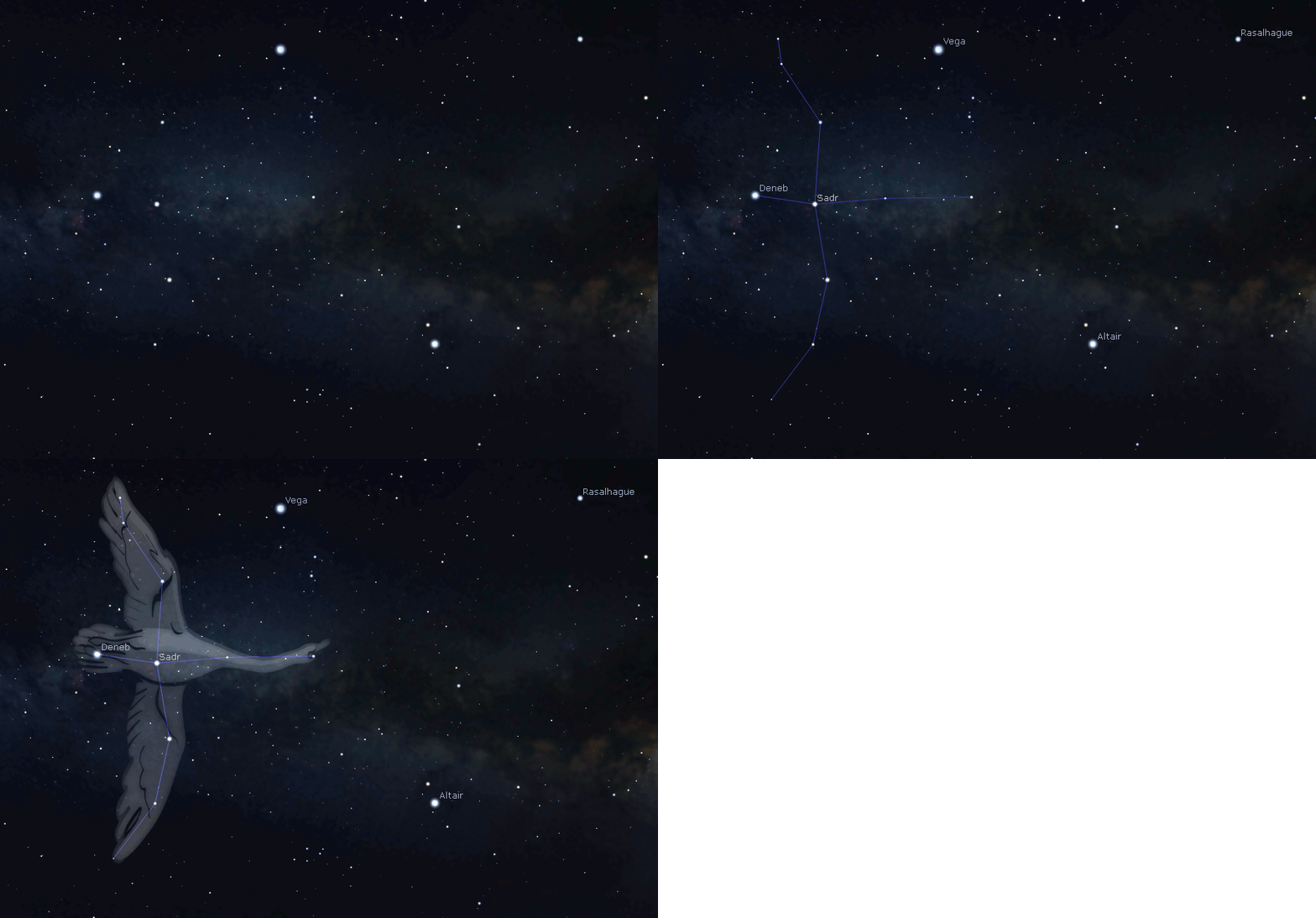
Animated Cygnus finder chart. Included also are, beside Deneb, the other stars of the Summer Triangle: Vega and Altair and their constellations Lyra the harp and Aquila. See if you can find them. Click on the image to enlarge it. Created using Stellarium.
07/06/2021 – Ephemeris – Looking at the constellation of Lyra the harp
This is Ephemeris for Tuesday, July 6th. Today the Sun will be up for 15 hours and 26 minutes, setting at 9:30, and it will rise tomorrow at 6:05. The Moon, 3 days before new, will rise at 3:56 tomorrow morning.
High in the east at 11 p.m. can be found a bright star just above a small, narrow, but very distinctive parallelogram of stars. They are the stars of the constellation Lyra the harp. The bright star is Vega, the 5th brightest night-time star. To the Romans, the star Vega represented a falling eagle or vulture. Apparently they never made the distinction between the two species. It is a pure white star and serves as a calibration star for color and brightness. In the evening, it is the top-most star of the Summer Triangle. The harp, according to Greek mythology, was invented by the god Hermes. The form of the harp, in the sky, is as he had invented it: by stretching strings across a tortoise shell. Hermes gave it to his half-brother Apollo, who in turn gave it to the legendary musician Orpheus.
The astronomical event times given are for the Traverse City/Interlochen area of Michigan (EDT, UT-4). They may be different for your location.
Addendum
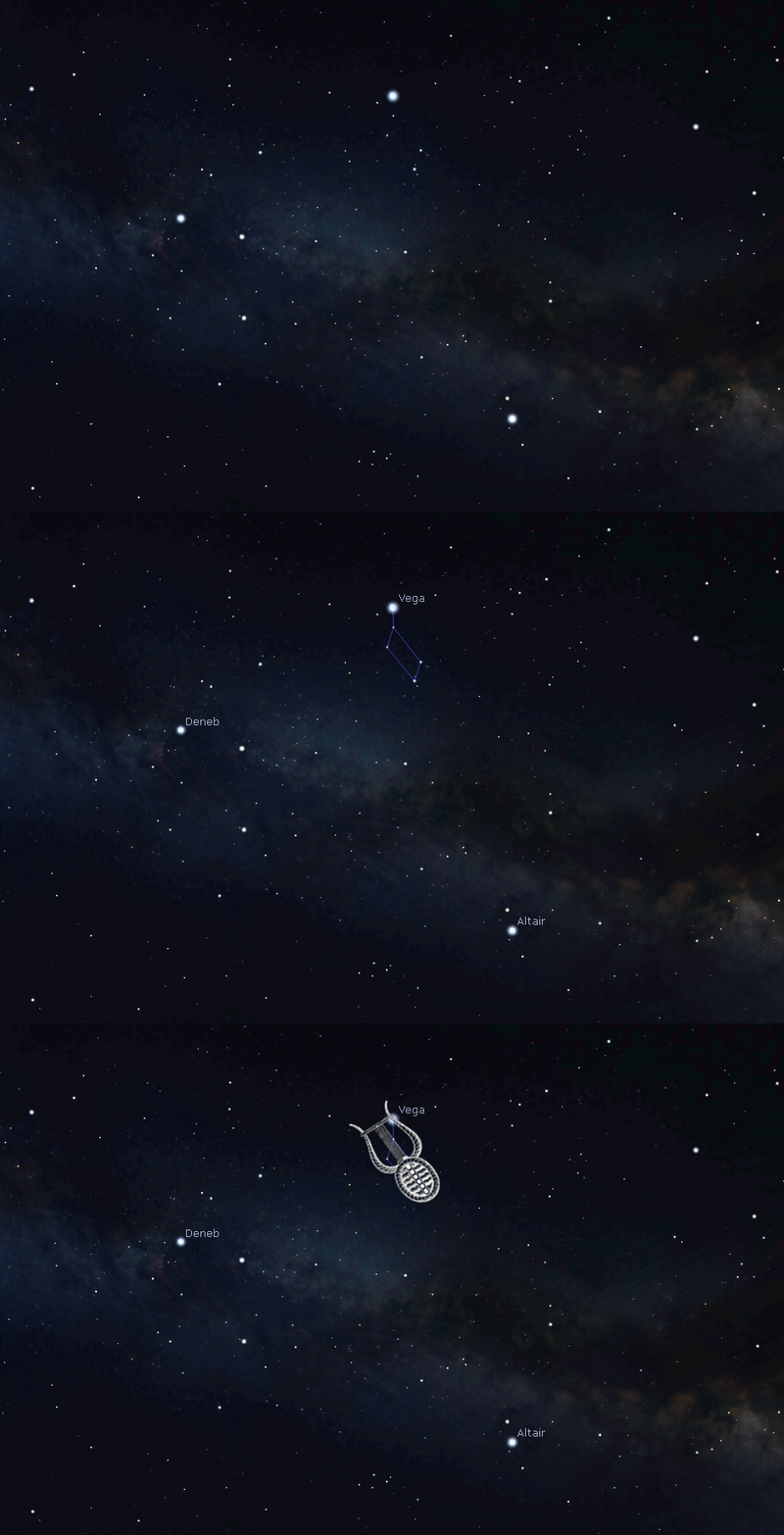
Animated Lyra finder chart. The lyre image not supplied by Stellarium but is from The World’s Earliest Music by Hermann Smith, Figure 60, A Project Gutenberg E-Book, and captioned “The Chelys or Greek Tortoiseshell Lyre”. Click on the image to enlarge it. Created using Stellarium and GIMP.
06/29/2021 – Ephemeris – The Summer Triangle
This is Ephemeris for Tuesday, June 29th. Today the Sun will be up for 15 hours and 32 minutes, setting at 9:32, and it will rise tomorrow at 6:00. The Moon, 2 days before last quarter, will rise at 1:14 tomorrow morning.
Dominating the eastern sky at 11 pm are three bright stars. These are all first magnitude stars, members of the group of 21 brightest stars in the night sky. Highest, in the east, is Vega, the brightest of the three. It and a small, slim parallelogram of stars below it belong to the constellation of Lyra the harp. Below it to the northeast is Deneb, dimmest of the three at the head of the horizontally appearing Northern Cross, an informal constellation or asterism. Properly, Deneb is in the tail of Cygnus the swan flying south through the Milky Way. The third star of the three is Altair, lower still, but in the east-southeast at the head of Aquila the Eagle. These three stars are in a large asterism called the Summer Triangle, which will be with us through summer and fall.
The astronomical event times given are for the Traverse City/Interlochen area of Michigan (EDT, UT-4). They may be different for your location.
Addendum
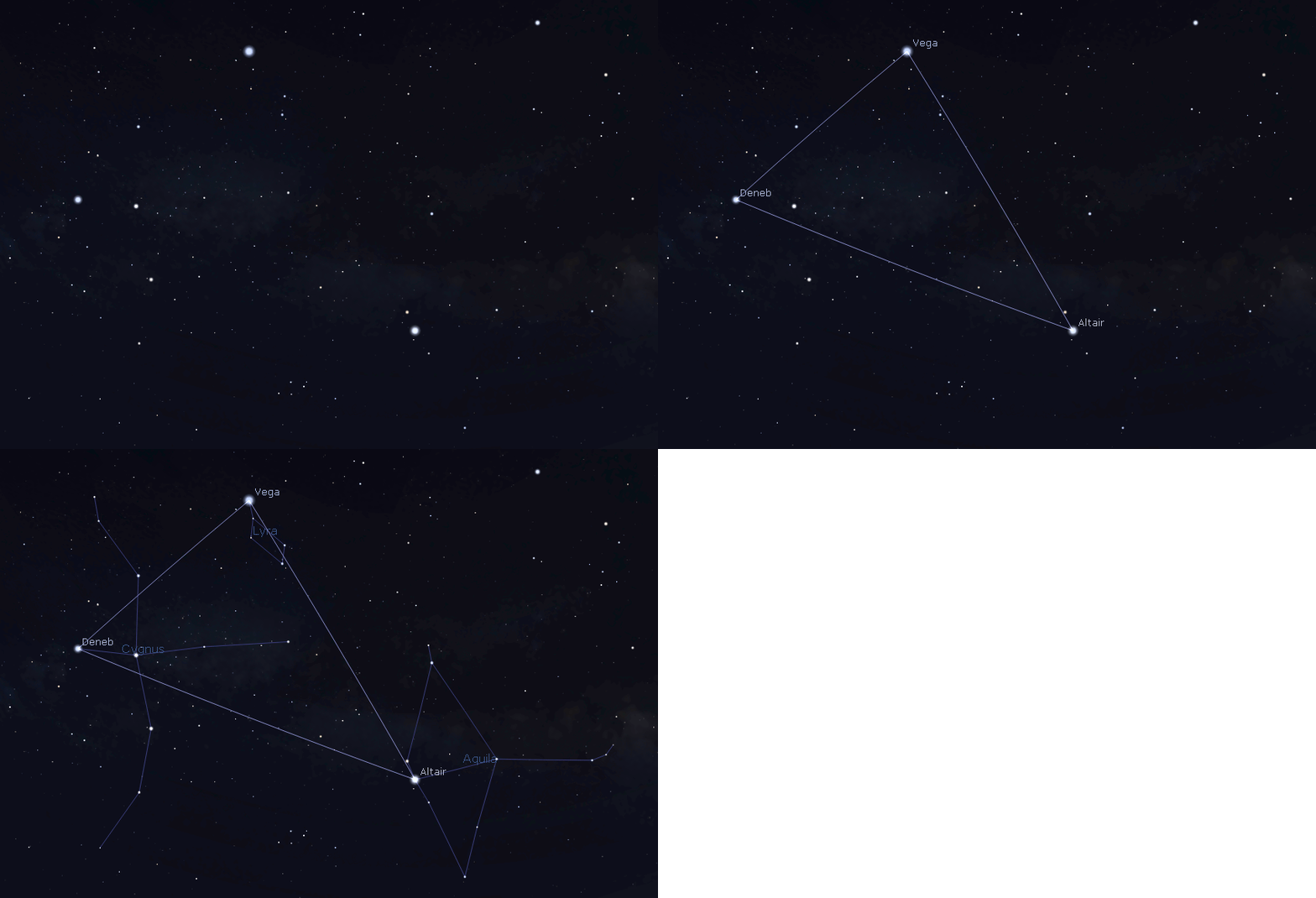
The Summer Triangle finder animation showing first the unlabeled sky, Then the Summer Triangle with the stars labeled, then the constellations of those stars. Click on the image to enlarge it. Created using Stellarium and GIMP.
 Bob Moler's Ephemeris Blog