Archive
03/12/2018 – Ephemeris – The Fisher is rising as spring approaches
Ephemeris for Monday, March 12th. The Sun will rise at 8:00. It’ll be up for 11 hours and 44 minutes, setting at 7:45. The Moon, 4 days past last quarter, will rise at 6:05 tomorrow morning.
Now in the evening the Big Dipper has moved up in the northeast. The Anishinaabek peoples around the Great Lakes, like the Ottawa and Chippewa saw instead of a dipper or a bear: Ojiig the Fisher. It’s a magical weasel-like creature who, with some animal friends, brought summer to the Earth. The story is too long to relay here, but my telling of it is here. For his trouble he was slain, and was placed among the stars of the sky by the Great Spirit Manitou where we see him today. His blood is said to paint the trees with the fall colors. However as the Fisher rises in the northeast in late winter and early spring it is a signal for the maple trees to bring forth their sweet sap.
The times given are for the Traverse City/Interlochen area of Michigan. They may be different for your location.
Addendum
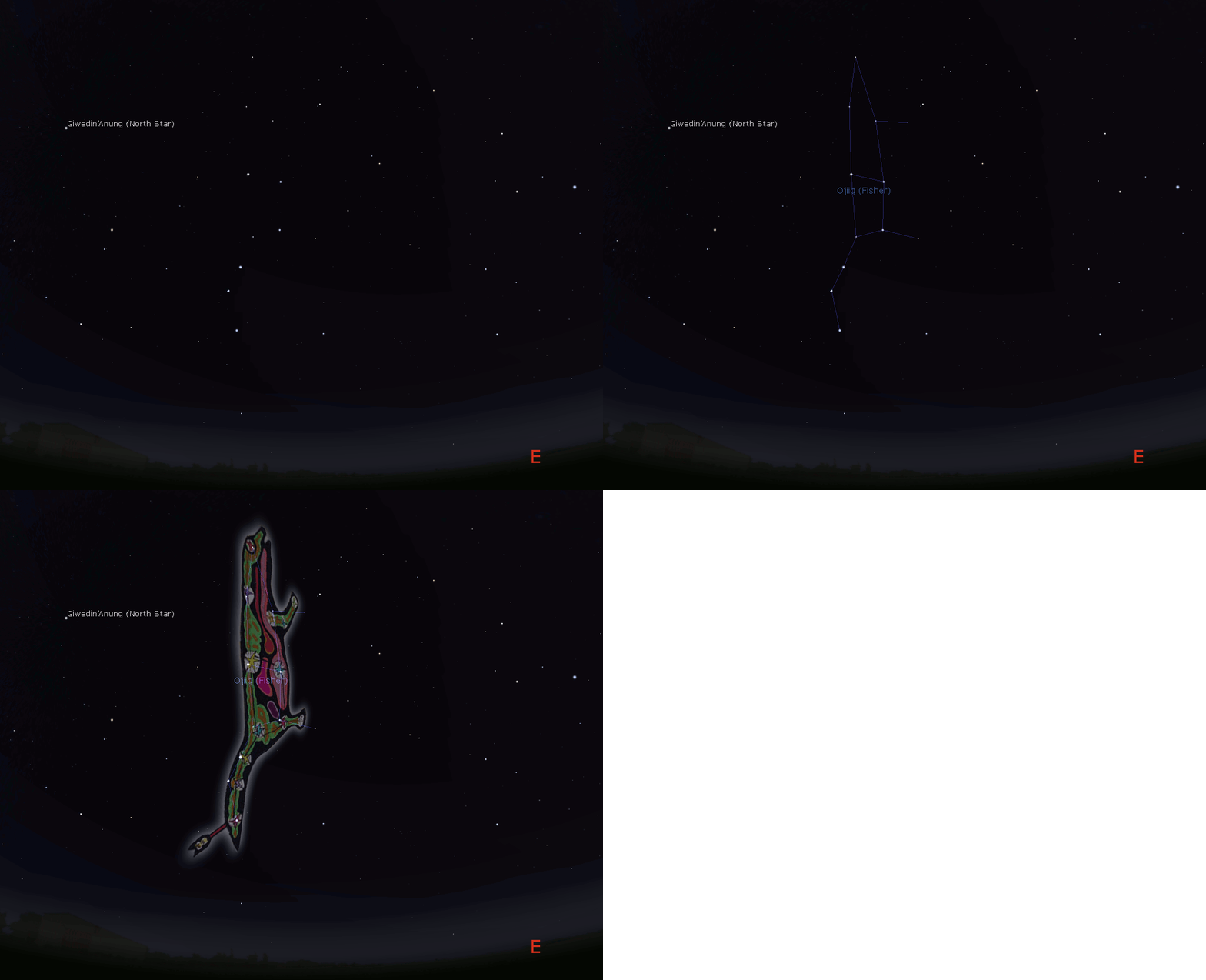
Finding the Big Dipper and the Fisher at 9 p.m., March 12, 2018. Click on the image to enlarge. Created using Stellarium and GIMP.
The Anishinaabek constellation drawings are from Ojibwe Sky Star Map Constellation Guide by Annette S. Lee, William Wilson, Jeffrey Tibbets and Carl Gawboy available locally and online. They are part of the latest editions of Stellarium, a free planetarium program. Links to it are on the left. Other information and links are available within the Sky Lore tab.
Here’s one of the links: http://www.nativeskywatchers.com/. It also contains links to Lakota star maps and lore.
03/09/2018 – Ephemeris – The good ship Argo
Ephemeris for Friday, March 9th. The Sun will rise at 7:06. It’ll be up for 11 hours and 35 minutes, setting at 6:41. The Moon, at last quarter today, will rise at 2:50 tomorrow morning.
Located south and east of Canis Major, the great hunting dog of Orion and it brilliant star Sirius in the south is a dim constellation of Puppis, the poop deck of the old constellation Argo Navis, the constellation that depicts the ship Jason and the Argonauts used in their search for the Golden Fleece. This huge constellation has been subdivided. Only Puppis and Pyxis the ship’s compass are visible from Michigan. The other parts of the ship are Carina the keel, and Vela the sails require traveling south at least to the southern most of the United States. Three other constellations also related to this expedition are Gemini with Castor, who died on the expedition and Pollux. Hercules was also aboard as was the physician of the constellation Ophiuchus.
The times given are for the Traverse City/Interlochen area of Michigan. They may be different for your location.
Addendum
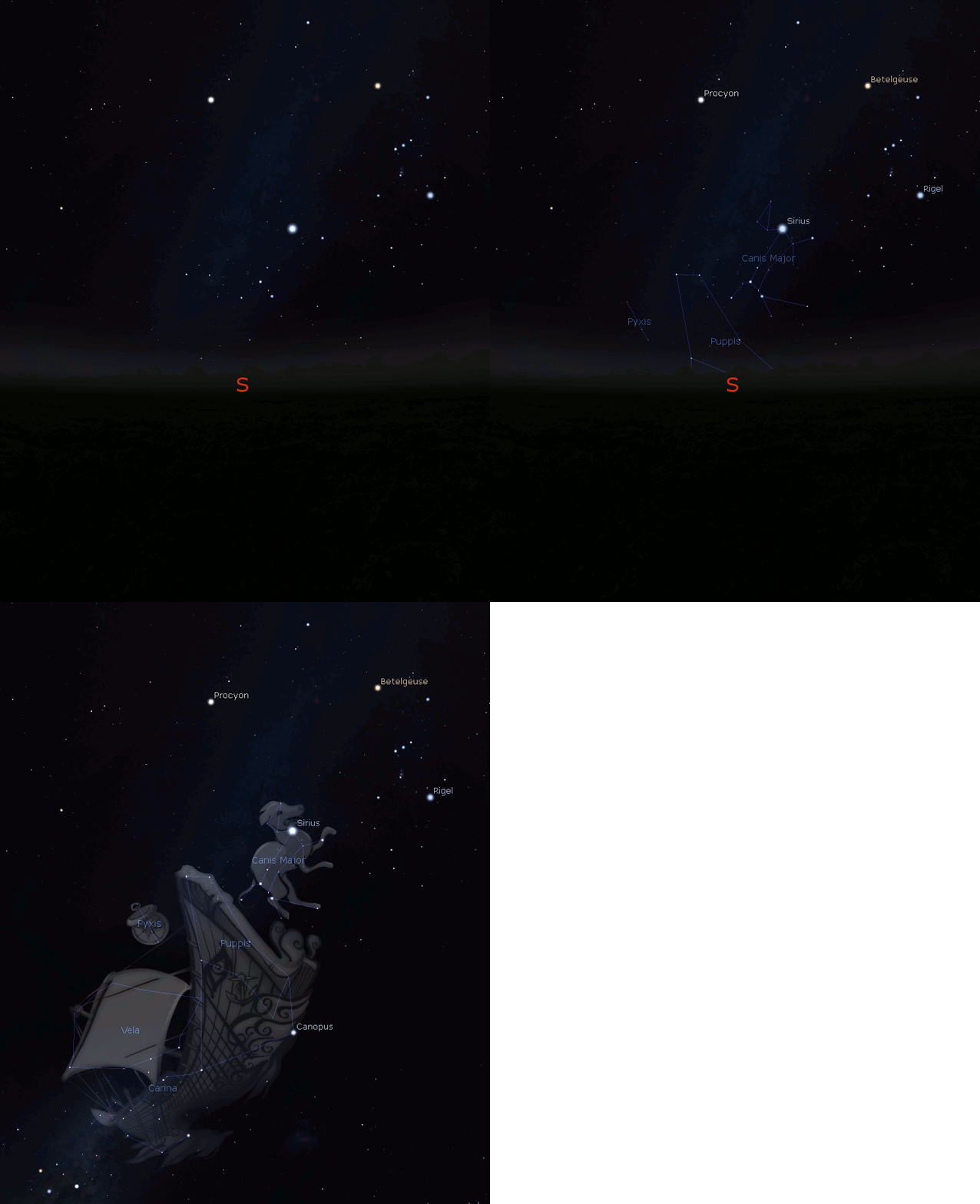
Puppis ans Pyxis; what we can see from Michigan, plus the rest of Argo Navis at 9 p.m., March 9, 2018. The Stellarium artist has the ship reversed. Puppis is the rear end, not the bow. Note that the Crux, the Southern Cross is below the ship. Click on the image to enlarge. Created using Stellarium and GIMP.
03/07/2018 – Ephemeris – All 5 naked eye planets are now visible
Ephemeris for Wednesday, March 7th. The Sun will rise at 7:09. It’ll be up for 11 hours and 28 minutes, setting at 6:38. The Moon, 2 days before last quarter, will rise at 12:58 tomorrow morning.
Let’s take our weekly look at the bright planets. All 5 of the naked eye planets are visible now. Two of them are in the evening sky, but very close to the Sun. Venus will be visible low in the Western twilight from about 7 p.m. until before it sets at 7:47. Mercury is much dimmer but above and a bit right of Venus, tonight about 5 Moon widths at 1 o’clock from Venus. It will set at 7:59. Mercury will appear higher than Venus in the sky until about March 20th. In the morning Jupiter will rise at 12:12 tomorrow morning. Mars will rise at 2:51. Saturn will end the procession, rising at 3:45 a.m. At 6 tomorrow morning bright Jupiter will be in the south to the left of it is dimmer Mars. Saturn is low in the southeast.
The times given are for the Traverse City/Interlochen area of Michigan. They may be different for your location.
Addendum

Venus and Mercury, low in the west at 7 p.m., March 7, 2018. Created using Stellarium.
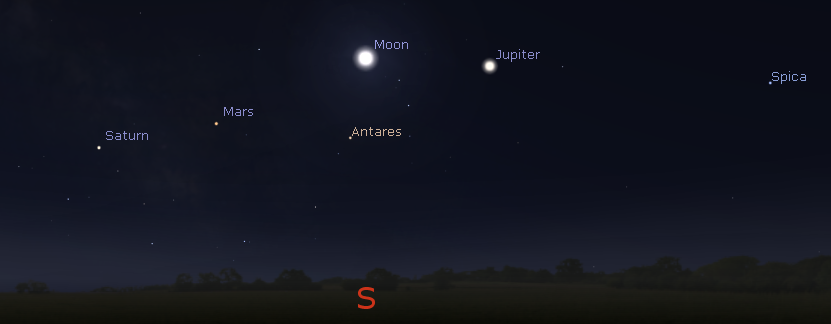
The morning planets of Jupiter, Mars and Saturn plus the Moon. Seen at 6 a.m. tomorrow morning March 8, 2018. Click on image to enlarge. Created using Stellarium.
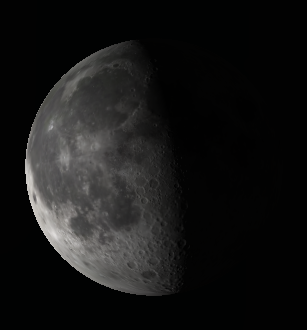
The waning gibbous Moon as it might be seen in binoculars at 6 a.m. tomorrow morning, March 8, 2018. Created using Stellarium.
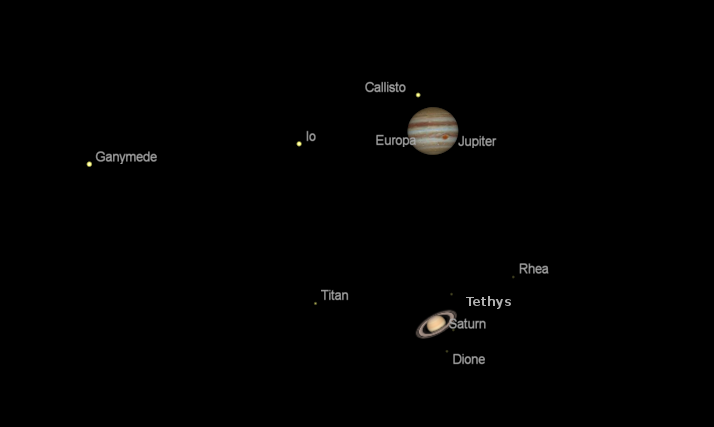
Jupiter and Saturn with their brighter satellites tomorrow morning at 6 a.m. March 8, 2018. They are displayed at the same scale. Saturn in about twice as far as Jupiter. Its disk is a bit smaller than Jupiter’s so it appears about half as large. The extent of the rings appear to be about the same as Jupiter’s diameter. Created using Cartes du Ciel (Sky Charts).
The Great Red Spot should be visible on Jupiter.
Europa is labeled but unseen at 6 a.m. EST
Here is what’s happening
Moon    Event              Date        UT       Local time
Europa: Eclipse start:     8 Mar 2018  7:12 UT  2:12 a.m. EST
Europa: Eclipse end:       8 Mar 2018  9:28 UT  4:28 a.m. EST
Europa: Occultation start: 8 Mar 2018  9:34 UT  4:34 a.m. EST
Europa: Occultation end:   8 Mar 2018 11:43 UT  6:43 a.m. EST
An eclipse is when the moon passes through Jupiter’s shadow. An occultation is when the moon is hidden behind the planet.
Note the 6 minutes between the end of the eclipse and the start of the occultation.
Timings are from https://www.projectpluto.com.
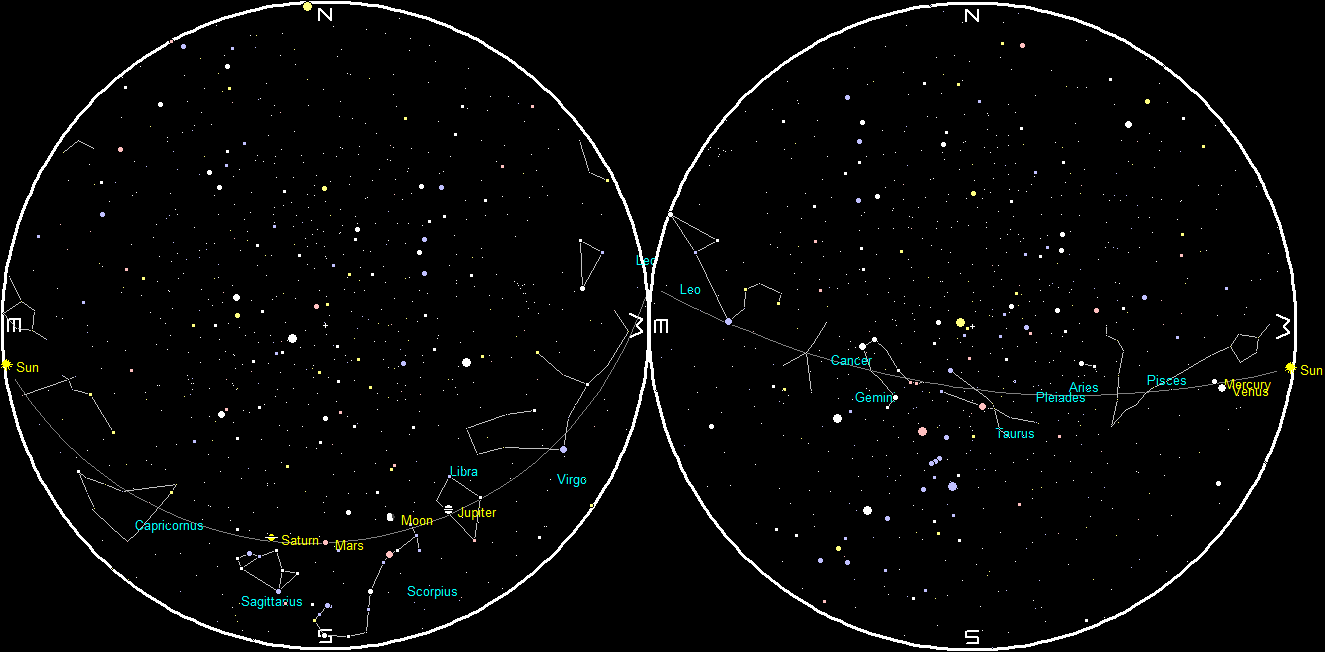
Planets at sunset and sunrise of a single night starting with sunset on the right on March 7, 2018. The night ends on the left with sunrise on the 8th. Click on the image to enlarge. Created using my LookingUp program.
03/06/2018 – Ephemeris – The Moon will pass the morning planets for the rest of the week
Ephemeris for Tuesday, March 6th. The Sun will rise at 7:11. It’ll be up for 11 hours and 25 minutes, setting at 6:37. The Moon, 3 days before last quarter, will rise at 11:57 this evening.
From tomorrow morning through the rest of the week the Moon will be passing above the morning planets one by one. Tomorrow morning the waning gibbous Moon will appear above and left of Jupiter the brightest of the morning planets in the south at 6 a.m. By Friday morning the then last quarter Moon will be approaching Mars and will be to the right and above the red planet. Saturday morning the then waning crescent Moon will appear above and right between Mars and Saturn. Sunday morning the waning crescent Moon will be left of Saturn. I love waning crescent Moons in morning twilight. In a couple of weeks, on the evening of the 19th to be exact the waxing crescent moon will pass Venus and Mercury.
The times given are for the Traverse City/Interlochen area of Michigan. They may be different for your location.
Addendum
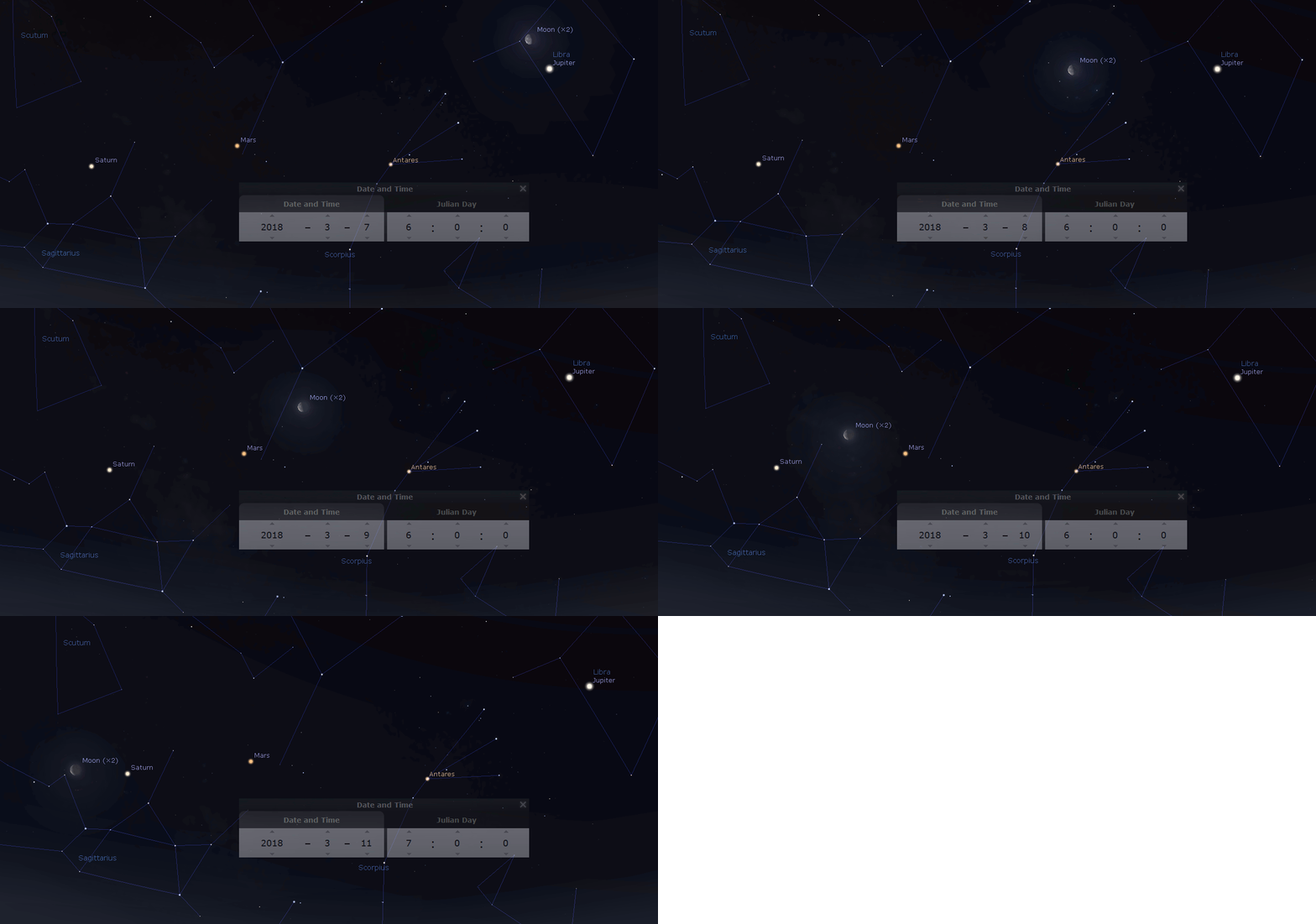
The Moon and morning planets at 6 a.m. each morning Wednesday through Sunday March 7-11, 2018. The Moon’s size has been doubled to show its phase. Note that due to Earth’s revolution of the Sun, that the sky will rotate about one degree westward per day. Click on the image to enlarge. Created using Stellarium and GIMP.
03/05/2018 – Ephemeris – Spring is coming: Leo is rising
Ephemeris for Monday, March 5th. The Sun will rise at 7:13. It’ll be up for 11 hours and 22 minutes, setting at 6:35. The Moon, half way from full to last quarter, will rise at 10:53 this evening.
The constellation Leo the lion is now rising in the east at 9 pm. It’s below and left of the Big Dipper higher up in the east-northeast. Leo is marked by two sets of easily recognizable stars. The front of him is a backward question mark of stars, also known as the Sickle that mark his head and mane, along with the front part of his body. Regulus is the star at the bottom of that backwards question mark. It’s the Little King Star. The hind end of him is a triangle of stars ending with another bright star, but not as bright as Regulus. It’s Denebola which means Lion’s tail. It is thought when the Sun was in this constellation long ago that the lions were driven by the heat to quench their thirst in the Nile river. Ancients physicians thought medicines were poison when the Sun was here also.
The times given are for the Traverse City/Interlochen area of Michigan. They may be different for your location.
Addendum
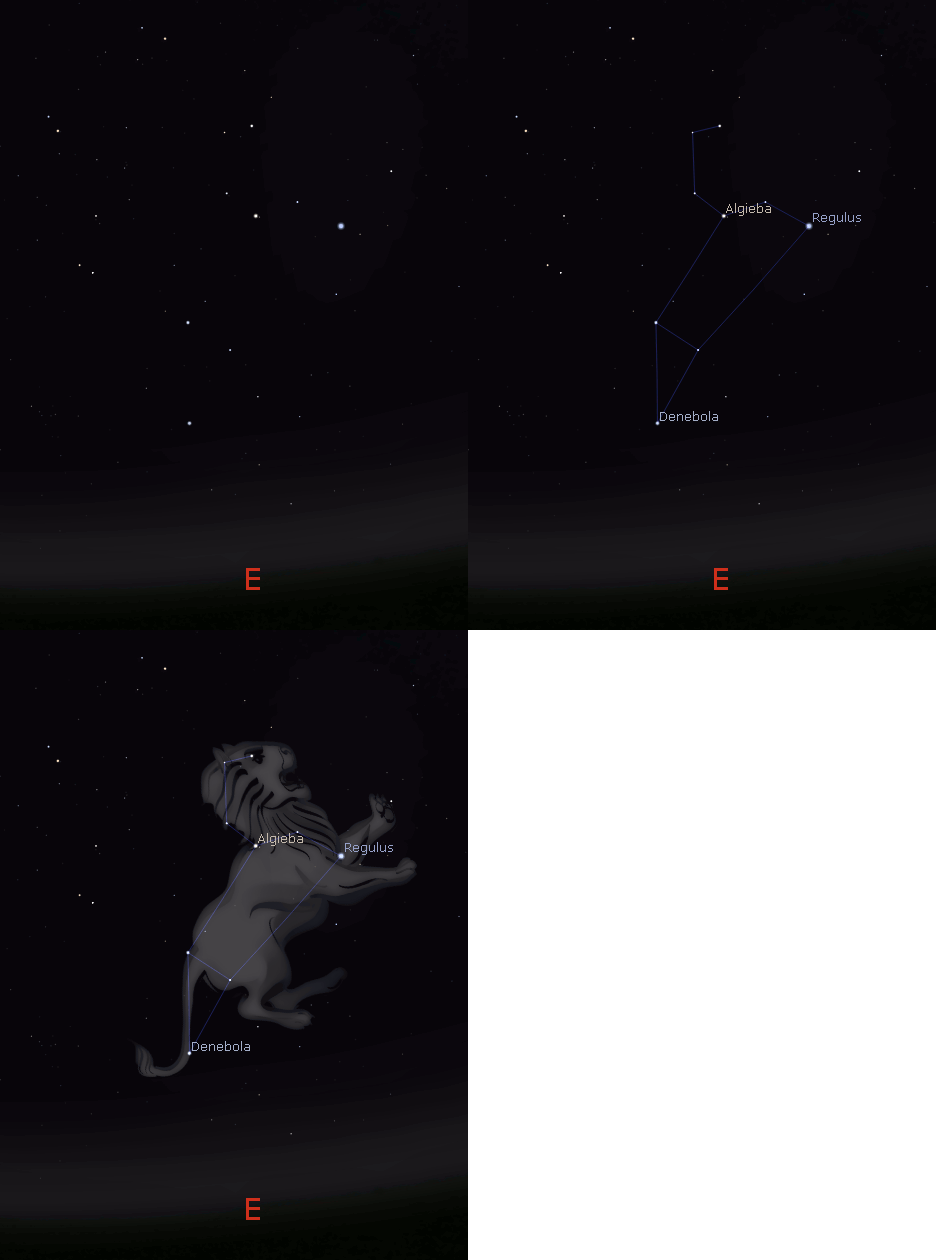
The constellation Leo animation. Created using Stellarium and GIMP.
Algieba is a binary star, which should be able to be split with any good telescope. The magnitude 2.4 and 3.6 components are separated by 4.6 arc seconds. Binary stars are one type of object that benefit from using high power to resolve. The stars are very close in temperature, so each appears a yellow-orange color offering no color contrast.
03/02/2018 – Ephemeris – Jeopardy type quiz at the GTAS meeting tonight
Ephemeris for Friday, March 2nd. The Sun will rise at 7:18. It’ll be up for 11 hours and 13 minutes, setting at 6:31. The Moon, 1 day past full, will rise at 7:29 this evening.
A Starpardy quiz will be held this evening between the NMC Astronomy Club and the Grand Traverse Astronomical Society at this evening’s meeting of the society at 8 p.m. at Northwestern Michigan College’s Rogers Observatory. I’ll be Alex Trebek for this Jeopardy style quiz. The society will accept anyone to help either side. These NMC students are smart.
After the Starpardy quiz there will be a star party starting at 9 p.m. On tap if its clear will be the Moon plus Orion and its great nebula, a star nursery only 1400 light years away will be a wonderful sight with its clouds and wisps of gas and dust illuminated by a clutch of hot baby stars. The Observatory is located south of Traverse City on Birmley Road off either Garfield or Keystone roads.
The times given are for the Traverse City/Interlochen area of Michigan. They may be different for your location.

03/01/2018 – Ephemeris – Previewing March skies
Ephemeris for Thursday, March 1st. The Sun will rise at 7:20. It’ll be up for 11 hours and 10 minutes, setting at 6:30. The Moon, at full today, will rise at 6:16 this evening.
Let’s look at the skies for the month of March. The Sun will pass the celestial equator in March as the promising season of spring will begin. Daylight hours in the Interlochen/Traverse City area and will increase from 11 hours and 10 minutes today to 12 hours 43 minutes on the 31st. The altitude, or angle, of the Sun above the southern horizon at local noon will be just under 38 degrees today and will ascend to nearly 50 degrees on the 31st. The altitude of the Sun in the Straits area will be a degree lower. Local apparent noon this month, when the Sun passes due south, will be about 12:49 p.m. and an hour later when daylight time starts. Spring will begin on the 20th at 12:15 p.m. Daylight Time, which now rules most of the year will start on the 11th.
The times given are for the Traverse City/Interlochen area of Michigan. They may be different for your location.
Addendum
March Evening Sky Chart
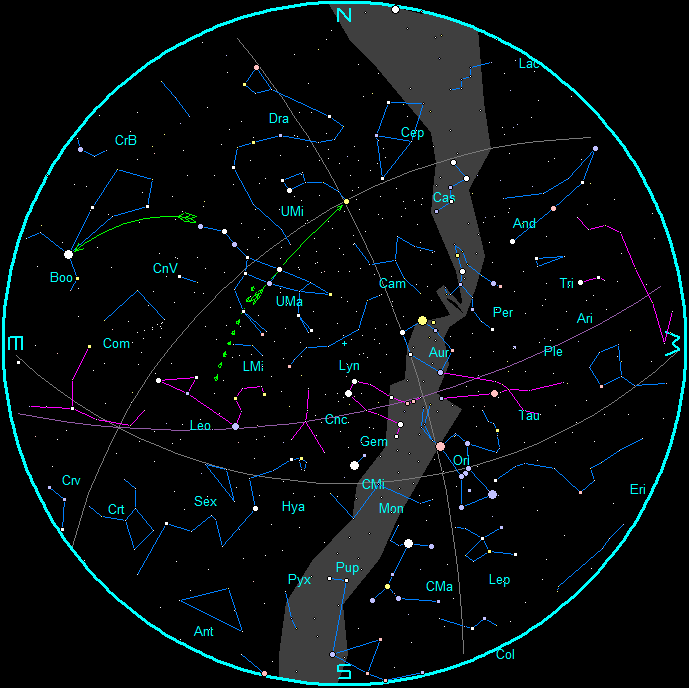
Star Chart for March 2018 (10 p.m. EDT March 15, 2018). Created using my LookingUp program. Click on image to enlarge.
The planets and stars are plotted for the 15th at 9 p.m. EDT in the evening and 6 a.m. for the morning chart. These are the chart times. Note that Traverse City is located approximately 45 minutes behind our time meridian. (An hour 45 minutes behind our daylight saving time meridian. during EDT and 45 minutes behind our daylight standard time meridian. during EST). To duplicate the star positions on a planisphere you may have to set it to 1 hour 45 minutes (Daylight Time) or 45 minutes (Standard Time) earlier than the current time if you are near your time meridian. Note that Daylight time starts at 2 a.m. Sunday March 11th for most US states.
Note the chart times of 10 p.m. and 6 a.m. are for the 15th. For each week before the 15th add ½ hour (28 minutes if you’re picky). Watch out for the time change. For each week after the 15th subtract ½ hour. The planet positions are updated each Wednesday on this blog. For planet positions on dates other than the 15th, check the Wednesday planet posts on this blog.
March Morning Star Chart
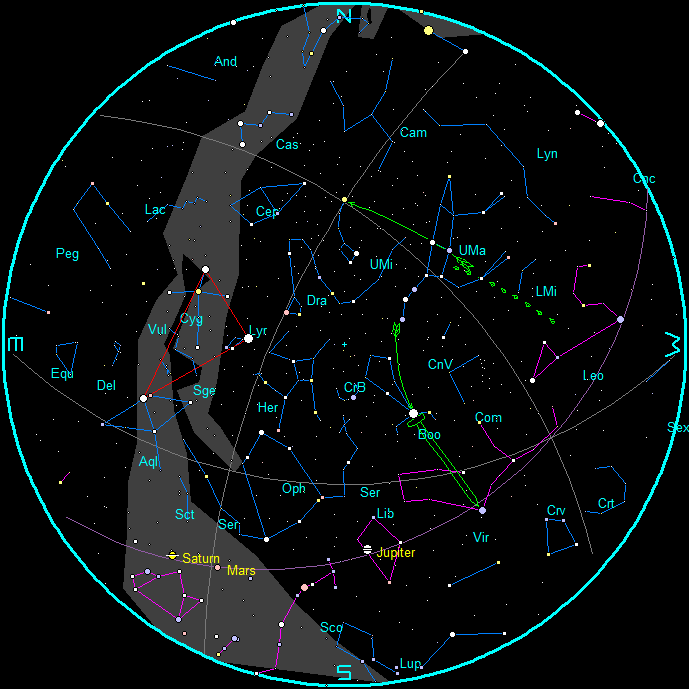
Star Chart for March 2018 mornings based on 6 a.m. March 15th. Created using my LookingUp program. Click on image to enlarge.
For a list of constellation names to go with the abbreviations click here.
Star chart annotations
- Pointer stars at the front of the bowl of the Big Dipper point to Polaris the North Star.
- Leaky Big Dipper drips on Leo.
- Follow the arc of the handle of the Big Dipper to the star Arcturus and
- Continue with a spike to Spica.
- The Summer Triangle is in red.
Twilight
Evening nautical twilight ends at 7:32 p.m. EST on the 1st, increasing to 9:16 p.m. EDT on the 31st.
Evening astronomical twilight ends at 8:06 p.m. EST on the 1st, increasing to 9:52 p.m. EDT on the 31st.
Morning astronomical twilight starts at 5:44 a.m. EST on the 1st, and decreasing to 5:49 a.m. EDT on the 31st.
Morning nautical twilight starts at 6:17 a.m. EST on the 1st, and decreasing to 6:25 a.m. EDT on the 31st.
NASA Calendar of Planetary Events
    Date    Time    Event
Mar 01  Th          Venus: 12.4° E
    01  Th 12:09 am Moon-Regulus: 0.9° S
    01  Th  7:51 pm Full Moon (Worm Moon)
    04  Su  8:32 am Neptune Solar Conjunction
    07  We  1:57 am Moon-Jupiter: 4.4° S
    09  Fr  6:20 am Last Quarter
    09  Fr  7:37 pm Moon-Mars: 4.2° S
    10  Sa  9:37 pm Moon-Saturn: 2.5° S
    11  Su  1:39 am Moon South Dec.: 20.1° S
    11  Su  2:00 am Daylight Saving Time begins
    11  Su  4:13 am Moon Apogee: 404700 km
    13  Tu 11:48 pm Moon Descending Node
    15  Th 10:59 am Mercury Greatest Eastern Elongation: 18.4°
    17  Sa  9:12 am New Moon
    18  Su  3:07 pm Moon-Venus: 3.9° N
    19  Mo  3:51 am Mercury-Venus: 3.8° N
    20  Tu 12:15 pm Vernal Equinox
    22  Th  6:33 pm Moon-Aldebaran: 0.9° S
    24  Sa 11:35 am First Quarter
    24  Sa 10:04 pm Moon North Dec.: 20.2° N
    26  Mo  1:17 pm Moon Perigee: 369100 km
    26  Mo  8:52 pm Moon-Beehive: 2.2° N
    27  Tu  6:56 am Moon Ascending Node
    28  We  9:38 am Moon-Regulus: 1° S
    31  Sa  8:37 am Full Moon (Blue Moon)
Apr 01  Su          Venus: 19.9° E
Sky Events Calendar by Fred Espenak and Sumit Dutta (NASA’s GSFC),
http://eclipse.gsfc.nasa.gov/SKYCAL/SKYCAL.html
If you go to the above site you can print out a list like the above for the entire year
or calendar pages for your time zone.
Sun and Moon Rising and Setting Events
     LU                  Ephemeris of Sky Events for Interlochen/TC
     March, 2018    Local time zone: EST
     +-----------------------------------------------------------------------+
     | DATE |  SUN     SUN  DAYLIGHT|   TWILIGHT*    |MOON  RISE OR    ILLUM |
     |      |  RISE    SET    HOURS |  END    START  |PHASE SET** TIME FRACTN|
     +=======================================================================+
     |Thu  1| 07:20a  06:30p  11:10 | 07:33p  06:17a |Full  Rise 06:16p  100%|
     |Fri  2| 07:18a  06:31p  11:13 | 07:35p  06:15a |      Rise 07:29p   99%|
     |Sat  3| 07:16a  06:33p  11:16 | 07:36p  06:13a |      Rise 08:40p   95%|
     +------+-----------------------+----------------+-----------------------+
     |Sun  4| 07:15a  06:34p  11:19 | 07:37p  06:12a |      Rise 09:48p   89%|
     |Mon  5| 07:13a  06:35p  11:22 | 07:38p  06:10a |      Rise 10:53p   82%|
     |Tue  6| 07:11a  06:37p  11:25 | 07:40p  06:08a |      Rise 11:57p   73%|
     |Wed  7| 07:09a  06:38p  11:28 | 07:41p  06:06a |      Rise 12:58a   64%|
     |Thu  8| 07:07a  06:39p  11:31 | 07:42p  06:05a |      Rise 01:56a   55%|
     |Fri  9| 07:06a  06:41p  11:35 | 07:44p  06:03a |L Qtr Rise 02:50a   45%|
     |Sat 10| 07:04a  06:42p  11:38 | 07:45p  06:01a |      Rise 03:40a   36%|
     +------+-----------------------+----------------+-----------------------+
     | EDT  |      Time Change      |                |                       |
     |Sun 11| 08:02a  07:43p  11:41 | 08:46p  06:59a |      Rise 05:25a   27%|
     |Mon 12| 08:00a  07:45p  11:44 | 08:48p  06:57a |      Rise 06:05a   19%|
     |Tue 13| 07:58a  07:46p  11:47 | 08:49p  06:55a |      Rise 06:42a   12%|
     |Wed 14| 07:57a  07:47p  11:50 | 08:50p  06:54a |      Rise 07:15a    7%|
     |Thu 15| 07:55a  07:48p  11:53 | 08:52p  06:52a |      Rise 07:45a    3%|
     |Fri 16| 07:53a  07:50p  11:56 | 08:53p  06:50a |      Rise 08:13a    0%|
     |Sat 17| 07:51a  07:51p  12:00 | 08:54p  06:48a |New   Set  08:06p    0%|
     +------+-----------------------+----------------+-----------------------+
     |Sun 18| 07:49a  07:52p  12:03 | 08:56p  06:46a |      Set  09:13p    2%|
     |Mon 19| 07:47a  07:54p  12:06 | 08:57p  06:44a |      Set  10:21p    7%|
     |Tue 20| 07:45a  07:55p  12:09 | 08:58p  06:42a |      Set  11:30p   13%|
     |Wed 21| 07:44a  07:56p  12:12 | 09:00p  06:40a |      Set  12:39a   22%|
     |Thu 22| 07:42a  07:57p  12:15 | 09:01p  06:38a |      Set  01:48a   32%|
     |Fri 23| 07:40a  07:59p  12:18 | 09:02p  06:36a |      Set  02:53a   43%|
     |Sat 24| 07:38a  08:00p  12:21 | 09:04p  06:34a |F Qtr Set  03:54a   54%|
     +------+-----------------------+----------------+-----------------------+
     |Sun 25| 07:36a  08:01p  12:25 | 09:05p  06:32a |      Set  04:47a   65%|
     |Mon 26| 07:34a  08:02p  12:28 | 09:06p  06:30a |      Set  05:34a   76%|
     |Tue 27| 07:32a  08:04p  12:31 | 09:08p  06:28a |      Set  06:14a   85%|
     |Wed 28| 07:31a  08:05p  12:34 | 09:09p  06:26a |      Set  06:49a   92%|
     |Thu 29| 07:29a  08:06p  12:37 | 09:11p  06:25a |      Set  07:21a   97%|
     |Fri 30| 07:27a  08:07p  12:40 | 09:12p  06:23a |      Set  07:50a  100%|
     |Sat 31| 07:25a  08:09p  12:43 | 09:13p  06:21a |Full  Rise 08:27p  100%|
     +-----------------------------------------------------------------------+
     * Nautical Twilight
     ** Moonrise or moonset, whichever occurs between sunset and sunrise
02/28/2018 – Ephemeris – Let’s take our weekly look at the bright planets
Ephemeris for Wednesday, February 28th. The Sun will rise at 7:22. It’ll be up for 11 hours and 7 minutes, setting at 6:29. The Moon, 1 day before full, will set at 7:17 tomorrow morning.
Let’s take our weekly look at the bright planets. Two of the bright naked eye planets are in the evening sky, but very close to the Sun. Venus will be visible low in the Western twilight from about 6:50 until before it sets at 7:29. Mercury is creeping up on Venus from below, tonight about 5 Moon widths at 5 o’clock down from Venus. It will set at 7:18. Mercury will appear to pass Venus Sunday night and will become higher than Venus in the sky until about March 20th. In the morning Jupiter will rise at 12:39 tomorrow morning, with Mars rising at 2:59. Saturn will end the procession, rising at 4:10 a.m. At 6 tomorrow morning bright Jupiter will be in the south to the left of it is dimmer Mars. Saturn is low in the southeast.
The times given are for the Traverse City/Interlochen area of Michigan. They may be different for your location.
Addendum
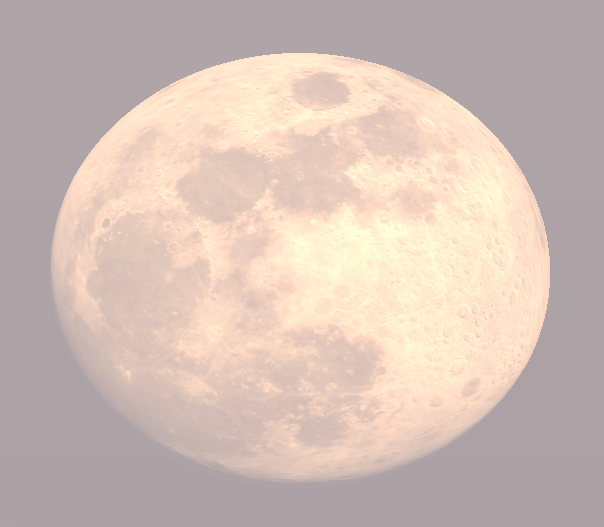
Moon rise at around 5:10 p.m. tonight February 28 2018 with daylight washing it out. Note the squished Moon due to atmospheric refraction which bends the light up. The lower in the sky it is the greater the bending of the light. This also happens to the Sun. Created using Stellarium as a built in effect.

Venus and Mercury, low in the west at 6:45 p.m., February 28, 2018. Created using Stellarium.
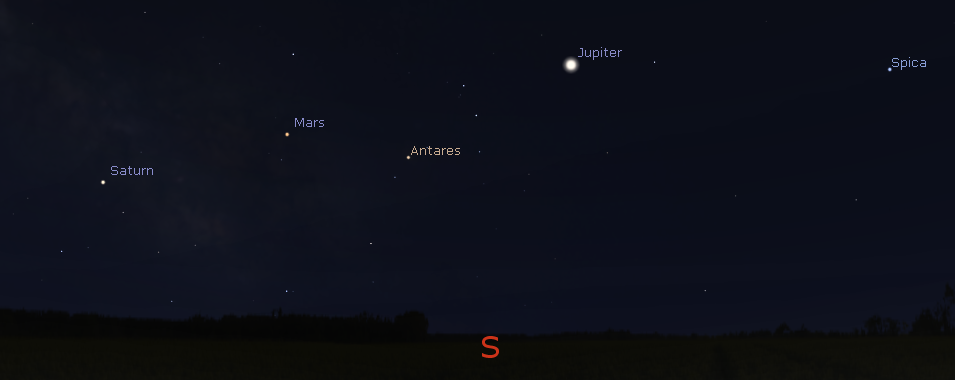
The morning planets of Jupiter, Mars and Saturn. Seen at 6 a.m. tomorrow morning March 1, 2018. Click on image to enlarge. Created using Stellarium.
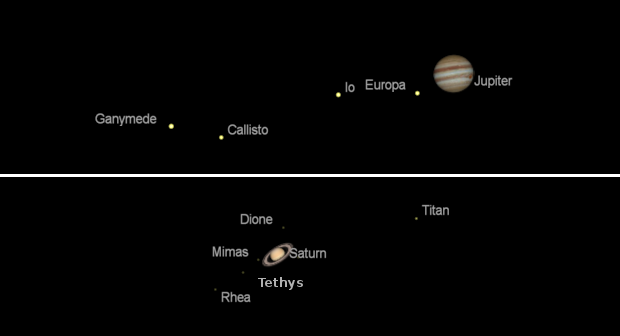
Jupiter and Saturn with heir brighter satellites tomorrow morning at 6 a.m. March 1, 2018. They are displayed at the same scale. Saturn in about twice as far as Jupiter. Its disk is a bit smaller than Jupiter’s so it appears about half as large. The extent of the rings appear to be about the same as Jupiter’s diameter. Created using Cartes du Ciel (Sky Charts). Oops, left in Mimas, which is much smaller and dimmer than the other satellites.
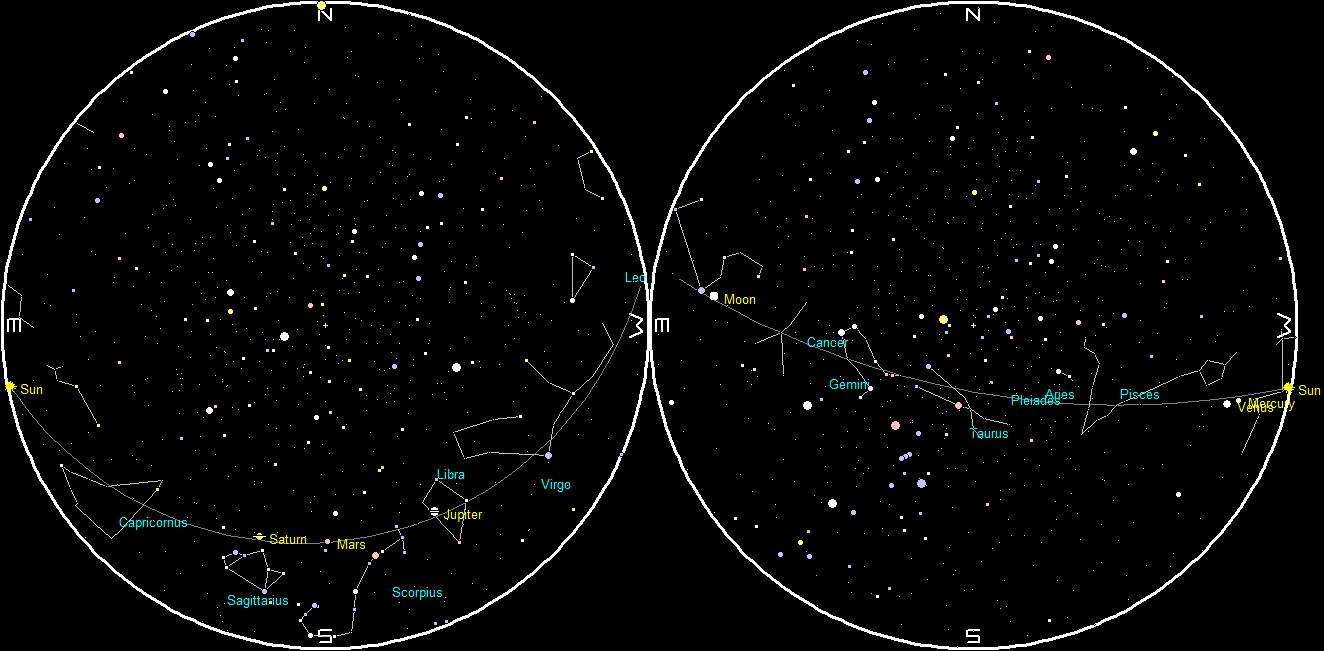
Planets at sunset and sunrise of a single night starting with sunset on the right on February 28, 2018. The night ends on the left with sunrise on March 1st. Click on the image to enlarge. Created using my LookingUp program.
02/27/2018 – Ephemeris – The bright spot on the Moon tonight
Ephemeris for Tuesday, February 27th. The Sun will rise at 7:23. It’ll be up for 11 hours and 4 minutes, setting at 6:27. The Moon, 2 days before full, will set at 6:38 tomorrow morning.
The moon tonight is bright. The sunrise line or terminator on the moon is crossing the large gray plain called Oceanus Procellarum, the largest of the moon’s seas. These seas were figments of the first telescopic observers imagination. They are really huge impact basins into which interior lava flowed. On the upper left edge of the moon near the terminator is a bright spot on the moon visible in binoculars. In a telescope it is a crater called Aristarchus. It is a fairly new crater, probably less than a billion years old. As a rule the brighter the crater the newer it is. Aristarchus is the brightest spot on the moon. Over the years visual astronomers have seen hazes and bright spots from time to time in and near Aristarchus.
The times given are for the Traverse City/Interlochen area of Michigan. They may be different for your location.
Addendum
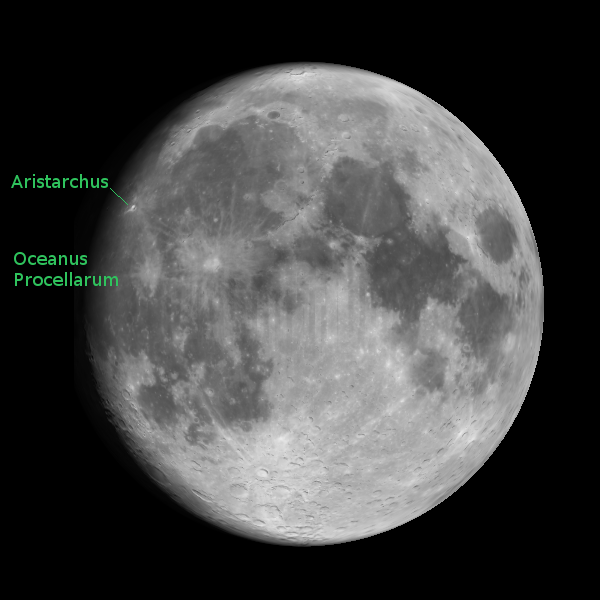
The Moon tonight at 9 p.m. February 27, 2018. Created using Virtual Moon Atlas.
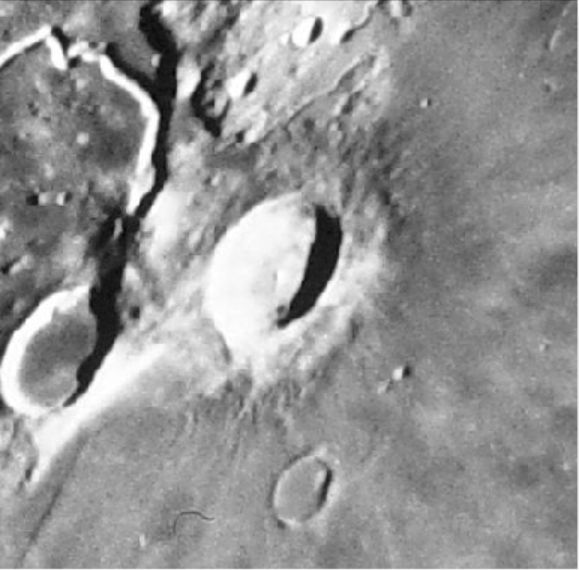
The crater Aristarchus. Credit: Lunar and Planetary Institute.
02/23/2018 – Ephemeris – Meet the stars Castor and Pollux
Ephemeris for Friday, February 23rd. The Sun will rise at 7:30. It’ll be up for 10 hours and 52 minutes, setting at 6:22. The Moon, at first quarter today, will set at 2:54 tomorrow morning.
The star Pollux is at the head of the same named brother of Gemini the twins. Castor is the slightly dimmer star right above it. Pollux is about 34 light years away. It’s twice as massive as the Sun, and has run out of hydrogen in its core and is in the process of evolving into a red giant star. One planet, recently given the name Thestias, has been detected around it. Castor is at 51 light years away. There are 6 stars in its system. The brightest three are visible in telescopes. Each is a spectroscopic binary, meaning that the companion stars are detected by the Doppler shifts of the lines in their spectra as the stars orbit each other. The Doppler shift is just one of the many pieces of information revealed by the spectroscope.
The times given are for the Traverse City/Interlochen area of Michigan. They may be different for your location.
Addendum
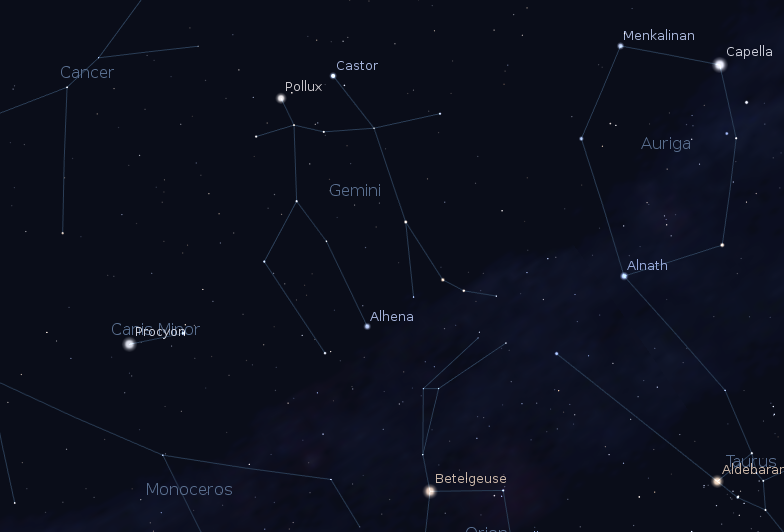
Gemini with the stars Castor and Pollux. Created using Stellarium.
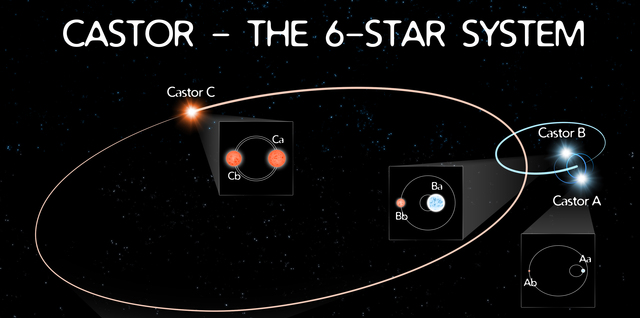
The Castor star system exploded in this JPL/NASA infographic.

