Archive
08/08/2017 – Ephemeris – Eclipse seasons
Ephemeris for Monday, August 7th. The Sun rises at 6:36. It’ll be up for 14 hours and 23 minutes, setting at 8:59. The Moon, at full today, will rise at 9:00 this evening.
At two weeks before the great solar eclipse, the world is experiencing another eclipse, this one is a partial lunar eclipse where the Moon will just clip the northern part of the Earth’s shadow this afternoon our time. It will be mainly visible from Asia. Eclipses occur in seasons of about a month long that occur at a bit less than six month intervals, so eclipses will occur a little earlier next year to the this. That’s because the crossing points of the Moon’s and the Earth’s orbital planes regress slowly westward. In an eclipse season two eclipses will occur: a solar and a lunar eclipse. On rare occasion when a lunar eclipse occurs in the center of a season a partial solar eclipse can occur two weeks before and again after the lunar eclipse, but they will affect the opposite polar regions of the Earth.
The times given are for the Traverse City/Interlochen area of Michigan. They may be different for your location.
Addendum
Table of this and next three eclipse seasons
| Date | Eclipse Type | Notes |
| 08/07/2017 | Lunar Eclipse – partial | Moon clips northern part of Earth’s umbra |
| 08/21/2017 | Solar Eclipse – total | Path of totality crosses US |
| 01/31/2018 | Lunar Eclipse – total | Moon crosses just south of center of umbra |
| 02/15/2018 | Solar Eclipse – partial | Visible mostly from Antarctica |
| 07/13/2018 | Solar Eclipse – partial | Seen from southern Australia |
| 07/27/2018 | Lunar Eclipse – total | Moon crosses center of umbra |
| 08/11/2018 | Solar Eclipse – partial | Seen from northern Europe, Asia |
| 01/06/2019 | Solar Eclipse – partial | Seen mostly from northern Pacific Ocean |
| 01/21/2019 | Lunar Eclipse – total | Moon crosses just north of center of umbra |
08/04/2017 – Ephemeris – View the Moon and planets Jupiter and Saturn tonight
Ephemeris for Friday, August 4th. The Sun rises at 6:32. It’ll be up for 14 hours and 30 minutes, setting at 9:03. The Moon, 3 days before full, will set at 4:32 tomorrow morning.
Tonight the Grand Traverse Astronomical Society will hold a viewing night at Northwestern Michigan College’s Rogers Observatory starting at 9 p.m. The celestial objects featured will be Jupiter, early, them the Moon and Saturn. Some of the brighter deep sky objects will be also seen as it gets dark. Deep sky objects are dim objects beyond the solar system like star clusters and nebulae, clouds of gas and dust either illuminated by stars or hiding them from view. The observatory’s telescopes are augmented by telescopes set up by members of the society. We also welcome the public to bring their telescopes to learn how to use them. The observatory is located south of Traverse City on Birmley Road.
The times given are for the Traverse City/Interlochen area of Michigan. They may be different for your location.
08/03/2017 – Ephemeris – The surreal world of totality
Ephemeris for Thursday, August 3rd. The Sun rises at 6:31. It’ll be up for 14 hours and 33 minutes, setting at 9:04. The Moon, half way from first quarter to full, will set at 3:43 tomorrow morning.
The brief world of solar eclipse totality is one everyone should experience at least once in their lifetime. The duration of totality is so brief that one cannot really absorb it all. As the Moon covers the last of the Sun’s bright photosphere there is a chill as the Sun’s heat is extinguished. Darkness of a deep twilight descends. Street lights come on, cocks will crow, as animals take the darkness as the approach of night. The approaching shadow of the Moon can be seen. During totality the Sun’s corona can be seen as a silvery apparition around the black spot of the Moon that’s covering the Sun’s disk. Bright planets and some stars will appear in a surreal image in the darkened sky, but the horizon is bright. Then suddenly the diamond ring appears and it’s over.
The times given are for the Traverse City/Interlochen area of Michigan. They may be different for your location.
Addendum
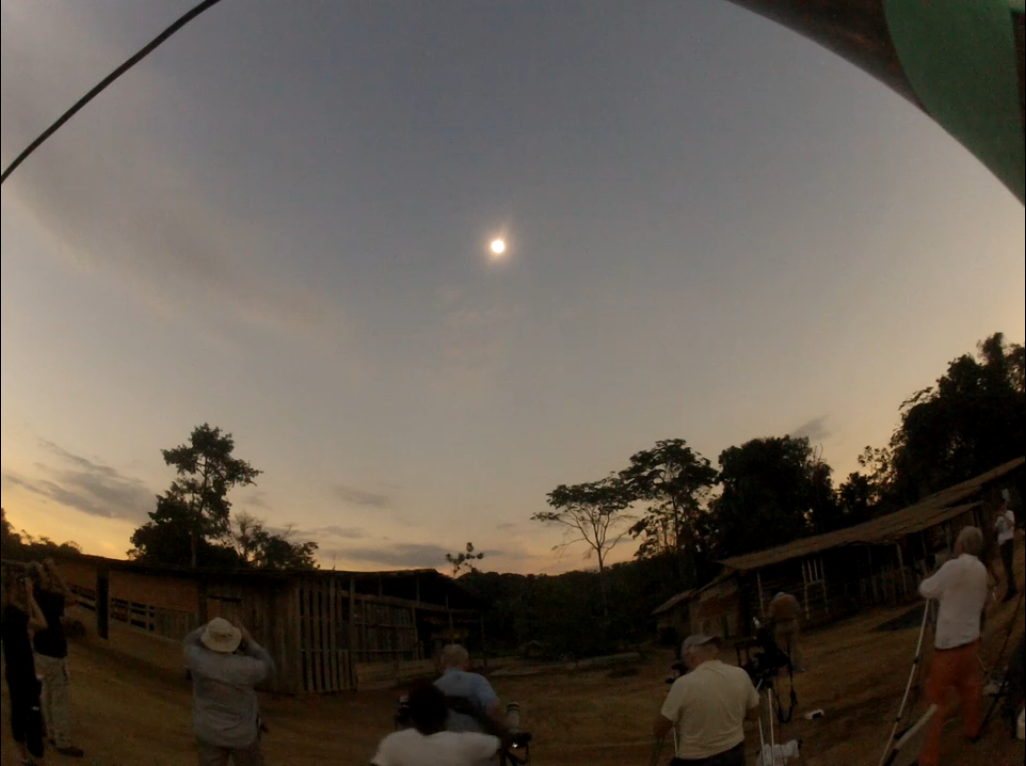
Screen capture from a video of a total solar eclipse of November 2, 2013 at the small village of Mikongo in the equatorial African country of Gabon. This video shows the eclipse expedition of Williams College led by Professor Jay Pasachoff. © 2013 Michael Zeiler. See the video at https://www.greatamericaneclipse.com/splendor/.
Check out the Great American Eclipse web site.
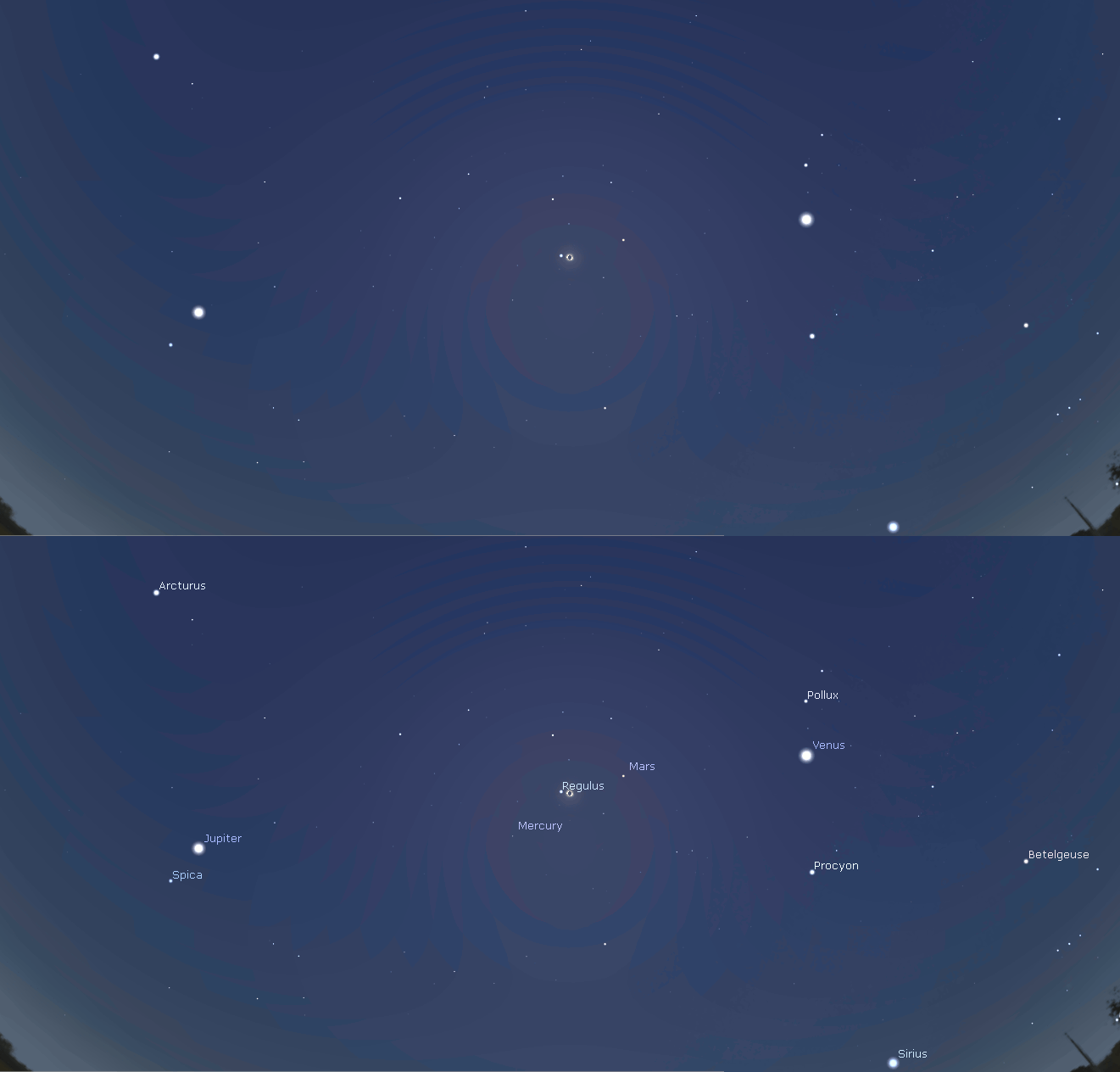
An animation of Stellarium’s version of the sky during totality of the August 21, 2017. My personal caveats based on 4 total eclipses are that Venus is always visible, Mercury only sometimes. I’ve never seen a star. Also the Sun’s corona is a whole lot brighter than seen here. See the image above. Click on this image to enlarge.
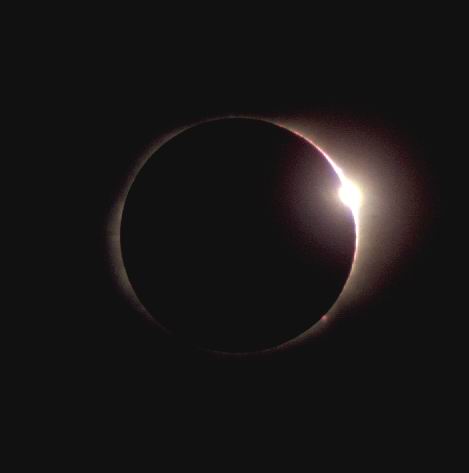
Diamond ring at the end of totality of the total solar eclipse July 10, 1972. Credit Bob Moler.
Additional notes:
The Sun’s corona is perfectly safe to view without a solar filter. Actually the Sun will disappear in solar eclipse glasses and projection viewers. That’s the time to look at the Sun with the naked eye or binoculars. However, when the corona brightens around the right side of the Moon, and the red chromosphere appears, drop the binoculars for the bright diamond ring will quickly appear.
The corona for the quiet Sun stretches out on either side of the Sun, with little at the poles. The active Sun, near a sunspot peak, tends to have a roundish corona. Below is the corona last evening via the Solar and Heliospheric Observatory (SOHO).
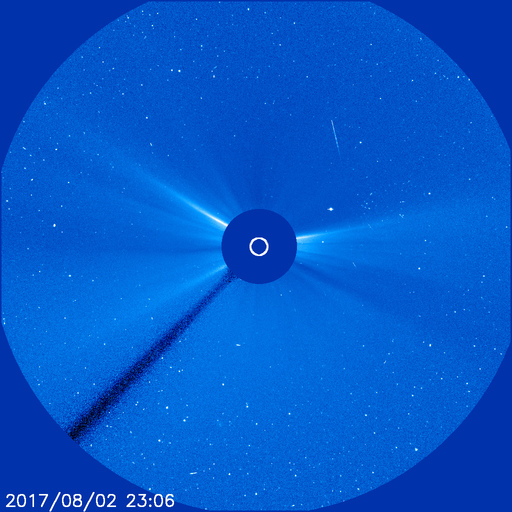
The black disk on the stalk is the occulting disk, hiding the bright photosphere and producing an artificial eclipse.. The white circle is the size of the Sun’s disk. Credit ESA and NASA
Part of the inner corona close to the Sun is covered by the disk. That is what is easiest to see during a total solar eclipse.
For a couple of minutes just before totality starts and again after it ends strange bands of light and shadow will flit along the smooth surface of the ground. They’re called shadow bands. I’ve seen the effect on a large concrete parking lot, an airport tarmac and a softball infield. The nearest thing I’ve seen to it the shadow ripples on the bottom of a swing pool on a sunny day. I finally saw them on my fourth total solar eclipse and two subsequent annular eclipses* which were viewed from or near smooth surfaces. It’s a product of air turbulence and shows up at night in the twinkling of stars.
* An annular eclipse is one in which the Moon is too far, and thus too small to completely cover the face of the Sun. The central part of this type of eclipse leaves a ring or annulus of the bright Sun surrounding the Moon.
08/02/2017 – Ephemeris – Lets check in on the bright planets for this week
Ephemeris for Wednesday, August 2nd. The Sun rises at 6:30. It’ll be up for 14 hours and 35 minutes, setting at 9:06. The Moon, 3 days past first quarter, will set at 3:00 tomorrow morning.
Let’s take our weekly look at the bright planets. Jupiter is sinking in the west-southwest as it gets dark in the evening. The bright blue-white star Spica, which pales in comparison to Jupiter, is seen left of it. In even the smallest telescopes Jupiter’s four largest moons can be seen. They shift positions from night to night. Jupiter will set at 11:41 p.m. Saturn can now be seen in the south as evening as twilight fades. Tonight Saturn will be just below and left of the waxing gibbous Moon. The reddish star Antares is off to the right of Saturn. Saturn’s rings are spectacular in telescopes. Saturn will set at 2:48 a.m. In the morning sky, brilliant Venus will rise at 3:29 a.m. and be visible until about 6 tomorrow morning. Mars and Mercury are too close to the Sun for us to see now.
The times given are for the Traverse City/Interlochen area of Michigan. They may be different for your location.
Addendum
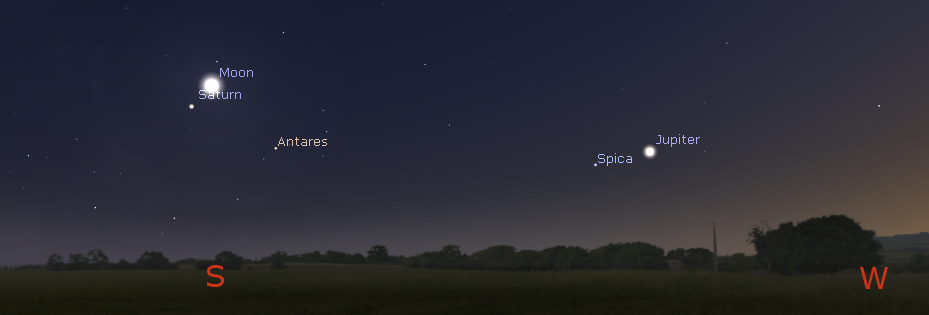
Jupiter, Saturn and the Moon at 10 p.m., August 2, 2017. Created using Stellarium. Click on image to enlarge.
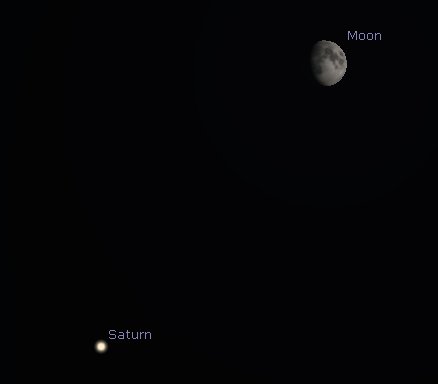
The Moon and Saturn at 10 p.m. EDT August 2, 2017. The Moon is moving to the left (eastward) at about its diameter every hour, so observers at different longitudes will see it in a different position depending on their time zone. Created using Stellarium.
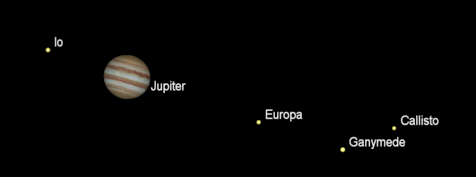
Jupiter and its moons at 10 p.m. August 2, 2017. Created using Cartes du Ciel (Sky Charts).
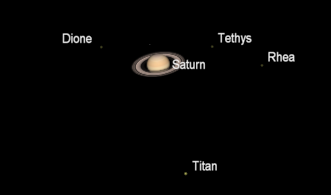
Saturn and its brightest moons overnight August 2/3, 2017. Created using Cartes du Ciel (Sky Charts).
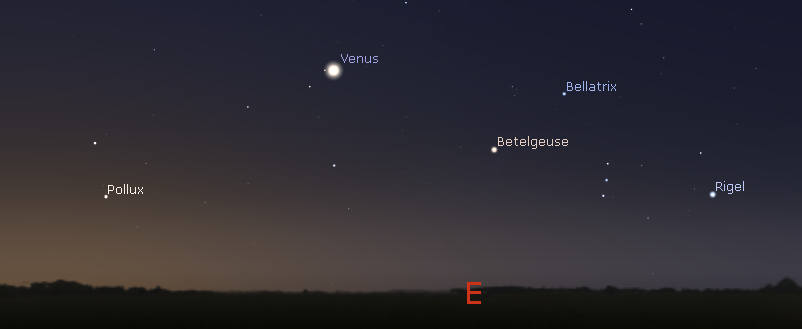
Venus with Orion rising at 5:30 a.m. August 3, 2017. Created using Stellarium.
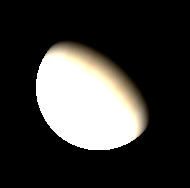
Venus in a telescope on the morning of August 3, 2017. It is greatly enlarged here to show its phase. Created using Stellarium
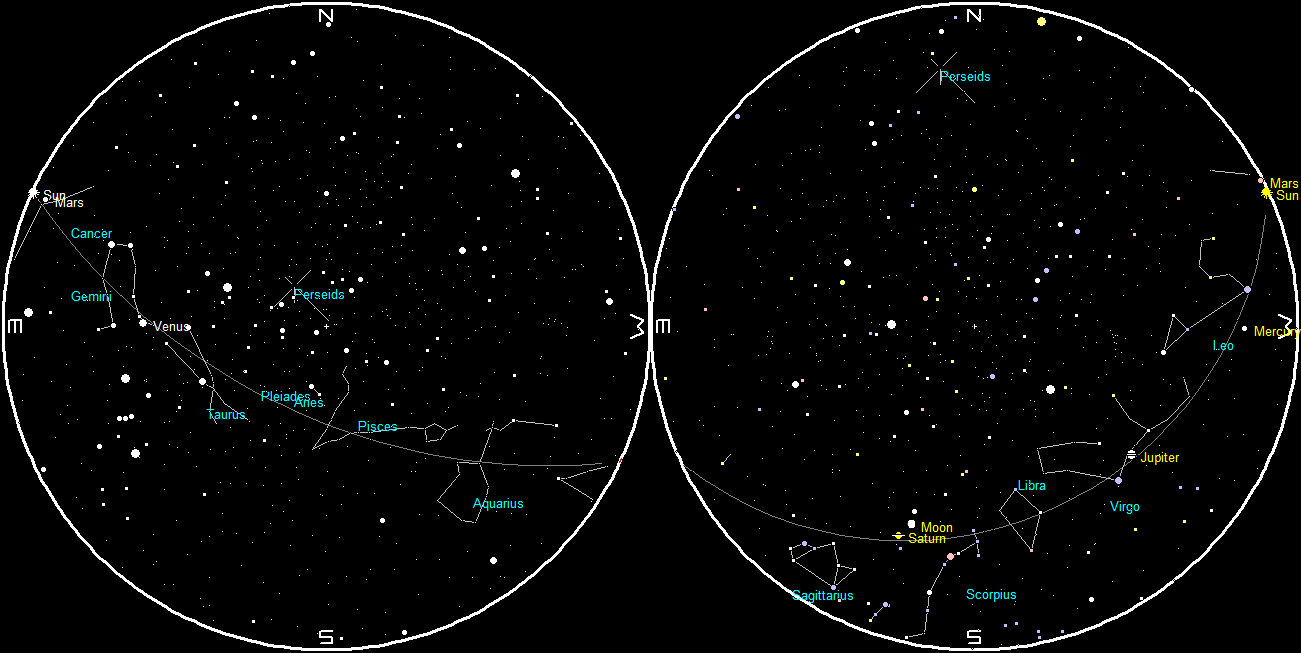
Planets at sunset and sunrise of a single night starting with sunset on the right on August 2, 2017. The night ends on the left with sunrise on August 3. Click on the image to enlarge. Created using my LookingUp program.
08/01/2017 – Ephemeris – A look at the busy month of August in astronomy
Ephemeris for Tuesday, August 1st. The Sun rises at 6:29. It’ll be up for 14 hours and 38 minutes, setting at 9:07. The Moon, 2 days past first quarter, will set at 2:21 tomorrow morning.
Let’s look ahead at the month of August in the skies. Daylight hours will decrease from 14 hours and 38 minutes today to 13 hours 16 minutes on the 31st. The altitude of the sun at local noon, that is degrees of angle above the horizon will decrease from 63 degrees today to just over 53 degrees on the 31st. The Perseid meteor shower will reach its peak on the evening of the 12th. However the bright waning gibbous moon will rise just after 11:30 for a very short dark sky viewing period. The big event this month will be the total solar eclipse that will be visible from all 50 of the United States and total for a narrow strip of land stretching from Oregon to South Carolina. That will occur on the afternoon of Monday the 21st.
The times given are for the Traverse City/Interlochen area of Michigan. They may be different for your location.
Addenda
August Evening Star Chart
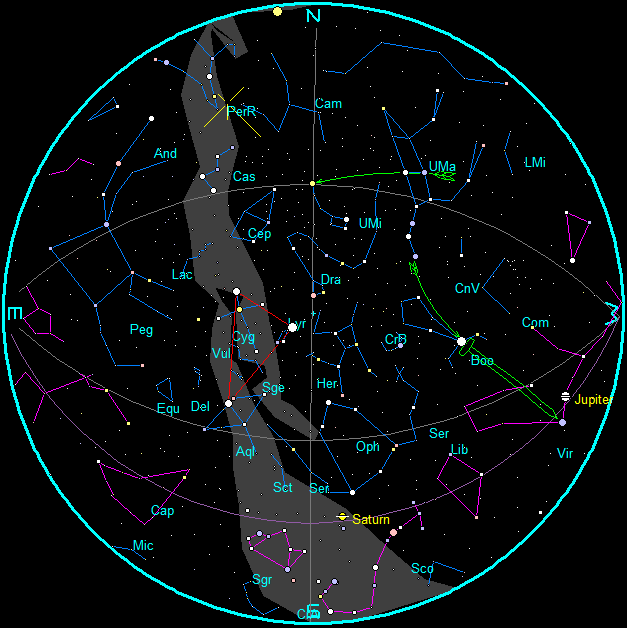
Star Chart for August 2017 (10 p.m. August 15, 2017). Created using my LookingUp program. Click on image to enlarge.
The planets and stars are plotted for the 15th at 10 p.m. EDT in the evening and 5 a.m. for the morning chart. These are the chart times. Note that Traverse City is located approximately 45 minutes behind our time meridian. (An hour 45 minutes behind our daylight saving time meridian. during EDT and 45 minutes behind our daylight standard time meridian. during EST). To duplicate the star positions on a planisphere you may have to set it to 1 hour 45 minutes (Daylight Time) or 45 minutes (Standard Time) earlier than the current time if you are near your time meridian.
Note the chart times of 10 p.m. and 5 a.m. are for the 15th. For each week before the 15th add ½ hour. For each week after the 15th subtract ½ hour. The planet positions are updated each Wednesday on this blog.
August Morning Star Chart
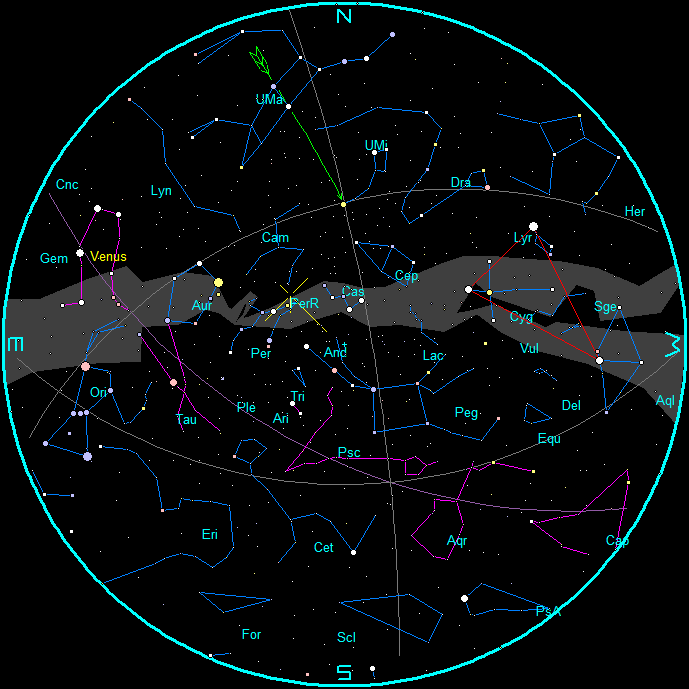
Star Chart for August 2017 mornings based on 5 a.m. August 15th. Created using my LookingUp program. Click on image to enlarge.
For a list of constellation names to go with the abbreviations click here.
- Pointer stars at the front of the bowl of the Big Dipper point to Polaris the North Star
- Leaky Big Dipper drips on Leo
- Follow the arc of the handle of the Big Dipper to the star Arcturus,
- Then follow the Spike to Spica
- The Summer Triangle is in red
- PerR is the Perseid Meteor Shower radiant
Evening nautical twilight ends at 10:26 p.m. EDT on the 1st, decreasing to 9:30 p.m. EDT on the 31st.
Evening astronomical twilight ends at 11:15 p.m. EDT on the 1st, decreasing to 10:09 p.m. EDT on the 31st.
Morning astronomical twilight starts at 4:30 a.m. EDT on the 1st, and increasing to 5:24 a.m. EDT on the 31st.
Morning nautical twilight starts at 5:19 a.m. EDT on the 1st, and increasing to 6:03 a.m. EDT on the 31st.
NASA Calendar of Planetary Events
Date        Time    Event
Aug 01  Tu          Venus: 38.4° W
    02  We  1:55 pm Moon Apogee: 405000 km
    03  Th  3:31 am Moon-Saturn: 3.8° S
    04  Fr  2:17 pm Moon South Dec.: 19.4° S
    07  Mo  2:11 pm Full Moon
    07  Mo  2:22 pm Partial Lunar Eclipse (Not visible from here)
    08  Tu  6:56 am Moon Descending Node
    12  Sa  2:35 pm Perseid Shower: ZHR = 90
    14  Mo  9:15 pm Last Quarter
    16  We  2:39 am Moon-Aldebaran: 0.4° S
    18  Fr  2:50 am Moon North Dec.: 19.4° N
    18  Fr  9:14 am Moon Perigee: 366100 km
    19  Sa 12:45 am Moon-Venus: 2.3° N
    20  Su  3:15 am Moon-Beehive: 3.2° N
    21  Mo  6:34 am Moon Ascending Node
    21  Mo  2:26 pm Total Solar Eclipse
    21  Mo  2:30 pm New Moon
    25  Fr  9:00 am Moon-Jupiter: 3.7° S
    26  Sa  4:32 pm Mercury Inferior Conj.
    29  Tu  4:13 am First Quarter
    30  We  7:25 am Moon Apogee: 404300 km
    30  We 10:23 am Moon-Saturn: 3.9° S
    31  Th 10:03 pm Moon South Dec.: 19.4° S
Sep 01  Fr          Venus: 31.7° W
Sky Events Calendar by Fred Espenak and Sumit Dutta (NASA’s GSFC),
http://eclipse.gsfc.nasa.gov/SKYCAL/SKYCAL.html
If you go to the above site you can print out a list like the above for the entire year
or calendar pages for your time zone.
August Rising and Setting Events
LU                  Ephemeris of Sky Events for Interlochen/TC
August, 2017    Local time zone: EDT
+-----------------------------------------------------------------------+
| DATE |  SUN     SUN  DAYLIGHT|   TWILIGHT*    |MOON  RISE OR    ILLUM |
|      |  RISE    SET    HOURS |  END    START  |PHASE SET** TIME FRACTN|
+=======================================================================+
|Tue  1| 06:29a  09:08p  14:38 | 10:23p  05:13a |      Set  02:21a   72%|
|Wed  2| 06:30a  09:06p  14:36 | 10:21p  05:15a |      Set  03:00a   80%|
|Thu  3| 06:31a  09:05p  14:34 | 10:20p  05:16a |      Set  03:43a   87%|
|Fri  4| 06:32a  09:04p  14:31 | 10:18p  05:18a |      Set  04:32a   93%|
|Sat  5| 06:33a  09:02p  14:29 | 10:16p  05:19a |      Set  05:26a   97%|
+------+-----------------------+----------------+-----------------------+
|Sun  6| 06:34a  09:01p  14:26 | 10:15p  05:21a |      Set  06:24a   99%|
|Mon  7| 06:36a  09:00p  14:23 | 10:13p  05:22a |Full  Rise 09:01p  100%|
|Tue  8| 06:37a  08:58p  14:21 | 10:11p  05:24a |      Rise 09:35p   98%|
|Wed  9| 06:38a  08:57p  14:18 | 10:09p  05:25a |      Rise 10:06p   95%|
|Thu 10| 06:39a  08:55p  14:16 | 10:07p  05:27a |      Rise 10:36p   89%|
|Fri 11| 06:40a  08:54p  14:13 | 10:06p  05:28a |      Rise 11:06p   81%|
|Sat 12| 06:41a  08:52p  14:10 | 10:04p  05:30a |      Rise 11:36p   72%|
+------+-----------------------+----------------+-----------------------+
|Sun 13| 06:43a  08:51p  14:08 | 10:02p  05:31a |      Rise 12:09a   62%|
|Mon 14| 06:44a  08:49p  14:05 | 10:00p  05:33a |L Qtr Rise 12:46a   51%|
|Tue 15| 06:45a  08:48p  14:02 | 09:58p  05:34a |      Rise 01:28a   39%|
|Wed 16| 06:46a  08:46p  13:59 | 09:56p  05:36a |      Rise 02:16a   28%|
|Thu 17| 06:47a  08:44p  13:57 | 09:54p  05:37a |      Rise 03:13a   18%|
|Fri 18| 06:49a  08:43p  13:54 | 09:52p  05:39a |      Rise 04:16a   10%|
|Sat 19| 06:50a  08:41p  13:51 | 09:50p  05:40a |      Rise 05:24a    4%|
+------+-----------------------+----------------+-----------------------+
|Sun 20| 06:51a  08:39p  13:48 | 09:48p  05:42a |      Rise 06:35a    1%|
|Mon 21| 06:52a  08:38p  13:45 | 09:47p  05:43a |New   Set  08:44p    0%|
|Tue 22| 06:53a  08:36p  13:42 | 09:45p  05:44a |      Set  09:18p    2%|
|Wed 23| 06:54a  08:34p  13:39 | 09:43p  05:46a |      Set  09:49p    6%|
|Thu 24| 06:56a  08:33p  13:37 | 09:41p  05:47a |      Set  10:18p   12%|
|Fri 25| 06:57a  08:31p  13:34 | 09:39p  05:49a |      Set  10:46p   20%|
|Sat 26| 06:58a  08:29p  13:31 | 09:37p  05:50a |      Set  11:15p   28%|
+------+-----------------------+----------------+-----------------------+
|Sun 27| 06:59a  08:27p  13:28 | 09:35p  05:52a |      Set  11:46p   37%|
|Mon 28| 07:00a  08:26p  13:25 | 09:33p  05:53a |      Set  12:19a   47%|
|Tue 29| 07:01a  08:24p  13:22 | 09:31p  05:54a |F Qtr Set  12:56a   56%|
|Wed 30| 07:03a  08:22p  13:19 | 09:29p  05:56a |      Set  01:38a   65%|
|Thu 31| 07:04a  08:20p  13:16 | 09:27p  05:57a |      Set  02:24a   74%|
+-----------------------------------------------------------------------+
* Nautical Twilight
** Moonrise or moonset, whichever occurs between sunset and sunrise
07/31/2017 – Ephemeris – Only 3 weeks to the eclipse (E – 21 days)
Ephemeris for Monday, July 31st. The Sun rises at 6:28. It’ll be up for 14 hours and 40 minutes, setting at 9:08. The Moon, 1 day past first quarter, will set at 1:46 tomorrow morning.
Today is E minus 21 days. E stands for Eclipse, the Great American Eclipse that is. August 21st is the day the shadow of the Moon will completely cover the United States and most of North America. The path where the Moon will completely block out the face of the Sun, called the path of totality crosses the country from parts of Oregon, Idaho, Wyoming, Nebraska, Kansas, Missouri, Illinois, Kentucky, Tennessee, North Carolina, Georgia, to South Carolina. The path of totality is only 90 miles wide at most, and 600 miles or more from northern Michigan. From here the eclipse will start shortly before 1 p.m. and end around 3:40 p.m. The official viewing spot where there will be guides from the Grand Traverse Astronomical Society will the public help view the eclipse will be at the Sleeping Bear Dunes Dune Climb.
The times given are for the Traverse City/Interlochen area of Michigan. They may be different for your location.
Addendum
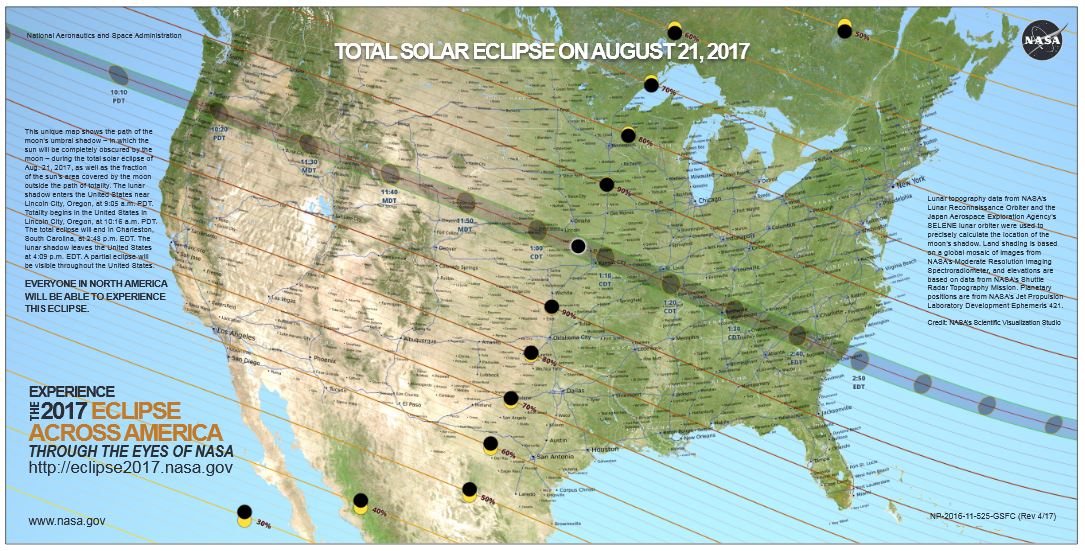
All 50 states will see some part of the August 21, 2017 solar eclipse. The face of the Sun will be totally covered by the Moon in the narrow band called the path of totality. Credit: NASA.
07/27/2017 – Ephemeris – Two meteor showers, one peaking another ramping up
Ephemeris for Thursday, July 27th. The Sun rises at 6:23. It’ll be up for 14 hours and 49 minutes, setting at 9:13. The Moon, 3 days before first quarter, will set at 11:50 this evening.
We are in the season for meteor showers. Today the South Delta Aquariid Meteor Shower will reach peak. This is a not very active shower where the meteors will seem to come from low in the southeastern sky after midnight. The radiant will rotate to the south by 5 a.m. The moon won’t bother it for the next few days. The number of meteors seen will be under 20 per hour. This long-lasting shower will still add a few meteors when the famous Perseid meteor shower begin to appear, which is around now. These meteors will seem to come from the northeastern part of the sky, and will reach peak for us in the evening hours of August 12th. On that night the Moon will brighten the sky after 11:30 p.m. So for the next two weeks both shower meteors can be seen.
The times given are for the Traverse City/Interlochen area of Michigan. They may be different for your location.
Addendum
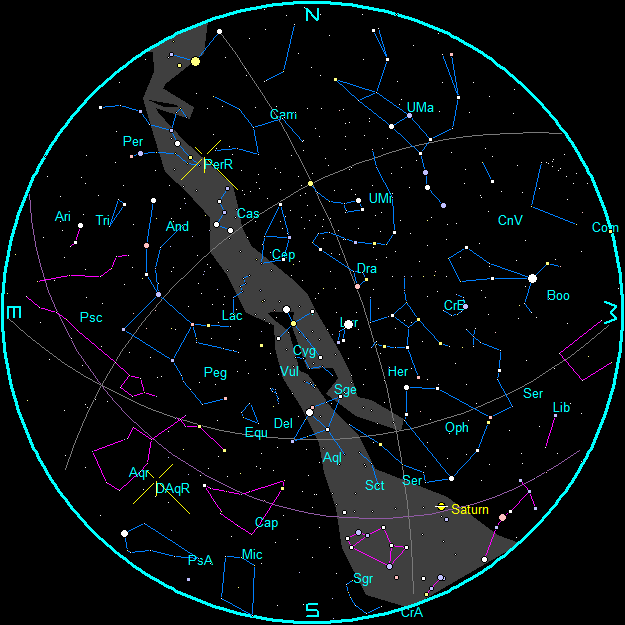
The sky at 1 a.m. tomorrow morning, July 28, 2017 showing the South Delta Aquariid (DAqR) and Perseid (PerR) meteor radiants. Created using my LookingUp program.
07/26/2017 – Ephemeris – Let’s check out the bright planets for this week
Ephemeris for Wednesday, July 26th. The Sun rises at 6:22. It’ll be up for 14 hours and 51 minutes, setting at 9:14. The Moon, 3 days past new, will set at 11:20 this evening.
Let’s take our weekly look at the bright planets. Jupiter is sinking in the west-southwest as it gets dark in the evening. The bright blue-white star Spica, which pales in comparison to Jupiter, is seen left of it. In even the smallest telescopes Jupiter’s four largest moons can be seen. They shift positions from night to night. Jupiter will set at 12:06 a.m. Saturn can now be seen in the south as evening as twilight fades. The reddish star Antares is off to the right of Saturn. Saturn’s rings are spectacular in telescopes. Saturn will set at 3:17 a.m. In the morning sky, brilliant Venus will rise at 3:25 a.m. and be visible until about quarter to 6 tomorrow morning. Mars is in conjunction with the Sun today, that is it’s almost directly behind the Sun, For the last week and the next, no commands will be sent to the orbiters and rovers on Mars due to the radio interference of the Sun.
The times given are for the Traverse City/Interlochen area of Michigan. They may be different for your location.
Addendum
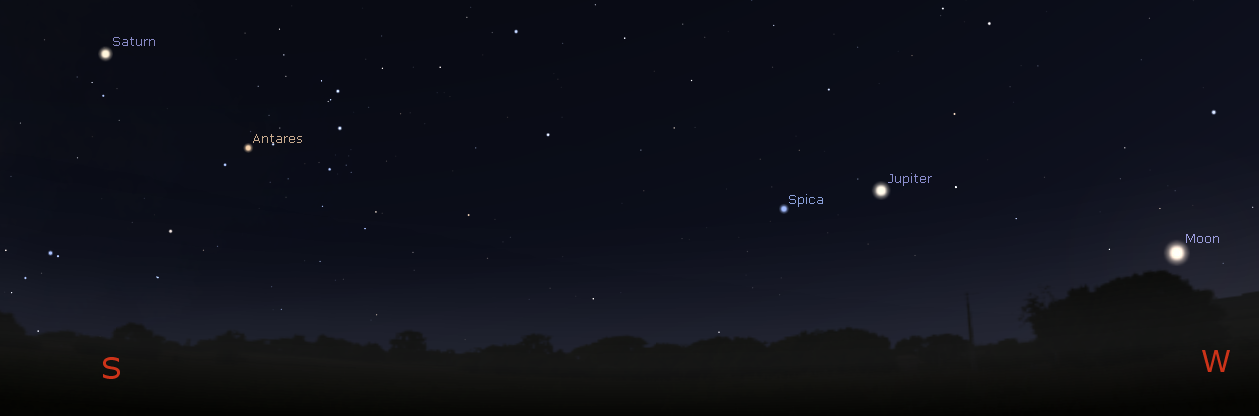
Jupiter and Saturn with the southern summer constellations and the crescent Moon at 10:30 p.m., July 26, 2017. Created using Stellarium. Click on image to enlarge.
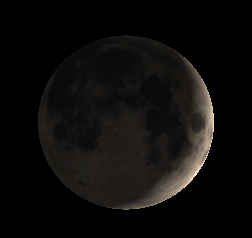
The Moon as it might be seen in binoculars showing also Earth shine at 10:30 p.m. July 26, 2017. Created using Stellarium.
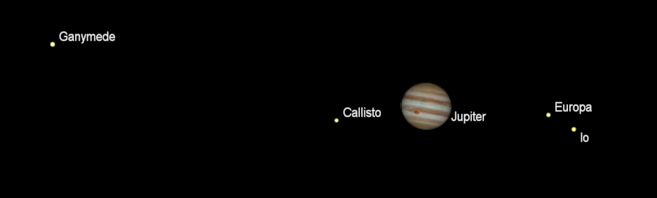
Jupiter and its moons at 10:30 p.m. July 26, 2017. The Great Red Spot will cross the planet’s central meridian at 11:39 p.m. Created using Cartes du Ciel (Sky Charts).
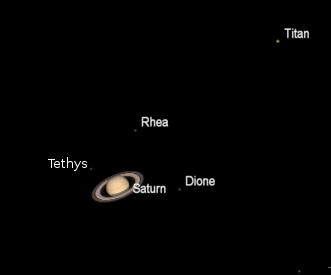
Saturn and its brightest moons overnight July 26/27, 2017. Created using Cartes du Ciel (Sky Charts).
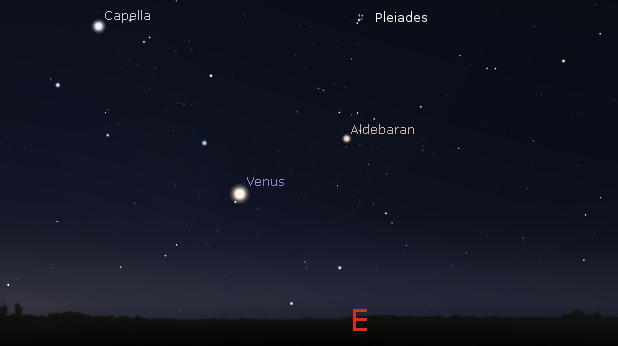
Venus with the stars of autumn at 5 a.m. July 27, 2017. Created using Stellarium.
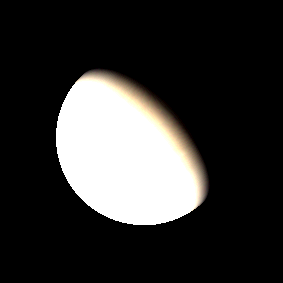
Venus as it might be seen through a telescope at 5 a.m. July 27, 2017. This is displayed at a larger scale/magnification than the Jupiter or Saturn images above. Created using Stellarium.
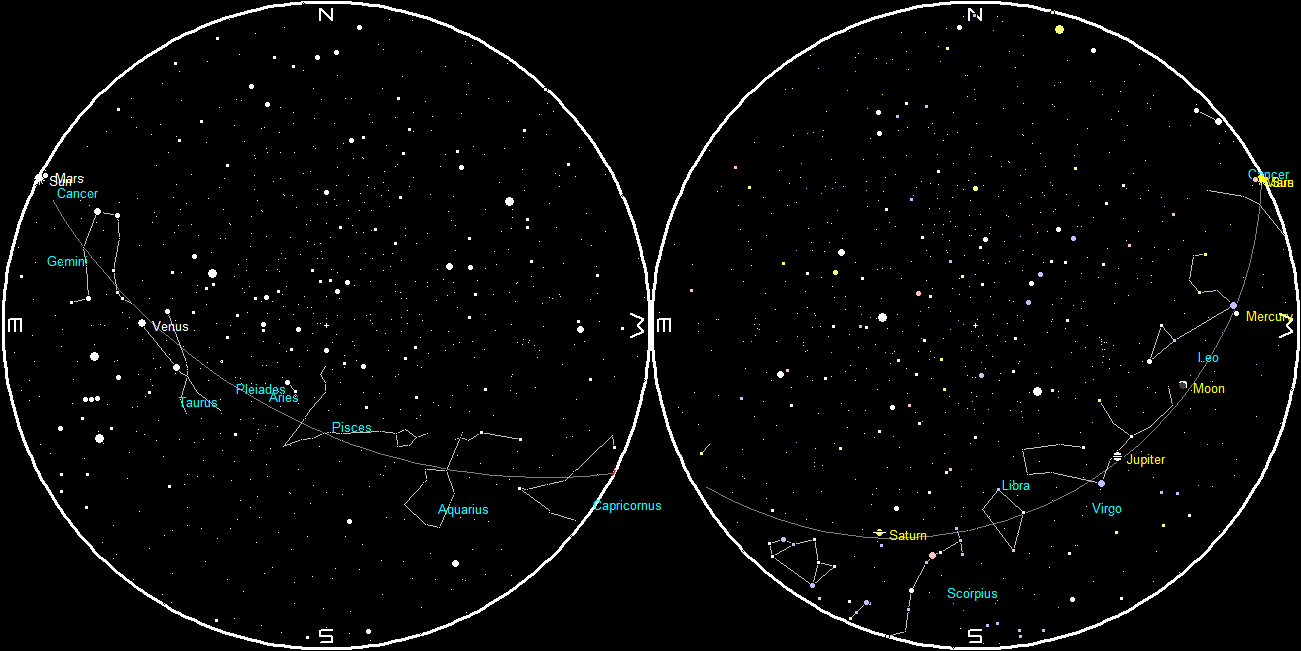
Planets at sunset and sunrise of a single night starting with sunset on the right on July 26, 2017. The night ends on the left with sunrise on July 27. Click on the image to enlarge. Created using my LookingUp program.
07/25/2017 – Ephemeris – Why do solar eclipses happen?
Ephemeris for Tuesday, July 25th. The Sun rises at 6:21. It’ll be up for 14 hours and 54 minutes, setting at 9:15. The Moon, 2 days past new, will set at 10:48 this evening.
We have a day less than 4 weeks before the Great American Total Solar Eclipse on August 21st will occur. Solar eclipses occur at new moon, when the moon is aligned so its shadow falls on the Earth. It doesn’t happen every new moon because the Moon is a long ways away, and its orbit is tipped some 5 degrees from the Earth’s orbit of the Sun, so usually the Moon is north or south of the Sun at new moon. About one in every 6 new moons produces an eclipse. They occur when the Moon is near the crossing point of the two orbital planes, called nodes. The point where the Moon is passing the node in northward direction is called the ascending node, and 180 degrees around the orbit there is the descending node, but you have to be in the right spot to see an eclipse.
The times given are for the Traverse City/Interlochen area of Michigan. They may be different for your location.
Addendum
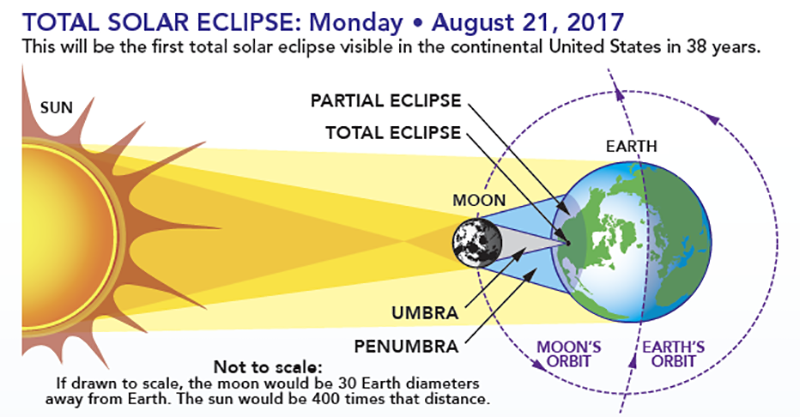
What happens to create a total solar eclipse. Note the Sun’ distance as being 400 times the distance of the Moon. The Sun is also 400 times the Moon’s diameter, so they appear nearly the same size from the Earth. Credit NASA and the Eclipse2017.NASA.gov website.
07/24/2017 – Ephemeris – The celestial scorpion
Ephemeris for Monday, July 24th. The Sun rises at 6:20. It’ll be up for 14 hours and 56 minutes, setting at 9:16. The Moon, 1 day past new, will set at 10:12 this evening.
Crawling just above the southern horizon at 11 p.m. is the zodiacal constellation of Scorpius the scorpion. His heart is the red giant star Antares. Its facing the west or right with a short arc of three stars as its head. His body and tail drop to the left and scrape the horizon before curving up to the critter’s poisonous stinger of two stars. It really makes a great scorpion. One story of the scorpion concerns Orion the hunter the great winter constellation. In that story Orion was killed by the sting of a scorpion. Therefore Orion and Scorpius are never seen in the sky at the same time. That is certainly true around here and for the Greeks, whose legend it is. However if one travels far enough south that is no longer true.
The times given are for the Traverse City/Interlochen area of Michigan. They may be different for your location.
Addendum
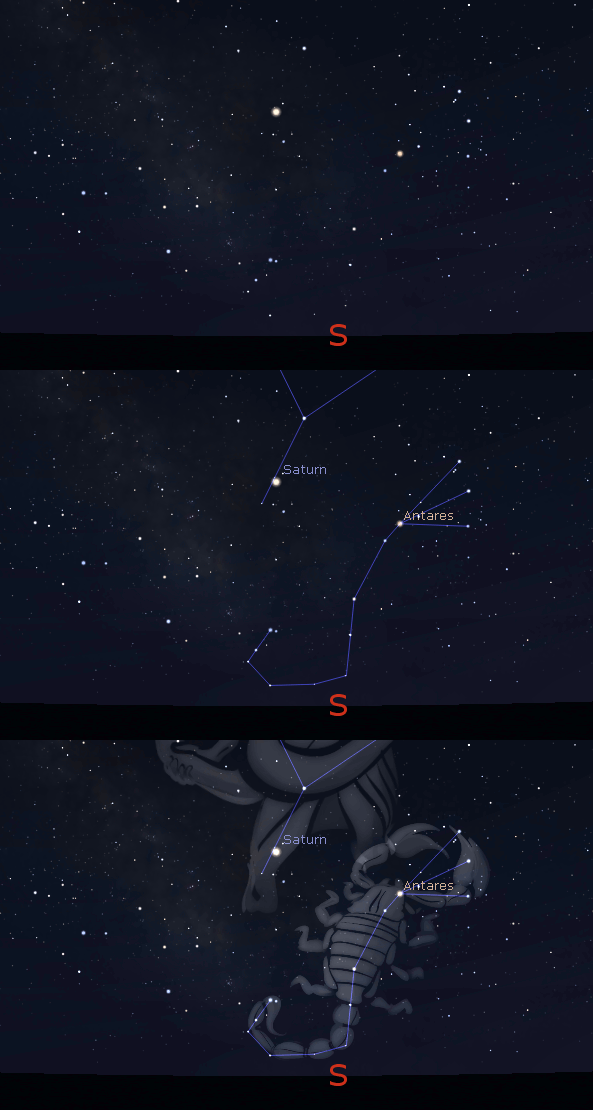
Scorpius finder chart for 10:30 p.m., July 24, 2017. Created using Stellarium, which has a bug in the newest version and is also showing Ophiuchus.

