Archive
07/21/2017 – Ephemeris – There’s an astronomy event tomorrow night
Ephemeris for Friday, July 21st. Today the Sun will be up for 15 hours and 2 minutes, setting at 9:19, and it will rise tomorrow at 6:18. The Moon, 2 days before new, will rise at 5:28 tomorrow morning.
Tomorrow, Saturday, the 22nd, there, will be viewing of the summer starry skies at the Northwestern Michigan College’s Rogers Observatory starting at 9 p.m. While starting before sunset, if it’s clear Jupiter should be spotted before 10 p.m. The planet Saturn and its rings will also be featured. By 10:30 the sky should be dark enough to spot some of the wonders among the stars, like star clusters, and nebulae that are the either the birth places of stars or the expelled remnants of dying stars. The Milky Way takes over the dark sky, it is its wonders that we see. The Observatory is located south of Traverse City on Birmley road. Take Garfield Road two traffic lights south of South Airport Road to turn right at Birmley Road.
The times given are for the Traverse City/Interlochen area of Michigan. They may be different for your location.
07/20/2017 – Ephemeris – Only one month and a day to the Great American Eclipse, and a personal note
Ephemeris for Thursday, July 20th. Today the Sun will be up for 15 hours and 4 minutes, setting at 9:20, and it will rise tomorrow at 6:17. The Moon, 3 days before new, will rise at 4:26 tomorrow morning.
As of tomorrow it will be one month to the Great American Eclipse, a total eclipse that will span the continental United States from Oregon to South Carolina. Here in northern Michigan, the Sun will be, at maximum 75 percent covered by the Moon around 2:20 p.m. The eclipse will last from 12:58 to 3:40 p.m. approximately. It will not be safe to look at the Sun without a solar filter or by projecting the image of the Sun on a white paper, either with a pinhole, one side of a binocular, or telescope. Hold the paper screen a foot or so behind the eyepiece. Try it before the eclipse. Or sit under a tree, and let the pinholes between the leaves project a myriad of suns on the ground. Check gtastro.org for lots of links to information about the eclipse.
The times given are for the Traverse City/Interlochen area of Michigan. They may be different for your location.
Addendum
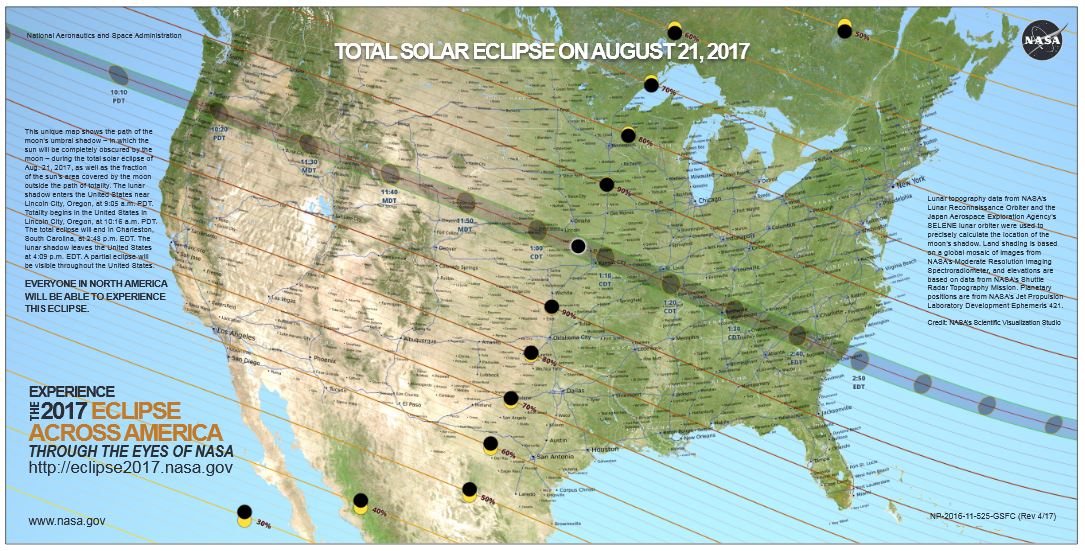
All 50 states will see some part of the August 21, 2017 solar eclipse. The face of the Sun will be totally covered by the Moon in the narrow band called the path of totality for up to 2 minutes, 40 seconds. Credit: NASA.
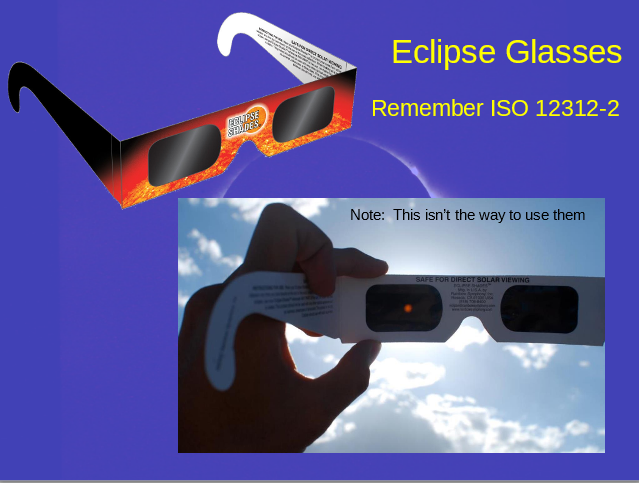
These are eclipse glasses which can be gotten for a couple dollars or less.
They are especially difficult to use, especially for people who wear glasses and can’t remove them because they are near-sighted.
Personally I do not recommend them, instead relying on one of the projection methods.
Be especially careful about children using them.
Remember the ISO 12312-2 compliance that should be printed on them. Do not use welders filters. Damaging exposure to the eyes is painless and may not show up for a day or two.
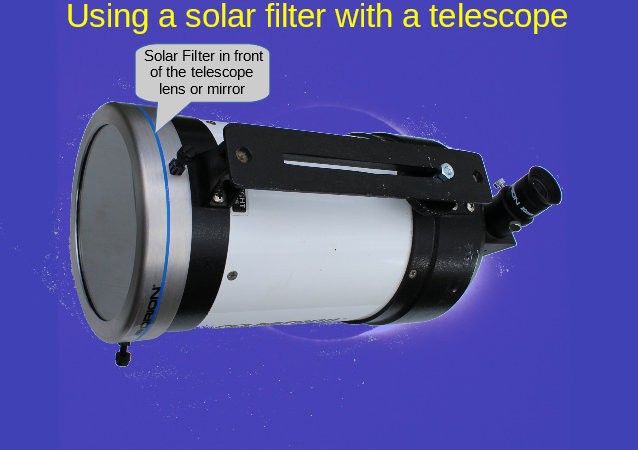
In using a solar filter with a telescope or binoculars the filter must be placed in front of the objective (front of the telescope).
Solar filters that fit into eyepieces are dangerous and can shatter with the heat.
Such filters should either be smashed and added to your favorite landfill, or taken to the bay to see how many times you can skip it on the water.
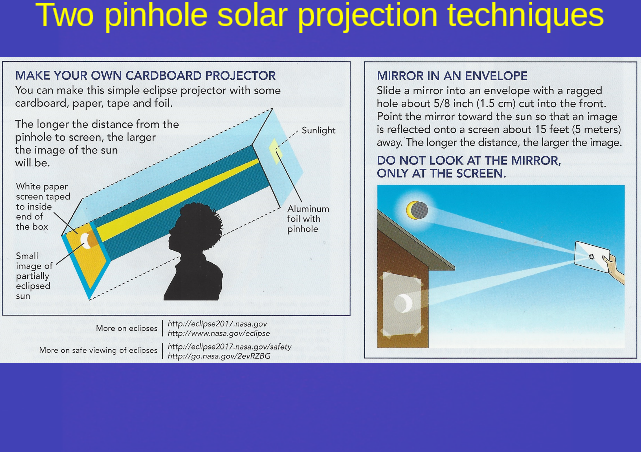
Pinhole projection is the simplest way to project the Sun’s image.
A long box can be used to project the image inside. The diameter of the pin hole is a compromise between sharpness and brightness of the image.
…The farther the image is projected the larger it is.
The throw of the image can be increased by using a mirror masked with a quarter of an inch or larger hole and sending the image 10 or more feet away.
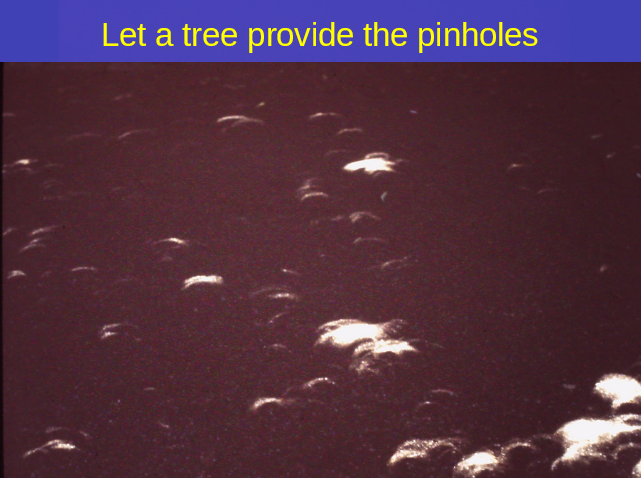
Let nature provide the pinholes. Sit under in the shade. Stay cool, And watch the Sun’s images on the ground.
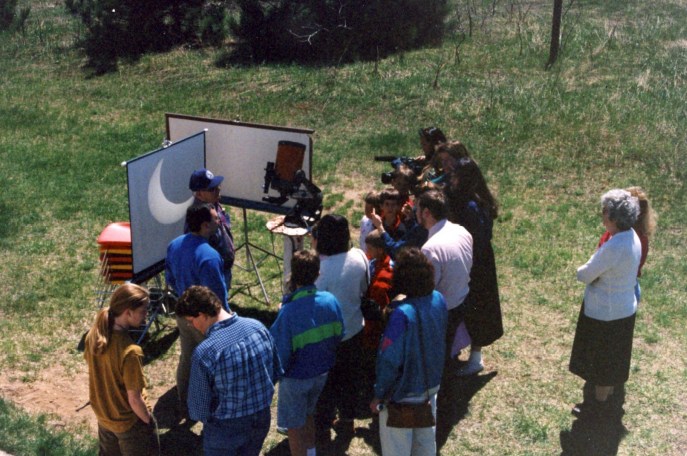
Here’s an 8” Schmidt Cassigrain telescope, with a low power eyepiece projecting a large image on a movie screen. For lots of people to view and photograph. Credit Eileen Carlisle.
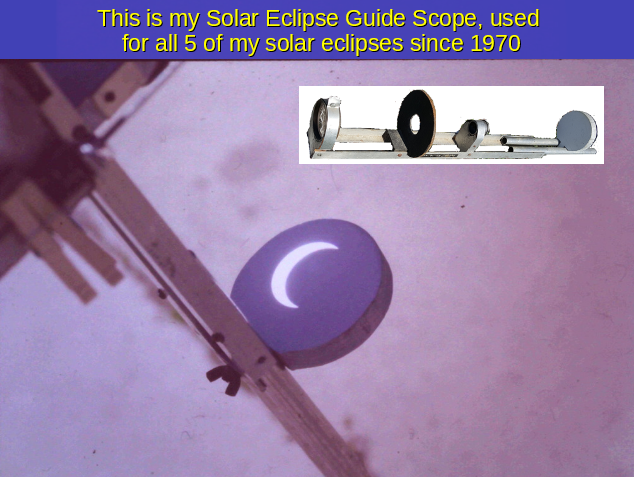
This is my Solar Guide Scope which I used for all my solar eclipses starting with 1970 (three total and 2 annular).
It is an open design, with an objective of about 300mm (12”) focal length, a shield to shield the screen from the Sun, a cheap 12mm (1/2”) focal length eyepiece and an adjustable screen to project the Sun’s image. I originally made it too short, so I extended it. It always attracts a crowd of eclipse watchers.
July 20th in history
48 years ago (1969) Apollo 11 landed on the Moon
41 years ago (1976) the Viking 1 Lander landed on Mars.
On a personal side: 54 years ago (1963) I saw my first total solar eclipse.
The 54th anniversary isn’t the big deal. The big deal has to do with the Saros, the period in which eclipses repeat. That interval is 6,585.3211 days or approximately 18 years 11 1/3 days, give or take a day, depending on the number of leap years in the interval. That one-third day is the kicker, because the next eclipse in the series will occur 120 degrees of longitude west of the last eclipse. There are many Saros series running at any given time, so eclipses don’t only happen every 18 years.
However after 3 Saros periods the eclipse will again occur at roughly the same longitude. If the Moon passes the Sun moving slightly southward, the eclipse series will trend southward on the globe. If northward, the series heads north.
The eclipse of August 21st 2017 is the third Saros eclipse after my first total solar eclipse
Since this upcoming eclipse tracks southward, the 1963 eclipse was farther north with the path of totality passing through Alaska, Canada and only the state of Maine.
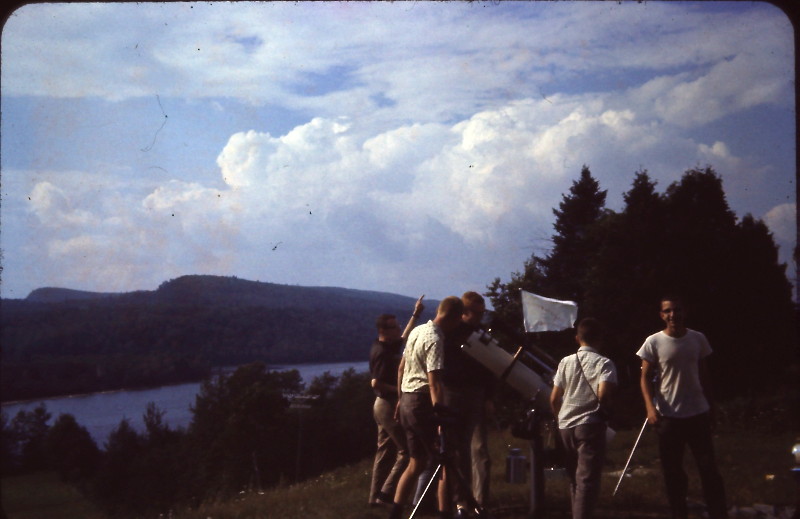
On that day, friends John Wesley, Dave DeBruyn and several other members of the University of Michigan team, and Stan Carr, a member of the Muskegon Astronomy Club found ourselves on a hill overlooking the St. Maurice River in Quebec Province of Canada.
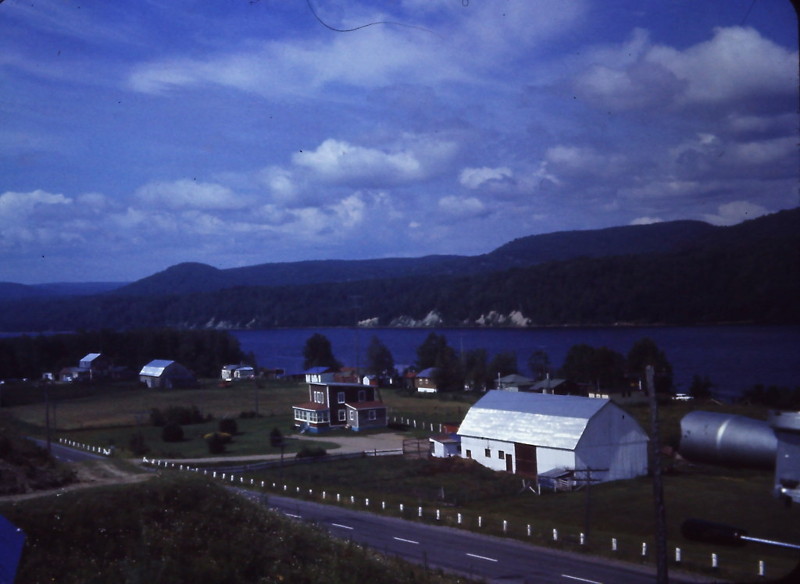
Overlooking the St Maurice River from our camp in the morning with the clouds then. But the eclipse would start about 4:30 in the afternoon.

At two p.m. and we’re socked in. Seen is John Wesley and our automated eclipse camera. 2 1/2 hours to totality.
Happy day! The eclipse is starting, and it’s clearing up.
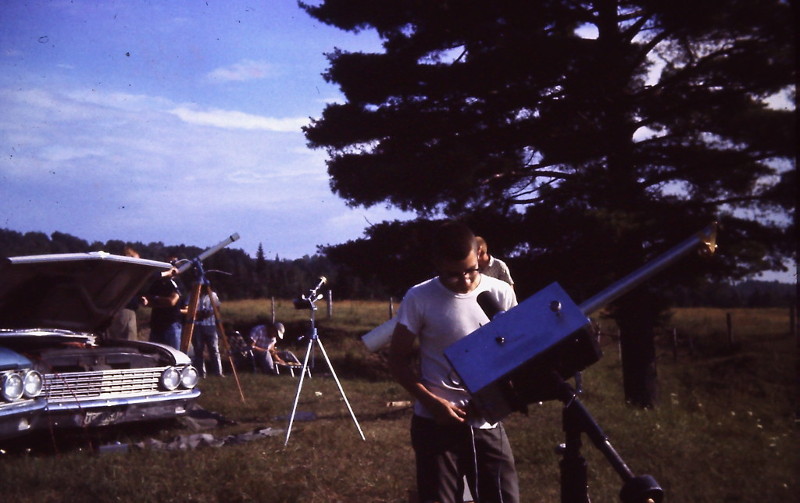
John Wesley checking the tracking of our eclipse camera.
It was for naught. Due to an operator error all the film was wound up when power was applied to the controller, because I left a switch in the wrong position.
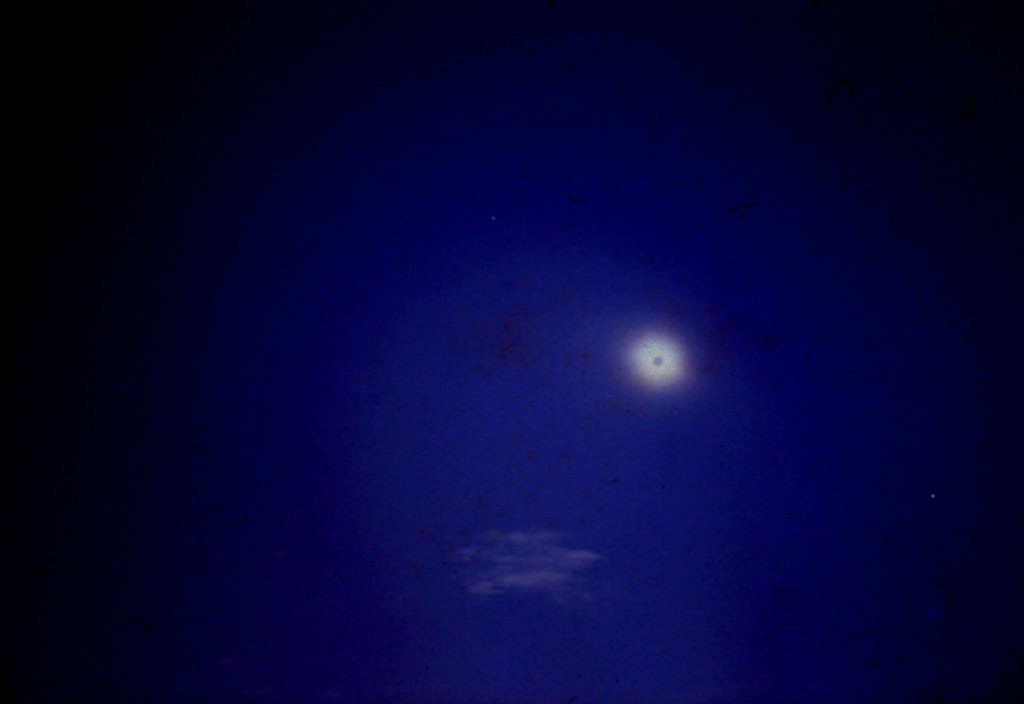
A shot with a 50mm lens with a guessed exposure. Thanks to GIMP and modern digital processing I was able to recover the over exposed image. But like all eclipse photographs, doesn’t really show it as the eye reveals the dynamic light levels of the corona.
07/19/2017 – Ephemeris – Our weekly look at the bright planets
Ephemeris for Wednesday, July 19th. Today the Sun will be up for 15 hours and 5 minutes, setting at 9:21, and it will rise tomorrow at 6:16. The Moon, 3 days past last quarter, will rise at 3:33 tomorrow morning.
Let’s take our weekly look at the bright planets. Jupiter is in the west-southwest as it gets dark in the evening. The bright blue-white star Spica, which pales in comparison to Jupiter, is seen left of it. In even the smallest telescopes Jupiter’s four largest moons can be seen. They shift positions from night to night. Jupiter will set at 12:32 a.m. Saturn can now be seen in the evening as twilight fades in the south. The reddish star Antares is off to the right of Saturn. Saturn’s rings are spectacular in telescopes. Saturn will set at 3:46 a.m. In the morning sky, brilliant Venus will rise at 3:22 a.m. and be visible until about quarter to 6 tomorrow morning. Mercury sets too close to sunset to be easily seen now.
The times given are for the Traverse City/Interlochen area of Michigan. They may be different for your location.
Addendum
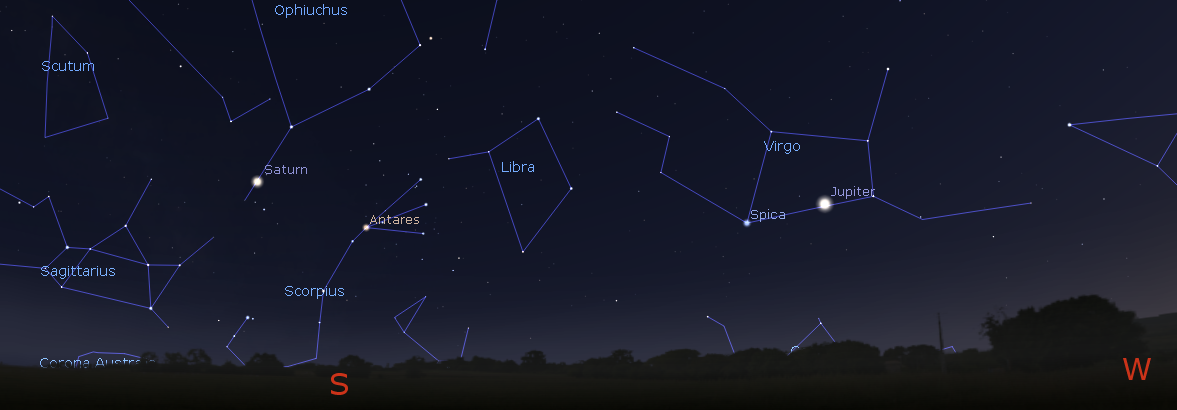
Jupiter and Saturn with the southern summer constellations at 10:30 p.m., July 19, 2017. Created using Stellarium. Click on the image to enlarge.
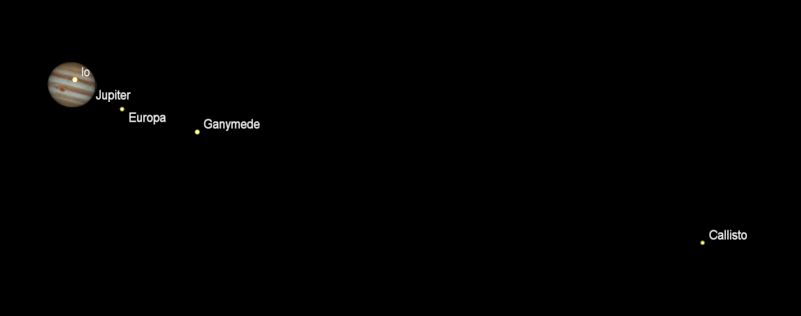
Jupiter and three of its moons. Io can be seen here in transit of the planet, but very difficult in reality, at 10:30 p.m,. July 19, 2017. Created using Cartes du Ciel (Sky Charts).
Project Pluto has the following events for the 12/13th:
Time is UT. Events prior to 20 July 2:35 UT (10:35 p.m. 19 July EDT) or later than 4:24 UT or 12:24 a.m. EDT will not be visible from Northern Michigan. Data from Project Pluto: https://www.projectpluto.com/jevent.htm#jun. The website also has a link to a list of Great Red Spot transits.
I : Tra start: 20 Jul 2017 1:21
I : Sha start: 20 Jul 2017 2:35
I : Tra end : 20 Jul 2017 3:32
II : Occ start: 20 Jul 2017 4:24
I : Sha end : 20 Jul 2017 4:46
II : Occ end : 20 Jul 2017 6:54
II : Ecl start: 20 Jul 2017 6:55
II : Ecl end : 20 Jul 2017 9:17
Satellites: I = Io and II = Europa
Tra = Transit of a satellite across the face of Jupiter, Sha = Transit of a moon’s shadow, Ecl = Eclipse (In Jupiter’s shadow), Occ = Occultation (Moon behind the planet).
The Great Red Spot transit: 20 Jul 2017 02:50 (10:50 p.m. 19 July EDT).
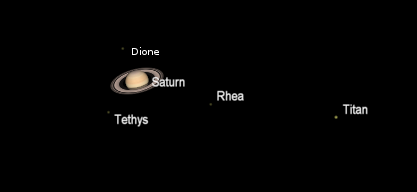
Saturn and its brightest moons overnight July 19/20, 2017. Created using Cartes du Ciel (Sky Charts).
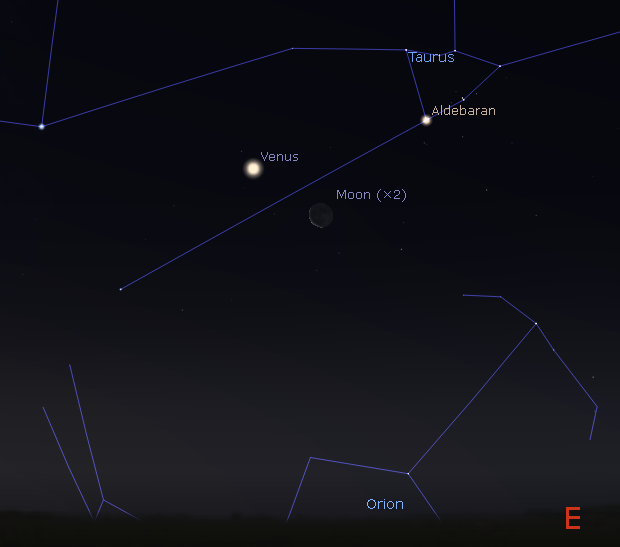
Venus and the Moon at twice its actual size at 5 a.m. July 20, 2017. Created using Stellarium.
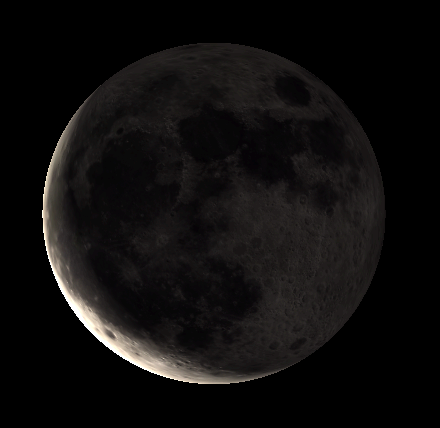
The Moon as it might be seen in binoculars showing also Earth shine at 5 a.m. July 20, 2017. Created using Stellarium.
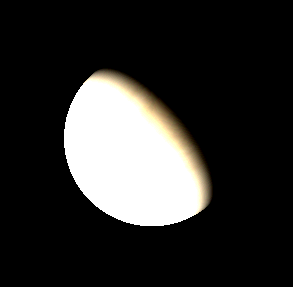
Venus as it might be seen through a telescope at 5 a.m. July 20, 2017. This is displayed at a larger scale/magnification than the Jupiter or Saturn images above. Created using Stellarium.
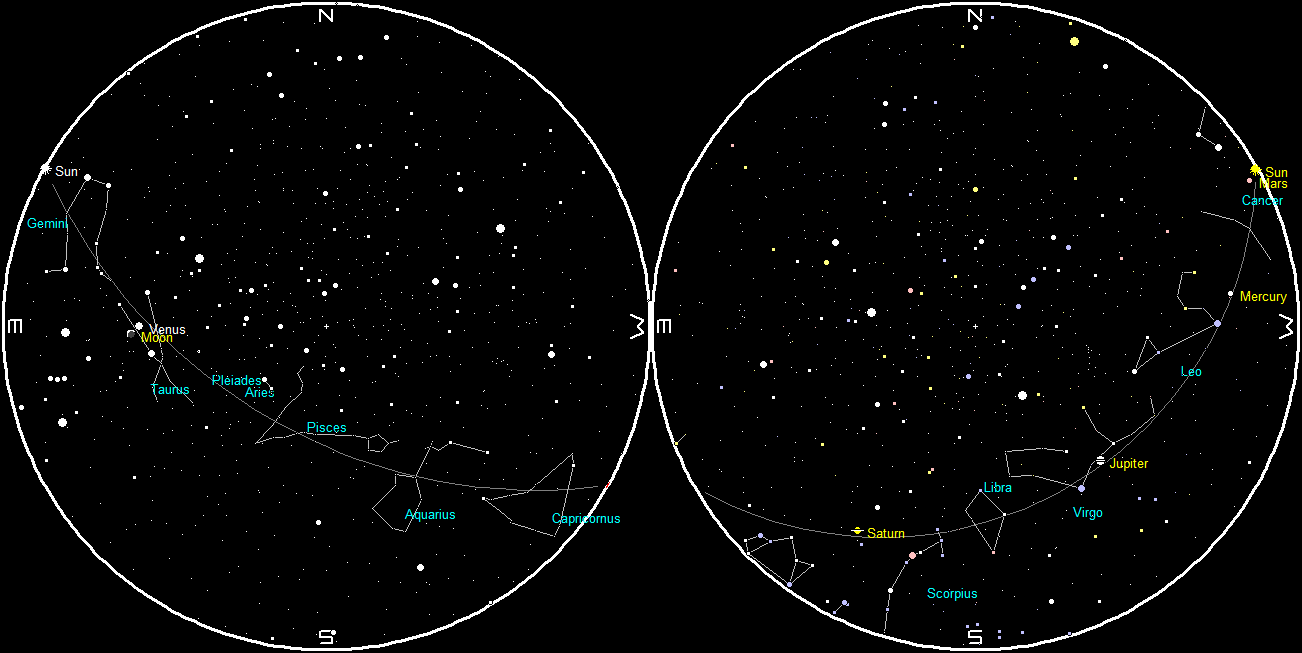
Planets at sunset and sunrise of a single night starting with sunset on the right on July 19, 2017. The night ends on the left with sunrise on July 20. Click on the image to enlarge. Created using my LookingUp program.
07/17/2017 – Ephemeris – Constellations of the Summer Triangle III: Aquila the Eagle
Ephemeris for Monday, July 17th. Today the Sun will be up for 15 hours and 9 minutes, setting at 9:23, and it will rise tomorrow at 6:14. The Moon, 1 day past last quarter, will rise at 2:08 tomorrow morning.
Aquila the eagle is a constellation that lies in the Milky Way. It’s in the southeastern sky as it gets dark. Its brightest star, Altair is one of the stars of the Summer Triangle, the group of three bright stars dominating the eastern sky in the evening now. Altair, in the head of the eagle, is flanked by two slightly dimmer stars, the shoulders of the eagle. The eagle is flying northeastward through the Milky Way. Its wings are seen in the wing tip stars. A curved group of stars to the lower right of Altair is its tail. Within Aquila the Milky Way shows many dark clouds as part of the Great Rift that splits it here. The other summer bird is Cygnus the swan above and left of Aquila, flying in the opposite direction.
The times given are for the Traverse City/Interlochen area of Michigan. They may be different for your location.
Addendum
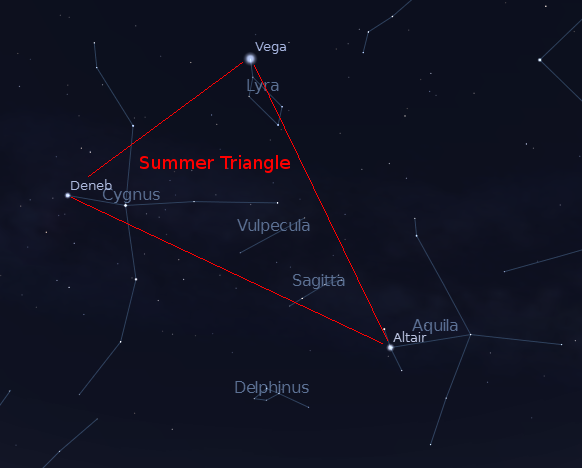
The Summer Triangle. Created using Stellarium and The Gimp.
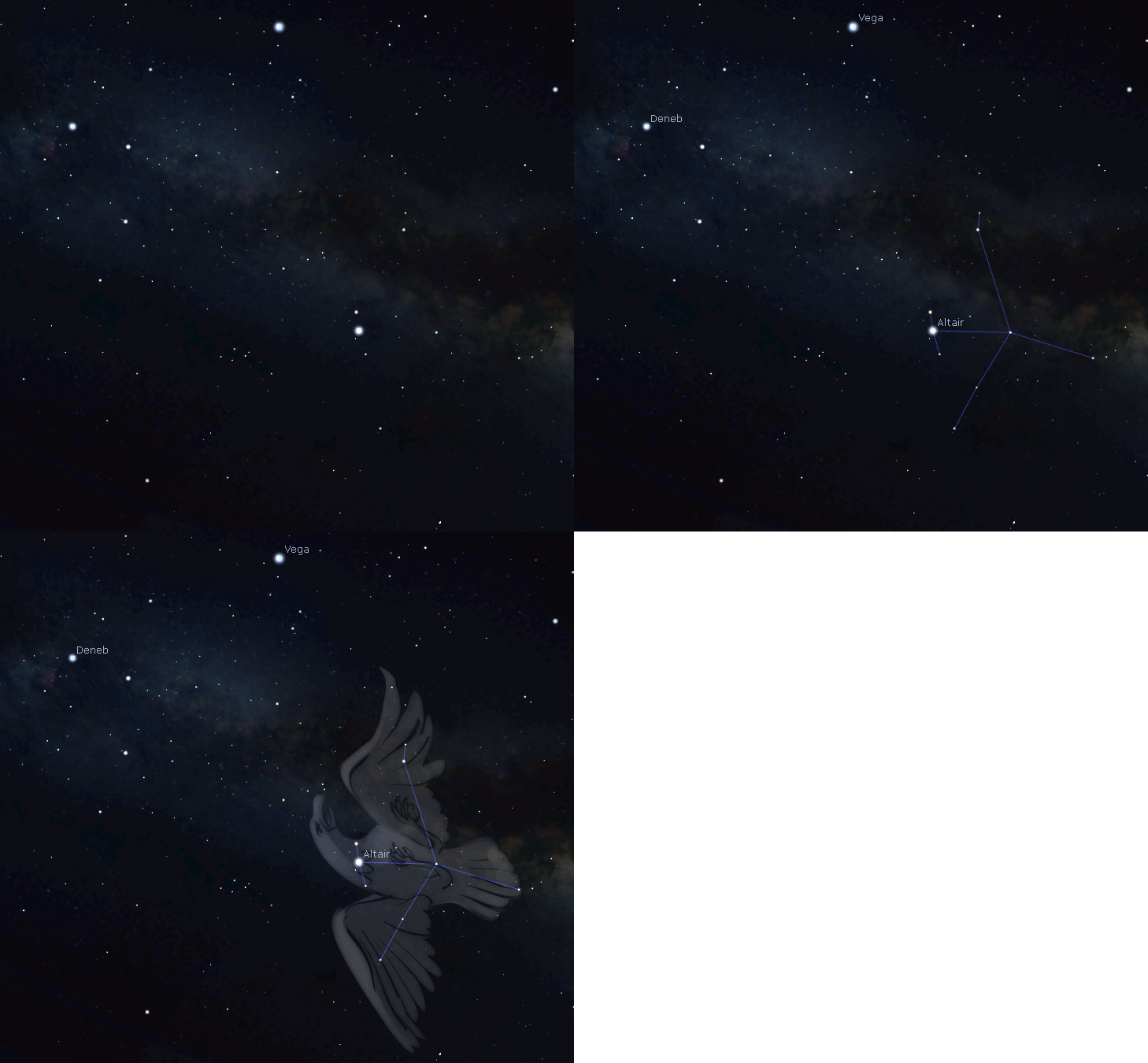
Animated Cygnus finder chart. Created using Stellarium.
07/15/17 – Ephemeris Extra – Possible Auroras to be visible this weekend
The National Oceanic and Atmospheric Administration (NOAA) Space Weather Prediction Center has issued a Geomagnetic Storm Watch for 16-17 July 2017 UT (Universal Time). The watch period starts tonight for the US. The 16th UT starts at 8 p.m. tonight, the 15th EDT. What it means, among other things, is that the Aurora Borealis (Northern Lights) may be visible from the northern tier of states in the United States and Canada, Scotland, Scandinavia, and Russia. And maybe even farther south. See the map below:
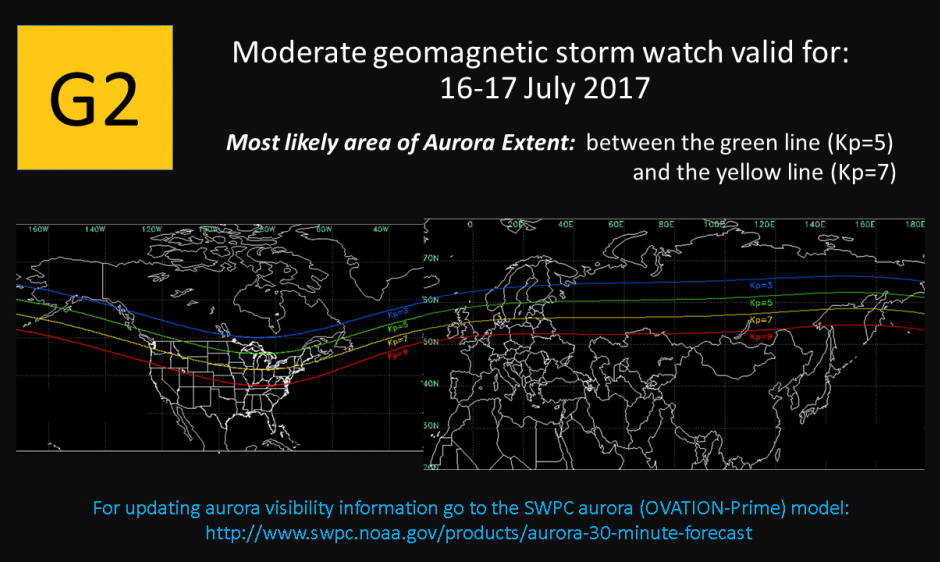
From the NOAA website. Click on the image to enlarge. Click here for the link mentioned in the image: http://www.swpc.noaa.gov/products/aurora-30-minute-forecast.
This alert was issued due to a Coronal Mass Ejection (CME) from the large, but decaying, sunspot group AR2665 at 2:09 UT on the 14th (10:09 p.m. on the 13th EDT). The CME is expected to encounter the Earth’s magnetosphere on the 16th.
A tip of the old observer’s hat to spaceweather.com for the heads up email.
07/14/2017 – Ephemeris – Constellations of the Summer Triangle II: Cygnus the swan
Ephemeris for Friday, July 14th. Today the Sun will be up for 15 hours and 14 minutes, setting at 9:25, and it will rise tomorrow at 6:11. The Moon, 2 days before last quarter, will rise at 12:32 tomorrow morning.
Fairly high in the east at 11 p.m. Is the constellation of Cygnus the swan, flying south through the Milky Way. It is also called the Northern Cross. At the left, the tail of the swan or the head of the cross is the bright star Deneb, one of the stars of the Summer Triangle. The next star right is Sadr the intersection of the body and the wings of the swan seen in flight, or the intersection of the two pieces of the cross. There are two or three stars farther to the right that delineate the swan’s long neck or upright of the cross, that ends with the star Alberio in the beak of the swan or foot of the cross. The crosspiece of the cross extends to the stars on either side of the intersection star Sadr, while the swan’s wings extend to a couple more stars each.
The times given are for the Traverse City/Interlochen area of Michigan. They may be different for your location.
Addendum
The Summer Triangle. Created using Stellarium and The Gimp.
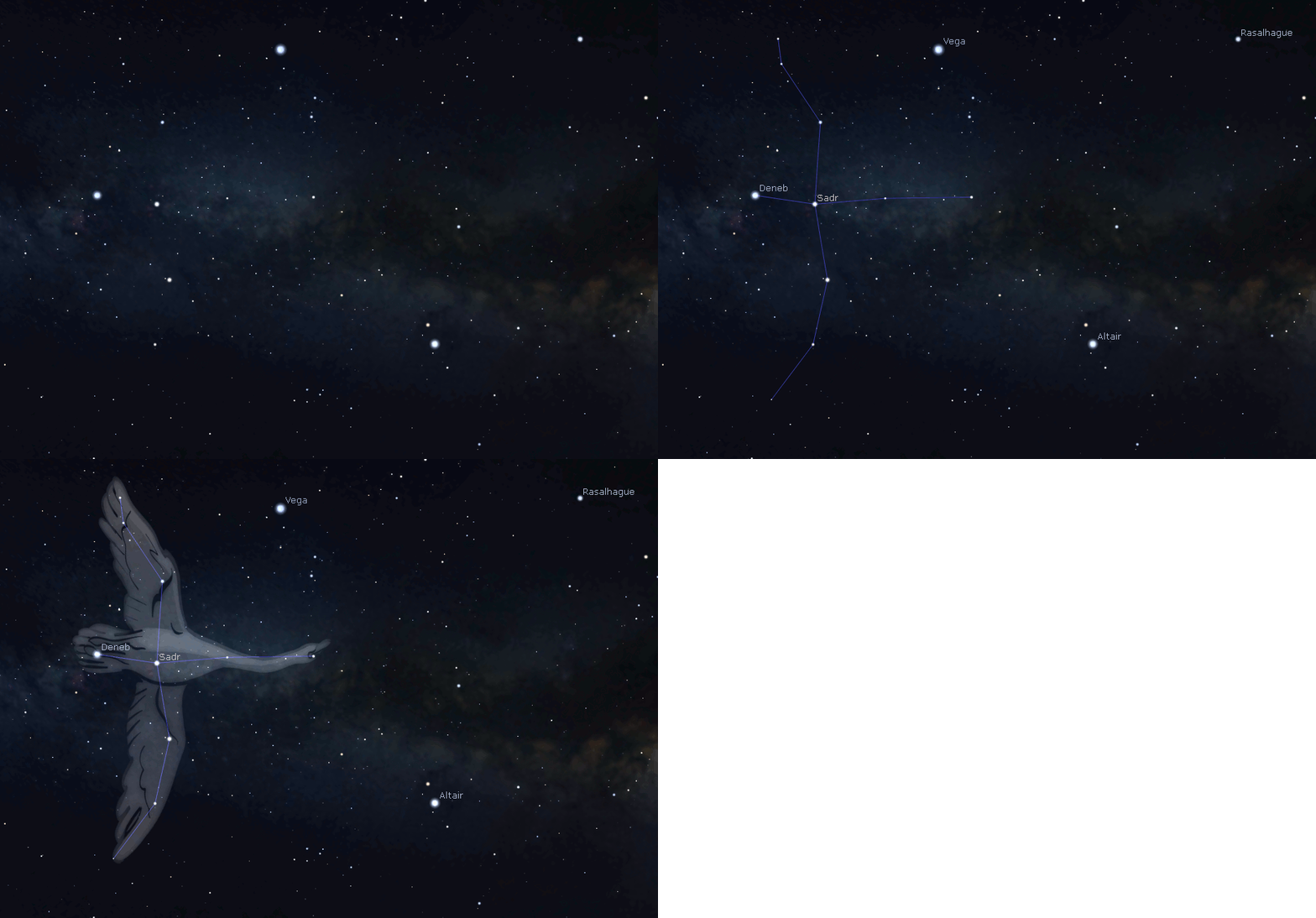
Animated Cygnus finder chart. Created using Stellarium.
In mythology Cygnus was the form Zeus took in the Leda and the swan affair. Out of that union was born Pollux of Gemini fame. His half-brother and twin Castor was fathered by a mere mortal. Go here for their story.
Alberio is the star that shows in Cygnus’ eye. In telescopes of even low power Alberio shows as a binary star whose components are distinctly and beautiful blue and gold. Binoculars are not quite powerful enough to split these two.
07/13/2017 – Ephemeris – Constellations of the Summer Triangle I: Lyra the harp
Ephemeris for Thursday, July 13th. Today the Sun will be up for 15 hours and 16 minutes, setting at 9:26, and it will rise tomorrow at 6:10. The Moon, 3 days before last quarter, will rise at 12:02 tomorrow morning.
Very high up in the eastern sky at 11 p.m. can be found a bright star just above a small, narrow, but very distinctive parallelogram of stars. They are the stars of the constellation Lyra the harp. The bright star is Vega, member of the Summer Triangle and one of the twenty one brightest first magnitude stars. Vega is actually the 5th brightest night-time star. The harp, according to Greek mythology, was invented by the Greek god Hermes. The form of the harp in the sky, is as he had invented it: by stretching strings across a tortoise-shell. Hermes gave it to his half-brother Apollo, who in turn gave it to the great musician Orpheus. The Sun’s motion with respect to most stars around it is towards the vicinity of Lyra.
The times given are for the Traverse City/Interlochen area of Michigan. They may be different for your location.
Addendum
The Summer Triangle. Created using Stellarium.
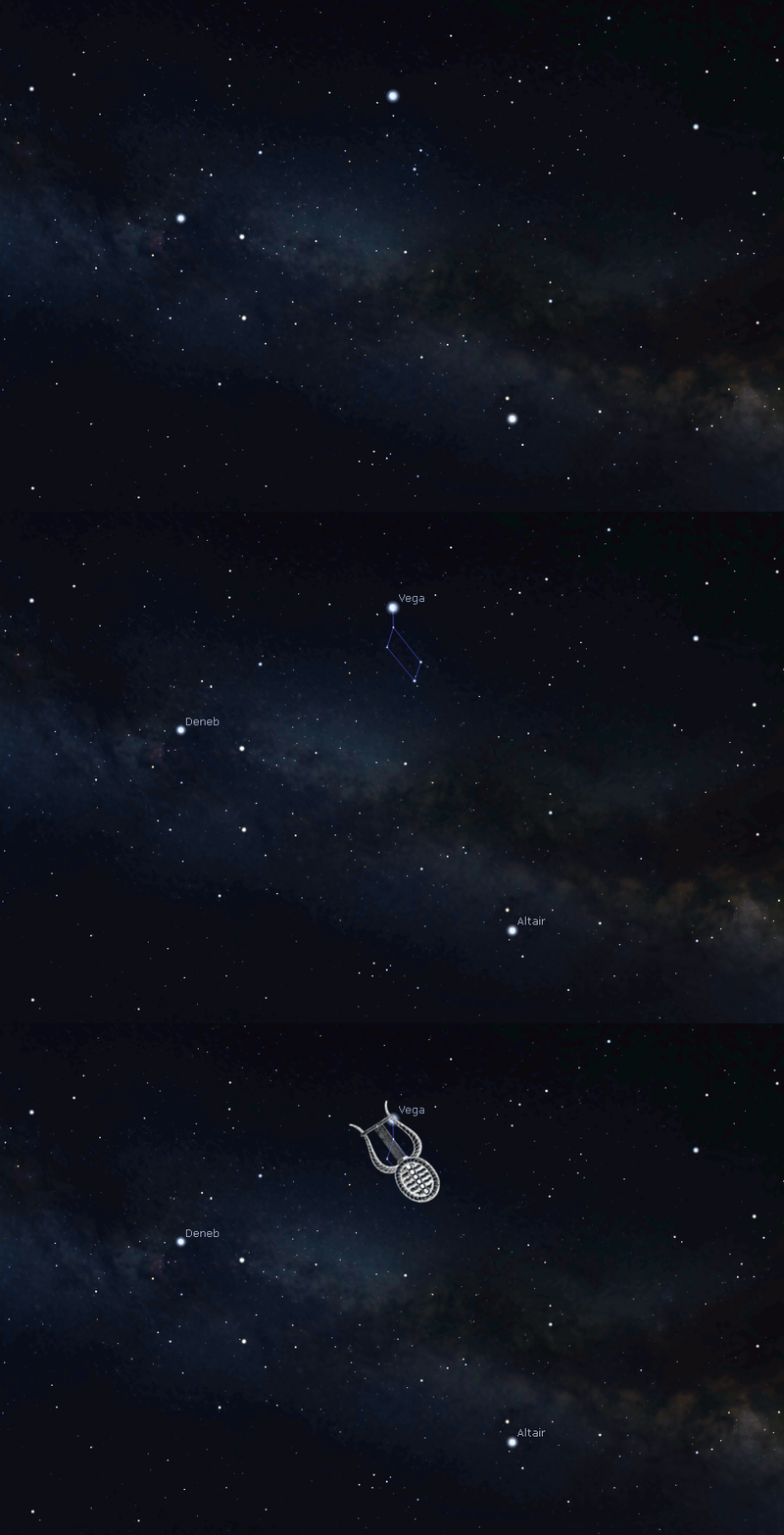
Animated Lyra finder chart. The lyre image not supplied by Stellarium but is from The World’s Earliest Music by Hermann Smith, a Project Gutenberg E book, figure 60, captioned “The Chelys or Greek Tortoiseshell Lyre”. Image created using Stellarium and GIMP.
07/12/2017 – Ephemeris – Let’s check out the whereabouts of the bright planets
Ephemeris for Wednesday, July 12th. Today the Sun will be up for 15 hours and 17 minutes, setting at 9:26, and it will rise tomorrow at 6:10. The Moon, 3 days past full, will rise at 11:32 this evening.
Let’s take our weekly look at the bright planets. Jupiter is in the southwest as it gets dark in the evening. The bright blue-white star Spica, which pales in comparison to Jupiter, is seen left of it. In even the smallest telescopes Jupiter’s four largest moons can be seen. They shift positions from night to night. Jupiter will set at 12:58 a.m. Saturn can now be seen in the evening as twilight fades in the south. The reddish star Antares is off to the right of Saturn. Saturn’s rings are spectacular in telescopes. Saturn will set at 4:15 a.m. In the morning sky, brilliant Venus will rise at 3:23 a.m. and be visible until about quarter to 6 tomorrow morning. Mercury sets too close to sunset to be easily seen now.
The times given are for the Traverse City/Interlochen area of Michigan. They may be different for your location.
Addendum
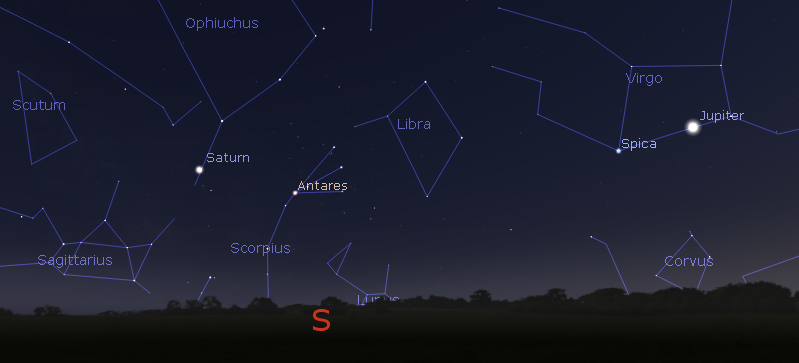
Jupiter and Saturn with the southern summer constellations at 10:30 p.m., July 12, 2017. Created using Stellarium.
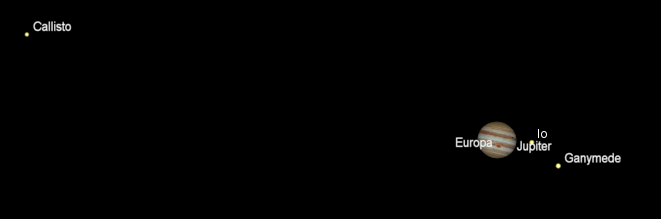
Jupiter and three of its moons. Europa is behind the planet at 10:30 p.m,. July 12, 2017. Created using Cartes du Ciel (Sky Charts).
Project Pluto has the following events for the 12/13th:
Time is UT. Events prior to 13 July 1:47 UT (9:47 p.m. 12 July EDT) will not be visible from Northern Michigan. Data from Project Pluto: https://www.projectpluto.com/jevent.htm#jun. The website also has a link to a list of Great Red Spot transits.
I : Tra start: 12 Jul 2017 23:25
I : Sha start: 13 Jul 2017 0:41
I : Tra end : 13 Jul 2017 1:36
II : Occ start: 13 Jul 2017 1:47
I : Sha end : 13 Jul 2017 2:51
II : Occ end : 13 Jul 2017 4:16
II : Ecl start: 13 Jul 2017 4:20
II : Ecl end : 13 Jul 2017 6:42
III: Occ start: 13 Jul 2017 7:10
III: Occ end : 13 Jul 2017 9:45
III: Ecl start: 13 Jul 2017 12:29
III: Ecl end : 13 Jul 2017 14:40
Satellites: I = Io, II = Europa, and III = Ganymede
Tra = Transit of a satellite across the face of Jupiter, Sha = Transit of a moon’s shadow, Ecl = Eclipse (In Jupiter’s shadow), Occ = Occultation (Moon behind the planet).
The Great Red Spot transit: 13 Jul 2017 02:01 (10:01 p.m. 12 July EDT).
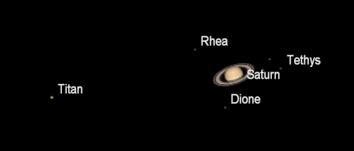
Saturn and its brightest moons overnight July 12/13, 2017. Created using Cartes du Ciel (Sky Charts).
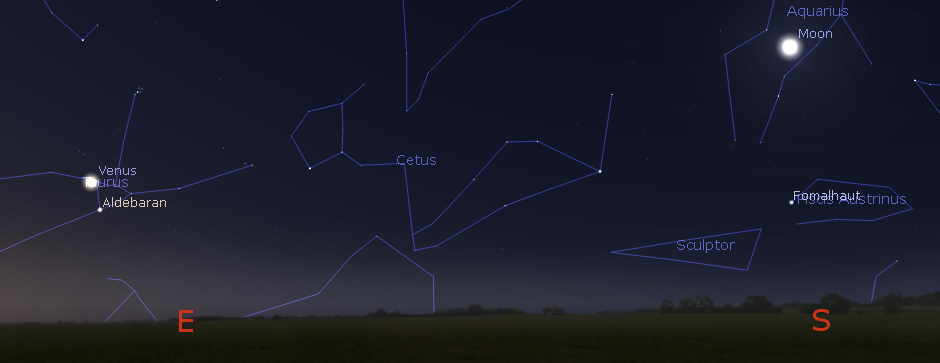
Venus and the Moon at 5 a.m. July 13, 2017. Created using Stellarium. Click on the image to expand.
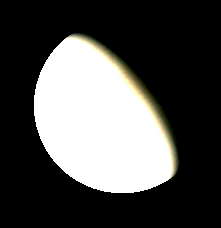
Venus as it might be seen through a telescope at 5 a.m. July 13, 2017. This is displayed at a larger scale/magnification than the Jupiter or Saturn images above. Created using Stellarium.
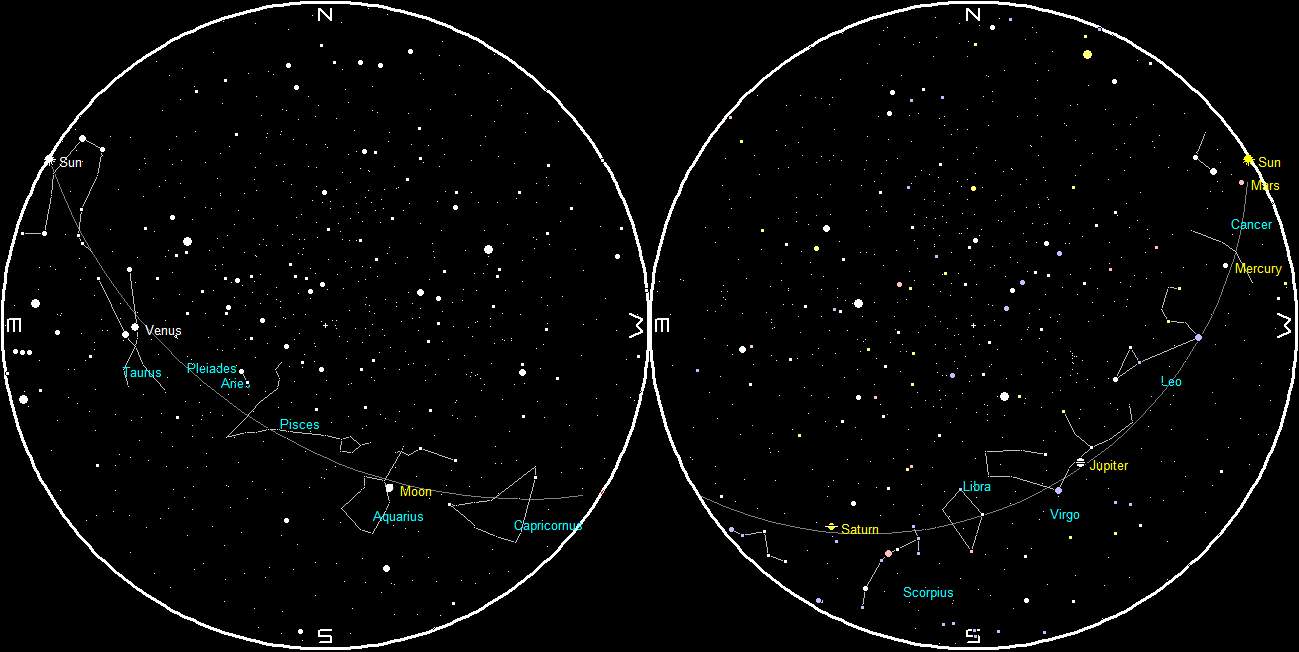
Planets at sunset and sunrise of a single night starting with sunset on the right on July 12, 2017. The night ends on the left with sunrise on July 13. Click on the image to enlarge. Created using my LookingUp program.
07/11/2017 – Ephemeris – Altair the nearest star of the Summer Triangle
Ephemeris for Tuesday, July 11th. Today the Sun will be up for 15 hours and 18 minutes, setting at 9:27, and it will rise tomorrow at 6:09. The Moon, 2 days past full, will rise at 10:59 this evening.
The southernmost star of the Summer Triangle is Altair, high in the east-southeast. The other two stars of the triangle are Vega nearly overhead in the east, and Deneb high in the east-northeast. Altair is the closest of the three at a distance of 16.7 light years away. One light year is nearly 6 trillion miles. Altair is 10 times the brightness of the Sun. If seen at Altair’s distance, the Sun would only be as bright as one of the two stars that flank it. What is rather different about Altair is its rapid rotation. While it’s almost twice the sun’s diameter, it rotates once in about 9 hours, The CHARA Interferometer at Mt. Wilson has actually imaged its squashed disk in the infrared. Our sun’s a slow poke, taking nearly a month to rotate once.
The times given are for the Traverse City/Interlochen area of Michigan. They may be different for your location.
Addendum
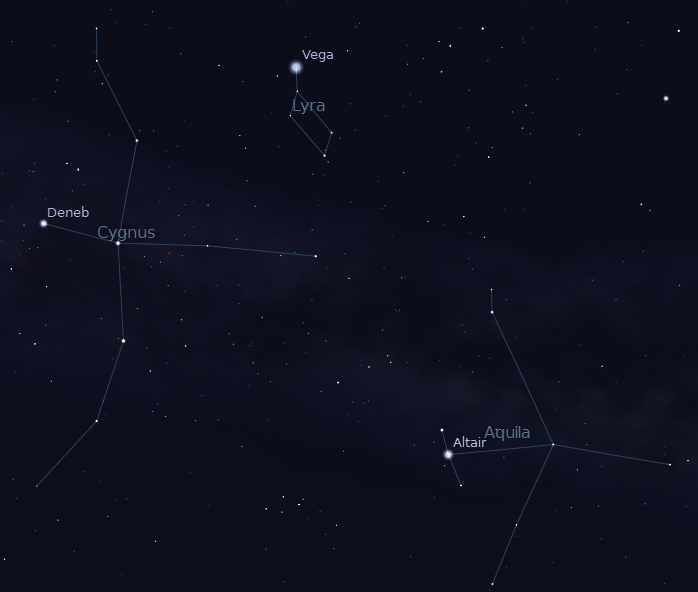
Summer Triangle. Created using Stellarium.
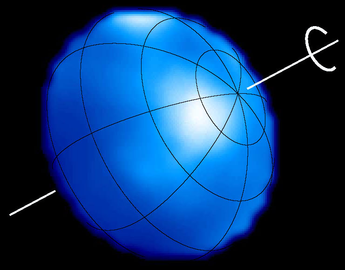
False-color image of the rapidly rotating star Altair, made with the MIRC imager on the CHARA array on Mt. Wilson. Credit: Ming Zhao, University of Michigan
07/10/2017 – Ephemeris – Deneb, a super bright star
Ephemeris for Monday, July 10th. Today the Sun will be up for 15 hours and 20 minutes, setting at 9:27, and it will rise tomorrow at 6:08. The Moon, 1 day past full, will rise at 10:24 this evening.
This evening when it gets dark the bright star Deneb in Cygnus the swan will be high in the east-northeast. Deneb is the dimmest star of the summer triangle. Of the other stars of the triangle, Vega is higher in the east, while Altair is lower in the southeast. While Deneb’s apparent magnitude, or brightness as seen from Earth, makes it the dimmest of the three bright stars, Deneb’s vast distance of possibly 1,400 light years* makes it over 50 times the distance of Vega. If brought as close as Vega, Deneb would be as bright at least as the quarter moon. It is possibly as bright as 200 thousand Suns; and a huge star, possibly as large in diameter as the orbit of the Earth. For all this it is only 20 to 25 times the mass of the sun.
The times given are for the Traverse City/Interlochen area of Michigan. They may be different for your location.
* Deneb’s distance is not well known. Over the years with the Ephemeris program and this blog I’ve given various distances to the star. Having no companion and being beyond the distance where trigonometric parallax is used, at least from the ground, makes distance measurement difficult. Hipparcos satellite measurements give a distance about twice as great. Estimates of the true brightness of a star are based on its known distance. An error in distance by a factor of two gives an error in terms of intrinsic luminosity by a factor of 4, due to the inverse square law of brightness with distance.
Addendum
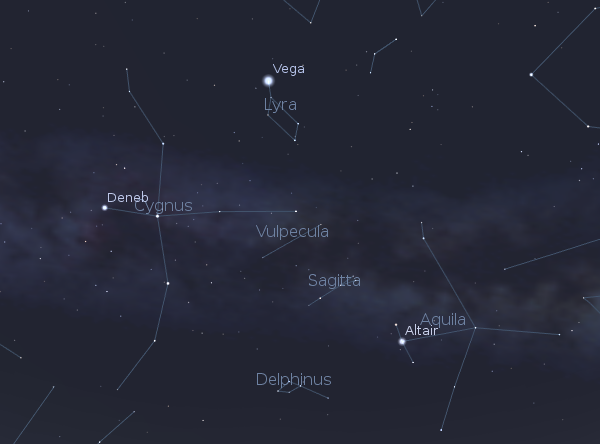
Deneb with the other stars and constellations in the Summer Triangle. Created using Stellarium.
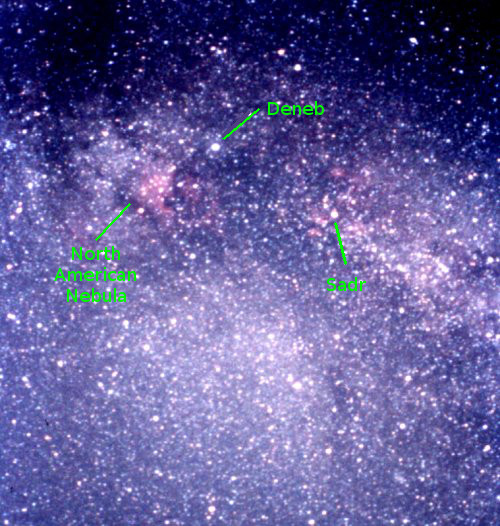
One of my old photographs of Deneb and the North American Nebula digitized from a slide. Deneb’s ultraviolet emissions cause the North American and unnamed here Pelican Nebulae to glow. The red color is due to hydrogen.

