Archive
07/07/2017 – Ephemeris – Tonight’s topic: Dark Matter
Ephemeris for Friday, July 7th. Today the Sun will be up for 15 hours and 24 minutes, setting at 9:29, and it will rise tomorrow at 6:05. The Moon, 2 days before full, will set at 5:48 tomorrow morning.
This evening the Grand Traverse Astronomical Society will hold its monthly meeting at the Northwestern Michigan College’s Rogers Observatory at 8 p.m. with a program featuring Dr. David Penney and his talk Dark Matter: What Is It? What Does It Mean? Dark matter, whatever it is appears to be the stuff that holds the universe together. We can’t see it, but we can see its effects in the rotation of galaxies, the motions of galaxies in clusters and their distribution and how it distorts the images of galaxies beyond it. After the talk, at 9 p.m. there will be a star party to view the heavens including the Moon, Saturn and Jupiter. The observatory is located south of Traverse City, on Birmley Road between Garfield and Keystone roads.
The times given are for the Traverse City/Interlochen area of Michigan. They may be different for your location.
Addendum
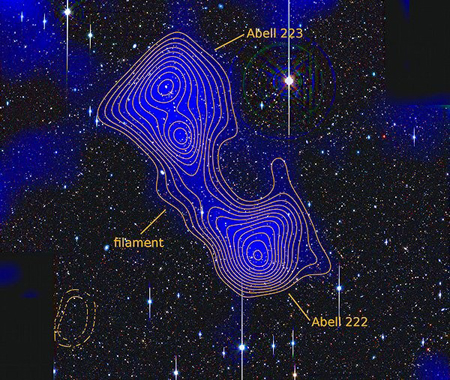
Dark Matter filament bridge between two galaxy clusters, discovered by Jörg Dietrich and his colleagues at the University of Michigan. The blue color is added to show the presence of dark matter. See the text below. Image from http://www.outerspacecentral.com/dark_matter_page.html.
Dark matter is detected by the distortions it creates in the distant galaxies behind it. These galaxies are not visible in the scale of the image shown. The gravitation of dark matter distorts spacetime as predicted by Einstein’s general theory of relativity, which distorts the shapes of the galaxies behind it.
07/06/2017 – Ephemeris – Saturn will appear near the Moon tonight
Ephemeris for Thursday, July 6th. Today the Sun will be up for 15 hours and 25 minutes, setting at 9:29, and it will rise tomorrow at 6:05. The Moon, 3 days before full, will set at 5:02 tomorrow morning.
The waxing gibbous Moon and the planet Saturn will appear together tonight. They are said to be in conjunction. The brightness of the Moon may make it hard to pick out Saturn which is right under the Moon by about seven Moon diameters. The Moon is very bright in binoculars or a telescope and looking at it destroys the dark adaption in the eye or eyes that look at it, at least for a while. So when viewing both Saturn and the Moon, concentrate of Saturn first. In a telescope Saturn’s rings are glorious. With a good telescope and enough magnification one might see the split in the rings, just inside the outer edge of them called Cassini’s Division, after it’s discoverer. The large moon Titan is off the western extremity of the rings tonight.
The times given are for the Traverse City/Interlochen area of Michigan. They may be different for your location.
Addendum
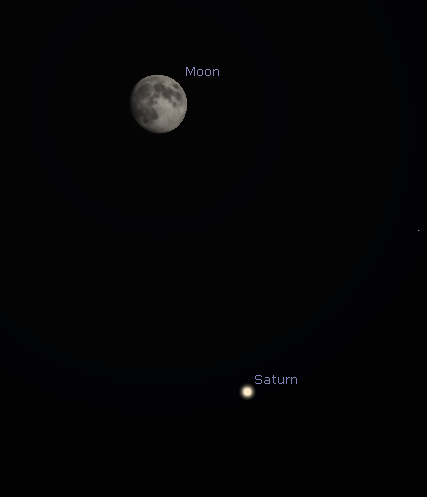
The Moon and Saturn at 10:30 p.m., July 6, 2017, as it would be seen from northern Michigan. Created using Stellarium.
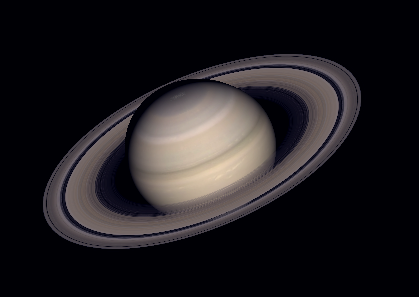
Saturn and its rings with Cassini’s Division. Created using Stellarium.
Ring particles at the distance of Cassini’s Division from Saturn orbit the planet twice in the time the satellite Mimas, nicknamed the Death Star, orbits the planet once. Ring particles are thus tugged by Mimas’ gravity away from Saturn in the same place every other orbit, which pulls them out of that particular orbital resonance.
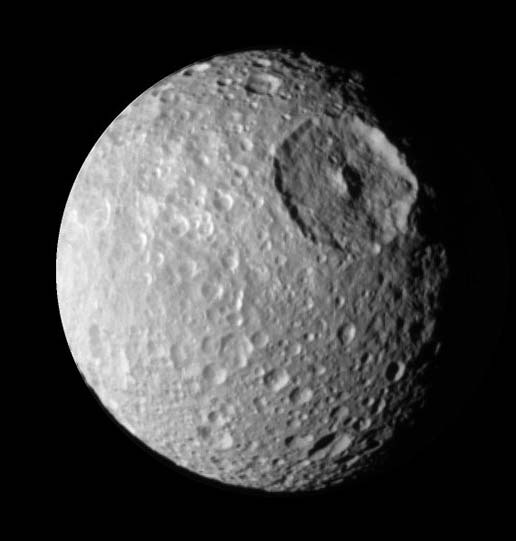
“That’s no moon!” Yes it is. Saturn’s moon Mimas, It’s diameter is 123 miles (198 km). The huge crater is named Herschel, after the moon’s discoverer William Herschel. Credit: NASA / JPL-Caltech / Space Science Institute.
07/05/2017 – Ephemeris – Our weekly look at the bright planets
Ephemeris for Wednesday, July 5th. Today the Sun will be up for 15 hours and 26 minutes, setting at 9:30, and it will rise tomorrow at 6:04. The Moon, 4 days before full, will set at 4:22 tomorrow morning.
Let’s take our weekly look at the bright planets. Jupiter is in the southwest as it gets dark in the evening. The bright blue-white star Spica, which pales in comparison to Jupiter, is seen left of it. In even the smallest telescopes Jupiter’s four largest moons can be seen. They shift positions night from to night and sometimes even as you watch. Jupiter will set at 1:25 a.m. Saturn can now be seen in the evening as twilight fades in the south, tonight it’s just left of the bright waxing gibbous Moon. Saturn’s rings are spectacular in telescopes. In the morning sky, brilliant Venus will rise at 3:36 a.m. and be visible until about quarter to 6 tomorrow morning. Mars and Mercury are too close to the direction of the Sun to be seen.
The times given are for the Traverse City/Interlochen area of Michigan. They may be different for your location.
Addendum
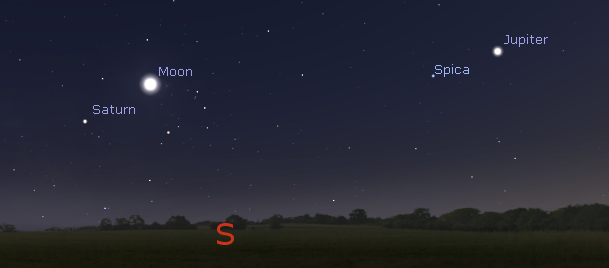
Jupiter, Saturn and the Moon at 10:30 p.m., July 5, 2017. Created using Stellarium.
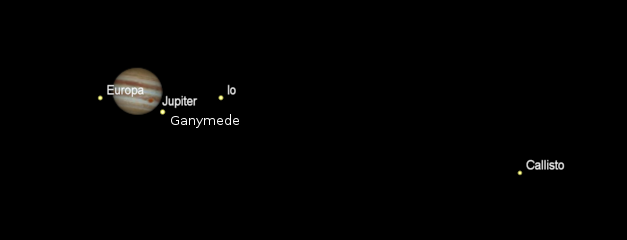
Jupiter and its four Galilean moons in tight to the planet as they might be seen in a telescope at 10:30 p.m,. July 5, 2017. Created using Cartes du Ciel (Sky Charts).
Project Pluto has the following events for the 5/6th:
Time is UT. Events prior to 5 July 1:41 UT (9:41 p.m. EDT) and after 6 July 4:08 UT (12:08 a.m. EDT) will not be visible from Northern Michigan. Data from Project Pluto: https://www.projectpluto.com/jevent.htm#jul
I : Tra start: 5 Jul 2017 21:30
I : Sha start: 5 Jul 2017 22:46
II : Occ start: 5 Jul 2017 23:12
I : Tra end : 5 Jul 2017 23:41
I : Sha end : 6 Jul 2017 0:56
II : Occ end : 6 Jul 2017 1:41
II : Ecl start: 6 Jul 2017 1:46
III: Occ start: 6 Jul 2017 3:09
II : Ecl end : 6 Jul 2017 4:08
III: Occ end : 6 Jul 2017 5:44
Satellites: I = Io, II = Europa, and III = Ganymede
Ecl = Eclipse (In Jupiter’s shadow), Occ = Occultation (Moon behind the planet), Sha = Moon’s shadow crossing the face of the planet, Tra = Transit of the moon across the face of the planet
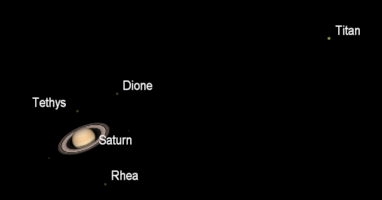
Saturn and its brightest moons overnight July 5/6, 2017. Created using Cartes du Ciel (Sky Charts).
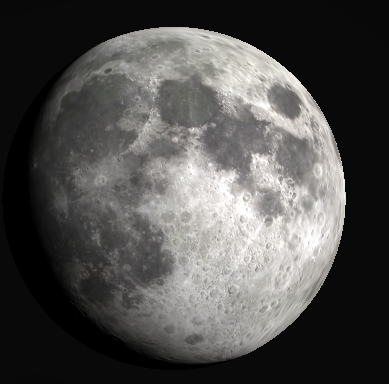
The Moon as it would appear in binoculars at 10:30 p.m. July 5, 2017. Created using Stellarium.
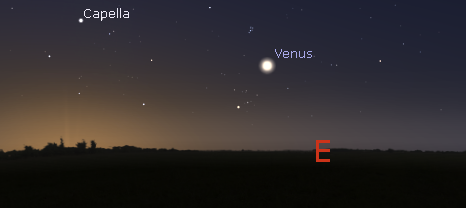
Venus at 5 a.m. July 6, 2017. Created using Stellarium.
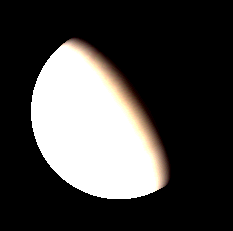
Venus as it might be seen through a telescope at 5 a.m. July 6, 2017. This is displayed at a larger scale/magnification than the Jupiter or Saturn images above. Created using Stellarium.
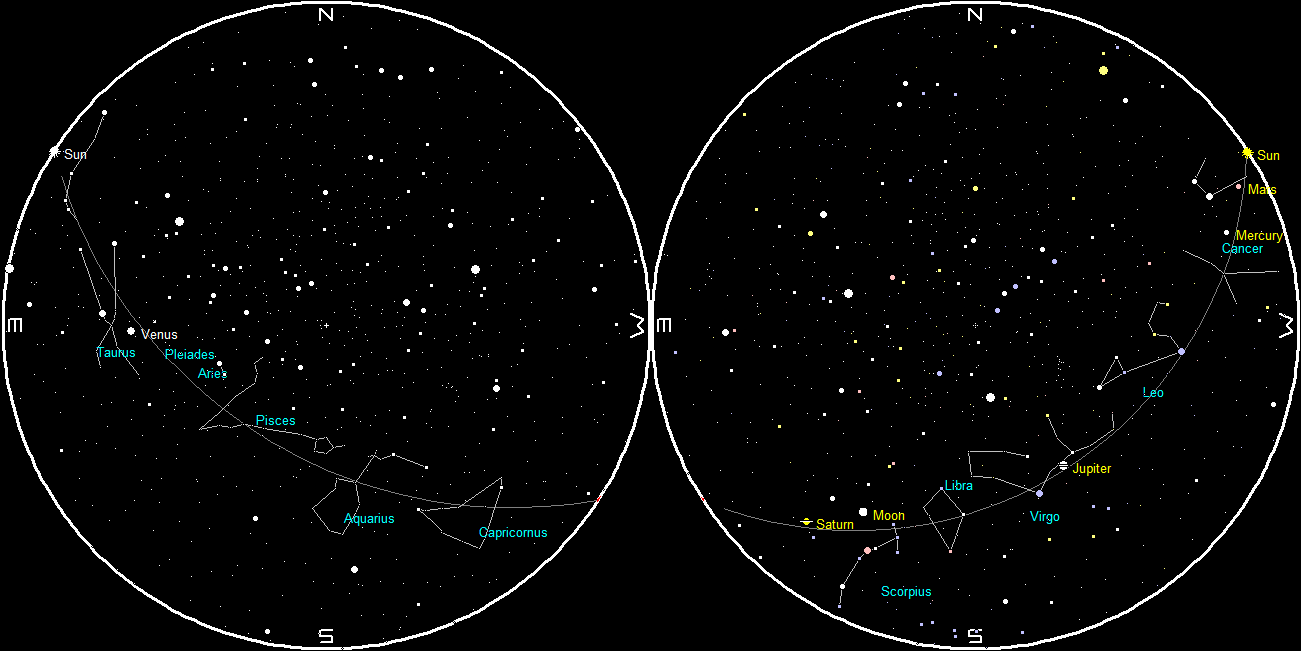
Planets at sunset and sunrise of a single night starting with sunset on the right on July 5, 2017. The night ends on the left with sunrise on July 6. Click on the image to enlarge. Created using my LookingUp program.
07/04/2017 – Ephemeris – Happy birthday America! Tomorrow morning Venus will appear near the Pleiades
Ephemeris for Independence Day, Tuesday, July 4th. Today the Sun will be up for 15 hours and 27 minutes, setting at 9:30, and it will rise tomorrow at 6:03. The Moon, 4 days past first quarter, will set at 3:46 tomorrow morning.
This is the 241st anniversary of the signing of the Declaration of Independence. Venus is our morning star now, and back in 1776 it too was a morning planet, but a lot closer to the rising Sun, and harder to spot.
Tonight Venus will pass south of the famous Pleiades star cluster, so that tomorrow morning at about 4:30 it will be dark enough to see the Pleiades above and left of our brilliant Morning Star.
Planets to us appear as stars to the naked eye due to their distance, though they are close enough to appear as disks in small telescopes. Very few of the largest telescopes can ever see the disk of a star, other than the Sun,, and only if that star is really huge, like Betelgeuse in the winter constellation of Orion.
The times given are for the Traverse City/Interlochen area of Michigan. They may be different for your location.
Addendum
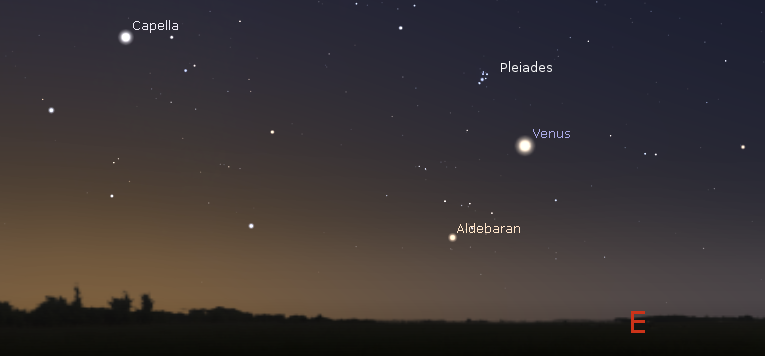
The eastern sky at 5 a.m. July 5, 2017 with the Pleiades above and left of Venus. Created using Stellarium.
We’ll be seeing the Pleiades in the evening sky in four months when summer is a memory.
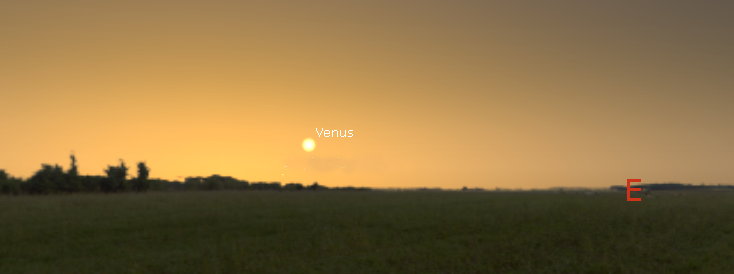
The morning sky to the east and Venus about 20 minutes before sunrise that auspicious morning July 4, 1776 from Philadelphia. Created using Stellarium.
Excuse the fact that the landscape is the same in both images.
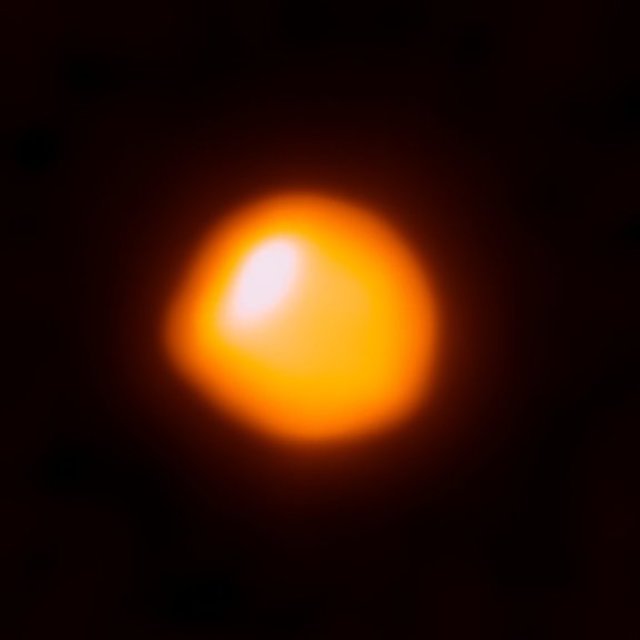
This is the disk of the star Betelgeuse in Orion. It is not an image from an optical telescope of an image created in submillimeter microwaves by the Atacama Large Millimeter/submillimeter Array (ALMA) in Chile. Credit: ALMA (ESO/NAOJ/NRAO)/E. O’Gorman/P. Kervella.
Betelgeuse, though it is 600 light years away has a radius of slightly more than the orbit of Jupiter. The bump on the left side of the image may be a plume of gas erupting from the star.
07/03/2017 – Ephemeris – The Earth is farthest from the Sun today
Ephemeris for Monday, July 3rd. Today the Sun will be up for 15 hours and 28 minutes, setting at 9:30, and it will rise tomorrow at 6:03. The Moon, 3 days past first quarter, will set at 3:13 tomorrow morning.
At 8:59 tonight the Earth will pass a point in its orbit of the sun called aphelion, the farthest point from the sun of 94.5 million miles (152 million km). The whole Earth gets something like 6% less heat from the Sun than early January when the Sun is closest. So why is it summer now? The difference in distance from the sun pales as a cause of the seasons next to the tilt of the earth’s axis. Six months ago, because the sun was up for a shorter period each day, and didn’t rise very high in the sky, the sun gave us in northern Michigan something like 70% less heat than it does now. The real effect of aphelion coming in summer is that it makes summer the longest season at 94 days. This is because the farther the Earth is from the Sun, the slower it travels. Hey, it’s summer – take the hint and slow down and enjoy the season.
The times given are for the Traverse City/Interlochen area of Michigan. They may be different for your location.
06/30/2017 – Ephemeris – A look ahead at the month of July
Ephemeris for Friday, June 30th. Today the Sun will be up for 15 hours and 30 minutes, setting at 9:31, and it will rise tomorrow at 6:01. The Moon, at first quarter today, will set at 1:48 tomorrow morning.
Lets preview July’s skies. The sun, having reached its northern solstice, is beginning to slide southward again, at first imperceptibly, then with greater speed. The daylight hours will decrease from 15 hours and 29 minutes tomorrow to 14 hours 40 minutes at month’s end. The daylight hours will be slightly shorter south of Interlochen, and slightly longer to the north. The altitude of the sun at local noon, when the sun is due south will decrease from 68 degrees tomorrow to 63 degrees at month’s end. The sun will be a degree lower in the Straits area. Despite the warmth, the earth will reach its greatest distance from the sun late Monday. The planet Jupiter will descend lower and lower in the west as the month progresses.
The times given are for the Traverse City/Interlochen area of Michigan. They may be different for your location.
Addenda
July Evening Star Chart
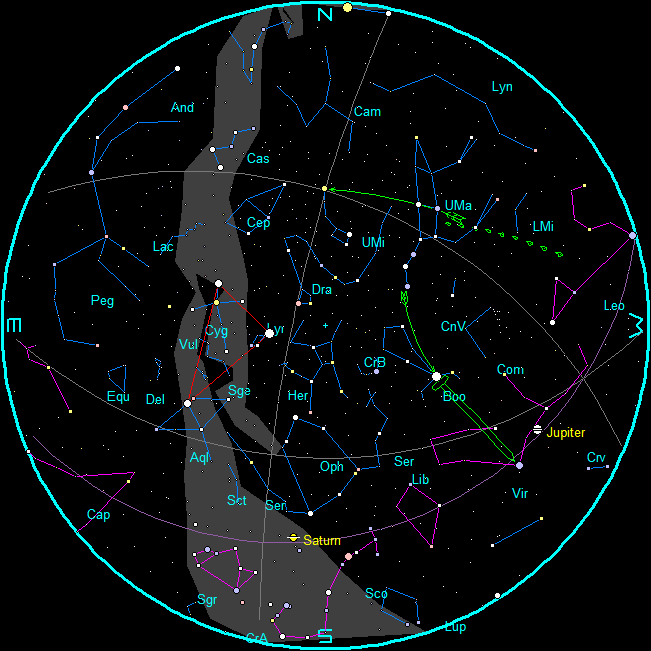
Star Chart for July 2017 (11 p.m. July 15, 2017). Created using my LookingUp program. Click on image to enlarge.
The planets and stars are plotted for the 15th at 11 p.m. EDT in the evening and 4:30 a.m. for the morning chart. These are the chart times. Note that Traverse City is located approximately 45 minutes behind our time meridian. (An hour 45 minutes behind our daylight saving time meridian. during EDT and 45 minutes behind our daylight standard time meridian. during EST). To duplicate the star positions on a planisphere you may have to set it to 1 hour 45 minutes (Daylight Time) or 45 minutes (Standard Time) earlier than the current time if you are near your time meridian.
Note the chart times of 11 p.m. and 4:30 a.m. are for the 15th. For each week before the 15th add ½ hour. For each week after the 15th subtract ½ hour. The planet positions are updated each Wednesday on this blog.
July Morning Star Chart
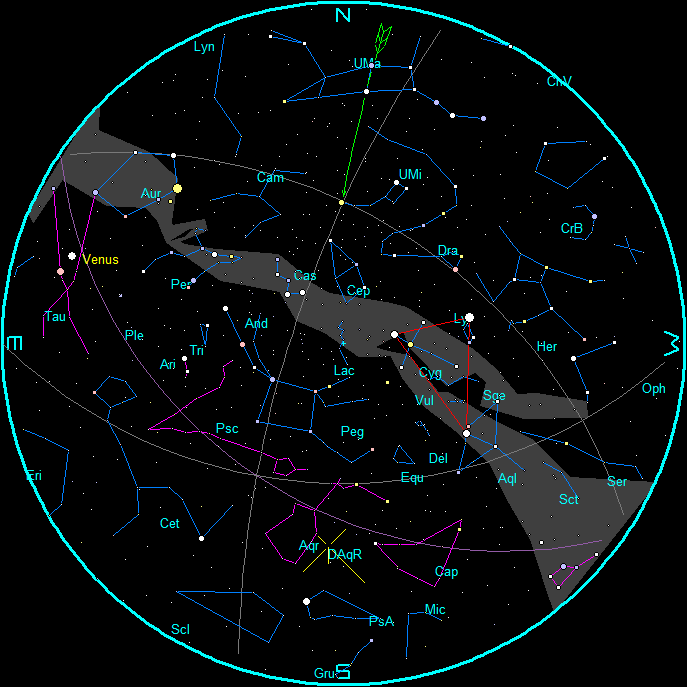
Star Chart for July 2017 mornings based on 4:30 a.m. July 15th. Created using my LookingUp program. Click on image to enlarge.
For a list of constellation names to go with the abbreviations click here.
- Pointer stars at the front of the bowl of the Big Dipper point to Polaris the North Star
- Leaky Big Dipper drips on Leo
- Follow the arc of the handle of the Big Dipper to the star Arcturus,
- Then follow the Spike to Spica
- The Summer Triangle is in red
- DAqr is the Delta Aquariid Meteor Shower radiant
Evening nautical twilight ends at 11:00 p.m. EDT on the 1st, decreasing to 10:28 p.m. EDT on the 31st.
Evening astronomical twilight ends at 12:03 p.m. EDT on the 1st, decreasing to 11:17 p.m. EDT on the 31st.
Morning astronomical twilight starts at 3:41 a.m. EDT on the 1st, and increasing to 4:28 a.m. EDT on the 31st.
Morning nautical twilight starts at 4:41 a.m. EDT on the 1st, and increasing to 5:17 a.m. EDT on the 31st.
NASA Calendar of Planetary Events
Date        Time    Event
Jul 01  Sa          Venus: 43.7° W
    01  Sa  3:28 am Moon-Jupiter: 2.9° S
    03  Mo  8:59 pm Aphelion: 1.0167 AU
    04  Tu  8:21 pm Venus-Pleiades: 6.7° S
    06  Th 12:27 am Moon Apogee: 405900 km
    06  Th 11:34 pm Moon-Saturn: 3.6° S
    08  Sa  6:49 am Moon South Dec.: 19.4° S
    09  Su 12:07 am Full Moon
    09  Su  9:33 pm Mercury-Beehive: 0.1° N
    12  We  1:17 am Moon Descending Node
    13  Th  2:06 pm Venus-Aldebaran: 3.1° N
    16  Su  3:26 pm Last Quarter
    19  We  7:37 pm Moon-Aldebaran: 0.4° S
    20  Th  7:13 am Moon-Venus: 2.7° N
    21  Fr  1:09 pm Moon Perigee: 361200 km
    21  Fr  6:11 pm Moon North Dec.: 19.4° N
    23  Su  5:46 am New Moon
    24  Mo  8:47 pm Moon Ascending Node
    25  Tu  4:49 am Moon-Mercury: 0.9° S
    25  Tu  6:14 am Moon-Regulus: 0°
    25  Tu  1:07 pm Mercury-Regulus: 0.9° S
    26  We  7:59 pm Mars Conjunction
    27  Th 10:41 pm Delta Aquariid Meteor Shower: ZHR = 20
    28  Fr  4:15 pm Moon-Jupiter: 3.4° S
    29  Sa 11:59 pm Mercury Elongation: 27.2° E
    30  Su 11:23 am First Quarter
Aug 01  Tu       Venus: 38.4° W
Sky Events Calendar by Fred Espenak and Sumit Dutta (NASA’s GSFC),
http://eclipse.gsfc.nasa.gov/SKYCAL/SKYCAL.html
If you go to the above site you can print out a list like the above for the entire year
or calendar pages for your time zone.
July Rising and Setting Events
     LU                  Ephemeris of Sky Events for Interlochen/TC
July, 2017    Local time zone: EDT
+-----------------------------------------------------------------------+
| DATE |  SUN     SUN  DAYLIGHT|   TWILIGHT*    |MOON  RISE OR    ILLUM |
|      |  RISE    SET    HOURS |  END    START  |PHASE SET** TIME FRACTN|
+=======================================================================+
|Sat  1| 06:01a  09:32p  15:30 | 10:57p  04:35a |      Set  02:16a   60%|
+------+-----------------------+----------------+-----------------------+
|Sun  2| 06:01a  09:31p  15:29 | 10:56p  04:36a |      Set  02:44a   69%|
|Mon  3| 06:02a  09:31p  15:29 | 10:56p  04:37a |      Set  03:13a   77%|
|Tue  4| 06:03a  09:31p  15:28 | 10:55p  04:38a |      Set  03:46a   85%|
|Wed  5| 06:03a  09:30p  15:27 | 10:55p  04:39a |      Set  04:22a   91%|
|Thu  6| 06:04a  09:30p  15:26 | 10:54p  04:39a |      Set  05:02a   96%|
|Fri  7| 06:05a  09:30p  15:24 | 10:54p  04:40a |      Set  05:48a   99%|
|Sat  8| 06:05a  09:29p  15:23 | 10:53p  04:41a |      Set  06:38a  100%|
+------+-----------------------+----------------+-----------------------+
|Sun  9| 06:06a  09:29p  15:22 | 10:52p  04:43a |Full  Rise 09:45p   99%|
|Mon 10| 06:07a  09:28p  15:21 | 10:51p  04:44a |      Rise 10:25p   97%|
|Tue 11| 06:08a  09:28p  15:19 | 10:50p  04:45a |      Rise 11:00p   92%|
|Wed 12| 06:09a  09:27p  15:18 | 10:49p  04:46a |      Rise 11:32p   86%|
|Thu 13| 06:09a  09:26p  15:16 | 10:48p  04:47a |      Rise 12:03a   78%|
|Fri 14| 06:10a  09:26p  15:15 | 10:47p  04:48a |      Rise 12:32a   69%|
|Sat 15| 06:11a  09:25p  15:13 | 10:46p  04:49a |      Rise 01:02a   59%|
+------+-----------------------+----------------+-----------------------+
|Sun 16| 06:12a  09:24p  15:12 | 10:45p  04:51a |L Qtr Rise 01:33a   48%|
|Mon 17| 06:13a  09:23p  15:10 | 10:44p  04:52a |      Rise 02:08a   37%|
|Tue 18| 06:14a  09:23p  15:08 | 10:43p  04:53a |      Rise 02:47a   26%|
|Wed 19| 06:15a  09:22p  15:06 | 10:42p  04:55a |      Rise 03:33a   16%|
|Thu 20| 06:16a  09:21p  15:04 | 10:41p  04:56a |      Rise 04:26a    8%|
|Fri 21| 06:17a  09:20p  15:02 | 10:39p  04:57a |      Rise 05:28a    3%|
|Sat 22| 06:18a  09:19p  15:00 | 10:38p  04:59a |      Rise 06:35a    0%|
+------+-----------------------+----------------+-----------------------+
|Sun 23| 06:19a  09:18p  14:58 | 10:37p  05:00a |New   Set  09:31p    1%|
|Mon 24| 06:20a  09:17p  14:56 | 10:35p  05:01a |      Set  10:13p    3%|
|Tue 25| 06:21a  09:16p  14:54 | 10:34p  05:03a |      Set  10:49p    9%|
|Wed 26| 06:22a  09:15p  14:52 | 10:32p  05:04a |      Set  11:21p   16%|
|Thu 27| 06:23a  09:14p  14:50 | 10:31p  05:06a |      Set  11:50p   25%|
|Fri 28| 06:24a  09:13p  14:48 | 10:29p  05:07a |      Set  12:18a   34%|
|Sat 29| 06:25a  09:11p  14:45 | 10:28p  05:09a |      Set  12:46a   44%|
+------+-----------------------+----------------+-----------------------+
|Sun 30| 06:27a  09:10p  14:43 | 10:26p  05:10a |F Qtr Set  01:15a   53%|
|Mon 31| 06:28a  09:09p  14:41 | 10:25p  05:12a |      Set  01:47a   63%|
+-----------------------------------------------------------------------+
* Nautical Twilight
** Moonrise or moonset, whichever occurs between sunset and sunrise
Above created using my LookingUp program for MS-DOS
06/29/2017 – Ephemeris – A closer look at the star Vega
Ephemeris for Thursday, June 29th. Today the Sun will be up for 15 hours and 31 minutes, setting at 9:31, and it will rise tomorrow at 6:00. The Moon, 1 day before first quarter, will set at 1:21 tomorrow morning.
The bright star high in the east is Vega, one of the stars of the Summer Triangle an informal constellation called an asterism. Vega belongs to the official constellation Lyra the harp, which includes a narrow parallelogram of stars to its south. Vega is regarded by astronomers as a standard calibration star. Though a first magnitude star, its actual magnitude is 0.03. It is a type A0 pure white star, and is 27 light years away. Astronomers however got a shock in 1983 when calibrating the Infrared Astronomy Satellite (IRAS) on it: Vega showed an excess of Infrared radiation that means the star is orbited by a disk of dust, perhaps a Kuiper belt of its own. Due to the slow wobble of the earth’s axis Vega will be our pole star in 14 thousand years.
The times given are for the Traverse City/Interlochen area of Michigan. They may be different for your location.
Addendum
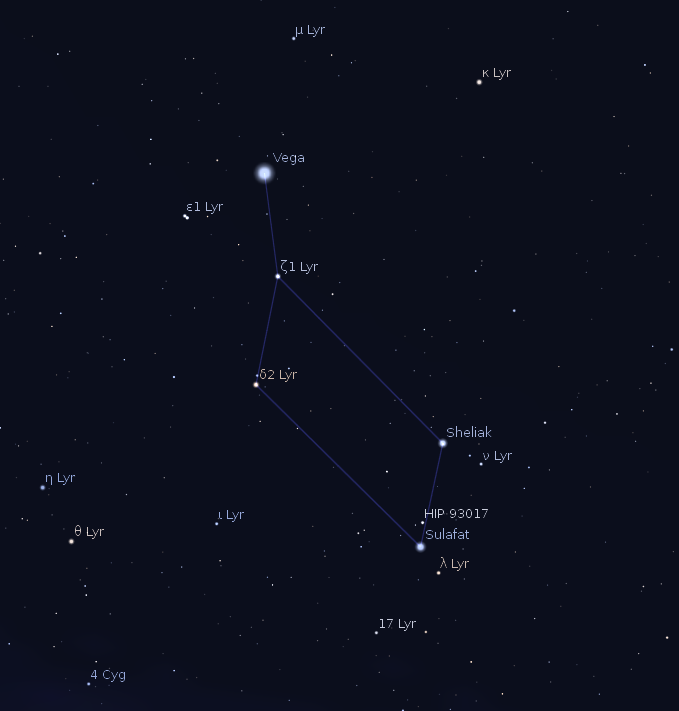
Magnified view of Lyra. Created using Stellarium.
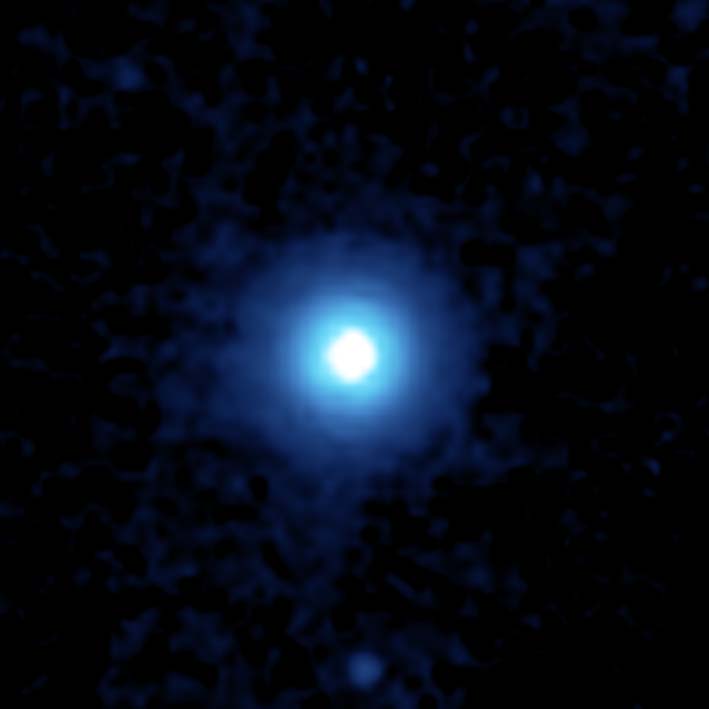
Vega in the mid-infrared from the Spitzer Infrared Satellite. Credit: NASA/JPL-Caltech/University of Arizona.
06/28/2017 – Ephemeris – A last look at the bright planets for June 2017
Ephemeris for Wednesday, June 28th. Today the Sun will be up for 15 hours and 31 minutes, setting at 9:31, and it will rise tomorrow at 6:00. The Moon, 2 days before first quarter, will set at 12:51 tomorrow morning.
Let’s take our weekly look at the bright planets for the last time in June. Jupiter is in the southwest as it gets dark in the evening, while the Moon is in the west. The bright blue-white star Spica, which pales in comparison to Jupiter, is seen left and below it. In even the smallest telescopes Jupiter’s four largest moons can be seen. They shift positions night from to night and sometimes even as you watch. Jupiter will set at 1:51 a.m. Saturn can now be seen in the evening as twilight fades in the southeast. It’s rings are spectacular in telescopes. It is to the left of the reddish star Antares, now more to the south. Brilliant Venus will rise at 3:31 a.m., at 5 a.m. it is seen in the east with Saturn about to set in the southwest.
The times given are for the Traverse City/Interlochen area of Michigan. They may be different for your location.
Addendum
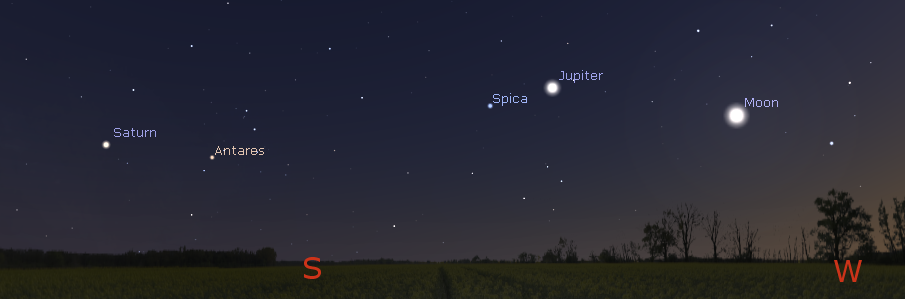
Jupiter, Saturn and the Moon at 10:30 p.m., June 28, 2017. Click on image to enlarge. Created using Stellarium.
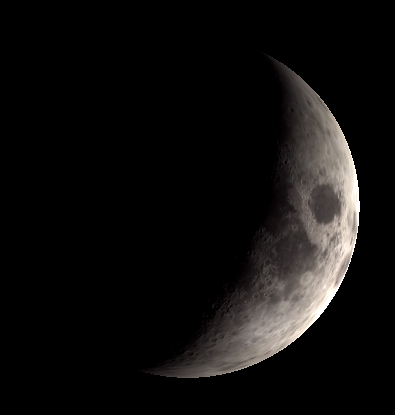
The Moon as it would appear in binoculars at 10:30 p.m. June 28, 2017. Created using Stellarium.
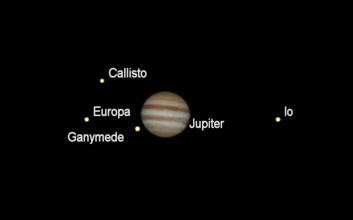
Jupiter and its four Galilean moons in tight to the planet as they might be seen in a telescope at 10:30 p.m,. June 28, 2017. Created using Cartes du Ciel (Sky Charts).
Project Pluto has the following events for the 28/29th:
Time is UT. Events prior to 29 June 4:30 UT (12:30 a.m. EDT) will not be visible from Northern Michigan. Data from Project Pluto: https://www.projectpluto.com/jevent.htm#jun
I : Tra start: 28 Jun 2017 19:36
II : Occ start: 28 Jun 2017 20:39
I : Sha start: 28 Jun 2017 20:51
I : Tra end : 28 Jun 2017 21:47
I : Sha end : 28 Jun 2017 23:02
II : Occ end : 28 Jun 2017 23:07
II : Ecl start: 28 Jun 2017 23:11
III: Occ start: 28 Jun 2017 23:13
II : Ecl end : 29 Jun 2017 1:34
III: Occ end : 29 Jun 2017 1:46
III: Ecl start: 29 Jun 2017 4:30
III: Ecl end : 29 Jun 2017 6:43
Satellites: I = Io, II = Europa, and III = Ganymede
Ecl = Eclipse (In Jupiter’s shadow), Occ = Occultation (Moon behind the planet).
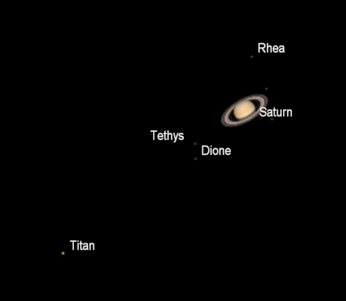
Saturn and its brightest moons overnight June 28/29, 2017. Created using Cartes du Ciel (Sky Charts).
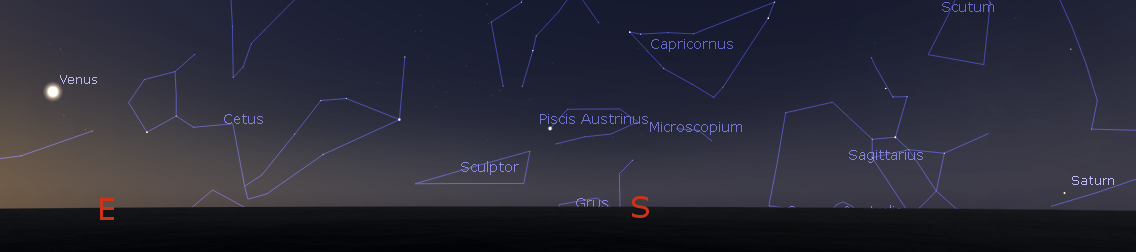
Venus and the setting Saturn at 5 a.m. June 29, 2017. Created using Stellarium. Click on the image to expand.
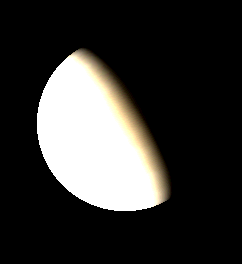
Venus as it might be seen through a telescope at 5 a.m. June 29, 2017. This is displayed at a larger scale/magnification than the Jupiter or Saturn images above. Created using Stellarium.
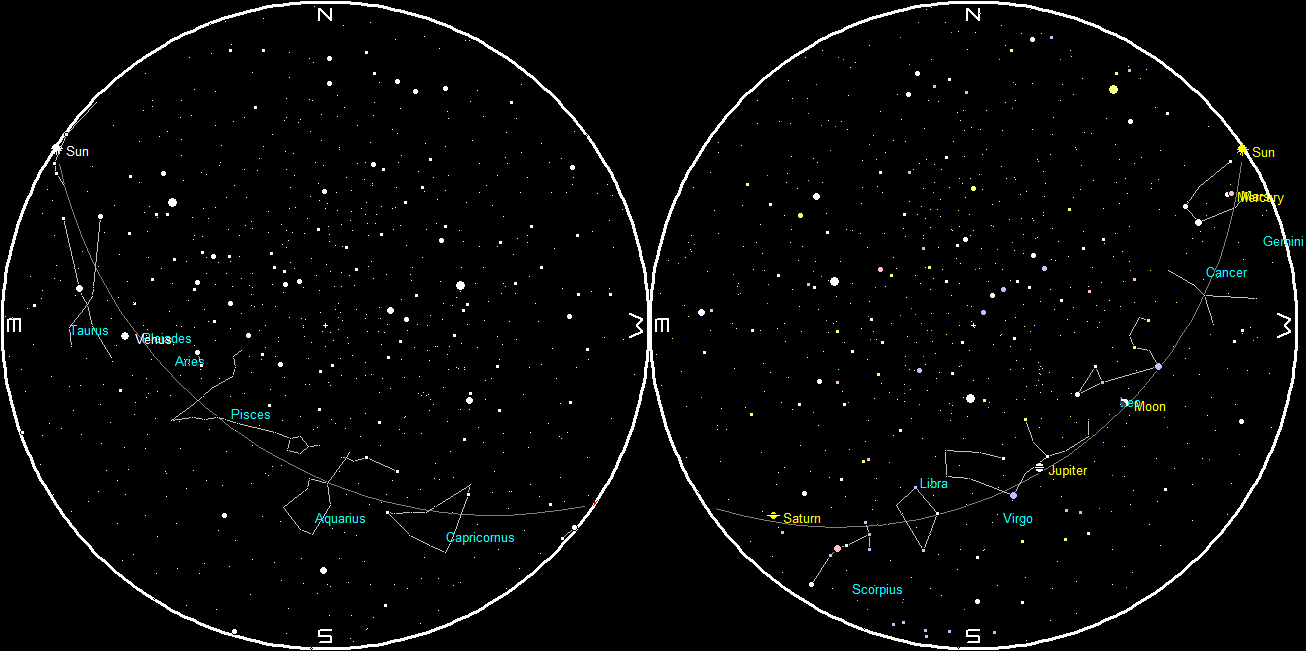
Planets at sunset and sunrise of a single night starting with sunset on the right on June 28, 2017. The night ends on the left with sunrise on June 29. Click on the image to enlarge. Created using my LookingUp program.
06/27/2017 – Ephemeris – Arcturus as a look at the Sun’s future
Ephemeris for Tuesday, June 27th. Today the Sun will be up for 15 hours and 32 minutes, setting at 9:31, and it will rise tomorrow at 5:59. The Moon, 3 days before first quarter, will set at 12:18 tomorrow morning.
With the Moon brightening the night sky, let’s take a look at the star Arcturus, which with its pointer, the curve of the Big Dipper’s handle is slipping into the high western sky. Arcturus is the 4th brightest night time star, though some think the star Vega, high in the east is brighter. They are different colors because Arcturus is orange, while Vega is whiter than the Sun. Arcturus is a preview of what the Sun will become in four or five billion years from now. It is only 10% more massive than the Sun and is that much older than the Sun, so it is turning into its red giant stage, after running out of hydrogen to turn into helium in its core to produce energy. The helium is now compressing and heating to begin its reaction.
The times given are for the Traverse City/Interlochen area of Michigan. They may be different for your location.
Addendum
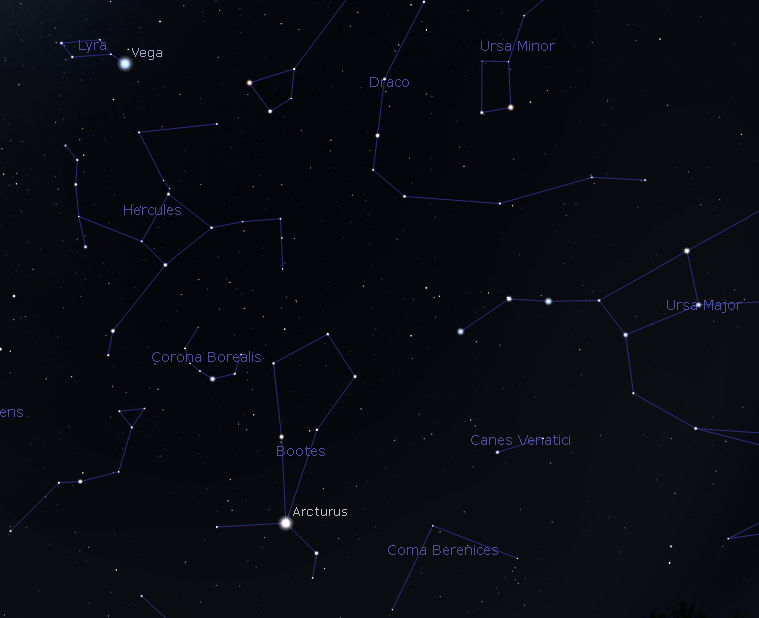
Arcturus finder chart with the Big Dipper and Vega as guide posts. Created using Stellarium.
Here’s one of my prior posts about Arcturus, about its great space velocity: https://bobmoler.wordpress.com/2016/04/26/04262016-ephemeris-arcturus-just-passing-through/
06/26/2017 – Ephemeris – Latest sunset and the apparent positions of the Summer Triangle stars
Ephemeris for Monday, June 26th. Today the Sun will be up for 15 hours and 32 minutes, setting at 9:31, and it will rise tomorrow at 5:59. The Moon, 3 days past new, will set at 11:40 this evening.
Tonight we have the latest sunset of the year. From now on until December sunsets will become earlier. Other than the sunrise and sunset numbers, we’ll begin to notice it for real in a few weeks. At first that realization strikes me a sad note that summer is beginning to end. However the astronomer in me realizes that means more night-time hours, and that the summer Milky Way is coming. Of the three bright stars of the Summer Triangle overhead and in the east, two of its stars are in the milky band. They are Deneb to the north and Altair to the south. Vega, closest to the zenith is not in the band. Actually all the stars we see with the naked eye or small telescopes belong to the Milky Way galaxy.
The times given are for the Traverse City/Interlochen area of Michigan. They may be different for your location.
Addendum
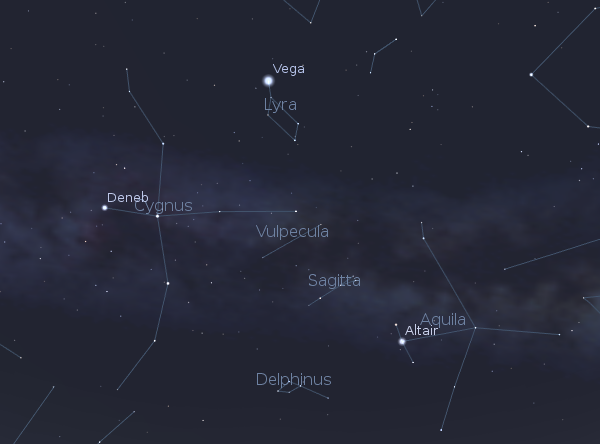
Looking at the stars of the Summer Triangle and their location in and near the Milky Way band. Created using Stellarium.

