Archive
10/06/2016 Ephemeris – Viewing the Moon tonight
Ephemeris for Thursday, October 6th. The Sun will rise at 7:47. It’ll be up for 11 hours and 25 minutes, setting at 7:13. The Moon, 3 days before first quarter, will set at 10:44 this evening.
Tonight the waxing crescent Moon will appear between Saturn on the right and Mars on the left. In a small telescope the Sea of Tranquility is now mostly in daylight. The Sun will rise on the Apollo 11 landing site about one this afternoon. The landing site cannot be seen from the Earth, it’s artifacts are too small. The Lunar Reconnaissance Orbiter has to get down to about 15 miles altitude to photograph them. The craters of Theophilus, Cyrillus and Catharina are seen to the south of Tranquility. Just south of them there looks like a wrinkle in the Moon surface. It’s the Altai Scarp, which is named for the Altai mountains of central Asia. The three craters border the small Sea of Nectar. The lunar seas are basins of solidified lava.
Times are for the Traverse City/Interlochen area of Michigan. They may be different for your location.
Addendum
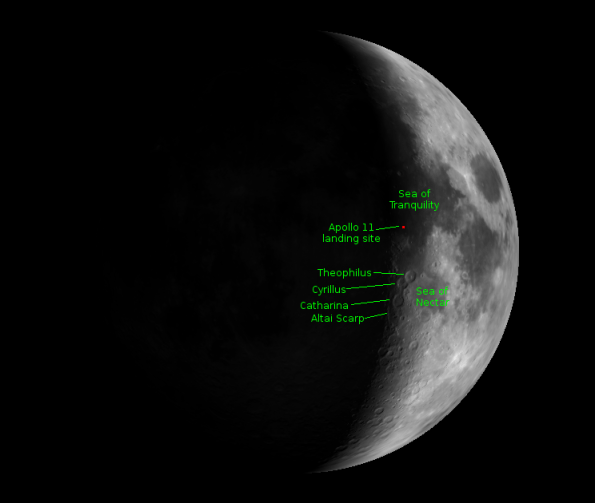
Moon Chart for tonight (October 6, 2016) at 9 p.m. showing the areas discussed above. Created using Virtual Moon Atlas.’
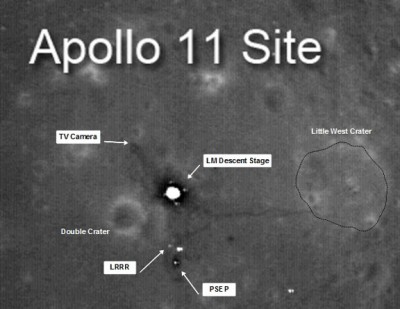
The Apollo 11 landing site in one photograph by the Lunar Reconnaissance Orbiter. There are many with varying Sun angles in the Internet. Search for: Apollo 11 LRO images. Credit NASA.
10/04/2016 – Ephemeris – The bright planets score: three in the evening and one in the morning
Ephemeris for Wednesday, October 5th. The Sun will rise at 7:46. It’ll be up for 11 hours and 28 minutes, setting at 7:15. The Moon, 4 days before first quarter, will set at 10:04 this evening.
Mercury is seen in the morning now, rising at 6:21 today, and should be high enough to be visible between 7 and 7:30 this morning low in the east if it’s clear. Venus, Saturn and Mars are in the evening sky. Venus is briefly visible after sunset, low in the west-southwest. It will set at 8:28 p.m., following the Sun’s earlier setting times. Mars, Saturn and the star Antares start the evening in the southwestern sky in a lengthening triangle, with Saturn on top and Antares below. Mars is way out to the left of the other two. Tonight Saturn will be about 10 of the Moon’s diameter to the left of the crescent Moon. Saturn, spectacular in telescopes with its rings, will set at 10 p.m. and Mars will set at 11:18 p.m.
Times are for the Traverse City/Interlochen area of Michigan. They may be different for your location.
Addendum
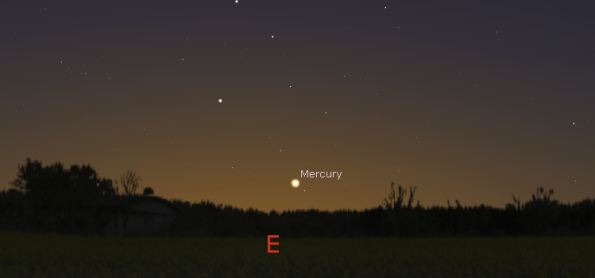
Mercury in the east at 7 a.m. this morning, October 5, 2016. Created using Stellarium.
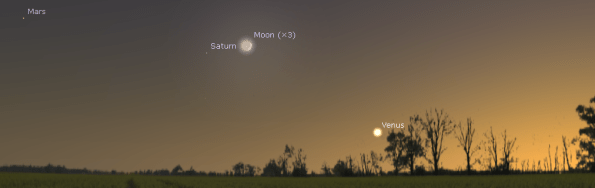
Venus, low in west-southwest with the Moon (enlarged to show phase), Saturn and Mars at 7:35 p.m. (20 minutes after sunset). Created using Stellarium.
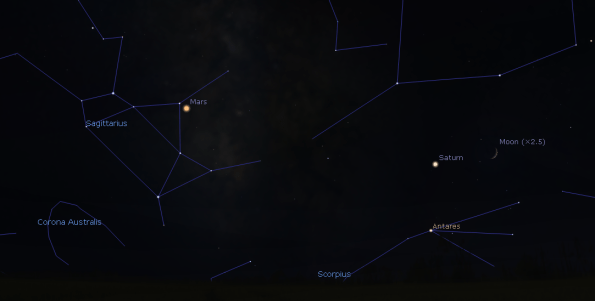
The Moon, Saturn, Antares and Mars with the low constellations in the southwest at 8:30 p.m. October 5, 2016. Created using Stellarium.
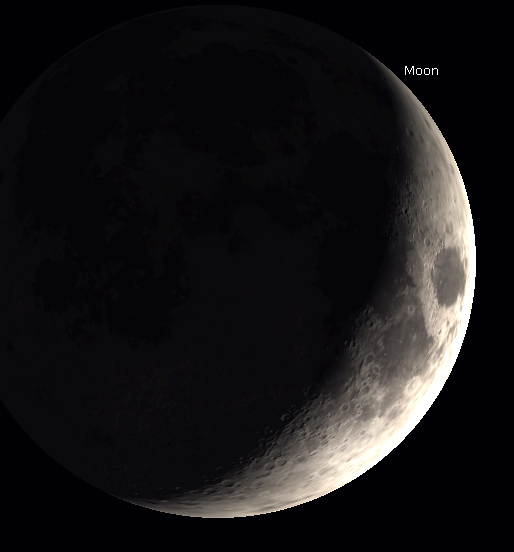
The Moon as it might appear in binoculars at 8:30 p.m. October 5, 2016. Created using Stellarium.
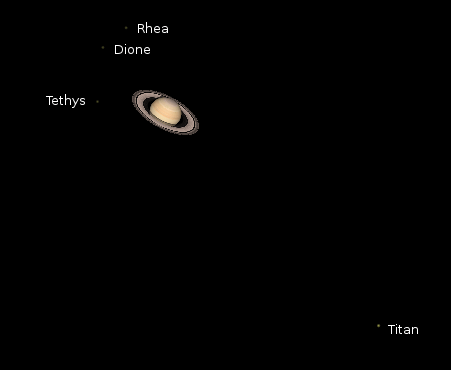
Saturn and some of its moons at 8:30 p.m. October 5, 2016. Created using Cartes du Ciel (Sky Charts).
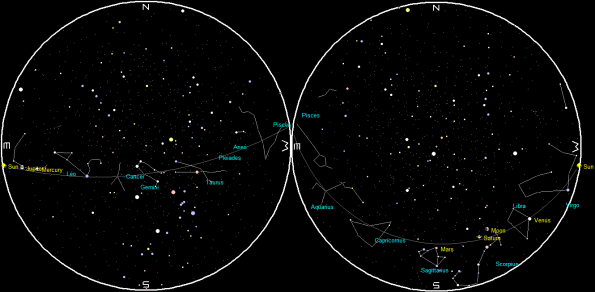
Planets and Moon at sunset and sunrise of a single night starting with sunset on the right on October 5, 2016. The night ends on the left with sunrise on October 6. If you are using Firefox right-click on the image and select View Image to enlarge the image. That goes for all the large images. Created using my LookingUp program.
10/04/2016 – Ephemeris – Celestial dolphin and Cupid’s arrow
Ephemeris for Tuesday, October 4th. The Sun will rise at 7:45. It’ll be up for 11 hours and 31 minutes, setting at 7:16. The Moon, 4 days past new, will set at 9:28 this evening.
There’s two small constellations I’ve overlooked in the heat of Summer. Located above the southernmost star of the Summer Triangle of three of the brightest stars in the sky, which is nearly overhead at 9 p.m., is the tiny constellation of Delphinus the dolphin, which is seen high in the south. Delphinus’ 6 stars in a small parallelogram with a tail, really does look like a dolphin leaping out of the water. The parallelogram itself has the name Job’s Coffin. The origin of this asterism or informal constellation is unknown. Of the dolphin itself: the ancient Greeks appreciated this aquatic mammal as we do. There’s another tiny constellation to the right of Delphinus, Sagitta the arrow, which represents Cupid’s dart.
Times are for the Traverse City/Interlochen area of Michigan. They may be different for your location.
Addendum
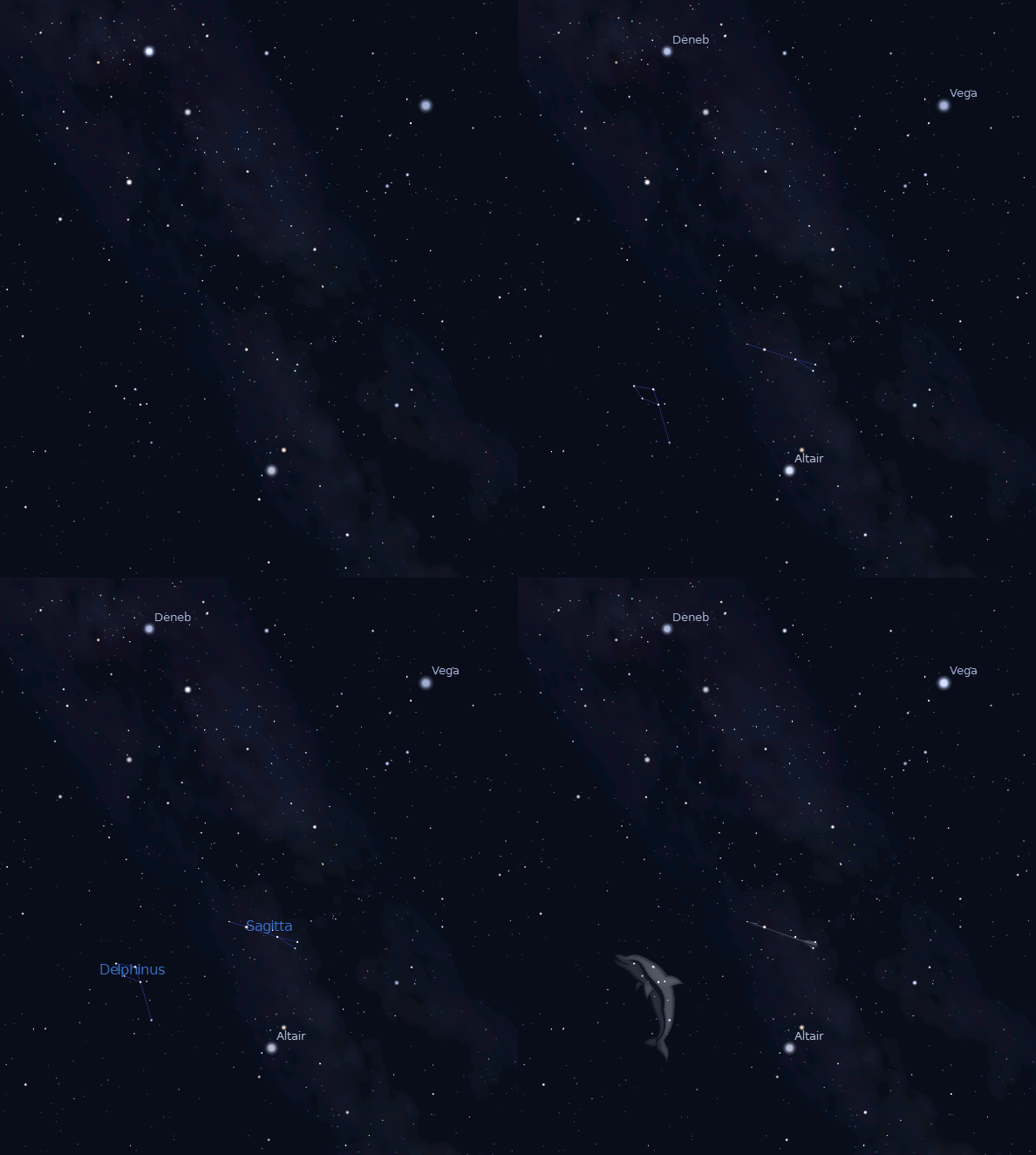
Delphinus and Sagitta seen in an animation showing them without captions, with stick constellations, labeled, and as an artist sees them. Created using Stellarium.
10/03/2016 – Ephemeris – Cassiopeia the celestial queen, and a look at Venus with the Moon
Ephemeris for Monday, October 3rd. The Sun will rise at 7:43. It’ll be up for 11 hours and 34 minutes, setting at 7:18. The Moon, 3 days past new, will set at 8:55 this evening.
The stars of autumn are in the northeastern to southeastern part of the evening sky. Look half way up the sky in the northeast at 9 p.m. and you can find the W shaped constellation of Cassiopeia the queen. Cassiopeia never sets for us in Michigan. It is opposite the pole star Polaris from the Big Dipper. Above Cassiopeia is a dim church steeple shaped constellation of Cepheus the king. The steeple is toppled to the left. The Milky Way flows through Cassiopeia and through a corner of Cepheus to the bright star Deneb in Cygnus the Swan, or Northern Cross, overhead. Below Cassiopeia it flows through the constellation of Perseus the hero, which kind of looks like a chicken, to the bright star Capella near the horizon.
Times are for the Traverse City/Interlochen area of Michigan. They may be different for your location.
Addendum
The crescent Moon will appear above Venus tonight.
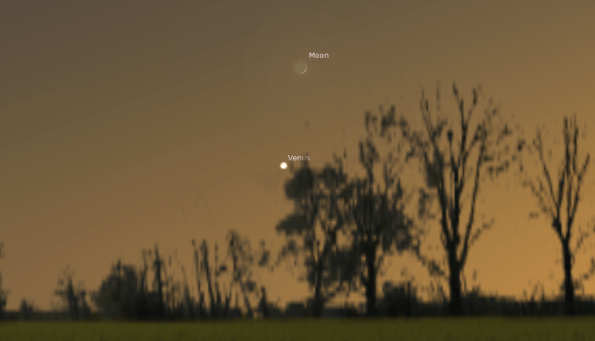
Looking very low in the west-southwest at 7:38 p.m., 20 minutes after sunset, October 3, 2016. The thin crescent Moon will appear about 4 degrees 15 minutes (8 1/2 moon diameters) above Venus. Created using Stellarium.
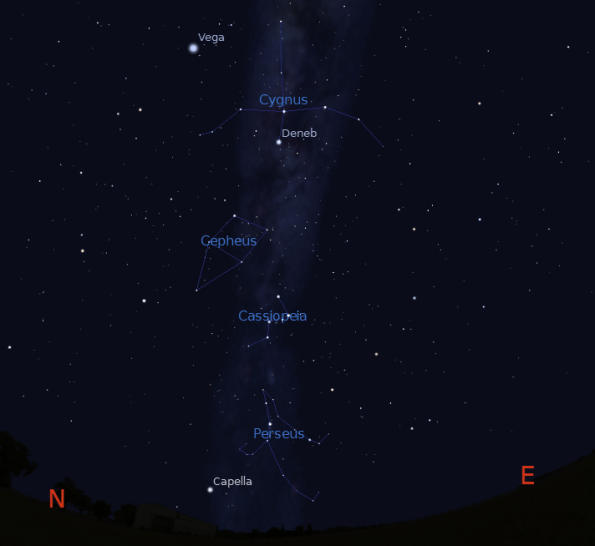
Cassiopeia with Cepheus, Cygnus and Perseus in the Milky Way in the northeastern sky. Created using Stellarium.
09/30/2016 – Ephemeris – Looking ahead to October skies
Ephemeris for Friday, September 30th. The Sun will rise at 7:40. It’ll be up for 11 hours and 44 minutes, setting at 7:24. The Moon is new today, and won’t be visible.
Let’s look at the skies for the month of October. The sun will still be moving south rapidly. Daylight hours in the Interlochen/Traverse City area and will drop from 11 hours and 41 minutes tomorrow to 10 hours, 12 minutes at month’s end.. The altitude of the sun above the southern horizon at local noon will be 42 degrees tomorrow, and will descend to 31 degrees on Halloween, also in the Interlochen area. The Straits area will have the sun a degree lower. Local noon, when the sun is due south will be about 1:30 p.m. Sunrise times will increase from 7:41 tomorrow all the way to 8:20 a.m. in Interlochen and Traverse City on the 31st. Sunset times will decrease from 7:22 p.m. tomorrow to 6:32 when the trick-or-treaters haunt our neighborhoods on Halloween.
Times are for the Traverse City/Interlochen area of Michigan. They may be different for your location.
Addendum
October Star Chart
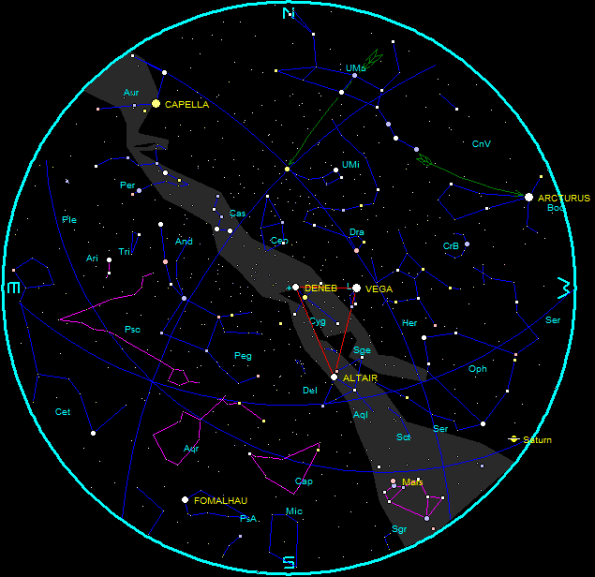
Star Chart for October 2016. Created using my LookingUp program. To enlarge in Firefox right-click on image then click View image.
The planets and stars are plotted for the 15th at 9 p.m. EDT. That is chart time. Note, Traverse City is located approximately 45 minutes behind our time meridian. (An hour 45 minutes behind our daylight saving time meridian.) To duplicate the star positions on a planisphere you may have to set it to 1:45 earlier than the current time if you are near your time meridian.
Evening nautical twilight ends at 8:25 p.m. EDT on the 1st, decreasing to 7:37 p.m. EDT on the 31st.
Morning nautical twilight starts at 6:38 a.m. EDT on the 1st, and increasing to 7:15 a.m. EDT on the 31st.
Add a half hour to the chart time every week before the 15th and subtract a half hour for every week after the 15th.
For a list of constellation names to go with the abbreviations click here.
- Pointer stars at the front of the bowl of the Big Dipper point to Polaris the North Star
- Follow the arc of the handle of the Big Dipper to the star Arcturus
- The Summer Triangle is outlined in red. Vega in Lyra (Lyr), Deneb in Cygnus (Cyg) and Altair in Aquila (Aql).
Calendar of Planetary Events
Credit: Sky Events Calendar by Fred Espenak and Sumit Dutta (NASA’s GSFC)
To generate your own calendar go to http://eclipse.gsfc.nasa.gov/SKYCAL/SKYCAL.html
Times are Eastern Time.
    Date    Time    Event
Oct 01  Sa          Venus: 30.9° E
    03  Mo  1:30 pm Moon-Venus: 5.6° S
    04  Tu  7:02 am Moon Apogee: 406100 km
    06  Th  4:04 am Moon-Saturn: 4.2° S
    08  Sa  2:03 am Moon South Dec.: 18.5° S
    09  Su 12:33 am First Quarter
    13  Th  5:43 am Moon Descending Node
    15  Sa  6:15 am Uranus Opposition
    16  Su 12:23 am Full Moon
    16  Su  7:36 pm Moon Perigee: 357900 km
    19  We  2:18 pm Moon-Aldebaran: 0.3° S
    20  Th  7:38 pm Moon North Dec.: 18.6° N
    21  Fr 12:45 am Orionid Shower: ZHR = 20
    22  Sa  3:14 pm Last Quarter
    25  Tu 12:01 am Moon-Regulus: 1.7° N
    25  Tu  9:45 pm Moon Ascending Node
    26  We  6:54 am Venus-Antares: 3.1° N
    27  Th 11:53 am Mercury Superior Conj.
    28  Fr  5:33 am Moon-Jupiter: 1.6° S
    29  Sa  9:47 pm Venus-Saturn: 3° N
    30  Su 12:38 pm New Moon
    31  Mo  2:29 pm Moon Apogee: 406700 km
Nov 01  Tu          Venus: 37.7° E
09/29/2016 – Ephemeris – The Rosetta spacecraft starts its fatal dive today
Ephemeris for Thursday, September 29th. The Sun will rise at 7:38. It’ll be up for 11 hours and 47 minutes, setting at 7:26. The Moon, 1 day before new, will rise at 7:09 tomorrow morning.
Tomorrow morning at 6:40 a.m. give or take 20 minutes the European Space Agency’s Rosetta spacecraft will slowly crash into Comet 67P/Churyumov-Gerasimenko after orbiting it for a bit over 2 years. The comet is carrying Rosette out toward Jupiter’s orbit where the spacecraft cannot receive enough sunlight to power it. Today the controllers will command the spacecraft to perform the collision maneuver to cancel Rosetta’s complete orbital velocity and let it fall straight down to hit the head of the rubber ducky shaped comet. It’s antenna will be facing Earth and it will be taking pictures all the way down for immediate transmission because Rosetta will turn off its transmitter forever when it impacts the comet.
Times are for the Traverse City/Interlochen area of Michigan. They may be different for your location.
Addendum
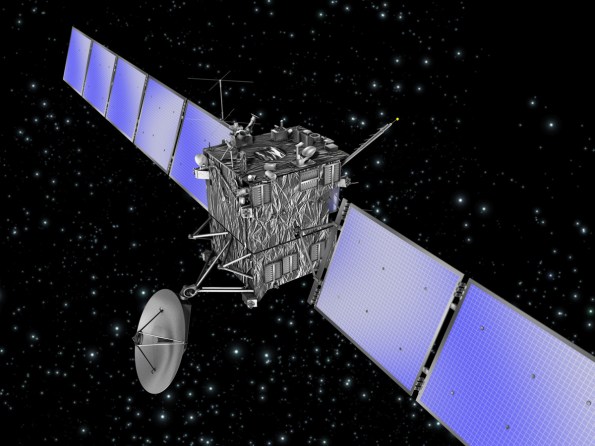
An artist’s illustration of the European Space Agency’s comet-chasing Rosetta spacecraft. Credit: ESA – C. Carreau
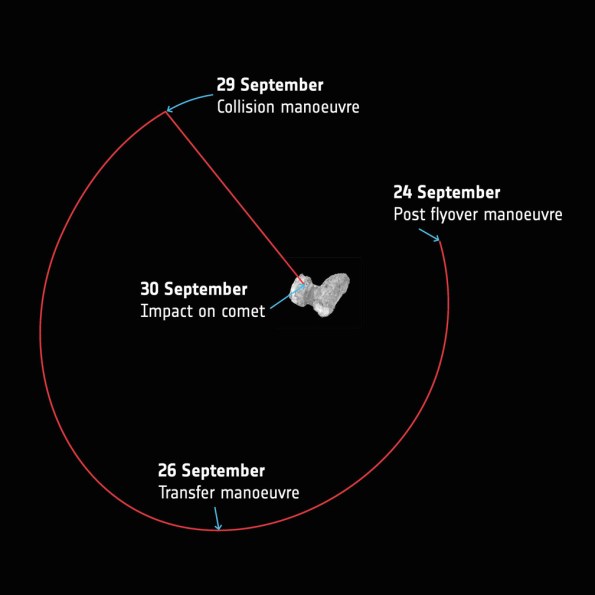
Rosetta, Final orbit. Credit & copyright European Space Agency (ESA)
09/28/2016 – Ephemeris – Then there were three
Ephemeris for Wednesday, September 28th. The Sun will rise at 7:37. It’ll be up for 11 hours and 50 minutes, setting at 7:27. The Moon, 2 days before new, will rise at 6:09 tomorrow morning.
Mercury will pass its greatest separation from the Sun in the morning sky later this afternoon and will be visible in the morning sky in the east for the next week or so. It’s now visible in the morning twilight and it will rise at 6:04 tomorrow morning with the moon below it. Venus, Saturn and Mars are in the evening sky. Venus is briefly visible after sunset, low in the west. It will set at 8:33 p.m., following the Sun’s earlier setting times. Mars, Saturn and the star Antares start the evening in the southwestern sky in a lengthening triangle, with Saturn on top and Antares below. Mars is way out to the left of the other two. Saturn, spectacular in telescopes with its rings, will set at 10:26 p.m. Mars will set at 11:23 p.m.
Times are for the Traverse City/Interlochen area of Michigan. They may be different for your location.
Addendum
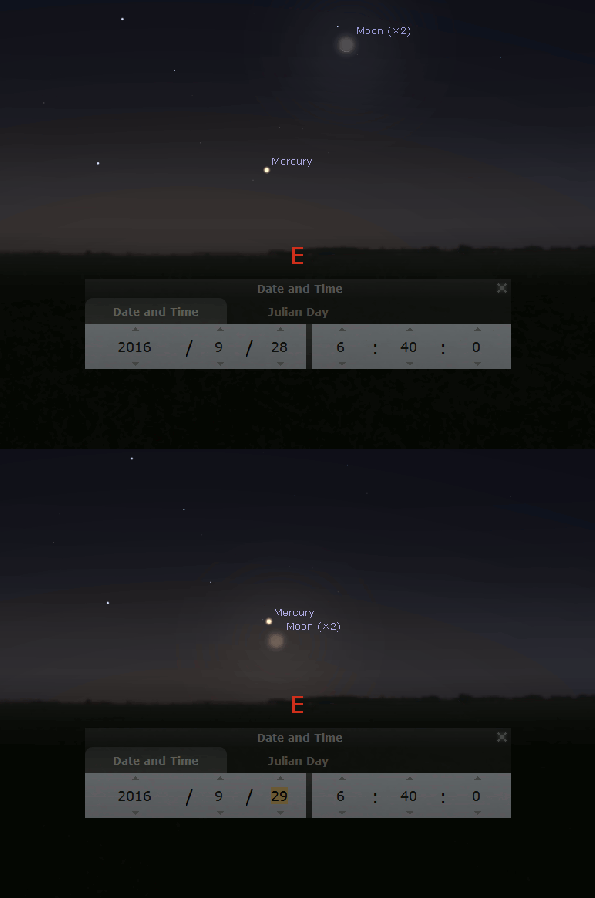
Mercury animation for two mornings, 9/28/16 and 9/29/16 at 6:40 a.m., about 36 minutes after sunrise. Note that the Moon is shown at two times its actual size. Created using Stellarium and GIMP.
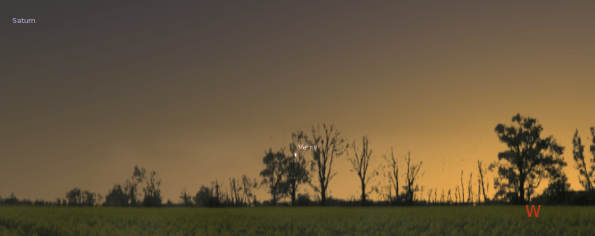
Looking very low in the west at 7:47 p.m., 20 minutes after sunset, September 28, 2016. Venus is approaching Saturn, which is probably not really visible in the bright twilight. To see how Venus’ position changes from week to week, check out the last few Wednesday’s posts. I’m using the same landscape for each which is supplied by Stellarium. Created using Stellarium.
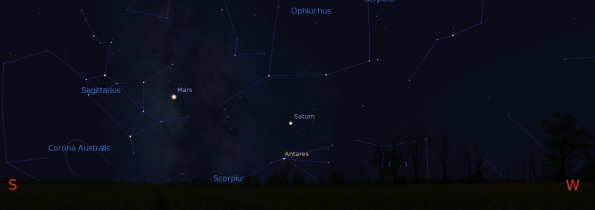
The lengthening Mars-Saturn-Antares triangle and the background constellations at 9 p.m., September 28, 2016. Created using Stellarium.
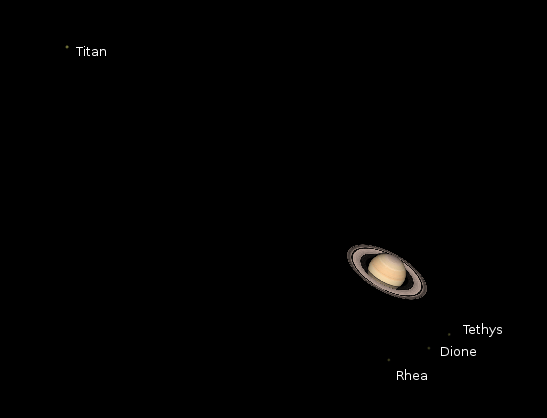
Saturn and some of its moons at 9 p.m. September 28, 2016. Created using Cartes du Ciel (Sky Charts).
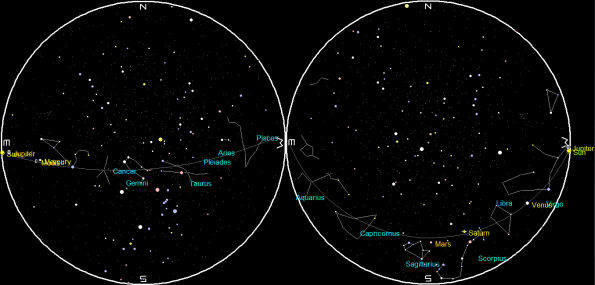
Planets and Moon at sunset and sunrise of a single night starting with sunset on the right on September 28, 2016. The night ends on the left with sunrise on September 29. If you are using Firefox right-click on the image and select View Image to enlarge the image. That goes for all the large images. Created using my LookingUp program.
09/27/2016 – Ephemeris – The princess Pegasus helped save
Ephemeris for Tuesday, September 27th. The Sun will rise at 7:36. It’ll be up for 11 hours and 53 minutes, setting at 7:29. The Moon, 3 days before new, will rise at 5:08 tomorrow morning.
In the east at 9 this evening can be found a large square of stars standing on one corner, the Great Square of Pegasus the flying horse. What look like its hind legs stretching to the left from the left corner star is another constellation, Andromeda the chained princess. She is seen in the sky as two diverging upward curving strings of three stars each. She was rescued by the hero Perseus, a nearby constellation, riding Pegasus. Andromeda’s claim to astronomical fame is the large galaxy seen with the unaided eye just above the upper line of stars, the Great Andromeda Galaxy, 2.5 million light years away. To the unaided eye the galaxy appears as a small smudge of light. In binoculars the galaxy is a delicate spindle of light.
Times are for the Traverse City/Interlochen area of Michigan. They may be different for your location.
Addendum
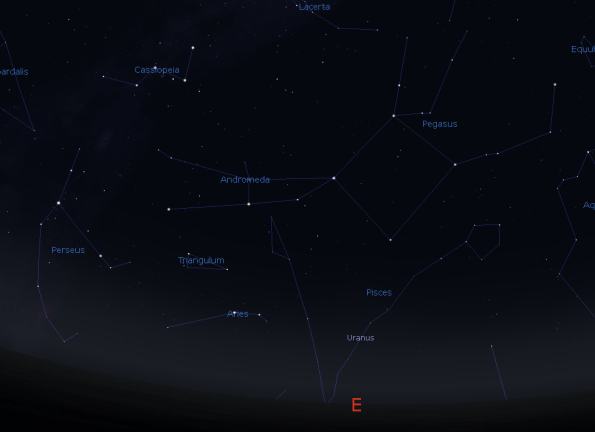
Andromeda, Pegasus and Perseus in the east. Created using Stellarium.
I added some constellation lines to Andromeda since yesterday to match the transcript and how I see her. Looks like I have some work to do with Perseus, before I talk about him later on. He doesn’t look like a chicken enough. I’m going for laughs here.
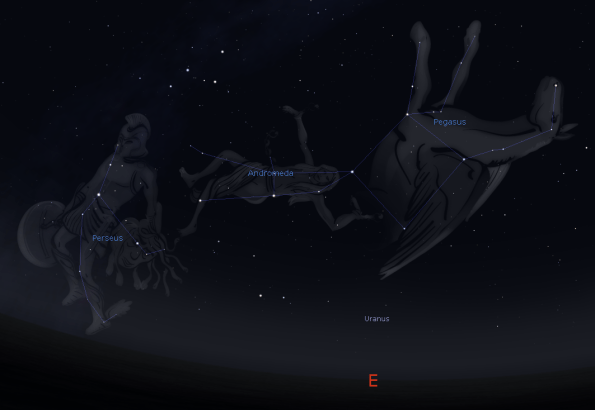
Andromeda. Pegasus and Perseus in the east. Created using Stellarium, art by Johan Meuris.
09/26/2016 – Ephemeris – Pegasus flies through autumn skies
Ephemeris for Monday, September 26th. The Sun will rise at 7:35. It’ll be up for 11 hours and 56 minutes, setting at 7:31. The Moon, 3 days past last quarter, will rise at 4:05 tomorrow morning.
Rising and almost half way up the sky in the east at as it gets dark around 9 p.m. can be found one of the great autumn constellations: Pegasus the flying horse of Greek myth. Its most visible feature is a large square of four stars, now standing on one corner. This feature, called the Great Square of Pegasus, represents the front part of the horse’s body. The horse is quite aerobatic, because it is seen flying upside down. Remembering that fact, the neck and head is a bent line of stars emanating from the right corner star of the square. Its front legs can be seen in a gallop extending to the upper right from the top star of the square. From the left star extend, not hind legs but the constellation of Andromeda, rescued with the help of Pegasus.
Times are for the Traverse City/Interlochen area of Michigan. They may be different for your location.
Addendum
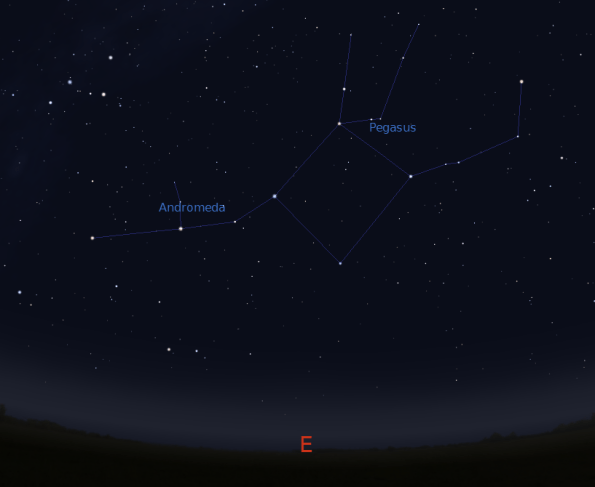
Pegasus and Andromeda in the east. Created using Stellarium.
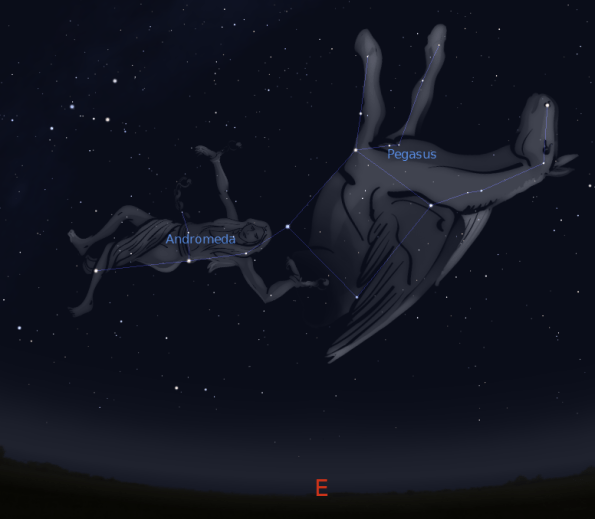
Pegasus and Andromeda in the east. Created using Stellarium, art by Johan Meuris.
09/23/2016 – Ephemeris – Solar observing available at the Acme Fall Festival tomorrow
Ephemeris for Friday, September 23rd. The Sun will rise at 7:31. It’ll be up for 12 hours and 5 minutes, setting at 7:37. The Moon, at last quarter today, will rise at 1:02 tomorrow morning.
Tomorrow members of the Grand Traverse Astronomical Society will be at the Acme Fall Festival at the Flintfields Horse Park, 6535 Bates Rd., just north of M72 from 10 a.m. to 5 p.m. Members will be viewing the Sun with telescopes equipped with solar filters and a special solar telescope which can view the Sun in the light of just the element hydrogen to see solar structures just above the bright ball of the Sun we usually see. This requires clear skies. The fat waning crescent moon should also be visible in the morning. Besides viewing the society will have displays showing the wonders of the heavens. Members will be there to answer your questions about astronomy and telescopes.
Times are for the Traverse City/Interlochen area of Michigan. They may be different for your location.

