Archive
06/12/2012 – Ephemeris – The bright star Antares
Ephemeris for Tuesday, June 12th. Today the sun will be up for 15 hours and 31 minutes, setting at 9:28. The moon, 1 day past last quarter, will rise at 2:20 tomorrow morning. Tomorrow the sun will rise at 5:56.
A rival to Mars is now low in southeast at 10:30. It is the red star Antares, whose names literally means “Rival of Mars”. This is from the Greek who’s god of war was Ares. Mars is in the southwest now and a bit brighter than Antares. When Mars catches up with Antares around October 20th this year, they will be nearly the same brightness, and one would be hard put to tell them apart. Antares is in the heart of Scorpius the scorpion which lies close to our southern horizon later in the evening, and is best seen next month at an earlier time. Antares is also a star that appears strange as its twinkling is very pronounced being always close to the horizon for us sputtering all the colors of the rainbow.
Times are for the Traverse City/Interlochen area of Michigan. They may be different for your location.
Addendum
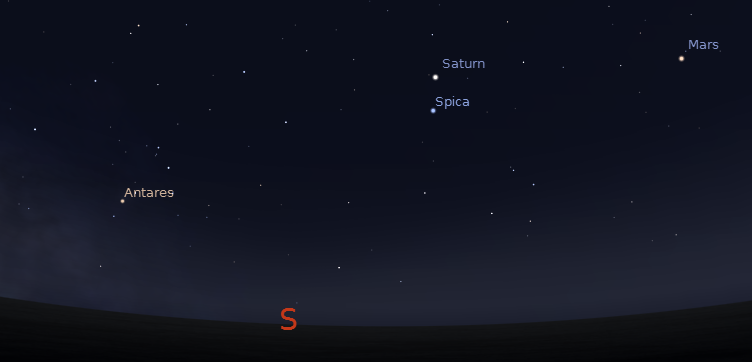
Antares and Mars at 11 p.m. on June 12, 2012. Created using Stellarium.
06/11/2012 – Ephemeris – The bright star Arcturus
Ephemeris for Monday, June 11th. Today the sun will be up for 15 hours and 30 minutes, setting at 9:27. The moon, at last quarter today, will rise at 1:55 tomorrow morning. Tomorrow the sun will rise at 5:56.
The bright star Arcturus appears high in the south at 10:30 in the evening. It’s at the base of a kite shaped constellation of Boötes the herdsman or bear chaser. Arcturus is remarkable for several reasons. It is only 10 percent more massive than the sun but is 110 times brighter and is orange in color. That’s because Arcturus has entered its red giant stage of life after depleting hydrogen in its core as its fuel source. Arcturus is much older than the sun to have evolved so far, being only a little more massive than the sun. Also Arcturus may be new to our galaxy, Its rapid motion of 76 miles per second with respect to the sun, along with 51 other stars known may have come from a small galaxy that collided with the Milky Way.
Times are for the Traverse City/Interlochen area of Michigan. They may be different for your location.
Addendum
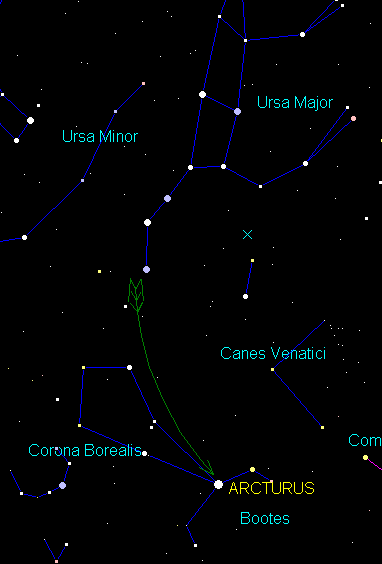
Arcturus, Boötes and the Big Dipper
06/08/2012 – Ephemeris – The constellation of Hercules
Ephemeris for Friday, June 8th. Today the sun will be up for 15 hours and 28 minutes, setting at 9:26. The moon, 3 days before last quarter, will rise at 12:38 tomorrow morning. Tomorrow the sun will rise at 5:57.
High in the east is the dim and reasonably large constellation of Hercules. Here is the greatest of the Greek heroes, dim and upside down even, while the comparative nobody Orion gets a great constellation to his name in the winter. Anyway, Hercules can be spotted by the distinctive keystone shape of stars that mark the old boy’s kilt. Stars connected to the four corners show his body and limbs. Check a constellation book for where all the stars lead to. On the west side of the keystone can be spotted with binoculars a fuzzy star. Investigations with larger and larger telescopes will reveal a huge assembly of stars called a globular star cluster. There’s perhaps a million stars there. The finest in the northern heavens.
Times are for the Traverse City/Interlochen area of Michigan. They may be different for your location.
Addendum
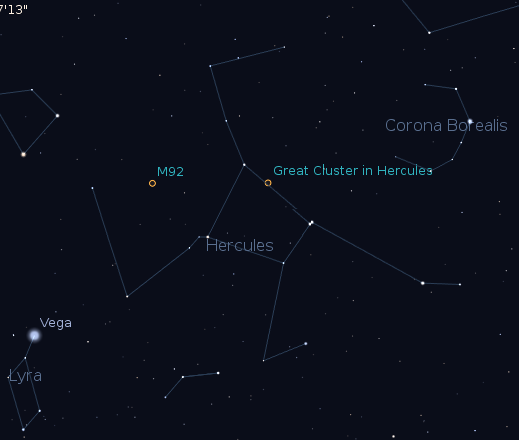
The constellation Hercules and his neighbors. Created with Stellarium.
M92 is also a globular star cluster but more distant. The Great Globular Cluster in Hercules is also designated M13.
06/07/2012 – Ephemeris – The constellation of Corona Borealis
Ephemeris for Thursday, June 7th. Today the sun will be up for 15 hours and 27 minutes, setting at 9:25. The moon, 3 days past full, will rise at 12:07 tomorrow morning. Tomorrow the sun will rise at 5:57.
High in the southeast at 10:30 p.m. can be found a rather small arc of stars just east of the kite shaped constellation of Boötes with the bright star Arcturus at the bottom. It’s called Corona Borealis, the Northern Crown. There is a Southern Crown, Corona Australis, just below the Teapot of Sagittarius, a late summer constellation, which barely rises above the horizon here. This semi-circle of stars was to the Greeks the crown bestowed to Princess Ariadne daughter of King Minos of Crete after she had helped the Greek Theseus escape from the Labyrinth of the Minotaur. To the Native Americans around here it was the sweat lodge, and to the Australian Aborigines it was the boomerang whenever it rose over their northern horizon.
Times are for the Traverse City/Interlochen area of Michigan. They may be different for your location.
Addendum

Corona Borealis with Boötes at 10:30 p.m. Created with Stellarium.
06/06/2012 – Ephemeris – Where are the bright planets this week?
Ephemeris for Wednesday, June 6th. Today the sun will be up for 15 hours and 26 minutes, setting at 9:24. The moon, 2 days past full, will rise at 11:31 this evening. Tomorrow the sun will rise at 5:57.
Let’s see what’s happening with the bright planets for this week. Venus is now in the morning sky and very close to the sun, will be seen again in a few weeks. Mars is in the southwest in the evening in the constellation of Leo the lion with its unmistakable bright reddish color, though its fading as it retreats from us. It’s heading eastward toward Virgo. Mars will be setting in the west at 2:20 a.m. Saturn will be in the south above the bright star Spica now. It’s due south at 10:09 p.m. and will set at 3:45 a.m. Jupiter, now a morning planet will rise at 5:01 a.m. in the east northeast. Mercury is in the evening sky but too close to the sun to be seen, we should be able to spot it the last week of this month.
Times are for the Traverse City/Interlochen area of Michigan. They may be different for your location.
Addendum
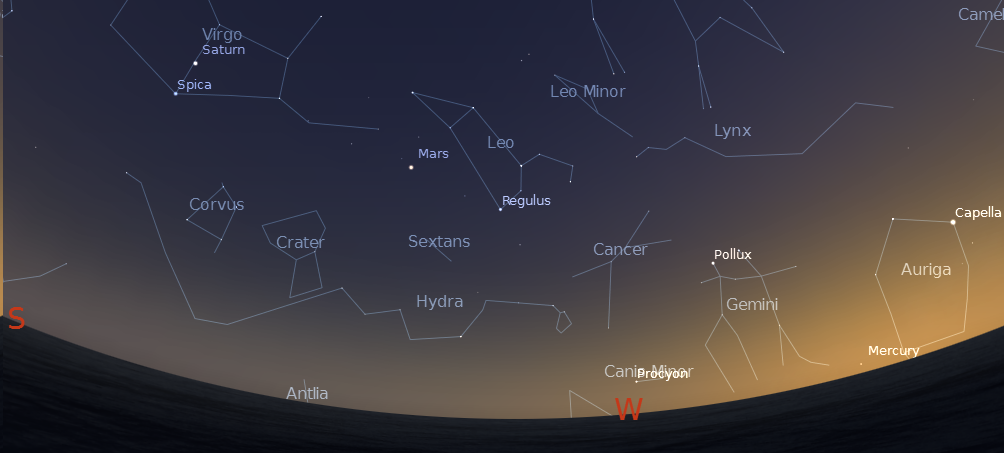
The planets at 10:15 in the evening. Check out Mercury near the horizon. Created using Stellarium.
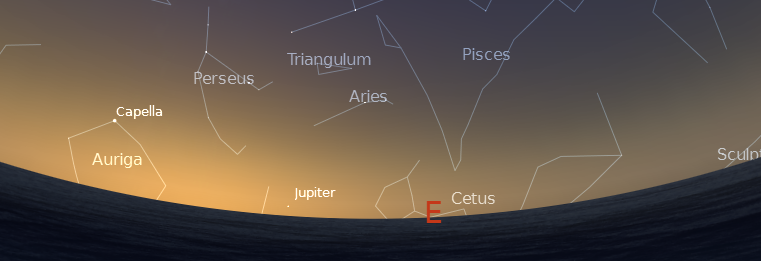
5:15 a.m. at 6/7/2012. Morning sky and Jupiter. Created using Stellarium.
06/05/2012 – Ephemeris – Transit of Venus is today!
Ephemeris for Tuesday, June 5th. Today the sun will be up for 15 hours and 25 minutes, setting at 9:24. The moon, 1 day past full, will rise at 10:46 this evening. Tomorrow the sun will rise at 5:58.
Early this evening we will see a rare event, the transit of the planet Venus across the sun. This will start at a few minutes after 6 p.m. When Venus will start crossing the sun from near the top. While the transit will last nearly 7 hours, we’ll see about 3 hours of it, clouds willing before the sun sets. The safety precautions are the same as viewing a solar eclipse, that is Do Not Look Directly At The Sun. Safe approved solar filters that fit in front of a telescope, projection of the sun’s image with a telescope or binoculars are the ways to view this event. The Grand Traverse Astronomical Society will be at the Open Space in Traverse City at 6 p.m. tonight for safe views of the event. The next transit of Venus will be in 2117.
Times are for the Traverse City/Interlochen area of Michigan. They may be different for your location.
Addendum
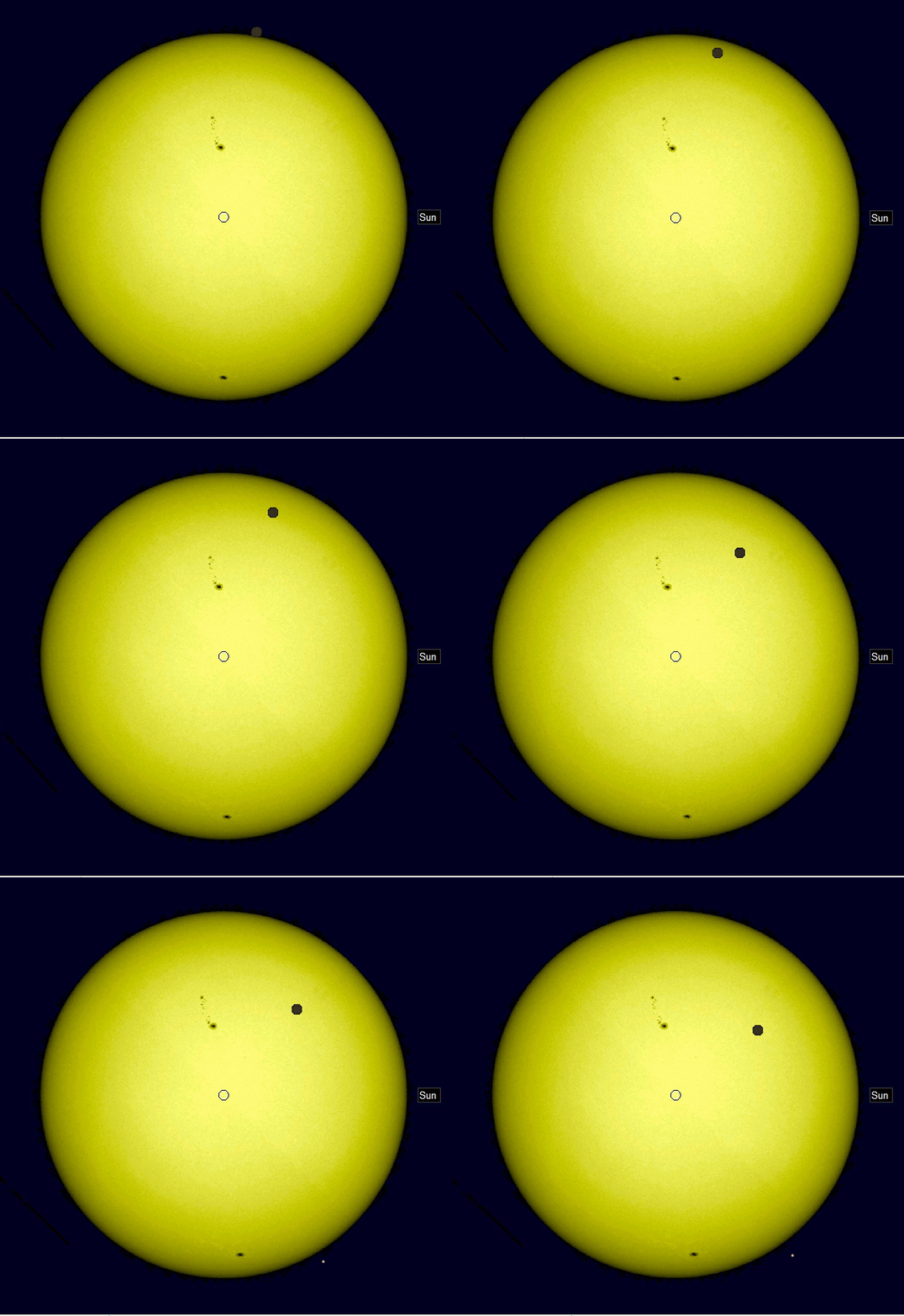
Animation of the Transit of Venus from Northern Michigan. Created using cartes du Ciel.
The Animation starts with Venus at contact 1, and every half hour until sunset. That’s why the transit ends abruptly.
For more information check out this NASA page.
How to observe the sun? The same techniques that are use to view a solar eclipse.
06/04/2012 – Ephemeris – Rare Transit of Venus is tomorrow
Ephemeris for Monday, June 4th. Today the sun will be up for 15 hours and 24 minutes, setting at 9:23. The moon, at full today, will rise at 9:51 this evening. Tomorrow the sun will rise at 5:58.
A partial eclipse of the moon is in progress this morning, but it started at moon set at 6 a.m. Tomorrow is a much rarer event, a transit of Venus across the face of the sun. This will start at a few minutes after 6 p.m. When Venus will start crossing the sun from near the top. While the transit will last nearly 7 hours, we’ll see about 3 hours of it, clouds willing. The safety precautions are the same as viewing a solar eclipse, that is Do Not Look Directly At The Sun. Safe approved solar filters that fit in front of a telescope, projection of the sun’s image with a telescope or binoculars are the ways to view this event. The Grand Traverse Astronomical Society will be at the Open Space in Traverse City at 6 p.m. Tomorrow for safe views of the event.
Times are for the Traverse City/Interlochen area of Michigan. They may be different for your location.
Addendum
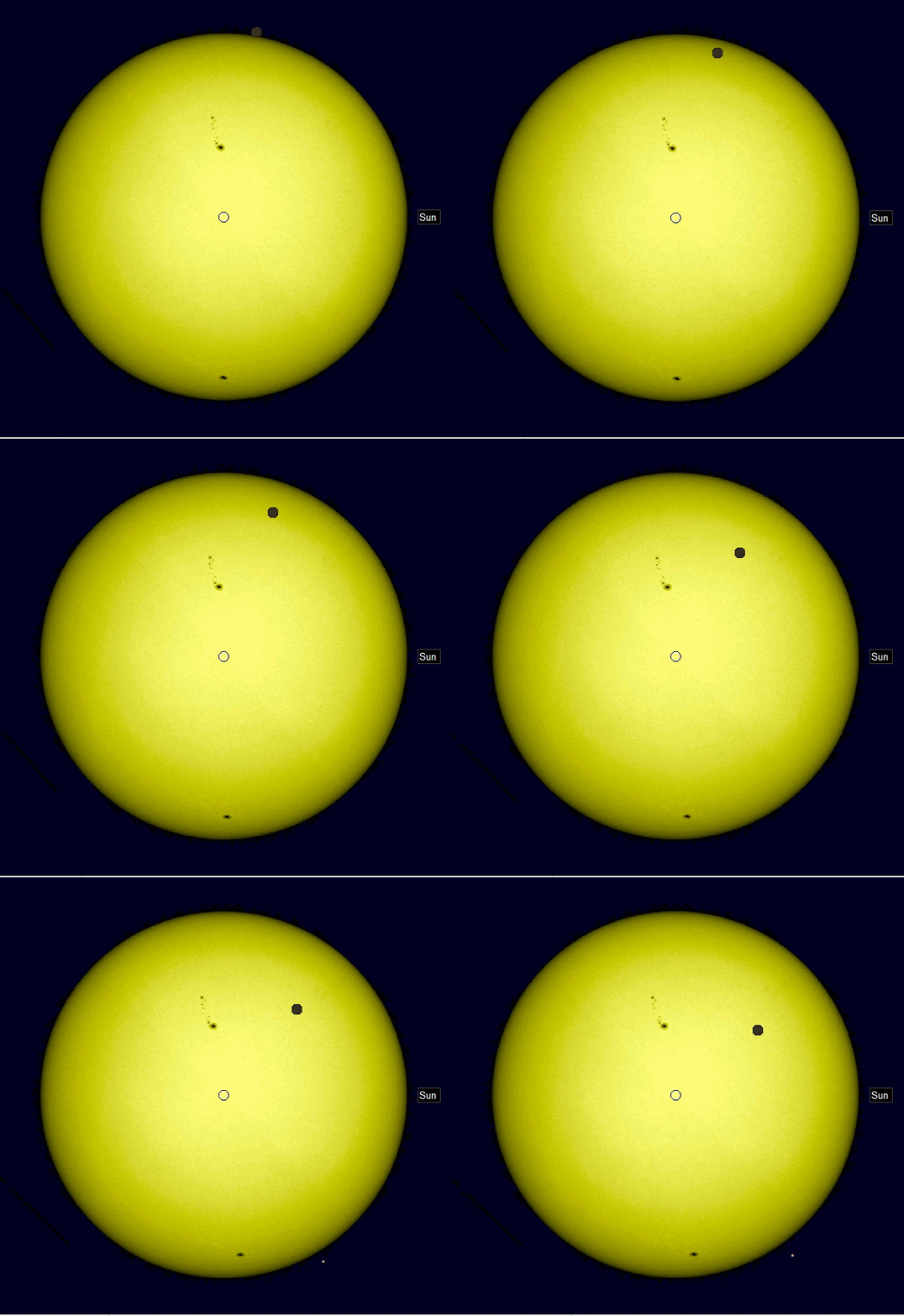
Transit of Venus as seen from the Grand Traverse Region. Created using Cartes du Ciel.
These plots are in 30 minute intervals starting around 6:10 p.m.
06/01/2012 – Ephemeris – Great local astronomical events this weekend
Ephemeris for Friday, June 1st. Today the sun will be up for 15 hours and 20 minutes, setting at 9:20. The moon, 3 days before full, will set at 4:20 tomorrow morning. Tomorrow the sun will rise at 5:59.
There’s a chock full weekend of astronomical events this weekend. First, this evening the Grand Traverse Astronomical Society will hold its monthly meeting at Northwestern Michigan College’s Rogers Observatory. We’ll preview the Transit of Venus and will be viewing the sun with the society’s new solar telescope if it’s clear. Following at 9 p.m. is the observatory’s star party. Tomorrow evening starting at 9 will be a star party at Sleeping Bear Dunes National Lakeshore at stop 3, the Dunes Overlook, on Pierce Stocking Scenic Drive. Both these star parties will feature the nearly full moon and the planets Mars and Saturn. Who knows, we might even spot Venus in twilight. No promises though.
Times are for the Traverse City/Interlochen area of Michigan. They may be different for your location.
05/31/2012 – Ephemeris – Previewing June skies
Ephemeris for Thursday, May 31st. Today the sun will be up for 15 hours and 19 minutes, setting at 9:20. The moon, 3 days past first quarter, will set at 3:41 tomorrow morning. Tomorrow the sun will rise at 6:00.
Let’s preview June skies. There’ll be a lot of sun in June. The daylight hours will increase a bit from 15 hours and 20 minutes on the 1st to 15 hours and 33 minutes on the 20tht, retreating back to 15 hours 30 minutes at month’s end. The big event of the month will be the Transit of Venus across the sun on June 5th. We’ll see the first part of the transit starting about 6:04 p.m. That evening. I’ll have more information on how to safely view this event. Remember looking directly at the sun is dangerous. There will be safe viewing of the event at Traverse City’s Open Space. The next Venus transit will be in 105 ½ years. The extra day in February this leap year pushed the start of summer up to the 20th at 7:07 p.m.
Times are for the Traverse City/Interlochen area of Michigan. They may be different for your location.
05/30/2012 – Ephemeris – Where are the bright planets tonight?
Ephemeris for Wednesday, May 30th. Today the sun will be up for 15 hours and 17 minutes, setting at 9:19. The moon, 2 days past first quarter, will set at 3:07 tomorrow morning. Tomorrow the sun will rise at 6:00.
Let’s see what’s happening with the bright planets for this week. Venus is now very difficult to spot low in the west northwest just after sunset. The next time you’ll see it will be passing in front of the sun June 5th, a rare event called a transit. Venus will set at 10:11 p.m. Venus is 27.3 million miles away and won’t get much closer. It is an incredibly thin crescent in telescopes. Mars is in the southwest in the evening in the constellation of Leo the lion with its unmistakable bright reddish color. It has resumed its eastward motion toward Virgo. Mars will be setting in the west at 2:42 a.m. Saturn will be in the south above the bright star Spica this now. It’s due south at 10:37 p.m. and will set at 4:13 a.m.
Times are for the Traverse City/Interlochen area of Michigan. They may be different for your location.

