Archive
05/23/11 – Ephemeris – The constellation Boötes
Monday, May 23rd. Today the sun will be up for 15 hours and 5 minutes, setting at 9:11. The moon, 1 day before last quarter, will rise at 1:59 tomorrow morning. Tomorrow the sun will rise at 6:06.
Appearing high in the eastern sky at 10 p.m. tonight is the kite shaped constellation of Boötes the herdsman. The bright star Arcturus is at the bottom of the kite, pointed to by the arc of the handle of the Big Dipper, overhead. In one story Boötes represents a young hunter named Arcas, son of Callisto, a beautiful young lady who had the misfortune of being loved by Zeus the chief Greek god. Zeus’ wife Hera, found out about it, and since she couldn’t punish Zeus, turned Callisto into an ugly bear. Arcas, unaware of why his mother disappeared in his youth was about to kill the bear when Zeus intervened and placed them both in the sky. Now Arcas as Boötes chases the Great Bear forever around the pole of the sky each night.
* Times are for the Traverse City/Interlochen area of Michigan. They may be different for your location.
Addendum
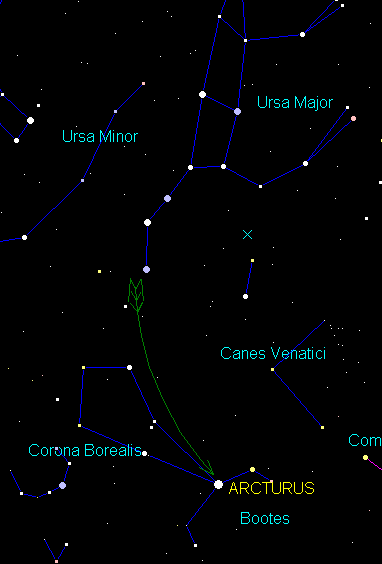
Bootes and the Big Dipper
05/20/11 – Ephemeris – Astronomy events this weekend in the Grand Traverse area
Friday, May 20th. Today the sun will be up for 14 hours and 59 minutes, setting at 9:08. The moon, 3 days past full, will rise at 12:30 tomorrow morning. Tomorrow the sun will rise at 6:08.
This weekend there are some local astronomical events It starts tonight with a viewing night at Northwestern Michigan’s Rogers Observatory with Saturn as the object best seen if it’s clear.. While the observatory opens at 9 p.m. Saturn itself will not be visible until after 9:30 due to the late sunset this time of year. The college has started to charge a fee for these event: $2 per person or $5 per family, something the Grand Traverse Astronomical Society has long opposed. Sunday the Astronomical Society will host exhibits at the NMC barbecue in the science building, plus viewing the sun if it’s clear. The society has many events this summer held at various venues around the area. Check gtastro.org for a schedule.
* Times are for the Traverse City/Interlochen area of Michigan. They may be different for your location.
05/19/11 – Ephemeris – The bright star Spica
Thursday, May 19th. Today the sun will be up for 14 hours and 57 minutes, setting at 9:07. The moon, 2 days past full, will rise at 11:47 this evening. Tomorrow the sun will rise at 6:09.
The large constellation of Virgo the reclining maiden is midway up the sky in the south when it gets dark. Virgo contains mostly faint stars in a large area of sky left of and below Leo the lion, but it has a few bright stars. Virgo’s brightest star Spica, can be found from the handle of the Big Dipper, overhead, following the arc to the star Arcturus, and straightening to a spike to Spica, the 16th brightest night time star. The planet Saturn is above and right of it. Spica is supposed to be a stalk of wheat held in Virgo’s hands. The star and Virgo itself were symbols of a bountiful harvest. The sun used to be in Virgo at the end of summer. In Egypt it was the goddess Isis, and at least one ancient temple was oriented to Spica’s setting point.
* Times are for the Traverse City/Interlochen area of Michigan. They may be different for your location.
Addendum
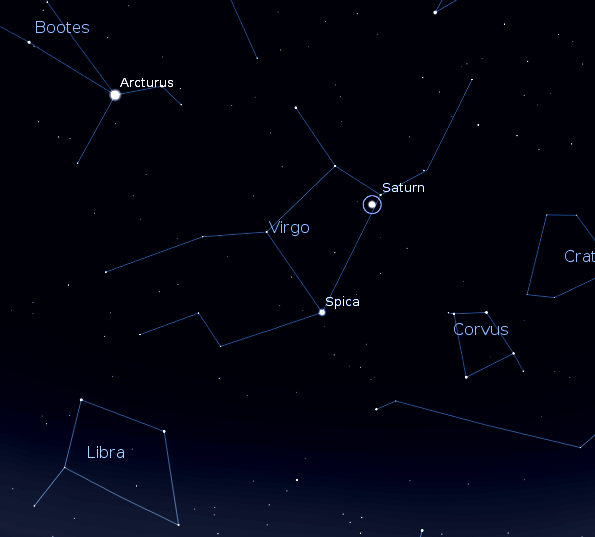
Virgo and Spica in the evening this month
05/18/11 – Ephemeris – The bright planets visible this week
Wednesday, May 18th. Today the sun will be up for 14 hours and 55 minutes, setting at 9:06. The moon, 1 day past full, will rise at 10:54 this evening. Tomorrow the sun will rise at 6:10.
It’s Wednesday and time again to take a look at the whereabouts of the bright planets. The ringed planet Saturn will be visible in the south southeast as it gets dark. It’s near the bright star Spica to its lower left. Spica has a blue tinge, while Saturn is yellowish. It will cross the meridian due south at 10:42 p.m. and will set at 4:36 a.m. The morning planet traffic jam is breaking up. Rising first will be Jupiter at 4:52 on the east. Mars will rise at 5:13 followed by Venus 3 minutes later. Mercury will rise at 5:24. Unless we have very clear skies and you have a very flat eastern horizon, you’d have to wait until maybe 5:45 to try to spot them. It will take binoculars to first locate Venus and Jupiter. Good luck finding the others.
* Times are for the Traverse City/Interlochen area of Michigan. They may be different for your location.
05/17/11 – Ephemeris – The Dawn spacecraft sights its target the asteroid Vesta
Tuesday, May 17th. Today the sun will be up for 14 hours and 52 minutes, setting at 9:05. The moon, at full today, will rise at 9:51 this evening. Tomorrow the sun will rise at 6:11.
The Dawn spacecraft is about to make news. Never heard of it? Well, it’s been slowly building up speed for the last nearly four years, spiraling its way out into the asteroid belt with its ion engines and one gravity assist from the red planet Mars, on which it tested its cameras. Its first target is coming up, the asteroid Vesta, the brightest of asteroids, though not the largest. There won’t be a time of engine firing to drop the spacecraft into orbit, but Dawn will slowly spiral into lower and lower orbits of this asteroid starting in July. It will spend a year at Vesta before heading to the largest asteroid, now dubbed dwarf planet Ceres. Last week dawn took its first image of Vesta, which covered 5 pixels in its camera, and shows Dawn to be right on target.
* Times are for the Traverse City/Interlochen area of Michigan. They may be different for your location.
05/16/11 – Ephemeris – Space Shuttle Endeavour to launch this morning
Monday, May 16th. Today the sun will be up for 14 hours and 50 minutes, setting at 9:04. The moon, 1 day before full, will set at 6:01 tomorrow morning. Tomorrow the sun will rise at 6:12
If all goes well the Space Shuttle Endeavor will lift off for the International Space Station at 8:56 this morning (EDT). The Endeavour, named for the for British Captain James Cook’s first vessel, which was sailed to Tahiti in in 1769 to observe the transit of Venus across the sun as part of an effort to determine the earth’s distance from the sun. Endeavour’s 25th and last flight will be the second to last flight of the Shuttle program. Gregory Johnson, mission pilot has family and a cottage in the area. The State Theater in downtown Traverse City will be open for a live feed of the launch starting at 8 a.m. if the launch is still a go. It will be hosted by NASA Solar System Ambassador Carolyn McKellar. This is a free event.
* Times are for the Traverse City/Interlochen area of Michigan. They may be different for your location.
Update
There were over 200 people, young and old that came to the theater for the event. It was very successful for such short notice of a relatively few days. Great work Carolyn and the volunteers and staff of the State Theater!
05/13/11 – Ephemeris – Astronomical meaning of the morning planet lineup
Friday, May 13th. Today the sun will be up for 14 hours and 43 minutes, setting at 9:01. The moon, 3 days past first quarter, will set at 4:09 tomorrow morning. Tomorrow the sun will rise at 6:16
The planet grouping that’s now breaking up in the morning twilight might be taken as having meaning by astrologers. To astronomers it’s just a nice line up of planets, that is along our line of sight. Let’s look at their distances from the earth. Mercury is actually closest of the four now at 86 million miles, The rest are farther than the sun. Venus is next farthest at 139 million miles. Next comes Mars at 214 million miles away. Finally there’s Jupiter at 541 million miles out. So these planets are grouped by accident of their directions from the earth. They are not really close together. As far as influence goes, the moon, Jupiter and Venus gave the greatest gravitational effect of the earth, but that’s miniscule compared to the sun.
* Times are for the Traverse City/Interlochen area of Michigan. They may be different for your location.
Addendum
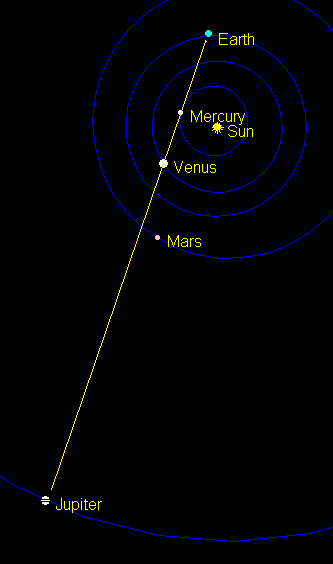
Line of sight of the planets in the Planet Jam for May 13th.
Here’s the animation of the morning planets this month.
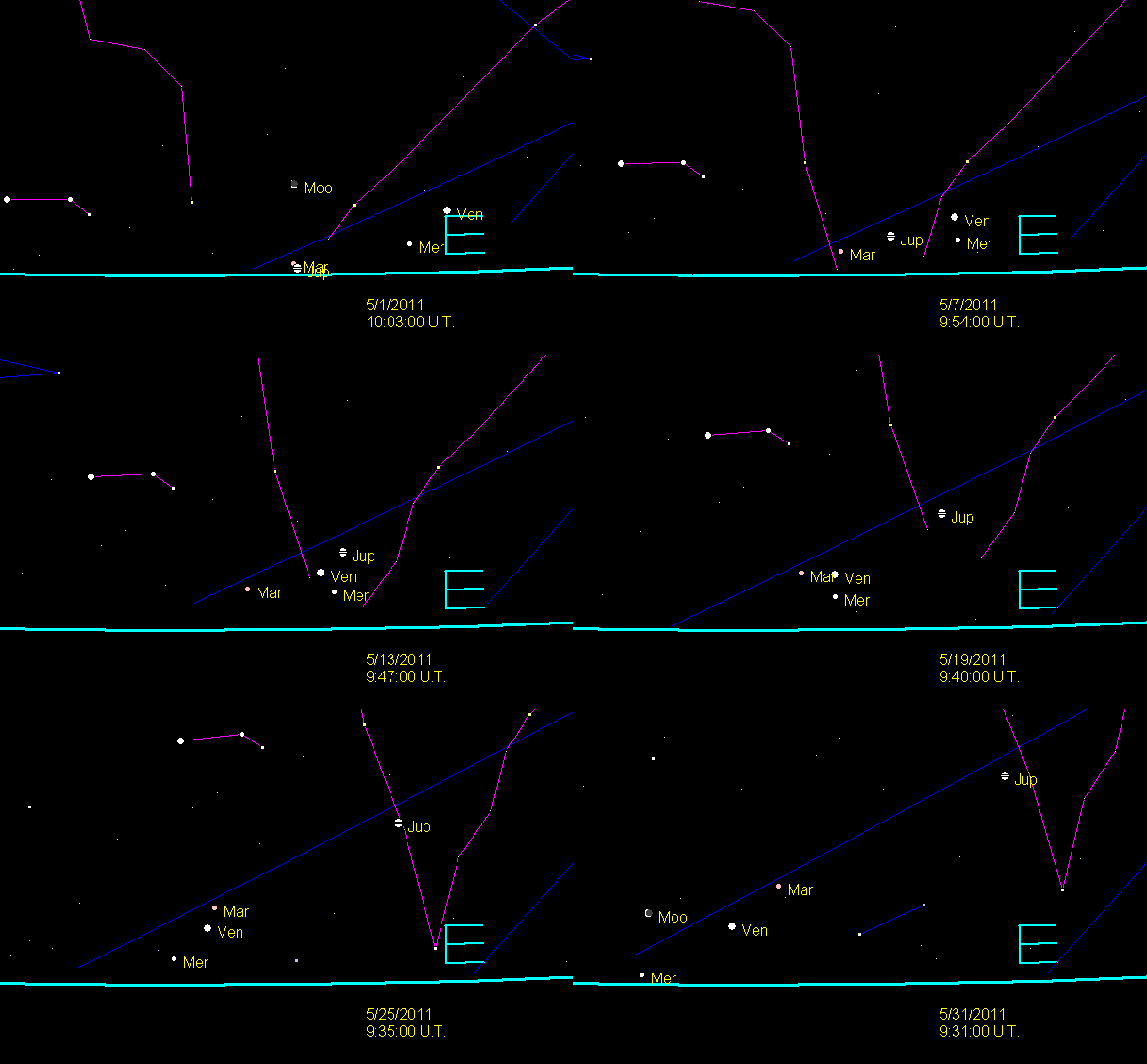
Planet Jam May 2011 animation
05/12/11 – Ephemeris – Lunar telescopic wonders: Bay of Rainbows and the crater Copernicus
Thursday, May 12th. Today the sun will be up for 14 hours and 41 minutes, setting at 8:59. The moon, 2 days past first quarter, will set at 3:40 tomorrow morning. Tomorrow the sun will rise at 6:17.
Tonight the moon will again show a hook out into the darkness at the upper left edge of the moon for observers using binoculars or a telescope. That’s the Jura mountains cupping the Bay of Rainbows, a rather gray lava expanse on the edge of the Sea of Showers. At the other edge of the that sea is the great crater Copernicus, center left on the moon. Its halo of rays will show up better when the moon is full, but now the crater itself can be appreciated. In a telescope its is quite a sight. It has a complex triple central peak, and terraced walls. The small asteroid that hit it less than a billion years ago, struck the moon, gouging out the 56 mile diameter crater we see today. Rebound created the central peaks.
* Times are for the Traverse City/Interlochen area of Michigan. They may be different for your location.
Addendum
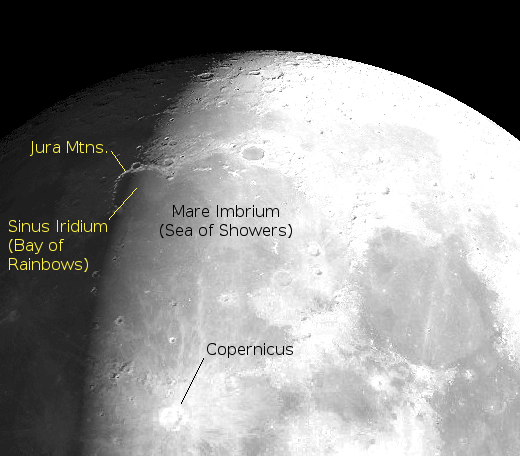
Bay of Rainbows and the crater Copernicus. Created using Virtual Moon Atlas.
I have more on Sinus Iridium and the Jura Mountains back in March.
05/11/11 – Ephemeris – The bright planets for this week
Wednesday, May 11th. The sun rises at 6:19. It’ll be up for 14 hours and 39 minutes, setting at 8:58. The moon, 1 day past first quarter, will set at 3:14 tomorrow morning.
It’s Wednesday and time again to take a look at the whereabouts of the bright planets. The ringed planet Saturn will be visible in the southeast as it gets dark. It’s near the bright star Spica to its lower left. Spica has a blue tinge, while Saturn is yellowish. It will cross the meridian due south at 11:11 p.m. and will set at 5:04 a.m. The morning planet traffic jam continues. Rising first will be Jupiter at 5:19 on the east. Venus rises at 5:25. Followed by Mars at 5:30 and Mercury at 5:31. Unless we have very clear skies and you have a very flat eastern horizon, you’d have to wait until maybe 5:45 to try to spot them. It will take binoculars to first locate Venus, Jupiter the second brightest will be nearby, followed by nearly impossible to spot Mars and Mercury.
* Times are for the Traverse City/Interlochen area of Michigan. They may be different for your location.
Addendum
The morning planets this month at 2 day intervals.
Planet Jam May 2011 animation
05/10/11 – Ephemeris – The Ancient Greeks and measuring the distance to the sun
Tuesday, May 10th. The sun rises at 6:20. It’ll be up for 14 hours and 36 minutes, setting at 8:57. The moon, at first quarter today, will set at 2:46 tomorrow morning.
The ancient Greek astronomers had great success in actually calculating the distance to the moon. They came up with 60 earth radii. Yes, they knew the earth was round and even measured its circumference to great accuracy. The distance they got for the moon lies within the range of the actual moon’s distance. They next tried to measure the distance from the sun. To do this, they tried to observe the moon and the sun at the exact time the moon was at first quarter. At this time the earth, sun and moon make a right triangle. Theoretically the actual angle between the sun and the moon would give the distance to the sun. The answer they got was that the sun was 20 times the moon’s distance. That’s way short, the sun is 400 times the moon’s distance away.
* Times are for the Traverse City/Interlochen area of Michigan. They may be different for your location.
Addendum
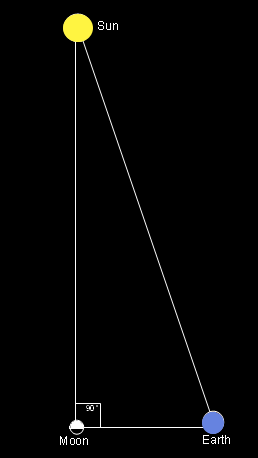
How the ancient Greeks tried to calculate the distance to the sun.
To the right is my take on the Greek sun measuring experiment. Using their guy Euclid and his geometry they knew that the sum of the angles of a triangle equal 180 degrees.
Having an exactly quarter moon, first or last, they knew the Sun-Moon-Earth angle was 90 degrees, so if they could measure the Sun-Earth-Moon angle from observation, they knew the other angle at the sun.
They had already calculated the moon’s distance, so they could calculate the other leg, the Sun-Moon distance using trigonometry. The first trig tables were invented by Greek astronomer Hipparchus.
Ah yes, Trig tables. I don’t suppose you kids use them anymore, with your electronic calculators. Back in my high school days my calculator was a slide rule. Sorry, old guy grousing.

