Archive
Ephemeris: 08/23/2023 – Let’s find out where the naked-eye planets have wandered off to this week
This is Ephemeris for Wednesday, August 23rd. Today the Sun will be up for 13 hours and 41 minutes, setting at 8:35, and it will rise tomorrow at 6:55. The Moon, 1 day before first quarter, will set at 11:36 this evening.
Let’s find out where the naked-eye planets have wandered off to this week. Three of the five planets are now visible. Mars and Mercury are too close to the Sun to be seen. Jupiter, Saturn and Venus are all officially morning planets now, although Saturn does rise in the evening shortly after sunset. It will become an evening planet in four days, when it will rise at sunset. It can be spotted in the southeast in the evening. And it will still be visible throughout the morning hours. Saturn is in retrograde or westward motion now, against the stars of Aquarius. Jupiter will rise at 11:21pm. Venus is making an appearance in the morning sky now. It will rise at 5:53 tomorrow morning in the east.
The astronomical event times given are for the Traverse City/Interlochen area of Michigan (EDT, UT –4 hours). They may be different for your location.
Addendum
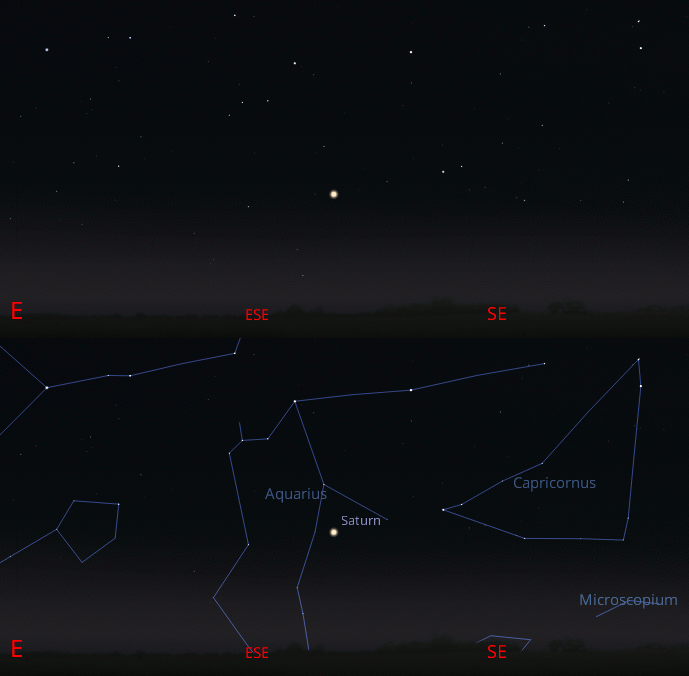
Finding Saturn in the evening for tonight at 10 pm, August 23, 2023. The unlabeled partial constellation on the left is part of Pisces, and the five stars in a circle is an asterism (informal constellation) called the Circlet. Another asterism is composed of the four stars in a small triangle with another in the center, above and a bit left of the Aquarius label is the Water Jar with water streaming from it to the right. Click or tap on the image to enlarge it. Created using Stellarium and GIMP.
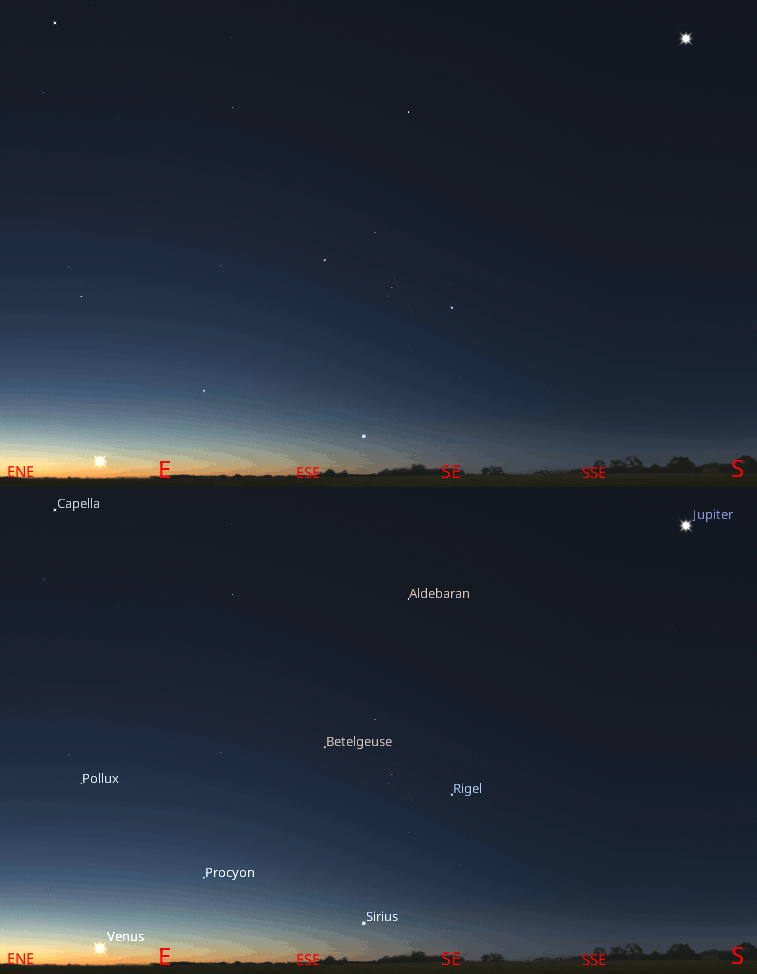
The morning planets at 6:10 am tomorrow morning, August 24, 3023, after Venus rises, with the bright stars of winter slowly disappearing in the advancing morning twilight. Click or tap on the image to enlarge it. Created using Stellarium and GIMP.
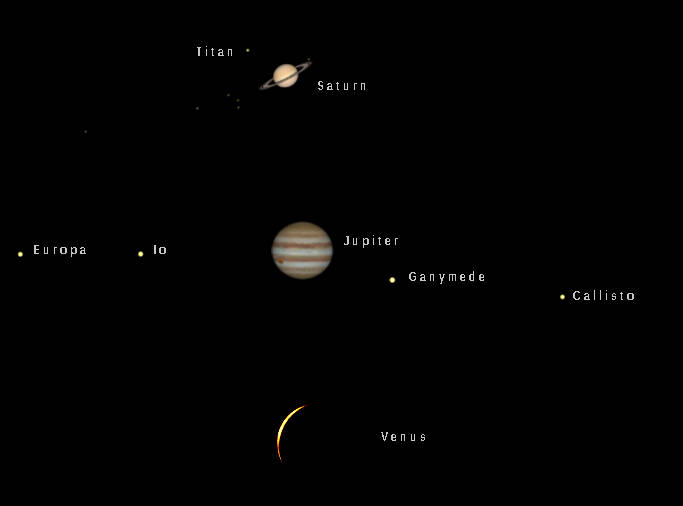
Telescopic Saturn, Jupiter and Venus (north up) as they would be seen in a small telescope, with the same magnification at 10 pm August 23, 2023, for Saturn and 6:10 am August 24, 2023, for Jupiter and Venus. Apparent diameters: Saturn 18.96″, its rings 44.17″; Jupiter 42.90″; and Venus 54.66″ and is 5.0% illuminated. The ” symbol means seconds of arc (1/3600th of a degree.) Click or tap on the image to enlarge it. Created using Cartes du Ciel (Sky Charts).
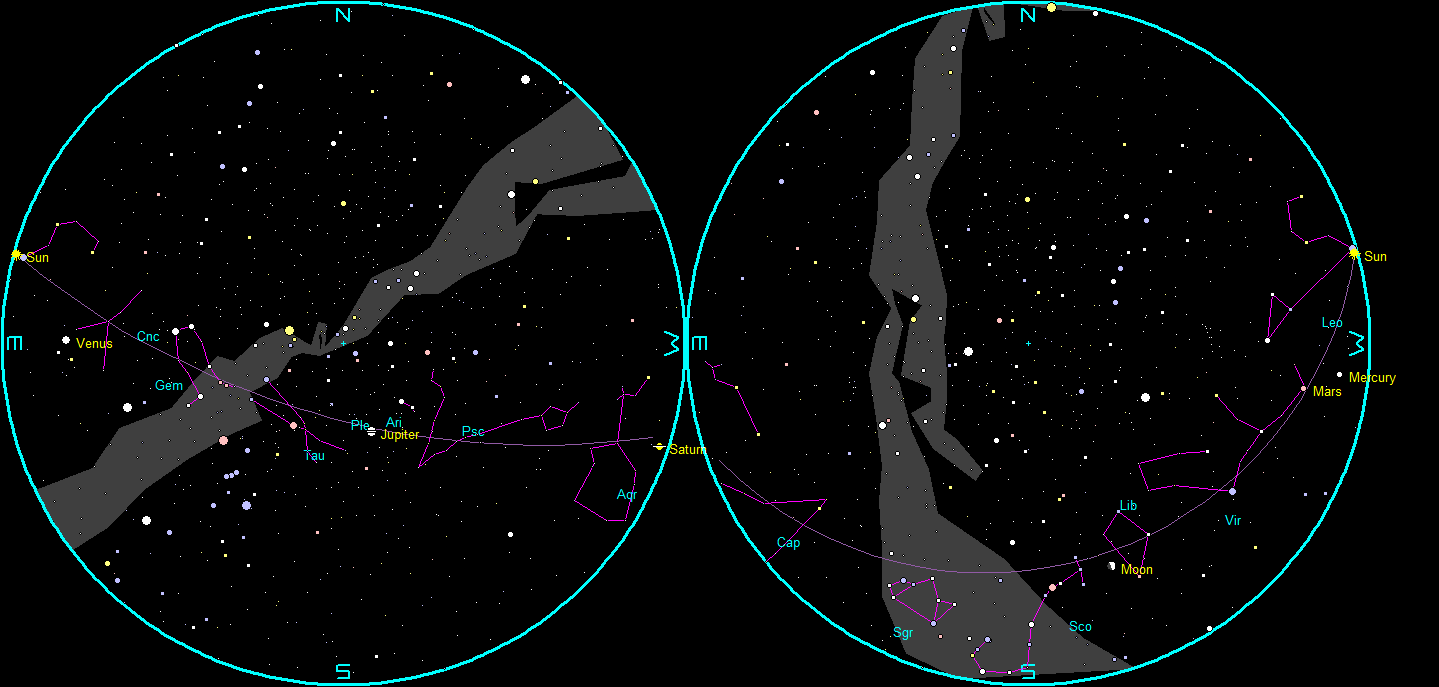
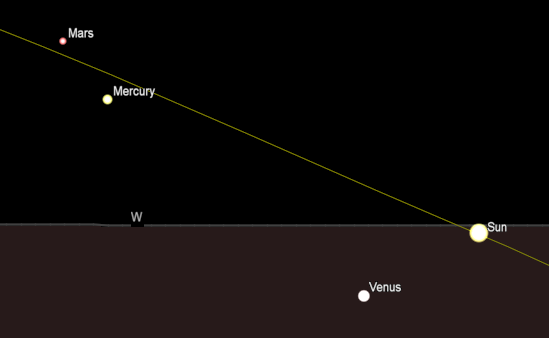
The naked-eye planets and the Moon at sunset and sunrise on a single night, starting with sunset on the right on August 23, 2023. The night ends on the left with sunrise on the 24th. Click or tap on the image to enlarge it. Created using my LookingUp app and GIMP.
Ephemeris: 08/22/2023 – We might see a naked eye comet next month
Aug 22. This is Ephemeris for Tuesday, August 22nd. The Sun will be up for 13 hours and 44 minutes today, setting at 8:37, and it will rise at 6:54 tomorrow. The Moon, 2 days before first quarter, will set at 11:09 this evening.
A new comet has been discovered that might be visible to the naked eye in early September. It was discovered 10 days ago by Hideo Nishimura of Kakegawa, Japan. Somehow he was able to scoop all the automated asteroid seeking discovery programs. The comet will be visible in the morning before sunrise in the northeastern sky. It will be probably be naked eye from the 7th to the 10th. That’s only about four days in September. At that point it may get up to about fourth magnitude which is not very bright, especially for a comet, it’s barely visible, since comets appear dimmer than their magnitude suggests. However, it will be far enough from the Sun at the beginning of the four-day period to be able to be viewed before astronomical twilight.
The astronomical event times given are for the Traverse City/Interlochen area of Michigan (EDT, UT –4 hours). They may be different for your location.
Addendum
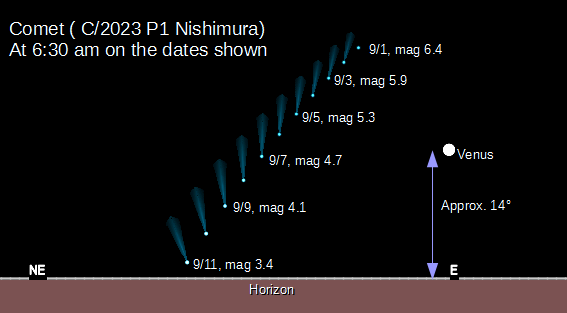
Most of the data for this posting comes from Seiichi Yoshida’s Weekly Information about Bright Comets webpage (www.aerith.net/comet/weekly/current.html).
Ephemeris: 08/21/2023 – Looking at a trio of lunar craters tonight
This is Ephemeris for Monday, August 21st. Today the Sun will be up for 13 hours and 47 minutes, setting at 8:39, and it will rise tomorrow at 6:53. The Moon, 3 days before first quarter, will set at 10:48 this evening.
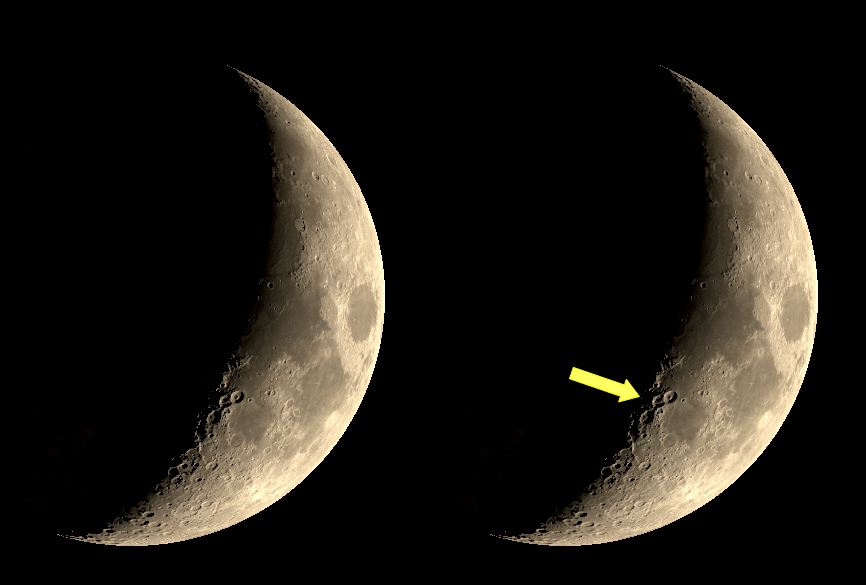
The crescent Moon tonight has what looks like a chain of three large craters near the terminator, visible in a low power telescope. The terminator is the line between day and night. Before the full moon, it’s the sunrise line. On closer inspection, these craters are of different ages. The north crater Theophilus, 63 miles in diameter and one of my favorite craters, looks relatively fresh. It’s not, it’s somewhat older than a billion years. The crater just south of it is Cyrillus, about the same size, which is almost 4 billion years old. Theophilus slightly overlaps Cyrillus. A bit farther south is Catharina, which again is about the same size and age range as Cyrillus, but seems more broken down than the other.
The astronomical event times given are for the Traverse City/Interlochen area of Michigan (EDT, UT –4 hours). They may be different for your location.
Addendum
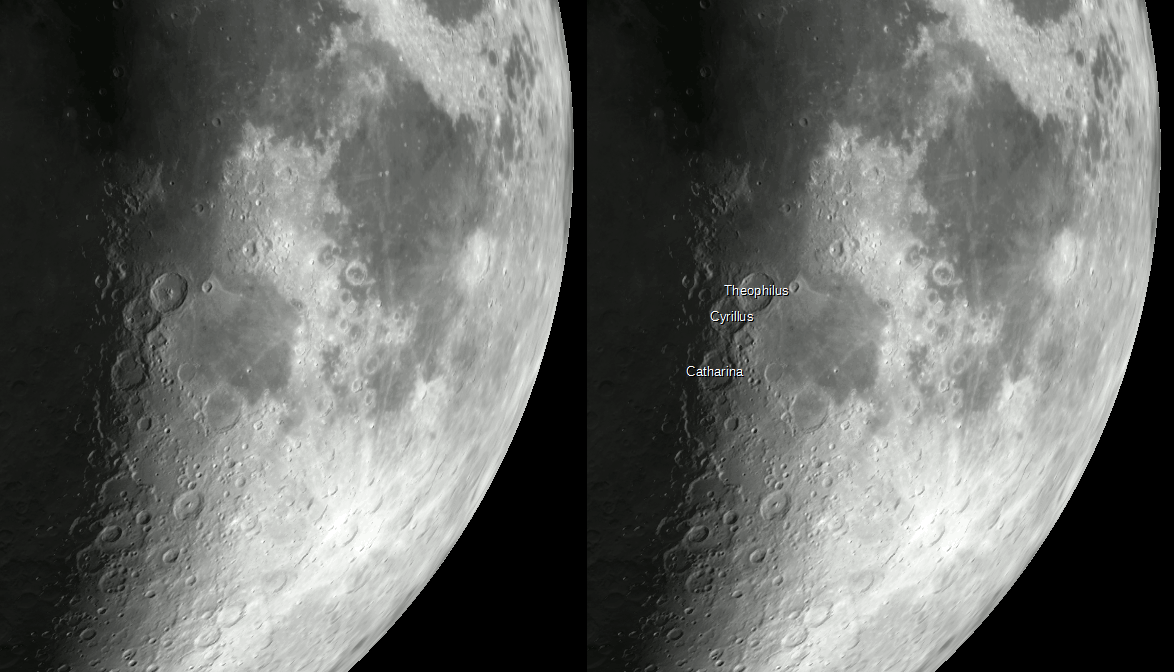
A closer look at these three craters for tonight at 10 pm. Created using Virtual Moon Atlas, LibreOffice Draw and GIMP.
Ephemeris: 08/18/2023 – There will be a Sun & Star Party tomorrow at the Sleeping Bear Dunes National Lakeshore
This is Ephemeris for Friday, August 18th. Today the Sun will be up for 13 hours and 55 minutes, setting at 8:44, and it will rise tomorrow at 6:49. The Moon, 2 days past new, will set at 9:57 this evening.
Weather permitting, a Sun and Star Party will be held tomorrow night at the Sleeping Bear Dunes National Lakeshore at the Dune Climb. The solar part will start at 5 pm, while the evening viewing will start at 9 pm. These events will be hosted by the park rangers and the Grand Traverse Astronomical Society, who will bring their telescopes to view the heavens, including the planet Saturn and the wonders of the summer Milky Way. The telescopes will be setup in the parking area closest to the dune. While as twilight fades Saturn will be about the only object to view, as it gets darker more and more wonders of the Milky Way will be seen. They include star clusters and nebulae, clouds of gas and dust.
The astronomical event times given are for the Traverse City/Interlochen area of Michigan (EDT, UT –4 hours). They may be different for your location.
Addendum
Ephemeris: 08/16/2023 – Let’s find out where the naked-eye planets have wandered off to this week
This is Ephemeris for Wednesday, August 16th. Today the Sun will be up for 14 hours and 1 minute, setting at 8:47, and it will rise tomorrow at 6:47. The Moon is new today, and won’t be visible.
Let’s find out where the naked-eye planets have wandered off to this week. Only two of these five planets are visible. Mars, Mercury and Venus are all too close to the Sun to be seen. Jupiter and Saturn are officially morning planets, although Saturn does rise in the evening shortly after sunset. It will become an evening planet on the 27th, when it will rise at sunset. It can be spotted in the southeastern part pf the sky in the evening. It will also be visible throughout the morning hours. Saturn is in retrograde or westward motion against the stars of Aquarius now. Jupiter, still moving slowly eastward against the stars of Aries the ram, also rises in the evening, but barely, rising just before midnight. It will be stationary, that is, it will stop its eastward motion against the stars, and will begin its retrograde or westward motion on September 7th.
The astronomical event times given are for the Traverse City/Interlochen area of Michigan (EDT, UT –4 hours). They may be different for your location.
Addendum
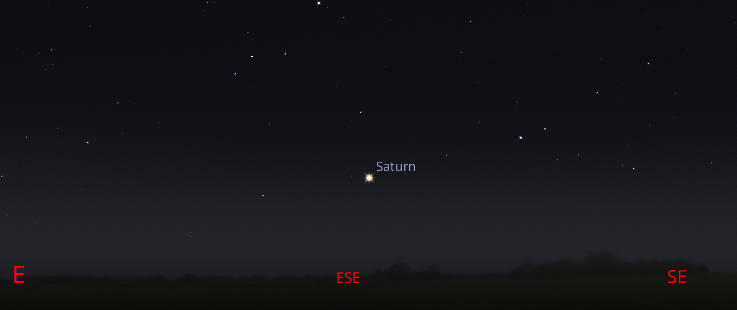
Saturn can be seen low in the east-southeast around 10 pm, or an hour or so after sunset. Created using Stellarium.
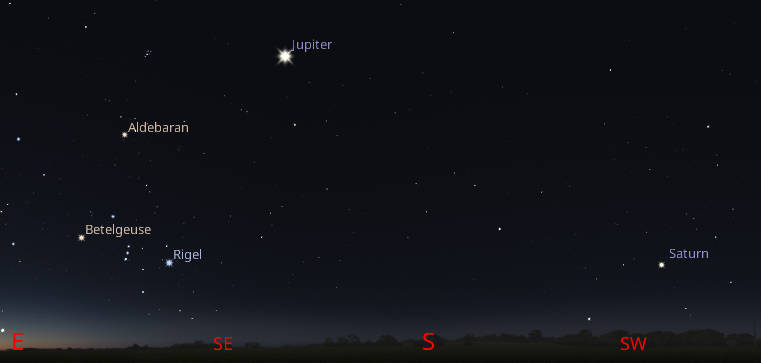
Morning planets and the winter stars are still visible about 45 minutes before sunrise. In the Interlochen/Traverse City Area, that would be about 5:45 am. Large images can be truncated on the right. Click or tap on the image to enlarge and display the complete image. Created using Stellarium.
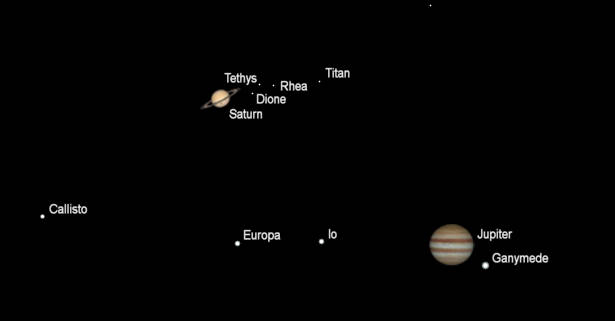
Telescopic Saturn and Jupiter (north up) as they would be seen in a small telescope, with the same magnification, Saturn at 11 pm, tonight, August 16, 2023, and Jupiter at 5:45 am on the 17th. Apparent diameters: Saturn 18.93″, its rings 44.10″; Jupiter 41.94″. Saturn and Jupiter are approaching us, so their apparent diameters are growing. The ” symbol means seconds of arc (1/3600th of a degree). Click or tap on the image to enlarge it. Created using Cartes du Ciel (Sky Charts).
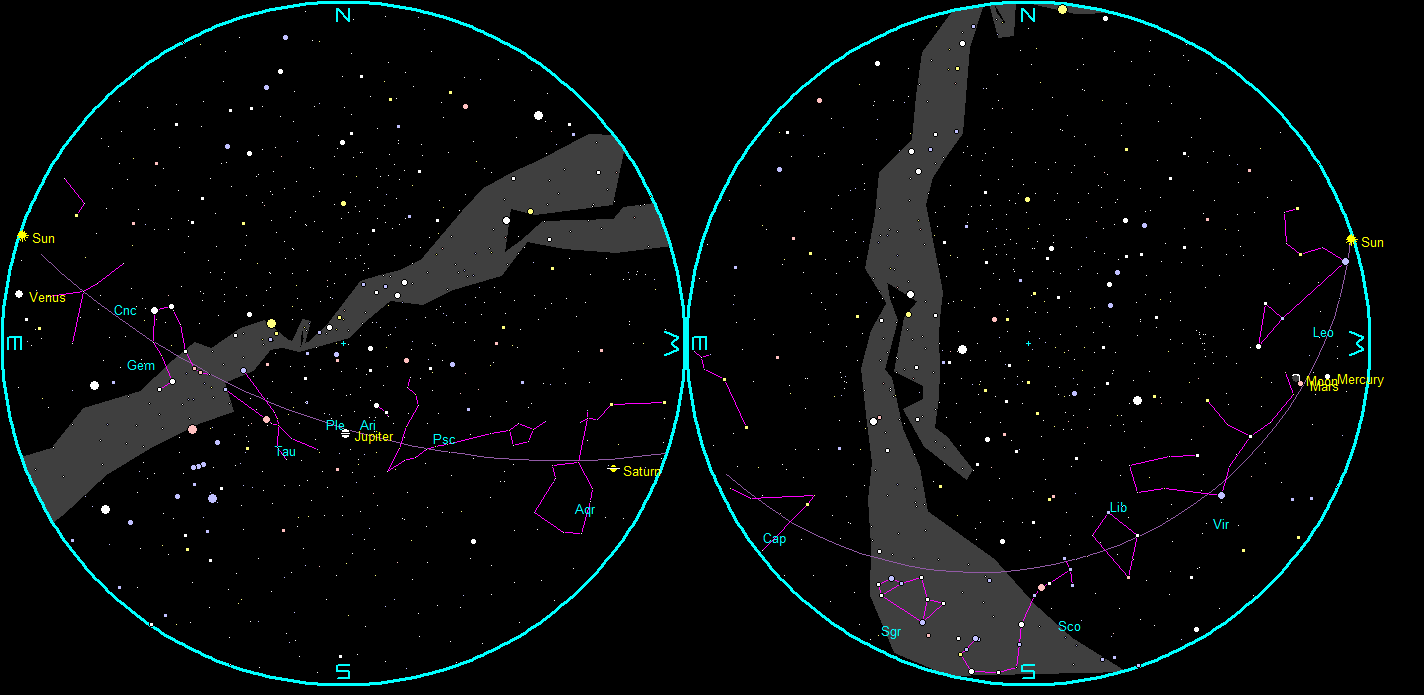
The naked-eye planets and the Moon at sunset and sunrise on a single night, starting with sunset on the right on August 16, 2023. The night ends on the left with sunrise on the 17th. Click or tap on the image to enlarge and display the complete image. Created using my LookingUp app and GIMP.
Ephemeris: 08/15/2023 – The Great Rift
This is Ephemeris for Tuesday, August 15th. Today the Sun will be up for 14 hours and 3 minutes, setting at 8:48, and it will rise tomorrow at 6:46. The Moon, 1 day before new, will rise at 6:41 tomorrow morning.
Once one finds the Milky Way which is pretty hard to miss this month, it becomes obvious that the Milky Way is split lengthwise starting near Deneb, the northernmost star of the Summer Triangle, almost all the way to the Teapot of Sagittarius low in the south. That dark split is called the Great Rift. Galileo first discovered that the hazy clouds of the Milky Way we’re actually made of faint stars, so it was thought the dark areas were due to a lack of stars. The great 18th century astronomer William Herschel did star counts all over the sky with his telescope. A map drawn of the shape of the Galaxy shows the lack of distant stars in the direction of the Great Rift. It’s not really fewer stars, but interstellar clouds of dust blocking the light of stars behind them.
The astronomical event times given are for the Traverse City/Interlochen area of Michigan (EDT, UT –4 hours). They may be different for your location.
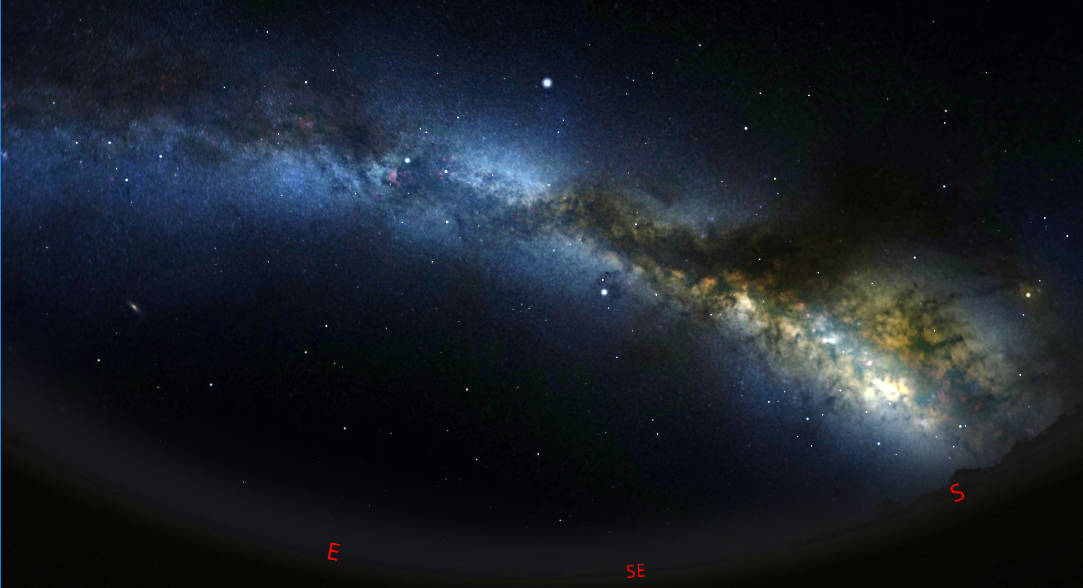
The span of the Milky Way across the summer sky as seen in the free Stellarium app. Specifically August 15th at 10 pm from Northern Michigan. The Milky Way has been set to its maximum brightness to show as much detail as possible. It really isn’t that bright. The horizon is only delineated by the compass points. The dark clouds of the Great Rift are also visible. The Milky Way, in Stellarium, is photo-realistic. The triangle of three bright stars above center is the Summer Triangle, Specifically, clockwise from the top star: Vega, Altair and Deneb. Large images can be truncated on the right. Click or tap on the image to enlarge and display the complete image.
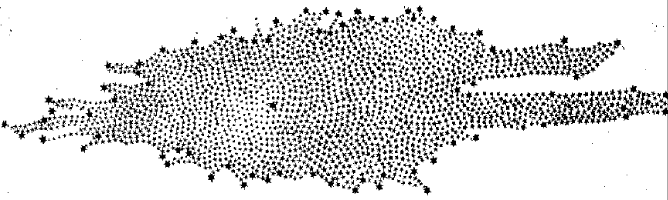
William Herschel’s vision of the cross-section of the Milky Way from 1785, drawn by his sister and collaborator, Caroline Herschel. The Great Rift is seen as the gap between the fingers of stars on the right. Herschel thought the rift was caused by a lack of stars. Other than that, he got the flattened shape right, for what he could see within ten thousand light years. The center of the Milky Way lies 27,000 light years to the right. The spiral structure of the Milky Way wasn’t determined until the advent of radio telescopes in the mid-twentieth century.
Ephemeris: 08/11/2023 – The Perseid meteor shower will reach its peak tomorrow night to early Sunday morning
This is Ephemeris for Friday, August 11th. Today the Sun will be up for 14 hours and 14 minutes, setting at 8:54, and it will rise tomorrow at 6:41. The Moon, 3 days past last quarter, will rise at 2:32 tomorrow morning.
The Perseid meteor shower at its peak and will be visible all night tomorrow. It won’t have to compete with the Moon until after 3:30 am Sunday morning. The meteors will be seen all over the sky, However Perseid meteors can be backtracked to a spot below the W shaped constellation of Cassiopeia, in the area of the constellation Perseus. As the night progresses, the radiant point will be rising higher in northeast. So lay down on a blanket in a dark location, keep mosquito repellent handy, dress warmly, because the ground and air will be chilly and dewy. Bring some hot coffee or chocolate to drink. And enjoy up to 60 meteors an hour at the peak in the morning. They will be near peak all weekend.
The astronomical event times given are for the Traverse City/Interlochen area of Michigan (EDT, UT –4 hours). They may be different for your location.
Addendum
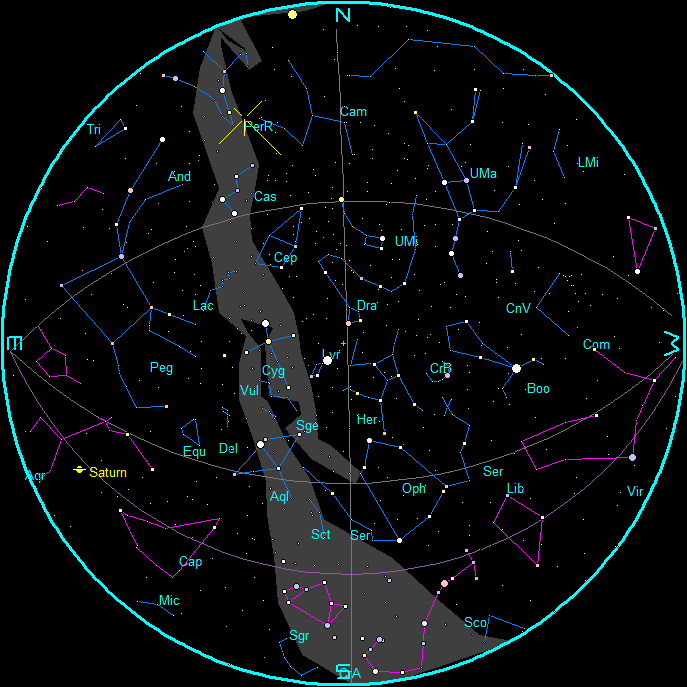
The Dome of the sky for the night of August 12th and 13th, 2023 at 10:30 PM for northern Michigan. The Perseid radiant is in the northeast and fairly low in the sky, and marked in yellow with the caption PerR. It will continue to rise in the northeast throughout the night. The constellation names are abbreviated. Their full names can be found here. Large images can be truncated on the right. Click or tap on the image to enlarge and display the complete image. Created using my LookingUp app.
The cool thing about viewing the meteor shower early in the evening is that the meteoroids enter the Earth’s atmosphere at a grazing angle, so they seem to last longer and have longer trains. I remember one early evening meteor traveling down the Milky Way, like it was a highway.
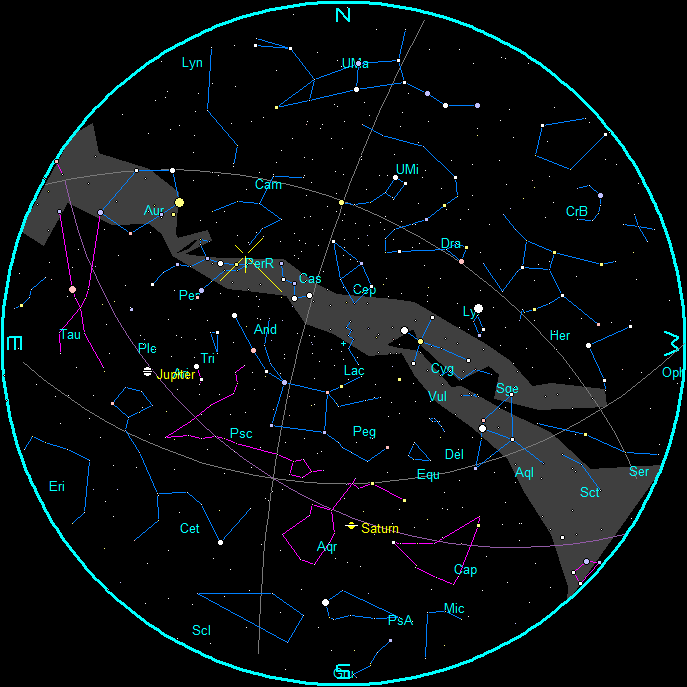
The Dome of the sky for August 12th and 13th, 2023 at 3 AM for northern Michigan. The Perseid radiant is in the northeast, much higher in the sky, and marked in yellow with the caption PerR. The constellation names are abbreviated. Their full names can be found here. Large images can be truncated on the right. Click or tap on the image to enlarge and display the complete image. Created using my LookingUp app.
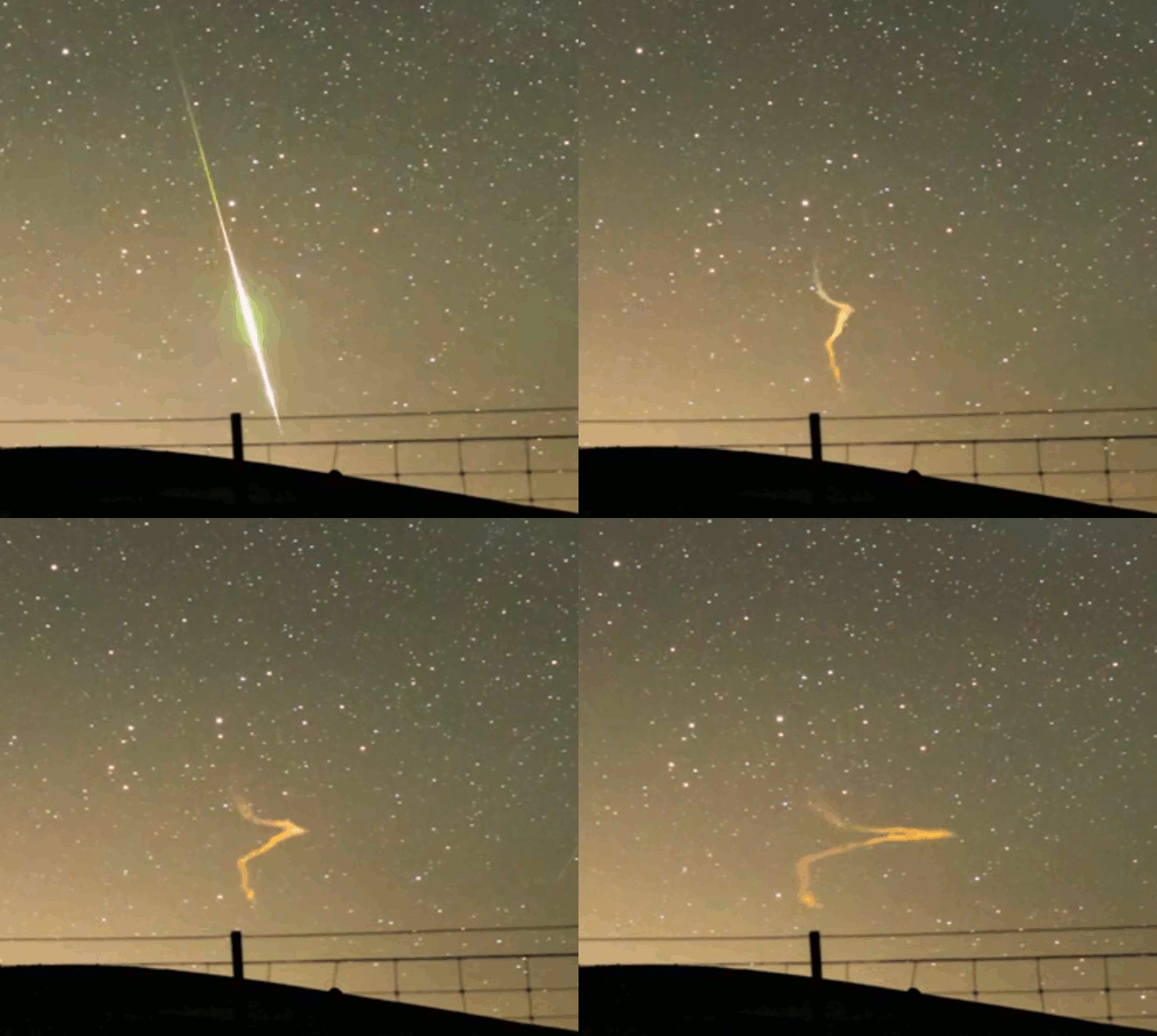
Binoculars come in handy to view the luminous trains that the brightest Perseids leave behind for a short time.
Ephemeris: 08/10/2023 – The Perseid meteor shower will reach its peak early Sunday morning
This is Bob Moler with Ephemeris for Thursday, August 10th. Today the Sun will be up for 14 hours and 17 minutes, setting at 8:56, and it will rise tomorrow at 6:40. The Moon, 2 days past last quarter, will rise at 1:43 tomorrow morning.
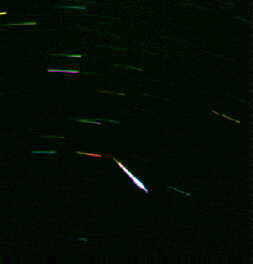
Back before astronomers recognized the major meteor shower that occurs at this time of year, the streaks of light in the sky of “falling” or “shooting” stars were called, by Christians, the Tears of Saint Lawrence, who was martyred on this day in the year 258. The bits of comet debris, ranging from the size of sand grains to that of a pea, hit our atmosphere at 38 miles (59 kilometers) per second and quickly vaporize due to friction, causing the streak of light we call a meteor. They are called the Perseids since they appear to come from the constellation of Perseus, located in the northeastern sky. They will be best seen Saturday night and into Sunday morning, with rates of up to one a minute, on average, especially in the early morning hours.
The astronomical event times given are for the Traverse City/Interlochen area of Michigan (EDT, UT –4 hours). They may be different for your location.
Addendum
The Dome of the sky for the night of August 12th and 13th, 2023 at 10:30 PM for northern Michigan. The Perseid radiant is in the northeast and fairly low in the sky, and marked in yellow with the caption PerR. It will continue to rise in the northeast throughout the night. The constellation names are abbreviated. Their full names can be found here. Large images can be truncated on the right. Click or tap on the image to enlarge and display the complete image. Created using my LookingUp app.
The Dome of the sky for August 12th and 13th, 2023 at 3 AM for northern Michigan. The Perseid radiant is in the northeast, much higher in the sky, and marked in yellow with the caption PerR. The constellation names are abbreviated. Their full names can be found here. Large images can be truncated on the right. Click or tap on the image to enlarge and display the complete image. Created using my LookingUp app.
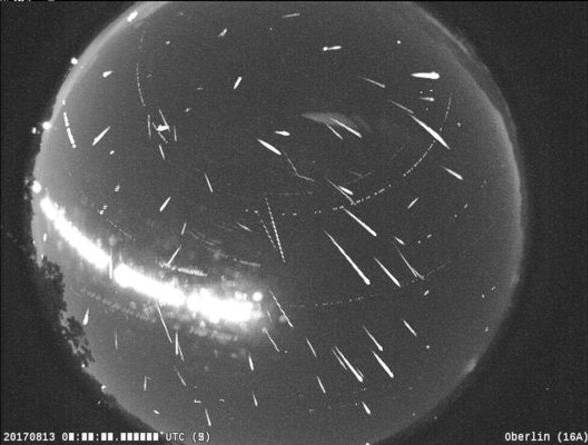
Remember, the meteors only seem to come from the radiant. They will appear all over the sky! The meteors of a shower travel in parallel paths, like train tracks, disappearing to a point in the distance.
Ephemeris: 08/09/2023 – Let’s find out where the naked-eye planets have wandered off to this week
This is Ephemeris for Wednesday, August 9th. Today the Sun will be up for 14 hours and 19 minutes, setting at 8:57, and it will rise tomorrow at 6:39. The Moon, 1 day past last quarter, will rise at 1:04 tomorrow morning.
Let’s find out where the naked-eye planets have wandered off to this week. Venus is gone, setting too close to sunset. It will pass between the Earth and the Sun on the 13th, and be visible before sunrise by the end of the month. Mars and Mercury, though technically in the evening sky and like Venus also appear too close to the Sun to be spotted. Mars will pass behind the Sun in November. The other two naked eye planets are in the morning sky. Appearing at 5:45 am, which is roughly 55 minutes before sunrise, tomorrow morning, Jupiter will be high in the southeast, Saturn will be lower in the southwest. And tomorrow morning, the waning crescent Moon will be midway up the sky in the east.
The astronomical event times given are for the Traverse City/Interlochen area of Michigan (EDT, UT –4 hours). They may be different for your location.
Addendum
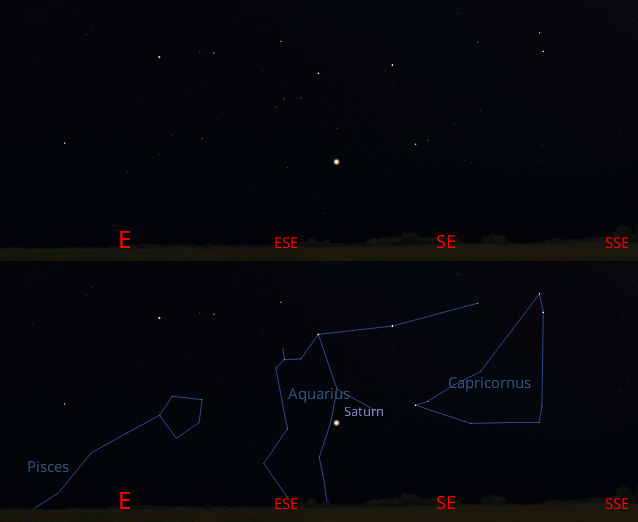
Saturn, low in the east-southeast at 11 pm, or about 2 hours after sunset, along with nearby zodiacal constellations. Click or tap on the image to enlarge it. Created using Stellarium and GIMP.
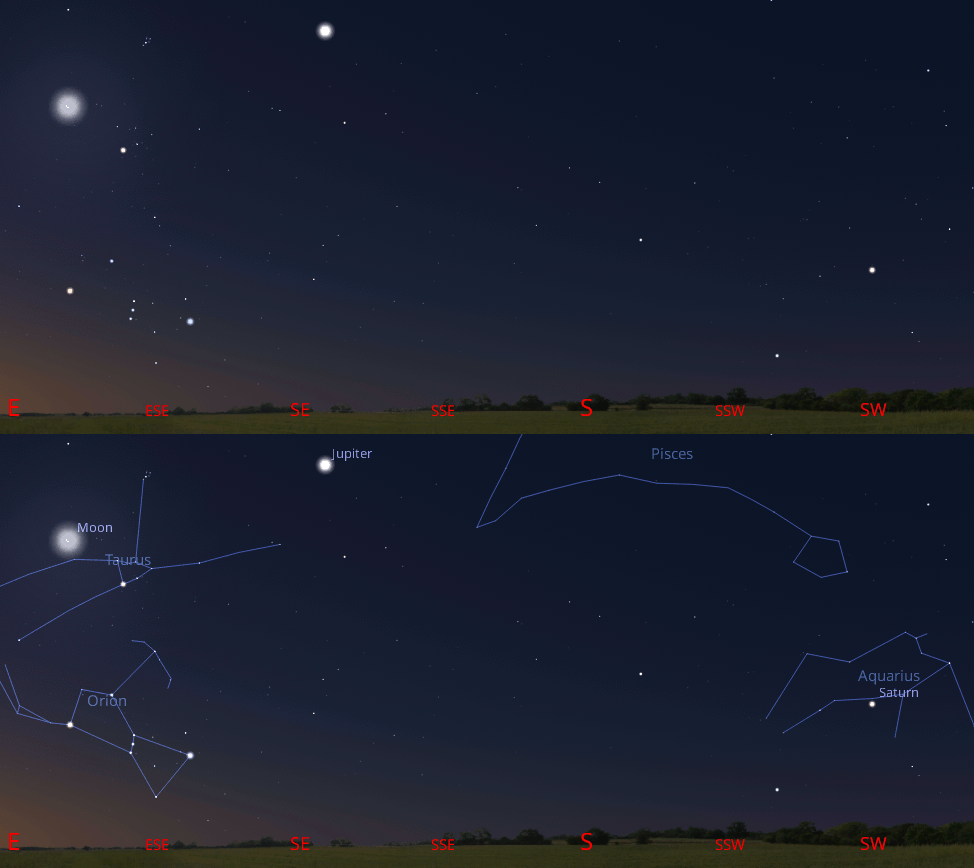
Jupiter Saturn and the Moon are seen at 5:45 tomorrow morning, August 10, 2023, about 55 minutes before sunrise. Also shown are the zodiacal constellations and Orion. The native peoples of our area, the Anishinaabe, called Orion the Winter Maker. So enjoy summer while it lasts, because and relatively few months it’s going to be all over, and Orion will be in the evening sky and winter will be here. Click or tap on the image to enlarge it. Created using Stellarium and GIMP.
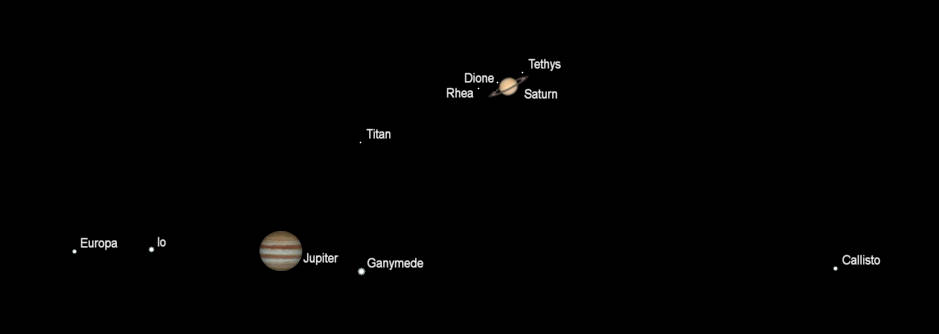
Telescopic Saturn and Jupiter (north up) as they would be seen in a small telescope, with the same magnification, Saturn at 11 pm, the 9th and Jupiter at 5:45 am August 10, 2023. Apparent diameters: Saturn 18.87″, its rings 43.96″; Jupiter 41.02″. Saturn and Jupiter are approaching us, so their apparent diameters are growing. The ” symbol means seconds of arc (1/3600th of a degree). Click or tap on the image to enlarge it. Created using Cartes du Ciel (Sky Charts).
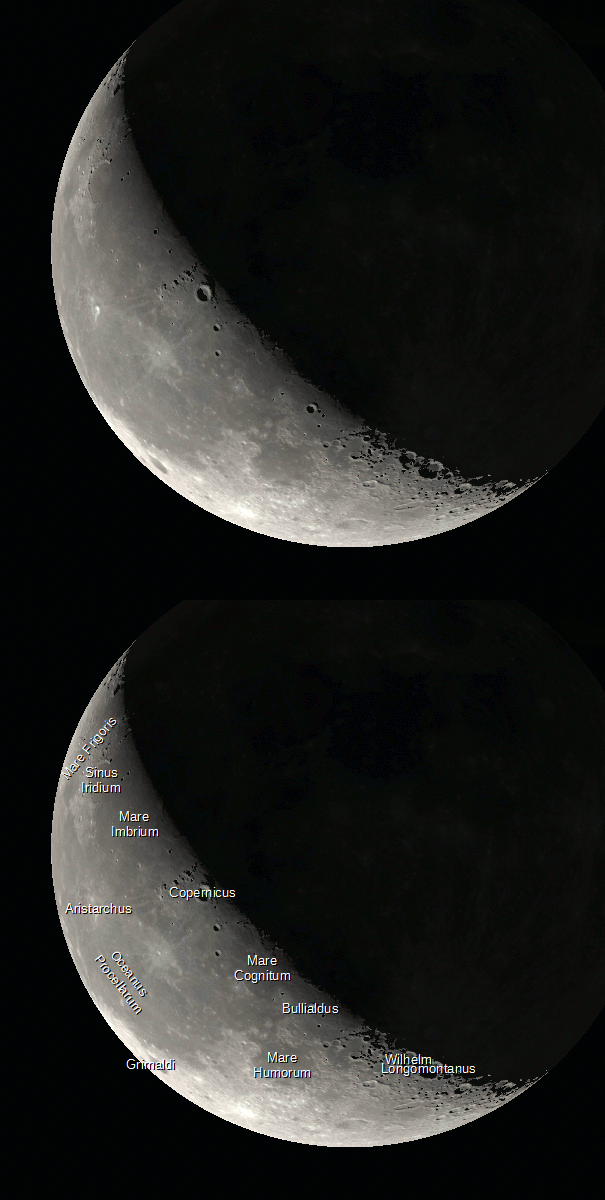
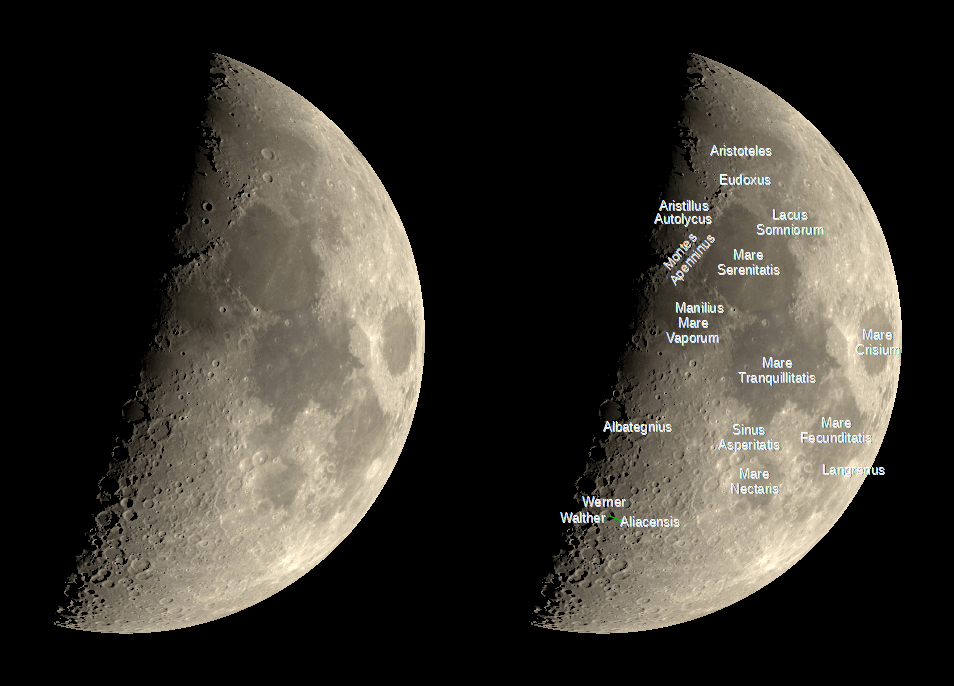
The Moon as it might appear in binoculars or telescope with selected features labeled tomorrow morning, August 10, 2023. Created using Stellarium, LibreOffice Draw for labels, and GIMP for the GIF animation.
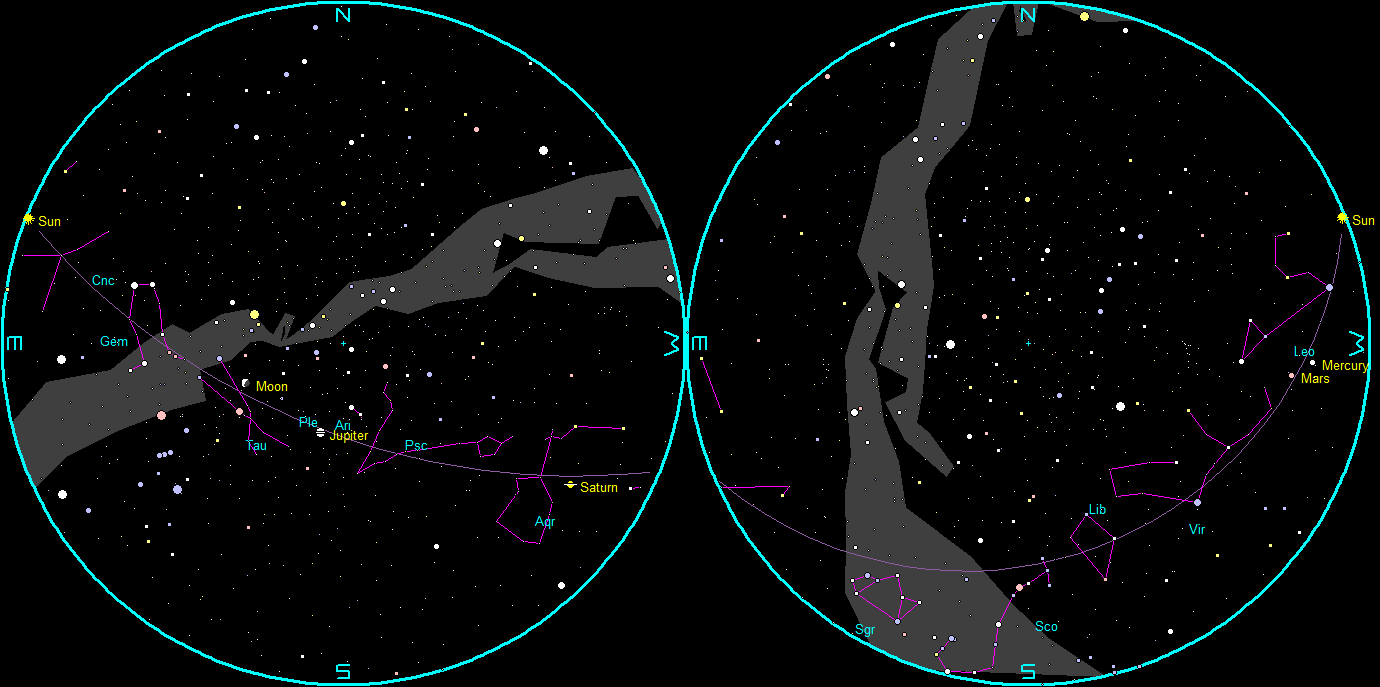
The naked-eye planets and the Moon at sunset and sunrise on a single night, starting with sunset on the right on August 9, 2023. The night ends on the left with sunrise on the 10th. Venus is not in the sky at either sunset or sunrise, being south of the Sun. Large images can be truncated on the right. Click or tap on the image to enlarge and display the complete image. Created using my LookingUp app and GIMP.
Ephemeris: 08/08/2023 – What the indigenous peoples of the northern Great Lakes thought of Scorpius
This is Ephemeris for Tuesday, August 8th. Today the Sun will be up for 14 hours and 22 minutes, setting at 8:59, and it will rise tomorrow at 6:37. The Moon, at last quarter today, will rise at 12:32 tomorrow morning.
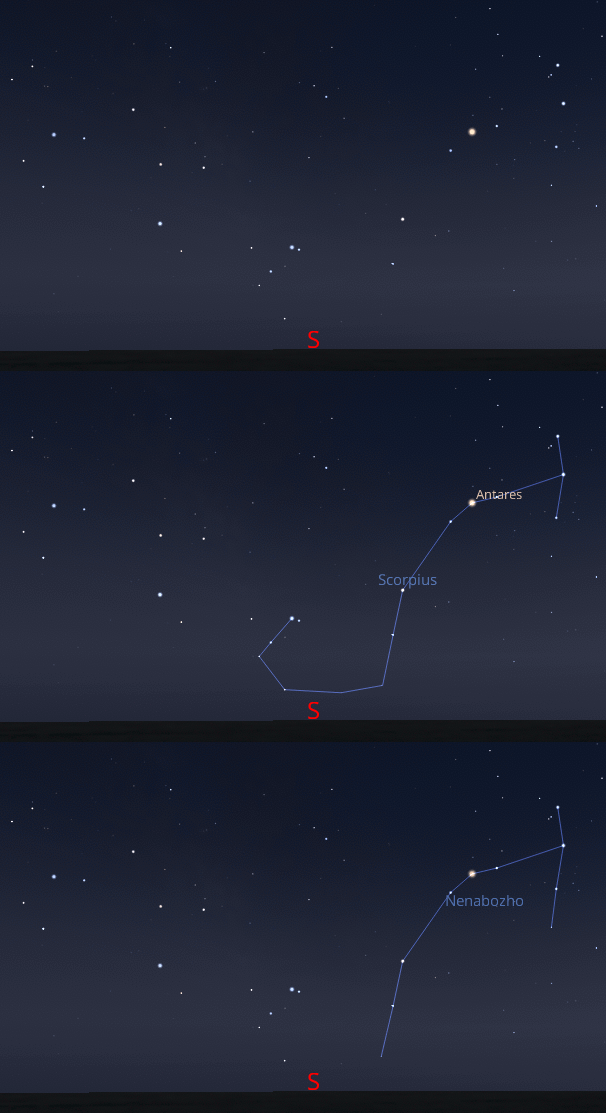
Scorpius the scorpion is now seen low in the southern sky in the at 10 pm. To me, the stars here make a very good scorpion. Scorpius was invented by the people of the Middle East, where scorpions are plentiful. The Anishinaabek native peoples of our area, however, saw here one of their legendary hero figures, Nenabozho. In the sky, the arc of four stars at the front of the scorpion and to the right of the bright star Antares is his bow. He is shooting an arrow toward the receding Great Panther or Curly Tail a constellation of spring whose curl of a tail is the head of the constellation Leo, now lost in the evening twilight in the west. Nenabozho was a hero in their creation stories, and a trickster who was sometimes seen as a rabbit.
The astronomical event times given are for the Traverse City/Interlochen area of Michigan (EDT, UT –4 hours). They may be different for your location.
 Bob Moler's Ephemeris Blog