Archive
05/25/2023 – Ephemeris – NASA awards contracts for a second lunar lander
This is Ephemeris for Thursday, May 25th. Today the Sun will be up for 15 hours and 9 minutes, setting at 9:14, and it will rise tomorrow at 6:04. The Moon, 2 days before first quarter, will set at 2:26 tomorrow morning.
A week ago, NASA announced that the contract for the second Artemis moon lander would go to a group of companies headed by Blue Origin for 3.4 billion dollars. Unlike Apollo, the rocket that sens crews to the Moon will not contain a moon landing craft. It will be sent out separately before the crew. SpaceX’s Lunar Starship will be used on the first two landings, for Artemis III and IV, while the Blue Origin lander will be used for Artemis V, sometime around 2029 or later. Little detail has been released about the lander, except for an artist’s rendering. It appears to be shorter than the Boeing lander first proposed, which would require an astronaut to climb up and down a very long ladder. SpaceX’s Starship would be taller still, but will have an elevator on the side.
The astronomical event times given are for the Traverse City/Interlochen area of Michigan (EDT, UT –4 hours). They may be different for your location.
Addendum
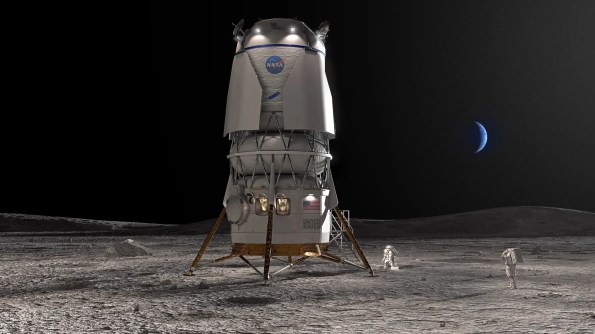
NASA picks Bezos’ Blue Origin to build second lunar lander. The crew compartment is on the bottom, allowing for a shorter ladder to the surface. The liquid oxygen (LOX) and hydrogen (LH) tanks are on top. The LH tank is on top with sun shields, with the LOX tank below. I’m guessing here, since very little information has been released. Credit: NASA.
The craft is officially known as the Human Landing System (HLS).
05/24/2023 – Ephemeris – Let’s find where the naked-eye planets have wandered off to this week
This is Ephemeris for Wednesday, May 24th. Today the Sun will be up for 15 hours and 7 minutes, setting at 9:13, and it will rise tomorrow at 6:05. The Moon, 3 days before first quarter, will set at 1:59 tomorrow morning.
Let’s find where the naked-eye planets have wandered off to this week. Venus is our blazing Evening Star, seen in the west all evening. It will set after midnight. The red planet Mars will appear below the Moon tonight. It has moved into Cancer, and is seen above and left of Venus by 14 degrees, or one and a half times the width of one’s fist held at arm’s length. Venus is closing the gap between them, but will never quite reach Mars while they are in the evening sky. The closest they will get is three and a half degrees or 7 moon diameters apart, before Venus pulls back toward the Sun faster than Mars will. In the morning, Saturn will be visible and low in the southeast at 5 am, rising at 2:47 am. Jupiter makes its morning appearance and is very low in the east-northeast at that hour.
The astronomical event times given are for the Traverse City/Interlochen area of Michigan (EDT, UT –4 hours). They may be different for your location.
Addendum
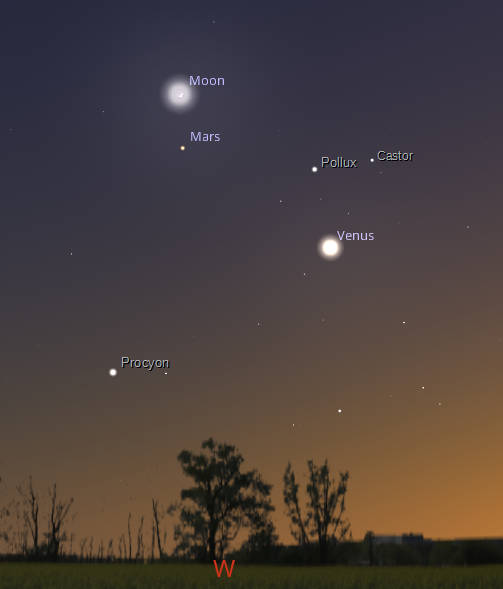
Evening planets and the Moon at 10 pm tonight, May 24, 2023. Created using Stellarium, LibreOffice Draw and GIMP.
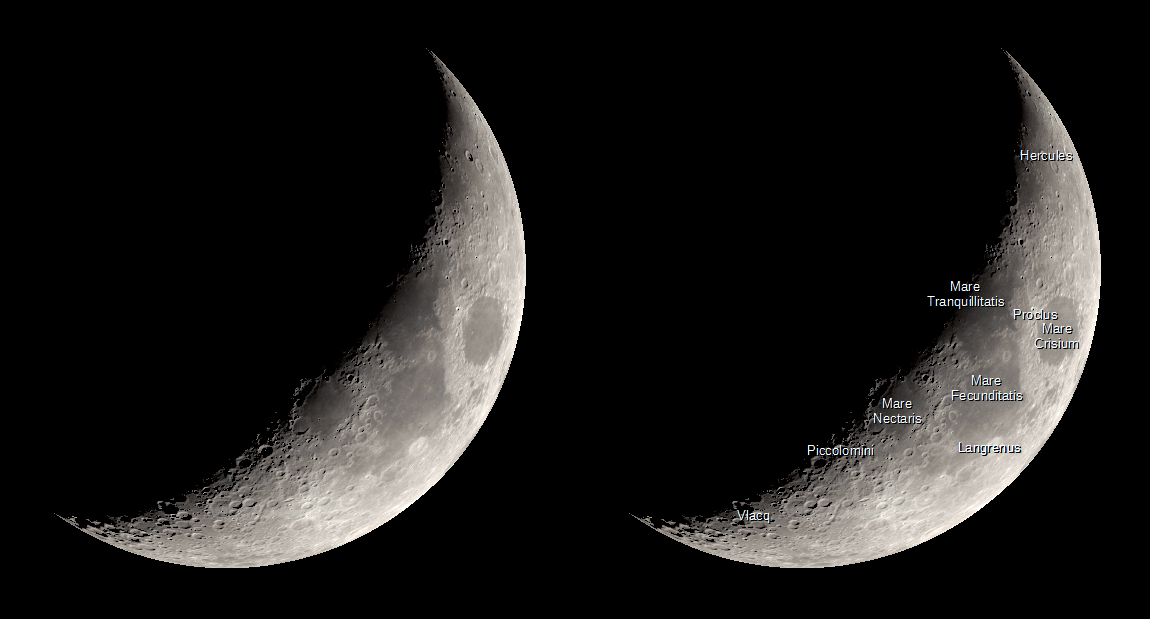
5 day old Moon with selected features labeled for May 24, 2023, at 10 pm. Created using Stellarium, LibreOffice and GIMP.
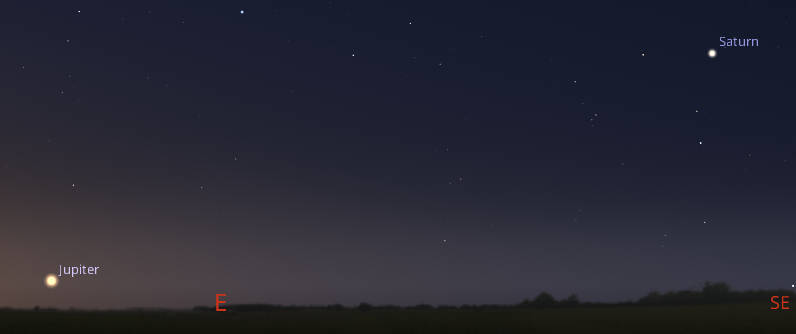
Saturn and Jupiter in early morning twilight at 5:00 am tomorrow, May 25, 2023. Created using Stellarium.
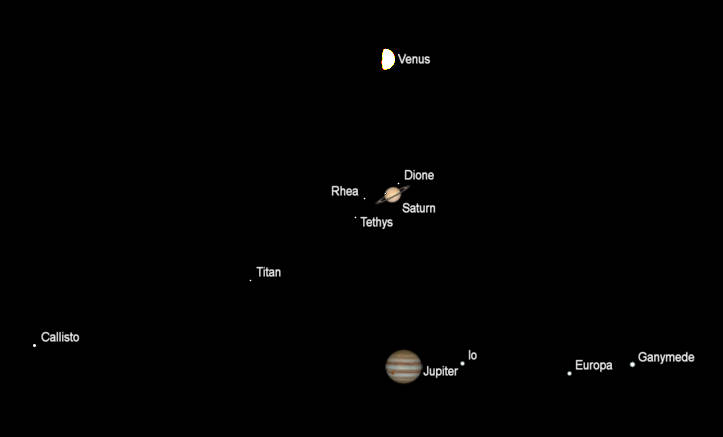
Telescopic Venus, Saturn and Jupiter (north up) as they would be seen in a small telescope, with the same magnification. Apparent diameters: Venus 21.03″ and is 55.4% illuminated; Saturn 16.96″, its rings 39.52″; Jupiter 34.07″. Mars, too small to be represented here, is 4.81″ in diameter. The ” symbol means seconds of arc (1/3600th of a degree.) Created using Cartes du Ciel (Sky Charts).
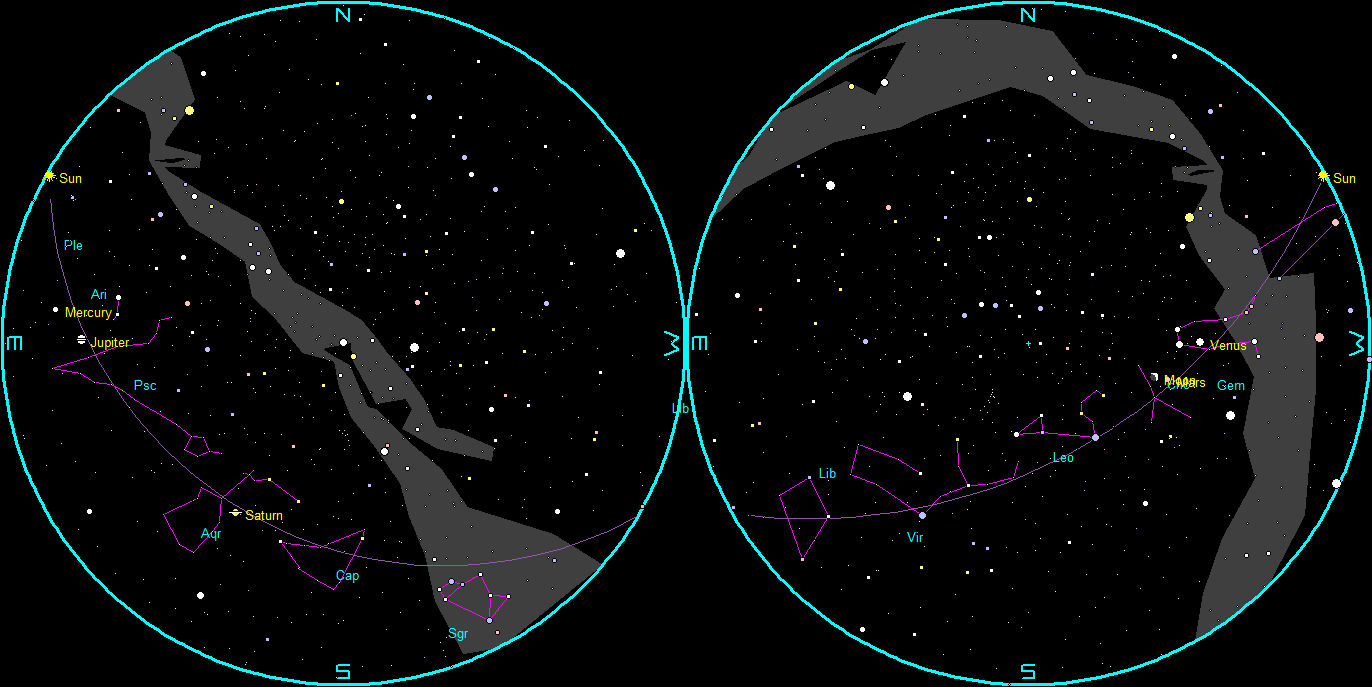
The naked-eye planets and the Moon at sunset and sunrise on a single night, starting with sunset on the right on May 24, 2023. The night ends on the left with sunrise on the 25th. Click or tap on the image to enlarge it. Created using my LookingUp app and GIMP.
05/23/2023 – Ephemeris – Let’s observe the four-day-old Moon
This is Bob Moler with Ephemeris for Tuesday, May 23rd. Today the Sun will be up for 15 hours and 5 minutes, setting at 9:12, and it will rise tomorrow at 6:06. The Moon, halfway from new to first quarter, will set at 1:25 tomorrow morning.
The four-day-old Moon has uncovered a sea below Mare Crisium or Sea of Crises. It’s Mare Fecunditatis, or the Sea of Fertility. It appears to have been created in the first period of the Moon’s history from 4.55 billion years to 3.92 billion years ago, called the pre- Nectarian geological period, while Mare Crisium is a bit younger, from 3.92 to 3.85 billion years ago, the Nectarian period. Both periods were named for Mare Nectaris, or Sea of Nectar, a small sea next to the Sea of Fertility just coming into sunlight. There are two small, but remarkable craters in the Sea of Fertility called Messier and Messier A which appear to be the result of a double asteroid impact, where it looks like the Moon was struck at a low angle, sending debris out in one direction.
The astronomical event times given are for the Traverse City/Interlochen area of Michigan (EDT, UT –4 hours). They may be different for your location.
Addendum
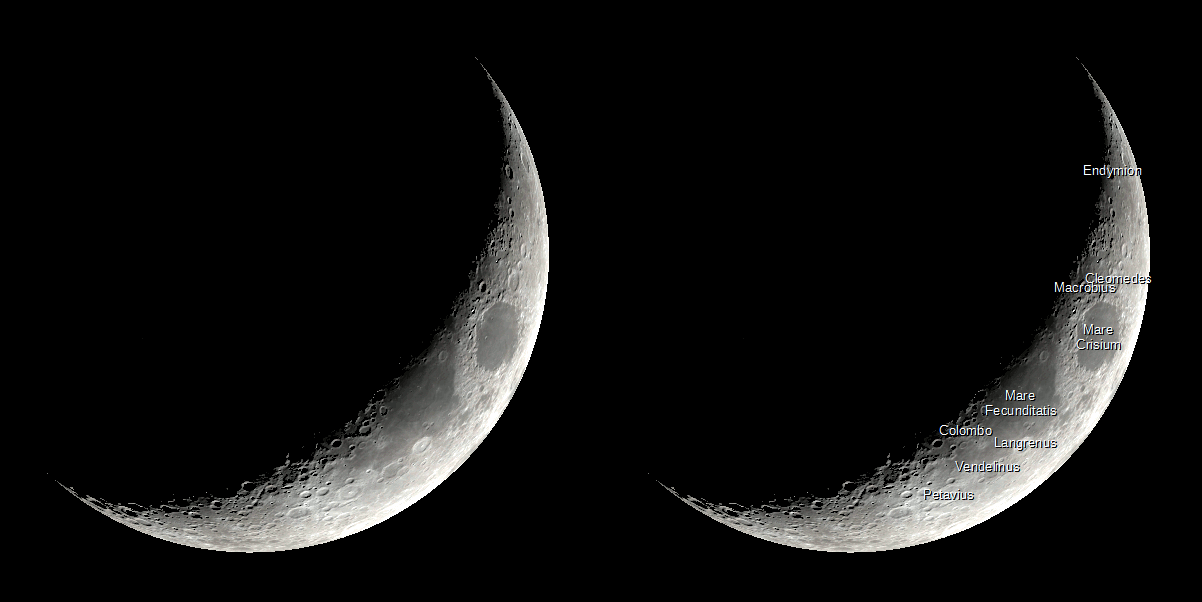
4 day old Moon with selected features labeled for May 23, 2023, at 10 pm. Created using Stellarium, LibreOffice Draw and GIMP.
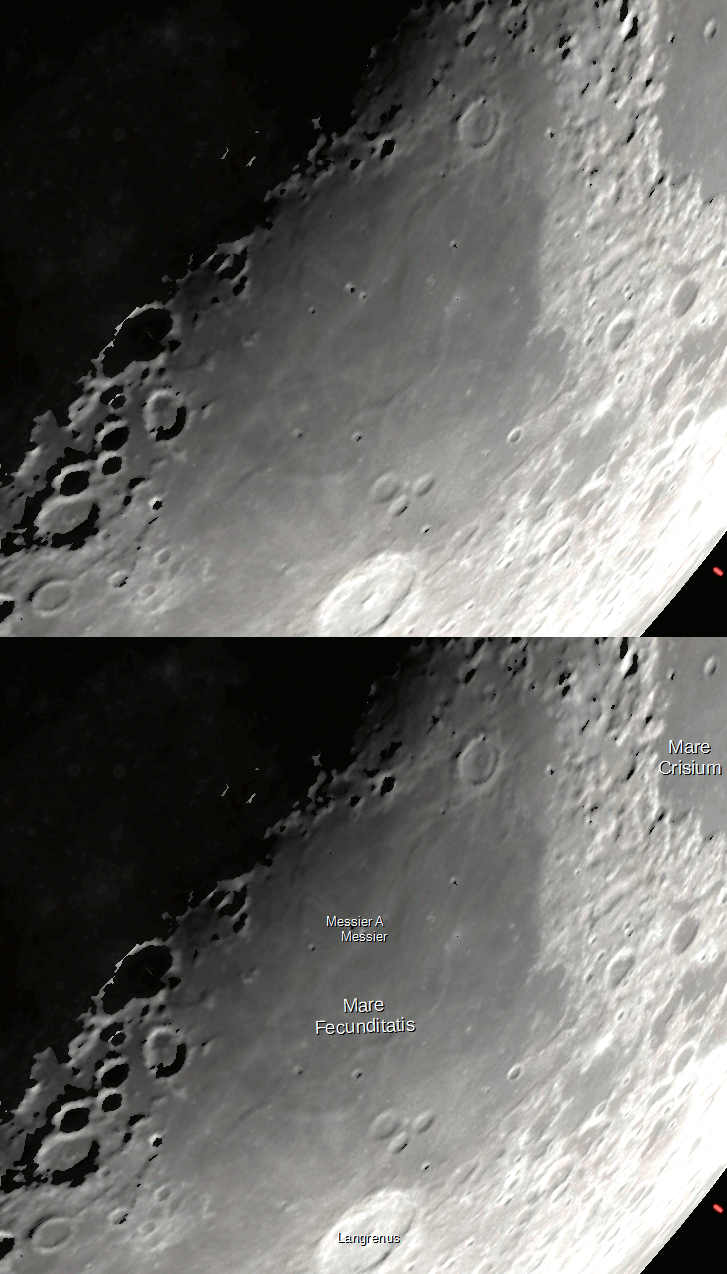
Mare Fecunditatis, 4 day old Moon with the 2 Messier craters labeled. Created using Stellarium, LibreOffice Draw and GIMP.
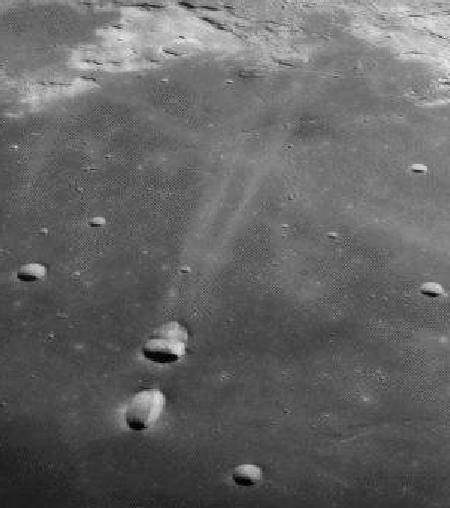
Messier craters from the Apollo astronauts. Credit NASA.
05/22/2023 – Ephemeris – Exploring the three-day-old Moon
This is Ephemeris for Monday, May 22nd. Today the Sun will be up for 15 hours and 4 minutes, setting at 9:11, and it will rise tomorrow at 6:06. The Moon, 3 days past new, will set at 12:43 tomorrow morning.
Tonight we will see the three-day-old moon low in the west. It may exhibit earthshine. That is, its night side will be illuminated by the Earth’s day side. Just as the earthly night is illuminated by moonlight, especially when the Moon is near full, the night side of the Moon, when near new, is illuminated by earthlight. In binoculars or telescope, the large dark spot, on the Moon’s right edge, is Mare Crisium, or Sea of Crises. The large crater below and a bit left of that sea is Langrenus, named after a 17th century Belgian engineer and mathematician who produced the first lunar map with nomenclature. Langrenus appears as a bright spot as the Sun rises higher for it. Also check out the south end of the cusp of the crescent for a lone mountain peak catching the Sun.
The astronomical event times given are for the Traverse City/Interlochen area of Michigan (EDT, UT –4 hours). They may be different for your location.
Addendum
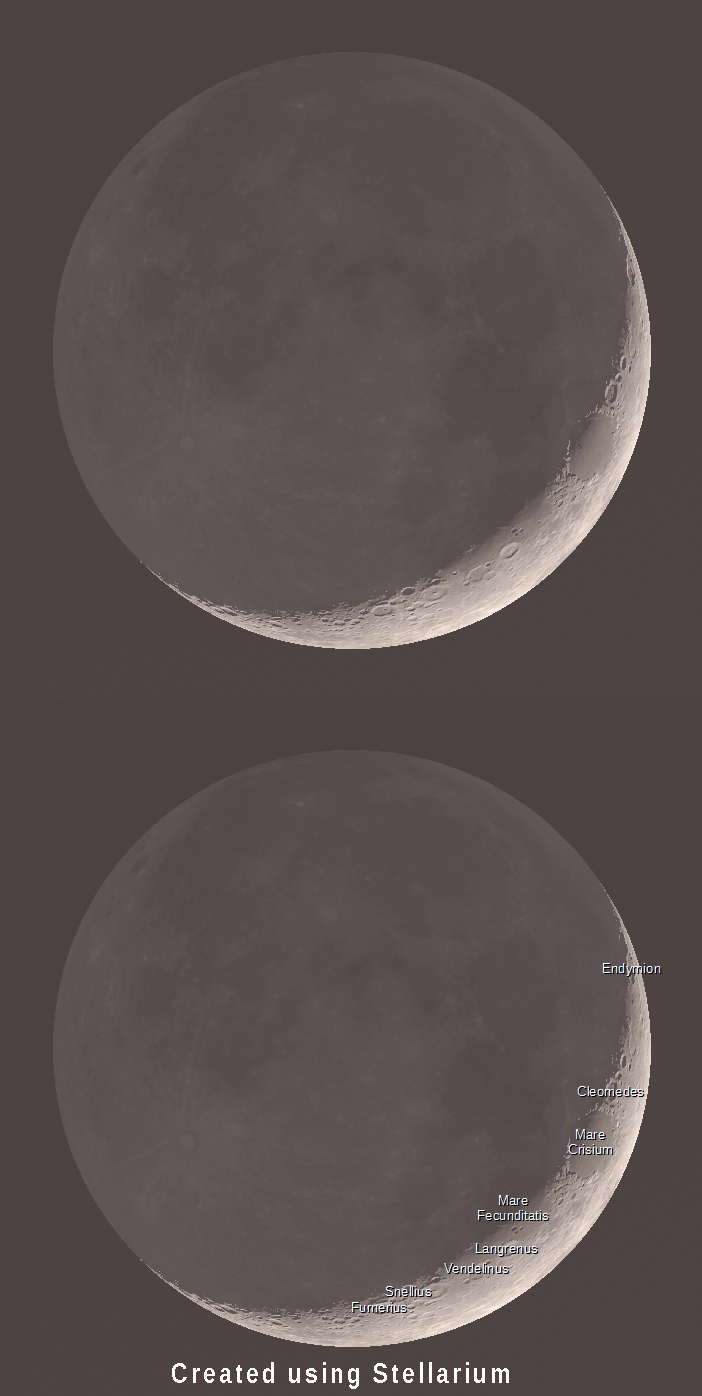
An annotated three old Moon as it might appear in binoculars or a small telescope tonight, May 22, 2023, at 10 pm. Click or tap on the image to enlarge it. Created using Stellarium, LibreOffice Draw and GIMP.
05/19/2023 – Ephemeris – It’s new moon, why is there no solar eclipse today?
This is Bob Moler with Ephemeris for Friday, May 19th. Today the Sun will be up for 14 hours and 58 minutes, setting at 9:08, and it will rise tomorrow at 6:09. The Moon is new today, and won’t be visible.
We are five months from witnessing a solar eclipse. That’s five lunar months, of approximately 29 and a half days. Solar eclipses can only happen at new moon, when the Moon is in the same direction as the Sun. Today, at 11:53 am, the instant of new moon, the Moon will be about two and a half of its diameters north of the Sun, so it won’t create a solar eclipse for us in Northern Michigan, or for any other place on the Earth for that matter. For locations south of Michigan, that Moon will appear somewhat farther from the Sun. For locations north of us, the Moon will appear closer to the Sun. But nobody will get a solar eclipse today. We will have to wait for the new moon of October 14th to see an eclipse of the Sun.
The astronomical event times given are for the Traverse City/Interlochen area of Michigan (EDT, UT –4 hours). They may be different for your location.
Addendum
The orbit of the Moon is tilted by about 5 degrees from the orbital plane of the Earth, so there’s a solar eclipse visible somewhere on the planet one out of six new moons on average. If our moon orbited near the earth’s equator like most major moons of their planet, eclipses would be much rarer than they are now, and only occur around the spring or autumn equinoxes. That’s because the Moon’s orbit would be tilted, on average, of 23½ degrees to Earth’s orbital plane.
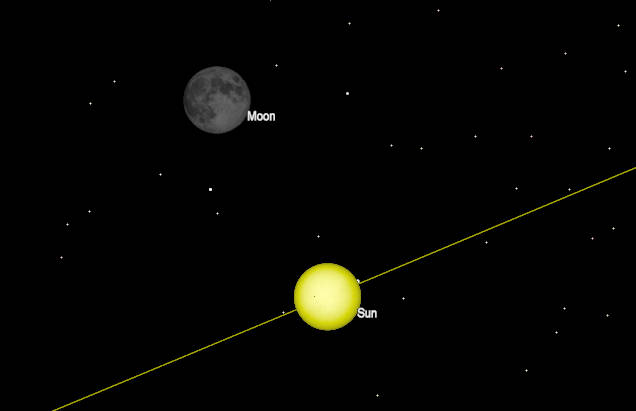
The new moon’s position north of the Sun at 11:53 am EDT. The yellow line is the ecliptic, which is the path of the Sun against the stars, or Earth’s orbital plane projected on the sky. If one could see the stars in the daytime, the Sun and Moon are below the Pleiades star cluster, which will make their first appearance in the evening sky this fall. While 11:53 am is only 7 minutes from noon EDT, for our location, local apparent solar noon, when the Sun is actually due south, isn’t until 1:39 pm. Our Eastern Daylight Saving Time meridian is off the coast of the US in the Atlantic Ocean at longitude 60 degrees west. We are located between 85 and 86 degrees west. Created using Cartes du Ciel (Sky Charts).
05/18/2023 – Ephemeris – Spica, the bluest first magnitude star
This is Bob Moler with Ephemeris for Thursday, May 18th. Today the Sun will be up for 14 hours and 55 minutes, setting at 9:07, and it will rise tomorrow at 6:10. The Moon, 1 day before new, will rise at 5:56 tomorrow morning.
In the south at 11 p.m. is the bright star Spica, which can be found from all the way back overhead to the Big Dipper. Follow the arc of the handle of the Big Dipper to the bright star Arcturus high in the southeast. Then straighten the curve of the arc to a straight spike which points to Spica, the brightest star in Virgo the virgin. Arcturus is much brighter than Spica and has an orange tint to Spica’s bluish hue. In fact, Spica is the bluest of the 21 first magnitude stars. That means that it has a really hot surface temperature. Actually, Spica is really two blue stars orbiting each other in 4 days. Spica is 250 light years away. It also was an important star to the ancient Greeks. One temple was built, and aligned to its setting point.
The astronomical event times given are for the Traverse City/Interlochen area of Michigan (EDT, UT –4 hours). They may be different for your location.
Addendum
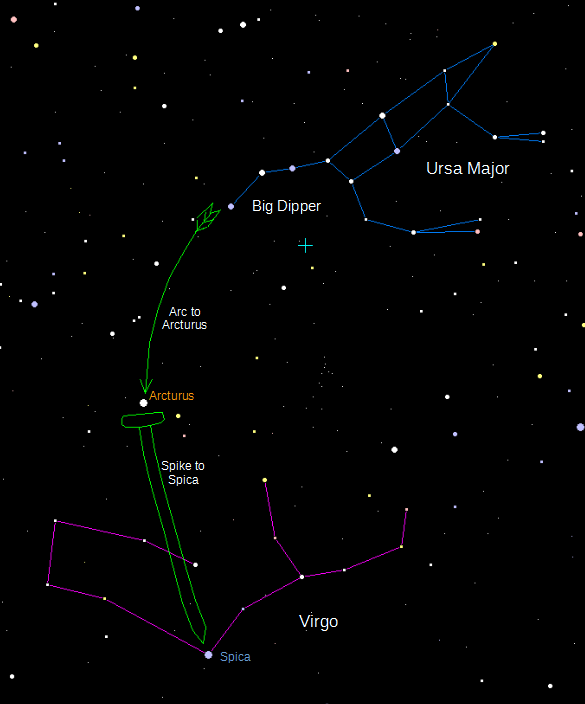
Finding Virgo from the Big Dipper at 10:30 pm, May 18th. There are no planetary interlopers this year. The small + sign marks the zenith, and the image faces south. Created using my LookingUp app, with captions added using LibreOffice Draw.
05/17/2023 – Ephemeris – Let’s find where the naked-eye planets have wandered off to this week
This is Bob Moler with Ephemeris for Wednesday, May 17th. Today the Sun will be up for 14 hours and 53 minutes, setting at 9:06, and it will rise tomorrow at 6:11. The Moon, 2 days before new, will rise at 5:30 tomorrow morning.
Let’s find where the naked-eye planets have wandered off to this week. Venus is our blazing Evening Star, seen in the west all evening. It will set after midnight. The red planet Mars has moved into Cancer, left of the namesake stars of the Gemini twins, with Pollux closest to Mars and Castor farther right. Mars is above and left of Venus by 18 degrees, or a bit less than two times the width of one’s fist held at arm’s length. Venus is closing the gap between them, but will never quite reach Mars while they are in the evening sky. The closest they will get is three and a half degrees or 7 moon diameters apart, before Venus pulls back toward the Sun faster than Mars will. In the morning, Saturn will be visible, low in the east-southeast by 5 am, rising at 3:18 am. This morning, the Moon is covering or occulting Jupiter. Daylight is making this a telescopic event.
The astronomical event times given are for the Traverse City/Interlochen area of Michigan (EDT, UT –4 hours). They may be different for your location.
Addendum
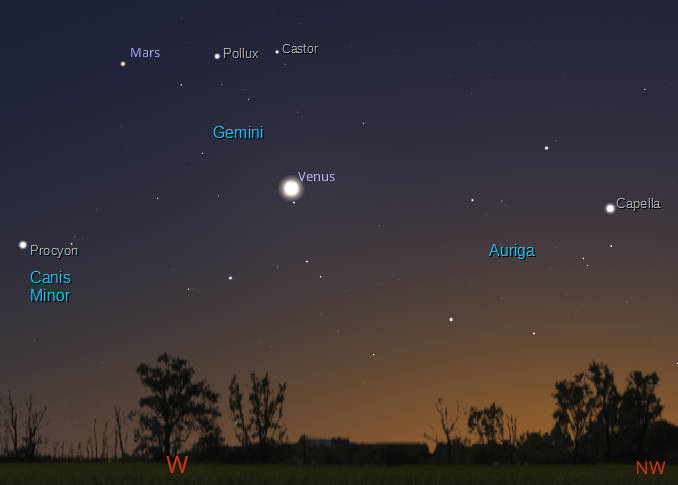
Evening planets with the stars at 10 pm tonight, May 17, 2023. Created using Stellarium and LibreOffice Draw.
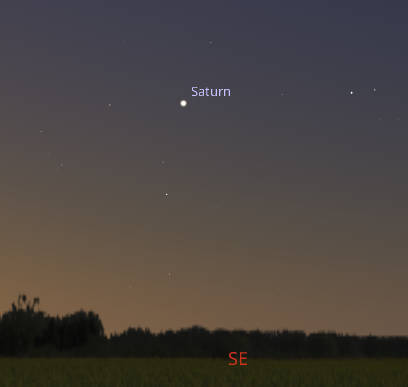
Saturn in morning twilight at 5:30 am tomorrow, May 18, 2023. Created using Stellarium.
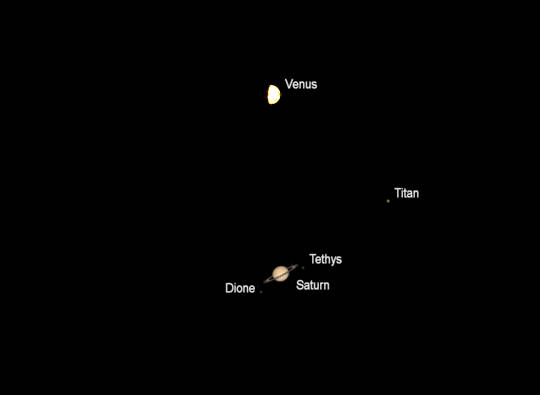
Telescopic Venus and Saturn (north up) as they would be seen in a small telescope, with the same magnification. Apparent diameters: Venus 19.65″ and is 58.9% illuminated; Saturn 16.77″, its rings 39.05″. Mars, too small to be represented here, is 4.96″ in diameter. Created using Cartes du Ciel (Sky Charts).
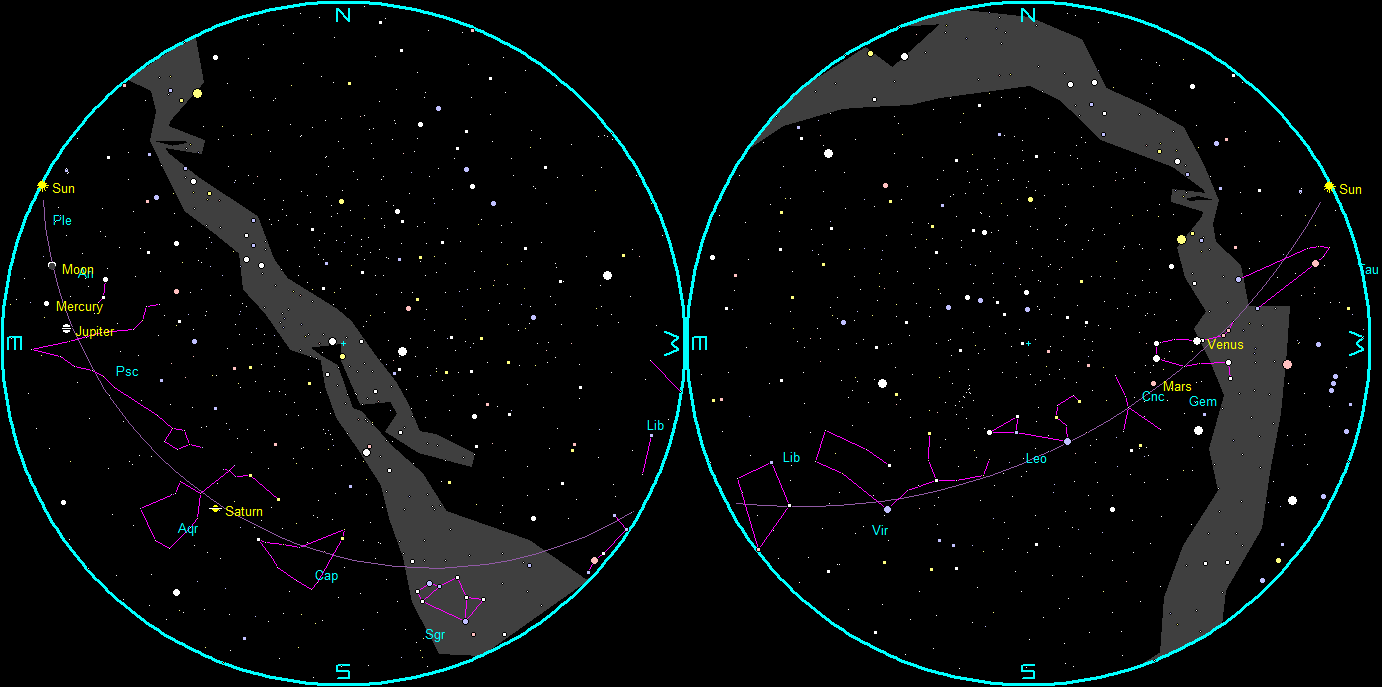
The naked-eye planets and the Moon at sunset and sunrise on a single night, starting with sunset on the right on May 17, 2023. The night ends on the left with sunrise on the 18th. Click or tap on the image to enlarge it. Created using my LookingUp app and GIMP.
05/16/2023 – Ephemeris – Regulus, the Little King Star
This is Ephemeris for Tuesday, May 16th. Today the Sun will be up for 14 hours and 51 minutes, setting at 9:05, and it will rise tomorrow at 6:12. The Moon, 3 days before new, will rise at 5:08 tomorrow morning.
Regulus is the brightest star in the constellation of Leo, the lion at the bottom of the backward question mark that is the head and mane of Leo. It’s in the southwest at 10 pm. Alluding to the lion’s status in the animal kingdom, Regulus is the little king star. It is dead last in order of brightness of the 21 brightest first magnitude stars, 1/13th the brightness of Sirius the brightest nighttime star, now lost in the evening twilight glow. To the Babylonians it was the king, the 15th of their constellations, that marked the passage of the Sun. Regulus is about 79 light years away, and 288 times the brightness of the sun. It is a rapidly spinning ellipsoid 3 times the sun’s diameter, rotating in just under 16 hours.
The astronomical event times given are for the Traverse City/Interlochen area of Michigan (EDT, UT –4 hours). They may be different for your location.
Addendum
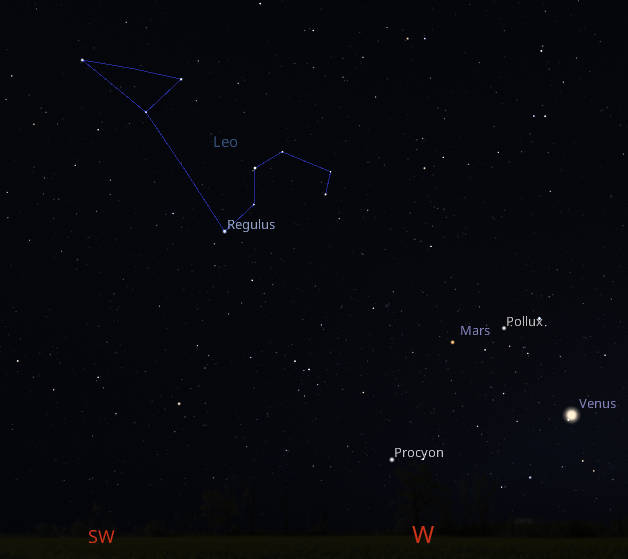
Regulus and Leo and the other stars and planets in the western sky at 11 pm, May 16, 2023. Created using Stellarium.
05/15/2023 – Ephemeris – Why are crows black?
This is Bob Moler with Ephemeris for Monday, May 15th. Today the Sun will be up for 14 hours and 49 minutes, setting at 9:04, and it will rise tomorrow at 6:13. The Moon, 3 days past last quarter, will rise at 4:47 tomorrow morning.
The small constellation of Corvus the crow is located low in the south at 10:30 this evening. It’s made of 6 dim stars, the pattern is a distinctive but distorted box with two stars in the upper left corner and two stars in the lower right corner. To the right is a fainter constellation of a thick stemmed goblet called Crater. Both appear above the long constellation of Hydra, the water snake who is slithering above the southern horizon. In Greek mythology Corvus, then white, was the god Apollo’s pet who once bid the crow to take a cup and fetch him some water. Corvus, however, dallied and waited for a green fig to ripen. Corvus then grabbed a snake and returned with a story on how the snake had delayed him. The angry Apollo saw through the story and turned the crow black.
The astronomical event times given are for the Traverse City/Interlochen area of Michigan (EDT, UT –4 hours). They may be different for your location.
Addendum
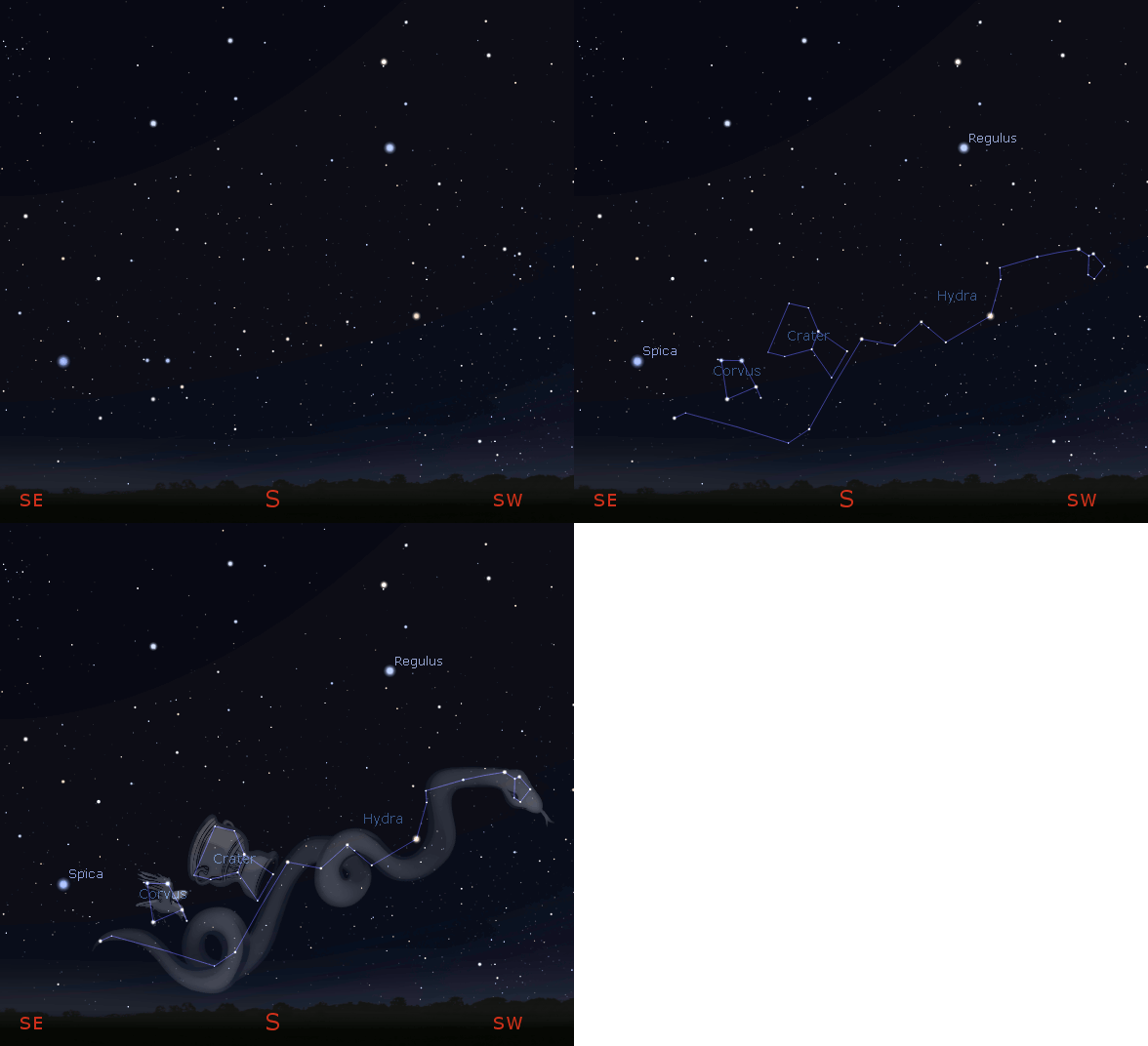
Corvus, Crater and Hydra finder chart. The chart was made for earlier in the month, so when it’s dark enough to see them, the constellations will have shifted to the west or right. Created using Stellarium and GIMP.
05/12/2023 – Ephemeris – Finding Virgo the virgin in the evening sky
This is Ephemeris for Friday, May 12th. Today the Sun will be up for 14 hours and 42 minutes, setting at 9:00, and it will rise tomorrow at 6:17. The Moon, at last quarter today, will rise at 3:44 tomorrow morning.
One of the large constellations we see in the south at 11 p.m. can be found using the Big Dipper overhead, follow the arc of the handle to the bright star Arcturus, then straighten the arc to a spike to reach Spica, a bright blue-white star in the south. Spica is the brightest star in the constellation Virgo, the virgin. She represents the goddess of the harvest, Virgo is holding a sheaf of wheat in depictions of her, and Spica is placed at the head of the sheaf. In the space between Spica and Leo the lion to her upper right is, a great cluster of thousands of galaxies just below naked eye visibility. The Virgo Cluster. Inside that cluster is galaxy M87, in whose center lies a black hole with the mass of 6.5 billion suns. The center of the cluster is at about 54 million light years away.
The astronomical event times given are for the Traverse City/Interlochen area of Michigan (EDT, UT –4 hours). They may be different for your location.
Addendum
Finding Virgo from the Big Dipper at 11 pm, May 12. There are no planetary interlopers this year. The small + sign marks the zenith, and the image faces south. Created using my LookingUp app, with captions added using LibreOffice Draw.
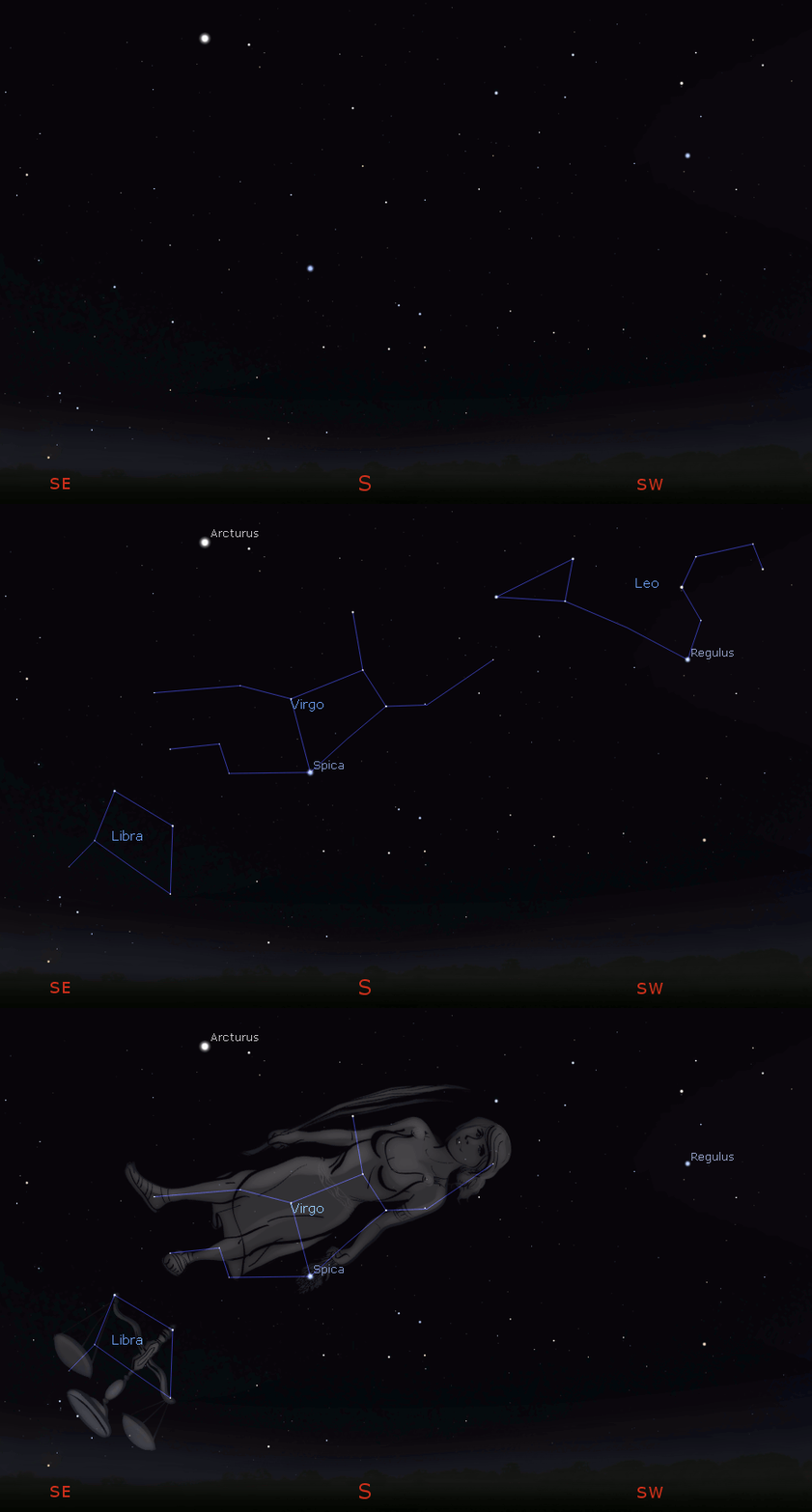
Virgo finder animation with Leo added as an aid for 11 p.m. tonight. Created using Stellarium and GIMP.
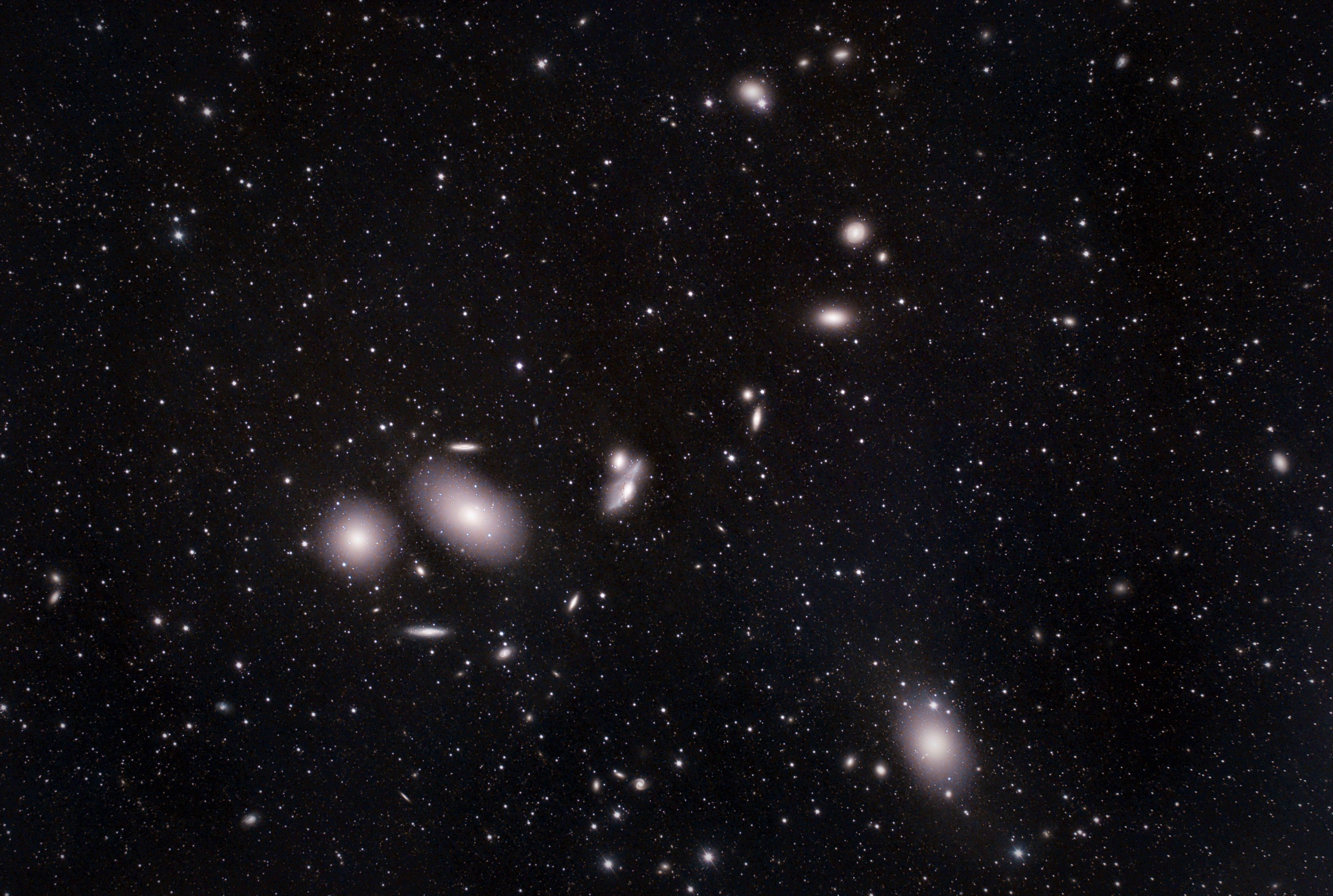
Markarian’s Chain, a small part of the Virgo Cluster of galaxies. Click or tap on the image to enlarge it. Credit: Daniel Dall’Olmo.

