


Archive

Archive for the ‘Ephemeris Program’ Category

04/26/2022 – Ephemeris – Tomorrow is the Moon’s final stop in passing the parade of morning planets

April 26, 2022 Comments off

This is Bob Moler with Ephemeris for Tuesday, April 26th. Today the Sun will be up for 14 hours and 1 minute, setting at 8:41, and it will rise tomorrow at 6:38. The Moon, 3 days past last quarter, will rise at 5:37 tomorrow morning.

Also, tomorrow morning, the Moon will conclude its sweep under the four bright planets of the morning sky by being seen below the left-most and lowest of the four, Jupiter. With nearby Venus, it makes a small right triangle The other planets in order to the right of Jupiter are Venus, Mars and finally Saturn. Jupiter and Venus are appearing to get closer to each other every day now. They will cross paths in conjunction this Saturday. Venus is slowly retreating back and around behind the Sun. Jupiter now appears to be moving away from the Sun. Both, however, are still moving eastward against the stars, it’s just that Venus is moving faster. Next month, when the Moon passes by these planets, they will be a different order.

The astronomical event times given are for the Traverse City/Interlochen area of Michigan (EDT, UT – 4 hours). They may be different for your location.

Addendum

The Moon passing the morning planets from Sunday to Wednesday mornings 4/24 to 4/27/2022

The Moon passing the morning planets from Sunday to Wednesday mornings 4/24 to 4/27/2022. Note also the approach of Jupiter and Venus. Their paths will cross on Saturday, 4/30/2022. Click on the image to enlarge it. Created using Stellarium and GIMP.

04/25/2022 – Ephemeris – The moon is passing the morning planet parade

April 25, 2022 Comments off

This is Bob Moler with Ephemeris for Monday, April 25th. Today the Sun will be up for 13 hours and 58 minutes, setting at 8:40, and it will rise tomorrow at 6:40. The Moon, 2 days past last quarter, will rise at 5:16 tomorrow morning.

Over this and the next couple of mornings, the waning crescent Moon will be passing the four morning planets. This morning it was below and between Saturn and Mars. Tomorrow morning, the Moon will be between and below Mars and Venus. Wednesday morning the Moon, Venus and Jupiter will make a nice right triangle with Jupiter above and a bit left of the Moon and Venus will appear above and a bit to the right of it. There’s some motion between Venus and Jupiter. While both are traveling eastward when comparing them to the stars, Venus is moving eastward faster, and is moving toward the Sun in our sky. Jupiter is moving away from the Sun from our vantage point. They will cross paths on Saturday.

The astronomical event times given are for the Traverse City/Interlochen area of Michigan (EDT, UT – 4 hours). They may be different for your location.

Addendum

The Moon passing the morning planets from Sunday to Wednesday mornings 4/24 to 4/27/2022

The Moon passing the morning planets from Sunday to Wednesday mornings 4/24 to 4/27/2022. Note also the approach of Jupiter and Venus. Their paths will cross on Saturday, 4/30/2022. Click on the image to enlarge it. Created using Stellarium and GIMP.

04/22/2022 – Ephemeris – Earth Day and the Moon passes four planets in the morning

April 22, 2022 Comments off

This is Ephemeris for Earth Day, Friday, April 22nd. Today the Sun will be up for 13 hours and 50 minutes, setting at 8:36, and it will rise tomorrow at 6:45. The Moon, 1 day before last quarter, will rise at 3:43 tomorrow morning.

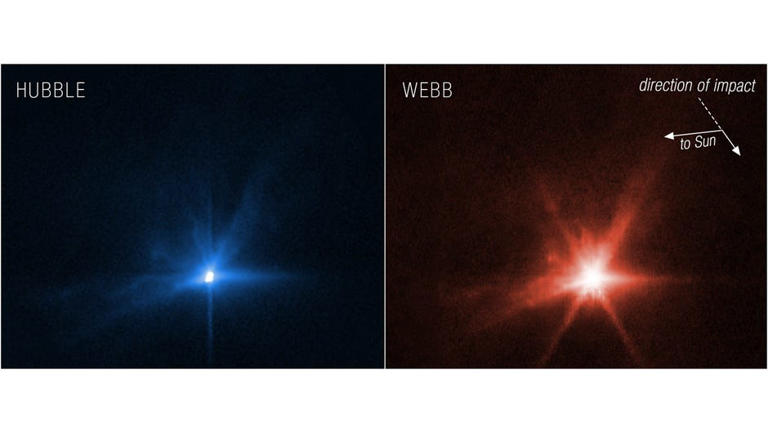
The Lyrid meteor shower will still be active tonight and tomorrow morning from 10 pm to almost 4 am. Speaking of things hitting the Earth, NASA’s DART Mission to collide and deflect a small asteroid is still on its way to smash into a tiny asteroid in September to see how it works. A more predictable disaster is climate change or global warming, which is continuing to appear more rapid than earlier thought. It demands that nations start immediately to reduce carbon emissions to slow and eventually stop the rise in global temperatures. As someone said: “There is no Planet B”. Mars isn’t it. It’s too cold, too small, too dry, and the air is too thin and contains no free oxygen. So support your local planet, it’s the only one we’ve got.

The astronomical event times given are for the Traverse City/Interlochen area of Michigan (EDT, UT – 4 hours). They may be different for your location.

Addendum

There is an interesting Planet and morning planet encounter Sunday through Wednesday mornings as the Moon passes four planets.

The Moon passing the morning planets from Sunday to Wednesday mornings 4/24 to 4/27/2022

The Moon passing the morning planets from Sunday to Wednesday mornings 4/24 to 4/27/2022. Note also the approach of Jupiter and Venus. Their paths will cross on Saturday, 4/30/2022. Click on the image to enlarge it. Created using Stellarium and GIMP

04/21/2022 – Ephemeris – The Lyrid Meteor Shower reaches its peak tomorrow afternoon

April 21, 2022 Comments off

This is Bob Moler with Ephemeris for Thursday, April 21st. Today the Sun will be up for 13 hours and 47 minutes, setting at 8:35, and it will rise tomorrow at 6:46. The Moon, 2 days before last quarter, will rise at 2:54 tomorrow morning.

The second major meteor shower this year will reach its peak tomorrow afternoon around 2 pm (~19h UT). One of the best times to see it will be tonight from about 10 pm to near 3 am when the Moon rises. The other is tomorrow night. The meteor shower is called the Lyrids, because they seem to come from near the constellation Lyra the harp and the bright star Vega. At 10 p.m. Vega is the brightest star low in the northeastern sky. By 3 a.m. Vega will be high in the east. The radiant of the meteors is to the west of Vega, between Lyra and the dim constellation of Hercules. The most meteors will be visible just before the Moon begins to brighten the sky before 3 a.m. Though a major shower, the peak hourly rate is expected to be less than 20 meteors an hour.

The astronomical event times given are for the Traverse City/Interlochen area of Michigan (EDT, UT – 4 hours). They may be different for your location.

Addendum

Lyrid radiant at 11 pm

The Lyrid radiant at 11 pm, looking to the east-northeast. The meteors will be seen all over the sky, but their tracks can be traced back to the radiant point, like the parallel rails of a train track recede to a point in the distance. Click on the image to enlarge it. Created using Stellarium.

Lyrid radiant at 3 am

The Lyrid radiant at 3 am, looking in this all-sky view. Vega will be very high in the east and Hercules will be almost overhead. The meteors will be seen all over the sky, but their tracks can be traced back to the radiant point, like the parallel rails of a train track recede to a point in the distance. There are two other minor meteor showers happening at the same time, though neither is at peak, providing only a few meteors per hour. Click on the image to enlarge it. Created using Stellarium.

04/20/2022 – Ephemeris – Let’s search for the naked-eye planets for this week

April 20, 2022 Comments off

This is Ephemeris for Wednesday, April 20th. Today the Sun will be up for 13 hours and 44 minutes, setting at 8:34, and it will rise tomorrow at 6:48. The Moon, 3 days before last quarter, will rise at 1:51 tomorrow morning.

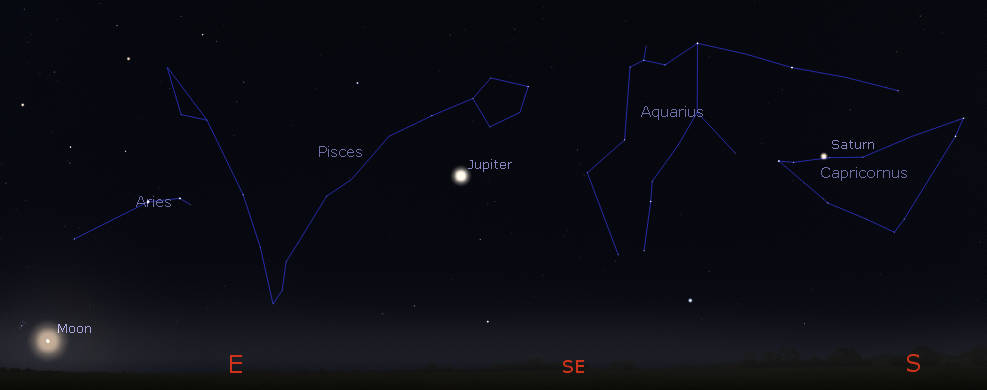
Let’s search for the naked-eye planets for this week. There is one bright planet in the evening sky. Mercury may be spotted around and after 9:15 this evening very low in the west-northwest and be visible for the next half hour or so. After that, the planet action shifts to the morning sky. The other 4 naked-eye planets are there. By 6 am, the planets will be spread out low from the east to southeast with brilliant Venus moving closer to Jupiter, lowest in the east. Dim Mars will be to the right and a bit above Venus, while brighter Saturn will be right and above Mars. Saturn will rise tomorrow at 4:27 am, with Mars following at 4:55. Venus will rise at 5:19 tomorrow morning, followed by Jupiter at 5:39 am. The Moon will be in the south at 6 am.

The astronomical event times given are for the Traverse City/Interlochen area of Michigan (EDT, UT – 4 hours). They may be different for your location.

Addendum

Mercury in the evening

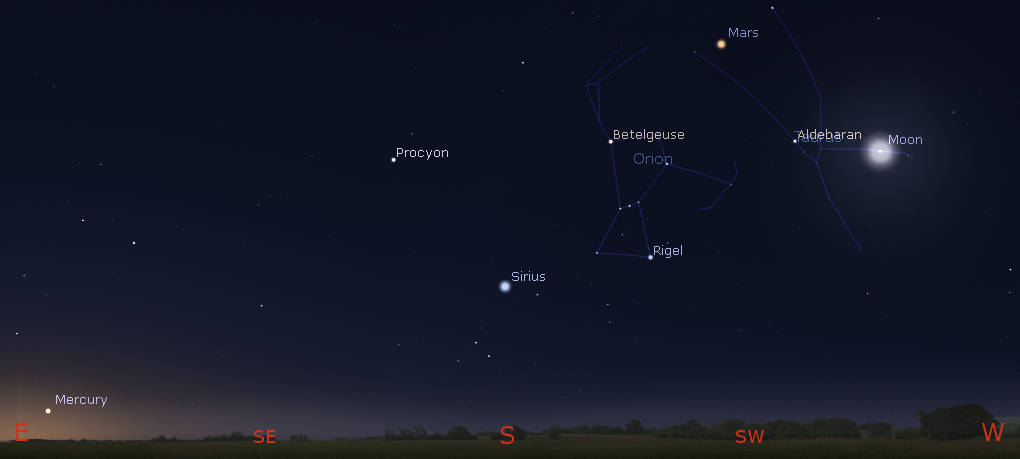
Mercury in the evening at 9:15, or about 40 minutes after sunset tonight, April 20, 2022. Created using Stellarium.

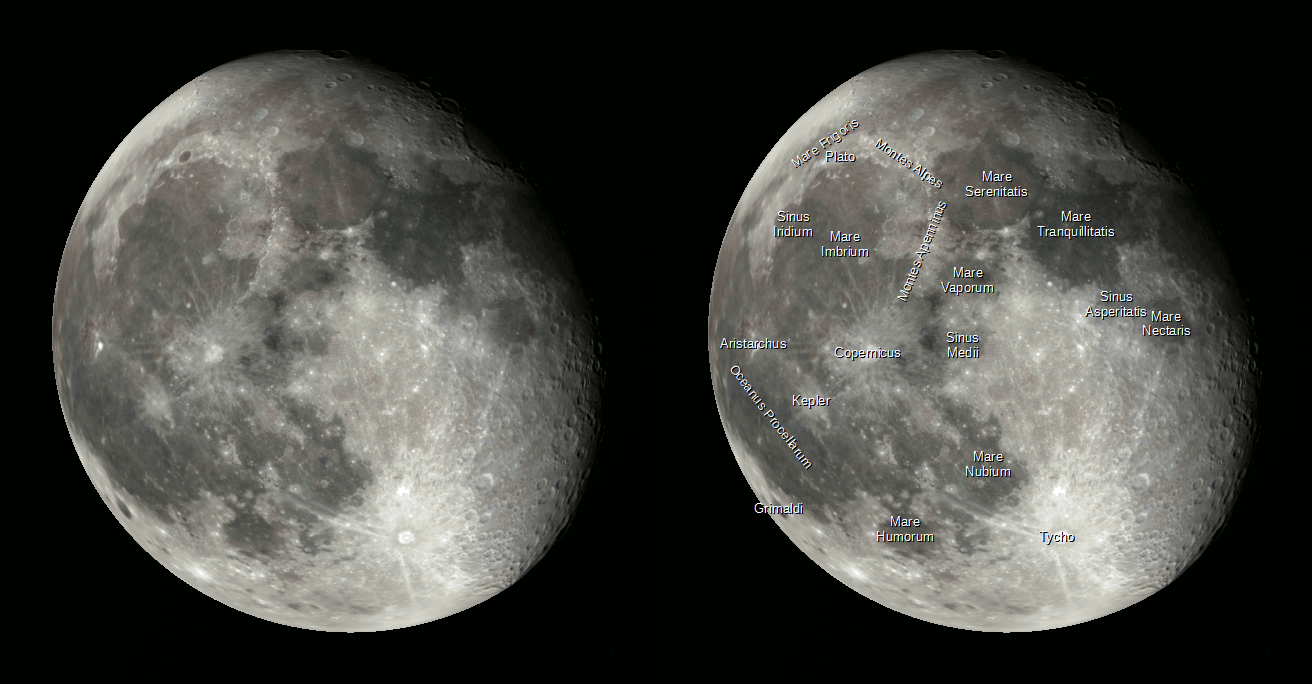
Annotated Binocular Moon

Annotated Binocular Moon. What the Moon might look like tomorrow morning, April 21, 2022. Created using Stellarium, GIMP and LibreOffice.

Translations

Mare Frigoris – Sea of Cold
Mare Humorum – Sea of Moisture
Mare Imbrium – Sea of Showers
Mare Nubium – Sea of Clouds
Mare Serenitatis – Sea of Serenity
Oceanus Procellarum – Ocean of Storms

Note that Mare is pronounced Mar-é

Parade of the morning planets

Parade of the morning planets at 6 am or about 45 minutes before sunrise tomorrow, April 21, 2022. Created using Stellarium.

Telescopic views of Venus, Saturn and Jupiter

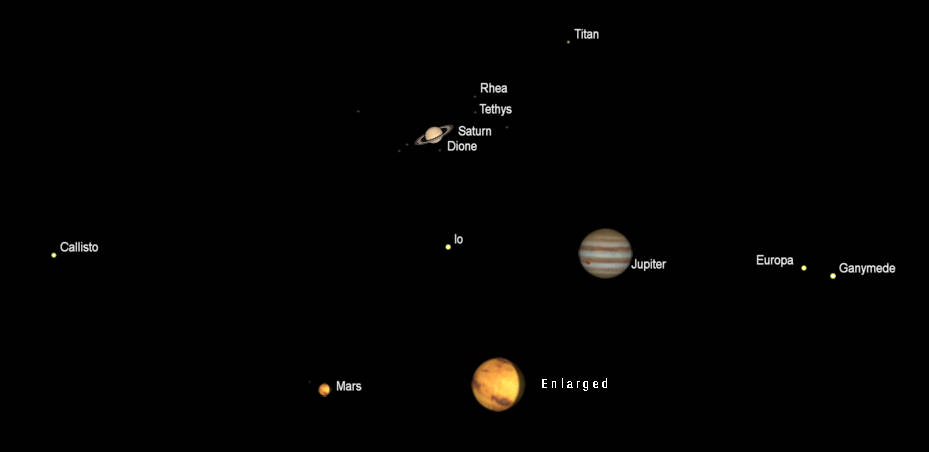
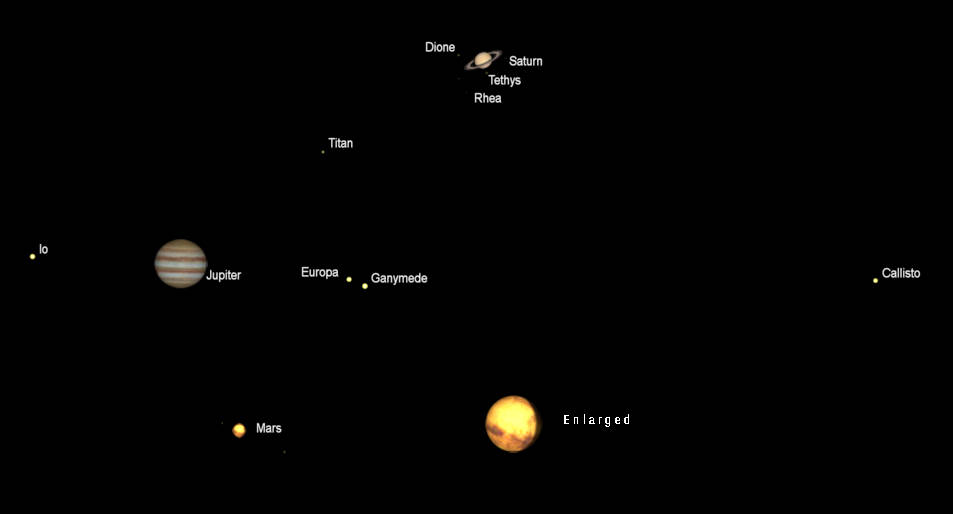
Views of Venus, Saturn, and Jupiter (north up) as they would be seen in a small telescope, with the same magnification, tomorrow morning at 6:00 am, April 21, 2022. I do not show planets less than 10 seconds of arc in diameter. Apparent diameters: Venus 18.01″, 64.0% illuminated; Saturn 16.24″, its rings 37.82″; Jupiter 34.24″. Mars is not shown, its apparent diameter is 5.56″ and is 90.2% illuminated. The moons of Jupiter and Saturn may not be visible in twilight. Io transiting the face of Jupiter definitely will not be visible. Jupiter is shown here much dimmer compared to its moons than it actually is. The ” symbol means seconds of arc (1/3600th of a degree.) Created using Cartes du Ciel (Sky Charts).

Planets and the Moon on a single night

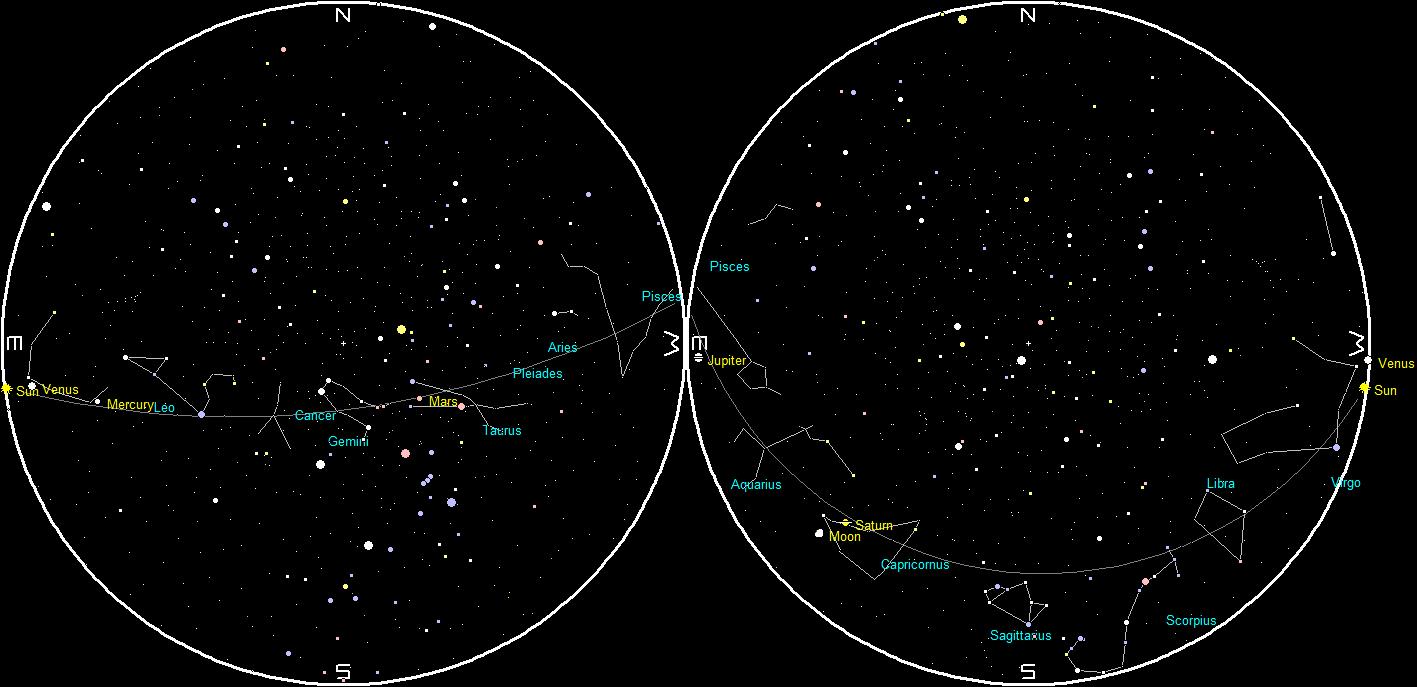
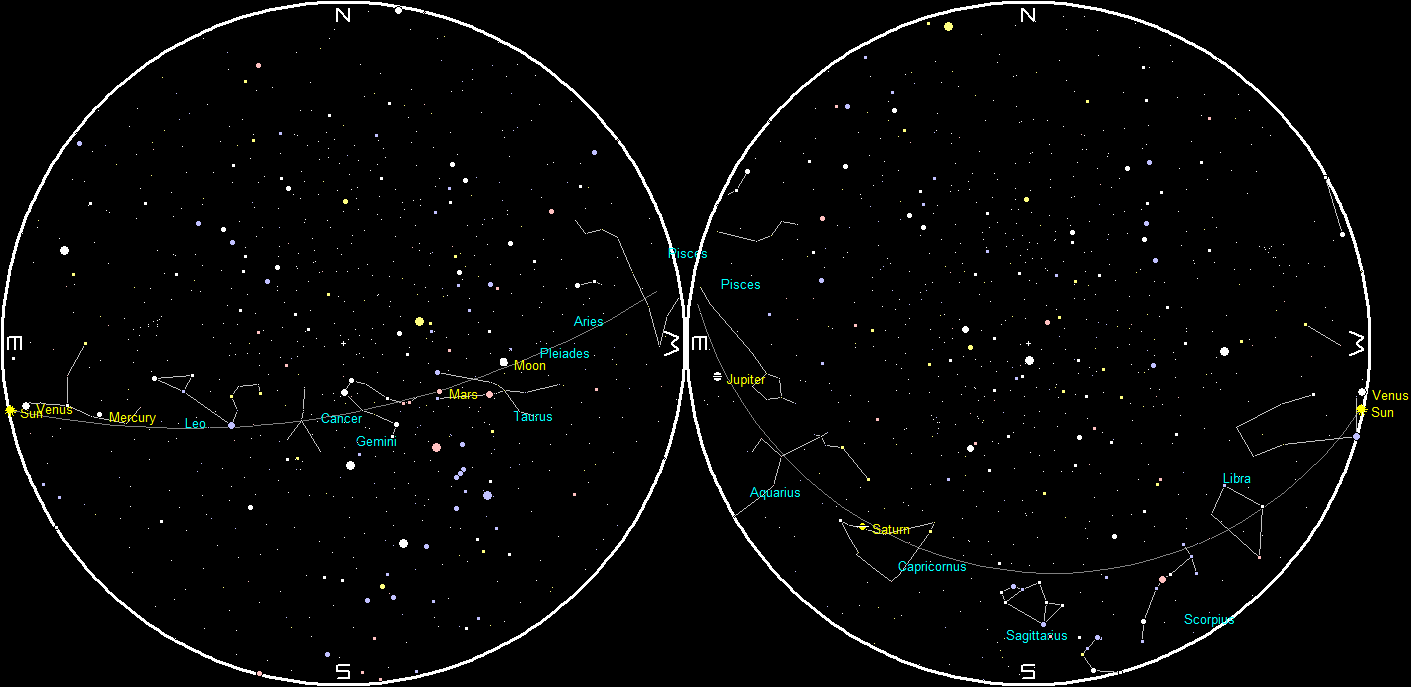
The naked-eye planets and the Moon at sunset and sunrise on a single night, starting with sunset on the right on April 20, 2022. The night ends on the left with sunrise on the 21st. Notice that all the naked-eye planets are in the morning sky now, with the Moon still hanging out in the evening sky. Click on the image to enlarge it. Created using my LookingUp program.

04/19/2022 – Ephemeris – A constellation memorializing a real person

April 19, 2022 Comments off

This is Ephemeris for Tuesday, April 19th. Today the Sun will be up for 13 hours and 41 minutes, setting at 8:32, and it will rise tomorrow at 6:49. The Moon, 3 days past full, will rise at 12:37 tomorrow morning.

High in the southeast at 10 p.m. is a tiny and faint constellation of Coma Berenices, or Berenice’s Hair. In it are lots of faint stars arrayed to look like several strands of hair to the naked eye. The whole group will fit in the field of a pair of binoculars, which will also show many more stars. The story behind it was that Berenice was a real Queen of Egypt, whose husband was away at war. This was in the days when the Greeks ruled Egypt after Alexander conquered it. She offered her golden tresses to the gods for the king’s safe return. The hair, was placed in a temple. However, the offering disappeared when the king returned. Ever since then, the constellation of Coma Berenices has been seen to commemorate the queen’s sacrifice.

The astronomical event times given are for the Traverse City/Interlochen area of Michigan (EDT, UT – 4 hours). They may be different for your location.

Addendum

Coma Berinices

Coma Berenices and neighboring constellations at 10 p.m. in mid-April. Note that only the upper right star of the upside down L shape actually belongs to the cluster. Click on the image to enlarge it. Created using Stellarium.

Coma Berenices

Approximate 7 power binocular field of view (FOV) of the Coma Berenices Cluster. Created using Cartes du Ciel (Sky Charts).

04/18/2022 – Ephemeris – Arcturus, the fourth-brightest nighttime star*

April 18, 2022 Comments off

This is Ephemeris for Monday, April 18th. Today the Sun will be up for 13 hours and 38 minutes, setting at 8:31, and it will rise tomorrow at 6:51. The Moon, 2 days past full, will rise at 11:17 this evening.

The fourth-brightest nighttime star* is now up in the east these evenings. It is Arcturus, a bright star with an orange hue. It can be found otherwise by finding the Big Dipper and tracing out and extending the curve of the handle and saying the phrase “Follow the arc of the handle to Arcturus”, to remember the name of the star and how to find it. Arcturus is about 37 light years from us and is moving quite rapidly across the sky, compared to most stars, but one would not notice it to the naked eye in one’s lifetime. Arcturus is slightly more massive than our Sun, and about 7 billion years old, and is entering its red giant stage of life after using all the hydrogen fuel in its core. Our Sun, being slightly less massive, will survive on hydrogen a bit longer.

The astronomical event times given are for the Traverse City/Interlochen area of Michigan (EDT, UT – 4 hours). They may be different for your location.

*Or 5th brightest star, depending on which list you look at. Arcturus and Vega, which is just above the horizon in the northeast at 10 pm, are nearly the same brightness, however Vega is white while Arcturus is orange, making brightness comparisons difficult visually. Stellarium, however, reports Vega is a slightly brighter magnitude 0.00, while Arcturus is 0.15. My older lists say Arcturus is the 4th brightest star. I’m an older guy, so I’m sticking with it.

Addendum

How to find Arcturus nearly a month into spring. Arcturus is in the east in the evening. The Big Dipper is high in the northeast standing on its handle. To find and remember the name of this star, simply follow the arc of the handle to Arcturus. Created using Stellarium and GIMP.

I’ll have more tidbits about this remarkable star throughout the spring and summer. Can’t wait? Search for Arcturus on this blog.

04/15/2022 – Ephemeris – How the date of Easter is determined

April 15, 2022 Comments off

This is Ephemeris for Good Friday, April 15th. Today the Sun will be up for 13 hours and 29 minutes, setting at 8:27, and it will rise tomorrow at 6:56. The Moon, 1 day before full, will set at 7:04 tomorrow morning.

Easter will be celebrated by Western Christian churches this Sunday. Easter is a movable feast in that it falls on a different date each year following the first full moon of spring. It’s an attempt to follow the Jewish Passover, which starts on the 15th of the month of Nisan. The Jewish calendar being a lunar calendar, the 15th is generally the night of the full moon. And since the Last Supper was a Seder, according to at least one Gospel, the Christian church wanted to link Easter with Passover as closely as possible using the Roman solar based (Julian) calendar. The months didn’t follow the cycle of the Moon anymore and where the year was 365.25 days long. Passover starts at sunset tonight. The western churches adopted the Gregorian calendar to keep in sync with the seasons. The Orthodox churches didn’t, so their Easter is a week later this year. They kept the old Julian Calendar and other considerations to calculate the date of Easter.

The astronomical event times given are for the Traverse City/Interlochen area of Michigan (EDT, UT – 4 hours). They may be different for your location.

Addendum

If you’re wondering about what all this has to do with astronomy? The answer is: Everything! Astronomy in ancient times wasn’t about the nature of planets, and stars, but about the cycles about the Sun and Moon. These cycles announced the seasons, and festival times. This is how the date of Passover is set. The Jews, at least in the Bible, only referenced the constellations of Orion and the Great Bear plus the star cluster Pleiades, that scholars have pinned down. There are two more possible references to constellations that don’t translate. These are all in the Book of Job. The only planet mentioned is Saturn, because it was thought to be closest to the firmament, the starry sphere.

Categories: Calendar, Ephemeris Program, Events Tags:

04/14/2022 – Ephemeris – The Moon appears to wobble

April 14, 2022 Comments off

This is Bob Moler with Ephemeris for Thursday, April 14th. Today the Sun will be up for 13 hours and 26 minutes, setting at 8:26, and it will rise tomorrow at 6:58. The Moon, 2 days before full, will set at 6:43 tomorrow morning.

Tonight’s Moon is nearly full, only two days to go. In the evening, the little dark sea on the Moon called Mare Crisium or Sea of Crises is near the top of the Moon. Now it’s real close to the top edge of the Moon, what astronomers call the limb. Ten days ago, when the Moon was a crescent, Mare Crisium was farther from the limb. This wobbling motion over the lunar month is called libration. This occurs because the Moon has an elliptical orbit of the Earth and speeds up when it’s closer and slows when it’s farther away. However, the Moon’s rotation is constant due to its angular momentum. The period of the revolution of the Moon around the Earth exactly matches its rotation. When the Moon is farthest, its rotation gets a bit ahead of its revolution around the Earth. When closest, the rotation lags a bit. So it appears to wobble over the lunar month.

The astronomical event times given are for the Traverse City/Interlochen area of Michigan (EDT, UT – 4 hours). They may be different for your location.

Addendum

The Moon as it should appear at 10 pm tonight

The Moon as it should appear at 10 pm tonight, April 14, 2022. Note the position, relative to the Moon’s limb, of the small lunar sea called Mare Crisium near the top of the Moon. Mare Crisium means Sea of Crises. It is quite close to the limb tonight. In the animation below, shown without the phase, the orientation of the Moon is not changed by the position in the sky or the latitude of the observer. Created using Stellarium.

Demonstration of libration via animation

A demonstration of libration by viewing the position of Mare Crisium. Also note that there is also a libration in the Moon’s latitude, causing a north-south nodding. Another good indicator of libration is the dark floored crater called Grimaldi on the left side of the Moon, which is not visible tonight in the image at the top. But it will appear in sunlight tomorrow night. Created using Virtual Moon Atlas.

04/13/2022 – Ephemeris – Let’s search for the naked-eye planets for this week

April 13, 2022 Comments off

This is Ephemeris for Wednesday, April 13th. Today the Sun will be up for 13 hours and 23 minutes, setting at 8:25, and it will rise tomorrow at 7:00. The Moon, 3 days before full, will set at 6:22 tomorrow morning.

Let’s search for the naked-eye planets for this week. There is one bright planet in the evening sky, but too close to the Sun to be seen. Mercury passed behind the Sun eleven days ago and will be visible later this month, so the planet action still shifts to the morning sky. The other 4 naked-eye planets are there, though Jupiter may be too low in the sky to be seen. By 6:15, the planets will be spread out low in the east-southeast to southeast, with brilliant Venus near the center of the four. Dim Mars will be to the right and a bit above Venus. Brighter Saturn will be right and above Mars. Jupiter will be near the horizon and left of Venus. Jupiter can be still spotted by 6:30 along with Venus and followed even closer to sunrise.

The astronomical event times given are for the Traverse City/Interlochen area of Michigan (EDT, UT – 4 hours). They may be different for your location.

Addendum

Tonight's Moon annotated

Tonight’s Moon annotated, for 10 pm, April 13, 2022, showing major formations visible in binoculars or a small telescope. Created using Stellarium.

Translations

Mare Crisium – Sea of Crises
Mare Fecunditatis – Sea of Fertility
Mare Humorum – Sea of Moisture
Mare Imbrium – Sea of Showers
Mare Nectaris – Sea of Nectar
Mare Nubium – Sea of Clouds
Mare Serenitatis – Sea of Serenity
Mare Tranquillitatis – Sea of Tranquility

Lineup of morning planets

The lineup of morning planets at 6:15 am, about 45 minutes before sunrise tomorrow morning, April 14, 2022. Created using Stellarium.

Telescopic views of Venus, Saturn and Jupiter

Views of Venus, Saturn, and Jupiter (north up) as they would be seen in a small telescope, with the same magnification, tomorrow morning at 6:15 am, April 14, 2022. I do not show planets less than 10 seconds of arc in diameter. Apparent diameters: Venus 19.12″, 61.2% illuminated; Saturn 16.07″, its rings 37.44″; Jupiter 33.90″. Mars is not shown, its apparent diameter is 5.43″ and is 90.7% illuminated. The moons of Jupiter and Saturn may not be visible in twilight. The ” symbol means seconds of arc (1/3600th of a degree.) Created using Cartes du Ciel (Sky Charts).

Planets and the Moon on a single night

The naked-eye planets and the Moon at sunset and sunrise on a single night, starting with sunset on the right on April 13, 2022. The night ends on the left with sunrise on the 14th. Click on the image to enlarge it. Created using my LookingUp program.