Archive
06/21/2012 – Ephemeris – Where are the bright planets this week?
Ephemeris for Thursday, June 21st. Today the sun will be up for 15 hours and 33 minutes, setting at 9:31. The moon, 2 days past new, will set at 10:48 this evening. Tomorrow the sun will rise at 5:57.
Let’s see what’s happening with the bright planets for this week, one day late. Mercury is in the evening sky but very low in the west northwest about 45 minutes after sunset. It will set at 11:09 p.m. Mars is in the west southwest in the evening between the constellations Leo the lion and Virgo with its unmistakable bright reddish color. Mars will be setting in the west at 1:33 a.m. Saturn will be in the south southwest above the bright star Spica now. It will set at 2:45 a.m. Jupiter, now a morning planet will rise at 4:10 a.m. in the east northeast. Venus, is now in the morning sky will rise at 4:45 a.m. In the east northeast. It’s making its debut as the morning star.
Times are for the Traverse City/Interlochen area of Michigan. They may be different for your location.
Addendum
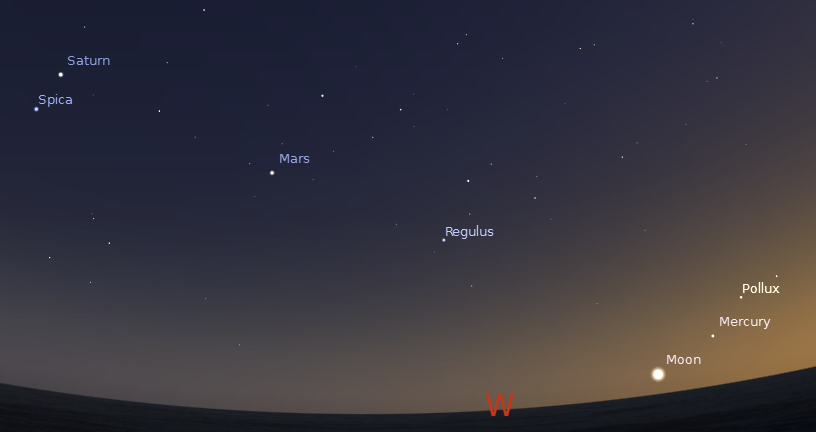
Looking at the fading twilit sky at 10:30 p.m. on June 21, 2012. Created using Stellarium.
This is just an hour after sunset. The moon is really a very thin crescent, and is much dimmer than is shown here. Click to expand. When expanded the images above and below will appear at the same scale.
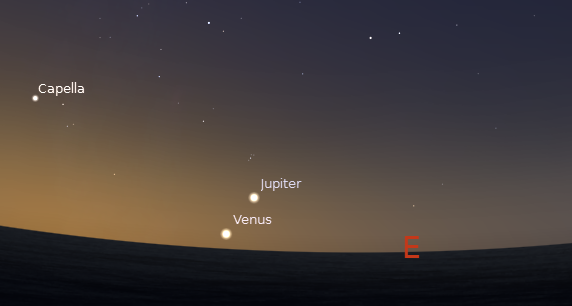
The eastern sky at 05:00 a.m. on June 22, 2012. Created using Stellarium.
This shows the sky an hour before sunrise tomorrow. In actuality Venus is much brighter than Jupiter.
06/18/2012 – Ephemeris – The Little Dipper
Ephemeris for Monday, June 18th. Today the sun will be up for 15 hours and 33 minutes, setting at 9:30. The moon, 1 day before new, will rise at 6:03 tomorrow morning. Tomorrow the sun will rise at 5:57.
11 p.m. is the best time now to spot the Little Dipper. It is difficult to spot, being mush smaller and dimmer than the Big Dipper. However it is the Big Dipper that points to it, by the two stars at the front of the bowl of the Big Dipper to point to the North Star Polaris, the star that doesn’t appear to move. That is the tip of the handle of the Little Dipper. The handle is seen in a curve of the stars upwards and a bit to the left to a small box of stars that is its bowl. The two stars at the front of the bowl are called the Guard Stars because they guard the pole. The Little Dipper is not an official constellation, but is Ursa Minor the lesser bear. To the Anishinabek native peoples of this area it represents a loon.
Times are for the Traverse City/Interlochen area of Michigan. They may be different for your location.
Addendum
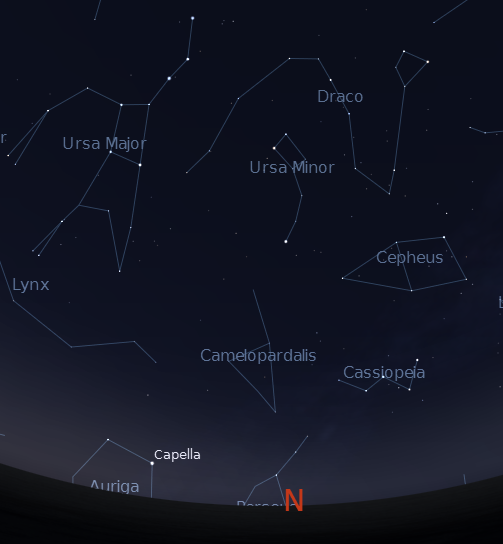
Little Dipper (Ursa Minor) and the Big Dipper (Ursa Major). Created using Stellarium.
06/05/2012 – Ephemeris – Transit of Venus is today!
Ephemeris for Tuesday, June 5th. Today the sun will be up for 15 hours and 25 minutes, setting at 9:24. The moon, 1 day past full, will rise at 10:46 this evening. Tomorrow the sun will rise at 5:58.
Early this evening we will see a rare event, the transit of the planet Venus across the sun. This will start at a few minutes after 6 p.m. When Venus will start crossing the sun from near the top. While the transit will last nearly 7 hours, we’ll see about 3 hours of it, clouds willing before the sun sets. The safety precautions are the same as viewing a solar eclipse, that is Do Not Look Directly At The Sun. Safe approved solar filters that fit in front of a telescope, projection of the sun’s image with a telescope or binoculars are the ways to view this event. The Grand Traverse Astronomical Society will be at the Open Space in Traverse City at 6 p.m. tonight for safe views of the event. The next transit of Venus will be in 2117.
Times are for the Traverse City/Interlochen area of Michigan. They may be different for your location.
Addendum
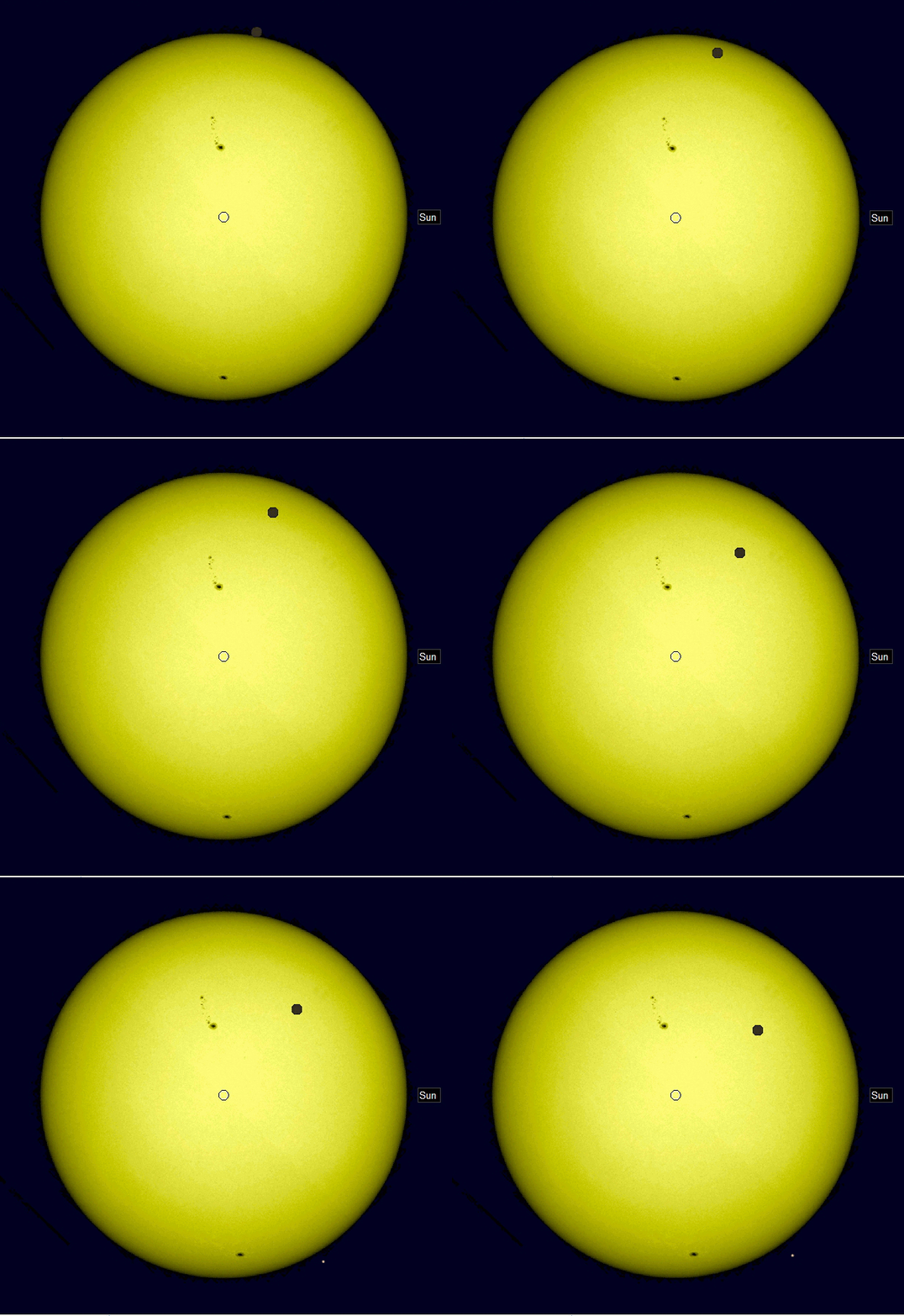
Animation of the Transit of Venus from Northern Michigan. Created using cartes du Ciel.
The Animation starts with Venus at contact 1, and every half hour until sunset. That’s why the transit ends abruptly.
For more information check out this NASA page.
How to observe the sun? The same techniques that are use to view a solar eclipse.
06/04/2012 – Ephemeris – Rare Transit of Venus is tomorrow
Ephemeris for Monday, June 4th. Today the sun will be up for 15 hours and 24 minutes, setting at 9:23. The moon, at full today, will rise at 9:51 this evening. Tomorrow the sun will rise at 5:58.
A partial eclipse of the moon is in progress this morning, but it started at moon set at 6 a.m. Tomorrow is a much rarer event, a transit of Venus across the face of the sun. This will start at a few minutes after 6 p.m. When Venus will start crossing the sun from near the top. While the transit will last nearly 7 hours, we’ll see about 3 hours of it, clouds willing. The safety precautions are the same as viewing a solar eclipse, that is Do Not Look Directly At The Sun. Safe approved solar filters that fit in front of a telescope, projection of the sun’s image with a telescope or binoculars are the ways to view this event. The Grand Traverse Astronomical Society will be at the Open Space in Traverse City at 6 p.m. Tomorrow for safe views of the event.
Times are for the Traverse City/Interlochen area of Michigan. They may be different for your location.
Addendum
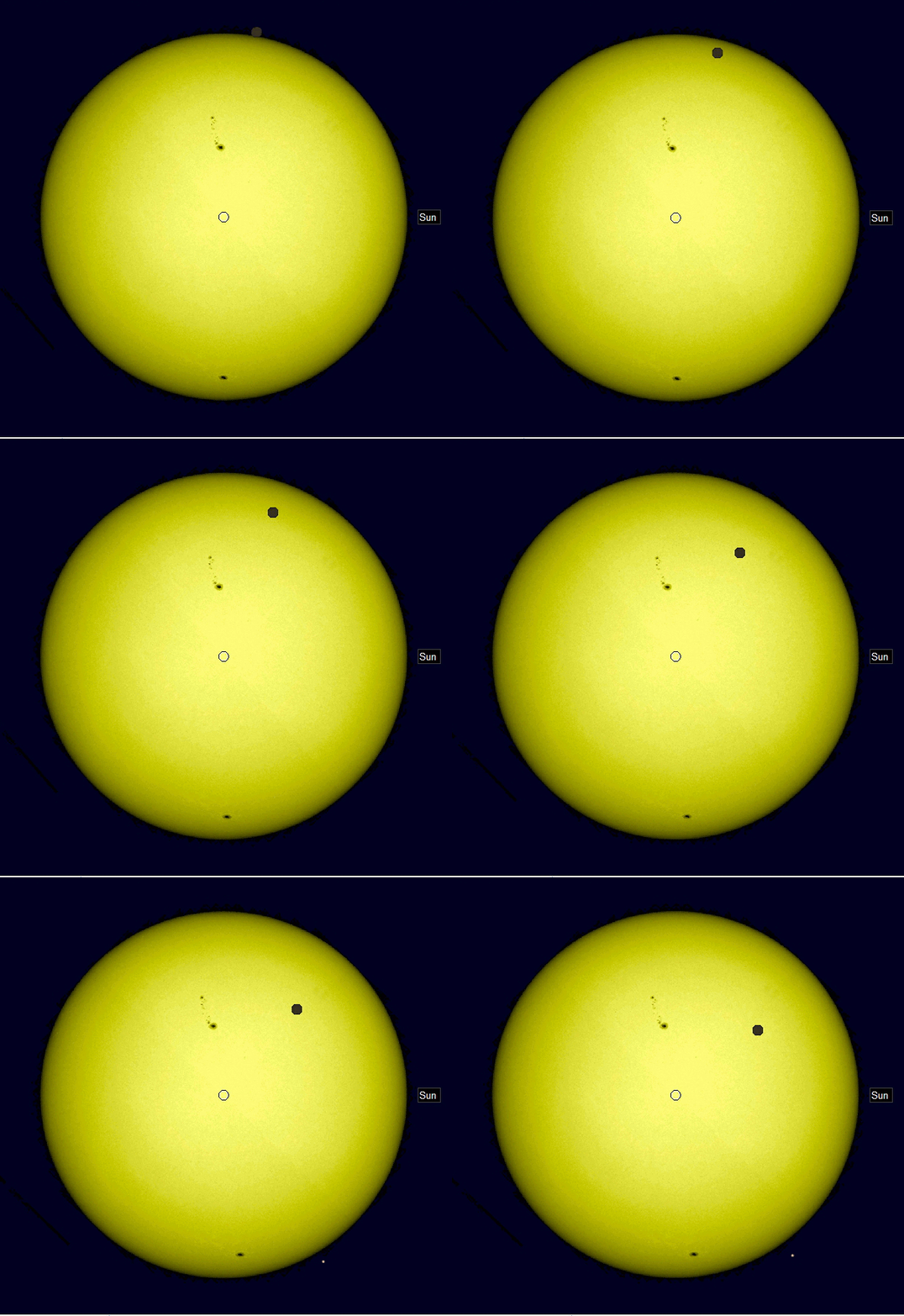
Transit of Venus as seen from the Grand Traverse Region. Created using Cartes du Ciel.
These plots are in 30 minute intervals starting around 6:10 p.m.
05/21/2012 – Ephemeris – What are the next solar eclipses to be visile from Northern Michigan?
Ephemeris for Monday, May 21st. Today the sun will be up for 15 hours and 2 minutes, setting at 9:10. The moon, 1 day past new, will set at 10:01 this evening. Tomorrow the sun will rise at 6:07.
With yesterday’s solar eclipse now history, when will we see the next one? The next solar eclipse visible from northern Michigan is another partial eclipse interrupted by sunset. That one’s on October 24, 2014, about two and a half years from now. It will be a partial eclipse for anyone able to see it. The central part of the moon’s shadow will miss earth to the north. In three years after that is a total eclipse whose path of totality crosses the United States from Oregon to South Carolina. That one is special to me. It will be the third saros periods of the first total eclipse I saw, back on July 20, 1963. Eclipses repeat in 18 years 10 or 11 1/3 days called a saros. The August 21, 2017 is that eclipse.
Times are for the Traverse City/Interlochen area of Michigan. They may be different for your location.
05/17/2012 – Ephemeris – A safe way to view this Sunday’s solar eclipse
Ephemeris for Thursday, May 17th. Today the sun will be up for 14 hours and 54 minutes, setting at 9:06. The moon, 3 days before new, will rise at 4:44 tomorrow morning. Tomorrow the sun will rise at 6:10.
Lets talk about a safe viewing method for viewing the sun, for Sunday’s solar eclipse, which starts about 8:19 p.m. Never look directly at the sun, eclipse or no. Pinhole projection is a cool method to watch the eclipse without hurting your eyes. Get a cardboard box, the longer the better. On one narrow end poke a hole, no larger than an 8th of an inch in diameter. You can poke several holes an inch apart of varying sizes to get multiple images of the sun of different brightnesses and sharpness. On the inside of the other end paste a piece of white paper. Point the holey end at the sun and its image will be projected on the white sheet. Tomorrow I’ll tell you where to go to get the best view of the eclipse.
Times are for the Traverse City/Interlochen area of Michigan. They may be different for your location.
Addendum
There’s more information on my blog here.
Pinhole projection:

Pinhole Projection of the sun.
Note the brightness of the sun was augmented and moon shadow added to give an idea what the solar image would look like. The box is 39 inches long. it gives an image 1/3 of an inch in diameter.
05/15/2012 – Ephemeris – Viewing prospects of Sunday’s solar eclipse viewed from northern lower Michigan
Ephemeris for Tuesday, May 15th. Today the sun will be up for 14 hours and 50 minutes, setting at 9:04. The moon, 3 days past last quarter, will rise at 3:51 tomorrow morning. Tomorrow the sun will rise at 6:13.
Sunday evening’s partial eclipse will begin within a minute of 8:19 p.m. for most locations in the IPR listening area. The sun will be only about a 7 degree angle above the horizon at that time. That’s slightly less than the width of your fist held at arm’s length. At sunset, at about 9:10 p.m., with the flat horizon of Lake Michigan about 50% of the sun will be covered. The farther inland you are, or east from the shore, the start of the eclipse will be about the same time, but sunset will be earlier one minute every 12 miles east you are. An obstructed horizon will make sunset earlier. Thursday and Friday I’ll have safe eclipse observing tips. Or go to my May 8th entry at bobmoler.wordpress.com for an illustrated entry.
Times are for the Traverse City/Interlochen area of Michigan. They may be different for your location.
Addendum

May 20, 2012 eclipse from northern Michigan just before sunset. Created using Stellarium.
04/20/2012 – Ephemeris – The Lyrid meteor shower peaks this weekend.
Ephemeris for Friday, April 20th. The sun rises at 6:49. It’ll be up for 13 hours and 45 minutes, setting at 8:34. The moon, 1 day before new, will rise at 6:41 tomorrow morning.
The Lyrid meteor shower is reaching a peak soon. With the nearly new moon, the moon will not interfere with the display. While this a major annual shower, it usually produces only 15 meteors an hour at peak, although in some years as many as 90 an hour have been spotted. The Lyrids are so named because the seem to come from the direction of the constellation Lyra the harp, one of the more famous summer constellations. Well, they seen to come from between Lyra and Hercules to the west. The peak of the shower occurs just after midnight on Sunday morning the 22nd. The radiant point is up all night. In the evening the meteors will come from the northeast from near the bright star Vega. The numbers of meteors will increase through the night until dawn.
* Times are for the Traverse City/Interlochen area of Michigan. They may be different for your location.
Addendum
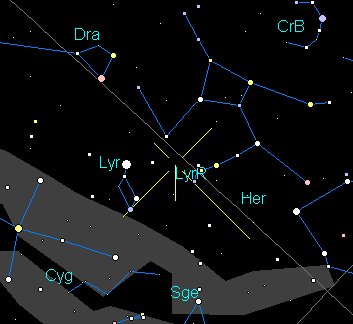
Lyrid meteor radiant. The bright star is Vega
04/02/2012 – Ephemeris – Venus will pass the Pleiades tonight
Ephemeris for Monday, April 2nd. The sun will rise at 7:20. It’ll be up for 12 hours and 51 minutes, setting at 8:11. The moon, 3 days past first quarter, will set at 5:14 tomorrow morning.
This evening Venus starts a pass by the Pleiades star cluster. The Pleiades is also known as the Seven Sisters and soon it will disappear in the twilight glow. The next time it will be seen in the evening is in next October. Venus will head back toward the sun, which it will pass directly in front of on June 5th. The sun will pass the Pleiades in mid May, so Venus will never quite make it back to the Pleiades this go around anyway. Though Venus is beginning to head back to the sun, it is still moving eastward against the stars, though a little slower than the sun. Right now Venus is mostly heading toward us. Around the 16th of May Venus will finally stop its eastward motion with respect with the stars and will head westward.
* Times are for the Traverse City/Interlochen area of Michigan. They may be different for your location.
Addendum
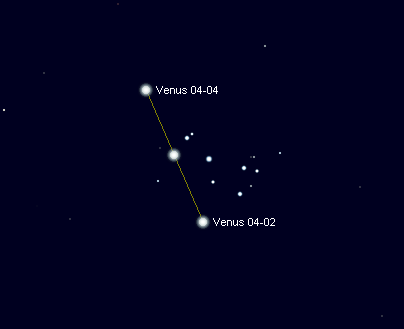
Venus passing the Pleiades April 2 - 4, 2012. Created using Cartes du Ciel.
In the real sky Venus is a heck of a lot brighter than you see here. And with binoculars, you’ll see a lot more stars in the Pleiades.
The sun is staying active – Check out the skies for the northern lights for the next few nights
Solar flares erupting from AR (Active Region) 1429, the big sunspot group now seen on the face of the sun, are sending clouds of charged particles toward the earth. Three flares in the last three days will provide an enhanced chance for auroral displays over the next few nights.
That’s both aurora borealis, northern lights and auroral australis, southern lights for or southern hemisphere friends.
Keep checking www.spaceweather.com for the latest information.
Also keep checking the western sky after sunset for Jupiter and Venus passing each other. These are the two brightest planets.

