Archive
03/08/2012 – Ephemeris – The full moon
Ephemeris for Thursday, March 8th. The sun will rise at 7:06. It’ll be up for 11 hours and 33 minutes, setting at 6:40. The moon, at full today, will rise at 7:30 this evening.
The full moon, contrary to what you’d think is a poor time to observe it. The moon is essentially gray on gray. And at full moon we are looking at the moon from about the same perspective as the sun, so there are no shadows to delineate its fine features. Since the actual instant of full moon occurred at 5 this morning, some shadows will be creeping in on the moon’s upper right face as it is seen in the evening. Full moon is the best time to see the maria or lunar seas, the dark areas that make up the man in the moon. In binoculars can be seen the bright rays emanating from the crater Tycho near the south end of the moon. Other craters have rays too, but none so long and distinctive. Night by night for the next two weeks the moon’s illuminated landscape will wane.
* Times are for the Traverse City/Interlochen area of Michigan. They may be different for your location.
Addendum
The image below is of the waxing gibbous moon presumably from last Sunday night. The phase fits Virtual Moon Atlas for that date. And I received the photo Monday. many of the full moon features including the maria and the crater Tycho can be seen on it. Click on it to see the larger version.
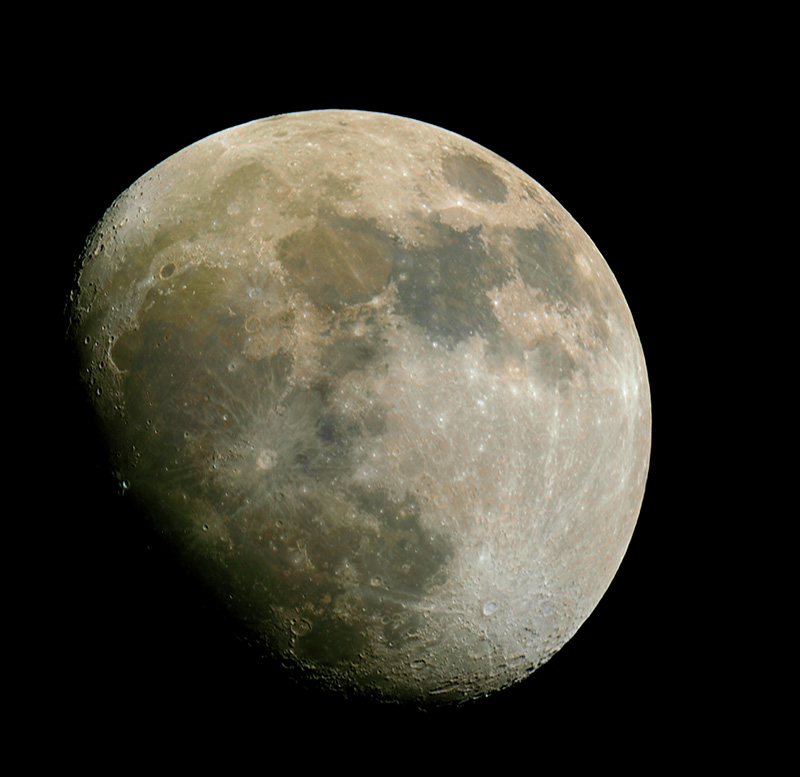
The gibbous moon 03/04/2012 by Scott Anttila
This is from Scott: “The full-size image is huge, a 6 panel mosaic by my DSLR in the (Celestron) C11. It has had the saturation boosted to show detail in the seas that otherwise is difficult if not impossible to detect. You can also see where different minerals are located in the highland areas. Not many people like this view of the moon, I’m fairly fond of it.”
03/07/2012 – Ephemeris – Where are the bright planets this week?
Ephemeris for Wednesday, March 7th. The sun will rise at 7:08. It’ll be up for 11 hours and 30 minutes, setting at 6:38. The moon, 1 day before full, will set at 6:47 tomorrow morning.
Let’s see what’s happening with the bright planets for this week. Mercury will make a brief appearance in the west after sunset. It will set at 8:15. Venus is brilliant in the western sky after sunset and will set at 10:39 in the west. Jupiter the second brightest planet after Venus is located just above it. They are approaching each other. Jupiter will set at 10:57 p.m.. Mars is up by sunset in the east and is in the constellation Leo the lion. It is 62.6 million miles away . It’s now as bright as most first magnitude stars. Mars will pass due south at 12:37 a.m. and will be setting in the west at sunrise. Saturn will rise at 10:00 p.m. just to the left of the bright star Spica in the east southeast. The moon will appear near it on Saturday evening.
* Times are for the Traverse City/Interlochen area of Michigan. They may be different for your location.
Addendum
Below is Mars a photo by Scott Anttila.
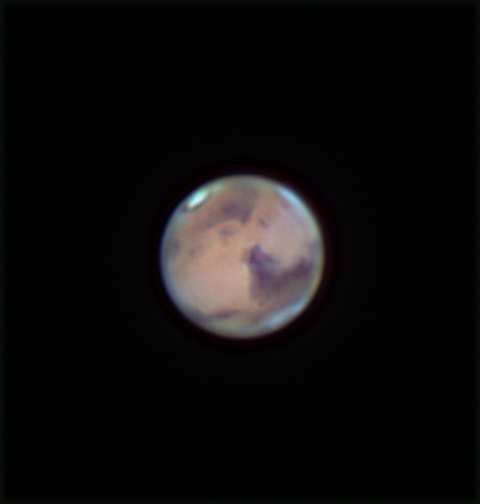
Mars on the morning of March 5, 2012 by Scott Anttila
Scott’s description: “Near 100% illumination, Syrtis Major, the Horse Tail, small polar cap, clouds all around the equatorial area. It is a quick and dirty processing of the Image. There might be more detail that can be teased out when I have more time.”
Syrtis Major is the large dark area. The name means Great Swamp. i am unfamiliar with the Horse Tail. I’m guessing that it’s the linear dark feature on the lower left of the image. If so the proper name is Sinus Sabaeus. Sinus is “Bay”. Ther are no bays or swamps on bone dry Mars or for that matter seas on the moon. The names were established before the nature of these features were known.
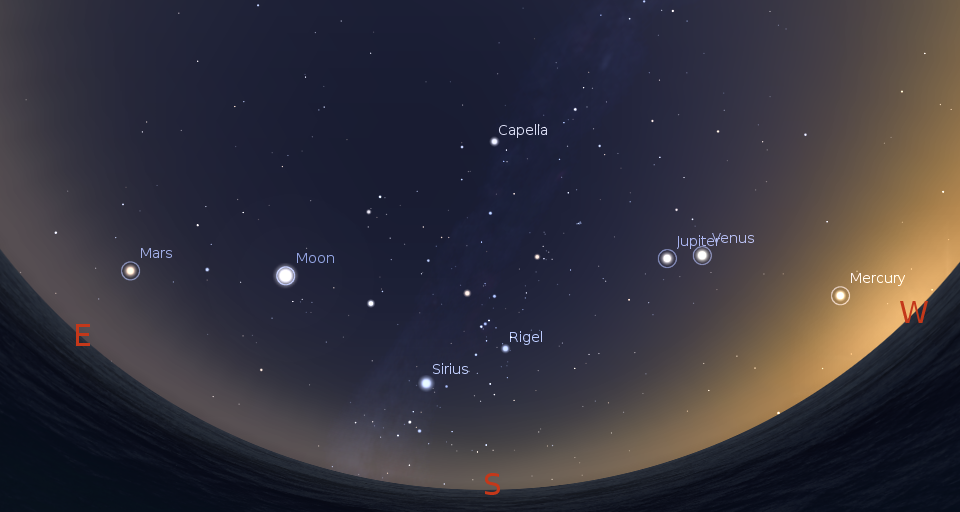
The sky after sunset showing all the evening planets. Created using Stellarium.
This is from Monday, but still pretty close to tonight’s view.
03/05/2012 – Ephemeris – Mars closest and Mercury at greatest elongation from the sun
Ephemeris for Monday, March 5th. The sun will rise at 7:12. It’ll be up for 11 hours and 24 minutes, setting at 6:36. The moon, 3 days before full, will set at 5:48 tomorrow morning.
The planet Mars is at its closest to the earth of this time around today. The distance is 62.6 million miles. All planets have elliptical orbits. The Earth varies its distance from the sun by 3 million miles. Mars has a remarkably elliptical orbit which varies its distance from the sun by nearly 30 million miles. It is now at its farthest from the sun. Another small planet is making its appearance in the evening sky now. That’s Mercury seen low in the west after sunset, much closer to the horizon than bright Venus and Jupiter. Mercury is at its greatest apparent distance or elongation from the sun. Mercury will set at 8:14 p.m. It is hard to spot in twilight, so binoculars will help. Like Mars Mercury’s orbit is also very elliptical.
* Times are for the Traverse City/Interlochen area of Michigan. They may be different for your location.
Addendum
The southern sky with the planets at 7:15 p.m. Created using Stellarium.
The sky after sunset showing all the evening planets. Created using Stellarium.
Click on the image to enlarge.
02/28/2012 – Ephemeris – The moon will pass south of the Pleiades tonight
Ephemeris for Tuesday, February 28th. The sun will rise at 7:22. It’ll be up for 11 hours and 5 minutes, setting at 6:28. The moon, 1 day before first quarter, will set at 1:34 tomorrow morning.
The fat crescent moon will appear below the Pleiades star cluster tonight. The Pleiades is also known as the Seven Sisters. With the moon as bright as it is the stars of the Pleiades may not be easily spotted, so a pair of binoculars might be needed. The Pleiades will appear nearly 8 moon diameters above the moon, so they might escape the moon’s glare somewhat. The moon will pass the Pleiades every 28 and a fraction days. Sometimes it passes south of the cluster, and sometimes north of it, and occasionally it passes in front of the stars of the cluster. The moon’s orbit of the earth wobbles or precesses once every 18.6 years. It’s why eclipses occur at different times of the year, and generally earlier one year to the next.
* Times are for the Traverse City/Interlochen area of Michigan. They may be different for your location.
Addendum
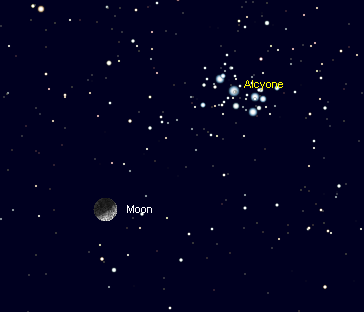
The moon south of the Pleiades at 10:19 p.m. February 28, 2012 from Michigan . Chart created using Cartes du Ciel (Sky Charts)
01/25/2012 – Ephemeris – Where are the planets this week?
Ephemeris for Wednesday, January 25th. The sun will rise at 8:08. It’ll be up for 9 hours and 31 minutes, setting at 5:40. The moon, 2 days past new, will set at 8:42 this evening.
It’s time again to take a look at the whereabouts of the bright planets. Venus is brilliant in the southwestern sky after sunset and will set at 9:01 in the west. Jupiter is the most prominent planet of the evening sky, once Venus sets. It’s located high in the south southeast as it gets dark and is seen against the stars of the constellation Aries. It will pass due south at 6:21 p.m. and it will set at 1:08 a.m.. Mars will rise at 9:36 p.m in the east northeast and is below the hind end of the constellation Leo the lion. It is 76.7 million miles away and closing and has been getting brighter. It’s now as bright as most first magnitude stars. Mars will pass due south at 4:02 a.m. Saturn will rise at 12:49 a.m. just to the left of the bright star Spica in the east southeast.
* Times, as always are for the Traverse City/Interlochen area of Michigan.
Addendum
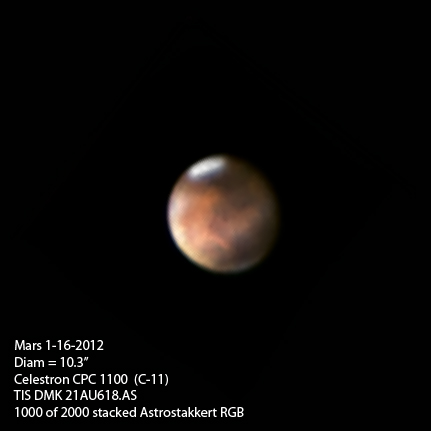
Mars 9 days ago. Photograph by Scott Anttila
Another gorgeous shot of Mars by Scott Anttila. At the time Mars appeared 10.3 seconds of arc in diameter. By comparison the moon and sun appear about 1,800 seconds of arc in diameter. Note that Mars appears slightly gibbous in shape. It will appear full on March 3rd. when it will be in opposition from the sun. It will be closest to us on March 5th. at about 62.6 million miles. At that time it will have an apparent diameter of 13.9 seconds of arc.
The CME from Monday hit the earth’s magnetic field at 10:10 a.m. EST
A geomagnetic storm is now raging above us and is inducing currents in the ground and transmission lines.. On the bright side look for a aurorae (Norther or Southern Lights) tonight!
01/24/2012 – Ephemeris – The face of the constellation Taurus – The Hyades
Ephemeris for Tuesday, January 24th. The sun will rise at 8:09. It’ll be up for 9 hours and 29 minutes, setting at 5:39. The moon, 1 day past new, will set at 7:36 this evening.
To the upper right of the constellation Orion in the south in the evening is a letter V of stars with a bright orange star at one tip. This is the face of Taurus the bull. In some constellation depictions the bull is charging Orion who is turned to face him. The V of stars isn’t very bright and are outshone by the Pleiades star cluster to the right in Taurus’ shoulder. In Greek mythology the V of stars are the Hyades, half sisters of the Pleiades. It is a star cluster like the Pleiades and very important, because it is the closest star cluster to us at 153 light years distant. It helped determine the scale of the universe. The bright star at the tip is Aldebaran the follower (of the Pleiades). It is not part of the Hyades and is less than half way to it at 65 light years.
* Times, as always are for the Traverse City/Interlochen area of Michigan.
Addendum
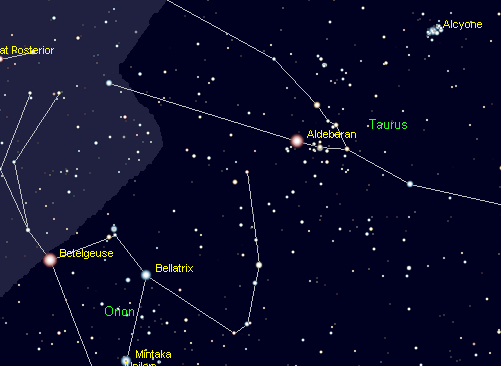
The Hyades, Orion and the Pleiades. Created using Cartes du Ciel
Another possible aurora due Tuesday January 24th, 2012
Just got this from http://www.spaceweather.com that a CME erupted from the sun today. It should reach the earth later tomorrow or early Wednesday. Look for aurorae (northern or southern lights depending on your hemisphere).
01/17/2012 – Ephemeris – The Great Orion Nebula part 1
Ephemeris for Tuesday, January 17th. The sun will rise at 8:15. It’ll be up for 9 hours and 15 minutes, setting at 5:30. The moon, 1 day past last quarter, will rise at 3:43 tomorrow morning.
One of the great questions of Christian theologians of Galileo’s time was why God would create stars that no human could see with the naked eye. Galileo’s primitive telescope showed a myriad of formerly invisible stars. Starting with Galileo, astronomers have shown that the stars weren’t made for man, and neither are the stars eternal. Stars are born and die, some spectacularly as supernovae. In the constellation of Orion the hunter, below the three stars of his belt are what appear another three stars hanging down as his sword.. Looking at what appears as the middle star with binoculars or a telescope one can detect a haze, a nebula astronomers call it. This is the Great Orion Nebula, even now the birthplace of stars.
* Times, as always are for the Traverse City/Interlochen area of Michigan.
Addendum
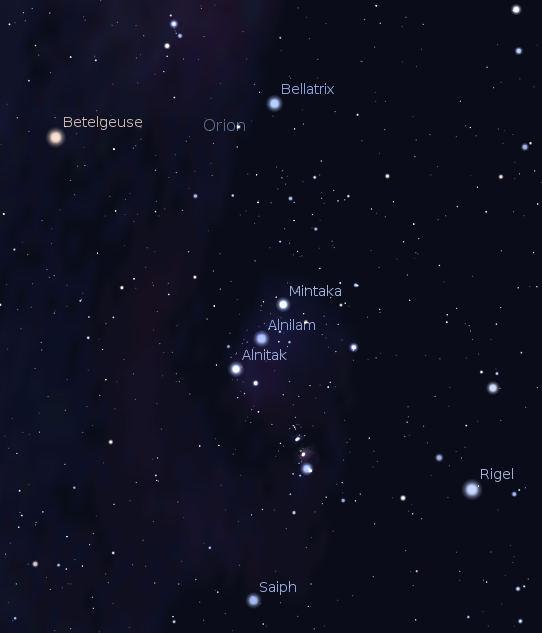
Torso of Orion centered on his belt. Created using Stellarium.
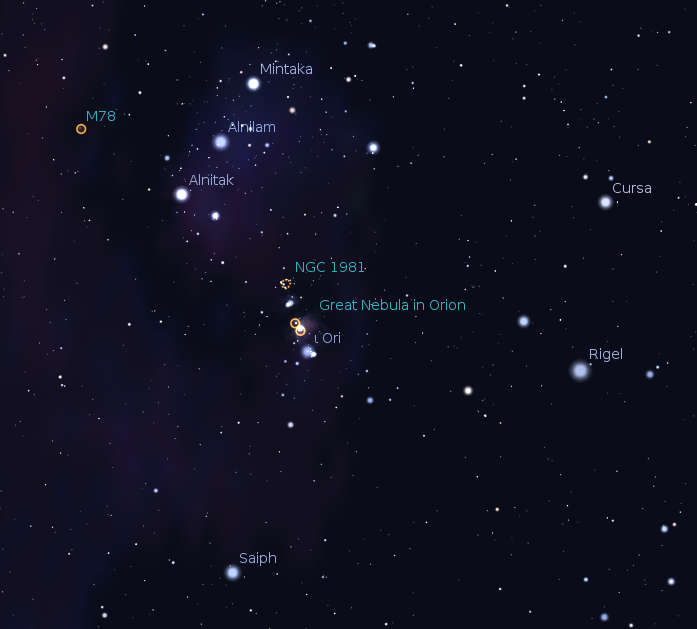
The lower part of Orion with the Great Orion Nebula. Created using Stellarium.
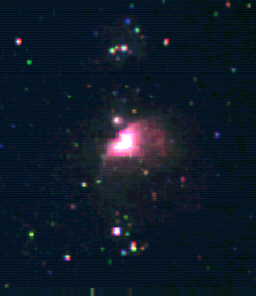
Great Orion Nebula in Orion's sword. My old photograph.
Note: The Great Orion Nebula usually photographs red due to the great abundance of the element hydrogen. However at low light levels our eyes are not sensitive to that particular color. So in the eyepiece the nebula looks gray or greenish due to the emission of hydrogen in the green and that of doubly ionized oxygen.
The Great Orion Nebula is also known by astronomers as M42 or Messier 42, a catalog of bright sky objects.
01/16/2012 – Ephemeris – The moon will appear below Saturn and Spica this morning
Ephemeris for Martin Luther King Day, Monday, January 16th. The sun will rise at 8:15. It’ll be up for 9 hours and 13 minutes, setting at 5:29. The moon, at last quarter today, will rise at 2:31 tomorrow morning. | This morning the crescent moon will appear below Saturn and the bright blue-white star Spica in the southeast before twilight brightens too much. When seen together Saturn and Spica really show the difference in their colors. Saturn reflects the light of our yellow sun, and that’s accentuated by it’s cream colored clouds. Only Saturn’s rings reflect the sun’s light pretty much unaltered because they’re made mostly of ice. Spica has the hottest surface temperature of any first magnitude star and shines with a blue tinge. This came home to me a long time ago, when I photographed a lunar eclipse with color film when the moon was next to Spica. Spica came out looking very blue indeed.
* Times, as always are for the Traverse City/Interlochen area of Michigan.
Addendum
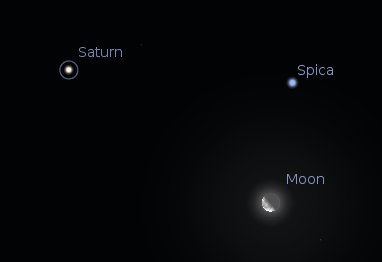
Saturn, Spica and the Moon on the morning of January 16, 2012. Created using Stellarium.

