Archive

Archive for the ‘Observing’ Category

Ephemeris: 05/23/2025 – M13, The Great Hercules Star Cluster

May 23, 2025 Comments off

This is Ephemeris for Friday, May 23rd. Today the Sun will be up for 15 hours and 6 minutes, setting at 9:13, and it will rise tomorrow at 6:05. The Moon, halfway from last quarter to new, will rise at 4:13 tomorrow morning.

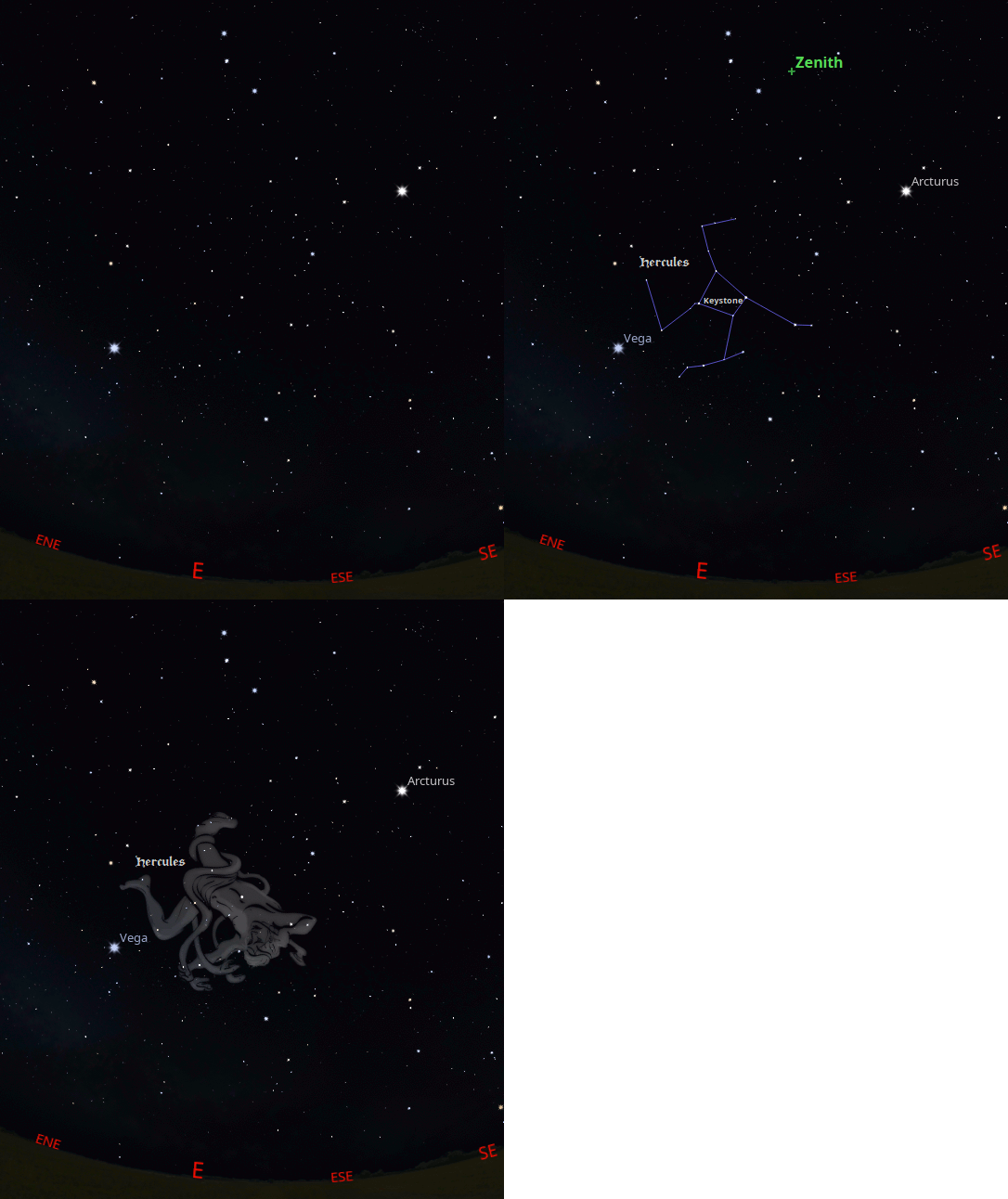
The constellation Hercules the hero can be found between the bright stars Vega which is fairly low in the east northeast and Arcturus high in the southeast. It’s about 1/3 of the way from Vega to Arcturus. His most distinctive feature is the keystone a box of four stars wider at the top than the bottom. Along the western edge of the keystone can be seen, sometimes with the naked eye, but better with binoculars as a small spot about 1/3 of the way down from the top star to the bottom star. It looks like a fuzzy spot. In telescopes smaller than 8 inch diameter, at least with my eyes, it stays fuzzy, but in larger telescopes it begins to crystallize out into a myriad of stars. It is the Great Hercules Globular Star Cluster. Number 13 on late 18th century astronomer Charles Messier’s catalog of fuzzy objects that weren’t the comets he was looking for. We know it as Messier 13, or M13.

The astronomical event times given in this blog are for the Traverse City/Interlochen area of Michigan (Lat 44.7° N, Long 85.7° W; EDT, UT – 4 hours) unless stated otherwise. Times will be different for other locations.

Addendum
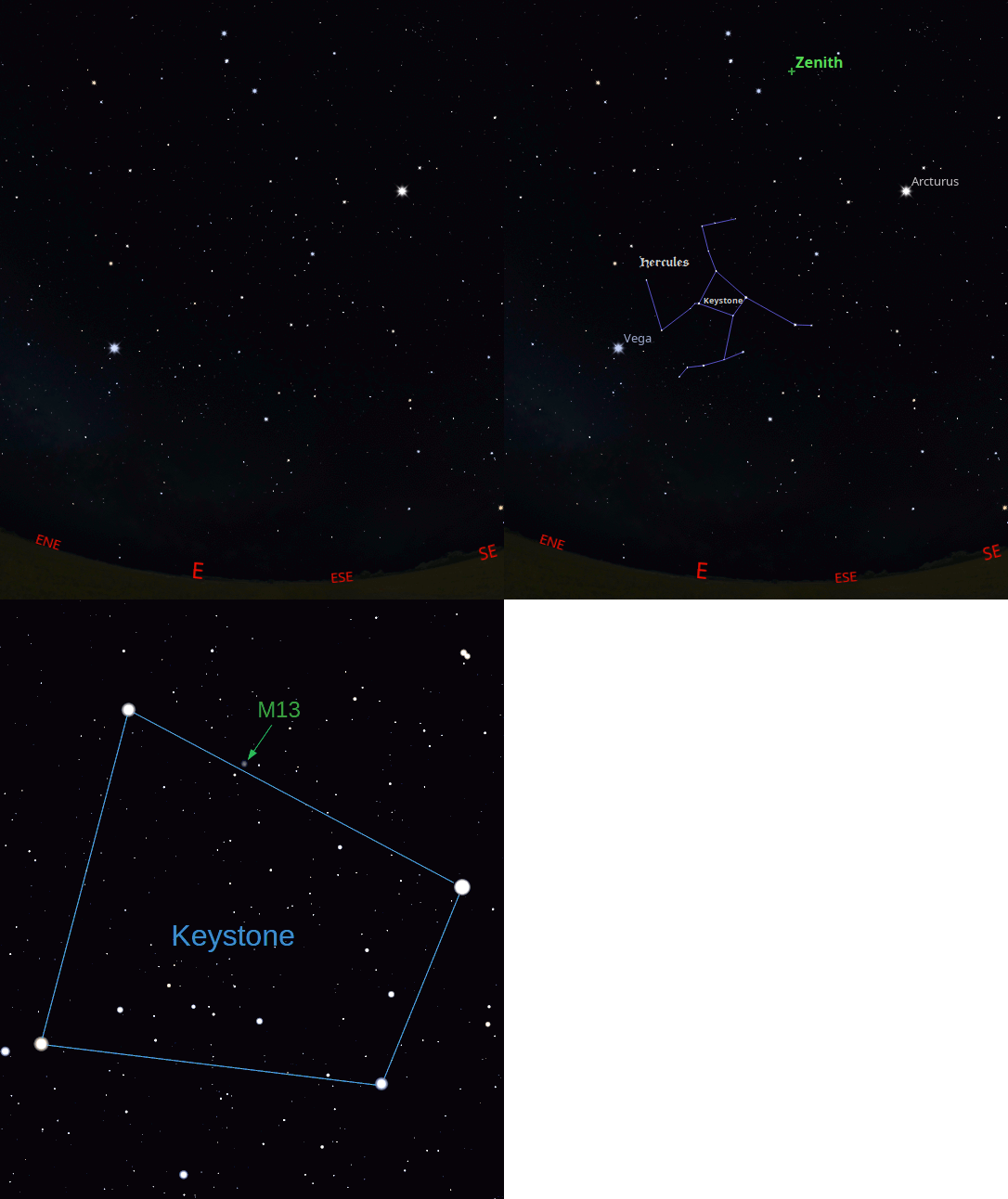
How to find the Great Hercules Star Cluster M13 in three frames. First the eastern sky without annotations, then adding the constellation lines for Hercules and reference star names of Vega and Arcturus, then a binocular view of the Keystone with M13 pointed out. The last view was what one would see with a pair of binoculars. Created using Stellarium, LibreOffice Draw, and GIMP.
M 13
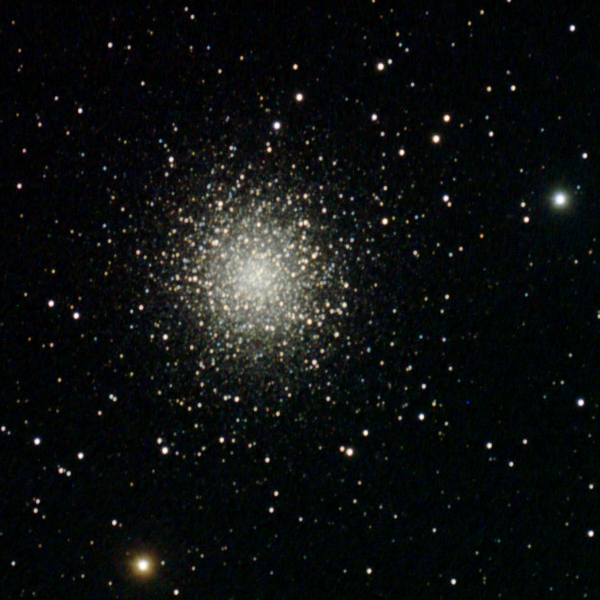
M13, the Great Globular Star Cluster in Hercules. Note the two stars to the right and below left that frame the star cluster, and identify this cluster as M13 and not another of the globular clusters visible in telescopes. This gives a view close to that as seen in large amateur telescopes. Credit: Scott Anttila.
M13 Great Globular Cluster in Hercules
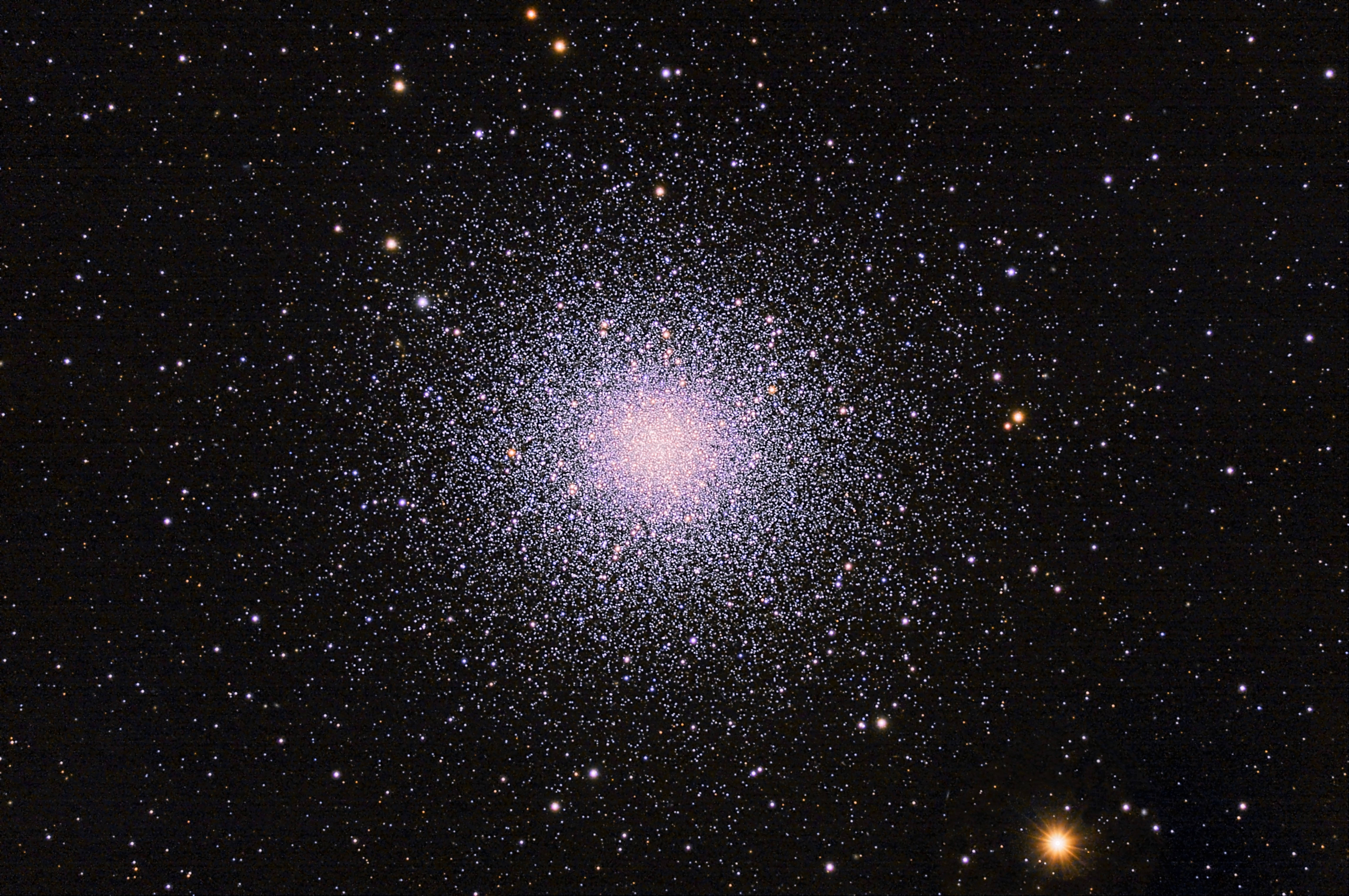
M 13 or Messier 13, the Great Hercules Globular Star Cluster, contains hundreds of thousands of stars, and is located around 25 thousand light years away. Credit: Daniel Dall’Olmo, Grand Traverse Astronomical Society member. Click or tap on the image to enlarge it.

Ephemeris: 05/22/2025 – Finding Hercules among the spring stars

May 22, 2025 Comments off

This is Bob Moler with Ephemeris for Thursday, May 22nd. Today the Sun will be up for 15 hours and 5 minutes, setting at 9:12, and it will rise tomorrow at 6:06. The Moon, 2 days past last quarter, will rise at 3:51 tomorrow morning.

In the eastern sky at 11 PM about a third of the way along the line from the bright star Vega in the east northeast and Arcturus high in the southeast is the constellation of Hercules the hero. It’s kind of hard to spot, although it’s one distinctive feature is the box of four stars called the Keystone of Hercules which means it’s wider at the top than at the bottom. That is his body. He’s upside down in the sky according to how they draw the picture of Hercules. Most of his stars are reasonably dim. This is the great hero of Greek myth. While in the winter sky the bright and splashy constellation of Orion the hunter, was kind of a hard luck hero, with no real accomplishments. Hercules has an astronomical jewel that I’ll talk about tomorrow.

The astronomical event times given in this blog are for the Traverse City/Interlochen area of Michigan (Lat 44.7° N, Long 85.7° W; EDT, UT – 4 hours) unless stated otherwise. Times will be different for other locations.

Addendum
A finder for Hercules
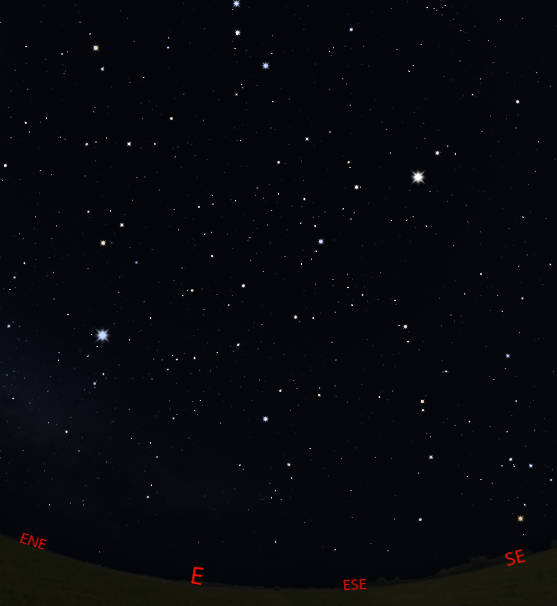
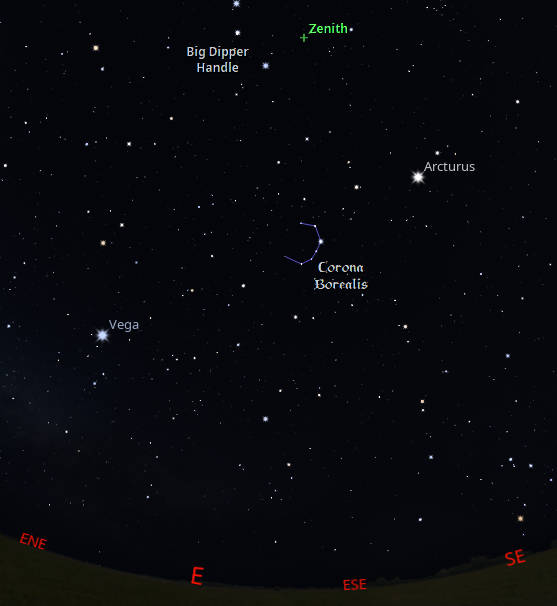
A finder for Hercules. Looking towards the eastern sky, from the horizon to the zenith, for Vega in the east northeast and Arcturus high in the southeast. The three stars near the zenith are the handle stars of the Big Dipper whose arc points to Arcturus. A third of the way from Vega to Arcturus can be found Hercules with its Keystone of four stars, a distinctive pattern though they aren’t very bright. Hercules is seen upside down, and in the artist’s figure from Stellarium he appears to be fighting the Hydra. Created using Stellarium, LibreOffice Draw, and GIMP.

Ephemeris: 05/21/2025 – Checking where the naked-eye planets are

May 21, 2025 Comments off

This is Bob Moler with Ephemeris for Wednesday, May 21st. Today the Sun will be up for 15 hours and 3 minutes, setting at 9:11, and it will rise tomorrow at 6:07. The Moon, 1 day past last quarter, will rise at 3:32 tomorrow morning.

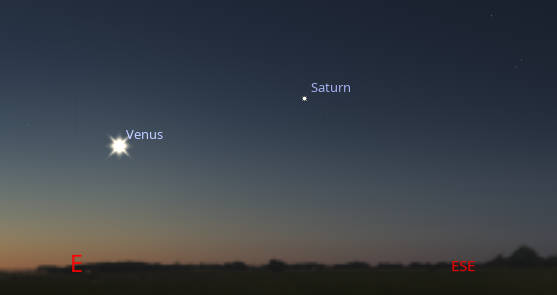
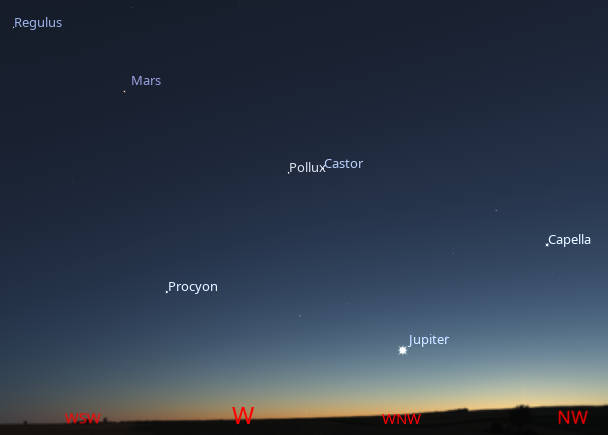
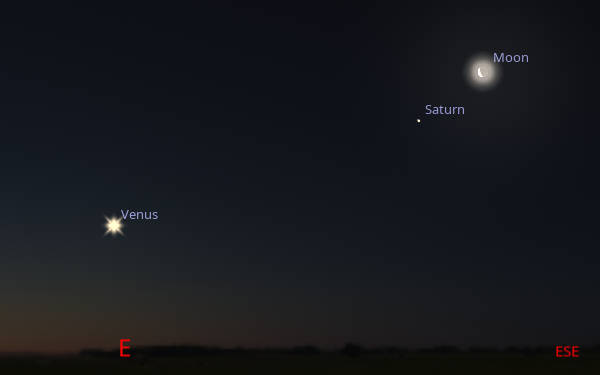
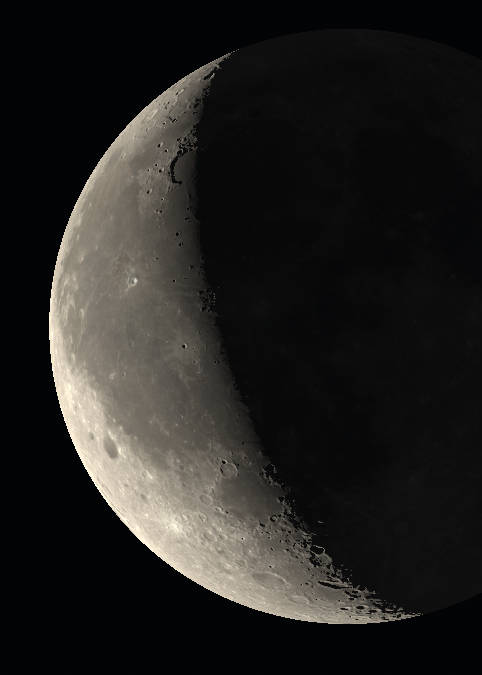
Let’s take our weekly look at the whereabouts of the naked-eye planets. At 10 PM this evening two naked eye planets will be out. Jupiter, is now low in the west-northwestern sky. The rapidly fading Mars, with its distinctive reddish hue, is in the west-southwest, at that time. Once it’s darker binoculars can be used to spot the Beehive Star Cluster to its lower right. By 5 AM Venus will be seen very low in the east, as the Morning Star, with Saturn and the waning crescent Moon in an upward line to the right and a bit above it. Venus will require a low eastern horizon then. But it will rise and be visible until close to 5:45 or later. For those with telescopes, Saturn’s rings are now opening up again, and will for the next 7 years.

The astronomical event times given in this blog are for the Traverse City/Interlochen area of Michigan (Lat 44.7° N, Long 85.7° W; EDT, UT – 4 hours) unless stated otherwise. Times will be different for other locations.

Addendum
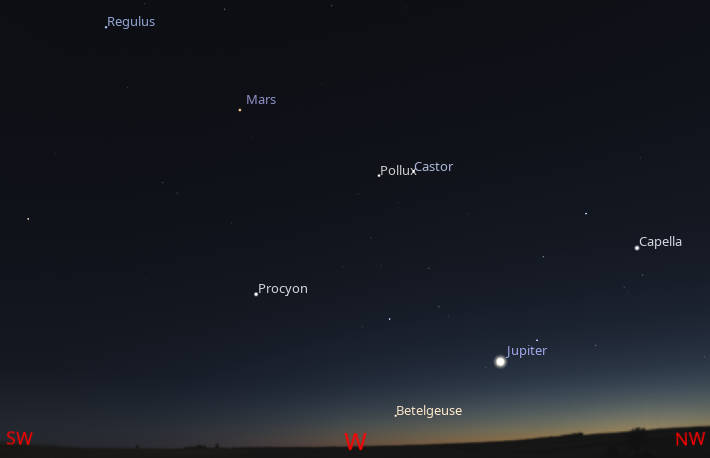
The evening planets Jupiter and Mars seen with the fading stars of winter at 10 PM
The evening planets Jupiter and Mars seen with the fading stars of winter at 10 PM, on May 21st, 2025. Created using Stellarium and GIMP.
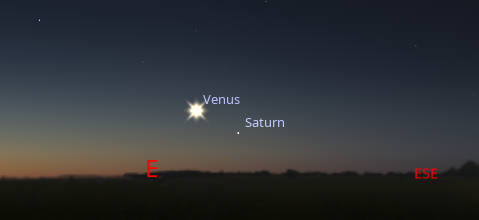
Venus, Saturn and the waning crfescent Moon at 5 AM tomorrow morning, May 22nd, 2025, low in the east. Created using Stellarium.
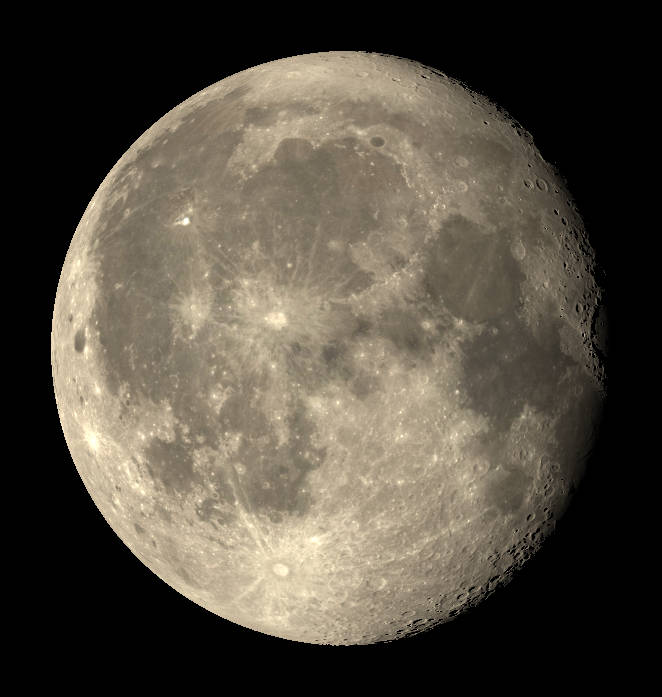
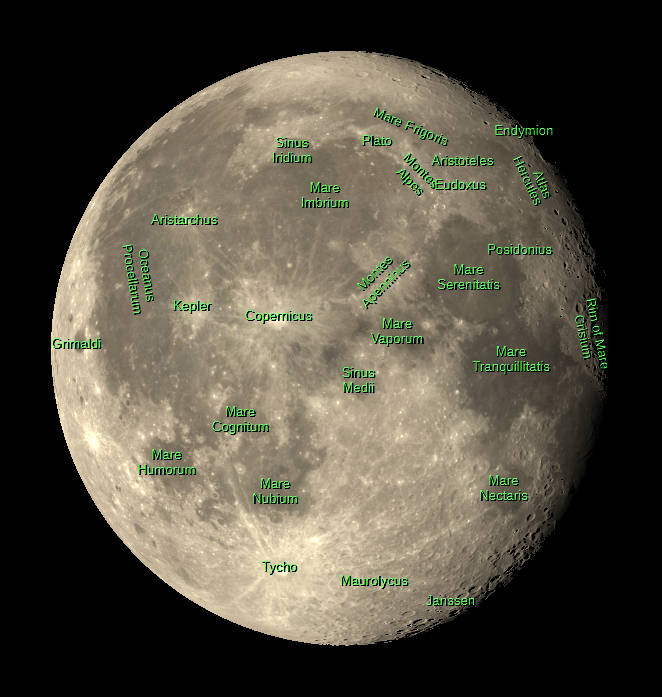
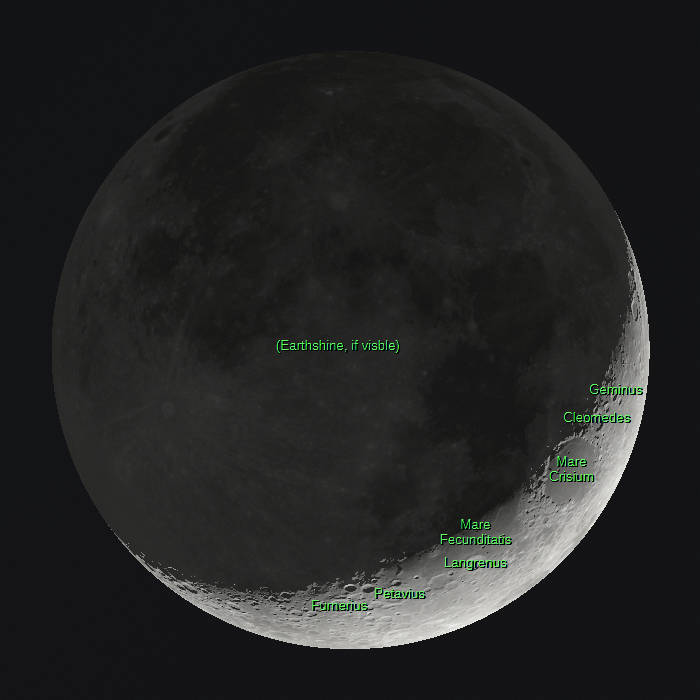
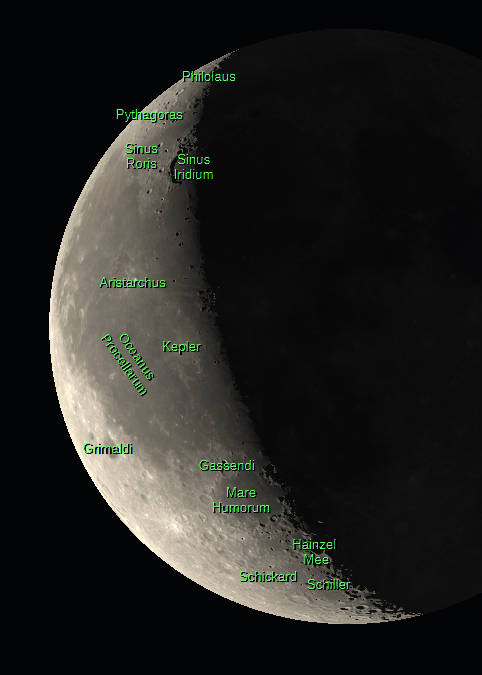
The waning crescent Moon tomorrow morning, May 22nd, 2025, in its orientation at 5 AM. A view visible in small telescopes showing an image with and without selected features labeled. Created using Stellarium, LibreOffice Draw, and GIMP.
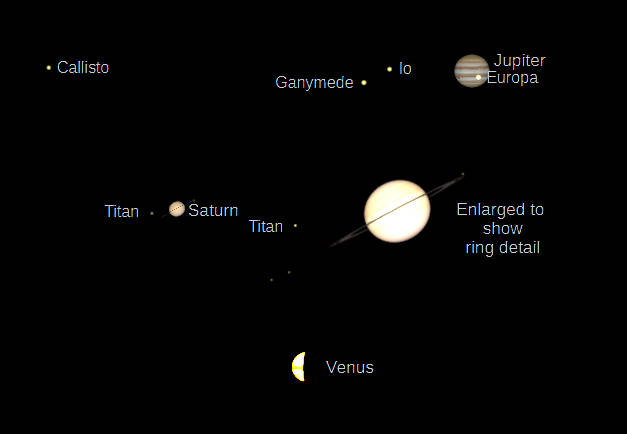
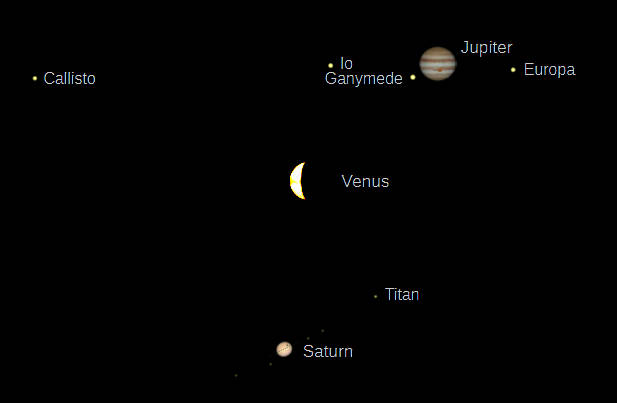
Telescopic Jupiter, Venus and Saturn as they would be seen in a small telescope with the same magnification
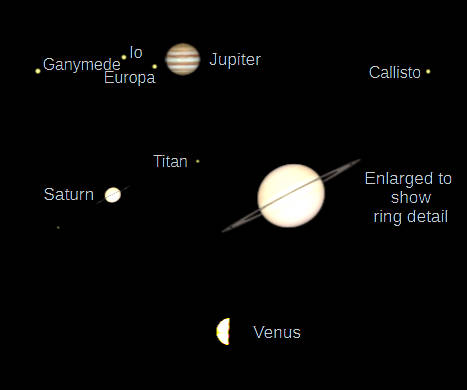
Telescopic Jupiter, Venus and Saturn (north up) as they would be seen in a small telescope with the same magnification. Jupiter is shown for tonight, 10 PM, May 21, 2025. Its apparent diameter is 32.7″. Mars is 5.8″ in diameter, too small to be shown here. My lower size limit is 10″. Venus is shown in the morning of the 22nd. Its apparent diameter is 26.9″, and is 44.0% iluminated. Saturn is 16.6″ in diameter, but its rings, being nearly edge on may not be visible, but extend to 38.6″. They are 2.8 degrees from being edge on and barely illuminated. Planetary surface detail is more subtle than shown here. The ” means seconds of arc, or 1/3600th of a degree. Created using Cartes du Ciel (Sky Charts).
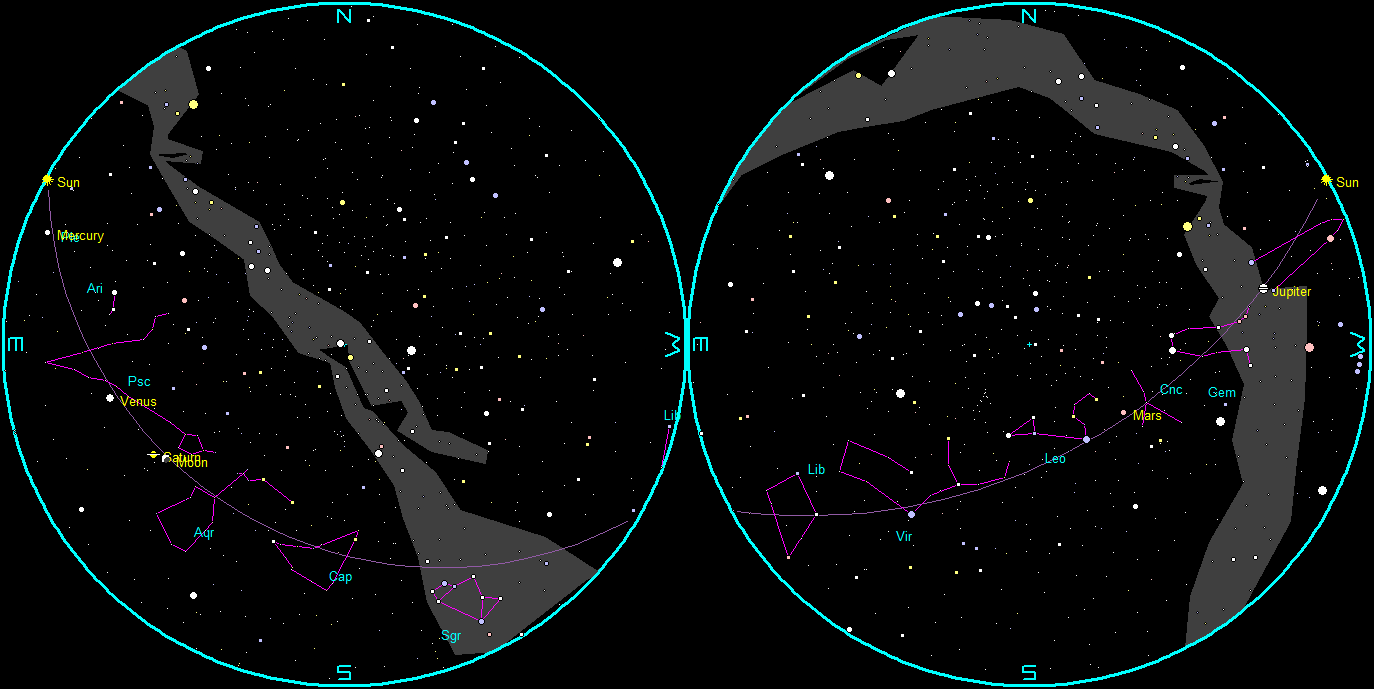
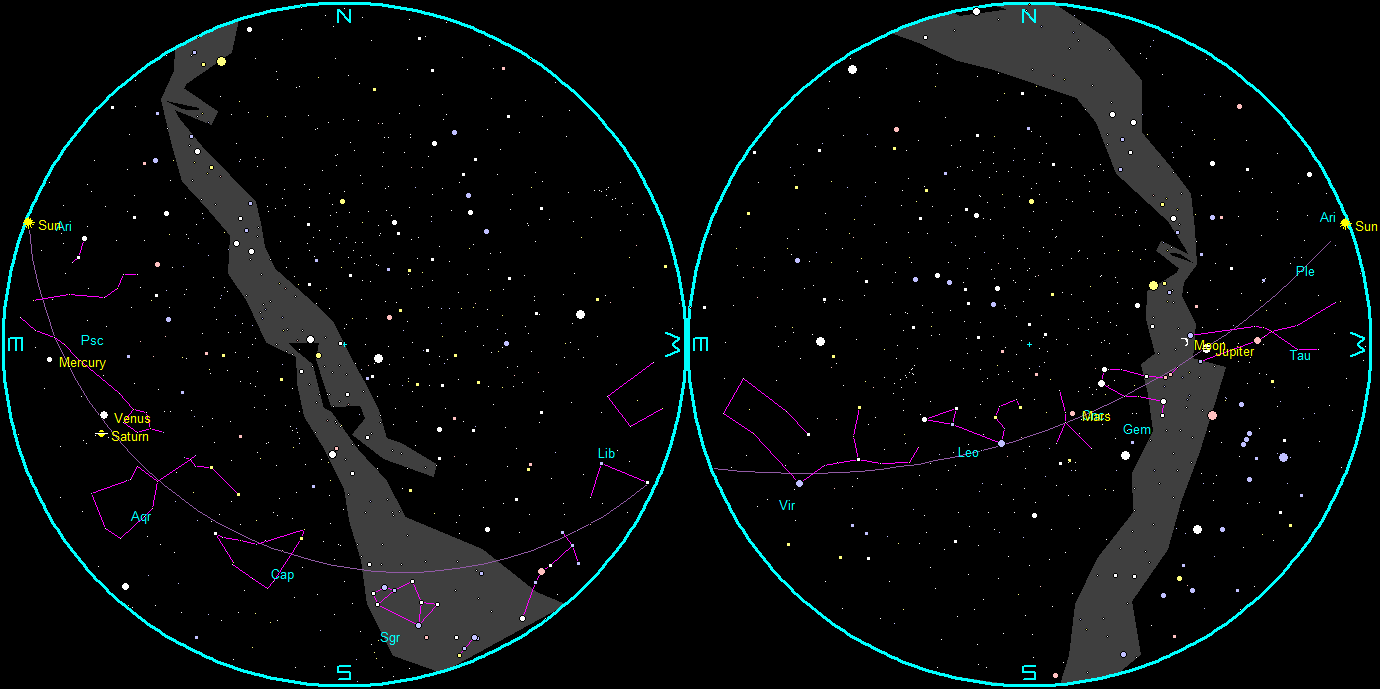
The naked-eye planets and the Moon at sunset and sunrise on a single night
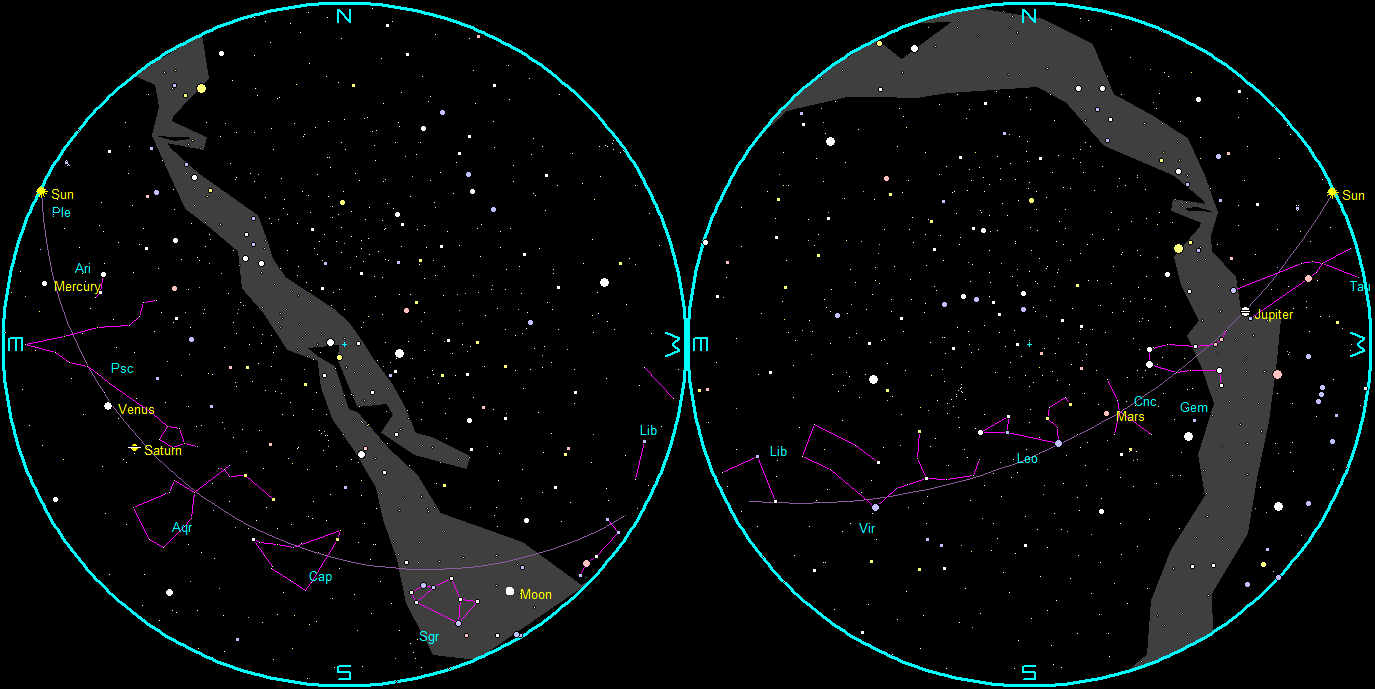
The naked-eye planets and the Moon at sunset and sunrise on a single night, starting with sunset on the right on May 21, 2025. The night ends on the left with sunrise on the 22nd. Click or tap on the image to enlarge it. Created using my LookingUp app and GIMP.
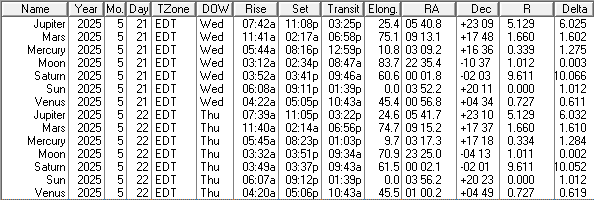
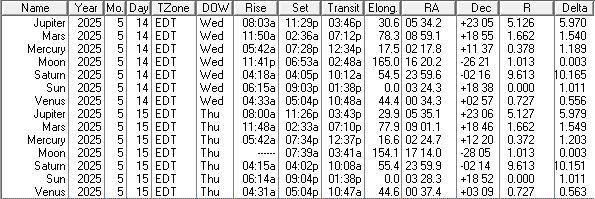
This is a low precision ephemeris of the Sun Moon and naked eye planet positions for today and tomorrow, May 21st and 22nd, 2025. Some of the columns are self-explanatory, others are not. The transit column is the time that the body crosses the meridian and is due south. Elong, for elongation, is the angle between the Sun and that body. RA is right ascension, which is the object’s east-west position on the celestial sphere in hours and minutes. Dec is declination which is the north-south position of the object on the celestial sphere in degrees and minutes. R is the distance of that object from the Sun in astronomical units. An astronomical unit is about 93 million miles or 150 million kilometers. And Delta is the distance of that object from the Earth, also in astronomical units. I omit the ‘m’ in am and pm for compactness. The data was generated using my LookingUp for DOS app and displayed as a table by my Ephemeris Helper app.

Ephemeris: 05/20/2025 – Corona Borealis, Ariadne’s Crown

May 20, 2025 Comments off

This is Ephemeris for Tuesday, May 20th. Today the Sun will be up for 15 hours and 1 minute, setting at 9:10, and it will rise tomorrow at 6:08. The Moon, at last quarter today, will rise at 3:12 tomorrow morning.

There are two bright stars in the eastern part of the sky. High in the southeast at 11 PM is Arcturus, and in the east northeast, lower down is the star Vega. A third of the way between Arcturus and Vega is a small arc of stars called Corona Borealis, the northern crown. It is a small constellation. The brightest star in it is called Alphecca. According to Greek mythology it is the crown given to Princess Ariadne, daughter of King Minos of Crete. Of interest in the next year or so is a possibility of a nova or bright star appearing just south of that arc of stars for about a week. It is a recurrent nova, which explodes about every 80 years. The last time was in 1946, so the next time would be within the next year or so. And astronomers are breathlessly waiting for that to happen.

The astronomical event times given in this blog are for the Traverse City/Interlochen area of Michigan (Lat 44.7° N, Long 85.7° W; EDT, UT – 4 hours) unless stated otherwise. Times will be different for other locations.

Addendum
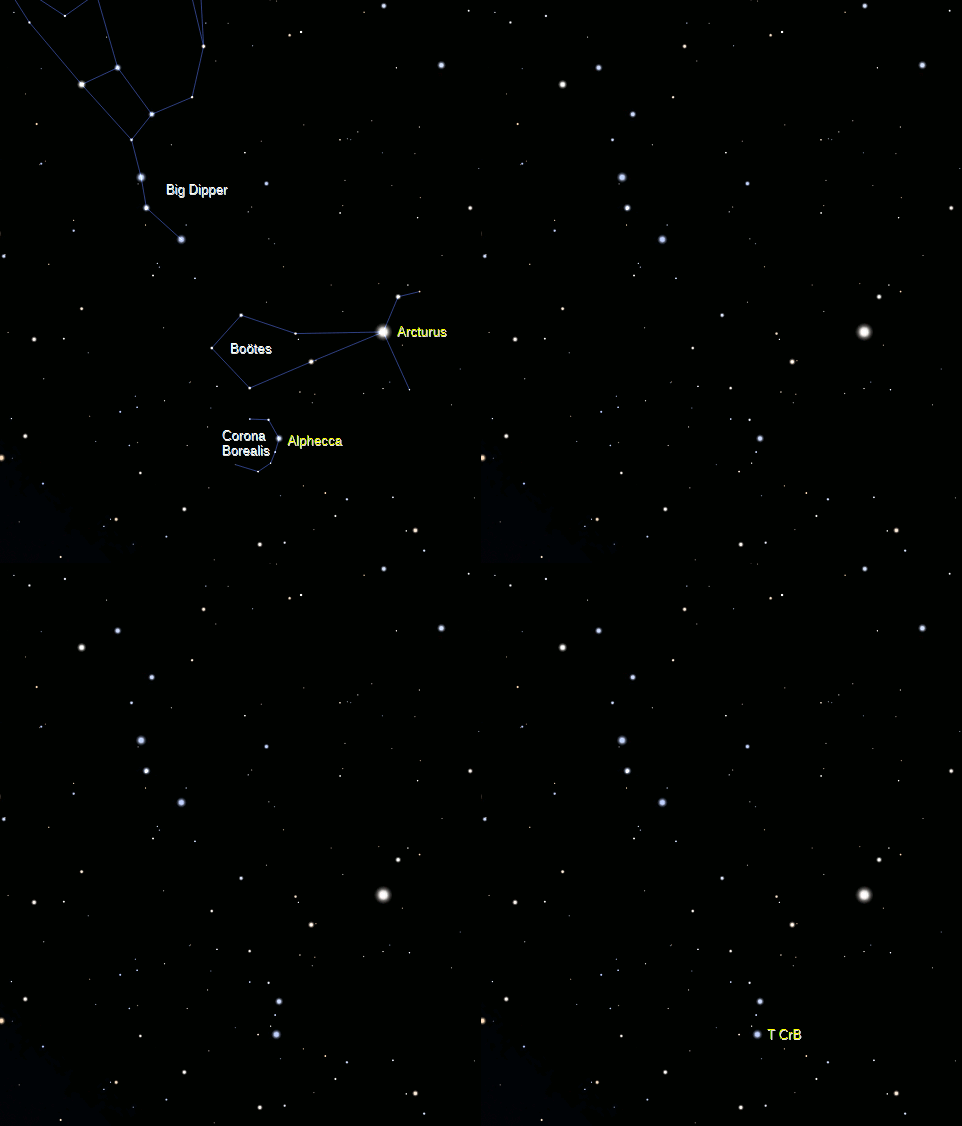
Looking in the east southeastern sky for Corona Borealis. The view is from the horizon to just pass the zenith. Corona Borealis is about 1/3 of the way from Arcturus which is high in the southeast to Vega lower in the east-northeast.. It’s a small semicircle of stars. Created using Stellarium, LibreOffice Draw, and GIMP.
T Coronae Borealis (T CrB) nova finder.
T Coronae Borealis (T CrB) nova finder, when it occurs. This is the orientation of its position in the sky if it occurs in the spring. Created using Stellarium, LibreOffice Draw, and GIMP.

Ephemeris: 05/19/2025 – Finding Libra the scales

May 19, 2025 Comments off

This is Ephemeris for Monday, May 19th. Today the Sun will be up for 14 hours and 59 minutes, setting at 9:09, and it will rise tomorrow at 6:09. The Moon, 1 day before last quarter, will rise at 2:51 tomorrow morning.

Libra the scales or balance is a dim constellation which is seen low in the southeast in the evening now. It is one of the constellations of the Zodiac. The term Zodiac means circle of animals, so Libra doesn’t exactly fit. The ancient Babylonians recognized it. Back then it may have represented the equality of day and night because the Sun would have been at the autumnal equinox in Libra at that time. The early Greeks, and possibly the Arabs, did not see Libra as being separate from the constellation of Scorpius the scorpion, which is rising to its lower left. Its two brightest stars have Arabic names meaning north claw and south claw. Scorpions have claws, and last I’ve checked, balances do not.

The astronomical event times given in this blog are for the Traverse City/Interlochen area of Michigan (Lat 44.7° N, Long 85.7° W; EDT, UT – 4 hours) unless stated otherwise. Times will be different for other locations.

Addendum
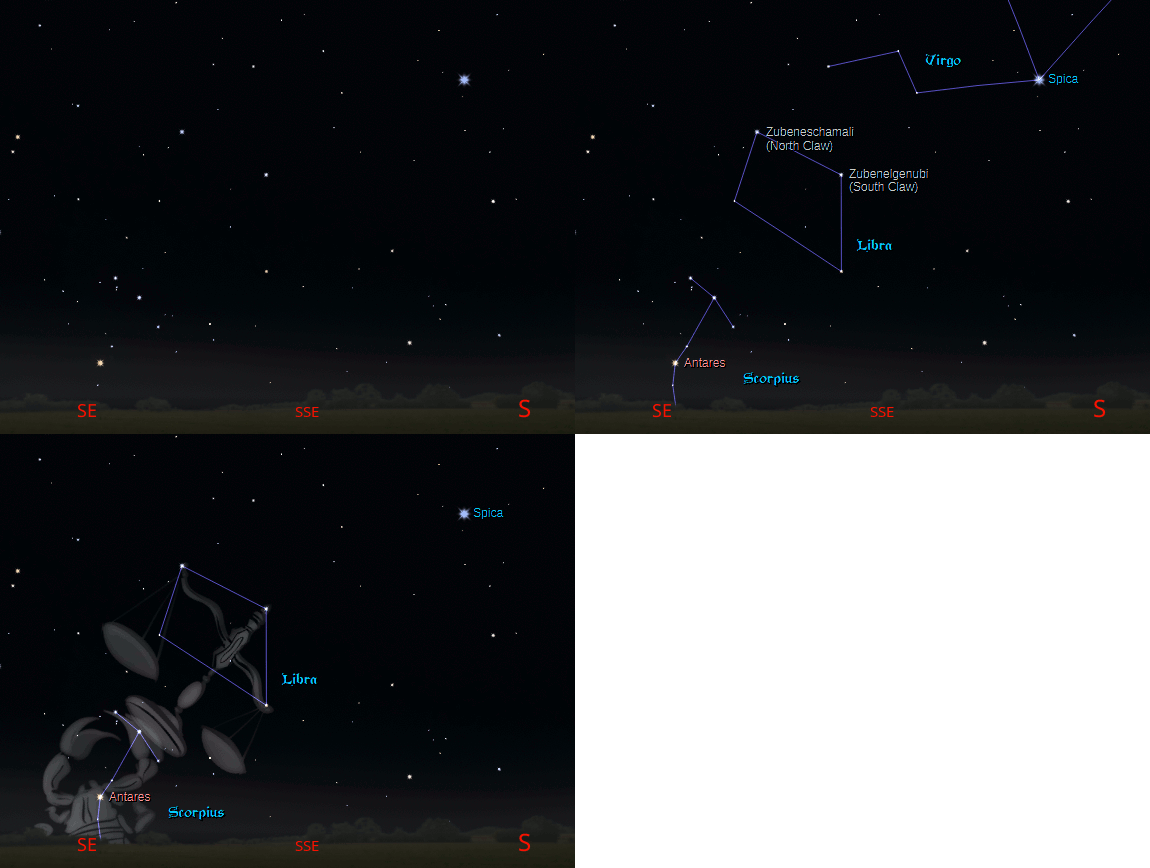
Finder chart for Libra the scales in three frames
Finder chart for Libra the scales in three frames. First, the stars as they would appear in the sky at 11 PM EDT, or about 2 hours after sunset, for Northwestern Lower Michigan. Second, connecting the stars for the constellations Libra, Scorpius and Virgo; with star names, including Zubeneschamali (north claw) and Zubenelgenubi (south claw) of the scorpion. The third frame includes the Stellarium artwork showing the Libra, the scales, and the front part of Scorpius, a much smaller scorpion than the Arabs, who named the stars, saw. Created using Stellarium, LibreOffice Draw and GIMP.

A bit of trivia: At 14 letters Zubeneschamali is the longest star name.

In a previous post I noted that Libra was associated with Virgo which also represents Astraea the goddess of Justice, with Libra, being her Scales of Justice.

Ephemeris: 05/16/2025 – Two bright stars, alike but different

May 16, 2025 Comments off

This is Bob Moler with Ephemeris for Friday, May 16th. Today the Sun will be up for 14 hours and 52 minutes, setting at 9:05, and it will rise tomorrow at 6:12. The Moon, halfway from full to last quarter, will rise at 1:21 tomorrow morning.

Two stars which I’ve been known to confuse in the twilit sky in late spring and late summer are Arcturus and Vega. These stars have about the same brightness and in some lists of stars swap places between the 4th and 5th brightest stars in the sky. Arcturus is an orangish star, now high in the southern sky in the evening, while Vega is a pure white star which to my eyes tends towards a little tinge of blue. Vega is high in the south, actually almost overhead, in the late summer. Now, in mid to late Spring Vega is rather low in the northeastern sky. Arcturus is a cool star on the outside which has depleted the hydrogen in its core and is a red giant star, while the younger and more massive Vega, still turning hydrogen into helium.

The astronomical event times given in this blog are for the Traverse City/Interlochen area of Michigan (Lat 44.7° N, Long 85.7° W; EDT, UT – 4 hours) unless stated otherwise. Times will be different for other locations.

Addendum
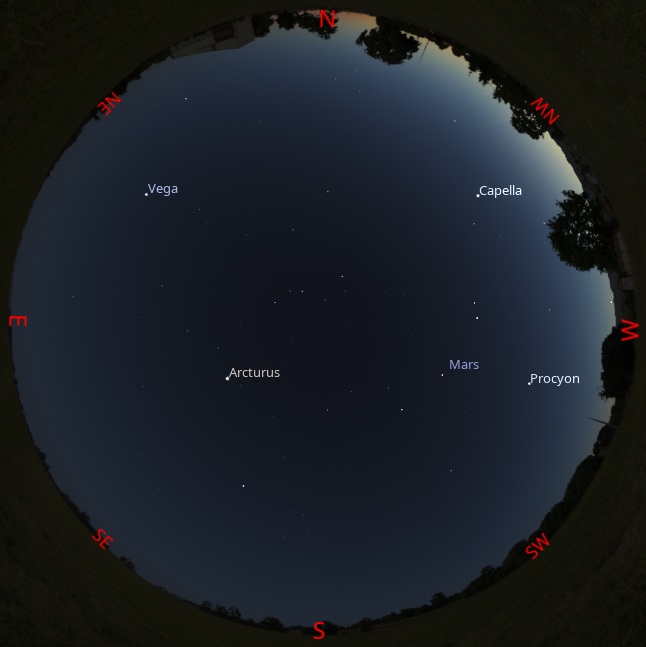
The bright stars in evening twilight at about 10 PM for Northwestern Lower Michigan
The bright stars in evening twilight at about 10 PM for Northwestern Lower Michigan or about an hour after sunset. The stars visible are basically first magnitude stars and some of the brighter second magnitude ones. Jupiter, which would normally be very bright, is hiding behind the tree in the west-northwest. The two stars coming on stage that are quite bright are Arcturus and Vega. Created using Stellarium.

Ephemeris: 05/14/2025 – Looking for the naked-eye planets

May 14, 2025 Comments off

This is Bob Moler with Ephemeris for Wednesday, May 14th. Today the Sun will be up for 14 hours and 48 minutes, setting at 9:03, and it will rise tomorrow at 6:14. The Moon, 2 days past full, will rise at 11:41 this evening.

Let’s take our weekly look at the whereabouts of the naked-eye planets. At 10 PM this evening two of the five naked eye planets will be out. Jupiter, is now the brightest evening planet, our substitute evening star if you will. It will be in the low in the west-northwestern sky. The rapidly fading Mars, with its distinctive reddish hue, is in the west-southwest, less than a binocular field’s width east of the Beehive Star Cluster in Cancer the Crab. By 5 AM Venus will be seen very low in the east, as the Morning Star. It will require a low eastern horizon. It should be visible until close to 6 AM. Saturn is visible to the right and a bit above Venus. It will disappear much sooner than the much brighter Venus.

The astronomical event times given in this blog are for the Traverse City/Interlochen area of Michigan (Lat 44.7° N, Long 85.7° W; EDT, UT – 4 hours) unless stated otherwise. Event times will be different for other locations.

Addendum

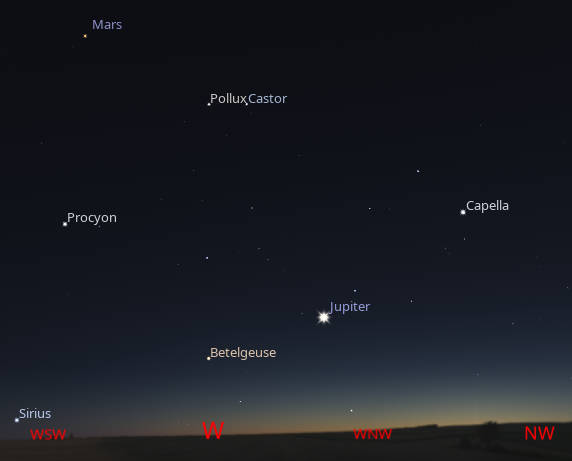
The evening planets Jupiter and Mars seen with the fading stars of winter at 10 PM
The evening planets Jupiter and Mars seen with the fading stars of winter at 10 PM, on May 14th, 2025. Created using Stellarium and GIMP.
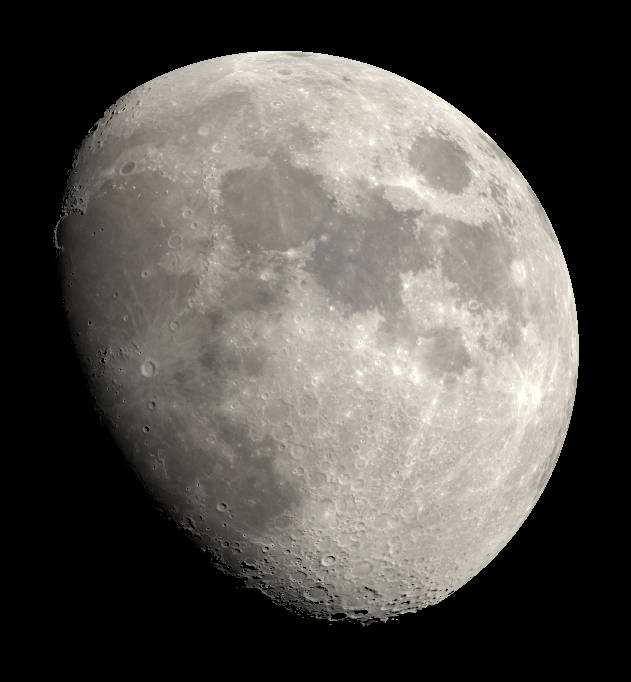
The Moon tomorrow morning, May 15, 2025, in its orientation at 5 AM. A view visible in small telescopes showing an image with and without selected features labeled. Created using Stellarium, LibreOffice Draw, and GIMP.
Venus and Saturn at 5:15 AM tomorrow morning
Venus and Saturn at 5:15 AM tomorrow morning, May 15th, 2025, low in the east. Created using Stellarium.
Telescopic Jupiter, Venus and Saturn
Telescopic Jupiter, Venus and Saturn (north up) as they would be seen in a small telescope with the same magnification. Jupiter is shown for tonight, 10 PM, May 15, 2025. Its apparent diameter is 33.0″. Mars is 6.1″ in diameter, too small to be shown here. My lower size limit is 10″. Venus is shown in the morning of May 8th. Its apparent diameter is 29.5″, and is 39.5% iluminated. Saturn is 16.4″ in diameter, but its rings, being nearly edge on may not be visible. They are 2.6 degrees from being edge on and barely illuminated. Planetary surface detail is more subtle than shown here. The ” means seconds of arc, or 1/3600th of a degree. Created using Cartes du Ciel (Sky Charts).
The naked-eye planets and the Moon at sunset and sunrise on a single night
The naked-eye planets and the Moon at sunset and sunrise on a single night, starting with sunset on the right on May 14, 2025. The night ends on the left with sunrise on the 15th. Click or tap on the image to enlarge it. Created using my LookingUp app and GIMP.
A low precision ephemeris of the Sun Moon and naked eye planet positions for today and tomorrow
This is a low precision ephemeris of the Sun Moon and naked eye planet positions for today and tomorrow, May 14th and May 15th, 2025. Some of the columns are self-explanatory, others are not. The transit column is the time that the body crosses the meridian and is due south. Elong, for elongation, is the angle between the Sun and that body. RA is right ascension, which is the object’s east-west position on the celestial sphere in hours and minutes. Dec is declination which is the north-south position of the object on the celestial sphere in degrees and minutes. R is the distance of that object from the Sun in astronomical units. An astronomical unit is about 93 million miles or 150 million kilometers. And Delta is the distance of that object from the Earth, also in astronomical units. I omit the ‘m’ in am and pm for compactness. The data was generated using my LookingUp for DOS app and displayed as a table by my Ephemeris Helper app.

Ephemeris: 05/07/2025 – Taking our weekly look at the whereabouts of the naked-eye planets

May 7, 2025 Comments off

This is Ephemeris for Wednesday, May 7th. Today the Sun will be up for 14 hours and 31 minutes, setting at 8:55, and it will rise tomorrow at 6:22. The Moon, 3 days past first quarter, will set at 4:36 tomorrow morning.

Let’s take our weekly look at the whereabouts of the naked-eye planets. At 10 PM this evening two of the five naked eye planets will be out. Jupiter, is now the brightest evening planet, our substitute evening star if you will. It will be in the low in the west-northwestern sky. The rapidly fading Mars, with its distinctive reddish hue, is in the west-southwest, moving away from the stars Castor and Pollux in Gemini to the lower right of it. By 5:30 AM Venus will be seen very low in the east, as the Morning Star. It will require a low eastern horizon. It should be visible until a bit after 6:30. Saturn is visible close and to its right and a bit above. It will disappear much sooner than Venus.

The astronomical event times given in this blog are for the Traverse City/Interlochen area of Michigan (Lat 44.7° N, Long 85.7° W; EDT, UT – 4 hours) unless stated otherwise. Times will be different for other locations.

Addendum
The evening planets Jupiter and Mars seen with the fading stars of winter at 10 PM
The evening planets Jupiter and Mars seen with the fading stars of winter at 10 PM, on May 7th, 2025. Created using Stellarium and GIMP.
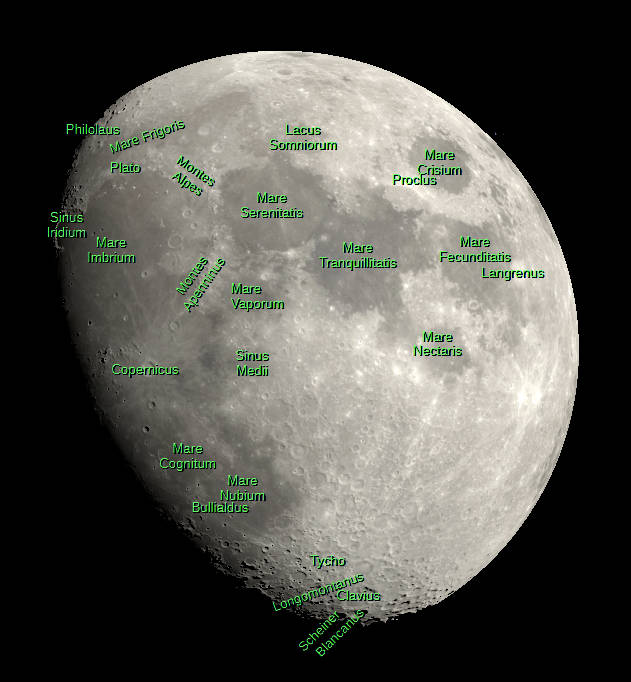
The Moon tonight, May 7, 2025. A view visible in small telescopes showing an image with and without selected features labeled. Created using Stellarium, LibreOffice Draw, and GIMP.
Venus and Saturn at 5:30 AM seen tomorrow morning
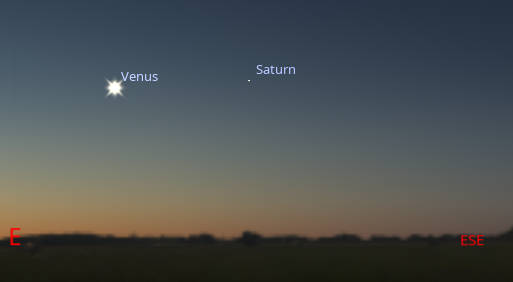
Venus and Saturn at 5:30 AM tomorrow morning, May 8th, 2025, low in the east. Saturn may still be tough to spot at our northerly latitude (45 N). Created using Stellarium.
Telescopic Jupiter, Venus and Saturn (north up) as they would be seen in a small telescope with the same magnification
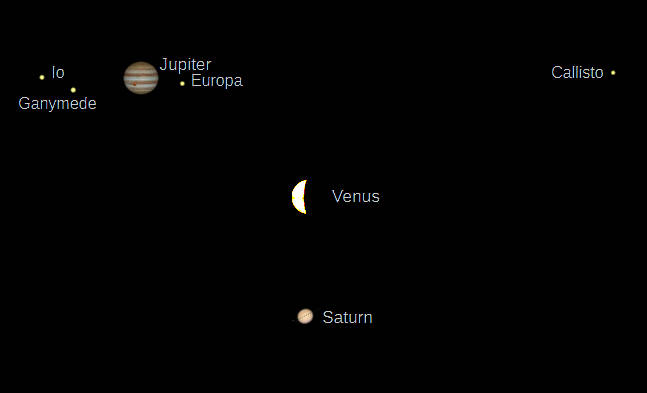
Telescopic Jupiter, Venus and Saturn (north up) as they would be seen in a small telescope with the same magnification. Jupiter is shown for tonight, 10 PM, May 7, 2025. Its apparent diameter is 33.3″. Mars is 6.3″ in diameter, too small to be shown here. My lower size limit is 10″. Venus is shown in the morning of May 8th. Its apparent diameter is 37.9″, and is 34.6% iluminated. Saturn is 16.3″ in diameter, but its rings, being nearly edge on may not be visible. They are 2.3 degrees from being edge on and barely illuminated, They were edge on to the Sun two days ago. Planetary surface detail is more subtle than shown here. The ” means seconds of arc, or 1/3600th of a degree. Created using Cartes du Ciel (Sky Charts).
The naked-eye planets and the Moon at sunset and sunrise on a single night
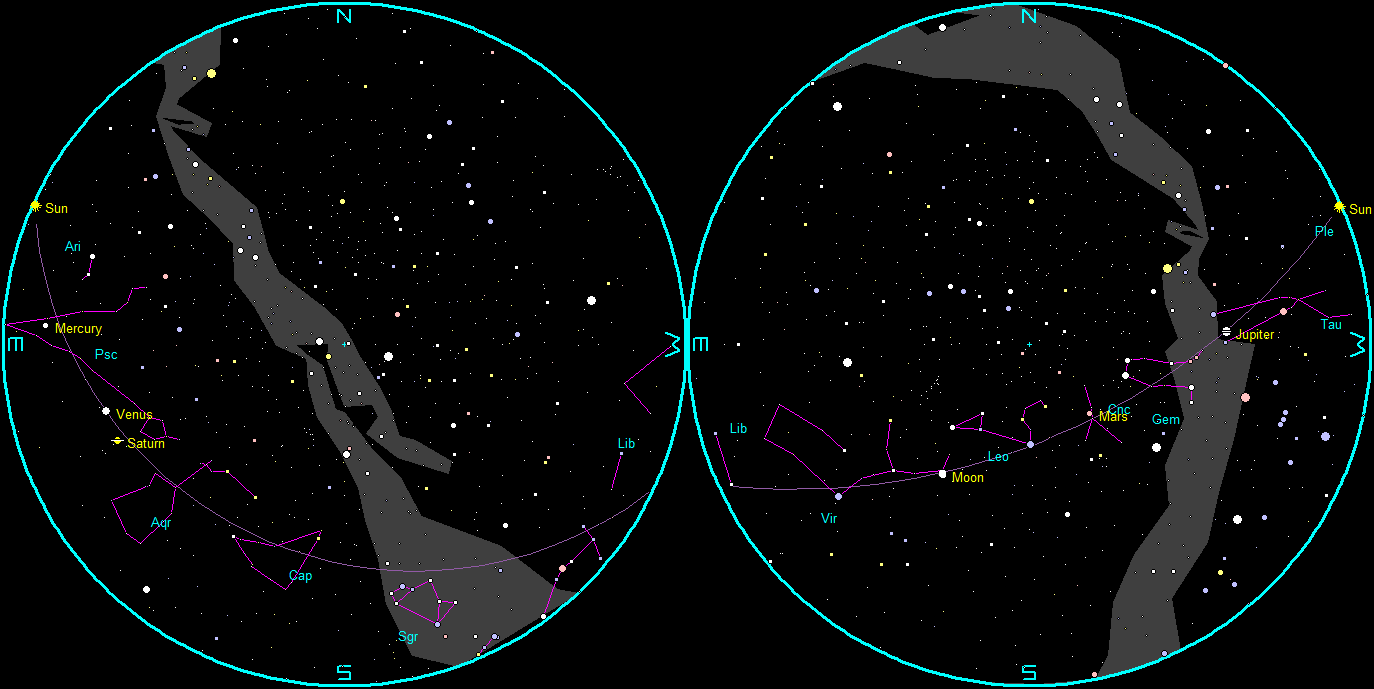
The naked-eye planets and the Moon at sunset and sunrise on a single night, starting with sunset on the right on May 7, 2025. The night ends on the left with sunrise on the 8th. Click or tap on the image to enlarge it. Created using my LookingUp app and GIMP.
A low precision ephemeris of the Sun Moon and naked eye planet positions for today and tomorrow
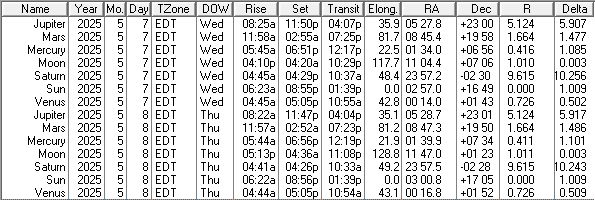
This is a low precision ephemeris of the Sun Moon and naked eye planet positions for today and tomorrow, May 7th and May 8th, 2025. Some of the columns are self-explanatory, others are not. The transit column is the time that the body crosses the meridian and is due south. Elong, for elongation, is the angle between the Sun and that body. RA is right ascension, which is the object’s east-west position on the celestial sphere in hours and minutes. Dec is declination which is the north-south position of the object on the celestial sphere in degrees and minutes. R is the distance of that object from the Sun in astronomical units. An astronomical unit is about 93 million miles or 150 million kilometers. And Delta is the distance of that object from the Earth, also in astronomical units. I omit the ‘m’ in am and pm for compactness. The data was generated using my LookingUp for DOS app and displayed as a table by my Ephemeris Helper app.

Ephemeris: 05/05/2025 – A brief early morning meteor shower

May 5, 2025 Comments off

This is Bob Moler with Ephemeris for Cinco de Mayo, Monday, May 5th. Today the Sun will be up for 14 hours and 26 minutes, setting at 8:53, and it will rise tomorrow at 6:25. The Moon, 1 day past first quarter, will set at 4:03 tomorrow morning.

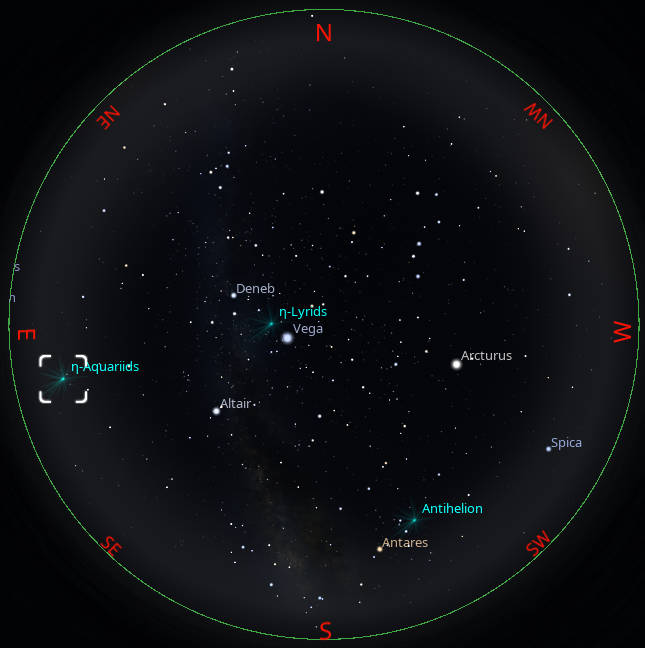
The Earth is now passing through a stream of bits of rock that were shed from Halley’s Comet on its many previous passes through the inner solar system. The Earth gets to pass through this stream twice a year, Once in late October as the stream passes the Earth’s orbit heading in, and in early May as the stream is departing. The peak of this meteor shower, the Eta Aquariids, is this afternoon. Since the meteoroids are coming from nearer the direction of the Sun, there is only a short period when these meteors are visible. Actually less than an hour between moonset at 4:03 AM and nearly 5 AM around here as twilight begins to interfere with the display. The meteors will seem to come from low in the east-southeast, but they will be seen all over the sky.

The astronomical event times given in this blog are for the Traverse City/Interlochen area of Michigan (Lat 44.7° N, Long 85.7° W; EDT, UT – 4 hours) unless stated otherwise. Times will be different for other locations.

Addendum
Eta Aquariid Radiant
The sky at 4:15 AM, May 6, 2025 on the morning after the peak. Despite the low position of the Eta (funny looking n) Aquariid radiant in the east, the meteors will appear all over the sky appear but can be traced back to the direction of the radiant. Created using Stellarium. The Eta Lyrid and Antihelion meteor showers, though active will contribute very few meteors.

Ephemeris: 04/30/2025 – Let’s take our weekly look at the whereabouts of the naked-eye planets

April 30, 2025 Comments off

This is Bob Moler with Ephemeris for Wednesday, April 30th. Today the Sun will be up for 14 hours and 13 minutes, setting at 8:46, and it will rise tomorrow at 6:32. The Moon, 3 days past new, will set at 1:08 tomorrow morning.

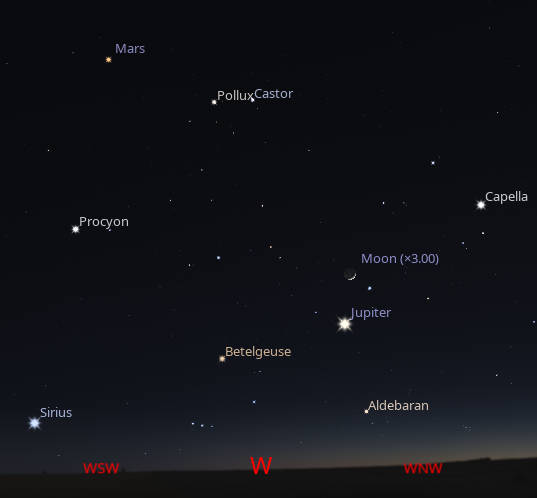
Let’s take our weekly look at the whereabouts of the naked-eye planets. At 9:30 PM this evening two of the five naked eye planets will be out. Jupiter, is now the brightest evening planet, our substitute evening star if you will. It will be in the western sky. Tonight it will be below the crescent Moon. To its lower left, the great constellation of Orion will be beginning to set. The rapidly fading Mars, with its distinctive reddish hue, is high in the southwest, with the stars Castor and Pollux in Gemini to the right of it. By 5:30 AM Venus will be seen very low in the east, as the Morning Star. It will require a low eastern horizon. It should be visible until a bit after 6:30. Saturn is visible close and to its lower right.

The astronomical event times given in this blog are for the Traverse City/Interlochen area of Michigan (Lat 44.7° N, Long 85.7° W; EDT, UT – 4 hours) unless stated otherwise. Times will be different for other locations.

Addendum
The evening planets Jupiter and Mars seen with the Moon
The evening planets Jupiter and Mars seen with the Moon (3 times normal size) and fading stars of winter at 10 PM, on April 30th, 2025. Created using Stellarium and GIMP.
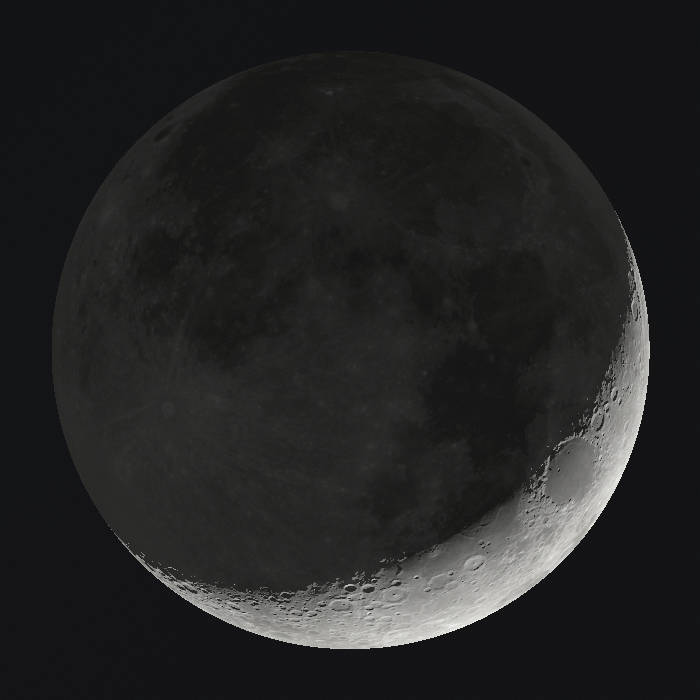
The Moon tonight, April 30, 2025. A view visible in small telescopes showing an image with and without selected features labeled. Created using Stellarium, LibreOffice Draw, and GIMP.
Venus and Saturn at 5:30 AM tomorrow morning, May 1st, 2025, low in the east. Saturn may still be tough to spot at our northerly latitude (45 N). Created using Stellarium.
Telescopic Jupiter, Venus and Saturn
Telescopic Jupiter, Venus and Saturn (north up) as it would be seen in a small telescope with the same magnification. Jupiter is shown for tonight, 10 PM, April 30, 2025. Its apparent diameter is 33.7″. Mars is 6.6″ in diameter, too small to be shown here. My lower size limit is 10″. Venus is shown in the morning of May 1st. Its apparent diameter is 40.6″, and is 23.3% iluminated. Saturn is 16.1″ in diameter, but its rings, being nearly edge on and not illuminated, should not be visible. Planetary surface detail is more subtle than shown here. The ” means seconds of arc, or 1/3600th of a degree. Created using Cartes du Ciel (Sky Charts).
The naked-eye planets and the Moon at sunset and sunrise on a single night, starting with sunset on the right on April 30, 2025. The night ends on the left with sunrise on the May 1st. Click or tap on the image to enlarge it. Created using my LookingUp app and GIMP.
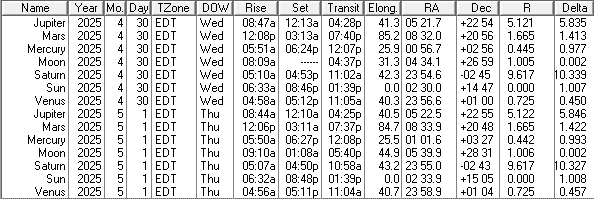
This is a low precision ephemeris of the Sun Moon and naked eye planet positions for today and tomorrow, April 30th and May 1st, 2025. Some of the columns are self-explanatory, others are not. The transit column is the time that the body crosses the meridian and is due south. Elong, for elongation, is the angle between the Sun and that body. RA is right ascension, which is the object’s east-west position on the celestial sphere in hours and minutes. Dec is declination which is the north-south position of the object on the celestial sphere in degrees and minutes. R is the distance of that object from the Sun in astronomical units. An astronomical unit is about 93 million miles or 150 million kilometers. And Delta is the distance of that object from the Earth, also in astronomical units. I omit the ‘m’ in am and pm for compactness. The data was generated using my LookingUp for DOS app and displayed as a table by my Ephemeris Helper app.