Archive
10/20/2022 – Ephemeris – Halley’s Comet returns… in little bitty pieces
This is Bob Moler with Ephemeris for Thursday, October 20th. Today the Sun will be up for 10 hours and 44 minutes, setting at 6:49, and it will rise tomorrow at 8:06. The Moon, 3 days past last quarter, will rise at 3:36 tomorrow morning.
Halley’s Comet is back! (Pronounced Hawley’s) Well sorta. In the form of the Orionid meteor shower. Bits of Halley’s Comet from previous passes by the Earth’s orbit make their twice-yearly show in our skies as these bits collide with the Earth’s atmosphere. Halley’s orbit passes close to the Earth’s orbit at points where the Earth is around May 6th and again near October 21st. Light dust and ionized gas get blown back into the tail of the comet. Heavier particles will roughly follow in the comet’s orbit. The radiant, a spot above the constellation Orion and below Gemini from which they will seem to come, will rise around 11 pm. So view them any time after that as their numbers will increase until the Moon rises both tonight and tomorrow nights.
The astronomical event times given are for the Traverse City/Interlochen area of Michigan (EDT, UT – 4 hours). They may be different for your location.
Addendum
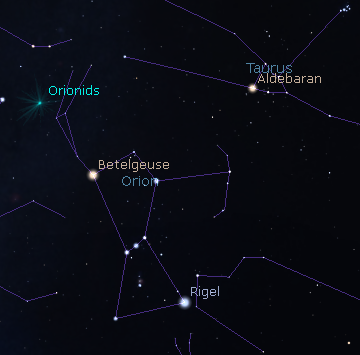
The Orionid Radiant is high in the south at 5 a.m. this weekend. Created using Stellarium.
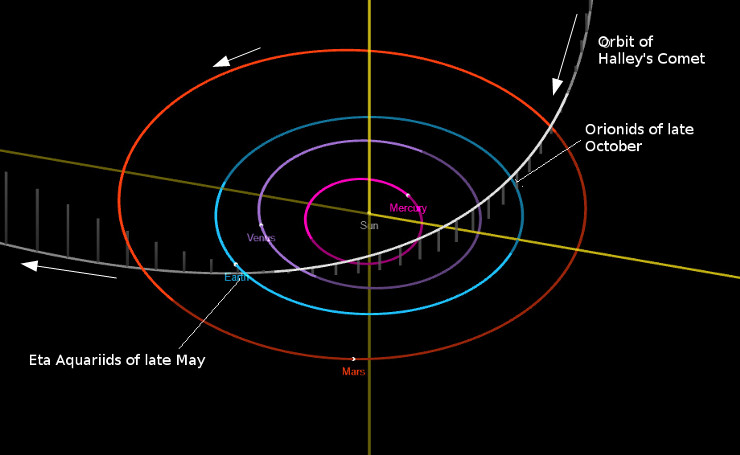
Halley’s Comet orbit with the orbits of the inner planets showing the points at which the debris from the comet intersect with the Earth’s orbit, causing meteor showers. Click on the image to enlarge it. Diagram credit JPL Small-Body Database Browser with my annotations.
10/19/2022 – Ephemeris – Let’s search for the naked-eye planets for this week
This is Bob Moler with Ephemeris for Wednesday, October 19th. Today the Sun will be up for 10 hours and 47 minutes, setting at 6:51, and it will rise tomorrow at 8:04. The Moon, 2 days past last quarter, will rise at 2:29 tomorrow morning.
Let’s search for the naked-eye planets for this week. Jupiter and Saturn will be visible this evening, in the east-southeast and south-southeast respectively, as soon after sunset as it will be dark enough to see them, which would be by 7:45 pm. Jupiter is seen against the stars of Pisces the fish, while Saturn is spotted in the eastern end of Capricornus the sea goat. The red planet Mars, though a morning planet, will rise tonight at 9:41 pm in the northeast. It’s located between the tips of the long horns of Taurus the bull. By seven tomorrow morning, the red planet Mars will be high in the southwestern sky, above the winter constellation of Orion. Tiny Mercury might be spotted very low in the east around 7:30 am for the next few days.
The astronomical event times given are for the Traverse City/Interlochen area of Michigan (EDT, UT – 4 hours). They may be different for your location.
Addendum
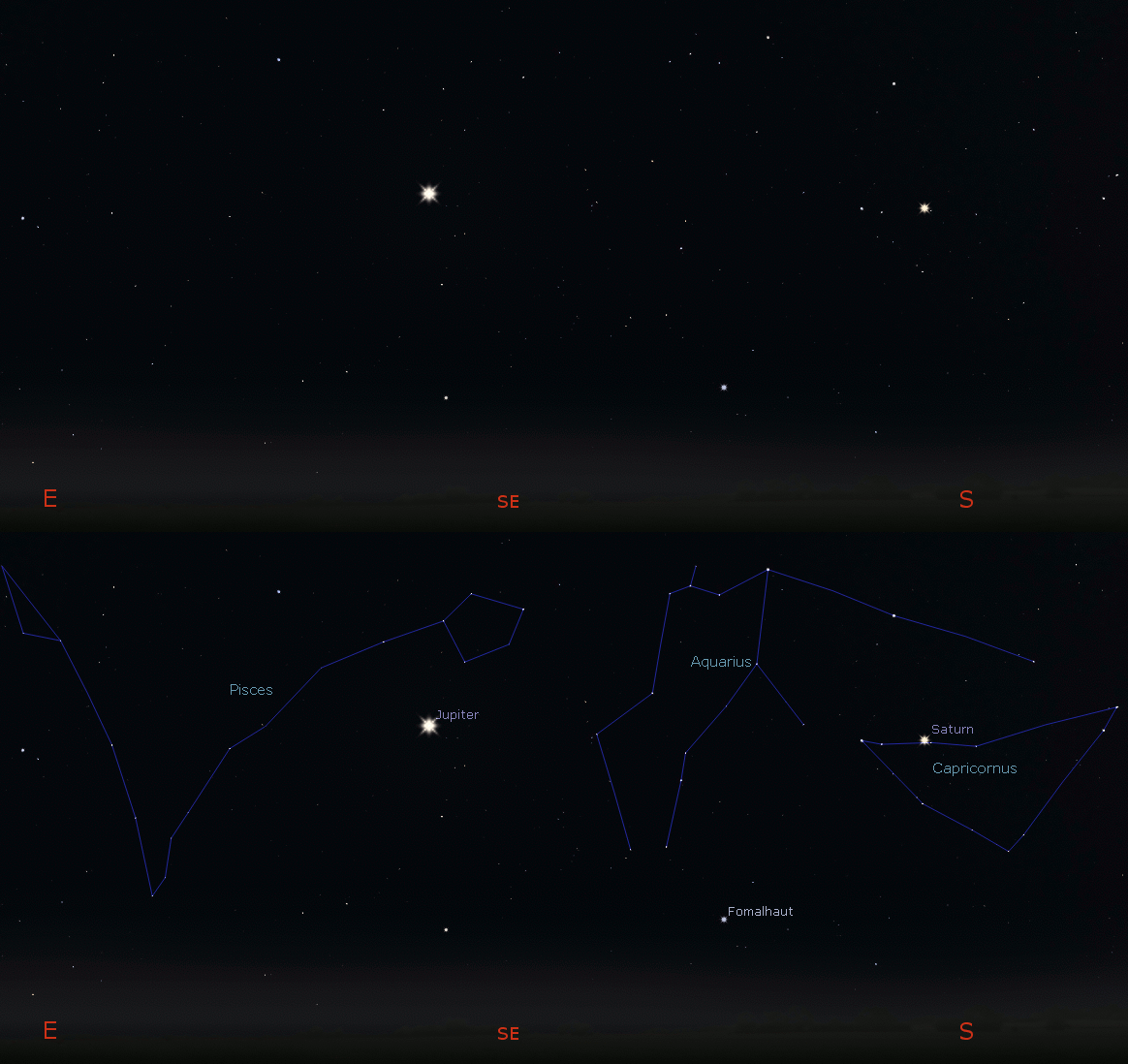
Jupiter and Saturn in the evening finder animation for 9 pm tonight, October 19, 2022. Click on the image to enlarge. Created using Stellarium and GIMP.
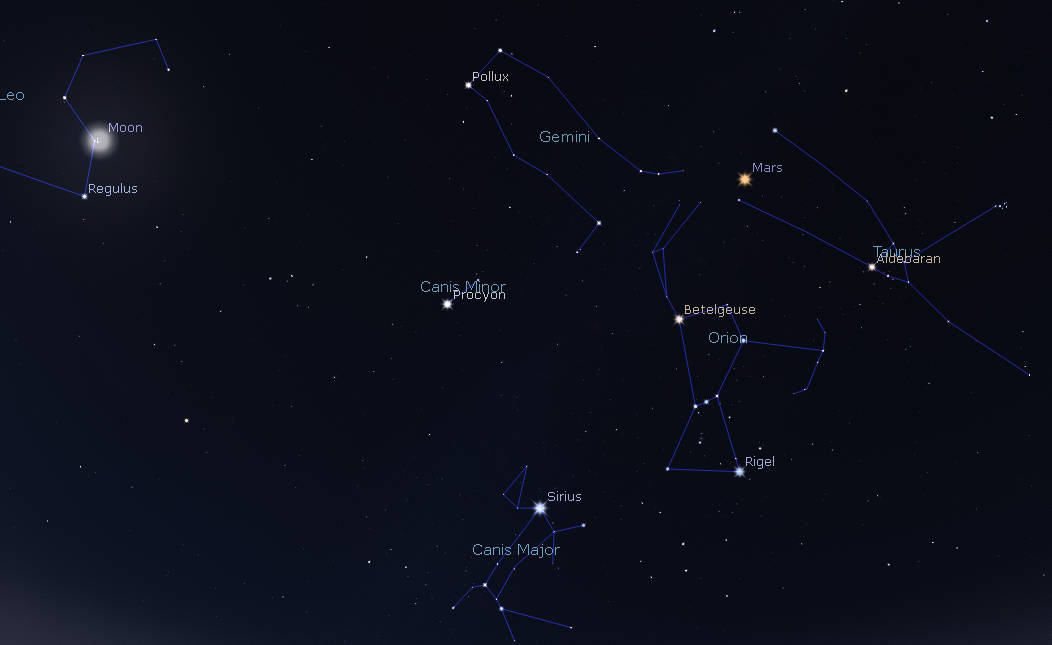
Mars among the winter stars at 7 tomorrow morning, October 20, 2022. Click on the image to enlarge it. Created using Stellarium.
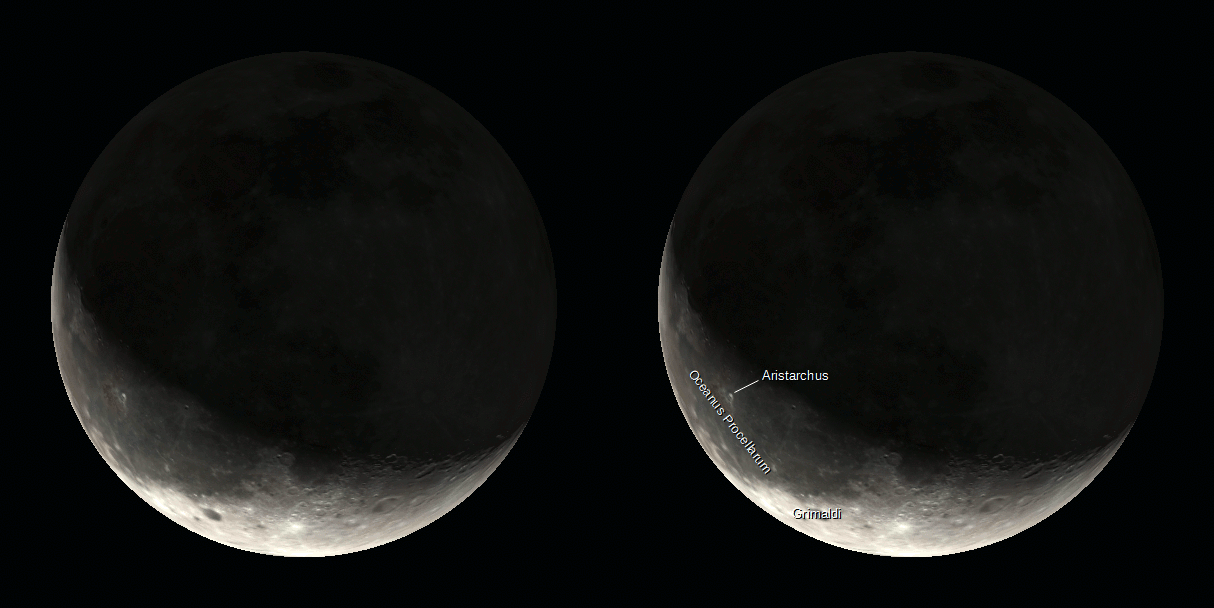
Waning crescent Moon labeled/unlabeled animation for 7 tomorrow morning, October 20, 2022. Created using Stellarium, LibreOffice Draw, and GIMP.
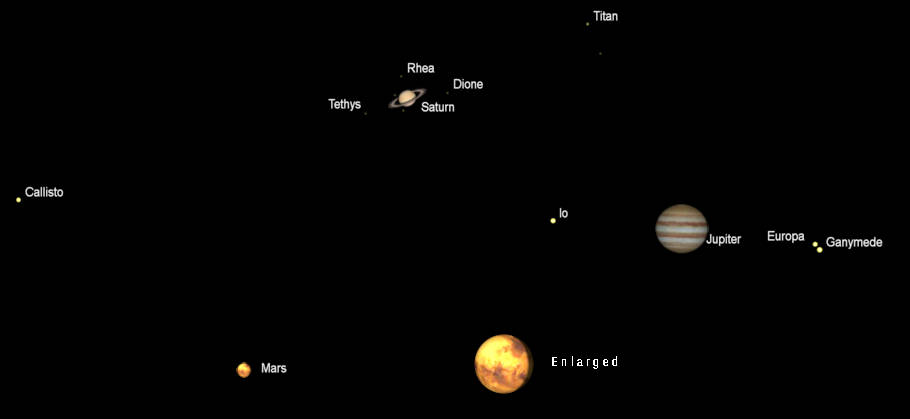
Telescopic views of Saturn Jupiter and Mars (north up) as they would be seen in a small telescope, with the same magnification. The image of Mars doesn’t show it, but the white north polar cap will appear at the top or north limb of Mars. Saturn and Jupiter are shown at 9 pm, Mars at 7 am. I do not show planets less than 10 seconds of arc in diameter, so Mercury is not shown. Apparent diameters: Saturn 17.61″, its rings 41.02″; Jupiter 48.82″. Mars 13.86″. Mars’ distance is 63.0 million miles (101.4 million kilometers). The ” symbol means seconds of arc (1/3600th of a degree.) Click on the image to enlarge it. Created using Cartes du Ciel (Sky Charts).
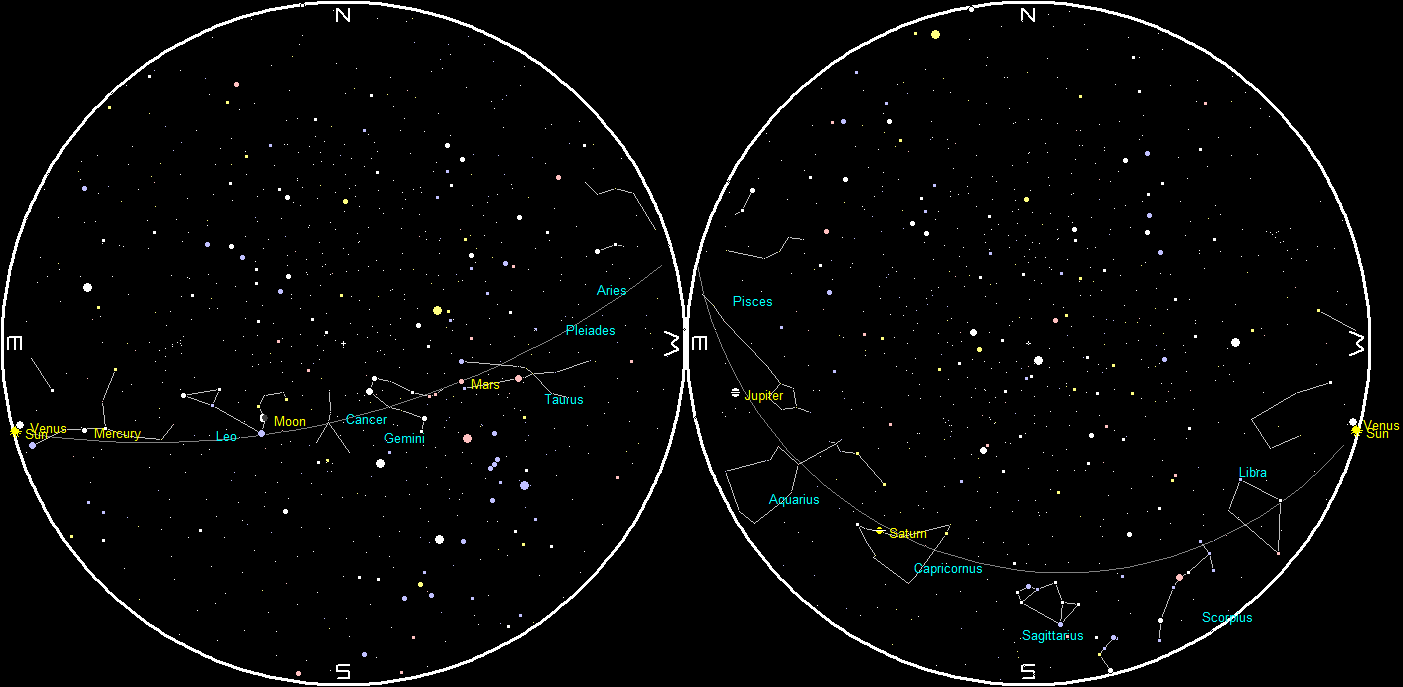
The naked-eye planets and the Moon at sunset and sunrise on a single night, starting with sunset on the right on October 19, 2022. The night ends on the left with sunrise on the 20th. Click on the image to enlarge it. Created using my LookingUp program and GIMP.
10/18/2022 – Ephemeris – The Great Andromeda Galaxy
Oct 18. This is Bob Moler with Ephemeris for Tuesday, October 18th. Today the Sun will be up for 10 hours and 50 minutes, setting at 6:52, and it will rise tomorrow at 8:03. The Moon, 1 day past last quarter, will rise at 1:22 tomorrow morning.
The closest large galaxy to our Milky Way galaxy is the Great Andromeda Galaxy, seen in the eastern sky when it gets dark. It is barely visible to the naked eye. To locate it, first find the Great Square of Pegasus high in the east, standing on one corner. The left star of the square is the head of the constellation Andromeda. Follow two stars to the left and a bit downward, then two stars straight up. The galaxy is near that last star as a small smudge of light. Binoculars are the best way to see it as a thin spindle of light. Visually through a telescope, one can see only the bright nucleus of the galaxy, that spans six Moon diameters in photographs. M 31* is its most well known catalog designation, and it’s two and a half million light years away.
The astronomical event times given are for the Traverse City/Interlochen area of Michigan (EDT, UT – 4 hours). They may be different for your location.
* M 31 is the 31st entry in French comet hunter Charles Messier’s catalog of fuzzy objects that can be mistaken for comets because they didn’t move in relation to the stars. It is a catalog of some of the brightest, what we call, deep sky objects: star clusters, nebulae, and galaxies. It is not a comprehensive catalog of these objects, since Messier was interested in comets.
Addendum
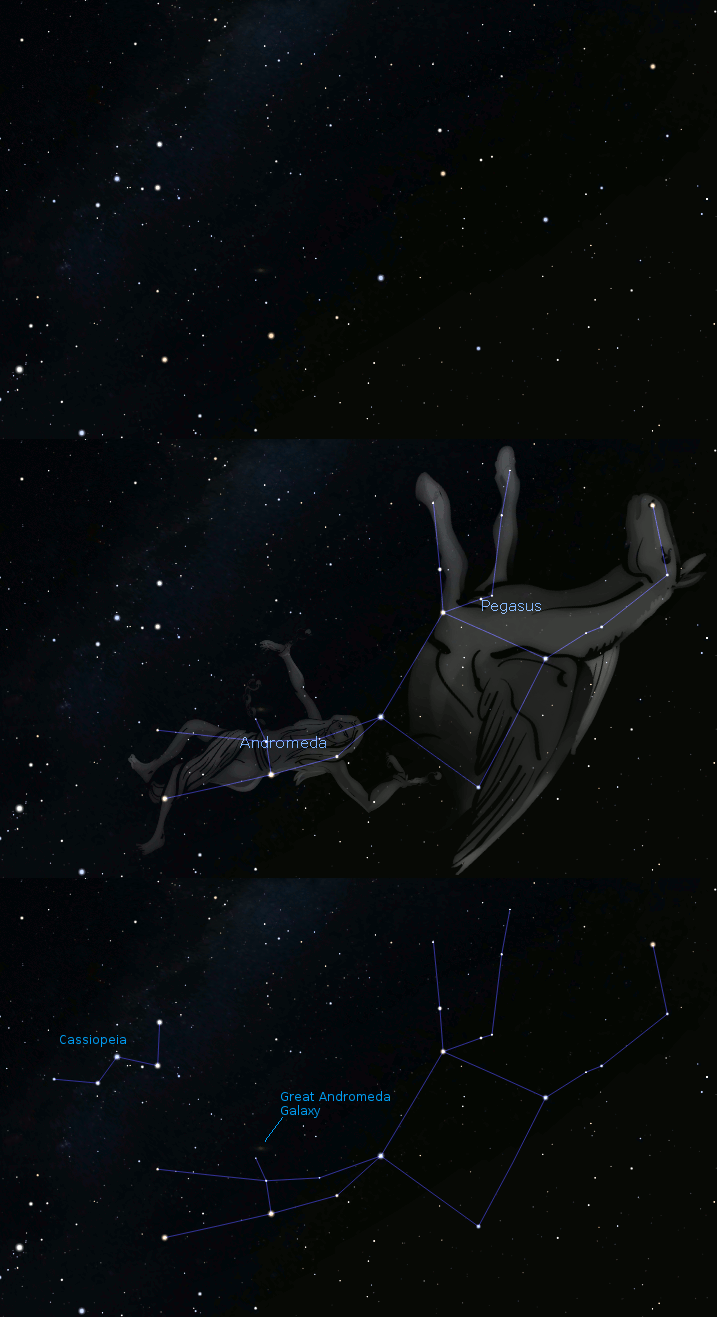
Andromeda animated finder, including the Great Andromeda Galaxy. I’ve added Cassiopeia that some folks use to find the galaxy. I start with the leftmost star of the Great Square of Pegasus that connects to Andromeda. I count off two stars on the lower curve because they are brighter than the upper curve. Then count two stars up. Next to that top star is a little smudge. That is the core of the Great Andromeda Galaxy. Click on the image to enlarge to full size. Created using Stellarium and GIMP.
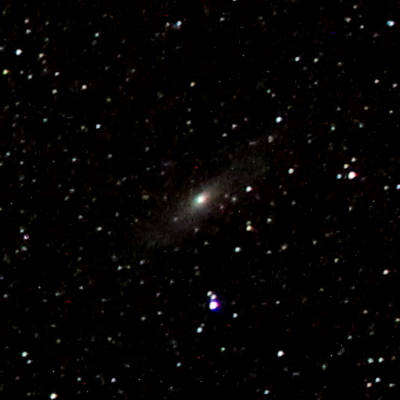
Low resolution and exposure view of M 31, the Great Andromeda Galaxy, simulating what it looks like in binoculars. Credit mine.
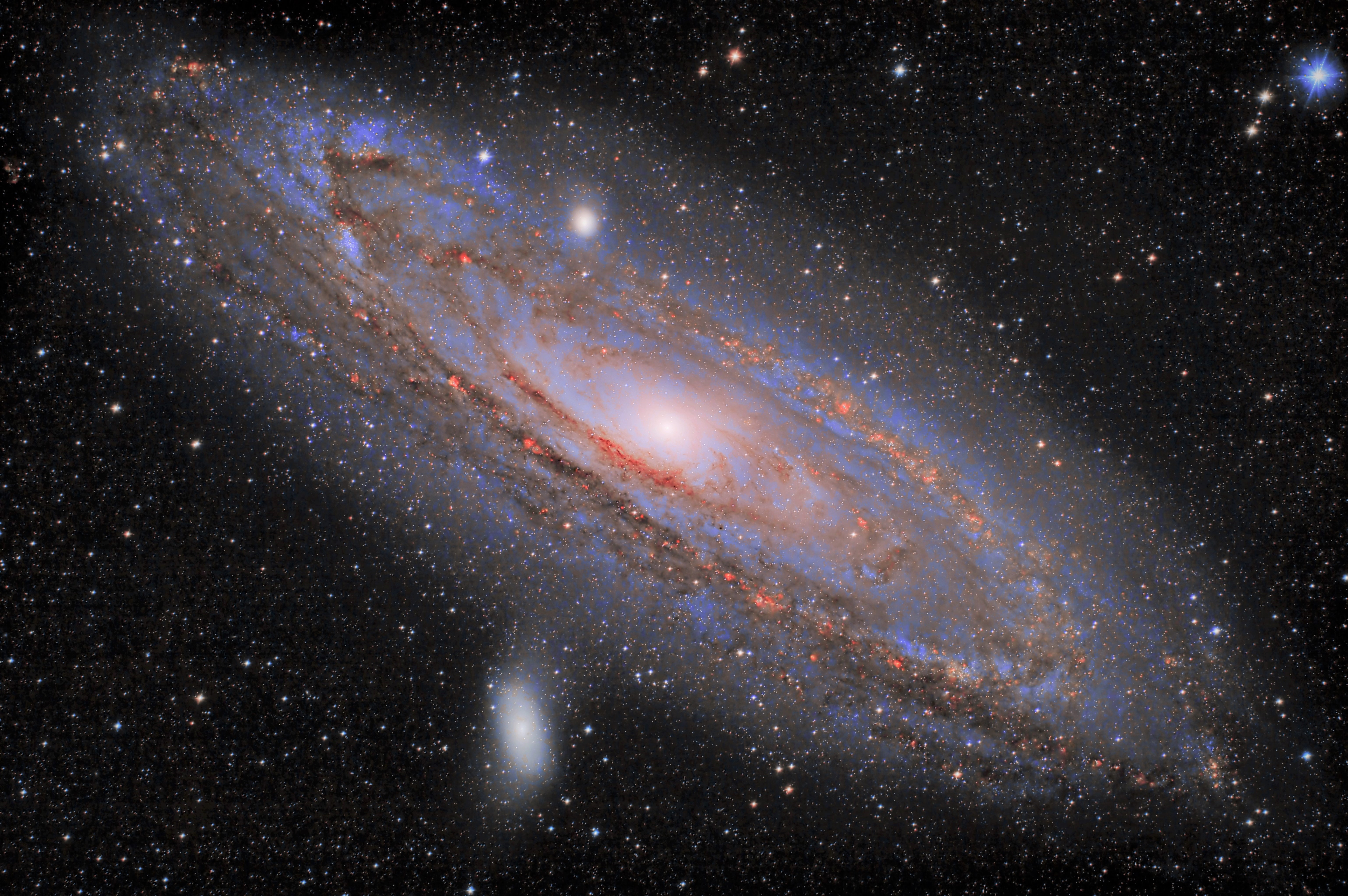
M 31, The Great Andromeda Galaxy. This image really shows the red H II Regions intermixed with the dark dust lanes that delineate the galaxy’s spiral arms. H II or ionized hydrogen regions are illuminated by hot young stars that were born within them. Click on the image to enlarge it. Credit: Dan Dall’Olmo.
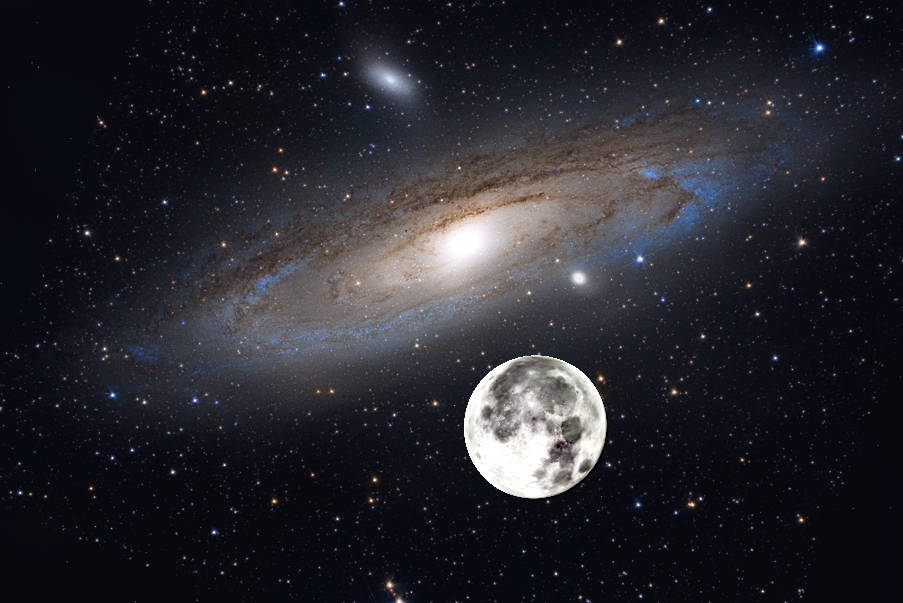
The moon superimposed on the Great Andromeda Galaxy, M31, for apparent size comparison. Created using Stellarium and the embedded image of the galaxy with that of the full Moon of October 31, 2020. M31 Image credit: Herm Perez: http://home.att.net/~hermperez/default.htm License: “Feel free to use these images, if you use them in a commercial setting please attribute the source.”
The Great Andromeda Galaxy is shown with two of its satellite galaxies, both elliptical. The nearly spherical one is M 32. The other one I knew and observed, in the 1950s, as NGC 205**. Even though Messier had described this object in 1773, he didn’t add it to his catalog. The suggestion that it be added as the last entry in Messier’s catalog was made in 1967 by Welsh amateur astronomer Kenneth Glyn Jones***
** NGC is the New General Catalogue of Nebulae and Clusters of Stars, and is not so new. It was published in 1888 by John Louis Emil Dreyer.
*** Source: messier-objects.com
10/17/022 – Ephemeris – Andromeda, damsel in distress
This is Ephemeris for Monday, October 17th. Today the Sun will be up for 10 hours and 53 minutes, setting at 6:54, and it will rise tomorrow at 8:02. The Moon, at last quarter today, will rise at 12:18 tomorrow morning
In the east at 9 this evening can be found a large square of stars, the Great Square of Pegasus the upside down flying horse. The square is standing on one corner. What looks like its hind legs stretching to the left from the left corner star is another constellation, Andromeda the chained princess. She is seen in the sky as two nearly horizontal but diverging curved strings of stars that curve upward. She was doomed due to her mother, Queen Cassiopeia’s boasting, which angered the god Poseidon. She was rescued by the hero Perseus, a nearby constellation, riding his steed Pegasus. Andromeda’s claim to scientific fame is the large galaxy seen as a faint fuzzy spot with the naked-eye just above the upper line of stars. The Great Andromeda Galaxy is two and a half million light years away.
The astronomical event times given are for the Traverse City/Interlochen area of Michigan (EDT, UT – 4 hours). They may be different for your location.
Addendum
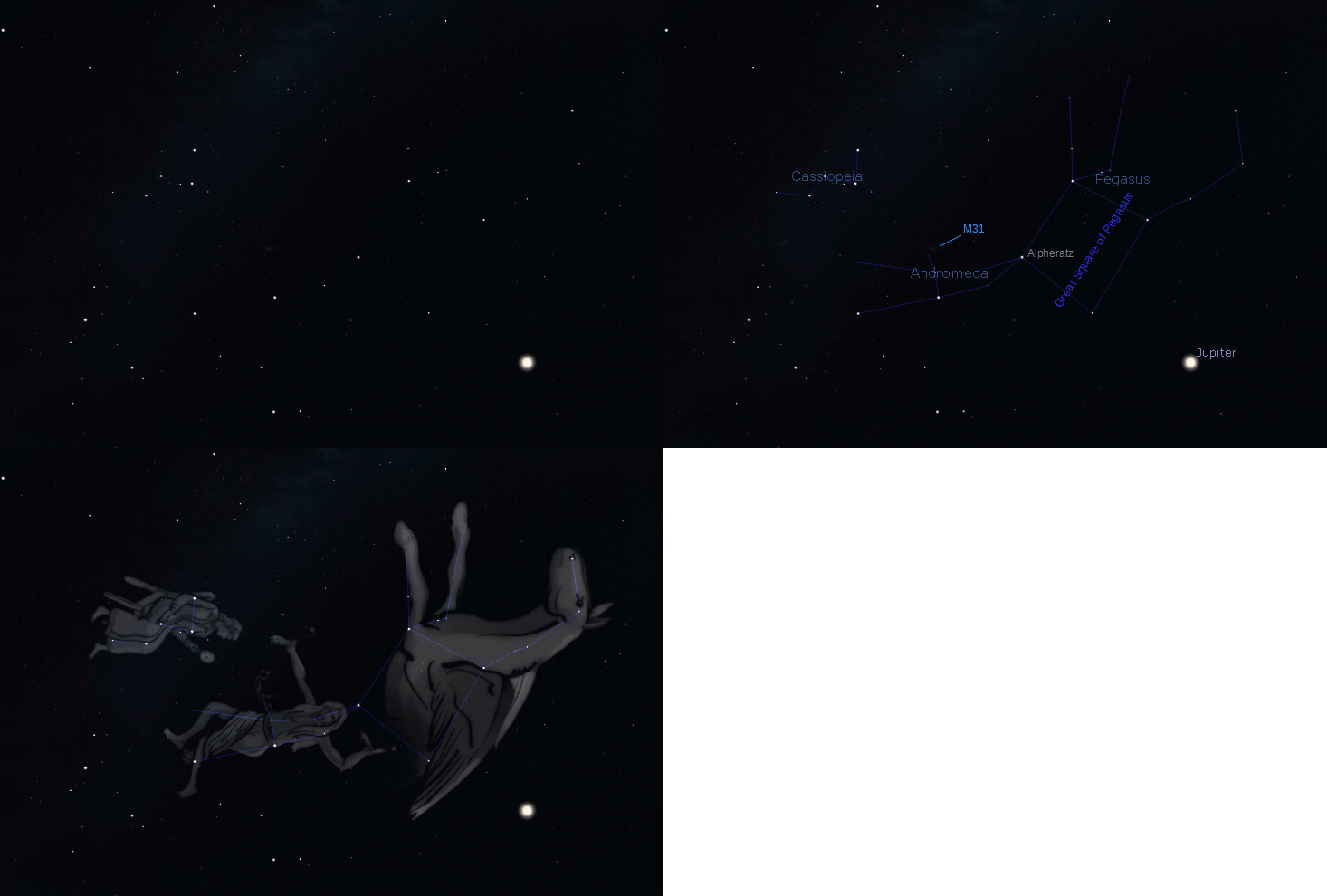
Andromeda finder animation looking east at 9 pm tonight, October 17, 2022. The left corner star of the Great Square of Pegasus is called Alpheratz, and actually belongs to Andromeda. The faint fuzzy spot labeled M31 is the Great Andromeda Galaxy, the Milky Way’s large neighbor. I’ll talk more about it tomorrow. Click on the image to enlarge it. Created using Stellarium and GIMP.
I’ve related Andromeda’s story in my post The Great Star Story of Autumn.
10/14/2022 – Ephemeris – The loneliest star in the sky isn’t so lonely this year, and more
This is Ephemeris for Friday, October 14th. Today the Sun will be up for 11 hours and 2 minutes, setting at 6:59, and it will rise tomorrow at 7:58. The Moon, 3 days before last quarter, will rise at 9:37 this evening.
There’s a bright star that appears for only seven and a half hours on autumn evenings. It’s appearance, low in the south-southeast at 9 p.m., is a clear indication of the autumn season. The star’s name is Fomalhaut, which means fish’s mouth. That’s fitting because it’s in the constellation of Piscis Austrinus, the southern fish. At our latitude it’s kind of the fish that got away, because Fomalhaut appears to be quite alone low in the sky. The other stars of its constellation are dim, and being low in the sky makes them even dimmer. However, this year Fomalhaut has visitors. Above and left of it is the brilliant planet Jupiter. And above and right of it is the bright planet Saturn. Both planets, while not very close to Fomalhaut, will keep it company this year.
The astronomical event times given are for the Traverse City/Interlochen area of Michigan (EDT, UT – 4 hours). They may be different for your location.
Addenda
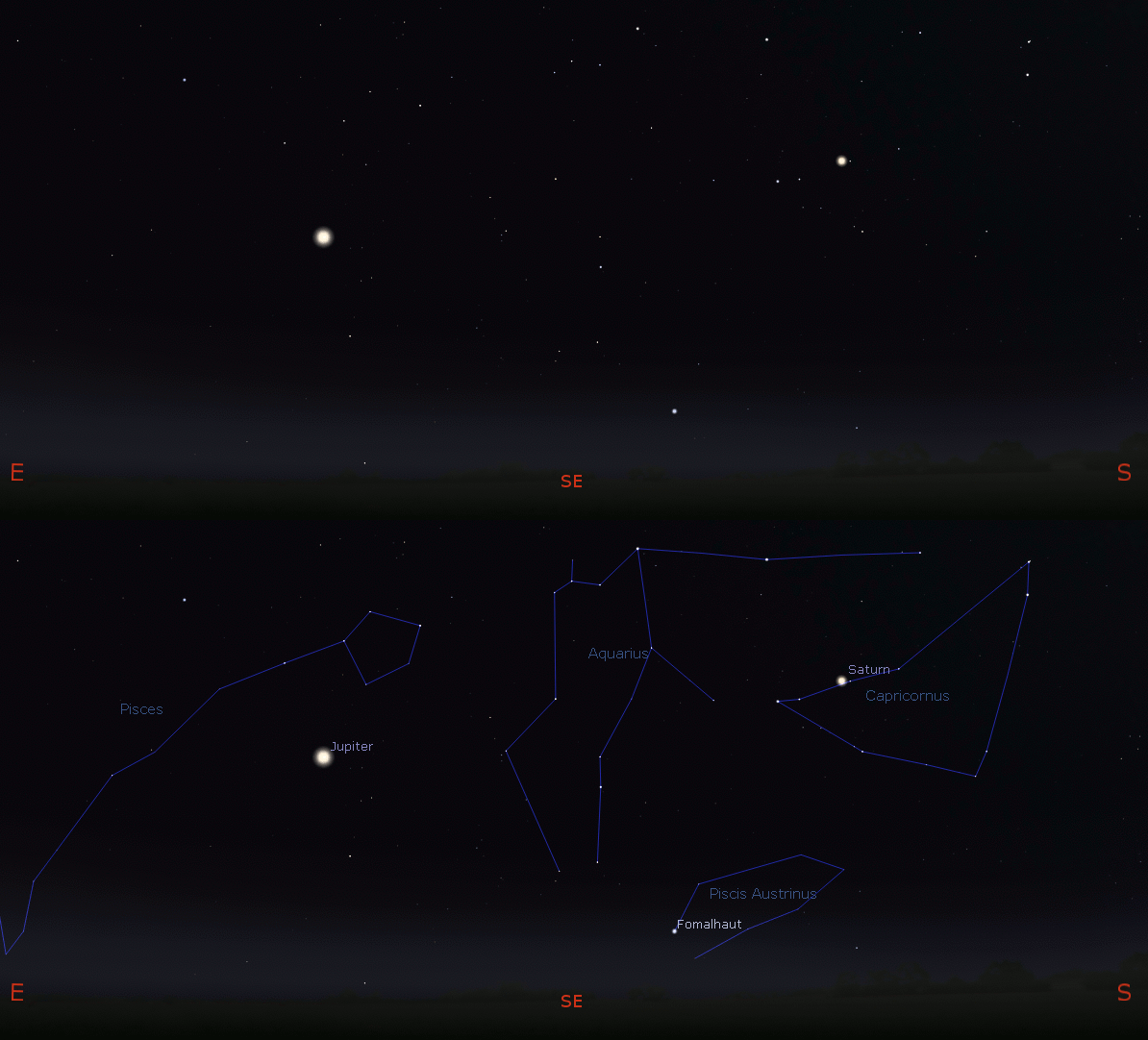
Fomalhaut and friends (Jupiter and Saturn) finder animation for 9 pm tonight, Friday, October 14, 2022. Click on the image to enlarge it. Created using Stellarium and GIMP.
Also at Corson Auditorium on the Interlochen Center for the Arts Campus…
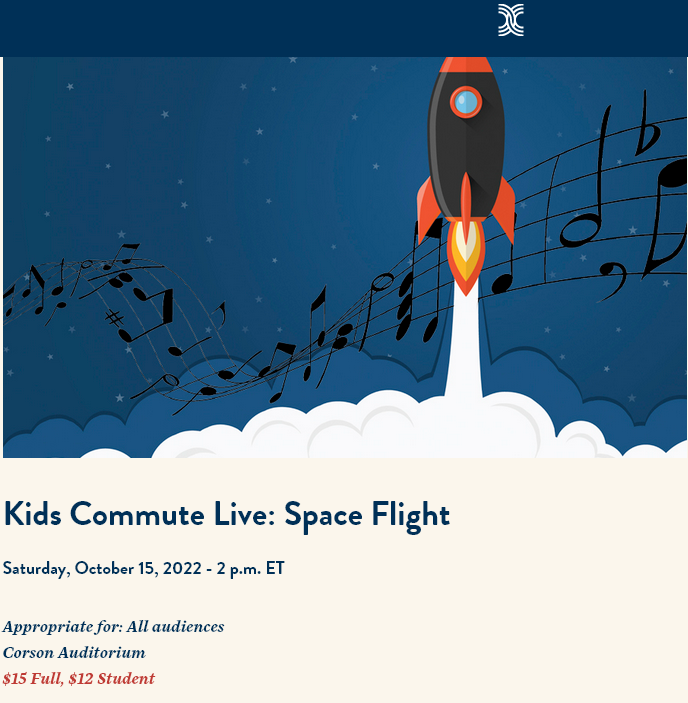
Join Interlochen Public Radio for Kids Commute Live! This family-friendly matinee is brought to you by the Interlochen Arts Academy Wind Symphony and features Interlochen theatre and singer-songwriter students, TCAPS middle school musicians, and special guests from NASA, the Coast Guard, and the International Dark Sky Park. Conductor Matthew Schlomer and Kids Commute host Kate Botello will lead this multi-sensory experience centered on the theme “Space Flight.”
The program will include Gustav Holst’s “Jupiter,” Michael Mogenson’s “Aerial Fantasy,” John Williams’ “Fantasy of Flight,” and more!
Come early for pre-concert activities for kids of all ages, including drone demonstrations and paper airplane contests. Space-themed food will be available for purchase.
I will be there from 12 to 1 pm, having the kids help me make COMETS! I’ll also be part of the program.
For more information and tickets: https://www.interlochen.org/events/kids-commute-live-space-flight-2022-10-15
10/12/2022 – Ephemeris – Let’s search for the naked-eye planets for this week
This is Bob Moler with Ephemeris for Wednesday, October 12th. Today the Sun will be up for 11 hours and 8 minutes, setting at 7:03, and it will rise tomorrow at 7:55. The Moon, 3 days past full, will rise at 8:28 this evening.
Let’s search for the naked-eye planets for this week. Jupiter and Saturn will be visible this evening, in the east-southeast and south-southeast respectively, as soon after sunset as it will be dark enough to see them, which would be by 7:45 pm. Jupiter is seen against the stars of Pisces the fish, while Saturn is spotted in the eastern end of Capricornus the sea goat. The red planet Mars, though a morning planet, will rise tonight at 10:04 pm in the northeast. It’s located between the long horns of Taurus the bull. By seven tomorrow morning, the red planet Mars will be high in the southwestern sky, above the winter constellation of Orion. Tiny Mercury can be spotted at that hour very low in the east and by 7:30 for the next week or so.
The astronomical event times given are for the Traverse City/Interlochen area of Michigan (EDT, UT – 4 hours). They may be different for your location.
Addendum
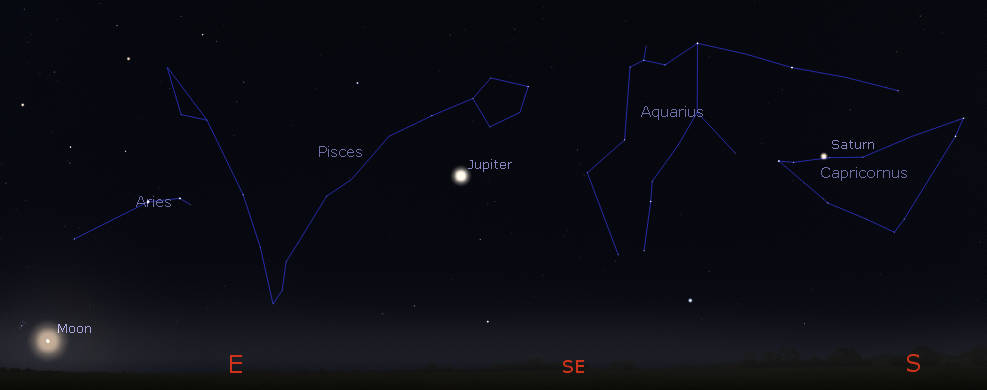
Evening planets and the Moon at 9 pm tonight, October 12, 2022, with the line figures of the zodiacal constellations in their part of the sky. Click on the image to enlarge it. Created using Stellarium.
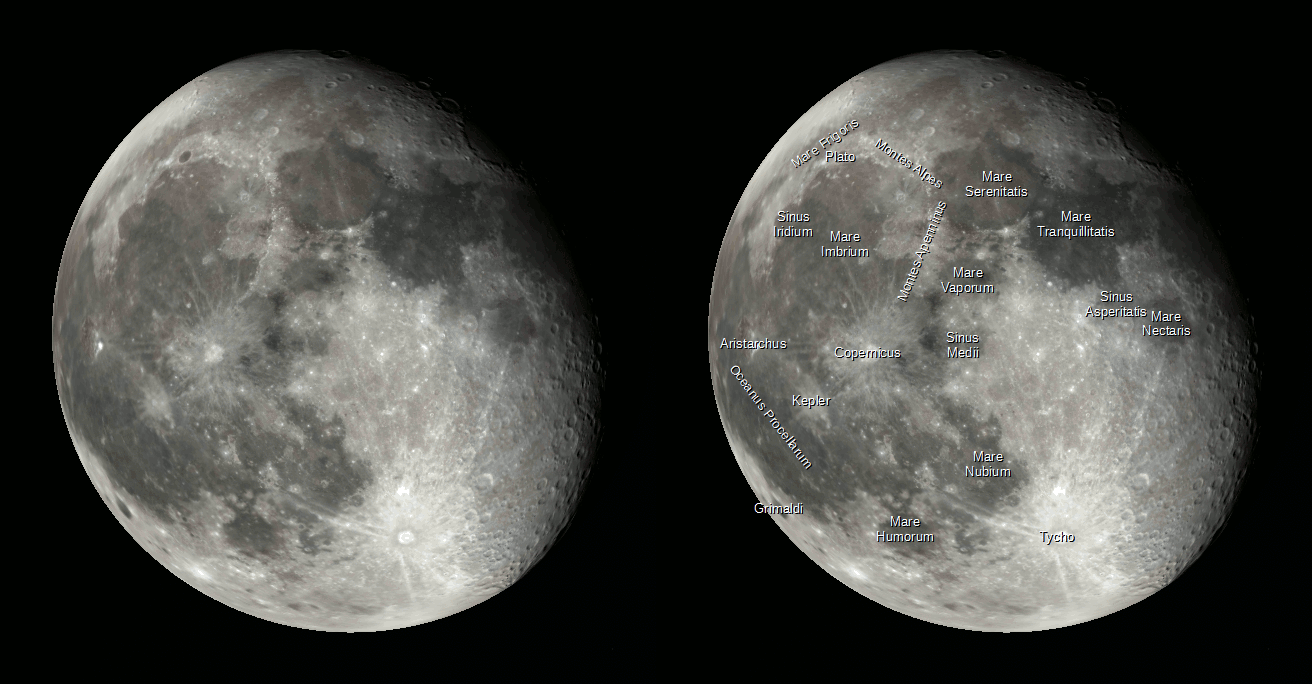
Annotated waning Gibbous Moon Animation for tonight, October 12, 2022, as it might look like in binoculars or a small telescope. Created using Stellarium, LibreOffice Draw and GIMP.
Translations of some lunar feature names according to Virtual Moon Atlas
Mare Frigoris – Sea of Cold
Mare Humorum – Sea of Moisture
Mare Imbrium – Sea of Showers
Mare Nubium – Sea of Clouds
Mare Serenitatis – Sea of Serenity
Mare Tranquillitatis – Sea of Tranquility
Mare Vaporum – Sea of Vapors
Montes Alpes – Alps Mountains
Montes Apenninus – Apennines Mountains
Oceanus Procellarum – Ocean of Storms
Sinus Asperitatis – Golfe des Asperites
Sinus Iridium – Bay of Rainbows
Sinus Medii – Central Bay
Craters are generally named after astronomers, people of science, or explorers
Note that Mare is pronounced Mar-é
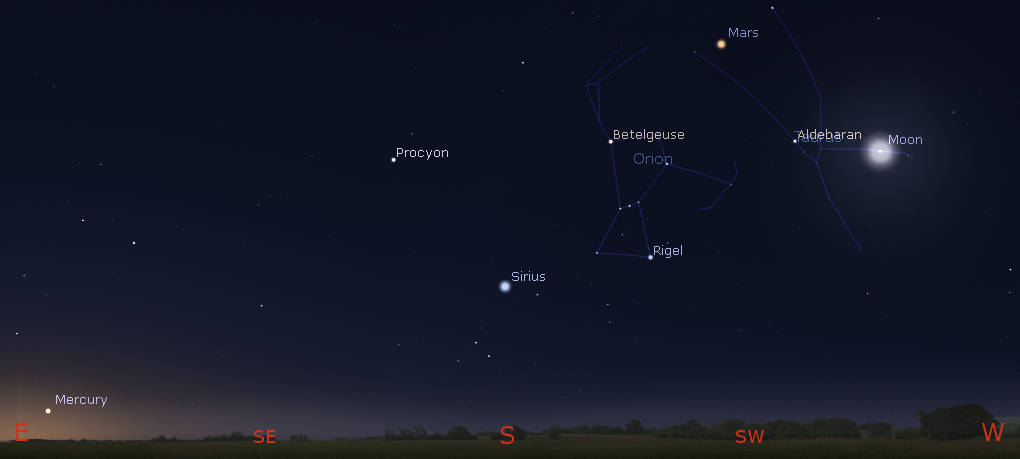
Morning planets Mars, Mercury and the Moon at 7 am tomorrow morning, October 13, 2022. Click on the image to enlarge it. Created using Stellarium.
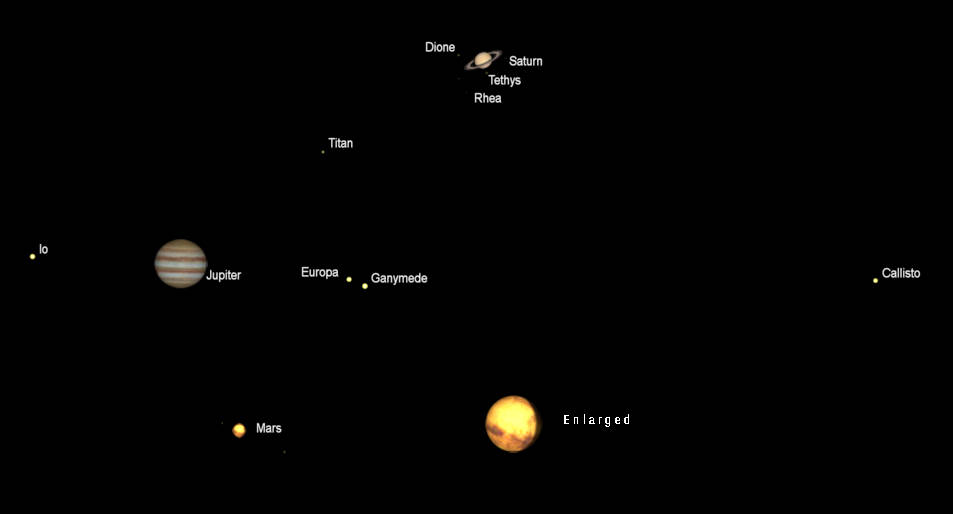
Telescopic views of Saturn Jupiter and Mars (north up) as they would be seen in a small telescope, with the same magnification. The image of Mars doesn’t show it, but the white north polar cap will appear at the top or north limb of Mars. Saturn and Jupiter are shown at 9 pm, Mars at 6 am. I do not show planets less than 10 seconds of arc in diameter, so Mercury is not shown. Apparent diameters: Saturn 17.81″, its rings 41.48″; Jupiter 49.34″. Mars 13.13″. Mars’ distance is 66.5 million miles (107.1 million kilometers). Mercury, which isn’t shown, is 6.17″ in diameter and 71.1% illuminated. The ” symbol means seconds of arc (1/3600th of a degree.) Click on the image to enlarge it. Created using Cartes du Ciel (Sky Charts).
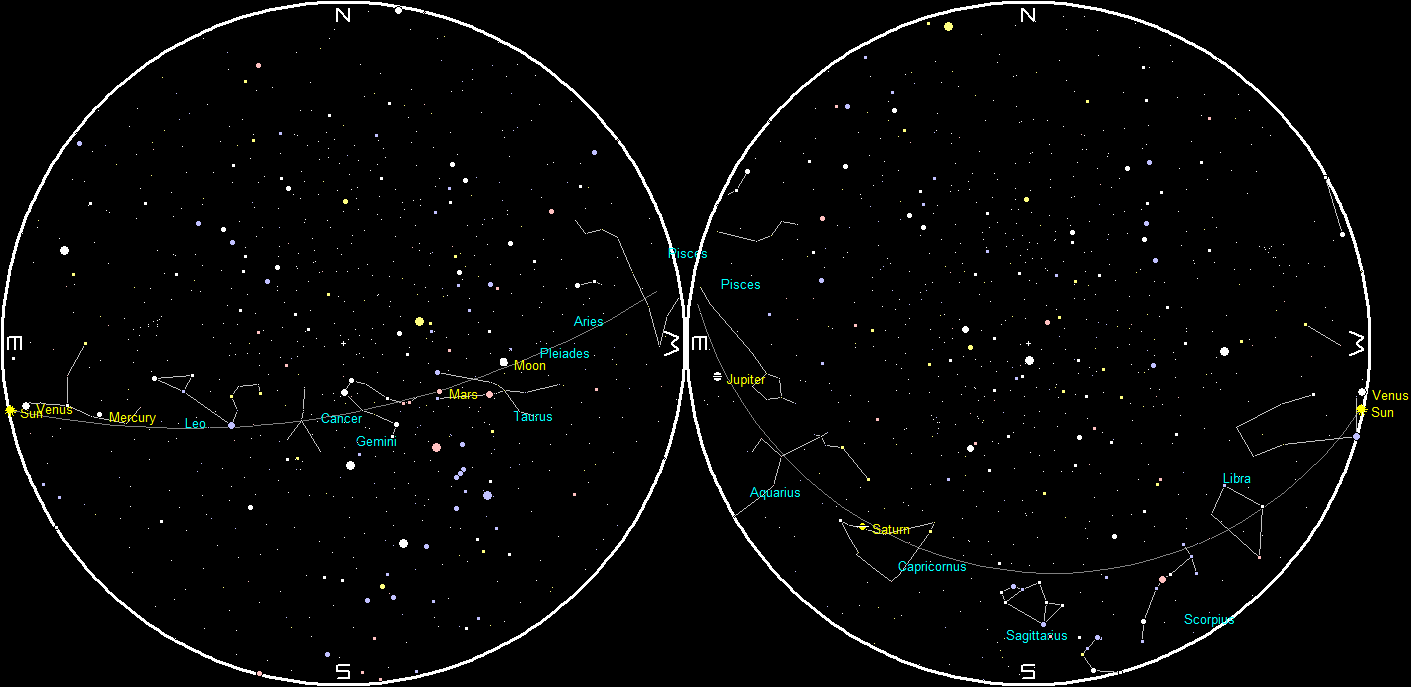
The naked-eye planets and the Moon at sunset and sunrise on a single night, starting with sunset on the right on October 12, 2022. The night ends on the left with sunrise on the 13th. Click on the image to enlarge it. Created using my LookingUp program and GIMP.
10/05/2022 – Ephemeris – Let’s search for the naked-eye planets for this week
This is Ephemeris for Wednesday, October 5th. Today the Sun will be up for 11 hours and 30 minutes, setting at 7:15, and it will rise tomorrow at 7:46. The Moon, 3 days past first quarter, will set at 3:33 tomorrow morning.
Let’s search for the naked-eye planets for this week. The waxing gibbous Moon will be visible near Saturn tonight, with the ringed planet right and above our Moon. Super bright Jupiter is to the far right of the Moon at 9 pm in the east southeast, the brightest star-like object in the sky. Jupiter is seen against the stars of Pisces the fish, while Saturn is spotted in the eastern end of Capricornus the sea goat. I don’t think the stars will be visible with the bright Moon. One star in their direction may be visible and low on the horizon and in line tonight with Saturn and the Moon. It’s Fomalhaut, normally the loneliest star in the sky. Before seven tomorrow morning, the red planet Mars will be high in the south, above the winter constellation of Orion. At that hour, Mercury can also be spotted low in the east.cc
The astronomical event times given are for the Traverse City/Interlochen area of Michigan (EDT, UT – 4 hours). They may be different for your location.
Addendum
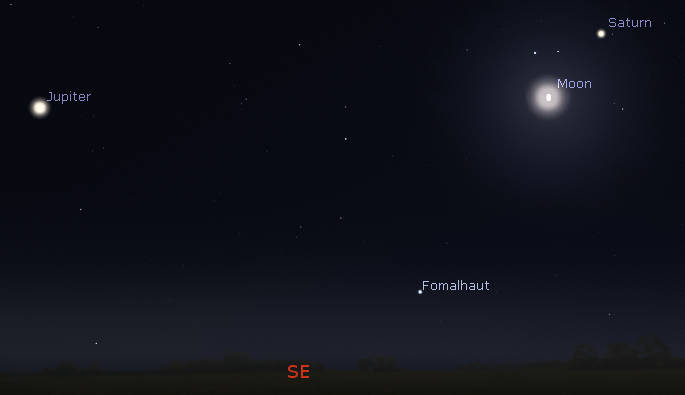
Evening planets and the Moon tonight, October 5, 2022, at 9 pm. Click on the image to enlarge it. Created using Stellarium.
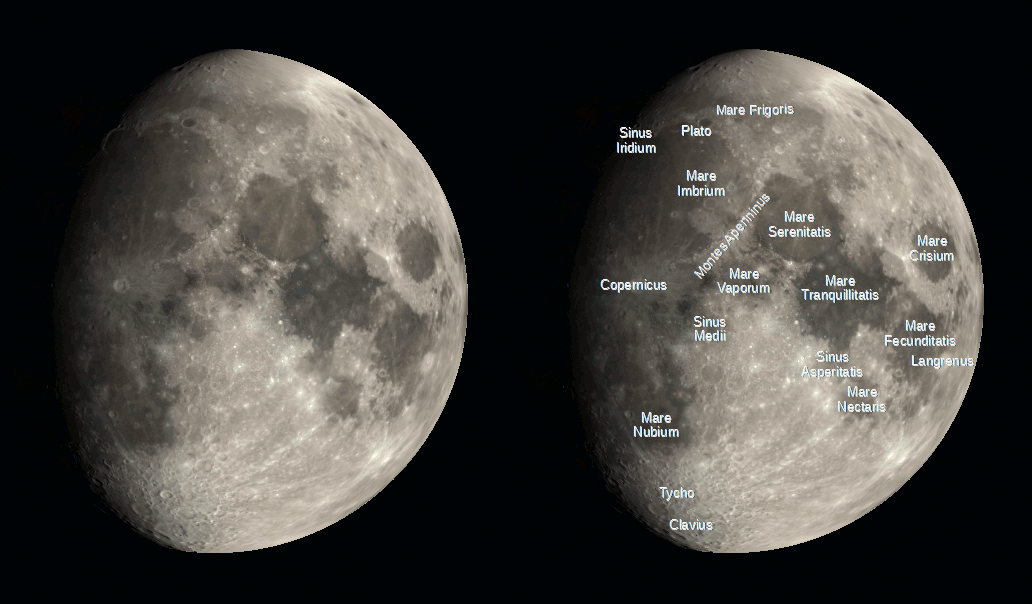
Annotated Gibbous Moon Animation for tonight, October 5, 2022, as it might in binoculars or a small telescope. Created using Stellarium, LibreOffice Draw and GIMP.
Translations of some lunar feature names according to Virtual Moon Atlas
Mare Crisium – Sea of Crises
Mare Fecunditatis – Sea of Fertility
Mare Frigoris – Sea of Cold
Mare Imbrium – Sea of Showers
Mare Nectaris – Sea of Nectar
Mare Nubium – Sea of Clouds
Mare Serenitatis – Sea of Serenity
Mare Tranquillitatis – Sea of Tranquility
Mare Vaporum – Sea of Vapors
Montes Apenninus – Apennines Mountains
Sinus Asperitatis – Golfe des Asperites
Sinus Iridium – Bay of Rainbows
Sinus Medii – Bay of the Center
Craters are generally named after astronomers, people of science, or explorers
Note that Mare is pronounced Mar-é
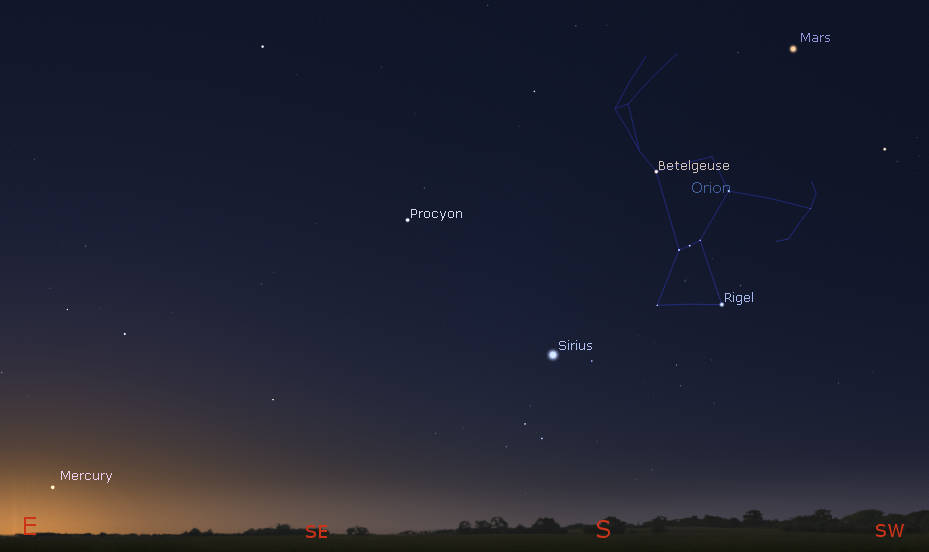
Morning planets, Mars and Mercury with the winter stars and Orion at 7 am tomorrow morning, October 6, 2022. Click on the image to enlarge it. Created using Stellarium.
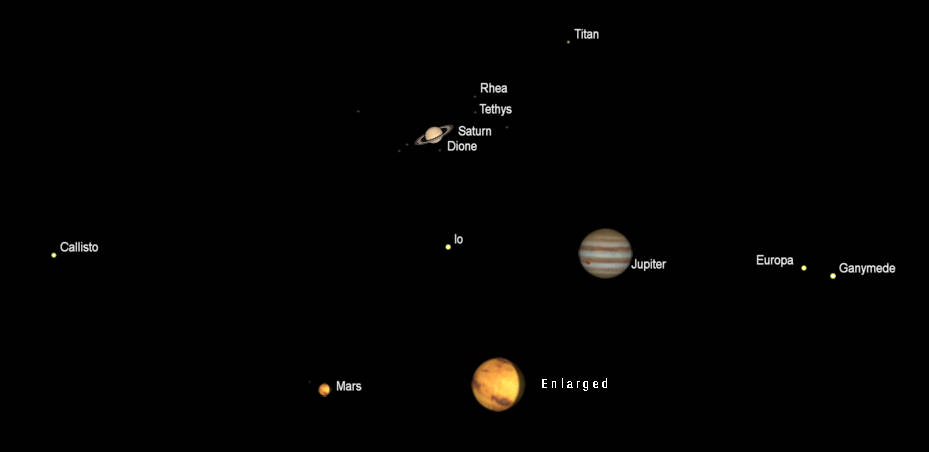
Telescopic views of Saturn Jupiter and Mars (north up) as they would be seen in a small telescope, with the same magnification. The image doesn’t show it, but the white north polar cap will appear at the top or north limb of Mars. Saturn and Jupiter are shown at 9 pm, Mars at 6 am. I do not show planets less than 10 seconds of arc in diameter. Apparent diameters: Saturn 18.00″, its rings 41.91″; Jupiter 49.69″. Mars 12.44″. Mars’ distance is 69.7 million miles (112.2 million kilometers). Mercury, which isn’t shown, is 7.51″ in diameter and 40.8% illuminated. The ” symbol means seconds of arc (1/3600th of a degree.) Click on the image to enlarge it. Created using Cartes du Ciel (Sky Charts).
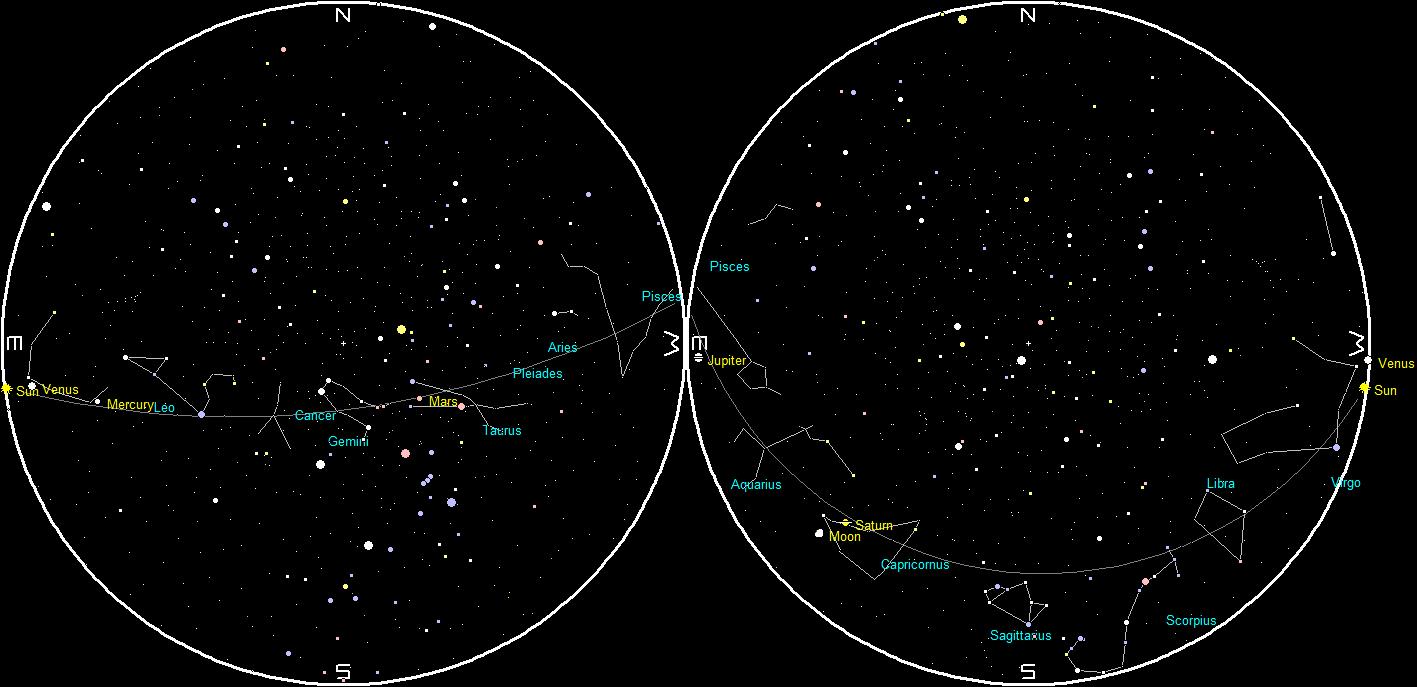
The naked-eye planets and the Moon at sunset and sunrise on a single night, starting with sunset on the right on October 5, 2022. The night ends on the left with sunrise on the 6th. Click on the image to enlarge it. Created using my LookingUp program and GIMP.
10/03/2022 – Ephemeris – There’s something on the Moon that’s straight and not circular
This is Ephemeris for Monday, October 3rd. Today the Sun will be up for 11 hours and 36 minutes, setting at 7:19, and it will rise tomorrow at 7:44. The Moon, 1 day past first quarter, will set at 12:55 tomorrow morning.
On this program, I try to talk about celestial objects one can see or find with the naked eye. Once found, I do talk about what they would look like in binoculars or small telescope. For those wanting more information, consult my blog bobmoler.wordpress.com where my scripts are posted with more information, illustrations and charts. The thing I’m talking about today is a feature on the Moon that’s visible only two nights a month. The day after first quarter, and the day after last quarter. It’s the straightest thing on the Moon, called the Straight Wall, that’s 67 miles (110 km) long and 900 feet (300 m) high. It is close to the terminator, the Moon’s sunrise line, about halfway from the center of the Moon to the south edge. It’s the thinnest dark line you can imagine.
The astronomical event times given are for the Traverse City/Interlochen area of Michigan (EDT, UT – 4 hours). They may be different for your location.
Addendum
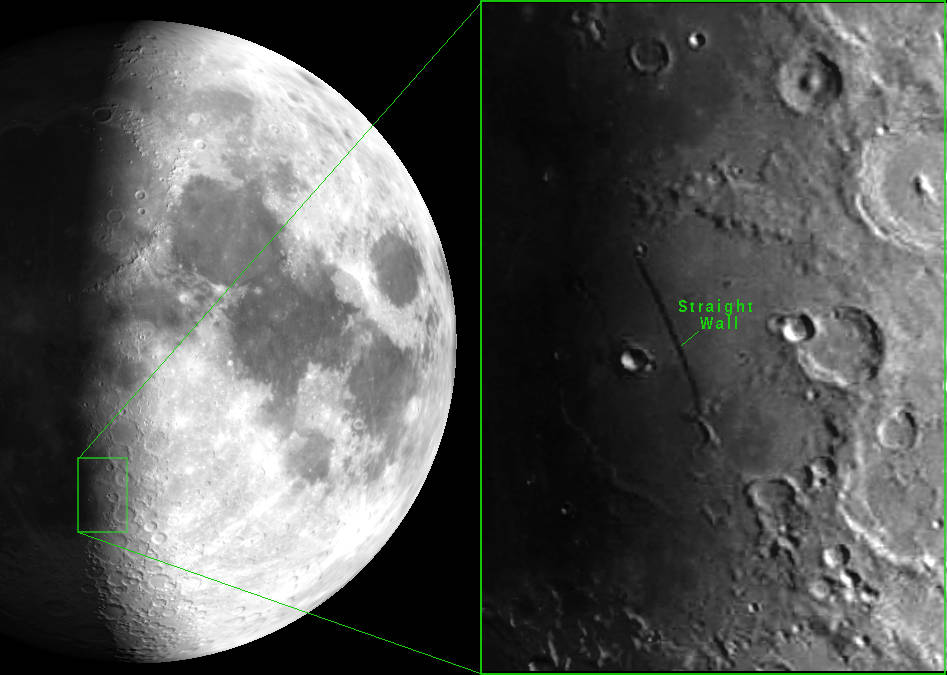
The Straight Wall or, officially in Latin, Rupes Recta, is a rectilinear fault. It isn’t really a wall, but a 7 degree slope. Once the Sun rises past seven degrees in that location of the Moon, it disappears. Near local sunset, a day after last quarter, the low sun in its sky shines more on it than the flat ground, so it shows up bright. Click on the image to enlarge it. The information and images were created from Virtual Moon Atlas, which is free software for MS Windows. I have a link to it on this page.
09/29/2022 – Ephemeris – Previewing October skies
This is Ephemeris for Thursday, September 29th. Today the Sun will be up for 11 hours and 48 minutes, setting at 7:26, and it will rise tomorrow at 7:39. The Moon, 3 days before first quarter, will set at 9:20 this evening.
Let’s take an early look at the skies for the month of October. Tomorrow I’ll talk about local observing events for Saturday, both afternoon and evening. Back to October. The Sun will still be moving south rapidly. Daylight hours in the Interlochen/Traverse City area and will drop from 11 hours and 42 minutes on Saturday the 1st to 10 hours, 13 minutes at month’s end. The altitude of the Sun above the southern horizon at local noon will be 42 degrees Saturday in the Interlochen area, and will descend to 31 degrees on Halloween. For the Straits of Mackinac area, the Sun will be a degree lower, and the daytime hours will be a bit shorter. The Orionid meteor shower, bits of Halley’s Comet, won’t be bothered by the bright Moon until the early morning on the 21st.
The astronomical event times given are for the Traverse City/Interlochen area of Michigan (EDT, UT – 4 hours). They may be different for your location.
Addendum
October Evening Star Chart
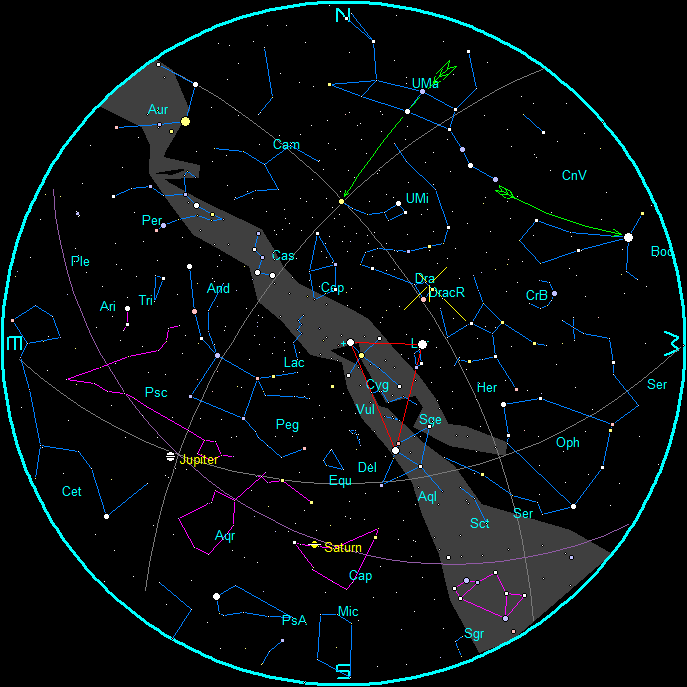
Star Chart for October 2022 (9 p.m. EDT, October 15, 2022). Click on image to enlarge it. Created using my LookingUp app.
The planets and stars are plotted for the 15th at 9 p.m. EDT in the evening and 6 a.m. for the morning chart. These are the chart times. Note that Traverse City is located approximately 45 minutes behind our time meridian, West 75° longitude. (An hour 45 minutes behind our daylight saving time meridian during EDT). To duplicate the star positions on a planisphere you may have to set it to 1 hour 45 minutes earlier than the current time.
October Morning Star Chart
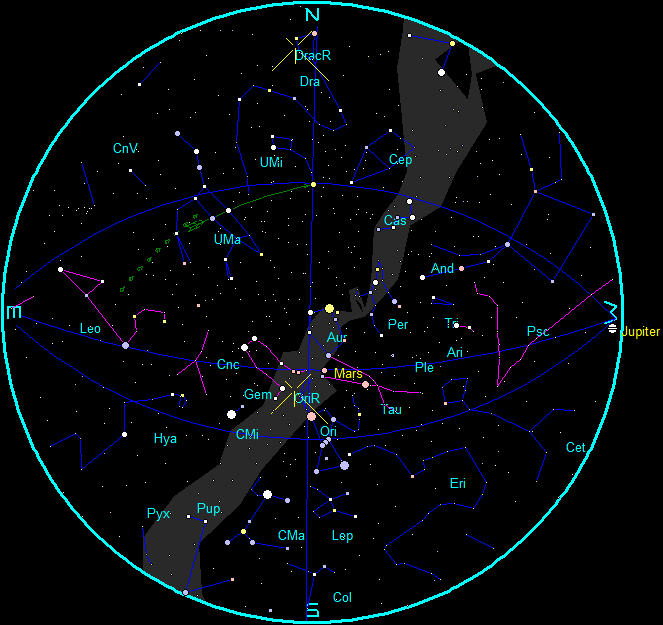
Star Chart for October mornings, 2022 (6 a.m. EDT, October 15, 2022). Click on image to enlarge. Created using my LookingUp app.
For a list of constellation names to go with the abbreviations, click here.
- Pointer stars at the front of the bowl of the Big Dipper point to Polaris, the North Star.
- Leaky dipper drips on Leo.
- Follow the arc of the handle of the Big Dipper to the star Arcturus.
- The Summer Triangle is in red.
- DracR – Draconid Radiant – Peaks the 8th – Zenithal Hourly Rate < 10 with rare outbursts of a thousand an hour. It’s hindered this year by the full moon.
- OriR – Orionid Radiant – Peak 21st – Zenithal Hourly Rate = 20
Twilight Limits, Nautical and Astronomical
| EDT | |||||||
| Morning | Twilight | Evening | Twilight | Dark | Night | Moon | |
| Date | Astro. | Nautical | Nautical | Astro. | Start | End | Illum. |
| 2022-10-01 | 6h09m | 6h43m | 20h29m | 21h04m | 22h45m | 6h09m | 0.41 |
| 2022-10-02 | 6h10m | 6h44m | 20h28m | 21h02m | 23h45m | 6h10m | 0.53 |
| 2022-10-03 | 6h11m | 6h46m | 20h26m | 21h00m | – | 6h11m | 0.64 |
| 2022-10-04 | 6h13m | 6h47m | 20h24m | 20h58m | 0h56m | 6h13m | 0.75 |
| 2022-10-05 | 6h14m | 6h48m | 20h22m | 20h56m | 2h14m | 6h14m | 0.84 |
| 2022-10-06 | 6h15m | 6h49m | 20h20m | 20h54m | 3h34m | 6h15m | 0.91 |
| 2022-10-07 | 6h16m | 6h50m | 20h18m | 20h52m | 4h52m | 6h16m | 0.97 |
| 2022-10-08 | 6h18m | 6h52m | 20h17m | 20h51m | 6h08m | 6h18m | 0.99 |
| 2022-10-09 | 6h19m | 6h53m | 20h15m | 20h49m | – | – | 1 |
| 2022-10-10 | 6h20m | 6h54m | 20h13m | 20h47m | – | – | 0.98 |
| 2022-10-11 | 6h22m | 6h55m | 20h11m | 20h45m | – | – | 0.94 |
| 2022-10-12 | 6h23m | 6h57m | 20h10m | 20h43m | – | – | 0.88 |
| 2022-10-13 | 6h24m | 6h58m | 20h08m | 20h42m | 20h42m | 21h00m | 0.81 |
| 2022-10-14 | 6h25m | 6h59m | 20h06m | 20h40m | 20h40m | 21h38m | 0.73 |
| 2022-10-15 | 6h26m | 7h00m | 20h05m | 20h38m | 20h38m | 22h24m | 0.64 |
| 2022-10-16 | 6h28m | 7h01m | 20h03m | 20h37m | 20h37m | 23h18m | 0.55 |
| 2022-10-17 | 6h29m | 7h03m | 20h01m | 20h35m | 20h35m | – | 0.45 |
| 2022-10-18 | 6h30m | 7h04m | 20h00m | 20h33m | 20h33m | 0h18m | 0.36 |
| 2022-10-19 | 6h31m | 7h05m | 19h58m | 20h32m | 20h32m | 1h23m | 0.27 |
| 2022-10-20 | 6h33m | 7h06m | 19h57m | 20h30m | 20h30m | 2h29m | 0.19 |
| 2022-10-21 | 6h34m | 7h08m | 19h55m | 20h29m | 20h29m | 3h37m | 0.12 |
| 2022-10-22 | 6h35m | 7h09m | 19h53m | 20h27m | 20h27m | 4h45m | 0.06 |
| 2022-10-23 | 6h36m | 7h10m | 19h52m | 20h26m | 20h26m | 5h54m | 0.02 |
| 2022-10-24 | 6h37m | 7h11m | 19h50m | 20h24m | 20h24m | 6h37m | 0 |
| 2022-10-25 | 6h39m | 7h12m | 19h49m | 20h23m | 20h23m | 6h39m | 0.01 |
| 2022-10-26 | 6h40m | 7h14m | 19h48m | 20h21m | 20h21m | 6h40m | 0.04 |
| 2022-10-27 | 6h41m | 7h15m | 19h46m | 20h20m | 20h20m | 6h41m | 0.1 |
| 2022-10-28 | 6h42m | 7h16m | 19h45m | 20h19m | 20h40m | 6h42m | 0.17 |
| 2022-10-29 | 6h44m | 7h17m | 19h43m | 20h17m | 21h37m | 6h44m | 0.27 |
| 2022-10-30 | 6h45m | 7h19m | 19h42m | 20h16m | 22h46m | 6h45m | 0.38 |
| 2022-10-31 | 6h46m | 7h20m | 19h41m | 20h15m | – | 6h46m | 0.49 |
Twilight calendar was generated using Cartes du Ciel (Sky Charts).
See my blog post: Twilight Zone for the definitions of the different periods of twilight here: https://bobmoler.wordpress.com/2018/09/27/.
NASA Calendar of Planetary Events
Oct  1 	Sa            Venus: 5.8° W
     2  Su   3:32 pm  Moon South Dec.: 27.4° S
     2  Su   8:14 pm  First Quarter
     4  Tu   1:01 pm  Moon Perigee: 369,300 km
     5  We  11:51 am  Moon-Saturn: 4.1° N
     8  Sa   2:06 pm  Moon-Jupiter: 2.1° N
     8  Sa   4:59 pm  Mercury Elongation: 18° W (Morning elongation)
     9  Su   4:55 pm  Full Hunter's Moon
    11  Tu   5:49 pm  Moon Ascending Node
    12  We  11:46 pm  Moon-Pleiades: 2.9° N
    15  Sa  12:28 am  Moon-Mars: 4° S
    16  Su   2:12 am  Moon North Dec.: 27.5° N
    17  Mo   6:21 am  Moon Apogee: 404300 km
    17  Mo  11:41 am  Moon-Pollux: 2° N
    17  Mo   1:15 pm  Last Quarter
    21  Fr   1:39 pm  Orionid Shower: ZHR = 20
    22  Sa   4:47 pm  Venus Superior Conjunction. Enters evening sky
    25  Tu   6:49 am  New Moon
    25  Tu   7:00 am  Partial Solar Eclipse (Parts of Europe, Africa and Asia)
    26  We   2:30 am  Moon Descending Node
    27  Th  10:48 pm  Moon-Antares: 2.3° S
    29  Sa  10:48 am  Moon Perigee: 368300 km
    29  Sa   9:04 pm  Moon South Dec.: 27.5° S
Nov  1  Tu            Venus: 2.6° E
All event times are given for UTC-4 hr: Eastern Daylight Saving Time.
Sky Events Calendar by Fred Espenak and Sumit Dutta (NASA’s GSFC),
http://eclipse.gsfc.nasa.gov/SKYCAL/SKYCAL.html.
If you go to the above site, you can print out a list like the above for the entire year or calendar pages for your time zone.
Sun and Moon Rising and Setting Events
LU              Ephemeris of Sky Events for Interlochen/TC
October 2022          Local time zone: EDT
+-----------------------------------------------------------------------+
| DATE |  SUN     SUN  DAYLIGHT|   TWILIGHT*    |MOON  RISE OR    ILLUM |
|      |  RISE    SET    HOURS |  END    START  |PHASE SET** TIME FRACTN|
+=======================================================================+
|Sat  1| 07:40a  07:23p  11:42 | 08:26p  06:37a |      Set  10:44p   39%|
+------+-----------------------+----------------+-----------------------+
|Sun  2| 07:42a  07:21p  11:39 | 08:24p  06:39a |F Qtr Set  11:44p   50%|
|Mon  3| 07:43a  07:19p  11:36 | 08:22p  06:40a |      Set  12:55a   61%|
|Tue  4| 07:44a  07:17p  11:33 | 08:20p  06:41a |      Set  02:14a   72%|
|Wed  5| 07:45a  07:15p  11:30 | 08:18p  06:42a |      Set  03:33a   82%|
|Thu  6| 07:46a  07:14p  11:27 | 08:16p  06:43a |      Set  04:52a   90%|
|Fri  7| 07:48a  07:12p  11:24 | 08:15p  06:45a |      Set  06:08a   96%|
|Sat  8| 07:49a  07:10p  11:20 | 08:13p  06:46a |      Set  07:22a   99%|
+------+-----------------------+----------------+-----------------------+
|Sun  9| 07:50a  07:08p  11:17 | 08:11p  06:47a |Full  Rise 07:19p  100%|
|Mon 10| 07:51a  07:06p  11:14 | 08:09p  06:48a |      Rise 07:39p   99%|
|Tue 11| 07:53a  07:05p  11:11 | 08:08p  06:50a |      Rise 08:02p   95%|
|Wed 12| 07:54a  07:03p  11:08 | 08:06p  06:51a |      Rise 08:28p   90%|
|Thu 13| 07:55a  07:01p  11:05 | 08:04p  06:52a |      Rise 08:59p   83%|
|Fri 14| 07:57a  06:59p  11:02 | 08:02p  06:53a |      Rise 09:37p   75%|
|Sat 15| 07:58a  06:58p  10:59 | 08:01p  06:54a |      Rise 10:23p   66%|
+------+-----------------------+----------------+-----------------------+
|Sun 16| 07:59a  06:56p  10:56 | 07:59p  06:56a |      Rise 11:17p   57%|
|Mon 17| 08:00a  06:54p  10:53 | 07:58p  06:57a |L Qtr Rise 12:18a   47%|
|Tue 18| 08:02a  06:52p  10:50 | 07:56p  06:58a |      Rise 01:22a   38%|
|Wed 19| 08:03a  06:51p  10:47 | 07:54p  06:59a |      Rise 02:29a   29%|
|Thu 20| 08:04a  06:49p  10:44 | 07:53p  07:01a |      Rise 03:36a   20%|
|Fri 21| 08:06a  06:48p  10:41 | 07:51p  07:02a |      Rise 04:44a   13%|
|Sat 22| 08:07a  06:46p  10:38 | 07:50p  07:03a |      Rise 05:53a    7%|
+------+-----------------------+----------------+-----------------------+
|Sun 23| 08:08a  06:44p  10:36 | 07:48p  07:04a |      Rise 07:04a    3%|
|Mon 24| 08:10a  06:43p  10:33 | 07:47p  07:06a |      Rise 08:18a    0%|
|Tue 25| 08:11a  06:41p  10:30 | 07:45p  07:07a |New   Set  06:53p    0%|
|Wed 26| 08:12a  06:40p  10:27 | 07:44p  07:08a |      Set  07:21p    3%|
|Thu 27| 08:14a  06:38p  10:24 | 07:42p  07:09a |      Set  07:55p    8%|
|Fri 28| 08:15a  06:37p  10:21 | 07:41p  07:10a |      Set  08:39p   16%|
|Sat 29| 08:16a  06:35p  10:18 | 07:40p  07:12a |      Set  09:36p   25%|
+------+-----------------------+----------------+-----------------------+
|Sun 30| 08:18a  06:34p  10:16 | 07:38p  07:13a |      Set  10:45p   36%|
|Mon 31| 08:19a  06:32p  10:13 | 07:37p  07:14a |      Set  12:02a   47%|
+-----------------------------------------------------------------------+
* Nautical Twilight
** Moonrise or moonset, whichever occurs between sunrise and sunset
Generated using my LookingUp for DOS program.
09/28/2022 – Ephemeris – Searching for the naked-eye planets for this week
This is Bob Moler with Ephemeris for Wednesday, September 28th. Today the Sun will be up for 11 hours and 51 minutes, setting at 7:28, and it will rise tomorrow at 7:38. The Moon, 3 days past new, will set at 8:51 this evening.
Let’s search for the naked-eye planets for this week. The thin sliver of a waxing crescent Moon may be visible very low in the southwest at 8 pm. We’re back to two naked-eye planets in the evening sky. Jupiter was in opposition from the Sun on Monday, and closest to the Earth. As it gets darker, Jupiter will be seen first low in the east. At that time, Saturn can be seen in the southeast. Jupiter is seen against the stars of Pisces the fish, while Saturn is spotted in the eastern end of Capricornus the sea goat. At 6:45 tomorrow morning, Mars will be high in the south, above the winter constellation of Orion, and Jupiter will be very low in the west. Venus will rise in the east at 7:02 into bright twilight.
The astronomical event times given are for the Traverse City/Interlochen area of Michigan (EDT, UT – 4 hours). They may be different for your location.
Addendum
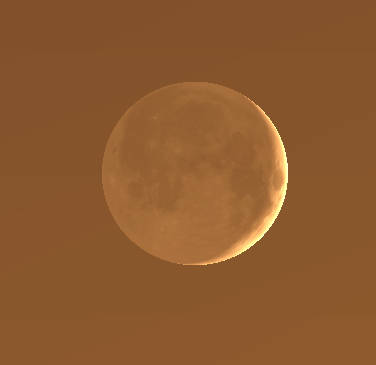
What the three-day-old Moon might look like in binoculars in twilight at 8 pm tonight, September 28, 2022. Illumination of the night part of the Moon will be provided by the bright gibbous Earth in its sky. The phenomenon is called earth shine. Created using Stellarium.
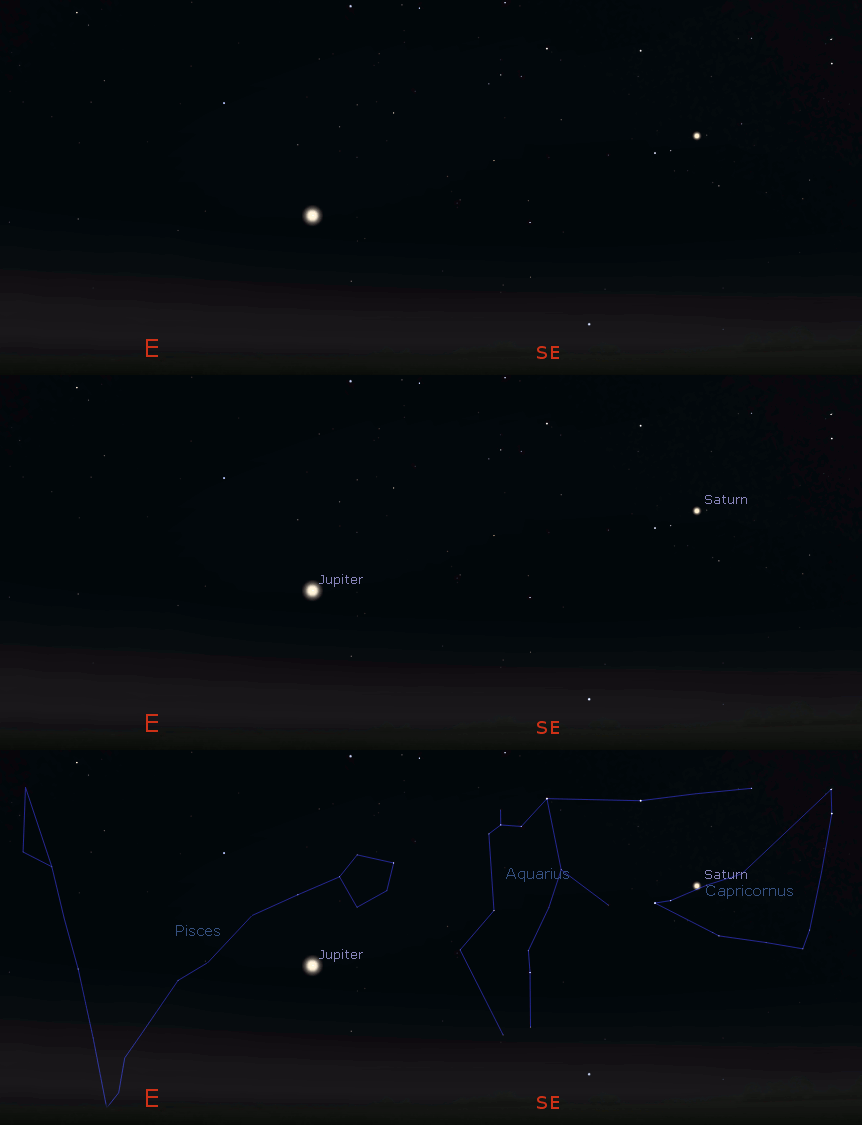
Evening planet finder animation by showing Jupiter and Saturn with and without the constellation lines. For 9 pm this evening, September 28, 2022. Click on the image to enlarge it. Created using Stellarium and GIMP.
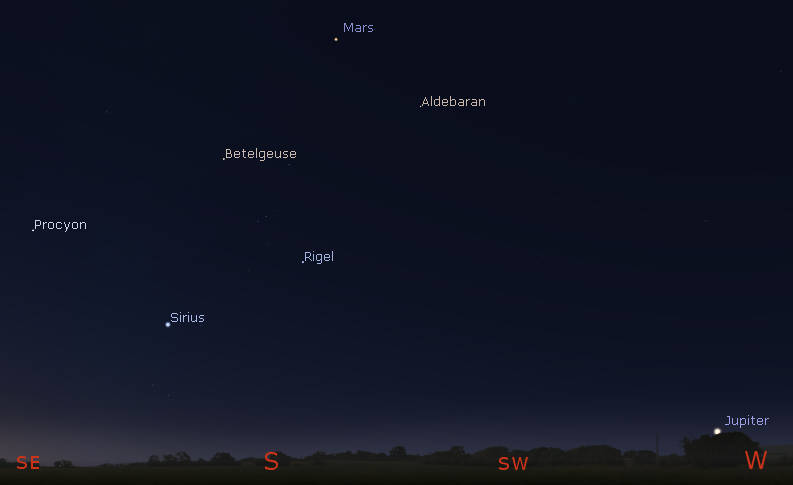
Morning planet Mars with the last gasp of the new evening planet Jupiter and bright winter stars at 6:45 tomorrow morning, September 29, 2022. Click on the image to enlarge it. Created using Stellarium.
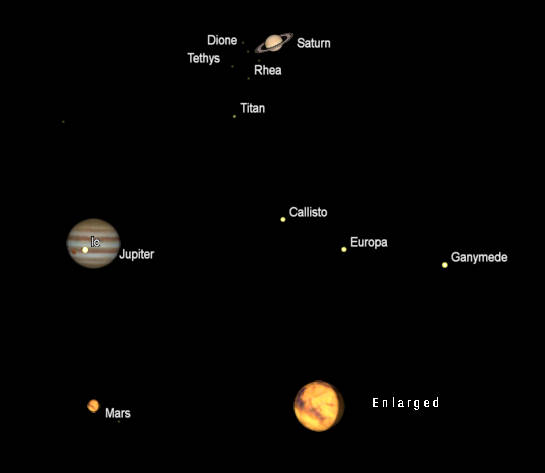
Telescopic views of Saturn, Jupiter and Mars (north up) as they would be seen in a small telescope, with the same magnification. The image doesn’t show it, but the white north polar cap will appear at the top or north limb of Mars. Saturn and Jupiter are shown at 10 pm, Mars at 6 am. Apparent diameters: Saturn 18.17″, its rings 42.33″; Jupiter 49.86″. Mars 11.01″. Mars’ distance is 73.8 million miles (118.7 million kilometers). The ” symbol means seconds of arc (1/3600th of a degree.) Created using Cartes du Ciel (Sky Charts).
One surprising thing about Mars in a telescope is how bright it is. That’s because it’s much closer to the Sun than Jupiter or Saturn, even thought it has a lower albedo (reflectance) than those planets.
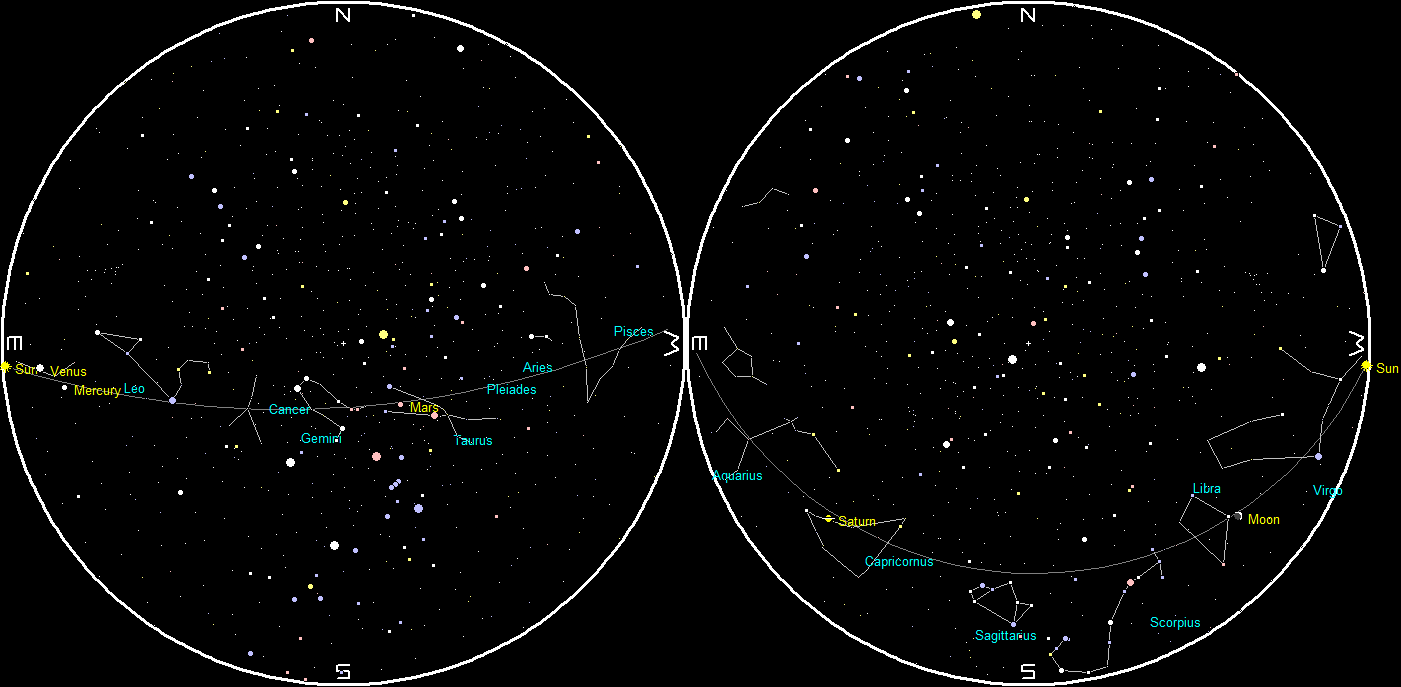
The naked-eye planets and the Moon at sunset and sunrise on a single night, starting with sunset on the right on September 28, 2022. The night ends on the left with sunrise on the 29th. Click on the image to enlarge it. Created using my LookingUp program and GIMP.

