Archive
03/23/2022 – Ephemeris – The search for the naked-eye planets moves to the morning sky
This is Bob Moler with Ephemeris for Wednesday, March 23rd. Today the Sun will be up for 12 hours and 18 minutes, setting at 7:59, and it will rise tomorrow at 7:38. The Moon, 2 days before last quarter, will rise at 2:50 tomorrow morning.
Let’s search for the naked-eye planets for this week. There are no bright planets in the evening sky. The planet action shifts to the morning sky. All five naked-eye planets are there, though Jupiter and Mercury are too close to the Sun to be seen. Late winter and early spring mornings aren’t the best for spotting planets close to the Sun, since they tend to lie low in the southeastern sky. Venus will rise at 5:46 tomorrow morning, Mars will rise at 5:51, and Saturn will rise at 6:10. By 7 am, they will be low in the southeast with much dimmer Mars at the 4 o’clock position below Venus, with Saturn lower, and at between the 7 and 8 o’clock position. Jupiter is just rising at that time.
The astronomical event times given are for the Traverse City/Interlochen area of Michigan (EDT, UT – 4 hours). They may be different for your location.
Addendum
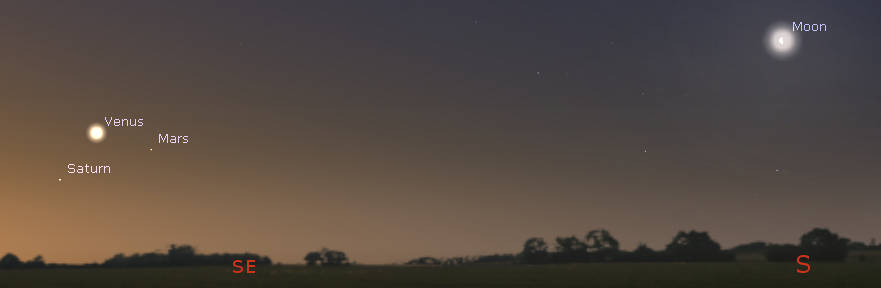
Morning planets and Moon at 7 am tomorrow morning, March 24, 2022. At that time Mars and Saturn may require binoculars to spot, however a quarter or a half an hour earlier they should be visible to the naked-eye.
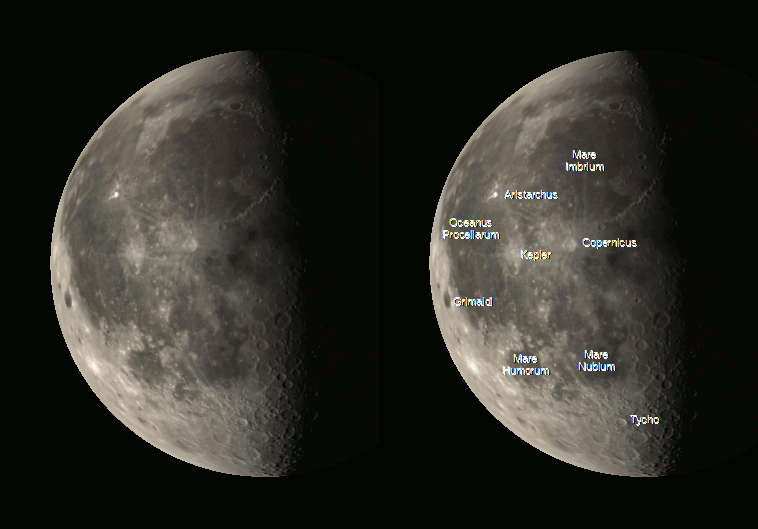
Waning gibbous Moon with animated labels. The Moon as it might appear in binoculars or a small telescope, with prominent lunar seas and craters labeled. I’ve retained the sea’s Latin names. Click on the image to enlarge it. Created using Stellarium, GIMP and LibreOffice.
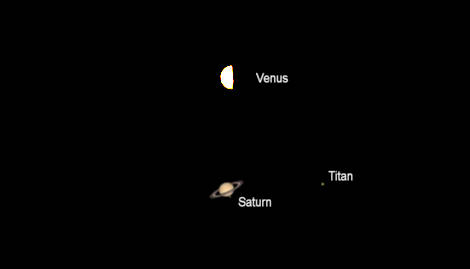
Telescopic views of the Venus and Saturn (north up) as they would be seen in a small telescope, with the same magnification, tomorrow morning at 7 am, March 24, 2022. I do not show planets less than 10 seconds of arc in diameter. Apparent diameters: Venus 23.52″, 51.6% illuminated; Saturn 15.66″, its rings 36.47″. Mars is not shown, its apparent diameter is 5.06″ and is 92.3% illuminated. The ” symbol means seconds of arc (1/3600th of a degree.) Created using Cartes du Ciel (Sky Charts).
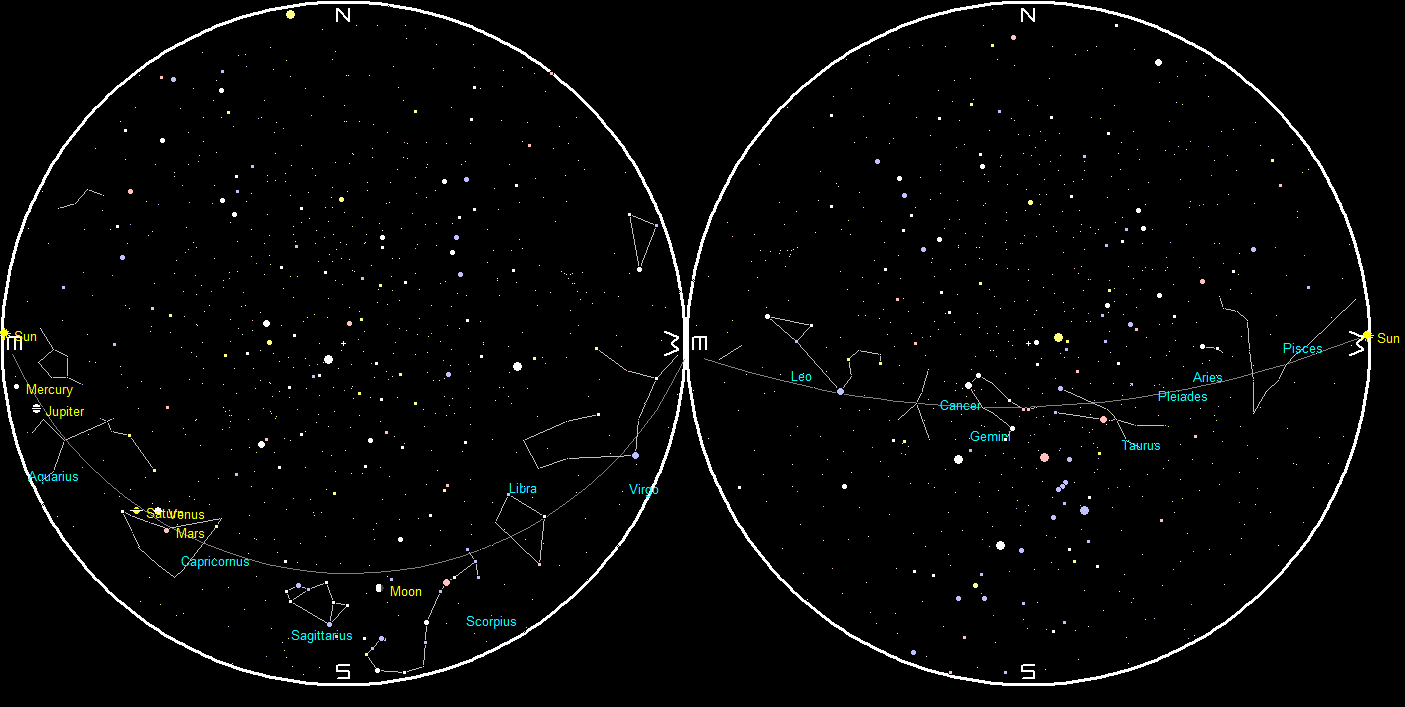
The naked-eye planets and the Moon at sunset and sunrise on a single night, starting with sunset on the right on March 23, 2022. The night ends on the left with sunrise on the 24th. Notice that all the naked-eye planets and the Moon are in the morning sky now. The labels for Saturn and Venus overlap. Click on the image to enlarge it. Created using my LookingUp program.
03/21/2022 – Ephemeris – Finding the celestial lion
This is Ephemeris for Monday, March 21st. Today the Sun will be up for 12 hours and 12 minutes, setting at 7:56, and it will rise tomorrow at 7:42. The Moon, 3 days past full, will rise at 12:15 tomorrow morning.
At 10 p.m. the spring constellation of Leo the lion will be fairly high in the southeast. It can be found by locating the Big Dipper high in the northeast and imagining that a hole were drilled in the bowl to let the water leak out. It would drip on the back of this giant cat. The Lion is standing or lying facing westward. His head and mane are seen in the stars as a backwards question mark. This group of stars is also called the Sickle. The bright star Regulus is at the bottom, the dot at the bottom of the question mark. A triangle of stars, to the left of Regulus, is the lion’s haunches. Leo contains some nice galaxies visible in moderate sized telescopes. The stars in Leo’s part of the sky are fewer than those in the winter sky.
The astronomical event times given are for the Traverse City/Interlochen area of Michigan (EDT, UT – 4 hours). They may be different for your location.
Addendum
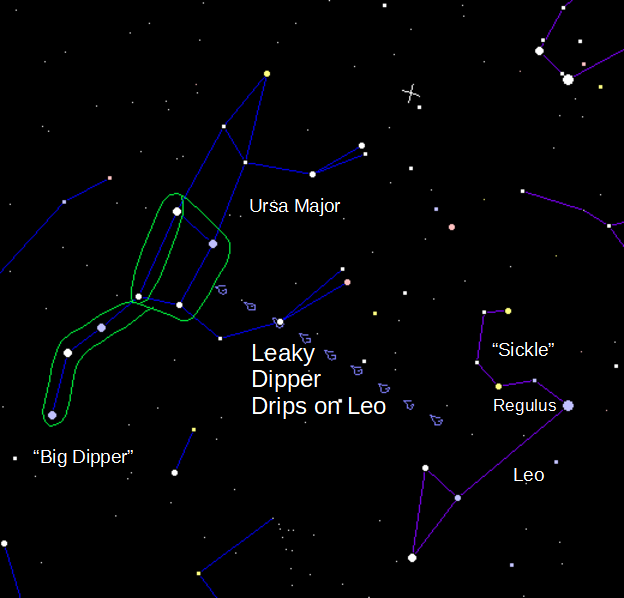
Leaky Big Dipper drips on Leo. The positions in the sky are for 10 pm local time, or about 2 hours after sunset. The little distorted cross at the top of the image marks the zenith. Look high in the east and southeast to see these stars. Created using my LookingUp program, GIMP and LibreOffice.
03/17/2022 – Ephemeris – We have 12 hours of daylight and night today, three days early
This is Ephemeris for St. Patrick’s Day, Thursday, March 17th. Today the Sun will be up for 12 hours even, setting at 7:51, and it will rise tomorrow at 7:49. The Moon, 1 day before full, will set at 8:20 tomorrow morning.
Why is this the day of equal day and night, when the vernal equinox, which means “equal night” is still three days away? The difference is due to our atmosphere and our definition of sunrise and sunset. Our atmosphere makes objects near the horizon appear higher than they actually are, which hastens sunrise and retards sunset. Also, the instant of sunrise and sunset is when the top of the sun appears to touch the horizon, rather than when the Sun bisects the horizon. Plus, it’s moving about a degree a day (twice its diameter) against the stars. So by the time of the equinox, on Sunday the 20th, the time between sunrise and sunset will have progressed to 12 hours and 9 minutes. But it was close enough for the ancients who coined the term.
The astronomical event times given are for the Traverse City/Interlochen area of Michigan (EDT, UT – 4 hours). They may be different for your location.
Addendum
This works for the Interlochen area. It may be a different by a day for other locations, but for the northern latitudes, it will be before the true equinox day, March 20th here.

How the atmosphere bends the light of the Sun or Moon rising or setting to appear higher than it actually is. S is the actual position of the Sun, S’ is the apparent position of the Sun. The blue line is the observer O’s horizon. The gray line is the actual, though much exaggerated, light path bent or refracted by the Earth’s atmosphere. The black line is the apparent sight line to the Sun. Credit Francisco Javier Blanco González, 2017
03/16/2022 – Ephemeris – Let’s search for the naked-eye planets for this week
This is Ephemeris for Wednesday, March 16th. Today the Sun will be up for 11 hours and 57 minutes, setting at 7:50, and it will rise tomorrow at 7:51. The Moon, 2 days before full, will set at 7:59 tomorrow morning.
Let’s search for the naked-eye planets for this week. There are no bright planets in the evening sky. Jupiter, the last to leave, will stay too close to the direction of the Sun to be visible in the morning sky for at least a month. So that’s where the action shifts to. Jupiter joins Mercury, Saturn, Venus and Mars. Late winter and early spring mornings aren’t the best for spotting planets close to the Sun, since they tend to lie low in the southeastern sky. Venus will rise at 5:51 tomorrow morning and Mars will rise at 6:04. Saturn will rise at 6:40. By 7:15, they will be low in the southeast with much dimmer Mars at the 5 o’clock position below Venus, with Saturn much lower at the 8 o’clock position.
The astronomical event times given are for the Traverse City/Interlochen area of Michigan (EDT, UT – 4 hours). They may be different for your location.
Addendum
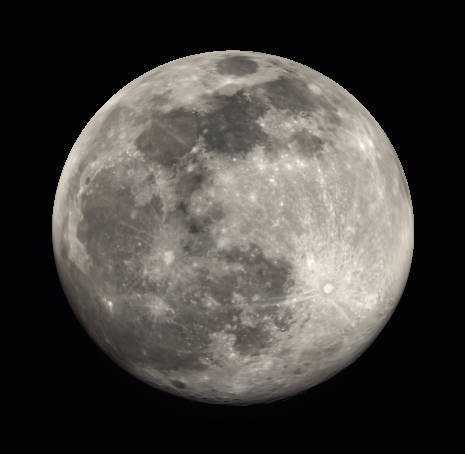
The Moon 2 days before full as it might appear in binoculars or small telescope, tonight, at 9 pm, March 16, 2022. Created using Stellarium.
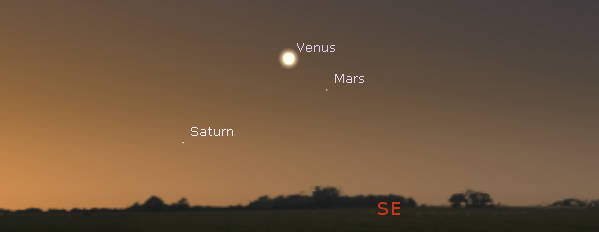
Morning planets Venus, Saturn and Mars at 7:15 am, or about 36 minutes before sunrise tomorrow, March 17, 2022. Binoculars may help in spotting Mars and Saturn. Over the week, these planets will continue to move away from the rising Sun. Well, all except Venus which will reach its greatest elongation, meaning separation from the Sun on Sunday, before beginning to slip back toward the Sun. Created using Stellarium.
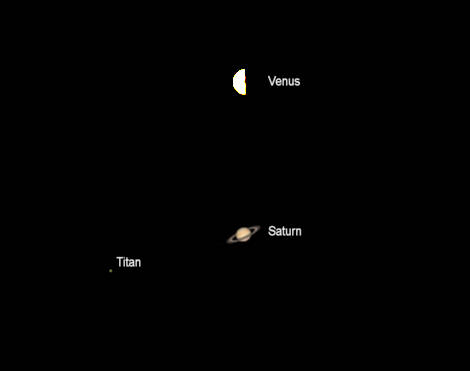
Telescopic views of the Venus and Saturn (north up) as they would be seen in a small telescope, with the same magnification, tomorrow morning at 7 15 am, March 17, 2022. I do not show planets less than 10 seconds of arc in diameter. Apparent diameters: Venus 25.49″, 48.0% illuminated; Saturn 15.55″, its rings 36.22″. Mars is not shown, its apparent diameter is 4.94″ and is 92.8% illuminated. The ” symbol means seconds of arc (1/3600th of a degree.) Created using Cartes du Ciel (Sky Charts).
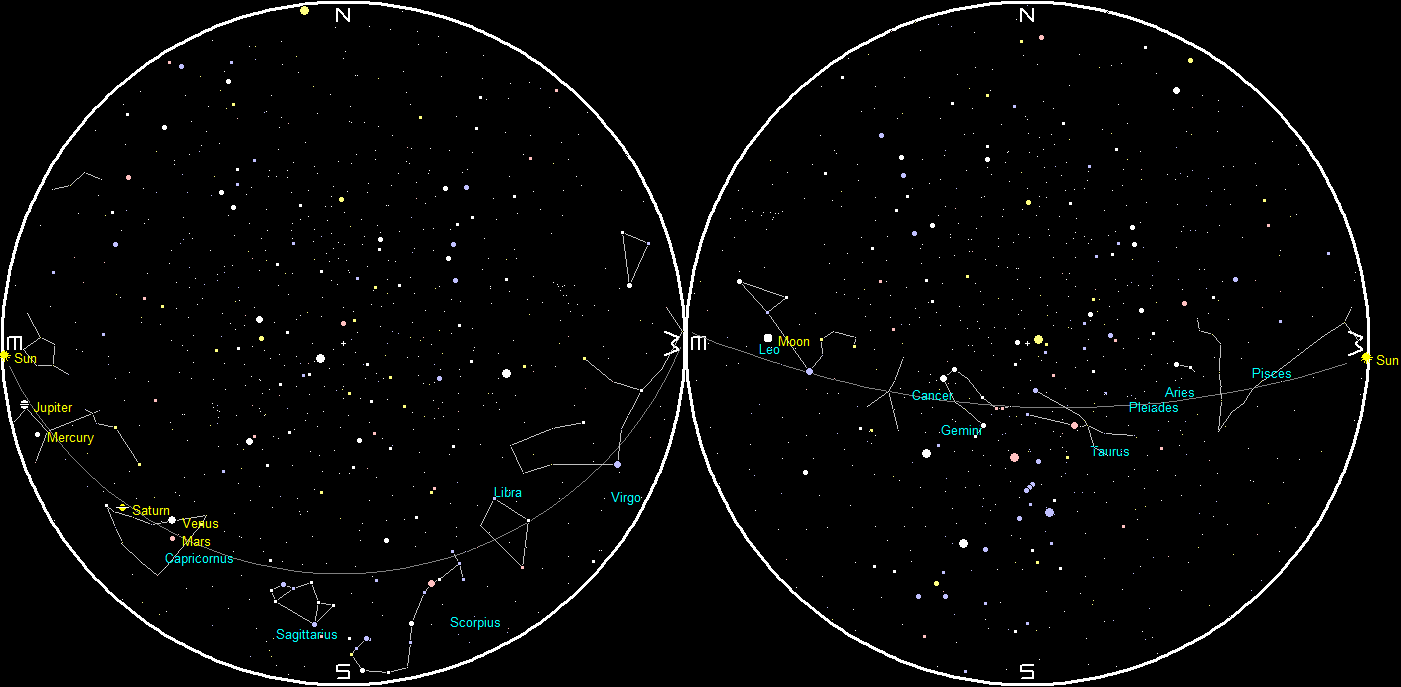
The naked-eye planets and the Moon at sunset and sunrise on a single night, starting with sunset on the right on March 16, 2022. The night ends on the left with sunrise on the 17th. Notice that all the naked-eye planets are in the morning sky now, with the Moon still hanging out in the evening sky. Click on the image to enlarge it. Created using my LookingUp program.
03/11/2022 – Ephemeris – Looking at the northern part of the Moon and the crater Plato
This is Ephemeris for Friday, March 11th. Today the Sun will be up for 11 hours and 41 minutes, setting at 6:43, and it will rise tomorrow at 7:00. The Moon, 1 day past first quarter, will set at 4:18 tomorrow morning.
As the Moon moves around the Earth, now one day past first quarter, more of it is revealed in sunlight. The top or north part of the moon is of interest now. The second-largest lunar sea, Mare Imbrium, or Sea of Showers, is now half illuminated by the advancing terminator, the sunrise line. That can be seen with the naked eye. With binoculars, in the mountains north or above Imbrium can be found the flat floored crater or walled plain called Plato. This crater is situated in the lunar Alps. Mountains on the Moon are named after their earthly counterparts. Visible in telescopes now will be the Alpine Valley cutting through the Alps just to the right of Plato. Each night from new to full, more of the Moon’s features are revealed near the terminator.
The astronomical event times given are for the Traverse City/Interlochen area of Michigan (EST, UT – 5 hours). They may be different for your location.
Addendum
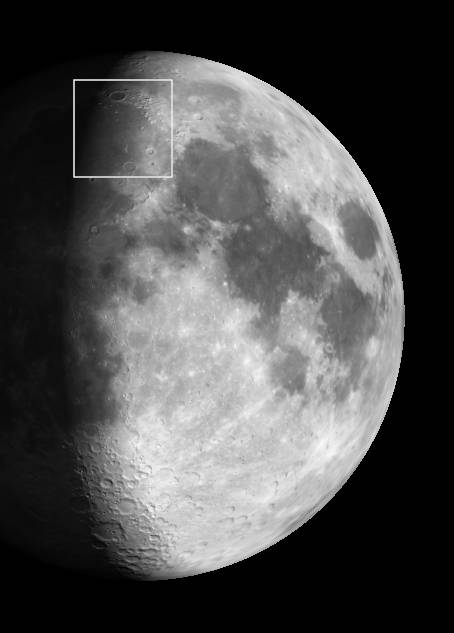
The Moon tonight, a day past first quarter, March 11, 2022, outlining the Mare Imbrium, crater Plato area, which is seen in detail below. Created using Virtual Lunar Atlas.
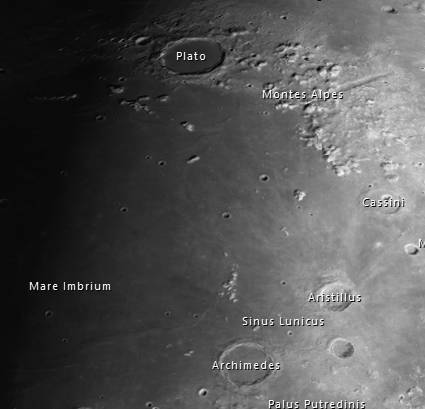
The Moon tonight, March 11, 2022, highlighting the crater Plato and lunar Alps. The Alpine Valley (Vallis Alpes), lies under the caption “Alpes” for the mountains. One of cool things to watch when the terminator is situated just right is to watch the shadows of the mountains retreat across Plato’s crater floor as the Sun rises. The shadows of the peaks appear very jagged as they retreat. Created using Virtual Lunar Atlas.
03/10/2022 – Ephemeris – Viewing the Moon at first quarter tonight
This is Ephemeris for Thursday, March 10th. Today the Sun will be up for 11 hours and 38 minutes, setting at 6:42, and it will rise tomorrow at 7:02. The Moon, at first quarter today, will set at 3:26 tomorrow morning.
By the time we spot the moon this evening, it will be over half a day from being exactly first quarter phase. Looking at the brighter part of the Moon in binoculars, which is at the bottom or south end. We are looking at the lunar highlands of mostly very old craters that extend back to the formation of the Moon, nearly 4.5 billion years ago, that weren’t obliterated by the asteroid strikes that created the darker maria or lunar seas half a billion years later. In small telescopes there is a vertical line of three large craters whose names, from largest to smallest and top down, are Ptolemaeus, Alphonsus, and Arzachel. Alphonsus is a curious crater. In 1958 a Soviet astronomer recorded a possible volcanic eruption or outgassing from the crater floor.
The astronomical event times given are for the Traverse City/Interlochen area of Michigan (EST, UT – 5 hours). They may be different for your location.
Addendum
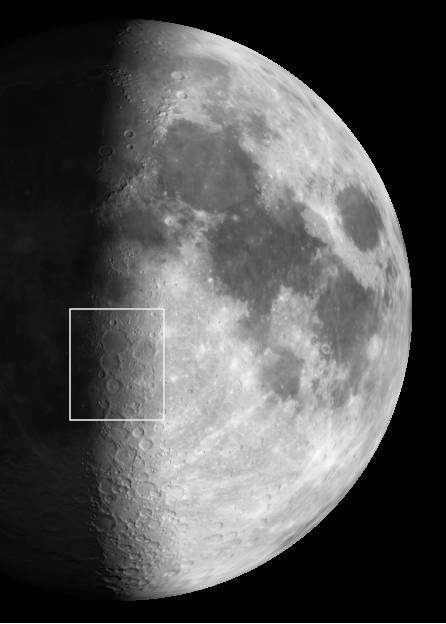
Lunar craters Ptolemaeus, Alphonsus and Arzachel outlined on the Moon’s disk, at first quarter, at 8 pm, March 10, 2022. Created using Virtual Moon Atlas.
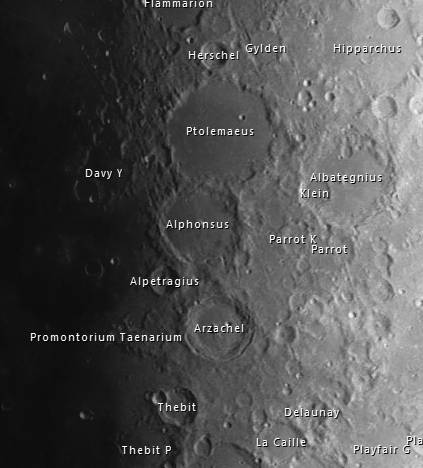
Closeup of lunar craters Ptolemaeus, Alphonsus and Arzachel, with other nearby craters, outlined above. Created using Virtual Moon Atlas.
02/24/2022 – Ephemeris – The celestial unicorn
This is Ephemeris for Thursday, February 24th. Today the Sun will be up for 10 hours and 55 minutes, setting at 6:23, and it will rise tomorrow at 7:27. The Moon, 1 day past last quarter, will rise at 3:57 tomorrow morning.
Among all the constellations in the sky of animals real and mythical, there is also a unicorn. It’s called Monoceros, and inhabits the south-southeastern sky at 8 p.m. mostly bounded by Orion on the right, Canis Major, the great dog below and Canis Minor, the little dog to the left and above. Unfortunately for observers without a telescope, Monoceros, is devoid of any but the faintest stars. Maybe that’s why no one sees unicorns anymore. It has many faint stars because the Milky Way runs through it. To the telescopic observer and astrophotographer it is a feast of faint nebulae or clouds of gas and dust, the birthplace of stars, including the red rose of the Rosette Nebula* (NGC 2237), and Hagrid’s Dragon Cluster (NGC 2301), which sounds suspiciously like it was recently, and unofficially, named. Monoceros also contains a beautiful telescopic triple star system, Beta (β) Monocerotis.
The astronomical event times given are for the Traverse City/Interlochen area of Michigan (EST, UT – 5 hours). They may be different for your location.
* The Rosette nebula surrounds the star cluster NGC 2244. This sparse star cluster is visible visually in telescopes. I’ve never been able to spot the nebula in a telescope, but it shows up, faintly, in my wide angle photographs of the area.
Addendum
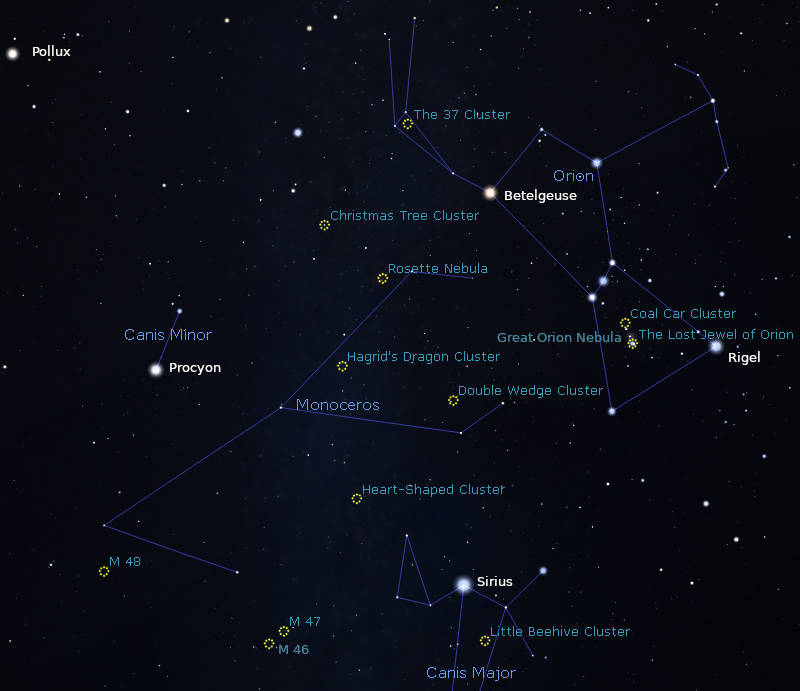
Deep Sky Objects in and around Monoceros. Deep Sky Objects are telescopic objects that lie beyond the solar system. Click on the image to enlarge. Created using Stellarium.
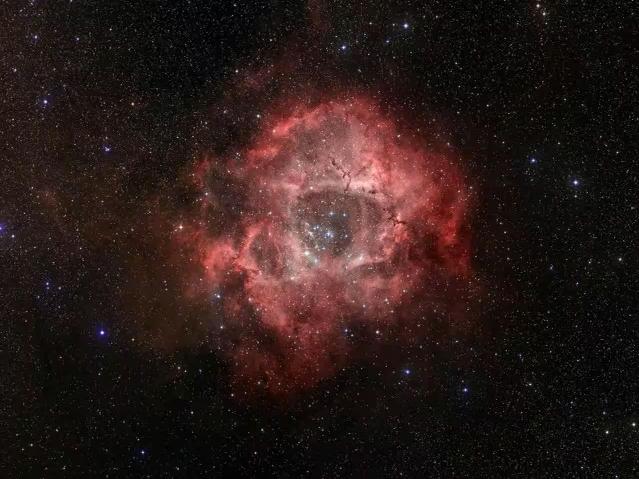
Rosette Nebula in the infrared from the Spitzer Space Telescope. Credit: NASA/JPL/Caltech
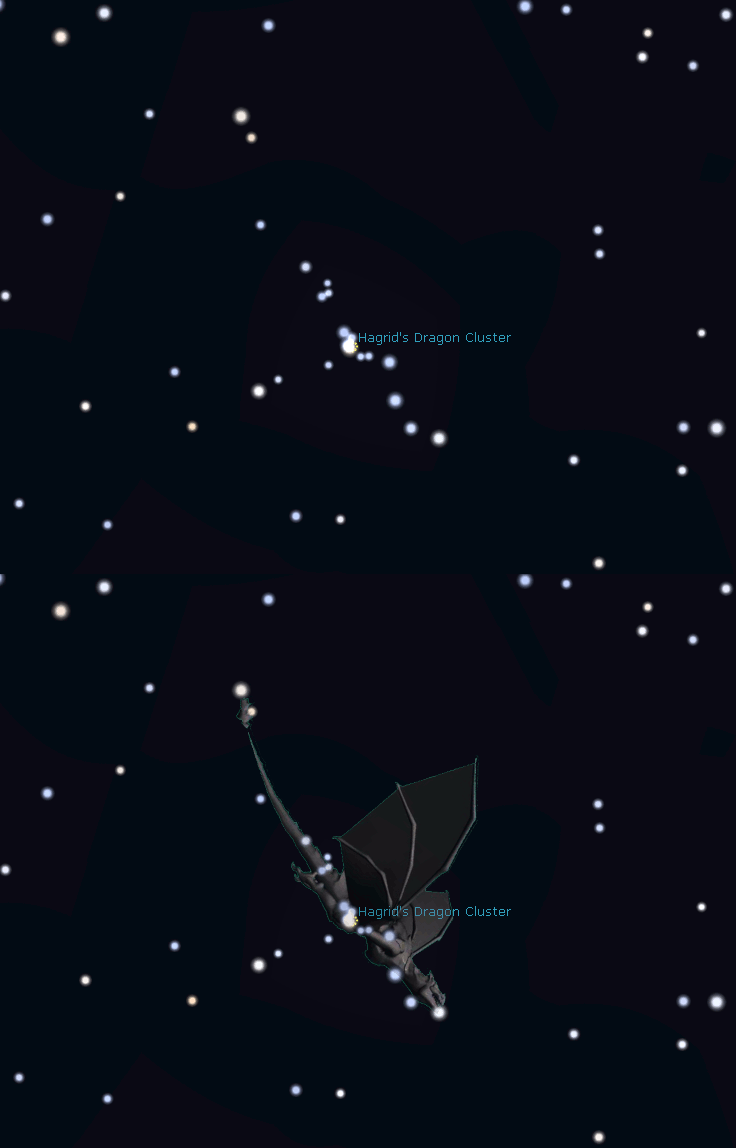
The brighter stars of NGC 2301 (Hagrid’s Dragon Cluster, AKA Great Bird Cluster and Copeland’s Golden Worm). It’s also in two other catalogs: Cr 119 and Mel 54. Created using Stellarium and GIMP. The dragon image is from “Dragon Flying Cycle” on YouTube by Simon Hussey.
Telescopic Beta Monocerotis. William Hershel, discoverer of Uranus, said that it was “One of the most beautiful sights in the heavens.” Credit: F. Ringwald, Fresno State.
02/23/2022 – Ephemeris – Let’s search for the naked-eye planets for this week
This is Ephemeris for Wednesday, February 23rd. Today the Sun will be up for 10 hours and 52 minutes, setting at 6:22, and it will rise tomorrow at 7:28. The Moon, at last quarter today, will rise at 2:43 tomorrow morning.
Let’s search for the naked-eye planets for this week. The last evening planet, Jupiter, is too close to the setting Sun to be spotted now after sunset. The action now shifts to the morning sky, where Venus and Mars reside. Saturn entered the morning sky sixteen days ago, and it will be about another month or so before it’s far enough from the direction of the Sun to be spotted. Venus, our brilliant morning star, Mars and maybe even Mercury can be spotted low in the southeast by 6:45 am, about half an hour before sunrise. Mars will be below, and right of Venus, while Mercury will be near the horizon left of Venus. Mercury is brighter than Mars, but lower in the more intense twilight. Venus will rise at 5:06, with Mars following at 5:38, and Mercury rising last at 6:32.
The astronomical event times given are for the Traverse City/Interlochen area of Michigan (EST, UT – 5 hours). They may be different for your location.
Addendum
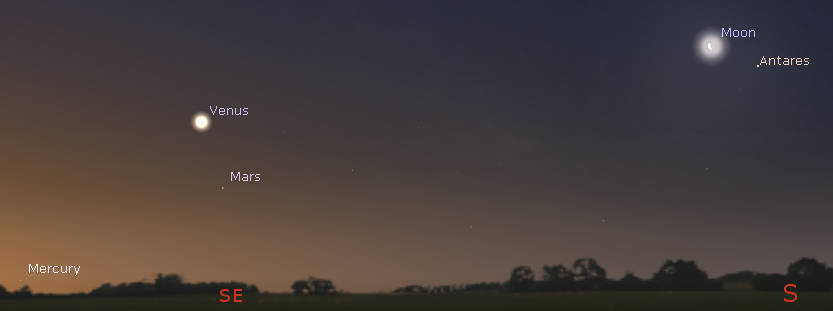
Morning planets and the waning crescent Moon at 6:45 am, or about 40 minutes before sunrise tomorrow morning, February 24, 2022. Mercury may not actually be visible. Click on the image to enlarge it. Created using Stellarium.
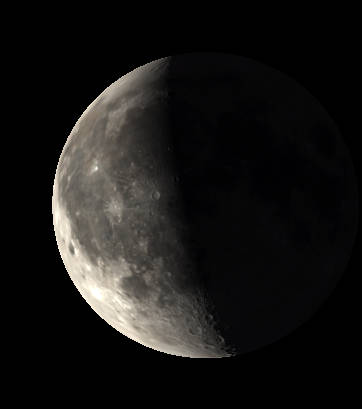
Waning Crescent Moon as it might be shown in binoculars or small telescope tomorrow morning, February 24, 2022. Created using Stellarium.
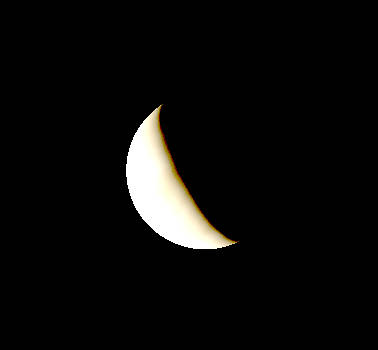
Venus through a telescope as it would appear before sunrise tomorrow morning, February 24, 2022. It’s shown larger than usual, since it’s the only planet that looks like anything in a small telescope now. Its apparent diameter is 33.72″, and it is 34.9% illuminated by the Sun.
(” means seconds of arc. 1″ is 1/3600th of a degree) Mars has an apparent diameter of 4.63″, while Mercury has one of 6.18″. Created using Stellarium, which is also the source for the apparent diameters and the illuminated fraction of Venus.
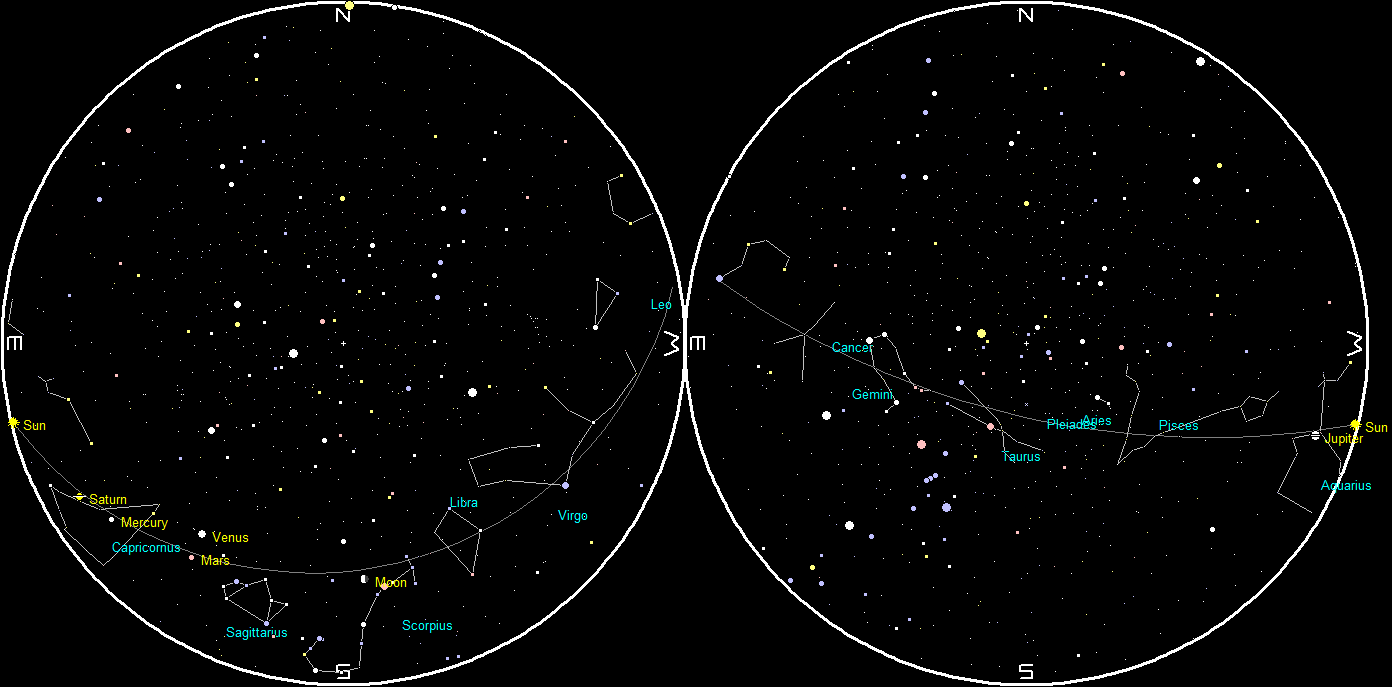
The naked-eye planets and the Moon at sunset and sunrise on a single night, starting with sunset on the right on February 23, 2022. The night ends on the left with sunrise on the 24th. Click on the image to enlarge it. Created using my LookingUp program.
02/22/2022 – Ephemeris – The Winter Triangle
This is Ephemeris for Tuesday, February 22nd. Today the Sun will be up for 10 hours and 49 minutes, setting at 6:21, and it will rise tomorrow at 7:30. The Moon, 1 day before last quarter, will rise at 1:26 tomorrow morning.
I’ve talked about the Winter Circle of bright stars already this winter, but some other astronomers talk about the Winter Triangle. The stars involved are Betelgeuse in the hunter Orion, Sirius in Canis Major, Orion’s large hunting dog, and Procyon in Canis Minor, his other small hunting dog. These three stars enclose a rather blank piece of sky with the faint Milky Way running through it and the almost invisible constellation of Monoceros the unicorn. The Summer Triangle has three bright stars with no other close competition. The Winter Triangle has four other bright stars near it. Any three of these would make a nice triangle. One of these constellations, Canis Minor, is tiny with Procyon and one other star. It makes me think of a dachshund, or maybe, if I’m hungry, a hot dog.
The astronomical event times given are for the Traverse City/Interlochen area of Michigan (EST, UT -5 hours). They may be different for your location.
Addendum
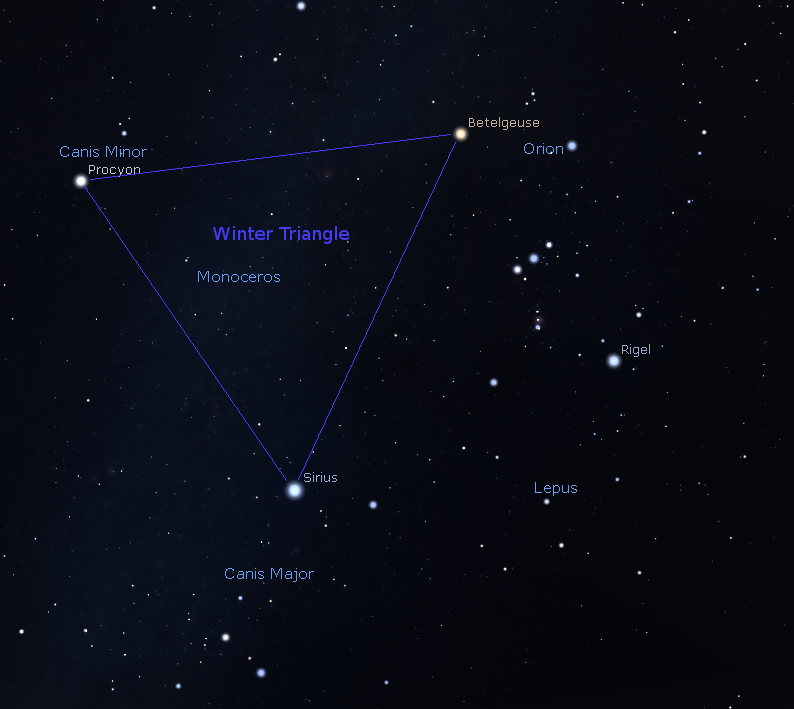
The Winter Triangle. It encloses a pretty blank space where Monoceros the unicorn lies. Created using Stellarium with my annotations for the Winter Triangle.
02/18/2022 – Ephemeris – Sirius, the brightest nighttime star
This is Ephemeris for Friday, February 18th. Today the Sun will be up for 10 hours and 37 minutes, setting at 6:15, and it will rise tomorrow at 7:36. The Moon, 2 days past full, will rise at 8:32 this evening.
In the evening, the great constellation of Orion the hunter can be seen in the south. Its large rectangle of bright stars is easily visible, even with a full moon. The three stars in a straight line, his belt, tilt downward to the left to a very bright star merrily twinkling lower in the sky. This star is called Sirius, also known as the Dog Star because it’s in the heart of Orion’s larger hunting dog, Canis Major. It is an arc light white star as seen in binoculars or telescope. It is the brightest star in the night sky, and a neighboring star, just twice the distance of the closest star to the Sun at 8.6 light years. It’s name, Sirius, has nothing to do with a dog, but is from the Greek meaning scorching for its brightness or sparkling, due to its intense twinkling.
The astronomical event times given are for the Traverse City/Interlochen area of Michigan (EST, UT – 5 hours). They may be different for your location.
Addendum
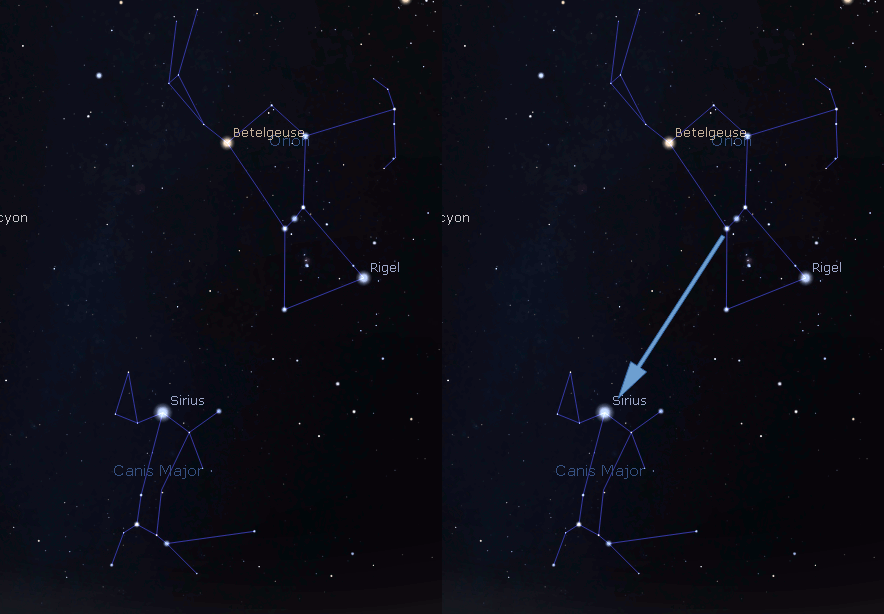
In the southern sky, Orion’s belt points to Sirius. Created using Stellarium, Libreoffice and GIMP.

