Archive
04/24/2020 – Ephemeris – The Big Dipper can be used to point to other stars and constellations
This is Bob Moler with Ephemeris for Arbor Day, Friday, April 24th. Today the Sun will be up for 13 hours and 57 minutes, setting at 8:39, and it will rise tomorrow at 6:41. The Moon, 2 days past new, will set at 10:21 this evening.
The Big Dipper can be used to point to other stars and constellations. Right now the Big Dipper is nearly overhead. The front bowl stars point to Polaris, the North Star which never seems to move in the sky. The handle can be used to find two stars. First follow the arc of the handle away from the bowl to find the fourth brightest night-time star Arcturus in the base of the kite shaped constellation of Boötes. Straighten the arc to a spike and continue to the south and you will come to the bright blue-white star Spica in Virgo the virgin. You can remember these stars with the phrase “Follow the arc of the handle to Arcturus and then spike to Spica” or if you prefer the alternate pronunciation of the latter star “Speak to Speeka”.
The event times given are for the Traverse City/Interlochen area of Michigan. They may be different for your location.
Addendum
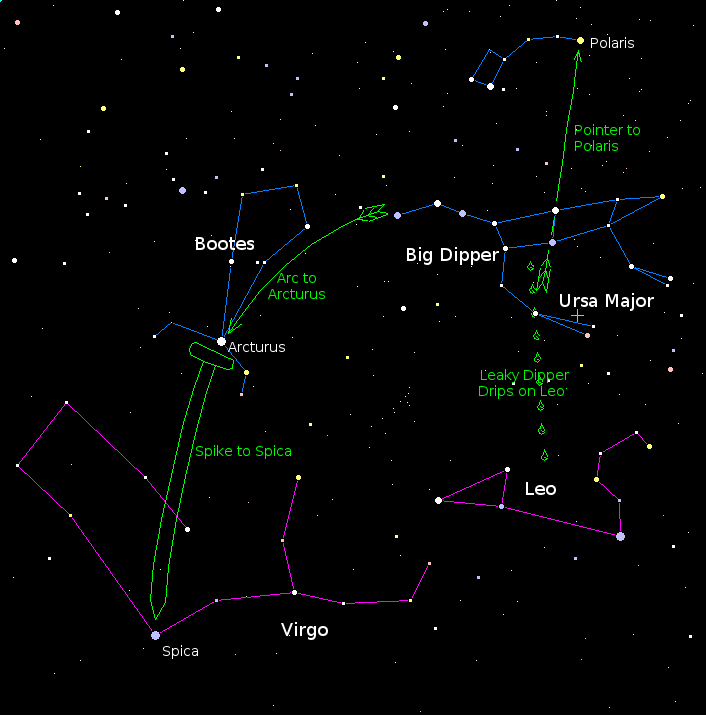
Finding stars and constellations using the Big Dipper. Click on the image to enlarge. Created using my LookingUp program for Windows.
04/21/2020 – Ephemeris – The Lyrid Meteor Shower will reach its peak after midnight tonight
This is Ephemeris for Tuesday, April 21st. Today the Sun will be up for 13 hours and 48 minutes, setting at 8:36, and it will rise tomorrow at 6:45. The Moon, 1 day before new, will rise at 6:58 tomorrow morning.
The Lyrid meteor shower will reach its peak tomorrow morning at around 2 a.m. The Moon will be new tomorrow so it won’t interfere. The radiant point, from which the meteor seem to come is between the constellation Lyra the harp for which they are named with its bright star Vega and Hercules. The numbers of meteors seen in an hour could be between 12 and 20. The Lyrids are caused by the debris left when a comet last seen in 1861, crossed Earth’s orbit as Comet Thacher. Speaking of comets, a new comet named SWAN was discovered a month ago. It was detected by with the Solar Wind An-iso-tropies camera or SWAN aboard the Solar and Heliospheric Observatory or (SOHO) spacecraft. We’ll follow Comet SWAN as it approaches the Sun next month.
The event times given are for the Traverse City/Interlochen area of Michigan. They may be different for your location.
Addendum
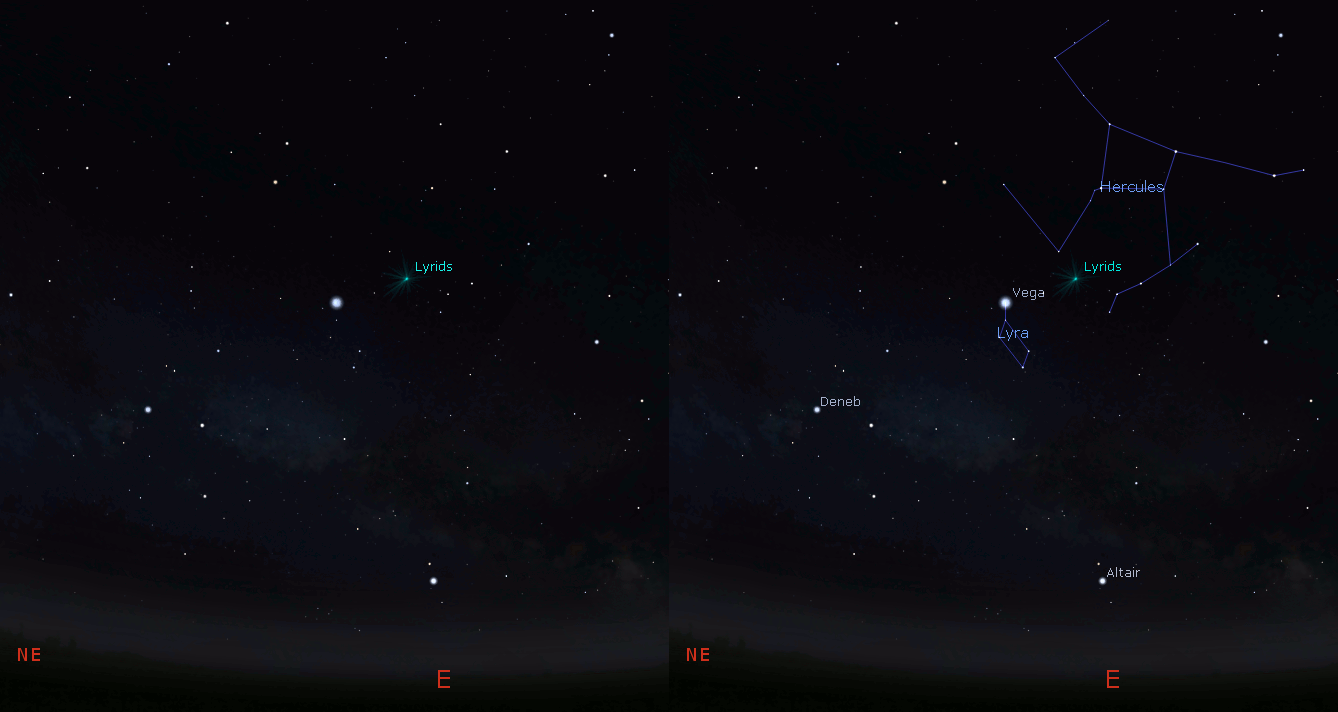
An animation Looking east at 2 a.m. April 22, 2020 toward Lyra, and Hercules with the Lyrid meteor radiant. The named stars are the stars of the Summer Triangle. Click on the image to enlarge. The meteors will appear all over the sky, but Lyrid meteors can be back traced to the radiant point. Created using Stellarium and GIMP.
04/13/2020 – Ephemeris – The story of Callisto and Arcas or Ursa Major and Boötes
This is Ephemeris for Monday, April 13th. Today the Sun will be up for 13 hours and 25 minutes, setting at 8:26, and it will rise tomorrow at 6:59. The Moon, 1 day before last quarter, will rise at 3:09 tomorrow morning.
Appearing mid way up the sky in the east at 10 p.m. is the kite shaped constellation of Boötes the herdsman. The bright star Arcturus is at the bottom-right of the kite, pointed to by the arc of the handle of the Big Dipper, above it. In one Greek myth Boötes represents a young hunter named Arcas, son of Callisto, a beautiful young lady who had the misfortune of being loved by Zeus the chief of the Greek gods. Zeus’ wife Hera, found out about the affair, and since she couldn’t punish Zeus, turned the poor woman into an ugly bear. Arcas, unaware of the events surrounding his mother’s disappearance in his youth was about to kill the bear when Zeus intervened and placed them both in the sky to save her. To this day Boötes continues to chase the Great Bear, Ursa Major, around the pole of the sky each night.
The event times given are for the Traverse City/Interlochen area of Michigan. They may be different for your location.
Addendum
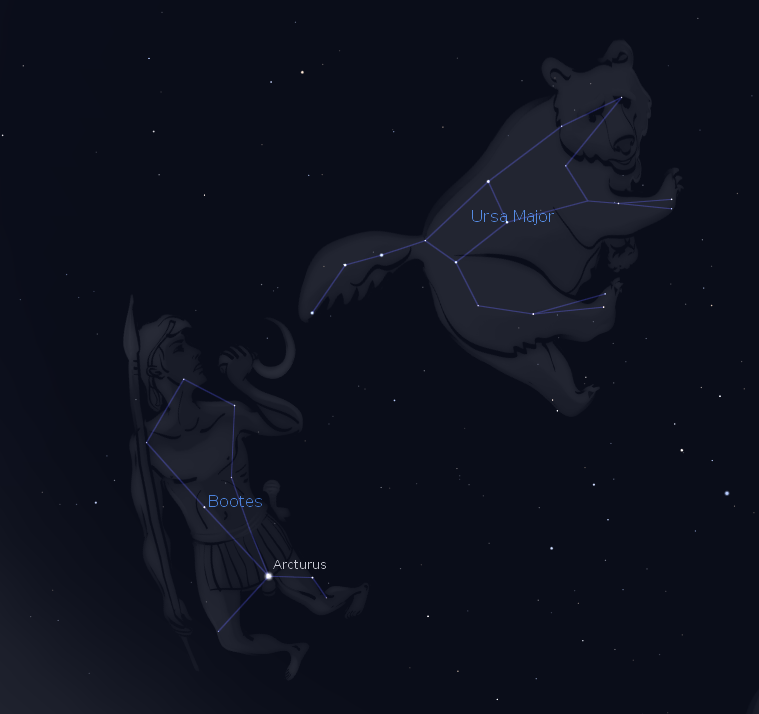
Bootes and Ursa Major aka Arcas chasing Callisto around the pole of the sky. Created using Stellarium.

Arcas about to slay the bear by the 17th century artist Baur. Source: University of Virginia Electronic Text Center
4/03/2020 – Ephemeris – Tonight Venus appears among the stars of the Pleiades
This is Bob Moler with Ephemeris for Friday, April 3rd. Today the Sun will be up for 12 hours and 54 minutes, setting at 8:13, and it will rise tomorrow at 7:17. The Moon, 2 days past first quarter, will set at 5:48 tomorrow morning.
This evening the brilliant evening star, the planet Venus will appear within the Pleiades or Seven Sisters star cluster. Venus will slowly pass the Pleiades for the next few days. By the end of the month the Pleiades will be pretty much lost in the twilight. Evening star gazers will again pick it up late on September evenings, rising in the northeast. Venus, itself appears as a tiny crescent in small telescopes, and in May the tiny crescent will even be visible in binoculars. Venus reflects about 77 percent of the sunlight it receives because it is completely socked in by clouds. Clouds of a sulfuric acid mist. It is not a nice place. Surface temperature averages 867 degrees, and the atmospheric pressure is 90 times that of Earth.
The event times given are for the Traverse City/Interlochen area of Michigan. They may be different for your location.
Addendum
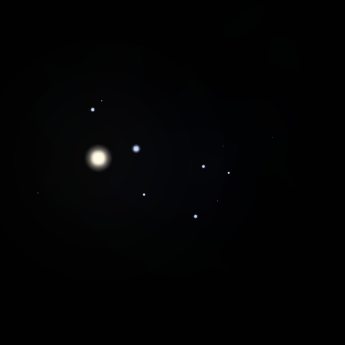
binocular view of Venus and the Pleiades tonight at 10 p.m. EDT April 3, 2020. (2 hr UT April 4) Created using Stellarium. Note: More stars may be visible. There will be a bright Moon out masking the dimmer members of the cluster. Your results may vary.
Update 04/03/2020 10:10 p.m. EDT
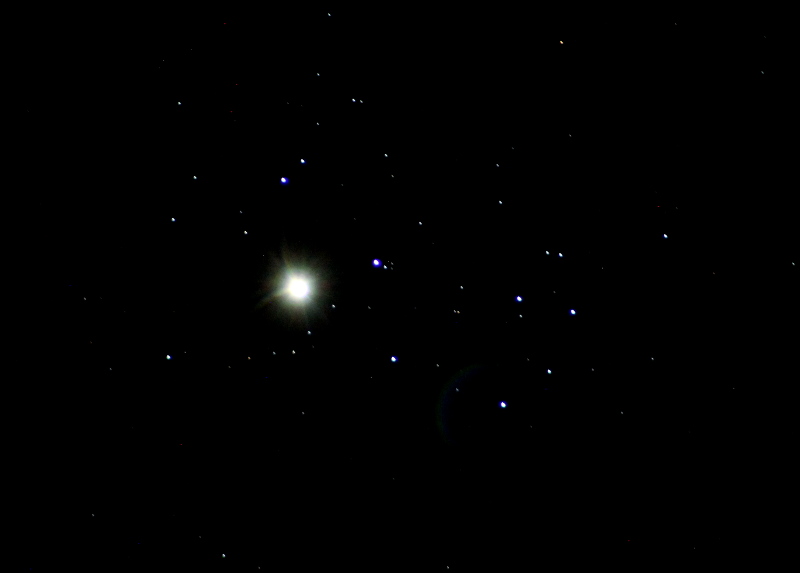
Photo of Venus and Pleiades taken at 9:37 p.m. EDT with Canon EOS Rebel T5, 300mm fl. f/5.6, 2 sec, ISO 3200, unguided. by myself.
04/02/2020 – Ephemeris – Let’s look at the Moon tonight
This is Ephemeris for Thursday, April 2nd. Today the Sun will be up for 12 hours and 51 minutes, setting at 8:12, and it will rise tomorrow at 7:18. The Moon, 1 day past first quarter, will set at 5:09 tomorrow morning.
Tonight’s gibbous Moon is a bright fixture in the evening sky it’s in the constellation of Cancer the crab which its brightness obliterates, between the stars Castor and Pollux of Gemini on the right and Regulus of Leo on the left. The Beehive star cluster in Cancer can be spotted in binoculars to the left of the Moon by about 7 to 8 of its diameters. On the Moon itself are the gray, so-called seas and two spectacular craters near the terminator. The first is near the bottom limb of the Moon, the very large crater Clavius with an interesting arc of small craters of decreasing size within. The other remarkable crater is Copernicus about half way up and left, near the terminator, the Moon’s sunrise line.
The event times given are for the Traverse City/Interlochen area of Michigan. They may be different for your location.
Addendum
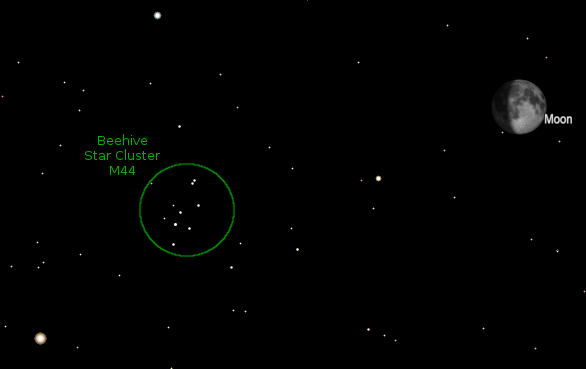
The Moon and Beehive Star Cluster at 10 p.m. tonight April 2, 2020. If you are not in the eastern daylight time the Moon will be in a different position if you are in a different time zone.
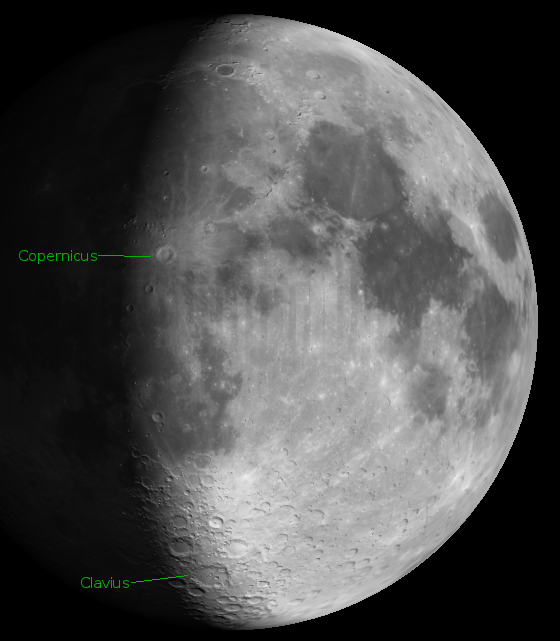
The Mon as it might appear in a low power telescope tonight at 10 p.m. April 2, 2020. Created using Virtual Moon Atlas (software).
04/01/2020 – Ephemeris – Looking at the naked-eye planets for this week
Ephemeris for April Fools Day, Wednesday, April 1st. Today the Sun will be up for 12 hours and 48 minutes, setting at 8:11, and it will rise tomorrow at 7:20. The Moon, at first quarter today, will set at 4:23 tomorrow morning.
Let’s look at the naked-eye planets for this week. Venus is our evening star shining brightly in the west just below the Pleiades. It will set at 12:26 a.m. The rest of the planet action is in the morning sky where there are three planets close together in the southeast. Bright Jupiter will rise first at 4:11 a.m. Followed by Saturn 4:31 a.m. Mars, left and below Saturn will rise at 4:39 a.m. It’s now as bright as a first magnitude star because it’s down to 135 million miles (217 million km) away, as the Earth slowly overtakes it at the rate of about 5 million miles (8 million km) a week. It’s brighter than the star Antares in the south-southwest. Mars passed Saturn yesterday afternoon moving eastward much faster than Saturn was.
The event times given are for the Traverse City/Interlochen area of Michigan. They may be different for your location.
Addendum
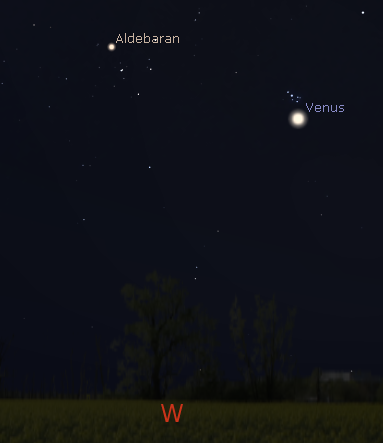
Venus under the Pleiades tonight at 10 p.m. April 1, 2020. Created using Stellarium.
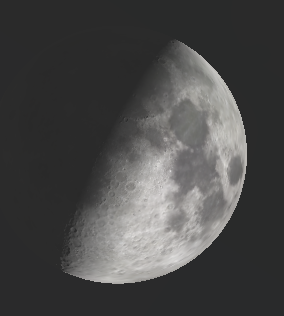
The Moon as it might look like in binoculars this evening April 1, 2020. Created using Stellarium.
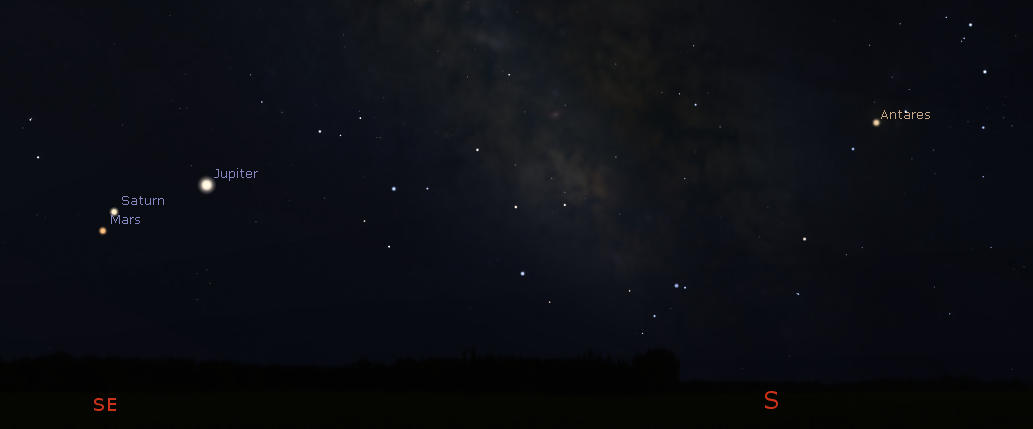
Morning planets and the southern stars of summer at 6 a.m. tomorrow morning April 2, 2020. Click on the image to enlarge. Created using Stellarium.
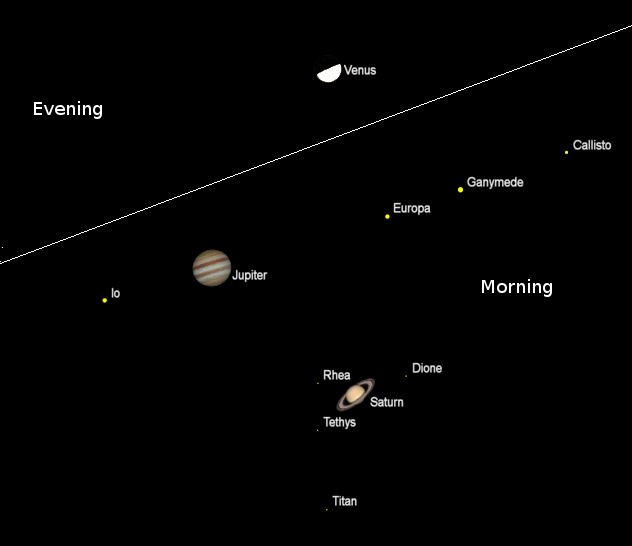
The planets as seen in a telescope with the same magnification. Venus in the evening and Jupiter and Saturn in the morning on the night of April 1/2, 2020. Apparent diameters: Venus, 25.85″; Jupiter, 37.21″; Saturn, 16.16″, rings, 37.65″. Mars at 6.46″ won’t be added until it reaches 10″. The ” symbol means seconds of arc (1/3600th of a degree.) Created using Cartes du Ciel (Sky Charts).
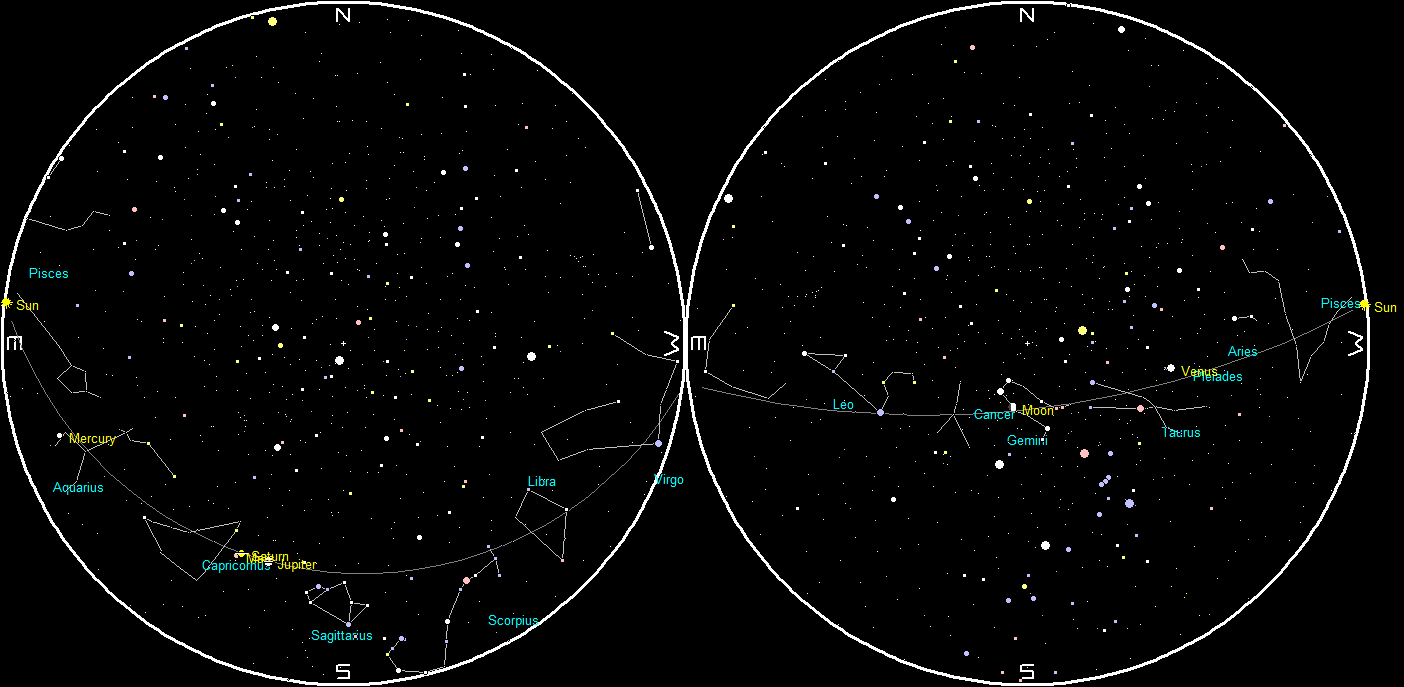
Planets and the Moon at sunset and sunrise of a single night starting with sunset on the right on April 1, 2020. The night ends on the left with sunrise on the 2nd. The planet traffic jam in the morning sky unfortunately overlays planets and labels. Click on the image to enlarge. Created using my LookingUp program.
03/27/2020 – Ephemeris – Enjoying astronomy when sheltering at home
Ephemeris for Friday, March 27th. Today the Sun will be up for 12 hours and 32 minutes, setting at 8:04, and it will rise tomorrow at 7:30. The Moon, 3 days past new, will set at 11:25 this evening.
With the coronavirus or COVID-19 pandemic hitting our area many of us are stuck in our homes waiting it out. It may be awhile. That’s OK for some of us. That’s because astronomical observation is in many ways a solitary pursuit. My mother taught me the first two constellations. She could never wake me to view the Perseid meteors of August. After that I learned the rest on my own, the first batch on a morning paper route in winter, previewing the spring and summer skies. Staying at home doesn’t mean staying indoors. Going out in the back yard or dark area alone also counts. It’s proximity to other people that’s the problem. I find that being alone out under the stars makes me feel that the Earth and its worries are a trillion miles away.
The event times given are for the Traverse City/Interlochen area of Michigan. They may be different for your location.
Addendum
Some constellation star fields guaranteed to be trillions of miles away:
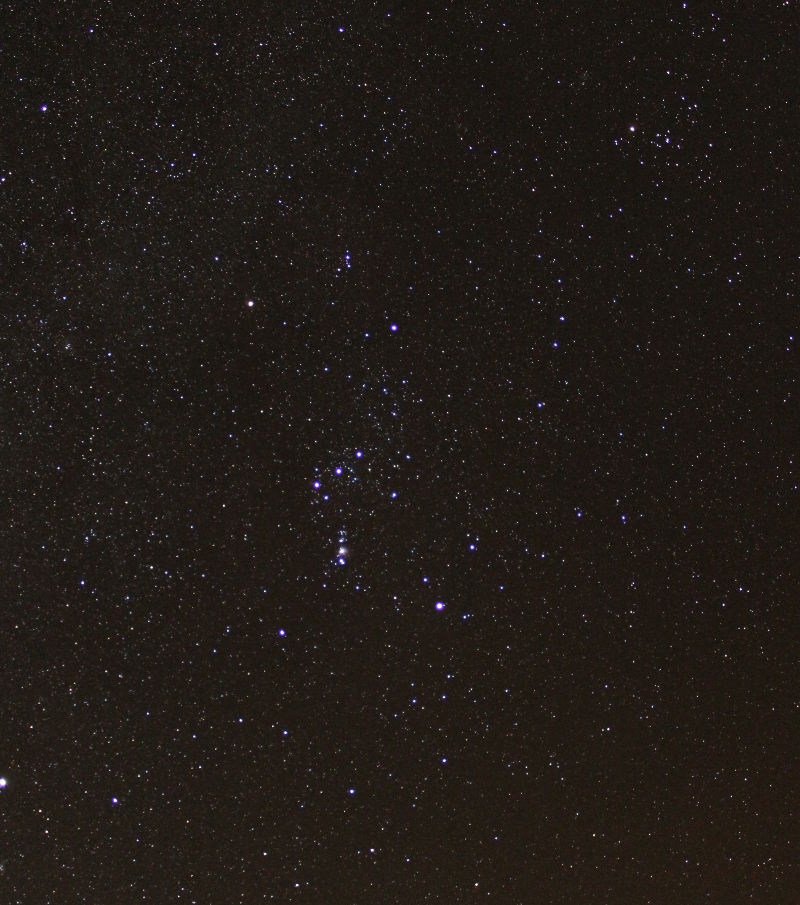
Orion in a 30 second exposure taken at the Sleeping Bear Dunes National Lakeshore Dune Climb February, 18, 2017 by Bob Moler. Click on image to enlarge a bit.
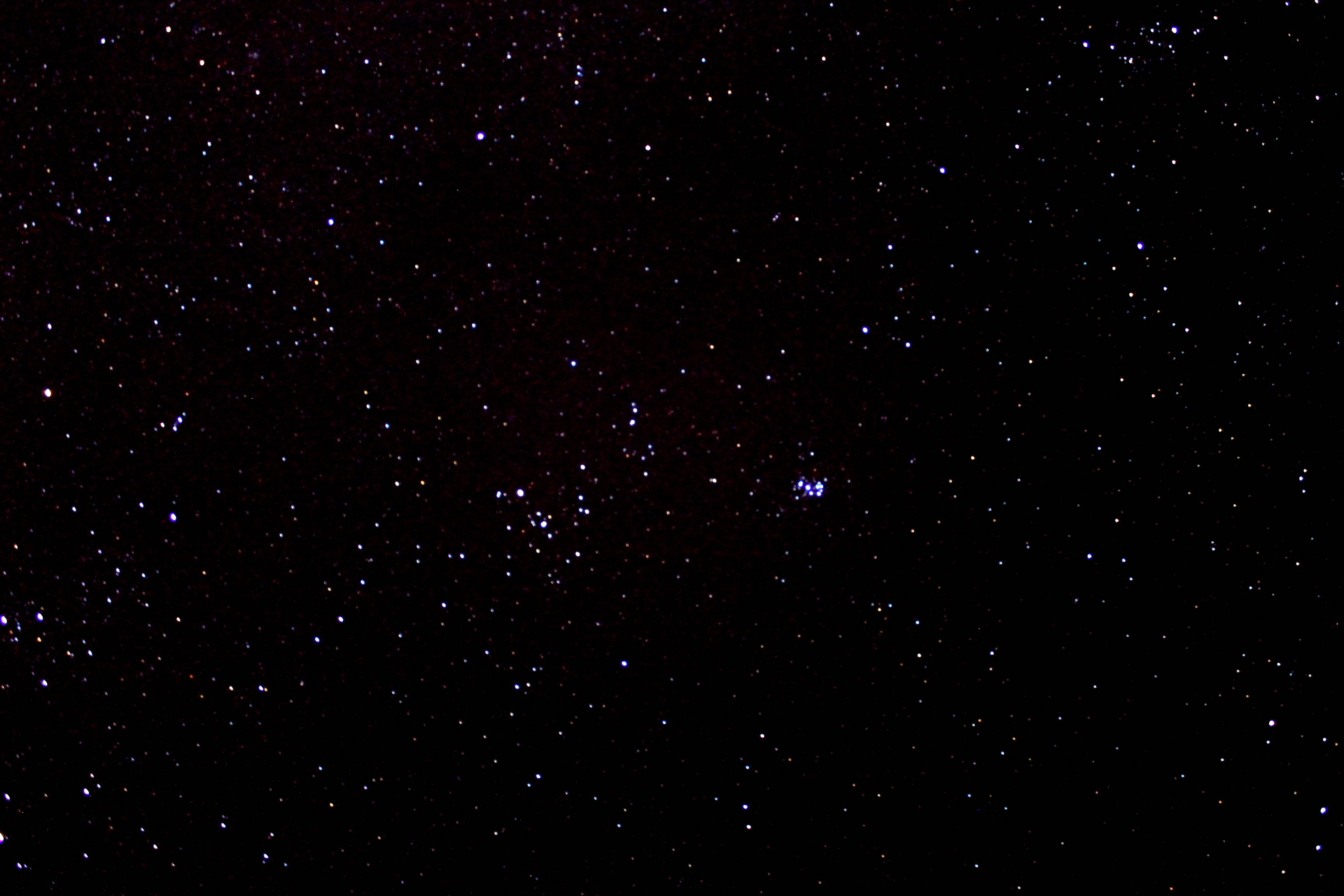
Actual photo of the Pleiades to the right of the Hyades, the face of Taurus the bull. Credit Bob Moler
03/26/2020 – Ephemeris – A spring warning about thin ice in the sky
Ephemeris for Thursday, March 26th. Today the Sun will be up for 12 hours and 29 minutes, setting at 8:03, and it will rise tomorrow at 7:31. The Moon, 2 days past new, will set at 10:22 this evening.
The Anishinaabe peoples of the Great Lakes Region, which includes the Ottawa, Chippewa and Ojibwe Indians have one constellation of winter. It is The Winter Maker which uses many of Orion’s stars and whose arms stretch from Aldebaran in Taurus the bull to Procyon the Little Dog Star, embracing the whole of the winter sky. Now that spring is here he is sinking into the west. The first constellation of spring is Curly Tail, or the Great Underwater Panther. Which uses the stars of Leo the lion’s backward question mark as its tail and the small knot of stars that are the head of Hydra the water snake below Cancer the crab as its head. The warning: Keep off the thinning ice or break through and be snatched by the panther that lives below.
The event times given are for the Traverse City/Interlochen area of Michigan. They may be different for your location.
Addendum
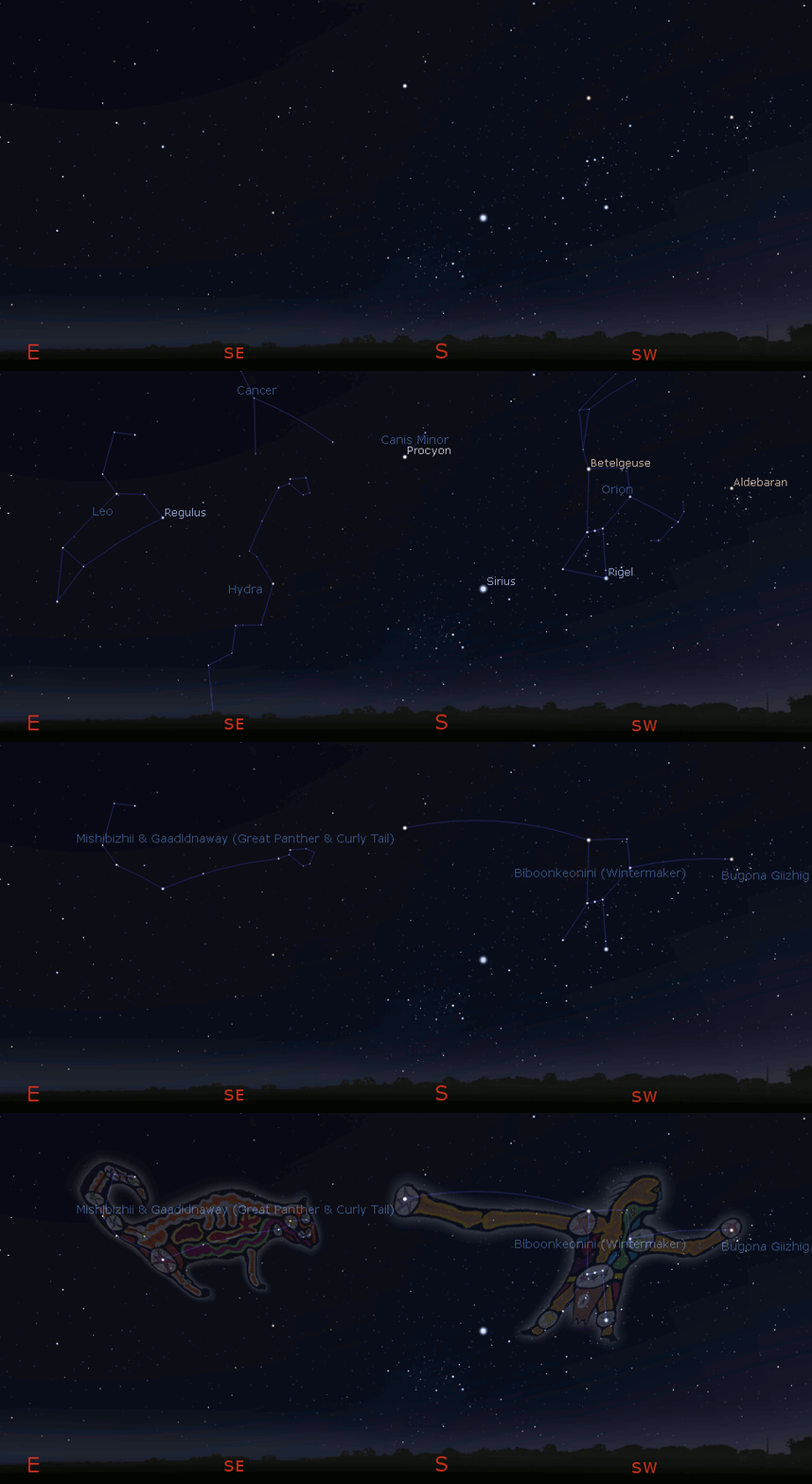
Great Underwater Panther finder animation relating western to Anishinaabe constellations for 9 p.m. in late March. Click on image to enlarge. Created using Stellarium.
03/25/2020 – Ephemeris – Let’s look at the naked-eye planets for this week
Ephemeris for Wednesday, March 25th. Today the Sun will be up for 12 hours and 26 minutes, setting at 8:02, and it will rise tomorrow at 7:33. The Moon, 1 day past new, will set at 9:21 this evening.
Let’s look at the naked-eye planets for this week. Venus is our evening star shining brightly in the west. It will set at 12:14 a.m. The rest of the planet action is in the morning sky where there are three planets close together in the southeast. Bright Jupiter will rise first at 4:35 a.m. Followed by Mars, left and below, rising at 4:50 a.m. It’s now as bright as a first magnitude star because it’s down to 140 million (226 million km) miles away, as the Earth slowly overtakes it at the rate of about 5 million miles (8 million km) a week. It’s brighter than the star Antares in the south-southwest. And lastly, Saturn will rise at 5:01 a.m. Mars is about half way between Jupiter and Saturn. It will pass Saturn next Tuesday.
The event times given are for the Traverse City/Interlochen area of Michigan. They may be different for your location.
Addendum
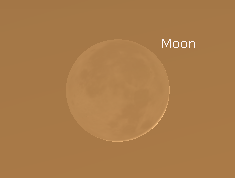
Day and a half old Moon low over a Lake Michigan horizon tonight at 8:30 p.m. March 25, 2020. The bright edge of the Moon will be a sit brighter, and the earthshine on the night side of the Moon a bit dimmer. Created using Stellarium.
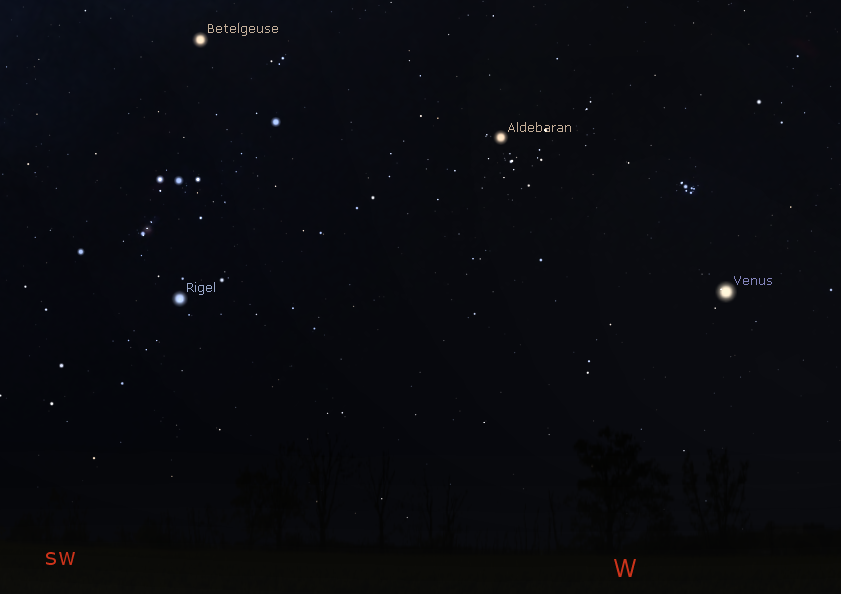
Venus and the setting winter stars tonight at 10 p.m. March 25, 2020. Click on the image to enlarge. Created using Stellarium.
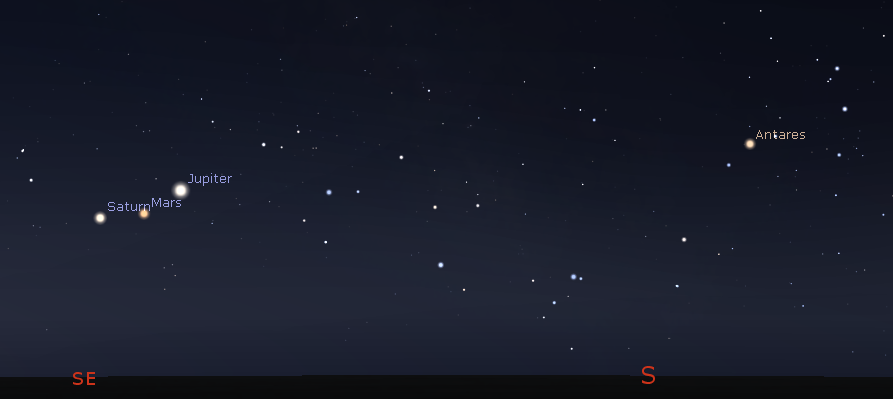
Saturn, Mars and Jupiter with the southern summer stars at 6:30 a.m. tomorrow March 26, 2020. Mars will pass Saturn on the 31st. Click on the image to enlarge. Created using Stellarium.
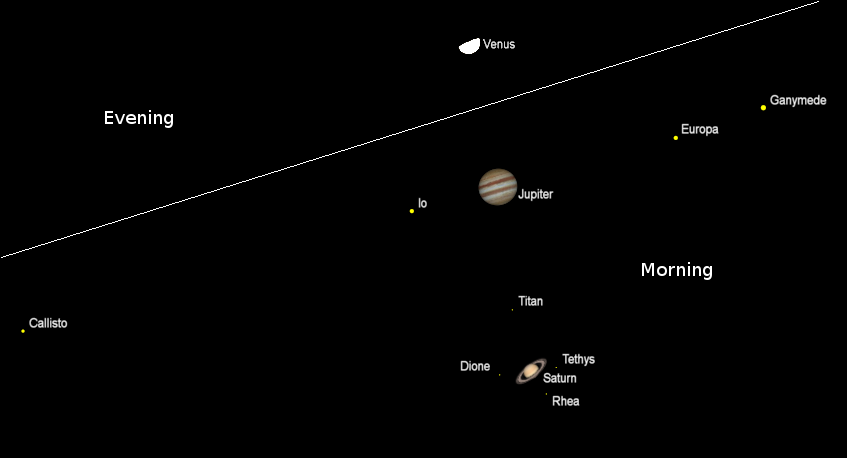
The planets as seen in a telescope with the same magnification. Venus in the evening and Jupiter and Saturn in the morning on the night of March 25/26, 2020. Apparent diameters: Venus, 23.85″; Jupiter, 36.46″; Saturn, 15.99″, rings, 37.26″. Mars at 6.22″ won’t be added until it reaches 10″. The ” symbol means seconds of arc (1/3600th of a degree.) Click on the image to enlarge. Created using Cartes du Ciel (Sky Charts).
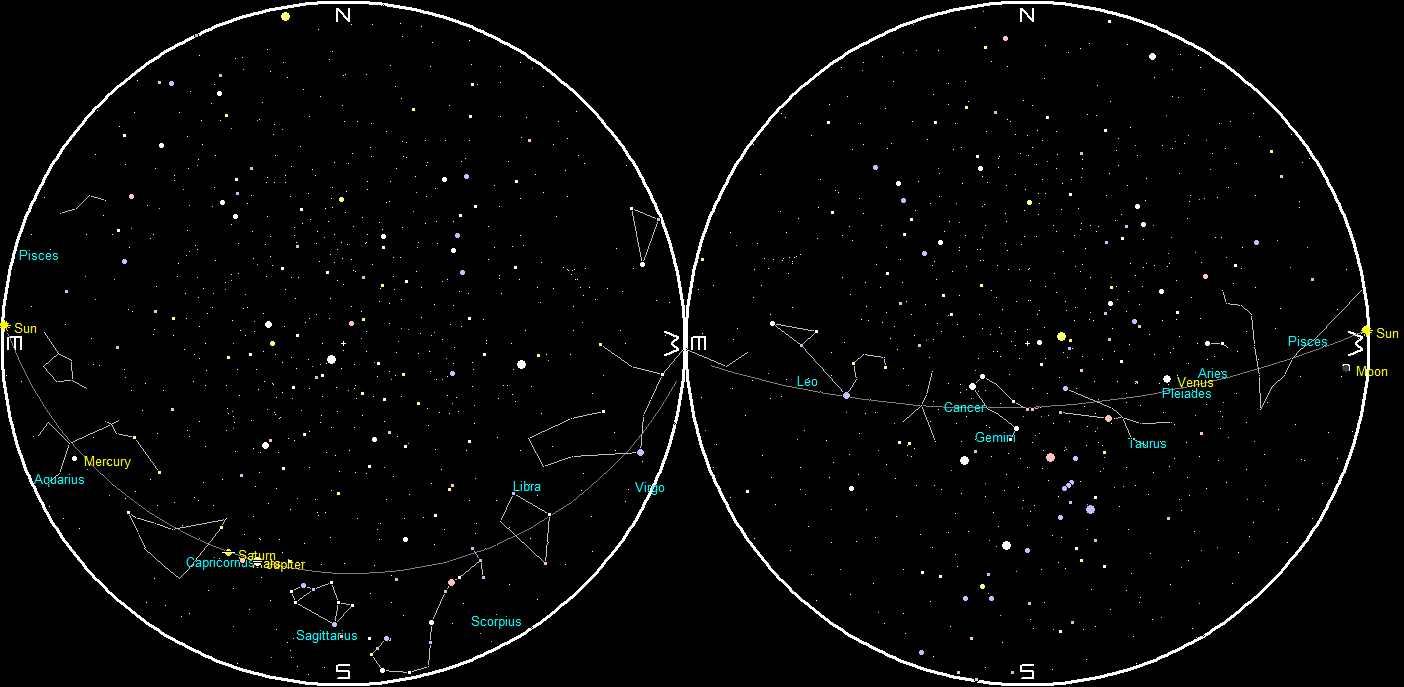
Planets and the Moon at sunset and sunrise of a single night starting with sunset on the right on March 25, 2020. The night ends on the left with sunrise on the 26th. Click on the image to enlarge. Created using my LookingUp program.
03/23/2020 – Ephemeris – See zodiacal light in the evening
Ephemeris for Monday, March 23rd. Today the Sun will be up for 12 hours and 20 minutes, setting at 7:59, and it will rise tomorrow at 7:37. The Moon, 1 day before new, will rise at 8:11 tomorrow morning.
With the bright moon out of the sky for a few more nights it’s time to look for the zodiacal light in the evening. It’s is a faint but towering glow that can be seen after the end of astronomical twilight on moonless nights. It is seen in the west in the evening in late winter and early spring and in the east in the morning in late summer and early autumn. The axis of the glow is the ecliptic, the apparent annual path of the Sun in the sky, along which lie the constellations of the zodiac. Right now the end of astronomical twilight is about 9:41 p.m. and advancing at a rate of a minute or two each night. Go to a spot with a dark western sky, no big cities or towns out that way. Zodiacal light is caused by dust spread out around the Sun.
The event times given are for the Traverse City/Interlochen area of Michigan. They may be different for your location.
Addendum
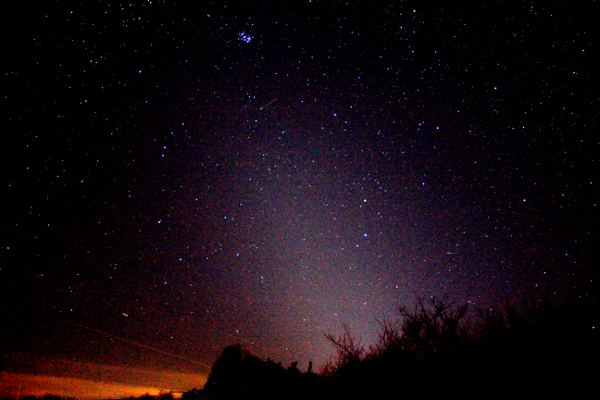
Much enhanced Zodiacal Light from the my back yard at 9:31 p.m. March 16, 2018, 5 minutes after the official end of astronomical twilight. Canon EOS Rebel T5 18mm f.l., f/3.5, 6 sec. ISO 12,800 . The clouds on the left appear to be illuminated by the lights of the towns of Beulah and Frankfort 20+ miles away.

