Archive
06/08/2020 – Ephemeris – Tomorrow’s Moon and the morning planets
This is Ephemeris for Monday, June 8th. Today the Sun will be up for 15 hours and 29 minutes, setting at 9:26, and it will rise tomorrow at 5:57. The Moon, 3 days past full, will rise at 12:28 tomorrow morning.
This afternoon the Moon will pass south of Jupiter, and this evening it will pass south of Saturn. By tomorrow morning the Moon will be to the lower left of both of them. However to see them one should get up by 5 am. By 5:30 the planets will be pretty much lost in twilight. The Moon should still be easily visible low in the south at that time. A careful observer, over time, may notice that both Jupiter and Saturn are moving slowly westward, rather than their normal eastward movement. We call this motion retrograde motion. This motion baffled the ancient Greeks, who thought the Earth to be stationary and the planets moved uniformly in perfect circles. They kind of solved it by adding smaller circles to the original ones.
The event times given are for the Traverse City/Interlochen area of Michigan. They may be different for your location.
Addendum
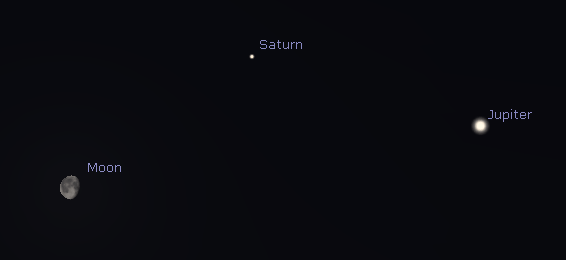
The Moon and morning planets at 5 a.m. tomorrow morning in the eastern US at 5 am, June 12, 2020. Created using Stellarium.
06/05/2020 – Ephemeris – A penumbral eclipse of the Moon for the eastern hemisphere of Earth today
This is Ephemeris for Friday, June 5th. Today the Sun will be up for 15 hours and 26 minutes, setting at 9:24, and it will rise tomorrow at 5:57. The Moon, at full today, will rise at 9:32 this evening.
There will be a penumbral eclipse of the Moon this afternoon. We won’t get to see it because the Moon won’t be up yet. The eclipse, such as it is, will be only visible from the eastern hemisphere of the Earth like Asia. Even then there won’t be much to see. In a penumbral eclipse the Moon only enters the Earth’s outer shadow, called the penumbra where sunlight is only partially cut off. Observers on the affected parts of the Moon would see the Sun only partially eclipsed. And anyone whose seen a partial solar eclipse will tell you that it doesn’t get that dark. So most penumbral eclipses go unnoticed unless one is told about them. This one less than 60% of the Moon will be immersed in the Earth’s penumbral shadow.
There will be two more penumbral lunar eclipses this year, both visible from the United States: July 5th when only 35% of the Moon’s diameter is immersed in the penumbra, and November 30th when 83% is immersed.
The event times given are for the Traverse City/Interlochen area of Michigan. They may be different for your location.
Addendum
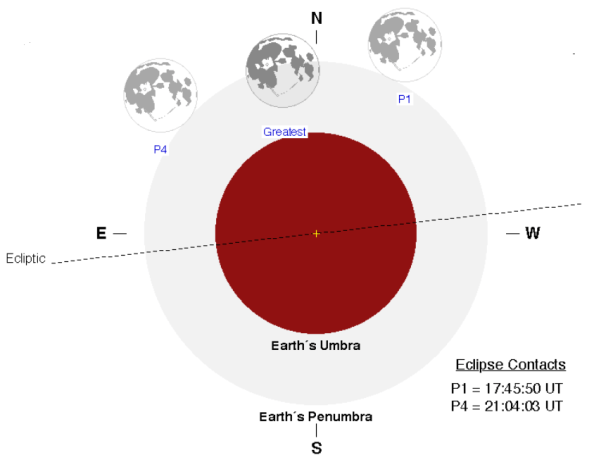
Lunar eclipse chart for the penumbral lunar eclipse of July 5th, 2020. Unfortunately for Michigan it will occur between 1:45 and 5:04 pm before the Moon rises tonight. Click on the image to see the original pdf page from NASA. Credit NASA GSFC/Fred Espenak.
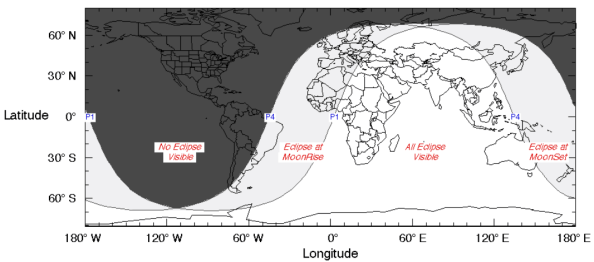
Eclipse visibility map. Areas on the Earth where the eclipse is visible. Credit NASA GSFC/Fred Espenak.
06/04/2020 – Ephemeris – Mercury is at it’s greatest separation from the Sun today
This is Ephemeris for Thursday, June 4th. Today the Sun will be up for 15 hours and 25 minutes, setting at 9:24, and it will rise tomorrow at 5:58. The Moon, 1 day before full, will set at 5:53 tomorrow morning.
Today at 9 am the planet Mercury will be at its greatest eastern elongation. That’s what astronomers call it. Implied is that it is at its greatest angular separation east of the Sun. Mercury, and also Venus have orbits inside Earth’s orbit of the Sun. For that reason they are called inferior planets. Therefore they never stray far from the position of the Sun in the sky. From around our latitude near 45 degrees north, we never see Mercury outside of twilight. Mercury has a remarkably elliptical orbit ranging from 29 million miles (47 million km) to 43 million miles (70 million km) from the Sun. In both spring and fall at favorable elongations, we see Mercury near perihelion, that close point. Southern hemisphere observers get a better view of it. Having a late spring greatest eastern elongation we get to see Mercury farther from the Sun than the same elongation earlier in the year.
The event times given are for the Traverse City/Interlochen area of Michigan. They may be different for your location.
Addendum
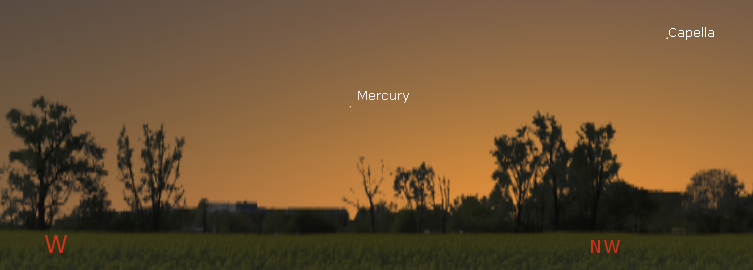
Mercury in the evening tonight at 10 pm June 3, 2020 (About 45 minutes after sunset). Click on the image to enlarge. Created using Stellarium.
05/22/2020 – Ephemeris – Venus hangs out with Mercury and the Moon this weekend
This is Ephemeris for Friday, May 22nd. Today the Sun will be up for 15 hours and 5 minutes, setting at 9:12, and it will rise tomorrow at 6:06. The Moon is new today, and won’t be visible
Low in the northwest shortly after sunset our brilliant evening star Venus may be seen. It’s getting closer to the Sun every evening. This is an illusion because Venus is in the process of passing between the Earth and the Sun, so it’s not getting closer to the Sun, but it is getting closer to us at 29 million miles (46.8 million km) today. Mercury has passed Venus and is now to the left and a bit above Venus as seen at 10 p.m. Both are pretty close to the horizon, so you may have to move to a spot with a low northwestern horizon. Tomorrow night the day old sliver of the Moon will be spotted just below both of them. It should be quite a sight with these two planets and the Moon in the twilight, just after sunset.
The event times given are for the Traverse City/Interlochen area of Michigan. They may be different for your location.
Addendum
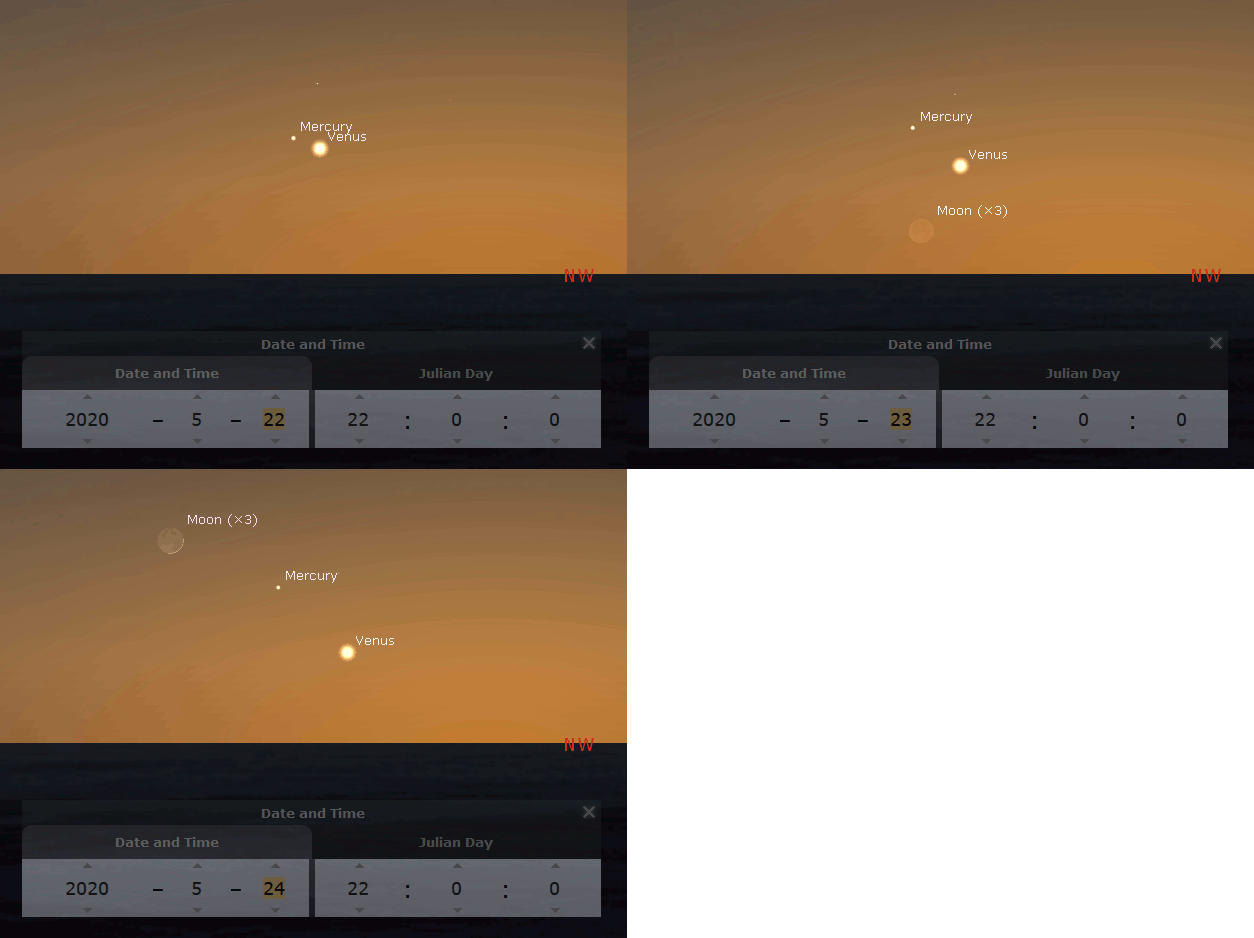
Venus, Mercury, Moon animation for 10 pm May 22nd, 23rd and 24th, 2020. The Moon is shown 3 times actual size in an attempt to show its phase. Created using Stellarium and GIMP.
05/20/2020 – Ephemeris – Let’s look at the naked-eye planets for this week
This is Ephemeris for Wednesday, May 20th. Today the Sun will be up for 15 hours and 1 minute, setting at 9:10, and it will rise tomorrow at 6:08. The Moon, 2 days before new, will rise at 5:49 tomorrow morning.
Let’s look at the naked-eye planets for this week. Venus is our evening star shining brightly in the west northwest. It will be our evening star for only the next 2 weeks. A tiny crescent can now be seen in binoculars. It will cross between the Earth and the Sun on June 3rd. It will set at 11:05 p.m. It’s only 30 million miles (48 million km) away. Mercury is making an appearance just below Venus now. In the morning sky there are three planets close together in the south and southeast. Bright Jupiter will rise first at 1:07 a.m. Followed by Saturn at 1:22 a.m. Mars, is stretching its lead left of Saturn and will rise at 3:00 a.m. Mars continues to get closer. Its now down to 101million miles (163 million km) away, as the Earth slowly overtakes it at the rate of about 5 million miles (7 million km) a week.
The event times given are for the Traverse City/Interlochen area of Michigan. They may be different for your location.
Addendum
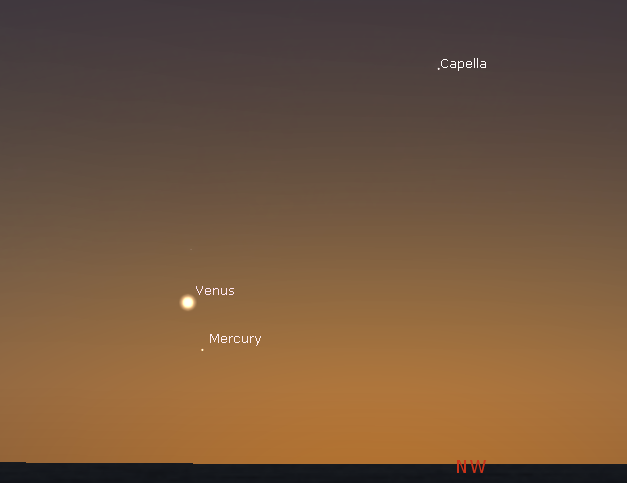
Venus and Mercury as it should appear at 10 pm low in the northwest over the Lake Michigan horizon. May 20, 2020. Created using Stellarium.
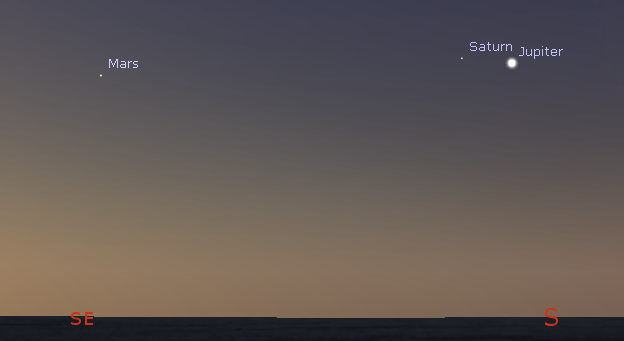
Jupiter, Saturn and Mars seen in the southern sky at 5:30 am tomorrow morning May 21, 2020. Created using Stellarium.
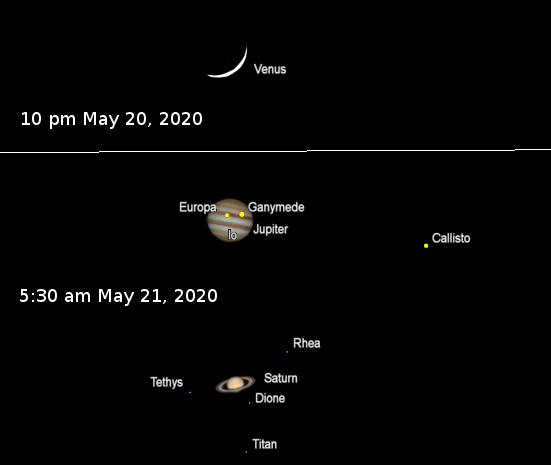
The planets as seen in a telescope with the same magnification. Venus, Jupiter and Saturn on the night of May 13/14, 2020. Apparent diameters: Venus, 52.76″, larger than Jupiter, at 43.37″; Saturn, 17.51″, rings 40.80″. Mars at 8.66″ won’t be added until it reaches 10″. Mercury is gibbous at 6.04″. The ” symbol means seconds of arc (1/3600th of a degree.) Note that Jupiter has two moons in transit, with another behind the planet. The transiting moons are nearly invisible, so only one moon, Callisto is visible. Created using Cartes du Ciel (Sky Charts).
Jovian satellite events (Subtract 4 hours from UT to get EDT)
Moon      Event          Date         UT
Europa:   Shadow start:  21 May 2020  2:36
Ganymede: Shadow end:    21 May 2020  5:50
Europa :  Shadow start:  21 May 2020  6:13
Ganymede: Transit start: 21 May 2020  7:02
Europa:   Transit start: 21 May 2020  8:22
Europa:   Shadow end:    21 May 2020  8:58
Ganymede: Transit end:   21 May 2020 10:24
Source: The Pluto Project https://www.projectpluto.com/jevent.htm
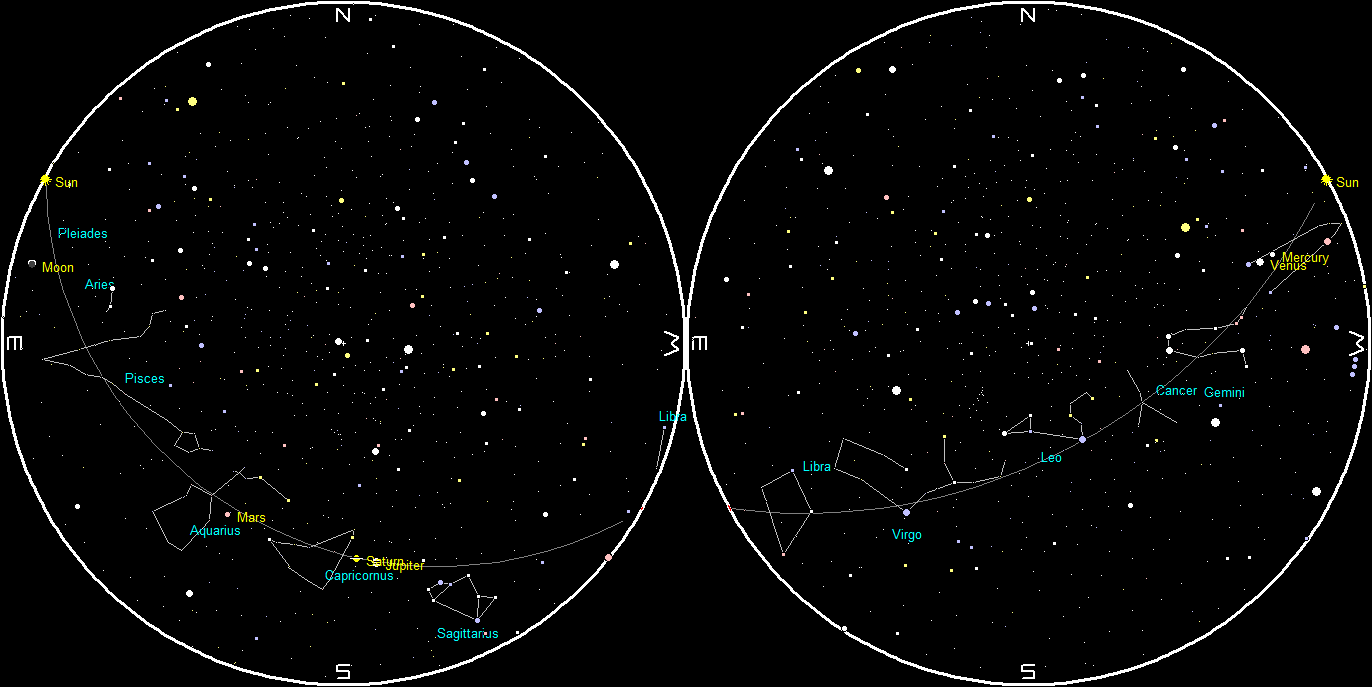
Planets and the Moon at sunset and sunrise of a single night starting with sunset on the right on May 20, 2020. The night ends on the left with sunrise on the 21st. The closeness of Jupiter and Saturn in the morning sky unfortunately overlays planets and labels. Click on the image to enlarge. Created using my LookingUp program.
05/15/2020 – Ephemeris – Virgo and its cluster of galaxies
This is Ephemeris for Friday, May 15th. Today the Sun will be up for 14 hours and 50 minutes, setting at 9:04, and it will rise tomorrow at 6:12. The Moon, 1 day past last quarter, will rise at 4:01 tomorrow morning.
One of the large constellations we see in the south at 11 p.m. can be found using the Big Dipper overhead, follow the arc of the handle to the bright star Arcturus, the straighten the arc to a spike to reach Spica, a bright blue-white star in the south. Spica is the brightest star in the constellation Virgo the virgin. She represents the goddess of the harvest, Virgo is holding a sheaf of wheat in depictions of her, and Spica is placed at the head of the sheaf. In the space between Spica and Leo the lion to her upper right is, a great cluster of thousands of galaxies just below naked eye visibility. The Virgo Cluster. Inside that cluster is galaxy M87 in whose center lies a black hole with the mass of 6.5 billion suns that was imaged last year. The center of the cluster is at about 54 million light years away.
The event times given are for the Traverse City/Interlochen area of Michigan. They may be different for your location.
Addendum
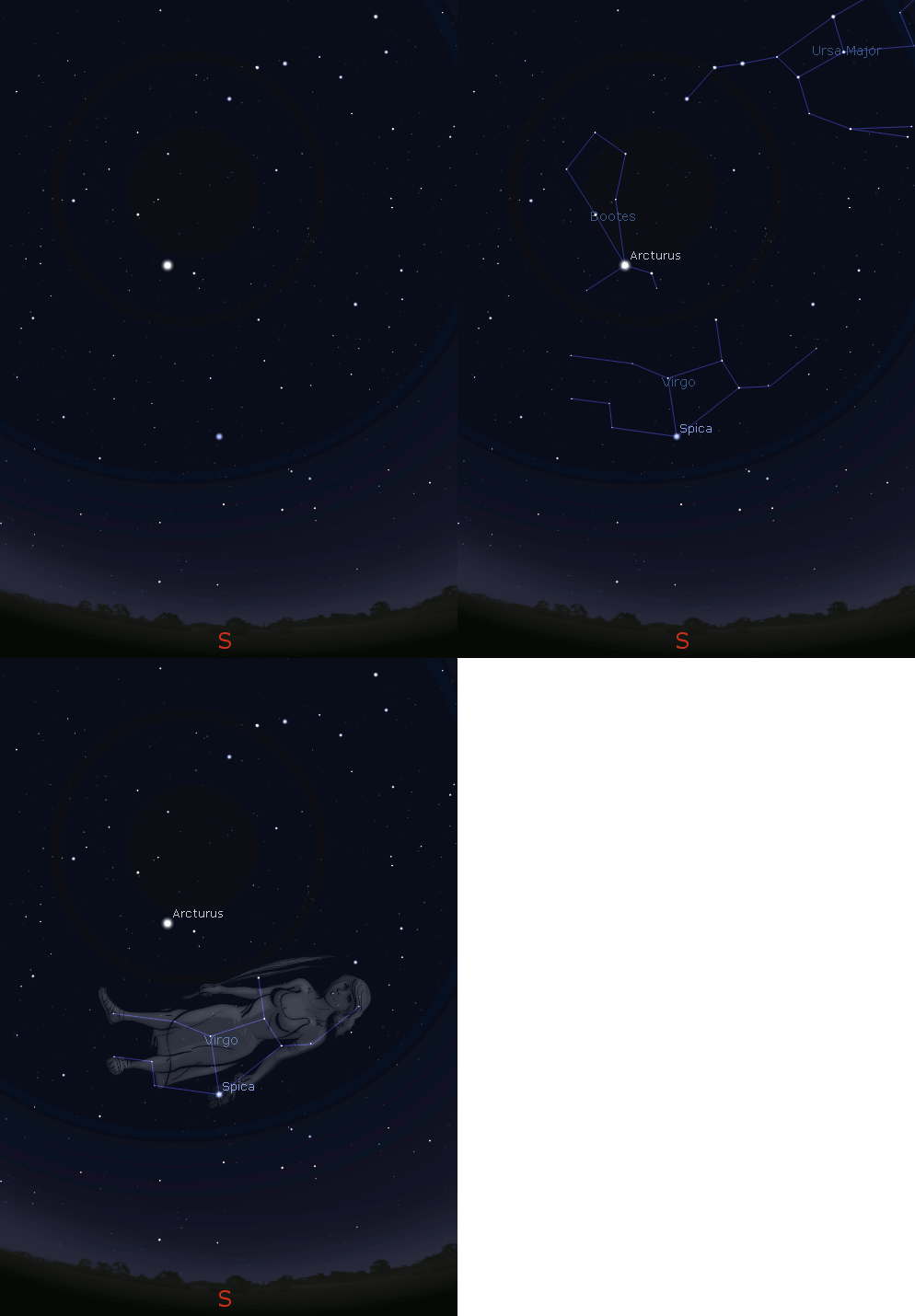
Spica finder animation . Click on the image to enlarge. Created using Stellarium and GIMP.
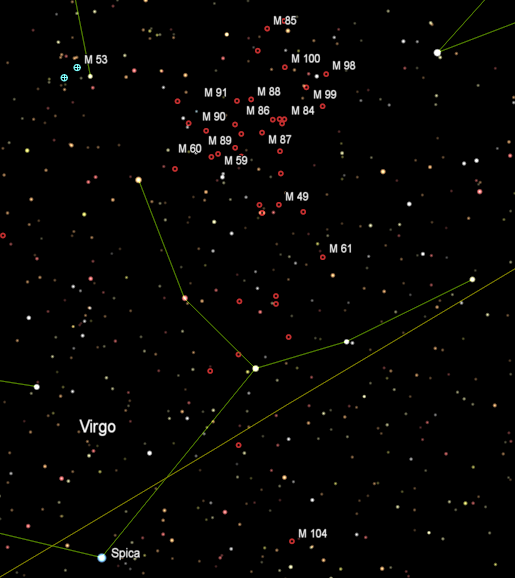
Some of the brighter members of the Virgo Cluster (of galaxies) as red ovals. The galaxies marked with an ‘M’ number are part of Charles Messier’s catalog. It took a telescope of 8 inch diameter for me to spot them. Someone with better vision, like Messier himself can spot them with a smaller telescope. M53 and the object next to it are globular star clusters in the outer reaches of our galaxy. Created using Cartes du Ciel (Sky Charts).
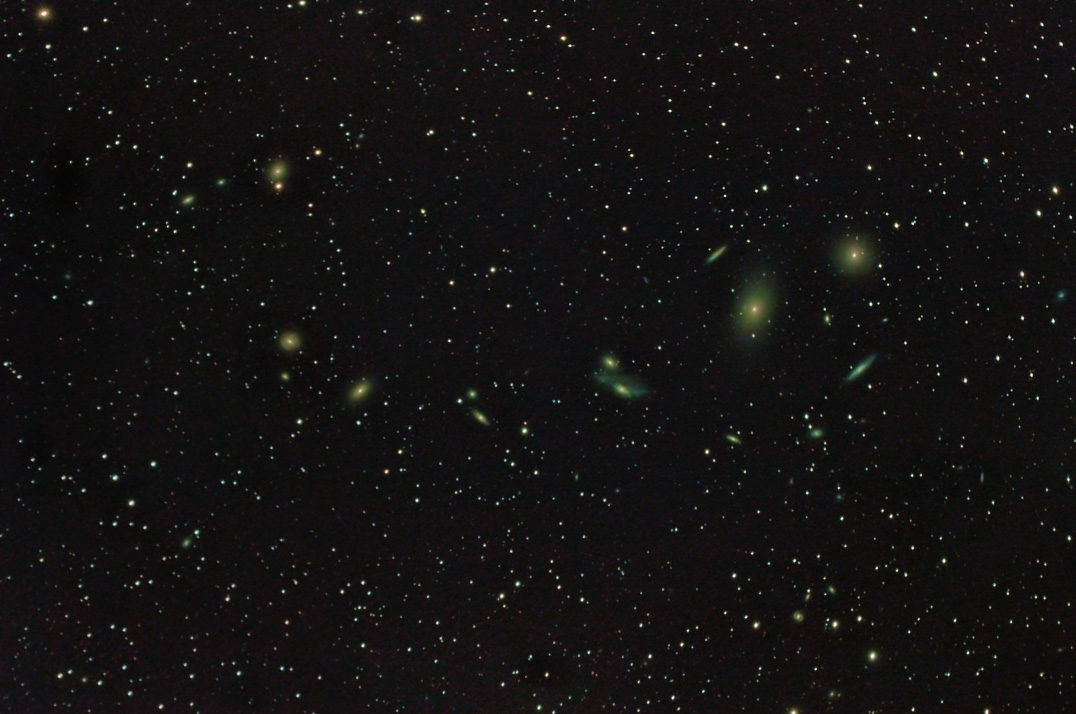
Markarian Chain of galaxies within the Virgo Cluster by Scott Anttila.
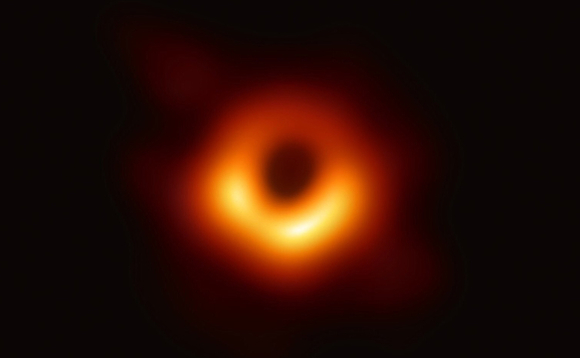
The first image of the black hole in M87. Credit Event Horizon Telescope.
05/14/2020 – Ephemeris – Finding the zodiacal constellation of Virgo
This is Ephemeris for Thursday, May 14th. Today the Sun will be up for 14 hours and 48 minutes, setting at 9:03, and it will rise tomorrow at 6:14. The Moon, at last quarter today, will rise at 3:36 tomorrow morning.
Tonight at 11 p.m. in the south is the constellation and member of the of the zodiac: Virgo the virgin. Virgo is a large constellation of a reclining woman holding a stalk of wheat. Spica, is the head of that spike of wheat; and as such it ruled over the harvest in two of Virgo’s guises as the goddesses Persephone and Ceres. Virgo is also identified as Astraea the goddess of justice. The constellation of Libra, the scales, which she is associated with, is found just east of her low in the southeast. Early Christians who sought to de-paganize the heavens saw Virgo as the Virgin Mary. Virgo is the host to a great cluster of galaxies seen far beyond its stars. Tomorrow morning Mars will appear just above the Moon for very early risers.
The event times given are for the Traverse City/Interlochen area of Michigan. They may be different for your location.
Addendum
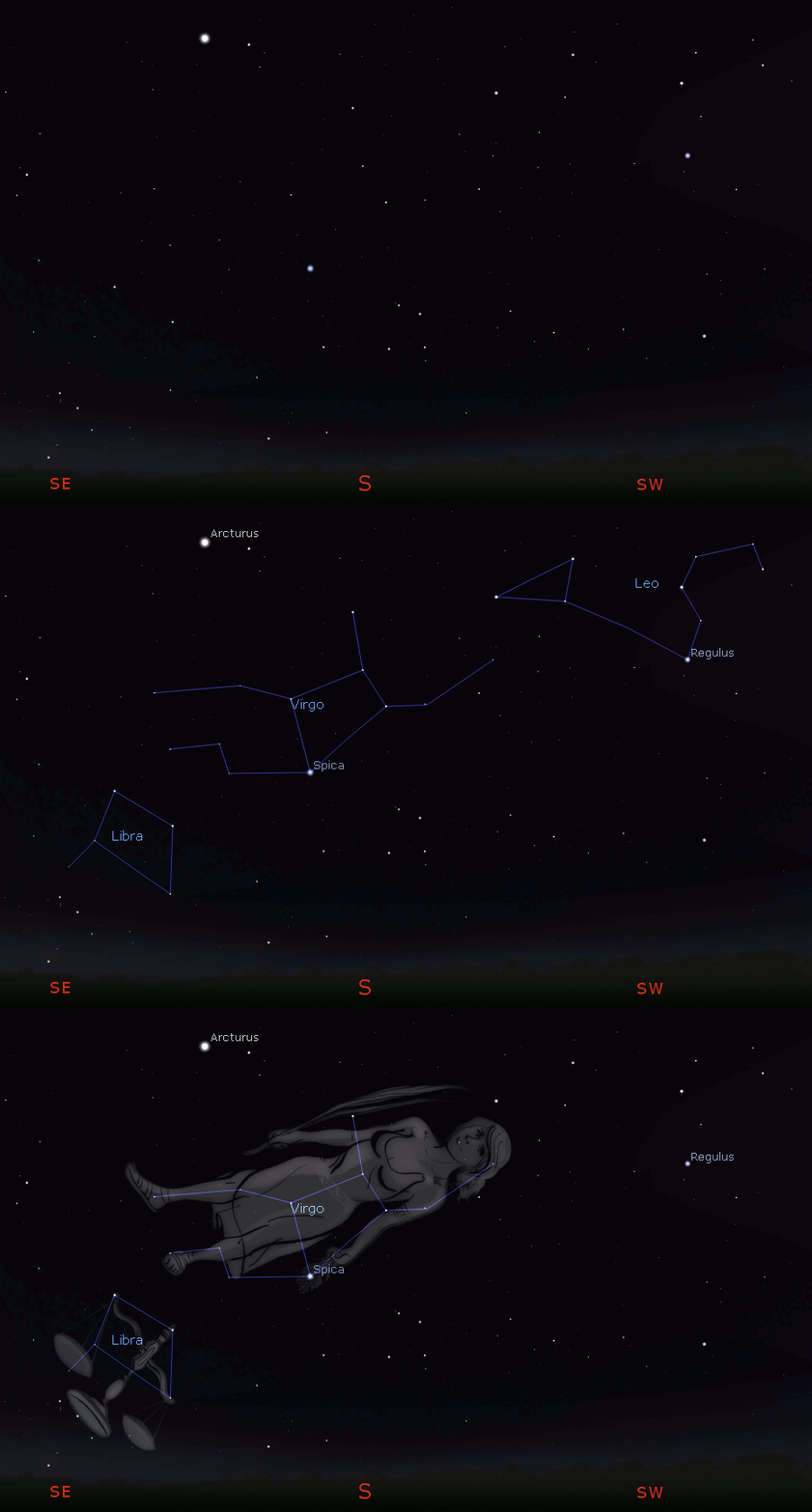
Virgo finder animation with Leo added as an aid for 11 p.m. tonight May 14th. Click on image to enlarge. Created using Stellarium and GIMP.
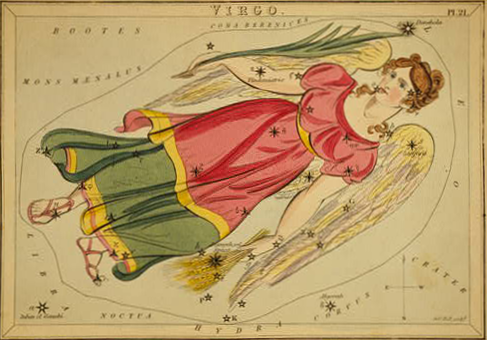
Virgo as depicted in Urania’s Mirror, a set of constellation cards published in London c.1825. From the Library of Congress. Hat tip Wikipedia.
05/12/2020 – Ephemeris – Hydra the water snake slithers along the southern horizon
This is Ephemeris for Tuesday, May 12th. Today the Sun will be up for 14 hours and 44 minutes, setting at 9:01, and it will rise tomorrow at 6:16. The Moon, 2 days before last quarter, will rise at 2:33 tomorrow morning.
Low in the south and southwestern sky at 10 p.m. and later can be found the constellation of Hydra the water snake. Unlike the monster of the same name this Hydra has but one head, which is its most distinctive part. At 11 p.m. the head of Hydra is located between the bright stars Procyon in the west southwest and Regulus in Leo the lion in the southwest. Hydra’s head is a small but distinctive group of 6 stars that make a drooping loop to the right. The rest of Hydra wends its way diagonally to near the southern horizon below the bright blue star Spica in Virgo. Some delineations of Hydra have the tail tickling the constellation Libra which has just risen in the southeast.
The event times given are for the Traverse City/Interlochen area of Michigan. They may be different for your location.
Addendum
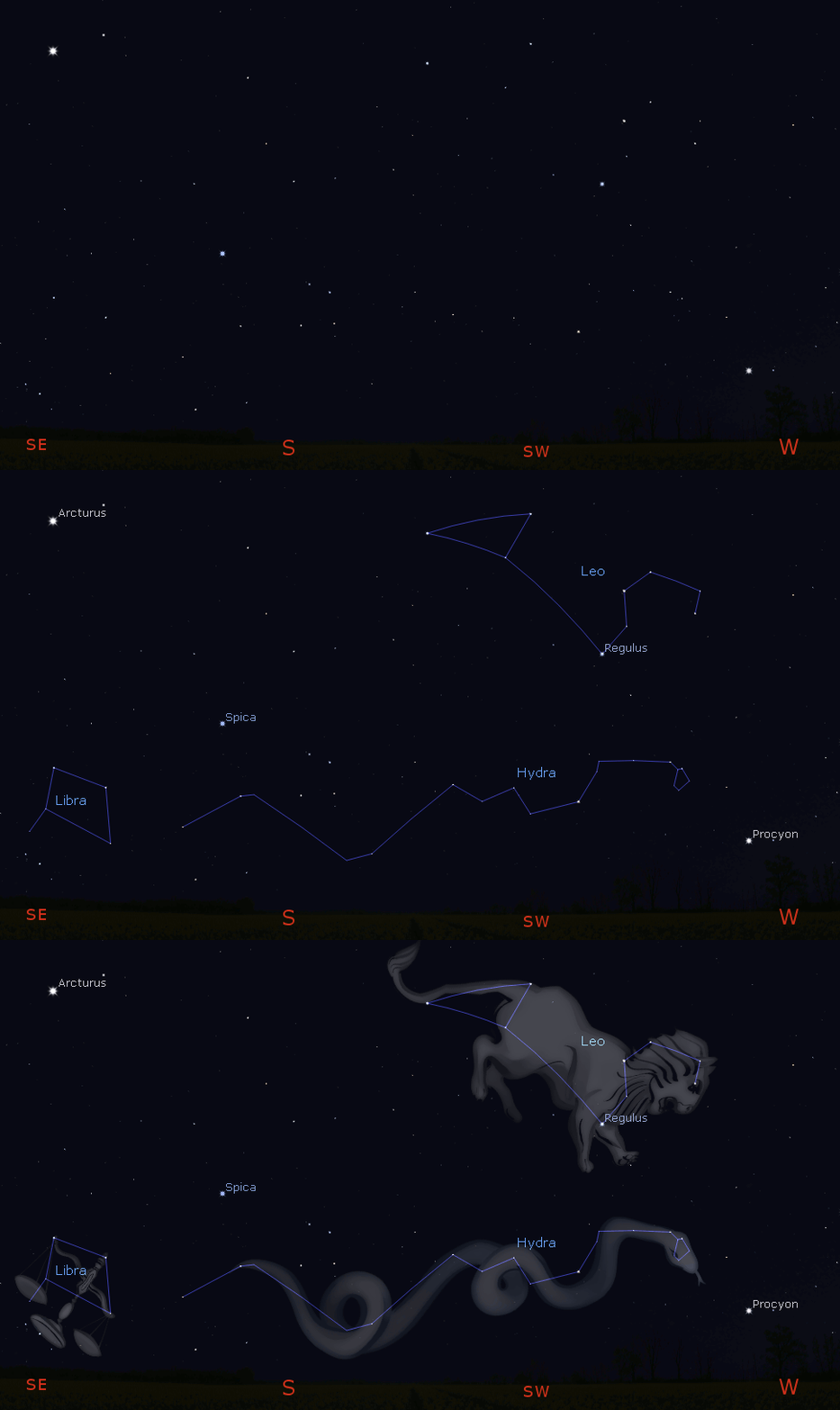
Hydra finder animation for tonight, May 12, 2020. Hydra is the longest constellation. Click on the image to enlarge. Created using Stellarium.
04/30/2020 – Ephemeris – See bits of Halley’s Comet in the morning crashing into the Earth’s atmosphere
This is Bob Moler with Ephemeris for Thursday, April 30th. Today the Sun will be up for 14 hours and 13 minutes, setting at 8:47, and it will rise tomorrow at 6:32. The Moon, at first quarter today, will set at 3:47 tomorrow morning.
Do you remember seeing Halley’s Comet back in 1986? The actual pronunciation is “Hawley’s”, according to Sir Edmund’s contemporary Samuel Pepys. The reason I asked is whether you saw it in 1986 or are young enough to live long enough to see it in 41 years, we all have a twice yearly chance to see bits of Halley’s Comet, shed in previous returns through the inner solar system and strewn along its orbit, burn up in Earth’s atmosphere as the Eta Aquariid meteor shower going on now, or the Orionids in late October. The time to see the meteor shower is in the early morning after the Moon sets. That’s after 3:47 a.m. tomorrow morning and 4:22 Saturday morning. Astronomical twilight starts about 4:40 a.m. It will probably be 5 a.m. before it really interferes. With the meteors all over the sky, coming from the southeast.
The event times given are for the Traverse City/Interlochen area of Michigan. They may be different for your location.
Addendum
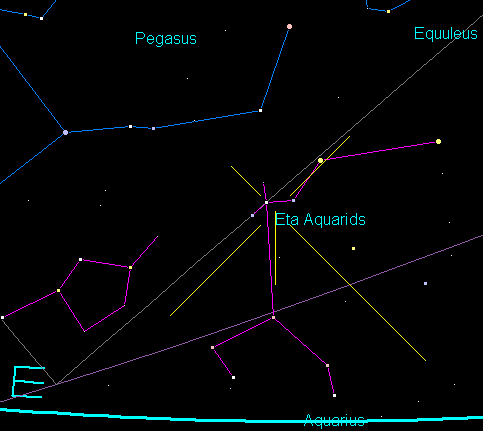
The Eta Aquariid radiant at the peak of the shower. The radiant moves slowly to the east with time. Credit: my LookingUp program.
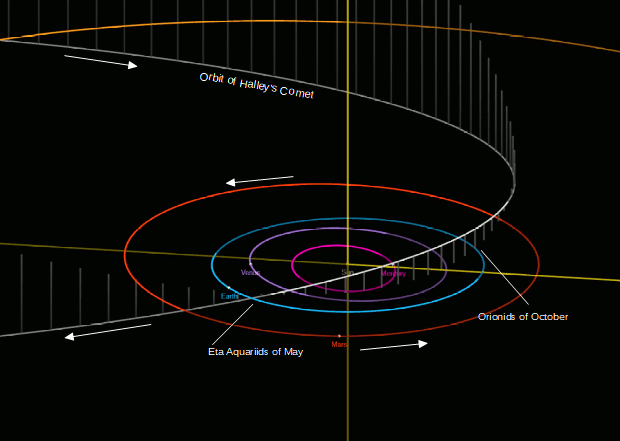
Halley’s Comet orbit with the orbits of the inner planets showing the points at which the debris from the comet intersect with the Earth’s orbit causing meteor showers. Diagram credit JPL Small-Body Database Browser with my annotations.
04/27/2020 – Ephemeris – Sunrise at Theophilus
This is Ephemeris for Monday, April 27th. Today the Sun will be up for 14 hours and 5 minutes, setting at 8:43, and it will rise tomorrow at 6:36. The Moon, 3 days before first quarter, will set at 1:26 tomorrow morning.
If my Moon charting software is correct this is the one evening out of the month when the central peak of the crater Theophilus catches the first rays of the rising Sun, while the crater floor is in shadow. It kind of looks like a bulls eye. It can be spotted with binoculars on the inside of the crescent, on the terminator, the sunrise line about half way between the ends of the crescent. Theophilus is 61 miles (101 km) in diameter. A telescope of any size with 30 to 50 power magnification will really bring out the detail. More magnification may be warranted, but if the bigger image becomes fuzzy, back off the power. It may be the diameter of your telescope due to the wave nature of light or the atmosphere you’re looking through that’s causing the problem.
The event times given are for the Traverse City/Interlochen area of Michigan. They may be different for your location.
Addendum
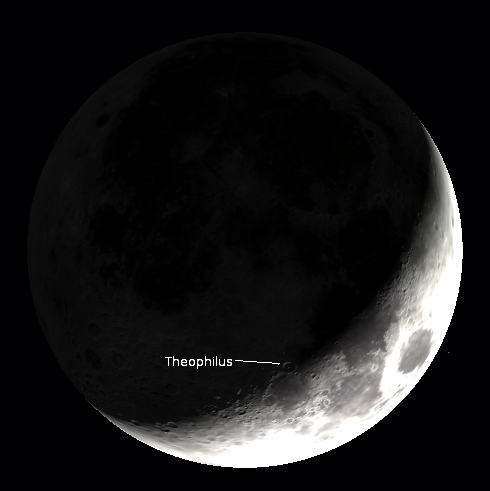
The Moon as it should appear at 10 p.m. tonight April 27, 2020 EDT (2:00 UT the 28th UT) with Theophilus on the terminator. Created with Stellarium.
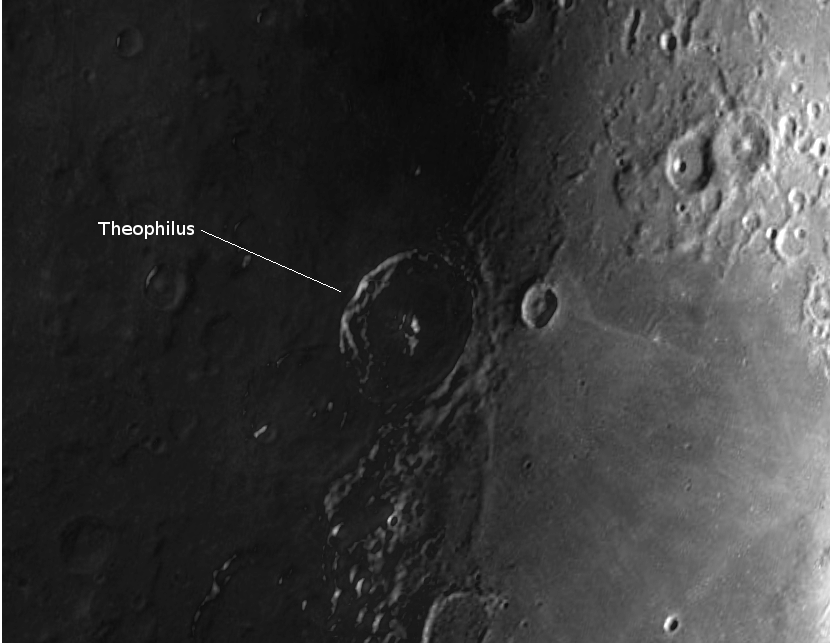
Theophilus at sunrise with the Sun illuminating the central peak and the far crater wall. Theophilus’ diameter is 61 miles or 101 kilometers in diameter. The crater walls rise 13 ,3000 feet or 4,400 meters above the crater floor, and the central mountain with four peaks rises 4,600 feet or 1,400 meters above the crater floor. Image and information from Virtual Moon Atlas. This image needs to be rotated clockwise about 45 degrees to match the image above.

