Archive
05/15/2014 – Ephemeris – Comet 209P/LINEAR and the meteor storm
Ephemeris for Thursday, May 15th. Today the sun will be up for 14 hours and 49 minutes, setting at 9:03. The moon, 1 day past full, will rise at 10:10 this evening. Tomorrow the sun will rise at 6:13. | A possible meteor storm is predicted for the morning of Saturday May 24th, between the hours of 3 and 4 a.m. with the first meteors showing up shortly after 1:30 a.m. and building after that. Meteor showers are produced by the debris of comets. The comet that will be responsible is 209P/LINEAR discovered in 2004 by Lincoln Near-Earth Asteroid Research, though the comet has been in and near its present orbit for centuries. The comet will pass closest to the Earth on May 28th, it will be very dim. The debris cloud will be ahead if it, crossing the earth’s orbit 4 days earlier. The Grand Traverse Astronomical Society is attempting to set up an all night star party/meteor watch. Stay tuned.
Times are for the Traverse City/Interlochen area of Michigan. They may be different for your location.
Addendum
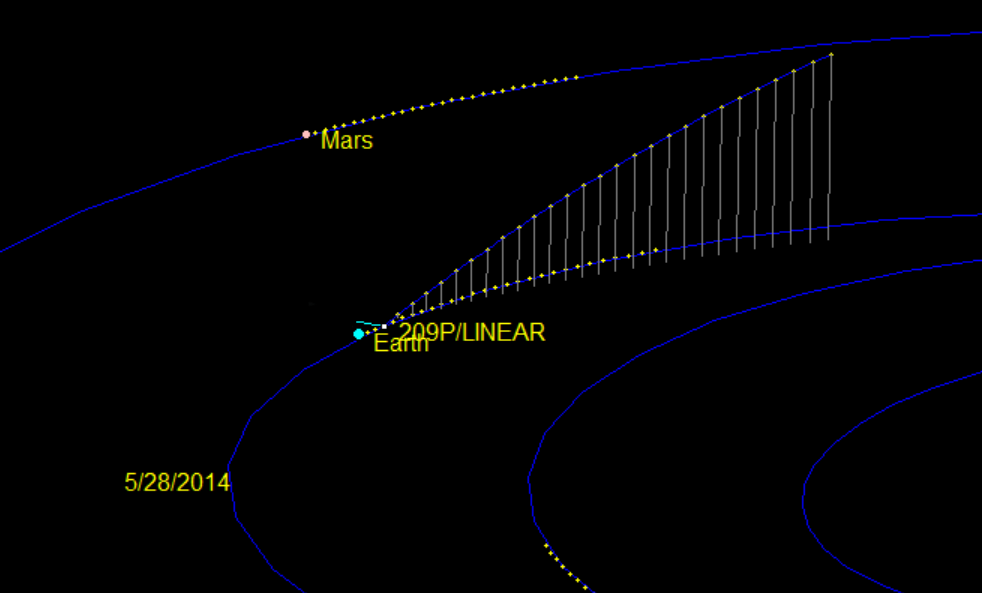
Comet 209P/LINEAR crosses the Earth’s orbit behind the Earth around May 28, 2014. The “stilts” on the comet’s orbit show that it is coming from north of the Earth’s orbital plane. Credit: Bob Moler’s LookingUp program.
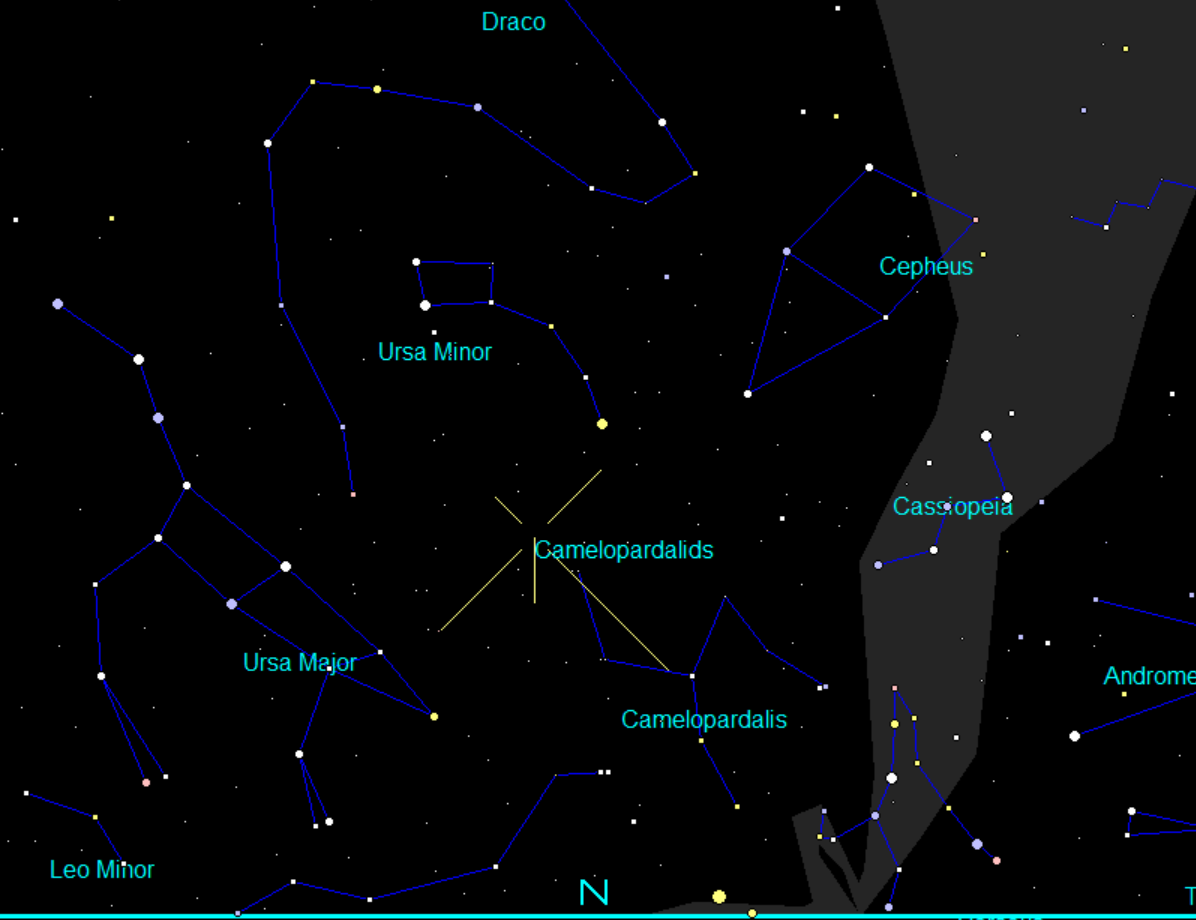
The expected radiant for the meteors of the May Camelopardids, the meteors from the comet 209P/LINEAR at 3 a.m. on May 24, 2014. Credit: My LookingUp program.
05/13/2014 – Ephemeris – A possible meteor storm for the early morning hours of May 24th
Ephemeris for Tuesday, May 13th. Today the sun will be up for 14 hours and 44 minutes, setting at 9:01. The moon, 1 day before full, will set at 6:16 tomorrow morning. Tomorrow the sun will rise at 6:15.
A meteor storm is an enhanced meteor shower in terms of numbers of meteors seen over a short interval. Some astronomers predict one where no meteor shower has been seen before, on the morning of May 24th this year. In the last couple of years two astronomers have projected the orbits of the debris from the comet now known as 209P/LINEAR, discovered in 2004. These astronomers are Peter Jenniskens of the SETI Institute and NASA and Esko Lyytinen of Finland. The International Meteor Organization calendar for this year reports predictions for the peak of meteor storm to be between 3 and 4 a.m. on May 24th. But no one really knows if the meteor storm will show at all. I’ll tell you of local observing plans on Thursday.
Times are for the Traverse City/Interlochen area of Michigan. They may be different for your location.
Addendum
The expected radiant for the meteors of the May Camelopardalids, the meteors from the comet 209P/LINEAR at 3 a.m. on May 24, 2014. Credit: My LookingUp program.
Note that the meteors will appear all over the sky, but can be traced back to this radiant.
05/01/2014 – Ephemeris – Previewing May skies
Ephemeris for Thursday, May 1st. The sun rises at 6:32. It’ll be up for 14 hours and 14 minutes, setting at 8:47. The moon, 2 days past new, will set at 11:21 this evening.
Today we will start the month when the promise of spring is finally fulfilled, we hope. Daylight hours in the Interlochen/Traverse City area will increase from 14 hours and 14 minutes today to 15 hours 18 minutes on May 31st. The altitude, or angle, of the sun above the southern horizon at local noon will ascend from 60 degrees today to 67 degrees at month’s end. The altitude of the sun in the Straits area will be a degree lower than that but your length of daylight will be a few minutes longer. Local apparent noon this month, when the sun passes due south, will be about 1:38 p.m. The Eta Aquarid meteor shower will reach its peak about 2 a.m. this Sunday morning the 4th. I’ll have more on my blog bobmoler.wordpress.com today.
Times are for the Traverse City/Interlochen area of Michigan. They may be different for your location.
Addenda
The Eta Aquarid Meteor Shower
This shower is associated with Halley’s Comet. We see two meteor showers from Halley’s comet. One in October where the comet debris is crossing the earth’s orbit heading toward the sun, and again as its leaving. This shower is caused by the debris leaving the vicinity of the sun.
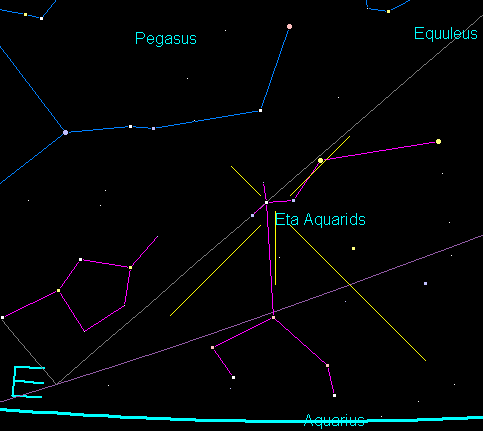
The Eta Aquarid radiant at the peak of the shower. The radiant moves slowly to the east with time. Credit: Bob Moler’s LookingUp program.
The peak of the shower will be at 7 h UT on May 6th. That’s 3 a.m. EDT, about 20 minutes before the radiant will rise. This will give about one hour before astronomical twilight starts to view the meteor shower in completely dark skies.
Possible Meteor Storm – May 24
There will be the possibility of a meteor storm on the morning of May 24th. A meteor storm differs from a meteor shower in the numbers of meteors seen and duration. There is a possibility of up to 400 meteors per hour for the hours of 7h to 8h UT (3 to 4 a.m. EDT).
The body responsible is Comet 209P/LINEAR. It was the 209th periodic comet discovered on February 3, 2004 by Lincoln Near-Earth Asteroid Research (LINEAR). Despite the recent discovery 209P has been orbiting the sun for hundreds of years, maybe longer. This year the comet will come close to the Earth and will allow the Earth to pass through debris that it shed hundreds of years ago.
Comet 209P/LINEAR crosses the Earth’s orbit around May 28, 2014. The “stilts” on the comet’s orbit show that it is coming from north of the Earth’s orbital plane. Credit: Bob Moler’s LookingUp program.
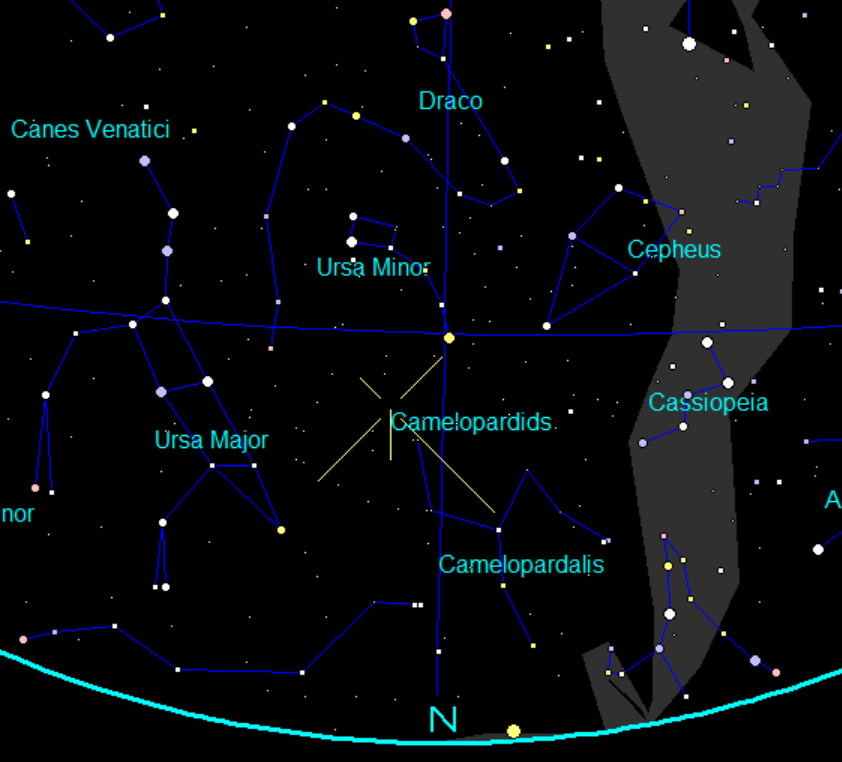
The radiant for the Comet 209P/LINEAR debris. For this purpose I’ve designated it Camelopardids (not official and probably not correct). Credit: Bob Moler’s LookingUp program. Note that the constellation of Camelopardalis is a giraffe.
Astronomical Twilight starts at 3:51 a.m., but the skies should remain dark enough. The 24% illuminated moon will rise about 2:45 or so and may not be much of an impediment in seeing the meteor storm.
May Star Chart
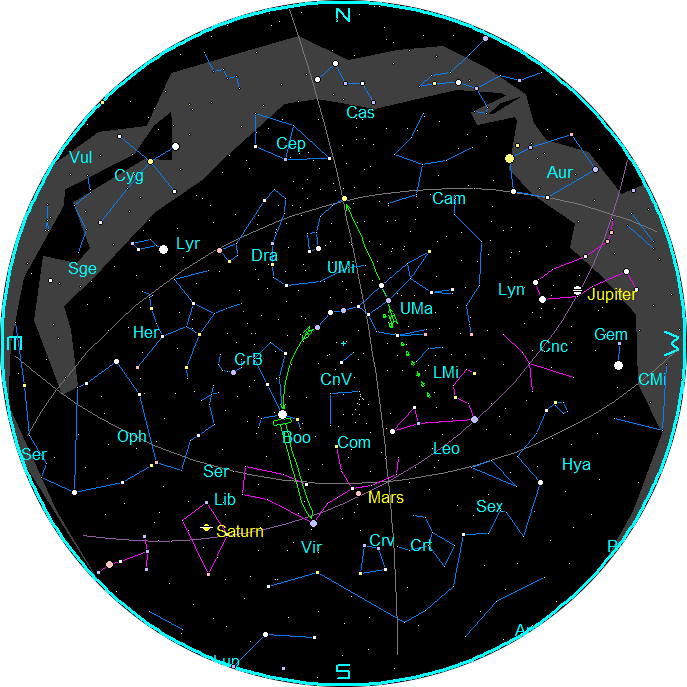
Star Chart for mid-month for May 2014 at 11 p.m. Credit: Bob Moler’s LookingUp program.
Add a half hour to every week before the 15th and subtract and hour for every week after the 15th.
For a list of constellation names to go with the abbreviations click here.
04/30/2014 – Ephemeris – It’s Wednesday, do you know where your planets are?
Ephemeris for Wednesday, April 30th. The sun rises at 6:34. It’ll be up for 14 hours and 11 minutes, setting at 8:45. The moon, 1 day past new, will set at 10:25 this evening.
It’s Wednesday and once again time to locate the bright planets for this week. Brilliant Jupiter will be in the western sky as darkness falls tonight. It will set at 1:54 a.m. Reddish Mars is in Virgo and outshines the bright bluish star Spica below left of it as darkness falls. Mars is in the south-east as it gets dark. It will pass due south at 11:51 p.m. It’s 59.5 million miles away now, and moving away, and will set at 5:41 a.m. Saturn will rise at 9:24 p.m. It’s in the faint constellation of Libra the scales this year. It will pass due south at 2:23 a.m. The telescope will bring out Saturn’s beautiful rings, whose short dimensions now are as wide as the planet. Brilliant Venus will rise in the east at 5:05 a.m. and will stay pretty low to the horizon.
Times are for the Traverse City/Interlochen area of Michigan. They may be different for your location.
Addendum
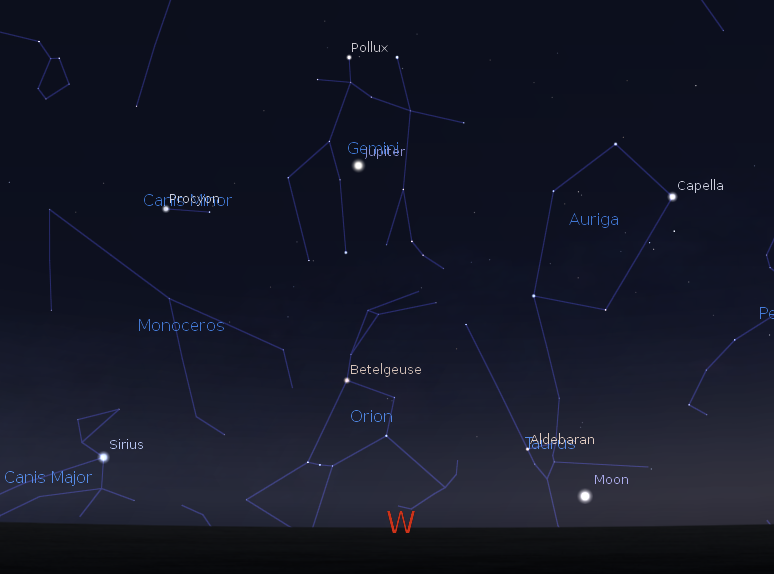
Jupiter, the Moon and the setting winter constellations in the west at 10 p.m. on April 30, 2014. Created using Stellarium.
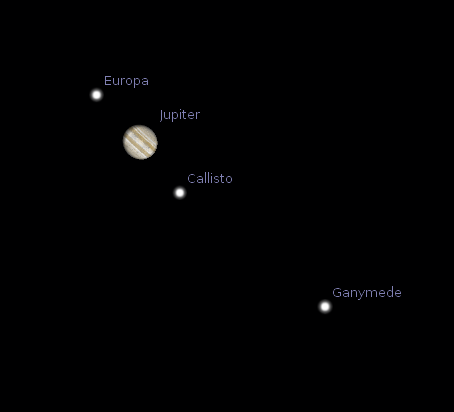
Jupiter and satellites through a telescope at 10 p.m. on April 30, 2014. The satellite Io is being occulted by Jupiter and will reappear at 11:56 p.m. (3:56 UT May 1, 2014). Created using Stellarium.
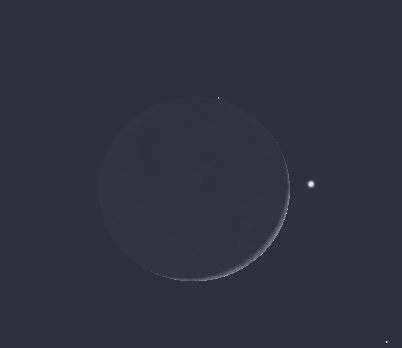
The crescent Moon at 10 p.m. on April 30, 2014. Created using Stellarium.
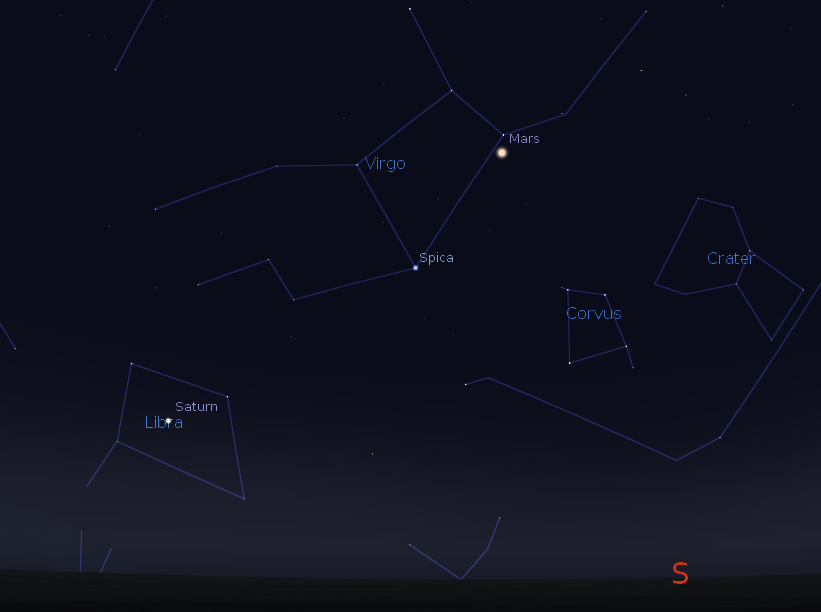
Mars, Saturn and some spring constellation at 11 p.m. April 30, 2014. Created using Stellarium.
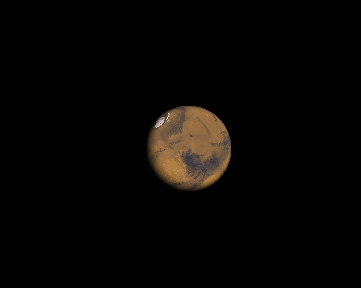
Telescopic view of Mars, 11 p.m. April 30, 2014. Created using Stellarium.
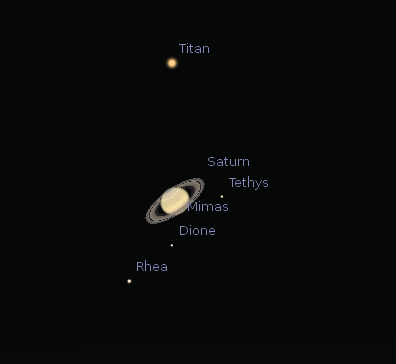
Telescopic view of Saturn and some of its moons at 11 p.m. April 30, 2014. Created using Stellarium.
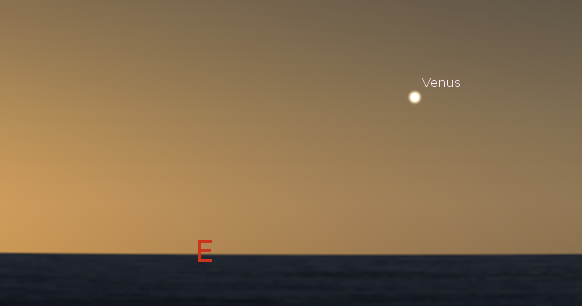
Venus in the twilight at 6 a.m. May 1, 2014. Created using Stellarium.
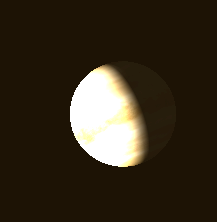
Telescopic view of Venus on May 1, 2014. Created using Stellarium.
04/24/2014 – Ephemeris – Venus and the Moon in the morning
Ephemeris for Thursday, April 24th. The sun rises at 6:43. It’ll be up for 13 hours and 55 minutes, setting at 8:38. The moon, 2 days past last quarter, will rise at 4:39 tomorrow morning.
The planet Venus will be hanging with the moon for the next two mornings. Tomorrow morning the crescent Moon will appear to the right and above Venus. The planet will rise at 5:13, though it should be high enough to spot by 5:30 or 5:45 a.m. in the east. Saturday morning the crescent moon will be to the left of Venus. The moon will be passing Venus about 5 p.m. tomorrow afternoon. Parts of Asia will get a good look at that. We’ll get before and after shots of it. Viewing the moon and planets near the sun is easy or hard depending on the season. For the best views its generally late winter and spring evenings and late summer and autumn mornings. It’s the wrong time of year for easy Venus viewing.
Times are for the Traverse City/Interlochen area of Michigan. They may be different for your location.
Addendum
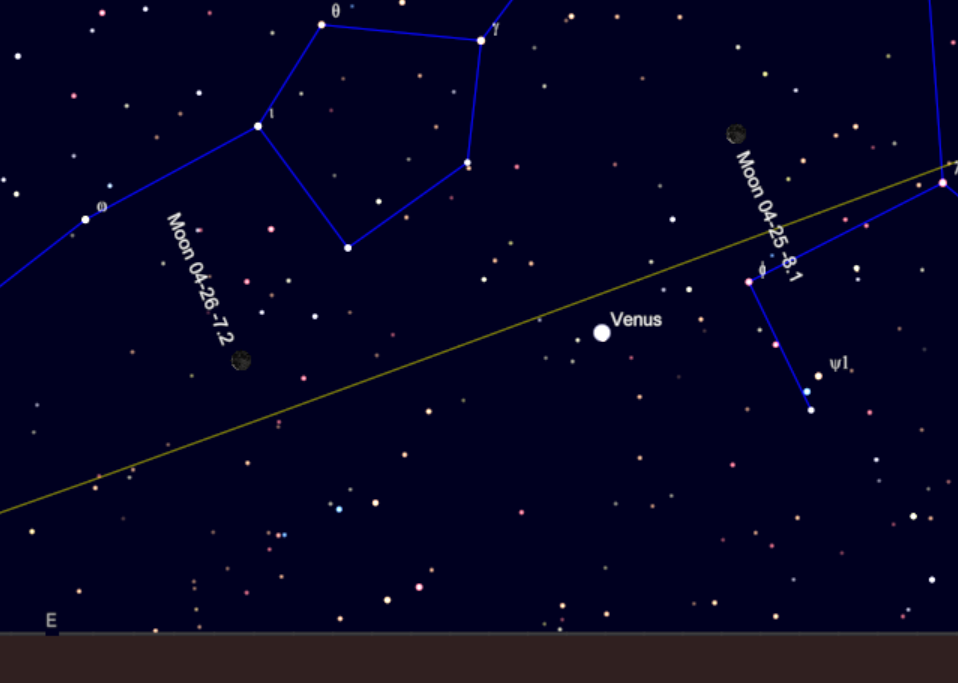
Venus and the Moon on two consecutive mornings 04/25/14 and 04/26/14 at 6 a.m. The yellow line is the ecliptic which is the path of the Sun in the sky. Created using Cartes du Ciel (Sky Charts).
04/28/2014 – Ephemeris – The Lyrid meteor shower will reach peak tomorrow
Ephemeris for Monday, April 21st. The sun rises at 6:48. It’ll be up for 13 hours and 46 minutes, setting at 8:34. The moon, 1 day before last quarter, will rise at 2:52 tomorrow morning.
The second major meteor shower this year will reach its peak tomorrow afternoon (~18h UT). The best shot to see it will be tonight from about 10 to near 3 a.m. when the moon rises. The meteor shower is called the Lyrids, because they seem to come from near the constellation Lyra the harp and the bright star Vega. At 10 p.m. Vega is the brightest star low in the northeastern sky. By 3 a.m. Vega will be high in the east. The radiant of the meteors is to the west of Vega between Lyra and the dim constellation of Hercules. The most meteors will be visible just before the moon begins to brighten the sky before 3 a.m. Though a major shower the peak hourly rate is expected to be 18 meteors an hour. However we won’t quite get close to that rate.
Times are for the Traverse City/Interlochen area of Michigan. They may be different for your location.
Addendum
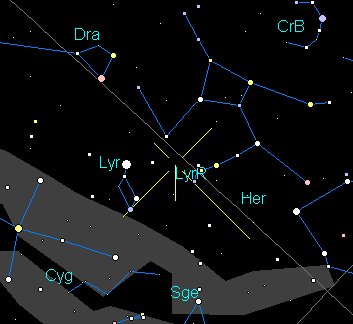
Lyrid meteor radiant. The bright star is Vega
The source of my information, the International Meteor Organization calendar can be downloaded from here.
David Dickinson’s post on this year’s Lyrid meteor shower on Universe Today is here.
04/01/2014 – Ephemeris – Viewing Zodiacal Light
Ephemeris for April Fools Day, Tuesday, April 1st. The sun will rise at 7:23. It’ll be up for 12 hours and 46 minutes, setting at 8:09. The Moon, 2 days past new, will set at 10:37 this evening.
There is a faint glow visible to the careful observer at twilight’s end at 9:51 p.m. This glow is in the west. It’s Zodiacal Light, the reflected glow from countless bits of cometary dust in the plane of the solar system. You’ll need to go to a spot with no towns or cities immediately to the west of you. The glow will appear as a thin pyramidal glow tilted to the left. It’s tough to find the first time, but once seen you’ll easily find it again. A recent study of the glow confirms the source of it. While bright comets are fairly rare, small comets are very plentiful, including plenty that graze the sun and evaporate liberating their dust into interplanetary space. After tomorrow night the Moon will interfere for two weeks.
Times are for the Traverse City/Interlochen area of Michigan. They may be different for your location.
Addendum
I could never photograph Zodiacal Light when I wanted to. However I did catch it inadvertently.
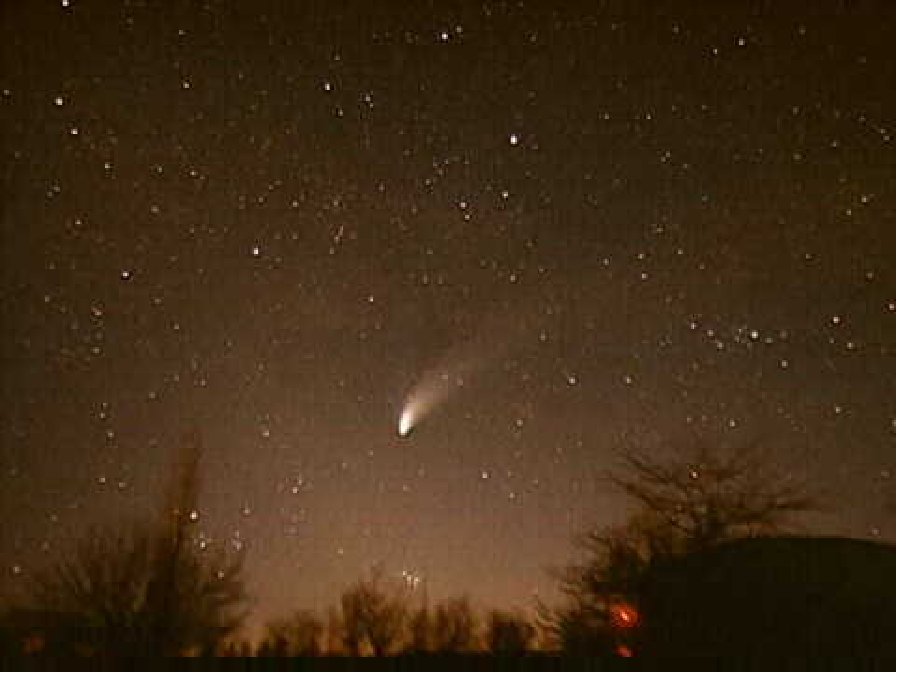
Zodiacal Light and Comet Hale-Bopp April 1997. My image.
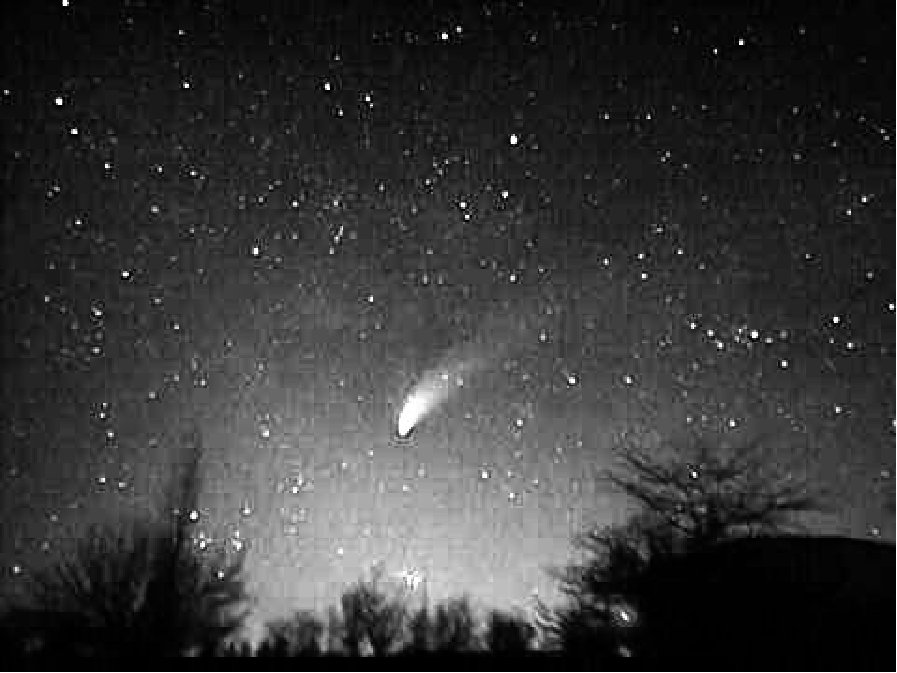
Zodiacal Light and Comet Hale-Bopp April 1997. Enhanced contrast.
03/04/2014 – Ephemeris – Observing the Moon tonight
Ephemeris for Fat Tuesday, Tuesday, March 4th. The sun will rise at 7:14. It’ll be up for 11 hours and 19 minutes, setting at 6:34. The moon, 3 days past new, will set at 10:52 this evening.
The Moon tonight is visible in the west after sunset. The sunrise terminator is slowly moving across its face. The solar day on the Moon equals its orbit of the Earth with respect to the sun of about 29 and a half days. As the moon is oriented in our sky the dark nearly circular sea. The Sea of Crises is rotated downward so it appear at between 4 and 5 o’clock on the moon’s face. At the bottom is the partially uncovered Sea of Fertility. With binoculars or preferably a small telescope can be seen the large crater Langrenus close to the lunar equator. A picture of that crater was one of the first brought back by the Apollo 8 crew in 1968. I’ve found it for the blog entry for this episode at bobmoler.wordpress.com.
Times are for the Traverse City/Interlochen area of Michigan. They may be different for your location.
Addendum
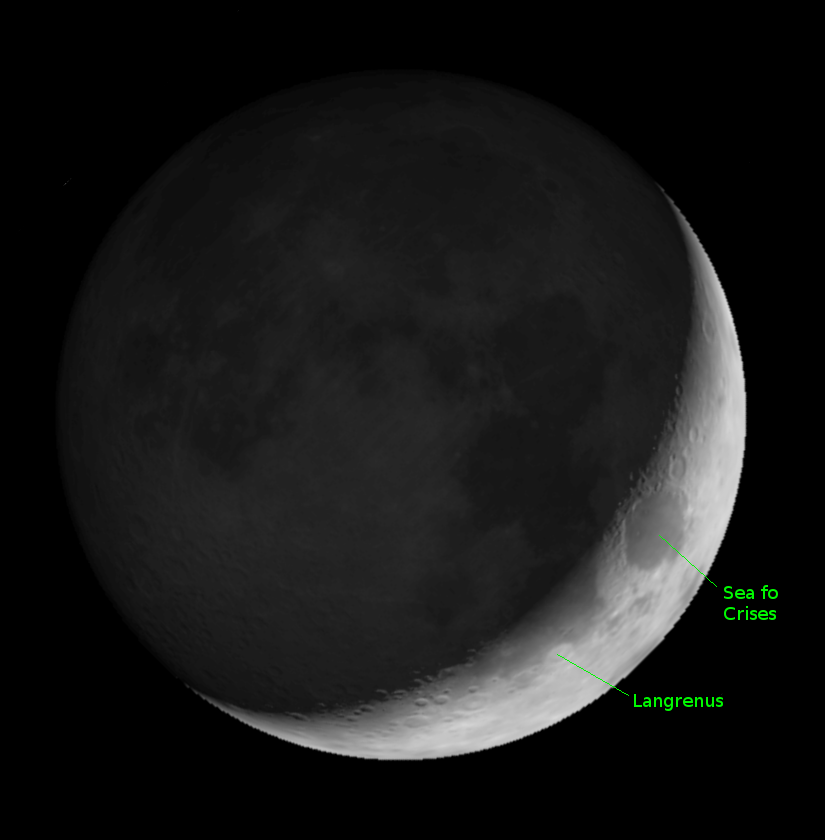
The moon rotated as if it were setting in the west showing the Sea of Crises (Mare Crisium) and the crater Langrenus. The image was enhanced to show Earth shine. Created using Virtual Moon Atlas.
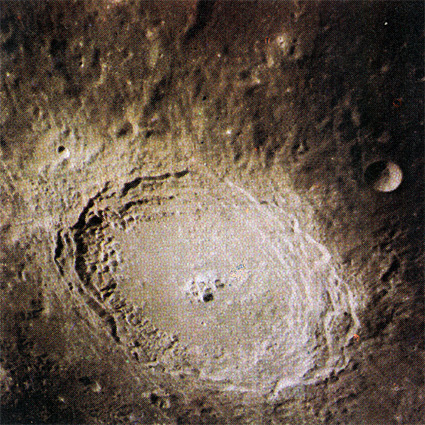
The crater Langrenus as imaged by the Apollo 8 crew on their historic orbiting of the Moon Christmas Eve 1968. Credit: NASA.
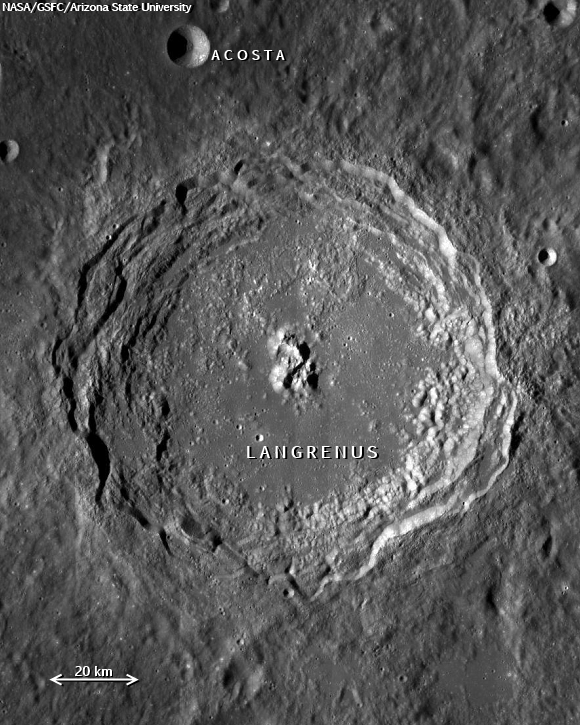
The crater Langrenus as imaged by the Lunar Reconnaissance Orbiter. Credit: NASA\GSFC\Arizona State University.
Note on credits: GSFC is the Goddard Space Flight Center.
03/03/2014 – Ephemeris – The dim zodiacal constellation of Cancer the Crab
Ephemeris for Monday, March 3rd. The sun will rise at 7:16. It’ll be up for 11 hours and 16 minutes, setting at 6:33. The moon, 2 days past new, will set at 9:44 this evening.
At 9 this evening, the faint constellation, and member of the Zodiac, Cancer the crab is located in the south-southeast half way between the bright stars Castor and Pollux of the constellation Gemini, high in the south and the bright star Regulus in Leo the lion in the east Cancer is very dim, looking like an upside-down Y. In the center of Cancer is a fuzzy spot to the unaided eye. In binoculars or a low power telescope this fuzzy spot becomes a cluster of stars. It is the Beehive cluster. At 525 light years away, it is one of the closest star clusters, but more distant than the Pleiades and Hyades the face of Taurus the bull. Back a few thousand years ago Cancer was the farthest north of the constellations, Gemini has that honor today.
Times are for the Traverse City/Interlochen area of Michigan. They may be different for your location.
Addendum
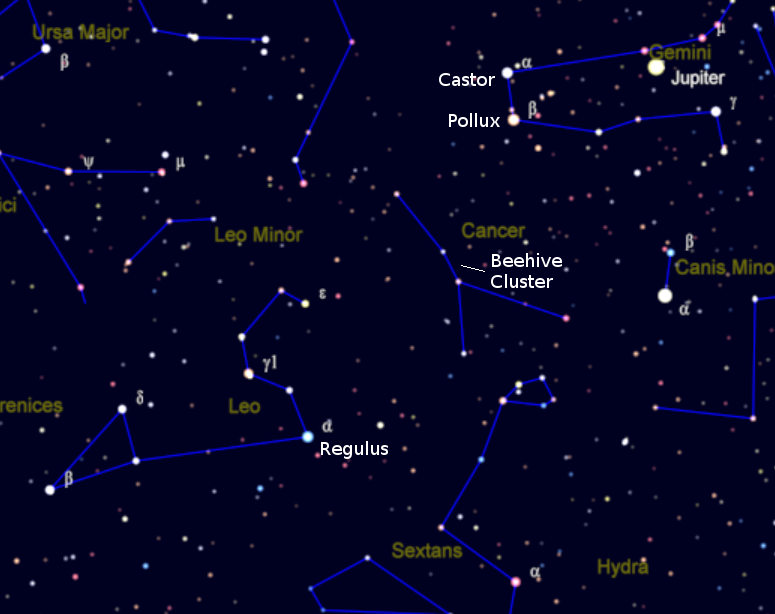
The constellation Cancer the crab at 9 p.m. March 3, 2014. Created using Cartes du Ciel (Skycharts).
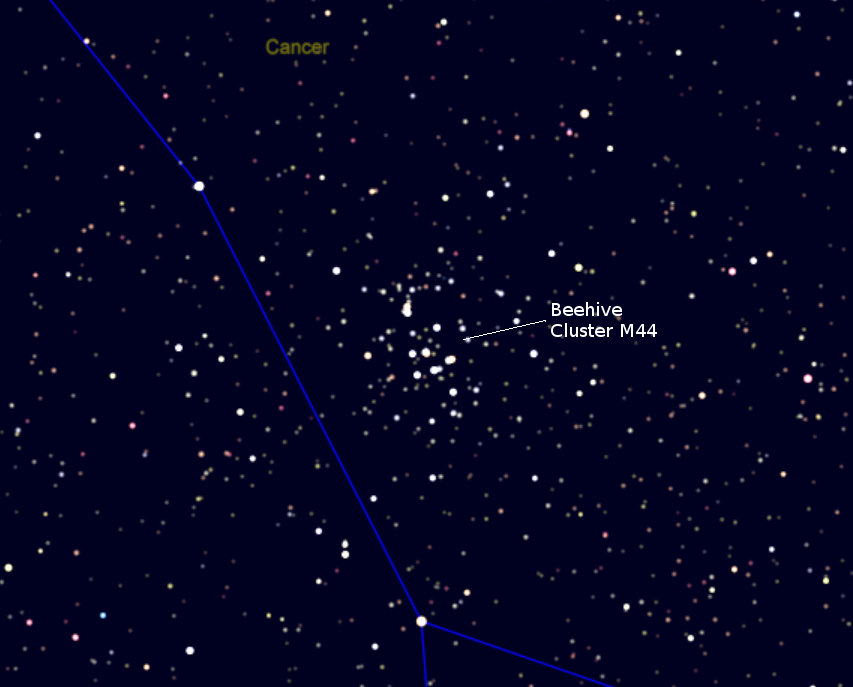
The Beehive star cluster, M44. Its ancient name was the Praesepe or manger when glimpsed by the naked eye. Created using Cartes du Ciel (Skycharts)
02/26/2014 – Ephemeris – Where are the bright planets this week?
Ephemeris for Wednesday, February 26th. The sun will rise at 7:25. It’ll be up for 11 hours and 1 minute, setting at 6:26. The moon, 3 days before new, will rise at 5:58 tomorrow morning.
Let’s take our weekly look at the planets. Jupiter will be in the southeastern sky as darkness falls tonight. It’s cruising against the stars of Gemini now. It will pass due south at 9:01 p.m., and will set at 4:44 a.m. in the west-northwest. Reddish Mars is in Virgo now and above and left of the bright star Spica, which it now outshines. Mars will rise at 10:29 p.m. and will appear above the moon when it rises a half an hour later. It will pass due south at 4 a.m. Saturn will rise at 12:45 a.m. in the east-southeast. It’s seen against the stars of Libra the scales this year. Venus will rise at 5:03 tomorrow morning but this morning it will appear above and right of the Moon. and shines brightly in the southeast before sunrise.
Times are for the Traverse City/Interlochen area of Michigan. They may be different for your location.
Addendum
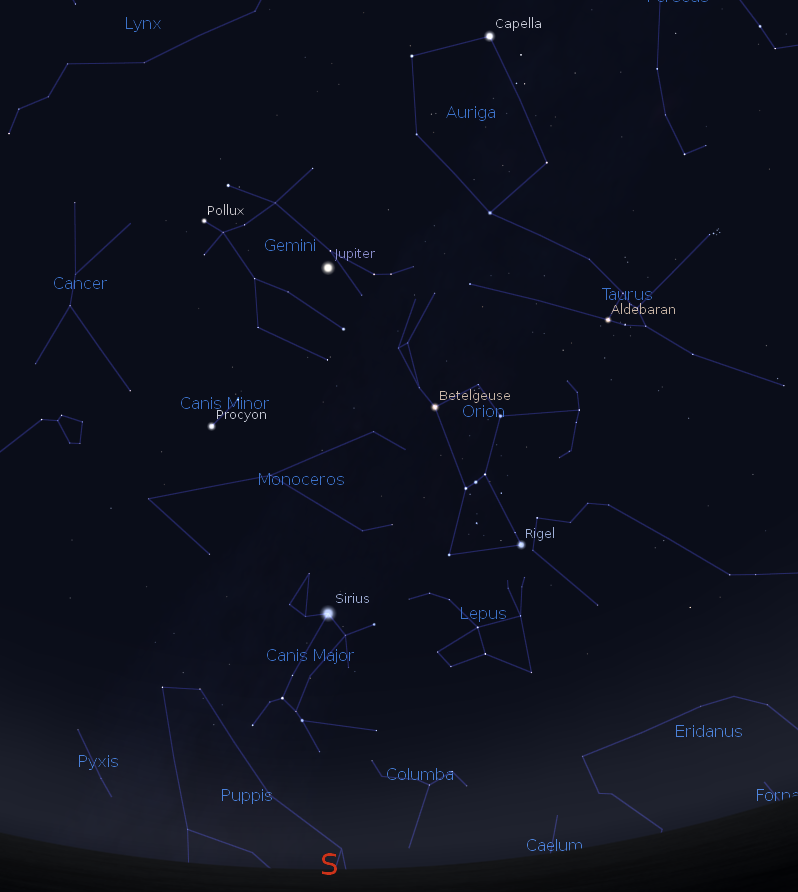
Jupiter and the winter constellations at 9 p.m. on February 26, 2014. Created using Stellarium.
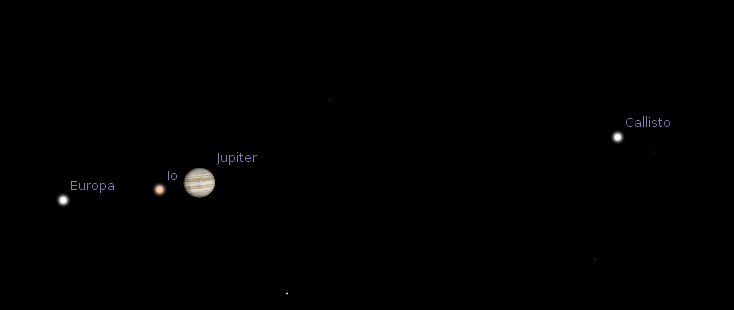
Telescopic Jupiter. The missing moon Ganymede is near Io from our vantage point, however it’s in Jupiter’s shadow. It will emerge into sunlight at 10:25 p.m. (3:25 UT on the 27th) between Io and Europa. Created using Stellarium.
Stellarium models the eclipses of the satellites fine, but for this one it is more than a half hour early. It may not take into account the light travel time between Jupiter and the earth. Another free program Cartes du Ciel does not model Jovian satellite eclipses at all.
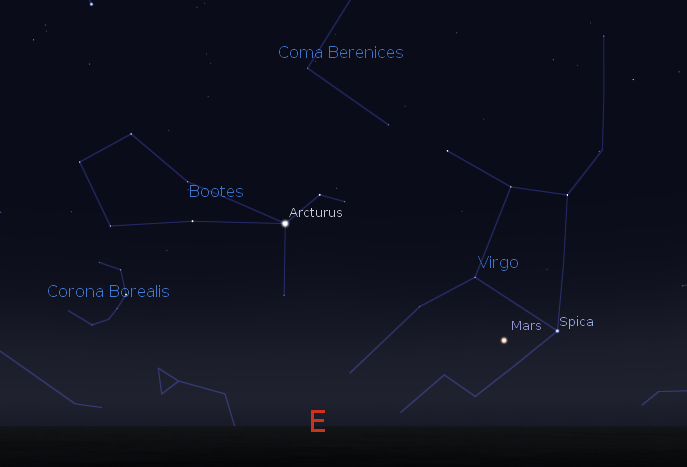
Mars rising near the star Spica at 11:30 p.m. February 26, 2014. Created using Stellarium.
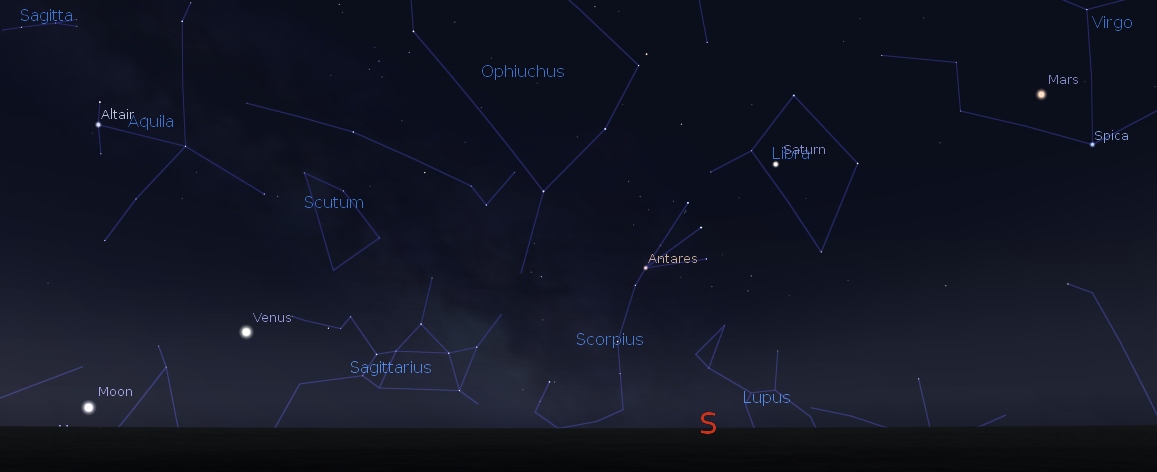
The morning planets Mars, Saturn and Venus with the moon at 6:15 a.m. February 27, 2014. Created using Stellarium.
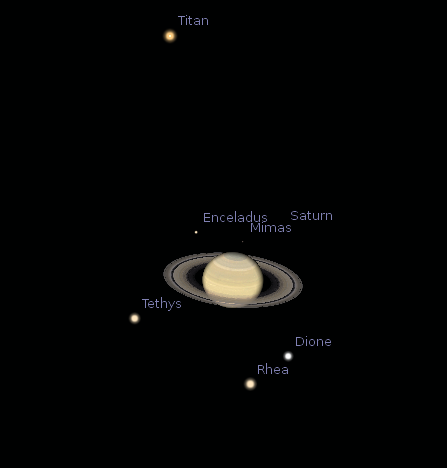
Saturn through a telescope on the morning of February 27, 2014. It would be difficult to see any satellites other than Titan with a small telescope. Created using Stellarium
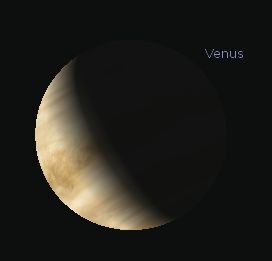
Venus through a telescope, except there will be no cloud detail, in the morning of February 27, 2014. Created using Stellarium.
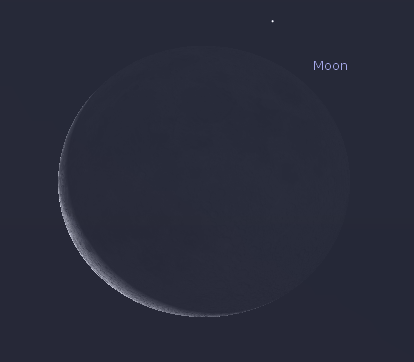
The thin crescent moon at 6:15 a.m. on February 27, 2014. Created using Stellarium.

