Archive
02/25/2014 – Ephemeris – Mars starts its retrograde motion this weekend
Ephemeris for Tuesday, February 25th. The sun will rise at 7:26. It’ll be up for 10 hours and 58 minutes, setting at 6:24. The moon, 3 days past last quarter, will rise at 5:15 tomorrow morning.
The planet Mars, which rises about 10:30 p.m. and is near the star Spica, is slowing its eastward motion as the Earth approaches it. Mars will stop and appear to reverse course on Saturday March 1st. It will begin what astronomers call retrograde motion. This westward motion will continue past Mars’ opposition with the sun on April 8th, and its closest approach to the Earth on April 14th. Mars retrograde motion will end on May 21st when Mars will resume its prograde or eastward motion. The ancient Greeks especially had a problem with this because they believed that celestial bodies traveled in uniform circular motion. They added a circle on the planet’s main circle called an epicycle to kind of solve the problem. The problem was solved centuries later by Copernicus who made the earth another planet and Kepler who made the planet orbits elliptical.
Times are for the Traverse City/Interlochen area of Michigan. They may be different for your location.
Addendum
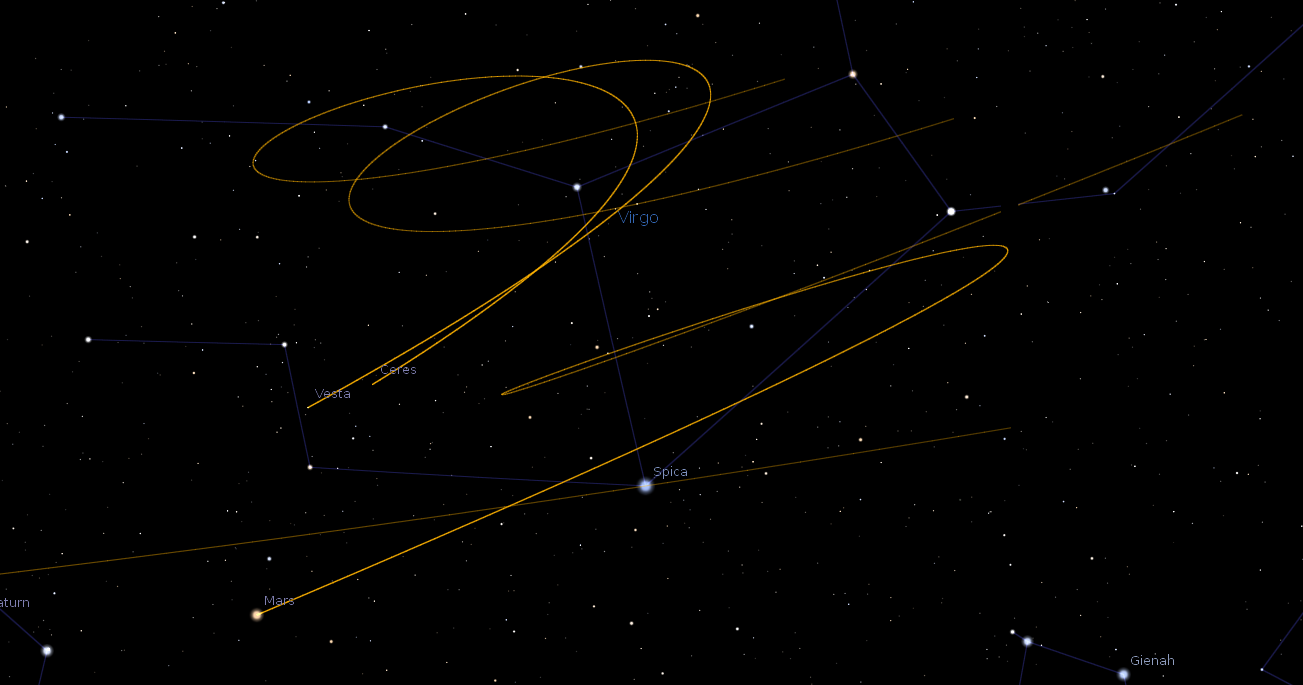
The trails of Mars and three asteroids from December 2013 to August 2014. Created using Stellarium.
Vesta and Ceres are going retrograde at the same time as Mars. The Dawn spacecraft traveling between Vesta to Ceres is about half way in between them. The other trail, not exhibiting retrograde is that of the small asteroid 2012 DA14 whose claim to fame is that it passed inside the ring of geosynchronous satellites on February 15, 2013. It was completely upstaged a few hours earlier by the meteor that exploded over Chelyabinsk, Russia. It looks like the orbital trail shown for 2012 DA14 has not been updated. As the result of the encounter with Earth that day the asteroid’s orbit was altered. 2012 DA14 is a provisional designation based on the year, half month and order of discovery. It’s permanent designation with a name is 367943 Duende. The name of the asteroid is usually up to the discoverer with the approval of the International Astronomical Union (IAU). It is the 367,943rd asteroid whose orbital elements are known. BTW Ceres is 1 Ceres, and Vesta is 4 Vesta. Though the 4th asteroid found, Vesta is the brightest, at the very limit of naked eye visibility.
02/24/2014 – Ephemeris – Two more bright star clusters of winter
Ephemeris for Monday, February 24th. The sun will rise at 7:28. It’ll be up for 10 hours and 55 minutes, setting at 6:23. The moon, 2 days past last quarter, will rise at 4:27 tomorrow morning.
The Milky Way isn’t as bright in the winter as it is in the summer. That’s because we are looking away from the galactic center, the central part of the Milky Way. But there’s still a lot to see as can be attested to by the bright stars of winter that outshine those of summer. There are a lot of Galactic or open star clusters visible, such as the Pleiades. With binoculars one can spot at least two more. Just below Sirius the Dog Star the brightest night-time star which can be found by extending the line of the belt stars of Orion to the lower left. It’s Messier 41. Then off Castor’s toe in Gemini, where the sun would be on the first day of summer, as I mentioned last Tuesday, is another bright binocular star cluster cataloged as Messier 35.
Times are for the Traverse City/Interlochen area of Michigan. They may be different for your location.
Addendum
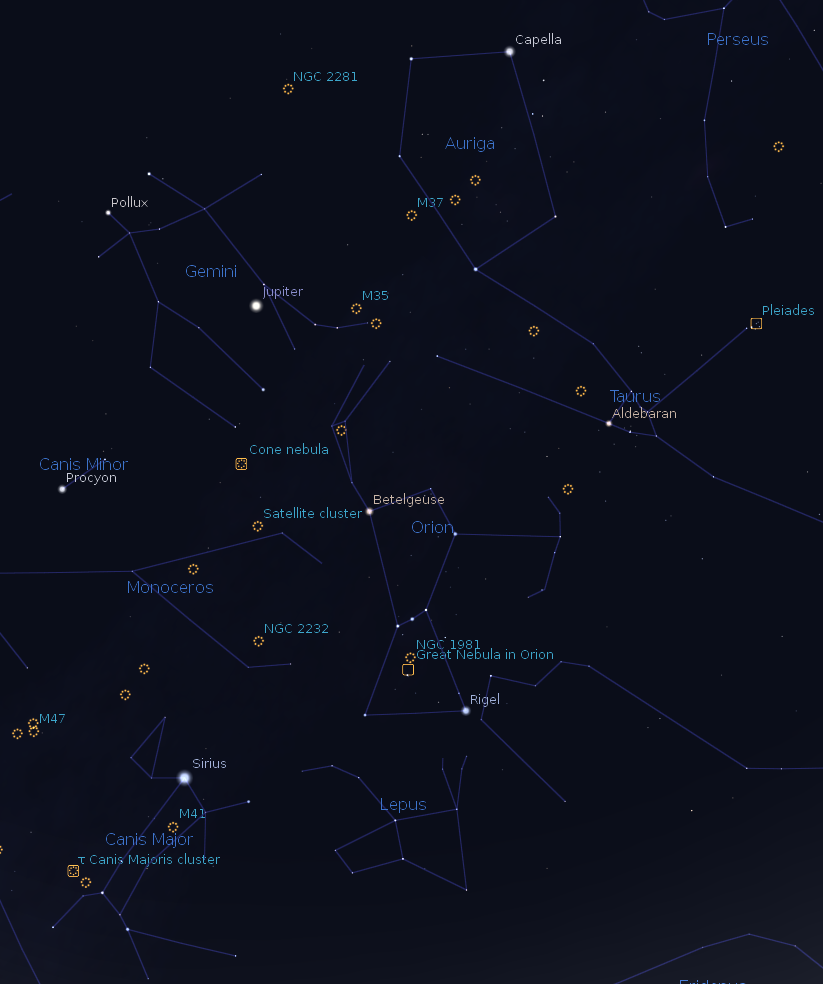
Winter Deep Sky Objects including the Pleiades, M35 and M41. Created using Stellarium.
02/19/2014 – Ephemeris – Where are the bright planets this week?
Ephemeris for Wednesday, February 19th. The sun will rise at 7:36. It’ll be up for 10 hours and 40 minutes, setting at 6:16. The moon, 3 days before last quarter, will rise at 11:23 this evening.
Let’s take our weekly look at the planets. Jupiter will be in the southeastern sky as darkness falls tonight. It’s cruising against the stars of Gemini now. It will pass due south at 9:29 p.m., and will set at 5:12 a.m. in the west-northwest. Reddish Mars is in Virgo now and above and left of the bright star Spica, which it now outshines. Mars will rise at 10:54 p.m. and will appear above the moon when it rises a half an hour later. It will pass due south at 4:26 a.m. Saturn will rise at 1:13 a.m. in the east-southeast. It’s seen against the stars of Libra the scales this year. Venus will rise at 5:10 tomorrow morning, and shines brightly in the southeast before sunrise. It’s in Sagittarius, left of its Teapot shape of stars.
Times are for the Traverse City/Interlochen area of Michigan. They may be different for your location.
Addendum
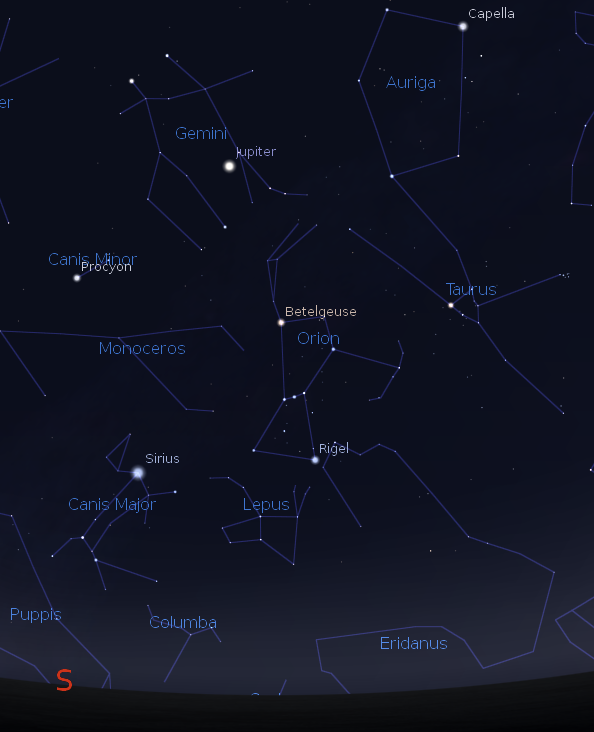
Jupiter and the constellations of winter at 9 p.m. February 18, 2014. Created using Stellarium.
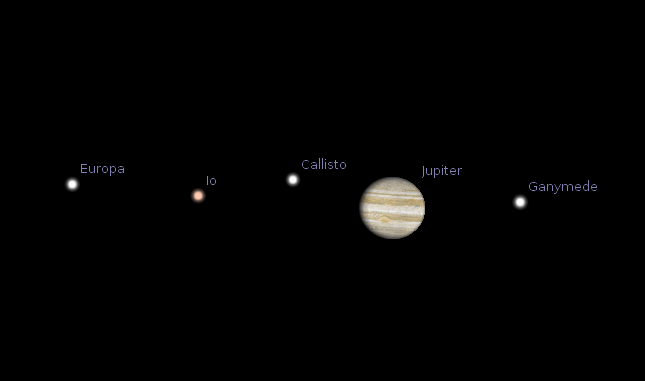
Jupiter at 9 p.m. on February 18, 2014. Created using Cartes du Ciel.
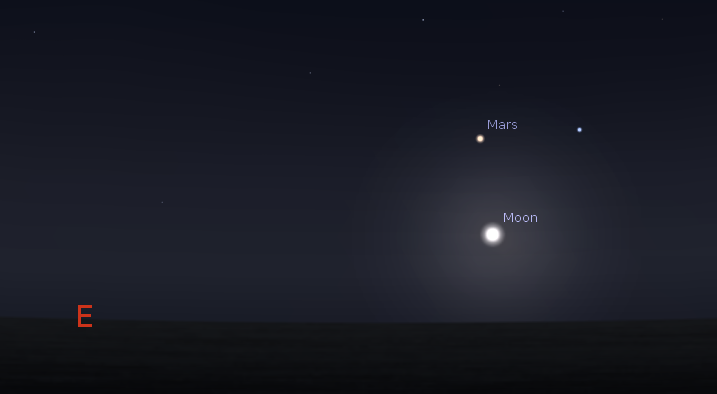
Mars and the Moon at midnight on February 20, 2014. Created using Cartes du Ciel.
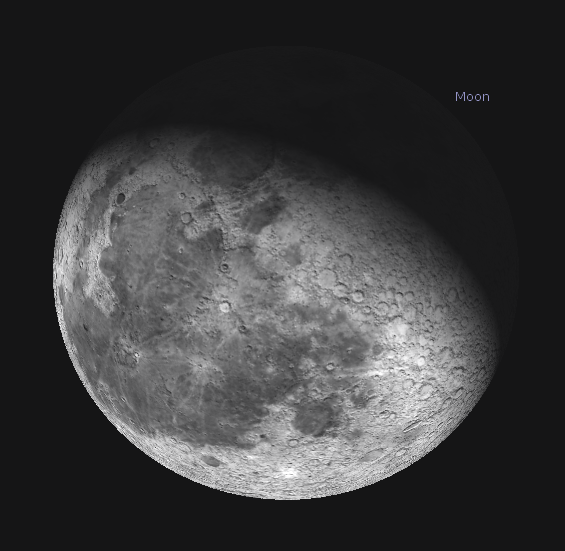
The Moon at midnight on February 20, 2014. Created using Stellarium.
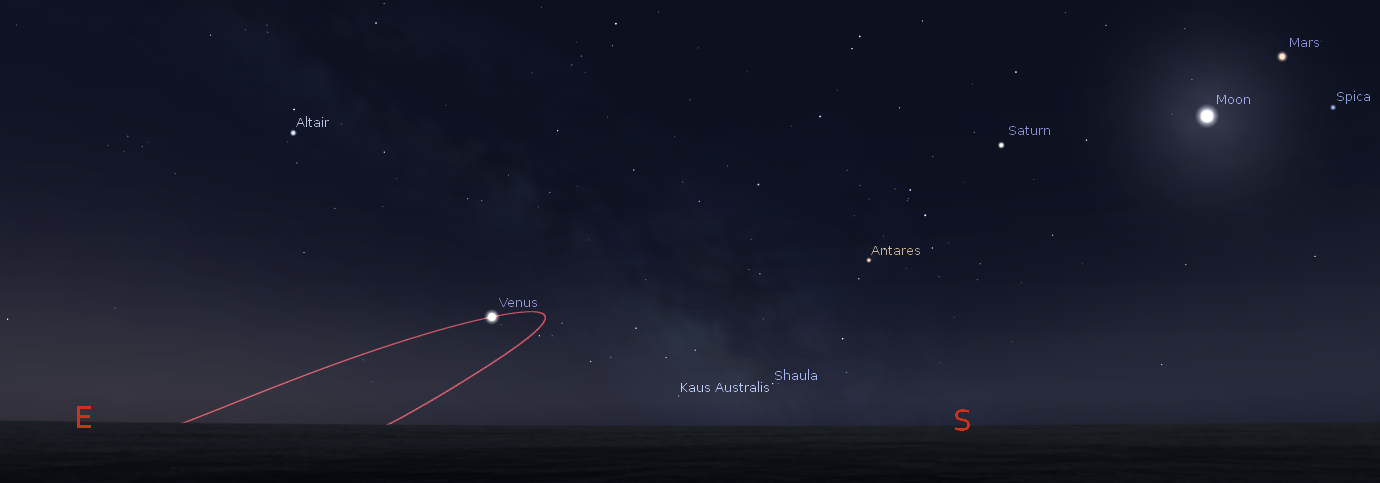
The morning planets at 6:30 a.m. February 20, 2014, including the orbit of Venus. Created using Stellarium.
Venus will reach the end of the red loop, its orbit as seen from Earth, on March 22nd. Of course we and Venus are moving, and so the apparent position of Venus will change also by the Earth’s motion.
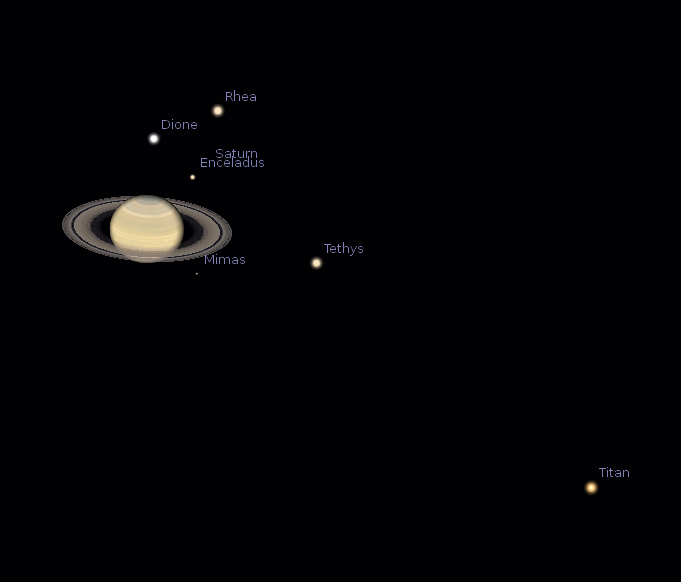
Saturn and its moons at 6:30, February 20, 2014. Of the moons, Titan will be the only one visible in small telescopes. Created using Stellarium.
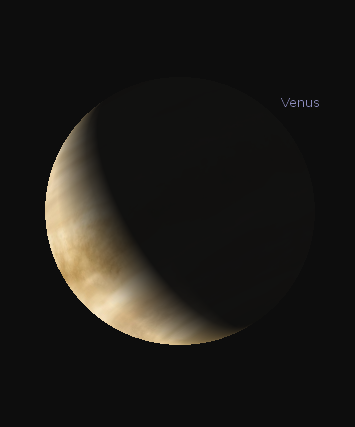
Venus through a telescope. The planet is getting smaller and its crescent is getting fatter as it moves away from the Earth. This image is for 6:30 a.m. February 20, 2014.Created using Stellarium.
02/17/2014 – Ephemeris – Viewing tonight’s waning gibbous moon
Ephemeris for President’s Day, Monday, February 17th. The sun will rise at 7:39. It’ll be up for 10 hours and 34 minutes, setting at 6:13. The Moon, 3 days past full, will rise at 9:17 this evening.
The bright Moon is now a waning gibbous phase, The right edge of the Moon is now in night as the sunset terminator slowly advances across the moon. Tonight the Sea of Fertility is half in daylight on the right side of the Moon. A telescope looking at it can spot the double crater of Messier and Messier A, a funny impact where the small asteroid skipped producing two craters and a double ray of ejecta. On the other side of the moon the largest sea Oceanus Procellarum, or Ocean of Storms can be seen in its entirety to the left limb of the moon. It happens that the moon is rotated toward us on that side, an effect called libration. The effect is due to the moon’s uneven velocity around the earth.
Times are for the Traverse City/Interlochen area of Michigan. They may be different for your location.
Addendum
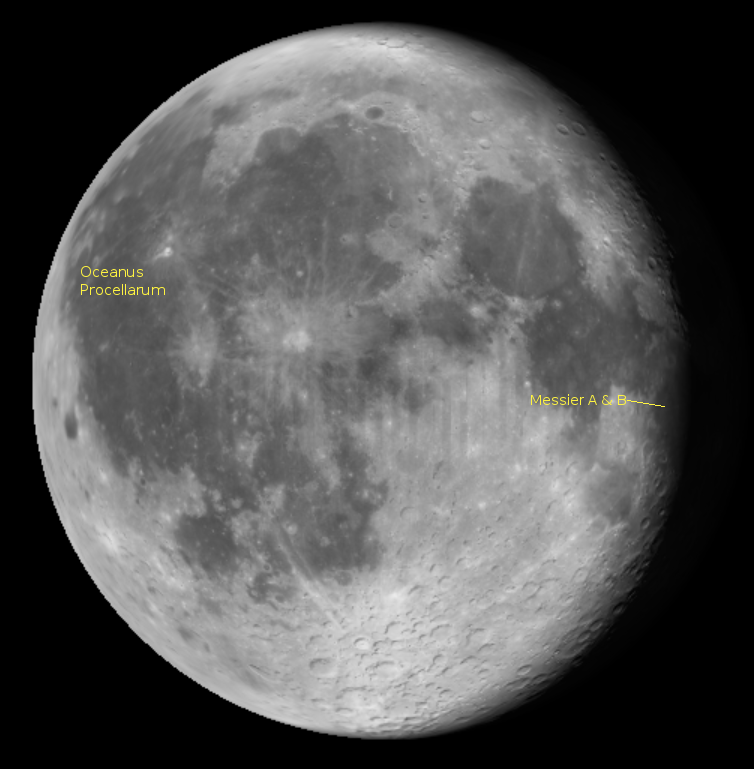
The moon at 9 p.m. on February 17, 2014 showing Oceanus Procellarum and the craters Messier A and B. Created using Virtual Moon Atlas.
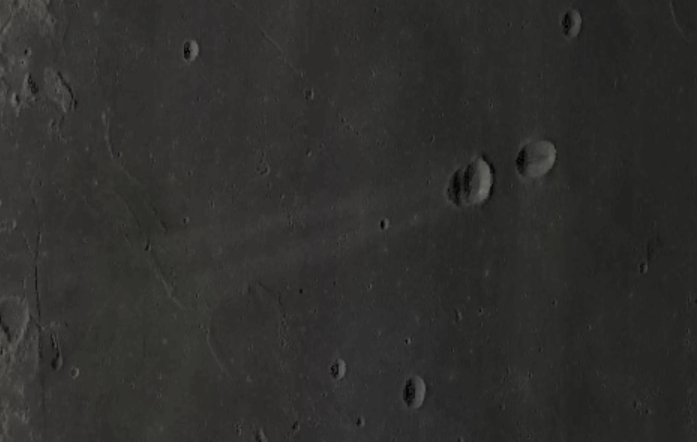
Closeup of the craters Messier A and B showing their twin rays. Created using Virtual Moon Atlas and the Lunar Reconnaissance Orbiter images. Credit: NASA.
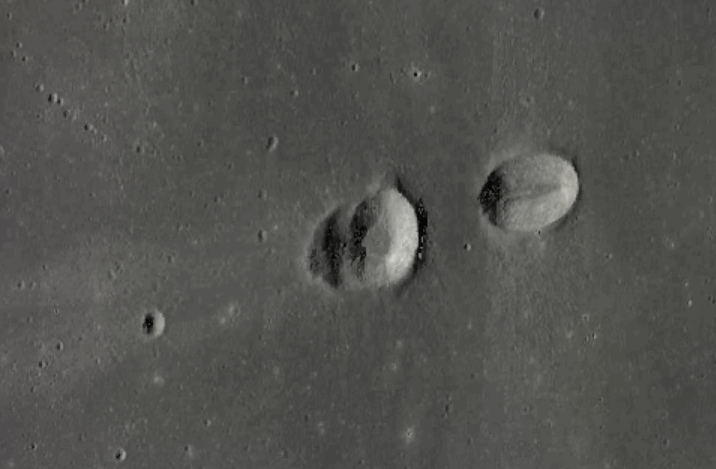
Extreme closeup of the craters Messier A and B showing their twin rays. Created using Virtual Moon Atlas and the Lunar Reconnaissance Orbiter images. Credit: NASA.
02/11/2014 – Ephemeris – The brightest spot on the moon is visible tonight
Ephemeris for Tuesday, February 11th. The sun will rise at 7:48. It’ll be up for 10 hours and 17 minutes, setting at 6:05. The Moon, 3 days before full, will set at 6:06 tomorrow morning.
The moon tonight is very bright. It will be full on Friday. Using binoculars the brightest object on the moon is a spot at the left edge of the moon that rotates to the upper left as the moon rises. It is the young crater Aristarchus. The age is less than 1.1 billion years. How much younger is unknown. It’s in the same age range as Copernicus to the lower right of it with the big round splash marks. In a telescope Aristarchus is a crater 24 miles (40 kilometers) in diameter. Generally, the fresher the crater the brighter it is. The Lunar Reconnaissance Orbiter has been in orbit of the moon for nearly four years. In that time it has discovered small craters that were formed after it arrived in orbit. The initial impacts drill into the moon’s lighter subsurface.
Times are for the Traverse City/Interlochen area of Michigan. They may be different for your location.
Addendum
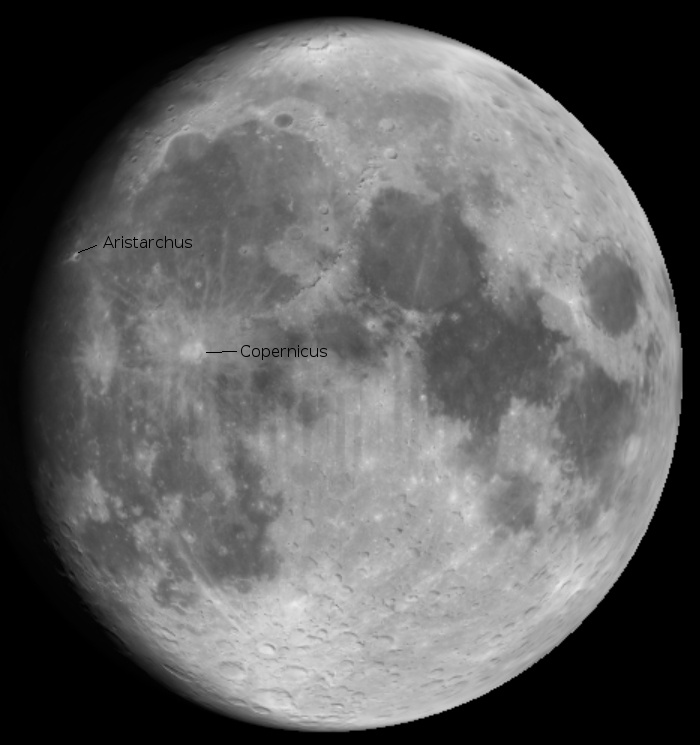
The Moon at 9 p.m. February 11, 2014 showing the craters Aristarchus and Copernicus. Created using Virtual Moon Atlas.
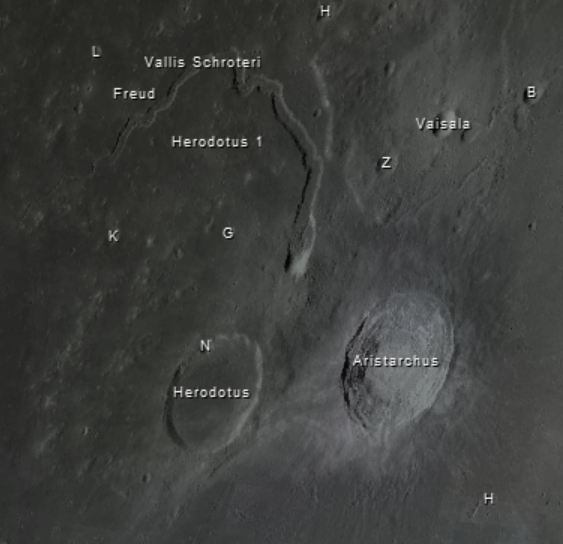
The crater Aristarchus and its environs via the Lunar Reconnaissance Orbiter as a texture in the Virtual Moon Atlas. Credit NASA.
Note the valley that borders Aristarchus, Vallis Schroteri, or Schroter’s Valley. It’s head is called the Cobra’s Head. It is up to a kilometer or 3,000 feet deep.
02/10/2014 – Ephemeris – Jupiter will appear near the Moon tonight
Ephemeris for Monday, February 10th. The sun will rise at 7:49. It’ll be up for 10 hours and 14 minutes, setting at 6:04. The Moon, half way from first quarter to full, will set at 5:28 tomorrow morning.
The planet Jupiter will appear above the moon tonight. At 9 p.m. Jupiter will be 5 and a half degrees, or 11 moon widths above the Moon. It will only get a little closer as the night progresses. The Moon will pass below Jupiter from our vantage point. In binoculars or a telescope the planets satellites can be seen spread out around the planet. Some of us amateur astronomers with pretty good-sized telescopes still can see only the same 4 moons that Galileo saw in 1610. The count of the Jovian satellites is up to something like 67, but these are small bodies Jupiter picked up from the outer part of the asteroid belt. Many of these are in retrograde of backward orbits, a sure sign of capture.
Times are for the Traverse City/Interlochen area of Michigan. They may be different for your location.
Addendum
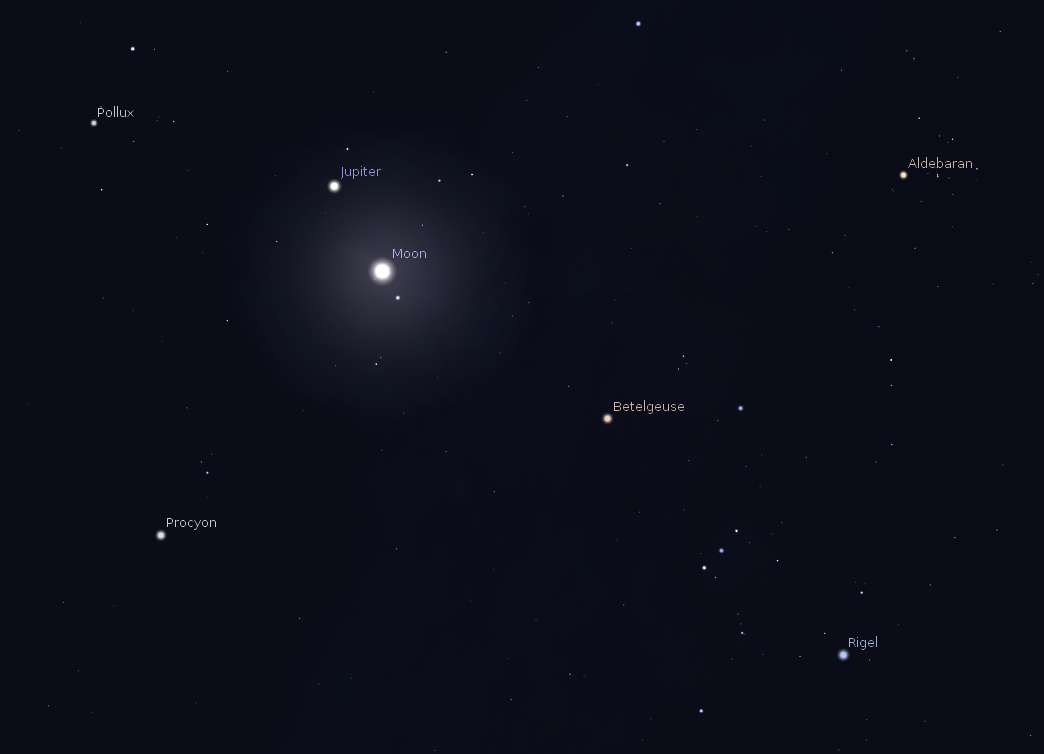
The Moon and Jupiter at 9 p.m. on February 10, 2014. Created using Stellarium.
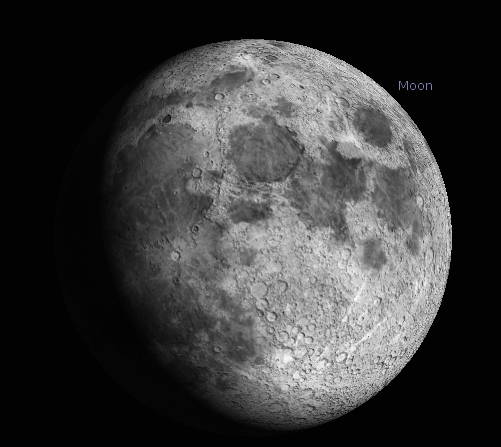
The Moon at 9 p.m. on February 10, 2014. Created using Stellarium.
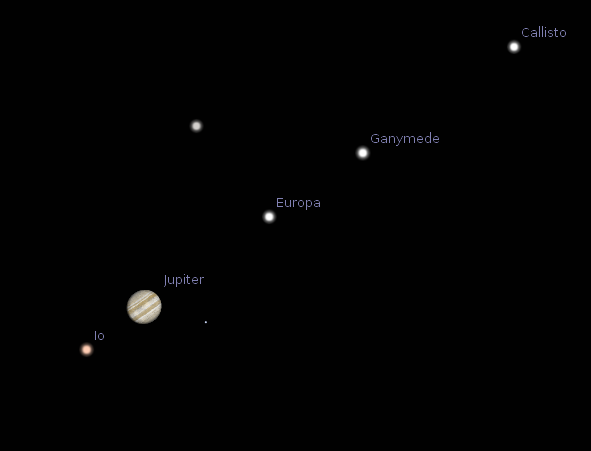
Jupiter at 9 p.m. on February 10, 2014. There’s quite a few interloper stars nearby. Created using Stellarium.
02/04/2014 – Ephemeris – Viewing the crescent moon tonight
Ephemeris for Tuesday, February 4th. The sun will rise at 7:57. It’ll be up for 9 hours and 57 minutes, setting at 5:55. The moon, 2 days before first quarter, will set at 12:05 tomorrow morning.
The Moon is now beginning to dominate the sky. In small telescopes one of my favorite craters is peeking into sunlight at the sunrise line, astronomers call it the terminator. This one is called Theophilus. Tonight it should be a ring of the circular ramparts lit by the sun as the evening progresses, in the center of which is the central peak just catching sunlight. Theophilus is at the edge of the small Sea of Nectar or Mare Nectaris. For those with small telescopes who want to learn more about how to use them the Grand Traverse Astronomical Society will host a Telescope Clinic at Northwestern Michigan College’s Rogers Observatory on Friday starting at 8 p.m. You can bring your telescope. It’s free, but for the star party the College requests a small donation.
Times are for the Traverse City/Interlochen area of Michigan. They may be different for your location.
Addendum
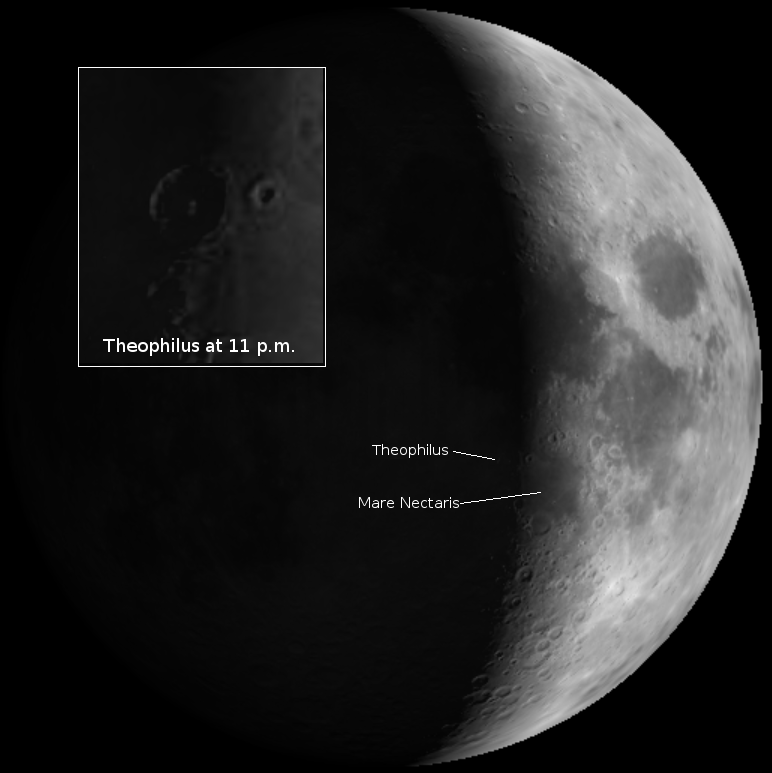
The Moon highlighting the crater Theophilus at 9 and 11 p.m. on February 4, 2014. Created using Virtual Moon Atlas.
02/03/2014 – Ephemeris – Why we don’t see unicorns anymore
Ephemeris for Monday, February 3rd. The sun will rise at 7:58. It’ll be up for 9 hours and 55 minutes, setting at 5:54. The moon, 3 days before first quarter, will set at 10:58 this evening.
Among all the constellations in the sky of animals real and mythical, there is also a unicorn. It’s called Monoceros, and inhabits the southern sky at 9 p.m. bounded by Orion on the right, Canis Major, the great dog below and Canis Minor, the little dog to the left. Unfortunately for observers without optical aid Monoceros, though large, is devoid of any but the faintest stars. Maybe that’s why no one sees unicorns anymore. It has many faint stars because the Milky Way runs through it. To the telescope it is a feast of faint nebulae or clouds of gas and dust, the birth place of stars, including the red rose of the Rosette Nebula, and the strange and tiny Hubble’s Variable Nebula. It contains no bright stars, but a wealth of wonders below the surface so to speak.
Times are for the Traverse City/Interlochen area of Michigan. They may be different for your location.
Addendum
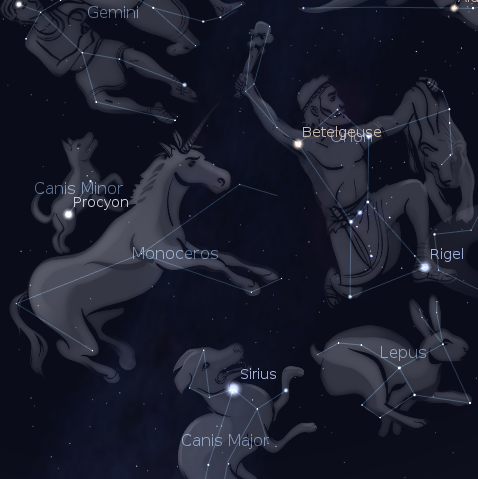
Moniceros the unicorn. See really, really dim stars. Created using Stellarium.
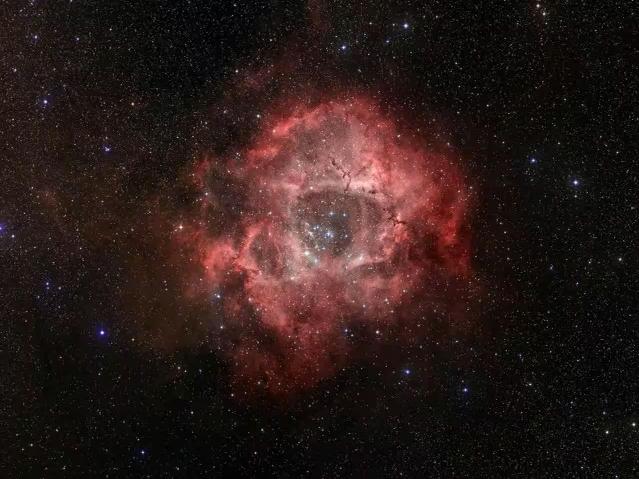
Rosette Nebula in the infrared from the Spitzer Space Telescope. Credit: NASA/JPL/Caltech
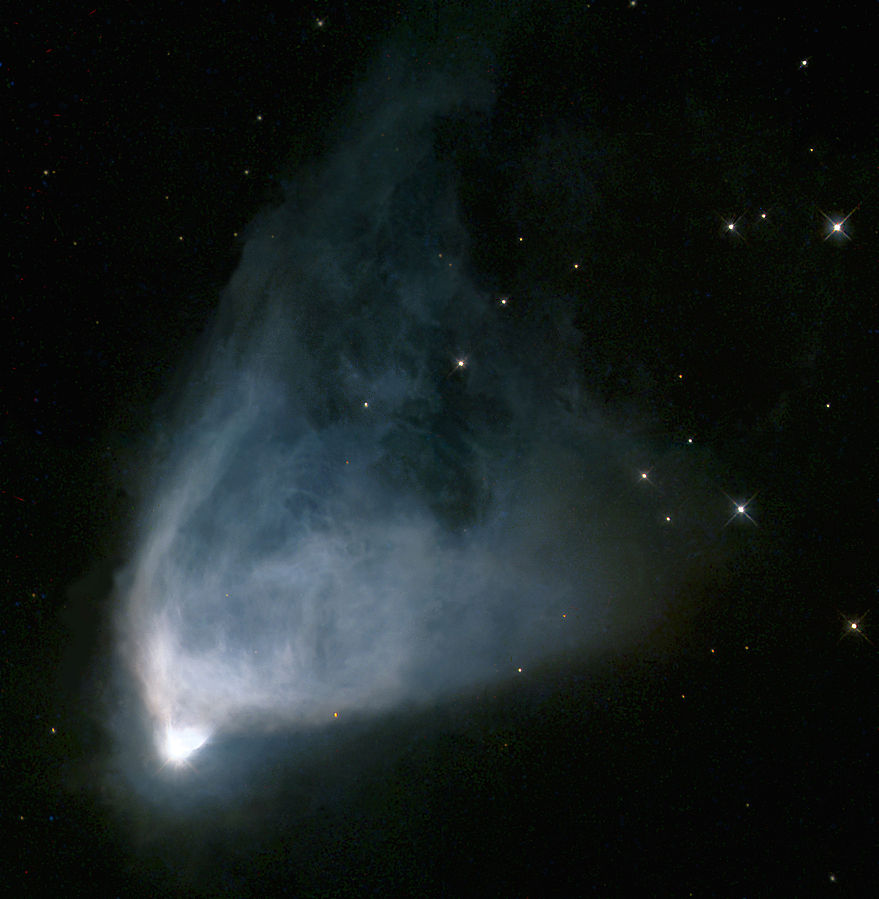
Hubble’s Variable Nebula photographed appropriately enough by the Hubble Space Telescope. Credit: NASA/ESA and The Hubble Heritage Team (AURA/STScI).

Another nebula: The Cone Nebula as seen with the Hubble Space Telescope. Credit ESA/Hubble
01/29/2014 – Ephemeris – We could spot all the 5 naked eye planets this week
Ephemeris for Wednesday, January 29th. The sun will rise at 8:04. It’ll be up for 9 hours and 42 minutes, setting at 5:47. The moon, 1 day before new, will rise at 7:27 tomorrow morning.
Let’s take our weekly look at the planets. Tiny Mercury is 3 days from its greatest eastern elongation low in the west-southwest between sunset and 7:22, when it sets. After that Jupiter takes over the evening sky. It will be in the eastern sky as darkness falls tonight. It’s cruising against the stars of Gemini now. It will move southeast and pass due south at 10:59 p.m., and will set at 6:41 a.m. in the west-northwest. Mars will rise at 11:55 p.m. in the east-southeast. Reddish Mars is in Virgo now and above the bright star Spica. Saturn will rise at 2:32 a.m. in the east-southeast. It’s seen against Libra the scales this year. Venus will rise at 6:02 tomorrow morning, so it may become visible around 6:30 or so very low in the east-southeast.
Times are for the Traverse City/Interlochen area of Michigan. They may be different for your location.
Addendum
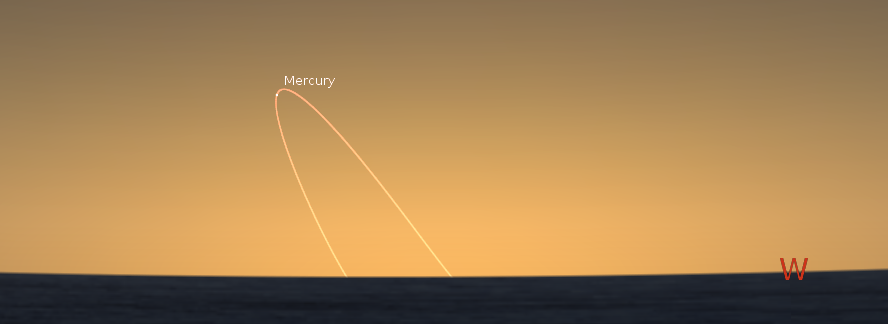
Mercury in the west southwest at 6:15 p.m. on January 29, 2014. Also displayed is Mercury’s orbit. It will reach the peak, its greatest eastern elongation from the Sun on Friday. Created using Stellarium.
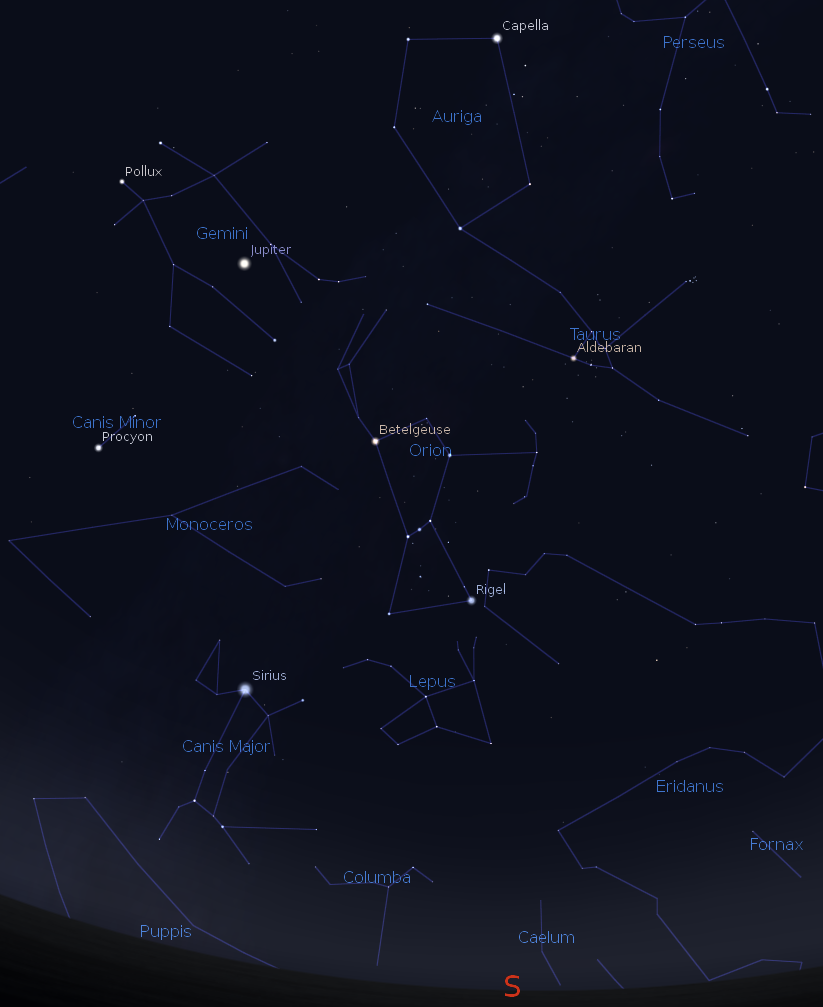
Jupiter with the winter constellations at 9 p.m. on January 29, 2014. Created using Stellarium.
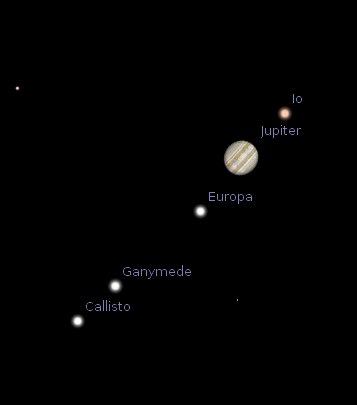
The telescopic Jupiter at 9 p.m. and January 29, 2014. Created using Stellarium.
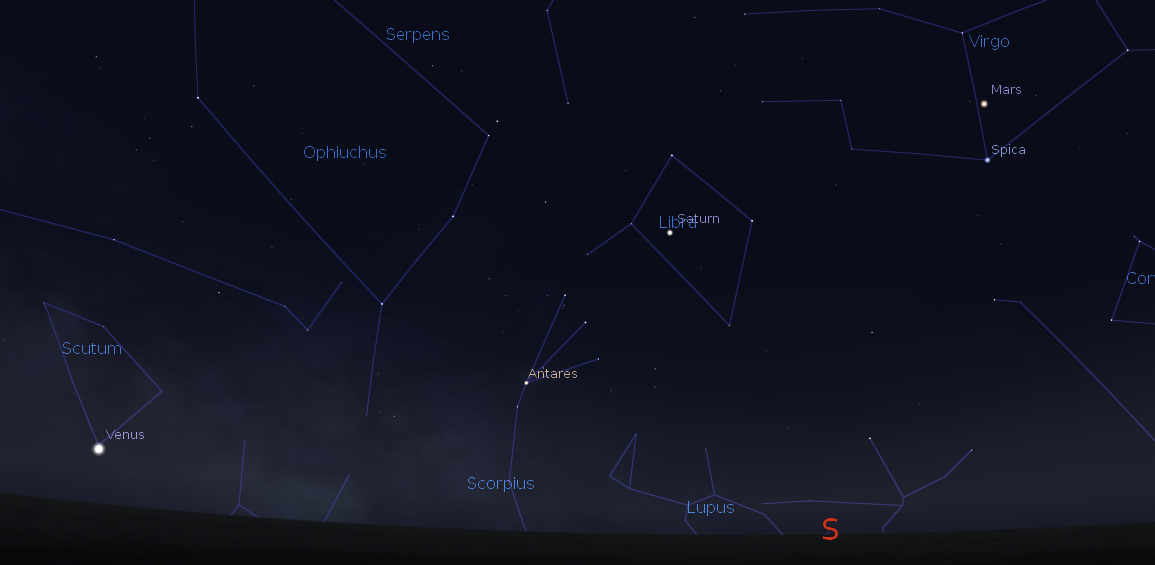
Mars, Saturn and Venus with the spring constellations at 6:30 a.m. on January 29, 2014. Created using Stellarium.
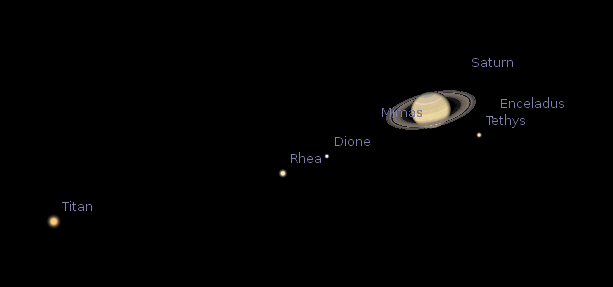
Saturn and its moons at 6:30, January 30, 2014. Of the moons, Titan will be the only one visible in small telescopes. Created using Stellarium.
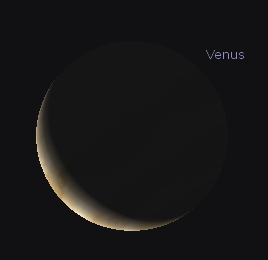
Venus as seen in a telescope at 7 a.m. on January 30, 2014. Created using Stellarium.
01/28/2014 – Ephemeris – A supernova found in a nearby galaxy
Ephemeris for Tuesday, January 28th. The sun will rise at 8:05. It’ll be up for 9 hours and 40 minutes, setting at 5:45. The moon, 2 days before new, will rise at 6:40 tomorrow morning.
There is a new supernova in our skies. It’s designation is SN 2014J and it’s pretty close as the things go, but not in our galaxy. It’s in another galaxy M82 off the front of the bowl of the Big Dipper, and 12 million light years away. It’s the closest supernova since supernova 1987A, which appeared on the last days of February 1987 in a companion galaxy to us the Large Magellanic Cloud. While the latter was visible to the naked eye, this will stay a binocular object at best. I’ll have a finder chart and more information in bobmoler.wordpress.org for those that may need it. This is a special type of supernova that’s used for distance measurement in the universe called a type 1a and this will be a good time to fine tune the calibration.
Times are for the Traverse City/Interlochen area of Michigan. They may be different for your location.
Addendum
Links to more discussion of the new supernova and type 1a supernovae in general.
Finder Charts
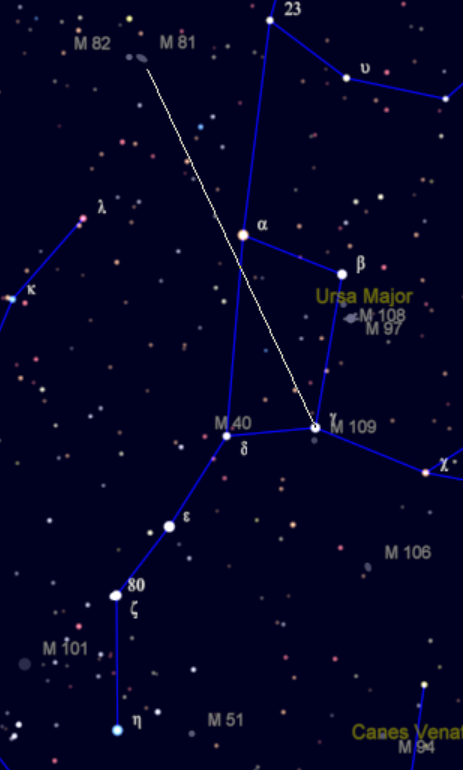
Finder Chart for M82 and M81. Actual time is 9 p.m. on January 28, 2014. Created using Cartes du Ciel (Sky Charts)
Pointer to M81 and M82 is a line diagonally through the bowl of the Big Dipper from the star Phad γ (gamma) Ursa Majoris through Dubhe α (alpha) Ursa Majoris. Note that the Big Dipper is not an official constellation but part of Ursa Major, the Great Bear.
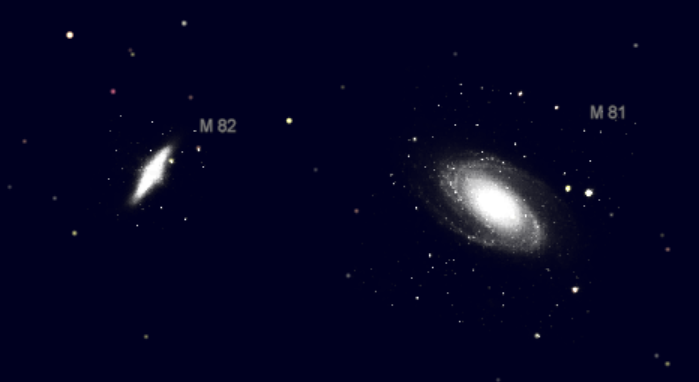
M82 and M81 as seen close up. Note the spiral arms of M81 are invisible visually. Created using Cartes du Ciel (Sky Charts).
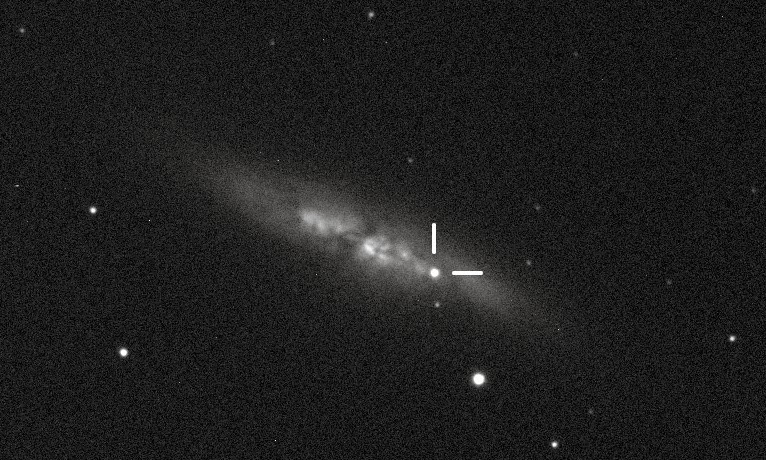
Discovery image of SN 2014J. Credit: UCL/University of London Observatory/Steve Fossey/Ben Cooke/Guy Pollack/Matthew Wilde/Thomas Wright.

