Archive
02/25/2022 – Ephemeris – The star that’s called the Pup
This is Ephemeris for Friday, February 25th. Today the Sun will be up for 10 hours and 58 minutes, setting at 6:25, and it will rise tomorrow at 7:25. The Moon, 2 days past last quarter, will rise at 5:04 tomorrow morning.
Sirius is the brightest nighttime star and is located in the south at 9 p.m. below and a bit left of Orion the Hunter. We’ve visited Sirius last Friday. But there is another star in the Sirius system that is practically invisible due to Sirius’ dazzling glare. Its name is Sirius B, nicknamed the Pup, alluding to Sirius’ Dog Star title as the heart of Canis Major, Orion’s larger hunting dog. The tiny star was suspected as far back as 1834 due to Sirius’ wavy path in the sky against the more distant stars. Sirius and the Pup have 50-year orbits of each other. The Pup was first seen by famed 19th century telescope maker Alvan Clark in 1862 while testing a new telescope. The Pup was the first of a new class of stars to be discovered, white dwarfs. The Pup, with the mass of the Sun, is packed into the volume of the Earth.
The astronomical event times given are for the Traverse City/Interlochen area of Michigan (EST, UT – 5 hours). They may be different for your location.
Addendum
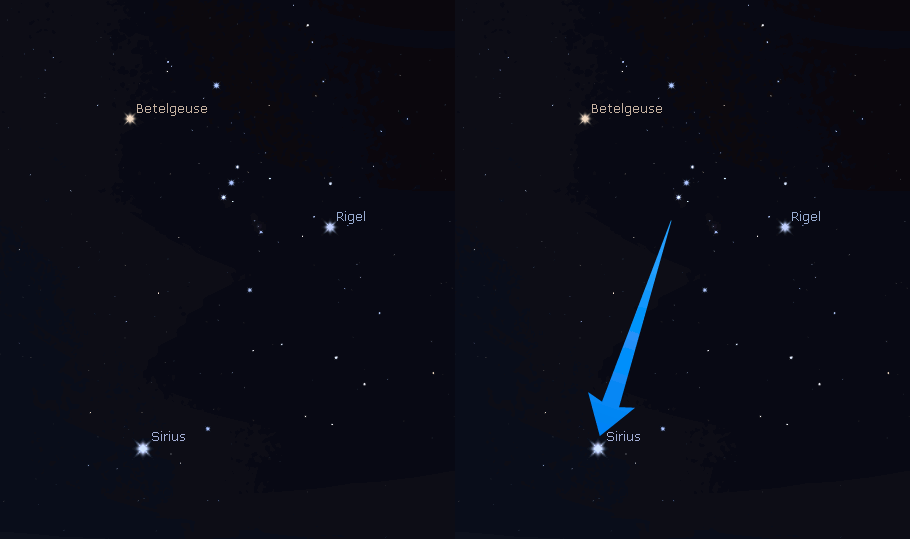
A Sirius finder animation for late January/early February at around 8 pm. Even in bright moonlight, the seven bright stars of Orion can be seen. The three stars of Orion’s belt make a great pointer to Sirius. Created using Stellarium, GIMP and Libreoffice (for the arrow).
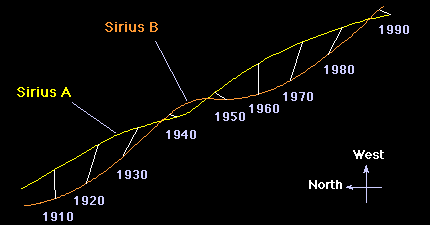
Sirius A & B’s path in the sky, showing the wobble that betrayed the Pup’s presence. Credit Mike Guidry, University of Tennessee.
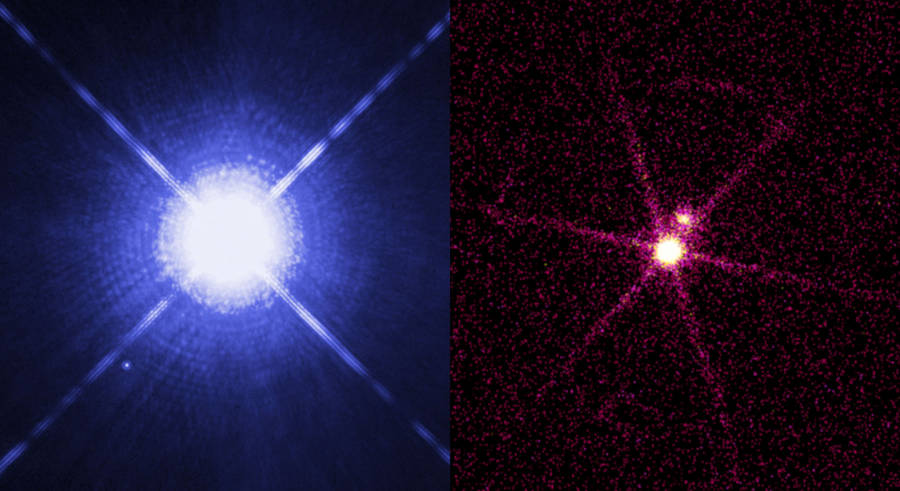
Sirius A and B imaged by two different space telescopes, revealing dramatically different views! Hubble’s image (left) shows Sirius A shining brightly in visible light, with diminutive Sirius B a tiny dot. However, in Chandra’s image (right) tiny Sirius B is dramatically brighter in X-rays! The “Universe in a Different Light” activity highlights more surprising views of some familiar objects: http://bit.ly/different-light-nsn NASA, ESA, H. Bond (STScI), and M. Barstow (University of Leicester) (left); NASA/SAO/CXC (right)
02/18/2022 – Ephemeris – Sirius, the brightest nighttime star
This is Ephemeris for Friday, February 18th. Today the Sun will be up for 10 hours and 37 minutes, setting at 6:15, and it will rise tomorrow at 7:36. The Moon, 2 days past full, will rise at 8:32 this evening.
In the evening, the great constellation of Orion the hunter can be seen in the south. Its large rectangle of bright stars is easily visible, even with a full moon. The three stars in a straight line, his belt, tilt downward to the left to a very bright star merrily twinkling lower in the sky. This star is called Sirius, also known as the Dog Star because it’s in the heart of Orion’s larger hunting dog, Canis Major. It is an arc light white star as seen in binoculars or telescope. It is the brightest star in the night sky, and a neighboring star, just twice the distance of the closest star to the Sun at 8.6 light years. It’s name, Sirius, has nothing to do with a dog, but is from the Greek meaning scorching for its brightness or sparkling, due to its intense twinkling.
The astronomical event times given are for the Traverse City/Interlochen area of Michigan (EST, UT – 5 hours). They may be different for your location.
Addendum
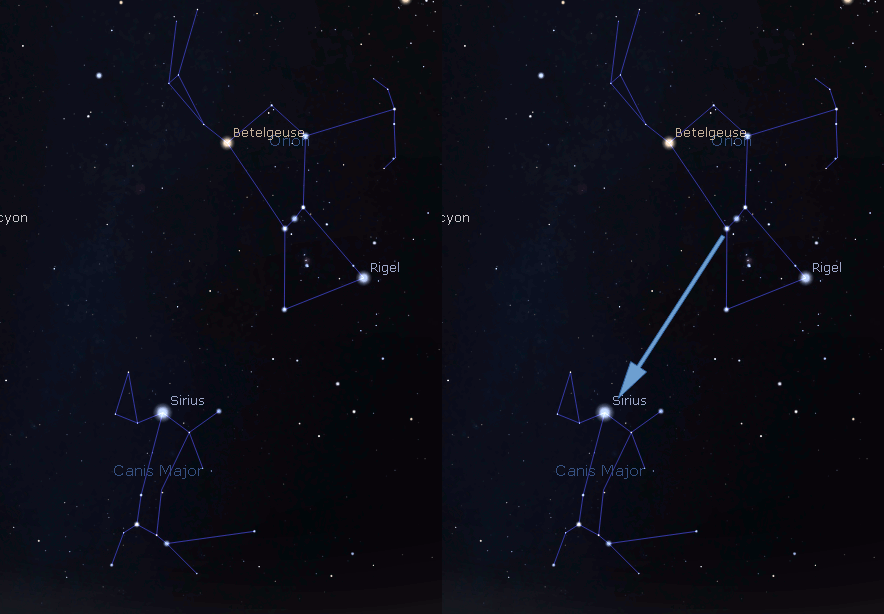
In the southern sky, Orion’s belt points to Sirius. Created using Stellarium, Libreoffice and GIMP.
01/31/2022 – Ephemeris – The winter circle of bright stars
This is Ephemeris for Monday, January 31st. Today the Sun will be up for 9 hours and 47 minutes, setting at 5:50, and it will rise tomorrow at 8:01. The Moon, 1 day before new, will rise at 8:48 tomorrow morning.
The winter skies are blessed with more first magnitude stars than any other season. Six of these stars lie in a large circle centered on the seventh, It’s called the Winter Circle. This circle is up in the evening. Starting high overhead is yellow Capella in Auriga the charioteer. Moving down clockwise is orange Aldebaran in the face of Taurus the Bull. Then down to Orion’s knee, we find blue-white Rigel. Down and left is the brightest star of all the brilliant white Sirius the Dog Star in Canis Major, lowest of these stars in the south-southeast. Moving up and left is white Procyon in Canis Minor, Above Procyon is Pollux in Gemini, the twins. All these are not quite centered on Betelgeuse, the bright red star in Orion’s shoulder.
The astronomical event times given are for the Traverse City/Interlochen area of Michigan (EST, UT – 5 hours). They may be different for your location.
Addendum
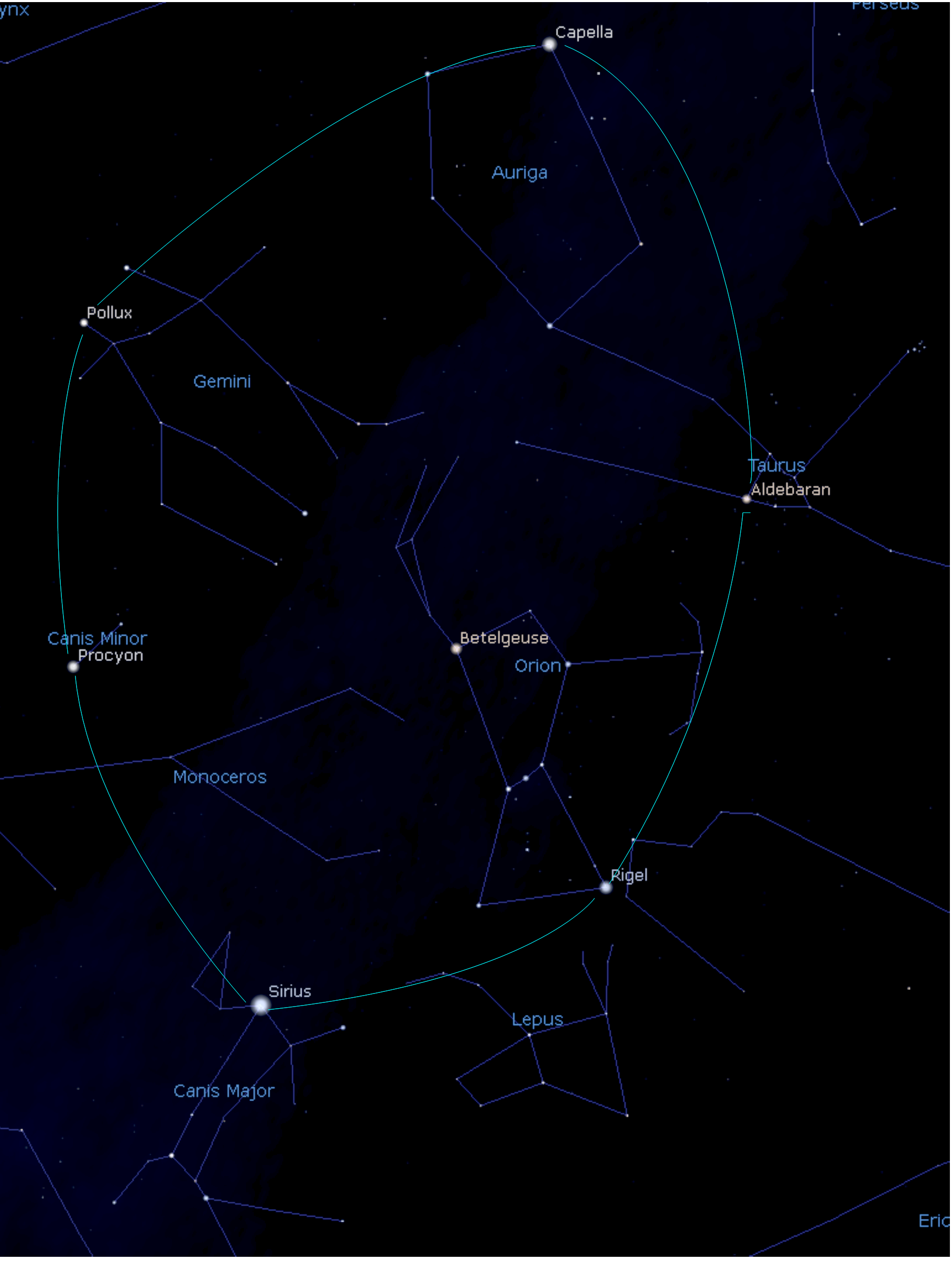
The bright stars of winter arrayed in a not so accurate circle. Some call it the Winter Hexagon. These stars are what make the winter sky so brilliant on the rare clear night in winter. Created using Stellarium.
10/28/2021 – Ephemeris – The spookiest star in the sky
This is Ephemeris for Thursday, October 28th. Today the Sun will be up for 10 hours and 21 minutes, setting at 6:36, and it will rise tomorrow at 8:17. The Moon, at last quarter today, will rise at 12:31 tomorrow morning.
We are getting down to the spookiest time of the year, with Halloween on Sunday, so it’s time to talk about the spookiest star in the sky, Algol the Ghoul or Demon Star. It’s in the constellation of Perseus the hero, now rising in the northeastern sky. The constellation itself looks like the Greek letter pi, or like the cartoon Roadrunner with its long legs. Algol is the second brightest star in the constellation, near the Roadrunner’s leading foot. That’s where the eye of the severed head of Medusa, that Perseus is carrying. It’s still winking, once every 2 days and 21 hours*. Tonight it will be in the deepest part of its wink at 8:43 pm. It will take about three hours to recover its usual brightness. I recall that the ancient Chinese weren’t fond of that star either.
The astronomical event times given are for the Traverse City/Interlochen area of Michigan (EDT, UT – 4 hours). They may be different for your location.
* More specifically, 2 days, 20 hours, 49 minutes on average and altered by Earth’s changing distance from the star due to its orbit of the Sun.
Addendum
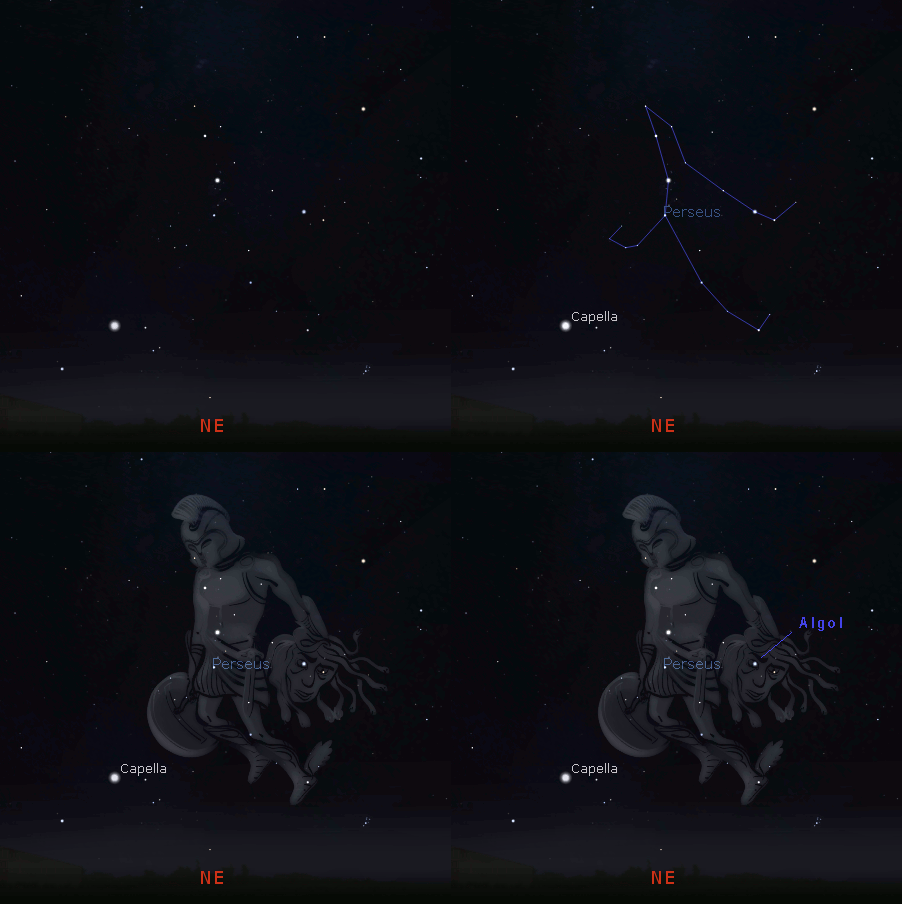
Algol Finder Animation for around 8 pm in the later part of October and early November (7 pm after the EST time change on the first Sunday in November). Created using Stellarium and GIMP.
Algol is an eclipsing binary star, where one star eclipses the other.

Animation of an eclipsing binary star like Algol. Credit: Wikimedia Commons h/t Earth and Sky
10/07/2021 – Ephemeris – The loneliest star in the sky
This is Bob Moler with Ephemeris for Thursday, October 7th. Today the Sun will be up for 11 hours and 23 minutes, setting at 7:11, and it will rise tomorrow at 7:49. The Moon, 1 day past new, will set at 8:06 this evening.
There’s a bright star that appears for only seven and a half hours on autumn nights. It’s appearance, low in the south-southeast at 9 p.m., is a clear indication of the autumn season. The star’s name is Fomalhaut, which means fish’s mouth. That’s fitting because it’s in the constellation of Piscis Austrinus, the southern fish. At our latitude it’s kind of the fish that got away, because Fomalhaut appears to be quite alone low in the sky. The dimness of the constellation’s other stars and location close to the horizon make the other stars hard to spot. The Earth’s thick atmosphere near the horizon reduces their brightness by a factor of two or more, so Fomalhaut, one of the brightest stars in the sky, keeps a lonely vigil in the south.
The astronomical event times given are for the Traverse City/Interlochen area of Michigan (EDT, UT-4 hours). They may be different for your location.
Addendum
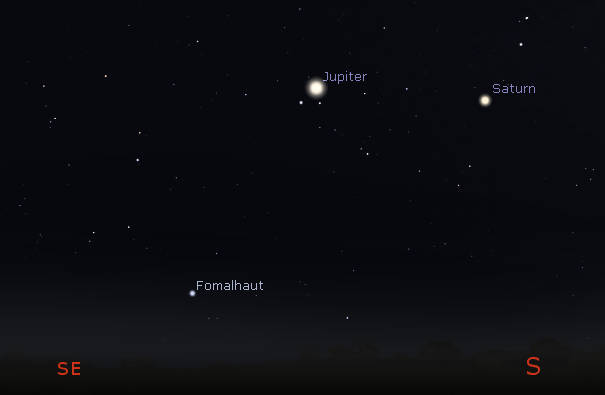
Fomalhaut at 9 pm, October 7, 2021. This year it has two bright planets relatively nearby, By they’re just passing through, albeit slowly. Normally the closest first magnitude star to Fomalhaut is Altair, the southernmost of the Summer Triangle stars. Created using Stellarium.
07/26/2021 – Ephemeris – Albireo, a colorful double star in Cygnus the swan
This is Ephemeris for Monday, July 26th. Today the Sun will be up for 14 hours and 52 minutes, setting at 9:15, and it will rise tomorrow at 6:23. The Moon, 3 days past full, will rise at 11:15 this evening.
Alberio is the name given to the star that is in the beak of the constellation of Cygnus the swan, which is high in the east these evenings. It is also at the foot of the asterism or informal constellation of the Northern Cross. To the naked eye Alberio looks like a single star, however even in small telescopes* its true nature is revealed. It is a double star whose individual star colors are strikingly different Its brightest star is yellow, and the dimmer star is blue. While star colors are subtle, these two, due to their apparent closeness, make an obvious color contrast. Unlike what your interior decorator says: In stars blue is hot, yellow, orange and red are cool. Also, it turns out that Alberio’s component stars don’t orbit each other. It is what is called an optical double. The blue star is a bit farther away than the yellow one, though they’re both around 430 light years away.
The astronomical event times given are for the Traverse City/Interlochen area of Michigan (EDT, UT – 4 hr). They may be different for your location.
* It will take at least about 20 power magnification to split. Binoculars won’t do it.
Addendum
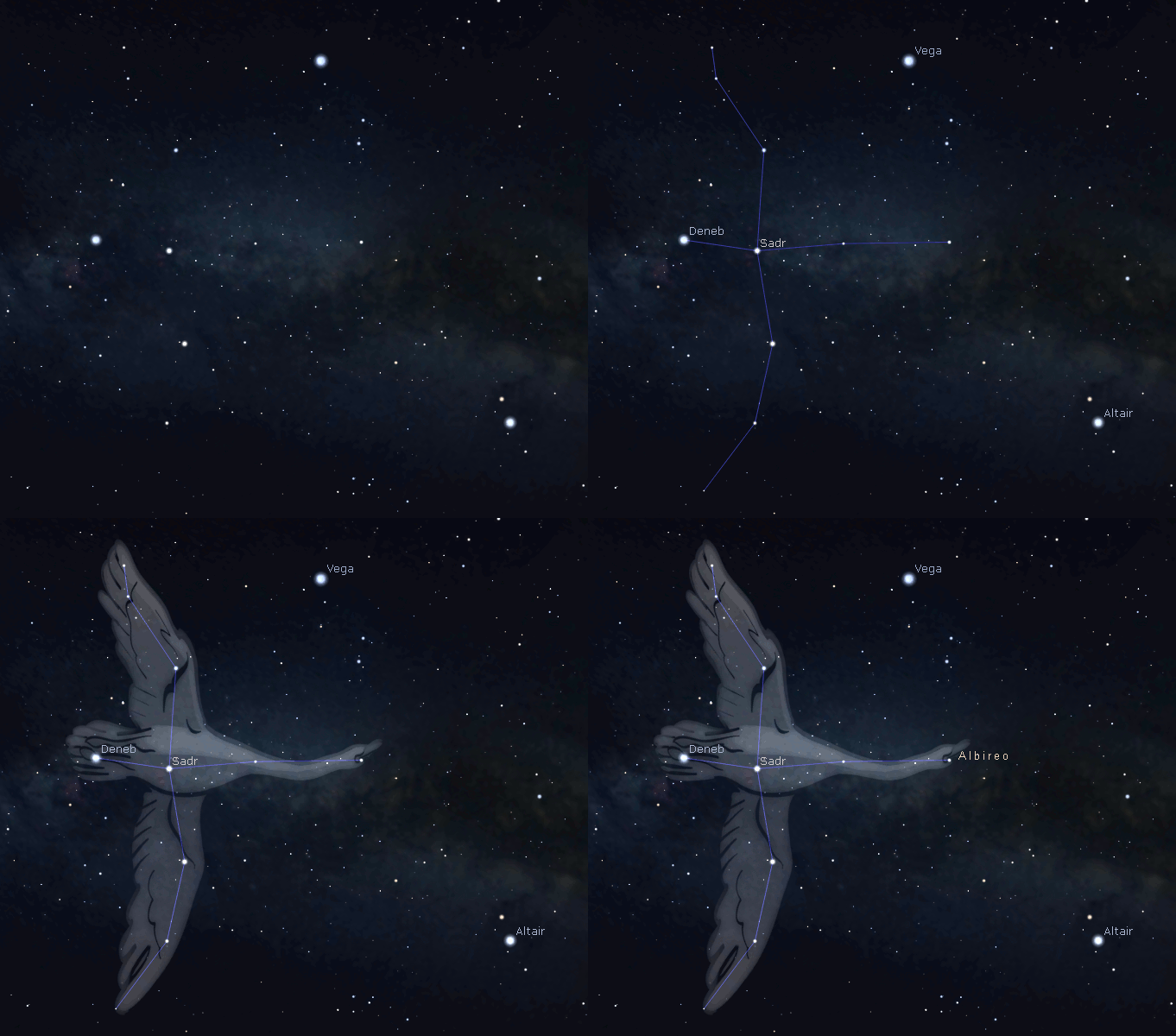
Animated Albireo finder chart. Albireo is located in the head of Cygnus the swan, or at the base of the Northern Cross. Tagged stars are, beside Albireo, the stars of the Summer Triangle: Deneb, Vega and Altair plus the star at the junction of the upright and crosspiece of the cross, Sadr. Created using Stellarium.

Albireo, captured at high magnification by the staff of the Smithsonian Institution.
06/29/2021 – Ephemeris – The Summer Triangle
This is Ephemeris for Tuesday, June 29th. Today the Sun will be up for 15 hours and 32 minutes, setting at 9:32, and it will rise tomorrow at 6:00. The Moon, 2 days before last quarter, will rise at 1:14 tomorrow morning.
Dominating the eastern sky at 11 pm are three bright stars. These are all first magnitude stars, members of the group of 21 brightest stars in the night sky. Highest, in the east, is Vega, the brightest of the three. It and a small, slim parallelogram of stars below it belong to the constellation of Lyra the harp. Below it to the northeast is Deneb, dimmest of the three at the head of the horizontally appearing Northern Cross, an informal constellation or asterism. Properly, Deneb is in the tail of Cygnus the swan flying south through the Milky Way. The third star of the three is Altair, lower still, but in the east-southeast at the head of Aquila the Eagle. These three stars are in a large asterism called the Summer Triangle, which will be with us through summer and fall.
The astronomical event times given are for the Traverse City/Interlochen area of Michigan (EDT, UT-4). They may be different for your location.
Addendum

The Summer Triangle finder animation showing first the unlabeled sky, Then the Summer Triangle with the stars labeled, then the constellations of those stars. Click on the image to enlarge it. Created using Stellarium and GIMP.
06/03/2021 – Ephemeris – Arcturus in the Bible.
This is Ephemeris for Thursday, June 3rd. Today the Sun will be up for 15 hours and 23 minutes, setting at 9:23, and it will rise tomorrow at 5:58. The Moon, 1 day past last quarter, will rise at 3:30 tomorrow morning.
Arcturus is a bright orangish star that’s high in the south at 11 pm. It’s also found by following the arc of the handle of the Big Dipper, which is the ridiculous tail of Ursa Major the Great Bear. It was considered the “Guardian of the Bear”, It is in the base of the kite shaped constellation of Boötes, the herdsman or the Bear Chaser. The latter story I recounted earlier this year. The name from the Greek has been confused with the bear itself. Thus, in the King James version of the Bible Arcturus, not the Bear, meaning the Great Bear, is mentioned in the 38th chapter of Job. This has been corrected in the newer versions I’ve seen. Arcturus has a rich history in literature, mostly by being confused with the Great Bear.
The astronomical event times given are for the Traverse City/Interlochen area of Michigan. They may be different for your location.
Addendum
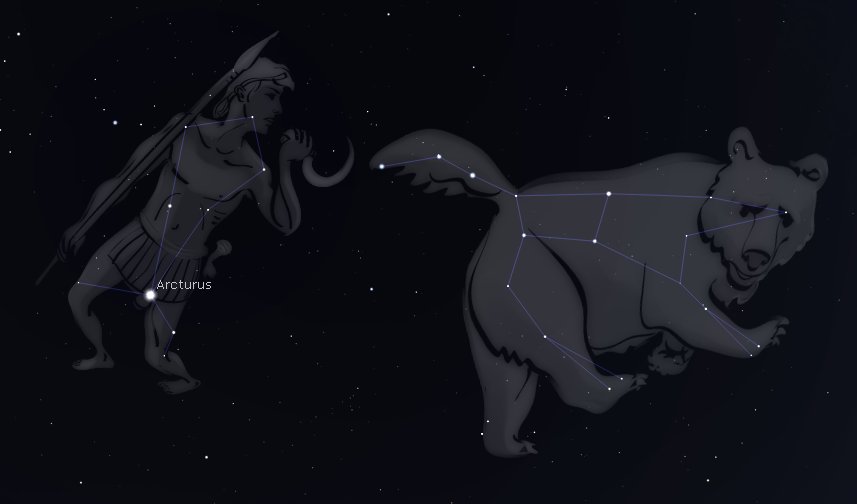
Arcturus, Boötes and Ursa Major can be seen by looking overhead while facing the west-southwest at 11 pm in early June. Created using Stellarium. Lines and figures not included.
Biblical translations
King James Version of Job 38:31-32
31 Canst thou bind the sweet influences of Pleiades,
   or loose the bands of Orion?

32 Canst thou bring forth Mazzaroth in his season?
   or canst thou guide Arcturus with his sons?
New International Version of Job 38:31-32
31
“Can you bind the chains of the Pleiades?
Can you loosen Orion’s belt?
32
Can you bring forth the constellations in their seasons
or lead out the Bear with its cubs?
No one is sure what a Mazzaroth is.
04/09/2021 – Ephemeris – Follow the arc to Arcturus
This is Bob Moler with Ephemeris for Friday, April 9th. Today the Sun will be up for 13 hours and 12 minutes, setting at 8:20, and it will rise tomorrow at 7:06. The Moon, 2 days before new, will rise at 6:57 tomorrow morning.
The fourth or fifth brightest night-time star, depending on whose list you see, is now up in the east in the evening. It is Arcturus, a bright star with an orange hue. It can be found otherwise by finding the Big Dipper and tracing out and extending the curve of the handle and “Follow the arc of the handle to Arcturus”, to remember the name of the star and how to find it. Arcturus is about 37 light years from us and is moving quite rapidly across the sky, compared to most stars, though one would not notice it to the naked eye in one’s lifetime. Arcturus is slightly more massive than our Sun, and about 7 billion years old, and is entering its red giant stage of life after using all the hydrogen fuel in its core. Our Sun, being slightly less massive will survive on hydrogen a bit longer.
The astronomical event times given are for the Traverse City/Interlochen area of Michigan. They may be different for your location.
Addendum
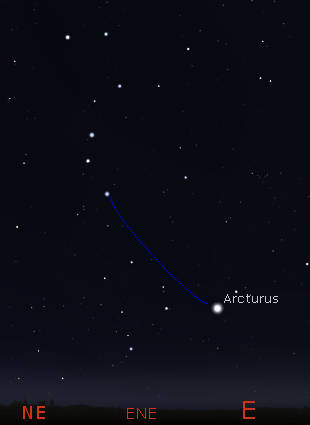
I’ll be talking more about Arcturus and the constellation it’s in Boötes the herdsman, a kite shaped constellation that’s currently laying on its side. He’s not herding, but chasing the Great Bear. But that’s another story.
03/11/2021 – Ephemeris – The Guardian of the Bear is rising
This is Ephemeris for Thursday, March 11th. Today the Sun will be up for 11 hours and 42 minutes, setting at 6:44, and it will rise tomorrow at 7:00. The Moon, 2 days before new, will rise at 7:09 tomorrow morning.
The brightest star of spring is Arcturus which will be visible by 9 pm low in the east-northeast. Arcturus can most famously be found by following the arc of the handle of the Big Dipper, which resides fairly high in the northeastern sky to it. “Follow the arc of the handle to Arcturus.” It’s the fourth or fifth brightest star in the sky, depending on the list. It was regarded as the “Guardian of the Bear”, meaning the Great Bear, Ursa Major, of which the Big Dipper is its hind end. Apparently it’s guarding its rear. Arcturus will stay in our evening sky until the end of summer and has a fascinating story of its own aside from its ancient mythology, which I’ll talk about when it’s higher in the sky. It’s located at the base of a kite shaped constellation called Boötes, which is now horizontal and too close to the horizon to be appreciated.
The astronomical event times given are for the Traverse City/Interlochen area of Michigan. They may be different for your location.
Addendum
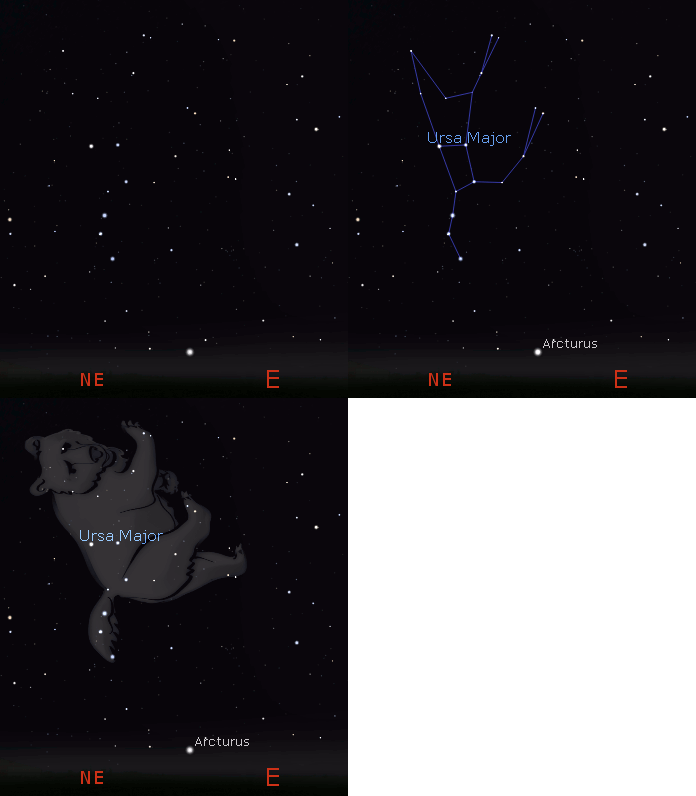
Arcturus rising finder animation for 9 pm tonight, March 11, 2021. Created using Stellarium and GIMP.
 Bob Moler's Ephemeris Blog