03/24/2021 – Ephemeris – Let’s search for the naked-eye planets for this week
This is Ephemeris for Wednesday, March 24th. Today the Sun will be up for 12 hours and 22 minutes, setting at 8:00, and it will rise tomorrow at 7:36. The Moon, 3 days past first quarter, will set at 6:26 tomorrow morning.
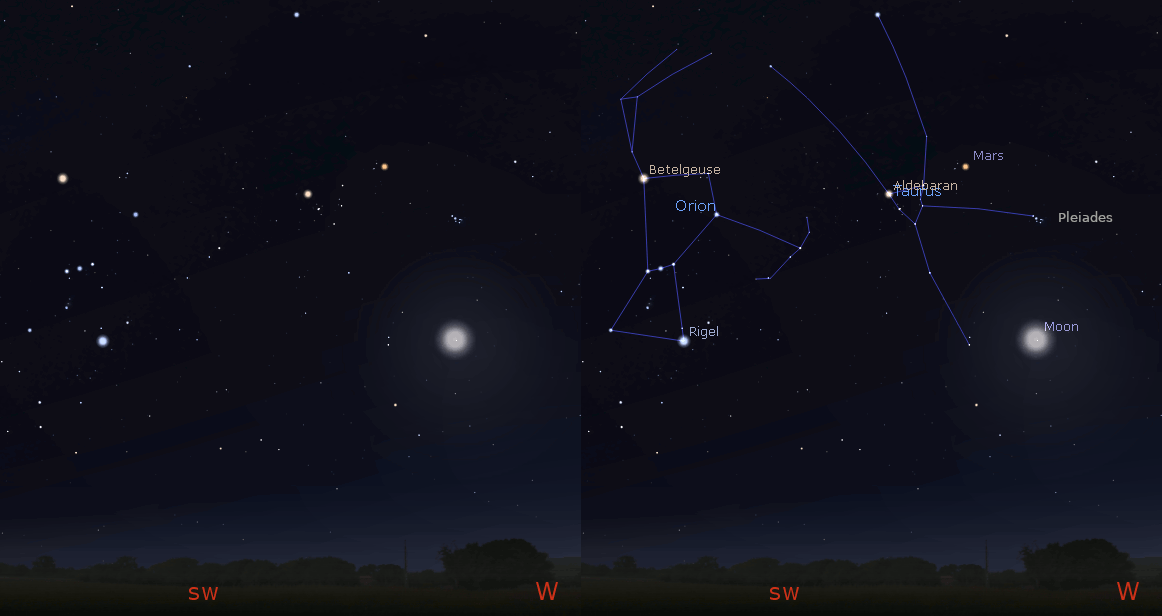
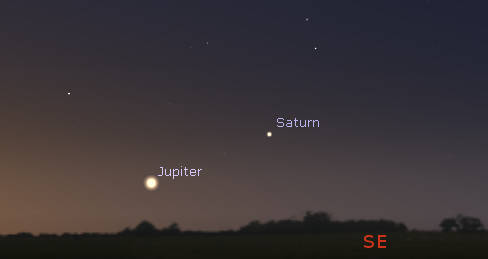
Let’s search for the naked-eye planets for this week. Unfortunately the only one you’ll find in the evening is Mars. It can be found high in the west-southwest at 9 pm tonight, above the orange star Aldebaran in the face of Taurus the bull, between it and the much higher star Capella in the west northwest. Mars will set at 2:01 am. Right now three of the other four naked eye planets are just west of the Sun in the Morning sky. Venus is now below and just a bit west of the Sun. Only Saturn and Jupiter are at a far enough angle from the Sun to be just spotted in the morning twilight. Saturn will rise at 5:35 am, with Jupiter rising a half hour later. By 7 am they will be low in the southeast.
The astronomical event times given are for the Traverse City/Interlochen area of Michigan. They may be different for your location.
Addendum
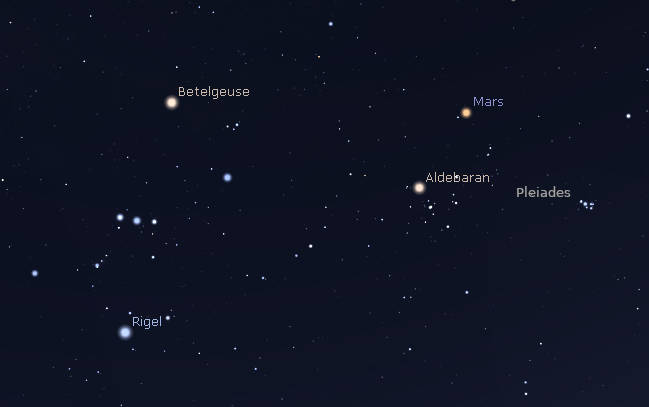
Mars appears above Aldebaran and the letter V of stars of the Hyades which is the face of Taurus the bull tonight March 24, 2021. This image is for 9 pm. or about an hour after sunset. Created using Stellarium.
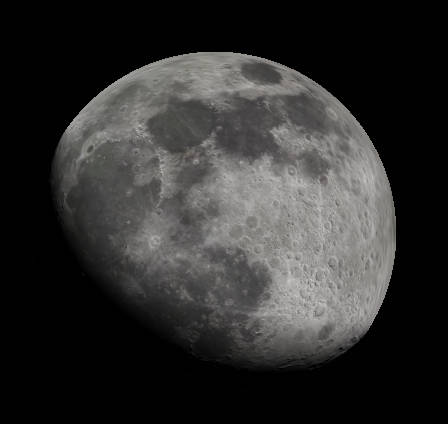
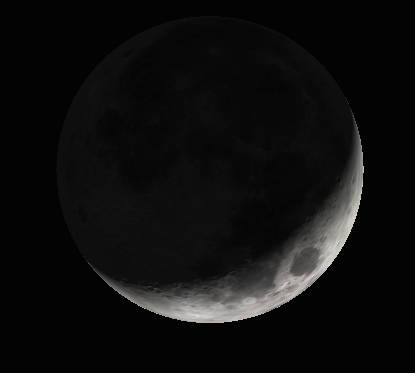
The waxing gibbous Moon as it might be seen in binoculars tonight at 9 pm, March 24, 2021. Created using Stellarium.
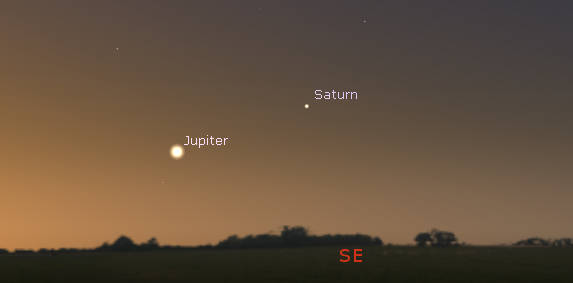
Jupiter and Saturn low in the southeast at 7 am tomorrow morning, March 25, 2021. Note that they will probably appear dimmer than shown. Created using Stellarium.
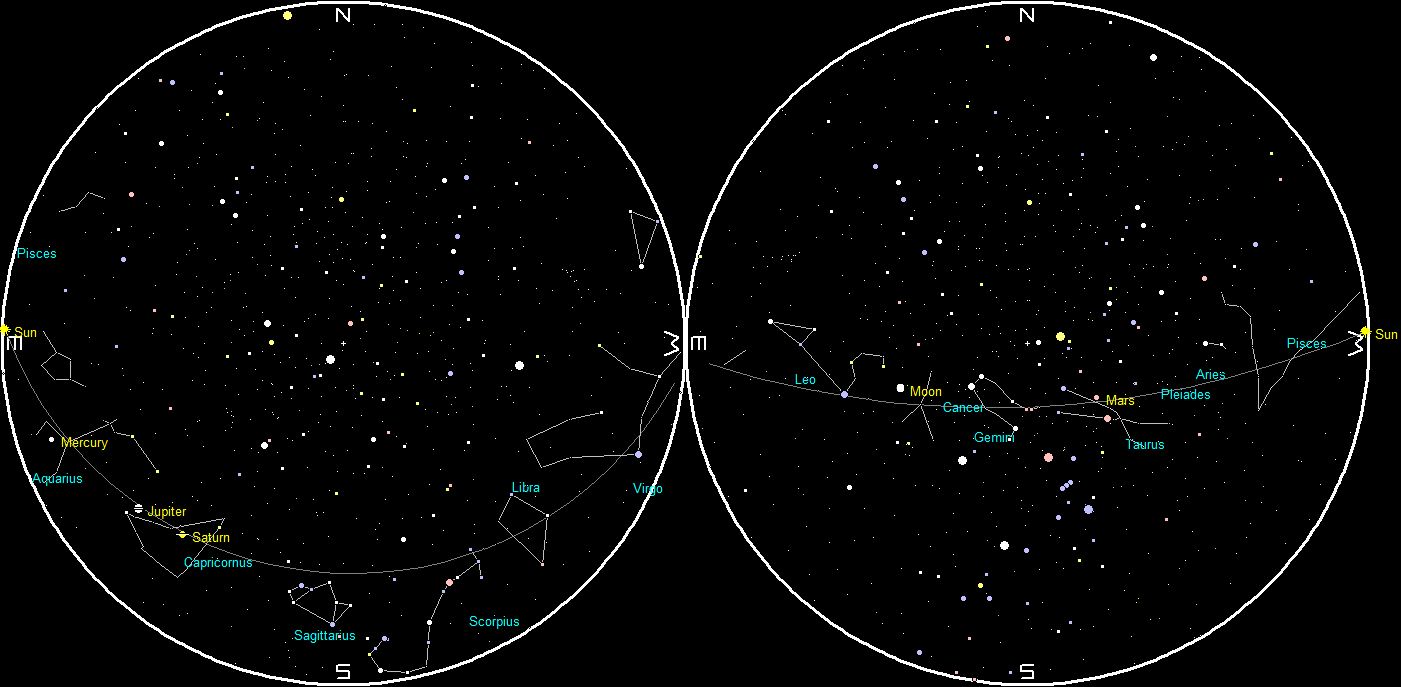
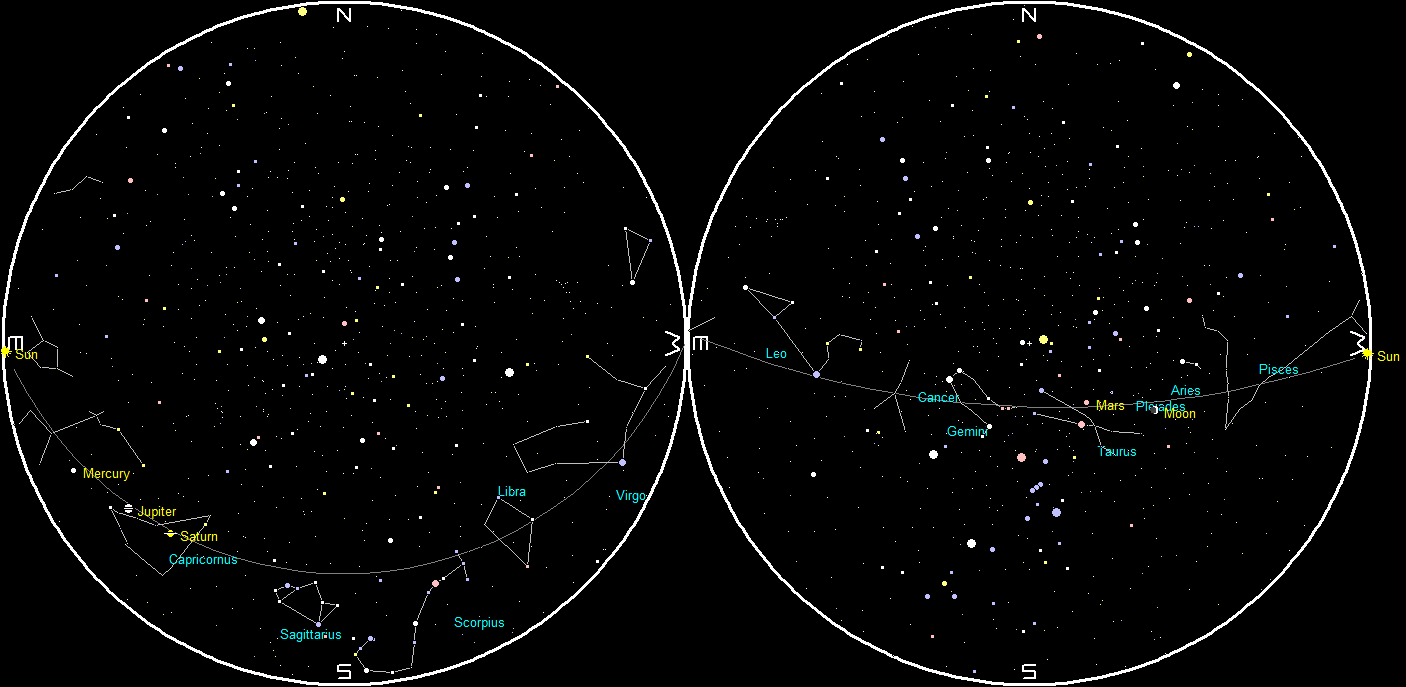
Planets and the Moon at sunset and sunrise of a single night starting with sunset on the right on March 24, 2021. The night ends on the left with sunrise on the 25th. Venus is too close and south of the Sun to be plotted. Click on the image to enlarge. Created using my LookingUp program.
03/23/2021 – Ephemeris – The Moon tonight: Bay of Rainbows
This is Bob Moler with Ephemeris for Tuesday, March 23rd. Today the Sun will be up for 12 hours and 19 minutes, setting at 7:59, and it will rise tomorrow at 7:37. The Moon, 2 days past first quarter, will set at 5:50 tomorrow morning.
A look at the Moon tonight will reveal that the sunrise line, or terminator has almost completely revealed the large Sea of Showers or Mare Imbrium to the upper left of the center of the gibbous disk. At the extreme upper left nearly completely in sunlight a very popular feature, the Bay of Rainbows or Sinus Iridium. It’s a colorful name for something that’s as gray as the rest of the Moon. It looks like a bay off of Imbrium, and has an arch like a rainbow. Its arch is the Jura Mountains, which jut into Mare Imbrium at Cape Heraclide, just catching sunlight, and Cape Laplace farther into morning. What’s cool is catching it as the sunlight is hitting the mountains while the convex floor, following the Moon’s curvature is only partially illuminated.
The astronomical event times given are for the Traverse City/Interlochen area of Michigan. They may be different for your location.
Addendum
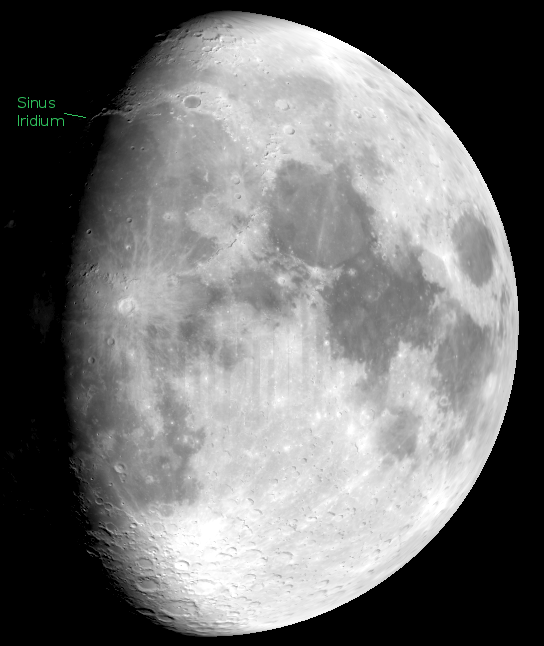
The Moon a little before how it will appear tonight highlighting Sinus Iridium. By tonight the floor of Sinus Iridium should be pretty much sunlit, and the Jura mountains completely lit. Created using Virtual Moon Atlas.
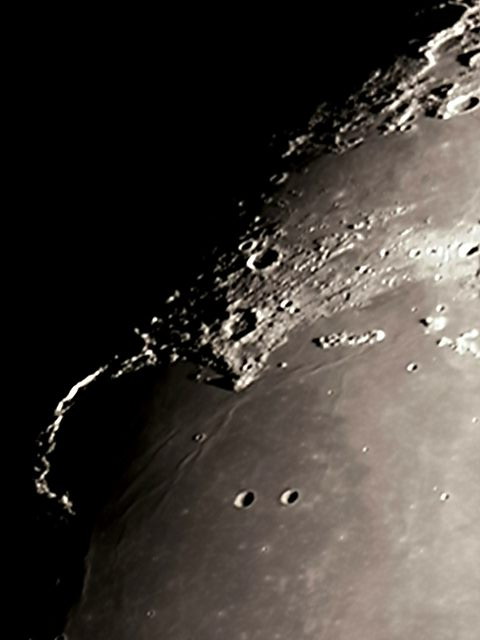
Sinus Iridium at sunrise. Photo by “Seb2003” on http://forums.futura-sciences.com/materiel-astronomique-photos-damateurs/5809-images-de-lune.html.
03/22/2021 – Ephemeris – The Moon and the week
This is Bob Moler with Ephemeris for Monday, March 22nd. Today the Sun will be up for 12 hours and 16 minutes, setting at 7:58, and it will rise tomorrow at 7:39. The Moon, 1 day past first quarter, will set at 5:08 tomorrow morning.
The Moon tonight is about as far north in the sky as it gets this month, and being six days before full, and this full Moon is the first full moon of spring, that means Easter is less than two weeks away. Did you notice that a week is nearly equal to a quarter of the Moon’s orbit of the Earth? If you look at a calendar that has the Moon’s phases on it the phases are 7 or 8 days apart. It’s a good thing that no one decided to adjust the length of the week to accommodate the Moon’s phases. It’d be hard to plan your weekend. Our calendar is pretty screwed up as it is with months of 28, 29, 30 and 31 days all set by politicians… Roman politicians at that. I haven’t heard much about calendar reform lately, so I guess we’re stuck with it.
The astronomical event times given are for the Traverse City/Interlochen area of Michigan. They may be different for your location.
Addendum
I wrote the above before actually checking out the historical origin of the time period we call a week. It turns out that the week is really related to a quarter of a lunation or lunar month. The Babylonians fixed the fact that seven days is a bit less than a quarter of a lunation by adding a day or two to the last week of the month, so the next month’s new moon started on the same day of the week.
Here the new moon is defined as the first appearance of the Moon in the evening sky after disappearing from the morning sky. We currently define the new moon as the Moon’s solar conjunction. Its first appearance in the evening sky would generally be the next day, or rather evening. The numbering still works out. Our new moon is day zero of the lunar month.
03/19/2021 – Ephemeris – Enjoy this last full day of winter!
This is Ephemeris for Friday, March 19th. Today the Sun will be up for 12 hours and 7 minutes, setting at 7:54, and it will rise tomorrow at 7:45. The Moon, 2 days before first quarter, will set at 2:23 tomorrow morning.
Spring is almost here. It will arrive at 5:37 tomorrow morning, so this is the last full day of winter, such as it was. That point in time and the point in the sky where the Sun crosses the celestial equator, the imaginary line in the sky above the Earth’s equator, heading northward is called the vernal equinox. Vernal means spring and equinox means equal night, meaning that day and night are equal, which they actually were last Tuesday. Since western civilization has spread south of the equator where the seasons are reversed, our Northern Hemisphere spring equinox is the Southern Hemisphere’s autumnal equinox, so to be understandable to both hemispheres we generally say March or September equinox instead.
Addendum
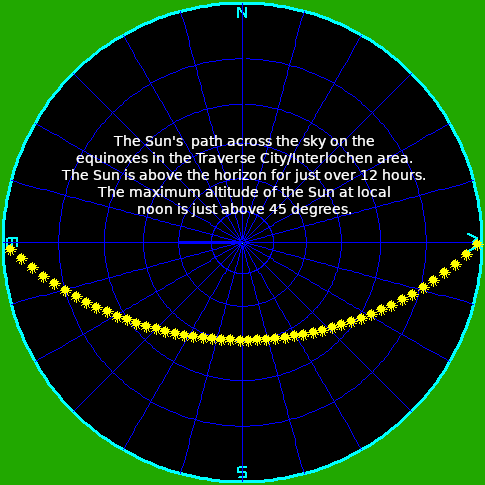
The Sun’s path through the sky on an equinox day from the Traverse City/Interlochen area in Michigan. The Sun is plotted every 15 minutes. This is a stereographic projection which compresses the sky near the zenith and enlarges the sky toward the horizon. Created using my LookingUp program.
03/18/2021 – Ephemeris – The aging Hubble Space Telescope survived its latest glitch
This is Bob Moler with Ephemeris for Thursday, March 18th. Today the Sun will be up for 12 hours and 4 minutes, setting at 7:53, and it will rise tomorrow at 7:47. The Moon, 3 days before first quarter, will set at 1:21 tomorrow morning.
On Sunday the 7th the Hubble Space Telescope, arguably the most famous telescope there is entered safe mode. Whenever a spacecraft finds an unexpected problem it stops what it is doing, orients itself, so its solar panels face the Sun if it can. It may or may not phone home. And waits for instructions. The last time Hubble experienced a glitch that forced a safe mode was 2018. Then it took 3 weeks to get it back to normal operations. This time it was 4 days. However, the ground controllers are still checking out one of its cameras, while the others are working again. Hubble is over 30 years old. It’s replacement, the James Webb Space Telescope is expected to finally be launched this October on the European Space Agency’s Ariane 5 rocket.
The astronomical event times given are for the Traverse City/Interlochen area of Michigan. They may be different for your location.
Addendum

The Hubble Space Telescope after a servicing mission. Credit: NASA.
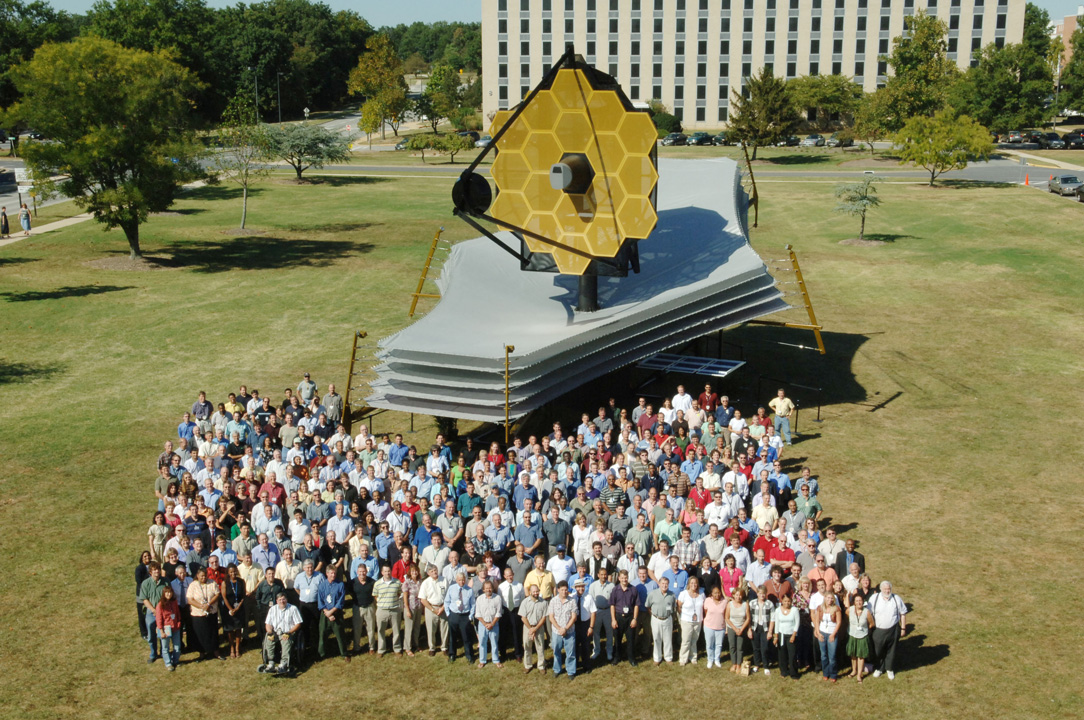
Full scale model of the James Webb Space Telescope at Goddard Space Flight Center. Note its scale with the people in front of it.
I’ll be covering the James Webb Space Telescope in more detail as we count down to its launch.
03/17/2021 – Ephemeris – Let’s search for the naked-eye planets for this week
This is Ephemeris for St. Patrick’s Day, Wednesday, March 17th. Today the Sun will be up for 12 hours and one minute, setting at 7:51, and it will rise tomorrow at 7:49. The Moon, halfway from new to first quarter, will set at 12:18 tomorrow morning.
Let’s search for the naked-eye planets for this week. Unfortunately the only one you’ll find in the evening is Mars. It can be found high in the west-southwest at 9 pm tonight, above a line between the Pleiades star cluster on its lower right and the letter V of stars that is the face of Taurus the bull on its lower left. The Pleiades will be above tonight’s waxing crescent Moon. Mars will set at 2:07 am.
Right now the other four naked eye planets are just west of the Sun in the Morning sky. But only Saturn and Jupiter are at a far enough angle from the Sun to be just be glimpsed in the morning sky. Saturn will rise at 6 am, with Jupiter a half hour later. By 7 am they will be low in the southeast.
The astronomical event times given are for the Traverse City/Interlochen area of Michigan. They may be different for your location.
Addendum
Mars finder animation for 9 pm, or about 70 minutes after sunset, tonight March 17, 2021. Created using Stellarium and GIMP.
The Moon as it might appear tonight, March 17, 2021, in binoculars or a small telescope. Created using Stellarium.
Jupiter and Saturn tomorrow morning at 7 am, March 18, 2021. Created by using Stellarium.
Planets and the Moon at sunset and sunrise of a single night starting with sunset on the right on March 17, 2021. The night ends on the left with sunrise on the 18th. Venus is too close and south of the Sun to be plotted. Click on the image to enlarge. Created using my LookingUp program.
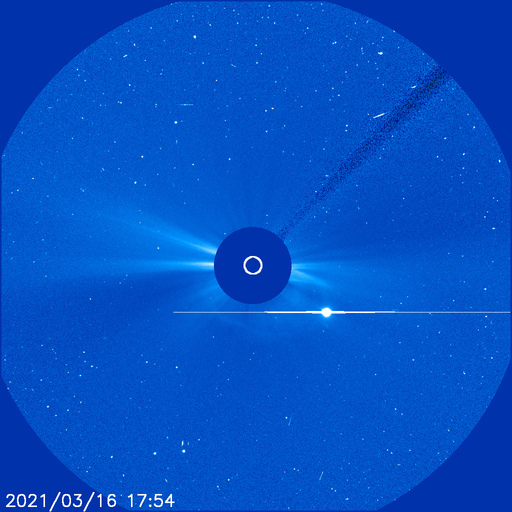
Venus in the Solar and Heliospheric Observatory (SOHO) LASCO C3 image. It will pass south and behind the Sun on the 26th and officially enter the evening sky.
03/16/2021 – Ephemeris – Tonight we’ll have exactly 12 hours of night
This is Ephemeris for Tuesday, March 16th. Today the Sun will be up for 11 hours and 57 minutes, setting at 7:50, and it will rise tomorrow at 7:50. The Moon, 3 days past new, will set at 11:15 this evening.
Did you notice what I just said? Sunset’s at 7:50 pm and sunrise’s at 7:50 am. Tonight we’ll have exactly 12 hours of night. That’s what the word equinox means, equal night… But the vernal or spring equinox isn’t until Saturday when spring starts. By then night, including twilight, will be down to 11 hours, 50 minutes. The disparity comes down to modern versus older definitions. Equinox, being Latin is an older definition. The modern instant of sunrise and sunset occurs when the top of the Sun’s disc touches the sea horizon. Because our atmosphere bends light, and at its greatest when looking at the horizon, the Sun will have set already, geometrically, by the time the bottom edge of the Sun appears to touch that sea horizon. Making daylight a bit longer than you’d think.
The astronomical event times given are for the Traverse City/Interlochen area of Michigan. They may be different for your location.
Addendum
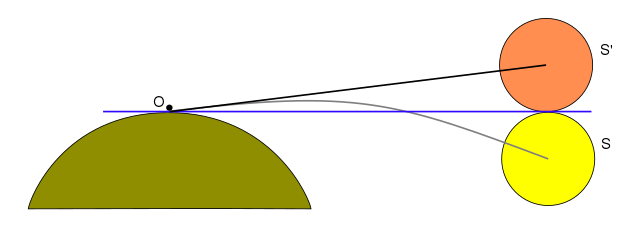
How the atmosphere bends the light of the Sun or Moon rising or setting to appear higher than it actually is. S is the actual position of the Sun, S’ is the apparent position of the Sun. The blue line is the observer O’s horizon. The gray line is the actual, though much exaggerated, light path bent or refracted by the Earth’s atmosphere. The black line is the apparent sight line to the Sun. Credit Francisco Javier Blanco González, 2017
03/15/2021 – Ephemeris – Newly discovered comet may reach naked-eye brightness by December
This is Ephemeris for Ides of March, Monday, March 15th. Today the Sun will be up for 11 hours and 54 minutes, setting at 7:49, and it will rise tomorrow at 7:52. The Moon, 2 days past new, will set at 10:12 this evening.
Now that daylight saving time is here all the times I give for sunrises and sunsets bump up at least an hour along with anything else the rises or sets. It’s lighter out in the evening now. The end of nautical twilight, by which time it’s dark enough to see most of the stars and constellations ends around 8:21 tonight, but that will continue to advance toward 11 pm by July. On to possibly happier news, a comet was discovered, and is called Comet 2021 A1 (Leonard). It could reach naked eye visibility and be brightest in mid-December. I mean could. Comets are unpredictable, and so is our weather that time of year. I’ll have more on Comet Leonard, its antics and more about comets in general as it heads in from the outer solar system during this year.
The astronomical event times given are for the Traverse City/Interlochen area of Michigan. They may be different for your location.
Addendum
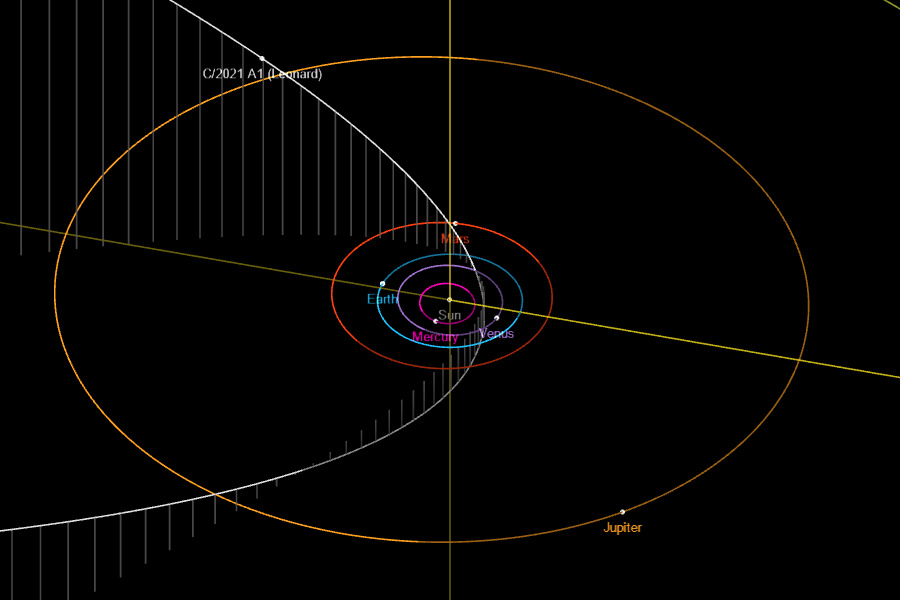
Comet C/2021 A1 (Leonard) orbit and position as of March 15, 2021. The vertical lines (I call them stilts) show the orbit’s position above or below the plane of the Earth’s orbit. It will reach its closest point to the Sun on January 3, 2022, just inside Venus’ orbit. Click on the image to enlarge. Credit NASA/JPL Small-Body Database Browser.
03/12/2021 – Ephemeris – It’s about time
This is Bob Moler with Ephemeris for Friday, March 12th. Today the Sun will be up for 11 hours and 45 minutes, setting at 6:45, and it will rise tomorrow at 6:58. The Moon, 1 day before new, will rise at 7:31 tomorrow morning.
Sunday morning at the instant the clock strikes 2 am, it will magically become 3 am. March 14th will become the shortest day of the year at 23 hours. The hour will be returned, without interest I might add, on the first Sunday in November. And we can’t even say “Spring forward.” It’s not even spring yet. “Late winter forward” just doesn’t have the same ring to it. Actually noon is not midday for those who work days. It’s more like two in the afternoon, maybe later. We have more leisure time after work than before, which kind of makes sense. But in summer the Sun’s out a long time anyway. In late June the Sun doesn’t set until 9:30 at night around here. It doesn’t get really dark until after 11 pm. It may be great for golfers, but not for those who enjoy the night sky.
The astronomical event times given are for the Traverse City/Interlochen area of Michigan. They may be different for your location.
Addendum
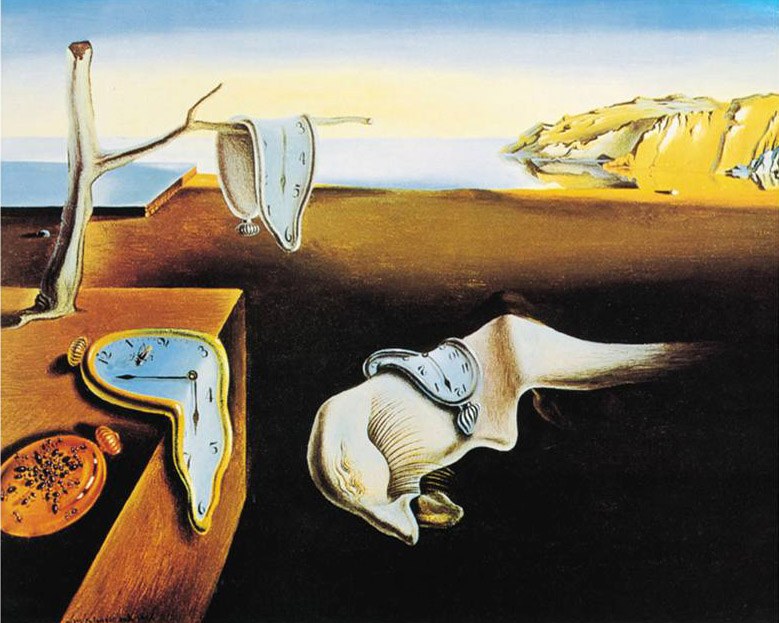
The Persistence of Memory by Salvador Dalí.
Growing up in the 1950s I wasn’t aware that we in Michigan didn’t set our clocks forward or back with the seasons until we got a television. All of a sudden in April all the evening shows came on an hour earlier. Around Halloween, they went back to their former times. In the 60s the politicians started to mess around with our clocks, first on the Federal level, then the state level. Long story short, we’re doing the spring forward, fall back thing like almost everyone else. The problem I see is that we are far west of our Eastern Standard Time meridian of 75 degrees west longitude, which runs through Philadelphia, PA. I live 43 Earth rotational minutes west of there. Standard time for us is almost like Daylight Saving Time for New York City. So come Sunday we will experience double daylight time. Kinda like “Double Secret Probation.” /rant
03/11/2021 – Ephemeris – The Guardian of the Bear is rising
This is Ephemeris for Thursday, March 11th. Today the Sun will be up for 11 hours and 42 minutes, setting at 6:44, and it will rise tomorrow at 7:00. The Moon, 2 days before new, will rise at 7:09 tomorrow morning.
The brightest star of spring is Arcturus which will be visible by 9 pm low in the east-northeast. Arcturus can most famously be found by following the arc of the handle of the Big Dipper, which resides fairly high in the northeastern sky to it. “Follow the arc of the handle to Arcturus.” It’s the fourth or fifth brightest star in the sky, depending on the list. It was regarded as the “Guardian of the Bear”, meaning the Great Bear, Ursa Major, of which the Big Dipper is its hind end. Apparently it’s guarding its rear. Arcturus will stay in our evening sky until the end of summer and has a fascinating story of its own aside from its ancient mythology, which I’ll talk about when it’s higher in the sky. It’s located at the base of a kite shaped constellation called Boötes, which is now horizontal and too close to the horizon to be appreciated.
The astronomical event times given are for the Traverse City/Interlochen area of Michigan. They may be different for your location.
Addendum
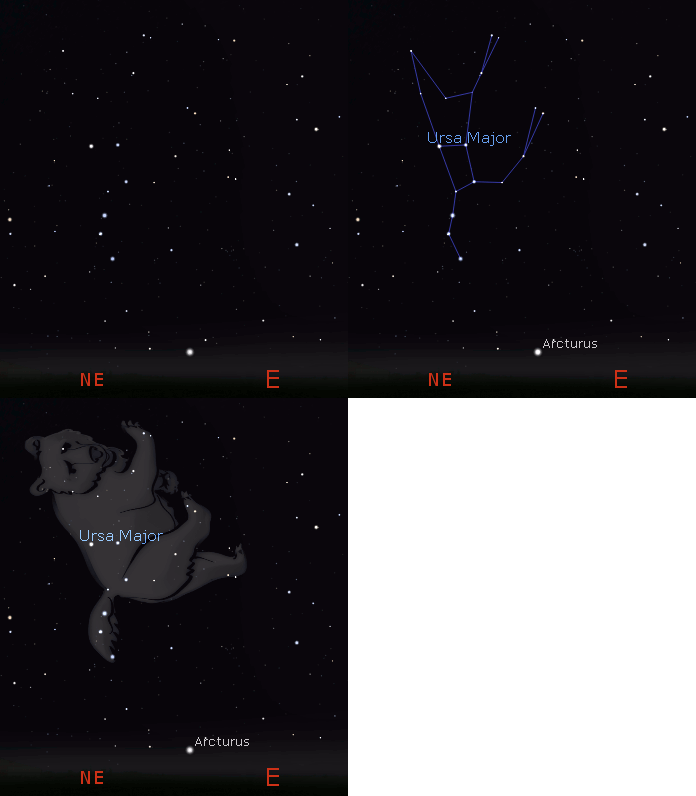
Arcturus rising finder animation for 9 pm tonight, March 11, 2021. Created using Stellarium and GIMP.
 Bob Moler's Ephemeris Blog