01/09/2020 – Ephemeris – What is Ephemeris about?
Ephemeris for Thursday, January 9th. Today the Sun will be up for 9 hours and 1 minute, setting at 5:20, and it will rise tomorrow at 8:18. The Moon, 1 day before full, will set at 8:15 tomorrow morning.
The Ephemeris program has been a labor of love of mine for going on 45 orbits of the Sun this June. The topics are astronomy and space. What can be seen with the naked eye, binoculars or a small telescope. We look at constellations visible in the evening, their stories, both of western civilization and of the native peoples of our land. We look at the planets, especially the naked-eye planets on Wednesday, and whenever the Moon appears close to one to point it out. We also give heads up on upcoming events like eclipses and meteor showers, plus local events like viewing opportunities we call star parties. I have a companion blog, often illustrated: It’s at bobmoler dot wordpress dot com.
The times given are for the Traverse City/Interlochen area of Michigan. They may be different for your location.
Addendum
When the Moon is in the evening sky I will talk about what can be seen on its surface that night, usually near the terminator, which in the evening is the sunrise line, where the shadows are longest. I don’t cover the Moon every month. Search “Moon” to find all the posts that I do. I just might have a post on the phase you are interested in. Otherwise when the bright Moon overpowers the constellations, I talk about what we know about the bright stars visible, astronomical news or concepts, whatever can be explained in 45 seconds. Sometimes I can only whet your appetite. Click the about button above for more information about the Ephemeris program and me.
01/08/2020 – Ephemeris – Looking for the naked-eye planets
Ephemeris for Wednesday, January 8th. Today the Sun will be up for 9 hours even, setting at 5:19, and it will rise tomorrow at 8:19. The Moon, 2 days before full, will set at 7:15 tomorrow morning.
Let’s look at the naked-eye planets for this week. Venus is our evening star low in the southwest in the early evening. It will set at 8:20 p.m. Saturn sets only 20 minutes after sunset and is not visible. It will pass behind the Sun on the 13th and will then join Jupiter in the morning sky. Jupiter is too close to the Sun in the morning twilight to be seen. Mars is visible in the morning sky and will rise in the east-southeast at 5:02 a.m. It’s not very bright because it’s 198 million (319 million km) miles away, but it’s getting slowly closer to the Earth at the rate of about 4 million miles (6 million km) a week. Mercury is now too close to the Sun to be seen in the morning, but will move into the evening sky on Friday.
The times given are for the Traverse City/Interlochen area of Michigan. They may be different for your location.
Addendum
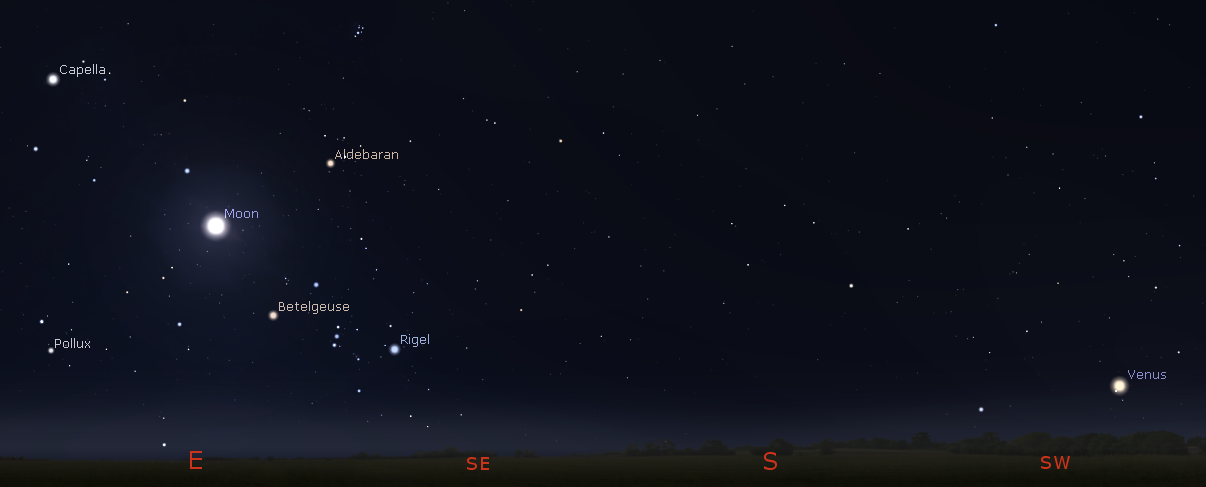
Venus and the Gibbous Moon in the evening tonight at 7 p.m. January 8, 2020. Orion is still easily spotted in the moonlight. Click on the image to enlarge. Created using Stellarium.
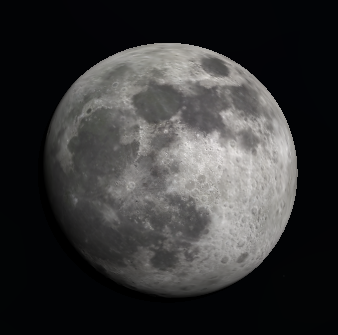
The gibbous Moon as it might appear in binoculars at 7 p.m. January 8, 2019. Created using Stellarium.
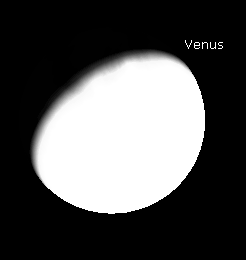
Venus, much larger than it would appear in any telescope to show its gibbous phase, tonight January 8, 2019. Created using Stellarium.
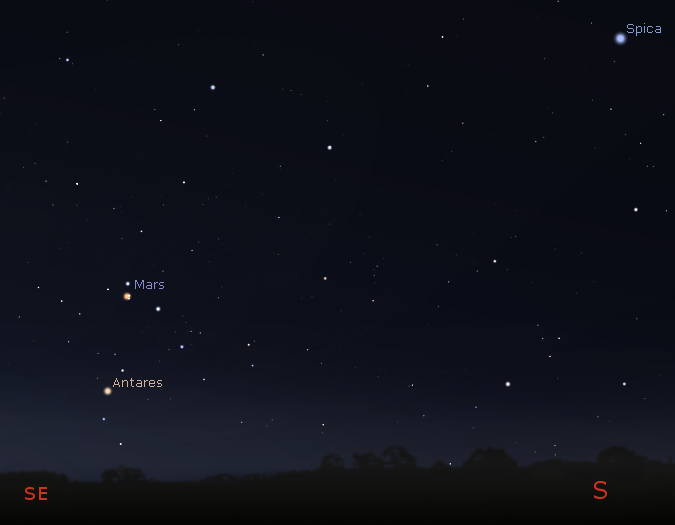
Mars in the morning with the bright stars at 7 a.m. January 9, 2020. Note that Mars is approaching the red giant star Antares. The name Antares means “Rival of Mars” (Ant – anti, Ares -the Greek god of war that the Romans appropriated as Mars). Mars will pass 4.8 degrees north of Antares on the 17th. Created using Stellarium.
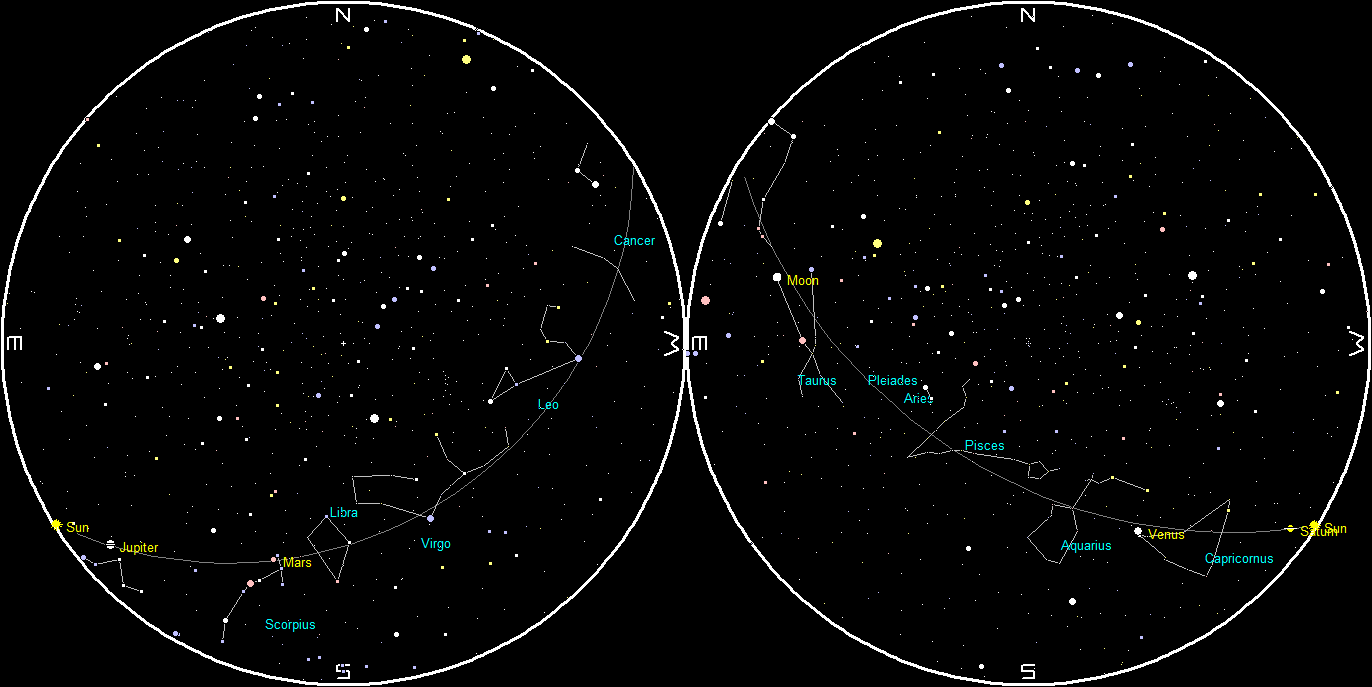
Planets and the Moon at sunset and sunrise of a single night starting with sunset on the right on January 8, 2020. The night ends on the left with sunrise on the 9th. Click on the image to enlarge. Created using my LookingUp program.
01/07/2020 – Ephemeris – What the heck is an ephemeris? Plus my Betelgeuse update
Ephemeris for Tuesday, January 7th. Today the Sun will be up for 8 hours and 58 minutes, setting at 5:18, and it will rise tomorrow at 8:19. The Moon, 3 days before full, will set at 6:09 tomorrow morning.
What the heck is an ephemeris? According to Wikipedia: “In astronomy and celestial navigation, an ephemeris (plural: ephemerides; from Latin ephemeris, meaning ‘diary’, from the Greek,… meaning ‘diary, <or> journal’) gives the positions of… astronomical objects… at a given time or times. Historically, positions were given as printed tables of values, given at regular intervals of date and time.” My tables are now databases which I generate for the year during the prior December from published algorithms. I will show all on my blog today: It’s at bobmoler<dot>wordpress<dot>com. (You are already here) I used to have to interpolate values from printed ephemerides for the first 5 or so years.
The times given are for the Traverse City/Interlochen area of Michigan. They may be different for your location.
Addenda
An Ephemeris Example
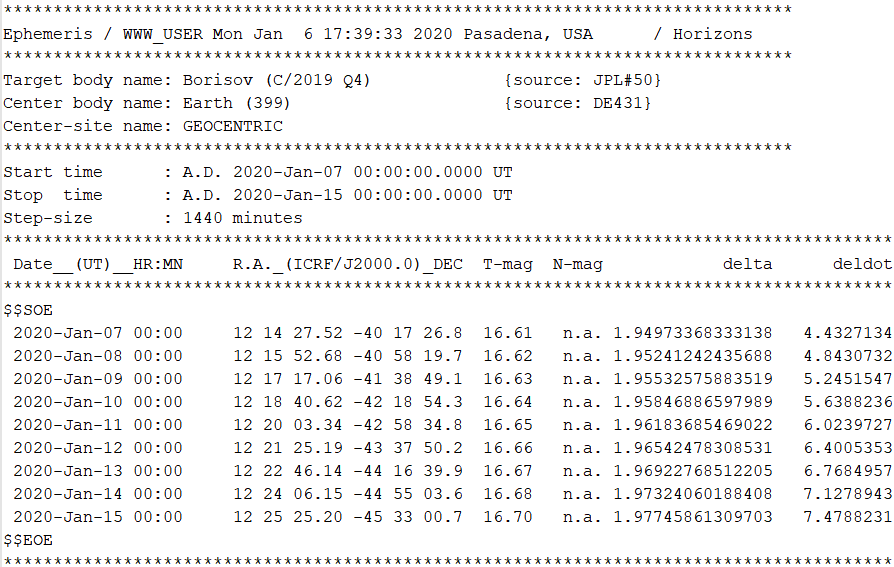
Here’s an ephemeris for the Interstellar comet for 2I/Borisov AKA C/2019 Q4 (Borisov) from the Jet Propulsion Laboratory’s (JPL) Horizons system.
R.A. is right ascension – East-west position in the sky, like longitude on the Earth, only it’s in hours, minutes and seconds. One hour = 15 degrees.
DEC is declination – North-south position, in the sky, exactly like latitude on the Earth in degrees, minutes and seconds.
J2000.0 means that the above coordinates are based on where the vernal equinox point in the sky was on January 1, 12:00 Terrestrial Time, 2000. Or January 1, 2000, 11:58:55.816 UTC as reported in Wikipedia.
APmag – Apparent visual magnitude. Magnitudes are like golf scores. The higher magnitude the dimmer the object. It’s really, really dim.
delta – Distance from the Earth in terms of Astronomical Units (AU). 1 AU is Earth’s mean distance from the Sun.
deldot – The change in delta. It’s in kilometers per second. If positive, it’s going away.
For more information on how I produce ephemerides for this program go here: https://bobmoler.wordpress.com/2019/01/22/
The dimming of Betelgeuse
I finally got a clear evening. However snow and freezing rain the rest of the week.
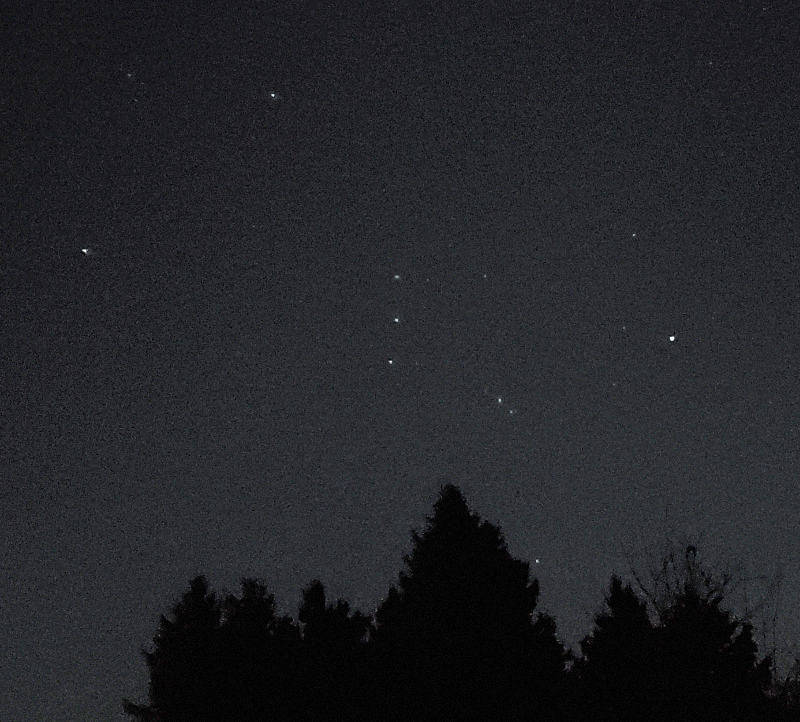
Betelgeuse in Orion at 7:07 p.m. January 6, 2020. Taken with my Samsung Galaxy S10+ in the moonlight. Compare the brightness of Betelgeuse with Rigel, Bellatrix and the belt stars.
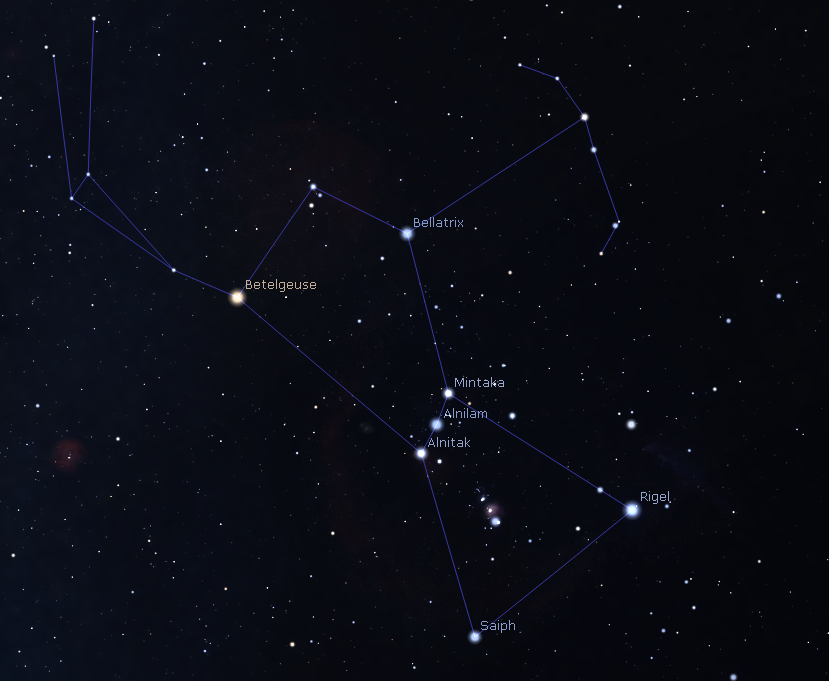
Orion’s brightest stars with their names for 9 p.m. January 7, 2019. Click on the image to make Orion a giant hunter. Created using Stellarium.
See last Thursday’s post on the dimming of Betelgeuse: https://bobmoler.wordpress.com/2020/01/02/
01/06/2020 – Ephemeris – The Earth was closest to the Sun in its orbit yesterday
Ephemeris for Monday, January 6th. Today the Sun will be up for 8 hours and 57 minutes, setting at 5:17, and it will rise tomorrow at 8:19. The Moon, half way from first quarter to full, will set at 5:02 tomorrow morning.
Yesterday’s perihelion, or closest point of the Earth to the Sun of roughly 91.4 million miles (147 million km) is only 1.7% closer to the Sun than average. It doesn’t do much to make our winters warmer, but it does make winter the shortest season. That’s because the Earth travels faster when near the Sun than when it’s farther away. Winter lasts only 89 ½ days. The Earth’s aphelion, when it’s farthest from the Sun will be on the 4th of July, in summer, making that the longest season at 93 ½ days. Of course being this far north it feels like winter is longer than summer, but astronomically it’s the other way around. Being a leap year, with February having 29 days, spring will arrive a calendar day early on the 19th of March.
The times given are for the Traverse City/Interlochen area of Michigan. They may be different for your location.
Addendum
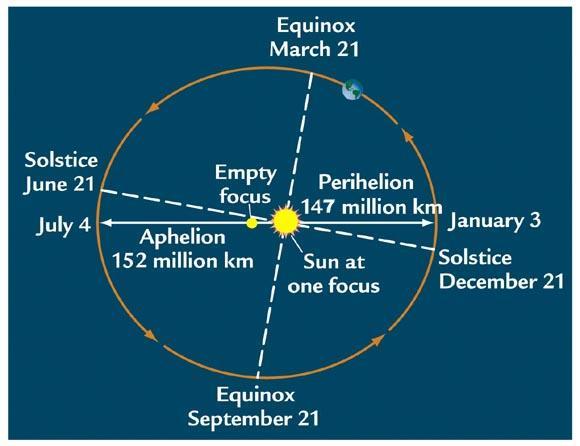
The Earth’s orbit, somewhat exaggerated, showing perihelion and the seasons. Credit “Starts with a Bang” blog by Ethan Siegel.

The Seasons for 2020 from data in Astronomical Tables of the Sun, Moon, and Planets Third Edition by Jean Meeus. Date and times are in TD, Dynamical Time. Subtract about 1 minutes to convert to Universal Time (UT). Also subtract 5 hours for Eastern Standard Time and 4 hours for Eastern Daylight Time.
For and explanation of the Cross-Quarter Days column, check out my Ground Hog Day post last year: https://bobmoler.wordpress.com/2019/02/02/02-02-2019-ephemeris-extra-groundhog-day-and-other-seasonal-days/
01/03/2020 – Ephemeris – Astronomical events this weekend
Ephemeris for Friday, January 3rd. The Sun will rise at 8:20. It’ll be up for 8 hours and 54 minutes, setting at 5:14. The Moon, 1 day past first quarter, will set at 1:49 tomorrow morning.
Tonight at 8 p.m. there will be a telescope clinic by the Grand Traverse Astronomical Society at the Rogers Observatory south of Traverse City on Birmley Road for those who have either received a telescope for Christmas or have one hidden away in an attic, to learn how to use it. Bring ‘em if you’ve got ‘em.
Tomorrow morning we’ll see the peak of the Quadrantid meteor shower after the Moon sets. The radiant for this shower is near the handle of the Big Dipper, though they will be seen all over the sky. The peak should be around 3:20 a.m. with the possibility of over a hundred meteors visible per hour.
On Sunday at 5 a.m. the Earth will be its closest to the Sun for the year of 91,394,000 miles (147,085,000 km).
The times given are for the Traverse City/Interlochen area of Michigan. They may be different for your location.
Addendum
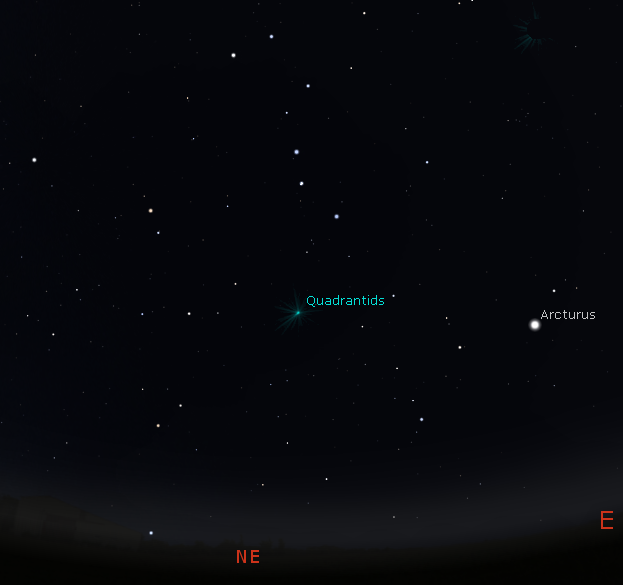
The location of the Quadrantid radiant at 3:20 a.m. January 4, 2020 for the peak of the meteor shower. Created using Stellarium.
The Earth’s orbit, somewhat exaggerated, showing perihelion and the seasons. Credit “Starts with a Bang” blog by Ethan Siegel.
01/02/2020 – Ephemeris – Orion’s great red star Betelgeuse is dimming
Ephemeris for Thursday, January 2nd. The Sun will rise at 8:20. It’ll be up for 8 hours and 53 minutes, setting at 5:13. The Moon, at first quarter today, will set at 12:48 tomorrow morning.
The bright red giant star in the constellation Orion’s shoulder is in the news. It is dimming, and it is dimmer now than it has been for a very long time. A chart by the American Association of Variable Star Observers shows that this is the dimmest it’s been going back to 1970 and maybe a long time before that. Betelgeuse was first noticed to vary in brightness in 1838. It is the left star at the top of Orion’s upright rectangle of stars. Bellatrix is the right corner star. Betelgeuse is now only a little brighter than it, and much dimmer than Rigel the lower right corner star. A couple of years ago it was brighter than it had been since 1970. Astronomers are watching and waiting. They expect Betelgeuse to explode as a supernova sometime in the next million years.
The times given are for the Traverse City/Interlochen area of Michigan. They may be different for your location.
Addendum
Orion’s brightest stars with their names for 9 p.m. January 7. Click on the image to make Orion a giant hunter. Created using Stellarium, which shows Betelgeuse at its average magnitude of 0.45.
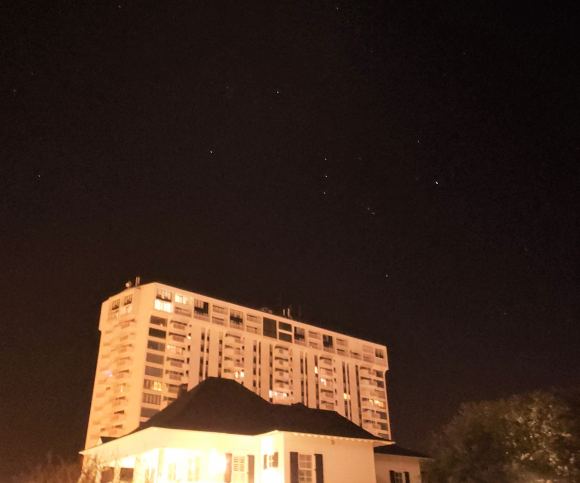
Orion and Betelgeuse on Christmas night 2019 by David Dickinson. Photo from a smart phone from Virginia Beach. Note that Betelgeuse is not much brighter than Bellatrix and much dimmer than Rigel.
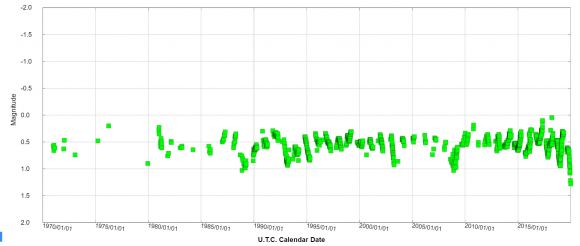
Magnitude estimates of Betelgeuse since 1970. Credit AAVSO.
Note on the magnitude scale: The lower the magnitude the brighter the star. Stars with magnitudes less than 1.5 are first magnitude stars. Second magnitude stars are between 1.5 and 2.5, and so on.
For more information check out Universe Today: https://www.universetoday.com/144465/waiting-for-betelgeuse-whats-up-with-the-tempestuous-star/
And Dr. Phil Plait’s Bad Astronomy: https://www.syfy.com/syfywire/dont-panic-betelgeuse-is-almost-certainly-not-about-to-explode
01/01/2020 – Ephemeris – A Happy New Year look at the naked-eye planets
Happy New Year, this is Ephemeris for New Years Day, Wednesday, January 1st. 2020. The Sun will rise at 8:20. It’ll be up for 8 hours and 52 minutes, setting at 5:12. The Moon, 1 day before first quarter, will set at 11:48 this evening.
Let’s look at the naked-eye planets for this week. Venus is our evening star low in the southwest in the early evening. It will set at 8:02 p.m. Saturn sets only 50 minutes after sunset and is not visible. It will pass behind the Sun on the 13th and will then join Jupiter in the morning sky. Jupiter is too close to the Sun in the morning twilight to be seen. Mars is visible in the morning sky and will rise in the east-southeast at 5:04 a.m. It’s not very bright because it’s 202 million (326 million km) miles away, but it’s getting slowly closer to the Earth at the rate of about 4 million miles (6 million km) a week. Mercury is now too close to the Sun to be seen in the morning, but will move into the evening sky on the 10th.
The times given are for the Traverse City/Interlochen area of Michigan. They may be different for your location.
Addendum
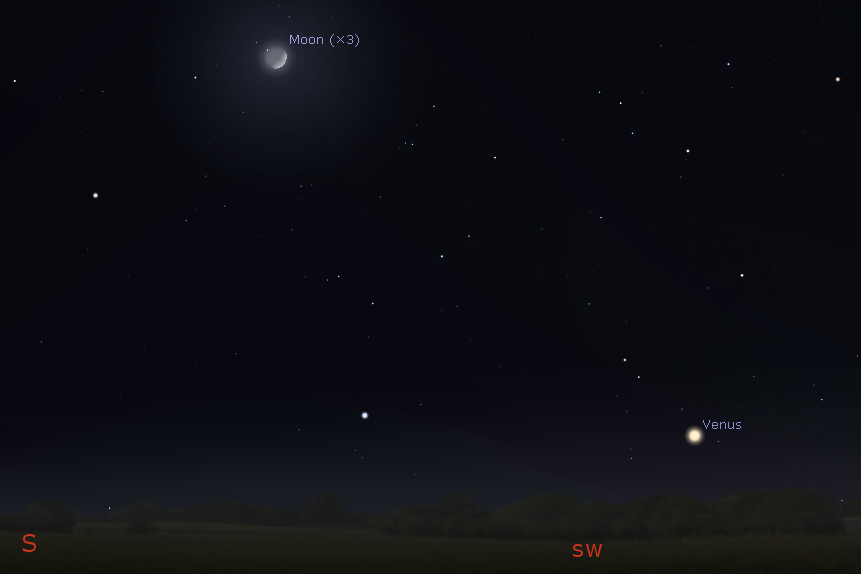
Venus and the Moon in the evening tonight at 7 p.m. January 1, 2020. Click on the image to enlarge. Created using Stellarium.
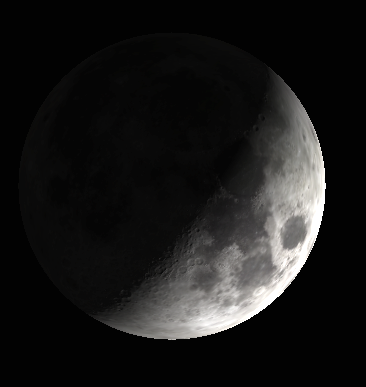
The crescent Moon as it might appear in binoculars or a small telescope tonight at 7 p.m. January 1, 2020. Created using Stellarium.

Venus, much larger than it would appear in any telescope to show its gibbous phase, tonight January 1, 2019. Created using Stellarium.
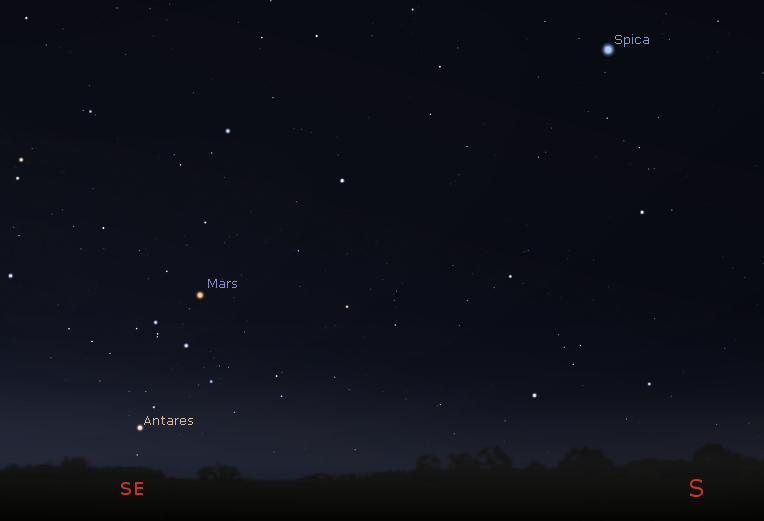
Mars in the morning with the bright stars at 7 a.m. January 1, 2020. Note that Mars is approaching the red giant star Antares. The name Antares means “Rival of Mars” (Ant – anti, Ares -the Greek god of war that the Romans appropriated as Mars). Mars will pass 4.8 degrees north of Antares on the 17th. Click on the image to enlarge. Created using Stellarium.
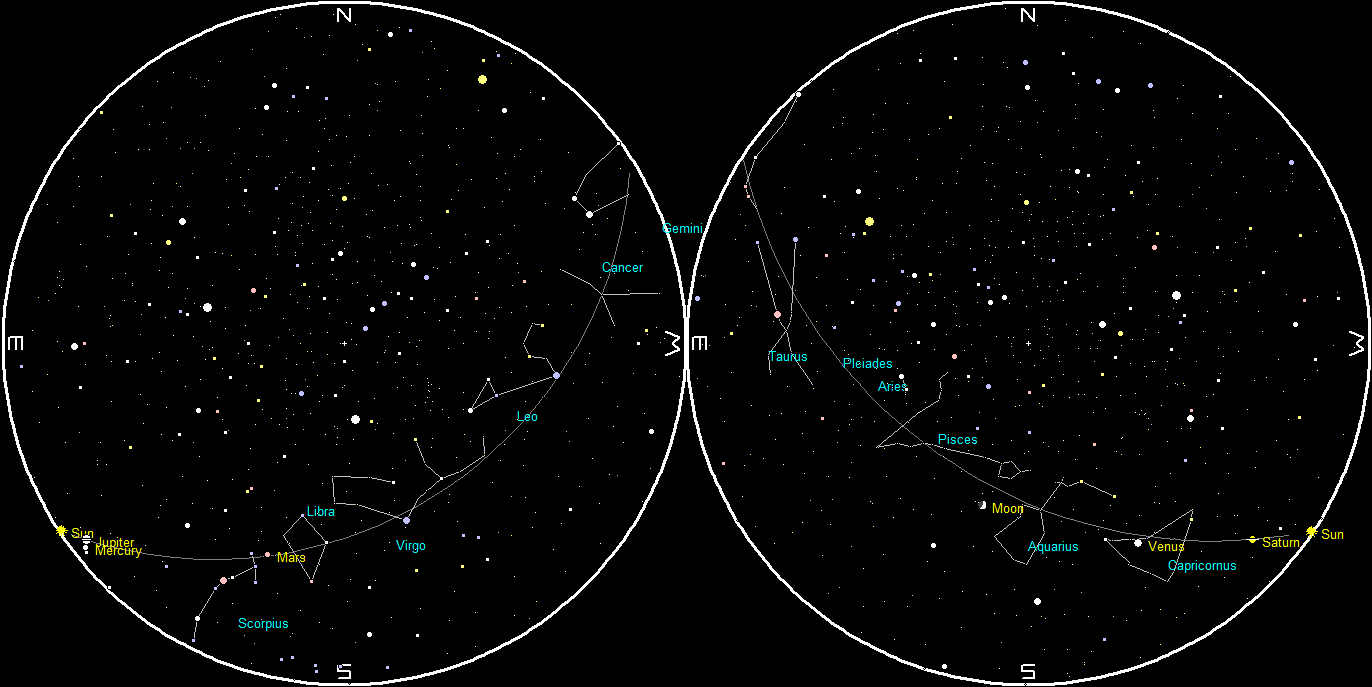
Planets and the Moon at sunset and sunrise of a single night starting with sunset on the right on January 1, 2020. The night ends on the left with sunrise on the 2nd. Click on the image to enlarge. Created using my LookingUp program.
12/31/2019 – Ephemeris – Previewing the skies of January 2020
Ephemeris for New Years Eve, Tuesday, December 31st. The Sun will rise at 8:20. It’ll be up for 8 hours and 51 minutes, setting at 5:11. The Moon, 2 days before first quarter, will set at 10:47 this evening.
Tomorrow starts a new year and a new decade. The daylight hours start slowly getting longer and will accelerate during the month. Daylight hours will increase from 8 hours and 52 minutes tomorrow to 9 hours and 45 minutes on the 31st. The sunrise time will decrease from 8:20 tomorrow to 8:03 at months end. The sunset times will increase from 5:12 tomorrow to 5:49 on the 31st. Along with that the altitude of the sun at noon will increase from 22 degrees tomorrow to nearly 28 degrees at month’s end. It will be a degree lower for folks in the Straits area because they are a degree of latitude farther north. Local noon, by the way for Interlochen and Traverse City is about 12:51 p.m. in January.
The times given are for the Traverse City/Interlochen area of Michigan. They may be different for your location.
Addendum
January Evening Star Chart
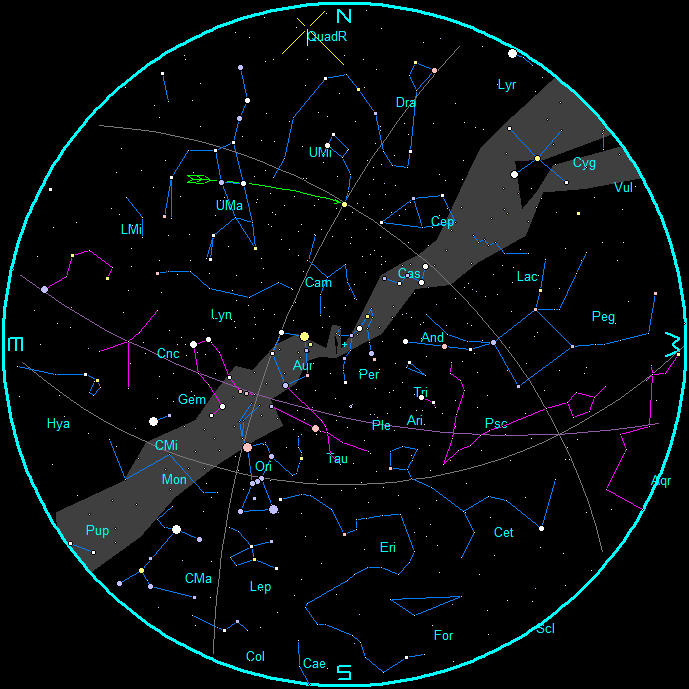
Star Chart for January 2020 (9 p.m. EST January 15, 2020). Click on image to enlarge.Created using my LookingUp program. Click on image to enlarge. Created using my LookingUp program.
The planets and stars are plotted for the 15th at 9 p.m. EST in the evening and 6 a.m. for the morning chart. These are the chart times. The brilliant planet Venus will enter the sky at the chart time during the latter half of the month in the southwest. Note that Traverse City is located approximately 45 minutes behind our time meridian, West 75° longitude. (An hour 45 minutes behind our daylight saving time meridian during EDT).
January Morning Star Chart
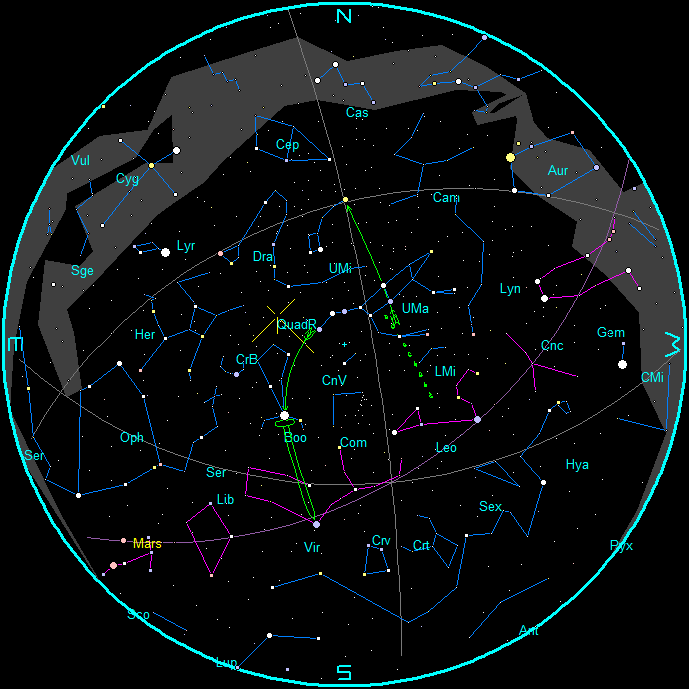
Star Chart for January mornings 2020 (6 a.m. EST January 15, 2020). Click on image to enlarge. Created using my LookingUp program.
For a list of constellation names to go with the abbreviations click here.
- Pointer stars at the front of the bowl of the Big Dipper point to Polaris the North Star.
- The leaky bowl of the Big Dipper drips on Leo.
- Follow the arc of the handle of the Big Dipper to the star Arcturus, then
- Follow the spike to Spica.
- QuadR on the star charts is the radiant of the Quadrantid meteor shower which peaks on the 4th at 3:20 a.m. EST (8:20 UT).
Twilight Limits, Nautical and Astronomical
| EST | |||||||
| Morning twilight | Evening twilight | Dark night | Moon | ||||
| Date | Astro. | Nautical | Nautical | Astro. | Start | End | Illum. |
| 2020-01-01 | 6h35m | 7h10m | 18h21m | 18h57m | 23h48m | 6h35m | 0.38 |
| 2020-01-02 | 6h35m | 7h10m | 18h22m | 18h57m | – | 6h35m | 0.48 |
| 2020-01-03 | 6h35m | 7h11m | 18h23m | 18h58m | 0h49m | 6h35m | 0.58 |
| 2020-01-04 | 6h35m | 7h11m | 18h24m | 18h59m | 1h50m | 6h35m | 0.67 |
| 2020-01-05 | 6h35m | 7h11m | 18h25m | 19h00m | 2h52m | 6h35m | 0.76 |
| 2020-01-06 | 6h35m | 7h11m | 18h26m | 19h01m | 3h57m | 6h35m | 0.85 |
| 2020-01-07 | 6h35m | 7h10m | 18h27m | 19h02m | 5h03m | 6h35m | 0.92 |
| 2020-01-08 | 6h35m | 7h10m | 18h28m | 19h03m | 6h10m | 6h35m | 0.97 |
| 2020-01-09 | 6h35m | 7h10m | 18h29m | 19h04m | – | – | 0.97 |
| 2020-01-10 | 6h35m | 7h10m | 18h30m | 19h05m | – | – | 1 |
| 2020-01-11 | 6h35m | 7h10m | 18h31m | 19h06m | – | – | 1 |
| 2020-01-12 | 6h34m | 7h10m | 18h32m | 19h07m | 19h07m | 19h44m | 0.97 |
| 2020-01-13 | 6h34m | 7h09m | 18h33m | 19h08m | 19h08m | 21h01m | 0.92 |
| 2020-01-14 | 6h34m | 7h09m | 18h34m | 19h09m | 19h09m | 22h17m | 0.84 |
| 2020-01-15 | 6h34m | 7h08m | 18h35m | 19h10m | 19h10m | 23h32m | 0.74 |
| 2020-01-16 | 6h33m | 7h08m | 18h36m | 19h11m | 19h11m | – | 0.63 |
| 2020-01-17 | 6h33m | 7h08m | 18h37m | 19h12m | 19h12m | 0h46m | 0.51 |
| 2020-01-18 | 6h32m | 7h07m | 18h38m | 19h13m | 19h13m | 1h59m | 0.39 |
| 2020-01-19 | 6h32m | 7h07m | 18h39m | 19h14m | 19h14m | 3h12m | 0.28 |
| 2020-01-20 | 6h31m | 7h06m | 18h41m | 19h15m | 19h15m | 4h22m | 0.19 |
| 2020-01-21 | 6h31m | 7h05m | 18h42m | 19h16m | 19h16m | 5h30m | 0.11 |
| 2020-01-22 | 6h30m | 7h05m | 18h43m | 19h17m | 19h17m | 6h30m | 0.05 |
| 2020-01-23 | 6h30m | 7h04m | 18h44m | 19h19m | 19h19m | 6h30m | 0.01 |
| 2020-01-24 | 6h29m | 7h03m | 18h45m | 19h20m | 19h20m | 6h29m | 0 |
| 2020-01-25 | 6h28m | 7h03m | 18h46m | 19h21m | 19h21m | 6h28m | 0.01 |
| 2020-01-26 | 6h28m | 7h02m | 18h48m | 19h22m | 19h33m | 6h28m | 0.04 |
| 2020-01-27 | 6h27m | 7h01m | 18h49m | 19h23m | 20h35m | 6h27m | 0.08 |
| 2020-01-28 | 6h26m | 7h00m | 18h50m | 19h25m | 21h36m | 6h26m | 0.14 |
| 2020-01-29 | 6h25m | 6h59m | 18h51m | 19h26m | 22h37m | 6h25m | 0.22 |
| 2020-01-30 | 6h24m | 6h59m | 18h53m | 19h27m | 23h37m | 6h24m | 0.3 |
| 2020-01-31 | 6h23m | 6h58m | 18h54m | 19h28m | – | 6h23m | 0.39 |
Twilight calendar was generated using Cartes du Ciel (Sky Charts).
See my blog post: Twilight Zone for the definitions of the different periods of twilight here: https://bobmoler.wordpress.com/2018/09/27/.
NASA Calendar of Planetary Events
   Date      Time    Event
Jan 1  We            Venus: 34.6° E
    1  We  08:30 pm  Moon Apogee: 404600 km
    2  Th  11:45 pm  First Quarter
    4  Sa  03:20 am  Quadrantid Meteor Shower: ZHR = 120
    5  Su  04:59 am  Perihelion: 0.9832 AU
    9  Th  06:29 pm  Moon Ascending Node
   10  Fr  01:03 am  Moon North Dec.: 23.2° N
   10  Fr  10:01 am  Mercury Superior Solar Conjunction
   10  Fr  02:10 pm  Penumbral Lunar Eclipse
                         (Europe, Africa, Asia, Aus)
   10  Fr  02:21 pm  Full Moon
   11  Sa  06:54 pm  Moon-Beehive: 1° S
   13  Mo  09:23 am  Saturn Solar Conjunction
   13  Mo  03:20 pm  Moon Perigee: 366000 km
   17  Fr  07:58 am  Last Quarter
   17  Fr  06:03 pm  Mars-Antares: 4.8° N
   20  Mo  02:13 pm  Moon-Mars: 2.4° S
   22  We  03:31 pm  Moon Descending Node
   22  We  09:42 pm  Moon-Jupiter: 0.4° N
   22  We  10:37 pm  Moon South Dec.: 23.2° S
   24  Fr  04:42 pm  New Moon
   28  Tu  02:29 am  Moon-Venus: 4.5° N
   29  We  04:28 pm  Moon Apogee: 405400 km
Feb 1  Sa            Venus: 40.4° E
All event times are given for UTC-5 Eastern Standard Time.
Sky Events Calendar by Fred Espenak and Sumit Dutta (NASA’s GSFC),
http://eclipse.gsfc.nasa.gov/SKYCAL/SKYCAL.html.
If you go to the above site you can print out a list like the above for the entire year or calendar pages for your time zone.
Sun and Moon Rising and Setting Events
LU             Ephemeris of Sky Events for Interlochen/TC
January, 2020    Local time zone: EST
+-----------------------------------------------------------------------+
| DATE |  SUN     SUN  DAYLIGHT|   TWILIGHT*    |MOON  RISE OR    ILLUM |
|      |  RISE    SET    HOURS |  END    START  |PHASE SET** TIME FRACTN|
+=======================================================================+
|Wed  1| 08:20a  05:12p  08:52 | 06:22p  07:09a |      Set  11:48p   39%|
|Thu  2| 08:20a  05:13p  08:53 | 06:23p  07:09a |F Qtr Set  12:48a   48%|
|Fri  3| 08:20a  05:14p  08:54 | 06:24p  07:09a |      Set  01:49a   58%|
|Sat  4| 08:20a  05:15p  08:55 | 06:25p  07:10a |      Set  02:52a   67%|
+------+-----------------------+----------------+-----------------------+
|Sun  5| 08:20a  05:16p  08:56 | 06:26p  07:10a |      Set  03:56a   76%|
|Mon  6| 08:19a  05:17p  08:57 | 06:27p  07:09a |      Set  05:02a   84%|
|Tue  7| 08:19a  05:18p  08:58 | 06:28p  07:09a |      Set  06:09a   91%|
|Wed  8| 08:19a  05:19p  09:00 | 06:29p  07:09a |      Set  07:15a   96%|
|Thu  9| 08:19a  05:20p  09:01 | 06:30p  07:09a |      Set  08:15a   99%|
|Fri 10| 08:18a  05:21p  09:02 | 06:31p  07:09a |Full  Rise 05:20p  100%|
|Sat 11| 08:18a  05:23p  09:04 | 06:32p  07:09a |      Rise 06:29p   98%|
+------+-----------------------+----------------+-----------------------+
|Sun 12| 08:18a  05:24p  09:05 | 06:33p  07:09a |      Rise 07:44p   94%|
|Mon 13| 08:17a  05:25p  09:07 | 06:34p  07:08a |      Rise 09:01p   87%|
|Tue 14| 08:17a  05:26p  09:09 | 06:35p  07:08a |      Rise 10:17p   78%|
|Wed 15| 08:16a  05:27p  09:11 | 06:36p  07:08a |      Rise 11:32p   67%|
|Thu 16| 08:16a  05:29p  09:12 | 06:37p  07:07a |      Rise 12:46a   56%|
|Fri 17| 08:15a  05:30p  09:14 | 06:38p  07:07a |L Qtr Rise 01:59a   45%|
|Sat 18| 08:15a  05:31p  09:16 | 06:40p  07:06a |      Rise 03:11a   34%|
+------+-----------------------+----------------+-----------------------+
|Sun 19| 08:14a  05:32p  09:18 | 06:41p  07:06a |      Rise 04:22a   24%|
|Mon 20| 08:13a  05:34p  09:20 | 06:42p  07:05a |      Rise 05:30a   15%|
|Tue 21| 08:12a  05:35p  09:22 | 06:43p  07:05a |      Rise 06:32a    9%|
|Wed 22| 08:12a  05:36p  09:24 | 06:44p  07:04a |      Rise 07:27a    4%|
|Thu 23| 08:11a  05:38p  09:27 | 06:45p  07:03a |      Rise 08:14a    1%|
|Fri 24| 08:10a  05:39p  09:29 | 06:47p  07:03a |New   Set  05:27p    0%|
|Sat 25| 08:09a  05:41p  09:31 | 06:48p  07:02a |      Set  06:29p    1%|
+------+-----------------------+----------------+-----------------------+
|Sun 26| 08:08a  05:42p  09:33 | 06:49p  07:01a |      Set  07:32p    4%|
|Mon 27| 08:07a  05:43p  09:36 | 06:50p  07:00a |      Set  08:35p    9%|
|Tue 28| 08:06a  05:45p  09:38 | 06:52p  06:59a |      Set  09:36p   15%|
|Wed 29| 08:05a  05:46p  09:40 | 06:53p  06:59a |      Set  10:37p   22%|
|Thu 30| 08:04a  05:48p  09:43 | 06:54p  06:58a |      Set  11:37p   31%|
|Fri 31| 08:03a  05:49p  09:45 | 06:55p  06:57a |      Set  12:38a   40%|
+-----------------------------------------------------------------------+
* Nautical Twilight
** Moonrise or moonset, whichever occurs between sunrise and sunset
Generated using my LookingUp for DOS program.
12/30/2019 – Ephemeris – Some space advances this year
Ephemeris for Monday, December 30th. Today the Sun will be up for 8 hours and 50 minutes, setting at 5:10, and it will rise tomorrow at 8:20. The Moon, 3 days before first quarter, will set at 9:45 this evening.
Let’s look back at space activity this past year. SpaceX launched its Falcon Heavy rocket twice successfully for commercial payloads. It also performed the Demo 1 flight to send a uncrewed Dragon 2 to the International Space Station. That went off without a hitch. However when testing the same capsule a month later it was destroyed in a fueling mishap that postponed further flight tests until next month. The other Commercial Crew contractor Boeing was having problems with its Star Liner capsule. The latest being a mishap with their test flight to dock with the ISS. Supposedly a timing malfunction caused it to use too much fuel, so it ended in the wrong orbit. However it did land safely.
The times given are for the Traverse City/Interlochen area of Michigan. They may be different for your location.
Addendum

A SpaceX Falcon Heavy rocket, carrying the U.S. Air Force’s Space Test Program 2 Mission, lifts off from the Kennedy Space Center in Cape Canaveral, Florida, U.S., June 25, 2019. REUTERS/Joe Skipper
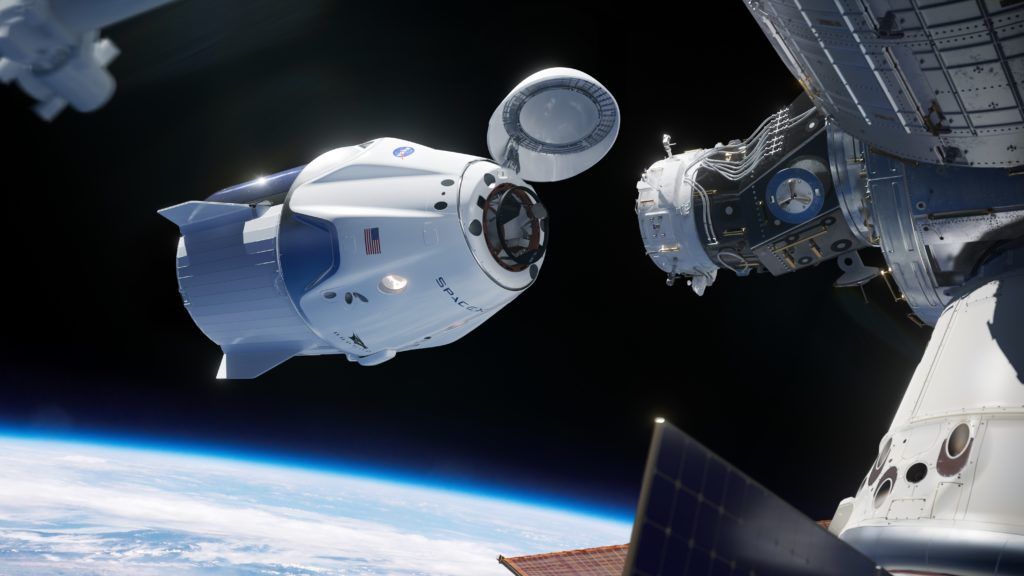
The Demo 1 Dragon docking with the International Space Station. Credit NASA
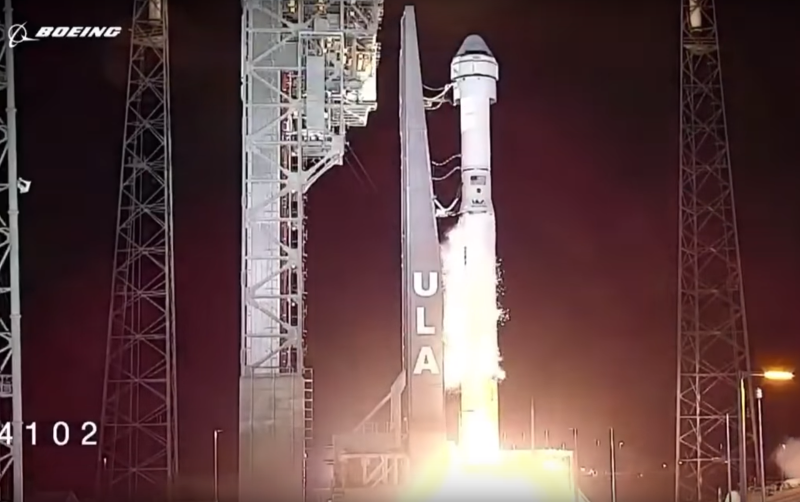
Starliner Orbital Test Launch on an Atlas 5. Credit Boeing.
12/27/2019 – Ephemeris – A Decade of astronomical and space firsts
Ephemeris for Friday, December 27th. Today the Sun will be up for 8 hours and 49 minutes, setting at 5:08, and it will rise tomorrow at 8:19. The Moon, 1 day past new, will set at 6:38 this evening.
The 2010s were quite a decade in astronomy and space. 24 years ago the first exoplanet, that is planet orbiting another star, was discovered: 51 Pegasi b. As of December 8th the number of confirmed exoplanets stands at 4,104. At mid decade we got a close look at the dwarf planet Pluto and its moons, and early this year at the distant object temporarily called Ultima Thule. Early this year the Event Horizon Telescope consortium released the image of a black hole over 50 million light years away. Also the LIGO and Virgo gravitational wave observatories detected two neutron stars colliding which set off a frenzy of activity by astronomers who viewed the aftermath from gamma rays to microwaves.
The times given are for the Traverse City/Interlochen area of Michigan. They may be different for your location.
Addendum
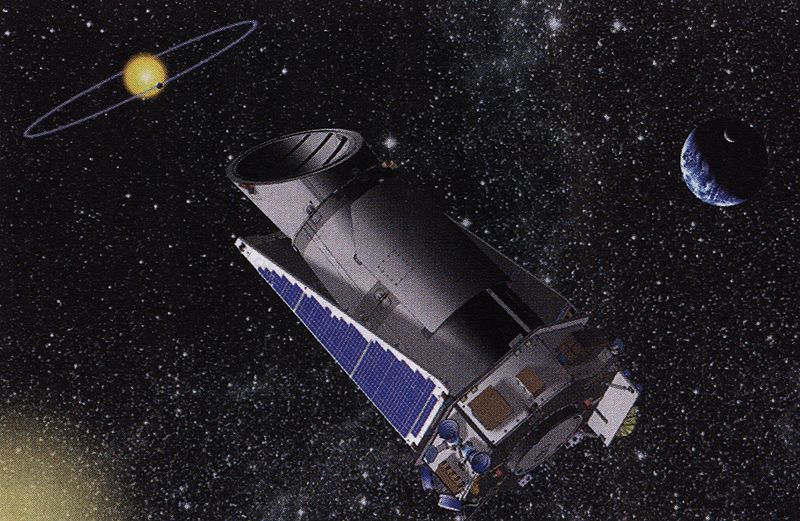
Kepler Spacecraft studied a single patch of sky for several years and has discovered the bulk of the exoplanets. Credit NASA.
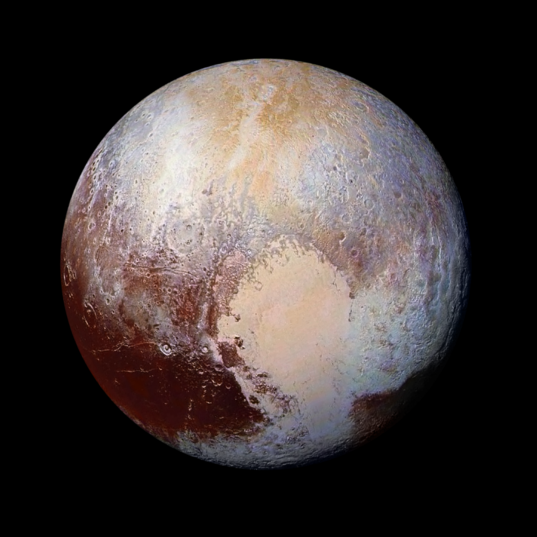
Enhanced color portrait of Pluto by the New Horizons spacecraft. Credit: NASA/JHUAPL/SwRI
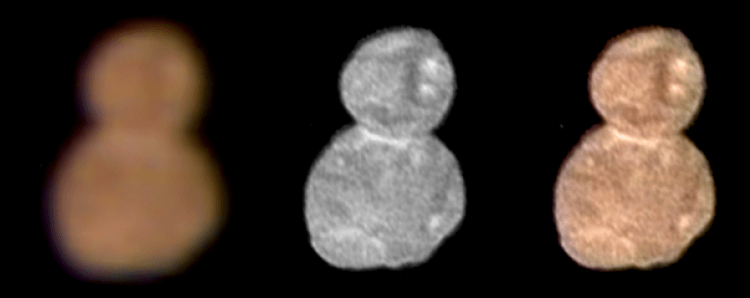
486958 Arrokoth original dubbed Ultima Thule by the New Horizons team on approach combining low resolution image with the high resolution monochromatic image shows the body in almost true color. Credit NASA/JHAPL/SWRi
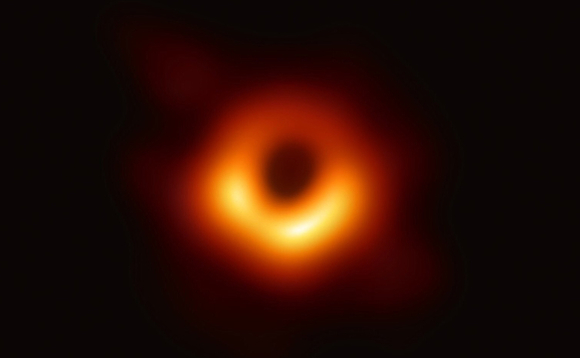
The first image of the black hole in M87. Credit Event Horizon Telescope.
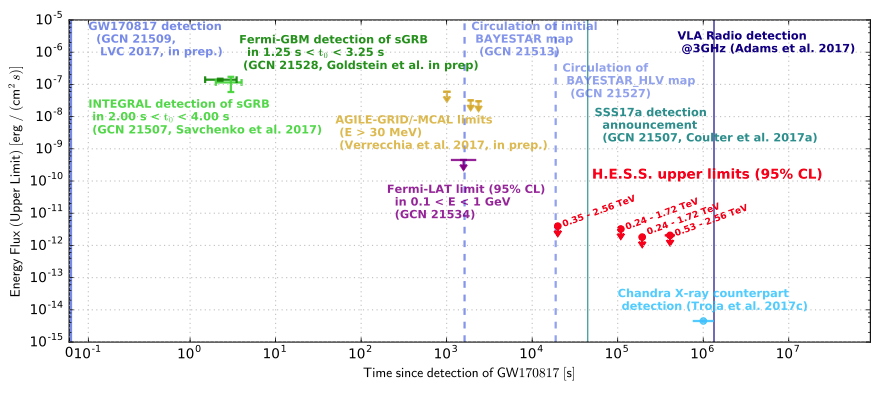
Neutron Star Collision GW 170817 timeline. Horizontal axis in seconds (exponential). Click on chart to enlarge. From the High Energy Stereoscopic System website.
 Bob Moler's Ephemeris Blog