10/30/2017 – Ephemeris – Halloween preview: The Ghoul Star
Ephemeris for Monday, October 30th. The Sun will rise at 8:17. It’ll be up for 10 hours and 15 minutes, setting at 6:33. The Moon, 3 days past first quarter, will set at 3:50 tomorrow morning.
Tomorrow night is the spookiest night of the year, so lets preview the spookiest star of all. It’s Algol, from Ghoul Star or Demon Star. The Chinese had a name for it that meant ‘piled up corpses’. It’s the second brightest star in the constellation Perseus the hero, rising in the northeast this evening. The star is located where artists have drawn the severed head of Medusa, whom he had slain. Medusa was so ugly that she turned all who gazed upon her to stone. Algol is her still glittering eye. Astronomers finally found out what was wrong with Algol. It does a slow 6 hour wink every two days 21 hours, because it is two stars that eclipse each other. It began to dip this morning just before sunrise and it will again centered on 11:41 p.m. Friday night.
The times given are for the Traverse City/Interlochen area of Michigan. They may be different for your location.
Addendum
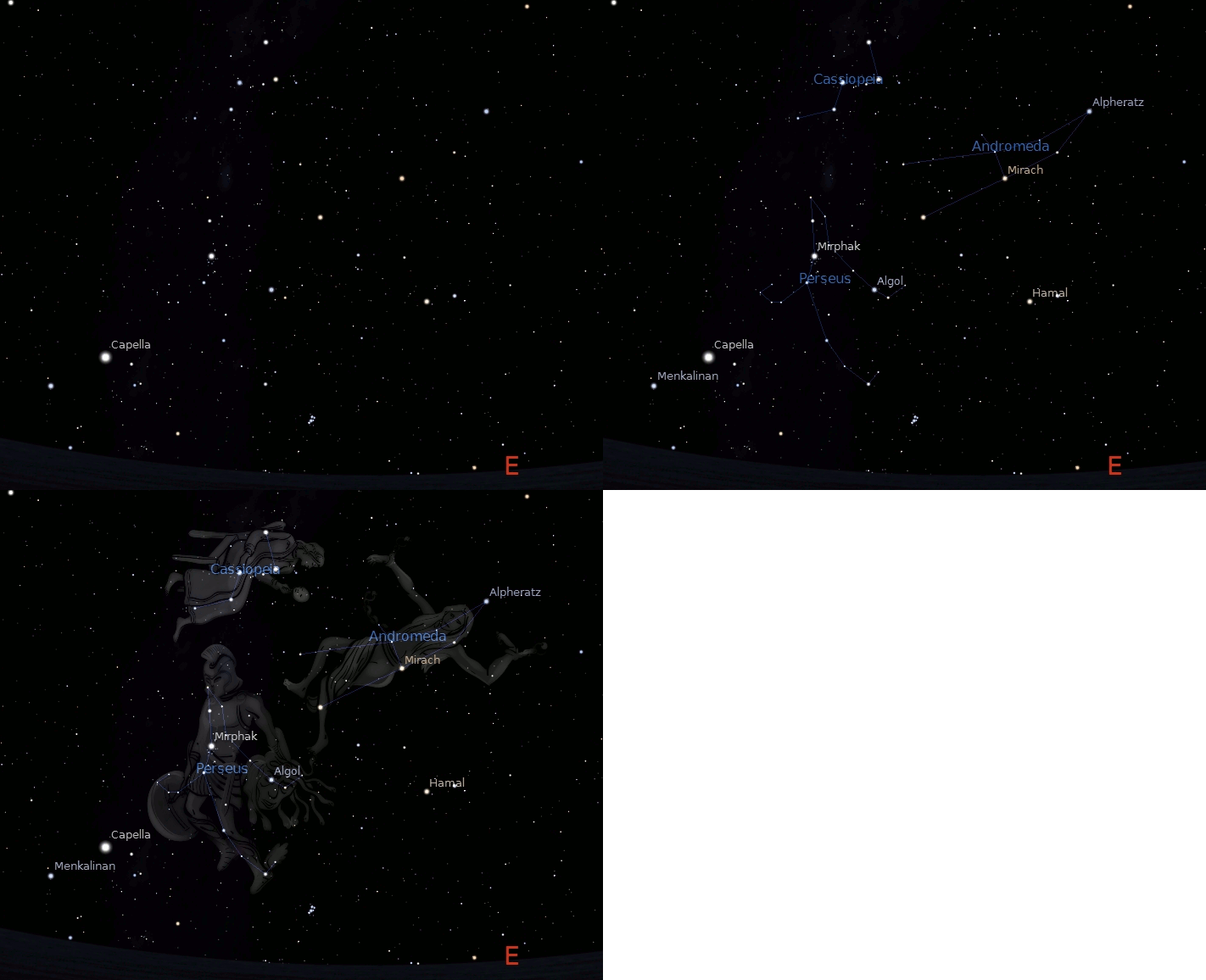
Perseus, Cassiopeia, Andromeda with Algol finder animation for Autumn evenings. Created using Stellarium and GIMP.
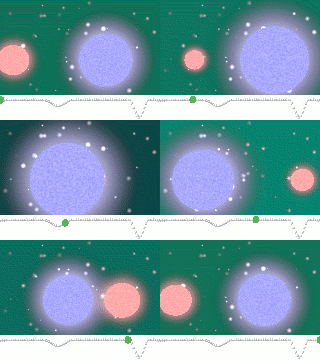
Animation of an eclipsing binary star like Algol. Credit: Wikimedia Commons h/t Earth and Sky
10/27/2017 – Ephemeris – Tomorrow night is International Observe the Moon Night in downtown Traverse City
Ephemeris for Friday, October 27th. The Sun will rise at 8:13. It’ll be up for 10 hours and 24 minutes, setting at 6:38. The Moon, at first quarter today, will set at 12:44 tomorrow morning.
The annual International Observe the Moon Night will be observed this Saturday evening. Members of the Grand Traverse Astronomical Society will be stationed on the north side of the 200 block of East Front Street. Starting at 7 p.m. near Orvis Streamside and will be moving our telescopes eastward from time to time to keep up with the westward sinking motion of the Moon over the single story buildings to the south as long as we can. The moon will be a day past first quarter with lots of craters and lunar seas visible in telescopes. The society will also have some giveaway items from NASA for the young and not so young. The event will be canceled due to heavy overcast or other inclement weather.
The times given are for the Traverse City/Interlochen area of Michigan. They may be different for your location.
Addendum
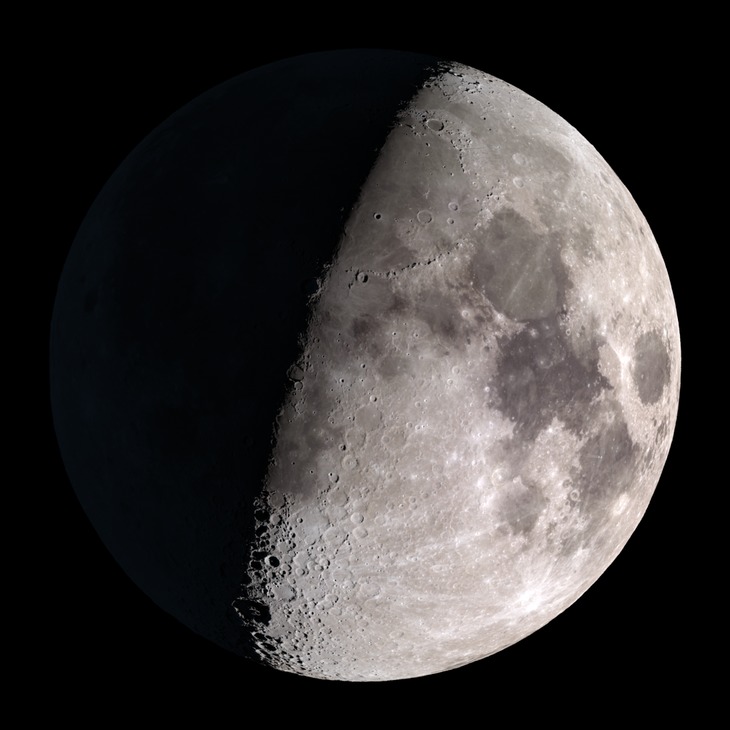
The Moon about as it would appear tomorrow night, October 28, 2017 at 8 p.m. Credit: NASA/Ernie Wright.
10/26/2017 – Ephemeris – Jupiter at perihelion and 96P/Comet Machholz 1 rounds the Sun
Ephemeris for Thursday, October 26th. The Sun will rise at 8:12. It’ll be up for 10 hours and 27 minutes, setting at 6:39. The Moon, 1 day before first quarter, will set at 11:48 this evening. | Today at 2:02 in the afternoon the planet Jupiter will be in conjunction with the Sun, moving from east to west with respect to the Sun. Leaving the evening sky to enter the morning sky. While invisible from the Earth’s surface. There are cameras recording the Sun at all times that will also pick up Jupiter. Two on the Solar and Heliospheric Observatory perched a million miles sunward of the Earth. are chronagraphs, and contain disks that block out the light of the Sun creating total eclipses. The planet will pass above or north of the Sun. The easiest way to find these images is to go to spaceweather.com, go down to the link section and select Solar and Heliospheric Observatory and click on The Sun Now. The images to check out at the two LASCO images.
The times given are for the Traverse City/Interlochen area of Michigan. They may be different for your location.
Addendum
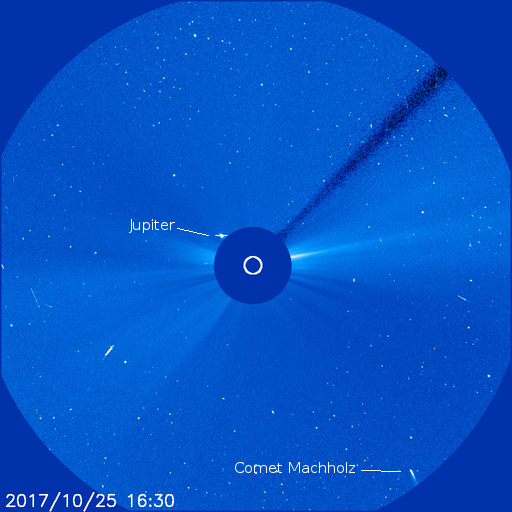
The current LASCO C3 image at this blog’s posting time Credit: ESA/NASA/SOHO.
Jupiter is about to be covered by the LASCO C3 coronagraph’s occulting disk. It will still be visible in the C2 field. As an extra bonus Comet 96P/Machholz entered the LASCO C3 field of view on the 25th and will exit on the 30th.
To follow Jupiter’s progress check out these animated GIFs: https://sohowww.nascom.nasa.gov/data/LATEST/current_c3.gif and https://sohowww.nascom.nasa.gov/data/LATEST/current_c2.gif.
Note that these animations will be current as of the date you click on them.
10/25/2017 – Ephemeris – Looking for the bright planets
Ephemeris for Wednesday, October 25th. The Sun will rise at 8:11. It’ll be up for 10 hours and 30 minutes, setting at 6:41. The Moon, 2 days before first quarter, will set at 10:56 this evening.
Let’s take our weekly look at the bright planets. Jupiter, will leave the evening sky and enter the morning sky tomorrow as it moves behind the Sun though not directly behind. Saturn is sinking lower in the southwestern sky in the evening. Saturn’s rings are still spectacular in telescopes, but since Saturn is so low in the sky the turbulence of the thick atmosphere makes Saturn fuzzy and seemingly to go in and out of focus. Saturn will set at 9:27 p.m.
Tomorrow in the morning sky, Mars, heading away from the Sun will rise in the east at 5:29 a.m., Venus, is heading closer to the Sun, will rise at 6:34 in the east. Mercury has moved into the evening sky 10 days ago, but will not be easily visible even at its greatest elongation a month from now.
The times given are for the Traverse City/Interlochen area of Michigan. They may be different for your location.
Addendum
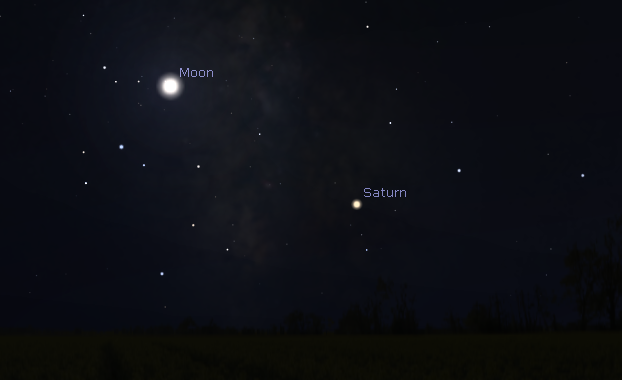
Saturn and the Moon at 8 p.m., October 25, 2017. Created using Stellarium
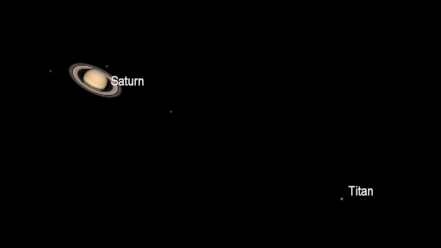
Saturn and Titan as it might be seen in a telescope. October 25, 2017. Created using Cartes du Ciel (Sky Charts).
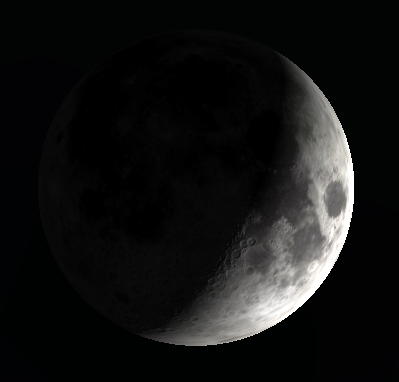
The Moon as it might be seen in binoculars at 8 p.m., October 25, 2017. Created using Stellarium.
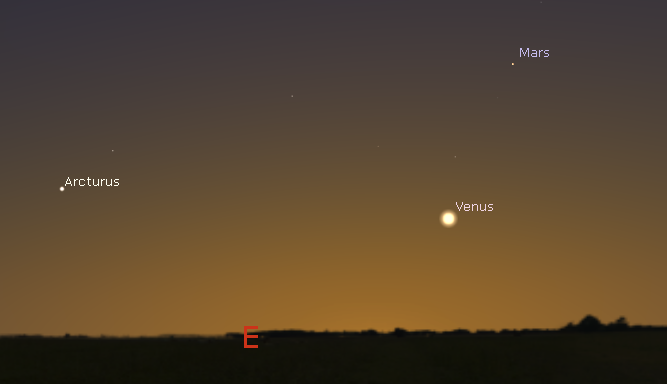
Mars and Venus at 7:30 a.m. October 26, 2017. Create using Stellarium.
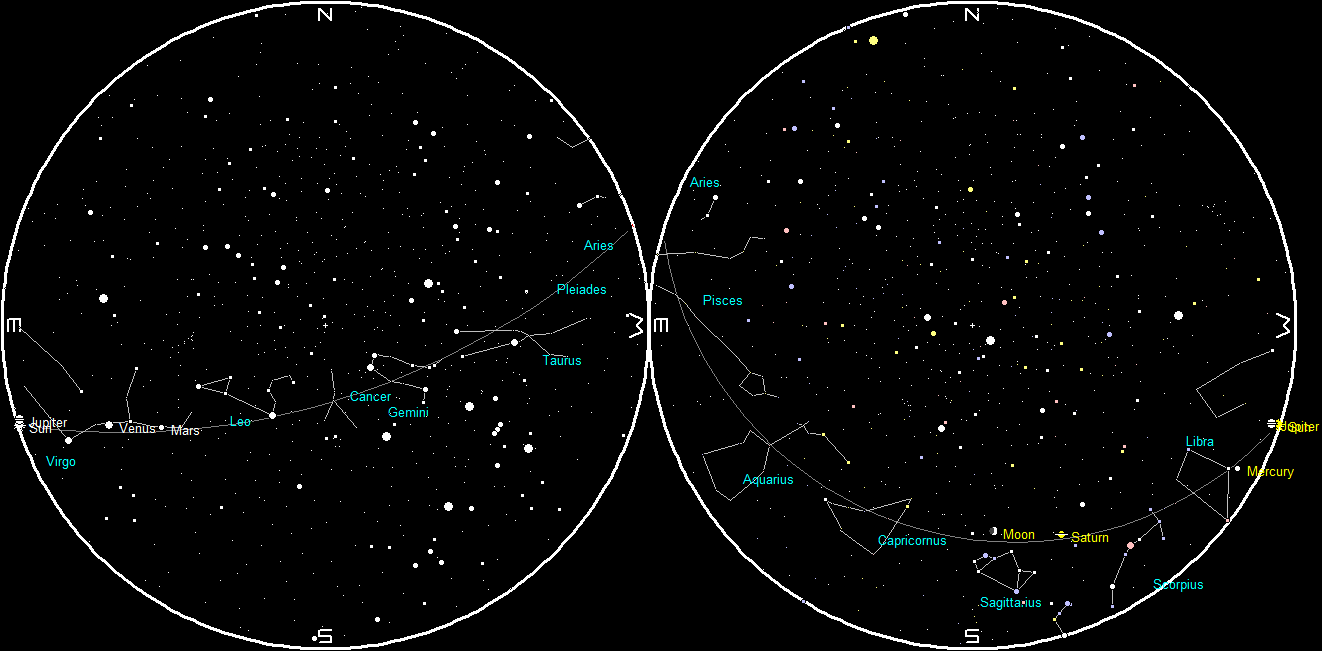
Planets at sunset and sunrise of a single night starting with sunset on the right on October 25, 2017. The night ends on the left with sunrise on the 26th. Click on the image to enlarge. Created using my LookingUp program.
10/24/2017 – Ephemeris – Saturn and the Moon tonight
Ephemeris for Tuesday, October 24th. The Sun will rise at 8:09. It’ll be up for 10 hours and 32 minutes, setting at 6:42. The Moon, 3 days before first quarter, will set at 10:09 this evening.
The crescent Moon will be in the southwest as it gets dark tonight. The planet Saturn will appear below and to the right of our satellite. Saturn has those gorgeous rings, which are visible at as low as 20 power scopes and hinted at lower magnifications. The Moon shows a fat crescent with two whole gray seas, Crises, nearest the limb, and below Fertility. Partially illuminated are Tranquility above and the small sea of Nectar. At the bottom end of that small sea is a horse shoe shaped crater called Fracastorius. It looks like the lava welling up from the Nectar asteroid impact washed down the walls of Fracastorius. The bottom part of the Moon is the lunar highlands of brighter rugged craters.
The times given are for the Traverse City/Interlochen area of Michigan. They may be different for your location.
Addendum
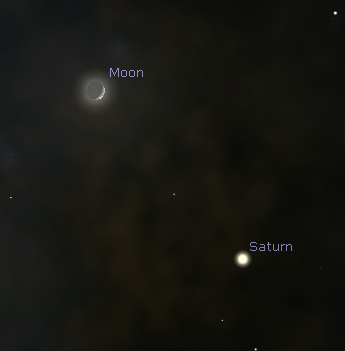
The Moon and Saturn at 8 p.m. October 24, 2017. Created using Stellarium.
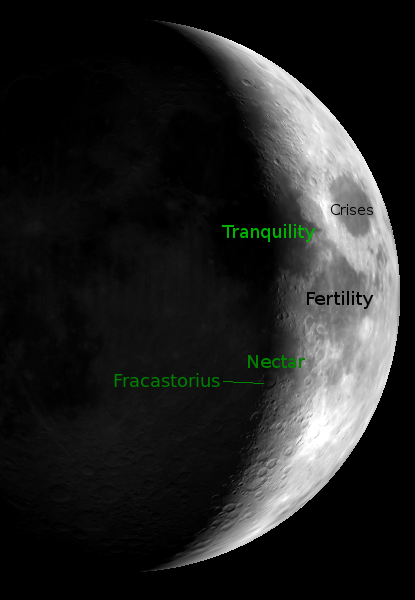
The Moon at 8 p.m. October 24, 2017 as it might be seen in binoculars. Created using Virtual Moon Atlas.
10/23/2017 – Ephemeris – The loneliest star in the sky
Ephemeris for Monday, October 23rd. The Sun will rise at 8:08. It’ll be up for 10 hours and 35 minutes, setting at 6:44. The Moon, half way from new to first quarter, will set at 9:27 this evening.
There’s a bright star that appears for only seven and a half hours on autumn evenings from northern Michigan. It’s appearance, low in the south at around 10:30 p.m. tonight, is a clear indication of the autumn season. The star’s name is Fomalhaut, which means fish’s mouth. That’s fitting because it’s in the constellation of Piscis Austrinus, the southern fish. At our latitude it’s kind of the fish that got away, because Fomalhaut appears to be quite alone low in the sky. The faintness of the constellation’s other stars and location close to the horizon make the dim stars hard to spot. The earth’s thick atmosphere near the horizon reduces their brightness by a factor of two or more, so Fomalhaut, one of the brightest stars in the sky, keeps a lonely vigil in the south.
The times given are for the Traverse City/Interlochen area of Michigan. They may be different for your location.
Addendum
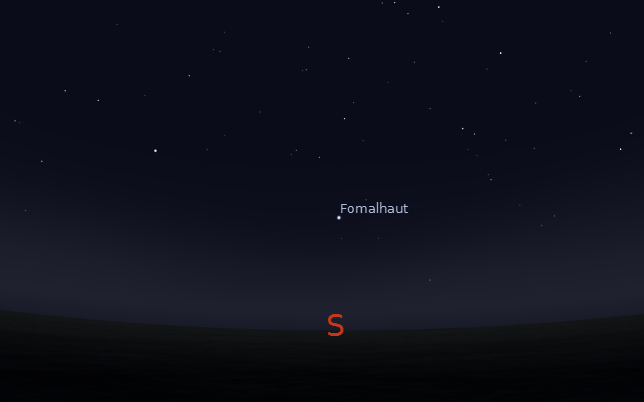
Fomalhaut in the south at 9:30 p.m. on October 23, 2017. Created using Stellarium.
10/20/2017 – Ephemeris – Last star party at Sleeping Bear Dunes this year is tomorrow night
Ephemeris for Friday, October 20th. The Sun will rise at 8:04. It’ll be up for 10 hours and 44 minutes, setting at 6:49. The Moon, 1 day past new, will set at 7:43 this evening.
A star party celebrating the 47th anniversary of the Sleeping Bear Dunes National Lakeshore will be held tomorrow evening, October 21 2017, starting at 8 p.m. at the Dune Climb if it’s clear. This is a change in location from some of the earlier notifications. It will be hosted by the Park Rangers and the Grand Traverse Astronomical Society. The society invites all to come, especially those with telescopes willing to share the wonders of the Milky Way, which will span the skies from horizon to horizon. The park has one of the darkest skies in the Lower Peninsula, and the Milky Way is especially impressive in late summer and early autumn. Please call 231-326-4700, ext. 5005 if in doubt about weather conditions. A decision will be made by 2 hours before the event.
The times given are for the Traverse City/Interlochen area of Michigan. They may be different for your location.
10/19/2017 – Ephemeris – Bits of Halley’s Comet will rain down on Earth this weekend
Ephemeris for Thursday, October 19th. The Sun will rise at 8:03. It’ll be up for 10 hours and 47 minutes, setting at 6:50. The Moon is new today, and won’t be visible.
The Orionid meteor shower is ramping up. This is the second of two visits of bits of Halley’s* comet this year, and every year, really. These are particles shed by the comet in past visits to the inner solar system. They are pretty much evenly strewn out along its orbit. The comet itself is now out past Neptune, and will reach aphelion, its farthest distance from the Sun around 2024, poised to head back to the inner solar system in 2061. It was last spotted in 2003 when it was just inside Neptune’s orbit. Anyway the Orionid meteors will appear to come from above the left side of constellation of Orion, about where the tip of his club is. They are best seen this weekend, in the early morning sky, with a possible 20 per hour visible.
Orionid meteor shower Saturday a.m.
The times given are for the Traverse City/Interlochen area of Michigan. They may be different for your location
* A contemporary of Edmund Halley, Samuel Pepys, spelled his name Hawley. We presume he pronounced it that way.
Addendum
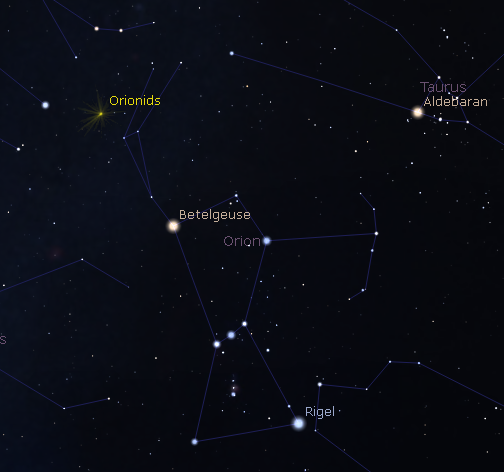
The Orionid meteor shower radiant at 5 a.m. October 21, 2017. The radiant rises at 11 p.m., so the meteors will be visible from then into morning twilight. Dispite the lication of the radiant, the meteors will b e seen all over the sky. However true Orionids can be traced back to the radiant point. Created using Stellarium.
10/18/2017 – Ephemeris – Our weekly look at the naked eye planets
Ephemeris for Wednesday, October 18th. The Sun will rise at 8:01. It’ll be up for 10 hours and 50 minutes, setting at 6:52. The Moon, 1 day before new, will rise at 7:39 tomorrow morning.
Let’s take our weekly look at the bright planets. Jupiter, for all intents and purposes is gone from the evening sky. It will cross into the morning sky next week Thursday. Saturn too is sinking lower in the southwestern sky in the evening. Saturn’s rings are still spectacular in telescopes, but since Saturn is so low in the sky the turbulence of the thick atmosphere makes Saturn fuzzy and seemingly to go in and out of focus. Saturn will set at 9:52 p.m.
Tomorrow in the morning sky, Mars, heading away from the Sun will rise in the east at 5:33 a.m., Venus, is heading closer to the Sun, will rise at 6:16 in the east. Mercury has moved into the evening sky 10 days ago, but will not be easily visible even at its greatest elongation a month from now.
The times given are for the Traverse City/Interlochen area of Michigan. They may be different for your location.
Addendum
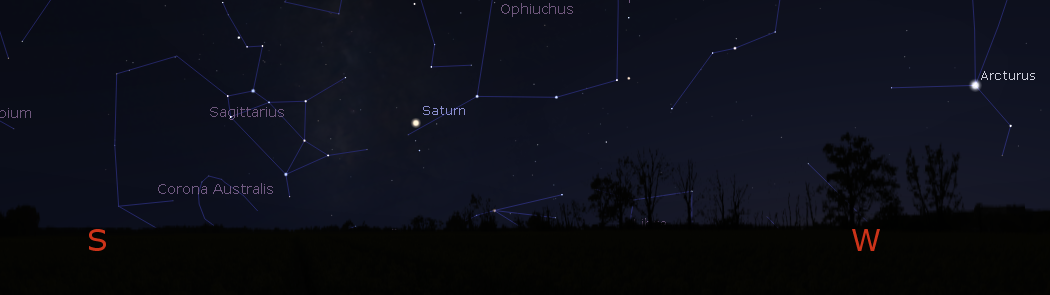
Saturn and the constellations of the evening tonight at 8:00 p.m., October 18, 2017. Click on the image to enlarge. Created using Stellarium.
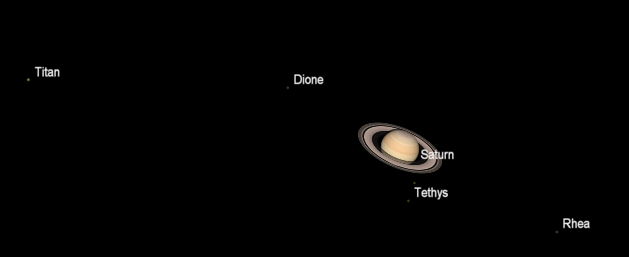
Saturn and its brightest moons on the evening of October 18, 2017. Created using Cartes du Ciel (Sky Charts).
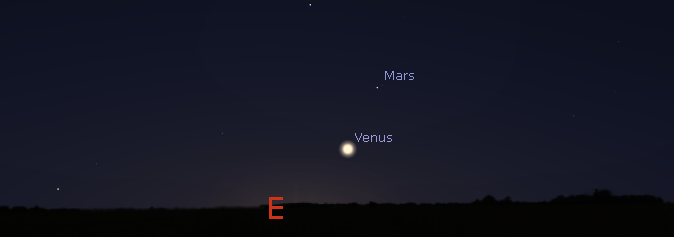
Mars and Venus at 7 a.m. October 19, 2017. Create using Stellarium.
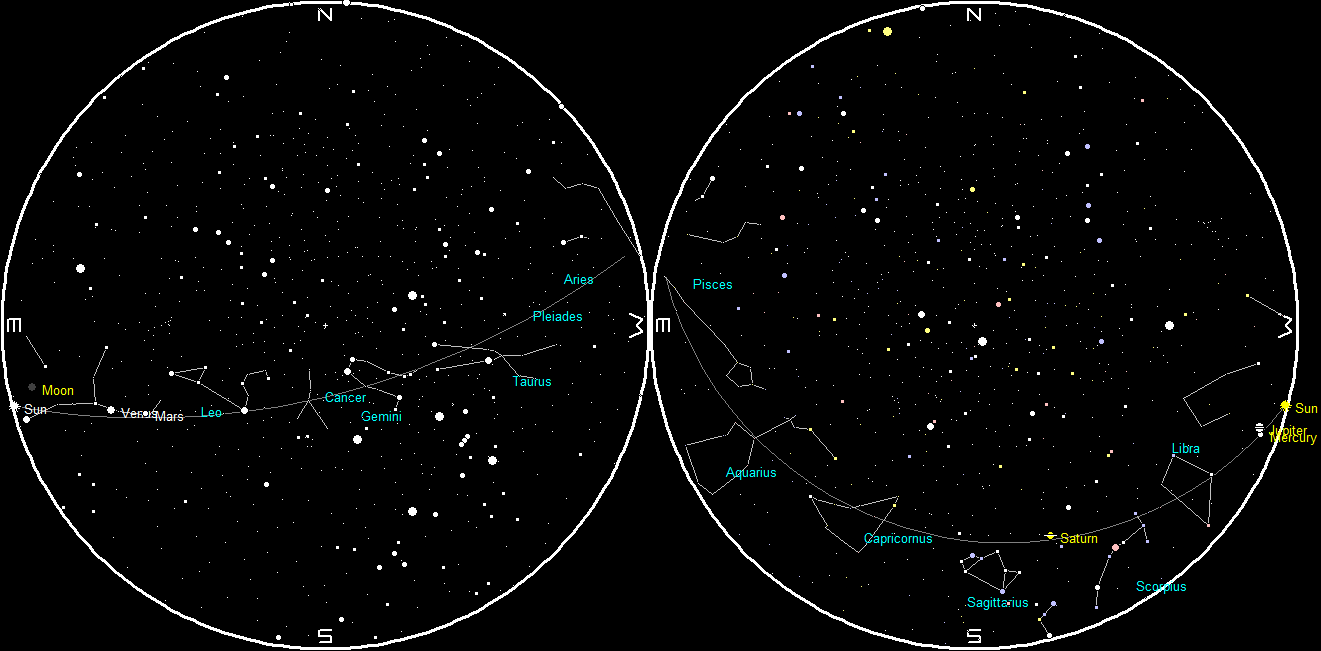
Planets at sunset and sunrise of a single night starting with sunset on the right on October 18, 2017. The night ends on the left with sunrise on the 19th. Click on the image to enlarge. Created using my LookingUp program.
10/17/2017 – Ephemeris – The Fisher paints the autumn leaves red
Ephemeris for Tuesday, October 17th. The Sun will rise at 8:00. It’ll be up for 10 hours and 53 minutes, setting at 6:54. The Moon, 2 days before new, will rise at 6:35 tomorrow morning.
This morning, if it’s clear the red planet Mars will appear just to the right of the thin crescent Moon. Mars isn’t the only thing that’s red now. So are the maple leaves as we advance into autumn. The native Anishinaabek peoples have a story about how that came to be. Of how a magical weasel-like creature called the Fisher or Ojiig brought summer to the Earth from Skyland. For his trouble he was shot with an arrow in his only vulnerable spot, the tip of his tail. As he fell to Earth the Great Spirit, Manitou caught him and placed him in the sky where we see the Great Bear (Ursa Major) and the Big Dipper. Every autumn we see his tail swoop down to the ground where his tail paints the leaves red with his blood.
The times given are for the Traverse City/Interlochen area of Michigan. They may be different for your location.
Addenda
The Moon and the morning planets this morning
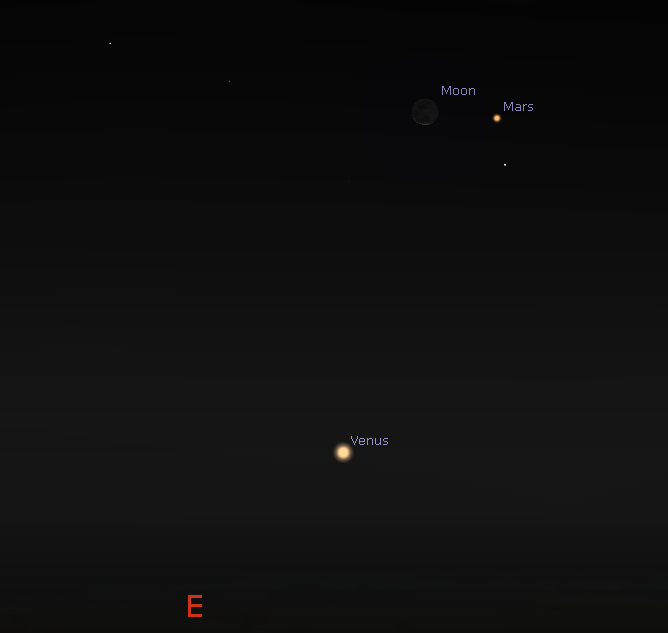
The Moon and Mars at 6:30 this morning October 17, 2017. Click on image to enlarge. Created using Stellarium.
At 00:21 UTC on the 18th Venus will be south of the Moon. It will be visible from Asia.
The Fisher (Ojiig) paints the trees with the autumn colors
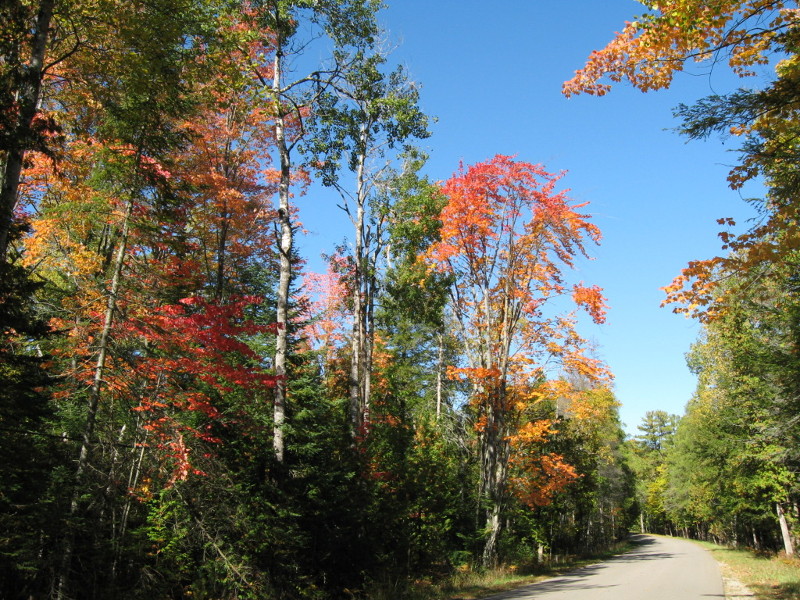
Autumn colors. My image.
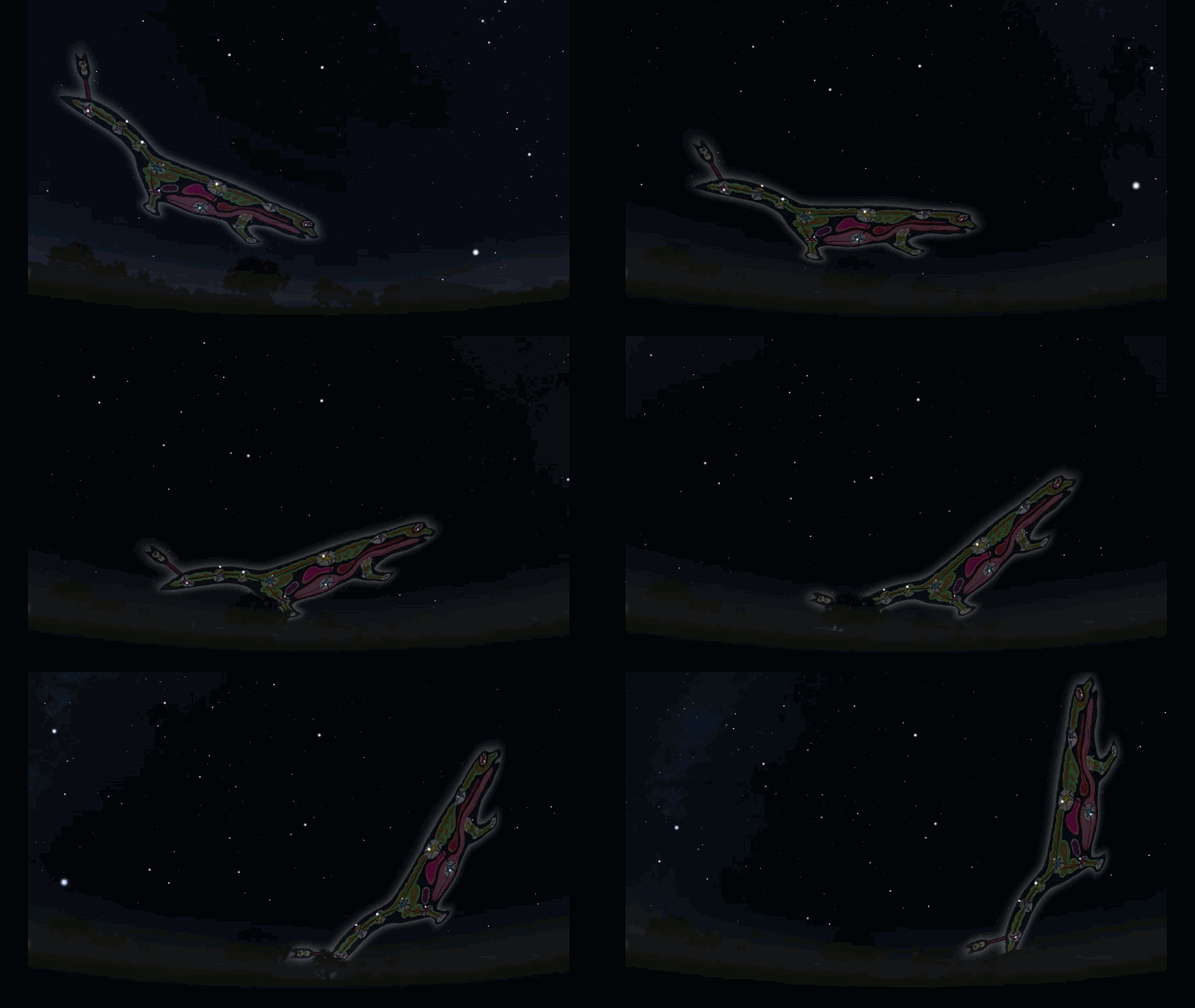
An animation of Fisher brushing his tail along the horizon on autumn nights. Click on image to enlarge. Created using Stellarium.
The constellation art is part of the latest versions of Stellarium. Ojibwe (Anishinaabek) constellation art by Annette S Lee and William Wilson from Ojibwe Sky Star Map Constellation Guide, ISBN 978-0-615-98678-4.
See the version of the story I learned: The story of the Fisher Star.
There are other variations of the story, and other adventures of the Fisher. Perform an Internet search for: Fisher or Fisher Star or Ojiig.

