01/06/2012 – Ephemeris – GTAS meeting and viewing night tonight
Friday, January 6th. The sun will rise at 8:19. It’ll be up for 8 hours and 58 minutes, setting at 5:17. The moon, 3 days before full, will set at 6:50 tomorrow morning.
The Grand Traverse Astronomical Society will have its first meeting of the year tonight at 8 p.m. at the Northwestern Michigan College’s Rogers Observatory. Following will be a public viewing night featuring the moon and Jupiter. This year the first viewing night of the month will come at the end of the society meeting at 9 o’clock. Come for both. The presentation for the meeting will be NMC Astronomy Club member Storm Strausheim and her topic will be those mysterious stellar cannibals – Black Holes. The observatory is located on Birmley Road between Keystone and Garfield roads. April through October this year there will be a second viewing night at the observatory later in the month.
* Times, as always are for the Traverse City/Interlochen area of Michigan.
01/05/2012 – Ephemeris – Viewing planets with that new telescope
Thursday, January 5th. The sun will rise at 8:19. It’ll be up for 8 hours
and 57 minutes, setting at 5:16. The moon, half way from first quarter to full, will set at 5:59 tomorrow morning.
Trying out that new Christmas telescope can be challenging on cold winter nights. Set it up indoors first and get used to it. The moon and planets are the easiest targets for the new telescope owner. Locate the moon first if it’s out as it is tonight and make sure that small telescope or reflex finder that pots a red dot on the object is aligned with the telescope. Then you can go off and locate the planets. Venus is nice and bright in the southwest early in the evening. A telescope will show a tiny nearly circular orb. But wait a couple of months and it will become a large crescent. Jupiter is always a great sight with its four moon shuttling from one side to the other of the planet from night to night. And don’t forget Jupiter itself with its cloud bands.
* Times, as always are for the Traverse City/Interlochen area of Michigan.
01/04/2012 – Ephemeris – The planets this week and the earth at perihelion
Wednesday, January 4th. The sun will rise at 8:19. It’ll be up for 8 hours and 56 minutes, setting at 5:15. The moon, 3 days past first quarter, will set at 5:03 tomorrow morning.
It’s the first Wednesday of 2012 and time again to take a look at the whereabouts of the bright planets. The planet Venus is brilliant in the southwestern sky after sunset setting at 8:07. Jupiter is the most prominent planet of the evening sky, once Venus sets. It’s located high in the south and is seen against the stars of the constellation Aries. It will pass due south at 7:41 p.m. It will set at 2:26 a.m.. Mars will rise at 10:52 p.m in the east northeast and is below the hind end of the constellation Leo the lion. It is 92.4 million miles away and closing. Saturn will rise at 2:07 a.m. just to the left of the bright star Spica in the east southeast. The sun is its closest to earth of the entire year today. Only 91.3 million miles away.
* Times, as always are for the Traverse City/Interlochen area of Michigan.
01/03/2012 – Ephemeris – The Quadrantid meteor shower tomorrow morning
January 3rd. The sun will rise at 8:19. It’ll be up for 8 hours and 55 minutes, setting at 5:14. The moon, 2 days past first quarter, will set at 4:04 tomorrow morning.
Tomorrow morning will see the peak of the Quadrantid meteor shower. They will be best seen after 4 a.m. and before twilight starts at 6:34. The radiant will appear high in the sky then near the handle of the Big Dipper. The meteors or shooting stars will appear to come from there but will appear all over the sky. The shower is named for the constellation that they appear to come from, unfortunately the constellation didn’t survive. It was supposed to represent a mural quadrant, and old astronomical measuring tool that was built into a north-south wall to measure the altitude of stars as the crosses due south before the advent of the telescope. The Quadrantids can be a spectacular shower and viewing can be endangered by cold feet and hands.
* Times, as always are for the Traverse City/Interlochen area of Michigan.
Addendum
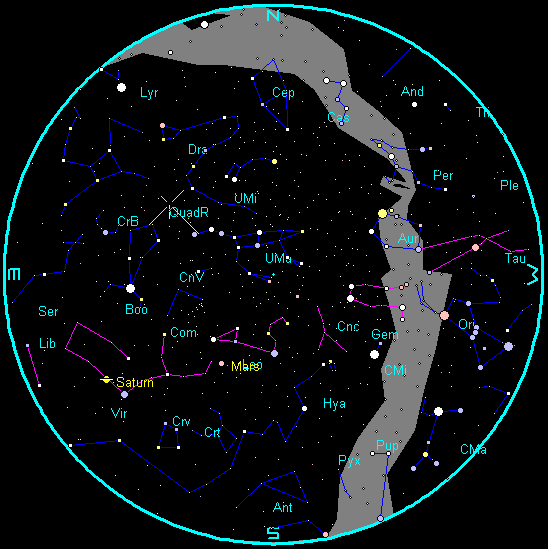
All sky Quadrantid radiant finder chart for 4 a.m.
01/02/2012 – Ephemeris – The moon and Jupiter and telescope tips
Monday, January 2nd 2012. The sun will rise at 8:19. It’ll be up for 8 hours and 54 minutes, setting at 5:13. The moon, 1 day past first quarter, will set at 3:04 tomorrow morning.
Tonight the bright planet Jupiter will appear below the moon. This is a great time to try out that new telescope or binoculars, or dig that old one out of the closet or attic. With a telescope use the lowest power to locate the moon and get an overview. The bright southern part of the moon, which may appear at the top of the image, because telescopes normally invert the image is heavily cratered. The other part has several dark nearly flat structures called seas. These are really huge craters that caused the internal lava to well up, making the smooth floors. Recently some astronomers hypothesized that a second moon was created with ours and that it crashed into our moon creating the lunar seas.
* Times, as always are for the Traverse City/Interlochen area of Michigan.
Addendum
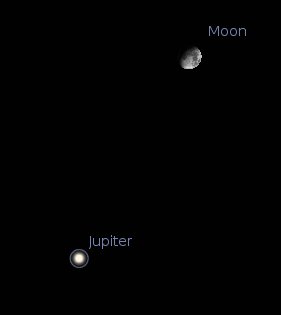
Jupiter appears below moon Jan 2, 2012 9 p.m. Created using Stellarium.
12/30/11 – Ephemeris – The best 2012 astronomical events
Friday, December 30th. The sun will rise at 8:19. It’ll be up for 8 hours and 51 minutes, setting at 5:10. The moon, 2 days before first quarter, will set at 12:02 tomorrow morning.
Let’s look ahead at next year’s astronomical events for this last Ephemeris of 2011. What won’t happen will be the end of the world on December 21st. There is no planet Nibiru. The closest alignment of the sun at the winter solstice and the center of the galaxy was in 1997. What will happen is partial eclipse of the sun, or about a half hour of it, before sunset on May 20th. An extremely rare transit of Venus, that is the planet Venus will cross the face of the sun on June 5th for us. We’ll see about 3 hours of it before sunset that day. The sun will continue to be more active next year with more sunspots and more displays of the northern lights. It will also be a good year for the Perseid meteor shower of August and the Geminids of December.
* Times, as always are for the Traverse City/Interlochen area of Michigan.
12/29/11 – Ephemeris – Astronomical highlights from 2011
Thursday, December 29th. The sun will rise at 8:18. It’ll be up for 8 hours and 51 minutes, setting at 5:10. The moon, 3 days before first quarter, will set at 11:00 this evening.
Let’s look at the best astronomical events of 2011. To my mind Comet Lovejoy’s survival near the sun is one. The announcements from the Kepler satellite keep coming in. Over 2000 planets in other solar systems suspected including a planet 2.4 times the size of the earth in its star’s habitable zone, two planets of another star about the size of the earth and a planet with two suns. A fourth moon of Pluto was discovered, worrying scientists operating the New Horizons spacecraft that will reach Pluto in 3 and a half years that there may be a debris field around the dwarf planet. This year the MESSENGER satellite gained orbit of the innermost planet Mercury, and the Dawn spacecraft began orbiting the asteroid Vesta. Those are just a sample.
* Times, as always are for the Traverse City/Interlochen area of Michigan.
12/28/11 – Ephemeris – Where are the planets this week?
Wednesday, December 28th. The sun will rise at 8:18. It’ll be up for 8 hours and 50 minutes, setting at 5:09. The moon, half way from new to first quarter, will set at 9:56 this evening.
It’s Wednesday and time again to take a look at the whereabouts of the bright planets. The planet Venus is prominent in the southwestern twilit sky after sunset setting at 7:48 after the end of twilight. Jupiter is the most prominent planet of the evening sky, once Venus sets. It’s located high in the south and is seen against the stars of the constellation Aries. It will pass due south at 8:08 p.m. It will set at 2:53 a.m.. Mars will rise at 11:08 p.m in the east northeast and will be in the constellation Leo. Mars will be due south at 5:38 a.m. It is 98.4 million miles away and closing. Saturn will rise at 2:32 a.m. just to the left of the bright star Spica in the east southeast. Of all the planets, Jupiter and Saturn look best in that new Christmas telescope.
* Times, as always are for the Traverse City/Interlochen area of Michigan.
12/27/11 – Ephemeris – The constellation of Eridanus the river
Tuesday, December 27th. The sun will rise at 8:18. It’ll be up for 8 hours and 50 minutes, setting at 5:08. The moon, 3 days past new, will set at 8:49 this evening.
One of the more obscure constellations around is Eridanus, which depicts a river. The river starts near the lower right corner of Orion, near the bright star Rigel and flows to the right then down near the southwestern horizon, then it meanders along the horizon to the south before turning below the horizon. One has to travel to the far south to see the southern terminus of the river, the bright star Achernar. Writers over the ages have seen here the Nile and the earth circling river Ocean of the flat earth days. Achernar was recently discovered to be the flattest star, due to its rapid spin. The dimensions of Achernar have been determined to be twice as wide across its equator than from pole to pole. It’s 139 light years away.
* Times, as always are for the Traverse City/Interlochen area of Michigan.
Addendum
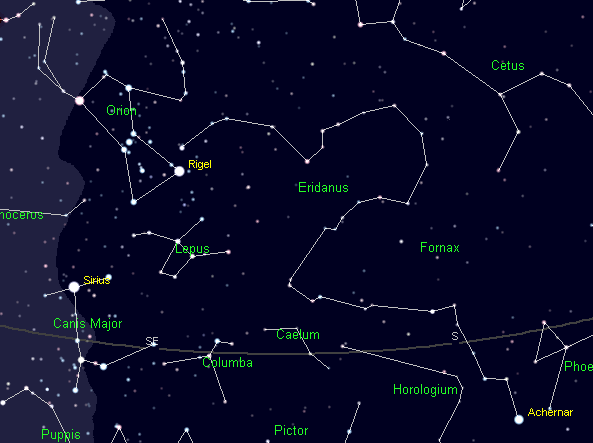
The constellation Eridanus the river, both above and below the horizon. Created using Cartes du Ciel.
The light curved line with the directions SE and S s the horizon from Traverse City, MI.
12/26/11 – Ephemeris – Comet Lovejoy wows southern hemisphere observers
Monday, December 26th. The sun will rise at 8:18. It’ll be up for 8 hours and 49 minutes, setting at 5:07. The moon, 2 days past new, will set at 7:40 this evening.
Comet Lovejoy has been the morning Christmas comet for folks in the southern hemisphere for the past week. After whipping around the sun and losing its tail comet Lovejoy grew another brighter tail that has been greeting early risers in the southern hemisphere since the 17th.. It surprised the astronauts on the International Space Station, who were not given the heads up in advance. However they did get some great time lapse movies of the comet rising. From the ground the tail rose for 40 or so minutes before the head. The comet is moving away from the sun so its heads out tail first. Comet Lovejoy hasn’t made it big on normal news channels, but astronomical sites on the Internet have been buzzing with the latest news.
* Times, as always are for the Traverse City/Interlochen area of Michigan.
Addendum
www.spaceweather.com is a great place to start. Look in their archives for the past week too.

