Ephemeris: 03/12/24 – The story of the twins of Gemini
This is Bob Moler with Ephemeris for Tuesday, March 12th. Today the Sun will be up for 11 hours and 46 minutes, setting at 7:45, and it will rise tomorrow at 7:57. The Moon, 2 days past new, will set at 11:07 this evening.
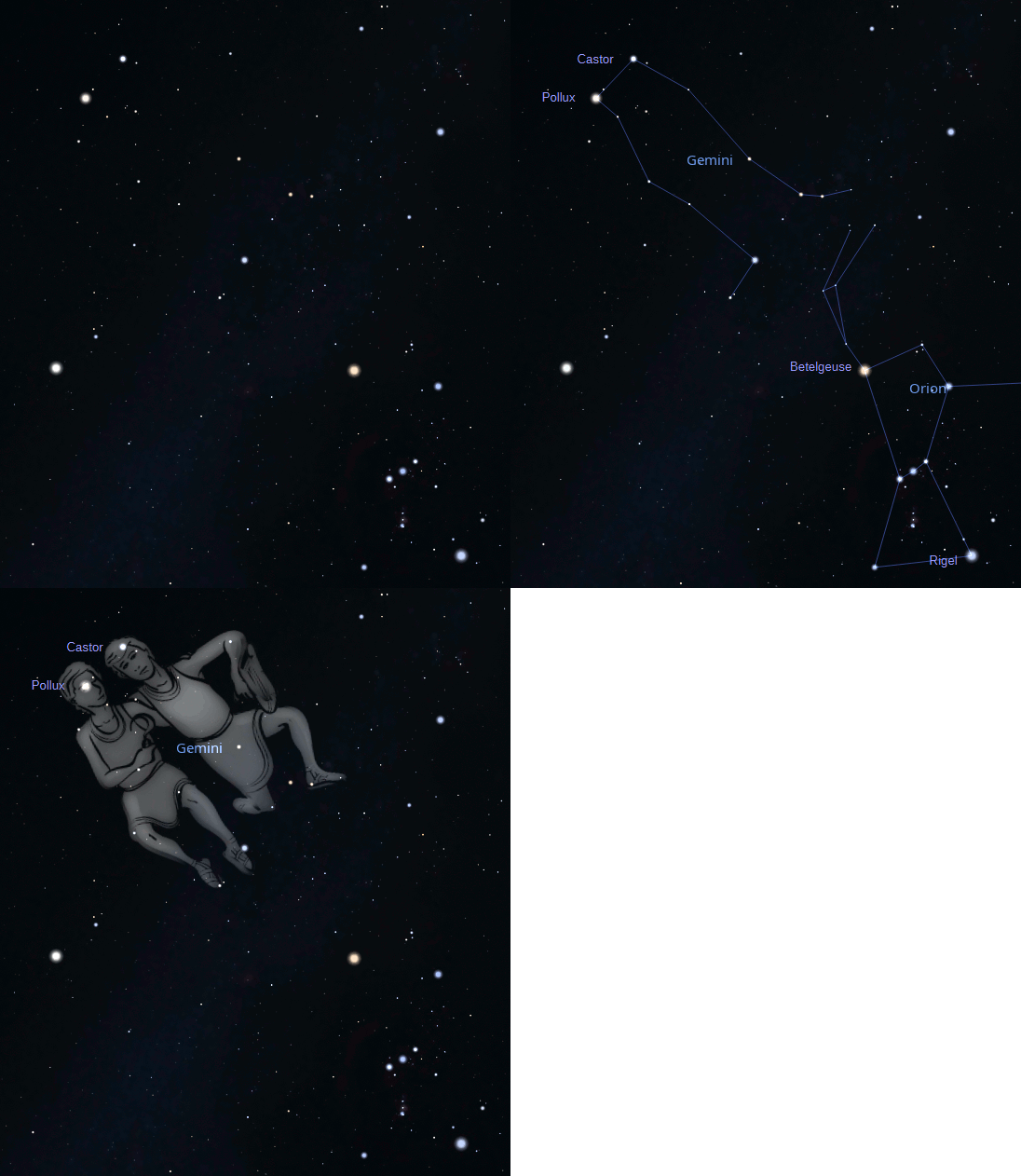
A week ago I talked about how to find the constellation of Gemini the twins above and to the left of the constellation Orion. Today I’ll talk about their story. Gemini the twins are fraternal twins, Castor and Pollux. Their namesake stars are the brightest in Gemini, with Castor above and the brighter Pollux below and left. Pollux was fathered by the god Zeus who raped his mother in the Leda and the Swan incident, while Castor was fathered by a mortal. They both went on the quest for the Golden Fleece with Jason and the Argonauts. Unfortunately Castor was killed. Pollux loved his brother so much he petitioned Zeus for him to die also and join Castor in the underworld. Instead, Zeus placed them both in the sky where we see them as Gemini.
The astronomical event times given are for the Traverse City/Interlochen area of Michigan (EDT, UT–4 hours). They may be different for your location.
Addendum

Ephemeris: 03/11/2024 – The Moon and the month
This is Ephemeris for Monday, March 11th. Today the Sun will be up for 11 hours and 43 minutes, setting at 7:44, and it will rise tomorrow at 7:59. The Moon, 1 day past new, will set at 9:44 this evening.
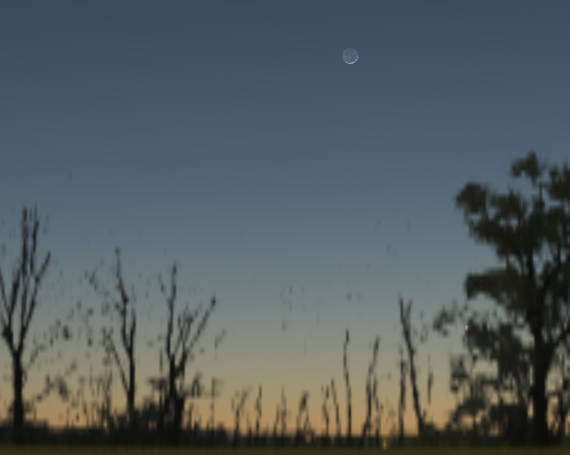
Tonight’s one-day old moon can be seen in the West shortly after sunset. Astrophysicist Dr. Rebecca Smethurst has a channel on YouTube under the name Dr. Becky. She calls it a toenail moon, because it looks like a toenail clipping. If you look real close, the rest of the Moon may be there. It’s not your eyes playing tricks on you, it’s the Earth shining on the Moon, illuminating the night side of it. For those using lunar calendars this would be day one or two of the lunar month. Since astronomically the Moon was new at 4 am yesterday morning our time. Folks in Europe and Asia may have seen the Moon in the sky last night. The Islamic lunar calendar requires the actual sighting of the new moon to start the month.
The astronomical event times given are for the Traverse City/Interlochen area of Michigan (EST, UT –5 hours). They may be different for your location.
Addendum
A note: being a leap year I will have more than my normal amount of posts about the calendar and problems with the calendar.
Ephemeris: 03/08/2024 – We’re one month away from the last Great American Eclipse for the next 21 years
This is Bob Moler with Ephemeris for International Women’s Day, Friday, March 8th. Today the Sun will be up for 11 hours and 33 minutes, setting at 6:40, and it will rise tomorrow at 7:05. The Moon, 2 days before new, will rise at 7:01 tomorrow morning.
We are exactly one month from our total solar eclipse this year, so I hope you’ve gotten your eclipse glasses or whatever else you need to safely view the Sun, or make plans to drive to the path of totality. This weekend we have a time change, spring forward to daylight savings time. It’s something I don’t look forward to, because it pushes the darkness in the evening out one more hour later. Not only does the sunset later each night, but we mess with the clocks to make it even later. By the end of June and early July twilight doesn’t officially end until after midnight. Then we only get 4 1/2 hours of darkness anyway if the Moon wasn’t out.
The astronomical event times given are for the Traverse City/Interlochen area of Michigan (EST, UT –5 hours). They may be different for your location.
Addendum
Ephemeris: 03/07/2024 – There’s a unicorn in there somewhere
This is Bob Moler with Ephemeris for Thursday, March 7th. Today the Sun will be up for 11 hours and 30 minutes, setting at 6:39, and it will rise tomorrow at 7:06. The Moon, 3 days before new, will rise at 6:35 tomorrow morning.
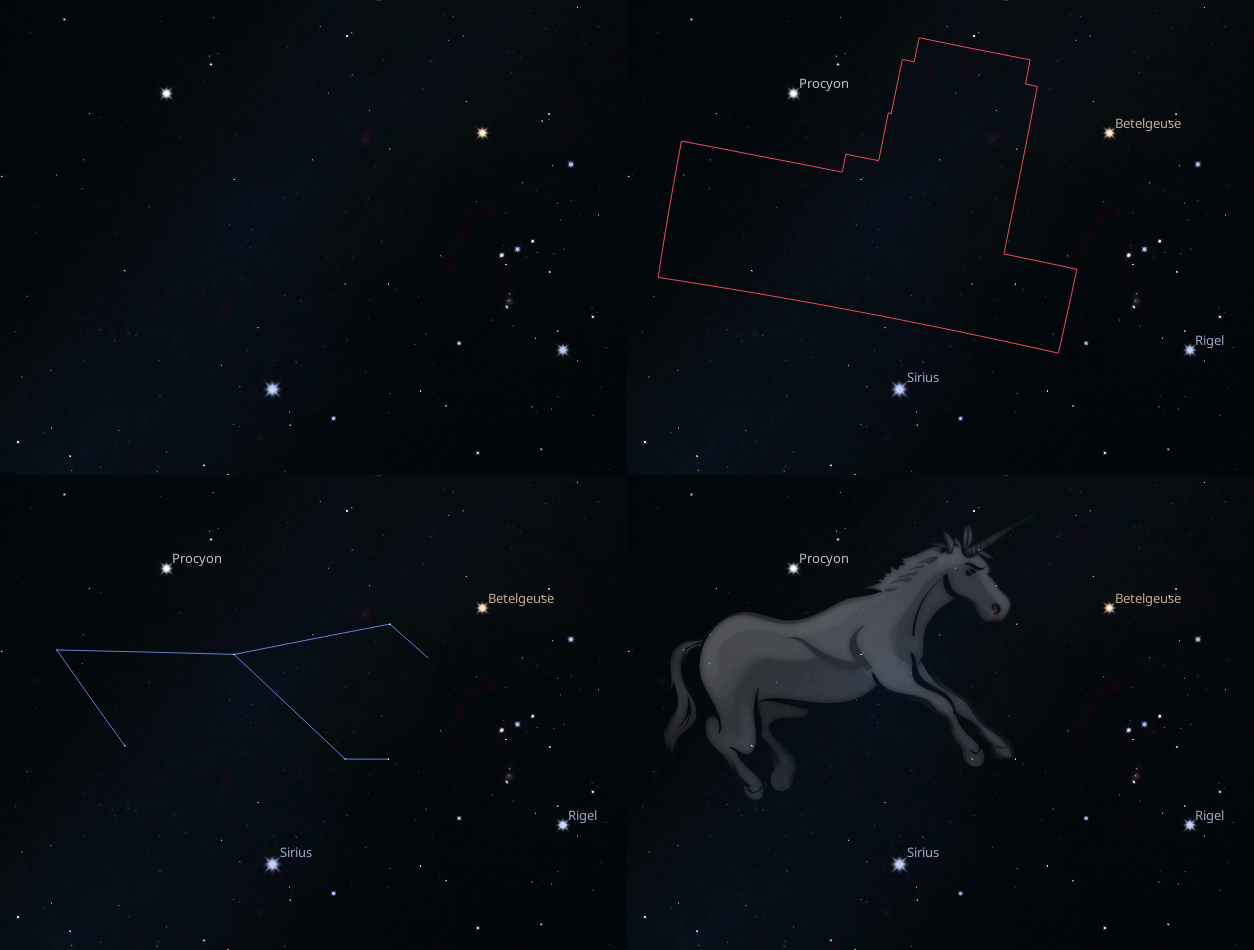
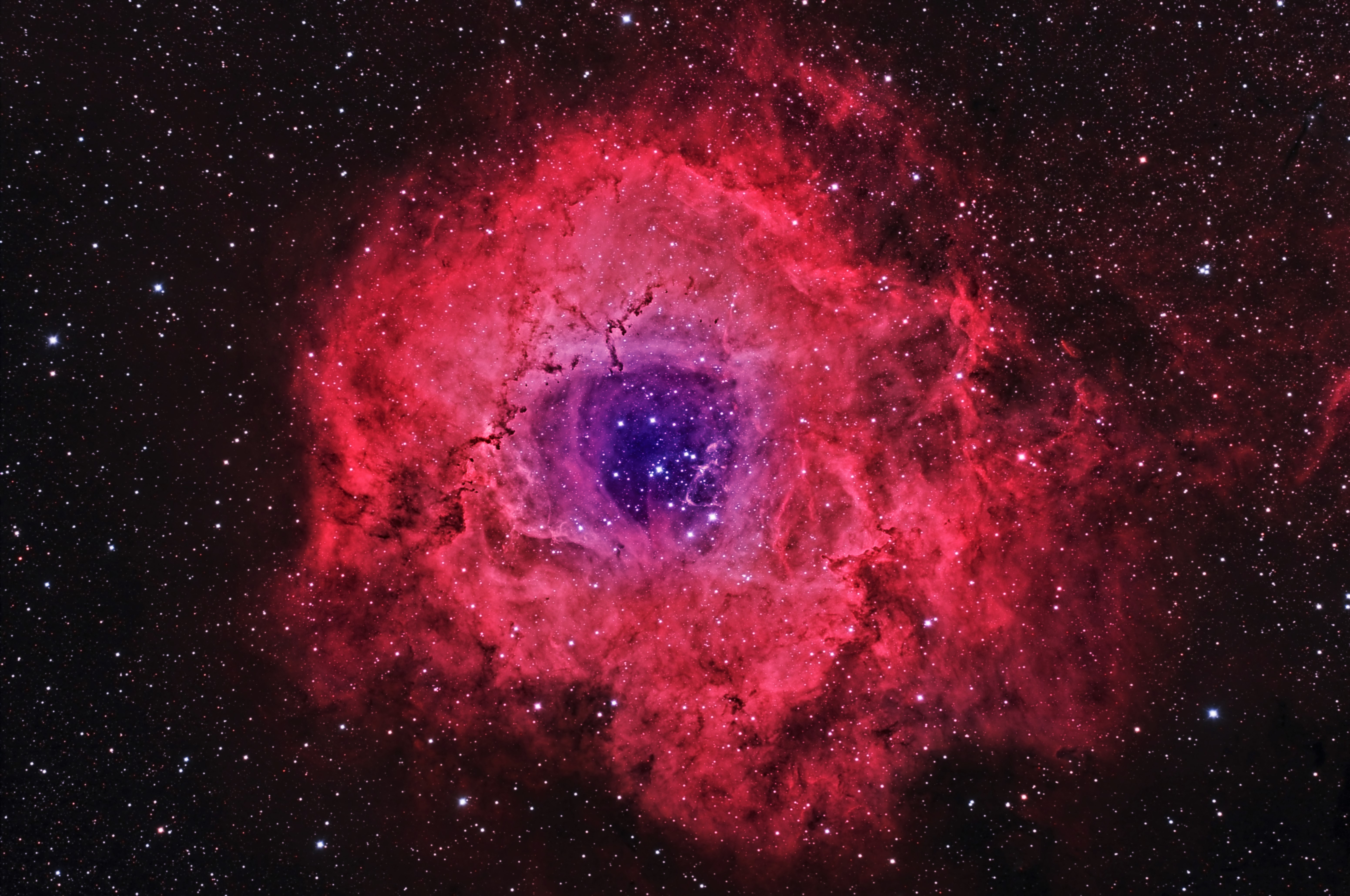
The constellation of Monoceros the unicorn is located in an area of sky to the left of Orion so it’s in the south at 8 pm, inside the Winter Triangle of stars, Betelgeuse in Orion; Sirius in the Great Dog, Canis Major; and Procyon in Canis Minor. If you don’t see anything there, it’s OK. Nobody sees real unicorns any more anyway. Are there any real unicorns? Anyway, there’s a great number of nebulae here in the Milky Way that runs through it, which unfortunately are too faint to be seen with amateur telescopes. However, it is a gold mine for amateur astronomers who are also astrophotographers using time exposures to record the faint nebulae here, including the famous Rosette Nebula!
The astronomical event times given are for the Traverse City/Interlochen area of Michigan (EST, UT –5 hours). They may be different for your location.
Addendum
Ephemeris: 03/06/2024 – Where have the naked-eye planets wandered off to this week?
This is Ephemeris for Wednesday, March 6th. Today the Sun will be up for 11 hours and 27 minutes, setting at 6:37, and it will rise tomorrow at 7:08. The Moon, 3 days past last quarter, will rise at 6:03 tomorrow morning.
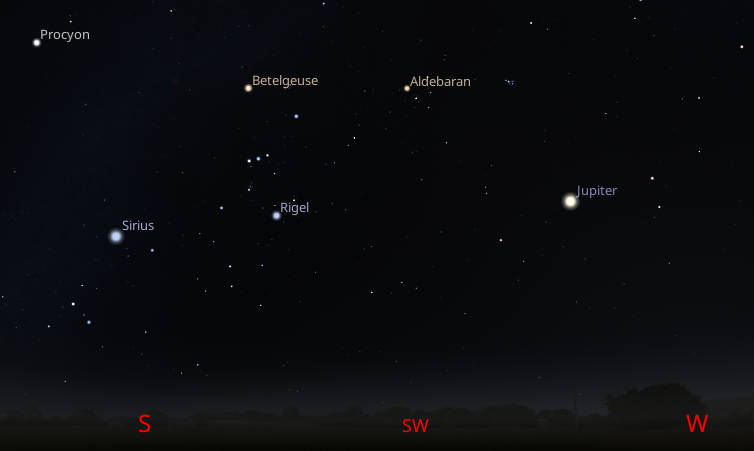
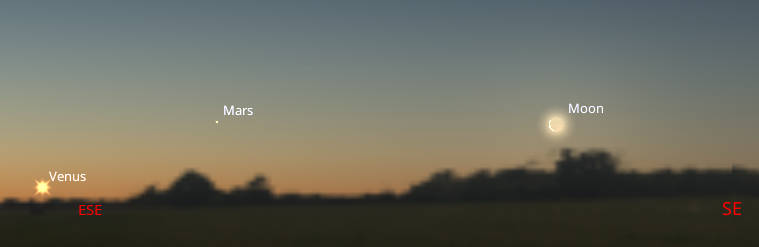
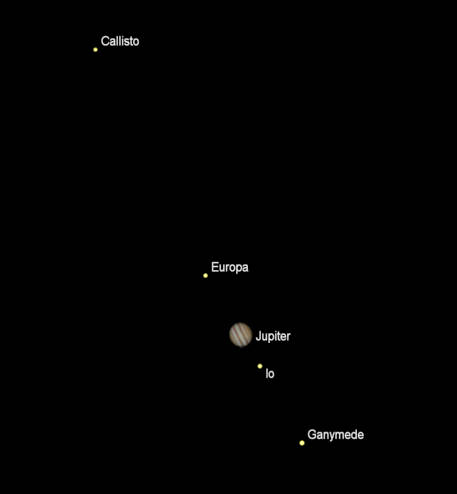
Let’s find out where the naked-eye planets have wandered off to this week, and see what planets are left. Saturn, and Mercury are gone, too close to the Sun to be seen. Jupiter will be in the west-southwest at 8 this evening. It will set at 11:25 pm in the west. Jupiter will be visible in the evening for only about another month or so. Venus, the morning star, will rise in the east-southeast at 6:23 am, but its brilliance is diminished by the bright twilight and its low position in the sky. It will be very low in the east-southeast at 6:45 am. Mars might be impossible to spot, being a bit to the right and above Venus. A pair of binoculars, at least, will be needed to spot it. It is about the width of the field of binoculars from Venus.
The astronomical event times given are for the Traverse City/Interlochen area of Michigan (EST, UT –5 hours). They may be different for your location.
Addendum
Ephemeris: 03/05/2024 – Finding Gemini the twins
This is Ephemeris for Tuesday, March 5th. Today the Sun will be up for 11 hours and 24 minutes, setting at 6:36, and it will rise tomorrow at 7:10. The Moon, 2 days past last quarter, will rise at 5:22 tomorrow morning.
The constellation of Gemini the twins can be seen high in the south at 8 pm tonight. It’s located above and left of the constellation of Orion. The two brightest stars at the upper left of the constellation have the twin’s names. They are Castor, the one to the upper right and Pollux the brighter one to the lower left. I tend to see the constellation as the two lines of stars from Castor and Pollux running down toward Orion as a silhouette of these two boys standing together. Others see them as two stick figures. At the bottom of the line of stars emanating from Castor, what I consider Castor’s foot, is a lovely star cluster which is visible in binoculars as a little fuzzy spot, but a telescope will show a great number of stars here called Messier 35 or simply M35.
The astronomical event times given are for the Traverse City/Interlochen area of Michigan (EST, UT –5 hours). They may be different for your location.
Addendum
Ephemeris: 03/04/2024 – The evening skies are a-changing
This is Ephemeris for Monday, March 4th. Today the Sun will be up for 11 hours and 21 minutes, setting at 6:35, and it will rise tomorrow at 7:12. The Moon, 1 day past last quarter, will rise at 4:30 tomorrow morning.
Tonight at 8 pm Orion is in the south. This will be the last month that we will be able to enjoy Orion in the evening sky, because by month’s end he will begin to dip low in the west in the evening twilight. Even though it’s not quite spring, the central constellation of that season, Leo the lion, is already rising in the east. It has cleared the horizon at 8 this evening. The backwards question mark of Leo’s head, mane and front part of his body is easily spotted in the east now with the bright star Regulus at the bottom. The Big Dipper is in the northeast, also rising higher, and signaling via the Anishinaabek constellation there of the Fisher Star, announcing the maple sugaring season.
The astronomical event times given are for the Traverse City/Interlochen area of Michigan (EST, UT –5 hours). They may be different for your location.
Addendum
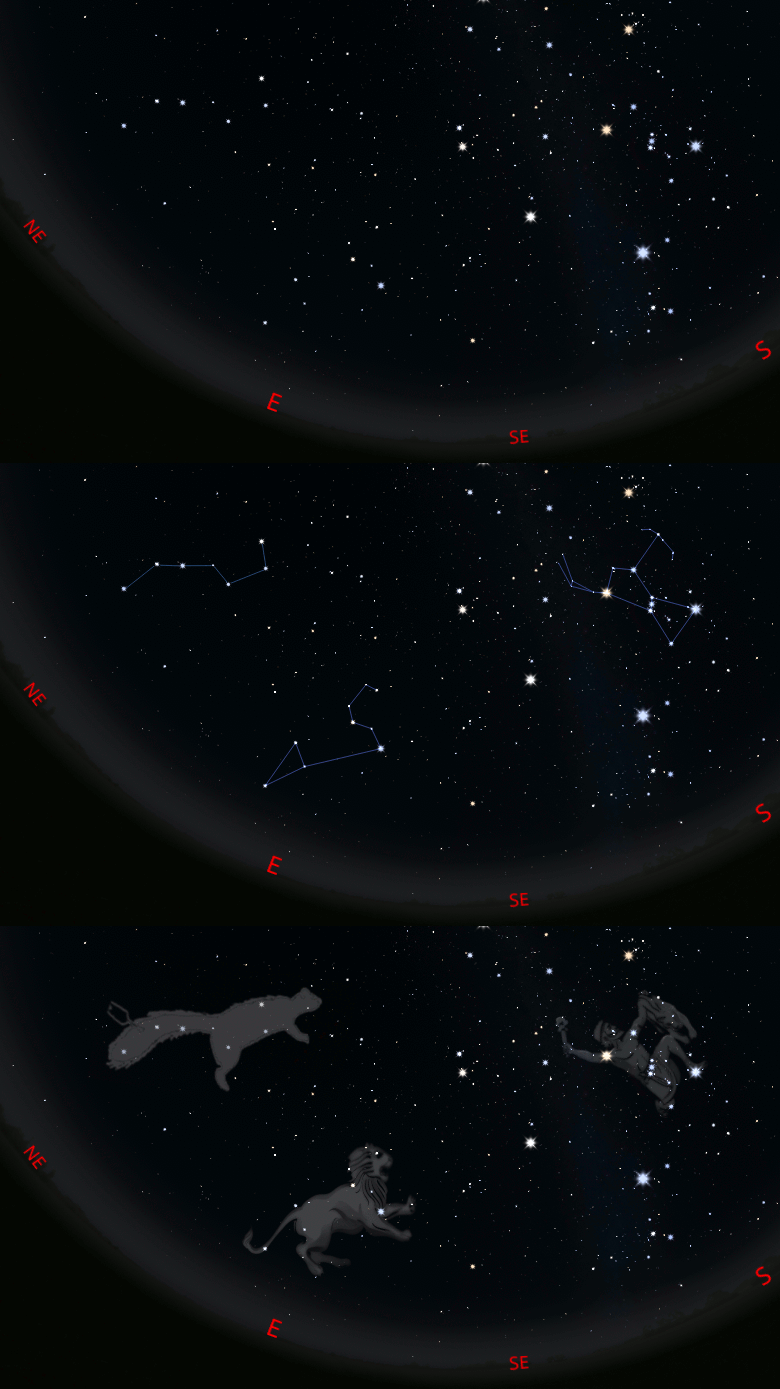
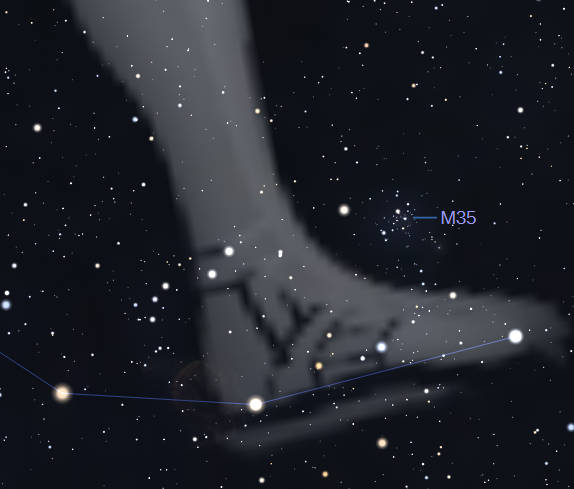
Looking to the east-southeast at 8 pm we look at three star groups or constellations. From left to right we have the Big Dipper and the Fisher Star in the northeast. Centered in the east we have Leo the lion. And on the right, just west of south, we have Orion the central winter constellation. Click or tap on the image to enlarge it. Credit: Stellarium, and using LibreOffice Draw, and GIMP.
Ephemeris Extra: 03/03/2024 – Tips for viewing the April 8, 2024 total solar eclipse
What is a solar eclipse?
Solar eclipses or eclipses of the Sun occur in about one in six new moons. However, one must be in the right part of the Earth to see them, which is why they may seem rare.
In a solar eclipse the moon’s shadow is cast upon the Earth. Because the Sun is a disk, the Moon’s shadow is fuzzy with sometimes a dark core. The fuzzy outer part of the shadow is called the penumbra. Observers there will see the Sun partially covered by the Moon, a partial eclipse. Observers in the dark core of the shadow are in the umbra, and see the face of the Sun completely covered by the Moon, a total eclipse. The maximum length of totality is never more than about seven minutes. Maximum for this eclipse will be 4 minutes 28 seconds in Mexico. The maximum length of the partial eclipse would be about 2 ½ hours.
What can be seen?
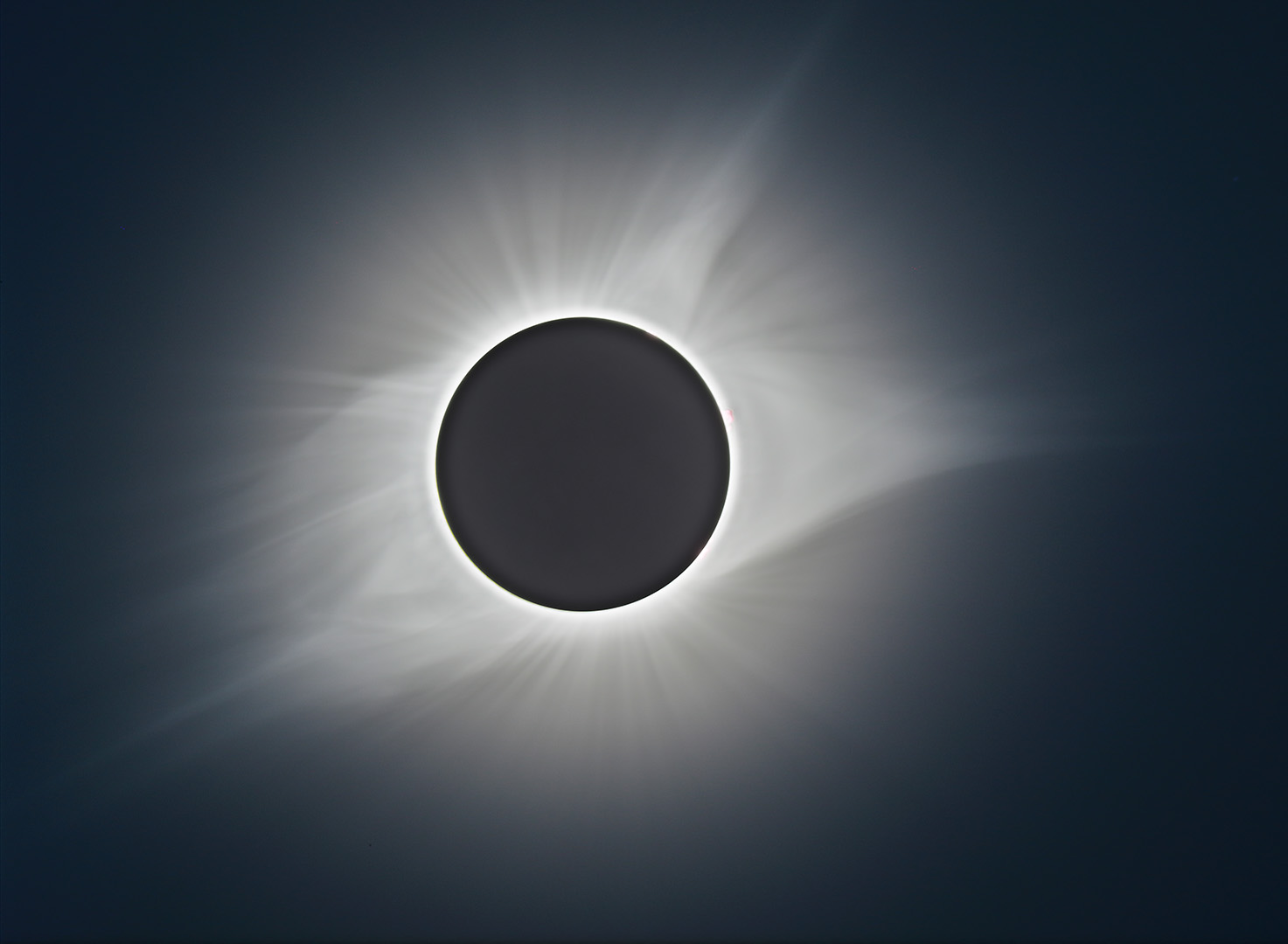
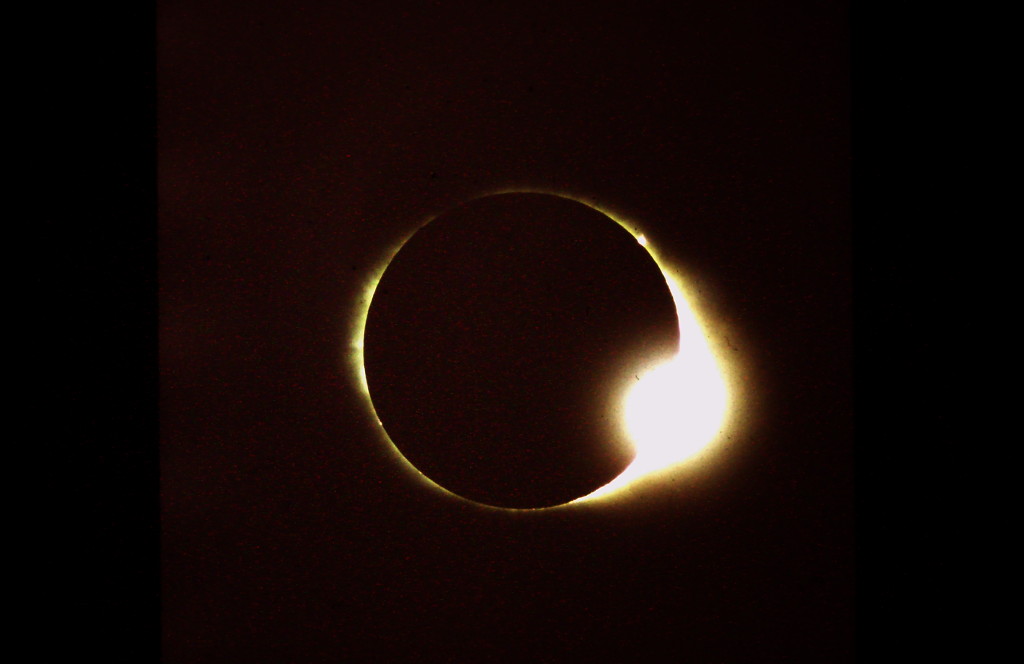
The outer three layers of the Sun are potentially visible to us: photosphere, chromosphere, and corona. The photosphere is the bright ball of the Sun we normally see. Looking at it for any length of time will cause blindness. Never look at the Sun’s photosphere without an approved solar filter. The other two layers can be seen during the totality of a solar eclipse. A thin red layer of gas with flame-like protrusions called prominences just above the photosphere and can normally be seen in a Hydrogen Alpha solar telescope, but easily seen in binoculars just after totality starts and before it ends. The corona is a silvery white extended solar atmosphere that can be seen out to several solar radii out from the edge of the Moon. Its shape changes hour to hour, and sometimes minute by minute.
All around you strange things happen as the Sun is covered by the Moon.
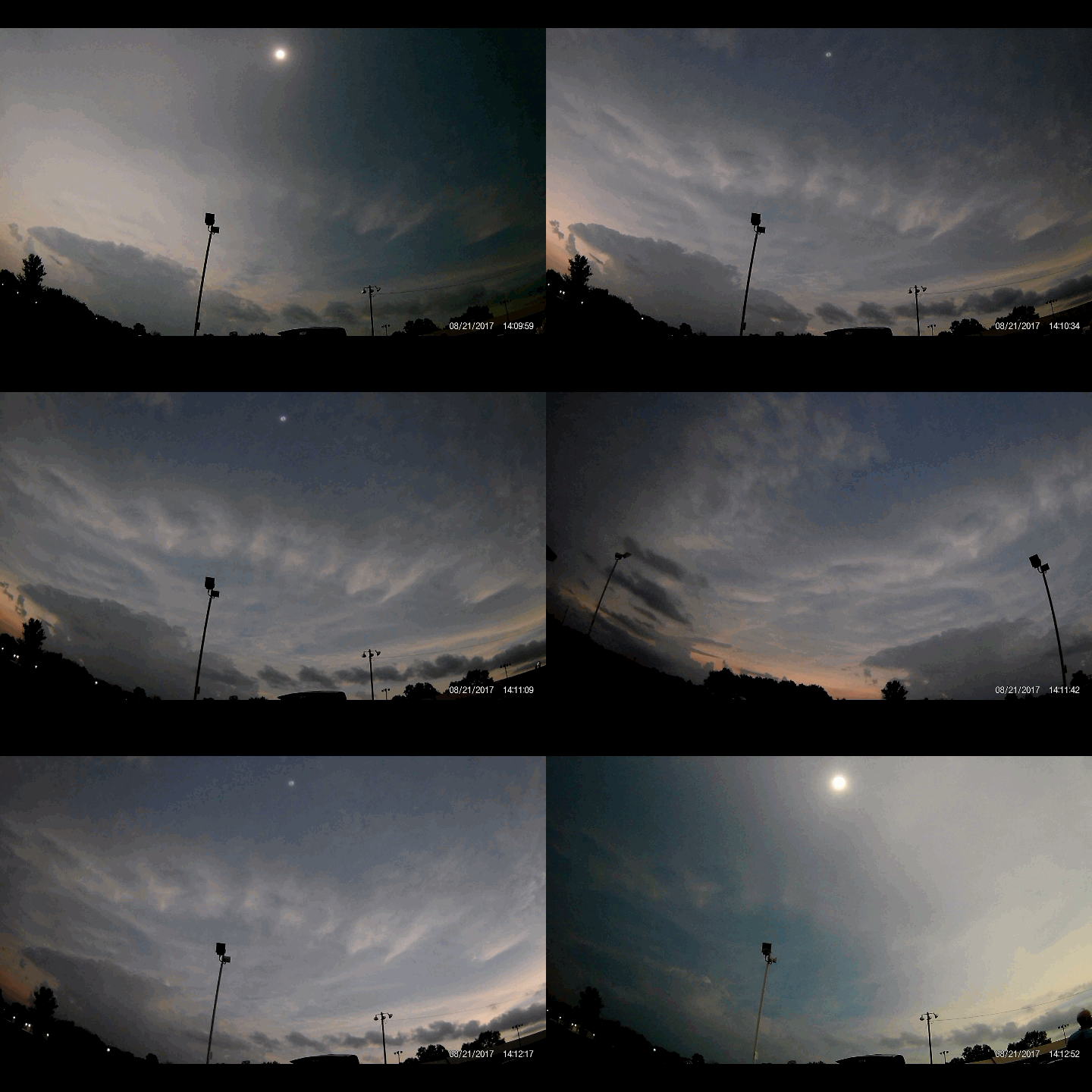
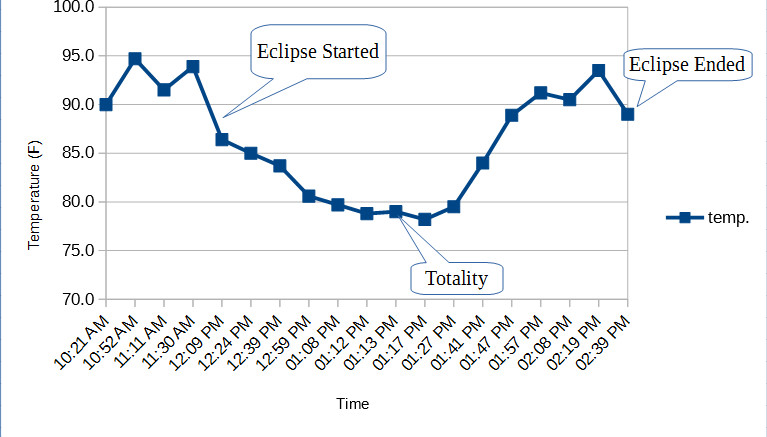
- The temperature will drop as the Sun is covered. It will be interesting to record the drop and recovery before, during and after the eclipse. Even a deep partial eclipse like what we’ll see locally will show a drop.
- Nearing totality the Sun’s light will appear somewhat yellow in hue. The revealed part of the Sun when it is mostly covered by the Moon is cooler and yellower than the central part. This is called limb darkening.
- As totality approaches and the sky darkens, streetlights will turn on.
- Also Chickens and other birds will go to roost. In the country cocks will crow before and after totality. Mosquitoes will think it’s twilight and will come out in mosquito prone areas for a snack.
- Shadow bands will be projected on flat smooth surfaces in near maximum phases of the partially eclipsed Sun. These are very subtle and are caused by atmospheric turbulence and the nearly pinpoint illumination by the Sun. It took me four total eclipses in order to be able to spot the effect on the tarmac of an airport. The nearest analog of this is seeing the shadow pattern on the bottom of a swimming pool on a sunny day, but very much fainter.
- Look for Venus (15° lower right) and Jupiter (30° upper left) of the Sun during totality. Just before, during and after totality look around at the sky and the incoming and outgoing umbral shadow.
- Check out the colorful horizon effects.
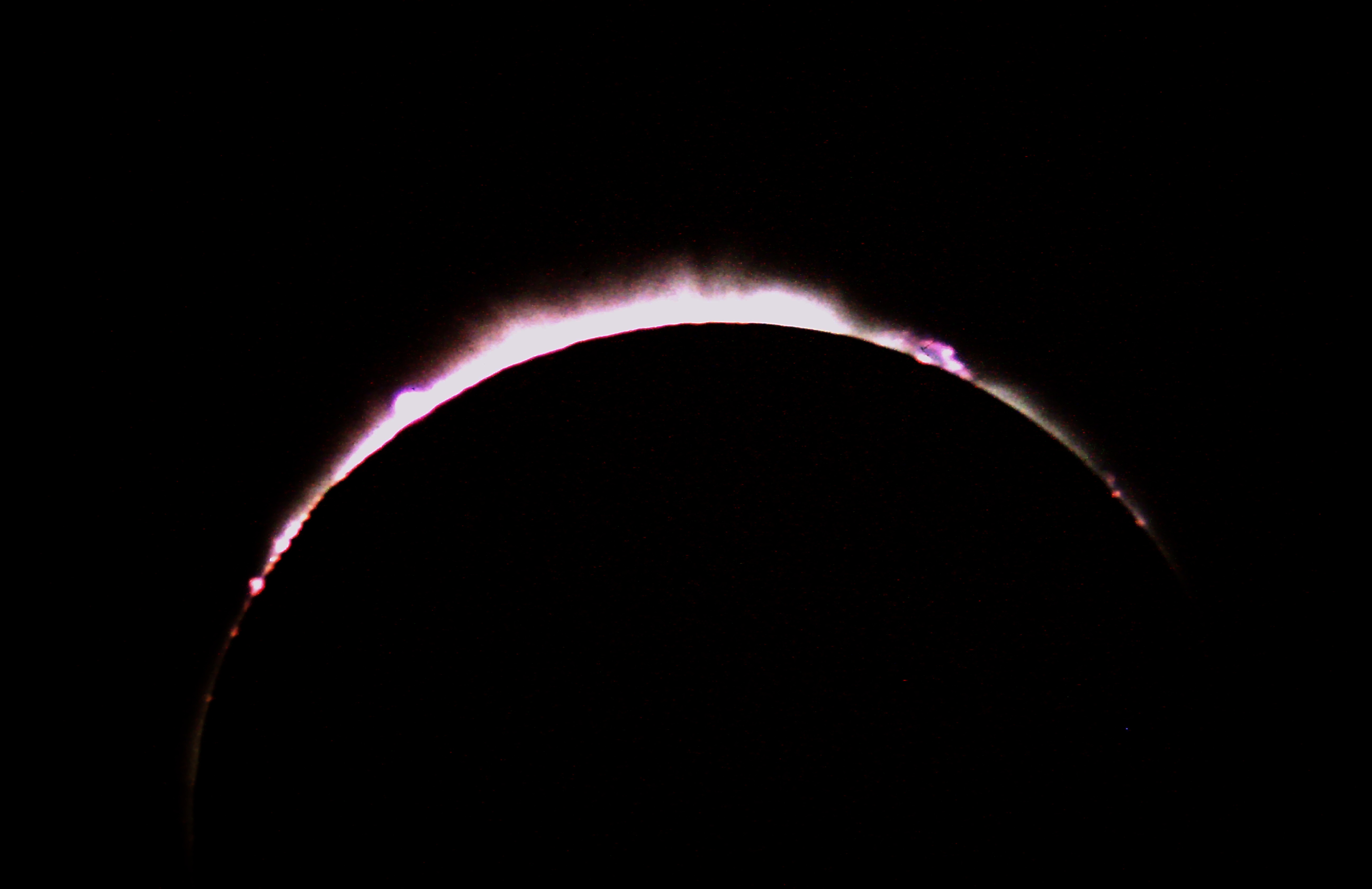
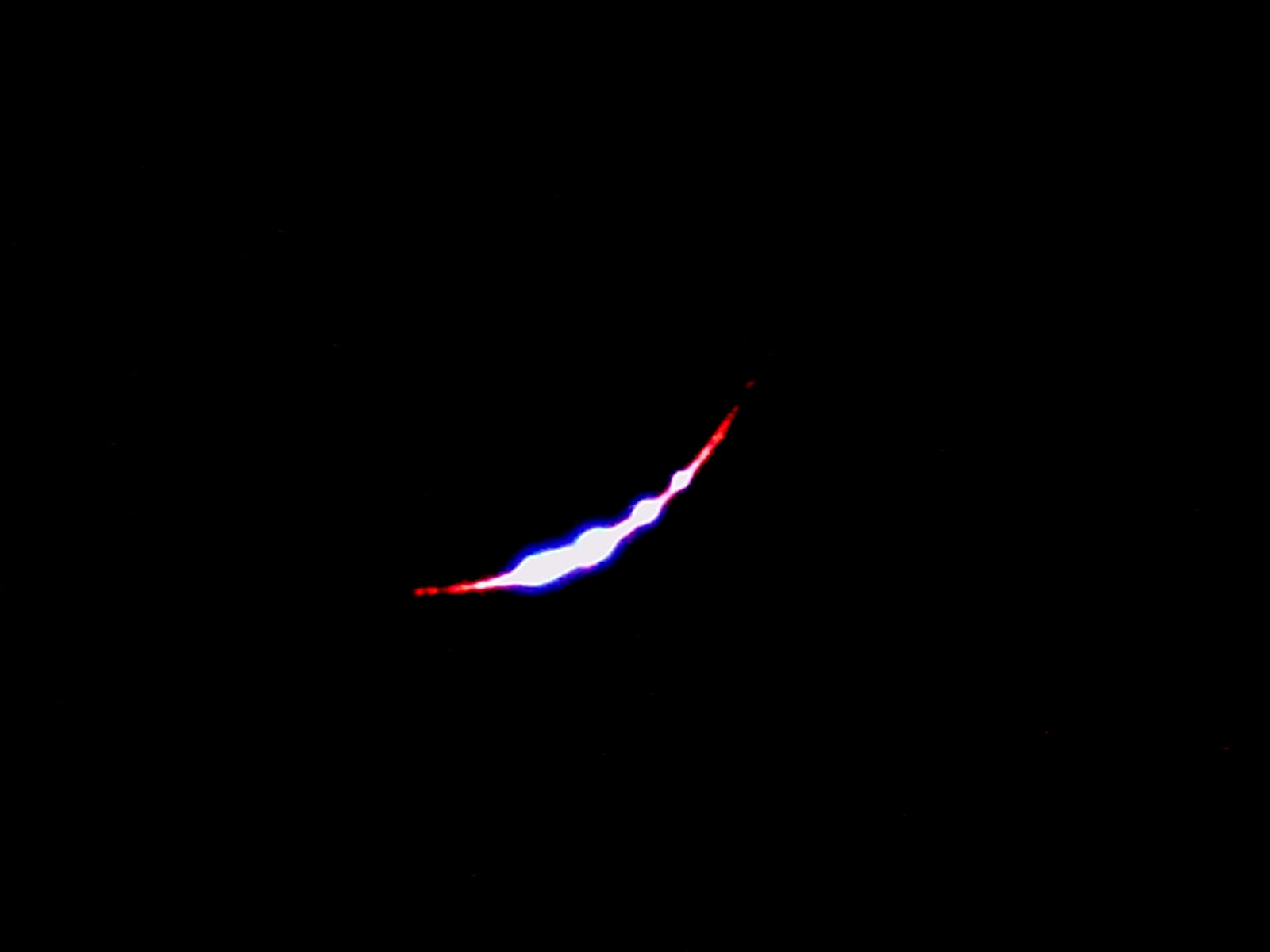
Viewing the partial solar eclipse

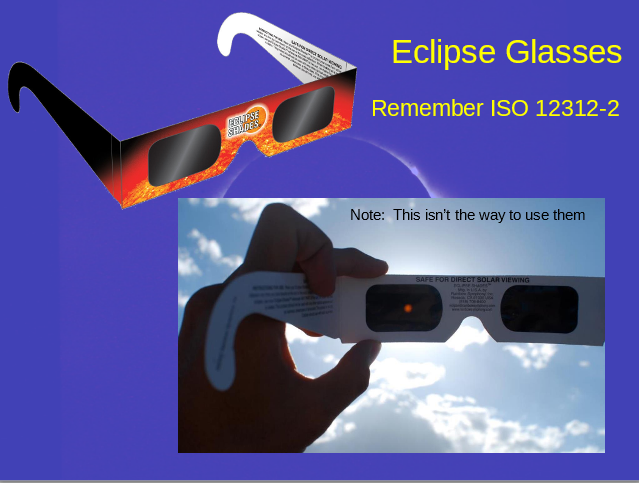
They are especially difficult to use, especially for people who wear glasses and can’t remove them because they are near-sighted.
Personally I do not recommend them, instead relying on one of the projection methods.
Be especially careful about children using them.
Remember the ISO 12312-2 compliance that should be printed on them.
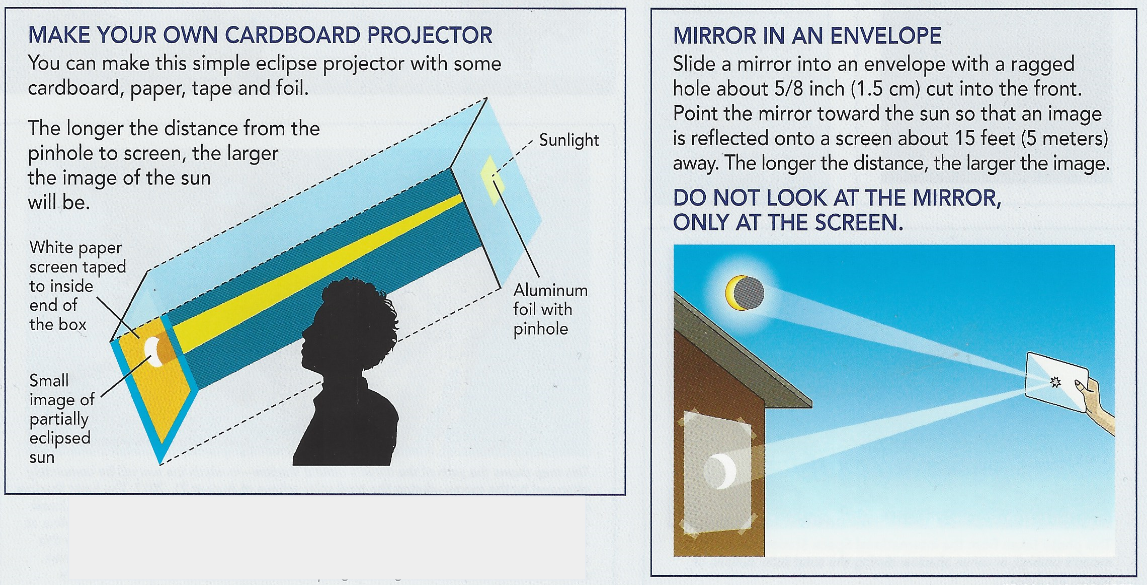
Never look directly at the partially eclipsed Sun without an approved solar filter. Solar filters must comply with ISO 12312-2 and transmit no more than 0.0032% of sunlight, and preferably less. Items sold as Eclipse viewing glasses must state that they comply with ISO 12312-2. People like me who wear glasses will find gaps above and below the frames of these filters where the Sun can get in, so must be used with extreme caution. No eclipse is worth your eyesight. The damage caused by looking directly at the Sun may not be known for several days after exposure, then it’s too late. I never use these filters, and prefer to project the Sun’s image on a white screen.
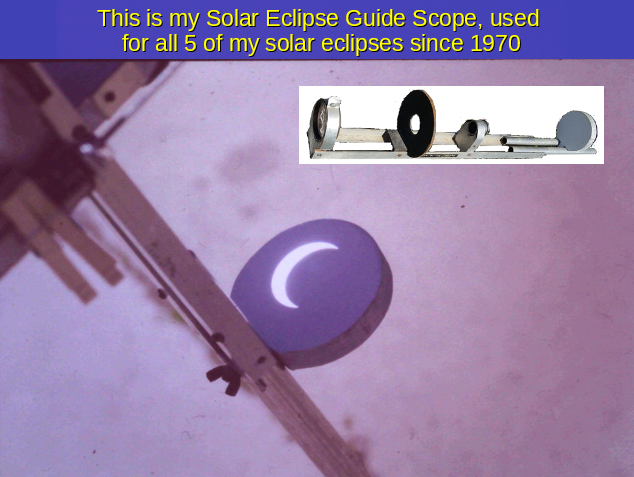
Pinhole projection is an easy way to project the Sun’s image. Depending on how far you want to project the image the larger the pinhole the farther and larger (and dimmer) the image can be. “Pinholes” up to 1/4 inch and maybe even half an inch can be used if you’re projecting it 10 feet or more. One can even use a mirror in an envelope with a small hole punched in it with the paper punch to project the sun’s image on the shady side of a building. That way many people can view the eclipse safely. Also try different size holes to get the best combination of size and brightness of the image. Unlike the illustration above it is best to mount the mirror on a tripod, or other support somehow, rather than holding it to keep the image steady. Using this method, the Sun’s motion due to the Earth’s rotation can be seen. Also, large sunspots may also be visible.
Local Circumstances
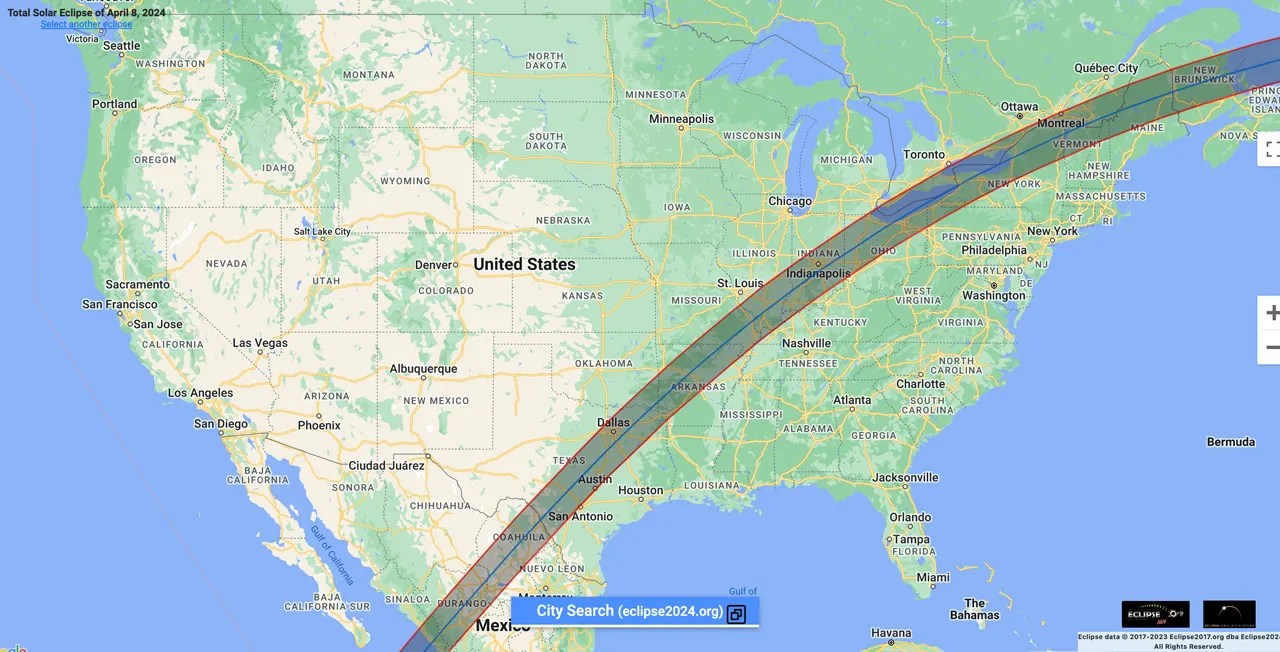
Local eclipse times for Traverse City: Starts (first contact) 1:58 p.m. Maximum 3:12 p.m. 89% covered Ends (last contact) 4:25 p.m. Times for other localities in northern Michigan will be within a minute or two of these values. It may be a minute or two after first contact for the first bite of the Moon to become discernible.
Eclipse2024.org provides an interactive map of the April 8, 2024 eclipse on the Internet to allow the display of eclipse times for any location: https://eclipse2024.org/eclipse_cities/statemap.html
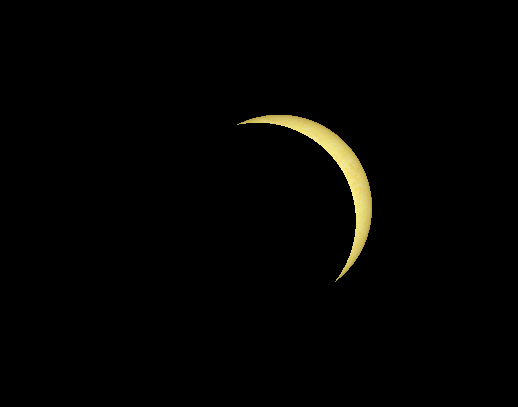
Eclipse2024.org provides an interactive map of the April 8, 2024 eclipse on the Internet to allow the display of eclipse times for any location: https://eclipse2024.org/eclipse_cities/statemap.html.
Ephemeris: 03/01/2024 – Mr. Eclipse to give a presentation about April’s Total Solar Eclipse
This is Ephemeris for Friday, March 1st. Today the Sun will be up for 11 hours and 11 minutes, setting at 6:31, and it will rise tomorrow at 7:17. The Moon, 2 days before last quarter, will rise at 1:09 tomorrow morning.
Tonight’s meeting of the Grand Traverse Astronomical Society will start at a special time, 7 pm, at Northwestern Michigan College’s Rogers Observatory, because we will join the Kalamazoo Astronomical Society via Zoom for a talk by Fred Espenak formerly of NASA. He is known as Mr. Eclipse and of course he will be talking about the April 8th total solar eclipse. Fred Espenak has been responsible for NASA’s eclipse website through the 2017 total solar eclipse. He’s chased the shadow of the Moon around the world. Now retired, he hosts two websites. One of which is mreclipse.com. The observatory is located south of Traverse City on Birmley Road between Garfield and Keystone roads.
You may also join the Kalamazoo Astronomical Society meeting directly: Follow this link to register for Zoom. They have room for 500 people on Zoom, and they’d like to max that out!
The astronomical event times given are for the Traverse City/Interlochen area of Michigan (EST, UT –5 hours). They may be different for your location.
Addendum
Ephemeris: 02/29/2024 – Previewing March Skies
This is Bob Moler with Ephemeris for Thursday, February 29th, the Leap Day or intercalary day. Today the Sun will be up for 11 hours and 8 minutes, setting at 6:30, and it will rise tomorrow at 7:19. The Moon, 3 days before last quarter, will rise at 11:59 this evening.
Let’s look at the skies for the month of March. The Sun will pass the celestial equator as the promising season of spring will begin. Daylight hours in the Interlochen/Traverse City area and will increase from 11 hours and 11 minutes Tomorrow to 12 hours 45 minutes on the 31st. The altitude, or angle, of the Sun above the southern horizon at local noon will be 38 degrees tomorrow and will ascend to nearly 50 degrees on the 31st. Spring will start on the 19th at 11:07 p.m. Part of the fault for that early date is the switch to daylight saving time this early in the year a while back. The Gregorian calendar reform of 1582 will keep the vernal equinox from falling much further back. So spring will come a bit early this year, calendar-wise.
The astronomical event times given are for the Traverse City/Interlochen area of Michigan (EST, UT –5 hours). They may be different for your location.
Addendum
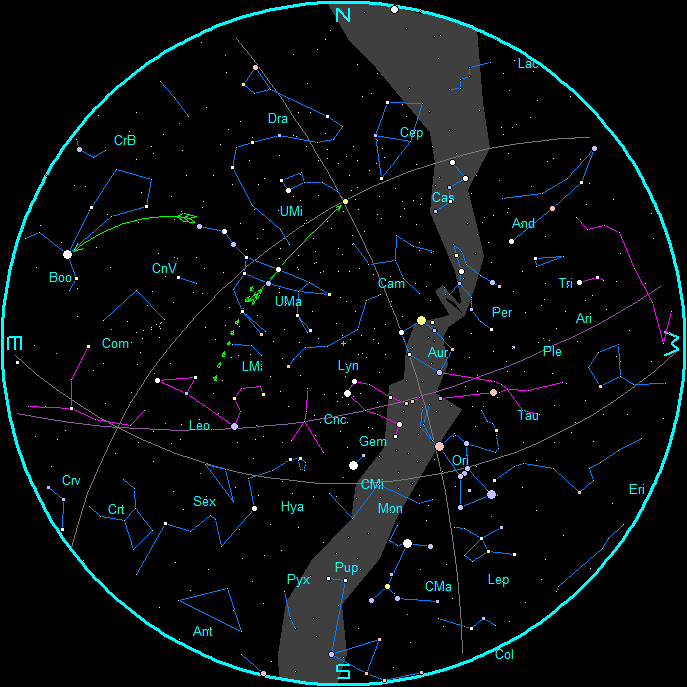
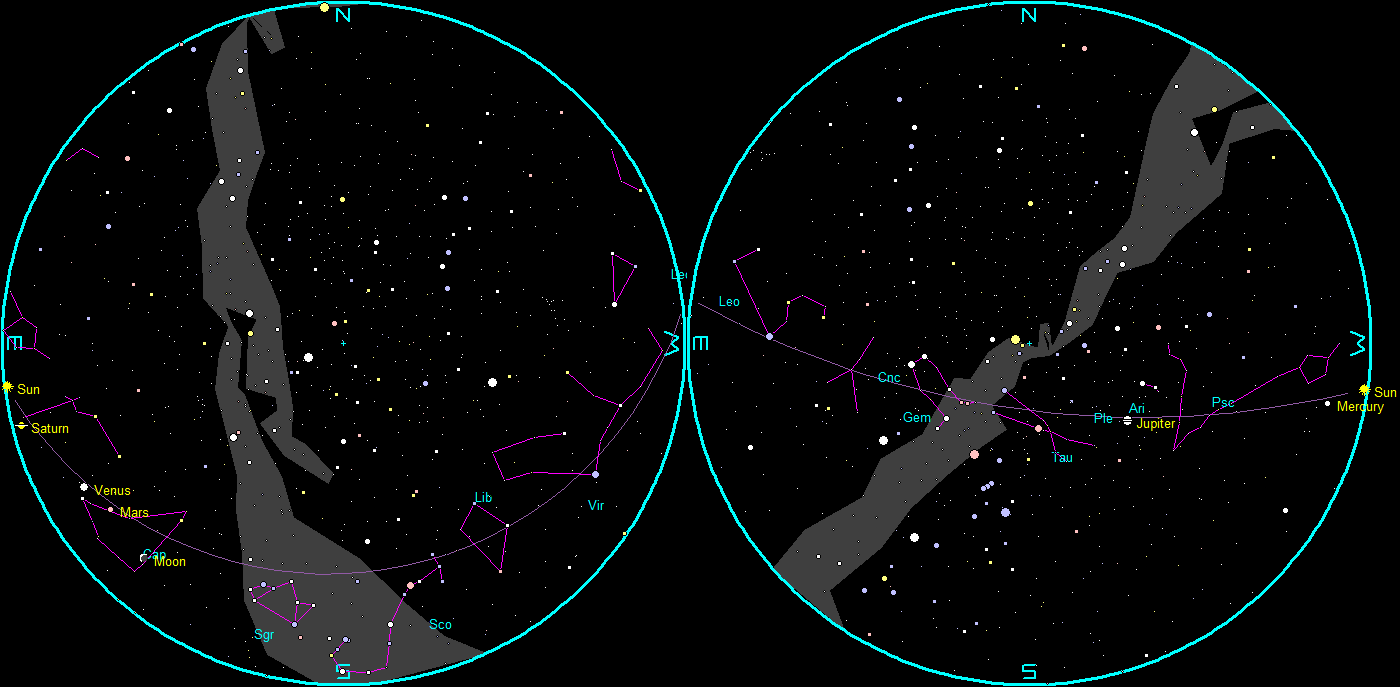
March Evening Star Chart
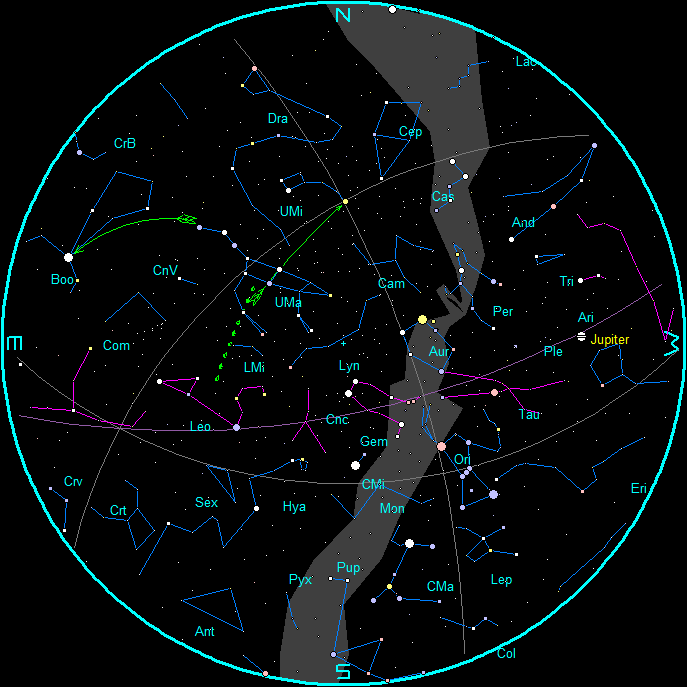
The planets and stars are plotted for the 15th at 10 p.m. EDT in the evening and 6 a.m. for the morning chart. These are the chart times. Note that Traverse City is located approximately 45 minutes behind our time meridian. (An hour and 45 minutes behind our Daylight Saving Time meridian during EDT). To duplicate the star positions on a planisphere (rotating star finder) you may have to set it to 45 minutes or 1 hour 45 minutes earlier than your current time.
Note the chart times of 10 p.m. and 6 a.m. are for the 15th. For each week before the 15th, add ½ hour (28 minutes if you’re picky). For each week after the 15th, subtract ½ hour. For planet positions on dates other than the 15th, check the Wednesday planet posts on this blog.
March Morning Star Chart
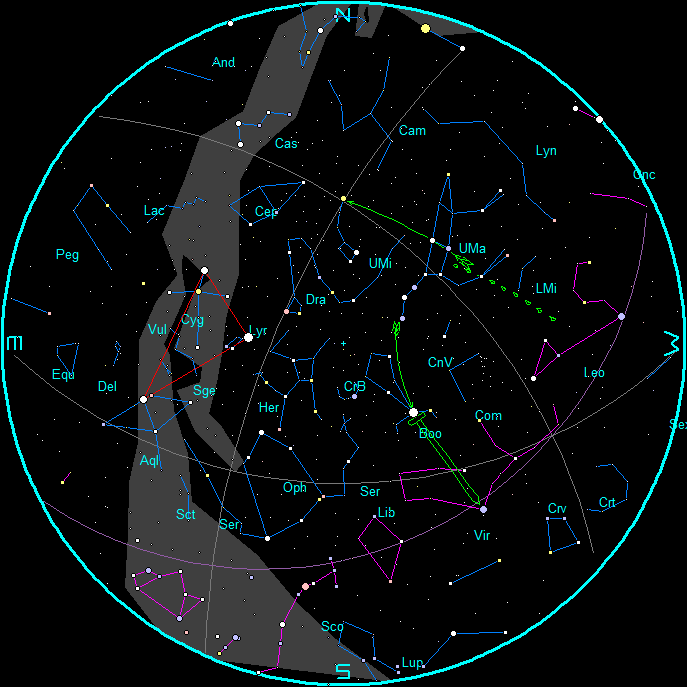
For a list of constellation names to go with the abbreviations click here.
- Pointer stars at the front of the bowl of the Big Dipper point to Polaris the North Star.
- The leaky bowl of the Big Dipper drips on Leo.
- Follow the arc of the handle of the Big Dipper to the star Arcturus, and
- Extend it as a spike to Spica.
- The Summer Triangle appears in red.
Twilight Limits, Nautical and Astronomical
| EST | |||||||
| Morning | Twilight | Evening | Twilight | Dark | Night | Moon | |
| Date | Astro. | Nautical | Nautical | Astro. | Start | End | Illum. |
| 2024-03-01 | 5h43m | 6h17m | 19h37m | 20h11m | 20h11m | – | 0.65 |
| 2024-03-02 | 5h41m | 6h15m | 19h38m | 20h12m | 20h12m | 1h09m | 0.55 |
| 2024-03-03 | 5h40m | 6h13m | 19h39m | 20h13m | 20h13m | 2h20m | 0.44 |
| 2024-03-04 | 5h38m | 6h12m | 19h41m | 20h15m | 20h15m | 3h28m | 0.34 |
| 2024-03-05 | 5h36m | 6h10m | 19h42m | 20h16m | 20h16m | 4h30m | 0.23 |
| 2024-03-06 | 5h34m | 6h08m | 19h43m | 20h17m | 20h17m | 5h22m | 0.14 |
| 2024-03-07 | 5h32m | 6h06m | 19h45m | 20h19m | 20h19m | 5h32m | 0.07 |
| 2024-03-08 | 5h30m | 6h05m | 19h46m | 20h20m | 20h20m | 5h30m | 0.02 |
| 2024-03-09 | 5h29m | 6h03m | 19h47m | 20h21m | 20h21m | 5h29m | 0.00 |
| EDT | |||||||
| 2024-03-10 | 6h27m | 7h01m | 20h48m | 21h23m | 21h23m | 6h27m | 0.01 |
| 2024-03-11 | 6h25m | 6h59m | 20h50m | 21h24m | 21h45m | 6h25m | 0.05 |
| 2024-03-12 | 6h23m | 6h57m | 20h51m | 21h25m | 23h07m | 6h23m | 0.12 |
| 2024-03-13 | 6h21m | 6h55m | 20h52m | 21h27m | – | 6h21m | 0.20 |
| 2024-03-14 | 6h19m | 6h54m | 20h54m | 21h28m | 0h29m | 6h19m | 0.30 |
| 2024-03-15 | 6h17m | 6h52m | 20h55m | 21h30m | 1h48m | 6h17m | 0.40 |
| 2024-03-16 | 6h15m | 6h50m | 20h56m | 21h31m | 3h02m | 6h15m | 0.51 |
| 2024-03-17 | 6h13m | 6h48m | 20h58m | 21h32m | 4h07m | 6h13m | 0.61 |
| 2024-03-18 | 6h11m | 6h46m | 20h59m | 21h34m | 5h00m | 6h11m | 0.70 |
| 2024-03-19 | 6h09m | 6h44m | 21h00m | 21h35m | 5h41m | 6h09m | 0.78 |
| 2024-03-20 | 6h07m | 6h42m | 21h02m | 21h37m | – | – | 0.86 |
| 2024-03-21 | 6h05m | 6h40m | 21h03m | 21h38m | – | – | 0.92 |
| 2024-03-22 | 6h03m | 6h38m | 21h04m | 21h40m | – | – | 0.96 |
| 2024-03-23 | 6h01m | 6h36m | 21h06m | 21h41m | – | – | 0.99 |
| 2024-03-24 | 5h59m | 6h34m | 21h07m | 21h43m | – | – | 1.00 |
| 2024-03-25 | 5h57m | 6h32m | 21h08m | 21h44m | – | – | 0.99 |
| 2024-03-26 | 5h55m | 6h30m | 21h10m | 21h46m | – | – | 0.97 |
| 2024-03-27 | 5h53m | 6h28m | 21h11m | 21h47m | 21h47m | 22h51m | 0.92 |
| 2024-03-28 | 5h50m | 6h26m | 21h13m | 21h49m | 21h49m | 0h00m | 0.86 |
| 2024-03-29 | 5h48m | 6h24m | 21h14m | 21h50m | 21h50m | – | 0.79 |
| 2024-03-30 | 5h46m | 6h22m | 21h15m | 21h52m | 21h52m | 1h10m | 0.70 |
| 2024-03-31 | 5h44m | 6h20m | 21h17m | 21h53m | 21h53m | 2h18m | 0.60 |
Twilight calendar was generated using Cartes du Ciel (Sky Charts).
See my blog post: Twilight Zone for the definitions of the different periods of twilight here: https://bobmoler.wordpress.com/2019/09/27/
NASA Calendar of Planetary Events
     Date   Time EST  Event
Mar  1  Fr            Venus: 24.3° W
     3  Su   3:16 am  Moon-Antares:  .4° S
     3  Su  10:24 am  Last Quarter
     4  Mo   9:03 pm  Moon South Dec.: 28.5° S
     7  Th  11:59 pm  Moon-Mars: 3.5° N
     8  Fr  12:01 pm  Moon-Venus: 3.2° N
            Time EDT
    10  Su   2:06 am  Moon Perigee: 356900 km
    10  Su   4:00 am  New Moon
    11  Mo   9:18 pm  Moon Ascending Node
    13  We   9:01 pm  Moon-Jupiter: 3.6° S
    14  Th  10:54 pm  Moon-Pleiades:  .4° N
    17  Su  12:11 am  First Quarter
    17  Su   6:31 am  Neptune Conjunction
    17  Su  10:45 am  Moon North Dec.: 28.5° N
    19  Tu   2:44 am  Moon-Pollux: 1.6° N
    19  Tu  11:07 pm  Vernal Equinox
    20  We   4:03 am  Moon-Beehive: 3.8° S
    21  Th   6:06 pm  Venus-Saturn:  .3° N
    23  Sa  11:44 am  Moon Apogee: 406300 km
    24  Su   5:59 pm  Mercury Elongation: 18.7° E
    25  Mo   3:00 am  Full Moon
    25  Mo   3:13 am  Penumbral Lunar Eclipse
    26  Tu  12:07 am  Moon Descending Node
    26  Tu   3:40 pm  Moon-Spica: 1.6° S
    30  Sa  10:24 am  Moon-Antares:  .3° S
Apr  1  Mo    Venus: 16.8° W
All event times are given for UTC-5:00: Eastern Standard Time before the 10th or UTC-4:00 Daylight Saving Time thereafter.
Sky Events Calendar by Fred Espenak and Sumit Dutta (NASA’s GSFC),
http://eclipse.gsfc.nasa.gov/SKYCAL/SKYCAL.html
If you go to the above site you can print out a list like the above for the entire year or calendar pages for your time zone.
Note that the site is now kept up for archival purposes. Fred Espenak retired from NASA several years ago and has his own site, AstroPixels, which contain the same information: http://astropixels.com/almanac/almanac.html.
Sun and Moon Rising and Setting Events
LU              Ephemeris of Sky Events for Interlochen/TC
March, 2024    Local time zone: EST
+-----------------------------------------------------------------------+
| DATE |  SUN     SUN  DAYLIGHT|   TWILIGHT*    |MOON  RISE OR    ILLUM |
|      |  RISE    SET    HOURS |  END    START  |PHASE SET** TIME FRACTN|
+=======================================================================+
|Fri  1| 07:19a  06:31p  11:11 | 07:34p  06:16a |      Rise 01:09a   66%|
|Sat  2| 07:17a  06:32p  11:15 | 07:35p  06:14a |      Rise 02:19a   57%|
+------+-----------------------+----------------+-----------------------+
|Sun  3| 07:15a  06:34p  11:18 | 07:37p  06:12a |L Qtr Rise 03:28a   46%|
|Mon  4| 07:14a  06:35p  11:21 | 07:38p  06:11a |      Rise 04:30a   36%|
|Tue  5| 07:12a  06:36p  11:24 | 07:39p  06:09a |      Rise 05:22a   26%|
|Wed  6| 07:10a  06:37p  11:27 | 07:41p  06:07a |      Rise 06:03a   16%|
|Thu  7| 07:08a  06:39p  11:30 | 07:42p  06:05a |      Rise 06:35a    8%|
|Fri  8| 07:06a  06:40p  11:33 | 07:43p  06:04a |      Rise 07:01a    3%|
|Sat  9| 07:05a  06:41p  11:36 | 07:44p  06:02a |      Rise 07:24a    0%|
+------+-----------------------+----------------+-----------------------+
| EDT  |      Time Change      |                |                       |
|Sun 10| 08:03a  07:43p  11:39 | 08:46p  07:00a |New   Set  08:22p    1%|
|Mon 11| 08:01a  07:44p  11:43 | 08:47p  06:58a |      Set  09:44p    4%|
|Tue 12| 07:59a  07:45p  11:46 | 08:48p  06:56a |      Set  11:07p   10%|
|Wed 13| 07:57a  07:47p  11:49 | 08:50p  06:54a |      Set  12:28a   18%|
|Thu 14| 07:55a  07:48p  11:52 | 08:51p  06:53a |      Set  01:47a   28%|
|Fri 15| 07:54a  07:49p  11:55 | 08:52p  06:51a |      Set  03:01a   38%|
|Sat 16| 07:52a  07:50p  11:58 | 08:54p  06:49a |      Set  04:06a   48%|
+------+-----------------------+----------------+-----------------------+
|Sun 17| 07:50a  07:52p  12:01 | 08:55p  06:47a |F Qtr Set  04:59a   58%|
|Mon 18| 07:48a  07:53p  12:04 | 08:56p  06:45a |      Set  05:41a   68%|
|Tue 19| 07:46a  07:54p  12:08 | 08:58p  06:43a |      Set  06:13a   77%|
|Wed 20| 07:44a  07:56p  12:11 | 08:59p  06:41a |      Set  06:38a   84%|
|Thu 21| 07:43a  07:57p  12:14 | 09:00p  06:39a |      Set  06:59a   91%|
|Fri 22| 07:41a  07:58p  12:17 | 09:02p  06:37a |      Set  07:16a   95%|
|Sat 23| 07:39a  07:59p  12:20 | 09:03p  06:35a |      Set  07:32a   98%|
+------+-----------------------+----------------+-----------------------+
|Sun 24| 07:37a  08:01p  12:23 | 09:04p  06:33a |      Set  07:48a  100%|
|Mon 25| 07:35a  08:02p  12:26 | 09:06p  06:31a |Full  Rise 08:39p  100%|
|Tue 26| 07:33a  08:03p  12:29 | 09:07p  06:29a |      Rise 09:44p   97%|
|Wed 27| 07:31a  08:04p  12:33 | 09:09p  06:27a |      Rise 10:50p   93%|
|Thu 28| 07:30a  08:06p  12:36 | 09:10p  06:25a |      Rise 11:59p   88%|
|Fri 29| 07:28a  08:07p  12:39 | 09:11p  06:23a |      Rise 01:09a   80%|
|Sat 30| 07:26a  08:08p  12:42 | 09:13p  06:21a |      Rise 02:18a   72%|
+------+-----------------------+----------------+-----------------------+
|Sun 31| 07:24a  08:09p  12:45 | 09:14p  06:19a |      Rise 03:21a   62%|
+-----------------------------------------------------------------------+
* Nautical Twilight
** Moonrise or moonset, whichever occurs between sunrise and sunset
Created using my LookingUp for DOS output as text.
 Bob Moler's Ephemeris Blog