Ephemeris: 08/29/2023 – Saturn’s rings disappear every 15 years
This is Ephemeris for Tuesday, August 29th. Today the Sun will be up for 13 hours and 23 minutes, setting at 8:25, and it will rise tomorrow at 7:02. The Moon, 1 day before full, will set at 6:05 tomorrow morning.
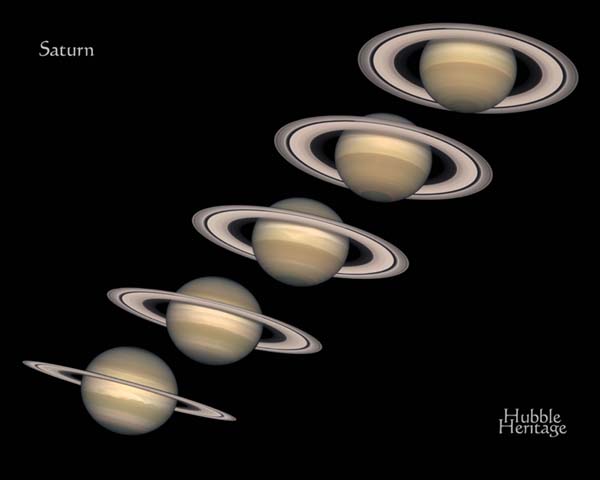
As seen in even low powered telescopes Saturn’s rings are visible. Currently, the rings are closing towards that edge on point which will they reach on March 23rd 2025 and then begin to open up again. The rings orbit Saturn’s equator, and Saturn has a nearly 27 degree inclination of its axis to its orbit, like the Earth’s 23 1/2 degrees and that means that near the equinoxes Saturn’s rings turn out to be nearly edge on to the Sun and the Earth, since we orbit much closer to the Sun than Saturn. Near the solstices on Saturn the rings are open to their widest extent. This occurs about 7 ½ years after the rings go edge on, and 7 ½ years before the next time. The next time the rings go edge on Saturn will be too close to the direction of the Sun to spot, but when they do go edge-on, they disappear. They are 150,000 miles in diameter and less than 70 feet thick.
The astronomical event times given are for the Traverse City/Interlochen area of Michigan (EDT, UT –4 hours). They may be different for your location.
Addendum
Ephemeris: 08/28/2023 – Observing Saturn’s rings
This is Ephemeris for Monday, August 28th. Today the Sun will be up for 13 hours and 26 minutes, setting at 8:26, and it will rise tomorrow at 7:01. The Moon, 2 days before full, will set at 4:38 tomorrow morning.
The most striking feature of the planet Saturn are its rings. It is not the only planet with rings. Jupiter Uranus and Neptune all have rings, plus some asteroids. And at least one Kuiper belt objects has rings, but Saturn has the grandest of all the ring systems. The broad rings are easily seen in small telescopes. They are labeled A, B and C, A being the outermost of the bright rings B is the center most and C is just barely seen inside the B ring. The diameter of these rings to the outside of the A ring is 150,000 miles, a bit more than the average distance from the Earth to our Moon, and a little less than 70 feet thick so when they go edge on to us as they do about every 15 or so years they completely disappear.
The astronomical event times given are for the Traverse City/Interlochen area of Michigan (EDT, UT –4 hours). They may be different for your location.
Addendum
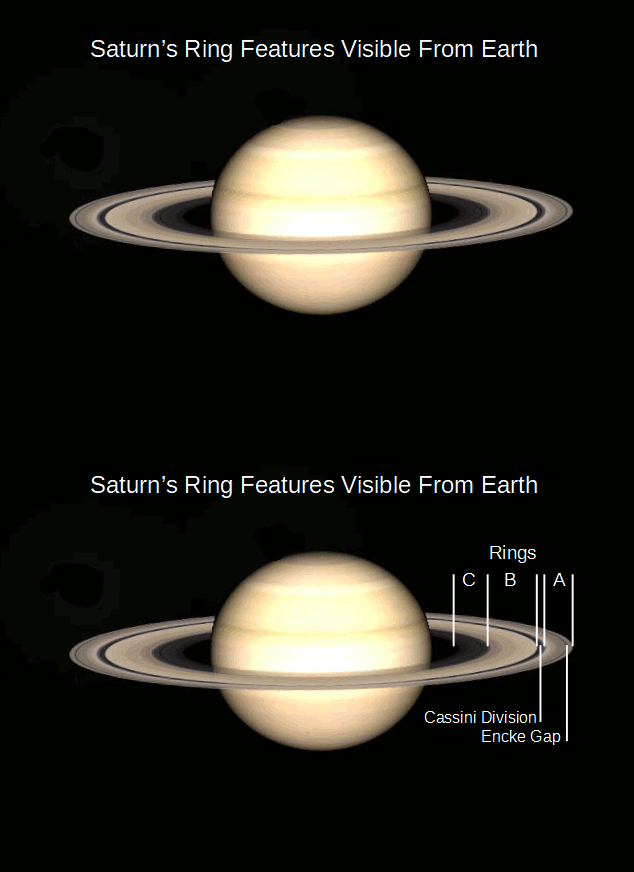
Saturn’s rings are much more complex than what can be seen in a small telescope. Observing Saturn through a small telescope, the A and B rings are evident, though the Cassini Division, of nearly 5,000 miles in width, may be elusive. The C, or Crêpe, ring is very hard to see, and is best seen as a dusky shadowlike feature against the planet. This image of Saturn was created by Stellarium, annotations were created in LibreOffice Draw, assembled and output using GIMP.
More on Saturn’s rings tomorrow.
Ephemeris: 08/25/2023 – Saturn will reach opposition on Sunday
This is Ephemeris for Friday, August 25th. Today the Sun will be up for 13 hours and 35 minutes, setting at 8:32, and it will rise tomorrow at 6:57. The Moon, 1 day past first quarter, will set at 12:57 tomorrow morning.
The planet Saturn will reach opposition on Sunday. That means it will be opposite the Sun in the sky. It will be rising as the sun sets, and it will then officially become an evening planet. Opposition is the time when Saturn is the closest it gets to the Earth, in this case it’s 816 million miles (1 billion 314 million kilometers). In telescopes, we’ll see very little in the way of shadows of the planet on the rings and the rings on the planet, because we are almost directly in line with the Sun and Saturn. We’re actually a little north of the line, so Saturn will exhibit very thin shadows, however a pretty big telescope will be needed to see them. This is the time when Saturn appears largest in telescopes, and the rings are the brightest.
The astronomical event times given are for the Traverse City/Interlochen area of Michigan (EDT, UT –4 hours). They may be different for your location.
Addendum
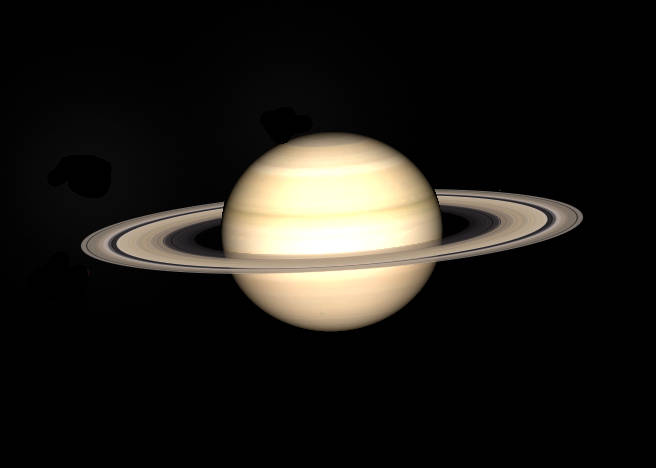
Saturn, as realized by the Stellarium planetarium app. It never appears this large in telescopes. The first time I saw Saturn in a telescope, and saw those rings, I was blown away. However, I was disappointed as to how small it was. Well, it is almost a billion miles (1.6 million kilometers) away, about twice as far as Jupiter. The extent of the rings are about as long as Jupiter’s apparent diameter, which averages about half of Saturn’s distance. Currently, the rings are getting more and more edge-on to us. The rings will be edge-on to us on March 23, 2025, nearly a year and a half from now, then begin to open up again. This is due to Saturn’s axial tilt of nearly 27 degrees, and the fact that the rings orbit the planet at its equator.
Ephemeris: 08/24/2023 – The Moon will pass in front of the star Antares tonight
This is Ephemeris for Thursday, August 24th. Today the Sun will be up for 13 hours and 38 minutes, setting at 8:33, and it will rise tomorrow at 6:56. The Moon, at first quarter today, will set at 12:11 tomorrow morning. | Tonight the Moon is going to pass in front of the bright reddish star in Antares in Scorpius scorpion. The event is called an occultation, and it is the only one of the monthly occultations which we’re going to be able to see in this series that began last month and will extend to August 2028. Antares will disappear at the lower left edge of the dark or night part of the Moon at approximately 10:28 pm* this evening, and it’ll stay hidden until 11:32 pm* when it will pop out on the lower right edge of the bright part of the Moon. Start looking for Antares early, probably with binoculars, because the Moon will be quite bright and might overpower Antares when viewed by the naked eye. Hoping for clear skies tonight.
*The astronomical event times given are for the Traverse City/Interlochen area of Michigan (EDT, UT –4 hours). They may be different for your location. For other locations a planetarium computer app like Stellarium can be used to graphically predict occultation timings within a few minutes. Check your planetarium app, and set it to use Topocentric coordinates. In Stellarium, the selection is in the Configuration window, Tools tab. Check everything under Topocentric coordinates. That way the position of the Moon in the sky will be based on the chosen location, rather than the center of the Earth.
Addendum
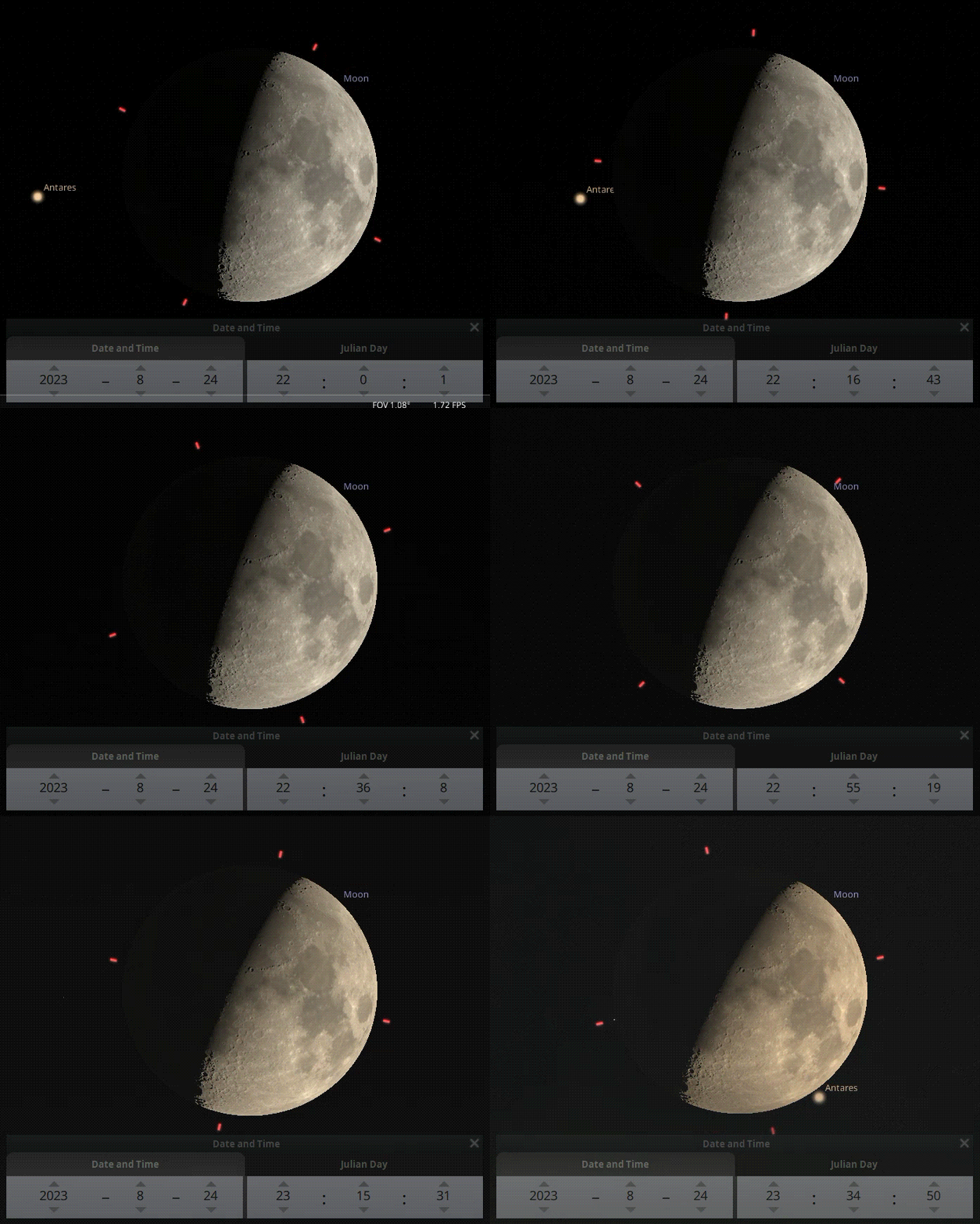
A time-lapse prediction of the occultation of Antares by the Moon based on Stellarium imagery. In the actual occultation Antares will wink out and on suddenly. Antares is a double star, with a 5th magnitude companion. It should wink out and in 9 seconds before the main first magnitude star.
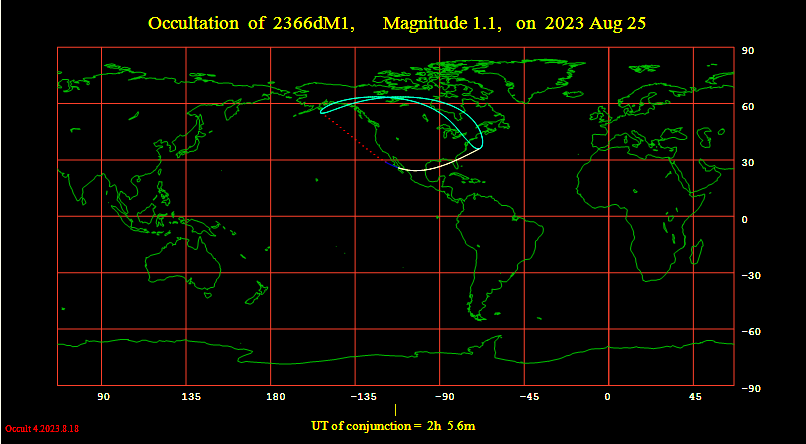
World map showing the area where the occultation of Antares can be visible. It is the area bounded by the white line, the red dotted line and the floppy figure 8 is the area where the occultation is visible. The red line shows that the area near that part of the line is where the occultation occurs during daylight the solid white line on the bottom encloses there is where the occultation will be seen at night. Michigan is close to that cyan line and so the occultation will occur near moonset. Credit: Occult 4 app.
Ephemeris: 08/23/2023 – Let’s find out where the naked-eye planets have wandered off to this week
This is Ephemeris for Wednesday, August 23rd. Today the Sun will be up for 13 hours and 41 minutes, setting at 8:35, and it will rise tomorrow at 6:55. The Moon, 1 day before first quarter, will set at 11:36 this evening.
Let’s find out where the naked-eye planets have wandered off to this week. Three of the five planets are now visible. Mars and Mercury are too close to the Sun to be seen. Jupiter, Saturn and Venus are all officially morning planets now, although Saturn does rise in the evening shortly after sunset. It will become an evening planet in four days, when it will rise at sunset. It can be spotted in the southeast in the evening. And it will still be visible throughout the morning hours. Saturn is in retrograde or westward motion now, against the stars of Aquarius. Jupiter will rise at 11:21pm. Venus is making an appearance in the morning sky now. It will rise at 5:53 tomorrow morning in the east.
The astronomical event times given are for the Traverse City/Interlochen area of Michigan (EDT, UT –4 hours). They may be different for your location.
Addendum
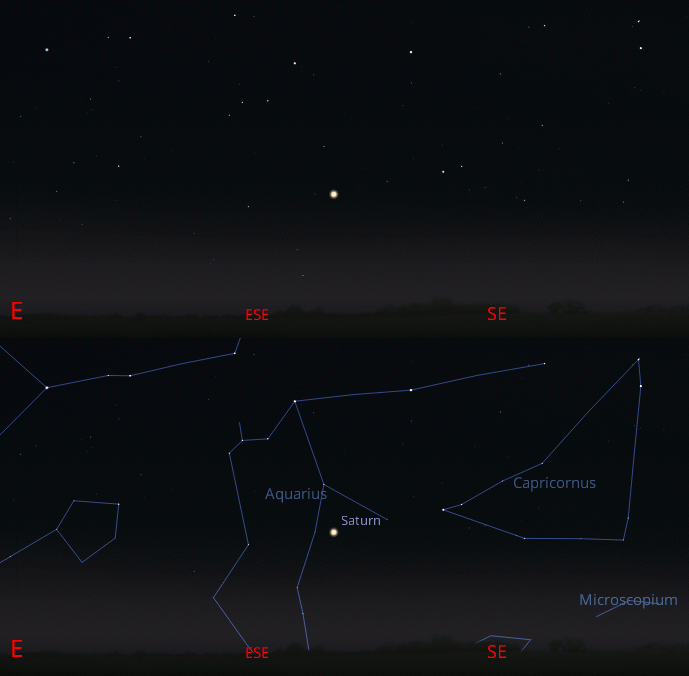
Finding Saturn in the evening for tonight at 10 pm, August 23, 2023. The unlabeled partial constellation on the left is part of Pisces, and the five stars in a circle is an asterism (informal constellation) called the Circlet. Another asterism is composed of the four stars in a small triangle with another in the center, above and a bit left of the Aquarius label is the Water Jar with water streaming from it to the right. Click or tap on the image to enlarge it. Created using Stellarium and GIMP.
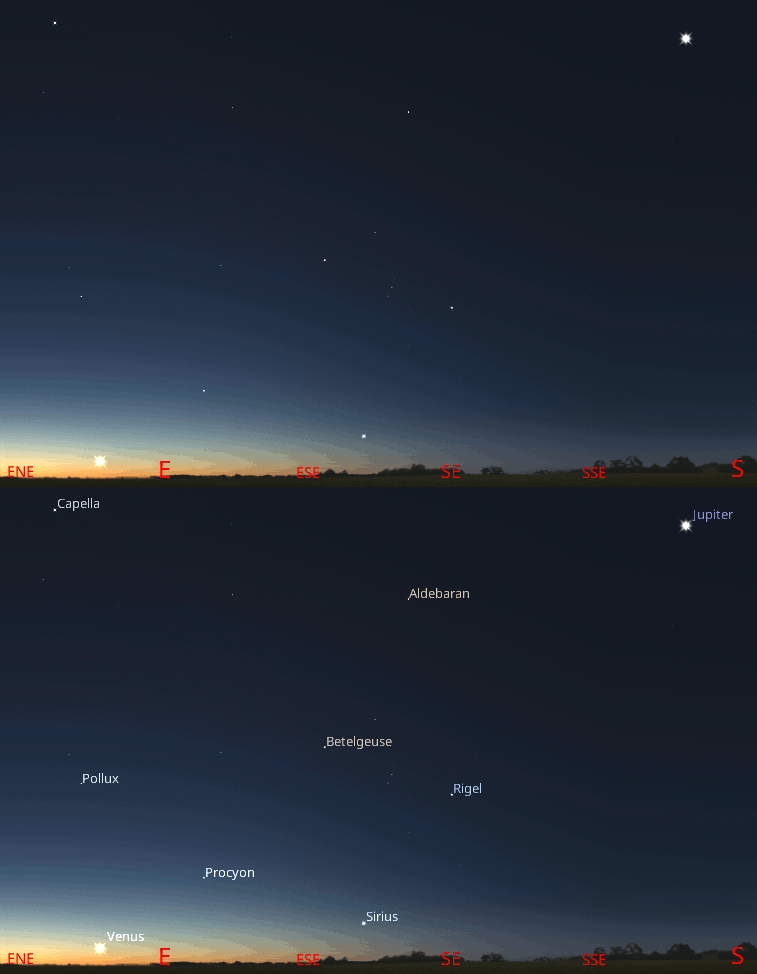
The morning planets at 6:10 am tomorrow morning, August 24, 3023, after Venus rises, with the bright stars of winter slowly disappearing in the advancing morning twilight. Click or tap on the image to enlarge it. Created using Stellarium and GIMP.
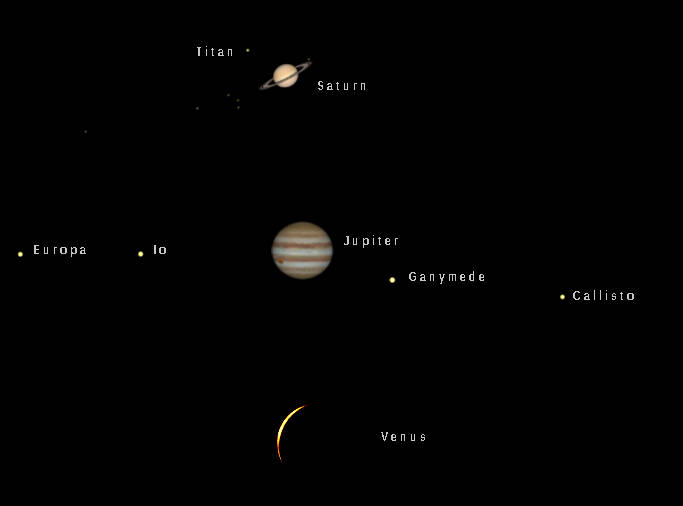
Telescopic Saturn, Jupiter and Venus (north up) as they would be seen in a small telescope, with the same magnification at 10 pm August 23, 2023, for Saturn and 6:10 am August 24, 2023, for Jupiter and Venus. Apparent diameters: Saturn 18.96″, its rings 44.17″; Jupiter 42.90″; and Venus 54.66″ and is 5.0% illuminated. The ” symbol means seconds of arc (1/3600th of a degree.) Click or tap on the image to enlarge it. Created using Cartes du Ciel (Sky Charts).
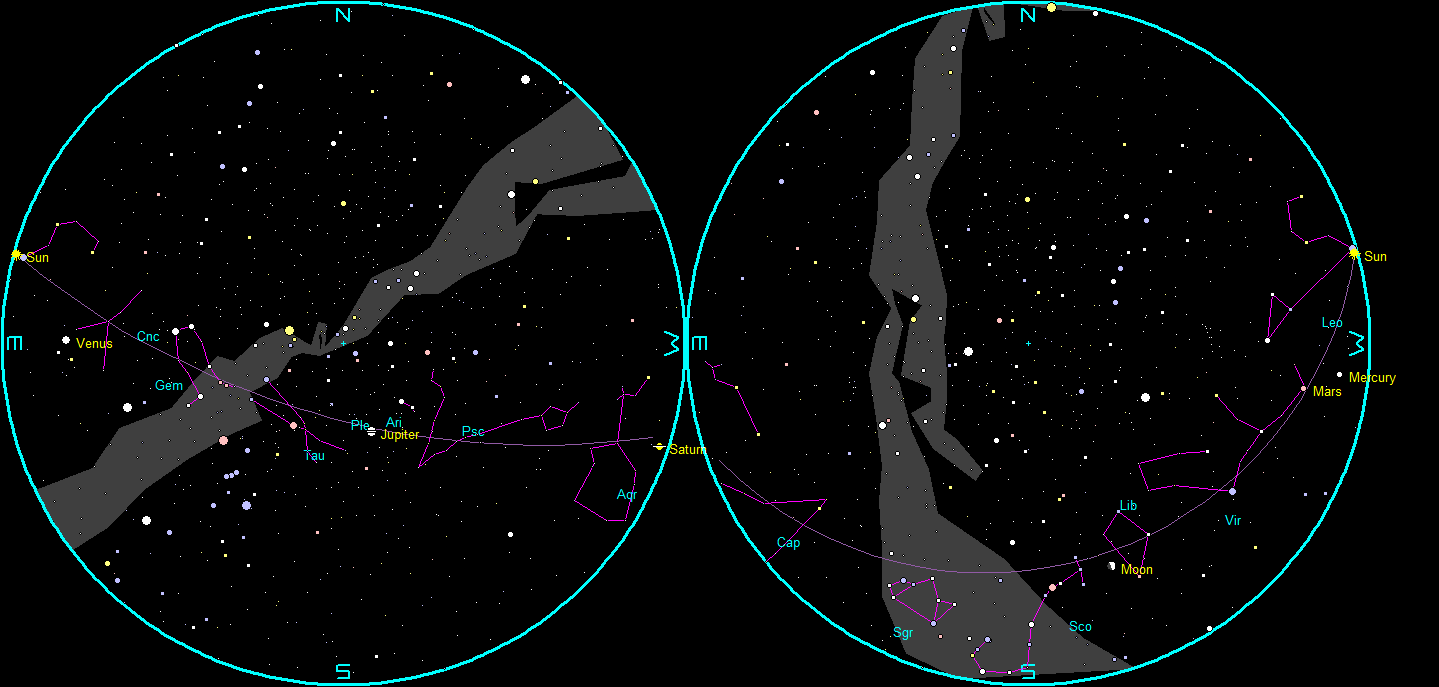
The naked-eye planets and the Moon at sunset and sunrise on a single night, starting with sunset on the right on August 23, 2023. The night ends on the left with sunrise on the 24th. Click or tap on the image to enlarge it. Created using my LookingUp app and GIMP.
Ephemeris: 08/22/2023 – We might see a naked eye comet next month
Aug 22. This is Ephemeris for Tuesday, August 22nd. The Sun will be up for 13 hours and 44 minutes today, setting at 8:37, and it will rise at 6:54 tomorrow. The Moon, 2 days before first quarter, will set at 11:09 this evening.
A new comet has been discovered that might be visible to the naked eye in early September. It was discovered 10 days ago by Hideo Nishimura of Kakegawa, Japan. Somehow he was able to scoop all the automated asteroid seeking discovery programs. The comet will be visible in the morning before sunrise in the northeastern sky. It will be probably be naked eye from the 7th to the 10th. That’s only about four days in September. At that point it may get up to about fourth magnitude which is not very bright, especially for a comet, it’s barely visible, since comets appear dimmer than their magnitude suggests. However, it will be far enough from the Sun at the beginning of the four-day period to be able to be viewed before astronomical twilight.
The astronomical event times given are for the Traverse City/Interlochen area of Michigan (EDT, UT –4 hours). They may be different for your location.
Addendum
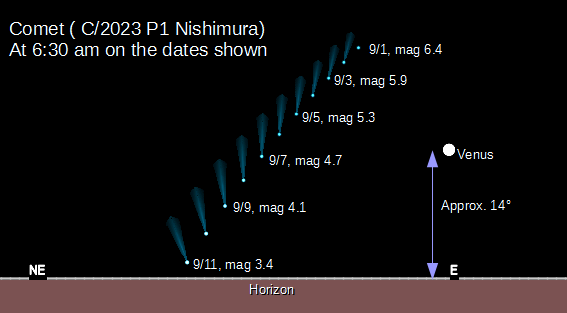
Most of the data for this posting comes from Seiichi Yoshida’s Weekly Information about Bright Comets webpage (www.aerith.net/comet/weekly/current.html).
Ephemeris: 08/21/2023 – Looking at a trio of lunar craters tonight
This is Ephemeris for Monday, August 21st. Today the Sun will be up for 13 hours and 47 minutes, setting at 8:39, and it will rise tomorrow at 6:53. The Moon, 3 days before first quarter, will set at 10:48 this evening.
The crescent Moon tonight has what looks like a chain of three large craters near the terminator, visible in a low power telescope. The terminator is the line between day and night. Before the full moon, it’s the sunrise line. On closer inspection, these craters are of different ages. The north crater Theophilus, 63 miles in diameter and one of my favorite craters, looks relatively fresh. It’s not, it’s somewhat older than a billion years. The crater just south of it is Cyrillus, about the same size, which is almost 4 billion years old. Theophilus slightly overlaps Cyrillus. A bit farther south is Catharina, which again is about the same size and age range as Cyrillus, but seems more broken down than the other.
The astronomical event times given are for the Traverse City/Interlochen area of Michigan (EDT, UT –4 hours). They may be different for your location.
Addendum
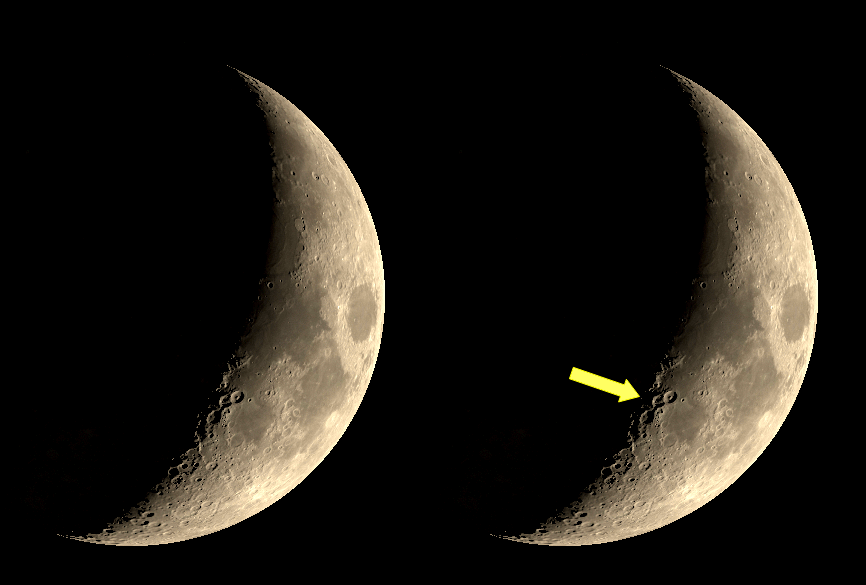
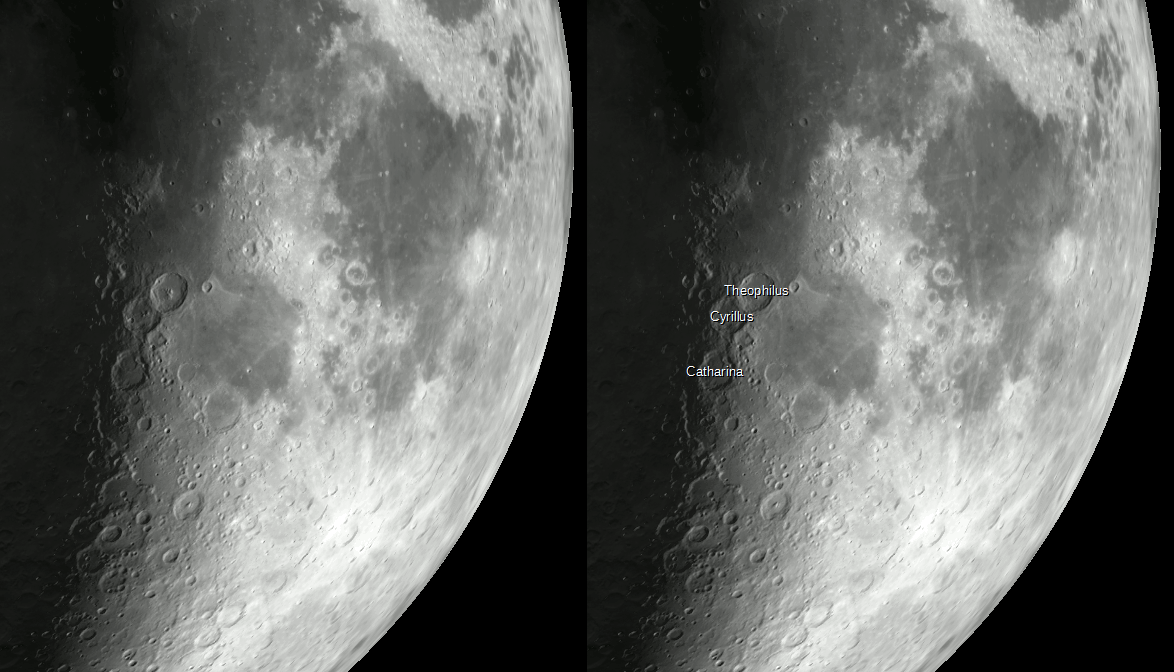
A closer look at these three craters for tonight at 10 pm. Created using Virtual Moon Atlas, LibreOffice Draw and GIMP.
Ephemeris: 08/18/2023 – There will be a Sun & Star Party tomorrow at the Sleeping Bear Dunes National Lakeshore
This is Ephemeris for Friday, August 18th. Today the Sun will be up for 13 hours and 55 minutes, setting at 8:44, and it will rise tomorrow at 6:49. The Moon, 2 days past new, will set at 9:57 this evening.
Weather permitting, a Sun and Star Party will be held tomorrow night at the Sleeping Bear Dunes National Lakeshore at the Dune Climb. The solar part will start at 5 pm, while the evening viewing will start at 9 pm. These events will be hosted by the park rangers and the Grand Traverse Astronomical Society, who will bring their telescopes to view the heavens, including the planet Saturn and the wonders of the summer Milky Way. The telescopes will be setup in the parking area closest to the dune. While as twilight fades Saturn will be about the only object to view, as it gets darker more and more wonders of the Milky Way will be seen. They include star clusters and nebulae, clouds of gas and dust.
The astronomical event times given are for the Traverse City/Interlochen area of Michigan (EDT, UT –4 hours). They may be different for your location.
Addendum
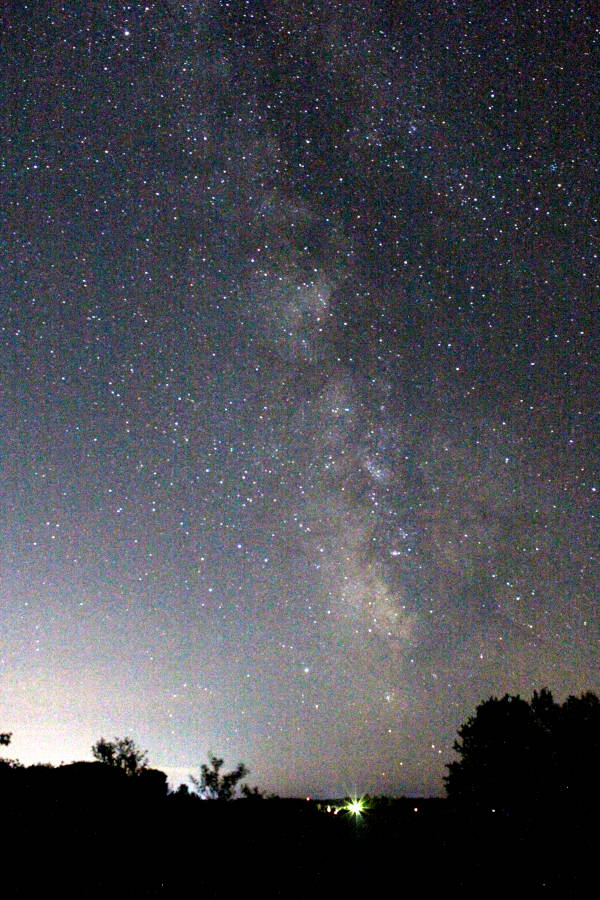
Ephemeris: 08/17/2023 – Finding Aquila the eagle
This is Bob Moler with Ephemeris for Thursday, August 17th. Today the Sun will be up for 13 hours and 58 minutes, setting at 8:45, and it will rise tomorrow at 6:48. The Moon, 1 day past new, will set at 9:40 this evening.
Aquila the eagle is a constellation that lies in the Milky Way. It’s in the southeastern sky as it gets dark. Its brightest star, Altair, is one of the stars of the Summer Triangle, the group of three bright stars high in the east to southeastern sky in the evening now. Altair, in the head of the eagle, is flanked by two slightly dimmer stars, the shoulders of the eagle. The eagle is flying northeastward through the Milky Way. Its wings are seen in the wing tip stars. A curved group of stars to the lower right of Altair is its tail. Within Aquila, the Milky Way shows many dark clouds as part of the Great Rift that splits it here. The other summer bird is Cygnus the swan above and left of Aquila, flying in the opposite direction. It was said this was the eagle that attended the Roman god Jupiter.
The astronomical event times given are for the Traverse City/Interlochen area of Michigan (EDT, UT –4 hours). They may be different for your location.
Addendum
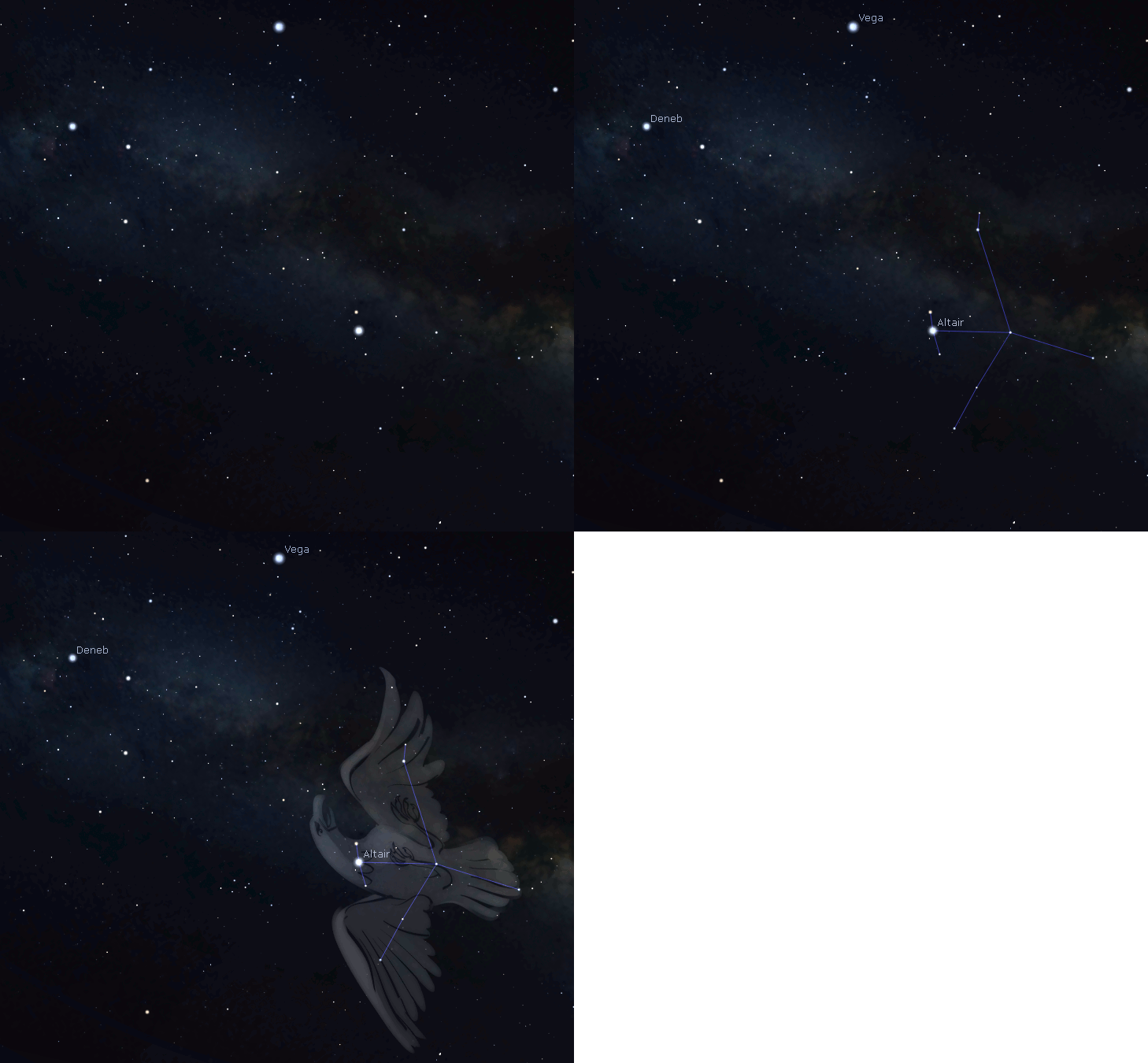
Animated Cygnus finder chart. Two small constellations are found near the head of Aquila. Created using Stellarium. Near the beak of the image of Aquila is Sagitta the arrow. A bit further left of Altair are the distinctive six stars of Delphinus the dolphin, as if it is jumping out of the water. Created using Stellarium and GIMP.
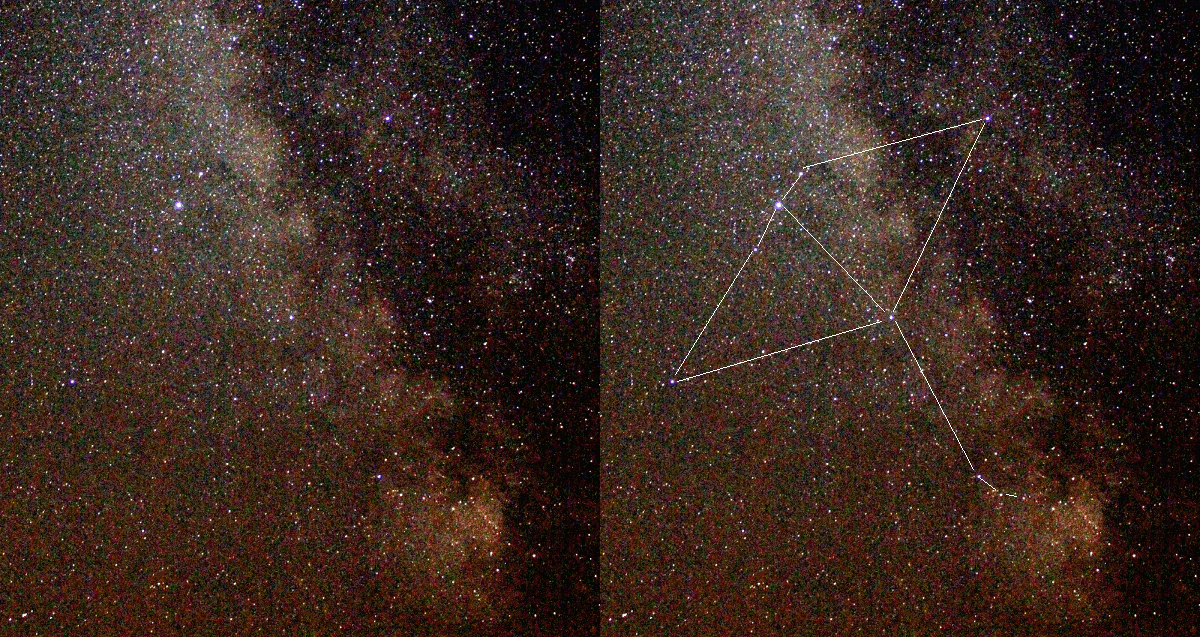
Animated photograph of Aquila the eagle with constellation lines taken on August 13, 2018, during the Perseid meteor shower. Alas, there are no Perseids in this photograph. The reddening of the image was in part due to the smoke and haze if the western states wildfires that year. Taken by me and processed using Registax and GIMP.
Ephemeris: 08/16/2023 – Let’s find out where the naked-eye planets have wandered off to this week
This is Ephemeris for Wednesday, August 16th. Today the Sun will be up for 14 hours and 1 minute, setting at 8:47, and it will rise tomorrow at 6:47. The Moon is new today, and won’t be visible.
Let’s find out where the naked-eye planets have wandered off to this week. Only two of these five planets are visible. Mars, Mercury and Venus are all too close to the Sun to be seen. Jupiter and Saturn are officially morning planets, although Saturn does rise in the evening shortly after sunset. It will become an evening planet on the 27th, when it will rise at sunset. It can be spotted in the southeastern part pf the sky in the evening. It will also be visible throughout the morning hours. Saturn is in retrograde or westward motion against the stars of Aquarius now. Jupiter, still moving slowly eastward against the stars of Aries the ram, also rises in the evening, but barely, rising just before midnight. It will be stationary, that is, it will stop its eastward motion against the stars, and will begin its retrograde or westward motion on September 7th.
The astronomical event times given are for the Traverse City/Interlochen area of Michigan (EDT, UT –4 hours). They may be different for your location.
Addendum
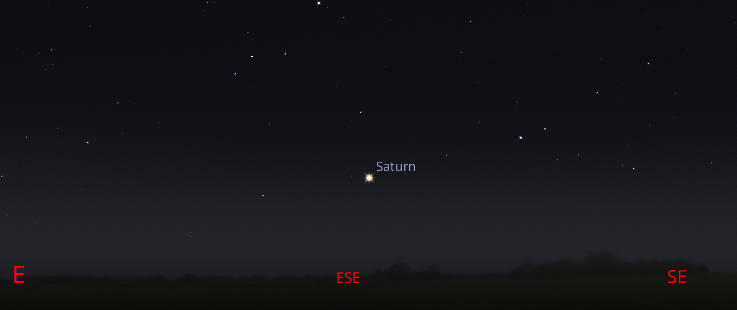
Saturn can be seen low in the east-southeast around 10 pm, or an hour or so after sunset. Created using Stellarium.
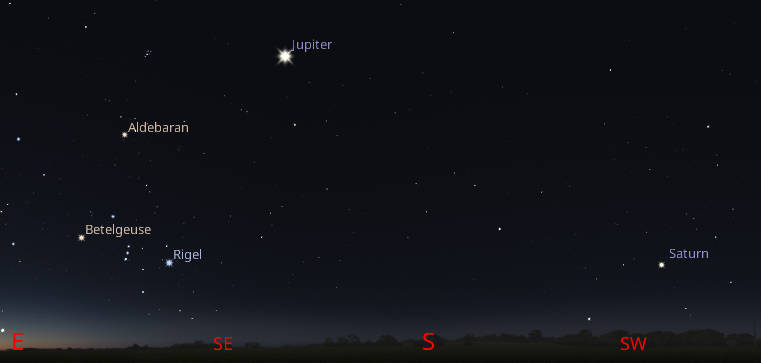
Morning planets and the winter stars are still visible about 45 minutes before sunrise. In the Interlochen/Traverse City Area, that would be about 5:45 am. Large images can be truncated on the right. Click or tap on the image to enlarge and display the complete image. Created using Stellarium.
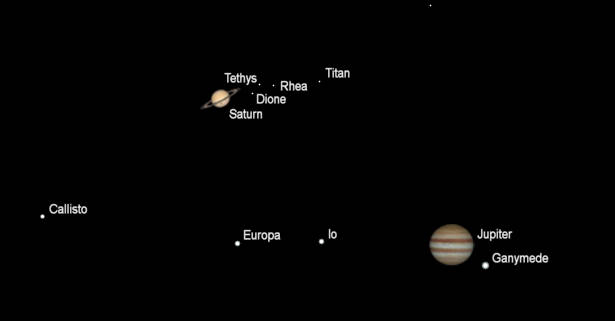
Telescopic Saturn and Jupiter (north up) as they would be seen in a small telescope, with the same magnification, Saturn at 11 pm, tonight, August 16, 2023, and Jupiter at 5:45 am on the 17th. Apparent diameters: Saturn 18.93″, its rings 44.10″; Jupiter 41.94″. Saturn and Jupiter are approaching us, so their apparent diameters are growing. The ” symbol means seconds of arc (1/3600th of a degree). Click or tap on the image to enlarge it. Created using Cartes du Ciel (Sky Charts).
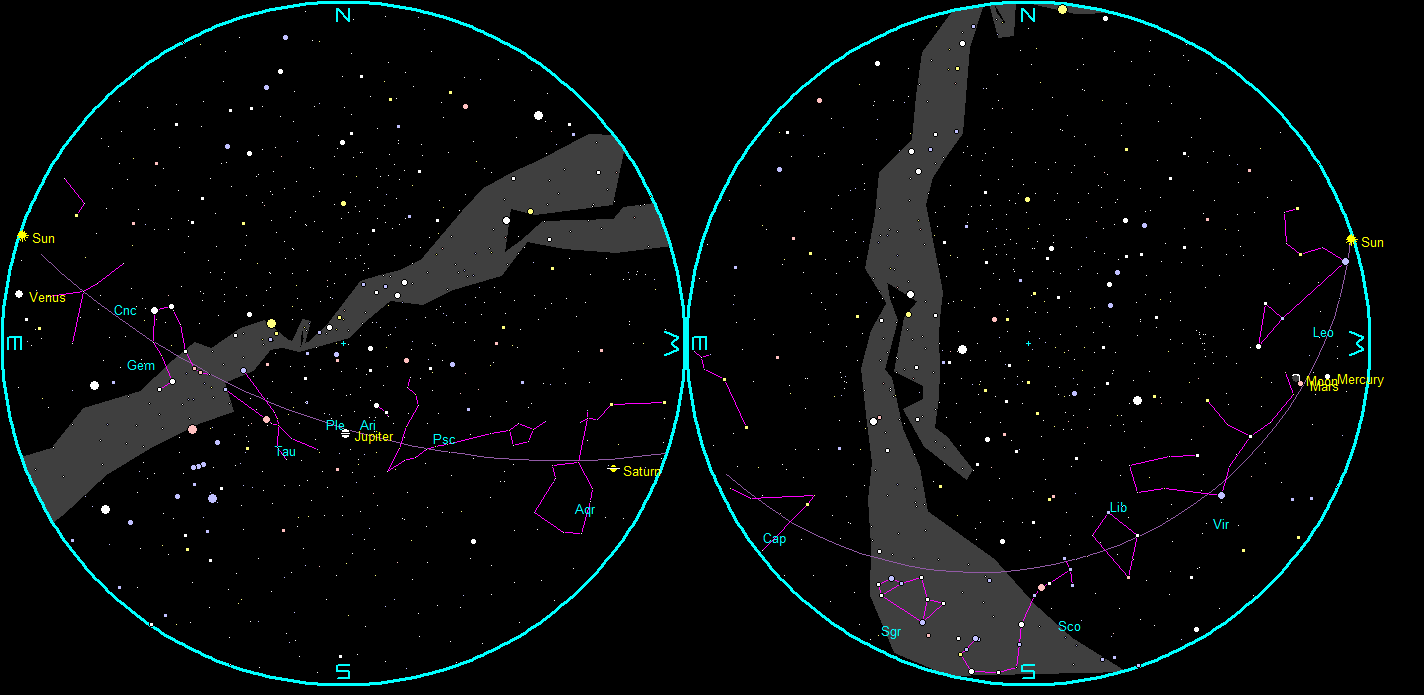
The naked-eye planets and the Moon at sunset and sunrise on a single night, starting with sunset on the right on August 16, 2023. The night ends on the left with sunrise on the 17th. Click or tap on the image to enlarge and display the complete image. Created using my LookingUp app and GIMP.

