Ephemeris: 02/25/2026 – Taking our weekly look at the whereabouts of the naked-eye planets

February 25, 2026 Comments off

This is Ephemeris for Wednesday, February 25th. Today the Sun will be up for 10 hours and 58 minutes, setting at 6:25, and it will rise tomorrow at 7:25. The Moon, 1 day past first quarter, will set at 4:37 tomorrow morning.

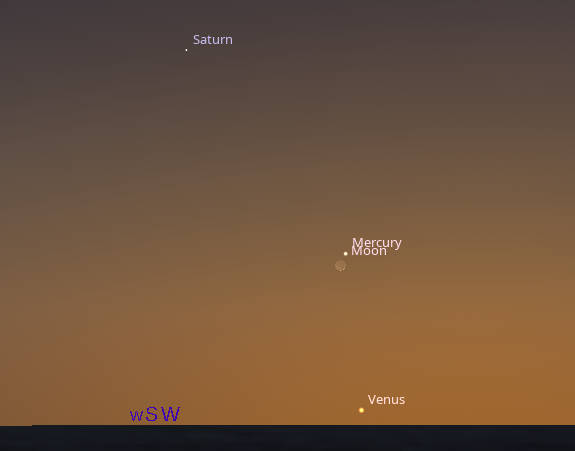
Let’s take our weekly look at the whereabouts of the naked-eye planets. At 7:00 PM or about and 1/2 hour after sunset Venus may be seen very low in the West above it and a bit to the right is Mercury which will be really difficult to spot since it is dimming now and above left of that is Saturn which is getting very low in the sky. We are in the last third of winter and the sunset times are increasing rapidly and taking with it the planets near the Sun including Saturn. By 8 PM Saturn will be very low in the West and not a very good object for telescope viewing. Jupiter is the brilliant star-like object more than halfway up in the southeastern sky, and tonight is below and left of the Moon. It’s the brightest star-like object in the sky. It is still moving to the west, but is slowing down and will stop and reverse its course 13 days from now.

The astronomical event times given in this blog are for the Traverse City/Interlochen area of Michigan (Lat 44.7° N, Long 85.7° W; EST, UT – 5 hours) unless stated otherwise. Times will be different for other locations.

Addendum
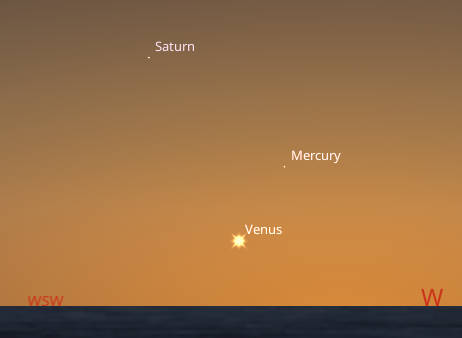
Saturn with Mercury and Venus in the west-southwestern sky at 7 PM tonight February 25, 2026, or 35 minutes after sunset. Spotting Mercury and Venus will be problematic: being too low in Venus' case, and too faint in Mercury's.
Saturn with Mercury and Venus in the west-southwestern sky at 7 PM tonight February 25, 2026, or 35 minutes after sunset. Spotting Mercury and Venus will be problematic: being too low in Venus’ case, and too faint in Mercury’s. Created using Stellarium.
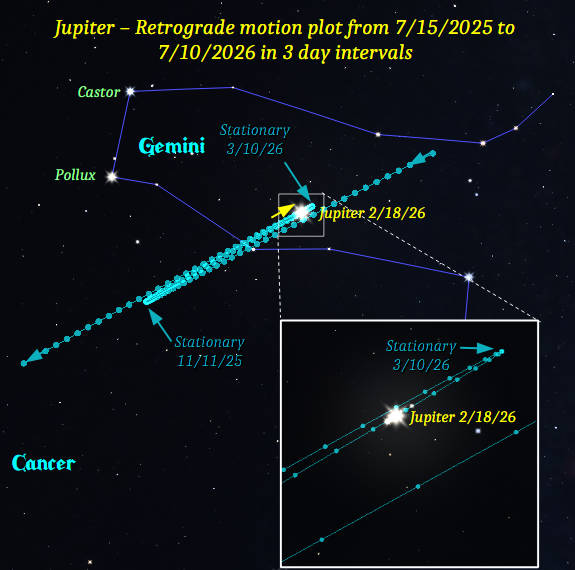
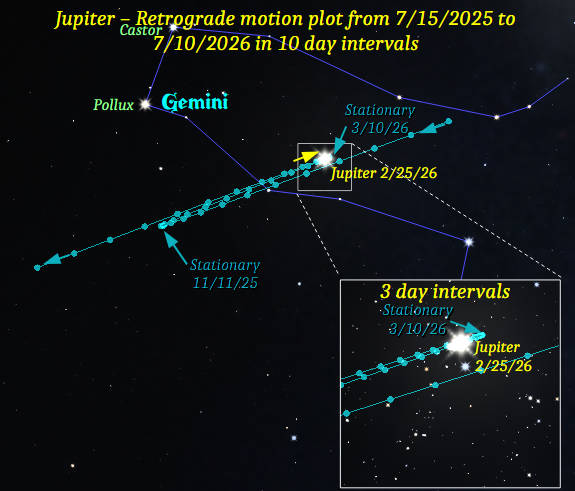
Jupiter as it appears tonight, February 25, 2026, in its orientation at 9:00 PM moving against the stars of Gemini.
Jupiter as it appears tonight, February 25, 2026, in its orientation at 9:00 PM moving against the stars of Gemini. Also shown is its track from last July to next July, and the retrograde loop that it is currently making, slowly moving to the West which it will do for the next 13 days until it stops (becomes stationary) on March 10th. Then it will resume its eastward motion. The inset shows a magnified view of the west end of the retrograde loop. Created using Stellarium, LibreOffice Draw and GIMP.
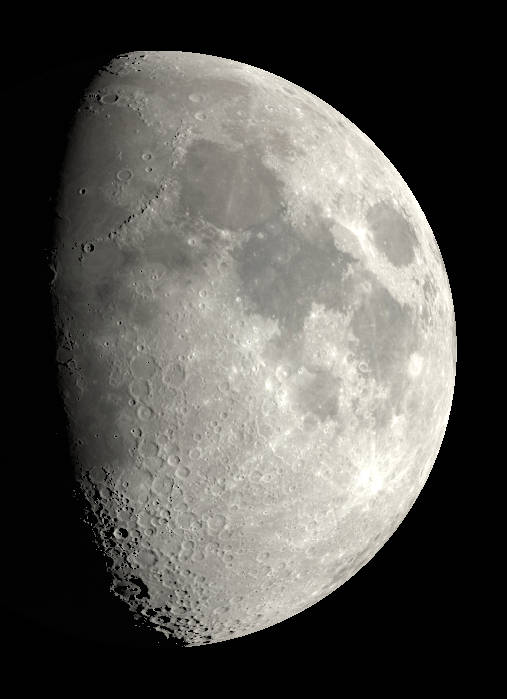
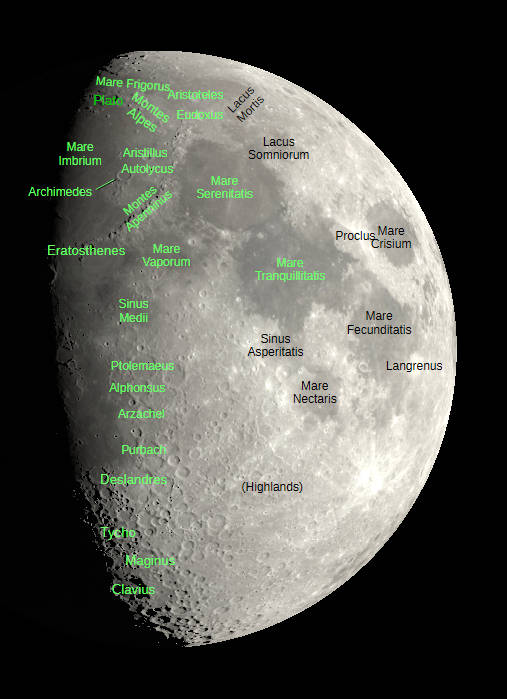
The Moon 1½ days past first quarter, as seen tonight, February 25, 2026. A view visible in small telescopes showing an image with and without selected features labeled. Created using Stellarium, LibreOffice Draw, and GIMP.
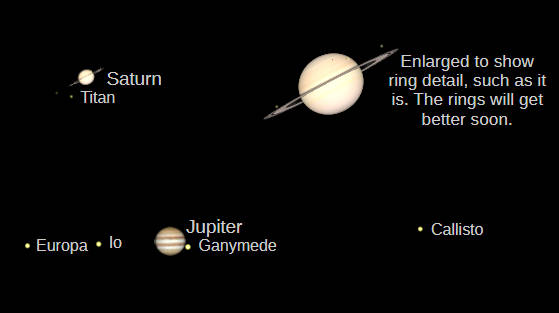
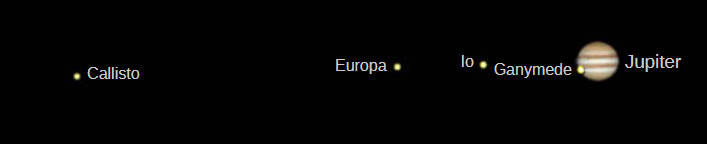
Jupiter is the one good planet available in a small telescope. Saturn is becoming too low in the sky to deliver a good image. This is how Jupiter will appear at 9 PM.
Jupiter is the one good planet available in a small telescope. Saturn is becoming too low in the sky to deliver a good image. This is how Jupiter will appear at 9 PM, with the exception of Ganymede with will begin its transit of the face of Jupiter at 8:56 PM EST. The satellites are shown much brighter compared to Jupiter than they actually are, so a satellite will seem to disappear against the brighter planet. Ganymede will not reappear before Jupiter sets for our location. Created using Cartes du Ciel (Sky Charts), LibreOffice Draw and GIMP.
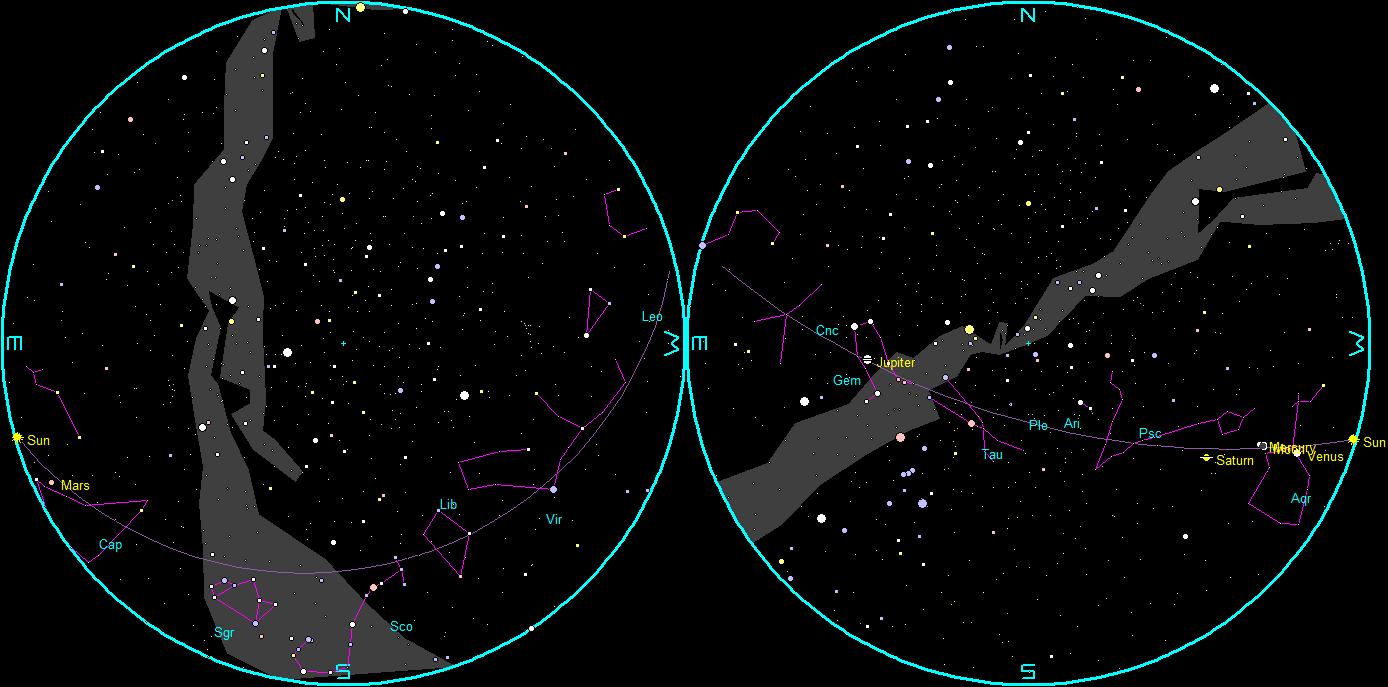
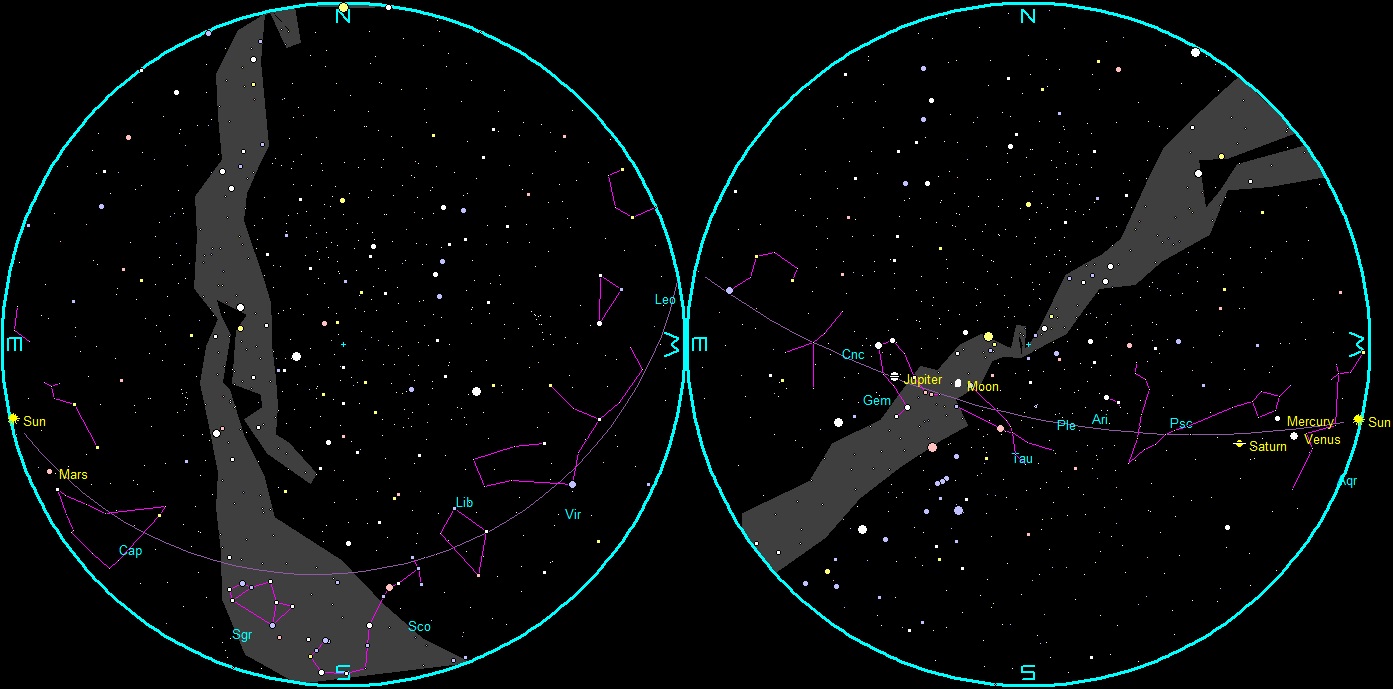
The naked-eye planets and the Moon at sunset and sunrise on a single night, starting with sunset on the right on February 25th, 2026. The night ends on the left with sunrise on the 26th.
The naked-eye planets and the Moon at sunset and sunrise on a single night, starting with sunset on the right on February 25th, 2026. The night ends on the left with sunrise on the 26th. Click or tap on the image to enlarge it. Created using my LookingUp app and GIMP.
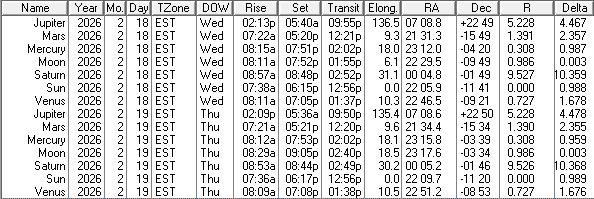
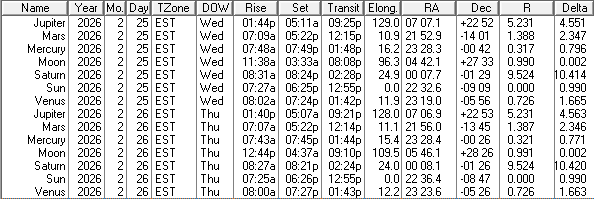
A low precision ephemeris of the Sun, Moon and naked eye planet positions for today and tomorrow.
This is a low precision ephemeris of the Sun, Moon and naked eye planet positions for today and tomorrow, February 25th and 26th, 2026. Some of the columns are self-explanatory, others are not. The transit column is the time that the body crosses the meridian and is due south. Elong, for elongation, is the angle between the Sun and that body. RA is right ascension, which is the object’s east-west position on the celestial sphere in hours and minutes. Dec is declination which is the north-south position of the object on the celestial sphere in degrees and minutes. R is the distance of that object from the Sun in astronomical units. An astronomical unit is about 93 million miles or 150 million kilometers. And Delta is the distance of that object from the Earth, also in astronomical units. I omit the ‘m’ in am and pm for compactness. The data was generated using my LookingUp for DOS app and displayed as a table by my Ephemeris Helper app.

Ephemeris: 02/24/2026 – Three cool craters at the Moon’s first quarter

February 24, 2026 Comments off

This is Ephemeris for Tuesday, February 24th. Today the Sun will be up for 10 hours and 55 minutes, setting at 6:23, and it will rise tomorrow at 7:27. The Moon, at first quarter today, will set at 3:33 tomorrow morning.

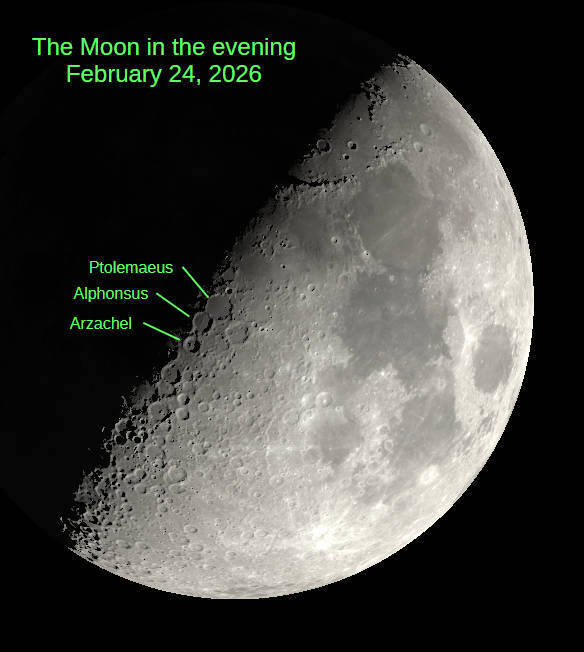
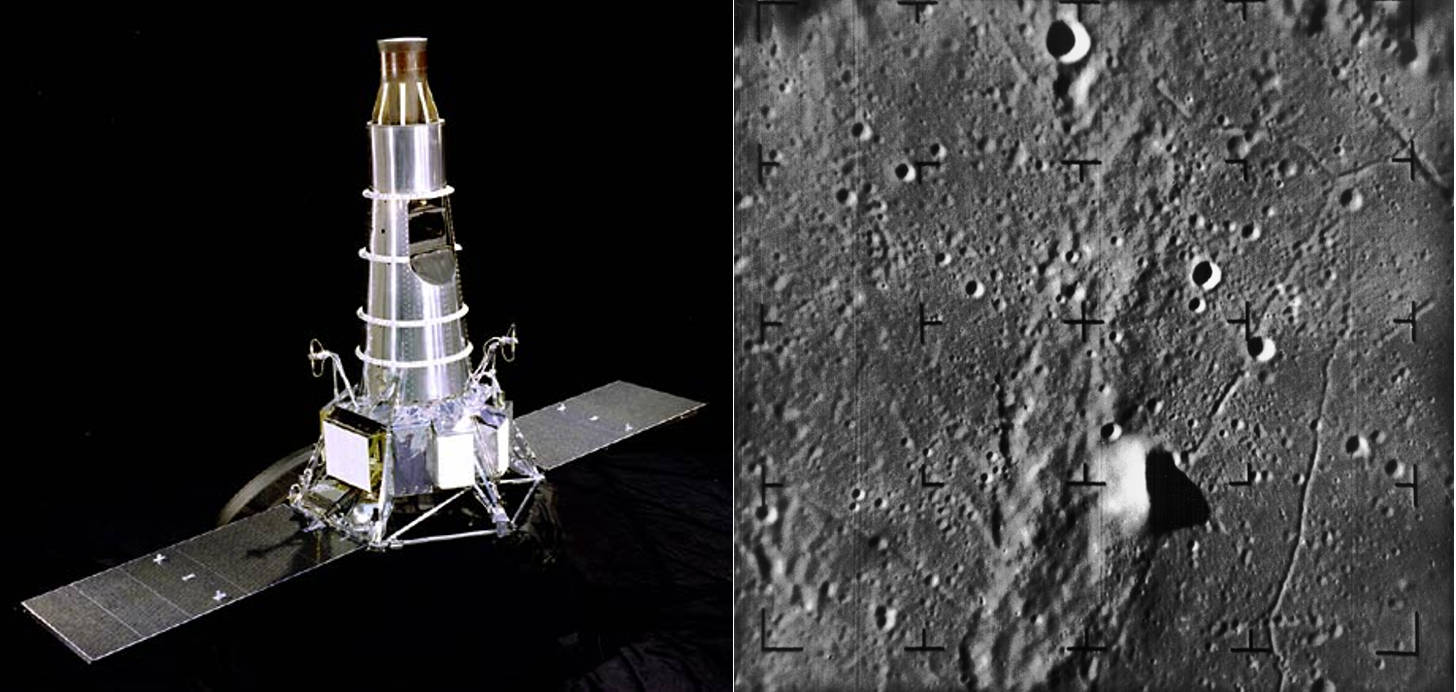
By the time we see the moon this evening it will be approximately half a day after became first quarter so it will be slightly gibbous tonight. Near the center of the moon near the terminator is a group of three craters . They are not a chain of craters in that they are of all of different ages. The largest in the north, called Ptolemaeus is named after Claudius Ptolemy the last great ancient Greek astronomer. The second is Alphonsus named after a Castilian king who was an astronomer. And the southern crater is Arzachel named after an 11th century Arabian astronomer and mathematician. In 1958 Soviet Astronomer Nikolai A. Kozyrev recorded the formation of a cloud near the center of the crater Alphonsus, suggesting perhaps some volcanic venting or activity.

The astronomical event times given in this blog are for the Traverse City/Interlochen area of Michigan (Lat 44.7° N, Long 85.7° W; EST, UT – 5 hours) unless stated otherwise. Times will be different for other locations.

Addendum
The telescopic first quarter Moon, featuring the three famous craters: Ptolemaeus, Alphonsus, and Arzachel. Moon image created using Stellarium.
Ranger spacecraft and closeup image of the Alphonsus crater.
Left: The Ranger spacecraft. Right: The floor of the crater Alphonsus from Ranger 9. Only the last 3 Ranger spacecraft were successful. They transmitted images all the way down as they crashed into the Moon. Credit NASA.

Ephemeris: 02/23/2026 – The Moon passes the Pleiades tonight

February 23, 2026 Comments off

This is Ephemeris for Monday, February 23rd. Today the Sun will be up for 10 hours and 52 minutes, setting at 6:22, and it will rise tomorrow at 7:28. The Moon, 1 day before first quarter, will set at 2:18 tomorrow morning.

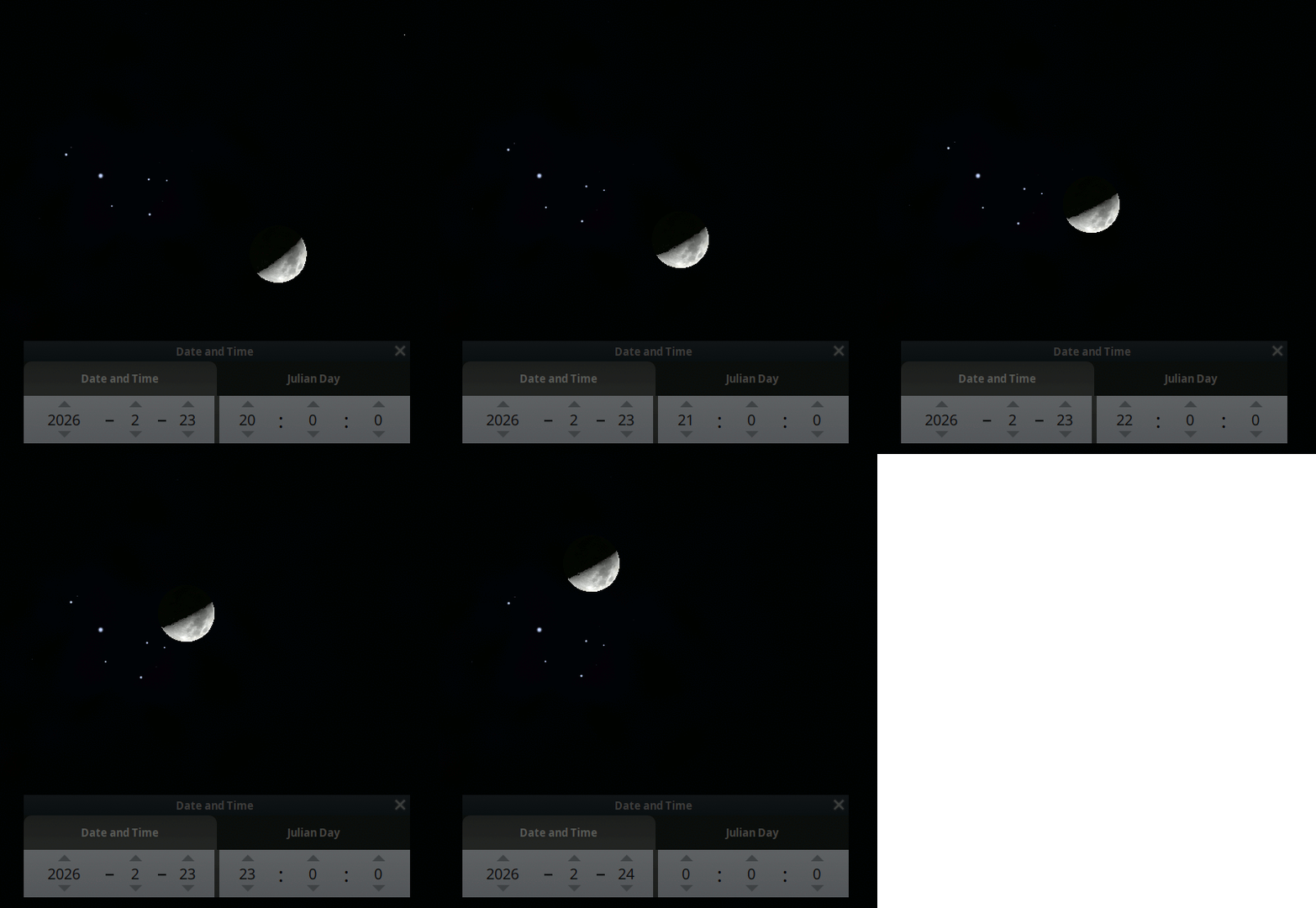
Tonight around 11o’clock the Pleiades star cluster will be just to the lower left of the nearly first quarter Moon. It will be very hard to spot them near the bright Moon, however they might be spotted with binoculars. Tonight the Moon will not occult or pass in front of the Pleiades’ brightest stars. The best time to see the Moon near or occulting the Pleiades is when it’s a crescent, and doesn’t overwhelm them, which will be later on this spring. However, the Moon passes by the Pleiades about a month apart, but they occur either in the afternoon or the morning hours so it won’t be as spectacular. The moon will also have close passages of the planet Venus this spring . The closest approach will be on May 18th.

The astronomical event times given in this blog are for the Traverse City/Interlochen area of Michigan (Lat 44.7° N, Long 85.7° W; EST, UT – 5 hours) unless stated otherwise. Times will be different for other locations.

Addendum
The nearly first quarter Moon will be passing north of the Pleiades this evening.
The nearly first quarter Moon will be passing north of the Pleiades this evening. The Moon actually far outshines the Pleiades, so one will have to view this event with binoculars or a low power telescope. The stars might be better seen by putting the Moon just out of the field of view. This display is actually centered on the star Alcyone the brightest star of the six of the Pleiades that are visible. This is an alt-azimuth orientation, where up is up and down is down. The sky rotates as it moves from east to west. During this period the Moon and Pleiades will be moving from the southwest down to the west-northwestern horizon. This display is for Northern Michigan. The apparent relationship between the Moon and the Pleiades changes with the observer’s location. Created using Stellarium and GIMP.

Ephemeris: 02/20/2026 – The star that’s called “Before the Dog”

February 20, 2026 Comments off

This is Ephemeris for Friday, February 20th. Today the Sun will be up for 10 hours and 43 minutes, setting at 6:18, and it will rise tomorrow at 7:33. The Moon, 3 days past new, will set at 10:21 this evening.

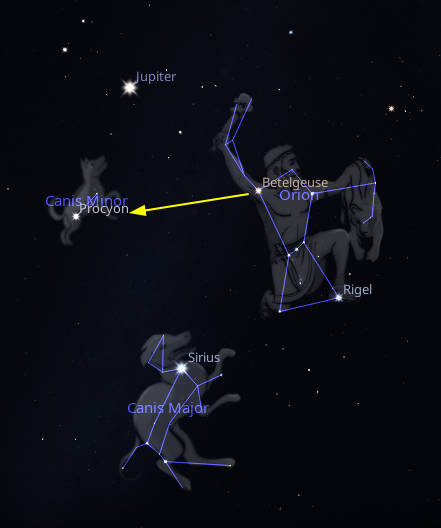
The star Procyon is in Orion’s little hunting dog, Canis Minor, which contains only one other star. It can be found by using the shoulder stars of Orion, Bellatrix and Betelgeuse, pointing to the left and down a bit to Procyon at 9 PM. With Jupiter above, Betelgeuse to the right and Sirius below, it makes an imposing diamond of stars. The word Procyon means “Before the Dog” meaning that rises before the Dog Star, Sirius, even though it is east of it. Procyon is also north of Sirius, which for observers above 30° north latitude, it does indeed rise before the Dog Star. It is a star like Sirius, though it’s not as bright, or white. Procyon is 11.5 light years away while Sirius is 8.6. Both have tiny white dwarf companion stars.

The astronomical event times given in this blog are for the Traverse City/Interlochen area of Michigan (Lat 44.7° N, Long 85.7° W; EST, UT – 5 hours) unless stated otherwise. Times will be different for other locations.

Addendum
How to find Procyon and Canis Minor.
How to find Procyon and Canis Minor with the help of Orion’s stars Betelgeuse and Bellatrix (at the top of the “n” in Orion). Jupiter, Betelgeuse, Sirius and Procyon make a temporary diamond in the winter sky this year. Created using Stellarium, LibreOffice Draw and GIMP.

Ephemeris: 02/19/2026 – The star called Pup

February 19, 2026 Comments off

This is Ephemeris for Thursday, February 19th. Today the Sun will be up for 10 hours and 40 minutes, setting at 6:17, and it will rise tomorrow at 7:35. The Moon, 2 days past new, will set at 9:05 this evening.

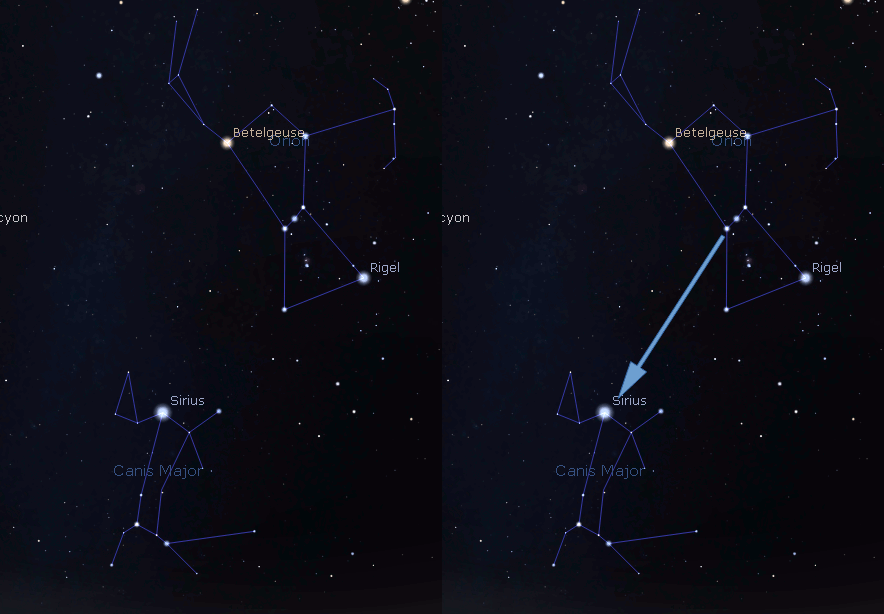
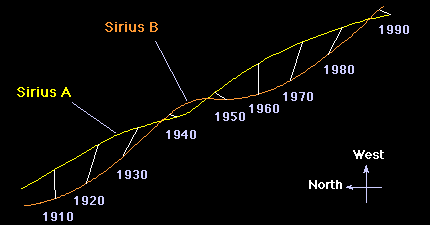
Sirius is the brightest nighttime star and is located in the south at 9 p.m. below and a bit left of Orion the Hunter. We’ve visited Sirius last Monday, but there is another star in the Sirius system that is practically invisible due to Sirius’ dazzling glare. Its name is Sirius B, nicknamed the Pup, alluding to Sirius’ Dog Star title as the heart of Canis Major, Orion’s larger hunting dog. The tiny star was suspected as far back as 1834 due to Sirius’ wavy path in the sky against the more distant stars. Sirius and the Pup have 50-year orbits of each other. The Pup was first seen in 1862. The Pup was the first of a new class of stars to be discovered, white dwarfs. The Pup, with the mass of the Sun, is packed into the volume of the Earth.

The astronomical event times given in this blog are for the Traverse City/Interlochen area of Michigan (Lat 44.7° N, Long 85.7° W; EST, UT – 5 hours) unless stated otherwise. Times will be different for other locations.

Addendum
Orion's belt points to Sirius
In the southern sky, Orion’s belt points to Sirius. Created using Stellarium, LibreOffice Draw and GIMP.
Sirius and the Pup's path through the sky
Sirius A & B’s path in the sky showing the wobble that betrayed the Pup’s presence. Credit Mike Guidry, University of Tennessee.
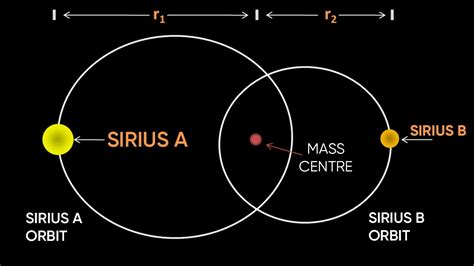
The orbits of Sirius A and B about their center of mass
The orbits of Sirius A and B about their center of mass. The represented scale of the sizes of the two stars are also. Sirius A is twice the mass of the Sun, and 1.7 times it’s diameter. Sirius B (Pup) has the mass of the Sun, and about 0.008 times the size of the Sun, or about the size of the Earth.
Two views of Sirius and the Pup
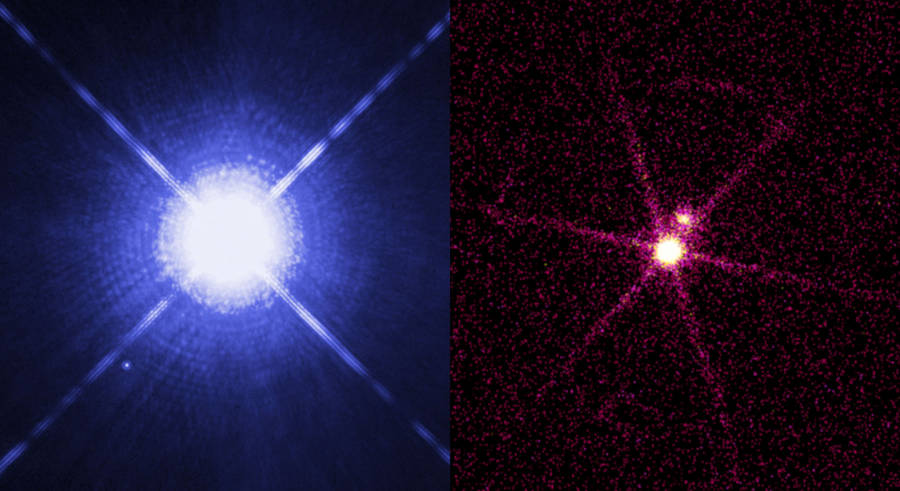
Sirius A and B imaged by two different space telescopes, revealing dramatically different views! Hubble’s image (left) shows Sirius A shining brightly in visible light, with diminutive Sirius B a tiny dot. However, in Chandra’s image (right) tiny Sirius B is dramatically brighter in X-rays! The “Universe in a Different Light” activity highlights more surprising views of some familiar objects: http://bit.ly/different-light-nsn NASA, ESA, H. Bond (STScI), and M. Barstow (University of Leicester) (left); NASA/SAO/CXC (right)
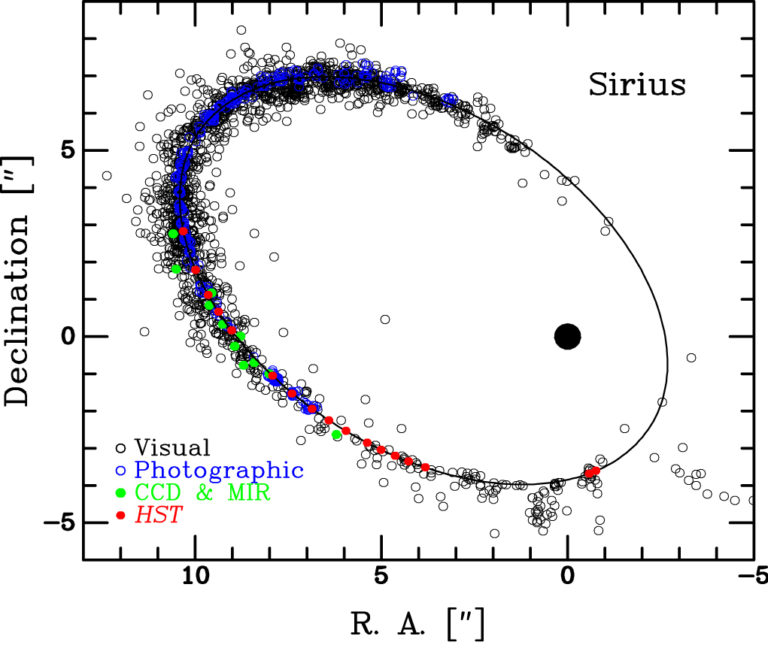
A plot of many observations of  Sirius B's position around Sirius A.
A plot of many observations of Sirius B’s position around Sirius A, color coded by the method of observation. Those from the Hubble Space Telescope (HST) are the most accurate. Credit: The Sirius System and Its Astrophysical Puzzles: Hubble Space Telescope and Ground-based Astrometry
by Howard E. Bond et al 2017 ApJ 840 70.

Ephemeris: 02/18/2026 – Taking our weekly look at the whereabouts of the naked-eye planets

February 18, 2026 Comments off

This is Ephemeris for Ash Wednesday, February 18th. Today the Sun will be up for 10 hours and 37 minutes, setting at 6:15, and it will rise tomorrow at 7:36. The Moon, 1 day past new, will set at 7:52 this evening.

Let’s take our weekly look at the whereabouts of the naked-eye planets. After sunset Venus may show up very low in the West probably before 7:00 PM. Above Venus, tonight, will be the 1 1/2 day old Moon and above it and very close, the planet Mercury making a rare appearance in our evening sky. At 8 PM Saturn remains low in the west southwestern sky, and it will set before 9 PM. In a telescope Saturn sports a very thin ring, 3.1 degrees from being edge on and is slowly opening. Jupiter is the brilliant star-like object more than halfway up in the east-southeastern sky. It’s the brightest star-like object in the sky. It is still moving to the west, but is slowing down and will stop and reverse its course 20 days now.

The astronomical event times given in this blog are for the Traverse City/Interlochen area of Michigan (Lat 44.7° N, Long 85.7° W; EST, UT – 5 hours) unless stated otherwise. Times will be different for other locations.

Addendum
Saturn appears with Mercury, the Moon and maybe even Venus in the west-southwestern sky at 7 PM tonight.
Saturn appears with Mercury, the Moon and maybe even Venus in the west-southwestern sky at 7 PM tonight February 18, 2026, or 45 minutes after sunset. The planet Mercury will most likely be dimmer than it appears here. It is always hard to spot in the twilight, though being just above the Moon will help tonight. Start looking for it around 6:45 PM or about a half hour after sunset. Created using Stellarium.
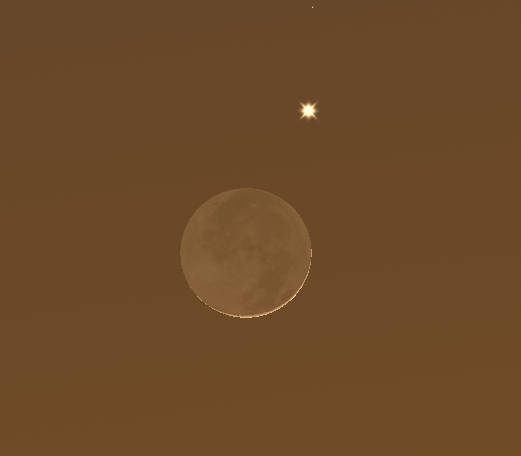
A closeup of Mercury and the day and a half old Moon.
A closeup of Mercury and the day and a half old Moon. Created using Stellarium.
Jupiter as it appears tonight, February 18, 2026, in its orientation at 9:00 PM moving against the stars of Gemini. Also shown is its track from last July to next July, and the retrograde loop that is currently making.
Jupiter as it appears tonight, February 18, 2026, in its orientation at 9:00 PM moving against the stars of Gemini. Also shown is its track from last July to next July, and the retrograde loop that is currently making, slowly moving to the West which it will do for the next 20 days until it stops (becomes stationary) on March 10th. Then it will resume its eastward motion. The inset shows a magnified view of the west end of the retrograde loop. Created using Stellarium, LibreOffice Draw and GIMP.
Telescopic Saturn, and Jupiter as they would be seen in a small telescope with the same magnification at 9 PM tonight.
Telescopic Saturn, and Jupiter (north up) as they would be seen in a small telescope with the same magnification at 9 PM tonight, February 18, 2026. Saturn will be 16.1″ in diameter, but its rings, being nearly edge on, may show up brighter than seen here, and extend to 37.4″. They are tilted 3.1° from being edge on. Jupiter will be 44.0″ in diameter. Earlier in the evening Mercury may be glimpsed just a bove the day and a half old Moon. Its too small to be represented here, because it’s only 7.0″ in diameter and is 52.8% illuminated. If you’re lucky enough to spot Venus, it’s 10″ in diameter and 98.4% illuminated. The (”) symbol means seconds of arc, or 1/3600th of a degree. Created using Cartes du Ciel (Sky Charts), LibreOffice Draw and GIMP.
The naked-eye planets and the Moon at sunset and sunrise on a single night.
The naked-eye planets and the Moon at sunset and sunrise on a single night, starting with sunset on the right on February 18th, 2026. The night ends on the left with sunrise on the 19th. The Moon and Mercury labels overlap near the sunset sun. Click or tap on the image to enlarge it. Created using my LookingUp app and GIMP.
A low precision ephemeris of the Sun, Moon and naked eye planet positions for today and tomorrow, February 18th and 19th, 2026
This is a low precision ephemeris of the Sun, Moon and naked eye planet positions for today and tomorrow, February 18th and 19th, 2026. Some of the columns are self-explanatory, others are not. The transit column is the time that the body crosses the meridian and is due south. Elong, for elongation, is the angle between the Sun and that body. RA is right ascension, which is the object’s east-west position on the celestial sphere in hours and minutes. Dec is declination which is the north-south position of the object on the celestial sphere in degrees and minutes. R is the distance of that object from the Sun in astronomical units. An astronomical unit is about 93 million miles or 150 million kilometers. And Delta is the distance of that object from the Earth, also in astronomical units. I omit the ‘m’ in am and pm for compactness. The data was generated using my LookingUp for DOS app and displayed as a table by my Ephemeris Helper app.

Ephemeris: 02/17/2026 – There’s an annular solar eclipse today… if you’re a penguin

February 17, 2026 Comments off

This is Ephemeris for Fat Tuesday, February 17th. Today the Sun will be up for 10 hours and 34 minutes, setting at 6:14, and it will rise tomorrow at 7:38. The Moon is new today, and won’t be visible.

This morning there is an annular solar eclipse occurring. Don’t run outside to see it, especially if you’re here in northern Michigan. The eclipse is only visible in the Southern Ocean and Antarctica. However, this eclipse marks the beginning of an eclipse season, and we will have an eclipse that will be visible for our location in two weeks: a total lunar eclipse, which will be visible before sunrise on Tuesday morning, March 3rd. There are two periods were eclipses will occur in a year, with at least one of the sun and the moon. These periods are separated by a little less than six months, and last about 35 days. That’s about 5 1/2 days longer than a lunar month, so it is possible to squeeze in another eclipse, though not this time.

The astronomical event times given in this blog are for the Traverse City/Interlochen area of Michigan (Lat 44.7° N, Long 85.7° W; EST, UT – 5 hours) unless stated otherwise. Times will be different for other locations.

Addendum
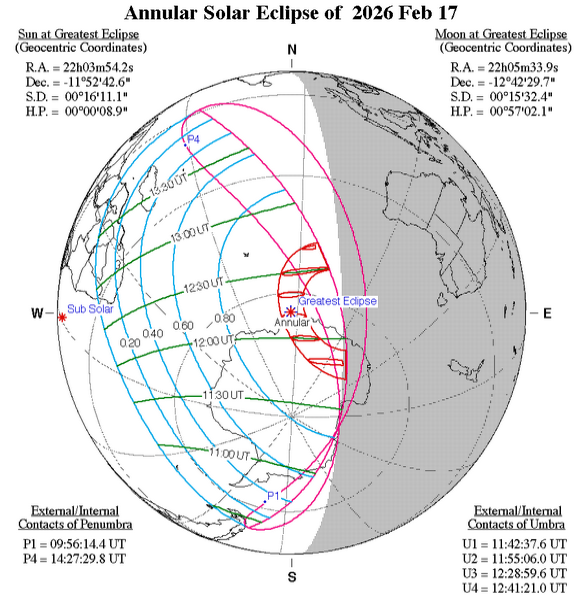
An adaption of the NASA eclipse map for the annular solar eclipse of February 17th 2026. The path of angularity is almost completely on Antarctica and a bit of the Southern Ocean.
An adaption of the NASA eclipse map for the annular solar eclipse of February 17th 2026. The path of angularity is almost completely on Antarctica and a bit of the Southern Ocean. The area of partial eclipse will extend from southern Africa along the eastern African coast and Madagascar. They will see a very slight partial eclipse. The eclipse season started about February 11th and will extend for 35 days. It will include a lunar eclipse which will be visible for us on the morning of March 3rd. Map by Fred Espenak. The original map is located at https://eclipse.gsfc.nasa.gov/SEplot/SEplot2001/SE2026Feb17A.GIF
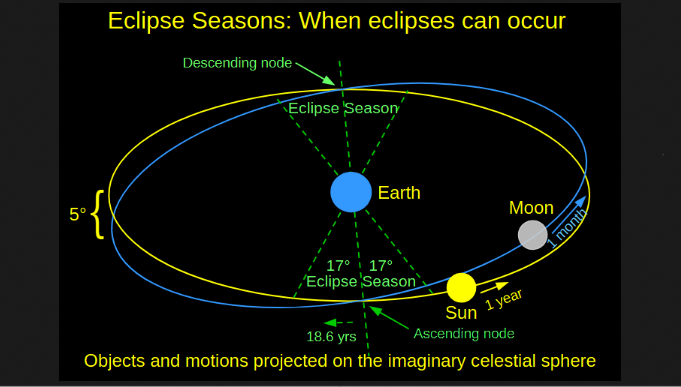
This is a diagram showing how eclipse seasons occur, due to the motions of the sun the moon and the wobbling of the moon’s orbit. The nodes which are the crossing points of the planes of the moons and the earth’s orbit around the sun shift westward over a period of 18.6 years. This causes the eclipse seasons to move earlier and earlier in the year over 18.6 years. Eclipses can occur when the sun is within 17° of the ascending or the descending nodes which is why eclipses eclipse seasons occur every six months and the season is long enough to squeeze in at least two eclipses, one each of the sun and the moon, and possibly a third if one occurs at the very beginning of the eclipse season.

Ephemeris: 02/16/2026 – The Dog Star

February 16, 2026 Comments off

This is Bob Moler with Ephemeris for President’s Day, Monday, February 16th. Today the Sun will be up for 10 hours and 31 minutes, setting at 6:12, and it will rise tomorrow at 7:39. The Moon, 1 day before new, will rise at 7:51 tomorrow morning.

The second-brightest star-like object in the evening sky is Sirius, also known as the Dog Star. It also is the brightest nighttime star in our skies period.  Tonight at 9 p.m. it’s located in the southern sky.  The Dog Star name comes from its position at the heart of the constellation Canis Major, the great dog of Orion the hunter.  The three stars of Orion’s belt tilt to the lower left to Sirius. Sirius means ‘Dazzling One’, because of its great brilliance and twinkling.  Its Egyptian name was Sopdet, and its first appearance in the dawn skies around July 20th signaled the flooding of the Nile, and the beginning of the agricultural year.  The relationship of the heliacal rising of Sirius and the seasonal or tropical year lasted from about 2900 BCE to the start of the Common Era. Sirius owes much of its brilliance to the fact that it lies close to us, only 8.6 light years away.

The astronomical event times given in this blog are for the Traverse City/Interlochen area of Michigan (Lat 44.7° N, Long 85.7° W; EST, UT – 5 hours) unless stated otherwise. Times will be different for other locations.

Addendum
Orion's belt points to Sirius
In the southern sky, Orion’s belt points to Sirius. Created using Stellarium, Libreoffice and GIMP.
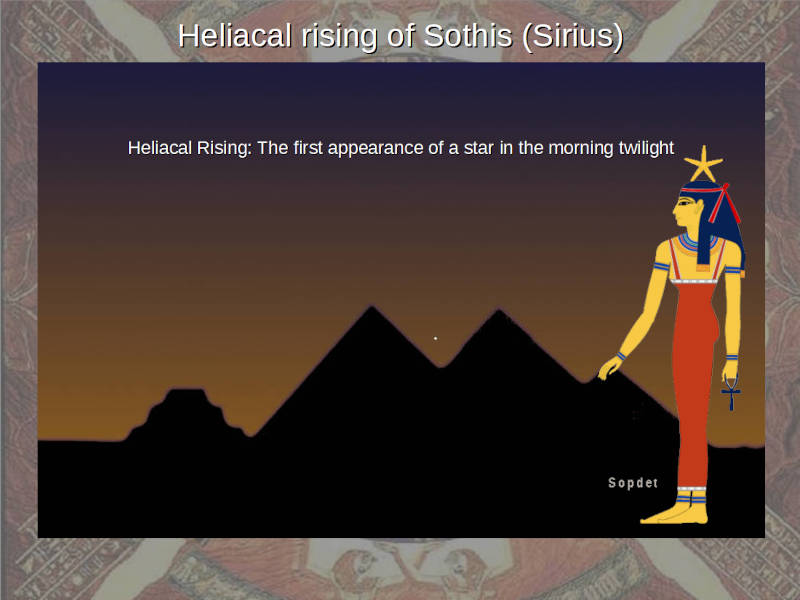
The Egyptian used the heliacal rising of Sirius as a signal that the flooding of the Nile was imminent, starting their agricultural year.
The Egyptians used the heliacal rising of Sirius as a signal that the flooding of the Nile was imminent, starting their agricultural year. The Greeks called the star Sothis, while the Egyptians themselves called it Sopdet, a goddess, and consort of the god Sah, our Orion. Part of my presentation on ancient Egyptian astronomy.

Trivia Note

The Greeks invented the term “Dog days of summer” for the hottest days of July because they thought that Sirius added its intensity to the heat of the Sun to make it hotter out. So why doesn’t Sirius help warm our winter nights? Just asking.

Ephemeris: 02/13/2026 – The real cause of a planet’s retrograde motion

February 13, 2026 Comments off

This is Ephemeris for Friday, February 13th. Today the Sun will be up for 10 hours and 22 minutes, setting at 6:08, and it will rise tomorrow at 7:44. The Moon, halfway from last quarter to new, will rise at 6:30 tomorrow morning.

So what is the real reason that Jupiter is currently moving westward for a while in retrograde motion? Retrograde motion occurs in outer planets because the Earth is actually passing them. A simple analogy would be, if you were in a car that was passing another, the car you are passing would seem to move backwards compared to you. And that is exactly what’s happening. The Earth moves faster than the outer planets. Since the solar system is like a racetrack, and we get to lap these outer planets repeatedly when they are closest to us. For the inner planet it’s opposite. They go retrograde or backwards when they are passing us. This is a much simpler answer than all these circles upon circles the ancients invented.

The astronomical event times given in this blog are for the Traverse City/Interlochen area of Michigan (Lat 44.7° N, Long 85.7° W; EST, UT – 5 hours) unless stated otherwise. Times will be different for other locations.

Addendum
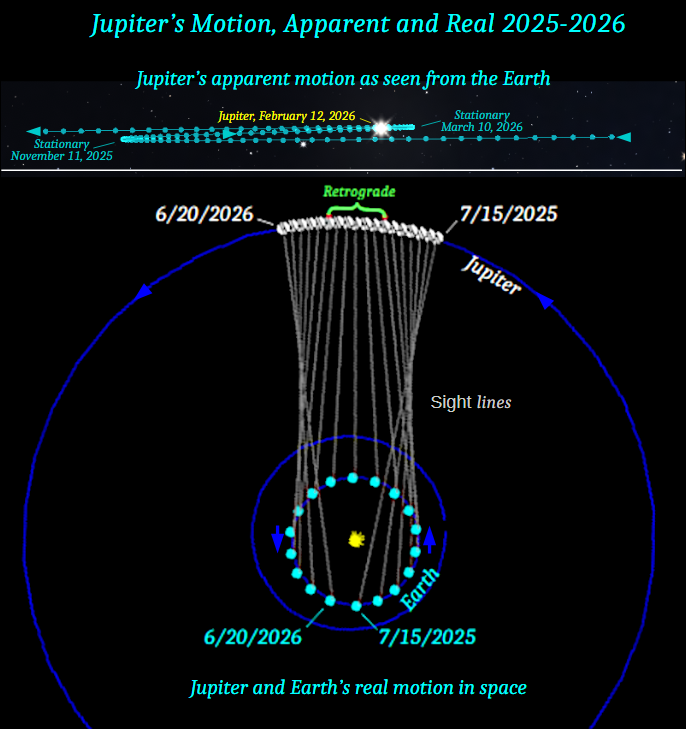
A diagram showing the Earth and Jupiter and above, the appearance of Jupiter in our sky and the retrograde motion as the Earth in essence passes Jupiter in our orbital motions around the Sun.
A diagram showing the Earth and Jupiter and above, the appearance of Jupiter in our sky and the retrograde motion as the Earth in essence passes Jupiter in our orbital motions around the Sun. When the sight lines from earth to Jupiter are trending counterclockwise, moving to the left, the planet appears to be moving eastward in its normal motion. As we pass Jupiter, at our closest point to it, the sight lines tend to rotate in the clockwise direction, which causes the appearance of retrograde motion of Jupiter in our sky. The plotting intervals on the top diagram is 10 days, 20 days on the bottom one. The diagram on the bottom was created using my LookingUp app, the upper diagram was created using Stellarium. Annotations added in LibreOffice Draw, all put together with GIMP.

Ephemeris: 02/12/2026 – Why do planets stop and move backward for a time? Part 1

February 12, 2026 Comments off

This is Ephemeris for Darwin Day, Thursday, February 12th. Today the Sun will be up for 10 hours and 19 minutes, setting at 6:07, and it will rise tomorrow at 7:45. The Moon, 3 days past last quarter, will rise at 5:49 tomorrow morning.

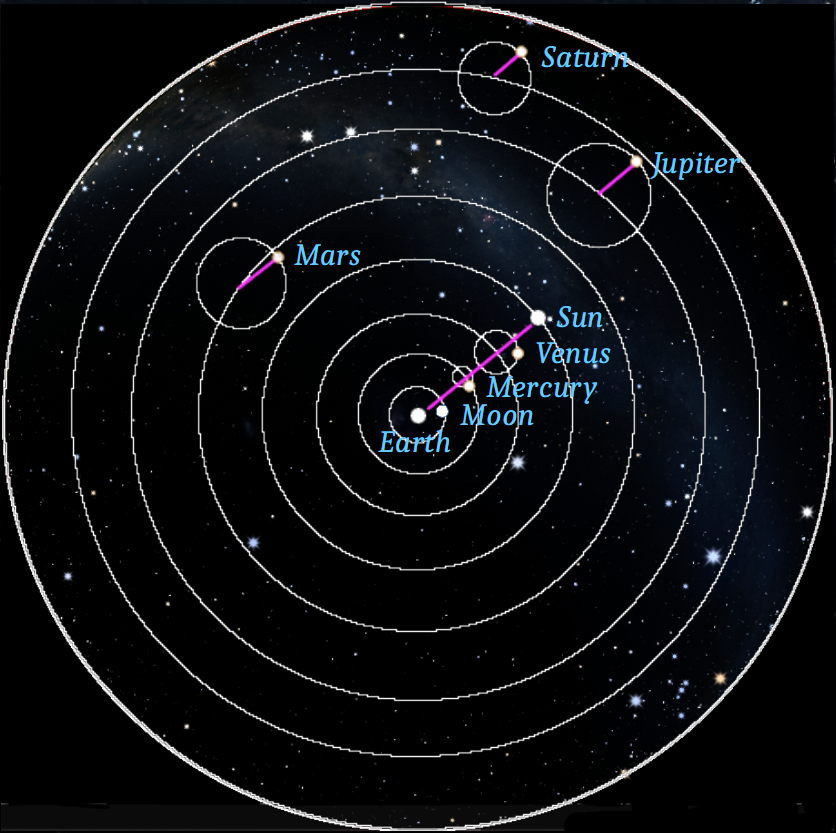
For the last month or so I’ve been talking about Jupiter in its retrograde or westward motion against the stars of Gemini. This motion isn’t due to just Jupiter itself. Jupiter orbits smoothly around the sun in one direction, in a little less than 12 years. The ancients thought that the earth was stationary, and everything in the sky orbited the earth. They thought that the planets orbited the earth in the same time that the planet orbits the sun, however every year and depending on where the planet was in the sky it would stop, reverse itself for a while and then resume its eastward motion through the sky. They thought that the planet moved on a small circle called an epicycle that rode on the larger circle called the deferent.

The astronomical event times given in this blog are for the Traverse City/Interlochen area of Michigan (Lat 44.7° N, Long 85.7° W; EST, UT – 5 hours) unless stated otherwise. Times will be different for other locations.

Addendum
A geocentric chart of the solar system.
The geocentric universe as imagined by the ancients with the Earth in the center. The outer ring is the celestial sphere of the stars. The other concentric circles around the Earth are deferents for each of the planets. Note that the line from the deferent to the planet on the epicycle is parallel to the line of the earth to the sun. One would think that screams the fact that somehow the Earth was in motion. But only the Greek astronomer Aristarchus figured it out. Then that idea was discarded until Copernicus in the 15th century of the modern era resurrected the idea.

Tomorrow, we’ll find out what’s really going on.