08/26/2022 – Ephemeris – Monday the launch window opens up for Artemis I
This is Bob Moler with Ephemeris for Friday, August 26th. Today the Sun will be up for 13 hours and 31 minutes, setting at 8:30, and it will rise tomorrow at 6:59. The Moon, 1 day before new, will rise at 7:00 tomorrow morning.
The first day of the Artemis I launch window is Monday morning. NASA will have three attempts to launch between August 29th and September 5th. There is also a daily launch window of up to two hours. If a launch is scrubbed one day, it will be at least two days before they can try again. Artemis I is an uncrewed mission, that will enter a large orbit of the Moon, and go around it one half or one and a half times before returning to the Earth. Major investigations that will take place in the Orion capsule are how well it would protect the astronauts from the Sun’s radiation and cosmic rays outside the Earth’s protective magnetosphere. The first launch window opens up at 8:33 am Eastern Daylight Time, August 29, 2022.
The astronomical event times given are for the Traverse City/Interlochen area of Michigan (EDT, UT – 4 hours). They may be different for your location.
Addendum

Artist’s rendering of the Artemis launch from Launch Pad 39B as it would be seen from offshore. Click on the image to enlarge it. Credit NASA.
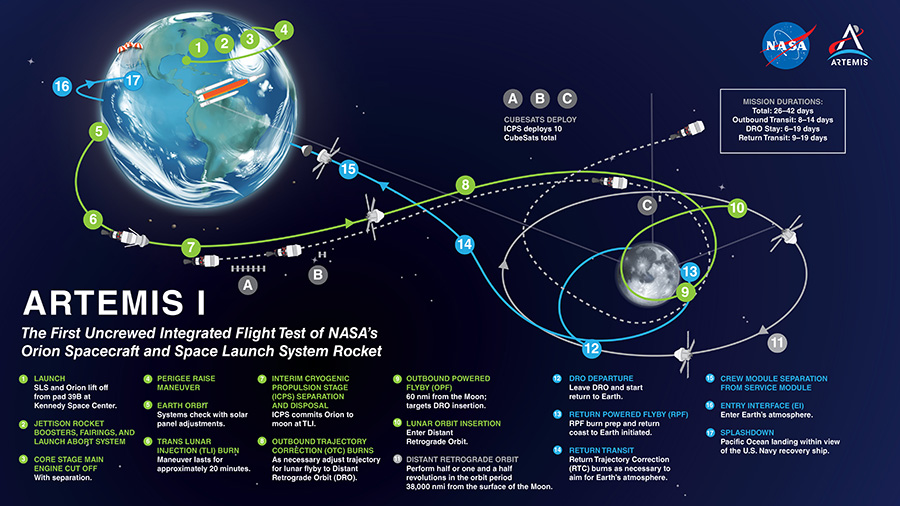
Major mission milestones. Click on the image to enlarge it. Credit: NASA
08/25/2022 – Ephemeris – Looking to the heart of the Milky Way
This is Bob Moler with Ephemeris for Thursday, August 25th. Today the Sun will be up for 13 hours and 34 minutes, setting at 8:31, and it will rise tomorrow at 6:58. The Moon, 2 days before new, will rise at 5:52 tomorrow morning.
Behind a dark cloud in the Milky Way, just above the spout of the teapot asterism or informal constellation that we see of the zodiacal constellation of Sagittarius, lies the very center of our Milky Way Galaxy. It cannot be seen in visible light, but can be detected with radio waves and infrared light that can penetrate the clouds of dust between. In 1932 Bell Laboratory physicist and radio engineer, Karl Jansky, discovered a source of radio static that came from that region of sky. It was subsequently given the designation Sagittarius A. It turns out that within that source there is an object called Sagittarius A* (Pronounced Sagittarius A Star), invisible in the near infrared, but with the mass of four million suns. It was recently imaged as the black hole at the center of our galaxy.
The astronomical event times given are for the Traverse City/Interlochen area of Michigan (EDT, UT – 4 hours). They may be different for your location.
Addendum
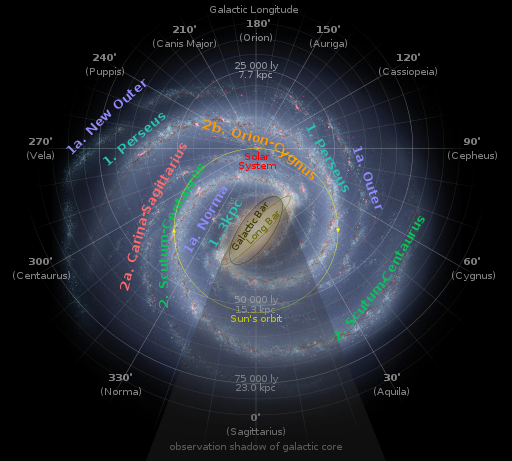
Our place in the Milky Way. Note that we appear to be in a barred spiral galaxy. The arms are numbered and named. 3kpc is the 3 kiloparsec arm. 3kpc = 9,780 light years. The Sun is about 27,000 light years from the center. Credit NASA and Wikimedia Commons, via EarthSky.org
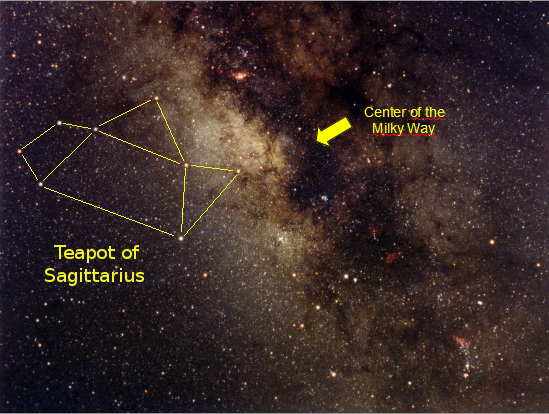
Location of the center of the Milky Way and the Teapot of Sagittarius. It’s behind that dark cloud.
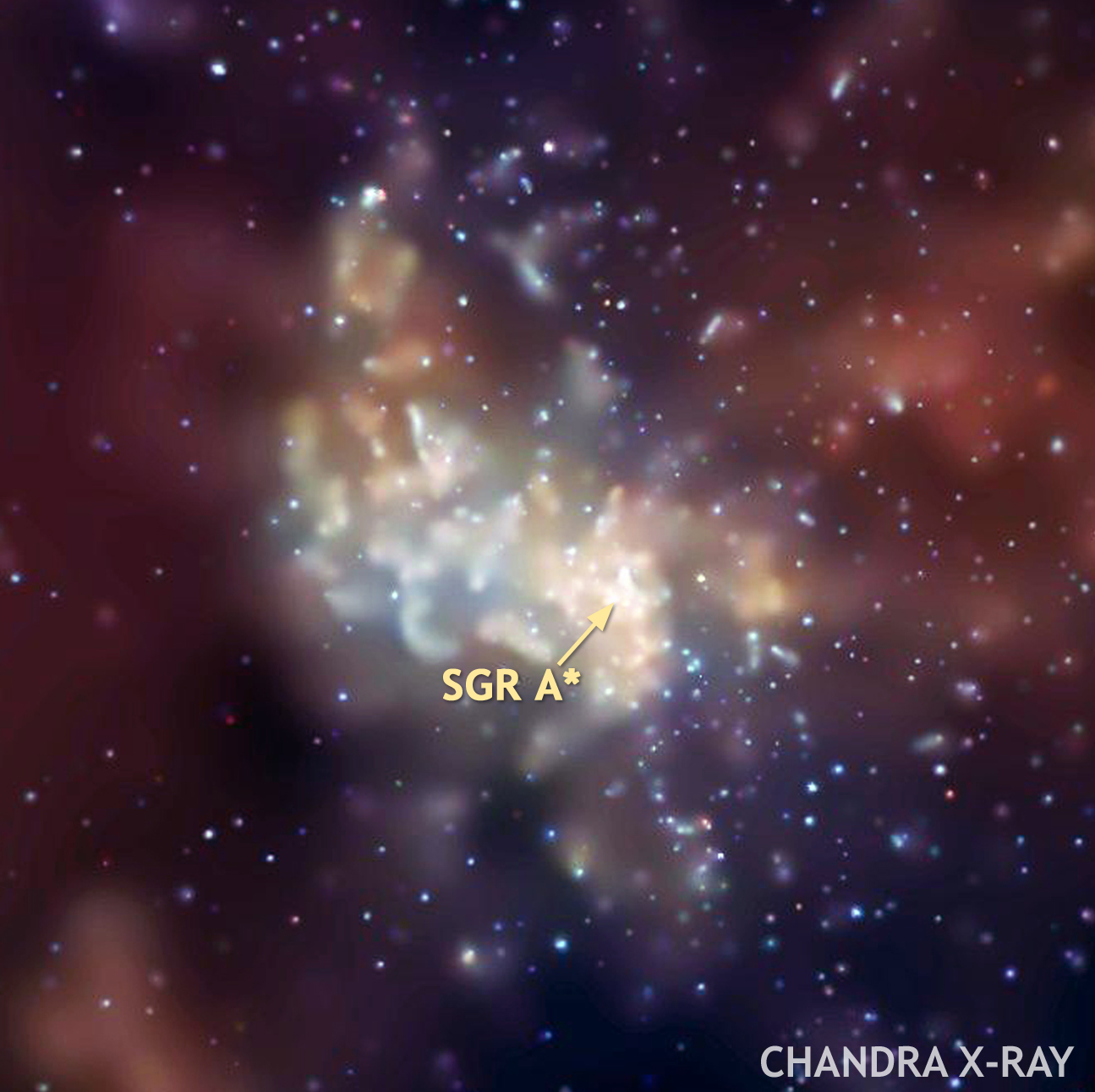
An image from the Chandra X-ray Telescope of the center of the Milky Way. SGR A or Sagittarius A is a radio source. SGR A*, pronounced Sagittarius A Star, is the 4 million solar mass black hole in the center of the Milky Way Galaxy. Credit NASA.
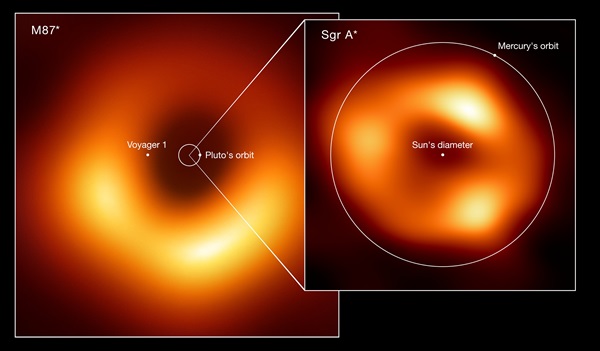
M87* size compared to Sagittarius A*. The size of a black hole is directly related to its mass. The asterisk * is pronounced “Star”. Credit: Event Horizon Telescope Collaboration.
The black hole images were reconstructed from data from 8 sub millimeter radio telescopes and arrays of the Event Horizon Telescope Collaboration. The telescopes were located from Greenland to the South Pole and From Hawai’i to Europe. The data from the telescopes, observing the black holes simultaneously, were combined to act like a single telescope with the diameter of the Earth in order to resolve the black holes.
Let’s search for the naked-eye planets for this week
This is Ephemeris for Wednesday, August 24th. Today the Sun will be up for 13 hours and 37 minutes, setting at 8:33, and it will rise tomorrow at 6:57. The Moon, 3 days before new, will rise at 4:46 tomorrow morning.
Let’s search for the naked-eye planets for this week. Two of the naked-eye planets are in the evening sky. Mercury probably sets too close to the Sun to be seen in the evening, but it might be spotted very low on a Lake Michigan horizon in the west at 9 pm. As it gets darker, Saturn can be seen low in the southeast. Jupiter rises in the east around 10 pm. At 6:15 am tomorrow, the morning planets will be spread out from brilliant Venus low in the east-northeast, and below the thin crescent Moon to Jupiter in the southwest. Mars, in the southeast, will be a lot higher than both Venus and Jupiter. Mars is among the rising stars seen in the late autumn and winter evening skies, when observing them then, it will be a lot colder than it will be tomorrow morning.
The astronomical event times given are for the Traverse City/Interlochen area of Michigan (EDT, UT – 4 hours). They may be different for your location.
Addendum
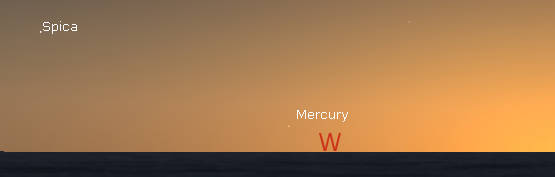
Mercury as it might appear at 9:05 pm tonight, August 24, 2024. I’ve included nearby Spica, which is easier to spot at that time. Actually, neither is likely to be visible. Mercury is only 2 1/2 degrees above a sea horizon. Created using Stellarium.
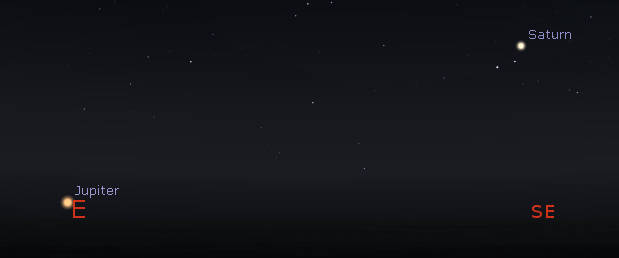
Jupiter rising, with Saturn in the southeast as it might be seen tonight, August 24, 2022. It reminds me of spotting Jupiter rising at our star party Monday night at the Sleeping Bear Dunes. Created using Stellarium.
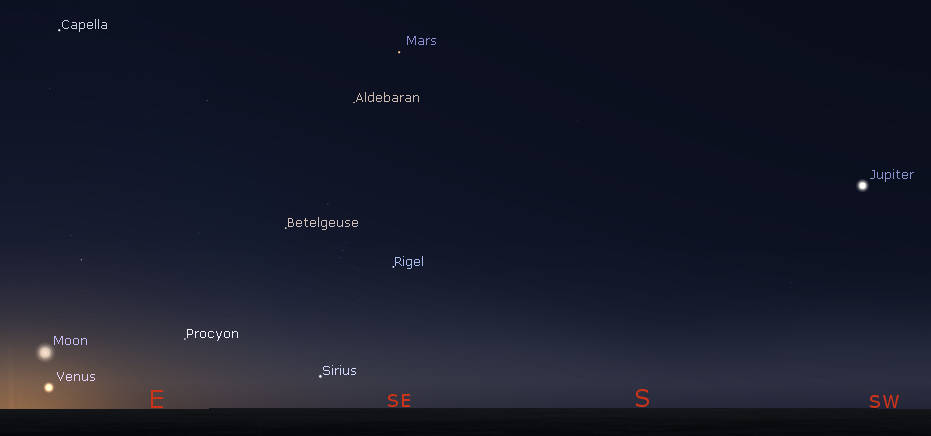
Morning planets and the Moon at 6 am tomorrow morning, August 25, 2022. The Moon will appear as a tiny sliver of a crescent. Created using Stellarium.
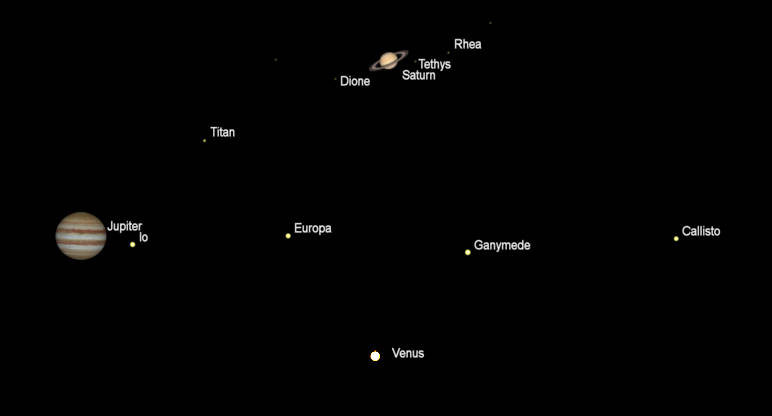
Views of Saturn, Jupiter, and Venus (north up) as they would be seen in a small telescope, with the same magnification. The times vary for each planet. Saturn is shown at 11 pm, Jupiter is shown at midnight. I do not show planets less than 10 seconds of arc in diameter, so Mars doesn’t show up yet. It will soon. Apparent diameters: Saturn 18.73″, its rings 43.63″; Jupiter 48.08″. Mars 9.40″, 84.9% illuminated; Venus 10.31″, 94.3% illuminated. The ” symbol means seconds of arc (1/3600th of a degree.) Click on the image to enlarge it. Created using Cartes du Ciel (Sky Charts).
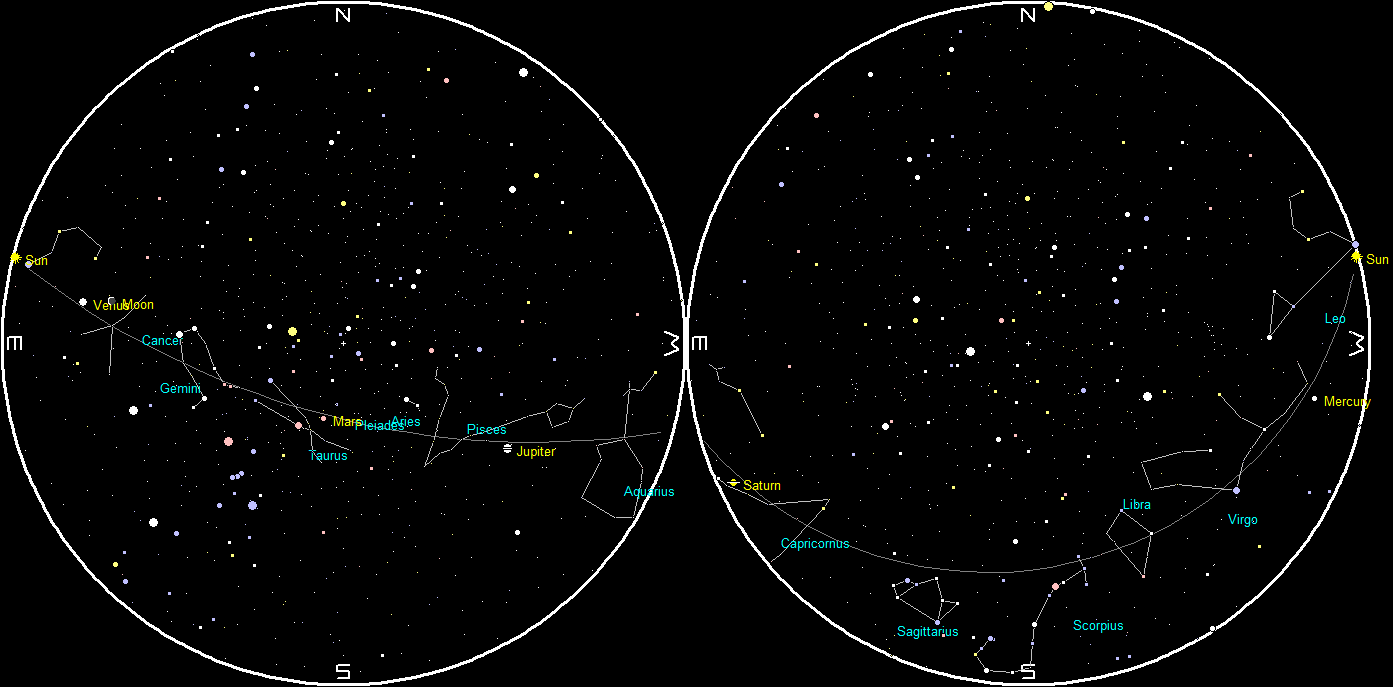
The naked-eye planets and the Moon at sunset and sunrise on a single night, starting with sunset on the right on August 24, 2022. The night ends on the left with sunrise on the 25th. Click on the image to enlarge it. Created using my LookingUp program.
08/23/2022 – Ephemeris – A king’s shield in the sky
This is Bob Moler with Ephemeris for Tuesday, August 23rd. Today the Sun will be up for 13 hours and 40 minutes, setting at 8:35, and it will rise tomorrow at 6:55. The Moon, halfway from last quarter to new, will rise at 3:42 tomorrow morning.
In the southern sky between the Teapot of Sagittarius below and Aquila the Eagle with its southernmost star of the Summer Triangle lies Scutum the shield of John Sobieski, the Polish king who stopped the advance of the Turks at Kalenberg in 1683. The Polish half of me is very proud. Scutum is one of two official constellations which are related to real persons. The other one is Coma Berenices, a hank of the Egyptian Queen Berenice’s hair. However, the stars here are so dim and embedded in the glow of the Milky Way as to be nearly impossible to discern. Scutum lies in one of the richest portions of the Milky Way, wonderful to scan with binoculars and telescopes for star clusters and nebulae or clouds of dust and gas.
The astronomical event times given are for the Traverse City/Interlochen area of Michigan (EDT, UT – 4 hours). They may be different for your location.
Addendum
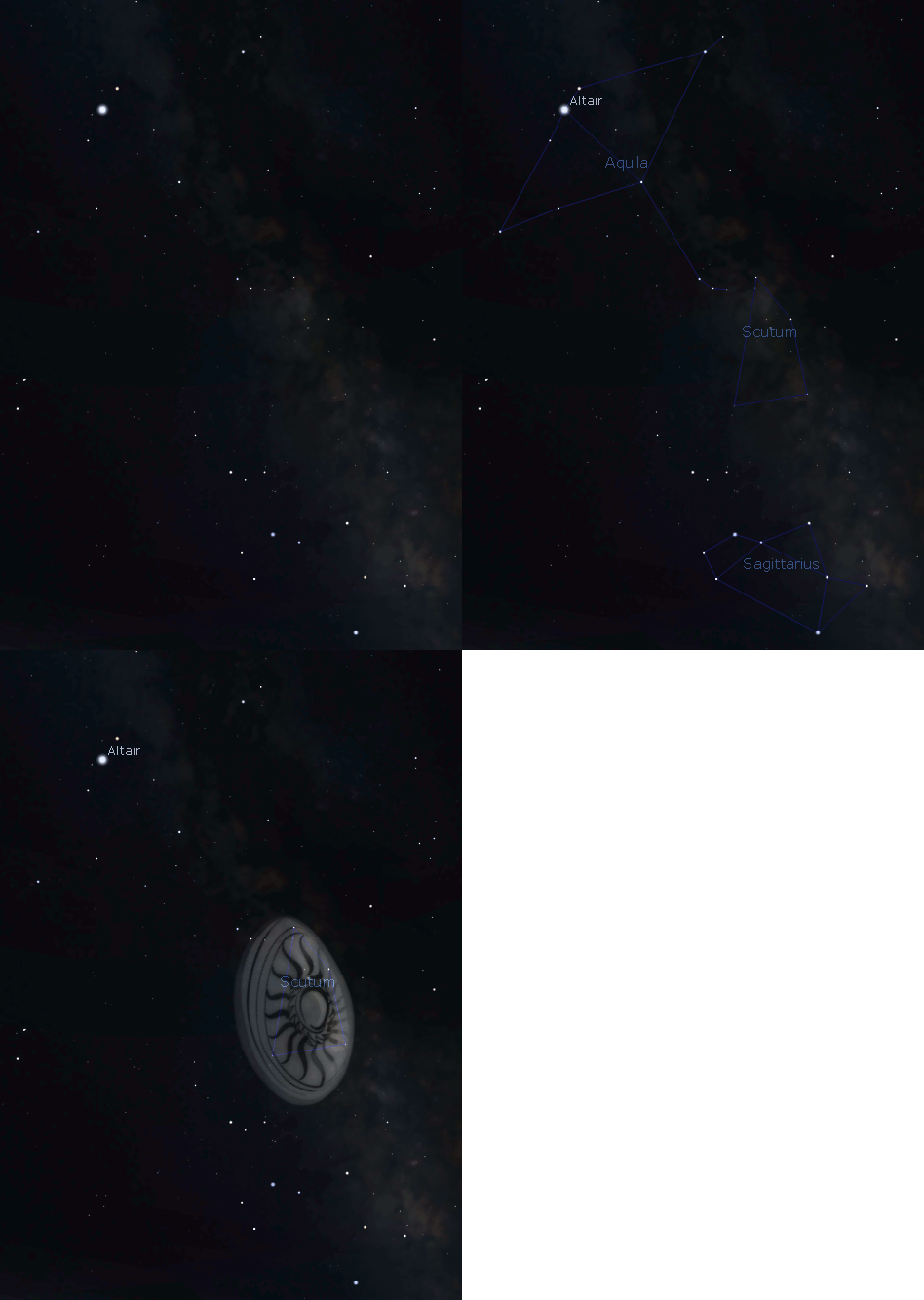
I think of Scutum as an area of the Milky Way between Aquila and Sagittarius. Created using Stellarium and GIMP.
08/22/2022 – Ephemeris – Sleeping Bear Dunes Star Party tonight!
This is Bob Moler with Ephemeris for Monday, August 22nd. Today the Sun will be up for 13 hours and 43 minutes, setting at 8:36, and it will rise tomorrow at 6:54. The Moon, 3 days past last quarter, will rise at 2:43 tomorrow morning.
Weather permitting, a star party will be held tonight at the Sleeping Bear Dunes National Lakeshore at the Dune Climb starting at 8 pm. The star party will be hosted by the park rangers and the Grand Traverse Astronomical Society, who will bring their telescopes to view the heavens, including the planet Saturn and the wonders of the summer Milky Way. The telescopes will be setup in the parking area closest to the dune. While as twilight fades Saturn will be about the only object to view, as it gets darker more and more wonders of the Milky Way will be seen. They include star clusters of both kinds: young open clusters of a few hundred stars sparkling like diamonds and great, ancient globular clusters of hundreds of thousands of stars. Jupiter will rise later in the evening, around 10 pm.
The astronomical event times given are for the Traverse City/Interlochen area of Michigan (EDT, UT – 4 hours). They may be different for your location.
Addendum
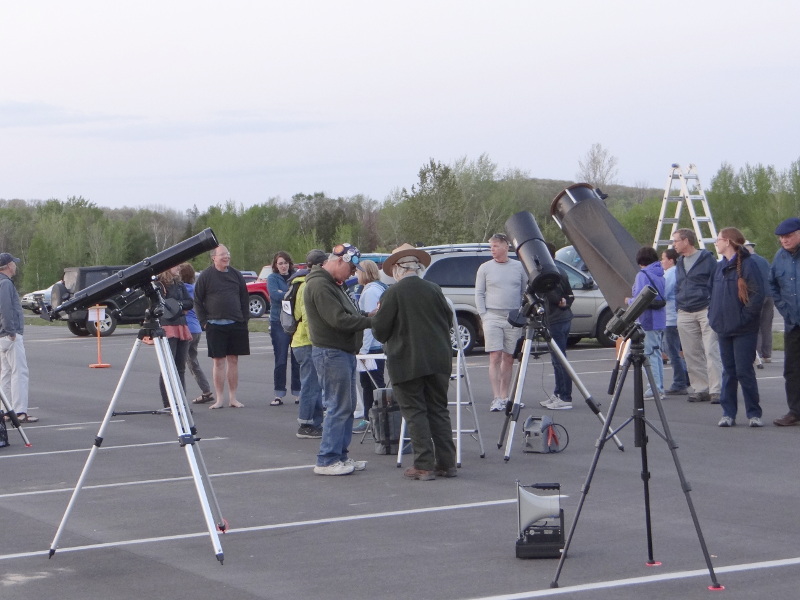
Preparing to start the May star party, 6 years ago at the Dune Climb. A few of the telescopes are visible, including the GTAS 25 inch “Emmettron” telescope at the far right. Credit: Eileen Carlisle.
08/19/2022 – Ephemeris – Finding the small constellations near the Summer Triangle
This is Ephemeris for Friday, August 19th. Today the Sun will be up for 13 hours and 52 minutes, setting at 8:41, and it will rise tomorrow at 6:51. The Moon, at last quarter today, will rise at 12:32 tomorrow morning.
I’ve already talked about the three constellations whose bright stars mark the Summer Triangle: Vega in Lyra the harp, Deneb in Cygnus the swan, and Altair in Aquila the eagle. There are two small constellations near the south end of the triangle near Altair. These are Delphinus the dolphin and Sagitta the arrow. Delphinus is easily spotted, as it’s five or six stars appear as a tiny dolphin leaping out of the water. Sagitta appears as a very short arrow. An interesting sight can be spotted in binoculars near the tail end of Sagitta. It’s 7 stars in a nearly straight line, with a hook of four stars below the center of the line. It’s called The Coathanger. It’s even better if seen in a finder telescope, which inverts the image.
The astronomical event times given are for the Traverse City/Interlochen area of Michigan (EDT, UT – 4 hours). They may be different for your location.
Addendum
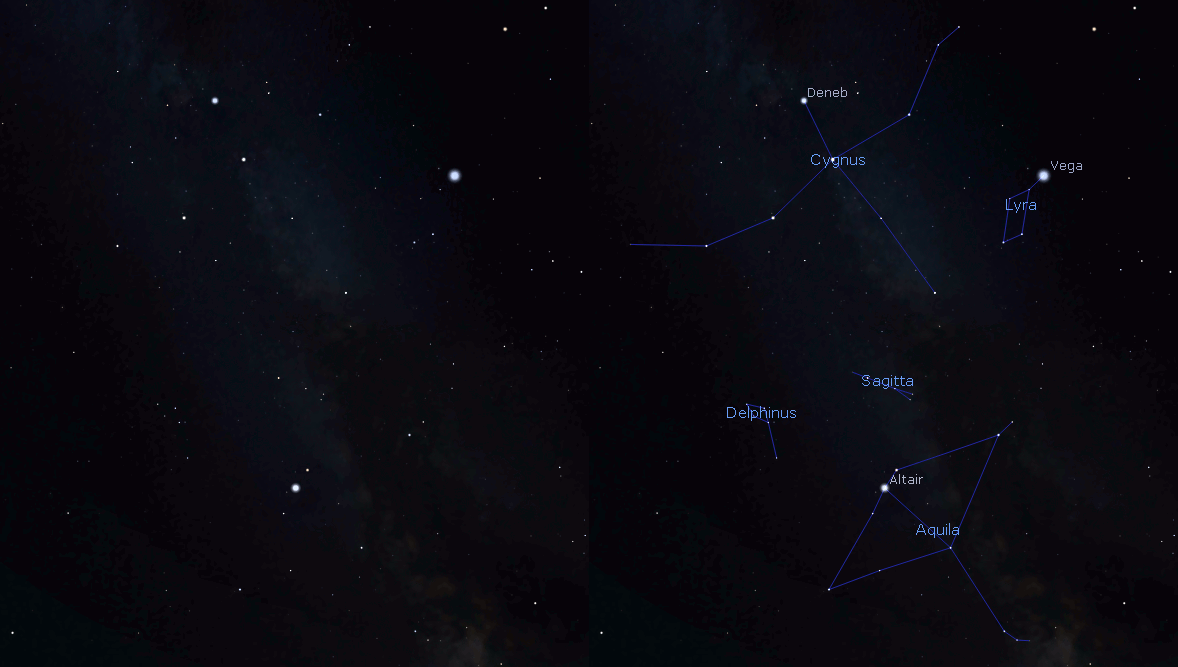
Finding the small constellations of Delphinus the dolphin and Sagitta the arrow among the stars and constellations of the Summer Triangle. Created using Stellarium and GIMP.
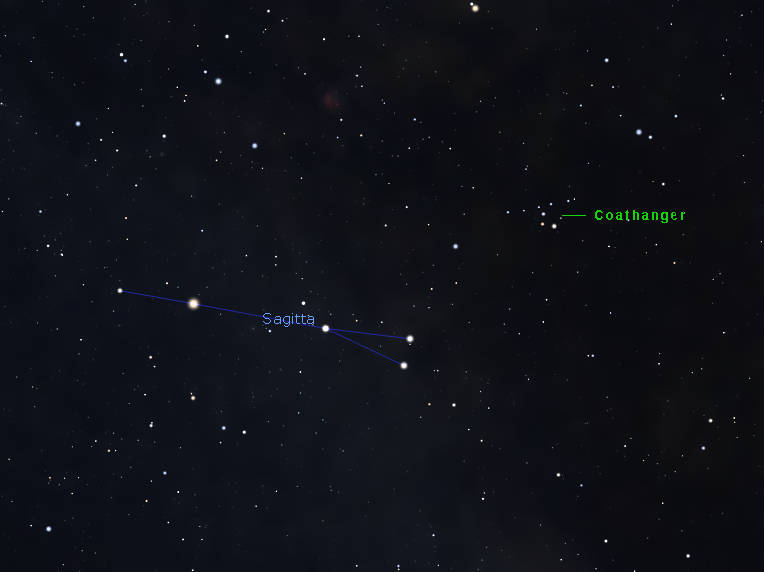
How to locate the binocular asterism of the Coathanger. It is also known as Collinder 399, Brocchi’s Cluster and Al Sufi’s Cluster. It’s not a real star cluster, but a random arrangement of stars at various distances, that from the solar system make a distinctive pattern.
08/18/2022 – Ephemeris – The Great Rift
This is Ephemeris for Thursday, August 18th. Today the Sun will be up for 13 hours and 54 minutes, setting at 8:43, and it will rise tomorrow at 6:49. The Moon, 1 day before last quarter, will rise at 12:02 tomorrow morning.
High overhead, the Milky Way is seen passing through the Summer Triangle of three bright stars. Here we find the Milky Way splits into two sections. The split starts in the constellation of Cygnus the Swan or Northern Cross very high in the east. The western part of the Milky Way ends southwest of Aquila the eagle. This dark dividing feature is called the Great Rift. Despite the lack of stars seen there, it doesn’t mean that there are fewer stars there than in the brighter patches of the Milky Way. The rift is a great dark cloud that obscures the light of the stars behind it. Sometimes binoculars can be used to find the edges of the clouds of the rift, as star numbers drop off suddenly. This is especially easily seen in Aquila.
The astronomical event times given are for the Traverse City/Interlochen area of Michigan (EDT, UT – 4 hours). They may be different for your location.
Addendum
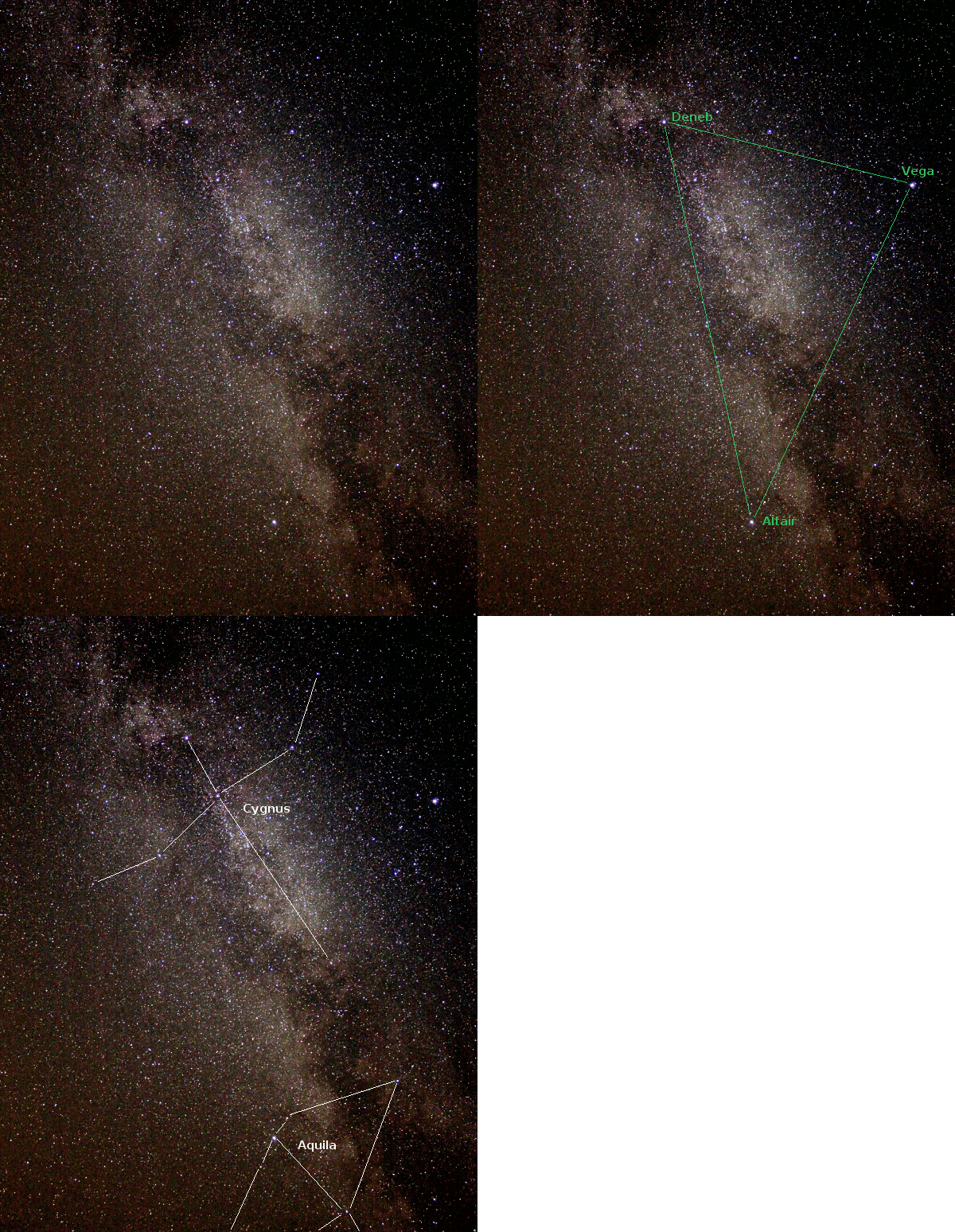
The Great Rift finder animation as seen in the Summer Triangle, also showing the constellations of Cygnus the swan and the northern part of Aquila the Eagle. This image a stack of 5 30 second exposures taken the morning of the Perseid meteor shower the is year in a vain attempt to capture some meteors.
Let’s search for the naked-eye planets for this week
This is Bob Moler with Ephemeris for Wednesday, August 17th. Today the Sun will be up for 13 hours and 57 minutes, setting at 8:45, and it will rise tomorrow at 6:48. The Moon, 2 days before last quarter, will rise at 11:37 this evening.
Let’s search for the naked-eye planets for this week. Two of the naked-eye planets are in the evening sky: Mercury sets too close to the Sun to be seen in the evening, but as it gets darker, Saturn can be seen low in the southeast. At 6 am tomorrow, the planets will be spread out from brilliant Venus low in the east-northeast to Saturn in the west-southwest. Mars will be a lot higher than Venus in the southeast. Jupiter is farther to the right in the south-southwest. Mars is dimmer than Jupiter, but is slowly getting brighter as the Earth creeps up on it. Saturn ends the line of planets lower than Venus, if it’s visible at all, in the west-southwest, only 5 degrees above a sea, or Lake Michigan horizon.
The astronomical event times given are for the Traverse City/Interlochen area of Michigan (EDT, UT – 4 hours). They may be different for your location.
Addendum
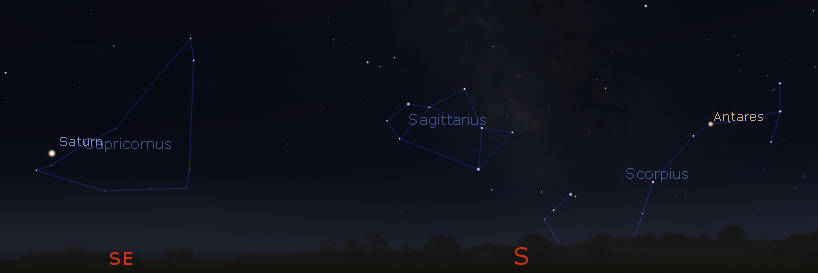
An animation showing Saturn at 10 pm, along with three zodiacal constellations, with and without labels, just after the end of nautical twilight tonight at 10 pm, August 17, 2022. Click on the image to enlarge it. Created using Stellarium and GIMP.
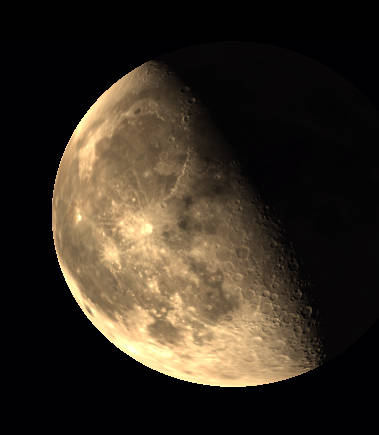
The Moon as it might appear at midnight tonight, August 18, 2022. Created using Stellarium.
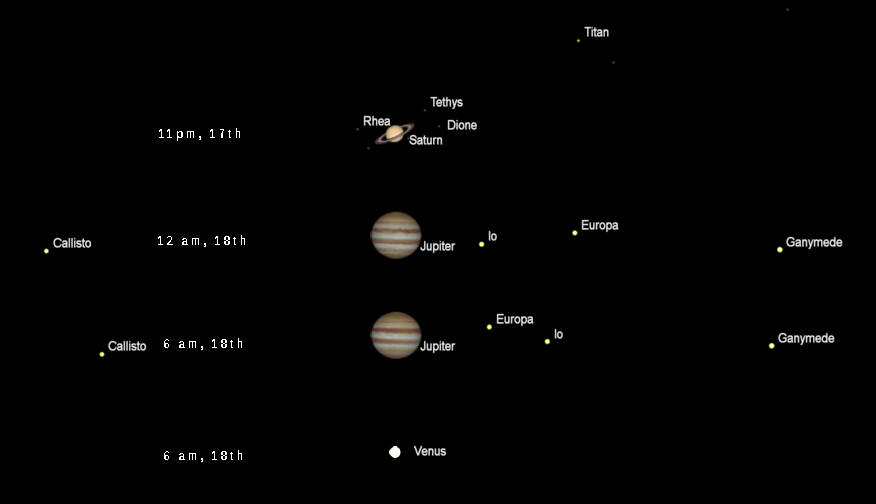
Views of Saturn, Jupiter, and Venus (north up) as they would be seen in a small telescope, with the same magnification. The times vary for each planet. Jupiter is shown twice, at midnight and 6 am, since its moons, especially Io and Europa, move rapidly. I do not show planets less than 10 seconds of arc in diameter, so Mars doesn’t show up yet. It will soon. Apparent diameters: Saturn 18.76″, its rings 43.70″; Jupiter 47.33″. Mars 9.04″, 84.7% illuminated; Venus 10.31″, 94.3% illuminated. The ” symbol means seconds of arc (1/3600th of a degree.) Click on the image to enlarge it. Created using Cartes du Ciel (Sky Charts).
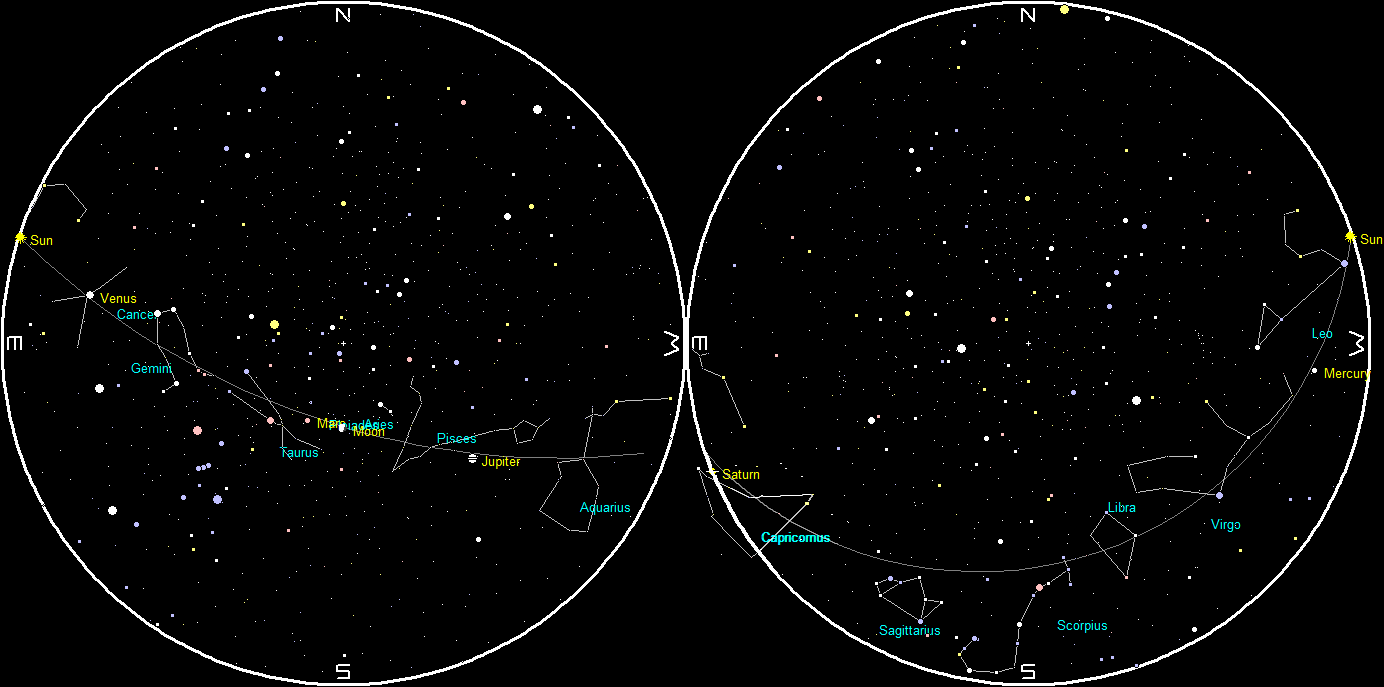
The naked-eye planets and the Moon at sunset and sunrise on a single night, starting with sunset on the right on August 17, 2022. The night ends on the left with sunrise on the 18th. Click on the image to enlarge it. Created using my LookingUp program.
08/16/2022 – Ephemeris – Scanning Sagittarius with binoculars
This is Bob Moler with Ephemeris for Tuesday, August 16th. Today the Sun will be up for 14 hours to the minute, setting at 8:46, and it will rise tomorrow at 6:47. The Moon, 3 days before last quarter, will rise at 11:15 this evening.
The Moon has left the evening sky, so let’s take another look at the constellation of Sagittarius. Its bright stars make a follow the dots image of a stout little teapot. In, around and above the teapot is a wealth of nebulae, which are clouds of gas and dust and clusters of stars. Stars are born in bunches from a cloud of gas. When enough stars are born, their stellar winds blow away the nebulosity leaving a star cluster. Use a pair of binoculars or a very low power telescope and just wander around and above the teapot, including and especially the spout on the right side. In binoculars, star clusters appear fuzzy like nebulae, however a small telescope with magnification of 20 times should resolve most of them.
The astronomical event times given are for the Traverse City/Interlochen area of Michigan (EDT, UT – 4 hours). They may be different for your location.
Addendum
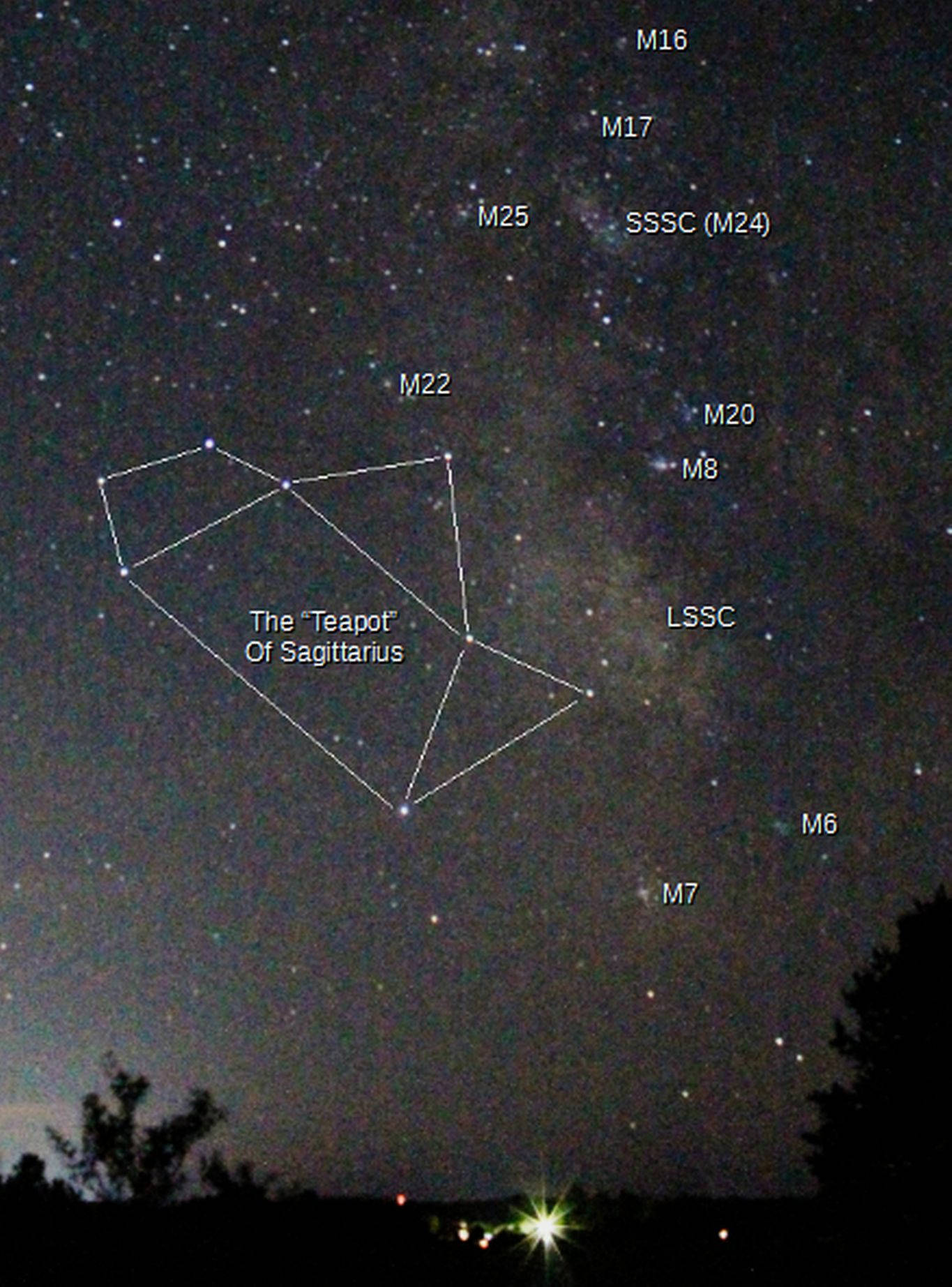
Sagittarius in a short time exposure with added annotations. The “M” designations are objects in Charles Messier’s catalog created in the latter half of the 18th century. LSSC is the Large Sagittarius Star Cloud, SSSC is the Small Sagittarius Star Cloud. Labels are to the right of the objects they name. Credit Bob Moler.
This is the short radio program version of the August 8, 2022, Ephemeris Extra post Wandering through Sagittarius
08/15/2022 – Ephemeris – Saturn moves into the evening sky
This is Ephemeris for Monday, August 15th. Today the Sun will be up for 14 hours and 3 minutes, setting at 8:48, and it will rise tomorrow at 6:46. The Moon, halfway from full to last quarter, will rise at 10:55 this evening.
Yesterday, Saturn was in opposition to the Sun. I’m not implying an argument here. Opposition is when a planet is opposite the Sun in the sky, so it rises around sunset and sets around sunrise. That means Saturn is the closest it can get to us this year. For the record, that’s 836 million miles (1,345 million kilometers). Saturn will first appear tonight in the southeast when it gets dark enough, say around 9:15 to 9:30 pm. It is in the constellation of Aquarius now. It is moving northeastward in our skies, or it would if it weren’t at opposition, and moving backward or retrograde as the Earth is, in effect, lapping Saturn in our eternal race around the Sun. Saturn’s rings appear to slowly get skinnier as the planet moves to an equinox, where its rings, which orbit its equator, will tilt edgewise to the Sun, and the Earth in 2025.
The astronomical event times given are for the Traverse City/Interlochen area of Michigan (EDT, UT – 4 hours). They may be different for your location.
Addendum
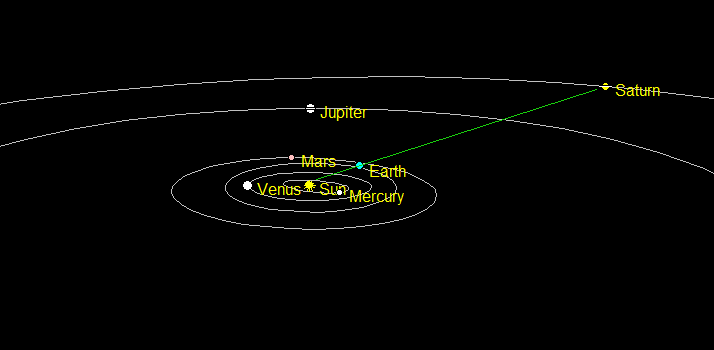
Display of the solar system out to Saturn, with added line showing Saturn’s location opposite the Sun from the Earth. This make the Earth nearly in line from the Sun to Saturn. This is the time that Saturn would be closest to the Earth. Credit: my LookingUp app. I wanted to use NASA’s Eyes, but there were too many interplanetary spacecraft near the Earth. The Earth was crowded out by spacecraft labels.
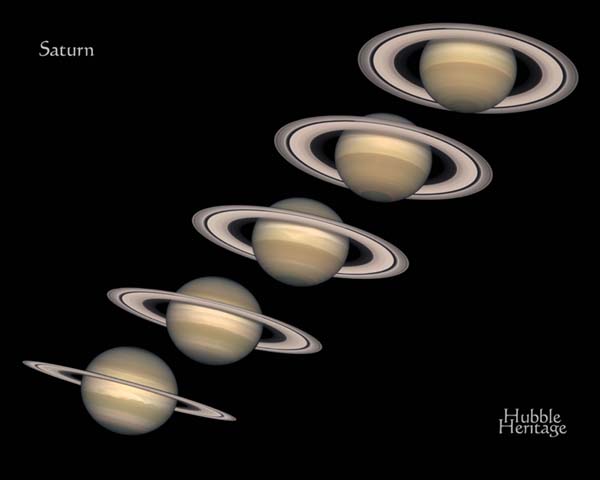
How the appearance of the rings change as Saturn orbits the Sun. Credit: NASA Hubble.
 Bob Moler's Ephemeris Blog