Archive
10/04/2016 – Ephemeris – The bright planets score: three in the evening and one in the morning
Ephemeris for Wednesday, October 5th. The Sun will rise at 7:46. It’ll be up for 11 hours and 28 minutes, setting at 7:15. The Moon, 4 days before first quarter, will set at 10:04 this evening.
Mercury is seen in the morning now, rising at 6:21 today, and should be high enough to be visible between 7 and 7:30 this morning low in the east if it’s clear. Venus, Saturn and Mars are in the evening sky. Venus is briefly visible after sunset, low in the west-southwest. It will set at 8:28 p.m., following the Sun’s earlier setting times. Mars, Saturn and the star Antares start the evening in the southwestern sky in a lengthening triangle, with Saturn on top and Antares below. Mars is way out to the left of the other two. Tonight Saturn will be about 10 of the Moon’s diameter to the left of the crescent Moon. Saturn, spectacular in telescopes with its rings, will set at 10 p.m. and Mars will set at 11:18 p.m.
Times are for the Traverse City/Interlochen area of Michigan. They may be different for your location.
Addendum
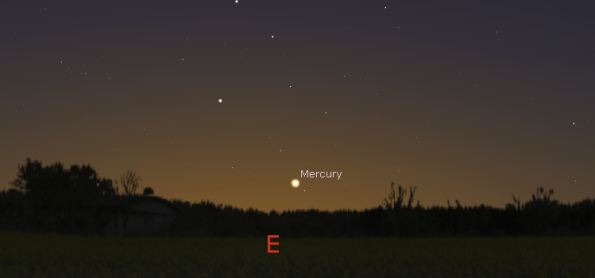
Mercury in the east at 7 a.m. this morning, October 5, 2016. Created using Stellarium.

Venus, low in west-southwest with the Moon (enlarged to show phase), Saturn and Mars at 7:35 p.m. (20 minutes after sunset). Created using Stellarium.
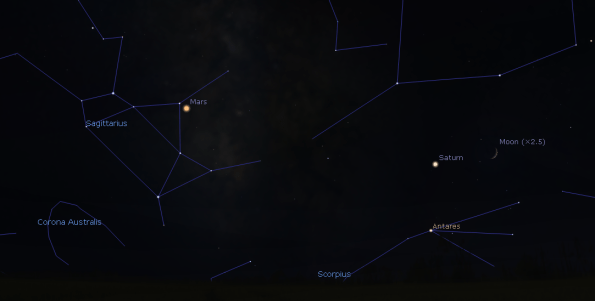
The Moon, Saturn, Antares and Mars with the low constellations in the southwest at 8:30 p.m. October 5, 2016. Created using Stellarium.
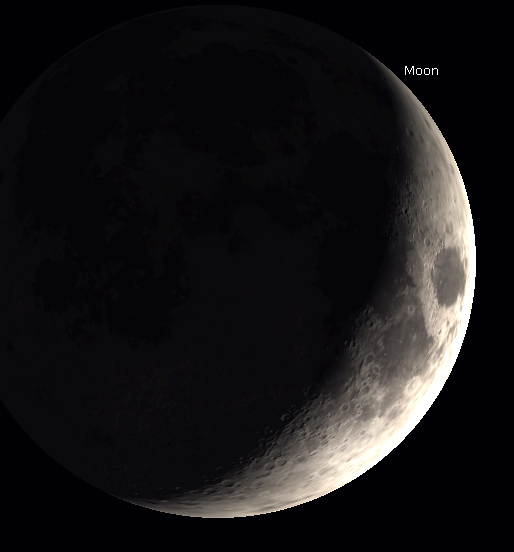
The Moon as it might appear in binoculars at 8:30 p.m. October 5, 2016. Created using Stellarium.
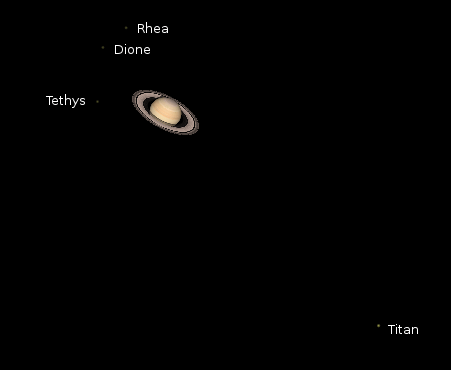
Saturn and some of its moons at 8:30 p.m. October 5, 2016. Created using Cartes du Ciel (Sky Charts).
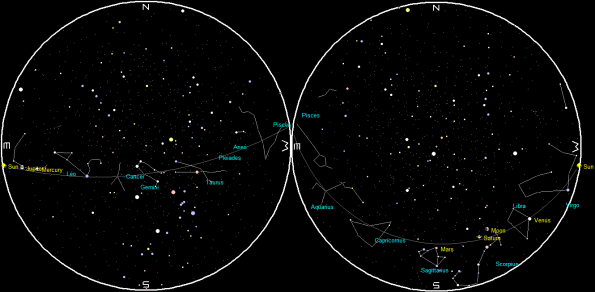
Planets and Moon at sunset and sunrise of a single night starting with sunset on the right on October 5, 2016. The night ends on the left with sunrise on October 6. If you are using Firefox right-click on the image and select View Image to enlarge the image. That goes for all the large images. Created using my LookingUp program.
08/24/2016 – Ephemeris – Planets gather into two groups this evening
Ephemeris for Wednesday, August 24th. The Sun rises at 6:56. It’ll be up for 13 hours and 36 minutes, setting at 8:32. The Moon, at last quarter today, will rise at 12:31 tomorrow morning.
Tonight we still have all the bright classical planets in the evening sky, barely. Mercury, Venus and Jupiter are very low in the west and will set at 9:08, 9:24 and 9:29 p.m. respectively. Saturday evening, right after sunset, Venus will be passing very close to Jupiter while they are low in the west, well within a low power telescope field. Mars, Saturn and the star Antares start the evening in the southwestern sky in a nearly perfect line. Antares, whose name means Rival of Mars is On the bottom with brighter Mars just above it, with Saturn above. Mars, moving rapidly to the east against the stars will set at 12:15 a.m. Saturn, spectacular in telescopes with its rings, will set at 12:39 a.m.
Times are for the Traverse City/Interlochen area of Michigan. They may be different for your location.
Addenda
The Planets Tonight
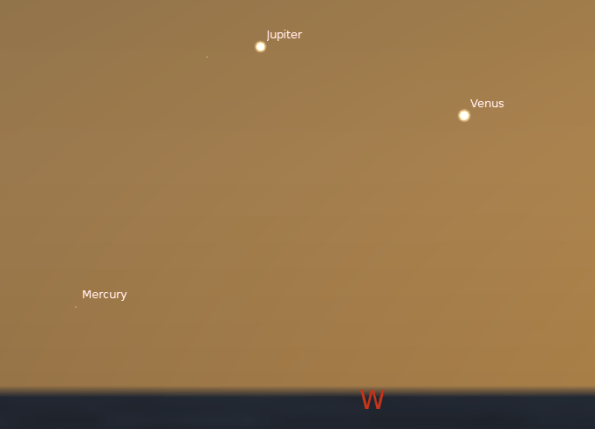
Looking very low in the west at 9 p.m., 28 minutes after sunset, August 24, 2016. For scale, Jupiter is a bit less than 5 degrees above the horizon, Mercury a bit lass than 2. Created using Stellarium.
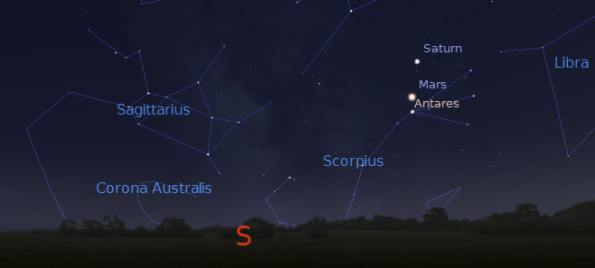
Mars breaks out the Saturn-Antares lineup at 9:30 p.m., August 24, 2016. Created by Stellarium.using Stellarium.
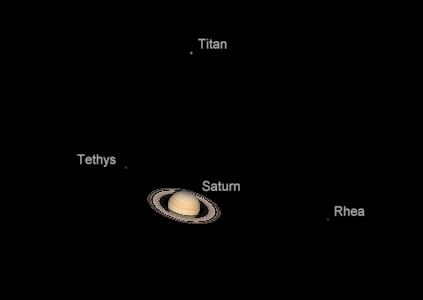
Saturn and some of its moons at 9:30 p.m. August 24, 2016. Created using Cartes du Ciel (Sky Charts).
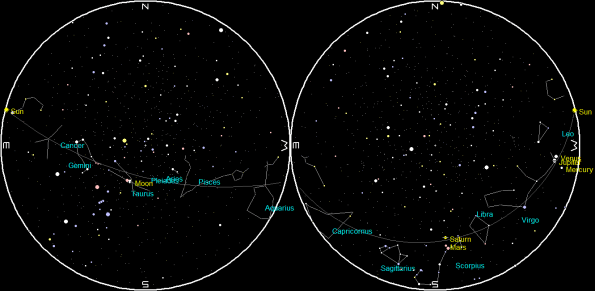
Planets at sunset and sunrise of a single night starting with sunset on the right on August 24, 2016. The night ends on the left with sunrise on August 25. Actually all the naked eye planets are in the evening sky. If you are using Firefox right-click on the image and select View Image to enlarge the image. That goes for all the large images. Created using my LookingUp program.
Mars, Antares and Saturn Last Night
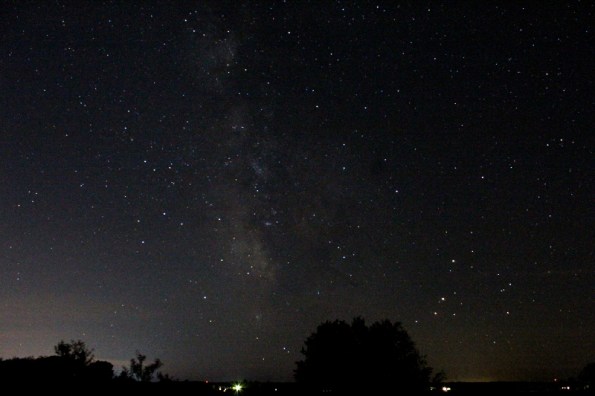
Saturn, Mars and Antares and the setting Scorpius to the right of the tree, and the Sagittarius Teapot with the Milky Way boiling out of the spout at 11:03 p.m. EDT, August 24, 2016. Credit Bob Moler from my back yard.
08/23/2016 – Ephemeris – Mars, Antares and Saturn line up
Ephemeris for Tuesday, August 23rd. The Sun rises at 6:55. It’ll be up for 13 hours and 39 minutes, setting at 8:34. The Moon, 1 day before last quarter, will rise at 11:49 this evening.
Tonight if you look out to the southwest, you will see a nearly perfect, nearly vertical line of bright stars. But two of these are planets. The brightest is the red planet Mars. Below is it’s rival, the red giant star Antares. Above is the ringed planet Saturn. Tonight Mars will be just to the right of the Saturn Antares line. After they set tonight and before we see them tomorrow night Mars will have moves to be just out of the line to the left. I hope it’s clear tonight so I can get a picture of them. A digital camera on a tripod with a low f-stop, and a high ISO speed with a shutter open for maybe 15 seconds ought to do it. Manually focus on infinity. Dark skies confuse auto focusers. And turn the flash off. Try it again tomorrow night.
Times are for the Traverse City/Interlochen area of Michigan. They may be different for your location.
Addendum
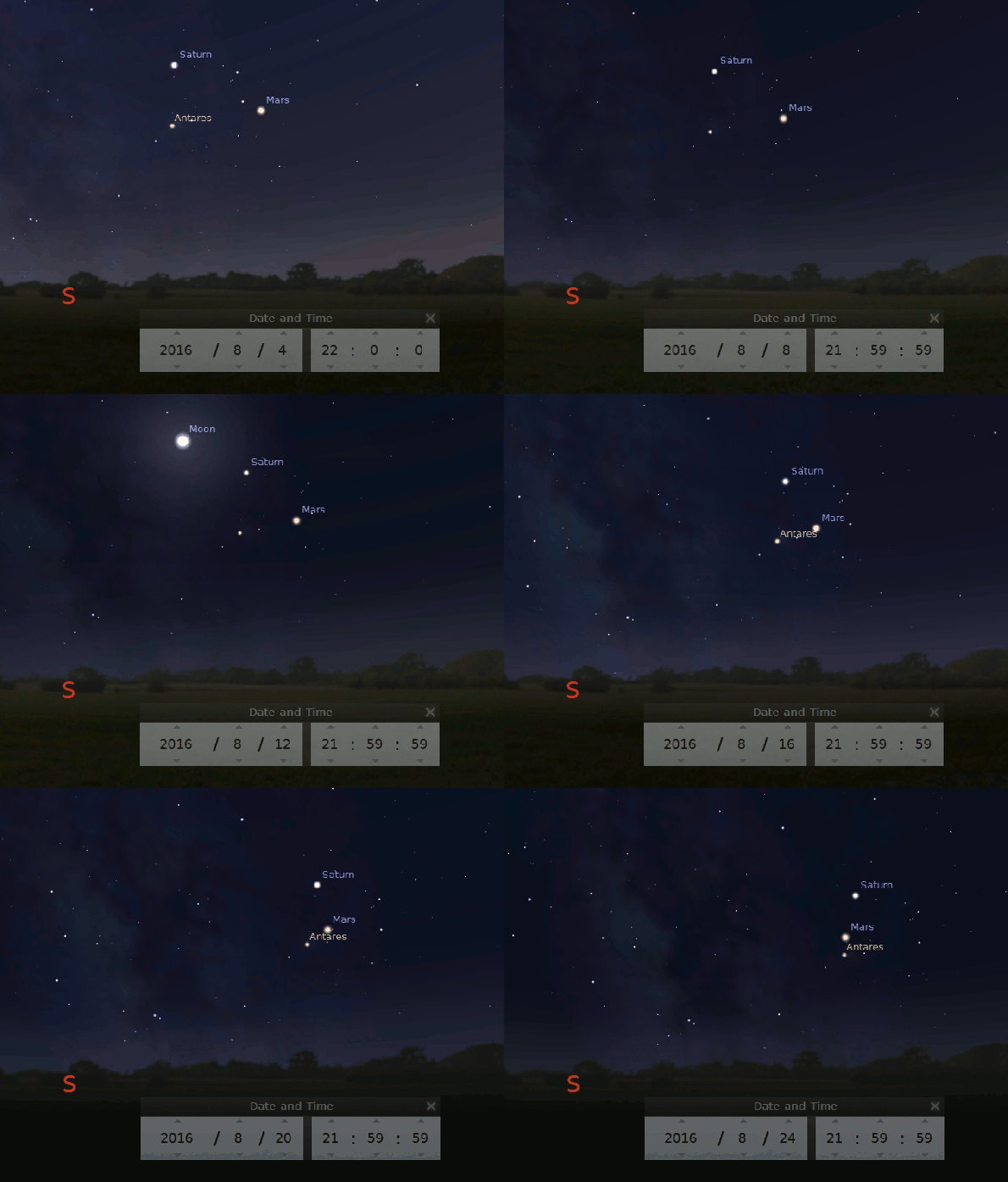
Animation of Mars approaching Antares from August 4 to the 24th, 2016 at 10 p.m. Created using Stellarium and GIMP.
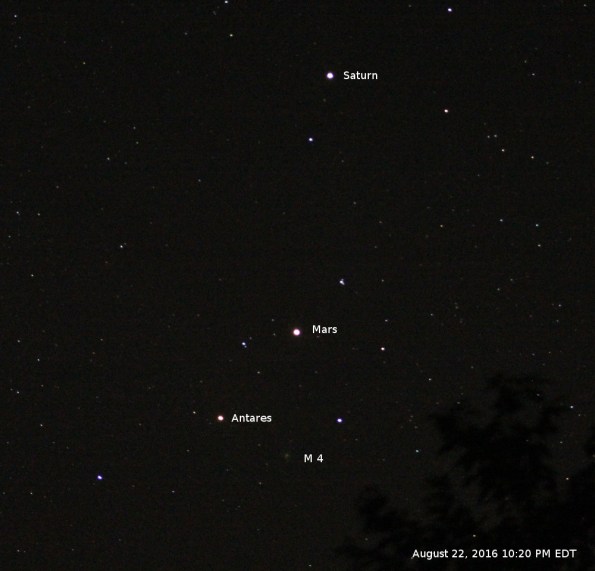
The lineup is forming. Saturn, Mars and Antares at 10:20 p.m., August 22, 2016. The globular cluster M 4 is also barely visible. Credit: Bob Moler.
75 mm focal length, 5 Seconds, F/4, ISO 6400
08/04/2016 – Ephemeris – Mars’ lookalike star
Ephemeris for Thursday, August 4th. The Sun rises at 6:32. It’ll be up for 14 hours and 30 minutes, setting at 9:03. The Moon, 2 days past new, will set at 10:01 this evening.
As it gets dark this evening a bright reddish star will appear low in the south. It will appear to twinkle mightily. It is not the planet Mars, which is brighter and to the right of it, but its rival the star Antares in Scorpius the scorpion. The star’s name, Antares, notes the rivalry. “Ant” means anti, while “Ares” is the Greek name for the Roman god Mars. Antares literally means “Rival of Mars”. Antares appears red due to its cool surface temperature of 3,600 Kelvin, much cooler than the sun’s 6,000 Kelvin, while Mars is red due to rust. Watch nightly as Mars slowly approaches Antares, and will pass it on the 24th. Being always low in the sky, Antares’ spectacular twinkling has sparked more than a few emails about a strange light in the sky.
Times are for the Traverse City/Interlochen area of Michigan. They may be different for your location.
Addendum
Animation of Mars approaching Antares from August 4 to the 24th, 2016 at 10 p.m. Created using Stellarium and GIMP.
08/02/2016 – Ephemeris – The Scorpion has visitors this year
Ephemeris for Tuesday, August 2nd. The Sun rises at 6:30. It’ll be up for 14 hours and 35 minutes, setting at 9:06. The Moon is new today, and won’t be visible.
There’s a large constellation located low in the south as it gets dark about 10:30 tonight It’s Scorpius the scorpion. Its brightest star is Antares in its heart, a red giant star whose name means “Rival of Mars”. From Antares to the right is a star then a vertical arc of three stars that is its head. The Scorpion’s tail is a line of stars running down to the left of Antares swooping near the horizon before coming back up and ending in a pair of stars that portray his poisonous stinger. This year the planet Saturn appears almost directly above Antares. Tonight Mars is right of Antares. On the 23rd of this month Mars will pass just above
Antares, between it and Saturn, making line of three bright objects. Mars is currently brighter than Antares.
Times are for the Traverse City/Interlochen area of Michigan. They may be different for your location.
Addendum
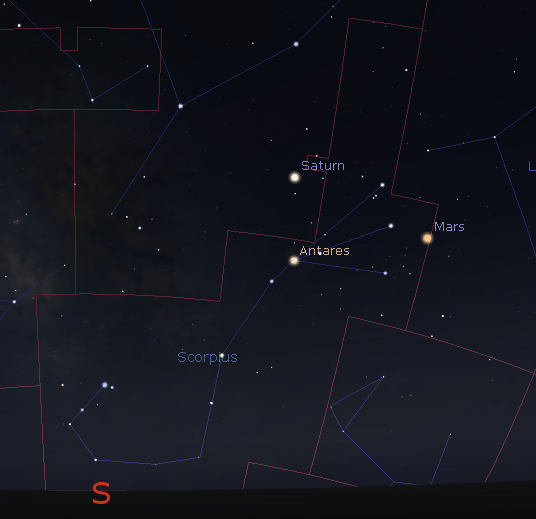
Scorpius with Mars and Saturn at 10:30 p.m. August 2, 2016. Created using Stellarium.
The red lines are the official constellation boundaries by the International Astronomical Union. From the look of some of the boundaries, astronomers apparently gerrymander as well as our politicians.
For those unfamiliar with gerrymandering put “gerrymander” in your favorite search engine or Wikipedia.
06/09/2016 – Ephemeris – Waiting for the first stars to appear
Ephemeris for Thursday, June 9th. Today the Sun will be up for 15 hours and 30 minutes, setting at 9:27, and it will rise tomorrow at 5:56. The Moon, 3 days before first quarter, will set at 12:59 tomorrow morning.
Lets look at the first stars and planets to appear tonight as it gets dark. The first object to appear will be the fat crescent Moon in the southwest. The planet Jupiter will be the next to appear after sunset left and above the Moon. Mars, low in the southeast will appear reddish, shortly thereafter. Looking very high in the southeast, the fourth brightest nighttime star will appear. This will be Arcturus with an orange hue. Saturn should appear to the left and below Mars. Soon other stars will appear including the Big Dipper overhead. Other bright stars will appear, the summer star Vega low in the northeast. Regulus between Jupiter and the Moon and Spica between Jupiter and Mars.
Times are for the Traverse City/Interlochen area of Michigan. They may be different for your location.
Addendum
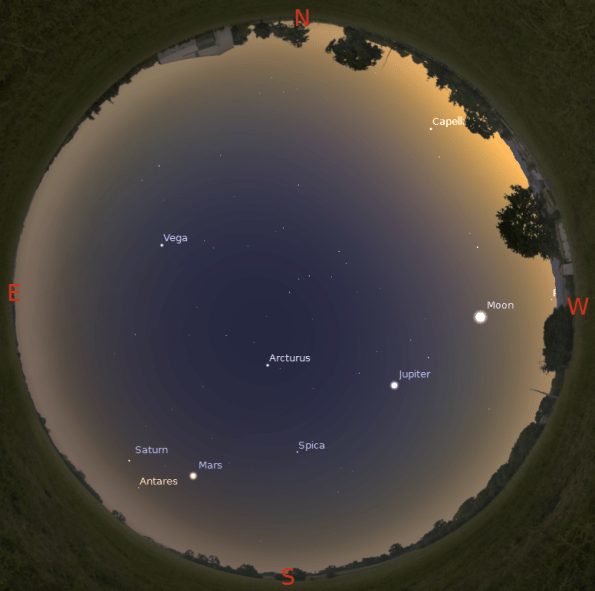
The sky at about 10 p.m. or a little later, watching the first stars and planets appear. Created using Stellarium. If viewing using Firefox right-click on the image and select View Image to enlarge.
04/27/2016 – Ephemeris – Mars is closing in on its rival, but backs off for now
Ephemeris for Wednesday, April 27th. The Sun rises at 6:38. It’ll be up for 14 hours and 5 minutes, setting at 8:43. The Moon, 2 days before last quarter, will rise at 1:36 tomorrow morning.
Let’s see what the bright naked eye planets are up to. Mercury is in the west-northwest, very low to the horizon, setting at 10:12 p.m. Mercury is really fading now. Jupiter is in the southeast in the early evening, and will pass due south at 10:17 p.m., and will set at 4:51 a.m. It’s below the stars of Leo this year. Binoculars can make out some of Jupiter’s moons, but a telescope is required to see all four bright moons and Jupiter’s cloud features. Mars will rise at 11:11 p.m. in the east-southeast. It’s now almost bu not quite directly north of its look-a-like star Antares, whose name means Rival of Mars. Saturn will rise at 11:40 p.m. in the east-southeast. It’s just left of Mars. Its rings are a telescopic treat. Venus is invisibly close to the Sun now.
Times are for the Traverse City/Interlochen area of Michigan. They may be different for your location.
Addendum
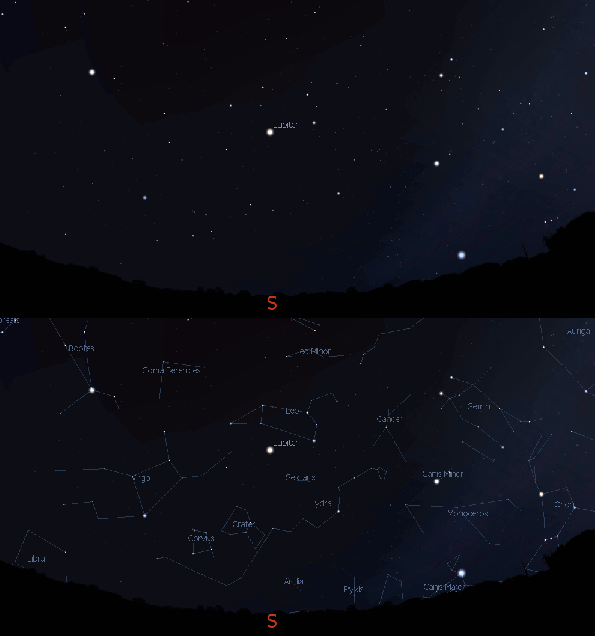
Jupiter and the spring stars animation. Set for 10 p.m. April 27, 2016. Created using Stellarium.
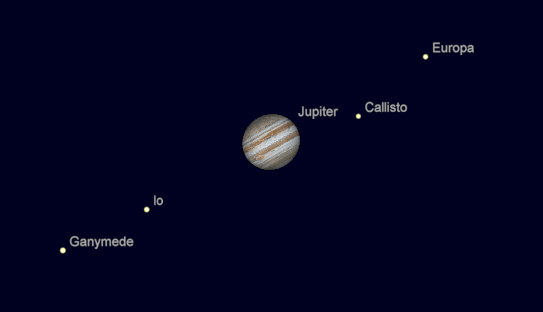
Jupiter and its moons as they might be seen in a telescope at 10 p.m., April 27, 2016. Jupiter’s apparent diameter is 41.2″ According to the Project Pluto web site the Great Red spot will cross Jupiter’s central meridian at 9:16 p.m., a half hour after sunset. If so, the position of the spot in this chart is incorrect. Created with Cartes du Ciel (Sky Charts).
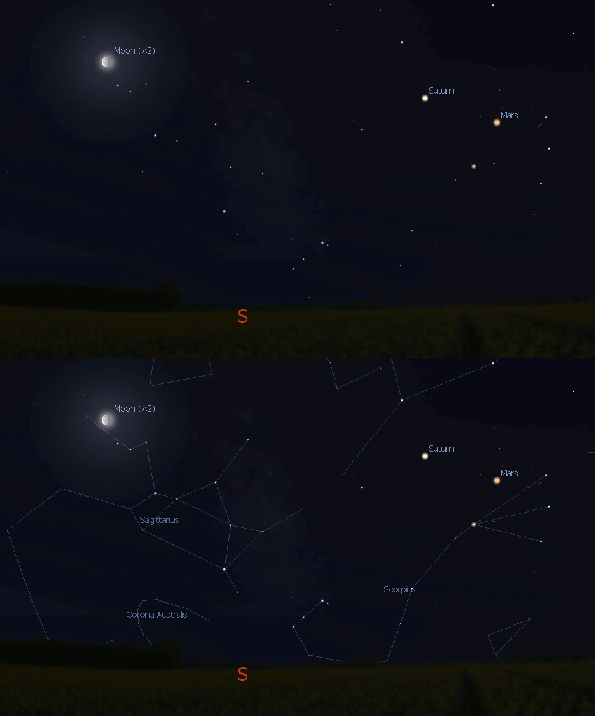
Mars, Saturn and the Moon at 5:30 a.m. April 28, 2016. Created using Stellarium.
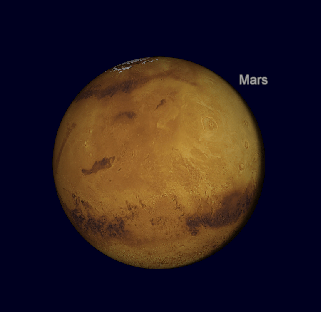
Mars as it might be seen in a large telescope with high power at 5:30 a.m., April 28 2016. Mars apparent diameter is 15.7″. The central meridian will be 169.90 degrees. Created using Cartes du Ciel (Sky Charts).
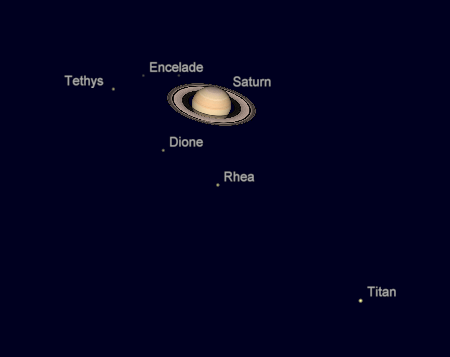
Saturn and its moons at 5:30 a.m., April 28, 2016. The apparent diameter of the planet will be 18.1″. The rings span 42.1″, a bit larger than the apparent diameter of Jupiter. Created using Cartes du Ciel (Sky Charts).
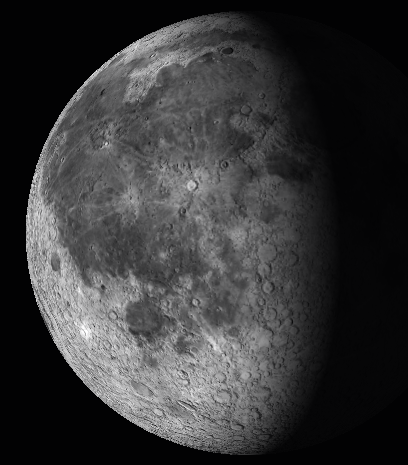
The Moon as it might appear in binoculars at 5:30 a.m. on April 28, 2016. Created using Stellarium.
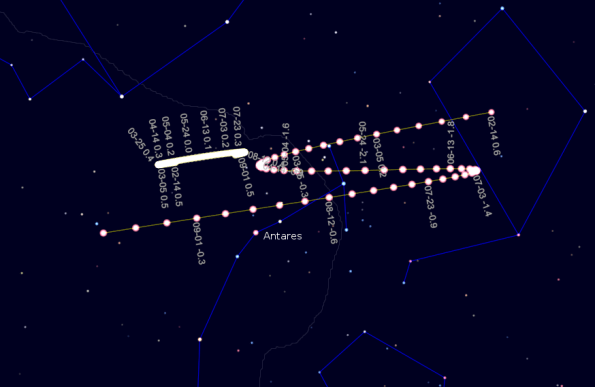
The retrograde tracks of Mars and Saturn as we pass both planets this year. The tracks start on February 14, 2016 and run to September 13, 2016 plotted at 4 day intervals and labeled every 20 days. I noticed when producing the Mars, Saturn & Moon plot above that Mars was not due north of Antares on the 27th. Mars actually became stationary and started it’s retrograde loop a few days ago before it got that far. However when Mars doubles back, it will have a much closer pass of Antares on August 27th. Saturn’s plots are so close together that they appear as a fat line. Created using Cartes du Ciel (Sky Charts).
Retrograde motion of the planets are caused when the Earth is either passing a superior planet (Mars, Jupiter, Saturn, etc.), or when being passed by an inferior planet (Venus and Mercury). It was a big problem with the old Earth center solar system, before Copernicus and Kepler.
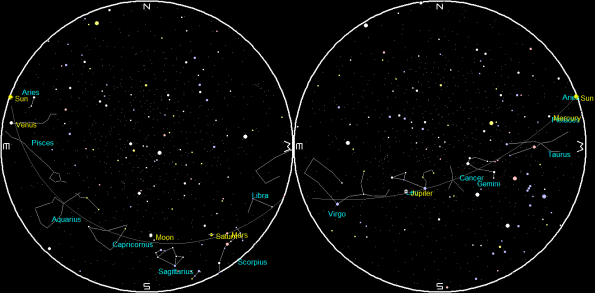
Planets at sunrise and sunset of a single night starting with sunset on the right on April 27, 2016. The night ends on the left with sunrise on April 28. If you are using Firefox right-click on the image and select View Image to enlarge the image. That goes for all the large images.
08/17/2015 – Ephemeris – The celestial snake handler
Ephemeris for Monday, August 17th. The Sun rises at 6:47. It’ll be up for 13 hours and 58 minutes, setting at 8:45. The Moon, 3 days past new, will set at 10:04 this evening.
The planet Saturn and the red star Antares shine in the south-southwest at 10:30 p.m. In the and around constellation of Scorpius. In the area of sky above it lies a large constellation of faint stars called Ophiuchus, the serpent bearer. The constellation shape is like a large bell, which reminds me of the head, shoulders and arms of a fellow that’s holding the snake-like a weight lifter pulling up a heavy bar bell. The serpent he’s holding is Serpens, the only two part constellation in the heavens. The head rises to Ophiuchus’ right and the tail extends up to the left. In legend Ophiuchus was a great physician, educated by the god Apollo, and the centaur Chiron, also found in the stars as Sagittarius, below and left of him.
Times are for the Traverse City/Interlochen area of Michigan. They may be different for your location.
Addendum
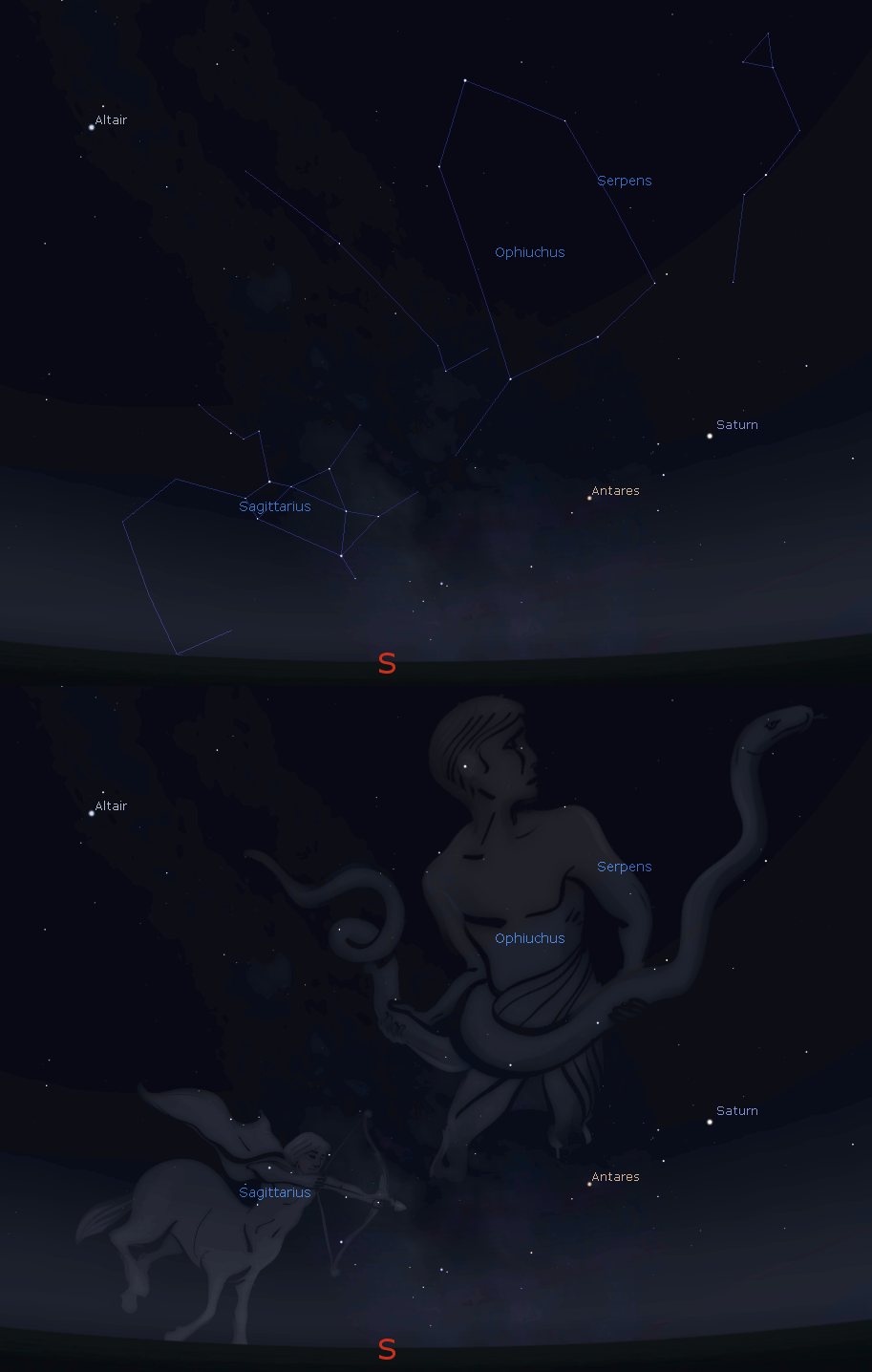
Ophiuchus, Serpens and Sagittarius with Saturn and Antares on August 17, at 10 p.m. Created using Stellarium.
07/10/2015 – Ephemeris – The celestial scorpion crawls over the horizon
Ephemeris for Friday, July 10th. Today the Sun will be up for 15 hours and 21 minutes, setting at 9:28. The Moon, 2 days past last quarter, will rise at 2:44 tomorrow morning, and tomorrow the Sun will rise at 6:07.
The planet Saturn, this year, is on the right edge of the constellation of Scorpius the scorpion which is in the south at 11 p.m. Its brightest star is Antares in its heart, a red giant star. From Antares to the right is a star then a vertical arc of three stars that is its head. The Scorpion’s tail is a line of stars running down to the left of Antares swooping to the horizon before coming back up and ending in a pair of stars that portray his poisonous stinger. Scorpius looks huge lying on the southern horizon. But if you go south Scorpius will be higher in the sky, and will look smaller. Being close to the horizon from Michigan, Scorpius shares with the rising and setting sun and moon the illusion of increased size.
Times are for the Traverse City/Interlochen area of Michigan. They may be different for your location.
Addendum
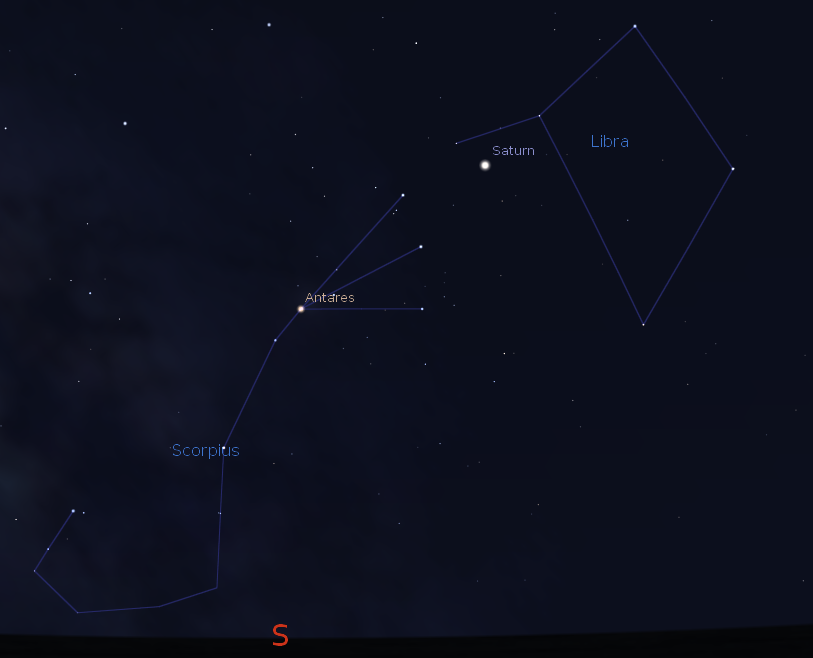
Scorpius from Traverse City/Interlochen at 11 p.m. on July 10, 2015. Created using Stellarium.
12/26/2014 – Ephemeris – Tragedies and triumphs of 2014
Ephemeris for Friday, December 26th. The sun will rise at 8:18. It’ll be up for 8 hours and 49 minutes, setting at 5:08. The moon, 2 days before first quarter, will set at 11:02 this evening.
2014 was a year of personal tragedy and also tragedy and triumph in space. The Space tragedies came in October with the destruction and loss of Orbital Science’s third supply mission to the International Space Station when the their Antares rocket blew up right after launch. A few days later Virgin Galactic’s SpaceShipTwo disintegrated on a test flight killing a pilot. In the Triumph department the European Space Agency’s Rosetta caught up and orbited its comet 67P, for short, in August and bounced down its lander Philae in November. It wasn’t supposed to bounce, but stick the landing. Bruised and battered Philae delivered its science before its batteries died. And this month an unmanned Orion capsule made its maiden voyage into space.
Times are for the Traverse City/Interlochen area of Michigan. They may be different for your location.
Addendum

Orbital Sciences Antares rocket explodes seconds after liftoff on October 28, 2014. Credit NASA.

SpaceShipTwo disintegrates October 31, 2014 killing a pilot. Credit USA Today.

After a second bounce on the Comet 67P the Philae lander ended up sideways apparently on the base of a cliff. Researchers were able to get data from just about all the instruments before the battery discharged. The team hopes and the comet gets closer to the sun and the sun angle changes they can revive Philae. Credit: ESA.

Screen capture of Delta IV Heavy rocket liftoff carrying the Orion test article into orbit on December 4, 2014. Credit .NASA via BBC
Ride back to the earth with Orion via a camera mounted in a window. The window is facing aft as the capsule re-enters the atmosphere heat shield first at 20,000 miles per hour. You’ll experience everything except the G forces. It comes with appropriate spacey music. It’s as close as I’ll ever get to ride in one of these things.
 Bob Moler's Ephemeris Blog