Archive
08/11/2014 – Ephemeris – The Moon’s terminator is now the sunset line
Ephemeris for Monday, August 11th. The sun rises at 6:40. It’ll be up for 14 hours and 13 minutes, setting at 8:54. The moon, 1 day past full, will rise at 9:15 this evening.
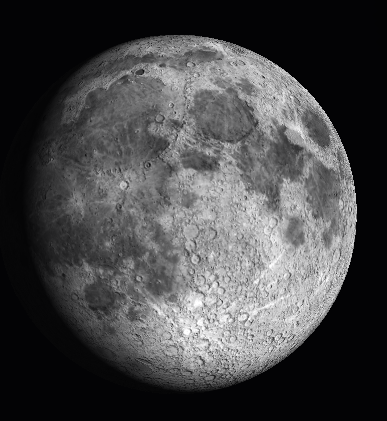
After the full moon the shadow action moves from the eastern or left edge of the moon to the western or right edge of the moon, or if the moon’s low in the east, to the upper right edge. For the first two weeks of the lunar cycle, from new to full we were watching the sunrise terminator slowly sweep across the face of moon. Now, after full the sunrise terminator is sweeping across the Moon’s far side, and the sunset terminator is beginning to sweep across the near side, our side of the Moon. Tonight the terminator is approaching the small Sea of Crises on the upper right of the Moon. By tomorrow night the terminator will be half way across that sea. By Wednesday it will be lights out for the Sea of Crises for two weeks.
Times are for the Traverse City/Interlochen area of Michigan. They may be different for your location.
Addendum
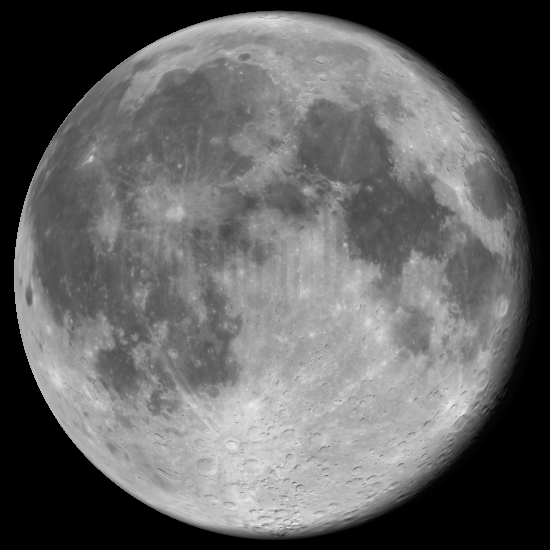
The moon at 10 p.m. tonight, August 11, 2014. Created using Virtual Moon Atlas.
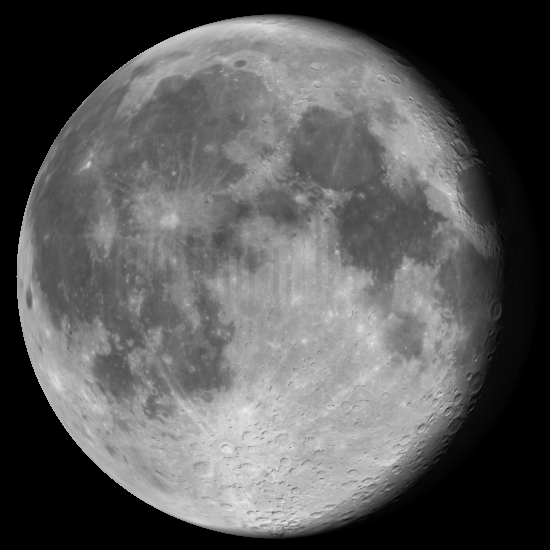
The moon at 10 p.m. tomorrow night, August 12, 2014. Created using Virtual Moon Atlas.
08/08/2014 – Ephemeris – Supermoon plus astronomical fun in the Grand Traverse Area
Ephemeris for Friday, August 8th. The sun rises at 6:36. It’ll be up for 14 hours and 21 minutes, setting at 8:58. The moon, 2 days before full, will set at 5:17 tomorrow morning.
In two days the Moon will reach perigee within a few hours of being a full moon. This has become known as a supermoon. Perigee is the point where an Earth orbiting object is closest to the Earth. The farthest point is called apogee. The coincidence of full moon and perigee was coined as the supermoon by astrologer Richard Knolle in 1979, but apparently didn’t catch on until he wrote a popular article in 2011. No wonder I hadn’t heard of it, this program had been on for 4 years before the term was even coined. The problem with appreciating the supermoon is the lack of a reference of nearly the same size. The moon always looks large when it’s near the horizon. It’s a well-known optical illusion, It’ll fool us every time.
Times are for the Traverse City/Interlochen area of Michigan. They may be different for your location.
Addendum
Saturday evening the 9th the Grand Traverse Astronomical Society (GTAS) will host a Sun and Star Party at Thoreson Farm at the Sleeping Bear Dunes National Lakeshore. It’s the concluding event at the Port Oneida Fair. Solar viewing will be from 4 to 6 p.m., and the evening event will run from 9 to 11 p.m. with the main attraction will be the nearly full Moon, the planet Saturn and colorful binary stars and bright star clusters. Thoreson Farm is located on South Thoreson Road. South Thoreson Road runs into M22, about a mile west of Port Oneida Road.
Sunday evening the 10th the GTAS will attend the Meteors and S’mores event at the Leelanau State Park at the tip of the Leelanau Peninsula. The event will run from 8:30 p.m. to 11:45 p.m. The Perseid meteor shower will reach peak a couple of days later, but there will still bright Perseids visible to the vigilant.
I’ll have more to say about the supermoon tomorrow in a non-Ephemeris post.
08/04/2014 – Ephemeris – The Moon’s remarkable crater Clavius
Ephemeris for Monday, August 4th. The sun rises at 6:32. It’ll be up for 14 hours and 31 minutes, setting at 9:03. The moon, 1 day past first quarter, will set at 1:20 tomorrow morning.
Let’s take a look at the Moon tonight. The south end of the moon is bright part, the lunar highlands, the oldest terrain on the Moon. A huge crater is visible that just came into sunlight. It is the crater Clavius. It’s visible in binoculars, but it is best seen in a telescope with enough magnification so the moon more than fills the field of view. Clavius has four small craters on its floor in a slight arc, in descending order of size. Clavius itself is 136 miles (225 km) in diameter. It has a flat floor, but it’s large enough to be convex following the curvature of the Moon, a fact that can be seen when Clavius is close to the terminator as it will be tonight. It is another one of my favorite lunar features.
Times are for the Traverse City/Interlochen area of Michigan. They may be different for your location.
Addendum
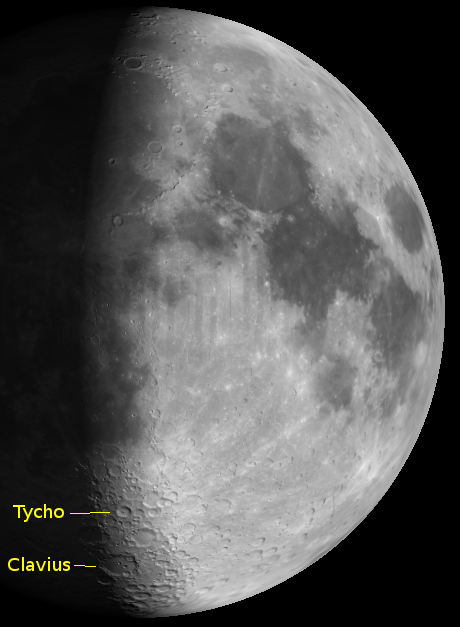
The Moon highlighting the craters Clavius and Tycho for 10 p.m. August 4, 2014. Created using Virtual Moon Atlas.
A note: For science fiction fans in the book and movie 2001 a Space Odyssey by Arthur C. Clarke the U.S. Moon Base was located in the crater Clavius, and the lunar monolith, designated TMA-1 (Tycho Magnetic Anomaly 1) in surveys, was located in the nearby crater Tycho.
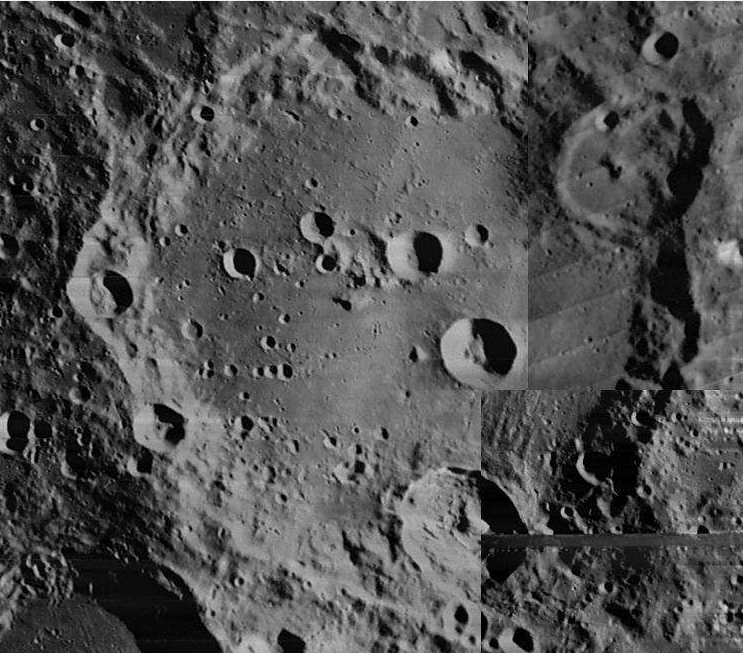
Clavius as photographed by one of the Lunar Orbiter spacecraft in the 1960s. From Digital Lunar Orbital Photographic Atlas. Credit Jeff Gillis, Lunar and Planetary Institute.
07/30/2014 – Ephemeris – Wednesday is classic planet day on Ephemeris
Ephemeris for Wednesday, July 30th. The sun rises at 6:26. It’ll be up for 14 hours and 43 minutes, setting at 9:10. The moon, half way from new to first quarter, will set at 10:40 this evening.
It’s Wednesday and once again time to look at the bright planets for this week. Reddish Mars is in Virgo in the southwest as darkness falls. It’s 109 million miles (176 million km) away now, over twice as far as it was last April, and will set at 12:17 a.m. Saturn will be low in the south-southwest as darkness falls, in the faint constellation of Libra the scales. It will set at 1:11 a.m. Saturn’s in perfect position for viewing with a small or large telescopes to see those fabulous rings and its large moon Titan. Somewhat larger telescopes can spot some smaller moons closer in. Brilliant Venus will rise in the east northeast
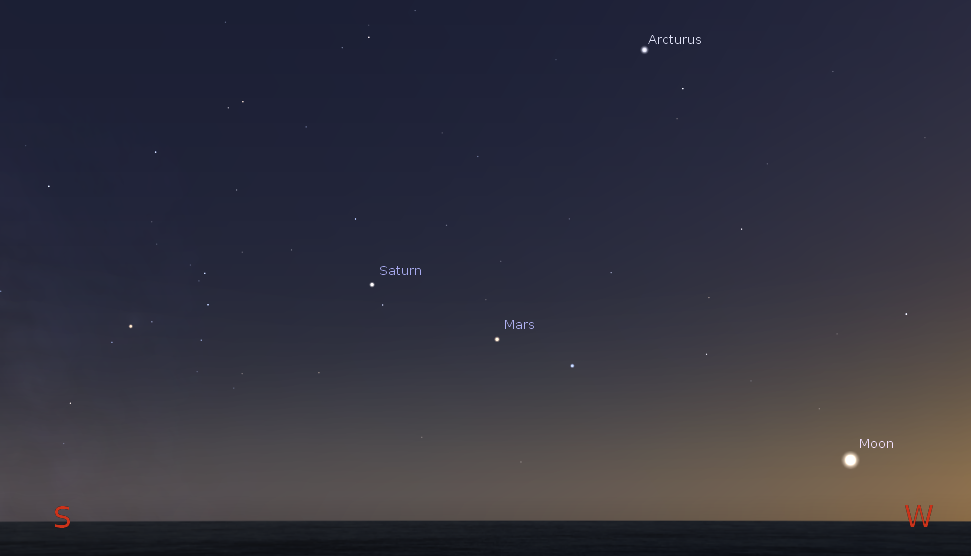
The Moon, Mars and Saturn at 10 p.m. on July 30, 2014. The bright star right of Mars is Spica, and the bright star left of Saturn is Antares. Created using Stellarium.
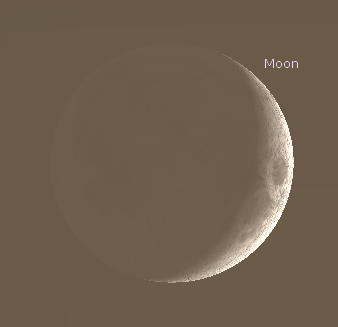
The Moon as seen in binoculars at 10 p.m. on July 30, 2014. Created using Stellarium.
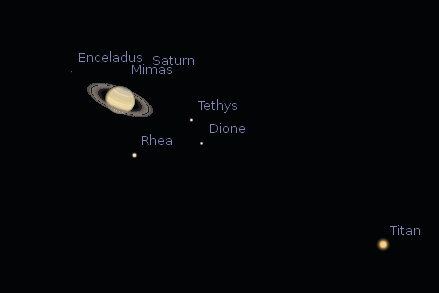
Saturn and its moons on the evening of July 30, 2014. Created using Stellarium.
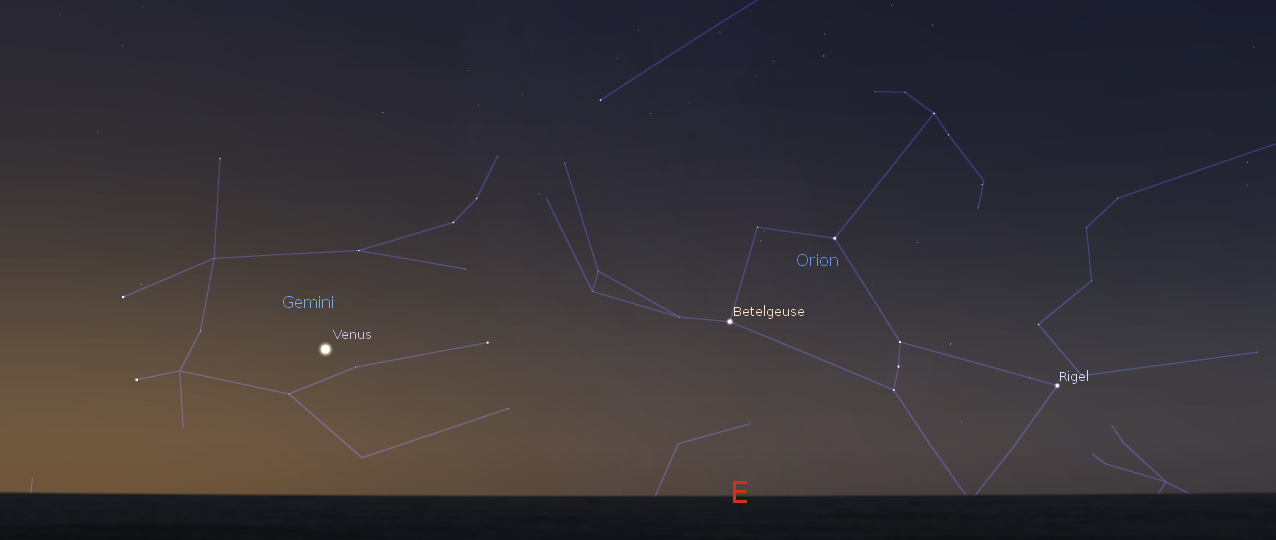
Venus and the winter constellations rising at 5:30 a.m. on July 31, 2014. Created using Stellarium.
at 4:33 a.m. in morning twilight. Mercury will rise at 5:36 and be nearly impossible to spot below Venus.
Times are for the Traverse City/Interlochen area of Michigan. They may be different for your location.
Addendum
07/23/2014 – Ephemeris – It’s Wednesday. Do you know where the bright planets are?
Ephemeris for Wednesday, July 23rd. The sun rises at 6:19. It’ll be up for 14 hours and 58 minutes, setting at 9:18. The moon, 3 days before new, will rise at 4:28 tomorrow morning.
It’s Wednesday and once again time to locate the bright planets for this week. Reddish Mars is in Virgo in the southwest as darkness falls. It’s 105 million miles (169 million km) away now, nearly 3 times farther away than it was last April, and will set at 12:39 a.m. Saturn will be low in the south-southwest as darkness falls, in the faint constellation of Libra the scales. It will set at 1:38 a.m. Saturn’s in perfect position for viewing with a small or large telescopes to see those fabulous rings and its large moon Titan. Somewhat larger telescopes can spot some smaller moons closer in. Brilliant Venus will rise in the east at 4:22 a.m. in morning twilight. Mercury will rise at 4:46 and be barely visible below Venus. The crescent moon will be right of Venus tomorrow morning.
Times are for the Traverse City/Interlochen area of Michigan. They may be different for your location.
Addendum
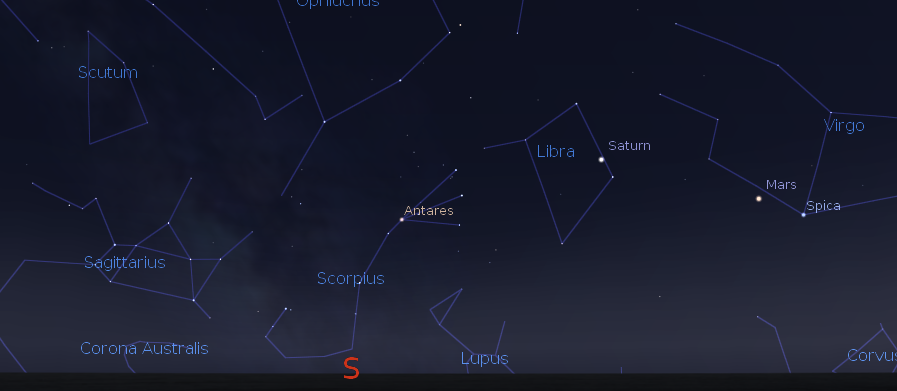
The evening planets Mars and Saturn with the zodiacal constellations at 10:30 p.m. on July 23, 2014. Created using Stellarium.
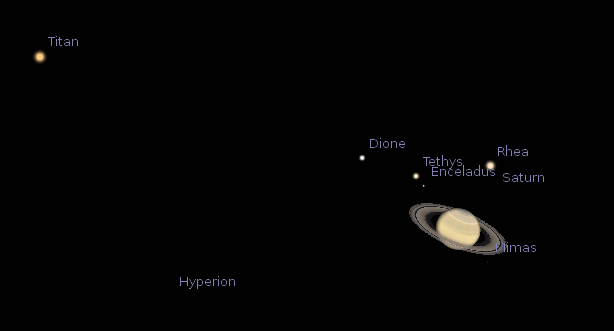
Saturn through a telescope. In small telescopes of the moons only Titan will be visible. July 23, 2014. Created using Stellarium.
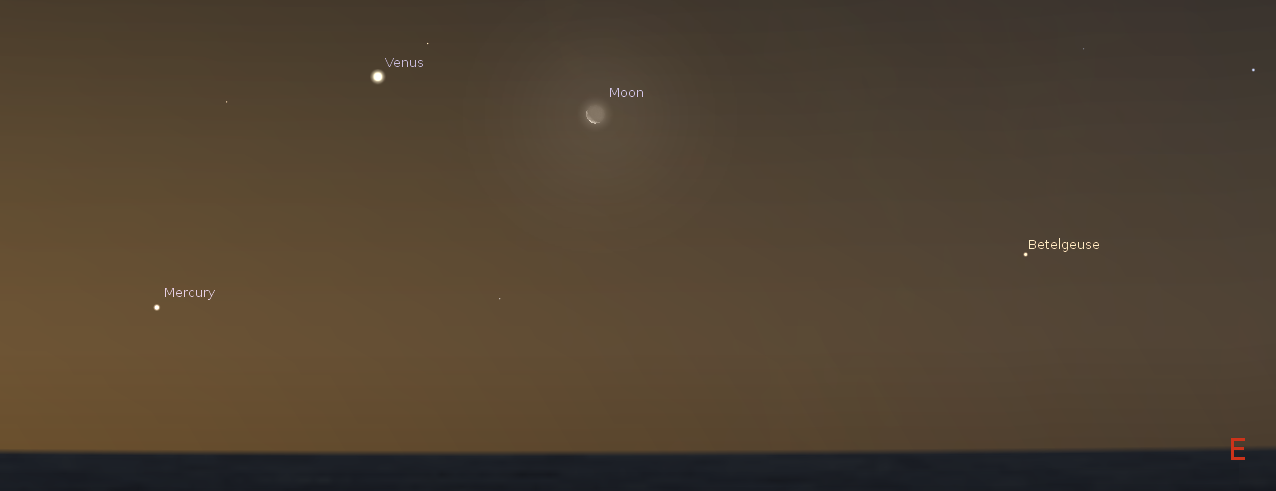
Venus, Mercury, and the crescent Moon at 5:30 a.m. on July 24, 2014. Created using Stellarium.
07/10/2014 – Ephemeris – Why is the bright Moon so low in summer and so high in winter?
Ephemeris for Thursday, July 10th. Today the sun will be up for 15 hours and 20 minutes, setting at 9:28. The moon, 2 days before full, will set at 5:22 tomorrow morning. Tomorrow the sun will rise at 6:08.
If you watch the moon for the next few nights, you won’t have to strain your neck because the moon at its highest will be less than 30 degrees above the southern horizon for us in northern Michigan. That’s because the moon closely follows the path of the sun in the sky, called the ecliptic, with a deviation of only 5 degrees maximum. Tonight it’s a couple of degrees north of the ecliptic. Tonight it’s located about where the sun was back last November or will be next November. In winter you’d swear that the full moon at its greatest height was practically overhead. It’s another effect of the Earth’s axial tilt of 23 ½ degrees. Our moon is odd in it doesn’t orbit the Earth’s equator like most large moons do for their planets.
Times are for the Traverse City/Interlochen area of Michigan. They may be different for your location.
Addendum
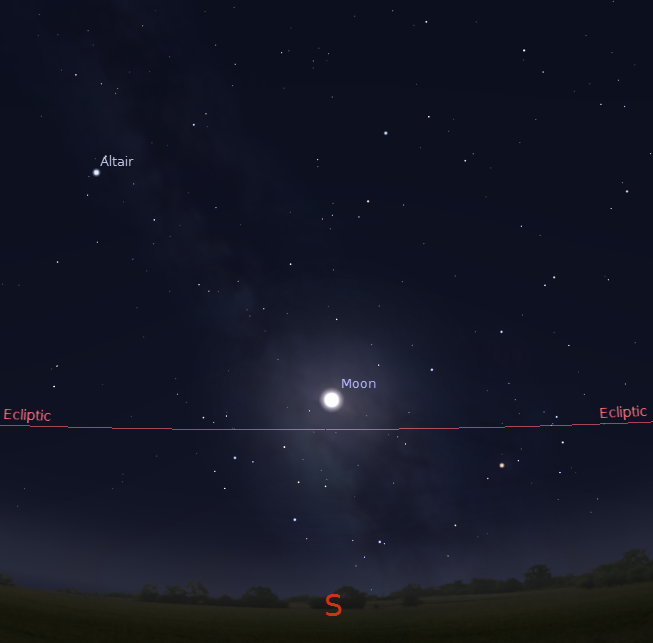
The full Moon on July, 12, 2014. Created using Stellarium.
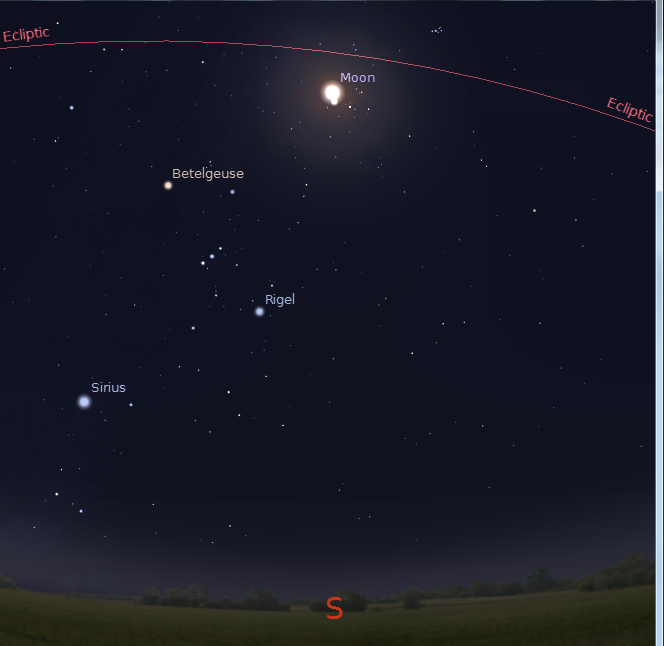
The full Moon on December 6, 2014. Created using Stellarium.
07/09/2014 – Ephemeris – Where are the bright planets this week?
Ephemeris for Wednesday, July 9th. Today the sun will be up for 15 hours and 22 minutes, setting at 9:28. The Moon, 3 days before full, will set at 4:20 tomorrow morning. Tomorrow the sun will rise at 6:07.
It’s Wednesday and once again time to locate the bright planets for this week. Jupiter sets less than a half hour after the sun, so it’s gone for us until September mornings. Reddish Mars is in Virgo in the southwest as darkness falls. It’s 97 million miles (156 million km) away now, nearly 2 and a half times farther away than last April, and will set at 1:17 a.m. Saturn will be low in the south-southwest as darkness falls, in the faint constellation of Libra the scales. It will set at 2:34 a.m. Saturn’s in perfect position for viewing with a small or large telescope to see those fabulous rings and its large moon Titan. Somewhat larger telescopes can spot some smaller moons closer in. Brilliant Venus will rise in the east at 4:09 a.m. in morning twilight.
Times are for the Traverse City/Interlochen area of Michigan. They may be different for your location.
Addendum
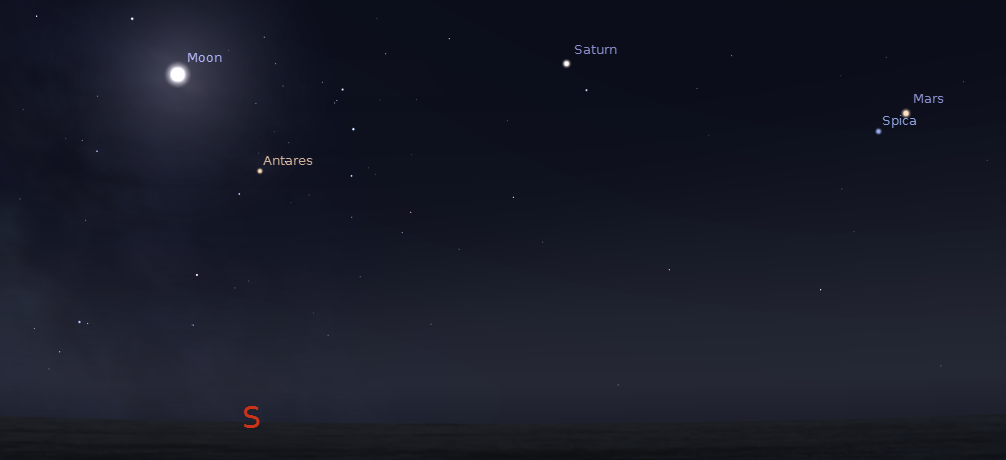
Mars, Saturn and the Moon will appear along with the brighter stars of summer at 11 p.m. on July 9, 2014. Created using Stellarium.
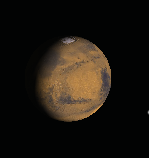
Mars as seen through a large telescope. It appears really tiny in any other telescope. Time: 11 p.m. on July 9, 2014. Created using Stellarium.
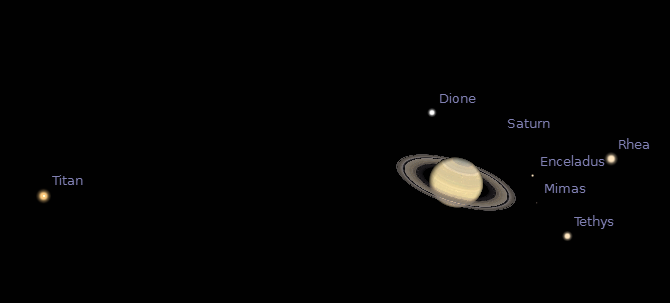
Saturn and some of its moons. Smaller telescopes will see only Titan, but see how many moon you can see. July 9, 11 p.m. Created using Stellarium.
A binocular view of the gibbous Moon on July 9, 2014 at 11 p.m. Created using Stellarium.
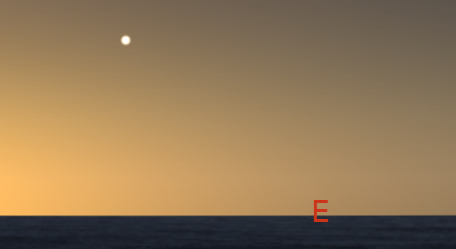
Venus low in the east at 5:45 a.m. July 11, 2014; roughly a half hour before sunrise. Created using Stellarium.
Venus low in the east at 5:45 a.m. July 11, 2014; roughly a half hour before sunrise. Created using Stellarium.

Bright gibbous disk of Venus as seen through a telescope on July 10, 2014. Created using Stellarium.
07/08/2014 – Ephemeris – Why are the near side and the far side of the moon so different?
Ephemeris for Tuesday, July 8th. Today the sun will be up for 15 hours and 23 minutes, setting at 9:29. The moon, 3 days past first quarter, will set at 3:27 tomorrow morning. Tomorrow the sun will rise at 6:06.
We’re all familiar with the gray blotches on the moon called seas that make up the face of the Man in the Moon. The other side, the far side, misnamed the dark side, has only one small sea. Astronomers have wondered why. Seems that it’s a product of the Moon’s birth and the late heavy bombardment that came later. In a new hypothesis, a Mars sized proto-planet hit the proto-Earth with a glancing blow peeling off material that fell into a disk that coalesced into the Moon, a lot closer to the earth than it is today, and the far side contained thicker light crustal material than the near side. When the giant planets began their migration much asteroidal material struck the moon. Near side impacts penetrated into the Moons magma, while the far side impacts did not.
Times are for the Traverse City/Interlochen area of Michigan. They may be different for your location.
Addendum
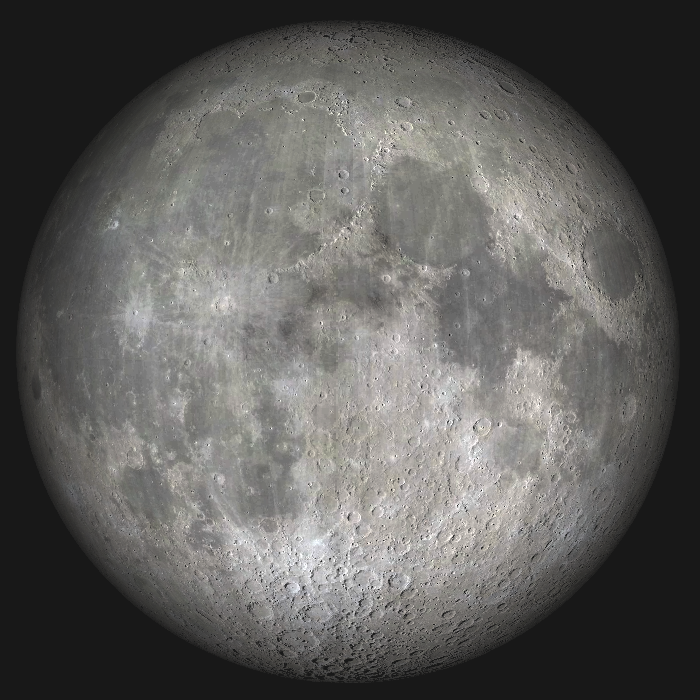
The Moon’s near side. Created using Virtual Moon Atlas.
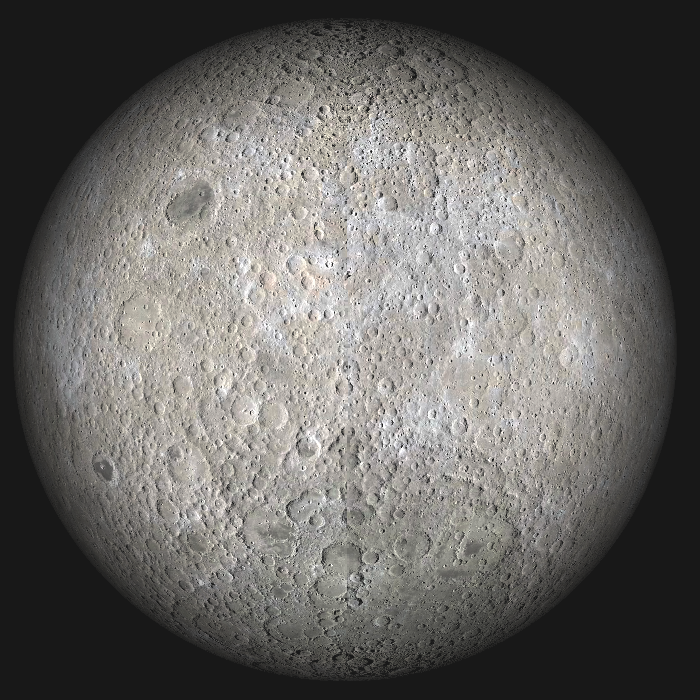
The Moon’s far side. Created using Virtual Moon Atlas.
07/07/2014 – Ephemeris – The Moon will appear near Saturn tonight
Ephemeris for Monday, July 7th. Today the sun will be up for 15 hours and 24 minutes, setting at 9:29. The Moon, 2 days past first quarter, will set at 2:43 tomorrow morning. Tomorrow the sun will rise at 6:05.
Tonight the planet Saturn will be seen above the bright gibbous Moon. At 11 p.m. Saturn will be only 3 moon widths above the moon and may be hard to spot in the Moon’s glare, so that binoculars may be needed to find it. Other than that the moon makes a nice pointer to the ringed planet. The rings of Saturn become apparent in telescopes of at least 20 power. At first the planet looks elliptical, then the planet can be seen to separate from the rings. The Moon itself is a fine but bright object for the telescope. Look near the terminator or sunrise line to see the long lunar shadows delineate the Moon’s crater detail, especially the grand Crater Copernicus near the center of the Moon.
Times are for the Traverse City/Interlochen area of Michigan. They may be different for your location.
Addendum
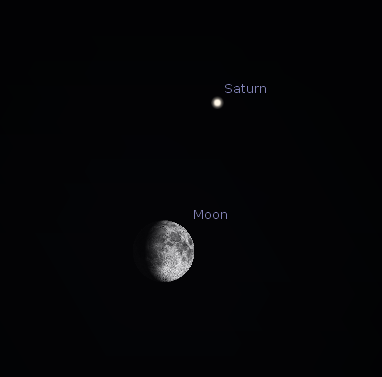
Saturn and the Moon as they would appear at 11 p.m. on July 7, 2014. Created using Stellarium.
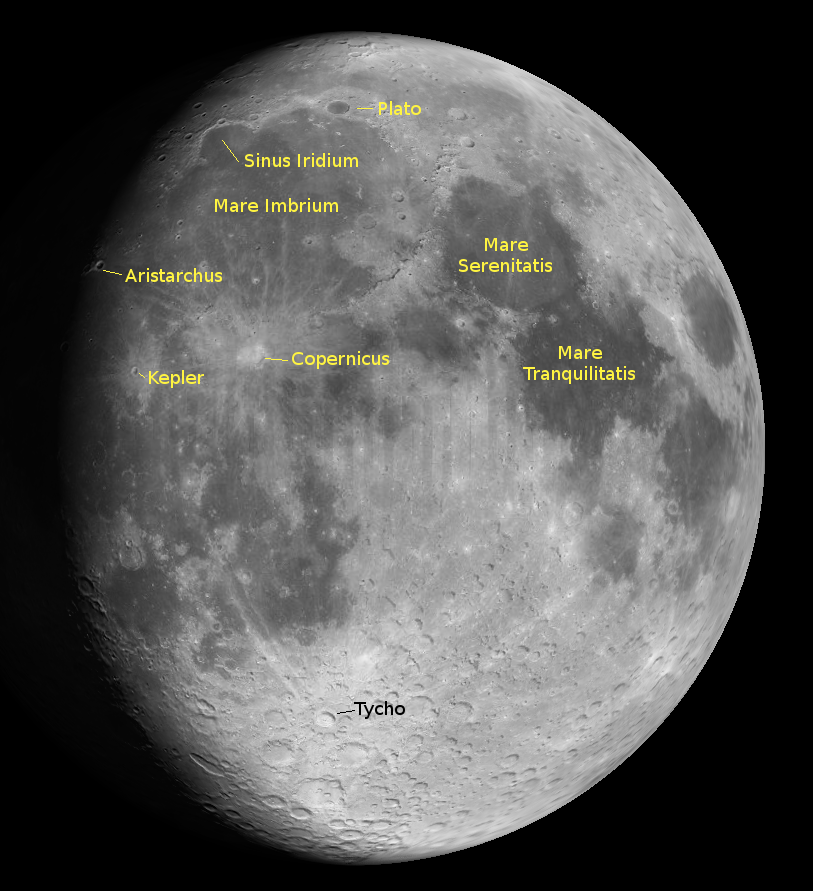
Oops, here’s the Moon for tomorrow night July 8th, 2014. The difference from tonight is the Aristarchus will not be visible, and Sinus Iridium will look cooler. Created using Virtual Moon Atlas. It’s 2 a.m. and I’m too tired to fix it.
07/02/2014 – Ephemeris – Bright planets to start off the 3rd quarter of 2014
Ephemeris for Wednesday, July 2nd. Today the sun will be up for 15 hours and 29 minutes, setting at 9:31. The moon, 3 days before first quarter, will set at 12:09 tomorrow morning. Tomorrow the sun will rise at 6:02.
It’s Wednesday and once again time to locate the bright planets for this week. Jupiter sets less than an hour after the sun, for most folks finding it in twilight will be futile. It will next be seen on September mornings. Reddish Mars is in Virgo in the southwest as darkness falls. It’s 93 million miles (150 million km) away now, and will set at 1:39 a.m. Saturn will be low in the south as darkness falls. It’s in the faint constellation of Libra the scales this year. It will pass due south at 10 p.m. It will set at 3:02 a.m. Saturn’s in perfect position for viewing with a small or large telescope to see those fabulous rings and its large moon Titan. Brilliant Venus will rise in the east at 4:07 a.m. in morning twilight.
Times are for the Traverse City/Interlochen area of Michigan. They may be different for your location.
Addendum
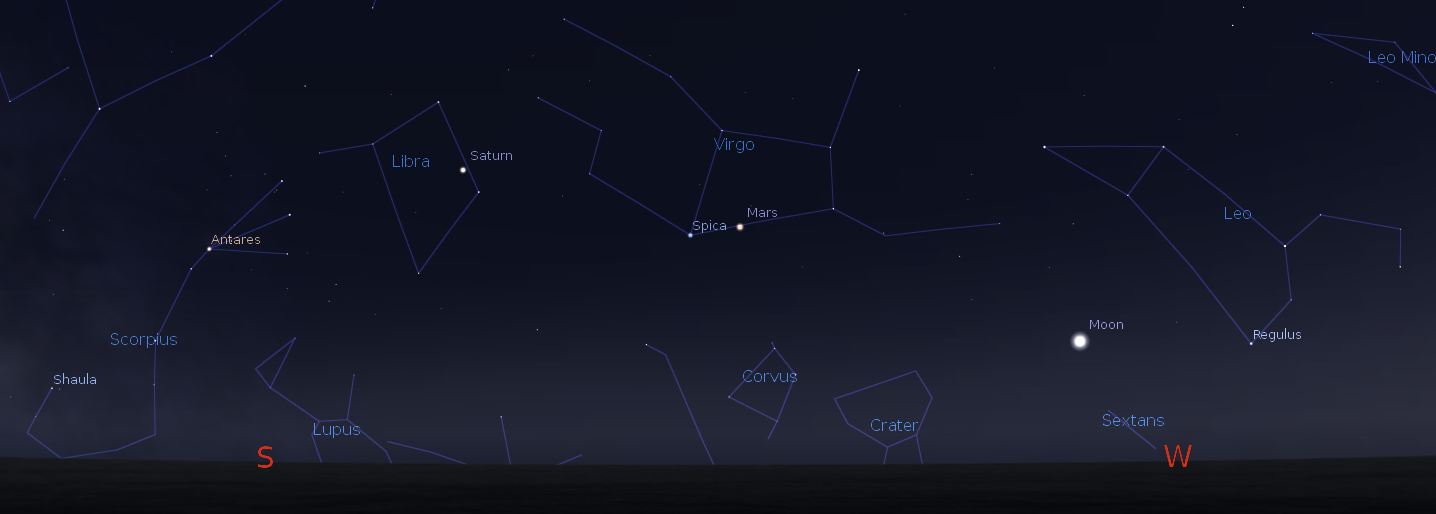
Saturn, Mars and the moon at 11 p.m. on July 2, 2014. Created using Stellarium.
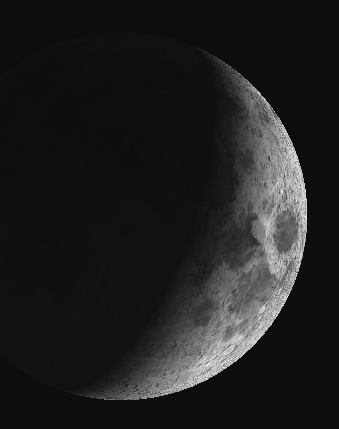
Binocular view of the Moon at 11 p.m., July 2, 2014. Created using Stellarium.
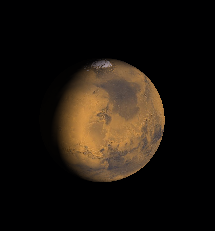
Telescopic view of Mars at high power at 11 p.m., July 2, 2014. Created using Stellarium.
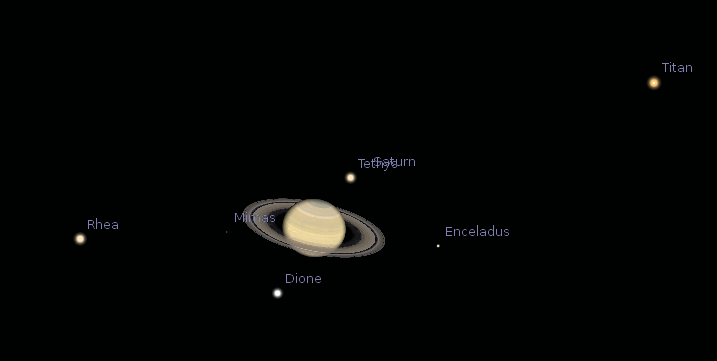
Telescopic view of Saturn and some of its moons on July 2, 2014. Created using Stellarium.
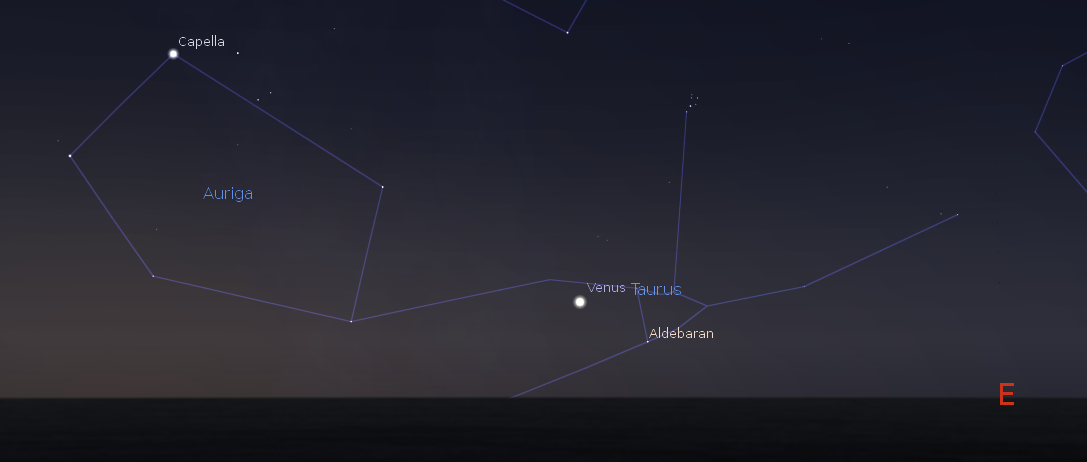
Venus and the morning stars at 4:45 a.m., July 3, 2014. Created using Stellarium.
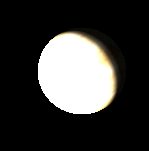
Telescopic view of Venus on July 3, 2014. Created using Stellarium.
 Bob Moler's Ephemeris Blog