Archive
03/06/2014 – Ephemeris – Observing the Moon tonight!
Ephemeris for Thursday, March 6th. The sun will rise at 7:11. It’ll be up for 11 hours and 25 minutes, setting at 6:36. The moon, 2 days before first quarter, will set at 12:56 tomorrow morning.
The Moon’s appearance has changed since I last talked about it on Tuesday. The Crescent is wider. The terminator, the sunrise line on the Moon that gives the Moon it’s now crescent phase has uncovered most of the Sea of Tranquility. In fact the sun will have risen at the Apollo 11 landing site by this evening. With a small telescope just beneath the center of the moon and near the terminator is one of my favorite craters Theophilus with its well-defined central peak. It’s kind of middle-aged for craters on the moon from 1 to 3 billion years old. It’s in much better shape than the crater Cyrillus of nearly the same size that it partially overlaps, which is thought to be at least a billion years older and shows it.
Times are for the Traverse City/Interlochen area of Michigan. They may be different for your location.
Addendum
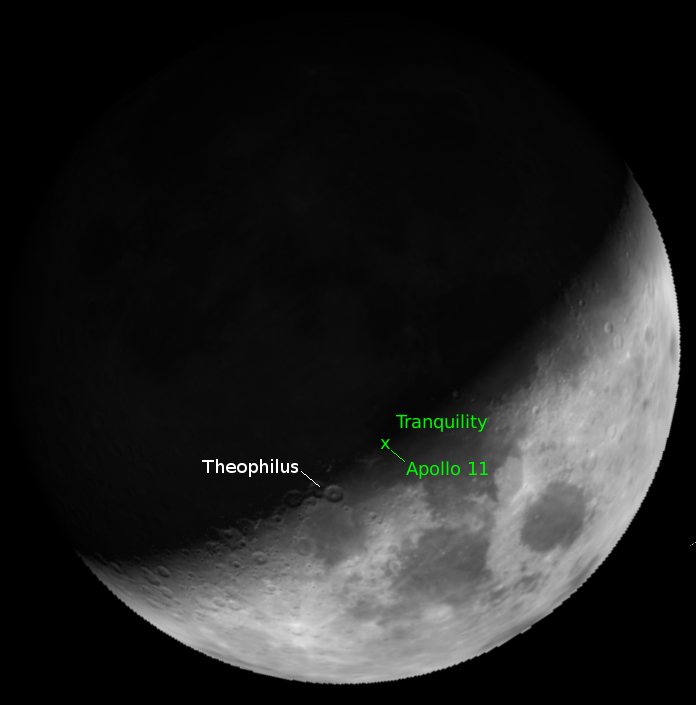
The Moon at 9 p.m. March 6, 2014 highlighting the Sea of Tranquility the Apollo 11 landing site (approximate) and the crater Theophilus. Created using Virtual Moon Atlas.
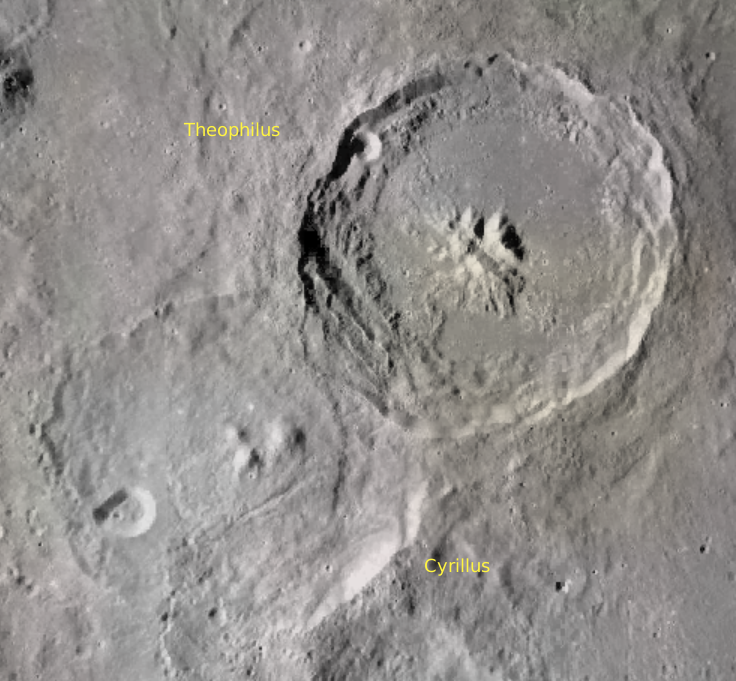
Lunar craters Theophilus and Cyrillus. Credit: NASA/LRO mapped onto Virtual Moon Atlas.
03/05/2014 – Ephemeris – It’s Wednesday, do you know where your planets are?
Ephemeris for Ash Wednesday, Wednesday, March 5th. The sun will rise at 7:12. It’ll be up for 11 hours and 22 minutes, setting at 6:35. The moon, 3 days before first quarter, will set at 11:56 this evening.
Wednesday is the “Where are the bright planets?” day on Ephemeris. Jupiter will be in the southeastern sky as darkness falls tonight. It’s cruising against the stars of Gemini now. It will pass due south at 8:33 p.m., and will set at 4:16 a.m. in the west-northwest. Reddish Mars is in Virgo now and above and left of the bright star Spica, which it now outshines. Mars will rise at 10:01 p.m. It will pass due south at 3:32 a.m. Saturn will rise at 12:18 a.m. in the east-southeast. It’s seen against the stars of Libra the scales this year. Venus will rise at 4:57 tomorrow morning and shines brightly in the southeast before sunrise.
Times are for the Traverse City/Interlochen area of Michigan. They may be different for your location.
Addendum
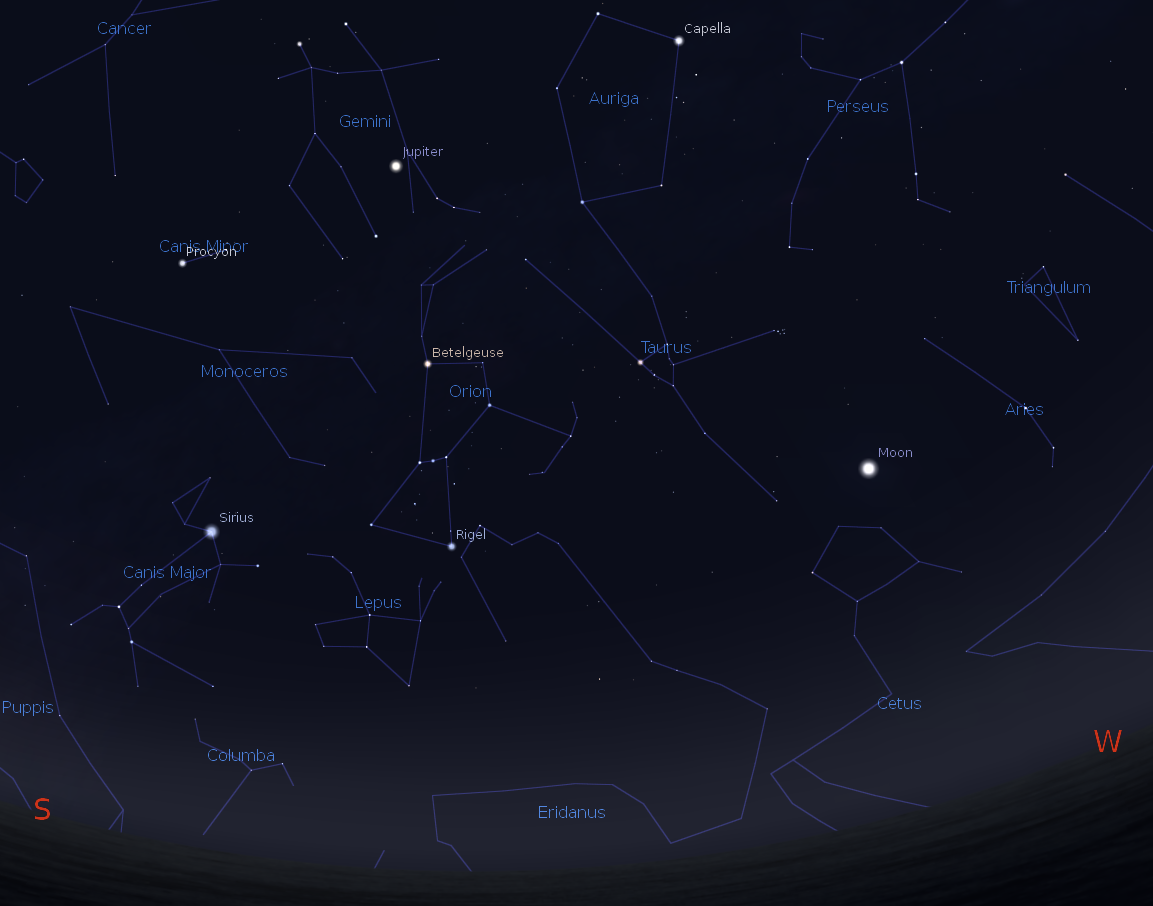
Jupiter, the Moon and the winter constellations at 9 p.m. on March 5, 2014. Created using Stellarium.
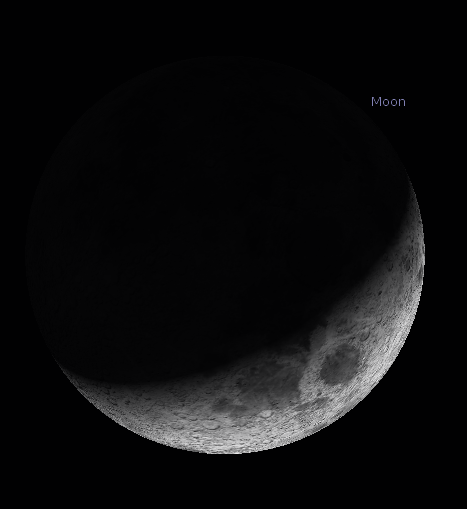
The Moon at 9 p.m. on March 5, 2014. Created using Stellarium.
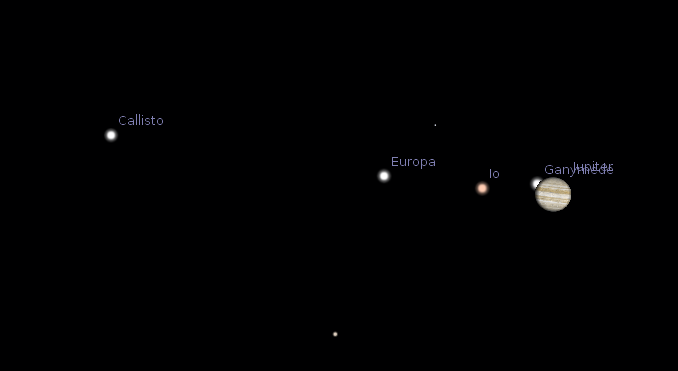
Jupiter and its moons at 9 p.m. on March 5, 2014. Created using Stellarium.
The Stellarium timing is a bit off. Ganymede won’t emerge from behind Jupiter until 9:37 p.m. It will disappear into Jupiter’s shadow at 11:07 p.m. and emerge from the shadow at 1:17 a.m.
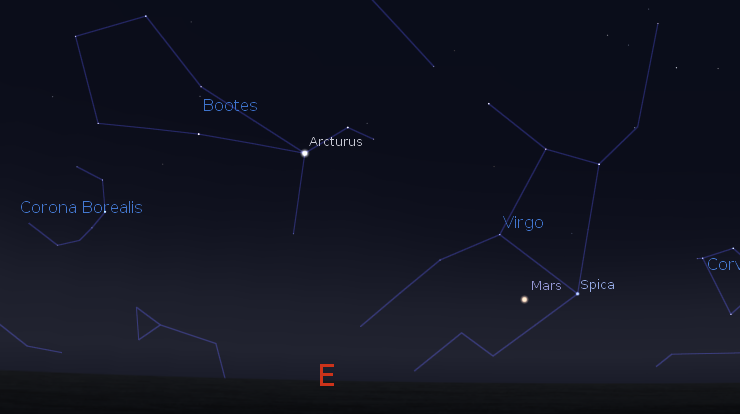
Mars rising near the star Spica at 11 p.m. March 5, 2014. Created using Stellarium.
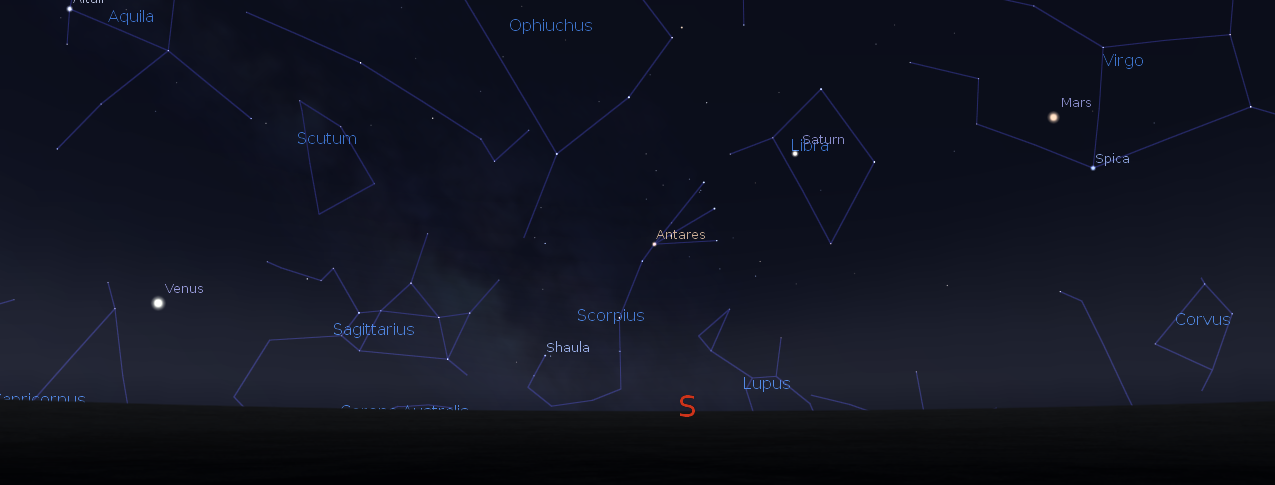
The morning planets Mars, Saturn and Venus with the moon at 6 a.m. March 6, 2014. Created using Stellarium.
The planets below is how they’d look in a small telescope. They are magnified twice as much as Jupiter and its moons above.
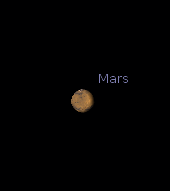
Mars at 6 a.m., March 6, 2014. Created using Stellarium.
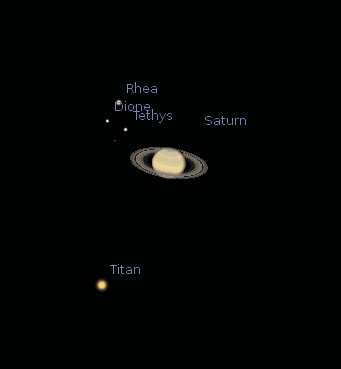
Saturn and its moons at 6 a.m., March 6, 2014. Created using Stellarium.
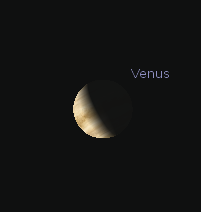
Venus at 6 a.m., March 6, 2014. Created using Stellarium.
03/04/2014 – Ephemeris – Observing the Moon tonight
Ephemeris for Fat Tuesday, Tuesday, March 4th. The sun will rise at 7:14. It’ll be up for 11 hours and 19 minutes, setting at 6:34. The moon, 3 days past new, will set at 10:52 this evening.
The Moon tonight is visible in the west after sunset. The sunrise terminator is slowly moving across its face. The solar day on the Moon equals its orbit of the Earth with respect to the sun of about 29 and a half days. As the moon is oriented in our sky the dark nearly circular sea. The Sea of Crises is rotated downward so it appear at between 4 and 5 o’clock on the moon’s face. At the bottom is the partially uncovered Sea of Fertility. With binoculars or preferably a small telescope can be seen the large crater Langrenus close to the lunar equator. A picture of that crater was one of the first brought back by the Apollo 8 crew in 1968. I’ve found it for the blog entry for this episode at bobmoler.wordpress.com.
Times are for the Traverse City/Interlochen area of Michigan. They may be different for your location.
Addendum
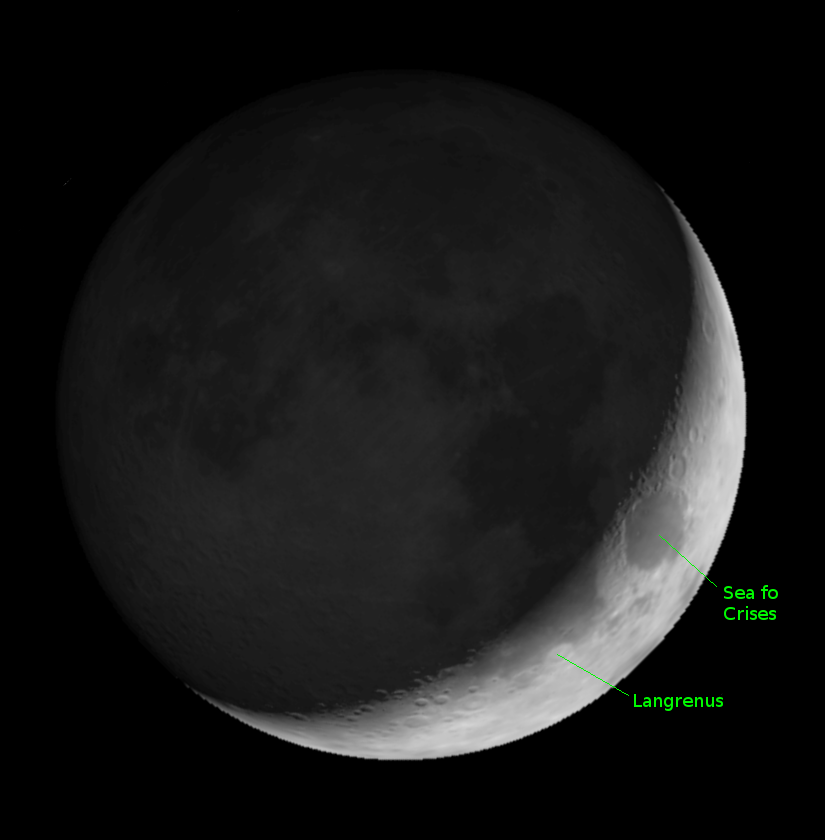
The moon rotated as if it were setting in the west showing the Sea of Crises (Mare Crisium) and the crater Langrenus. The image was enhanced to show Earth shine. Created using Virtual Moon Atlas.
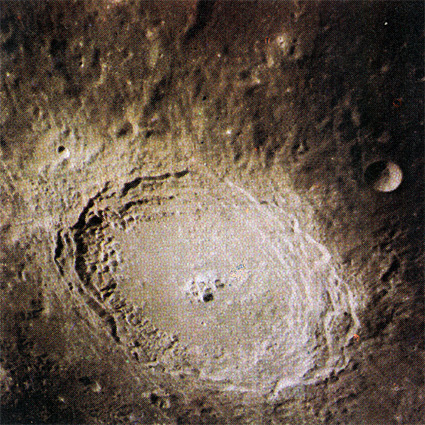
The crater Langrenus as imaged by the Apollo 8 crew on their historic orbiting of the Moon Christmas Eve 1968. Credit: NASA.
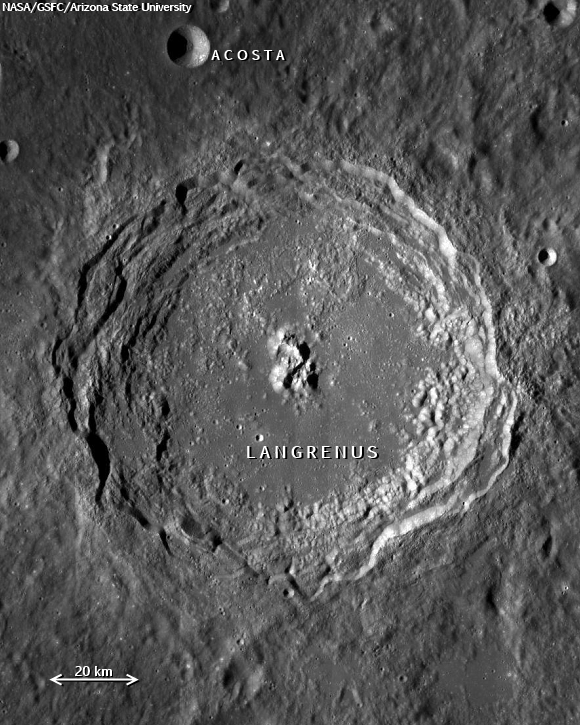
The crater Langrenus as imaged by the Lunar Reconnaissance Orbiter. Credit: NASA\GSFC\Arizona State University.
Note on credits: GSFC is the Goddard Space Flight Center.
02/26/2014 – Ephemeris – Where are the bright planets this week?
Ephemeris for Wednesday, February 26th. The sun will rise at 7:25. It’ll be up for 11 hours and 1 minute, setting at 6:26. The moon, 3 days before new, will rise at 5:58 tomorrow morning.
Let’s take our weekly look at the planets. Jupiter will be in the southeastern sky as darkness falls tonight. It’s cruising against the stars of Gemini now. It will pass due south at 9:01 p.m., and will set at 4:44 a.m. in the west-northwest. Reddish Mars is in Virgo now and above and left of the bright star Spica, which it now outshines. Mars will rise at 10:29 p.m. and will appear above the moon when it rises a half an hour later. It will pass due south at 4 a.m. Saturn will rise at 12:45 a.m. in the east-southeast. It’s seen against the stars of Libra the scales this year. Venus will rise at 5:03 tomorrow morning but this morning it will appear above and right of the Moon. and shines brightly in the southeast before sunrise.
Times are for the Traverse City/Interlochen area of Michigan. They may be different for your location.
Addendum
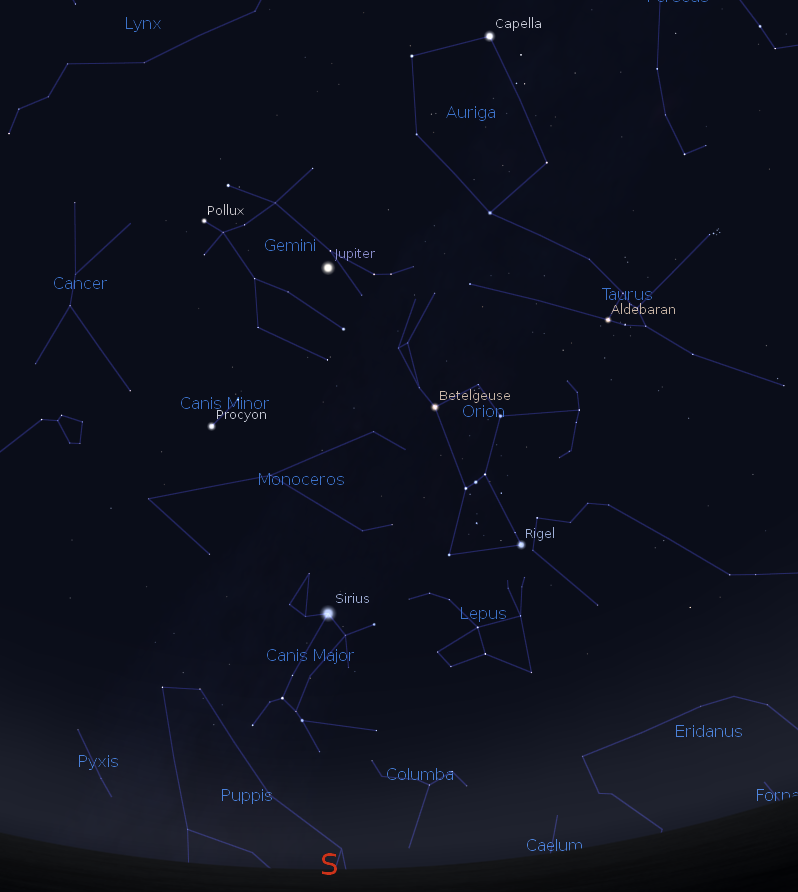
Jupiter and the winter constellations at 9 p.m. on February 26, 2014. Created using Stellarium.
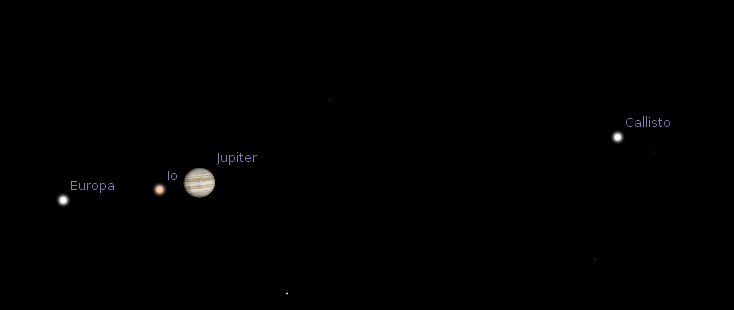
Telescopic Jupiter. The missing moon Ganymede is near Io from our vantage point, however it’s in Jupiter’s shadow. It will emerge into sunlight at 10:25 p.m. (3:25 UT on the 27th) between Io and Europa. Created using Stellarium.
Stellarium models the eclipses of the satellites fine, but for this one it is more than a half hour early. It may not take into account the light travel time between Jupiter and the earth. Another free program Cartes du Ciel does not model Jovian satellite eclipses at all.
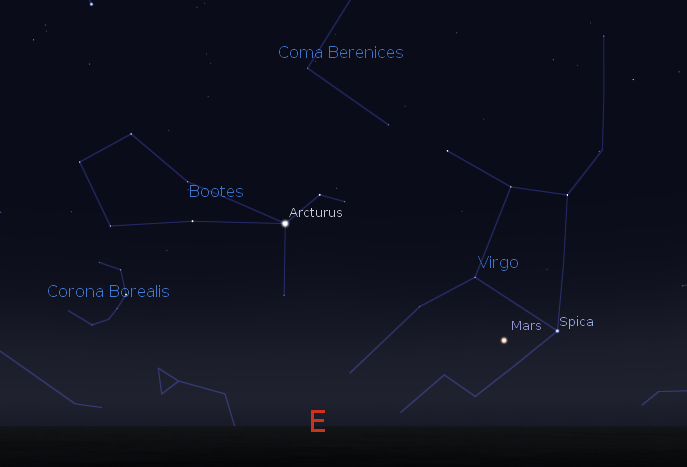
Mars rising near the star Spica at 11:30 p.m. February 26, 2014. Created using Stellarium.
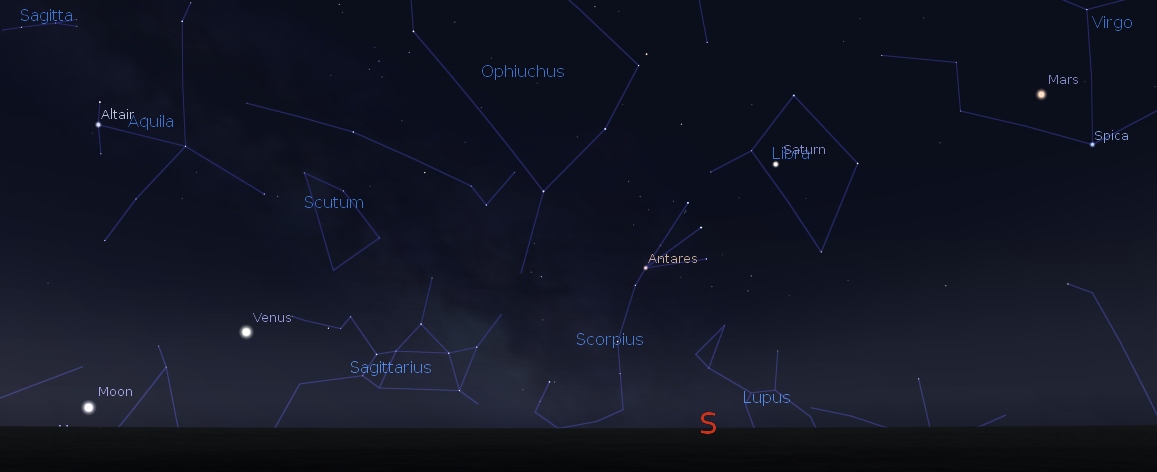
The morning planets Mars, Saturn and Venus with the moon at 6:15 a.m. February 27, 2014. Created using Stellarium.
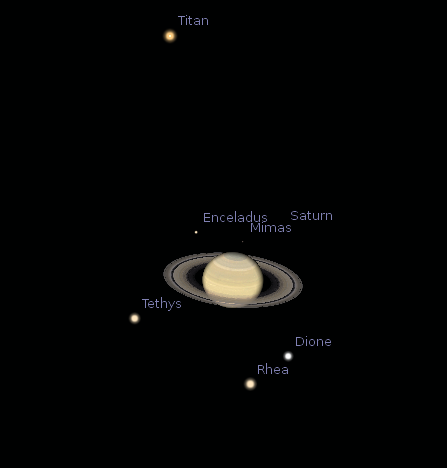
Saturn through a telescope on the morning of February 27, 2014. It would be difficult to see any satellites other than Titan with a small telescope. Created using Stellarium
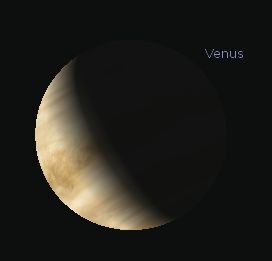
Venus through a telescope, except there will be no cloud detail, in the morning of February 27, 2014. Created using Stellarium.
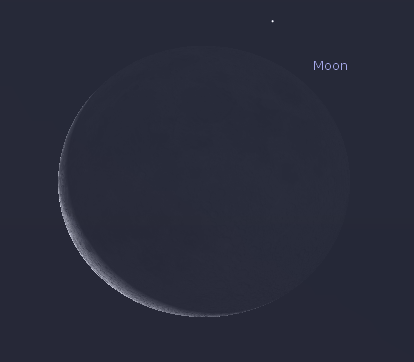
The thin crescent moon at 6:15 a.m. on February 27, 2014. Created using Stellarium.
02/19/2014 – Ephemeris – Where are the bright planets this week?
Ephemeris for Wednesday, February 19th. The sun will rise at 7:36. It’ll be up for 10 hours and 40 minutes, setting at 6:16. The moon, 3 days before last quarter, will rise at 11:23 this evening.
Let’s take our weekly look at the planets. Jupiter will be in the southeastern sky as darkness falls tonight. It’s cruising against the stars of Gemini now. It will pass due south at 9:29 p.m., and will set at 5:12 a.m. in the west-northwest. Reddish Mars is in Virgo now and above and left of the bright star Spica, which it now outshines. Mars will rise at 10:54 p.m. and will appear above the moon when it rises a half an hour later. It will pass due south at 4:26 a.m. Saturn will rise at 1:13 a.m. in the east-southeast. It’s seen against the stars of Libra the scales this year. Venus will rise at 5:10 tomorrow morning, and shines brightly in the southeast before sunrise. It’s in Sagittarius, left of its Teapot shape of stars.
Times are for the Traverse City/Interlochen area of Michigan. They may be different for your location.
Addendum
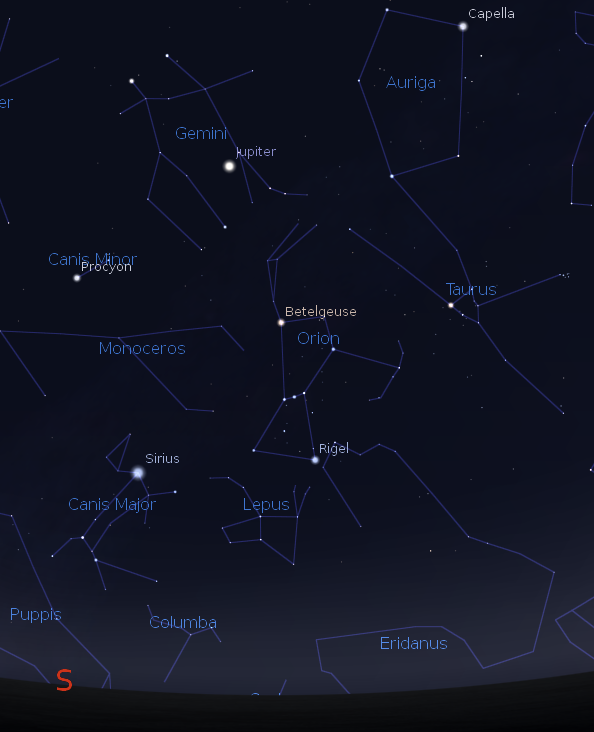
Jupiter and the constellations of winter at 9 p.m. February 18, 2014. Created using Stellarium.
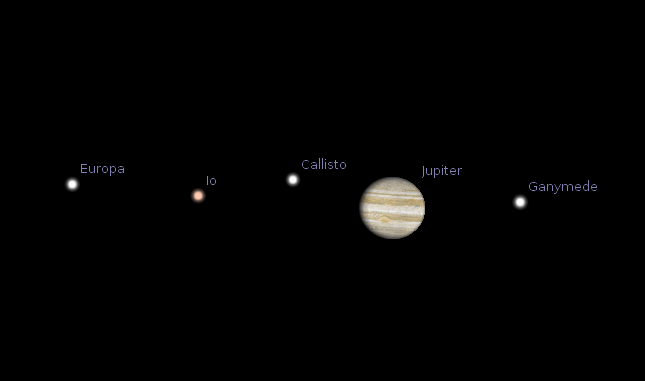
Jupiter at 9 p.m. on February 18, 2014. Created using Cartes du Ciel.
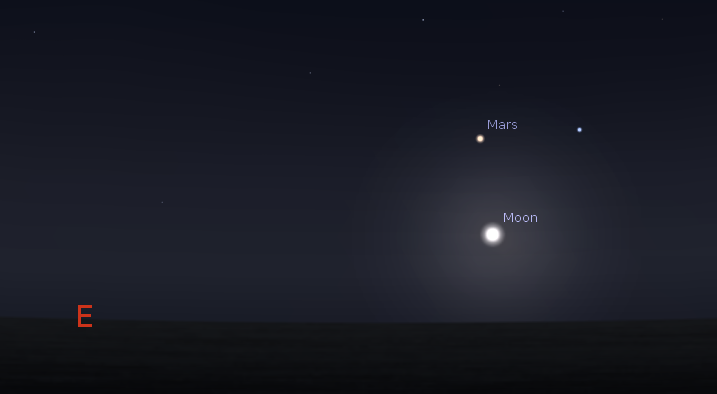
Mars and the Moon at midnight on February 20, 2014. Created using Cartes du Ciel.
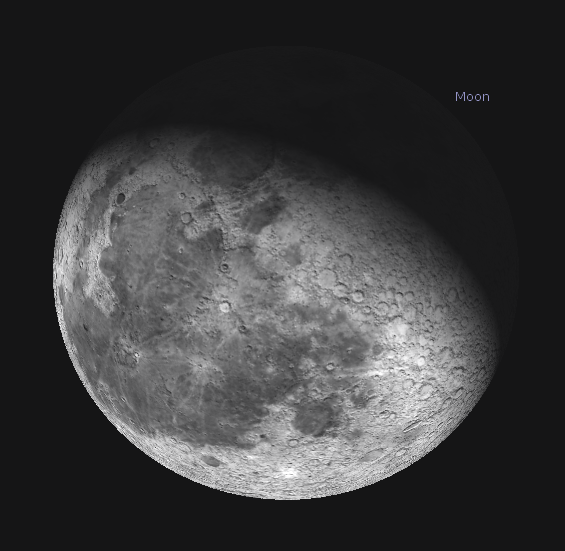
The Moon at midnight on February 20, 2014. Created using Stellarium.
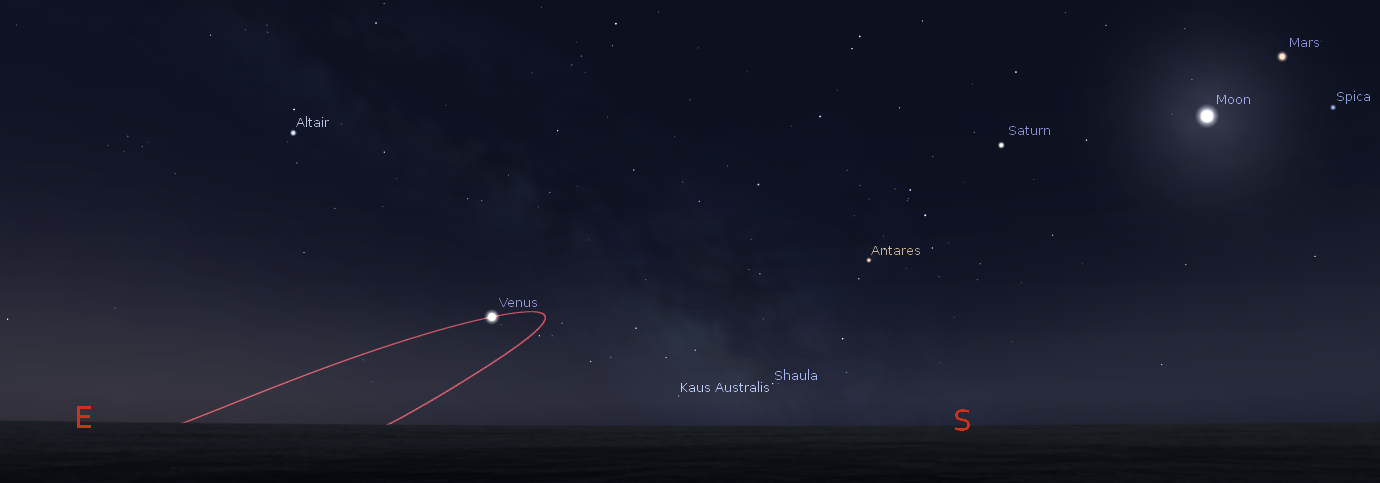
The morning planets at 6:30 a.m. February 20, 2014, including the orbit of Venus. Created using Stellarium.
Venus will reach the end of the red loop, its orbit as seen from Earth, on March 22nd. Of course we and Venus are moving, and so the apparent position of Venus will change also by the Earth’s motion.
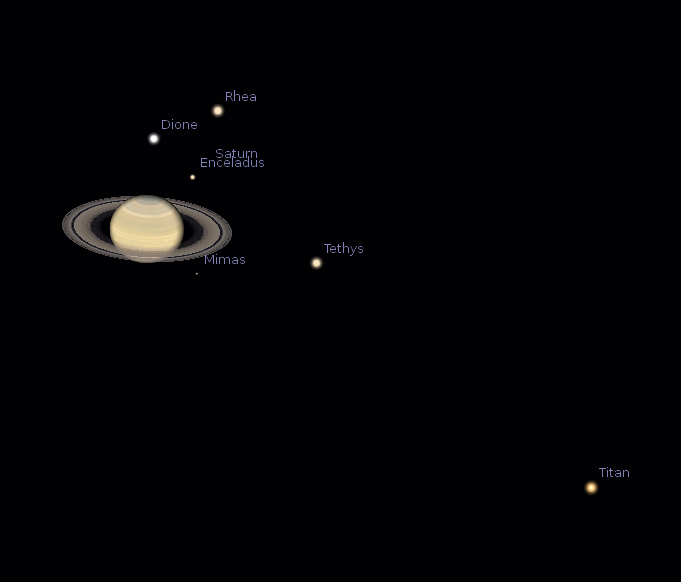
Saturn and its moons at 6:30, February 20, 2014. Of the moons, Titan will be the only one visible in small telescopes. Created using Stellarium.
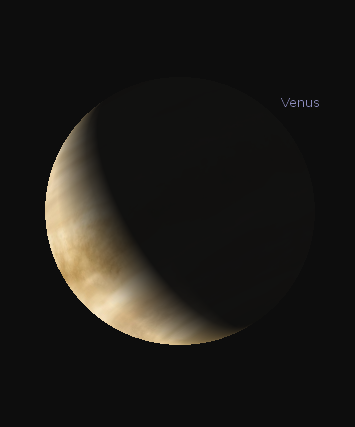
Venus through a telescope. The planet is getting smaller and its crescent is getting fatter as it moves away from the Earth. This image is for 6:30 a.m. February 20, 2014.Created using Stellarium.
02/17/2014 – Ephemeris – Viewing tonight’s waning gibbous moon
Ephemeris for President’s Day, Monday, February 17th. The sun will rise at 7:39. It’ll be up for 10 hours and 34 minutes, setting at 6:13. The Moon, 3 days past full, will rise at 9:17 this evening.
The bright Moon is now a waning gibbous phase, The right edge of the Moon is now in night as the sunset terminator slowly advances across the moon. Tonight the Sea of Fertility is half in daylight on the right side of the Moon. A telescope looking at it can spot the double crater of Messier and Messier A, a funny impact where the small asteroid skipped producing two craters and a double ray of ejecta. On the other side of the moon the largest sea Oceanus Procellarum, or Ocean of Storms can be seen in its entirety to the left limb of the moon. It happens that the moon is rotated toward us on that side, an effect called libration. The effect is due to the moon’s uneven velocity around the earth.
Times are for the Traverse City/Interlochen area of Michigan. They may be different for your location.
Addendum
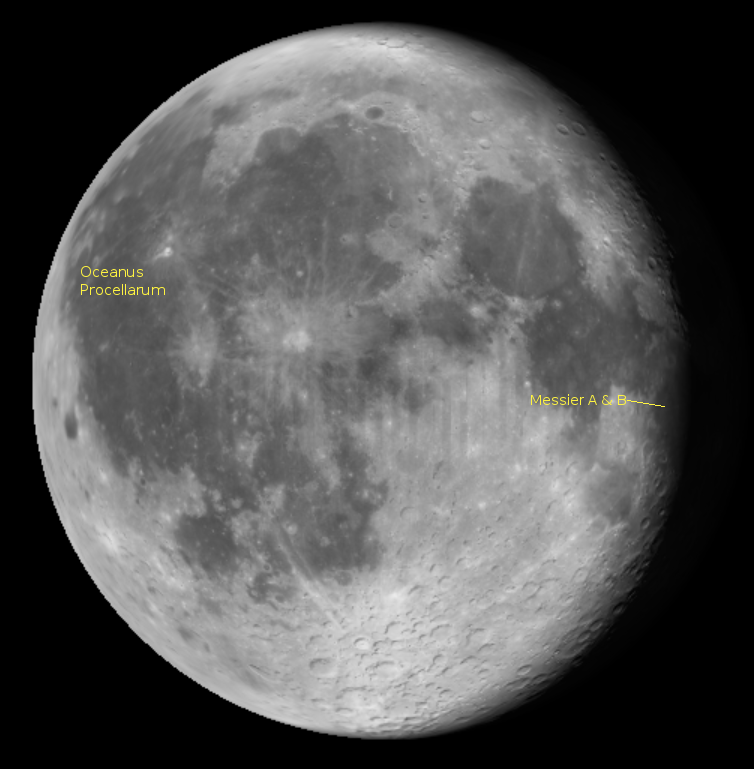
The moon at 9 p.m. on February 17, 2014 showing Oceanus Procellarum and the craters Messier A and B. Created using Virtual Moon Atlas.
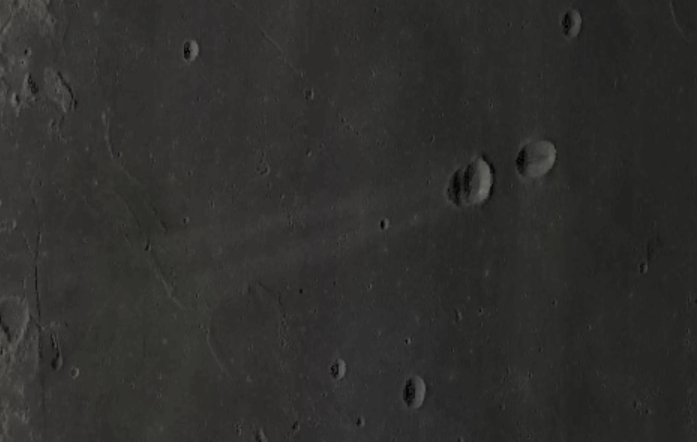
Closeup of the craters Messier A and B showing their twin rays. Created using Virtual Moon Atlas and the Lunar Reconnaissance Orbiter images. Credit: NASA.
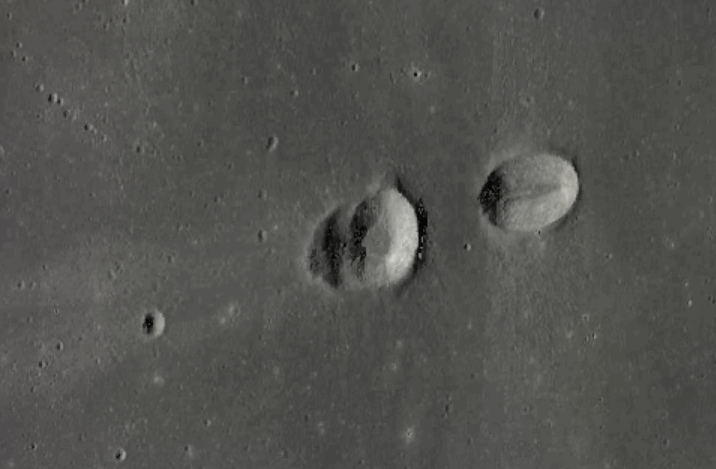
Extreme closeup of the craters Messier A and B showing their twin rays. Created using Virtual Moon Atlas and the Lunar Reconnaissance Orbiter images. Credit: NASA.
02/14/2014 – Ephemeris – This full moon is a bit too cold for lovers.
Ephemeris for St Valentine’s Day, Friday, February 14th. The sun will rise at 7:44. It’ll be up for 10 hours and 25 minutes, setting at 6:09. The Moon, at full today, will rise at 6:15 this evening.
Tonight’s full moon won’t be the type that young lovers would want to look up to because, well it’s February, and it’s cold. Let’s wait until June. But one can bundle up and get the telescope or binoculars out to view the face of our only natural satellite. Even though the actual reflectance is a bit less than 13% of the light that the sun sends its way. If it were snow covered it would really be bright. Looking at it with or without binoculars one can see the man in the moon face. At the bottom of the moon or bottom right as the moon rises is the splashiest crater of all, the crater Tycho. The crater itself seems to have a dark halo around it. Also one can see rays extending great distances across the moon from it.
Times are for the Traverse City/Interlochen area of Michigan. They may be different for your location.
Addendum
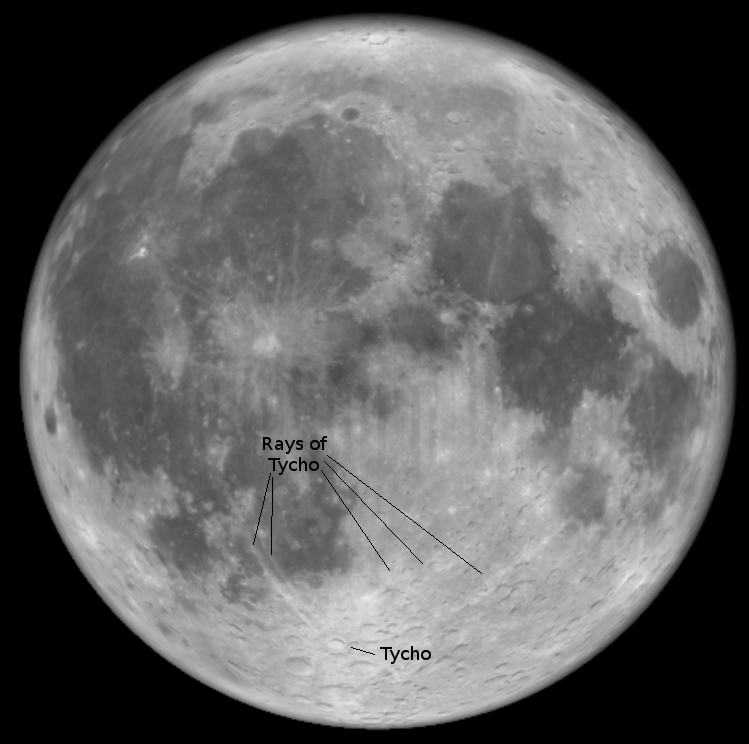
Tycho’s rays at full moon are actually secondary craters thrown by debris from the initial impact. At full moon they are no longer shadow filled so show as being bright. Image created using Virtual Moon Atlas.
02/12/2014 – Ephemeris – Where are the bright planets this week?
Ephemeris for Wednesday, February 12th. The sun will rise at 7:47. It’ll be up for 10 hours and 19 minutes, setting at 6:06. The Moon, 2 days before full, will set at 6:39 tomorrow morning.
Let’s take our weekly look at the planets. Jupiter will be in the southeastern sky as darkness falls tonight. It’s cruising against the stars of Gemini now. It will pass due south at 9:58 p.m., and will set at 5:41 a.m. in the west-northwest. The moon is seen where Cancer is tonight. Mars will rise at 11:17 p.m. in the east-southeast. Reddish Mars is in Virgo now and above and left of the bright star Spica, which it now outshines. Mars will pass due south at 4:49 a.m. Saturn will rise at 1:39 a.m. in the east-southeast. It’s seen against the stars of Libra the scales this year. Venus will rise at 5:21 tomorrow morning, and shines brightly in the southeast before sunrise. It’s in Sagittarius, above the Teapot asterism.
Times are for the Traverse City/Interlochen area of Michigan. They may be different for your location.
Addendum
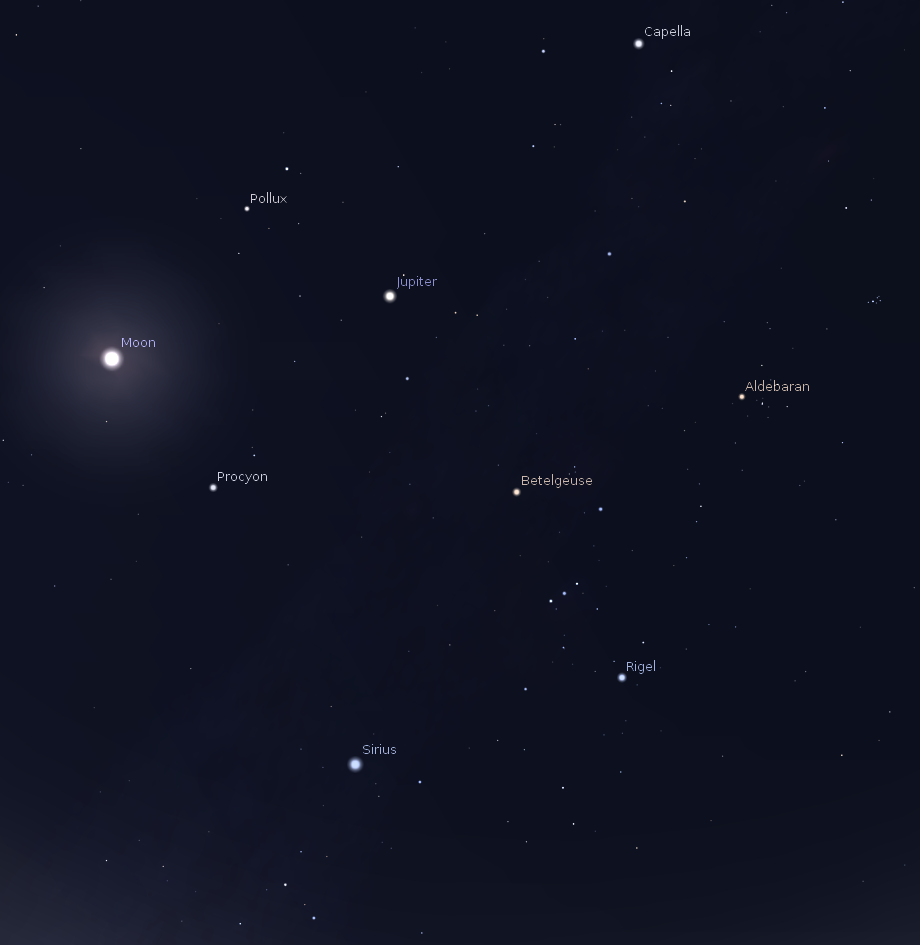
Jupiter, the Moon and the bright stars of winter at 9 p.m. February 12, 2014. Created using Stellarium.
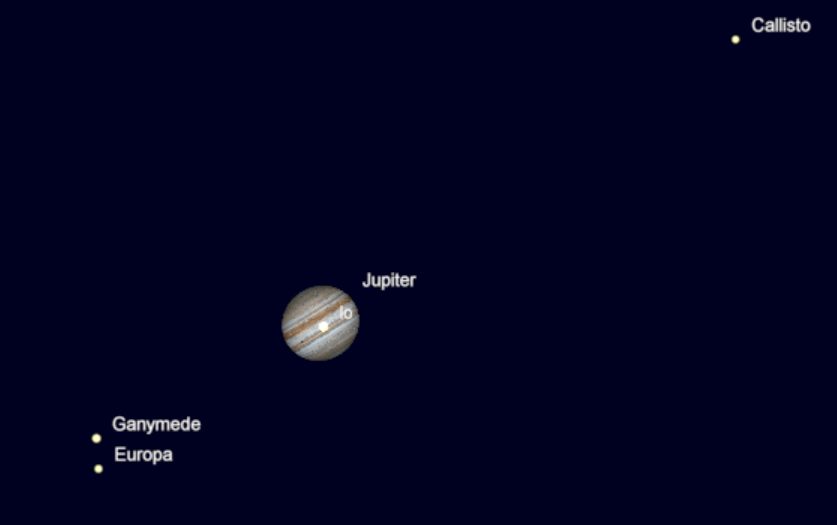
Jupiter at 9 p.m. on February 12, 2014. IO is pretty much invisible in front of the planet. Created using Cartes du Ciel.
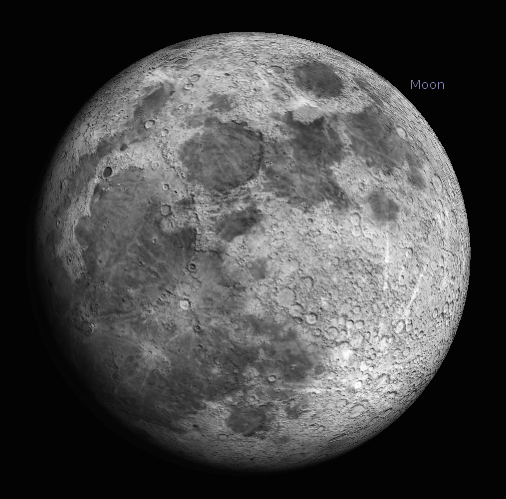
The Moon at 9 p.m. on February 12, 2014. Created using Stellarium.
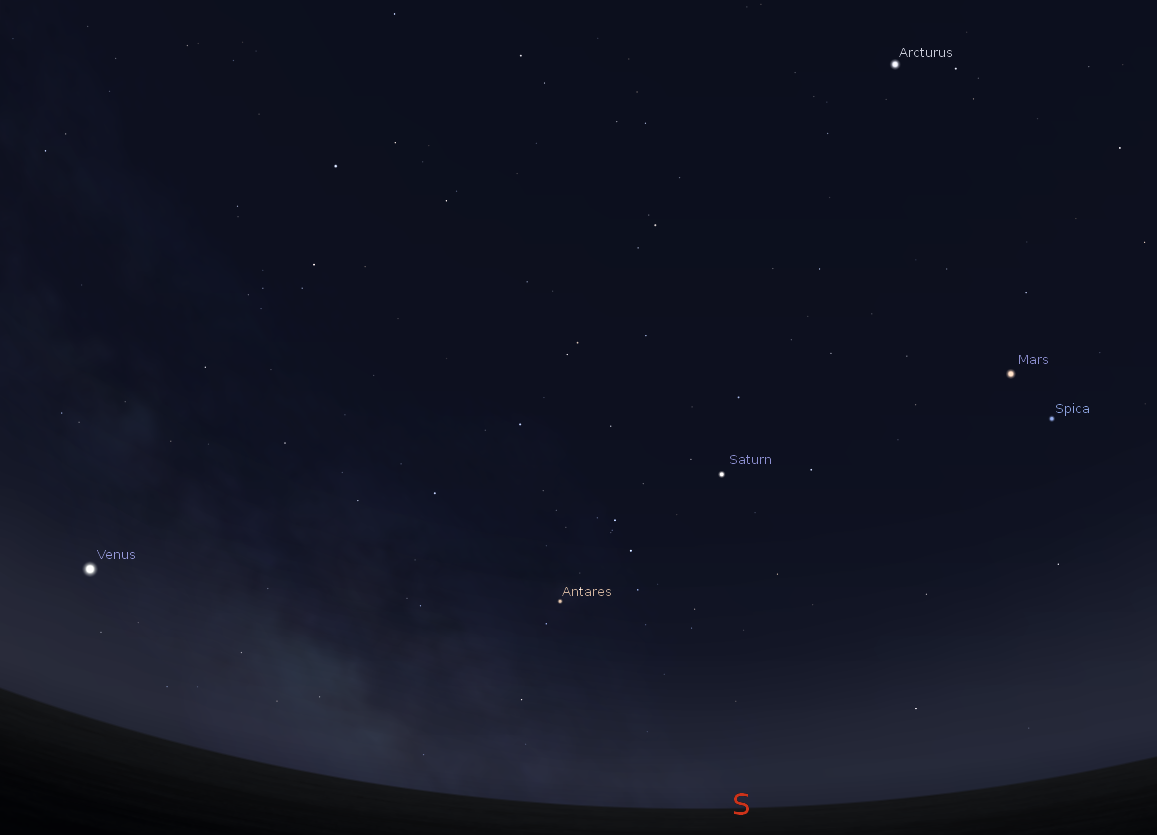
Mars, Saturn, and Venus at 6:30 a.m. February 13, 2014. Created using Stellarium.
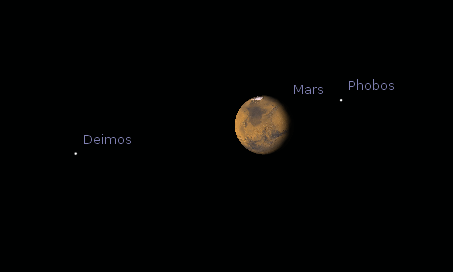
Tiny Mars in a telescope at 6:30 a.m. on February 13, 2014. Don’t expect to see it’s satellites Phobos and Deimos. Created using Stellarium.
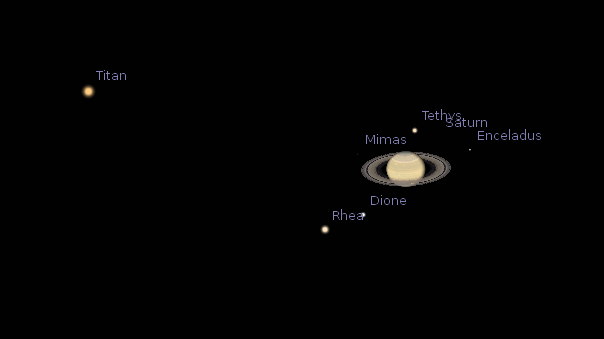
Saturn and its moons at 6:30, February 13, 2014. Of the moons, Titan will be the only one visible in small telescopes. Created using Stellarium.
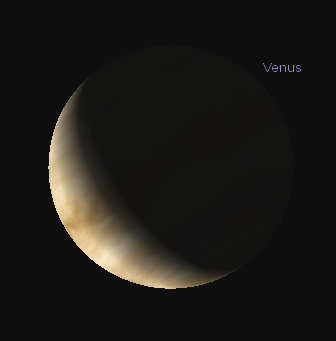
Venus through a telescope. The planet is getting smaller and its crescent is getting fatter as it moves away from the Earth. This image is for 6:30 a.m. February 13, 2014.Created using Stellarium.
02/11/2014 – Ephemeris – The brightest spot on the moon is visible tonight
Ephemeris for Tuesday, February 11th. The sun will rise at 7:48. It’ll be up for 10 hours and 17 minutes, setting at 6:05. The Moon, 3 days before full, will set at 6:06 tomorrow morning.
The moon tonight is very bright. It will be full on Friday. Using binoculars the brightest object on the moon is a spot at the left edge of the moon that rotates to the upper left as the moon rises. It is the young crater Aristarchus. The age is less than 1.1 billion years. How much younger is unknown. It’s in the same age range as Copernicus to the lower right of it with the big round splash marks. In a telescope Aristarchus is a crater 24 miles (40 kilometers) in diameter. Generally, the fresher the crater the brighter it is. The Lunar Reconnaissance Orbiter has been in orbit of the moon for nearly four years. In that time it has discovered small craters that were formed after it arrived in orbit. The initial impacts drill into the moon’s lighter subsurface.
Times are for the Traverse City/Interlochen area of Michigan. They may be different for your location.
Addendum
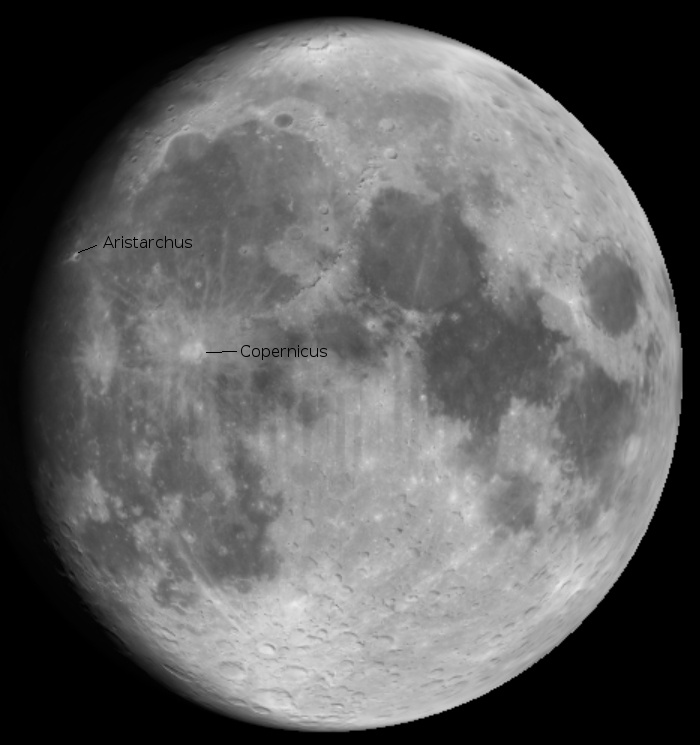
The Moon at 9 p.m. February 11, 2014 showing the craters Aristarchus and Copernicus. Created using Virtual Moon Atlas.
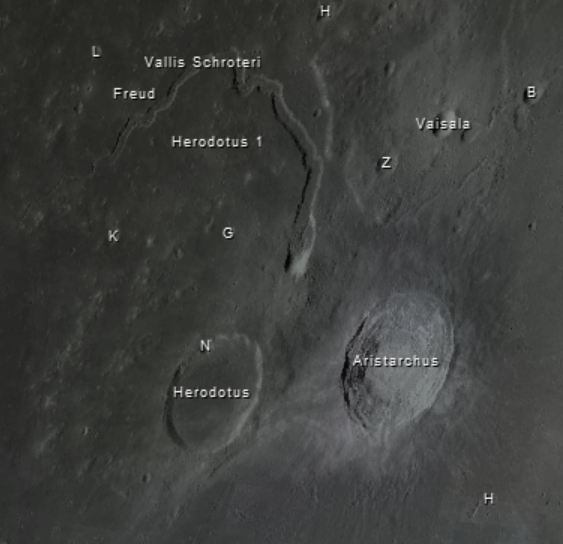
The crater Aristarchus and its environs via the Lunar Reconnaissance Orbiter as a texture in the Virtual Moon Atlas. Credit NASA.
Note the valley that borders Aristarchus, Vallis Schroteri, or Schroter’s Valley. It’s head is called the Cobra’s Head. It is up to a kilometer or 3,000 feet deep.
02/05/2014 – Ephemeris – Where are the bright planets this week?
Ephemeris for Wednesday, February 5th. The sun will rise at 7:56. It’ll be up for 10 hours and 1 minute, setting at 5:57. The moon, 1 day before first quarter, will set at 1:10 tomorrow morning.
Let’s take our weekly look at the planets. Tiny Mercury is 4 days after its greatest eastern elongation and is seen low in the west-southwest between sunset and 7:25, when it sets. After that Jupiter takes over the evening sky. It will be in the southeastern sky as darkness falls tonight. It’s cruising against the stars of Gemini now. It will pass due south at 10:28 p.m., and will set at 6:11 a.m. in the west-northwest. Mars will rise at 11:37 p.m. in the east-southeast. Reddish Mars is in Virgo now and above the bright star Spica, which it now outshines. Saturn will rise at 2:06 a.m. in the east-southeast. It’s seen against Libra the scales this year. Venus will rise at 5:38 tomorrow morning, and shines brightly in the southeast before sunrise.
Times are for the Traverse City/Interlochen area of Michigan. They may be different for your location.
Addendum

Mercury, its orbit and the ecliptic (you’ll only see Mercury) at 6:30 p.m. on February 5, 2014. Created using Stellarium.
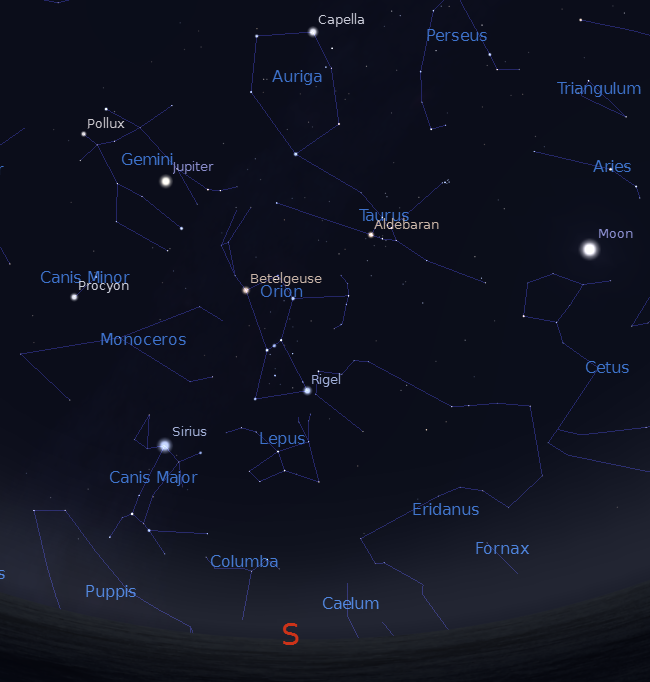
Jupiter, the Moon and the constellations of winter at 9 p.m. February 5, 2014. Created using Stellarium.
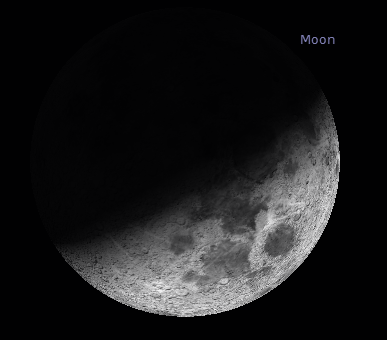
The Moon at 9 p.m. February 5, 2014. Created using Stellarium.
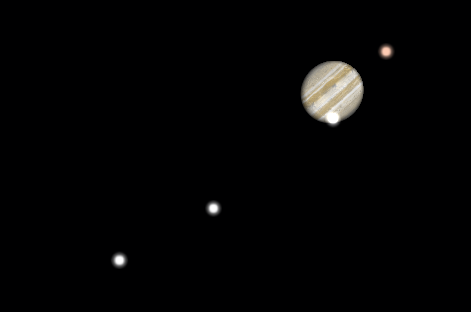
Jupiter and it’s satellites at 9 p.m. February 5, 2014. The satellites from left to right are Ganymede, Europa, Callisto and Io) Callisto may not be visible against the face of Jupiter. Created using Stellarium.
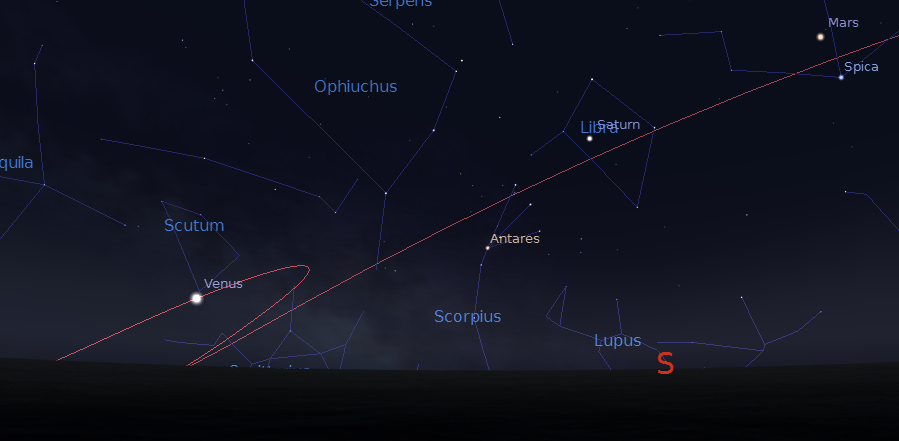
Mars, Saturn, and Venus at 6:30 a.m. February 6, 2014 along with imaginary lines of Venus’ orbit and the ecliptic. Created using Stellarium.
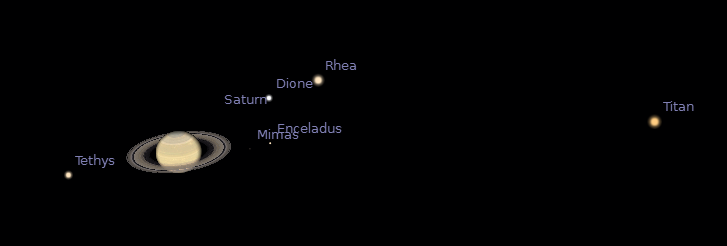
Saturn and its satellites at 6:30 a.m. February 6, 2014. You’ll need a big telescope to see any satellites other than Titan. Created using Stellarium.
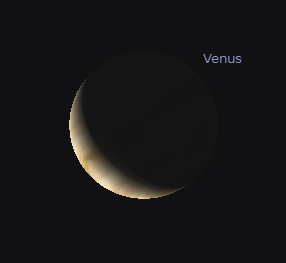
Venus through a telescope. The planet is getting smaller and its crescent is getting fatter as it moves away from the Earth. Created using Stellarium.
Sorry for the late post, but I was watching the Bill Nye – Ken Ham creationist debate last night. Bill took him apart like Inherit the Wind 2.
 Bob Moler's Ephemeris Blog